Naikda, A. R., Thakare, B. G., Yajgar, N. M., Chaudhari, B. B., Samudre, N. S., More, K. M., More, A. J., Nandre, S. J., Ahire, R. R., & Chavhan, S. D. (2026). Hydrothermally Grown CuO Thin Films for Optoelectronic Applications: Optical and Electrical Analysis. Hydrothermally Grown CuO Thin Films for Optoelectronic Applications: Optical and Electrical Analysis, 13(13), 1–10. https://doi.org/10.26643/ijr/2026/s13/1
Amol R. Naikda1,2, Bharat G. Thakare1 , Navnath M. Yajgar1 , Bhushan B. Chaudhari1,3, Niranjan S. Samudre1, Kishor M. More1 , Anup J. More1 , Sachin J. Nandre4 , R. R. Ahire1 , Sudam D. Chavhan1 *
1. Department of Physics, S. G. Patil Art’s, Science and Commerce College, Sakri, Maharashtra, India.
2. Department of Physics, S.S.V.P. S’s L.K.Dr. P.R.Ghogrey Science College Dhule, Maharashtra, India.
3. Department of Physics, Nandurbar Taluka VidhayakSamiti’s G. T. Patil Arts, Commerce and Science College, Nandurbar, Maharashtra, India.
4. Department of Physics, U. P. College, Dahivel, Maharashtra, India.
Cupric oxide (CuO) thin films were deposited using a simple and cost-effective hydrothermal technique and examined for their optoelectronic suitability. The optical properties were studied using UV–Visible spectroscopy, which revealed significant absorption in the visible and near-infrared regions. The optical band gap, evaluated using the Tauc approach, was estimated to be 3.58 eV. The observed widening of the band gap compared to bulk CuO is attributed to nanoscale effects, defect-related localized states, and growth conditions associated with the hydrothermal process. Electrical characterization showed a linear current–voltage response, indicating ohmic conduction and good electrical contact. These findings demonstrate that hydrothermally synthesized CuO thin films possess favorable optical transparency and stable electrical transport, making them promising candidates for optoelectronic device applications.
Copper oxide (CuO) is a widely investigated p-type metal oxide semiconductor owing to its narrow direct bandgap in the range of 1.3–2.1 eV, high optical absorption coefficient, good chemical and thermal stability, and environmentally friendly nature [1–3]. These properties make CuO an attractive material for various optoelectronic applications, including photodetectors, solar cells, gas sensors, memory devices, and photocatalytic systems [4,5]. Compared to conventional semiconductor materials, metal oxide semiconductors such as CuO offer advantages such as low cost, ease of fabrication, non-toxicity, and compatibility with existing semiconductor technologies [6].
The optoelectronic performance of CuO thin films is strongly influenced by their structural, morphological, optical, and electrical properties, which depend largely on the synthesis technique and processing parameters [7]. Several fabrication methods, including sol–gel processing [8], spray pyrolysis [9], magnetron sputtering [10], thermal oxidation [11], and co-precipitation [12], have been reported for the preparation of CuO thin films. However, many of these methods require high processing temperatures, sophisticated equipment, or offer limited control over film uniformity and microstructure.
Among the various synthesis routes, the hydrothermal method has emerged as a simple, low-cost, and scalable technique for the growth of high-quality CuO thin films with controlled morphology and crystallinity [13, 14]. Hydrothermal growth allows precise control over reaction parameters such as temperature, pressure, reaction time, and solution pH, which play a key role in determining nucleation, crystal growth, and defect formation [15]. Moreover, hydrothermal synthesis can be carried out at relatively low temperatures, making it suitable for large-area deposition and substrate-sensitive applications [16].
The optical properties of CuO thin films, particularly light absorption behavior and bandgap energy, are critical factors governing their optoelectronic performance [17]. Similarly, electrical properties such as conductivity, carrier transport, and photo response are significantly affected by intrinsic defects, crystallinity, particle size, and post-deposition treatments [18, 19]. A comprehensive understanding of the relationship between synthesis conditions, optical behavior, and electrical characteristics is therefore essential for optimizing CuO-based optoelectronic devices.
In the present work, CuO thin films were synthesized using a hydrothermal growth method and systematically characterized to investigate their optical and electrical properties. The influence of growth conditions on bandgap energy, light absorption, and electrical behavior was analyzed in detail to evaluate the potential of hydrothermally grown CuO thin films for optoelectronic applications [20, 21].
2. Materials and Methods.
Copper nitrate trihydrate (Cu (NO₃)₂·3H₂O, analytical grade, ≥99%) was used as the copper precursor, and sodium hydroxide (NaOH, ≥98%) was used as the pH-adjusting agent. Deionized (DI) water (18.2 MΩ·cm) was used as the solvent throughout the experiment. Microscope glass substrateswere used as substrates for thin-film deposition.
Prior to deposition, the glass substrates were cleaned to ensure uniform film growth and good adhesion. The substrates were ultrasonically cleaned successively in acetone, ethanol, and deionized water for 10 min each. After cleaning, the substrates were dried using hot air and stored in a dust-free environment.
CuO thin films were synthesized by a hydrothermal method. A 0.1 M aqueous solution of copper nitrate trihydrate was prepared by dissolving the required amount of Cu (NO₃)₂·3H₂O in 100 mL of deionized water under continuous magnetic stirring at room temperature. Separately, a 1.0 M NaOH solution was prepared and added dropwise to the copper precursor solution under constant stirring until the pH reached 10–11, resulting in the formation of a homogeneous blue precipitate.
The resulting reaction mixture was transferred into a Teflon-lined stainless-steel autoclave (100 mL capacity). The cleaned substrates were placed vertically inside the autoclave. The autoclave was sealed and maintained at 150 °C for 5 hour to facilitate the hydrothermal growth of CuO thin films.
After completion of the hydrothermal reaction, the autoclave was allowed to cool naturally to room temperature. The deposited films were removed, rinsed thoroughly with deionized water to remove residual ions, and dried at 60 °C for 1 hour. To convert the intermediate hydroxide phase into crystalline CuO and to enhance the optical and electrical properties, the films were annealed in a hot-air oven at 450 °C for 2 hour under ambient atmospheric conditions.
3. Results and Discussion
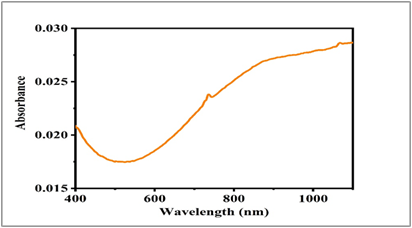
The optical absorption properties of the CuO thin films synthesized by the hydrothermal method were investigated using UV–Visible spectroscopy in the wavelength range of 400–1100 nm. The absorbance spectrum of the CuO thin film is shown in Fig. 2. The film exhibits moderate absorption in the visible region, followed by a gradual increase toward the near-infrared region. A minimum absorbance is observed around 500–550 nm, after which the absorbance increases continuously with wavelength.
The observed absorption behavior is attributed to electronic transitions between the valence and conduction bands of CuO. The gradual increase in absorbance at higher wavelengths may be associated with defect-related localized states, such as oxygen vacancies and grain boundary defects, which are commonly introduced during hydrothermal synthesis. These defects contribute to sub-band-gap absorption and influence the optical response of the film. The absorption characteristics confirm that the hydrothermally synthesized CuO thin film exhibits suitable optical properties for optoelectronic applications.
Fig. 2.UV–Visible absorbance spectrum of hydrothermally synthesized CuO
thin film recorded in the wavelength range of 400–1100 nm.
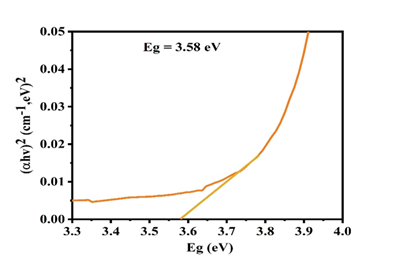
The optical band gap energy of the CuO thin film was estimated using the Tauc relation, assuming a direct allowed transition:(αhν)2=A(hν−Eg). The plot of (αhν) 2versus photon energy (hν) is shown in Fig. 3. A clear linear region is observed in the higher photon energy range (3.6–3.8 eV), indicating the onset of strong interband optical absorption
Fig. 3. The graph of (αhν) 2versus photon energy for hydrothermally
Synthesized CuO thin film showing a direct optical band gap of 3.58 eV.
By extrapolating the linear portion of the curve to the energy axis at (αhν) 2= 0, the optical band gap energy of the CuO thin film is determined to be 3.58 eV. The deviation from linearity at lower photon energies can be attributed to band tailing effects caused by localized defect states and structural disorder in the film. The relatively wide band gap suggests high optical transparency in the visible region and strong absorption in the ultraviolet region. Such characteristics are desirable for applications in UV photodetectors, transparent optoelectronic devices, and window layers in photovoltaic systems.
The electrical transport properties of the hydrothermally synthesized CuO thin film were examined through current–voltage (I–V) measurements at room temperature. The I–V characteristics of the film are presented in Fig. 4, with the applied voltage varied from 0 to 14 V.The I–V curve exhibits a nearly linear relationship between current and applied voltage, indicating ohmic conduction behavior. This linearity suggests good electrical contact between the electrodes and the CuO thin film, as well as uniform film thickness and improved grain connectivity. The absence of current saturation or rectifying behavior implies minimal barrier formation at the electrode–film interface.
Fig. 4. Current–voltage (I–V) characteristics of hydrothermally synthesized
CuO thin film measured at room temperature.
The observed electrical behavior confirms the semiconducting nature of the CuO thin film and demonstrates efficient charge carrier transport. The hydrothermal synthesis method contributes to improved crystallinity and reduced interfacial resistance, resulting in stable electrical performance suitable for device applications.
The optical and electrical studies reveal a strong correlation between the structural quality and functional performance of the CuO thin film. The wide optical band gap of 3.58 eV ensures high transparency in the visible region, while the linear I–V characteristics confirm efficient charge transport across the film. Although defect states introduced during hydrothermal synthesis influence the optical absorption behavior, they do not significantly deteriorate the electrical conductivity, indicating an optimal balance between optical and electrical properties.
The hydrothermal method plays a crucial role in controlling the growth and properties of CuO thin films. The controlled temperature and pressure conditions promote uniform nucleation, enhanced crystallinity, and strong adhesion to the substrate. These factors collectively contribute to the observed optical transparency, well-defined band gap, and ohmic electrical behavior. The results demonstrate that hydrothermal synthesis is an effective and reliable technique for producing high-quality CuO thin films for optoelectronic applications.
4. Conclusion
In the present study, CuO thin films were successfully synthesized using a simple and cost-effective hydrothermal method and systematically investigated for their optical and electrical properties. The hydrothermal growth process enabled the formation of uniform, well-adhered CuO thin films with favorable optoelectronic characteristics.
UV–Visible spectroscopic analysis revealed moderate absorption in the visible region with enhanced absorption toward the near-infrared region. The optical band gap, determined using the Tauc method, was found to be 3.58 eV, which is higher than that of bulk CuO. This widening of the band gap is attributed to nanoscale effects, defect-induced band tailing, and structural disorder introduced during hydrothermal synthesis and post-annealing treatment. The wide band gap indicates high transparency in the visible region, making the films suitable for ultraviolet-based optoelectronic applications.
Electrical characterization demonstrated a nearly linear current–voltage relationship, confirming ohmic conduction behavior and efficient charge transport across the film. The absence of rectifying behavior suggests good electrical contact and uniform film morphology, which are essential for reliable device performance.
Overall, the combined optical and electrical analyses confirm that the hydrothermal synthesis route is an effective and scalable technique for producing high-quality CuO thin films. The wide optical band gap, stable electrical response, and low-cost fabrication process highlight the potential of hydrothermally grown CuO thin films for applications in UV photodetectors, transparent electronics, optoelectronic devices, and photovoltaic window layers.
5.Acknowledgements
The authors are grateful to the Principal of S. G. Patil Arts, Science and Commerce College, Sakri, Dist-Dhule for providing laboratory facilities and experimental support to carry out this research work. The authors also acknowledge the support extended by S.S.V.P. S’s L.K. Dr. P. R. Ghogrey Science College, Dhule,for their cooperation and academic encouragement.
The authors sincerely thank the technical staff of the participating institutions for their assistance during thin-film synthesis and electrical and optical characterization. The authors declare that no external funding was received for this work.
References.
Ü. Özgür, Y. I. Alivov, C. Liu, et al., “A comprehensive review of ZnO materials and devices,” J. Appl. Phys., vol. 98, no. 4, p. 041301, 2005.
S. J. Pearton, D. P. Norton, K. Ip, Y. W. Heo, and T. Steiner, “Recent advances in processing of ZnO,” Prog. Mater. Sci., vol. 50, pp. 293–340, 2005.
J. B. Goodenough, “Electronic and ionic transport properties and other physical aspects of perovskites,” Rep. Prog. Phys., vol. 67, pp. 1915–1960, 2004.
A. Rogalski, “Infrared detectors: status and trends,” Prog. Quantum Electron., vol. 27, pp. 59–210, 2003.
M. H. Fulekar, Nanotechnology: Importance and Applications, I. K. International Publishing House, New Delhi, 2010.
S. B. Ogale, Thin Films and Heterostructures for Oxide Electronics, Springer, Berlin, 2005.
R. Chandrasekaran, S. Jayakumar, and M. G. Krishna, “Structural, optical and electrical properties of CuO thin films,” J. Mater. Sci.: Mater. Electron., vol. 25, pp. 152–158, 2014.
C. J. Brinker and G. W. Scherer, Sol–Gel Science: The Physics and Chemistry of Sol–Gel Processing, Academic Press, New York, 1990.
S. Major, S. Kumar, M. Bhatnagar, and K. L. Chopra, “Effect of hydrogen plasma treatment on transparent conducting oxides,” Thin Solid Films, vol. 122, pp. 31–36, 1985.
P. K. Ghosh, S. K. De, and S. Chaudhuri, “CuO thin films deposited by magnetron sputtering,” Surf. Coat. Technol., vol. 206, pp. 123–129, 2011.
J. Morales, L. Sánchez, F. Martín, J. R. Ramos-Barrado, and M. Sánchez, “Thermal oxidation synthesis of CuO nanostructures,” Electrochim. Acta, vol. 50, pp. 2039–2044, 2005.
A. Phuruangrat, T. Thongtem, and S. Thongtem, “Synthesis of CuO nanostructures by precipitation method,” Mater. Lett., vol. 63, pp. 1537–1539, 2009.
K. Byrappa and M. Yoshimura, Handbook of Hydrothermal Technology, William Andrew Publishing, New York, 2001.
K. Byrappa and T. Adschiri, “Hydrothermal technology for nanotechnology,” Prog. Cryst. Growth Charact. Mater., vol. 53, pp. 117–166, 2007.
M. Yoshimura and K. Byrappa, “Hydrothermal processing of materials: past, present and future,” J. Mater. Sci., vol. 43, pp. 2085–2103, 2008.
R. E. Riman, W. L. Suchanek, and K. Byrappa, “Solution synthesis of ceramics,” Annu. Rev. Mater. Sci., vol. 32, pp. 377–407, 2002.
S. Jana, A. K. Srivastava, and S. P. Singh, “Size dependent optical properties of CuO nanoparticles,” J. Alloys Compd., vol. 509, pp. 9809–9815, 2011.
H. Raebiger, S. Lany, and A. Zunger, “Origins of p-type conductivity in Cu₂O,” Phys. Rev. B, vol. 76, p. 045209, 2007.
A. Al-Amri, A. S. Al-Tuwirqi, A. A. Al-Ghamdi, and F. Yakuphanoglu, “Optical properties of Ni-doped CuO nanoparticles,” Physica B, vol. 407, pp. 2497–2501, 2012.
A. M. Abd-Elnaiem, M. M. Rashad, and H. H. Afify, “CuO nanowires for photocatalytic applications,” Appl. Surf. Sci., vol. 258, pp. 8171–8176, 2012.
D. Giziński, A. Lisowska-Oleksiak, and M. Gazda, “CuO as electrode material for electrochemical applications,” Electrochim. Acta, vol. 104, pp. 94–101, 2013.
Salim, S. binti . (2026). Pluralism And Public Order in Malaysia: A Jurisprudential Study of the Rukun Negara, the Federal Constitution, and the Ṣaḥīfat al-Madīnah. International Journal of Research, 13(2), 101–117. https://doi.org/10.26643/ijr/2026/35
Suriyati binti Salim
Department of Civil Law, Ahmad Ibrahim Kulliyyah of Laws, International Islamic University Malaysia
This study conducts a critical analysis of the constitutional discourse concerning non-theistic citizens in Malaysia, a state defined by Article 3 of the Federal Constitution of Malaysia and the Rukun Negara, whose first pillar affirms belief in God. Prevailing legal scholarship often treats constitutional supremacy and Islamic identity as a dichotomy, lacking a coherent integrative analysis. This study addresses that analytical gap. It aims to elucidate how national unity (perpaduan) is conceptualised by undertaking a comparative legal-jurisprudential examination of three primary sources: the Federal Constitution (supreme law), the Rukun Negara (national philosophy), and the Ṣaḥīfat al-Madīnah (the Charter of Medina, 622 CE). Employing a tripartite methodology of constitutional-textual, historical-jurisprudential, and comparative discourse analysis, the study maps the normative logic of these primary sources. The analysis reveals that both the Ṣaḥīfat al-Madīnah and the Rukun Negara articulate a political community (Ummah Siyāsah) founded on allegiance to a supreme constitutional covenant, not theological uniformity. The study concludes that the discourse of perpaduan can be coherently interpreted through the Rukun Negara as a modern political covenant: Pillars III (Supremacy of the Constitution) and IV (Rule of Law) establish the terms for pluralistic citizenship, while Pillar I (Belief in God) sustains the substantive identity derived from Article 3 without mandating universal creedal conformity. The study’s novel contribution lies in its demonstration of a covenantal constitutional logic: it shows how the Rukun Negara, interpreted through this tripartite lens, provides a viable framework where a substantive state identity (derived from Article 3) and a pluralistic political community to coexist under a supreme legal order, thereby offering a new perspective on managing religious diversity while maintaining public order.
Keywords:Federal Constitution, Rukun Negara, Ṣaḥīfat al-Madīnah, Pluralism, National Unity (Perpaduan), Malaysia.
1. INTRODUCTION: THE THEISTIC ‘SOUL’, PLURALISM, AND THE PRESERVATION OF PUBLIC ORDER
The Federal Constitution (the Constitution) operates within a unique constitutional framework, where Article 3(1) declares that “Islam is the religion of the Federation, but other religions may be practised in peace and harmony in any part of the Federation” (Mahmod et al., 2022). Constitutional analysis supports the view that this provision carries substantive weight, with scholars arguing it establishes Islam as a foundational element of the nation’s legal identity. This position is reinforced by related constitutional provisions, such as Article 11(4), which empowers State Legislatures to regulate proselytisation among Muslims or any expansion of the doctrine or religion other than Islam among Muslims (Ishak & Aziz, 2022). Furthermore, this constitutional framework enables the operationalisation of Islamic law through specific legal architecture: state legislatures and the federal parliament are empowered to enact Islamic laws governing personal, family, and religious matters for Muslims, and to establish a separate Syariah court system with jurisdiction exclusively over persons professing Islam (Mohamed & Ahmad, 2021).
This foundational philosophy is enshrined in the Rukun Negara, promulgated in 1970 as the national philosophy following a period of profound social fracture. Its first principle, Belief in God, reflects the moral foundation of the state, while its remaining principles emphasise constitutional supremacy, the Rule of Law, and loyalty as the basis of collective life. A public document articulates this vision: to build a progressive society advancing with science and technology while upholding ‘theistic values’ (nilai-nilai ketuhanan) (Malaysia, 2023). While Article 3(4) ensures this article does not derogate from other provisions, the Rukun Negara simultaneously champions a liberal society where members are free to practise their customs in line with the interests of national unity (kepentingan perpaduan negara) (Malaysia, 2023).
Nevertheless, this constitutional configuration raises persistent jurisprudential challenges, particularly in relation to citizens who fall outside traditional religious categories, including non-theistic individuals. Hence, central to this analysis is the concept of pluralism, understood as the recognition of religious diversity and the condition of harmonious coexistence (Yaacob, 2011). Scholars argue the Rukun Negara was designed to form a ‘Bangsa Malaysia’ that respects this diversity under unified national loyalty (Meerangani et al., 2021). However, a precise legal distinction must be made regarding supremacy. As argued by Mohamed Azam, Mohamed Adil and Nisar Mohammad Ahmad (2014), despite Islam’s special position, the Constitution under Article 4 is the supreme law. Islamic law is subordinate, with jurisdiction limited to the State List. Consequently, while acknowledging this legal hierarchy, the study examines the normative orientation of the state as expressed through its foundational texts. Furthermore, increasing administrative and legal tensions surrounding non-traditional religious identities, as illustrated by cases such as Nora Koh Abdullah, who sought legal recognition as a non-Muslim (Report on The State of Religious Liberty In Malaysia for the Year 2007, 2008).
Therefore, this study examines the Ṣaḥīfat al-Madīnah, alongside the Rukun Negara and the Constitution, to illustrate how these governance frameworks manage pluralism and public order through structured political authority and collective security, while preserving perpaduan (unity) among all citizens, including non-theists.
2. SCOPE OF THE STUDY
In view of its scholarly objectives, this theoretical legal and jurisprudential study examines three primary sources, namely the Constitution, the Rukun Negara, and the Ṣaḥīfat al-Madīnah, to develop a coherent framework for national unity within a constitutional order that acknowledges the special position of Islam. Moreover, the scope of this inquiry is explicitly defined as doctrinal, analytical, and citizenship-centred.
As a doctrinal study, the research focuses on the rigorous examination of constitutional and historical-documentary texts rather than engaging in theological debate. Additionally, as an analytical inquiry, it is concerned with interpreting the existing constitutional logic and the normative architecture it produces instead of prescribing legislative reform. Finally, as a citizenship-centred analysis, it utilises constitutional citizenship as the primary lens through which to examine the challenges of pluralism and public order.
3. METHODOLOGY
3.1. Methodological Justification and Focus
The focus of this study on non-theistic citizens is a deliberate methodological choice because this demographic represents the liminal case that most rigorously tests the boundaries of the constitutional covenant. Furthermore, demonstrating the principled inclusion of citizens who explicitly reject theistic premises serves a dual purpose by validating the capacity of the framework for universal pluralism and shifting the discourse from creedal identity to civic belonging under a supreme constitutional pact.
Moreover, the acknowledged absence of quantitative data on this group is not a methodological limitation but is instead a critical datum that underscores the core theoretical problem, which is the lack of a formal constitutional paradigm for such a category. Consequently, this justifies the employment of a qualitative, text-based, and comparative methodology.
3.2. Methodological Design: A Tripartite Comparative Analysis
The study employs a comparative legal and conceptual methodology, which is executed in three integrated and sequential phases:
Constitutional-Textual Analysis
This phase involves a doctrinal examination of the Constitution, with specific focus on Article 3, Article 4, and the fundamental liberties enshrined in Articles 5 to 13, alongside the Rukun Negara. Therefore, this phase establishes the formal legal structure and the normative architecture of the Malaysian constitutional order.
Historical-Jurisprudential Analysis
This phase provides a critical interpretation of the Ṣaḥīfat al-Madīnah as a historical-constitutional document. Furthermore, it extracts core principles for governing a plural political community, including the concept of the political covenant or Mīthāq and the analytical distinction between the creedal community, or Ummah ʿAqīdiyyah (creedal community), and the political community, or Ummah Siyāsah.
Comparative Synthesis and Interpretive Framework Development
The final phase consists of a systematic comparison of the principles derived from the first two stages of the research. Consequently, this phase develops an interpretive framework that maps the conceptual relationships between the texts and elucidates how pluralism is discursively managed within a system that maintains a substantive theistic and Islamic orientation.
Ultimately, this tripartite methodology theorises the structural conditions for inclusion by analysing the foundational logic of the system and thereby directly addresses the constitutional position of non-theists.
4. Literature Review
4.1. Balancing Public Order and Individual Liberties
The tension between maintaining the state’s religious sanctity and respecting individual liberties is a recurring theme. Ismail Mustapha Adua, Abdul Ghafur Hamid, and Mohammed Iqbal Abdul Wahab (2015) examine this through the Islamic legal principles of darūrah (Necessity) and al-maṣāliḥ al-mursalah (public interest), finding that protecting the maqāṣid al-sharīʿah (objectives of Islamic law), such as religion and life, can legitimise otherwise restricted actions in extreme circumstances. Applying this logic analogously to constitutional governance, this paper submits that the state has a legitimate maṣlaḥah in protecting the Islamic identity embedded in Article 3 to preserve public order. However, this paper contends that this interest is not unbounded. It must be operationalised and balanced through the supreme constitutional framework itself. The ultimate safeguard for the dignity of the non-hostile individual, and the mechanism for this balance, is the universal application of the ‘Rule of Law’, a principle that forms the foundational covenant of both the Rukun Negara and the Ṣaḥīfat al-Madīnah.
4.2. The Administration of Justice: Limits of Jurisdiction
The historical mechanism for managing the balance between religious governance and constitutional supremacy is embedded within the administrative structure of the legal system. Ramizah Wan Muhammad (2009) details the evolution of the Syariah Courts, charting their development as institutions serving the Muslim community while operating under the supreme authority of the Constitution. This relationship introduces inherent complexity, a point underscored by the significant constraints on their institutional reform.
For instance, regarding structural proposals to elevate their national standing, Farid Sufian Shuaib et al. (2017) advocate the professionalisation of the Syariah judiciary but emphasise its constitutional limitations. They note that amending the Constitution to establish a national apex Syariah court “would be contrary to the concept of federalism… and, realistically, it would be very difficult to obtain the required consent of the Conference of Rulers.” This underscores that the Syariah courts function as a distinct subsystem, with jurisdiction deliberately confined and constitutionally circumscribed.
Building on this, the same scholars advocate for the structural reinforcement and professionalisation of these courts within their defined sphere, consistently affirming their separation from the civil hierarchy (Shuaib et al., 2017). The tangible progress in this professionalisation is documented by Najibah Mohd Zin (2012), who catalogues significant advancements in the Syariah judiciary’s infrastructure and judicial training. Ultimately, this doctrinal and administrative separation is analytically cemented by Adil and Ahmad (2014), who clarify the critical constitutional reality: although Islam is the religion of the Federation, the primary enforcement of fundamental liberties and human rights protections resides within the jurisdiction of the civil courts.
The strictly personal nature of Syariah Court jurisdiction is further illustrated in its procedural rules. As examined by Abdul Rani Kamarudin, Arinen Ahadin, and Nuarrual Hilal Md. Dahlan (2009), a foundational question within this subsystem is the compellability of witnesses, specifically whether its rules can extend to non-Muslims. The very existence of this jurisprudential question underscores that these courts are constituted for the Muslim community, their authority derived from and constrained by Islamic personal law.
Together, this body of literature establishes the definitive operational context of Malaysia’s dual legal system. It is a framework where Islamic law functions within a constitutionally defined and limited sphere, thereby creating a distinct domain in which societal pluralism is ultimately governed by a supreme civil legal order.
4.3. The Sunnah of Unity and Religious Freedom
Historical models provide instructive guidance for managing pluralism and public order. For instance, Helimy bin Aris, Amran Abdul Halim, and Nazri Muslim (2021) demonstrate that the Ṣaḥīfat al-Madīnah successfully created a harmonious civil society by embedding principles of unity, justice, and social protection. Within the contemporary Malaysian context, the administration of religious exit remains challenging. Nor Ashikin Md Nasir and Siti Zubaidah Ismail (2016) note that apostasy is treated as a doctrinal offence under Islamic law, with legal provisions varying across states. Complementing this, Siti Zubaidah Ismail and Mohd Zahiri Awang Mat (2016) advocate for clearer, more uniform legal procedures and a rehabilitative approach.
Therefore, based on these findings, this paper posits that the administrative challenge of religious exit highlights the tension between Ummah ʿAqīdiyyah and Ummah Siyāsah. The literature suggests that a covenant-based model, which prioritises public order and civic loyalty as found in the Rukun Negara, could inform more coherent and just administrative processes that uphold both constitutional supremacy and social harmony.
Moreover, this pursuit of equilibrium is reinforced by the Islamic legal principle of wasatiyyah (moderation and balance), which serves as a key jurisprudential methodology for harmonising divergent legal principles and interests within an Islamic framework (Ibrahim et al., 2021).
4.4. The Sanctity of Blood (Ḥurmat al-Dam) and Lessons from Conflict
In contrast to the tragedies of contemporary conflicts, the Prophetic model was designed to prevent the spilling of blood, establishing the paramount doctrine of the ‘sanctity of blood’. The catastrophic consequences of a failed social covenant are illustrated by the crisis in Gaza. Jannis Julien Grimm and Lilian Mauthofer (2025) analyse how semantic disputes can hinder meaningful scholarly analysis during violence, highlighting the responsibility for ethical representation. Their analysis echoes concerns about the collapse of legal frameworks leading to systemic injustice, a critical consensus reached at the International Symposium on Gaza in Crisis: Rethinking International Law and the Path to Justice (2026).
Drawing from these external analyses, this paper submits that the Gaza crisis illustrates the consequences of a failed social order, highlighting the necessity of a respected and authoritative framework. For Malaysia, this underscores the pivotal role of the Rukun Negara, which must function not merely as policy but as the supreme national framework that unites the polity. It provides a non-negotiable foundation for coexistence, safeguarding against internal conflict and ensuring the preservation of public order.
4.5. Sovereignty, Perpaduan (Unity), and the Political Covenant of the Ṣaḥīfat al-Madīnah
The Ṣaḥīfat al-Madīnah (622 CE) stands as a foundational constitutional document that established political sovereignty and unity (perpaduan) within a deeply fractured Medinan society. It successfully transformed warring Arab and Jewish tribes into a single, confederated political community (ummah), not through forced religious conversion, but by instituting a binding civic covenant, a ‘pact of non-aggression and mutual defence’ (Anjum, 2021).
This covenant explicitly recognised and incorporated religious diversity under a shared political structure. A central provision states: “The Jews of Banū ‘Awf are one community alongside the believers… To the Jews their religion, and to the Muslims their religion” (Anjum, 2021). The Charter’s very definition of the political community is articulated in Article 1, which identifies the parties, including the Prophet Muhammad Peace Be Upon Him (PBUH), the emigrants (muhājirūn), the eight Arab tribes of Madīnah, and later, nine Jewish groups, as forming “one ummah to the exclusion of (all other) people”. This definition was inherently expansionist, as the phrase “and those who followed them, then joined them and strived with them” allowed for the accession of other groups to the constitutional covenant (Kamal, 2025).
The Charter thus established a suite of constitutional principles, including ummah, territorial integrity, consultation (shūrā), justice (‘adl), equality, and freedom of religion, which were derived from Qur’ānic verses revealed prior to its drafting (Kamal, 2025). This jurisprudential derivation highlights the application of the Islamic principle of wasatiyyah, serving as a methodology to translate divine injunctions into a balanced framework for pluralistic governance (Ibrahim et al., 2021).
The Charter’s genius lies in its simultaneous embodiment and operational distinction between the conceptual categories of the Ummah ʿAqīdiyyah (the transnational creedal community of Muslims) and the Ummah Siyāsah (a territorially defined political community based on allegiance to a governing covenant) (Hasan, 2023).
Nonetheless, Anjum (2021) argues that the Ṣaḥīfat al-Madīnah is not a constitution in the modern sense but a foundational, context-bound covenant. He notes that classical scholars, including al-Shāfiʿī, viewed it as a transitional agreement whose principles were later integrated into Islamic law, not as a standalone constitutional model. Framing it as a modern constitution, he contends, misrepresents its historical role and overlooks the broader Islamic legal tradition it informed.
The core precedent of the Ṣaḥīfat al-Madīnah is a political community based on allegiance to a supreme covenant, unifying diverse groups through civic guarantees in exchange for political loyalty. This provides the analytical model for Malaysia’s challenge of balancing its substantive Islamic identity (Article 3) with pluralistic protections, a constitutional equilibrium also seen in managing tensions between equality and affirmative action in employment (2023). The Medinan model thus affirms that such a balance is a foundational Islamic political tradition.
4.6. Comparative Analysis: Mapping the Constitutional Framework to the Rukun Negara Pillars
The analysis reveals that the Prophetic Mīthāq established a political community founded on collective loyalty and civic security, rather than religious conformity. Analogously, the Rukun Negara functions as a modern normative covenant for national governance. To elucidate how this covenant manages pluralism, a comparative framework is constructed by mapping the principles of the Ṣaḥīfat al-Madīnah onto the pillars of the Rukun Negara and their grounding in the Constitution. The resulting matrix (Table 1) illustrates a structured approach for constitutional pluralism, drawing from the foundational texts of the Constitution (Articles 3 and 4), the Rukun Negara, and the Ṣaḥīfat al-Madīnah (Articles 1, 13, 42, and 47).
Table 1: A Comparative Framework for Managing Pluralism: Mapping the Rukun Negara to the Constitution and the Ṣaḥīfat al-Madīnah
Sources: Federal Constitution of Malaysia (1957); Ṣaḥīfat al-Madīnah (c. 622 CE) (Anjum, 2021); Rukun Negara (1970) (Malaysia, 2023)
Rukun Negara Pillar
Federal Constitution Context
Corresponding Ṣaḥīfa Principle
I. Belief in God (Kepercayaan Kepada Tuhan)
Establishes the state’s theistic moral compass under Articles 3(1) and 11(4).
Article 42: Ultimate referral to God and His Messenger (Sovereignty).
II. Loyalty to King and Country (Kesetiaan Kepada Raja dan Negara)
The Yang di-Pertuan Agong is the Head of Islam (Article 3(2)) and the symbol of national unity.
Article 1: Establishment of “one ummah to the exclusion of (all other) people.”
III. Supremacy of the Constitution (Keluhuran Perlembagaan)
Article 4(1) declares the Constitution to be the supreme law of the Federation.
Article 47: Prohibition of treachery against the Charter.
IV. Rule of Law (Kedaulatan Undang-Undang)
Law governs all conduct under Federal and State jurisdictions.
Article 13: Justice applies universally, even against one’s own kin.
4.7. Analytical Application
Accordingly, Pillar I establishes a theistic public ethic but is not a tool for persecution. Mirroring how the Ṣaḥīfat al-Madīnah granted covenantal protection without requiring conversion (Anjum, 2021), the Malaysian Constitution allows non-theists to be citizens of the Ummah Siyāsah if they adhere to the constitutional order and do not act with hostility towards the religion of the Federation. This balance between a substantive state identity and individual rights is operationalised through Pillars III (Supremacy) and IV (Rule of Law).
This constitutional equilibrium is not merely theoretical. It mirrors the pragmatic balance actively sought in other domains, such as employment policy, where the tension between equality (Article 8) and affirmative action (Article 153) is managed to sustain public order and cohesion (Amin & Afandi, 2023).
5. Discussion: Synthesising the Medinan Framework for Malaysia
The Rukun Negara, interpreted through this comparative lens, provides a coherent framework for navigating Malaysia’s constitutional configuration. A significant precedent was set in (The Ritz Hotel Casino Ltd & Anor v. Datuk Seri Osu Haji Sukam [2005] 6 MLJ 760, where the court recognised gambling as contrary to religious teachings and contrary to public policy, holding that the Rukun Negara’s first pillar, ‘Belief in God’, reinforces the state’s theistic public ethic. The ruling emphasised that while gambling might be licensed for regulatory purposes, it cannot be considered “good” and that policies conflicting with the Rukun Negara are against public policy.
This judicial interpretation aligns with analyses of Malaysia’s holistic governance approaches, which are characterised by a measured balancing of competing interests. For instance, the nation’s counter-terrorism strategy integrates ‘hard’ security measures with ‘soft’ de-radicalisation approaches, requiring proportionate responses that focus on dismantling networks and countering ideologies without unduly impeding lawful rights (Mokhtar, 2022). It also resonates with Islamic principles on religious diversity, which advocate tolerance and coexistence within a framework that does not equate all religions theologically (Mahmod et al., 2022). Furthermore, this balance is underpinned by the jurisprudential principle of wasatiyyah, which provides an Islamic mandate for seeking justice and equilibrium in governance, thereby legitimising the constitutional balancing act between Article 3’s substantive identity and the pluralistic protections of the supreme charter (Ibrahim et al., 2021).
This synthesis reveals the precise constitutional tension at the heart of Malaysia’s framework. While the Rukun Negara’s pillars operationalise a Medinan-style covenant, prioritising political allegiance (Pillars II and III) and the Rule of Law (Pillar IV), their application remains contingent on a substantive state ethic derived from Islam (Pillar I). Judicial rulings like Ritz Hotel Casino demonstrate how this theistic public policy can override other interests, and the state’s holistic strategies in areas like counter-terrorism show a constant balancing act. This balancing methodology reflects a broader Islamic ethic of systemic equilibrium, akin to the principles of information security, which are confidentiality, integrity, and availability, which are derived from and practised within the Islamic tradition to protect communal welfare and ensure justice (Zulhuda, 2010). Thus, while the wasatiyyah-inspired framework theoretically accommodates pluralism, its stability hinges on a critical, potentially precarious condition: the state’s definition of ‘non-aggression’ and ‘respect for the constitutional order’ must not functionally equate to requiring citizens to endorse the religious premises of Pillar I. This creates the ongoing jurisprudential challenge of ensuring that the ‘supreme constitutional pact’ protects all citizens equally, even those who exist outside its declared theological foundation.
6. Conclusion
Accordingly, this study has undertaken a comparative legal and jurisprudential analysis of the Rukun Negara, Article 3 of the Constitution, and the Ṣaḥīfat al-Madīnah to address the constitutional question of accommodating non-theistic citizens within Malaysia’s distinctive constitutional order. Moreover, the analysis demonstrates that a sustainable model of perpaduan is not externally imposed but is embedded within the internal logic of the constitutional framework itself when read holistically and systematically. In particular, the findings show that the Rukun Negara operates as an organising normative framework that mediates between Malaysia’s substantive Islamic identity and its plural civic structure. While Pillar III, namely the Supremacy of the Constitution, establishes the ultimate legal authority, and Pillars II and IV, namely Loyalty to King and Country and the Rule of Law, delineate the conditions of political membership and equal justice, Pillar I, namely Belief in God, supplies the foundational theistic ethic that gives normative meaning to Article 3 without compelling uniformity of belief.
Furthermore, this integrated framework, informed by the Islamic jurisprudential principle of wasatiyyah, regulates pluralism through constitutional allegiance and lawful civic conduct rather than through theological conformity. Consequently, non-Muslims and non-theistic citizens are situated within the political community as rights-bearing members whose legal protection flows from the Rule of Law, provided that they observe constitutional loyalty and refrain from conduct that threatens public order. Nevertheless, the study also identifies a continuing jurisprudential tension, namely the risk that the notion of non-aggression may be interpreted too expansively and thereby operate, in effect, as an indirect requirement to endorse the state’s theistic premises. Therefore, careful judicial and administrative calibration remains essential to ensure that constitutional unity does not erode the pluralism it seeks to sustain.
Ultimately, the significance of this study lies in its analytical contribution to Malaysian constitutional discourse. Specifically, it moves beyond the conventional dichotomy between constitutional supremacy and Islamic identity by demonstrating their functional integration within a single, coherent legal structure. In doing so, it clarifies that the Constitution’s theistic orientation and its pluralistic guarantees are not inherently contradictory but are mutually reinforcing when applied through the Supremacy of the Constitution and the Rule of Law. Thus, this study offers a robust and textually grounded framework for understanding and strengthening perpaduan within Malaysia’s complex socio-legal landscape.
7. Acknowledgements
This study did not receive any specific grant or financial support from funding agencies in the public, commercial, or non-profit sectors. The author expresses appreciation for the library and academic database resources provided by her institution, which were vital for completing this research. Additionally, the author sincerely acknowledges the foundational contributions of the scholars referenced herein, whose work serves as the basis for this article.
8. Author’s Contributions
The author was solely responsible for the conception of the study, the formulation of its theoretical framework, the doctrinal and comparative analysis, interpretation, and manuscript preparation.
9. Disclosure
The author declares no conflict of interest.
10. REFERENCES
Adil, M. A. M., & Ahmad, N. M. (2014). Islamic Law and Human Rights in Malaysia. Islam and Civilisational Renewal (ICR), 5(1), 43–67. https://doi.org/10.1007/978-981-33-6187-4_3
Adua, I. M., Sein, A. G. H. @ K. M., & Wahab, M. I. A. (2015). Airline Passengers’ Screening: An Appraisal From the Islamic Law Perspective. IIUM Law Journal, 23, 133–148. https://doi.org/https://doi.org/10.31436/iiumlj.v23i1.157
Aris, H. bin, Halim, A. A., & Muslim, N. (2021). Keharmonian Kaum Berasaskan Sunnah: Kajian Terhadap Piagam Madinah. Malaysian Journal of Social Sciences and Humanities (MJSSH), 6(7), 139–148. https://doi.org/https://doi.org/10.47405/mjssh.v6i7.836
Grimm, J. J., & Mauthofer, L. (2025). Multi-Perspectivity & Ethical Representation in the Context of Gaza & October 7: Addressing the Semantic Void. Daedalus, 154(2), 169–188. https://doi.org/https://doi.org/10.1162/daed_a_02146
Ibrahim, B. H., Mohd, A., Husin, N., Zawawi, M., Kamal, M. H. M., Jusoh, H., Arifin, M., Napiah, M. D. M., Omar, M. N., & Aziz, S. A. (2021). The Concept of Wasatiyyah under Islamic law Perspective: A Manifestation of Just and Balanced Rule. Harmonisation of Shari‘ah and Law: Issues and Challenges, September. http://irep.iium.edu.my/92164/4/The Concept of Wasatiyyah Under ISlamic Law edited.pdf
International Symposium on Gaza in Crisis: Rethinking International Law and the Path to Justice. (2026). Ahmad Ibrahim Kulliyyah of Laws (AIKOL).
Ismail, S. Z., & Mat, M. Z. A. (2016). Faith and Freedom: The Qur’anic Notion of Freedom of Religion vs. the Act of Changing Religion and Thoughts on the Implications for Malaysia. Religions, 7(7), 88. https://doi.org/https://doi.org/10.3390/rel7070088
Kamarudin, A. R., Ahadin, A., & Md. Dahlan, N. H. (2009). Compellability of Muslim Witnesses in the Syariah Courts in Malaysia: Is Non-Muslim Also Included? Proceedings of the Seminar on Research Findings 2008., 45–51.
Mahmod, N. A. K. N., Yusoff, R. M., Mohd, A., Harun, A., Salleh, M. C. M., Noor, N. A. M., & Islam, M. A. (2022). An Analysis of Islamic Principles on Religious Diversity and Religious Freedom at Workplaces. International Journal of Academic Research in Business and Social Sciences, 12(1), 1181–1191. https://doi.org/10.6007/IJARBSS/v12-i1/11612
Md Nasir, N. A., & Ismail, S. Z. (2016). Conversion out of Islam in Malaysia: Problems from the Legal Perspective. Journal of Shariah Law Research, 1(1), 141–154. https://doi.org/10.22452/jslr.vol1no1.8
Meerangani, K. A., Razak, A. Q. A., & Noor, M. M. (2021). Peranan Prinsip Rukun Negara dalam Pembentukan Bangsa Malaysia. In Islam dan Dinamika Masyarakat Sivil di Malaysia (pp. 47–53). Penerbit UM. https://doi.org/10.14425/9789674881962
Mokhtar, K. A. (2022). Unmasking the Devil: The Role of the Civil Court and Islamic Religious Authorities in the Battle Against Religious Extremism and Terrorism in Malaysia. Constitutional Review, 8(1), 87–112. https://doi.org/https://doi.org/10.31078/consrev814
Shuaib, F. S., Kamal, M. H., Bustami, T. A., Othman, N., & Sulaiman, M. S. (2017). Towards an Apex Sharia Court in Malaysia. Pertanika Journal of Social Sciences and Humanities, 25(Special Issue), 309–322. http://www.pertanika.upm.edu.my/resources/files/Pertanika PAPERS/JSSH Vol. 25 (S) Mar. 2017/28 JSSH(S)-0418-2016-1stProof.pdf







 Eduindex
You must be logged in to post a comment.