GOOSEBERRY 🫒

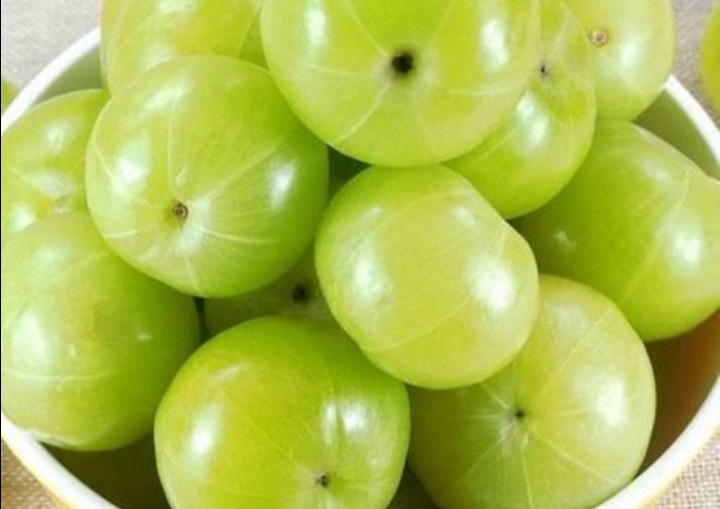
Gooseberry (Ribes spp.) scientifically known as Phyllanthus emblica is a small spiny bush in the family Rosaceae which is grown for its edible fruit of the same name. It is also known as “fayberries” because of the ancient belief that fairies used bushes of gooseberry to hide from danger. The plant is native to Nepal, India and Sri Lanka, throughout South-East Asia to southern China. Apart from gooseberry it is also known as Amla, Emblic, Indian Gooseberry, Malacca Tree and Myrobalan. The bush begins fruiting 2-3 years after plantation. One gooseberry bush produces 8 to 10 pounds of fruit per season. Gooseberry can produce fruit and survive at least 20 years in the wild. Fredonia, Pixwell, Downing and Poorman are few of the popular varieties of Gooseberry.
Gooseberry Quick Facts

Name : Gooseberry

Scientific Name: phyllanthus emblica

Origin : Nepal, India and Sri Lanka, throughout South-East Asia to southern China.

Colors : Pale green changing to yellow when mature

Shapes : Depressed globose drupe 2–4 cm in diameter, with six vertical striations

Taste : Sweet, slightly tart taste

Calories : 66 Kcal./cup

Major nutrients : Vitamin C (46.22%)
Total dietary Fiber (16.84%)
Carbohydrate (11.75%)
Copper (11.67%)
Manganese (9.39%)

Health benefits : Cancer, Improving Appetite, Diarrhea and Dysentery, Infection, Brain health,Heart Disease, Digestion, Diuretic Activity, Diabetes, Menstrual Cramps, Metabolic Activity, Aging, Calcium Absorption, Eye Care, Hair care

Plant

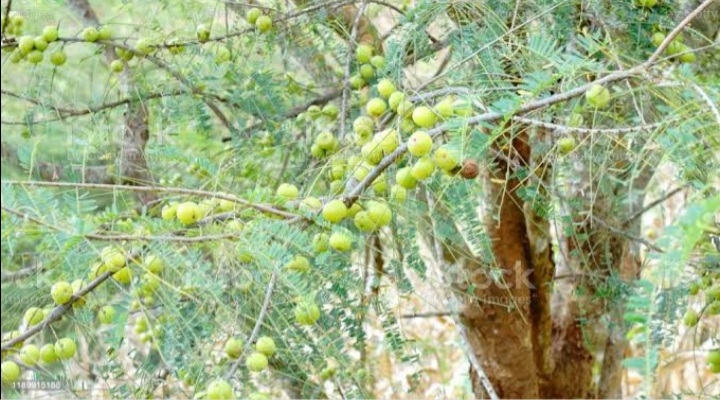
Gooseberry is a fast growing, small to medium-sized, low, deciduous tree, 5–25 m tall; trunk often crooked and gnarled, up to 35 cm in diameter; bark thin, smooth, grey, peeling in patches, with numerous knobs, main branches angular and densely pubescent. The plant has sharp thorns all along its woody branches. It is normally found growing in tropical and subtropical regions from near sea-level. It grows equally well in arid and wet or humid conditions. It is light demanding plant, common in grassy areas, brush and village groves. The plant is not fastidious of soil type and grows on a wide range of soil types ranging from sandy loam to clay, light or heavy, and slightly acidic to slightly alkaline. It flourishes in deep, fertile soil. It is moderately drought resistant but some cultivars may be sensitive to drought and frost. It is fire-resistant and is one of the first trees to recover after a fire. Branchlets are glabrous or finely pubescent, 10–20 cm long, usually deciduous.
Leaves

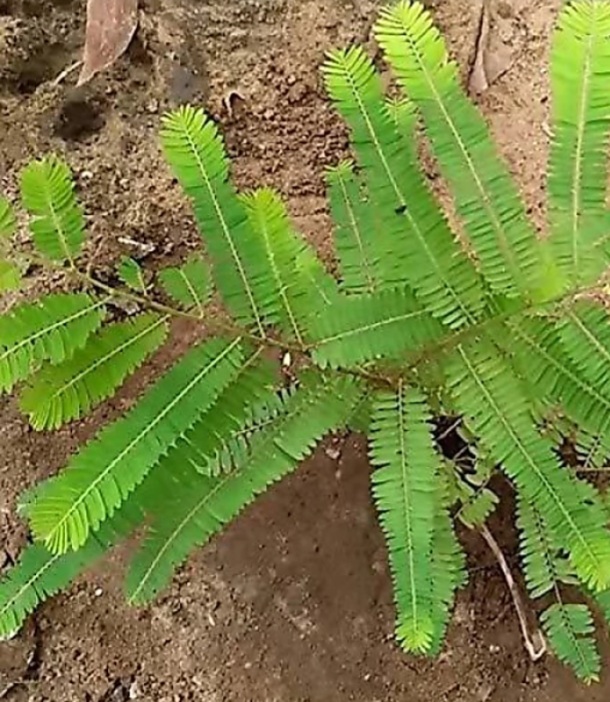
The buds perk up early in the spring, dotting the stems with green when most other plants are still tawny. Leaves are alternate, single, deeply lobed, and glossy dark green (European types), or pale to gray-green and sometimes finely pubescent (American types). The stems are thin, becoming woody, with a large thorn at each axil. American gooseberry stems are densely bristly, with one or more additional thorns at each axil. Leaf size and number are reduced under heat or light stress, and are easily burned by intense sunlight. Plants that have been subject to drought may make a new growth flush after deep irrigation. If the roots are lost, regrowth will wait until the following spring.
Flowers

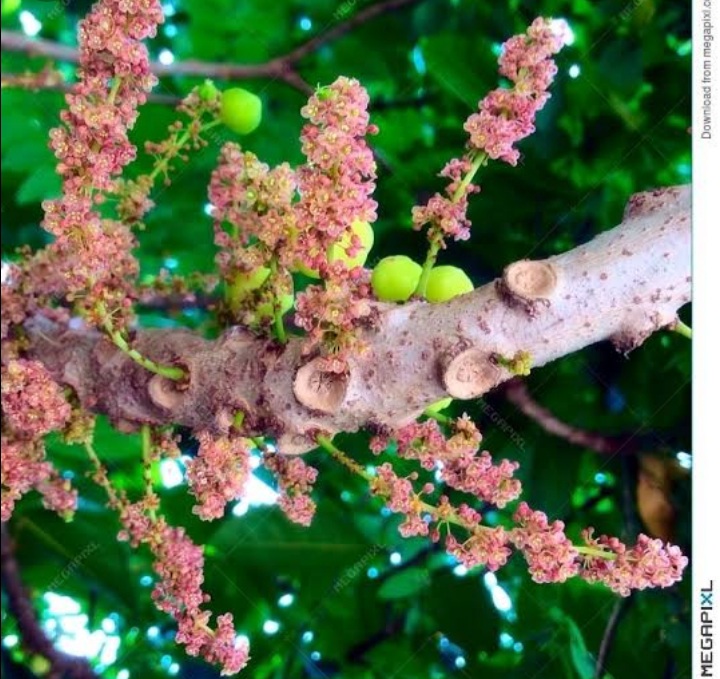
Flowers are greenish-yellow, fascicled in axils of leaves or fallen leaves, unisexual. The male flowers are numerous at base of young twigs, the female flowers solitary and higher up the twig. Male flowers are shortly pedicellate, with six pale green perianth lobes 1.5–2.5 mm long and three entirely connate stamens, six disk glands alternating with the perianth lobes; female flowers sessile, with six somewhat larger perianth lobes, a cup-like six-angular disk, and a superior three celled, glabrous ovary crowned by three styles, connate for more than half of their length and deeply bifid at apex. The flowers are self-fertile and pollinated by wind and insects, including bees. Each flower bud opens to yield from one to four flowers, depending on cultivar.
Fruit

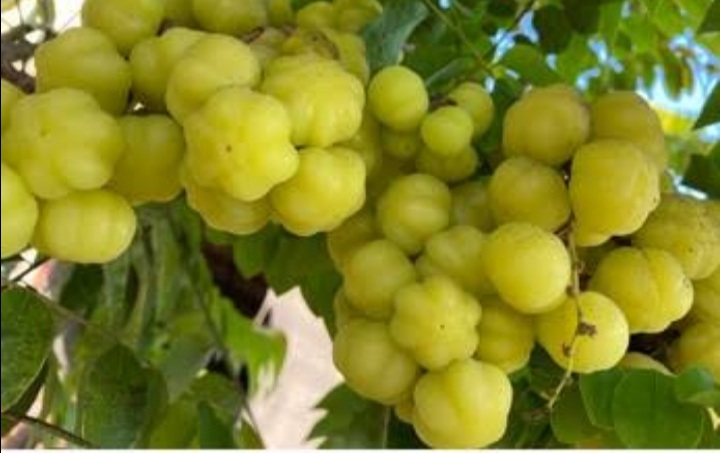
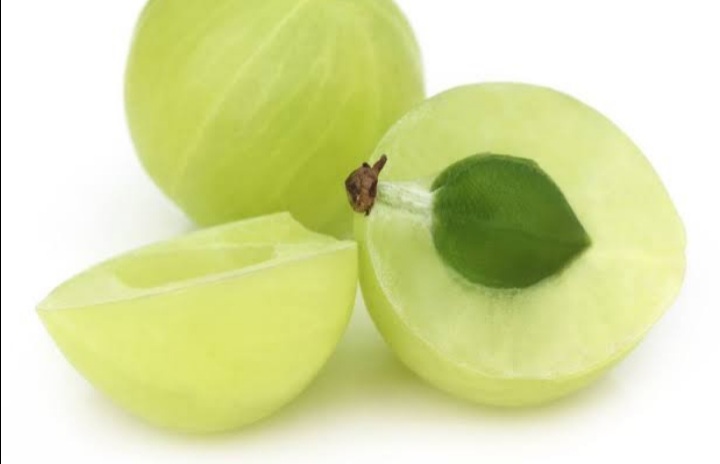
Fruit, borne singly or in pairs at the axils, is a berry with many minute seeds at the center. A gooseberry is depressed globose drupe 2–4 cm in diameter; with six vertical striations. The color of the berries is usually green, but there are red (to purple), yellow, and white variants. (Ribes hirtellum fruit can be green or dark purple to black. Fruits of the European gooseberry may be very large, like a small plum, but are usually 1 inch long, less in width. American gooseberry fruits are smaller (to 1/2 inch), perfectly round, all becoming pink to wine-red at maturity. In general, the berries weigh about 4 g to 10 g. The fruit skin is thin, translucent and adherent to the very crisp, juicy, concolorous flesh. Inside, a berry may hold 15-30 tiny edible seeds. Skin color is most intense in full sunlight. Berries generally drop when overripe. The fruit has a flavor all its own, the best dessert cultivars as luscious as the best apple, strawberry  or grape.
History

Phyllanthus emblica commonly known as gooseberry is considered to have originated in Nepal, India and Sri Lanka, throughout South-East Asia to southern China. It is widely cultivated for its fruits throughout its natural area of distribution, particularly in India, and also in the Mascarene Islands (Réunion, Mauritius), the West Indies (Cuba, Trinidad), Central America (Honduras, Costa Rica), and the West Indies and Japan. Formerly it was cultivated in Madagascar. It is commonly cultivated in home gardens in India, Malaysia, Singapore and southern China. Nowadays because of its wonderful taste and health promoting benefits it is grown throughout the world.
Nutritional value

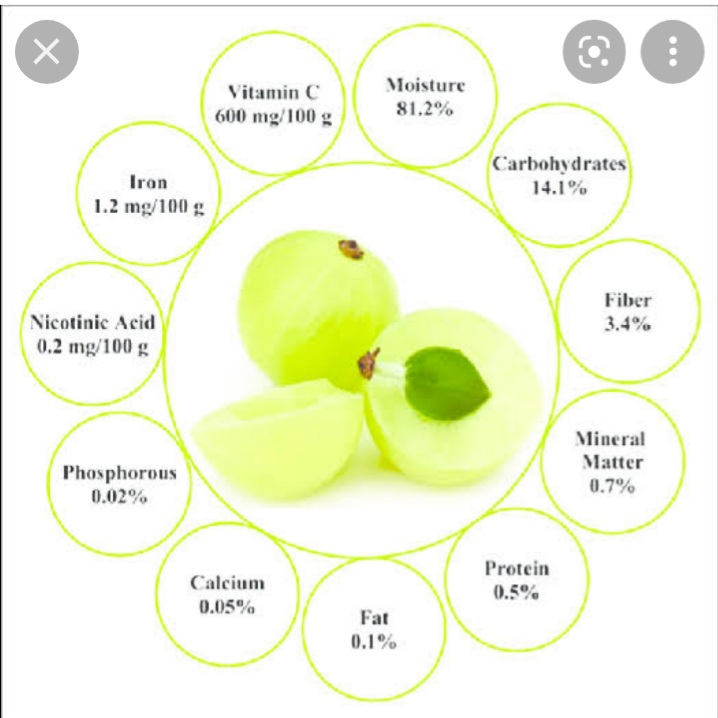
Apart from their sweet, slightly tart taste, gooseberry is a good source of nutrients, vitamins and minerals. Consuming 150 gram of gooseberry offers 41.6 mg of Vitamin C, 6.4 g of Total dietary Fiber, 15.27 g of Carbohydrate, 0.105 mg of Copper, 0.216 mg of Manganese, 0.12 mg of Vitamin B6, 0.429 mg of Vitamin B5, 297 mg of Potassium, 0.46 mg of Iron and 40 mg of Phosphorus.
Health benefits of Gooseberry

The gooseberry features a higher nutrient content and is also obtainable in white-colored, green, or even red types. One fourth of the everyday requisite of vitamin C is available in the average offering of gooseberries. Gooseberries usually have an acidic sour taste to them, yet recently, new versions have been discovered to become fairly sweet. These types of berries are generally utilized whilst producing jams, jellies as well as puddings.

Gooseberries are not typically the most popular of fruits, and lots of individuals don’t have any idea exactly what a gooseberry is, however this unusual, somewhat sour fruit has numerous health advantages. From assisting in avoiding ageing to maintaining the body powerful from problems, this particular remarkable gooseberry has numerous healthy and balanced advantages!

Some of the reasons to eat Gooseberry are listed below-

1. Eye Care

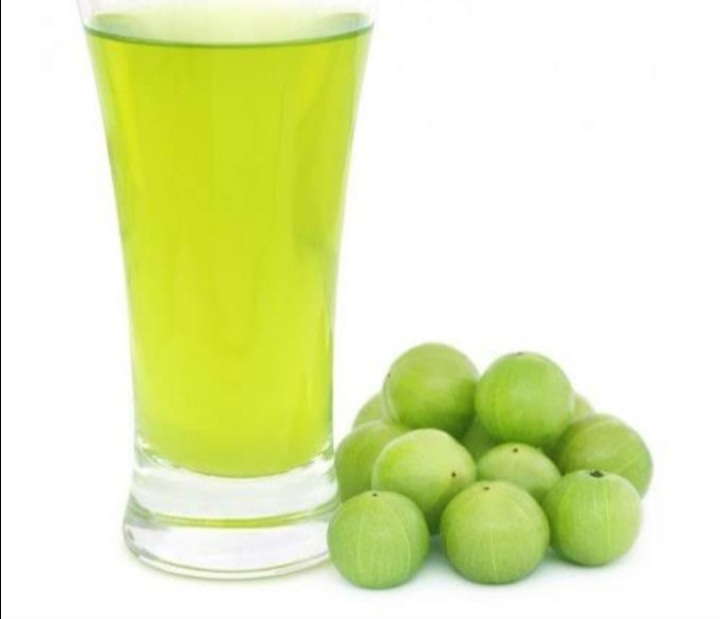
Regular consumption of Gooseberry juice along with honey is quite beneficial for improving eyesight, and research has shown it to improve nearsightedness and cataracts, while decreasing intra-ocular tension. This is mainly due to its remarkable content of carotene, which has long been known for their powerful effect on vision-related disorders, including those that stem from free radical activity. Vitamin A and carotenes reduce macular degeneration, night blindness, and strengthen your vision before the age-related degeneration from free radicals can occur

2. Digestion

Just like most of the fruits, gooseberry is very high in fiber. Fiber helps to add bulk to the stool and helps food move through the bowels and keeps bowel movements regular. This reduces the chances of constipation, and fiber bulk up loose stools and decrease diarrhea. Fiber also encourages the secretion of gastric and digestive juices, hence food is digested efficiently, nutrients are absorbed in an optimal way, and you feel lighter and healthier.

Reducing constipation can also help protect your from several gastrointestinal disorders, even colorectal cancer!
3. Diabetes

Gooseberry consists of chromium, which has a therapeutic value for diabetic patients. Indian Gooseberry encourages the isolated group of cells that secrete the hormone insulin, thus decreasing blood sugar in diabetic patients and keeping their body balanced as well as healthy. When blood sugar is reduced, it means that glucose is also being used by the cells as functional energy, thus the metabolism is stronger and you have more energy, without the plunges and spikes in blood sugar that are so dangerous for diabetic patients. Chromium also improves the effect of beta blockers, which are used for heart health, by decreasing the LDL cholesterol content of the body.

4. Calcium Absorption

Gooseberry helps the body absorb calcium in a positive way. Calcium is a crucial component of our bones, teeth, and nails, and also ensures that we have attractive lustrous hair. Thus, regular consumption of vitamin C-rich fruit like Indian gooseberries is a wonderful way to keep the body looking and feeling great!

5. Cancer

Gooseberry is a rich source of antioxidants which is effective to prevent DNA cell damage from free radicals. Similarly due to its high Oxidative Radiance Activity Capacity (ORAC) it protects cell damage from oxidative stress.  The Best part of Gooseberry is that it doesn’t lose it nutrients value even in powered form. During research it was found that Gooseberry has tremendous effect on multiple cancers.

First, it slows down the growth of cancer. Later it starts killing the cancer cells. After complete slow down, it also starts to kill the cancer cells. Also, the major part is that it didn’t harm any healthy cells. It shows beneficial in preventing and protecting from cancer. It is effective to prevent growth and spread of cancer cell. It is effective to prevent tumor cell growth.

6. Menstrual Cramps

Gooseberry consists of huge variety of minerals and vitamins which is quite useful in the treatment of menstrual cramps. Since it takes a while for the necessary elements to accumulate in the body, it is better to consume gooseberry on a regular basis so it is always in the system and menstrual cramps can be prevented every month for women.

7. Brain health

Gooseberry consists of huge amount of vitamin and minerals that helps to improve brain health. Due to the high iron in the blood, it offers oxygen to the brain. Also, it improves memory.

Apart from that it contains a high amount of antioxidants; it is effective to prevent degeneration of brain caused due to oxygen free radicals. Therefore, it provides complete health benefits to the brain.

Additionally Gooseberry is effective to protect from Alzheimer’s disease but not to cure it.

8. Aging

Aging is common with the increase in age. But the process of aging is totally changed. Skin starts to show sign of aging at an early age.

These early signs of aging are due to unhealthy diet, pollution, stress and much more.

Gooseberry helps you fight the problem of aging due to its high antioxidants content. Oxidative Radiance Activity Capacity (ORAC) value is 3387 micromole per 100 g. Free radicals are known to damage healthy cells. They damage the healthy skin and accelerate the process of aging. But antioxidants fight these free radicals and slow down the process of aging.
9. Diarrhea and Dysentery

Due to its strong cooling and laxative properties, Gooseberry is a wonderful component in remedies for diarrhea and dysentery. It offers great relief for gastric syndrome as well as hyperchlorhydria (burning sensation in the abdomen). As a laxative, it helps flush out toxins or harmful substances you may have eaten that are causing your discomfort or illness, thus removing it from your system so the healing process can begin, and cooling the burning and discomfort often felt when diarrhea occurs.

10. Hair care

Gooseberry is used in several hair tonics because it enhances hair growth and hair pigmentation. It fortifies the roots of hair, maintains color, and improves luster. Regular consumption of fresh gooseberry or applying its paste on hair roots improves hair growth and color. Gooseberry oil is quite popular in India because it has been shown to decrease the chances of hair loss and baldness. This quality is due to the carotene content of gooseberry, as well as its iron content and general antioxidant capacity, which reduces hair loss by not allowing free radicals to damage hair follicles or impact the hormones that can cause premature hair loss.

11. Improving Appetite

Regular consumption of Gooseberry powder with butter  and honey  before a meal improves appetite. It also helps to balance nitrogen levels, thus increasing weight in a healthy ways.

12. Heart Disease

Gooseberry helps to strengthen the heart muscles, so the heart pumps blood effortlessly throughout the body. By decreasing excess cholesterol buildup, the chromium can reduce the chances of atherosclerosis, or plaque buildup in the vessels and arteries. This reduces the chances of strokes and heart attacks. The iron content encourages the creation of new red blood cells, increasing circulation and the oxygenation of organs and cells to maximize growth and regeneration of tissue, while keeping the blood vessels and arteries clean.

13. Diuretic Activity

Besides being a fruit that is very high in water, Gooseberry is slightly diuretic in nature. This means that it increases the frequency as well as volume of urination. Urination helps to eliminate unwanted toxins and excess levels of water, salts, and uric acid from the body. Additionally, it can help you lose weight, since up to 4% of urine is actually composed of fat. Thus, a diuretic substance is always essential for keeping our kidneys healthy, and also preventing urinary infections and uterine infections. Gooseberry is a great way to do this.

14. Infection

Gooseberries have antibacterial and astringent attributes; so it protects the body against infection and improves the body’s immune response. They are also a very good source of vitamin C, which is eminent for its impressive antioxidant abilities and its stimulation of the immune system. It increases the white blood cell count in the body, which is the main line of defense for the immune system, since white blood cells attack and remove foreign toxins and substances in the bloodstream and throughout the body.

15. Metabolic Activity

Regular consumption of protein rich foods is one of the most significant ways to stay healthy, since proteins are an essential part of our body’s metabolic activities. Our enzymes can breakdown plant proteins into amino acids and reunite them into usable proteins for our body. Protein is essential for cellular growth; muscle development, organ health, and a wide range of other metabolic activities that we need to remain healthy and happy!

How to Eat

  • Emblic fruit is extremely rich in vitamin C and edible fresh, cooked, dried or pickled.
  • Fruit is cooked in various cuisines in a dhal (lentil) preparation and in a sweet dish amle ka murabbah indigenous to the northern part of India (wherein the berries are soaked in sugar syrup for a long time) which is traditionally consumed after meals in Andra Pradesh.
  • Fresh fruits are also baked in tarts.
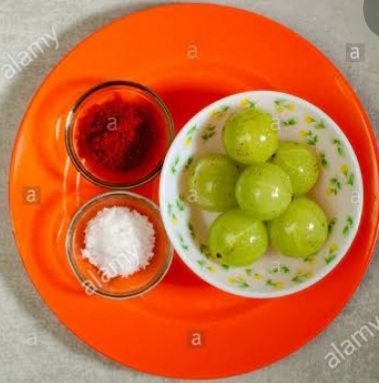
  • It is a common practice for Indian housewives to cook the fruits with sugar and saffron and give one or two to a child every morning.
  • Fruit is used to as sour seasoning in sambal and sayor in place of tamarind pulp in Indonesia and Malaysia.
  • Ripe or half-ripe fruits are used to make sweetmeats, jams, jellies, “emblic myrobalan” fruit preserves, candies, emblic powder, chutney, pickles and relishes.
  • Emblic preserves are manufactured and marketed in large quantities in India.
  • Preserved amblics are available in enameled cans or crystallized as a confection.
  • Emblic flesh can be dried and made into chips.
  • Fruit juice is used to flavor vinegar.
  • Fruit is extensively used by local Thais to quench the thirst when walking in the forest in Thailand.
  • Phyllanthus drink prepared from fruit extract is commonly known, and wine made from fruit extract is sold in the market in China.
  • Tart, astringent quality berries are favored in fish, poultry, and meat dishes.
  • Berries are also used in muffins, pie-fillings, and ice creams.
  • They are also used to flavor beverages such as sodas, flavored waters, or milk, and can be made into fruit wines and teas.
  • Gooseberries can be preserved in the form of jams, dried fruit, or as the primary or a secondary ingredient in pickling, or stored in sugar syrup.


Growing Up Is Fun But Really Stressful By An Adolescent

College is one of the most important phases in any person’s life. There are some who enjoy these days by going to parties and watching movies and simply enjoy themselves, there are others who have to work and provide for to a family at the same time. This period, like any other period, in a person’s life goes through in phases and with each phase comes an increasing level of stress. Some stress is good and is necessary, it is termed as Eustress. It is the minimum level of stress that keeps us motivated to do our best and thus is positive in nature. Some stress is negative and its constancy can cause us much harm, this kind of stress is known as Distress.

The first change that occurs with college is the absolute freedom we receive, and we are not always use to it and get carried away in the process. Important decisions are to be made, like what courses to choose and what career to follow? Whether to live at home or in a hostel? Students have to develop an ethical value system that is best suited to them. Once the courses are chosen, the most common reason for stress is grades. The students put themselves under a lot of pressure to perform better, the professors often tend to side

the ones who score high marks rather than focusing on how much the students learn, the pressure to perform together with the pressure to impress could lead to a lot of stress. Students who enter college on scholarship programs or those from low socio economic status who have the responsibility of caring and providing for the family, suffer the most. Some of them even take up part time jobs that leave them no time to relax.

Next in line are friends. Friends are the most important part of any ones life. Friends give our life meaning and to some extent help us find our inner self. Making new friends and adjusting with their lifestyles is never easy. Sometimes it may lead to change in the value system. In the shoes of a non-smoker, “Do I really need to smoke to fit in the group?” Sometimes individuals change their entire perspective on life. Deciding on giving in to peer pressure or to stick with your own values and judgments often lead to conflict and stress.

Love is another important change in an adolescent’s life. There are different kinds of lovers. There are some who feel love is a game. Some feel it is something which would make them cool. Some are just flirting and then there are those who think love is eternal and forever. With these different perspectives sometimes different kinds of lovers get together. This could lead to a lot of stress. From one of my heart broken friends I got this, “My boyfriend

thinks love is just another game in life. If you are strong enough you will win the game or else you are a looser. Sex is just another parameter just like cloths or shoes in life.” Many times sex is misunderstood and misused as love. Sometimes girls feel pressurized into being physical on the demand of their boyfriends. Sometimes it can lead to date rape or sexual harassment also. Most girls get too embarrassed to talk about it or seek much needed help; this resistance is very harmful to their mental and physical health.

With love and relationships come break-ups. Breakups are never easy. It can lead to self doubt, feeling depressed, and can sometimes also lead to a negative and poor self image. By the age of 17, most of the college students have had their heart broken and fallen in love all over again. By the time they are 18, they face different kind of stressors. Now they are official adults and have far more responsibilities. There is a conflict inside of them, as they

are not children and not totally adults. They have to find socially accepted ways to express themselves.

This is a period where adolescents usually face identity confusion. They are in the process of making an individual identity based on their on values. Sometimes these values go against the values of their parents and family systems. In a typical Indian society, there are a lot of gender related stressors. Adolescent girls are under the pressure of getting married, and many times against their will. She is expected to perform all the house hold functions

and duties and has to manage her education and homely duties which can be very stressful. She is expected to be humble and respectful and is many times not allowed to speak her mind. She is dominated by the wishes of her father and is given very little freedom. On the other hand the male child is encouraged to go out, and make a living. They are given more freedom than women.

These are few stressors that my surveys conclusively indicated. There are far too many that are faced by the adolescents of today. The stressors faces by adolescents today are far more different from the ones faces by their parents or even their elder siblings. The adolescents in our modern world are aware and willing to make a difference.

NATIONAL EDUCATION POLICY 2021- SALIENT FEATURES

BY DAKSHITA NAITHANI

Who created NEP (National Education Policy)?

The challenges that would occur in the Indian education system – from school to college to work – were examined by a panel of experts chaired by former ISRO chairman K Kasturirangan. 

NEP- National Education Policy

The “New Education Policy 2020-2021” was recently adopted by the Central Government Cabinet Committee. 2 crore schoolchildren would be reintegrated into the mainstream under the NEP 2020. With 12 years of schooling and 3 years of Anganwadi/Preschool, a new 5 + 3 + 3 + 4 curriculum was launched.

Anganwadi will provide pre-school education to children for the first three years. The students will then be educated in first and second grades for the following two years. First five years of study will be completed by a new curriculum which will be developed. Activity-based learning will be the main focus. It will be available to youngsters aged three to eight. 

Preparatory stage – Classes three through five will be covered at this time. Children will be taught science, mathematics, the arts, and other subjects through experiments during this period. Children between the ages of 8 to 11 will be covered.

 Middle Stage – These subject-based workshops will include grades 6-8, as well as students aged 11-14. Courses in skill development will begin in sixth grade.

The secondary stage- From ninth through twelfth grade, students will be divided into two groups for intense study of the topics. There will also be the option of picking and choosing subjects. Previously, this system did not exist in government pre-schools. From first grade through tenth grade, there was a general education programme. 

With no clear distinction between academic streams, schools will focus a greater emphasis on extracurricular activities, professional development, reading, and numeracy. In accordance with the new policy 2020, vocational education will begin in the sixth grade. It will be mandatory to teach in the mother tongue / regional language till the fifth grade. Improvement of evaluation and tracking progress of students to accomplish learning goals, among other things, is covered with a full 360-degree progress card.

Other important changes in school education – Salient Features of #NEP2020

According to Dr. Kasturirangan, vocational education, led the committee created to approve the new education policy, and now the kid will get vocational education and skills beginning in the sixth grade. Internships will be available on a local level as well. Vocational education and skill development will be prioritised.

There will be no job losses as a result of the new education approach. The youngsters will receive the essential education in school for professional environment. The 10th and 12th grade Board examinations will be straightforward. The Board examinations for classes 10th and 12th will undergo modifications.

Exams conducted by the council will be undervalued. There are a lot of good ideas in this article. Exams, for example, should be given twice a year and divided into two portions, one objective and the other explanatory. When it comes to council examinations, students are always under pressure and rely on training to improve their grades. According to the education strategy, various councils will create a realistic model for board exams in the near future. Exams and units at the yearly and quarterly levels, for instance.

Changes will be made to children’s report cards, which will be used to evaluate their school achievement and performance. They will be graded on three different levels. The first will be a student, the second will be a classmate, and the third will be his teacher.

In 2019, the rough draft of NEP was introduced, and it received much praise as well as harsh criticism. The idea to declare Hindi one of the essential languages was quickly shot down. After that, the document was made public, and individuals and other stakeholders were asked to submit policy ideas for improvement.

Changes Made in Higher Education

50% Increase in GER

By 2035, the NEP intends to raise the existing GER (Gross Enrolment Ratio) from 26.3 – 50 percent. 3.5 Crore additional places in higher education would be added.

Interdisciplinary general education

The strategy aims to provide a complete, multidisciplinary, and broad-based college education with flexible plans, additional topic options, a greater emphasis on vocational education, and the ability to enrol and exit the programme with a recognised degree. For example, Certificate after 1 year, Advanced Diploma after 2 years, Degree after 3 years, License for research after 4 years.

India’s educational system is at a critical crossroads. On the one hand, it is expected to replace an out-of-date paradigm with the NEP 2020. New digital learning platforms and creative teaching approaches, on the other hand, are driving it to global standards and setting new milestones.

Any country’s education is judged by the quality of its human capital. A well-educated population with a high literacy rate is better prepared to take on social, economic, and political responsibilities responsibly while maintaining a broad understanding of global concerns. This is the goal embodied in the NEP 2020, which, if implemented well, would make education more comprehensive and enjoyable.

With the announcement to qualitatively improve 15,000 schools across India to adopt NEP in the Union Budget 2021-22 and these will act as role models for other schools to emulate. To maximise the benefits of the NEP, the education sector must harness the powers of technology in the future. This will result in a rising curve in the standard of education in India.

As we emerge from the coronavirus epidemic and begin a new academic year, it is critical to recognise the potential for change in Indian education as a consequence of these 3 forces: the National Education Policy (NEP) and the accompanying new platforms and teaching and learning methodologies.

.

CREATING A ROUTINE IN COVID: WHY IS IT SO IMPORTANT?

White Notebook With Black Pen

Owing the advent of Covid-19 pandemic last year, the entire world has turned upside—down. Almost everyone has been impacted by the pandemic after being forced to isolate and pursue their lives within the four walls of their house, till this trouble dies.

Unfortunately, not everyone has been able to deal with these times of crises in a healthy manner. With the entire foundation of everyone’s lives being shaken, the structure has collapsed; the routines have been destroyed. There is constant state of confusion that prevails in the minds of people as they have to constantly worry about what to do next, while trying to stay as productive as possible  and not waste away their days.

Here comes the role of routines; as humans thrive off of routines, forming an easy-to-follow routine can really help those feeling miserable in such confusing times.

Routines can be efficiently incorporated in our lives in pandemic in a number of ways:-

CREATE A LIST

As our lives have been frazzled with a constant need to answer the question: “what to do next?” , forming a list of goals that can be achieved smoothly in a day helps us feel more fulfilled and productive. This ensures that when we go to bed at night, we sleep with a feeling of accomplishment.

STAY HEALTHY

Whether it is to lose weight or a means of escapism from being cooped up within your house, exercising can provide us ease and peace as exercising produces endorphins or the ‘happy hormones’ in your body. Also, try to have meals 3 times a day in order to prevent binging on unhealthy snacks.

EXPAND YOUR HORIZONS

With a major portion of our commute time to work/school being cut down, we surprisingly have a lot of time on our hands. Instead of wasting away the precious time, try to learn something new. It can be anything; picking up your once favourite past time of playing piano or learning a new language that could really help develop your CV.

GET ADEQUATE SLEEP

A healthy sleep of 7 to 8 hours is necessary for our bodies to perform our best in our routinely tasks and stay on top of our game. However, with the beginning of the pandemic, people have really messed up their sleep schedules, which is quite unhealthy for them in the long run.

Hence, make sure to go to bed at the same time every night and get a good night’s rest to stay refreshed.

#5 TAKE BREAKS

 While we set targets that have to be achieved everyday in order to be as active as possible, it quite essential to take short breaks between work. Play with your dog or try to make a cup of coffee for yourself. These breaks ensure a higher productivity in the various tasks that we execute throughout the day and at the same time, really enjoy the things that we do so life does not appear monotonous to us.

So, make sure to stay active but at the same time, take care of yourself!  

Story of MBA Chaiwala

After reading the title you must be laughing at it but it the story of an entrepreneur or I could say a success entrepreneur who was struggling with himself and came up with this idea which proved a billion dollar deal to him. I know you would be interested to know the name and his journey but she journey is not always easy. Like there is a saying that life is not a bed of roses and that is applied here.

As I was going with my YouTube videos I saw a video of Prafull Billore yeah that’s the name and the thing which attracted me was the name MBA Chaiwala. It’s sound very funny but when I watched the video and the journey of him I was inspired. Like what a deal and what an inspiration one could get from him.

He was planning and decided to MBA like any other individual would go with giving the entrance exams and clearing it with good marks. But the idea was struck into his mind if starting his own business and then opened a roadside thela in Ahemdabad along with the utensils of chai that he bought in 45 days. He dropped from his college and started his business with his job also. He worked at a restaurant where he served burgers and that’s where he got the inspiration of his own food business.

The name was thought to be unique as in India customers come if the name is unique only. So it was named as Mr Billore A’bad Chaiwala. At chai point customers come ,have a cup of tea and forgets about their worries for sometime. Chai is a stress buster for us indeed.

Now he is well known name for the people and the network has become stronger . I’m sure that after reading the story of this startup you must also be thinking about it. Hope you will like reading it and I will try to bring more stories like this for my readers. Have a great day.

Thank you!!

World Sanskrit day

The day which revives the language Sanskrit. Today is World Sanskrit day which is also known as vishwa sanskrita dinam. Sanskrit is not only just a language but a tradition of India. It is the oldest languages in the world. The mother to all languages which lost its importance in this modern world. Sanskrit language is the soul of India and considered as one of the most sacred language.This year the event is celebrated on August 22, 2021.

Sanskrit is not only the language to be spoken but it has a religious importance too. The Vedas has Sanskrit shlok, epic books such as the Ramayan and the Mahabharata are written and scripted in Sanskrit. Most of the puranas of Hindu tradition are having detail written in Sanskrit language. Hinduism contains majority shlok in Sanskrit language only which have a perfect and divine meaning. It is celebrated on the shravani purnima in the month of shravan according to Hindu calendar. Sanskrit language is considered to be the language of gods and sages.

It is the official language of Uttrakhand and different programs are being organised to promote the language. It involves lectures which must be included in the normal lives to be connected with the nature. Sanskrit week is celebrated at national level to know and revive our mother language. Different types of competition like kavi sammelan, debates, poetry are performed in Sanskrit.

Not only at national but the day is celebrated internationally also and people are recognising the concept and tradition of Sanskrit in modern life. It also emproves the pronouncing ability of the individual. In yoga Sanskrit shloks are recited so as to understand the concept and connect with the power of it. Even Sanskrit teachers are hired at higher posts to teach Sanskrit as a language to their kids.

As an Indian we should try to know and promote it to our future generations too. The language can be tough yet beautiful.The language is spoken by not reading the words but by learning and understanding it by heart. I hope this information was useful for you.

Hope you will like it. Thank you!!

DOLPHINS 🐬

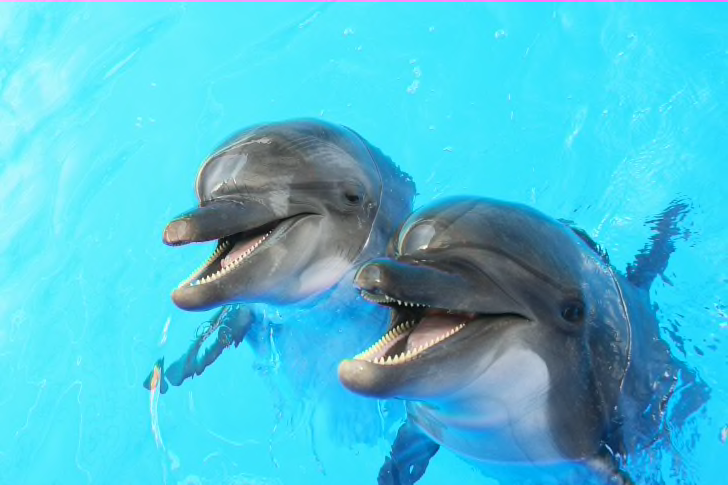
Dolphins are known for being smart, playful creatures that can learn to perform impressive tricks. But you might not know that dolphins are also champion nappers who have helped the U.S. Navy protect nuclear warheads.

DOLPHINS ARE EXCELLENT NAPPERS.

Since dolphins can’t breathe underwater, they need to swim up to the ocean’s surface to get air. So how do they sleep without drowning? Essentially, dolphins are champion power nappers. Rather than sleep for several hours at a time, they rest one hemisphere  of their brain for 15 to 20 minutes at a time, and they take these “naps” several times each day. By resting one hemisphere of their brain at a time, dolphins can continue swimming, breathing, and watching for predators 24/7.

DOLPHINS COMMUNICATE WITH CLICKS AND WHISTLES

Dolphins communicate with one another underwater by making a variety of vocalizations. To find prey and navigate the ocean, they make clicking sounds, and they “speak” to other dolphins by whistling. Dolphins also produce loud burst-pulse sounds when they feel excited or aggressive, such as when they need to scare off a nearby shark. Some female dolphins also produce a burst-pulse to reprimand their offspring, called calves, for bad behavior.

BUT DOLPHIN LANGUAGE REMAINS A MYSTERY.

Although marine scientists have studied and recorded dolphin vocalizations for decades, many aspects of the animals’ language and how they communicate are still unknown. Scientists have not yet broken down the individual units  of dolphin sounds, and they’re still searching for a Rosetta Stone that links the animals’ vocalizations to their behavior. By using new technologies—including algorithms and high-frequency recorders that work underwater—scientists hope to finally unlock the mystery of the dolphin language.

DOLPHINS USE ECHOLOCATION TO NAVIGATE.

To know where they are in relation to other objects and animals, dolphins use echolocation (a.k.a. biological sonar). After emitting a series of high-pitched clicks, they listen for the echoes to bounce off their surroundings. Based on these echoes, dolphins can judge where they are in space and determine the size and shape of nearby objects. Besides helping dolphins evade predators, echolocation allows them to trap, catch, and eat fish and squid.

DOLPHINS MAKE FRIENDS WITH OTHER DOLPHINS.

Dolphins are highly social, and scientists are still discovering fascinating details about how the aquatic mammals socialize with one another. In 2015, scientists at Florida Atlantic University’s Harbor Branch Oceanographic Institute published research in the Marine Mammal Science journal about the social networks of dolphins. After spending over six years tracking 200 bottlenose dolphins in Florida’s Indian River Lagoon, the scientists discovered that dolphins have friends. Instead of spending equal time with the dolphins around them, the animals actually segregate themselves into friend groups. Just like humans, dolphins seem to prefer the company of certain peers more than others.

EACH DOLPHIN RESPONDS TO ITS OWN NAME.

Dolphins aren’t swimming around with name tags, but every dolphin has its own unique whistle. Scientists believe that dolphins use these signature whistles  for life, and female dolphins may even teach their calves their whistles before they’re born. Dolphins use their signature whistles to call out to one another and may be able to remember other dolphins’ whistles after decades apart.

THERE ARE 44 DIFFERENT DOLPHIN SPECIES.

Although bottlenose dolphins are the most well-known and recognizable, there are 43 other  dolphin species. Most species live in temperate and tropical oceans, but a few live in colder oceans or rivers. Depending on their species, dolphins can vary considerably in their physical attributes and behavior. For example, the largest dolphin species, the Orca (also called Killer Whale), can be 30 feet long—10 times longer than the smallest dolphins.

DOLPHINS DON’T USE THEIR TEETH TO CHEW FOOD.

Dolphins have teeth, but they don’t use their chompers to chew food. Instead, dolphins use their teeth to catch prey (fish, crustaceans, and squid) and swallow it whole. Since they forgo-chewing , digestion occurs in their stomach—or, more precisely, in part of their stomach. Dolphins have multiple stomach chambers, one of which is devoted to digestion, while the other chambers store food before it’s digested.

DOLPHINS TYPICALLY GIVE BIRTH TO JUST ONE CALF.

Depending on their species, most female dolphins (called cows) carry their babies for nine to 17 months before giving birth to a calf. Interestingly, calves are born tail first, rather than head first, so they don’t drown during the birthing process. After nursing for one to two years, a calf typically stays with its mother for the next one to seven years, before mating and having its own calves.

 A DOLPHIN’S SKIN CAN BE REGENERATED EVERY TWO HOURS.

If you’ve ever swum with dolphins, you know their skin looks and feels super smooth and sleek. There’s a reason for that—a dolphin’s epidermis (outer layer of skin) can be sloughed off and replaced with new skin cells as often as every two hours. Because their skin regenerates so often, it stays smooth and, as most scientists believe, reduces drag as they swim.

DOLPHINS ARE NOT THE SAME AS PORPOISES.

To the untrained eye, dolphins and porpoises look nearly identical, and many people mistakenly think that porpoises are a type of dolphin. But the two species belong to completely different families and differ in their physical attributes. So how can you tell them apart? Dolphins, which are usually bigger than porpoises, typically have longer breaks  and curved dorsal fins. Porpoises, on the other hand, have more triangular dorsal fins as well as spade-shaped (rather than conical) teeth.

HUNTING, OVERFISHING, AND RISING OCEAN TEMPERATURES THREATEN DOLPHINS.

Some dolphin species are endangered or functionally extinct (like China’s baiji dolphin) due to hunting, overfishing, and pollution. Although dolphin meat is high in mercury, the animals are still hunted for their meat and eaten in parts of Japan and the Faroe Islands of Denmark. Overfishing means that dolphins’ food sources are shrinking, and some dolphins get caught up in fishing nets and die. Additionally, climate change and rising ocean temperatures are driving some fish and squid away from their natural habitats, putting dolphins’ main food source at risk.

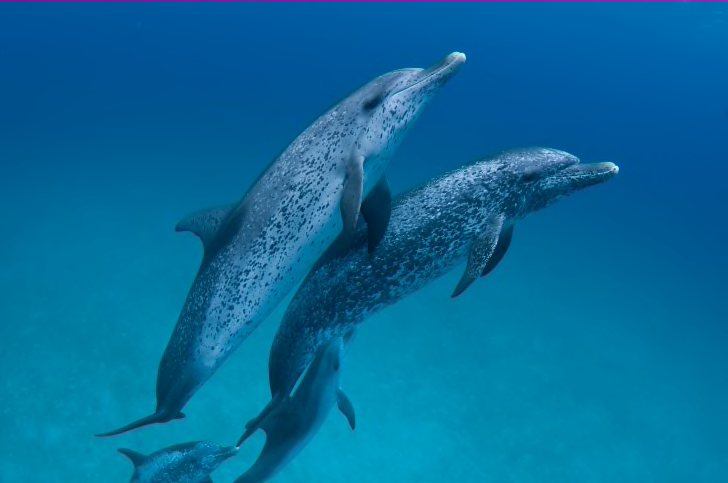
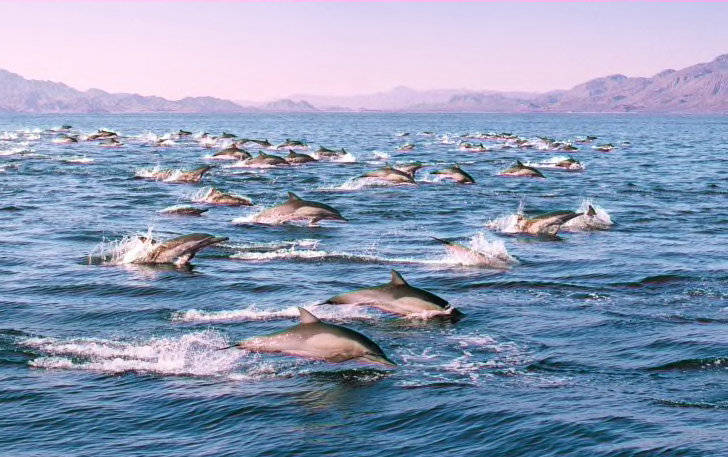
A SUPERPOD CAN CONSIST OF MORE THAN 1000 DOLPHINS.

Dolphins live in groups, called pods, that typically contain dozens or hundreds of dolphins. By swimming in a pod, dolphins work together to hunt prey, evade predators, and care for  sick or injured members. But different pods can also merge, forming a superpod of more than 1000 dolphins. Superpods are typically temporary and occur in parts of the ocean with plentiful food (and less competition for tasty squid).

THE OLDEST DOLPHIN IN CAPTIVITY LIVED TO THE AGE OF 61.

Dolphin lifespan varies greatly by species. Most dolphins in the wild live for a few decades, while those in captivity have a drastically reduced lifespan and may live for only a few years. So it’s all the more shocking that the oldest dolphin in captivity lived to be a sexagenarian. Nellie, a bottlenose dolphin who lived in a marine entertainment park  in Florida, was born in 1953. She appeared on TV shows and commercials and performed tricks for the park’s attendees before passing away in 2014.

A Journal a year

Photo by Jess Bailey Designs on Pexels.com

Journal, a record of the official statement or the record of the personal activity of the day or the entry of business details for the transaction or the news sheet according to the 17th century.

Even though most of us think that keeping a record of something you do every day is a lot to do, many of us by adapting this method have found out the secret it holds.

Journaling is something quite creative and yet it is so basic of whatever you are thinking, you are doing or you want to do.

Writing a journal is all about finding the right motivation and the push so that whatever you are writing you are enjoying as the journal is not about the diary or not about the decoration though it may act as a plus, it is surely all about the thought and facts you are choosing to write down or the information you are mentioning about each passing day or yours or anything else.

Journaling is the habit that can make you just believe more in whatever you trust on it is the drive that can keep you up when you are down in the driving force of life.

But it is not that easy to keep writing or recording the day-to-day deed so to tip it off for you guys this article is here.

A few minutes a day

We think writing and organizing your though in a particular format and manner is going to take a lot of time from your busy schedule right?

But, no it won’t as even when you are riding in the bus or switching the train with few hour gaps in between or stuck in the subway you just have to scribble the keyword which can sum up that particular day’s activity and for that, you don’t even need to have the journal paper even your mobile’s note will do and yup you did it and when you will be looking back then you will understand what and why you wrote it that way which is a helpful tool in making and tracking some of your important decision of life.

Not a pressure 

Writing a journal seems like pressure to you? Then don’t as it’s not important to write it if you don’t find peace with it. 

Writing a journal is a way for some of us to cope with our thought storms resulting in way out of control Hollywood 2012’s conclusion.

So. yeah write it when you want it but again some of us dodge this writing down process just because we think we going to write everything correctly if we are recording it but whom do you need to show for it to be all perfect?

No one right? As journaling is for you to track every day of your life not for others to get more reasons to judge you based on your thought process.

Conclusion 

Concluding my article with saying that the importance of journaling is well explained by the Mystic Falls squad which is based on journaling only even though the entire thing has nothing to do with the reality it still is a fun way of getting inspired and bangs, writing everything out.

Positive Thinking And Your Creative Mind: 7 Steps To Success

You have a bright idea hidden somewhere in the back of your mind that you just can’t wait to test out. The question is, do you really want to bring it out into the light? What could motivate you to churn your creative, inspiring juices to their utmost flavor?

Did you know that it always helps to set a time limit to your personal goals? Set yourself up so you can accomplish the most tasks in record time. For example, mowing the lawn in an hour before the big game on TV. A correct and positive attitude in whatever you do will make things easier, and even enjoyable.

It’s simple. If you begin to allow yourself a bit of positive thinking then you will begin to realize things that you never thought possible. Thinking big is indeed the American Way and that what made our country prosperous. You can follow other great Americans who tapped into their creative mind and began to thing big..

Discover some tips to make it through your first week of possibility thinking even if you’re just sitting in your favorite couch. Your mind is constantly at work for you. Tap into it’s great resource while doing everyday activities.

1. Act. You must take passionate action towards living your life by design. Talk is cheap. Action = deposits in the bank of a passionately authentic future. My mother (probably quoting someone else) always said, “Action speaks louder than words”. Without action, passion is void.

Dreams become reality when you simply start by tinkering with your mind, then with your hands. And if the idea weakens or falters you can always go back to it later until you finish it. Thomas Edison and his Dream Team had to go back to the idea of a light bulb and recalculate it over 1,000 times before the first working light bulb begin to light the world.

2. Love. Commit to yourself. Then commit to those you love to powerfully create a life you can love. Instead of reacting, commit to creating from your heart and soul, out of love rather than fear. The American Dream will always be there, but a dream will still be a dream without motion. Be amazed as the transformation begins.

3. Live. Embrace moments and opportunities. Recognize and embrace the thought that each moment is perfect regardless of its outcome. Every time you hit on something that may appear too extreme why not give it a shot anyway. See if it will work. You may be surprised with the results. If you are not then decide to use that moment to learn from it and make the appropriate shift. Learning and growing from mistakes and failures is a part of living.

4. Be grateful. Dwell completely in a place of gratitude. Learn to utilize what you have in your hands and make use of it in the most constructive way. Necessity is the mother of invention. Have you ever been stuck without something you needed and had to make do with something else? (MacGyver,from the famous tv show, was famous for that!) How grateful were you that you had the means to solve your situation? Slipping into neediness will become less of a habit when you repeatedly shift towards gratitude and away from poverty consciousness.

5. Be Passionate. Use a Passion Formula of Recognize/Reevaluate/Restore in place of the Shoulda/Woulda/Coulda whirlwind. The former is based on increased knowledge and abundance while the latter focuses on scarcity and lack. As you face people or tasks that may seem harder than scaling the summit of the Himalayas, allow yourself to realize that the task is just as important as giving out orders to your subordinates. You would rather be richly passionate!

6. Laugh. Keep humor at the forefront of thought, laughing at and with yourself whenever possible. You may find yourself quite entertaining when you loosen up! I have yet to see a comedian ever go hungry even though his jokes are as ‘old as great-grandma’. Life has too much to offer to allow yourself to mope around in self pity. Humor is very attractive, very passionate: life-giving.

7. Discover Your Purpose. Believe that you are the architect of your destiny. Realizing how you wish to be remembered when you pass from this life is a truly driving force. Your purpose for being can be a seemingly simple as being a great parent to as elaborate as discovering miraculous cures.

When you have a strong purpose no one can take your passionate future from you except for you! Truly, as long as there’s still breath in your body, there is no end to how much you can accomplish in a lifetime. Discovering and following your purpose will enable you to enjoy your work. Celebrate in the discovery that acting on your creative mind’s thoughts is fulfilling your purpose. Watch everything flow into place with perfect, passionate precision.

Activate your positive thinking. Stretch your imagination. Think bigger than you feel comfortable. Act on your thoughts. The number one tip here is action. You want to start practicing these steps.

Think about this: It is unfortunate that so many people still do not use a computer because it appears too complicated to begin using. Or maybe they just keep putting it off till a more convenient time. These are just a couple of limitations one can set up for themselves. Limitations and failure to act on ideas and opportunities leave many as a dim bulb in a dark corner.

Alert! You are not doomed to darkness. You are interested in living a life of purpose and love. The wonderful, creative idea in you is about to be released. You are interested in doing this because you are reading this article. Fortunately if you truly desire something, the will to attain it will open your creative mind to find a way.

Now you need only to begin to act on your desire to create. Act now! Make your path to creativity and follow your purpose. Take your first step today with a positive attitude.

Book review: “War and peace” by Leo Tolstoy

This is the second time I’ve read this book. The first was a copy I borrowed a few years ago, and now I’ve purchased one for my own library. I try to collect good books I really loved reading, and “War an peace” easily falls into this category.

It is an epic novel in the truest sense of “epic”. Stretching over a period of several decades, it masterfully describes the history of Russia from the end of the 18th century and into the first third of the 1800s. At more than 1600 pages, it is definitely one of the longest novels out there, but unlike many much shorter books, its length is well justified. I can barely count on the fingers of one hand the amount of times I felt some section is too long. Although Tolstoy is very thorough, his writing is easily readable and the pages just fly.

The books focuses on two main topics. One is the Russian-French wars of 1805 and 1812. Tolstoy describes the wars, and in particular the battles of Austerlitz (1805) and Borodino (1812) in vivid detail and apparently very accurately from a historic point of view. The characters of Napoleon and Kutuzov (the Russian army leader) take active part in the narration, with the lesser leaders (Bagration, de Tolli, Davoux) also getting enough attention to build a complete and interesting story. Specific events of the war are highlighted with the participation of the book’s main characters, like Andrey Bolkonsky, Nikolay Rostov and Pierre Bezoukhov.

The other is the high Russian society of that time. The book provides a very interesting and in-depth glimpse into this unusual society by today’s standards, somewhat modeled after, and thus similar to, other European societies (French, British, etc.). Tolstoy also presents the life in rural Russia a little, and the interrelations between the rich and the serfs, although he doesn’t spend on this topic nearly as much as in Anna Karenina.

The characters in the book are various and present the different ideas Tolstoy tries to infuse into his narration. They are all, without exception, extremely believable and well developed. I can’t think of many authors who know how to present and develop their characters as well as Tolstoy.

Additionally, the book presents plenty of interesting philosophical and scientific (“science of history”) ideas. The chief one is undoubtedly the question “What causes and shapes historical events?”. Contrary to the popular dogma that historical events are the result of actions of single notable persons (such as Napoleon or king Alexander), Tolstoy believes that such persons don’t really cause events, but rather can only affect them in some ways once they are already in existence. He claims that what really changes history is the amalgam of human actions, built from thousands, nay, millions of small decisions, desires and ambitions of the people. A historical version of chaos theory.

Well, this review can be arbitrarily long, and I have to wrap up at some point. I just want to address one important issue – the book’s name. In Russian, the book’s name is “Voina i mir”, which may mean “War and peace” but may also mean “War and society”, since “peace” and “society” are homonyms in Russian. There are differences of opinion as to which Tolstoy actually meant when he authored the book, as you can read here or more at length here (Russian). Personally, I firmly believe that the “War and society” translation is more correct. It is very obvious that Tolstoy places a lot of emphasis on society in the book. Pierre compares his experiences in the society with his war adventures to form philosophical opinions. The same for Andrey. I can barely see any mention of peace in its “non-war” sense in the book.

Understanding the Role of Social Media in Marketing.


These days, everyone from small business owners to some of the biggest companies in the world is using social media to spread the word about their brands, products, and services.

Whether it’s Twitter, Instagram, or Facebook, companies use these low-cost tools to combine technology and social interaction with the use of words, images, and video. Social media gives marketers a voice and a way to communicate with peers, customers, and potential consumers. It personalizes your brand and helps you to spread your message in a relaxed and conversational way.

The downfall of social media, if you could call it that, is that it must be a part of your everyday life to keep the momentum and attention you need for it to be successful. Let’s look at who is using social media to promote their brand—and what you can learn from them.

Companies That Use Social Media

Here are just a few examples of brands you may have seen actively using social media:

  • Absolut Vodka: The popular vodka brand has used online videos on YouTube and hosted bartender fan pages on Facebook.
  • BMW: The iconic car brand has turned to Facebook to promote its 1-Series Road Trip and created a Bimmerfest Page for fans.
  • Dunkin’ (formerly Dunkin’ Donuts): The ubiquitous doughnut brand is now everywhere online, with its microblogging Twitter account and National Donut Day social media blasts.

The Benefits of Social Media Marketing


What role should social media play in your marketing? Marketing is a tool we use to inform consumers about our products, who we are, and what we offer. Social media accomplishes all of these goals. Here’s how:

  1. You can use social media to define your brand identity and the products or services that you offer.
  2. Social media allows you to create relationships with people who might not otherwise know about your products and services or what your company represents.
  3. Social media can make you “real” to consumers. If you want people to follow you, don’t just talk about the latest product news, but share your personality with them.
  4. You can use social media to associate yourself with peers that may be serving the same target market.
  5. Social media makes it easy to communicate and provide the interaction that consumers look for.

How to Use Social Media for Your Marketing


Social media clearly carries a lot of potential value for your business. But gaining that value isn’t guaranteed unless you do it right. Here are a few tips:

  1. You cannot just depend on social media; you must integrate it with other vehicles of marketing. While social media will create awareness, it won’t usually help you sell $1 million worth of products right out of the gate. That’s not to say that it can’t one day, once you’ve built up your social media “stardom,” but it probably won’t happen tomorrow.
  2. Be yourself and reflect your personality. There are no written right or wrong rules when it comes to social media. Only you can determine what will work for you and fits your brand.
  3. Be consistent. Social media requires ongoing engagement. If you don’t plan on being consistent, don’t do it at all.

Social media success stories are abundant, from headhunters that find job applicants to new businesses that want to introduce a new product, as well as established Fortune 500 companies that want to strengthen their brand.

A thread to tie

Photo by Erika Pugliese on Pexels.com

It is just a thread, but it can hold so many emotions and feelings representing the unbreakable bond of sister and brother. The ancient root of this festival is deeply rooted in the idea of the all-life protection of sisters from every evil out there by their brothers. The tying thread on the wrist of the brother is the symbol of his blessing and a promise which they service throughout their lives in every up and down of the sister’s life.

As the auspicious day of Rakhi is celebrated today on this very day of Purnima, let’s find out its importance and a glance at its past.

History

The history of any festival is very enriched and secures great importance in today’s life. As we are pacing fast with the changing time, we are somewhere just enjoying the festival. We are so not into why and when of their origins.

But don’t worry with few incidents which can show how important the tying of the thread is in our culture I have written them in this article.

Draupadi:

Once when Krishna Ji was using his Sudarshan Chakra on the King Shisupala, during the time he injured his finger which Draupadi Ji tried to treat by wrapping the piece of her cloth around Krishna Ji’s finger and that time Krishna Ji vowed to always protect Draupadi from all the evil.

That is the importance of tying thread around the wrist on the festival of Rakshabandhan nowadays.

A Peace Offering

During the time of the Britishers, they believed in the rule and divide policy which did have many severe effects on the relationship of the mostly Hindu and Muslims,

To overcome this difference between themselves our freedom fighters tried to mend the relationship between the two by saying we are brother and sister of the same mother nation and that is why many women of both sides at the time tied the Raksha thread to ensure and again build the trust and love of brotherhood and sisterhood between two different mindsets.

DEEP LEARNING SERIES- PART 10

This is the last article in this series. This article is about another pre-trained CNN known as the ResNet along with an output visualization parameter known as the confusion matrix.

ResNet

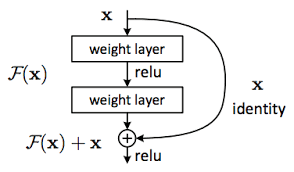
This is also known as a residual network. It has three variations 51,101,151. They used a simple technique to achieve this high number of layers.

Credit – Xiaozhu0429/ Wikimedia Commons / CC-BY-SA-4.0

The problem in using many layers is that the input information gets changed in accordance with each layer and subsequently, the information will become completely morphed. So to prevent this, the input information is sent in again like a recurrent for every two steps so that the layers don’t forget the original information. Using this simple technique they achieved about 100+ layers.

ResNet these are the three fundamentals used throughout the network.

  (conv1): Conv2d (3, 64, kernel_size= (7, 7), stride= (2, 2), padding= (3, 3))

  (relu): ReLU

  (maxpool): MaxPool2d(kernel_size=3, stride=2, padding=1)

These are the layers found within a single bottleneck of the ResNet.

    (0): Bottleneck

  1    (conv1): Conv2d(64, 64, kernel_size=(1, 1), stride=(1, 1))

  2    (conv2): Conv2d(64, 64, kernel_size=(3, 3), stride=(1, 1), padding=(1, 1))     

  3    (conv3): Conv2d(64, 256, kernel_size=(1, 1), stride=(1, 1))    

      (relu): ReLU(inplace=True)

   Down sampling   

   Conv2d(64, 256, kernel_size=(1, 1), stride=(1, 1))

    (1): Bottleneck

  4    (conv1): Conv2d(256, 64, kernel_size=(1, 1), stride=(1, 1))

  5    (conv2): Conv2d(64, 64, kernel_size=(3, 3), stride=(1, 1), padding=(1, 1))     

  6   (conv3): Conv2d(64, 256, kernel_size=(1, 1), stride=(1, 1))     

      (relu): ReLU(inplace=True)

    )

    (2): Bottleneck

  7    (conv1): Conv2d(256, 64, kernel_size=(1, 1), stride=(1, 1))

  8    (conv2): Conv2d(64, 64, kernel_size=(3, 3), stride=(1, 1), padding=(1, 1))

  9   (conv3): Conv2d(64, 256, kernel_size=(1, 1), stride=(1, 1))

   (relu): ReLU

There are many bottlenecks like these throughout the network. Hence by this, the ResNet is able to perform well and produce good accuracy. As a matter of fact, the ResNet is the model which won the ImageNet task competition.

There are 4 layers in this architecture. Each layer has a bottleneck which comprises convolution followed by relu activation function. There are 46 convolutions, 2 pooling, 2 FC layers.

TypeNo of layers
7*7 convolution1
1*1, k=64 + 3*3, k=64+1*1, k=256 convolution9
1*1, k=128+ 3*3, k=128+1*1, k=512  convolution10
1*1, k=256+ 3*3, k=256 + 1*1, k=1024 convolution16
1 * 1, k=512+3 * 3, k=512+1 * 1, k=2048 convolution9
Pooling and FC4
Total50

There is a particular aspect apart from the accuracy which is used to evaluate the model, especially in research papers. That method is known as the confusion matrix. It is seen in a lot of places and in the medical field it can be seen in test results. The terms used in the confusion matrix have become popularized in the anti-PCR test for COVID.

The four terms used in a confusion matrix are True Positive, True Negative, and False positive, and false negative. This is known as the confusion matrix.

True positive- both the truth and prediction are positive

True negative- both the truth and prediction are negative

False-positive- the truth is negative but the prediction is positive

False-negative- the truth is positive but the prediction is false

Out of these the false positive is dangerous and has to be ensured that this value is minimal.

We have now come to the end of the series. Hope that you have got some knowledge in this field of science. Deep learning is a very interesting field since we can do a variety of projects using the artificial brain which we have with ourselves. Also, the technology present nowadays makes these implementations so easy. So I recommend all to study and do projects using these concepts. Till then,

HAPPY LEARNING!!!

DEEP LEARNING SERIES- PART 9

This article is about one of the pre-trained CNN models known as the VGG-16. The process of using a pretrained CNN is known as transfer learning. In this case, we need not build a CNN instead we can use this with a modification. The modifications are:-

  • Removing the top (input) and bottom (output) layers
  • Adding input layer with size equal to the dimension of the image
  • Adding output layer with size equal to number of classes
  • Adding additional layers (if needed)

The pre-trained model explained in this article is called the VGGNet. This model was developed by the Oxford University researchers as a solution to the ImageNet task. The ImageNet data consists of 10 classes with 1000 images each leading to 10000 images in total.

VGGNet

I/p 1     2   3     4     5        6       7         8      9          10     11            12       13   o/p

Credit: – Nshafiei neural network in Machine learning  Creative Commons Attribution-ShareAlike 4.0 License.

This is the architecture for VGGNet. This has been found for the CIFAR-10 dataset, a standard dataset containing 1000 classes. This was used for multiclass classification. Some modifications are made before using it for detecting OA. The output dimension is changed into 1*1*2 and the given images must be reshaped to 224*224 since this dimension is compatible with VGGNet. The dimensions and other terms like padding, stride, number of filters, dimension of filter are chosen by researchers and found optimal. In general, any number can be used in this place.

The numbers given below the figure correspond to the layer number. So the VGGNet is 13 layered and is CNN till layer 10 and the rest are FNN.

Colour indexName
GreyConvolution
RedPooling
BlueFFN

Computations and parameters for each layer

Input

224*224 images are converted into a vector whose dimension is 224*224*3 based on the RGB value.

Layer 1-C1

This is the first convolutional layer. Here 64 filters are used.

Wi =224, P=1, S=1, K=64, f=3*3

Wo =224 (this is the input Wi for the next layer)

Dim= 224*224*64

Parameter= 64*3*3= 576

Layer 2-P1

This is the first pooling layer

 Wi =224, S=2, P=1, f=3

Wo=112 (this is the input Wi for the next layer)

Dim= 112*112*3

Parameter= 0

Layer 3-C2C3

Here two convolutions are applied. 128 filters are used.

Wi =112, P=1, S=1, K=64, f=3

Wo=112 (this is the input Wi for the next layer)

Dim= 112*112*128

Parameter= 128*3*3=1152

Layer 4- P2

Second pooling layer

Wi =112, P=1, S=2, f=3*3

Wo =56 (this is the input Wi for the next layer)

Dim= 56*56*3

Parameter= 0

Layer 5- C4C5C6

Combination of three convolutions

Wi =56, P=1, S=1, K=256, f=3*3

Wo = 56 (this is the input Wi for the next layer)

Dim= 224*224*64

Parameter= 64*3*3= 576

Layer 6-P3

Third pooling layer

Wi =56, P=1, S=2, f=3*3

Wo =28 (this is the input Wi for the next layer)

Dim= 28*28*3

Parameter= 0

Layer 7-C7C8C9

Combination of three convolutions

Wi =28, P=1, S=1, K=512, f=3*3

Wo =28 (this is the input Wi for the next layer)

Dim= 28*28*512

Parameter= 512*3*3= 4608

Layer 8-P4

Fourth pooling layer

Wi =28, P=1, S=2, f=3*3

Wo =14 (this is the input Wi for the next layer)

Dim= 14*14*3

Parameter= 0

Layer 9-C10C11C12

Last convolution layer, Combination of three convolutions

Wi =14, P=1, S=1, K=512, f=3*3

Wo =14 (this is the input Wi for the next layer)

Dim= 14*14*512

Parameter= 512*3*3= 4608

Layer 10-P5

Last pooling layer and last layer in CNN

Wi =14, P=1, S=2, f=3*3

Wo =7 (this is the input Wi for the next layer)

Dim= 7*7*3

Parameter= 512*3*3= 4608

With here the CNN gets over. So a complex 224*224*3 boil down to 7*7*3

Trends in CNN

As the layer number increases,

  1. The dimension decreases.
  2. The filter number increases.
  3. Filter dimension is constant.

In convolution

Padding of 1 and stride of 1 to transfer original dimensions to output

In pooling

Padding of 1 and stride of 2 are used in order to half the dimensions.

Layer 11- FF1

4096 neurons

Parameter= 512*7*7*4096=102M

Wo= 4096

Layer 12- FF2

4096 neurons

Wo= 4096

Parameter= 4096*4096= 16M

Output layer

2 classes

  • non-osteoarthritic
  • osteoarthritic

Parameter= 4096*2= 8192

Parameters

LayerValue of parameters
Convolution16M
FF1102M
FF216M
Total134M

It takes a very large amount of time nearly hours for a machine on CPU to learn all the parameters. Hence they came with speed enhancers like faster processors known as GPU Graphic Processing Unit which may finish the work up to 85% faster than CPU.

HAPPY LEARNING!!

Science and technology : Solar energy

A very much known form of energy nowadays. Today’s article is about solar energy and it’s science and technology. As we all know the fact that Sun is the ultimate source of energy for every organism present on Earth. Sun provides the required energy to all and nourish them in the form of sunlight rays radiated on the Earth. For the balance of life, to make it happen sunlight is the most important part in the ecosystem.

The concept of solar energy evolves around trapping the light and utilising it in the form of energy that can be used by the people. Earth is blessed with biodiversity and the main sources are sun, air and water of this system. To live life every organism need these sources. Energy can be renewable and non renewable. Sunlight is such an example of renewable energy resource.

In context to India we see that India is a country where there is ultimate sunlight present. For understanding this, think on the facts that are as follows – We know that North India receives maximum sunlight in the month of April to June whereas Southern part of India receives sunlight all throughout the year, the desert areas are also an source to this. The conversion of sunlight into the form of electricity will be useful to the population of India as the demand of electricity is increasing day by day and will not harm the environment or increase the global warming.

For this government and environmental activists have given suggestions and a way to generate solar electricity by installing solar panels on the rooftop or on the land wherever they are comfortable with. It not only reduces the cost and demand of electricity but also creates a source of income for them. The implementation of this scheme will create new job opportunities also.

This concept has also been discussed at national and international conferences and many have supported it. By 2024 we’ll be generating solar energy at huge level. Solar energy is the future in the upcoming years and many have already started working on it. So what are you waiting for ,just try to get acknowledged with the facts and do it once, it will be a long term benefit. It can be proved as a major transformation in the field of science and technology.

Hope you will like reading it. Thank you!!!