Climate Change Of The Earth – Explained

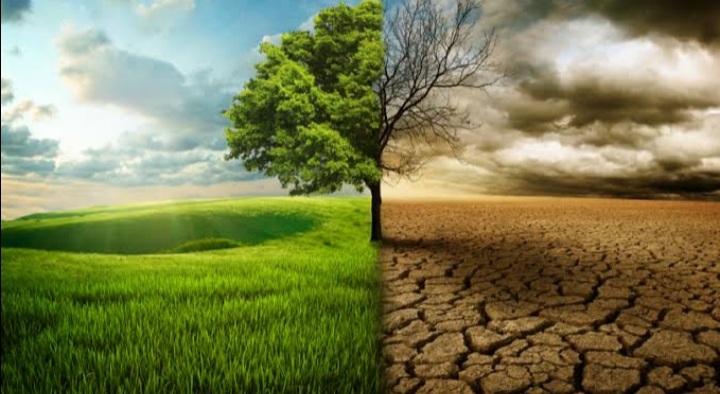
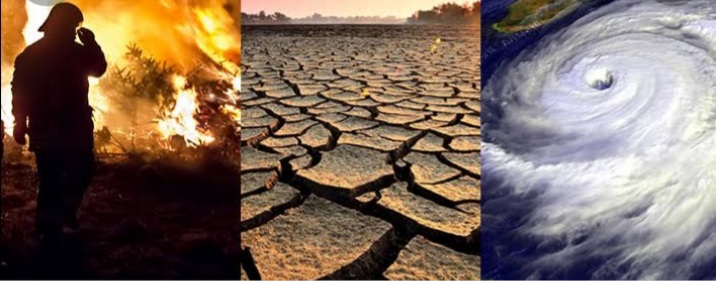
 This is a simple explanation of Climate Change, based on an article in the New York Times. The average temperature on the surface of the planet has already increased 1.7 degrees Fahrenheit since 1880, which may not seem like much, but think about it this way, the heat from human emissions is roughly equal to 400,000 Hiroshima atomic bombs exploding across the planet every single day. Future generations are in big trouble. But for now it will continue to get warmer and storms will grow more intense, with longer periods of drought in between. But longer-term, if emissions continue to rise unchecked, the climate disasters will be so severe they will destabilize entire nations, send millions of refugees across borders, cause widespread extinction of most species on Earth, and melt the polar ice caps, leaving most of the world’s coastal cities several feet underwater.

 All this could take centuries, but something like the sudden collapse of agriculture would trigger immediate chaos in society. Best case is we get our act together and begin to rapidly bring emission levels down; meanwhile, Earth turns out to be less sensitive to greenhouse gases than we currently believe, plants and animals adapt quickly, and major technological breakthroughs help society limit emissions and adjust to climate change. But, these are all the opposite of what we’re actually seeing, so the only thing in our control is to limit emissions using all available tools and best behaviors currently at our disposal. Worst case, the collapse of food production causes spiraling prices and kind of like a zombie apocalypse, but with extreme hunger spreading chaos instead.
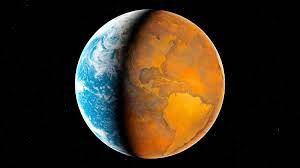
 So, yeah, still just like a zombie apocalypse. This would be coupled with the melting of the Antarctic ice sheet, leading to rapidly rising seas that would force us to abandon many of our greatest cities and all of the social and scientific progress that we were making within them. Adding insult to injury is the fact that many of the emissions were emitted while building these now abandoned, underwater metropolises. If emissions continue unchecked, we’re looking at a total rise of between 80 to 160 feet, which would occur if all the ice in the polls melted. 

So the oceans will rise, the real question is how fast? Scientists only have Earth’s history to base their predictions on, which suggests that the rate has occasionally hit 1 foot per decade…so we’ll have to adapt to an altered coastline sooner or later, but probably much sooner than later. Because… Computer forecasts only give us a range of future possibilities, the most important evidence comes from the study of past climate conditions which clearly show that every time the amount of carbon dioxide in the air rises, the Earth warms up, ice melts, and the ocean rises. What’s important to remember here is that we are in uncharted territory
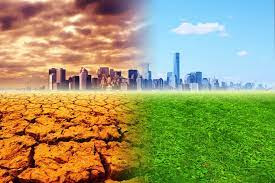
–humans are pumping carbon dioxide into the air far faster than nature ever has before us. Scientists have been publishing strong evidence that warming is making drought and heat waves more frequent, causing heavier rainstorms, and more severe coastal flooding. But while the Internet has made us all more aware of weather disasters in distant countries, it’s hard to prove these are all directly made worse by climate change, although they probably are. Canada and Russia both have vast, frozen lands, and could see some economic benefits from a warmer climate. Putin and the Russians, therefore, have been reluctant to make ambitious climate commitments. 

But expect that to change as these countries realize they will be swamped by millions of refugees from less fortunate nations. Libertarians and other political conservatives do not like the policies proposed to fight climate change and have chosen to try and block them by actively undermining the science. This effort has been funded by the oil and coal industry, who favor making money above all else. As more resources are devoted to solving the problem, our chances at big technological breakthroughs are improving, but we still should be spending about three-times as much money as we currently are on these efforts according to several in-depth reports. 

You can reduce your carbon footprint by doing things like plugging leaks in your home insulation, installing a smart thermostat, taking public transit, taking less airplane trips, buying an electric car, and putting solar panels on your roof. A big one is eating less meat. But what’s really needed is for you to speak up and exercise your rights as a citizen, because strong, collective action through state and national policies is how we’ll make the most impact. Considering that we’ve been ignoring scientists’ warnings since the 80’s to limit emissions, we’re pretty late in the game. But we’ve finally reached a moment where nearly every country in the world agrees this is a huge problem, and seem ready to commit to taking at least some kind of action. 

Leading corporations will continue to make bold promises to do their part, low-emission technologies will improve, and many states and cities will go much further than any goals set by their national governments. The United States, the world’s biggest economy, is finally starting to move aggressively, and China, the world’s largest emitter, is beginning to recognize that it needs to do the same, as many of its megacities cities will be underwater if the seas rise too high. But it’s up to us, the ordinary citizens, to continue demanding our political leaders tackle climate change, the hardest problem that humanity has ever faced. 

Why is Biodiversity so important ?

Hello Friends ……Our planet’s diverse thriving ecosystems may seem like permanent fixtures, but they’re actually vulnerable to collapse. Jungles can become deserts, and reefs can become lifeless rocks, even without cataclysmic events, like volcanoes and asteroids. What makes one ecosystem strong and another weak in the face of change? The answer, to a large extent, is biodiversity. Biodiversity is built out of three intertwined features: ecosystem diversity, species diversity, and genetic diversity. The more intertwining there is between these features, the denser and more resilient the weave becomes. 

Take the Amazon rainforest, one of the most biodiverse regions on Earth due to its complex ecosystems, huge mix of species, and the genetic variety within those species. Here are tangled liana vines, which crawl up from the forest floor to the canopy, intertwining with treetops and growing thick wooden stems that support these towering trees. Helped along by the vines, trees provide the seeds, fruits and leaves to herbivores, such as the tapir and the agouti, which disperse their seeds throughout the forest so they can grow. 

Leftovers are consumed by the millions of insects that decompose and recycle nutrients to create rich soil. The rainforest is a huge system filled with many smaller systems, like this, each packed with interconnected species. Every link provides stability to the next, strengthening biodiversity’s weave. That weave is further reinforced by the genetic diversity within individual species, which allows them to cope with changes. Species that lack genetic diversity due to isolation or low population numbers, are much more vulnerable to fluctuations caused by climate change, disease or habitat fragmentation. 

Whenever a species disappears because of its weakened gene pool, a knot is untied and parts of the net disintegrate. So, what if we were to remove one species from the rainforest? Would the system fall apart? Probably not. The volume of species, their genetic diversity, and the complexity of the ecosystems form such rich biodiversity in this forest that one species gap in the weave won’t cause it to unravel. The forest can stay resilient and recover from change. But that’s not true in every case. In some environments, taking away just one important component can undermine the entire system. 

Take coral reefs, for instance. Many organisms in a reef are dependent on the coral. It provides key microhabitats, shelter and breeding grounds for thousand of species of fish, crustaceans and mollusks. Corals also form interdependent relationships with fungi and bacteria. The coral itself is a loom that allows the tangled net of biodiversity to be woven. That makes coral a keystone organism, one that many others depend on for their suvival. So what happens when destructive fishing practices, pollution and ocean acidification weaken coral or even kill it altogether? Exactly what you might think. 

The loss of this keystone species leaves its dependents at a loss, too, threatening the entire fabric of the reef. Ecosystem, species and genetic diversity together form the complex tangled weave of biodiversity that is vital for the survival of organisms on Earth. We humans are woven into this biodiversity, too. When just a few strands are lost, our own well-being is threatened. Cut too many links, and we risk unraveling it all. What the future brings is unpredictable, but biodiversity can give us an insurance policy, Earth’s own safety net to safeguard our survival.

What is Dyslexia? – Student's Problems

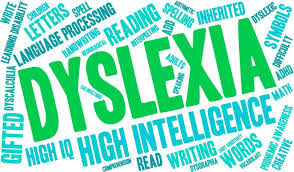
Hello Friends !.. . Take a moment to read the following. How was that? Frustrating? Slow? What were those sentences about? They’re actually a simulation of the experience of dyslexia, designed to make you decode each word. Those with dyslexia experience that laborious pace every time they read. When most people think of dyslexia, they think of seeing letters and words backwards, like seeing “b” as “d” and vice versa, or they might think people with dyslexia see “saw” as “was”. The truth is people with dyslexia see things the same way as everyone else. 

Dyslexia is caused by a phonological processing problem, meaning people affected by it have trouble not with seeing language but with manipulating it. For example, if you heard the word cat and then someone asked you, “Remove the ‘c’,” what word would you have left? At. This can be difficult for those with dyslexia. Given a word in isolation, like fantastic, students with dyslexia need to break the word into parts to read it: fan, tas, tic. Time spent decoding makes it hard to keep up with peers and gain sufficient comprehension. Spelling words phonetically, like s-t-i-k for stick and f-r-e-n-s for friends is also common. These difficulties are more widespread and varied than commonly imagined. Dyslexia affects up to one in five people. It occurs on a continuum.

One person might have mild dyslexia while the next person has a profound case of it. Dyslexia also runs in families. It’s common to see one family member who has trouble spelling while another family member has severe difficulty decoding even one syllable words, like catch. The continuum and distribution of dyslexia suggests a broader principle to bear in mind as we look at how the brains of those with dyslexia process language. 

Neurodiversity is the idea that because all our brains show differences in structure and function, we shouldn’t be so quick to label every deviation from “the norm” as a pathological disorder or dismiss people living with these variations as “defective.” People with neurobiological variations like dyslexia, including such creative and inventive individuals as Picasso, Muhammad Ali, Whoopi Goldberg, Steven Spielberg, and Cher, clearly have every capacity to be brilliant and successful in life. So, here’s the special way the brains of those with dyslexia work. 

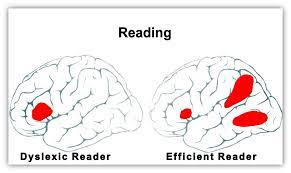
The brain is divided into two hemispheres. The left hemisphere is generally in charge of language and, ultimately, reading, while the right typically handles spatial activities. fMRI studies have found that the brains of those with dyslexia rely more on the right hemisphere and frontal lobe than the brains of those without it. This means, when they read a word, it takes a longer trip through their brain and can get delayed in the frontal lobe. Because of this neurobiological glitch, they read with more difficulty.’

 But those with dyslexia can physically change their brain and improve their reading with an intensive, multi-sensory intervention that breaks the language down and teaches the reader to decode based on syllable types and spelling rules. The brains of those with dyslexia begin using the left hemisphere more efficiently while reading, and their reading improves. 

The intervention works because it locates dyslexia appropriately as a functional variation in the brain, which, naturally, shows all sorts of variations from one person to another. Neurodiversity emphasizes this spectrum of brain function in all humans and suggests that to better understand the perspectives of those around us, we should try not only to see the world through their eyes but understand it through their brains.

What is Dyslexia? – Student's Problems

Hello Friends !.. . Take a moment to read the following. How was that? Frustrating? Slow? What were those sentences about? They’re actually a simulation of the experience of dyslexia, designed to make you decode each word. Those with dyslexia experience that laborious pace every time they read. When most people think of dyslexia, they think of seeing letters and words backwards, like seeing “b” as “d” and vice versa, or they might think people with dyslexia see “saw” as “was”. The truth is people with dyslexia see things the same way as everyone else. 

Dyslexia is caused by a phonological processing problem, meaning people affected by it have trouble not with seeing language but with manipulating it. For example, if you heard the word cat and then someone asked you, “Remove the ‘c’,” what word would you have left? At. This can be difficult for those with dyslexia. Given a word in isolation, like fantastic, students with dyslexia need to break the word into parts to read it: fan, tas, tic. Time spent decoding makes it hard to keep up with peers and gain sufficient comprehension. Spelling words phonetically, like s-t-i-k for stick and f-r-e-n-s for friends is also common. These difficulties are more widespread and varied than commonly imagined. Dyslexia affects up to one in five people. It occurs on a continuum.

One person might have mild dyslexia while the next person has a profound case of it. Dyslexia also runs in families. It’s common to see one family member who has trouble spelling while another family member has severe difficulty decoding even one syllable words, like catch. The continuum and distribution of dyslexia suggests a broader principle to bear in mind as we look at how the brains of those with dyslexia process language. 

Neurodiversity is the idea that because all our brains show differences in structure and function, we shouldn’t be so quick to label every deviation from “the norm” as a pathological disorder or dismiss people living with these variations as “defective.” People with neurobiological variations like dyslexia, including such creative and inventive individuals as Picasso, Muhammad Ali, Whoopi Goldberg, Steven Spielberg, and Cher, clearly have every capacity to be brilliant and successful in life. So, here’s the special way the brains of those with dyslexia work. 

The brain is divided into two hemispheres. The left hemisphere is generally in charge of language and, ultimately, reading, while the right typically handles spatial activities. fMRI studies have found that the brains of those with dyslexia rely more on the right hemisphere and frontal lobe than the brains of those without it. This means, when they read a word, it takes a longer trip through their brain and can get delayed in the frontal lobe. Because of this neurobiological glitch, they read with more difficulty.’

 But those with dyslexia can physically change their brain and improve their reading with an intensive, multi-sensory intervention that breaks the language down and teaches the reader to decode based on syllable types and spelling rules. The brains of those with dyslexia begin using the left hemisphere more efficiently while reading, and their reading improves. 

The intervention works because it locates dyslexia appropriately as a functional variation in the brain, which, naturally, shows all sorts of variations from one person to another. Neurodiversity emphasizes this spectrum of brain function in all humans and suggests that to better understand the perspectives of those around us, we should try not only to see the world through their eyes but understand it through their brains.

Overpopulation – The Human Explosion

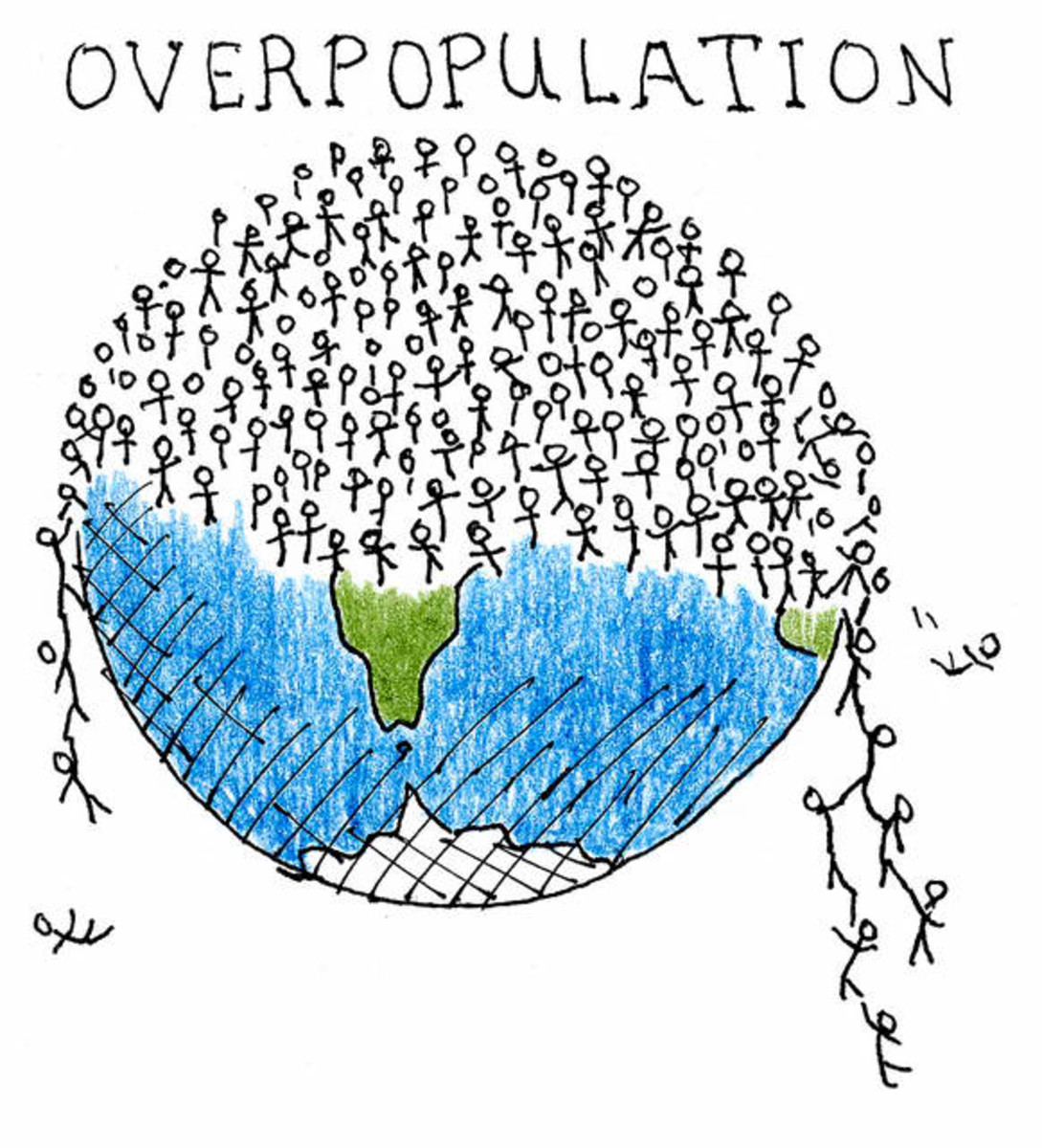
Never before in history, have there been so many people on Earth as right now. Our numbers have skyrocketed, from 1 billion in 1800, to 2.3 billion in 1940, 3.7 billion in 1970, and 7.4 billion in 2016. The world population increased fourfold in the last century, so what can we expect for the next century? And what does population growth mean for our future? Will there be mass-migration? Overcrowded slums and megacities covering continents? Diseases and pollution? Chaos and violence over energy, water, and food? And a human species focused only on sustaining itself? Will population growth destroy our way of life? Or is this prophecy just ungrounded panic? In the 1960s population growth reached an unprecedented rate. Which lead to apocalyptic prophecies. 

The poor would pro-create endlessly and overrun the developed world. The legend of overpopulation was born. But it turns out high birth rates and the population explosion are not permanent features of some cultures or countries, But rather a part of a four step process the whole world is going through, The demographic transition. Most developed countries have already made the transition, while other countries are doing it right now. Let’s go back to the 18th century, when the entire world, including Europe, was in the first stage of the demographic transition. By today’s standards, Europe was worse off, than a developing region, suffering from poor sanitation, poor diets, and poor medicine. 

A lot of people were born, but lots of them died just as fast, so the population hardly grew. Women had between 4 and 6 children, but only 2 of them would reach adulthood. Then the industrial revolution happened in the UK and bought the greatest change in human living conditions since the agricultural revolution. People went from being peasants to workers. Manufactured goods were mass produced and became widely available. The sciences flourished and advanced transportation, communication, and medicine. The role of women in society shifted and created the conditions for their emancipation. Slowly this economic progress not only formed a middle class, but also raised standards of living and health care for the poor working population. The second transition stage started. 

Better food supplies, hygiene and medicine, meant people stopped dying all the time, especially so, at a very young age. The result was a population explosion. Doubling the UK’s population between 1750 and 1850. The main reasons families used to have lots of children was that only a few of them were likely to survive. Now that had changed, so the third stage of transition was set in motion. Fewer babies were conceived, and population growth slowed down. Eventually a balance emerged, fewer people were dying and fewer children were born, so the death rate and birth rate became stable. 

Britain had reached the fourth stage of the demographic transition. This didn’t only happen in the UK, more and more countries went through the four stages. First, many births and many deaths due to bad living conditions. Second, better living conditions leading to fewer deaths and a population explosion. Third, fewer deaths resulting in fewer births, and population growth came to an end. But if birth rates have dropped so much, why is the population still growing so fast? Well, the children born in the population explosion of the 70s and 80s are having kids themselves now. Leading to a noticeable spike in overall population. But they are having far fewer children on average than their parents.

 The average today is 2.5, it was 5, 40 years ago. So as this generation gets older, and fertility declines further, the rate of population growth will keep on slowing. This is true for every country. In the west, we tend to overlook progress in other regions of the world. But actually most of the world’s countries have made it to the fourth stage. Just look at Bangladesh. In 1971, the average woman had 7 kids, but 25% of them would die before the age of 5. In 2015, the mortality rate was down to 3.8% and women had only 2.2 kids on average. This is the rule, not an exception, we’re not special, we just had a head start. It took developed countries about 80 years to reduce fertility from more than 6 children, to less than 3. Others are catching up fast. 

Malaysia and South Africa did it in only 34 years; Bangladesh took just 20. Iran managed it in 10 years. All these countries that are catching up didn’t have to start from scratch and the more support they get, the faster they catch up. This is why programs that help lower child mortality or help poor nations develop, are so important, No matter what your motivation is, whether you dream of a world where all people live in freedom and wealth, or you just want fewer refugees coming into your country, 

The simple truth is, that it’s beneficial to you personally if people on the other side of the globe can live a good life. And we are getting there, the percentage of people living in extreme poverty has never been as low as today. So the future of global population growth is not an apocalyptic prophecy, it’s a promise! Population growth will come to an end. The UN forecasts that the 12th billionth human will never be born at all. And as the development level of the world rises, the number of people a higher education will increase tenfold. Countries who used to be a need, will help advance development instead. More people is going to mean more people able to advance our species.

Big Basket Business Model – How Big Basket Earns

Hello Friends ! Big Basket, our grocery leader in India so the story starts in 1999 when there was a .com boom and this is one of the 1st e-commerce company who came to buy online after 2 years they added grocery too in starting a lot of people came online but you know in starting people don’t buy online only COD can operate at that time and not online payment so people came but did not buy it so they analyze and they came to offline and in south India they got a huge success they opened a fab mart and sell everything in it but still it did not make much profit and in 2006 Birla group overtook it and in 2011 they again return online under sell retail network in 2011 only they got a funding do try to understand this.

If you want to have a grocery business so what are the options 1st is inventory modal, means I will buy product directly from the company at a discount rate next I will be selling to my target audience and rest is my profit 2nd is market place, like amazon and flipkart do here if I will get an order then I will transfer to other and they will deliver it 3rs is hybrid here I am doing the both 1st and 2nd logically they did marketplace, they captured small-small grocery shop and made a pact with them and now the orders they get via there app and website, they do forward to these small grocery shops and deliver the product via a delivery boy so this was the simple process slowly they got the findings and they started to grow and then they shifted to inventory model because in this there is a lot of margin and you can too control your quality they have 18000 listed products, more than 1000 brands and still it’s going under loss.

 but slowly and slowly there revenue is increasing last year they did Rs1176 crore revenue and had a loss of Rs191 crore they had a 1500 ticket size and 650 ticket size if one opts for express delivery there target is by the end of 2020 we gonna to take 2000 crore revenue in my opinion fab mart too was a good business model but in 1999’s internet used to be a new technology and people don’t trust internet and online payment, not good speed, and not visual websites so they took a good step by coming to offline market and made money and reinvested afterword so from 2011 they are in loss, but in coming years they will be coming in profit because it’s inventory modal will keep on increasing with the advent of revenue there expenses will tend to decrease they do a simple strategy by ranking it’s customer basically. 

If you order today then you are not it’s customer so suppose in 3 month you ordered 2-3 times, then you became a silver customer for them silver customer means that this is our potential customer and their platinum customer comes 95% repeatedly so your expenditure get’s decreases time to time countanously in 13 funding round, they had taken 884 million dollar and recently they had taken 300 million dollar funding from Alibaba in June 2015 they acquired deliver and that inquisition was good according to me because of this they are able to deliver products on time before that in inventory modal they used to get delay in delivery time.

Now they can deliver vegetables in 2 to 3 hours in vegetable you need to deliver within 1 hours and not in 2 to 3 days so this thing is possible due to delivery acquisition and I will be giving them +1 in grocery they operate in 35% of profit margin and in other item 10-12% margin you may be finding it more but if you see there expenditure-website, app, delivery and many more things to run this makes there expenditure and still they are under loss there is 2 trillion dollar economy in this globally out of which 300 billion dollar online is there if we take globally then it will fluctuate 15-30% in online retail .

If you want to do this type of business then target the cities because in cities there is a lot more awareness, less acquisition cost and you will be getting at a less rate ultimately will tend to sell in your products and will increase your potential customer in village your accusation cost will tend to rise due to lack of education .

Starbucks Failed In Australia WHY ?….

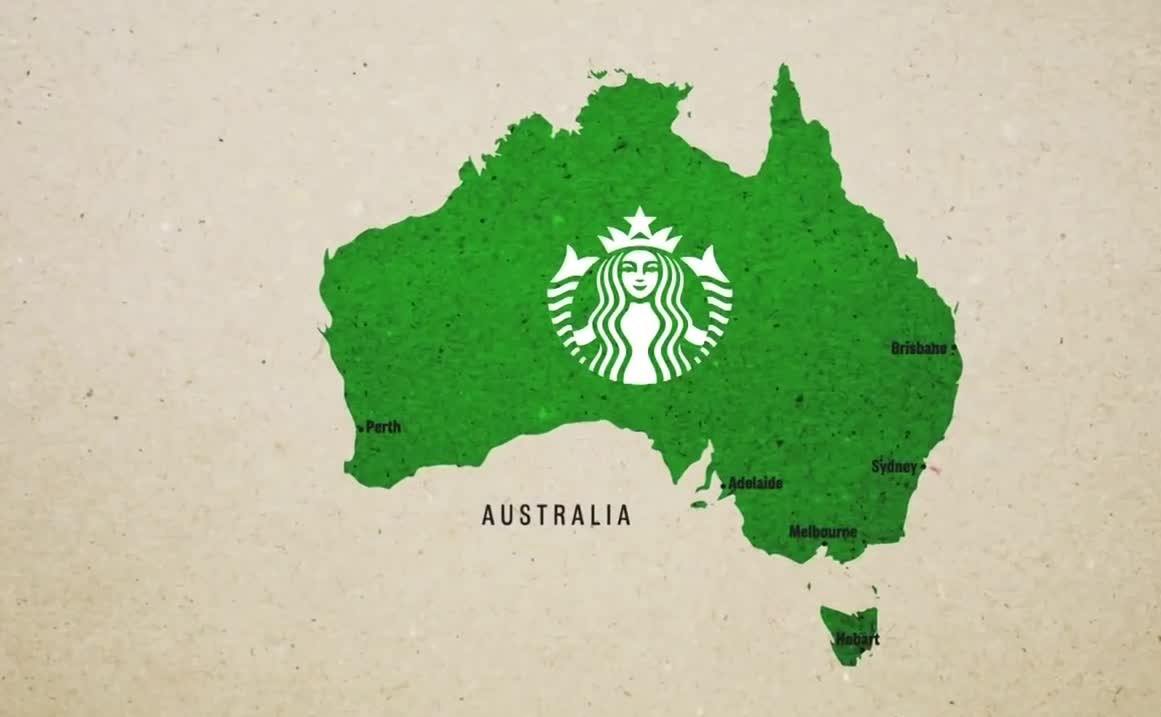
Starbucks has coffee shops all over the world There are more than 28,000 locations and 76 markets From Shanghai to Guantanamo Bay And in China, a new Starbucks location opens up every 15 hours But there is one continent that seems uninterested in the hype over the Seattle based coffee chain And that continent is Australia It’s proven to be one of the toughest markets in the world to break into So tough in fact, that Starbucks closed more than two-thirds of its stores on the continent back in 2008. So what went so wrong with Starbucks and Australia To answer that let’s go back to July of 2000 When Starbucks opened its first Australian shop in Sydney.

 From there it expanded fast By 2008 Starbucks had 87 stores across the continent I think one of the problems with Starbucks and its true for a lot of businesses that have been successful in one country is that they thought that their business model could just roll out to a different environment and there was no need for them to adjust But that was the problem They tried to grow the Empire too fast Starbucks rapidly opened up multiple locations instead of slowly integrating them into the Australian market When they launched they launched too rapidly and didn’t give .

The Australian consumer an opportunity to really develop an appetite for the Starbucks brand They also moved into regional areas into outer suburbs of major cities And so for the Australian consumer it was almost like it was too available for them And so there wasn’t this point of difference, this want, this need for Starbucks And it wasn’t an organic growth which is what we very much saw in the US In its first 7 years in Australia, Starbucks accumulated $105 million in losses By 2007, Starbucks Australia was hanging on by a thread taking big loans from the US, totaling up to $54 million And in 2008, Starbucks announced it was shutting down 61 stores But of course 2008 was a difficult time for businesses due to the financial crisis Along with Australia closures, Starbucks also closed 600 underperforming American stores But even still such a retreat in Australia was embarrassing for the brand.

When you’re shutting down 75 stores For the Australian consumer when they, when they did leave the market or at least a large number of bestowals were shut down they didn’t really care It’s partly because Australians are spoiled for choice when it comes to coffee Australia’s coffee market is one of the biggest in the world the industry is expected to hit more than $6 billion in total revenue in 2018 They’ve been immersed in nuances of cafe culture since the mid 1900s when Italian and Greek immigrants began traveling to the country The immigrants introduced Australians to espresso By the 1980s, Australians were fully engulfed in cafe culture.

They’ve also grown accustomed to specialty menu items like a flat white or an Australian macchiato So cafes in Australia were born out of like the Italian culture of, you know, meeting of friends and knowing your local barista and it being kind of like a local meeting place where everyone knew each other and that coffee was just a part of that and then Starbucks came in with what is more of an American style like coffee culture which is essentially just like coffee is a product, coffee is a commodity Coffee is like, like perk me up in the morning it’s caffeination Starbucks had a basic menu and offered more sugary drinks which most Australians didn’t like in Australia where, you know, local tastes are different So we don’t really want a coffee that’s, you know, hundreds of ounces with lots of sugar in it We want something a little more sophisticated Plus Starbucks charge more than local cafes .

So Australians instead opted to pay less for coffee they liked from a local barista they trusted And so when you come in with this big like hey, we’re going to open all these cafes And they’re all gonna be to go focus It just was the complete wrong market for what, what the Australian was used to But there is one American coffee company that’s thriving in Australia Founded in Chicago and now based in Australia Gloria Jean’s got the traction in Australia that Starbucks couldn’t Gloria Jean’s has more than 400 Australian locations And serves more than 35 million consumers in Australia each year So what is Gloria Jean’s doing in Australia that Starbucks isn’t Well the company attributed to success to two Australians who franchised the business in their home country Shops started to show up in Australia in 1996 Fast forward to today, the company has a presence in every Australian state .

The reason? Its menu The chain offers a wide variety of espresso drinks and specialty coffee Failing to adapt its menu to Australians coffee culture proved to be a mistake for Starbucks And the company faces another challenge later this year Italy Starbucks is opening its first store in Milan in late 2018 home of the espresso, Italy is rich in cafe culture But according to Starbucks it’s not going to make the same mistakes that it did in Australia The company said that it would develop in Italy with humility and respect for its coffee culture It announced it would be opening a roastery which is not your average cafe It gives customers a chance to see coffee beans roasted and processed before their eyes So there’s a chance that it won’t struggle like it did in Australia But Starbucks isn’t admitting defeat in Australia either Starbucks is staging a comeback on the continent In 2014, Starbucks locations in Australia were purchased by the Mount Waverley base withers group .

So this time it’s taking a different approach to putting Starbucks on the continent So if you just think about Australia as a big tourist destination There’s a lot of U.S. and Chinese tourists Starbucks has been very successful in China and it makes a lot of sense for them to build out because there are people looking for something that’s familiar to them Now with 39 locations in Brisbane, Melbourne, the Gold Coast, and Sydney areas this time it’s not looking to appeal to Australians but instead the coffee giant hopes to be a familiar face for tourists visiting popular vacation destinations in Australia free Australia has always been a high-volume tourist market .

The same thing in terms of international students at our universities are potential opportunities for them And we’re starting to see Starbucks enter into some large shopping malls here in Australia as well Australia welcomed 9 million tourists from 2017 and 2018 And those international visitors spent more than $30 billion in 2017 alone So tourists could possibly be the key to keeping the company afloat and preventing another downfall .

New Education Policy

Photo by Julia M Cameron on Pexels.com

Education is the most powerful weapon we can use to change the world- Nelson Mandela”

The knowledge and skills acquired by a person depends on the education system. A person cannot become a saint by learning about the scriptures and holy books, for this he must practice some basic self-actualization habits to conquer the hurdles and to achieve the desired position. Likewise, an engineer in his degree period is not restricted to the technical books. for this he also comes across the practical field to excel in the career.

The policies of education in the teaching sector are the backbone of it. Education policy is a plan where government is involved in the educational sphere and laws of education system. The most common place where education policy plays its part are- field of schools, include school size, class size, school choice, school privatization, teaching selection, education and certification, teacher pay, teaching method, curricular content, graduation requirement and school infrastructure investment. All the major part of the education revolves around the education policy. The stronger the policy the better will be the future of schooling.

With the onset of pandemic, the education policy has taken a big turn. For which, the whole world had to undergo the revision of education policy. In India, Government has come with National Education policy of 2020 where there are some modifications of rules and guidelines. Here, school curriculum  will be restructured in a new 5+3+3+4 form. Early childhood care and education (ECCE) focuses on investment infrastructure such as children playing equipments. There is also a Foundational literacy and Numeracy plan (FLN) where there is a three month preparatory course to students to access digital contents through energized textbook ETB-Diksha. It also aims to achieve universal foundational literacy and numeracy in primary schools by 2025. The policy also states that higher education system shall aim to be multidisciplinary by 2040. One of the most needed guidelines for teachers (Teachers and teacher education) where the policy proposes the minimum education degree requiring   a 4 year B.Ed undergraduate programme.  Policy also demands to allow promotion based on merit. A big change where this policy is coming up with “Equitable and inclusive education” plan where there is gender equality and promises to female and transgender students by driving state level inclusion activities, developing sufficient infrastructure for safety, and targeted boarding. Talking about the ground system and the building structure of education in country, this policy plans to re-organize smaller schools with very low enrolment into a school complex structure which connects 10-15 such small schools into one administrative which will help reduce school isolation efficiently, use teaching learning resources, and increase governance and accountability, especially in rural/ adivasi parts of India.

Thus, it is quite evident that the countries education system has reversed. There is a big competition in the education field to achieve the best goal. With the right plan and structures this country could attain success. As said,” Education is the best economy policy there is – Tony Blair”

GLOBAL WARMING

Green house effect

Global warming refers to an average increase in the earth’s temperature, which in turn causes changes in climate.   During the past 4.65 billion years of its history, earth has warmed many times. But at present it is facing a rapid warming mainly due to human activities. The average temperature of the earth is about 59⁰F (15⁰C). During the last century this average has risen by about 1⁰F. By the year 2100, it is believed that the rise would be between 2.5 and 10.4⁰F. This will cause dramatic changes such as rise in sea level, changes in rainfall patterns,wide range of impacts on plants, wildlife and humans.

Green house gases and Green house effect

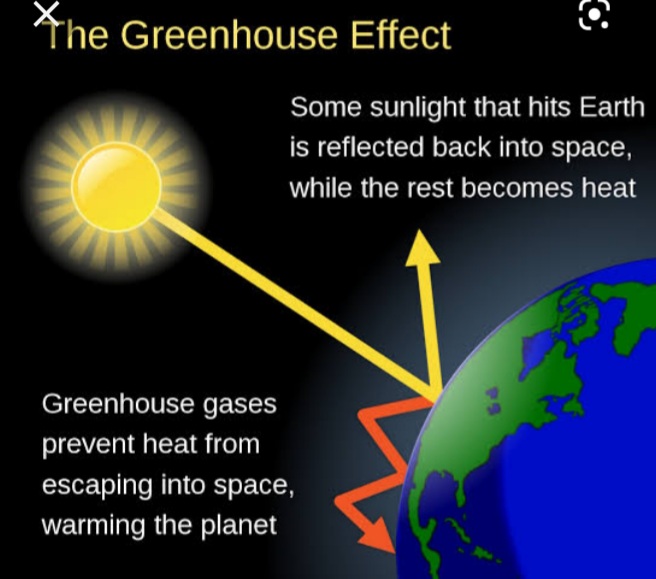
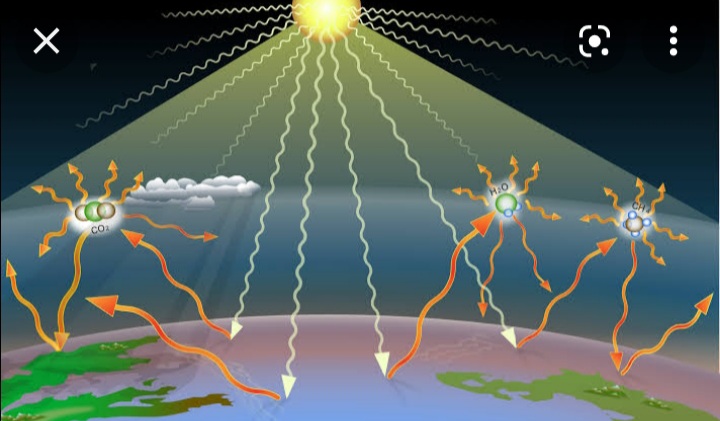
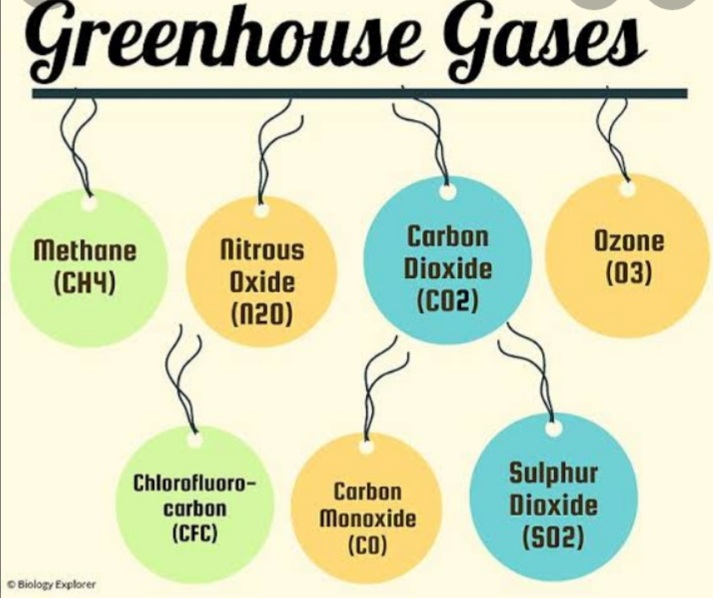
The trapping of energy from the sun by certain gases in the atmosphere leading to rise in earth’s temperature is known as Green house effect. Hence these gases are known as green house gases. Some gases such as water vapour, carbon dioxide, nitrous oxide and methane act as the trap. These gases absorb and reflect infra-red waves radiated by earth. By doing so,these gases conserve heat as in a green house.

Normally all life on earth depends on this green house effect. If it does not exist, earth would be cooled,and ice would cover earth from pole to pole.But if the greenhouse effect becomes strong it could make the earth warmer than usual. Even a little extra warming may cause problems for humans, plants and animals.

Types of Greenhouse Gases

In the environment, greenhouse gases occur (i) naturally or (ii) from the human activities.

The most abundant greenhouse gas is carbon dioxide. It reaches the atmosphere due to volcanic eruptions, respiration of animals, burning and decay of organic matter such as plants.  Normally carbon-dioxide is removed by the plants through photosynthesis. Carbon dioxide is also absorbed into ocean water. But humans by their activities increase the release of carbon dioxide into the atmosphere. Such activities include burning of fossil fuels,solid wastes,wood and wood products to drive vehicles, generate electricity etc. At the same time due to deforestation, the number of trees available to absorb carbon dioxide through photosynthesis has been greatly reduced.

Human activities, have caused carbon-dioxide to be released to the atmosphere at rates much faster than that at which earth’s natural processes can recycle this gas. There were about 280 molecules of carbon-dioxide per million molecules of air (i.e.,parts per million or ppm) in 1750. Today atmospheric carbon-dioxide concentrations are 368ppm, a 31% increase.

Methane traps 20 times more heat than carbon-dioxide. It is emitted during the production and transport of coal,natural gas and oil. It is also emitted from rotting organic waste in sand fills,by the cows as a by product of digestion. Since 1750,the amount of methane in the atmosphere has more than doubled.

Nitrous oxide traps 300 times more heat than carbon-dioxide. Burning fossil duels and ploughing farm soil releases Nitrous oxide. Since 1750 ots level increased by 17%.

Hydrocarbons formed from the manufacture of foams,coolants such as chlorofluorocarbons used in refrigerators are the other gases responsible for global warming.

In 2000,scientists discovered an alarming increase in the level of a new gas called trifluoromethyl sulphur penta fluoride. Eventhough the gas is rare, it traps more effectively than all other greenhouse gases, The saddest part of it is that the industrial source of the gas is not yet identified.

Effects of Global warming

1. Due to the warming of oceans, sea level will rise. Glacier ice will also melt,causing further rise in sea level. As a result in the 21st century sea level will rise from 9 to 88 cm. Such a rise will submerge many parts of countries.

2. Seasons will be longer in some areas.

3. The warmed would will be generally more humid and greater humidity will increase the rainfall.

4. Storms are expected to be more frequent and intense.

5. Some regions of the world become dry.

6. Wind blows will be harder and in different patterns . Hurricane would be more severer.

7. Weather patterns would be less prediclable and more extreme.

8. Crops and forests may be affected by more insects and plant diseases.

9. Some types of forests may disappear.

10. More people will get sick or die from heat stress.

11. Tropical diseases such as malaria, dengue fever,yellow fever and encephalitis will spread to other parts of the world.

Effects to control Global warming

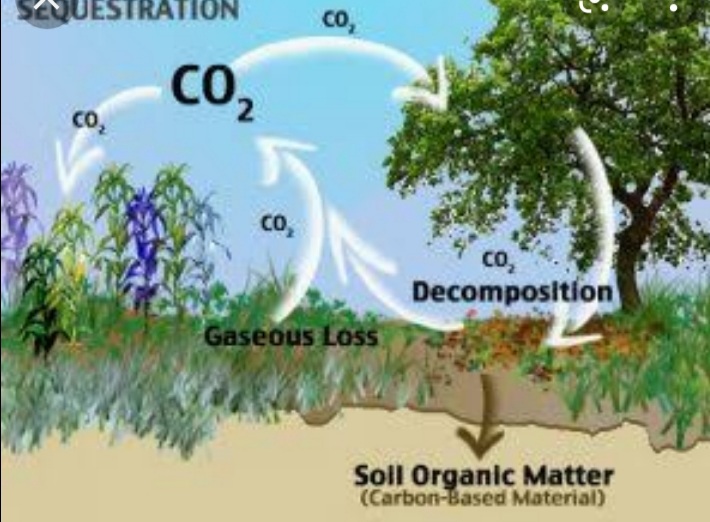
Two major ways are there to control global warming: 1. to keep the carbon-dioxide out of the atmosphere by storing the gas or its carbon component somewhere else,a strategy called carbon sequestration. 2.to reduce the production of greenhouse gases.

Carbon sequestration

The simple technique is to preserve trees and plants more. Trees ,take up carbon-dioxide, break it down in photosynthesis, and store carbon in new wood. It need massive reforestation. Carbon-dioxide can also be sequestration directly into deep ocean water or into oil wells or some aquifer from which it cannot escape.

Reduce the production of greenhouse gases

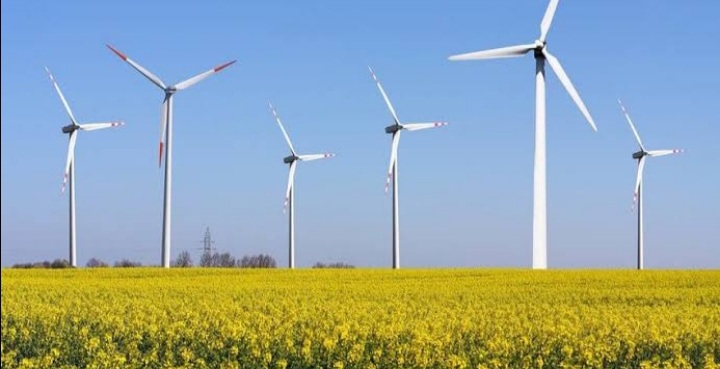
Usage of alternative fuels such as nuclear energy, solar power, wind power and hydrogen fuel cells which emit no greenhouse gases are being considered.

Bhagat Singh- The Legend.

Bhagat Singh was a true symbol of heroism for the youth of India. Born on September 28, 1909, in Lyallpur now in Pakistan. Bhagat was the son of Shri Kishan and Shrimati Vidyavati. He was still a student of the National College and only sixteen years of age when he joined the revolutionary movement.

  The very tragedy of Jallianwala Bagh in 1919, where the British fired at the gathering in the bagh killing men, women, and children. This event caused a wave of terror and anger amongst the people all over the country. Bhagat Singh then a young lad of twelve years was greatly disturbed by this event. The feeling that the British must be driven out of India., lodged in the young boy’s mind. He asked his father Kishan Singh who himself was a revolutionary for permission to join the revolutionary movement.

  Later on, he even refused to marry and dedicate his life to the Liberation of India. He organized revolutionary activities others like namely Raj Guru, Chandrashekhar Azad, Sukhdev, and others. The planned agitations in Panjab, U.P., Delhi. They also planned agitation against the Simon Commission who had come from England to India to decide how much freedom and responsibility could be given to Indians. The absence of Indians on the committee made the Indians very angry. They protested with black flags, shouting ‘Go Back, Simon’. Lala Lajpat Rai was the patriot leader of this group. An officer named Saunders had hit Lala Lajpat Rai on his chest. Lalaji was badly injured and succumbed to his injuries a month later. This loss was avenged by Bhagat Singh and his revolutionaries who decided to kill Scott who had ordered the assault, instead they killed Saunders, the same officer who had hit Lalaji and killed him.

   They also exploded a bomb in the Central Legislative Assembly of ‘Inqalaab Zindabad’ ( long live Revolution). Bhagat Singh and his companions were arrested and a trial commenced. The judgment said that Bhagat Singh, Raj Guru, and Sukhdev were to be hanged until death while some others were jailed for a few years. The day decided was the 24th of March 1931, but they were hanged a day earlier and not even their families were allowed to meet them. Even on the day of hanging, they were fearless and cheerful. Kissing the rope, they themselves put it around their neck, they died with the name of Bharat Mata on their lips.

  Bhagat Singh was a revolutionary and a true patriot. He was against the tyrannical explorers and was of the view that the people were strong enough to rid themselves of their capitalist oppressors. He urged the people to feel proud and dedicate themselves to the liberation of their Motherland. Bhagat Singh died when he was only twenty-four years of age. An age at which other young people indulge in trivial pleasures and have no real aim in life. We owe it to him, and to the others who had died for the nation, to realize their dreams and shape India according to the ideals set by them that of a progressive and peaceful India.

The Fascination of Blue

Photo by Pixabay on Pexels.com

The fascination is something that comes in handy when you indeed are gifted with the weird yet beautiful planet of the solar system. Yes, earth, though this earth has many things to provide us and above all give us our life, a place to call home and a guardian to protect us too it also has many secrets, some of them we can find but some are way deep than our reach and all this is what makes it more fascinating and mysterious in its way.

So, today this article will provide you more facts and data to help the level of fascination to be more than just a child’s dream of a candy house.

Rolling It Up

  • Round- Round way flat- Though we have always learned from childhood that our home is round but what if I tell you it’s flat around the equator and the melting of ice is also helping in the broadening of its waistline. Earth rotation, many other forces, and motion are responsible for changing the earth’s shape, it still will be able to hold this not-so-round sphere shape for a long time.
  • The Purple and long DayDo you know that many scientists believe that our earth once was purple in color because at that time as a molecule Retinol was used as the way to absorb green light instead of chlorophyll. Our day use to be 6 hours long but as our moon keeps slowing down the rotation of the earth today we have 24hrs long days and it will keep on increasing after every century.
  • Magic is in Air: Every one of us believes in the magic of something or anything but what if I say that it’s actually true that magic is in the air and every day the dust or cosmic dust as we call them is falling on the earth surface around 60 tons every day. Our earth is not just having cosmic dust but also there is no record of having the information about who gave it the name Earth as every else planet is named after Greek god just not the earth.
  • The big Appetite: Our earth is close enough to the sun, though having many benefits over the doom but we still have some pressing issue of the big, old and angry star our Sun. As every old star gets old, exhausts its hydrogen and collapses into gravity, and then consumes everything around him to create a void-filled hole, a black hole. So do can happen with our sun and taking all of us in the process but we don’t need to worry it’s still a long way down.
  • The apple that fell: As the apple fell so do the gravity gets its virtue but even though we know there is everywhere gravity and not just our solar system but each and everything is under the direct effect of gravity which is keeping everything in its static position, but then also some of the places or point of the gravity bed is so high and so low that they make a noticeable difference. This variation is known as Gravity Anomili.

DEEP LEARNING SERIES- PART 6

The previous article was about the procedure to develop a deep learning network and introduction to CNN. This article concentrates on the process of convolution which is the process of taking in two images and doing a transformation to produce an output image. This process is common in mathematics and signals analysis also. The CNN’s are mainly used to work with images.

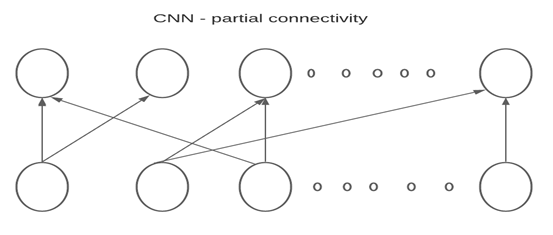
In the CNN partial connection is observed. Hence all the neurons are not connected to those in the next layer. So the number of parameters reduces leading to lesser computations.

Sample connection is seen in CNN.

Convolution in mathematics refers to the process of combining two different functions. With respect to CNN, convolution occurs between the image and the filter or kernel. Convolution itself is one of the processes done on the image.

Here also the operation is mathematical. It is a kind of operation on two vectors. The input image gets converted into a vector based on colour and dimension. The kernel or filter is a predefined vector with fixed values to perform various functions onto the image.

Process of convolution

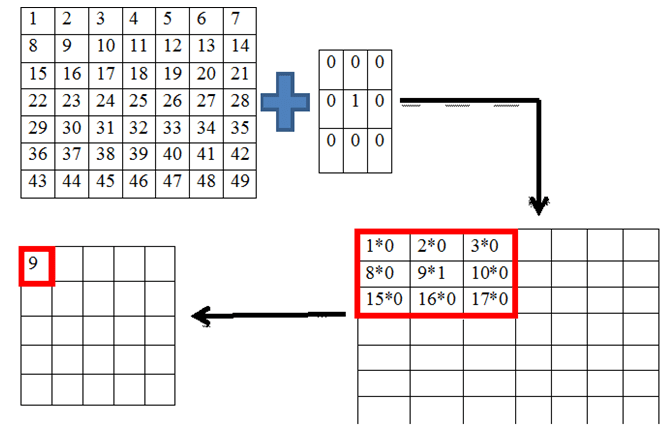
The kernel or filter is chosen in order of 1*1, 3*3, 5*5, 7*7, and so on. The given filter vector slides over the image and performs dot product over the image vector and produces an output vector with the result of each 3*3 dot product over the 7*7 vector.

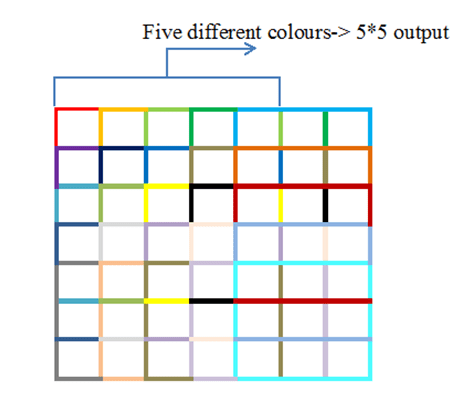
A 3*3 kernel slides over the 7*7 input vector to produce a 5*5 output image vector. The reason for the reduction in the dimension is that the kernel has to do dot product operation on the input vector-only with the same dimension. I.e. the kernel slides for every three rows in the seven rows. The kernel must perfectly fit into the input vector. All the cells in the kernel must superimpose onto the vector. No cells must be left open. There are only 5 ways to keep a 3-row filter in a 7-row vector.    

This pictorial representation can help to understand even better. These colors might seem confusing, but follow these steps to analyze them.

  1. View at the first row.
  2. Analyse and number the different colours used in that row
  3. Each colour represents a 3*3 kernel.
  4. In the first row the different colours are red, orange, light green, dark green and blue.
  5. They count up to five.
  6. Hence there are five ways to keep a 3 row filter over a 7 row vector.
  7. Repeat this analysis for all rows
  8. 35 different colours will be used. The math is that in each row there will be 5 combinations. For 7 rows there will be 35 combinations.
  9. The colour does not go beyond the 7 rows signifying that kernel cannot go beyond the dimension of input vector.

These are the 35 different ways to keep a 3*3 filter over a 7*7 image vector. From this diagram, we can analyse each row has five different colours. All the nine cells in the kernel must fit inside the vector. This is the reason for the reduction in the dimension of output vector.

Procedure to implement convolution

  1. Take the input image with given dimensions.
  2. Flatten it into 1-D vector. This is the input vector whose values represent the colour of a pixel in the image.
  3. Decide the dimension, quantity and values for filter. The value in a filter is based on the function needed like blurring, fadening, sharpening etc. the quantity and dimension is determined by the user.
  4. Take the filter and keep it over the input vector from the first cell. Assume a 3*3 filter kept over a 7*7 vector.
  5. Perform the following computations on them.

5a. take the values in the first cell of the filter and the vector.

5b. multiply them.

5c. take the values in the second cell of the filter and the vector.

5d. multiply them.

5e. repeat the procedure till the last cell.

5f. take the sum for all the nine values.

  • Place this value in the output vector.
  • Using the formula mentioned later, find the dimensions of the output vector.

HAPPY LEARNING!!

DEEP LEARNING SERIES- PART 5

The previous article was on algorithm and hyper-parameter tuning. This article is about the general steps for building a deep learning model and also the steps to improve its accuracy along with the second type of network known as CNN.

General procedure to build an AI machine

  1. Obtain the data in the form of excel sheets, csv (comma separated variables) or image datasets.
  2. Perform some pre-processing onto the data like normalisation, binarisation etc. (apply principles of statistics)
  3. Split the given data into training data and testing data. Give more preference to training data since more training can give better accuracy. Standard train test split ratio is 75:25.
  4. Define the class for the model. Class includes the initialisation, network architecture, regularisation, activation functions, loss function, learning algorithm and prediction.
  5. Plot the loss function and interpret the results.
  6. Compute the accuracy for both training and testing data and check onto the steps to improve it.

Steps to improve the accuracy

  1. Increase the training and testing data. More data can increase the accuracy since the machine learns better.
  2. Reduce the learning rate. High learning rate often affects the loss plot and accuracy.
  3. Increase the number of iterations (epochs). Training for more epochs can increase the accuracy
  4. Hyper parameter tuning. One of the efficient methods to improve the accuracy.
  5. Pre-processing of data. It becomes hard for the machine to work on data with different ranges. Hence it is recommended to standardise the data within a range of 0 to 1 for easy working.

These are some of the processes used to construct a network. Only basics have been provided on the concepts and it is recommended to learn more about these concepts. 

Implementation of FFN in detecting OSTEOARTHRITIS (OA)

Advancements in the detection of OA have occurred through AI. Technology has developed where machines are created to detect OA using the X-ray images from the patient. Since the input given is in the form of images, optimum performance can be obtained using CNN’s. Since the output is binary, the task is binary classification. A combination of CNN and FFN is used. CNN handles feature extraction i.e. converting the image into a form that is accepted by the FFN without changing the values. FFN is used to classify the image into two classes.

CNN-convolutional neural network

The convolutional neural network mainly works on image data. It is used for feature extraction from the image. This is a partially connected neural network. Image can be interpreted by us but not by machines. Hence they interpret images as a vector whose values represent the color intensity of the image. Every color can be expressed as a vector of 3-D known as RGB- Red Green Blue. The size of the vector is equal to the dimensions of the image.


This type of input is fed into the CNN. There are several processing done to the image before classifying it. The combination of CNN and FNN serves a purpose for image classification.

Problems are seen in using FFN for image

  • We have seen earlier that the gradients are chain rule of gradient at different layers. For image data, large number of layers in order of thousands may require. It can result in millions of parameters. It is very tedious to find the gradient for the millions of these parameters.
  • Using FFN for image data can often overfit the data. This may be due to the large layers and large number of parameters.

The CNN can overcome the problems seen in FFN.

HAPPY LEARNING!!!

BACTERIAL MENINGITIS

BY- DAKSHITA NAITHANI

INTRODUCTION

The inflammation of the meninges is known as meningitis. The Dura mater, arachnoid mater, and pia mater are the three membranes (meninges) that border the vertebral canal and skull, encapsulating the brain and spinal cord. Symptoms such as headaches, fever, and stiff neck are common.

Prior to the discovery of antibiotics, this was a fatal illness. Despite tremendous advancements in healthcare, the disease still has a death rate of over 25%. Many different pathogens can cause the disease, but bacterial meningitis has the largest worldwide impact.

Despite advances in diagnosis, treatment, and immunisation, 8.7 million cases of meningitis were recorded globally in 2015, with fatalities as much as 379,000. In early 2020, the first incidence of meningitis linked to COVID 19 was discovered. Every year on April 24th, World Meningitis Day is commemorated. Meningitis is one of the leading causes of illness and death in children under the age of five worldwide. According to Indian studies, meningitis is one of the main causes of mortality among infants under the age of five. 

TYPES OF MENINGITIS

Viral meningitis: It is the most frequent, but not the most dangerous, form of meningitis, accounting for 85 percent of cases. Enteroviruses are among the most prevalent causing viruses.

Bacterial meningitis: Bacterial meningitis is the second most prevalent kind of meningitis, affecting around 3 per million individuals each year. N. meningitidis, S. pneumoniae, H. influenzae, and S. aureus are the microorganisms that cause this kind of meningitis. Inflammation of the meninges can be caused by the same bacterium that causes TB.

In most countries, N.meningitidis is the primary cause of meningitis and a feared illness. The fatality rate from bacterial meningitis is frequently greater in underdeveloped nations than in industrialised countries.

Fungal meningitis: It’s a rare occurrence that generally leads to persistent meningitis. It is caused by a fungus that infects the body and travels from the blood to the nervous system, as the name implies.

Parasitic meningitis: It is less frequent than viral or bacterial meningitis and is caused mostly by parasites found in soil, excrement, cereals, or chickens. The infection is spread through ingesting the parasite’s eggs rather than normal routes. One of the most severe diseases is amoebic meningitis.

Non-infectious meningitis: It is a complication of an underlying health condition, rather than an infection. Inflammation in the tissues can be caused by a variety of factors, including drug use, head trauma, brain surgery, and cancer-related issues.

HOW DOES IT SPREAD FROM ONE INDIVIDUAL TO ANOTHER?

Meningitis caused by fungi, parasites, or non-infectious organisms is not contagious, while viral and bacterial are extremely contagious. Sneezing, coughing, and sharing utensils, cutlery, and toothbrushes are all ways to spread viral and bacterial meningitis. People who have these viruses or bacteria in their nose or throat but are not ill are generally carriers.

RISK FACTORS FOR MENINGITIS:

Risk factors for meningitis include:

•People who do not complete or skip their recommend childhood or adult immunization schedule

• Most of the viral cases occur in children younger than five years of age. Bacterial cases are common to those under the age of twenty years. Age also plays a big role in determining the risk factor.

 • It is possible to live in a community. Meningococcal meningitis is more common in college students who live in dorms and children who attend boarding schools or child care centres. This is most likely due to the bacterium’s ability to spread fast among big populations through the respiratory pathway.            

• Immune system dysfunction. Meningitis is also made more likely by AIDS, alcoholism, diabetes, immunosuppressive medications, and other immune system disorders. Anyone without a spleen should be immunised to reduce their risk.

SYMPTOMS

Meningitis affects more than two-thirds of children under the age of two, with the majority of cases occurring in the first two years of life. This might be related to low immunity and increased brain vascularity, which puts children at a higher risk. Furthermore, due to the immaturity of the central nervous system (CNS) in babies and children, the symptoms of infection are also hazy. Due to these reasons doctors depend more on the diagnostic tests rather than the symptoms.

-Fever for more than a week

-Neck stiffness

-Headaches

-Nausea and vomiting

-Altered or reduced level of consciousness

-Lethargy

-Rash

-Convulsions

Meningitis rash

A mild rash is one of the late indicators that one of the bacteria that causes meningitis, Neisseria meningitidis, is present in your circulation. The rash will become more visible as the illness progresses and spreads. The palms of the hands and the inside of the mouth, for example, may exhibit indications of a rash more easily than other parts of the body.

TREATMENT AND MANAGEMENT OF DISEASE

The therapy is determined on the underlying aetiology of meningitis. Antibiotics are used to treat bacterial meningitis, which may necessitate urgent hospitalisation. This might aid in the prevention of brain injury. The treatment of fungus meningitis may need the use of antifungal medicines. Viral meningitis may go away on its own, but you’ll need to see a doctor to figure out what’s causing it and how to treat it properly. On the basis of symptoms present parasitic meningitis is treated.

In all instances of bacterial meningitis, prompt treatment and supportive care and antibiotics are essential. Antibiotics are chosen depending on the organism that is thought to be causing the illness. In order to give the optimum antimicrobial coverage, the physician must consider the patient’s medical history.

Steroid Therapy: There isn’t enough data to back up the use of them in bacterial meningitis.

Chemoprophylaxis: Close contacts of a patient with N. meningitidis and H. influenzae type B meningitis should take this medication. People who have shared utensils, and health care providers in close proximity to secretions are all examples of close interactions.

Physical Therapy Management

In most cases, physical rehabilitation begins in the intensive care unit. It’s critical to remember a patient’s chart contraindications to therapy, such as intracranial pressure, cerebral pressure, and other lab results that dictate rehabilitation recommendations, while starting a plan of care. In the acute phase, proper posture and range of exercises should be started as soon as it is safe to do so. Proper pillow and towel placement will maintain the integrity of the skin and avoid contractures. Maintaining trunk and neck mobility is critical for functional mobility.

The earlier a patient begins therapy, the lower the risk of subsequent impairments, allowing for a better treatment.

If left untreated it can lead to significant brain problems and is sometimes deadly. In 10–20 percent of survivors, it can cause brain damage, hearing loss, or learning disabilities, as well as amputations in certain cases.

DIAGNOSTIC TESTS

 It is detected by analysing the cerebrospinal fluid, which includes a white blood cell count, glucose, protein, and, in rare circumstances, a polymerase chain reaction (PCR). A lumbar puncture is used to collect CSF, and the opening pressure can be monitored.

Bacteria in the blood are identified using blood cultures. Bacteria have the ability to move from the bloodstream to the meninges. Both sepsis and meningitis can be caused by a variety of bacteria, including N. meningitidis and S. pneumonia.

A differential complete blood count is an indicator of health general. The amount of red and white blood cells in your blood is counted. Infection is fought by white blood cells. In meningitis, the count is generally high.

Pneumonia, TB, and fungal infections can all be detected using chest X-rays. Meningitis can develop as a result of pneumonia.

A head CT scan may reveal issues such as a brain abscess. From the sinuses to the meninges, bacteria can spread.

A glass test may also be performed by doctors. The doctor performs this test by rolling a glass over the rash formed. It’s most probable meningitis rash if the rash doesn’t disappear with pressure. The odd patches on the skin may be the consequence of another ailment if it fades away.

PREVENTION

Microbes that cause meningitis can easily be dispersed all around through aerosols when a carrier coughs, sneezes or shares utensils or other oral items. A few steps which are present to prevent it are:-

• Please wash your hands. Hand cleaning is important in preventing the transmission of germs. Hands should be washed before and after meals, touching objects or animals in public places. Show children how to wash and rinse their hands completely and properly.

 •Practice good oral hygiene. Do not share edibles and utensils with anybody else.

•Maintain a good immune system by keeping a good diet and staying healthy.

 •One should always cover their mouth while coughing or sneeze.

• If you’re expecting a child, be cautious about what you eat. Reduce your risk of listeriosis by cooking meat to 165 degrees Fahrenheit, which includes hot dogs.  Choose pasteurised milk cheeses that are clearly stated on the package.

Why are the whales the biggest animals ever?

Most people are aware of the whales that can grow up to a massive 98 feet in length but did you know that just a few million years ago they only grew to about 32 feet. There are lots of different species of whales out there in today’s time approximately over 80 and some of the popular whales are the killer whale, the humpback whale, the beluga whale, the grey whale, the sperm whale and the blue whales. They are somewhat different in colour and shape but one common thing is that they’re all pretty impressive in size. For example, the sperm whale is the largest toothed predator on earth and the blue whale is the largest animal ever they are even larger than a dinosaur, woolly mammoth or any other living creature we know of that has ever lived on our planet.


Nearly 50 million years ago, Whales first came into existence and they looked nothing like they do today in fact they didn’t even live underwater. The first whale was Pakicetus, this was a four-footed land mammal and is known as the first whale and it was about the size of a wolf and was a carnivore.


According to the American Museum of Natural History fossils found in Pakistan back in 1983 revealed that these mammals lived on land by shallow waters. Some scientists believe that Pakicetus was a land dweller who is forced to swim in the ocean due to a lack of food on land or warm temperatures as they spent more and more time in the water the animal evolved into a creature that lived in the sea over the years this evolution helped the whales to develop features like fins instead of legs so that they could adapt to living in the water.


Pakicetus displayed whale-like characteristics like a long skull paleontologists also had a unique ear bone something that’s distinctive. They evolved thanks to our environmental changes over time that influenced the animal’s habitat diet and behaviour. The Natural History Museum in London explains that one of the first evolved mammals to come from Pakicetus was a species known as Ambulocetus, who lived near an estuary between 50 to 48 million years ago. Similar to Pakicetus this species of early whale had four feet however its hind legs were shorter and resembled flippers they also formed a special tail for swimming using these to swim faster in the water.


Over a period of about 37 million years, Pakicetus gradually evolved into over 80 different species of whales you heard that right it took 37 million years for this evolution to take place that’s why 27 and a half million years ago one of the first whales was significantly smaller than they are today this particular species of whale was just 18 feet long and had baleen instead of teeth. For some who don’t know baleen then, Baleen is a filtration system that whales have that pushes the water out of their mouths keeping animals like krill which are small shrimp-like crustaceans in their mouths for them to eat the bristles of baleen are comprised of keratin the same keratin that humans have in their fingernails and hair today about a dozen existing whale species have baleen the rest have teeth but these teeth are different than the ones humans have.


Since they’re designed to catch prey rather than chew it whales definitely didn’t start out as the Titans of the sea they are today as their smaller size made them easy prey for predators like hungry sharks it wasn’t until three million years ago if things started to shift in the whales favor this time was known as the Ice Age as temperatures in the water began to drop whales instinctively needed to pack on extra pounds of blubber to keep them warm they are warm-blooded mammals after all thanks to shifting currents and temperature changes in the water the ocean floor grew rich with plankton and with this plankton came hungry krill to sate whales were well fed at this time was an understatement whales everywhere filled their tummies with scrumptious krill and they grew larger and larger the whales that had developed baleen instead of teeth took full advantage of this never-ending feast since they were better equipped to swallow up dense patches of food thanks to their growing size they were able to swim longer distances to look for even more food and reach warmer waters which encouraged even more growth.


Today’s humpback whales can travel over 5000 miles each year that’s one of the largest migrations of any animal on earth whales are consistently the biggest animal on our planet. For example, the blue whale weighs more than a Boeing 757 passengers and its belly buttons are the size of a dinner plate. The blue whale is currently so massive that if you were to take all its blood vessels and form them into a continuous line. Today’s whales are fully evolved from Pakicetus you can still see a glimpse of their ancestors not just with the naked eye of course some whales still have remnants of what used to be a bone for a hind leg in their skeleton it just doesn’t show outside the skin.
While science has proven that whales have evolved from Pakicetus they have another possible relative that still lives on earth with us today. The study conducted at the University of Calgary in 2009 Hippopotamus is believed to be the closest living relative to the whale based on fossil evidence in DNA data there seems to be a strong relationship between whales and Hippopotamus. Many scientists believe that the hippopotamus also descended from Pakicetus. Today’s Hippopotamus like whales spend tons of time in the water and are also mammals.


However, before this study was conducted many scientists argued that hippopotamuses were more closely related to pigs cows sheep and even giraffes. It’s still argued in different circles whether hippopotamus are more closely related to whales or pigs but as more and more studies are conducted many scientists are leaning toward calling hippopotamus and whales cousins no matter which mammals whales are most closely related to there’s no denying that when it comes to size they’re truly one of a kind.


Many scientists believe that whales have hit their capacity for growth once they measure 109 feet that’s because at 110 feet a whale can’t physically close their mouth within 10 seconds before its prey escapes if it took any longer they wouldn’t be able to eat which would lead to their death. A whale of 109 feet can consume enough water to fill up a large living room and that’s every time it opens its mouth to feed.