Social issue : What is a crime?

A crime is an offence that merits community condemnation and punishment usually by way of fine imprisonment. This is different from a civil wrong, which is an action against on individual that requires compensation or seized to pay a debt. There are lots of different types of crime and nearly everyone will experience a crime at some point in their lives. One in five people are affected by crime every year. It affects people from all background, location and ages.

FEATURES OF CRIME:-

  1. Physical act : This is the physical act or lack of action that make up the criminal act itself. A crime must be committed with voluntary actions. One can judge the person on the basis of their physical act.
  2. Mental state : In many cases, a person’s mental state maybe taken into consideration when deciding if they are guilty of a crime. The defendant must have committed the crime with a culpable state of mind.
  3. Causation: Causation has to do with the actions of the accused and the result of those actions. It must be clearly established that the defendant’s actions directly harmed or victimized someone
  4. Attendant circumstances : Attendant circumstances are the facts involved in an event. If a person was accused of abusing a nursing home patient the age and medical condition of the victim would be part of attendant circumstances.

Types of crime :

It is also important to know that how many types of crime are there and should be considered and are punishable under the law. Same of them are Child Abuse, Cyber crime, Domestic violence, Fraud, Modern slavery, Hate crime, Burglary, Arson, Murder and Manslaughter, Robbery, Rape and sexual assault, Violent crime, Terrorism and Stalking and harassment.

Through this article we will get to know the exact meaning of crime and can differentiate between what is acceptable as a crime and what is not. The above mentioned types are crime are very familiar with the people nowadays but it is the time to know that if it is a crime , strict action must be taken otherwise this will never stop. People should understand that crime is done by the accused person not the person who is victim. It is not the duty of the court or the lawyers to tell whether the crime has been committed or not but the duty of the normal individual too that if he sees it gets to know about such any crime the victim must be saved immediately and necessary action must be taken. A life will be saved if we are aware about the facts and knowledge.

Hope you will be acknowledged with good knowledge. Thank you !!

The World’S Greatest Lie

“Everyone believes the world’s greatest lie…” says the mysterious old man.

“What is the world’s greatest lie?” the little boy asks.

The old man replies, “It’s this: that at a certain point in our lives, we lose control of what’s happening to us, and our lives become controlled by fate. That’s the world’s greatest lie.”

(An excerpt from The Alchemist by Paulo Coelho. A fable about following your dreams.)

Do you believe you have no control over your life? Are you who you are today, by choice or by fate? Will a change in your actions create a change in your life? Many people have given up on their dreams… they say, “Dreaming is only for the rich. When you have money, you can dream. When you have no money, don’t dream.”

That’s true… not everyone is lucky enough to be born with a silver spoon. If you are lacking in funds, it’s going to be difficult to start living life the way you want to. Money buys you freedom to follow your passions. But you don’t have to give up on your dreams, just because you lack money. Depending on where you are brought up, you will face limitations depending on your family finance, culture, and environment. Some of us are born to have easy lives, while some are born to take a more challenging path. Perhaps the limitations and obstacles you face today are part of your journey — you must overcome them to grow stronger on the path to achieving your goals.

When we are young, we all seem to have clear idea of what we want to be when we grow up. But somewhere along the way, these dreams get buried under the reality of daily living. The focus shifts from ‘living the dream’ to just ‘finding a good job with a stable income’. “Survival first”, as they call it. The sad part is that many people spend much of their lives doing what they don’t like, so they can finally earn enough to start doing what they do like. I say, that’s a great way to bury your happiness and turn into an economic slave. Doing what you dislike, day after day, will numb the sense of joy within you. Soon you will feel that your life has no greater purpose, and there is nothing to look forward to but work, work, work…. You will have forgotten how much fun it is to spend your time doing the things you like to do.

*~The Secret to Living Your Dreams~*

It’s painful if you don’t make enough money to live comfortably. But what’s more painful is if the work you do has no meaning to you. Everyday you can drag yourself to work, perform meaningless actions, and then drag yourself back home. Apart from sleeping, work takes up the majority of our time. So if you’re not enjoying your work, you’re not enjoying your life. And life is so short, isn’t it? We probably have less than a hundred years to make our mark in this world. And you never know… you fail to look while crossing the road and BOOM! You could be gone tomorrow. So why spend your life doing something you don’t like to do? We don’t slog three-quarters of our lives just so we can enjoy one-quarter… we might not live that long. Realize that the essence of your life is happening right now — you are walking a path; making your journey through life. And if the work you do, is not designed to help you fulfill your higher purpose in life, then perhaps you are walking in the wrong direction. No point taking this path… change direction.

For your dream to stay alive, you have to act on it. It’s like a fire that grows brighter and stronger if you fan its flames and keep adding wood. If you leave the fire alone, never doing anything to keep it alive, it will burn itself out. When you fail to act on your dreams, they die.

A little girl called Leanne wants to be a ballerina. But her family is poor and unable to afford the fees of the fine arts dance school. Her father tells her not to dream because dreaming is only for the rich. But her mother says, “Lea, you can be whatever you want to be. As long as you put your heart into it, and never give up. Always hold on to your dreams because when there’s a will, there’s a way.”

Leanne remembered her mother’s words. She paid her way through a college degree in the fine arts, using money she earned from working full-time. She was talent scouted by the Royal Dance and Music Theatre of England, where she began her illustrious career as a ballerina. Earning in British pounds, she made more than enough to support her family and give them a comfortable lifestyle.

Leanne had a choice… to fervently believe in her dreams, and do whatever it takes to achieve it, or believe the World’s Greatest Lie… that at some point in her life, she lost control, and fate took over. She had to have the courage to step up to her dreams, and not give up just because she lacked money. If she listened to her father and put her love aside because dreaming was only for the rich, then she wouldn’t have lived to experience her passion. She would pass on from this world, with the music still left within her… buried under some obscure belief that she could never make money doing what she loved to do.

There is music within you, and you only need to coax it out. The daily grind forces us to forget what we love to do. Imagine you’re retired… You have enough money to live comfortably, but not to splurge. How would you spend your time? What activities would you find purpose in? What would you do to amuse yourself? If you have an idea of what you would love to do but are not doing, then schedule some time everyday to do it. Making time for what you love is just like fanning the flames of your passion — the fire can only grow stronger. It’s what will bring a sense of purpose and meaning into your life; that spark of joy and wonder.

The happiest people are those who enjoy their work. They’ve managed to make money doing what they love to do, just like Leanne. And this can happen for you… if you are willing to reject the World’s Greatest Lie. Realize that you always have control over your actions, and therefore your results. The only time your start to fail in life, is when you stop believing in your ability to make a difference. You don’t need a silver spoon; you don’t need to be a genius. What you need is a sincere belief in yourself and willingness to take action towards your dreams. Believe me, you have what it takes. Just follow what British Prime Minister, Winston Churchill said in World War II: “…never give up, never give up.” And you’ll win the war.

Why is the Google algorithm so important?

Finding useful information on the ­World Wide Web is something many of us take for granted. According to the Internet research firm Netcraft, there are nearly 150,000,000 active Web sites on the Internet today [source: Netcraft]. The task of sifting through all those sites to find helpful information is monumental. That’s why search engines use complex algorithms — mathematical instructions that tell computers how to complete assigned tasks.

Google’s algorithm does the work for you by searching out Web pages that contain the keywords you used to search, then assigning a rank to each page based on several factors, including how many times the keywords appear on the page. Higher ranked pages appear further up in Google’s search engine results page (SERP), meaning that the best links relating to your search query are theoretically the first ones Google lists.


For Web page administrators, being listed prominently on Google can result in a big boost in site traffic and visibility. In 2007, Google surpassed Microsoft as the most visited site on the Web [source: The San Francisco Chronicle]. With that much traffic, getting a good spot on a Google SERP could mean a huge boost in the number of site visitors.

Google’s keyword search function is similar to other search engines. Automated programs called spiders or crawlers travel the Web, moving from link to link and building up an index page that includes certain keywords. Google references this index when a user enters a search query. The search engine lists the pages containing the same keywords in the user’s search terms. Google’s spiders may also have some more advanced functions, such as being able to determine the difference between Web pages with actual content and redirect sites — pages that exist only to redirect traffic to a different Web page.

­Keyword placement plays a part in how Google finds sites. Google looks for keywords throughout each Web page, but some sections are more important than others. Including the keyword in the Web page’s title is a good idea, for example. Google also searches for keywords in headings. Headings come in a range of sizes, and keywords in larger headings are more valuable than if they are in smaller headings. Keyword dispersal is also important. Webmasters should avoid overusing keywords, but many people recommend using them regularly throughout a page.

Google’s PageRank System 

The Google algorithm’s most important feature is arguably the PageRank system, a patented automated process that determines where each search result appears on Google’s search engine return page. Most users tend to concentrate on the first few search results, so getting a spot at the top of the list usually means more user traffic. So how does Google determine search results standings? Many people have taken a stab at figuring out the exact formula, but Google keeps the official algorithm a secret. What we do know is this:

  1. PageRank assigns a rank or score to every search result. The higher the page’s score, the further up the search results list it will appear.
  2. Scores are partially determined by the number of other Web pages that link to the target page. Each link is counted as a vote for the target. This logic is that pages with high-quality content will be linked to more often than mediocre pages.
  3. Not all votes are equal. Votes from a high-ranking Web page count more than votes from low-ranking sites. You can’t really boost one Web page’s rank by making a bunch of empty Web sites linking back to the target page.
  4. The more links a Web page sends out, the more diluted its voting power becomes. In other words, if a high-ranking page links to hundreds of other pages, each vote won’t count as much as it would if the page only linked to a few sites.
  5. Other factors that might affect scoring include how long the site has been around, the strength of the domain name, how and where the keywords appear on the site and the age of the links going to and from the site. Google tends to place more value on sites that have been around for a while.
  6. Some people claim that Google uses a group of human testers to evaluate search returns, manually sorting through results to handpick the best links. Google denies this and says that while it does employ a network of people to test updated search formulas, it doesn’t rely on human beings to sort and rank search results.

­Google’s strategy works well. By focusing on the links going to and from a Web page, the search engine can organize results in a useful way. While webmasters can use a few tricks to improve Google standings, the best way to get a top spot is to consistently provide top-quality content, which gives other people the incentive to link back to their pages.

Kargil War – Why it happened? Real Story of Vikram Batra

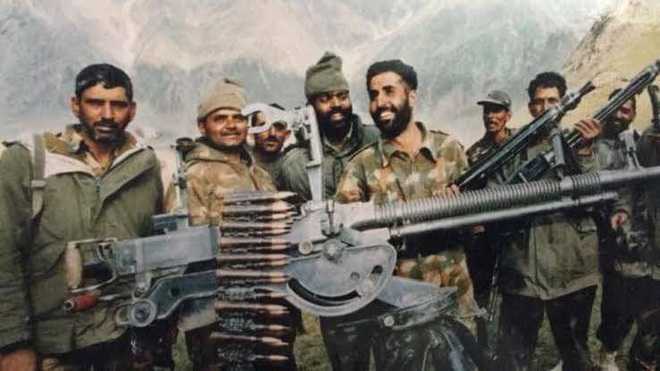
Hello, friends! The year was 1999. Some Pakistani soldiers infiltrated Indian territory. And the Indian Defence Forces retaliated bravely. Soon, a full-fledged war ensued between India and Pakistan. The war is now known as the Kargil War. Kargil War of 1999. This place became the centre of much international intrigue and war. Between India and Pakistan. 22 years ago, India was betrayed by its neighbour Pakistan. Prime Minister Atal Bihari Vajpayee, made it clear that India would emerge victorious. The world has seen that we want peace now the world will see that to protect our peace we can use strength if we need to. One of the most famous war heroes of the Kargil War was Captain Vikram Batra. Recently, a film has been made about him. Shersaah. On Amazon Prime Video. 

What was the Kargil War? What were the reasons that led to it? And what happened exactly? The international geopolitics at play there is also very interesting. Come, let’s find the answers to these in today’s video on Kargil War. Our story begins on 3rd May 1999. In a small village in the Batalik region there was a local shepherd Tashi Namgyal. He had lost his yak. He went to look for his yak with a friend. While looking through the binoculars, he saw something strange. He saw that some armed men digging bunkers. He found it quite fishy. “There we saw around 6 men, they were in black outfits, so I continued looking for some time. They were breaking rocks. And digging.” He got suspicious that those people were from the other side of LoC. So he went to the nearest post of the Indian Army. 

To inform the Indian Army. Thankfully, the Indian Army checked this information. And found that the information was correct. But this wasn’t a minor intrusion. This was a well-planned attack by the Pakistani Army. Intrusions were reported in Dras Kaksar and Mushkoh sectors. Overall, they had occupied more than 130 posts. Their aim was to block the critically important national highway NH 1. By blocking it, they could’ve cut off Kashmir from Ladakh. The code name of this operation was Operation Badr. If we look at this action from the perspective of international relations, this was a direct breach of the 1972 Simla Agreement. That was signed by the former Indian Prime Minister Indira Gandhi and the former Pakistani President Zulfiqar Ali Bhutto. According to this agreement, both neighbouring countries had agreed to never violate the LoC. And in case of any issue between India and Pakistan a peaceful resolution would be worked out. Through bilateral approaches. 
The unfortunate thing was that, friends, only a few months before the intrusions, in February 1999, the former Indian Prime Minister Atal Bihari Vajpayee had made a journey to Lahore in a bus. Where he had recited a poem, “Hum Jung Na Hone Denge” (We Will Not Let War Break.) And signed the Lahore declaration as well. Along with the former Pakistani Prime Minister Nawaz Sharif. This was, in a way, a monumental effort by the former Prime Minister Atal Bihari Vajpayee. To establish peace between India and Pakistan. “We’ve been enemies for too long. Now, we should spend some time as friends.” Only 3 months after this, this large-scale intrusion by the Pakistani soldiers, showed very clearly how there was someone in Pakistan that didn’t want this peace to last. But anyway, to retaliate against this, the Indian Army launched a counterattack. That was given the code name Operation Vijay (Victory). 

Thousands of Army troops were mobilized and sent to the Kargil sector. Then the Chief of Army was General Ved Prakash Malik. The Indian Airforce played a very crucial role. On 26th May, they launched the Operation Safed Sagar (White Sea). That aimed at driving out the Pakistani troops from the Indian territory. Traditionally, whenever air-power is used in a conflict, It is considered that all-out war has been declared. It was the first time that India had deployed air-power in such an environment. The Indian Airforce had also planned that they’d cross the LoC into Pakistan and bomb a few targets. But as Air Chief Marshall Anil Yashwant Tipnis has later revealed Prime Minister Vajpayee was completely against it. He had firmly ordered that LoC should not be crossed. And there is a very interesting diplomatic reason for it. Friends, whenever any two countries go on a war against each other, looking at the war from the third perspective, it becomes quite difficult to judge who is right and who’s wrong. Because often, both sides commit mistakes and violations are from both sides. 
Take your example. When we as Indians watch the war between Israel and Palestine or the war between Azerbaijan and Armenia, it becomes difficult for us to know who is in the right and who is in the wrong because often, both sides have good arguments to justify themselves. Similarly, in the Kargil War of 1999 between India and Pakistan, it was difficult to judge from an international perspective who was right and who was wrong. Which country could be trusted? So India showed a lot of restraint. By not crossing the LoC. It showed the international public that it was a defensive war. “Pakistani soldiers had intruded in the Indian territory we want to push them out, and we are not interested in crossing the LoC and carrying out bombings in Pakistan.” “We simply want to protect our country.” Doing this was a major diplomatic victory for India. Within the next few weeks, the other countries European Union, ASEAN Regional Forum, the United States, G8 Countries, all of them supported India in this Kargil War. The then US President Bill Clinton pressured Nawaz Sharif to withdraw the Pakistani soldiers. The entire world could see that India was in the right and Pakistan was wrong. 

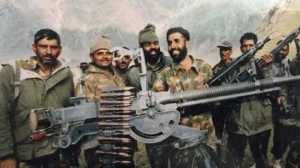
But talking about the ground situation, the Pakistani troops had an advantage. “Taking advantage of the geography of the region, which in many instances, favoured them, Pakistan Army regulars accompanied by fully armed and well-trained militants, sneaked into Indian territory.” The Pakistani soldiers were in an advantageous position in this war because they were on higher grounds in the mountains. Additionally, this region gets very cold. The Dras region is considered to be the coldest inhabited region in India. Often, temperatures fall to -40°C. So it was immensely difficult for the soldiers to fight in such conditions. But there is a popular saying in the Indian Army, ‘When the going gets tough, the tough get going.’ In the Kargil War, the Battle of Tololing is considered to be the turning point. When the war changed its course. To recapture the Tololing Hill, was a difficult task for the Indian Forces.

 At the height of 16,000 feet, temperature between -5°C to -11 °C, with blanket firing from above, because the enemies were placed higher in the hill. Because of all these reasons, for the Indian forces to move or try to climb that hill, was possible only in bad weather and moonless nights. The nights when the moon wasn’t visible in the sky. So that there isn’t much light and when they move, it doesn’t alert the enemies. Captain Ajit Singh was among the officers who attempted this. He recalled how to carry even 1 gram of extra weight meant carrying an extra load. Often the soldiers had to choose, between carrying food rations with them or carrying ammunition. Food packet weighing 2 kg, or 100 bullets. Captain Ajit chose bullets. And he survived for 3 days by smoking cigarettes. Without any food. Considering all these conditions it was estimated that till will take a fit soldier 11 hours to reach the top of the Tololing hill. Major Rajesh Adhikari led the company that tried to climb the mountain. 

And his company was successful to quite an extent. But when they were about 15 meters from the top, Intruders saw them and started firing. Major Adhikari and two other soldiers were martyred in hand-to-hand combat. Because of heavy firing from the enemy, the rest of his company had to retreat, and the company took three positions behind huge rocks. But as soon as the soldiers tried to move from behind the rocks, firing would start from the top. So they were trapped in between. 15,000 feet above the base, And approx 1,000 feet below the top. These soldiers were stuck in the middle. The situation was really bad. Because they did not have any more grenades with them. The Indian Army made it their current priority to recapture Tololing hill. Colonel Ravindranath handpicked 90 soldiers. To go help the soldiers stuck in between, and recapture the hill. Several washermen, cobblers and barbers in the battalion were also helping them because they had to carry the heavy ammunition to the top of the hill. 

So physical strength was needed. More people were needed. On 12th June they were successful at reaching the soldiers stuck in the middle. Around 8 pm. Only a thousand feet away from the enemy, Colonel Ravindranath gave a final pep talk to his soldiers. “I have given you what you wanted. Now you have to give me what I want.” The heavy firing lasted for 4 hours. More than 10,000 shells and more than 120 artillery guns were fired. There was so much firing that later this ridgeline was named Barbaad (Destroyed) Bunker. The plan was to divide the soldiers into 3 teams. Arjun, Bheem and Abhimanyu. (Characters from the Epic Mahabharata.) The first team would lead the frontal attacks. The second team would move to the other side of the cliff to a lower ridge, And the third team will cover fire. The enemies were attacked from the back by the platoon led by Major Vivek Gupta.

 A hand-to-hand battle took place and unfortunately, Major Vivek Gupta along with 6 other soldiers was martyred. But these soldiers were eventually successful in capturing Tololing. Thankfully, the intruders had left behind butter, tinned pineapple and honey, so there were no problems with getting food supplies. For the Indian soldiers who reached the top of this hill. About 1.6 km to the North of Tololing hill, was the Point 5140. It was the highest point in the same ridgeline. At the height of 17,000 feet. Thus, higher than the Tololing hill. Between Tololing and Point 5140, there were 10 high grounds known as Humps. From Hump 1 to Hump 10. 

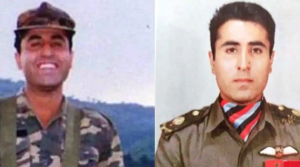
These Humps were easily captured by the Indian Army. And then the Indian Army reached the base of Point 5140. Known as the Rocky Knob. The task of capturing Point 5140 was assigned to the Lieutenant Colonel Yogesh Kumar Joshi. After this, two groups of soldiers were formed to climb the hill in two different directions. One group was under the command of Lieutenant Sanjeev Singh Jamwal. And the second group was led by Lieutenant Vikram Batra. Whose code name was Shershaah. (Lion King) That’s why friends, the upcoming movie on Amazon Prime Video is named Shershaah. Both Lieutenants were told to choose a success signal. When they’d be successful in their mission, how will they signal the others? Lieutenant Sanjeev chose the signal “Oh! Yeah, Yeah, Yeah!” And Lieutenant Vikram Batra chose the signal “Yeh Dil Maange More.” (lyrics of a song; this heart desires for more) “The other company’s success signal, Oh, yeah, yeah which was passed to our Colonel Joshi on the radio set. 

After that, another bunker was captured. My company’s success signal was ‘Dil Maange More.’ The guys were so highly charged up that they’re wanting that some more bunkers should have been there and we would have got more chaps.” In the early hours of 20th June, Both groups started the climb. And both groups were successful. There were no casualties. And both sent their success signals to the command post. Lieutenant Vikram Batra was promoted because of the successful mission. To the rank of Captain. He called his father and told him, “Daddy, I have captured.” On capturing this point, India got its diplomatic victory. Because at this point, several Pakistani documents were recovered. “What you heard right behind you was the sound of Bofors guns directly targetting the top of Tiger hill. Prelude to the final assault.” 

Another major point was Tiger Hill. One side of Tiger Hill is a vertical cliff of 1,000 feet. And the Indian Army decided to surprise the enemy by climbing this cliff. By using mountaineering equipment. So between the nights of 3rd and 4th July, a group of 22 brave soldiers undertook this mission. One of the soldiers was 19-year-old grenadier Yogendra Singh Yadav. He had volunteered for this mission. They had reached halfway on this 1,000 feet high vertical cliff, when the enemy found out about them. Machine guns, as well as rockets, were fired on them from above. platoon commander along with 2 others were martyred then. But grenadier Yogendra Singh continued climbing despite the firing. He climbed 940 feet. He was only 60 feet away from the top. When three bullets hit him.

 In his legs and shoulder. But even after being hit by three bullets, he continued climbing. And he climbed to the top, threw a grenade and killed 4 enemies. He attacked another bunker with the soldiers. And the remaining soldiers of his platoon, were so motivated by his bravery, that they completed the climb to the top as well. And attacked Tiger Hill. And this mission was successful. Perhaps the most shocking part of this entire mission was despite being hit by multiple bullets, grenadier Yogendra Singh Yadav survived. He was admitted to the hospital And later he was given the title of Honorary Lieutenant. Do you remember Hrithik Roshan’s movie Lakshya? The vertical cliff that’s climbed at the end of the movie and the capture of the Hill, was inspired by the story of Yogendra Singh Yadav. On the other hand, more missions were being conducted to recapture the remaining hilltops.

 Capturing Point 4875 was one of them. For this mission too, Captain Vikram Batra was assigned. This time his battle companion was Captain Anuj Nayyar. On the morning of 8th July, he was successful at his mission of capturing this peak. The mission was almost completed. Captain Vikram Batra came out of his bunker, to rescue a Lieutenant. Who had lost his legs because of an explosion. No sooner than he had gone out to help the Lieutenant, the enemy that was retreating fired a bullet that hit him in the chest. And unfortunately, he was martyred. India won at Point 4875, but had to lose two heroes Captain Vikram Batra and Captain Anuj Nayyar. Today, this point is known as Batra Top. The Battle at Point 4875 was a major landmark of the Kargil War. That had almost sealed India’s victory. 

Two days later, on 11th July, the Pakistani Army started to withdraw. And India had captured the remaining major points of the Batalik. On 14th July, Prime Minister Vajpayee declared Operation Vijay to be a success. And on 26th July, the Kargil War officially ended when the Indian Army announced that all the intruders had been completely evicted from the Indian territory. Now, 26th July is celebrated as Kargil Vijay Diwas (Kargil Victory Day). Some months later, in October 1999, a bloodless coup takes place in Pakistan. Nawaz Sharif gets detained and Pakistan’s Army General Pervez Musharraf suspends the Constitution, declares an emergency in the country and takes over the control of the country. The internal politics of Pakistan becomes clearly evident here. Later it is revealed that Pervez Musharraf was actually the Chief Strategist of the Kargil plan. It was his idea to intrude into India dressed as Kashmiri militants. And do everything. 

All the peace talks between India and Pakistan, to end them all completely. On the other hand, Nawaz Sharif claims that he had no idea that the Pakistani Army had come up with the Kargil plan. In 2019, Pervez Musharraf was given a death sentence by a court in Pakistan. On the charges of treason. To act against his country. Although later, Lahore High Court overturns this. 

On the other hand, in India, India’s highest gallantry medal, that is the Param Vir Chakra, is awarded to 4 soldiers. Captain Vikram Batra, Lieutenant Manoj Kumar Pandey, Rifleman Sanjay Kumar, and Grenadier Yogendra Singh Yadav. Overall, it is estimated that around 527 Indian soldiers were martyred in the Kargil War. And around 1,300 were injured. Another unfortunate thing that happened was that all the efforts made by PM Vajpayee to maintain peace between India and Pakistan, all of it went in vain. 

India's Best School – Ratnavati School In Rajasthan

Hello, friends! In terms of historical architecture, I consider Rajasthan to be the most beautiful state of India. Here, you can find forts, palaces and mansions each more grand and beautiful than the last. This state is also rich culturally. The folk dance and folk music here and the Rajasthani cuisine, they’re all unparalleled. As well as the lakes, desert, camel safari. So it’s not surprising that Rajasthan is a very popular tourist destination for foreigners. But behind this facade of beauty, lies a harsh truth. Friends, Rajasthan is the worst state in the country in terms of female literacy. Only 57% of the females in the entire state are literate. They can read and write. Do you know the name of the country we’re living in? Country, as in? Do you know which country we live in? Which country do we live in? 

Rajasthan. Because of female illiteracy, female unemployment is also very high. According to a study, 73% of women in Rajasthan are jobless. Do you teach this to your children? So you teach it to your daughter.  You don’t teach it to your son. Why? Because my daughter will have to do these chores. Many people hide this bitter truth with a veil. And look the other way. But there are some brave people who try to bring about a change. In Rajasthan’s Jaisalmer, one such change was successfully introduced. Come, the Gem of India is not an individual. 

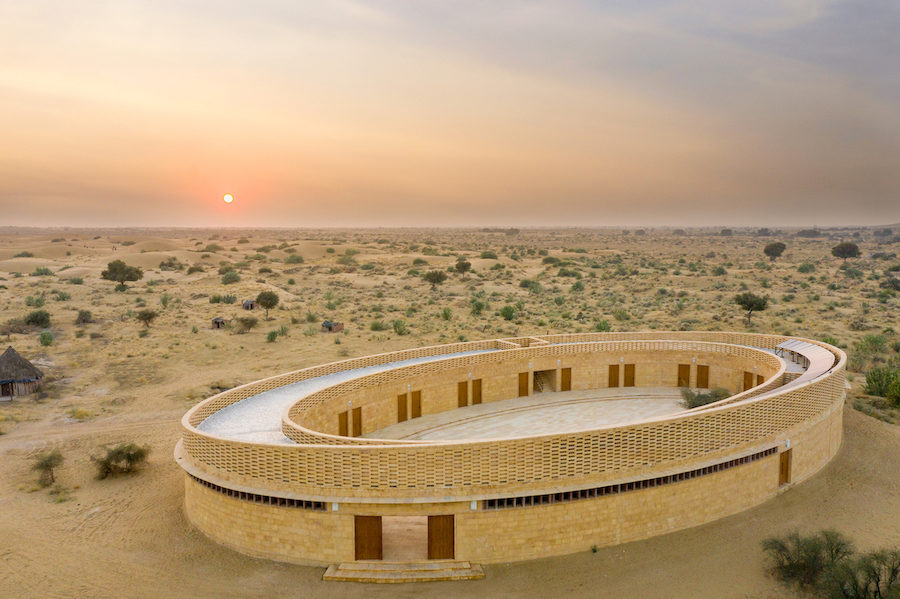
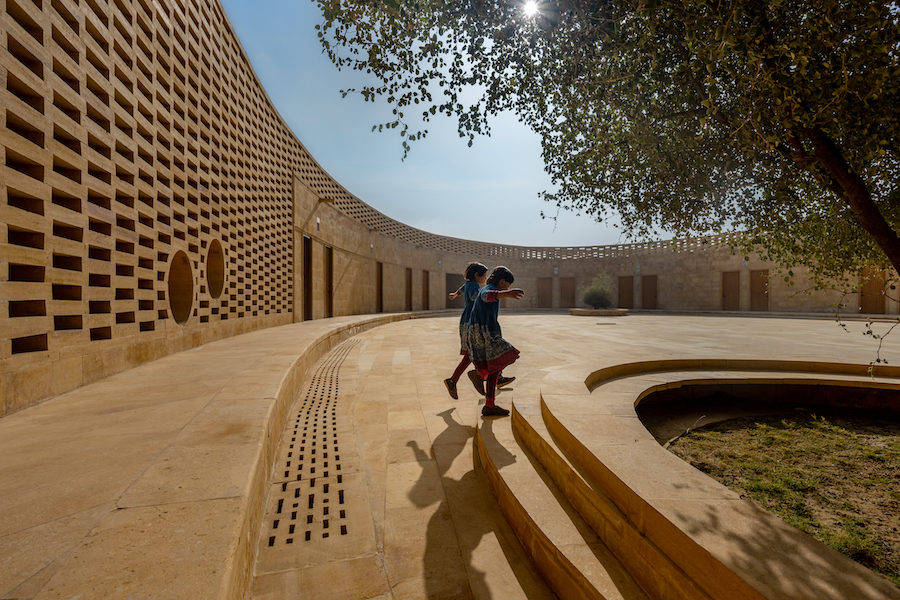
It is a school building. About 40 km from the city of Jaisalmer, there is a popular tourist spot known as Sam Sand Dunes. A few kilometres before this Sam desert, there is a village. This new school is built near this village. What’s special about the school is that not only is it a completely free school, to educate girls from below the poverty line, but the building of this school is also an architecture marvel. Look at this building. Look, at how beautiful it is. It is built in a futuristic-modern style. The building also looks minimalistic. Additionally, the traditional architecture of Rajasthan has also been used in it. To top it all, this is a sustainable building. There are solar panels on the roof of this building. There are no ACs inside. Instead, traditional architecture is used in the building in such a way that the stones used to build it, will keep it cool from the inside. And the design of this building, will help to cool down the interiors. Who built this school? And how? .

There’s a non-profit organisation, CITTA. Its founder is Michael Daube. He had a dream to build a school like this. So really it’s kind of, it didn’t happen like an epiphany, but it did mould like a chess game. It was kind of like realising ‘in the next 20 moves, what’s gonna happen?’ and really kinda mapping out the ripple effects of this. Talking about implementing dreams, the supervisor of this project is Chahat Jain. When our reporter Vijeta Dahiya was on site to film this school, the school hadn’t opened up then. At least, hadn’t completely opened up. Teachers were being recruited. For Class 1 through Class 10th. The plan is, there will be 40 girls in each class, in total, 40 x 10 400 girls would be given free education in this school. Everything will be free. Their transport facility. The transport from their homes to the school and back will be free. Their education. Their books and uniforms will be free. They would also get free lunch at school. About the curriculum of the school, Chahat has experience in handling several such projects. 

So, keeping holistic development in the forefront, he has designed a curriculum for the girls. Things like the local textile, singing, dance forms we included these in the curriculum so that the children can be proud of their heritage and the slowly fizzling out artforms can be protected and revived. It will be a holistic development of the child. It also includes computer skills, third languages that a child should normally know. To fulfill this dream, Michael had local support as well. Like, the support of Chaitanya Raj Singh Bhati who belongs to the erstwhile Royal family of Jaisalmer. And his mother, Mrs Raseshwari Rajya Laxmi was also on the Board of Directors of the CITTA India. Another member of the Board of Directors is Manvendra Singh Shekhawat. He is a hotelier. And a co-founder of the NGO I Love Jaisalmer.

 It was Manvendra who had contributed the land to build this school. While doing so, he had put forth a condition to the architect, that two berry bushes that were there, should not be harmed. They shouldn’t be removed. And the school should be built around them. Now at the centre of the school, those two berry bushes are proudly thriving. The architect used lime for the walls of the school. And the ceiling has been raised quite a bit. And windows at placed near the top. All these things improve air circulation. And the temperature remains cool inside. Not only solar panels are installed on the roof for generating electricity, but there is also a rainwater harvesting system in this building. It is a wholesome package of Sustainability and Eco-friendliness. The architect of this building is Diana Kellogg. And impressively, she didn’t charge anything for designing this building. Same with the costume designer.

 The costume designer that designed the uniforms for the girls, did not charge for this. To design the uniforms, what he did was that he went in and found local textiles like Ajrakh. Then it’s an age-old It’s one of the oldest block printing techniques in the world, and most complex. It’s one thing to design a building. But to actually build it with the design is the biggest challenge. And many local contractors refused to work on it. Because they looked at this complicated design and it was unlike anything they had ever done before so they decided to not do it. After a long search they found one contractor. Karim Khan. He implemented this plan and made it possible in real life. He helped in its building. This place is in the middle of a desert. There’s nothing around. It took us 2 years to build this. We used to work here even at 50°C temperatures. We had to carry food and water with us. One couldn’t find anything for miles here. This was a challenge for us. How could the girls study in those conditions? That’s why we build this school. So Diana and Karim Khan coordinated and local labourers were employed for this project and finally, this building was completed within one year. Once the school was built, Parag Ji takes care of the security of the school. And Raju Ji and Mange Khan see to the cleanliness of the school. From Michael to Raju this is the entire team that is enabling this dream to come true. After the school was ready their team carried out publicity of the school in the nearby villages.

 And the Chief of the nearby village also joined the CITTA team. We conducted a small event on behalf of the school, on behalf of the school’s management on behalf of Mr Shekhawat and the other members of the Board. Distributing ice cream among kids, that was really successful. Then we had another event on Republic Day, Many villagers attended that, adults as well as kids, We had a magic show there. The magic show was a huge success. It was great, all of us enjoyed it. 

How can someone sleep on a cloud? To make this whole project possible the money came through charitable donations. As I said, this is an NGO. You too can donate to it if you want to. They claim that all contributions are used for the education of the girls. The link to donate will be in the description below, in case you’re interested. We’re giving free education to the girls. They’ll get food and a uniform as well. The medium of instruction will be English. Teachers will come from Jaisalmer. The kids will be picked up and dropped off at home. That’s about the school. Now we want that the women in the neighbourhood of our students, like you their mother or their elder sister, we want to do something for them as well. Two more buildings are being built like the school building In it, we will provide training to women. Like what your mother-in-law was working on. 

You will get to learn something new. And we’ll even pay you for learning. Since you’ll work hard to learn. So we intend to support the women and girls around here. The most exciting thing is that, friends, while only one building has been built by now, but in reality, this entire project, called the Gyaan Centre, three buildings will be built in total. The two other buildings are yet to be built. Here, in the computer animation, you can see how the other two buildings will look. In one of the buildings, there will be a Women’s Cooperative. 

India's Best School – Ratnavati School In Rajasthan

Hello, friends! In terms of historical architecture, I consider Rajasthan to be the most beautiful state of India. Here, you can find forts, palaces and mansions each more grand and beautiful than the last. This state is also rich culturally. The folk dance and folk music here and the Rajasthani cuisine, they’re all unparalleled. As well as the lakes, desert, camel safari. So it’s not surprising that Rajasthan is a very popular tourist destination for foreigners. But behind this facade of beauty, lies a harsh truth. Friends, Rajasthan is the worst state in the country in terms of female literacy. Only 57% of the females in the entire state are literate. They can read and write. Do you know the name of the country we’re living in? Country, as in? Do you know which country we live in? Which country do we live in? 

Rajasthan. Because of female illiteracy, female unemployment is also very high. According to a study, 73% of women in Rajasthan are jobless. Do you teach this to your children? So you teach it to your daughter.  You don’t teach it to your son. Why? Because my daughter will have to do these chores. Many people hide this bitter truth with a veil. And look the other way. But there are some brave people who try to bring about a change. In Rajasthan’s Jaisalmer, one such change was successfully introduced. Come, the Gem of India is not an individual. 

It is a school building. About 40 km from the city of Jaisalmer, there is a popular tourist spot known as Sam Sand Dunes. A few kilometres before this Sam desert, there is a village. This new school is built near this village. What’s special about the school is that not only is it a completely free school, to educate girls from below the poverty line, but the building of this school is also an architecture marvel. Look at this building. Look, at how beautiful it is. It is built in a futuristic-modern style. The building also looks minimalistic. Additionally, the traditional architecture of Rajasthan has also been used in it. To top it all, this is a sustainable building. There are solar panels on the roof of this building. There are no ACs inside. Instead, traditional architecture is used in the building in such a way that the stones used to build it, will keep it cool from the inside. And the design of this building, will help to cool down the interiors. Who built this school? And how? .

There’s a non-profit organisation, CITTA. Its founder is Michael Daube. He had a dream to build a school like this. So really it’s kind of, it didn’t happen like an epiphany, but it did mould like a chess game. It was kind of like realising ‘in the next 20 moves, what’s gonna happen?’ and really kinda mapping out the ripple effects of this. Talking about implementing dreams, the supervisor of this project is Chahat Jain. When our reporter Vijeta Dahiya was on site to film this school, the school hadn’t opened up then. At least, hadn’t completely opened up. Teachers were being recruited. For Class 1 through Class 10th. The plan is, there will be 40 girls in each class, in total, 40 x 10 400 girls would be given free education in this school. Everything will be free. Their transport facility. The transport from their homes to the school and back will be free. Their education. Their books and uniforms will be free. They would also get free lunch at school. About the curriculum of the school, Chahat has experience in handling several such projects. 
So, keeping holistic development in the forefront, he has designed a curriculum for the girls. Things like the local textile, singing, dance forms we included these in the curriculum so that the children can be proud of their heritage and the slowly fizzling out artforms can be protected and revived. It will be a holistic development of the child. It also includes computer skills, third languages that a child should normally know. To fulfill this dream, Michael had local support as well. Like, the support of Chaitanya Raj Singh Bhati who belongs to the erstwhile Royal family of Jaisalmer. And his mother, Mrs Raseshwari Rajya Laxmi was also on the Board of Directors of the CITTA India. Another member of the Board of Directors is Manvendra Singh Shekhawat. He is a hotelier. And a co-founder of the NGO I Love Jaisalmer.

 It was Manvendra who had contributed the land to build this school. While doing so, he had put forth a condition to the architect, that two berry bushes that were there, should not be harmed. They shouldn’t be removed. And the school should be built around them. Now at the centre of the school, those two berry bushes are proudly thriving. The architect used lime for the walls of the school. And the ceiling has been raised quite a bit. And windows at placed near the top. All these things improve air circulation. And the temperature remains cool inside. Not only solar panels are installed on the roof for generating electricity, but there is also a rainwater harvesting system in this building. It is a wholesome package of Sustainability and Eco-friendliness. The architect of this building is Diana Kellogg. And impressively, she didn’t charge anything for designing this building. Same with the costume designer.

 The costume designer that designed the uniforms for the girls, did not charge for this. To design the uniforms, what he did was that he went in and found local textiles like Ajrakh. Then it’s an age-old It’s one of the oldest block printing techniques in the world, and most complex. It’s one thing to design a building. But to actually build it with the design is the biggest challenge. And many local contractors refused to work on it. Because they looked at this complicated design and it was unlike anything they had ever done before so they decided to not do it. After a long search they found one contractor. Karim Khan. He implemented this plan and made it possible in real life. He helped in its building. This place is in the middle of a desert. There’s nothing around. It took us 2 years to build this. We used to work here even at 50°C temperatures. We had to carry food and water with us. One couldn’t find anything for miles here. This was a challenge for us. How could the girls study in those conditions? That’s why we build this school. So Diana and Karim Khan coordinated and local labourers were employed for this project and finally, this building was completed within one year. Once the school was built, Parag Ji takes care of the security of the school. And Raju Ji and Mange Khan see to the cleanliness of the school. From Michael to Raju this is the entire team that is enabling this dream to come true. After the school was ready their team carried out publicity of the school in the nearby villages.

 And the Chief of the nearby village also joined the CITTA team. We conducted a small event on behalf of the school, on behalf of the school’s management on behalf of Mr Shekhawat and the other members of the Board. Distributing ice cream among kids, that was really successful. Then we had another event on Republic Day, Many villagers attended that, adults as well as kids, We had a magic show there. The magic show was a huge success. It was great, all of us enjoyed it. 

How can someone sleep on a cloud? To make this whole project possible the money came through charitable donations. As I said, this is an NGO. You too can donate to it if you want to. They claim that all contributions are used for the education of the girls. The link to donate will be in the description below, in case you’re interested. We’re giving free education to the girls. They’ll get food and a uniform as well. The medium of instruction will be English. Teachers will come from Jaisalmer. The kids will be picked up and dropped off at home. That’s about the school. Now we want that the women in the neighbourhood of our students, like you their mother or their elder sister, we want to do something for them as well. Two more buildings are being built like the school building In it, we will provide training to women. Like what your mother-in-law was working on. 

You will get to learn something new. And we’ll even pay you for learning. Since you’ll work hard to learn. So we intend to support the women and girls around here. The most exciting thing is that, friends, while only one building has been built by now, but in reality, this entire project, called the Gyaan Centre, three buildings will be built in total. The two other buildings are yet to be built. Here, in the computer animation, you can see how the other two buildings will look. In one of the buildings, there will be a Women’s Cooperative. 

Social Media and our Mental Health

By Anshiki Jadia

The social media plays in psychological wellness

Individuals are social animals. We need the friendship of others to flourish throughout everyday life, and the strength of our associations massively affects our emotional wellness and satisfaction. Being socially associated with others can ease pressure, nervousness, and wretchedness, support self-esteem, give solace and happiness, forestall dejection, and even add a long time to your life. On the other side, lacking solid social associations can represent a genuine danger to your psychological and passionate wellbeing.

In this day and age, a large number of us depend via web-based media stages like Facebook, Twitter, Snapchat, YouTube, and Instagram to discover and associate with one another. While each has its advantages, recollect that online media can never be a substitution for certifiable human association. It needs face to face contact with others to trigger the chemicals that reduce pressure and cause you to feel more joyful, better, and more good. Amusingly for an innovation that is intended to unite individuals, investing an excess of energy drawing in with online media can really cause you to feel all the more desolate and detached—and intensify emotional wellness issues like uneasiness and despondency.

In case you’re investing an unnecessary measure of energy in web-based media and sensations of bitterness, disappointment, dissatisfaction, or dejection are affecting your life, it could be an ideal opportunity to rethink your online propensities and track down a better equilibrium.

The positive parts of web-based media – While virtual cooperation via online media doesn’t have similar mental advantages as vis-à-vis contact, there are as yet numerous positive manners by which it can help you stay associated and support your prosperity. Web-based media empowers you to: – Impart and keep awake to date with loved ones all throughout the planet. – Discover new companions and networks; network with others who share comparative interests or aspirations. – Join or advance advantageous aims; bring issues to light on significant issues. – – Look for or offer enthusiastic help during difficult stretches. – Discover fundamental social association in the event that you live in a far off region, for instance, or have restricted freedom, social uneasiness, or are essential for a minimized gathering. – Discover a source for your imagination and self-articulation. – Find (with care) wellsprings of important data and learning.

The negative parts of web-based media

Since it’s a somewhat new innovation, there’s little examination to set up the drawn out results, positive or negative, of online media use. In any case, different examinations have tracked down a solid connection between substantial online media and an expanded danger for gloom, tension, dejection, self-hurt, and surprisingly self-destructive musings.

Online media might advance negative encounters, for example,

Insufficiency about your life or appearance. Regardless of whether you realize that pictures you’re seeing via online media are controlled, they can in any case cause you to feel unreliable about what you look like for sure’s going on in your own life. Additionally, we’re all mindful that others will in general share simply the features of their lives, infrequently the depressed spots that everybody encounters. In any case, that doesn’t decrease those sensations of jealousy and disappointment when you’re looking through a companion’s artificially glamorized photographs of their tropical sea shore occasion or finding out about their intriguing new advancement at work.

Dread of passing up a major opportunity (FOMO). While FOMO has been around far longer than online media, destinations, for example, Facebook and Instagram appear to intensify sentiments that others are having a good time or carrying on with preferable lives over you are. The possibility that you’re passing up specific things can affect your confidence, trigger nervousness, and fuel much more prominent web-based media use. FOMO can force you to get your telephone like clockwork to check for refreshes, or urgently react to every single caution—regardless of whether that implies facing challenges while you’re driving, passing up rest around evening time, or focusing via web-based media communication over certifiable connections.

Separation. An examination at the University of Pennsylvania tracked down that high utilization of Facebook, Snapchat, and Instagram increments rather diminishes sensations of dejection. Then again, the investigation found that decreasing web-based media use can really cause you to feel less desolate and separated and work on your general prosperity.

Melancholy and nervousness. Individuals need vis-à-vis contact to be intellectually solid. Nothing lessens pressure and lifts your mind-set quicker or more viably than eye-to-eye to eye connection with somebody who thinks often about you. The more you focus via online media communication over in-person connections, the more you’re in danger of creating or compounding state of mind issues like tension and gloom.

Cyberbullying. Around 10% of youngsters report being harassed via web-based media and numerous different clients are exposed to hostile remarks. Web-based media stages, for example, Twitter can be focal points for spreading terrible bits of gossip, lies, and misuse that can leave enduring enthusiastic scars.

Self-retention. Sharing unending selfies and all your deepest contemplations via web-based media can make an unfortunate narcissism and distance you from genuine associations.

Signs that web-based media is affecting your psychological well-being Everybody is unique and there is no particular measure of time spent via web-based media, or the recurrence you check for refreshes, or the quantity of posts you make that demonstrates your utilization is becoming unfortunate. Maybe, it has to do with the effect time spent via web-based media has on your disposition and different parts of your life, alongside your inspirations for utilizing it. For instance, your web-based media use might be risky in the event that it makes you disregard eye to eye connections, diverts you from work or school, or leaves you feeling jealous, furious, or discouraged. Essentially, in case you’re spurred to utilize web-based media since you’re exhausted or forlorn, or need to present something on make others envious or upset, it very well might be an ideal opportunity to rethink your online media propensities.

Pointers that online media might be antagonistically influencing your emotional well-being include:

Investing more energy in web-based media than with true companions. Utilizing web-based media has gotten a substitute for a ton of your disconnected social communication. Regardless of whether you’re out with companions, you actually want to continually check web-based media, regularly determined by sentiments that others might be having some good times than you.

Contrasting yourself horribly and others via web-based media. You have low confidence or negative self-perception. You might even have examples of disarranged eating.

Encountering cyberbullying. Or then again you stress that you have no power over the things individuals post about you.

Being occupied at school or work. You feel strain to post customary substance about yourself, get remarks or likes on your posts, or react rapidly and energetically to companions’ posts.

Lacking the capacity to deal with self-reflection. Each extra second is filled by drawing in with online media, leaving you or no an ideal opportunity for pondering what your identity is, your opinion, or why you act the way that you do—the things that permit you to develop personally.

Participating in hazardous conduct to acquire preferences, offers, or positive responses via online media. You play risky tricks, post humiliating material, cyberbully others, or access your telephone while driving or in other perilous circumstances.

Experiencing rest issues. Do you check web-based media last thing around evening time, before anything else, or in any event, when you awaken in the evening? The light from telephones and different gadgets can disturb your rest, which thusly can truly affect your psychological well-being.

Deteriorating side effects of uneasiness or melancholy. Maybe than assisting with reducing negative sentiments and lift your state of mind, you feel more restless, discouraged, or desolate in the wake of utilizing online media.

Internship & The Role of an Intern

What is an internship? An internship is a period of work experience offered by an organization for a limited period of time. They are typically undertaken by students and graduates looking to gain relevant skills and experience in a particular field. An internship consists of an exchange of services for experience between the intern and the organization. Internships are used to determine whether the intern still has an interest in that field after the real-life experience. Internships provide current college students with the ability to participate in a field of their choice to receive hands-on learning about a particular future career, preparing them for full-time work following graduation.

Internships are usually short-term. They’re smaller investments in time and energy than full-time jobs. But they are certainly without a doubt a great investment of your time. Consequently, they’re perfect opportunities to explore your options. You deserve work that’s fulfilling. If necessary, you can sign up for a different but related internship role elsewhere to see if you’re happier there.

Your internship is going to shape the course of your career. It’ll assist you in acquiring the skills you need to perform up-to-par when you’re hired full-time. It’s essential you use your internship as the training opportunity it represents.

You’re sure to have a bright future if you work hard, build positive relationships, and use the skills you develop in your internship to your advantage.

Who is an intern?

An intern is a trainee who has signed on with an organisation for a brief period. An intern’s goal is to gain work experience, occasionally some university credit, and always an overall feel for the industry they’re interning in.

An intern is primarily a support role at least in the beginning. When you join up, your main job will be to assist, learn, and grow. After you’ve settled in, you’ll be expected to pull your own weight.

What does an intern do?

So, what does an intern do exactly? That depends on the industry in question and the kind of internship you’ve signed up for.

Here’s a general overview of the work you can expect to do as an intern:    

1. Assist and contribute to the team

In the beginning of your internship, you may your time simply trying to learn how the company works. You may shadow an employee to get an understanding of their role. After few days of learning the ins-and-outs of the company, you’ll start to assist and contribute more to the team. 

Here are some day-to-day intern roles and their responsibilities :  

  • Performing clerical duties
  • Managing social media and emails
  • Event handling
  • Research

2. Learn and gain experience

You’ll be expected to learn as much as you possibly can while you work, regardless of the kind of internship you’ve signed up for.

What kind of learning will you be doing? It can be broken down into two main areas :

  • Picking up hard skills : Hard skills are the technical skills you need to carry out your intern responsibilities, and eventually job duties, successfully.
  • Brushing up on your soft skills : Soft skills are as important as hard skills. Soft skills are all about your ability to relate to people and building mutually-beneficial relationships.

3. Job shadow

Job shadowing has become the norm recently. As the name suggests, the practice involves “shadowing” someone as they perform their daily duties, observing their activities, and learning what the role entails via indirect experience.

How does this work exactly? When you join the organisation, you may be assigned a mentor. The first few weeks, you may be tasked with following them around. Once you’ve shadowed for a while, you may be asked to help your mentor on projects or eventually take over some of their tasks.

4. Take on an increasing amount of responsibility

As time goes by, expect to shoulder an increasing amount of responsibility. Initially, they’ll gauge your current skill set and reliability with your initial workload. As you prove yourself to your colleagues and bosses, you’ll be entrusted with more crucial tasks. The better you perform, the more the responsibilities you’ll be given. Employers prefer quality over quantity – don’t afraid to ask for help if you need it. 

5. Make a career call 

Finally, usually at the tail-end of your internship, you have to make a career-defining decision: continue in the field you interned in or try your hand at something else entirely. You got a taste of what working in your industry full-time would be like. That’s the beauty of an internship you can always go into another field you would like. 

Why internships are beneficial?

Here are some reasons that expand on why an internship is essential to your personal and professional development:

  • Tests industry knowledge
  • Helps you figure out your interests
  • Creates new interests
  • Connects you to industry professionals
  • Allows you to learn in a safe environment
  • allows you to get paid to learn
  • Provides possible credit for your college degree
  • Allows you to potentially gain more internship opportunities
  • Creates a unique travel experience
  • Inspires you to learn more about an industry
  • Teaches you about the importance of work-life balance
  • Introduces you to office politics

VEGETARIAN PROTEIN ALTERNATIVES IN INDIAN DIETS

Ranging from a variety of reasons like muscle and bone building, to healthier skin, nails and even hair, protein is in very high demand among the people of the world today, as they become more and more health conscious and start taking care of their mind and body by feeding and maintaining it well. Most of the times, protein is majorly incorporated in diets of people who want to build muscles. However, as vegetarianism is expanding a rapid pace in today’s world, one of the first concerns of the people as they switch to vegetarian diets is the apparent lack of protein in the regular, western, vegetarian diets. But, a point that needs to be acknowledged that is not a problem in indian diets at all. Protein forms a very important part of indian diets and so, people can consume regulated amounts of protein that they require in a day.

Some of the protein rich foods in indian diets are as follows:-

#1 PANEER, ALSO KNOWN AS COTTAGE CHEESE

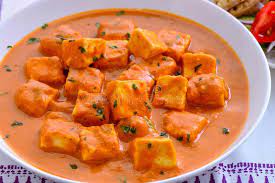
Cottage cheese, or popularly known as paneer in indian subcontinent is largely used in dishes and cuisines, especially in North India. Paneer is cooked in a variety of manners, supplemented with other vegetables like capsicum to make kadhi paneer, or even used to make the famous paneer parathas. They are also added in sweets, making it an all-round ingredient. While paneer is a major source of protein, it is also quite rich in fats. It is highly nutritious as well; consisting of vitamin B12, calcium and iron as well. Around 100gm of paneer consists of 20gm protein. Hencforth, try having paneer infused dishes to get your daily dose of protein

#2 LENTILS

LENTILS ARE POPULARLY CONSUMED IN LUNCH TIME IN INDIAN DIETS. However, we can also add it in salads and soups. Lentils are highly enriched with fiber, foliate, iron as well protein. Around 240gms of a cup of lentils consist of 18 gms of protein, making it a healthy vegetarian protein ingredient.

#3 NUTS

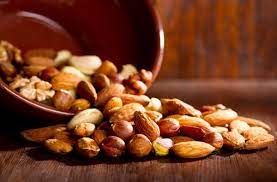
Nuts are considered ‘super-foods’. One of the major reasons behind this claim is that nuts offer a variety of benefits on consumption. They are packed with vitamins like vitamin E and A, that are extremely good for hair and nail growth and keep your eyes healthy as well. Not only this, they are really good for your skin and eyes. Furthermore, they are widely prevalent and even recommended by doctors as they help in keeping cholesterol levels in check in people that suffer from this grave issue. They are also enriched in protein, making it a good source of protein in indian diets.

#4 KIDNEY BEANS AND CHICKPEAS

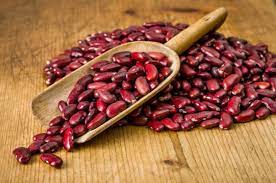
Kidney beans and chickpeas are quite popular in north indian cuisines, not only for their superb taste, but also their nutrients. This is evident through the fact that they are rich in iron, magnesium, complex carbs and fiber, along with protein. So, make sure to not skip out that plate of rajma chawal on sunday!

To sum it all up, there are various vegetarian protein rich foods in diets around India, you just have to look hard enough!

BEING VEGAN

Plant based meat or meat subsidies are taking the world by storm. There is science and capitalism behind the growth of this multibillion-dollar industry. There are cultural and environmental aspects too. First the science: A study published in March 2020 noted that plant-based diets can help reduce the risk of heart disease, which is a much bigger killer than to COVID 19. As of end December 2020 COVID-19 already has killed more than 300,000 people in the U S. By comparison in 2018 heart disease was the cause of death for about 6,55,000 Americans; cancer for 5,99,000 and stroke nearly 140,000.

In general, consumption of red processed meats has been associated with increasing weight gain over time as well as increased risk of diabetes heart diseases and colon cancer according to the study. It is no wonder a whole new industry has risen out of protein alternatives. at the end of 2020 the global meat substitutes sector was worth 20.7 billion it is set to grow 23.2 billion by 2024, according to market research company Euromonitor. And there are moves among food scientist make plant -based protein tastier and healthier. The awareness of healthy eating habits is growing. A vegan diet is not considered a fad diet rather it is an eating pattern that has been more on the rise with the increased awareness on anti-animal affairs and environmental concerns. For many vegans’ nutritional choices centered around taking better care of the earth’s resources and the environment, ethical issues about animal care the use of antibiotics and growth stimulant to produce animals.

Vegans are generally thinner have lower serum cholesterol and blood pressure and have lower risk of cardiovascular disease. Sticking to veganism is ultimately a matter of commitment and determination. Food companies come up with many choices for the consumers fast food chains too have options for vegans. A vegan diet contains more antioxidants and fibers. It is rich in potassium magnesium foliates and vitamins A C and E. It is also a good way to reduce excessive body fat and maintain healthy body weight if it is well balanced. the median effect of adopting a vegan diet is an increase in energy levels. this is also accompanied by changing bowel habits to a regular and healthier pattern ensuring good digestive health. these benefits are associated with the detoxification for the process as you substitute animal products with whole foods higher in fiber and lower in fats and sugars. Generally, vegans often might need to add vitamin B12 supplements omega-3 and calcium.

WOMEN SAFETY IN INDIA

Women in India, today, are becoming the most vulnerable section as far as their safety and security is concerned. Women are the greatest strength of our society and it is so disheartening to see that they are getting unsafe day by day as the number of crimes against them are increasing. According to a poll by Reuters, India has been ranked the most dangerous country out of the world’s 10 worst countries for women. When we turn the pages of a newspaper, we come across many headlines reporting cases of molestation, harassment, trafficking, ill treatment of women in houses, violence against women in remote areas etc. Women feel unsafe and unsecure and feel that their freedom and liberty are expose to risk. It is unbearable to imagine the plight of women who are sufferers of such crimes. It is a shake on the confidence of the women of the society and on our judicial system.

According to the National Crimes Records Bureau(NCRB), India recorded 88 rape cases every day in 2019 and crimes against women increased by 63.3% in the first six months of 2021. NCRB report highlights that rape vulnerability of a girl or woman has increased up to 44% in the last 10 years. As per the latest NCRB data, KOLKATA comes out on top in safety, not just for women, but overall as well. To protect women from domestic violence THE PARLIAMENT OF INDIA passed ‘The Protection of Women from Domestic Violence Act 2005’.

IMPORTANCE OF WOMEN SAFETY-

Safety of women is very important in this cruel and evil society. As the number of cases are arising against women, it is very important to exercise the laws and get the criminal arrested and punished as soon as possible. It helps women be calmer, understanding and they feel protected. They will trust the government if the criminal gets required punishment in time. It will develop body and mind control in them. They will take active part in every thing if proper safety is ensured to them. There are laws but there should be proper safety measures which we have to follow strictly to protect the women from violence.

We generally play the blame game for any such incidence and hence have not succeeded to reach the root cause of this issue. An effective implementation of loss protecting women’s rights is the first step in this direction. There should be stringent loss and the criminals of such crime should be severely punished.

CRIMES AGAINST WOMEN-

In India, sexual harassment, rapes, domestic violence, dowry cases and murder are common forms of violence against women. It is found in some places that even today, there is a tradition of taking dowry from the girl’s family and the father sacrifices and loses everything to pay it. Domestic violence is also increasing very badly where one partner or a man abuses another another partner or a girl in a relationship. It leads to depression and suicides. It’s not a direct murder but it is the cause of murder for sure. Cheating in a relationship and giving divorce is also a crime against women which destroys the whole life of a women and the man easily finds a new girl and marries her. Acid throwing is considered to be the most heinous crime against women which ruins the beautiful girl’s life and left her in a state of shock.

HOW CAN WE SAFEGUARD WOMEN OF OUR SOCIETY?

We also need to create social awareness about these issues and ostracise those who commit such crimes and not the victims. Women safety is a crucial concern in India and a lot of organisations started working on it after Nirbhaya’s case. Women should be taught some self-defence tips and tricks in schools, colleges, offices and residential colonies, so that if anyone tries to harm them, they can apply these tricks to protect them and hurt the person trying to attack her. Also, various videos of self-defence techniques are uploaded online, on various social media platforms for educating women’s safety. Women should always put some chilly powder, ginger-garlic paste or some harming materials while going out to harm the attacker. To ensure the security of the women in the country, the entire population should be well-educated and the laws should be very tough against every kind of crime. Both the men and women of the society should be empowered with proper education and income so that they can fight against any harm to them. There are also various helpline numbers for ensuring women safety in India. Only when these measures are taken, India can become a carefree and enjoyable place for women when they can go where ever they like to without any fear of being stared at, molested or discriminated.

”It took me quite a long time to develop a voice, and now that I have it, I am not going to be silent”. – Madeleine Albright

BUBBLES

surround everyone you can think

of in bubbles of love

~ Diana Cooper

Bubbles! We all know how fascinating they are, evoking happy memories of blowing and chasing the mystical orbs with our friends. A bubble’s fragile nature, beautiful rainbow colors, and ability to soar through the sky make them universally fascinating among kids.

How are bubbles formed?

Bubbles are pockets of soap and water that are filled with air. When soap and water are mixed together and air is blown into the mixture, the soap forms a thin skin or wall and traps the air, creating a bubble.

What are some fun facts about bubbles?

A bubble consists of three layers: two layers of soap clinging to either side of a layer of water. Light that hits the different layers interferes with itself, causing colorful iridescence. A bubble always attempts to form a sphere because surface tension pulls the liquid inward.

What is the purpose of bubbles?

What’s the science behind (or inside) a bubble? Bubbles provide the opportunity to study science concepts such as elasticity, surface tension, chemistry, light, and even geometry.

What are the properties of bubbles?

Properties of Bubbles

  • Liquid-Solid Contact Angles.
  • Film-Film Contact Angles.
  • Film-Solid Contact Angles.

Who invented bubbles?

Bubbles are no longer simply soap and water. Invented by Taiwanese bubble solution expert Jackie Lin, the top-secret solution contains a polymer that allows bubbles to resist evaporation.

Why do bubbles float?

soap bubbles can’t really fly — they float! … Because the air trapped inside a bubble is less dense than the air outside the bubble, it’s up, up and away! The heavier carbon dioxide in the air around the bubble pushes up on the air trapped inside the bubble and off it goes.

Are bubbles liquid or gas?

A bubble is a globule of one substance in another, usually gas in a liquid. Examples include soap bubbles, foam, bubbles in carbonated drinks, etc. The surface of a bubble is usually liquid. A bubble is a globule of one substance in another, usually gas in a liquid.

What are the different kinds of bubbles?

  • Air bubbles as a man surfaces in a swimming pool.
  • Bubbles of gas in a soft drink.
  • Bubble of gas in a mudpot.
  • A bubble of gas in a tar pit.
  • Frosted bubble.
  • Man blows bubble.

” Happiness is a soap bubble that

changes color as the iris and that breaks when touched “

~Honore de Balzac

5 most dangerous animal on the planet

There are many animals on this planet. Some are fine but some are venomous and dangerous for all. Some might hurt you back when you try to hurt them as well but some are just not as good as you can think of them. So here we are going to talk about 5 of these dangerous animals on the planet.

1) Box jellyfish

Box jellyfish is one the dangerous animals found on the planet. They are native to Australia. They are cnidarian vertebrates distinguished by their box like body. Some species of this animal produces venom that are fatal to humans. It is said to be the deadliest creature in the sea.

2) Mosquitoes

Mosquitoes are one of the smallest creature but is as deadly as large venomous creatures. They are found in every region except Antarctica. Genera Aedes, Anopheles and Culex are the main dangers. They are primary vector for diseases like malaria, chikungunya, yellow fever, dengue, elephantiasis, Zika virus, encephalitis and dengu. These diseases affect more than 700 million people in a year and caused death of nearly 725000 people.

3) Saltwater crocodile

They are one of the most dangerous beast. They can grow up to 26ft. They are massive in size and weights upto tonnes. They are aggressive they tear the humans into pieces. One or two fatal attacks are reported by these creatures. If looked properly they resembles T.rex. There are sign board present to avoid swimming in the area of this beast. Mainly 20-30 attacks outside Australia take place by these massive man eaters. Most of them are males.

4) Stonefish

Stone fish are found in indo-pacific ocean, The Red sea and the great barrier reef. They are the most venomous fish known and they are fatal to human. Stonefish stings are extremely painful and potentially lethal. Stonefish stings can occur on the beach, not only in water but also outside the water as they can survive 24 hours outside the water. They look similar to rocks or corals.

5) Puffer fish

Puffer fish is also known as blowfish. They are closely related to porcupinefish which have large external spines. These species are toxic and some are poisonous. Pufferfish can be lethal if not served properly. Puffer poisoning usually results from consumption of incorrectly prepared Puffer soup, fugu chiri, or occasionally from raw Puffer meat. Pufferfish tetrodoxin deadens the tongue and lips, and induce dizziness and vomiting, followed by numbness and prickling over the body, rapid heart rate, decreased blood pressure and muscle paralysis.

CONCEPT OF THE RENAISSANCE

WHAT do you mean by Renaissance?

REBIRTH

  • Renaissance is a French word meaning “rebirth.” It refers to a period in European civilization that was marked by a revival of Classical learning and wisdom.
  • The word “Renaissance,” whose literal translation from French into English is “Rebirth,” appears in English writing from the 1830s. The word occurs in Jules Michelet’s 1855 work, Histoire de France.
  • The word “Renaissance” has also been extended to other historical and cultural movements, such as the Carolingian Renaissance and the Renaissance of the 12th century.

The Renaissance was a period in Europe, from the 14th to the 17th century, regarded as the cultural bridge between the Middle Ages and modern history. It started as a cultural movement in Italy, specifically in Florence, in the late medieval period and later spread to the rest of Europe, marking the beginning of the early modern age. 

Beginnings

Various theories have been proposed to account for the origins and characteristics of the Renaissance, focusing on a variety of factors, including the social and civic peculiarities of Florence at the time; its political structure; the patronage of its dominant family, the Medici; and the migration of Greek scholars and texts to Italy following the Fall of Constantinople at the hands of the Ottoman Turks.

Many argue that the ideas characterizing the Renaissance had their origin in late 13th-century Florence, in particular in the writings of Dante Alighieri (1265–1321) and Petrarch (1304–1374), as well as the paintings of Giotto di Bondone (1267–1337).

Cultural, Political, and Intellectual Influences

  • As a cultural movement, the Renaissance encompassed the innovative flowering of Latin and vernacular literature, beginning with the 14th-century resurgence of learning based on classical sources, which contemporaries credited to Petrarch; the development of linear perspective and other techniques of rendering a more natural reality in painting; and gradual but widespread educational reform.
  • In politics, the Renaissance contributed the development of the conventions of diplomacy, and in science an increased reliance on observation. Although the Renaissance saw revolutions in many intellectual pursuits, as well as social and political upheaval, it is perhaps best known for its artistic developments and the contributions of such polymaths as Leonardo da Vinci and Michelangelo, who inspired the term “Renaissance man.”

IMMUNOLOGY SERIES- PART 9- VACCINES

The previous article was all about the process of inflammation. This article is about vaccines.

The vaccines fall under the type of artificial active acquired immunity. This is artificial because we are giving the vaccine externally and this is active because the body is generating the antibodies/response and it is acquired because we are getting the immunity and it is not present by birth. You must have known what immunity is at least by now.

A vaccine is a biological preparation that provides active acquired immunity to a particular infectious disease. A vaccine typically contains an agent that resembles a disease-causing microorganism and is often made from weakened or killed forms of the microbe, its toxins, or one of its surface proteins (antigens). So these vaccines are nothing but the pathogen itself but it cannot cause any disease, instead, it triggers the immune system.

This is a quick recap of the principle of working on vaccines. The vaccine contains the pathogens as a whole or the surface antigens only. These antigens stimulate the immune system. If the immune system had a memory about this antigen, then it would immediately produce an antibody, and phagocytosis of the antigen occurs by the macrophage aided by the antibody. In this scenario, the antigen is new and there is no memory, therefore the immune system struggles and takes time to produce the antibody.

So the antigen reign over the body and this can lead to inflammation. As a result, some of the symptoms of inflammation like fever, heat, pain in the area of application, and swelling may appear. The chances of them are rare and also severity is less (last for a few hours/days) since the pathogen is attenuated.

Once the immune system produces the correct antibody, phagocytosis of the antigen occurs and hence the causative agent is eliminated from the body (primary response). So if the same or similar pathogen which has disease-causing ability enters into the body, the memory triggers the immune system to produce the correct antibody. So a heightened and rapid response is generated in order to kick away the pathogen quickly (secondary response).

There are three types of vaccines:-

Live- infection is caused without any harm – measles & polio

Dead- doesn’t last long, requires booster dose- cholera

Microbial products- involves non-infectious pathogen, capsule and toxoid- anthrax, diptheria

Hence using the vaccine as a stimulus, the body is able to generate a response that is stored and can be useful for preventing the disease caused by the pathogen.

There might be an idea to generate vaccines for all diseases so that all humans are protected. But there are some difficulties in this which are listed below:-

There are new microbes being discovered every day and no one knows which microbe can cause disease. There can be multiple microbes causing the same or similar disease. So being immune to one microbe doesn’t mean being immune to the disease

The disease-causing microbe can undergo mutation meaning that there can be changes in the genetic material and hence the antigen can change. In this case, the antibody which was stimulated by the vaccine won’t work. A suitable example is a common cold, it is impossible to produce a vaccine that covers all mutants of viruses

The pathogen has to be genetically modified so as to remove its disease-causing ability which is easy to say but difficult to implement

Also, it is important that the antigen chose for the vaccine must be close to that of the original causative agent of the disease. If the original pathogen is not so close to that of the vaccine, then it will not work

Hence all these above points explain the difficulties in producing a vaccine. Despite these many research organizations in many countries have produced vaccines especially for the pandemic and dreadful diseases like the COVID-19, hepatitis, polio, etc. in which some vaccines provide lifetime immunity to some of the diseases. We must take a minute to appreciate those who have done immense work and their contribution is stopping some of the dreadful diseases.

With this, we come to the end of the series. I hope that all the concepts explained in this were simple and clear and also would have inculcated an interest in immunology. By now, it would be clear how the immune system protects us from several microbes and diseases.

HAPPY LEARNING!!