EduPub (Edupedia Publications Pvt Ltd) is a company dedicated to the development of the education, learning, research and innovation in the field of the research and books publication. We are pioneer in providing wide range of services to educational institutions, government agencies, individuals and corporates in the field of training and education, research and development, research and innovation. research and publication.
International Journal of Research (IJR)is an international scholarly refereed research journal which aims to promote the theory and practice of engineering management, innovation, technology, management science, technology forecasting, and management engineering consulting. But the topics are not limited to these. We welcomes the submission of manuscripts that meet the general criteria of significance and scientific excellence. The current issue of the journal is available online at https://ijrjournal.com/index.php/ijr
Send papers for publication to editor@pen2print.org
The topics related to this journal include but are not limited to:
•
Operations Management, Operations Research, and Supply Chain Management
•
New Product Development and Product Engineering
•
Systems Engineering
•
Industrial Engineering
•
Management Science
•
Management Engineering Consulting
•
Seamless Integration of Heterogeneous Technologies
•
Emergent Complex Engineering Problems
•
Management of Technology
•
Technical Professionals
•
Technical Organizations
•
The Practice of Engineering Management
•
Technology Forecasting
•
Managing Research
•
Engineering Activities
•
Engineering Science and Technology
•
Engineering Design
•
Philosophical Foundations of Management in Theory and Practice
When we talk about women’s empowerment, gaining formal education, a career or some form of a stable means of livelihood forms an important part. From not allowing girls entry into schools and colleges to witnessing women make pioneering discoveries in the fields of science, technology, medicine, and space, the world has come a long way.
However, let us also not forget the fact that only 33% of researchers globally are women (UN Women 2022). They are also provided fewer funds than men and promoted less. According to a study conducted by The Times of India in 2018, women made up only about 25% of the scientific faculty of universities and institutions. While they form a significant fraction of science teachers in both government and private schools and colleges, the number of women sitting in top positions and with successful careers in these fields is quite small. This is mostly because women more often than not face the pressure of balancing their careers with their families. There remains an inherent belief among many that maintaining the family is primarily the women’s responsibility and cannot be compromised because of their job. A portion of female students enrolled in PG courses and female Ph.D. researchers end up unable to complete their courses due to family pressure regarding marriage. More than 50% of female graduates end up choosing a teaching career, rather than working as professionals in physics, mathematics, and engineering.
Then there are also the numerous complaints of harassment and biased and discriminatory behavior reported in such institutions. The representation of women in the overall field of science is small because people generally see science as a profession for men.
Despite all this, there have been many women visionaries in India who have made significant contributions in the field of science. Here are some of the well-known females in India’s scientific field:
Kamala Sohonie {1912-1998} was the first female student of C.V. Raman and was the first woman to obtain a Ph.D. degree in a scientific discipline. She discovered that every cell in a plant tissue contained the ‘cytochrome c’ enzyme which was involved in the oxidation of all plant cells.
Anandibai Gopalrao Joshi (1865-1887) was the first Indian woman to have graduated with a degree in western medicine in the U.S and went on to become the first woman physician in India.
Janaki Ammal (1897-1984) was a talented botanist who worked on developing different varieties of homegrown sugarcane and eggplant. She received the Padma Shri award in 1977 and was also appointed the Director-General of the Botanical Survey of India.
Asima Chatterjee (1917-2006) was a chemist well-known for her contribution in the fields of organic chemistry and phytochemistry.
Tessy Thomas (1963-) is the Director-General of Aeronautical Systems of DRDO. She is also the first woman scientist to head a missile project in India.
Major women scientists of ISRO, like Ritu Karidhal, T.K. Anuradha, Nandini Harinath, and V.R. Lalithambika among many others have received widespread praise and recognition for their work on various successful space missions like Mangalyaan, Chandrayaan, etc.
All of this goes to show us that science is not just a men’s field of play. It is as much a woman’s subject as it is a man’s and this is definitely not the last we will see of women in the field of science.
International Journal of Research (IJR)is an international, open access and peer-reviewed journal that dedicates itself to mathematical economic theory, with an emphasis on microeconomics. In addition, the journal seeks research findings and commentary on international developments in economics. Articles on economic issues between individual nations, emerging and evolving trading blocs will be particularly welcomed. Contributors are encouraged to spell out the practical implications of their work for economists in government and industry.
Send papers for publication in this indexed journal to editor@edupub.org
The topics related to this journal include but are not limited to:
India is the world’s second-largest consumer of liquor. The WHO study also illustrates that India’s consumption was 2.4 liters per person in 2005, which surged up to 5.7 liters per person in 2016. The Research and Markets on changing behavioral patterns of Indian Alcohol consumption, says that the estimated consumption of alcohol would reach up to 16.8 billion liters by 2022. The report also says that the alcohol industry in Indian markets is growing at a CAGR of 8.8 percent. The figures infer that there is always a thriving market that creates an opportunity for the alcohol industry in India to strengthen its sales and revenue.
Despite pervasive alcohol harmful effects, India does not have a national alcohol policy system. Instead, alcohol policy solutions rely on state governments. Even though alcohol benefits the economy of India more than the revenue it generates. The state governments think of alcohol as a revenue-generating product. This thinking led to alcohol policy-making such as excise alcohol taxation being centered around revenue instead of public health.
Reason for online services
Alcohol stores were closed nationwide from March 25, 2020, accepting social distancing protocols due to the deadly pandemic of COVID-19. While the reopening in May 2020 caused people to throng outside stores in massive numbers, and the government had to quickly re-analyze. Meanwhile, the New Delhi authorities introduced a “Special Corona Fee” of 70% on top of retail liquor costs. On the other hand, Mumbai shut down its liquor stores entirely within two days of its reopening. So, the administration exercised online home delivery of alcohol. On May 8, 2020, the Supreme Court of India examined that the states should find alternatives to liquor delivery. Here is where players like Zomato and Swiggy came into the process.
Methods
As alcohol is regulated by the state government so different states are using different methods for online delivery of alcohol. These include,
Online purchase and issuing e-tokens for pickup,
Online purchase and home delivery through the alcohol portal, or
Online purchase and home delivery through a third-party delivery platform.
Difficulty faced during service
However, the delivery of liquor and its products is not as simple as the food delivery market. It is a highly regulated market. Different states have established different legal ages for alcohol consumption. Also, the suppliers have to obey multiple regulations and rules assessed by the government to stay within legal holds to deliver liquor.
The solution to ensure safe delivery
To secure the safe delivery of alcohol in obedience to laws, Swiggy introduced compulsory age confirmation and user authentication features on their application. Customers have to verify their age by uploading a picture of a valid government ID. A selfie is then also instructed for authentication that is verified by the platform using an AI-powered system. Every order carries a special OTP, which is expected at the time of delivery and needs to be procured by the customer. There is also control over the quantity of liquor ordered.
Zomato, as well, has acquainted consumption and identity confirmation procedures, several safety procedures and inspections, to ensure credible and safe ordering and delivery of alcohol. There are age checks at the time of ordering as well as the delivery. There are product category maxima to stimulate responsible consumption. The application only has licensed alcohol retailers who have opted for the service.
Drawbacks
Although this move by the delivery companies like Zomato and Swiggy has opened a new way for alcohol orders through smartphones, which promotes social distancing and consumer safety. But there is a high possibility that the delivery man can be attacked by goons for the bottles and, we know, what a person can do if he does not get goods to which he is addicted. Moreover, the young generation knows how to use the internet very well. So there is a possibility of a bad influence on the young generation of the country.
Some of your favorite accessories are the ones you reach for again and again, those items that are portable, easy, and convenient. When shopping for accessories for everyday use, special events, or travel, several factors stand out. The following tips will help you identify accessories that will make your life easier.
• Easy. Ease of use is a top consideration in everyone’s favorite, go-to accessories. Be it a wallet with just the right number of slots, a purse with pockets in just the right place, or a smartphone case that doubles as an ID holder, the right accessories make your life easier. If you’re a smokeless tobacco user, a portable spittoon that can be open and shut with one hand makes it easy to enjoy smokeless tobacco on the go. The portable spittoon from Atlanta-based FLASR features a one-hand operational design for ease of use.
• Convenient. Everyone wants accessories that are convenient. Smokeless tobacco users seeking a convenient spittoon for on-the-run use will appreciate the latest product from FLASR. The 4-ounce portable spittoon is designed to stay securely shut to minimize the risk of spills and leaks when not in use, and the one-hand, open/close feature is engineered to help maximize convenience and discreet use while on the go.
• Portable. The right accessories will enhance your life, not hinder it. Otherwise, what’s the point? To that end, nothing gets in the way of having a good time on a date or at a party like a poorly designed purse that falls open, a wallet that won’t close, or a smartphone case that’s bulky. For smokeless tobacco users, portability is paramount if they want to have a subtle spittoon on hand in order to enjoy dip, chew or snuff at an event away from home. FLASR’s single-hand design and 4-ounce size is designed to fit in a pocket for easy, subtle storage that won’t attract attention.
• Personal. Of course, the best accessories are the ones that let you showcase your personality and style, such as that unique handbag, or customized smartphone case. Smokeless tobacco users seeking a portable spittoon have a choice of several designs
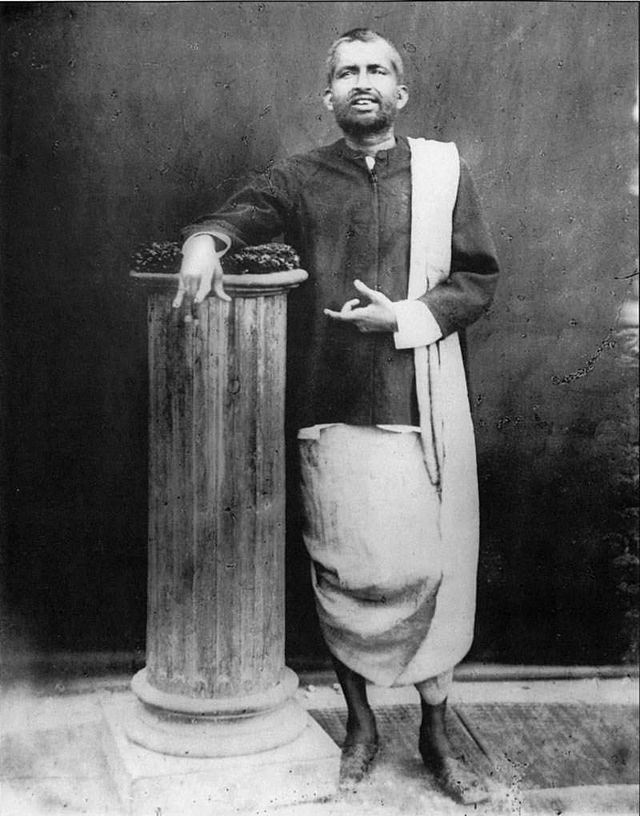
Sri Ramakrishna was an Indian Hindu religious leader and saint of 19th century Bengal who is known for his enlightening teachings on God and religion. On his 186th birth anniversary, let us take a look into his compelling life and ideals which has influenced and still remains influencing a great number of minds.
Sri Ramakrishna Paramahamsa
Sri Ramakrishna was born on 18 February 1836 to Kshudiram Chattopadhyaya and Chandramani Devi, in the village of Kamarpukur, West Bengal, in India. Born in a very poor, yet pious and orthodox household, he did not show much interest towards formal education, saying that he was not interested in “bread-winning education”.
Spirituality, Priesthood and Marriage
It was at the age of six that he went through his first experience of spiritual trance, when he came across the sight of a flock of white cranes flying against a background of black rain clouds and continued to have similar experiences throughout his childhood. He was also interested in spiritual discourses from an early age. The death of his father when he was just seven years old added to his introspective nature.
At sixteen, Ramakrishna travelled to Kolkata to help his brother Ramkumar who was the chief priest at the Dakshineshwar Kali Temple. When his brother died after a few months, Ramakrishna was made the priest. He now became completely absorbed in the worship of Goddess Kali. He spent days and nights in prayer, singing devotional songs and meditating, forgetting his priestly duties, longing for the divine vision of Mother Kali. Finally, on an occasion when he was in utmost despair yearning for Mother Kali, he was blessed with her vision, later describing it as an infinite sea of radiation and light which enveloped him and everything around him.
Rumors of Sri Ramakrishna’s unstable life resulted in his concerned family getting him married to Sarada, a five-year old from the neighboring village of Jayarambati. She later joined him in Dakshineshwar at the age of eighteen. Sri Ramakrishna had by this time been ordained a Sannyasin and thus observed the basic vows of monastic life. Thus, their marital life remained truly spiritual. He even worshipped Sarada as the Divine Mother while performing the Shodashi Puja in his room at Dakshineshwar.
After his marriage, Sri Ramakrishna returned to Dakshineshwar, where he proceeded to learn and experience different aspects of God he followed, with the help of various Gurus, and realized God through each path. Bhairavi Brahmani, an ascetic well-versed in scriptures, was the first Guru to arrive at Dakshineshwar in 1861 and teach Sri Ramakrishna various disciplines of the Tantric path. A Vedanta monk named Tota Puri arrived in 1865 and guided him to Nirvikalpa Samadhi, which is the highest spiritual experience according to Hindu scriptures. Sri Ramakrishna also went on to practice Islam and Christianity, wanting to experience God in all forms. He was able to attain the highest realization through each of them in a short span of time. He spent 12 years practicing various forms of religion and spirituality, finally expressing his spiritual realization as “So many religions, so many paths to reach one and the same goal”.
Disciples and Final Years
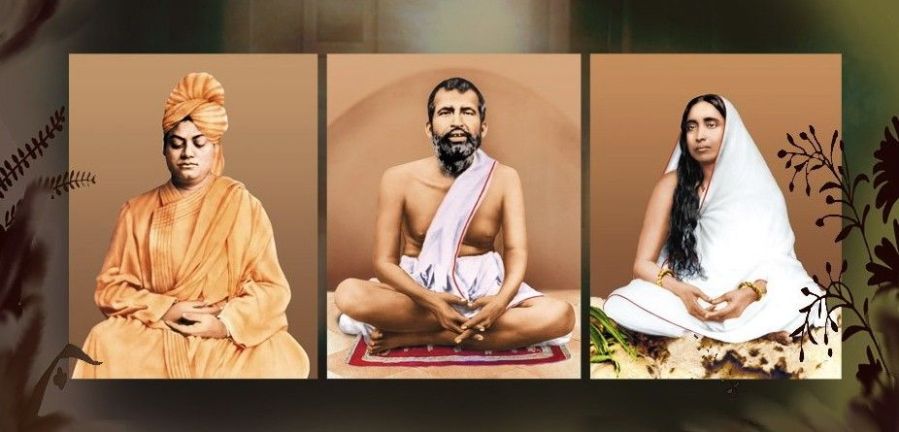
As his name and spiritual messages spread all over the country, it attracted people from different backgrounds. Disciples arrived from all over, wanting to learn from him. He divided his disciples into householders, who were taught to realize God while performing their family duties, and young, educated monks, who were tasked with spreading the universal message of Vedanta. One of his most influential disciples was Swami Vivekananda, who re-invigorated Hinduism and remains one of the most celebrated spiritual leaders in India.
Swami Vivekananda, Sri Ramakrishna Paramahamsa and Sarada Devi
In 1885, Sri Ramakrishna was diagnosed with throat cancer after which he was shifted to a suburban villa where he was nursed by his disciples and Sarada Devi. He gave up his physical body on 16 August 1886, uttering “Ma” before passing away. Sri Ramakrishna’s disciples, led by Swami Vivekananda founded the Ramakrishna Math and Ramakrishna Mission. His illuminating conversations with visitors and disciples have been noted down by his disciple Mahendranath Guptha and published as a book “The Gospel of Sri Ramakrishna“, released in 1942.
Cats are a secret that has charmed individuals’ hearts for millennia. Felines are an exceptionally well known pet due to their mysterious character and stunning components; as indicated by a report, 18% of families in the UK alone are administered by a feline. With such countless felines around, unquestionably everybody has a universal knowledge of them, correct? Wrong! There are a ton of fascinating realities about felines that you certainly didn’t think about, such the world’s biggest feline and how they walk.
A portion of these feline realities make certain to astound you!
The most seasoned realized pet feline existed 9,500 years prior: The most established This captivating feline goody makes certain to intrigue your visitors at your next evening gathering. Did you realize that the feline should have been tamed by Egyptians? In any case, in 2004, archeologists from France uncovered a 9,500-year-old feline burial chamber in Cyprus. This makes it the world’s most established known pet feline, going back more than 4,000 years before Egyptian feline workmanship!
Felines burn through 70% of their lives dozing: You’d be right in the event that you expected felines spend the a large portion of their lives resting. Felines go through 70% of their time on earth snoozing, which likens to around 13-16 hours consistently, as indicated by Veterinary Hub. It’s the existence of a feline!
The most established feline on the planet was 38 years of age: When he passed on, the most seasoned feline on the planet was 38 years and 3 days old. Creme Puff, brought into the world on August 3, 1967, made due until August 6, 2005, and his proprietor Jake Perry additionally had Grandpa Rex Allen, the past most established feline record holder, who kicked the bucket at the excellent age of 34! Jake Perry is an expert at whatever he does!
The record for the longest feline at any point is 48.5 inches: Domestic felines are ordinarily thought to be modest and sensitive animals. However, did you realize that the world’s longest feline, Stewie, a Maine Coon, was 48.5 inches long? Arcturus, then again, held the title for being the tallest feline, remaining at a faltering 19.05 inches tall! Those are some enormous cats.
The most extravagant feline on the planet had? 7 million: According to Guinness World Records, Blackie is the world’s most well off feline. At the point when his rich proprietor kicked the bucket, he declined to specify his family in his will and rather left Blackie a 7,000,000 pound fortune! That interesting feline data bewilders us!
Felines walk like camels and giraffes: Have you at any point seen how felines stroll similarly that camels and giraffes do? They stroll with both right feet first, then, at that point both left feet, pushing half of their body ahead simultaneously. The lone different creatures that can walk this way are camels and giraffes. Still don’t trust us? Have a look at the video underneath!
A house feline can arrive at velocities of up to 30mph: If you’ve at any point seen your little catlike run around the family room when they’re energized, you realize felines are quick, yet you will have a hard time believing this feline truth. They can arrive at paces of more than 30 miles each hour, which is sufficiently quick to overcome Usain Bolt in a 200-meter run!
In 1963, a feline went to space: You’ve presumably known about monkeys and canines in space, yet did you realize a feline has additionally wandered into the obscure? Felicette, usually known as “Astrocat,” was the sole feline to go to space on October 18, 1963.
House felines share 95.6% of their hereditary cosmetics with tigers: This data about felines will dumbfound you. As indicated by an investigation, our homegrown felines share 95.6 percent of their hereditary cosmetics with tigers! They likewise display a significant number of similar practices, for example, fragrance and pee checking, following, and jumping on prey.
Isaac Newton concocted the feline entryway: Isaac Newton is generally known for his computations on gravity, yet he is likewise credited with developing the feline entryway. Newton’s examinations at the University of Cambridge were routinely hindered by his felines scratching at the passage, as indicated by How Stuff Works. Subsequently, he employed a Cambridge craftsman to cut two openings in the entryway, one for the mother feline and the other for her infants! These openings, as per reports, may in any case be seen at the grounds today.
Start-ups wow……. What a innovative and independent way. So today let’s know about something about startups. Startup looks like the newest way to explore our opportunities in the most significant and planned manner. The boss of your own. Sounds great and yes startups are just like that. Skill, knowledge ,technique and experience can lead to a good startup. A startup is an opportunity for an individual to enhance his skills and it will be an employment generation. When the works is facing unemployment, lack of jobs, competition and scarce resources, start-ups come as a best and appropriate option because the creation of jobs is more important rather than being only employed. It gives a way to people of different backgrounds to work under circumstances according to their skill and specification.
A job of their own in which they can take decisions and these decisions can be an example for other people too. Startup can’t be defined because a tea seller is also doing a startup and a businessman too is doing the startup. It’s the need of the hour to understand and go with the trend. Jobs may come and go but experience can’t. People are making milestones in these start-ups whether it is at a village level of group of people who doesn’t possess high degrees to an MBA individual. Startups have never been considered as an option because there is always a risk. And people don’t want to take that risk. But as we know the population is increasing day by day and it’s almost impossible to for any government to provide secure job to every individual. But startups are a game changer in this changeover.
They aren’t only providing employment but are also heading toward the society to change its mindset. A change is the only way to explore and innovate. As a result the youth are taking interest in enhancing their skills and being a part of these startups. Not only the youth, our one genera is of old people who are retired from their jobs but it is not easy for them to accept it mentally. They want to do work because it’s their habit and they have lived that lifestyle for a long period of time. So their experiences and our knowledge can be the perfect balance for a good startup. Startup also creates a step further to communicate our thoughts with the outside world and can create a feeling of good competition. Startup develops the leadershi
Most of us always wanted to explore the Outer-space to discover various unique planets or Aliens, but have we ever wondered that our planet Earth holds many unexplainable secrets that even scientists couldn’t able to explain. There are many Mysterious places on our planet which we have to still figure out, and those places are:-
There is a place in the United States of America called by the name Minnesota which is known for this mysterious waterfall which is known as Devil’s Kettle Falls. This Waterfall has been puzzling the scientist, geologists and Hikers for many decades because as it looks like an average waterfall that drops about 800 feet of water but the interesting part about this waterfall has two different bodies of falling water. One side of the body of waterfalls on Lake Superior and the other one falls straight into a huge natural hole in the ground, where this water lead is still a mystery. Many researchers or curious people who visited this place has poured many items like dye, sticks, ping pong balls and even logs into the kettle but one of them found any trace of a thing in the water or the nearby area.
Stonehenge
It is a unique prehistoric monument on Salisbury Plain located in Wiltshire, England, two miles (3 km) away from the west of Amesbury. It is considered to be one of the architecturally sophisticated and only surviving lintel led stone circles in the world. According to the Encyclopedia Britannica, Stonehenge was constructed in six stages between 3000 and 1520 BCE. Nowadays we have machines that can help us lift heavy materials to build huge buildings and monuments, but back in those days when Stonehenge was built no one had access to this type of technology. Many questions are arising that how can anyone have lifted stones weighing anywhere from four to thirty-seven tons and also that why were they doing this, archaeologists have come up with plenty of theories to explain this phenomenon some guessed that the men who built Stonehenge used a system of sledges rollers and boats others hypothesized that it was built with a weighted levy system well many of these guesses seem to make sense to a certain extent to this day no one has a definitive answer.
The Hessdalen Lights
This is an unidentified light which are 12 kilometres long located in a Hessdalen valley in rural central Norway. The residents of Hestia land valley Norway have to live with this burning question every single night it has to Lin Valley brightly coloured lights appear in the sky in different colours and shapes for the last four decades and possibly longer. This phenomenon has continued to puzzle scientists, according to some theories these lights could be caused by a nearby radioactive lake emitting particles that light up in the air as they evaporate other scientists think that the base of the valley contains a lot of sulfuric acids when it comes into contact with the water it causes sparks to appear in the sky even though there are many different guesses as to why this town gets their very own light show every night scientists still haven’t come up with a definitive answer.
The Boiling River in the Amazon
In the Amazon forests lies a floating river in the forested region of my Mayantuyacu that boasts temperatures so hot that any person or animal that falls into it boils alive from the inside out. This river runs at an unbelievable 196 degrees Fahrenheit dang that’s hot locals used the water to brew tea and sometimes they cook with it well this river’s high temperature is incredibly intriguing what makes this natural phenomenon a mystery is a fact that no one can figure out what makes the water so hot. According to geophysicist Adres Ruzo, boiling waters are typically attached to an active volcano or magmatic system like the boiling River Trail in Yellowstone National Park in the US but in the town of my Mayantuyacu, there are no active volcanoes within 400 miles. Over the centuries residents of this town believed that the river had magical healing powers and used it spiritually and medicinally. Ruzo guesses that hot geothermal waters pour in from cracks in the earth heating the temperature of the river but this has yet to be scientifically proven.
Movile Cave
There’s a place on earth with its ecosystem and atmosphere similar to another planet well the name of that place is movile cave which is located in the southeastern part of Romania remain closed in complete darkness for approximately 5.5 million years. It wasn’t until workers discovered the cave when they were looking for a place to build that anyone learned about it scientists carved out an opening to the cave and found that a completely sustained ecosystem was thriving inside as a pathway was carved through the rock past numerous tunnels. Scientists found a lake of sulfuric water that stinks, the air was filled with hydrogen sulfide and had 100 times more carbon dioxide than Earth’s air contains needless to say this air is completely toxic what’s even crazier is that a whole ecosystem has been existing in this cave with 33 species that can’t be found anywhere else on earth this cave gives us a glimpse of what could exist on other planets with completely different atmospheres how it managed to exist on earth all this time is still a question.
Circles of Namibia
Namibian deserts are full of elephants, snakes, antelope and also hundreds of evenly placed circles which makes the mysterious part of this desert, this brutally hot desert is home to a vast array of wildlife but even more interesting are the fields of grass with evenly spaced holes and now these circles are almost perfect and range anywhere from 10 to 65 feet in diameter many scientists have offered up theories as to why these circles appear instead of other more random shapes. In 2013 environmental scientist Norbert Juergens hypothesized that termites were the cause of these circles but like all the hypotheses that came before his, it was later disproved.
Negotiable instrument act enacted on 9th December 1881, by Imperial Legislative Council is an act to define the law relating to negotiableinstruments. Some imp dates and their significance for the act:
Negotiable Instrument Act (1881) (Citation: ACT No. 26 of 1881)1866 – The act was originally drafted.1867- “Introduced in the council and was referred to a select committee.” 1877-“ the bill was revised by a select committee, after the lapse due to criticism by local governments , high courts and chamber of commerce.” 1880-“ By the order of secretary of state the bill was referred to new law commission as in spite of everything happened in the past bill could not reach the final stage.”
The bill was redrafted.1881- Thus after being prepared for 4 times, it was introduced in the council.1882- Commenced on 1 March 1882. Characteristics of Negotiable Instruments :· These are freely transferable in nature. for example; property is a negotiable instrument and it is readily transferable by a simple process of delivery..· Presumed to have been
1. made
2. accepted
3. endorsed
4. drawn
5. negotiated6. transferred for consideration· They are easy for recoveryIndependent Title: “The general principle as regards the transfer of property, that is, no “One can give a better title than he himself has, is not applicable in case of negotiableinstruments. If the transferor had obtained a negotiable instrument by exercising fraud, but the transferee obtains that negotiable instrument in good-faith (bona-fide) for value, then the transferee shall enjoy a good title as regards that negotiable instrument. Thus, the title of the transferee as regards a negotiable instrument is independent of the title ofthe transferor.”“The holder who acquires the instruments hold title free from all defects.”“Every holder of instrument is presumed to be holder in due course.” Presumptions as to negotiable instruments: “Sections 118 and 119 of the Negotiable Instrument Act lay down certain presumptions which the court presumes in regard to negotiable instruments. In other words these presumptions need not be proved as they are presumed to exist in every negotiable instrument”. Until the contrary is proved the following presumptions shall be made in case of all negotiable instruments: 1. Consideration: “It shall be presumed that every negotiable instrument was made drawn, accepted or endorsed for consideration. It is presumed that, consideration is present in every negotiable instrument until the contrary is presumed. The presumption of consideration, 6 however may be rebutted by proof that the instrument had been obtained from, its lawful owner by means of fraud or undue influence.” 2.Date: “Where a negotiable instrument is dated, the presumption is that it has been made or drawn on such date, unless the contrary is proved.” 3. Time of acceptance: “Unless the contrary is proved, every accepted bill of exchange is presumed to have been accepted within a reasonable time after its issue and before its maturity. This presumption only applies when the acceptance is not dated; if the acceptance bears a date, it will prima facie be taken as evidence of the date on which it was made.” 4. Time of transfer: “Unless the contrary is presumed it shall be presumed that every transfer of a negotiable instrument was made before its maturity.” 5. Order of endorsement: “Until the contrary is proved it shall be presumed that the endorsements appearing upon a negotiable instrument were made in the order in which they appear thereon.” 6. Stamp: “Unless the contrary is proved, it shall be presumed that a lost promissory note, bill of exchange or cheque was duly stamped. “7. “Holder in due course: Until the contrary is proved, it shall be presumed that the holder of a negotiable instrument is the holder in due course. Every holder of a negotiable instrument is presumed to have paid consideration for it and to have taken it in good faith. But if the instrument was obtained from its lawful owner by means of an offence or fraud, the holder has to prove that he is a holder in due course.”Negotiable instrument act enacted on 9th December 1881, by Imperial Legislative Council is an act to define the law relating to negotiableinstruments. Some imp dates and their significance for the act: Negotiable Instrument Act (1881) (Citation: ACT No. 26 of 1881)1866 – The act was originally drafted.1867- “Introduced in the council and was referred to a select committee.” 1877-“ the bill was revised by a select committee, after the lapse due to criticism by local governments , high courts and chamber of commerce.” 1880-“ By the order of secretary of state the bill was referred to new law commission as in spite of everything happened in the past bill could not reach the final stage.” The bill was redrafted.1881- Thus after being prepared for 4 times, it was introduced in the council.1882- Commenced on 1 March 1882. Characteristics of Negotiable Instruments :· These are freely transferable in nature. for example; property is a negotiable instrument and it is readily transferable by a simple process of delivery..· Presumed to have been 1. made2. accepted3. endorsed4. drawn5. negotiated6. transferred for consideration· They are easy for recoveryIndependent Title: “The general principle as regards the transfer of property, that is, no “One can give a better title than he himself has, is not applicable in case of negotiableinstruments. If the transferor had obtained a negotiable instrument by exercising fraud, but the transferee obtains that negotiable instrument in good-faith (bona-fide) for value, then the transferee shall enjoy a good title as regards that negotiable instrument. Thus, the title of the transferee as regards a negotiable instrument is independent of the title ofthe transferor.”“The holder who acquires the instruments hold title free from all defects.”“Every holder of instrument is presumed to be holder in due course.” Presumptions as to negotiable instruments: “Sections 118 and 119 of the Negotiable Instrument Act lay down certain presumptions which the court presumes in regard to negotiable instruments. In other words these presumptions need not be proved as they are presumed to exist in every negotiable instrument”. Until the contrary is proved the following presumptions shall be made in case of all negotiable instruments: 1. Consideration: “It shall be presumed that every negotiable instrument was made drawn, accepted or endorsed for consideration. It is presumed that, consideration is present in every negotiable instrument until the contrary is presumed. The presumption of consideration, 6 however may be rebutted by proof that the instrument had been obtained from, its lawful owner by means of fraud or undue influence.” 2.Date: “Where a negotiable instrument is dated, the presumption is that it has been made or drawn on such date, unless the contrary is proved.” 3. Time of acceptance: “Unless the contrary is proved, every accepted bill of exchange is presumed to have been accepted within a reasonable time after its issue and before its maturity. This presumption only applies when the acceptance is not dated; if the acceptance bears a date, it will prima facie be taken as evidence of the date on which it was made.” 4. Time of transfer: “Unless the contrary is presumed it shall be presumed that every transfer of a negotiable instrument was made before its maturity.” 5. Order of endorsement: “Until the contrary is proved it shall be presumed that the endorsements appearing upon a negotiable instrument were made in the order in which they appear thereon.” 6. Stamp: “Unless the contrary is proved, it shall be presumed that a lost promissory note, bill of exchange or cheque was duly stamped. “7. “Holder in due course: Until the contrary is proved, it shall be presumed that the holder of a negotiable instrument is the holder in due course. Every holder of a negotiable instrument is presumed to have paid consideration for it and to have taken it in good faith. But if the instrument was obtained from its lawful owner by means of an offence or fraud, the holder has to prove that he is a holder in due course.”
Vijay Tendulkar was a famous Indian playwright of contemporary times, during the third phase of threatre. He could be called a complete playwright in tradition of Shakespeare because how he reflected on the society in his plays and the way her brought the characters to life.Not many playwrights can claim such an achievement. He took on themes that were not spoken on in those times, various taboo themes of sexuality, violence within the family and outside, treatment of women in the Indian society.
One such play he wrote that brought him to spotlight was ‘Silence! The Court Is In Session’. The play takes on the plight of a single Indian woman, the stigma attached to her in the society at that times and how she held more accountable for wanting to live her life her way, unlike a man ever would be. A play within a play, it centers around the mock trial aimed at showing the Samant what a court proceeding looks like and prosecuted the protagonist, Ms. Benare, for a fake crime that was turned into a contempt against her and her personal life and she felt as if she was on a real trial for her “crime” – Being an unwed mother.Ms. Leela Benare, the protagonist, is written as a modern young woman in the middle class society today she is cheerful, lively and seeks to live life on her own terms. She is a dedicated and devoted teacher and believes that one should live their life to the fullest. He character suffers in the play because the way she lived her life defied the established social norms and her private life was dissected for the evil pleasure of the males of the group and to satisfy the jealous of the only woman present there apart from Ms. Benare.The highlighted character represents a modern day free-minded women who are out there in the field doing what they love and living the life on their own terms. The times have changed since the play was first written but the plight of such women still exists and is in effect more than we would like it to be. A woman, even today is questioned for the clothes she wear, working late night, hanging out with male friends and having fun and living their life. The stigma still continues that a woman needs to be reserved, should marry as soon as possible and live her life as far as the permission of her husband allows. And this is the top most layer of it all. The things turn worse if a woman is romantically involved with a man she is not married. She becomes an object of scrutiny for the entire society n the pall-bearers of the “purity of society” treat them as an anomaly and possible threat to the “sancity” of the society. For some reason, the affair of a married man is not as big an issue for the people as a romantic involvement of a woman is. A man can follow his desires, even sexual, run away from his responsibility of upholding the sanctity of society and still live his life in peace. The private life of a man never comes in question when his professional competency is concerned unless it’s something as grave as committing a crime, which still form a crucial part for professional area, the background of an employee. A woman on the other hand, needs to maintain a “society-approved” speckless record of personal life to prove her professional competency. All this gets far much worse if you are an unmarried single woman who’s pregnant or a divorcee. Male divorcees are still treated with more pity than a female divorcee. In the case of the play, how Miss Benare was treated for having a flirtatious nature and living a life full of fun and enthusiasm won’t come as big surprise for the readers. Also, how Prof. Damle was not at all held at contempt, neither was her maternal uncle, for getting involved with her. But Ms. Benare alone faced the blunt of it all, because she’s a woman who wanted nothing more than love from a man and was betrayed. In the game, skeletons tumbled out of the closet and her suicidal tendencies as well as seducing every male member in the troupe and proposal of marriage to everyone is revealed. The institution of a inquiry in her school for her moral conduct which will dismiss her from service (her sole means of sustenance) was also ordered. The hypocrite society calls motherhood divine, higher than heaven and infanticide a great sin will not take any kind of motherhood other than the what they suppose is correct, which is, a married woman. Other elements such as inter-caste marriage is not included in the play but that as well decides the level of divinity of one’s mother hoodShe does not want to abandon his child as she has enjoyed some blissful moment. She talks about her genuine love for her maternal uncle and Prof. Damle and how she left her both the time. Even in the current time, a woman will be treated with quite a bit of harsh contempt for her romantic and , especially, sexual involvement with any person she is not married to. Whereas men and their love for only the flesh of a person, their lust, will always be justified or overlooked, or both. Society might have changed, women a more free than they ever were before, but shaking off of a long set stigma and the utter lack of respect for the personal life of a woman will take a long long time.
Revocation generally in terms mean to withdraw something. It can be anything of a good , offer, task, deal anything. It may also stand for cancellation. So revocation in the law of contracts can be defines as a remedy given to buyers if not satisfied with goods of the sellers. The buyers here are termed as offerers and revocation must be communicated to offree before acceptance. This is also the general common rule on revocation.
Section 2(e) says that an agreement is defined as a set of promises. This happens when an offer is placed by the offererand accepted by the offree. Revocation can only be done before the acceptance of a particular agreement.According to section 2e All agreements are not contracts but all contracts are agreements.
Problems Of Revocation:
Formation of a contract lies within giving the power of acceptance to the offreerather than in a meeting of the minds, A different principle has been definitely established . Admittedly even today Freedom of contracting and making the offers permits the offeror to reserve for himself the possibility of revoking his offer without any notice. Thus in Tartoria v Mankoa real estate broker having a listing of Ds property was held to be entitled to his comissionwhen he procured a customer after the property had been sold since the seller had concealed the sale from the broker.”
Today revocation is generally so strictly connected with the offerees notice about it has also been defined as the communication of change in the offererspurpose. Its justified that communication is essential for revocation purpose.
Hey guys so I have been reading this book “LAWS OF SPIRITUAL WORLD” by “khorshed Bhavnagri”. It was the book I was looking for. Hearing about the spirit world is so calming. It’s like you know it but you cannot remember it. In this book the writer lost her two young sons in an accident and she explained how she overcome that trauma and contacted her sons in spirit world. Her sons explained many things about spirit world like why humans come on Earth? What is karma? Who is God? What is our mission on Earth?
They explained that every human being on Earth has a spiritual mission. Humans in spirit world choose their own mother their date of birth as well as date of death. Humans choose how they want to be trained on Earth so they can fight their negative karma and rise spiritually.
The government of India brought up the initiative of Azadi Ka Amrit Mahotsav to mark and celebrate the 75 years of developing independent India. The initiative is a personification of all the developments of India’s political, socio-cultural and economic identity and through this India is commemorating the glorious history of it’s culture, people and accomplishments.
On 12th March 2021, the Prime Minister of India, Shri Narendra Modi flagged off the beginning of the 75-week long ‘Azadi Ka Amrit Mahotsav’ from Sabarmati Ashram to celebrate 75 years of India’s freedom. This festival commenced the countdown to India’s 75th independence day anniversary and this will end after a year on 15th August 2023. A Dandi Yatra from Sabarmati Ashram was initiated by Mahatma Gandhi on 12th March 1930 in awake of nation’s self-esteem and self-reliance. On the same day in 2021, PM Modi started the emblematic Dandi Yatra which marked the amelioration of the journey of self-reliance and self-esteem through Azadi Ka Amrit Mahotsav. Azadi Ka Amrit Mahotsav is devoted to the people of India who have been contributory and influential in the evolutionary progress of India as well as who also hold within them the potential and capability to enable PM Modi’s vision to initiate the 2.0 version of India which is energized by the Atmanirbhar Bharat spirit.
The centre focus is on participation of citizen to make Azadi Ka Amrit Mahotsav a ‘Janandolan’ where local level minor efforts will accumulate notable national gains. Thus, a number of intensive campaigns are being organized countrywide. In order to celebrate the freedom of fighters, numerous programs of freedom with the name of Azadi Ka Amrit Mahotsav are being coordinated across the nation. These campaigns or programs include various competitions, photo exhibitions, etc. that portrays the contribution and struggle of the freedom fighters. In some places, the display of Azadi Ka Amrit Mahotsav is in two parts, one part depicting the freedom movement prior to the Mahatma Gandhi’s arrival and the other picturizing the struggle of freedom led by Gandhiji. Various historical photographs depict the contribution of the famous Lal-Bal-Pal, Lala Lajpat Rai, Lokmanya Tilak and Bipin Chandra Pal. The movements of various other revolutionaries are also displayed including Mangal Pandey, Rani of Jhansi Rani Laxmibai, Raja Rammohan Roy, Swami Vivekananda, Swami Dayanand, Chief Kartar Singh Sarabha, Veer Savarkar, Annie Besant, Khudiram Bose, Bhika Ji Cama and many more. The entry of Gandhi into Indian politics post his return to India from South Africa in 1915 is well portrayed in the photo exhibition series and his freedom movement was taken into a new era. The war fought through Satyagraha reaches Champaran Satyagraha (1917), Kheda Satyagraha (1918), Jallianwala Bagh Nar Sanhar (1919) from Non-Cooperation Movement (1921) to Dandi Satyagraha (1930) is shown along with special; reference to Sardar Vallabhai Patel’s role in the integration of nation and Netaji Subhash Chandra Bose’s role in the freedom movement. Meanwhile, the martyrdom of Chandra Shekhar Azad, Bhagat Singh, Sukhdev, Rajguru was also remembered. The exhibition as a whole depicts the chronological order of freedom fighters, independence movements and their struggle to make India free.
Thus, it can be inferred that the rapid strides that India took in the past 75 years is commemorated in the ‘Azadi Ka Amrit Mahotsav’ festival. This festival aims at encouraging us to retrieve our strengths that are hidden and prompts us to take sincere and collaborative action to regain our deserving place in the nation’s courtesy.
These studies were originally prepared for a series of radio broadcasts. They have been edited for publication, but formality of style has not been a priority. I hope that the conversational tone of these studies will not be a stumbling block to you, but that it will, rather, make this work easier to read. May you find the commentary readable and enjoyable as well as instructive. This commentary is a book of STUDIES (please bear with me for the all capital letters that I use throughout this book for emphasis). However, they are also intended to be practical and devotional, as well as doctrinal. If our studies do not stir you to love God more and to live for Him better, then as an author I will have failed. I have no desire to increase your intellect without also influencing your will and challengingyou to follow the Lord Jesus Christ more fully.







 Eduindex
You must be logged in to post a comment.