

I have been thinking about this movie for the past several days since watching it which is probably the sign of a good movie. It builds the emotional attachment you have to the characters until you start to truly feel what they are going through. It also has a great message about living and life. It's not your usual vapid teen romance comedy but is relatable to any age. I fell in love with Skye's spirit and strength and it was another great performance by Maisie Williams who I believe will be one of our premier actresses in the future. Asa Butterfield ... remember him from Enders Gsme... can't tell...the guy has some range. Overall definitely a must watch for when you are looking to sit and chill instead of getting hyped up watching an action glick.
Author: Eduindex News
Visit us for more news at https://eduindex.org
The Chernobyl Disaster
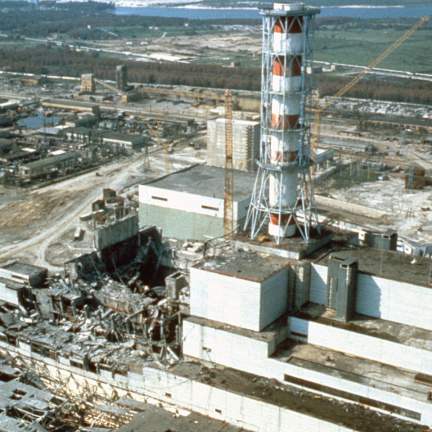
On April 25, 1986, the worst nuclear accident in history occurred in present day Ukraine as a reactor at a nuclear power plant exploded and burned. The disaster took place near the city of Chernobyl in the former USSR, which invested heavily in nuclear power after World War II.
The accident started during a safety test on an RBMK-type nuclear reactor. The test was a simulation of an electrical power outage to help create a safety procedure for maintaining reactor cooling water circulation until the back-up electrical generators could provide power. Three tests were conducted since 1982, but they had failed to provide a solution. On this fourth attempt, an unexpected 10-hour delay resulted in, unprepared operating shift of workers were on duty. During the planned decrease of reactor power in preparation for the electrical test, the power unexpectedly dropped to a near-zero level. The operators were able to only partially restore the specified test power, which put the reactor in an unstable condition. This risk was not made evident in the operating instructions, so the operators proceeded with the electrical test. Upon test completion, the operators triggered a reactor shutdown, but a combination of unstable conditions and reactor design flaws caused an uncontrolled nuclear chain reaction.
A large amount of energy was suddenly released, and two explosions ruptured the reactor core and destroyed the reactor building. One was a highly destructive steam explosion from the vaporizing super-heated cooling water and the other explosion could have been another steam explosion or a small nuclear explosion. This was immediately followed by an open-air reactor core fire that released considerable airborne radioactive contamination for about nine days that precipitated onto parts of the USSR and Western Europe, especially Belarus, 16 km away, where around 70% landed, before being finally contained on 4 May 1986. The fire gradually released about the same amount of contamination as the initial explosion. As a result of rising ambient radiation levels off-site, a 10-kilometre radius exclusion zone was created 36 hours after the accident. About 49,000 people were evacuated from the area, primarily from Pripyat. The exclusion zone was later increased to 30 kilometres when a further 68,000 people were evacuated from the wider area.
To reduce the spread of radioactive contamination from the wreckage and protect it from weathering, the protective Chernobyl Nuclear Power Plant sarcophagus was built by December 1986. It provided radiological protection for the crews of the undamaged reactors at the site, which continued operating.

The reactor explosion killed two of the reactor operating staff. A massive emergency operation to put out the fire, stabilize the reactor, and clean up the ejected nuclear core began. In the disaster and immediate response, 134 station staff and firemen were hospitalized with acute radiation syndrome due to absorbing high doses of ionizing radiation. Of these 134 people, 28 died in the days to months afterward and approximately 14 suspected radiation-induced cancer deaths followed within the next 10 years. More than 15 childhood thyroid cancer deaths were documented. Significant clean-up operations were taken in the exclusion zone to deal with local fallout, and the exclusion zone was made permanent. The World Health Organisation estimates 4000 people will eventually die as a result of the accident, from cancers and radiation poisoning.
It’s estimated that the amount of radioactive material was 400 times more than the atom bomb dropped on Hiroshima. Scientists estimate the zone around the former power plant will not be habitable for up to 20,000 years.
Journey to Ithica
How the character of 'the Mother' was dubious.

Introduction:
The novel Journey to Ithica is a literary genre from the second half of the 19th century. Novel as a literary genre rose in Spain in the 17th century, France and Europe in the 18th century and America in the first half of the 19th century. Literary novel is a criticism of life and gives an authentic picture of life. It’s only character based and the central character revolves around the growth and development of that character.
The main theme is how Sophie wants to prove that what the Mother is seen for is fake, and she wants to expose her true self. Things weren’t exactly harmonic between Sophie and her husband Matteo, Matteo was ill from hepatitis (dangerous form of jaundice). He finds the Mother/Guru and starts to live in her ashram and blindly believes everything be sees. On the other hand, Sofie, the more mature one, realized that there is more to what meets the eye and tries to uncover the truth as only then can Matteo be treated in the hospital. In this article, I’ll be expanding my thoughts on how the character of the Mother is dubious.
About the author:
Anita Desai was born on June 24, 1973 in Missouri, India. She is an English language Indian novelist who excels in evoking character and mood through visual images. Most of her novels reflect the tragic view of Life. Journey to Ithica was first published in 1995.

Journey to Ithica describes a pilgrimage to India by a young couple, Matteo and Sophie and the life of a mysterious woman, ‘the Mother’, who runs the ashram where they live. The ashram is located at the foothills of the Himalayas.
~ The character of ‘the Mother’ in the novel is portrayed as very suspicious or dubious. Even though Matteo completely trusted and devoted himself to her, Sophie was still unsure about her and the fact that she went on a whole journey just to learn more about her or learn about her spiritual journey does raise a lot of suspicion.
~ We see how Matteo was so ill, he still chose to stay with ‘the Mother’ and learn more about scriptures rather than go home to his kids and wife. This shows how devoted he was to ‘the Mother’. It is also suspicious how every time the mother falls, all her devotees fall ill too. It is very a natural for something like that to happen.
~ Even though, in the story she is shown as someone who might be doing better than other gurus, the readers do not find it amusing or any different as she sits among her devotees and not at the top. This raises suspicion of her being a Guru.
~ The novel tells us how ‘the Mother’ has childhood roots from Egypt but the doubtful part here is that she possesses the Indian English accent of dragging the letters.
~ It is still a question as to why she travelled to India and what was the reason that she decided to do things differently compared to other cult leaders. All of her actions points towards the fact that she has not yet attained enlightenment or even any kind of divinity. Her actions are childish and immature which makes us question if she is even worthy of the title ‘Guru’.
~ She also does not treat her devotees equally. She mainly focuses on the new members and ignores the old members which is suspicious.
Conclusion:
Henceforth, all her actions prove that she is a very doubtful and dubious person.
Human Excretory System
Metabolic activities continuously take place in living cells. All metabolic products produced by the biochemical reactions are not utilized by the body because certain nitrogenous toxic waste substances are also produced. They are called excretory products. In human beings urea is the major excretory product. The tissues and organs associated with the removal of waste products constitute the excretory system. The human excretory system consists of a pair of kidney, which produce the urine, a pair of ureters which conduct the urine is stored temporarily and urethra through which the urine is voided by bladder contractions. If the waste products are accumulated and not eliminated, they become harmful and poisonous to the body. Hence, excretion plays an important role in maintaining the homeostatic condition of the body. Some of the excretory organs other than kidneys are skin (removes small amounts of water, urea, and salts in the form of sweat) and lungs (eliminate carbon-dioxide and water vapour through exhaling).
Skin
Skin is the outer most covering of the body. It stretches all over the body in the form of a layer. It accounts for 15% of an adult’s human body weight. There are many structures and glands derived from the skin. It eliminates metabolic wastes through perspiration. The human body functions normally at a temperature of about 37°C. When it gets hot sweat glands start secreting sweat, which contains water with small amounts of other chemicals like ammonia,urea,lactic acid and salts(mainly sodium chloride). The sweat passes through the pores in the skin and gets evaporated.
Kidneys
Kidneys are bean-shaped organs reddish brown in colour. The kidneys lie on either side of the vertebral column in the abdominal cavity attached to the dorsal body wall. The right kidney is placed lower than the left kidney as the liver takes up much space on the right side. Each kidney is about 11cm long, 5cm wide and 3cm thick. The kidney is covered by a layer of fibrous connective tissue,the renal capsules,adipose capsule and a fibrous membrane.
Internally the kidney consists of an outer dark region, the cortex and an inner lighter region, the medulla. Both of these regions contain uriniferous tubles or nephorns. The medulla consists of multitubular conical masses called the medullary pyramids or renal pyramids whose bases are adjacent to cortex. On the inner cancave side of each kidney, a notch called hilum is present through which blood vessels and nerves enter in and the urine leaves out.
Ureters: Ureters are thin muscular tubes emerging out from the hilum. Urine enters the ureter from the renal pelvis and is conducted along the Uretet by peristaltic movements of its walls. The ureters carry urine from kidney to urinary bladder.
Urinary bladder: Urinary bladder is a sac-like structure, which lies in the pelvic cavity of the abdomen. It stores urine temporarily.
Urethra: Urethra is a membranous tube, which contacts urine to the exterior. The urethral sphincters keep the urethra closed and opens only at the time of micturition(urination).
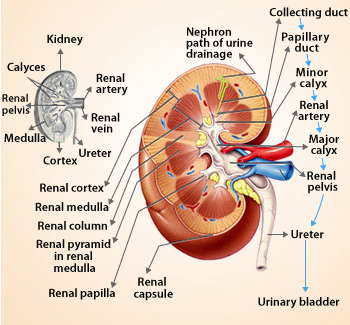
Functions of kidney
- Maintains the fluid and electrolytes balance in our body.
- Regulates acid-base balance of blood.
- Maintains the osmotic pressure in blood and tissues.
- Helps to retain the important plasma constituents like glucose and amino acids.
Structure of Nephron
Each kidney consists of more than one million nephorns. Nephrons or uriniferous tubles are structural and functional units of the kidneys. Each nephron consists of Renal corpuscle or Malphigian corpuscle and Renal tubule. The renal corpuscle consists of a cup-shaped structure called Bowman’s capsule containing a bunch of capillaries called glomerulus. Blood enters the glomerulus capillaries through afferent arterioles and leaves out through efferent arterioles. The Bowman’s capsule continues as the renal tubule which consists of three regions proximal convoluted tubule, U – shaped hair pin loop, the loop of Henle and the distal convoluted tubule. The distal convoluted tubule opens into the collecting tubule. The nitrogenous wastes are drained into renal pelvis which leads to ureters and stored in the urinary bladder. Urine is expelled out through the urethra.
Mechanism of Urine Formation
The process of urine formation includes the following three stages.
- Glomerular filtration
- Tubular reabsorption
- Tubular secretion
Glomerular filtration: Urine formation begins with the filtration of blood through epithelial walls of the glomerulus and Bowman’s capsule. The filtrate is called as the glomerular filtrate. Both essential and non-essential substances present in the blood are filtered.
Tubular reabsorption: The filtrate in the proximal tubule consists of essential substances such as glucose, amino acids, vitamins,sodium, potassium, bicarbonates and water that are reabsorbed into the blood by a process of selective reabsorption.
Tubular secretion: Substances such as H+ or K+ ions are secreted into the tubule. This tubular filtrate is finally known as urine, which is hyperbolic in man. Finally the urine passes into collecting ducts to the pelvis and through the ureter into the urinary bladder. When the urinary bladder is full the urine is expelled out through the urethra. This process is called micturition. A healthy person excretes one to two litres of urine per day.

Dialysis or Artificial kidney: when kidneys lose their filtering efficiency, excessive amount of fluid and toxic waste accumulate in the body. This condition is known as kidney (renal) failure. For this, an artificial kidney is used to filter the blood of the patient. The patient is said to be put on dialysis and the process of purifying blood by an artificial kidney is called haemodialysis.when renal failure cannot be treated by drug or dialysis,the patients are advised for kidney transplantation.

Marriage Market Prevailed In Indian Society
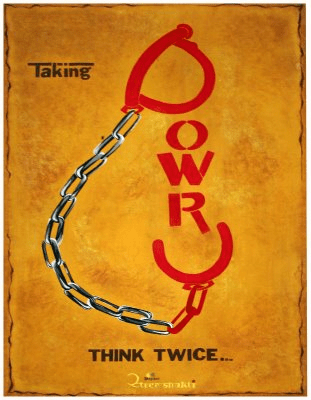
The most prevailed system of financial transaction followed in India is marriage market which takes place during the time of marriage. Dowry which is offered by the bride’s side to her groom is like a ritual practice universally in Indian society. In the name of gifts and presents people mostly pressurize the bride mates to offer a bulk amount of dowry. These are not only gifts given with a happy heart but one who gives birth to a girl is bounded to follow such traditions in the name of rituals. One of the root causes of people getting disappointed during a birth of a girl child is the marriage market which is prevailed in our society. And because of this system girls are considered as a burden for the family and due to this reason people usually practice abortion so that they can avoid payment of dowry during their marriage.

This dowry provided during the time of marriage in India usually results as poverty for several households also relative weakness of formal financial markets. Apart from this the expenses of the wedding itself charges high cost and in addition to this dowry successfully plays a significant role in investment of the entire saving amount. According to the Indian Government, giving as well as asking for dowry is a social ill that is not meant to be practice by us. The government has also passed many laws and legislatures regarding it but it seems that all efforts have gone in vain. We live in a contemporary world were we believe in the scheme of modernism and equality and in this time practicing such ill works are not acceptable. It is found that if more females are employed and educated as well as given equal opportunities as men are provided than this rate of dowry may reduce and practice of such marriage market will also fall down. Marriage is something which is it too pure but we human beings have made this a kind of business. First thing which is mostly kept in the mind during the time of marriage is jati and dowry. Dowry were the essential part in every wedding and this was found during the time of 1975 but now if we look at the system it has developed a lot. If there is some negative side there is positive too. Now with the passage of time we all have developed a lot and our mind set has also changed. Today also dowry ritual is followed but in rare case people refuse to take dowry and as an alternative of it they want an educated girl and an employed one too.
Dowry tradition is something which is followed from generation to generation and will be followed too but with the passage of time this rate is decreasing and it is expected to decrease more. If each one of us will decide to boycott such custom and also boycott the one who supports such ill tradition than that day will not be much far when such dowry will end up and no girl will be burned or murdered inside the mother’s womb.
Procrastination!
“Amateurs sit and wait for inspiration, the rest of us just get up and go to work” — Stephen King.
We all are possessed with the mixture of both the good and bad kind of qualities. Procrastination is one such thing which is impregnated in all of us, while we tend to gain something from our daily experiences. It is the act of delaying an important task for the sake of trivial matters. It can restrict one’s potential and undermine one’s career. Some tend to avoid any important meetings, some delay their work schedule and these people cannot reach the higher levels in their life.
Re-scheduling the works would inhibit the growth of oneself. It would lead one to loose their opportunities, affects the outcomes of the accomplished task and would also spoil one’s name. It really takes one to move backward, rather being prudent and moving forward. If one meets a person at 11.00 clock, who is supposed to meet at 10.00; then how would the other trust him/her?he value of time is important to be acknowledged. Each and every second that one go through in a leisure manner, is the time whence, others would be achieving something in some corner. There is something that a person should always consider and, it is known as the other end. We may take privilege upon our tasks and time but the particular thing has its own time to be done; or the other person who is involved may have many other works to be finished and they really don’t waste their time for anyone’s sake.
“Time is a storm in which we all are lost”, said by William Carlos Williams. The value of time is important to be acknowledged. Each and every second that one go through in a leisure manner, is the time whence, others would be achieving something in some corner. There is something that a person should always consider and, it is known as the other end. We may take privilege upon our tasks and time but the particular thing has its own time to be done; or the other person who is involved may have many other works to be finished and they really don’t waste their time for anyone’s sake.
Some reasons for the procrastination of works are : perceiving that the work is hard, fear of getting adapted to a new thing, exhaustion, annoying or uninteresting tasks, fetching for easier tasks, raunchy and carelessness.
Here are few steps to avoid procrastination: The work that should be done today, should not be delayed for the next day. The harder or boring work should be given the first preference, so that it would be finished off. One should always have in their mind that being responsible in our work is linked with our growth and success.
Those who procrastinate their task would lose their happiness and growth. Successful people won’t delay their task as they really long to taste it.
THE BIGGER THE AGE DIFFERENCE, THE SHORTER THE MARRIAGE
There are numerous factors which can affect a relationship. Some of them are income levels, age difference or commitment etc. With the help of different researches and studies, it was concluded that age difference can also emerge as one of the factors for divorce and for creating odds in an relationship. Studies have concluded that, the greater the age difference between couples, the greater is the chance of ending a marriage and having divorce. Different studies were conducted for understanding the situation of marriage in different age intervals . According to different studies, couples having one or less than one year age difference have only 3% chances of getting divorced. If there is a difference of 5 years then the risk increases to 18%. And if the age difference is 10 years then the risk factor is 39%. This rate keeps on increasing with the increasing age gap. Couples who have less age gap have lesser chances of getting divorced and ending the marriage than those with someone who is very young or old as compared to the other. Individuals who are close in age belong to the same generation and have similar mindsets and outlook towards society and life. This provides a strong foundation to the relationship. These people have similar cultural references and taste, life experiences and will be achieving milestones in the same time. According to different findings, the chances of ending a marriage is highly reduced if marriage is done with the person having same age.
SMALL GAPS : Researchers have found that the couples having small age gaps have less chances of getting divorced. That’s not to say those marriages will not end in divorce. They certainly could. But the age difference would not be the reason for the divorce.
LARGE GAPS :The problem arises when the age difference is higher and the bigger the gap there is between people’s age, the more likely they are to end in divorce.
Changes happen slowly. The marriage may feel to be successful in the starting but the feeling change with time if there are unsuitable conditions. And in case of large age difference, it is seen that the people of more age feel to be more satisfied than the younger one and this eventually pushes the couple to divorce. People find themselves in different places and phases of and in life. If one thinks about his career or good health while the other will be focusing on retirement or declining health due to old ages. Despite the age differences and perspectives, people also have similar feelings and must have felt the happiness but in the similar way there will be numerous differences also. While examining or understanding any relationship it is necessary to understand both the partners. Relative ages of spouses affect if the husbands will leave their wives or the wives leave the husband and mostly it is found that the older spouses are left by the younger. Hence, spouses start to look less appealing and the thinking styles differs more and more as he or she ages, and it is absolute age that is driving divorce.
Sunsets
The only reason I believe in happy endings

Like SRK said if the ending is not happy ending then, “Picture abhi baki hai mere dost”. When the sky is in it’s beautiful colours and the sun is going down, may be they are trying to say us that look, “the endings can be beautiful too”, may be they are giving us hope, hope for better and beautiful future, may be, they are trying to say us that, let go what happened today, just forgot what happened in the past by looking at this beautiful sunset skies and look forward to every sunrise, it’s your golden opportunity to “RESET”.
It’s the nature of life that things don’t stay the same but sunsets are the proof that, they can end beautifully, so don’t give up, just keep going no matter what happens the end gonna be beautiful. After entire day work just you, a cup of coffee and beautiful sunset with your favourite music will help you to forgot about all your worries and you’ll just want to live in that moment forever when the sky is in it’s beautiful colours. The world is fighting against the virus and we are too young to dealing with all this, so much has happened, so much is happening, at some point in our life we all feel depressed, sad and lonely, sometimes we just want to give up and it’s a life but, DON’T, comfort yourself by looking at these beautiful sunset skies.
Some people may sound like that, you need to do something special in life, and that’s not true. They will judge you at every point in your life but, don’t think, don’t put so much thoughts into what you’re doing and what others are saying or what others will say, you just have to keep going. Start doing things for yourself let them call you selfish sometimes it’s really okay to be selfish.
Also always remember, you are just a little bit doubtful of your potential and unsure of your worth but you are as amazing as these sunset skies.
A 600-million-dollar Yacht
This is a hydro-powered yacht over 370 feet long superyacht designed by Sinot Yacht Architecture and Design. Let’s take a look at what this means and who owns it now. Well, hydrogen power is considered a green source of energy, which implies this yacht does not harm our environment. But what’s this hydrogen power? Well, hydrogen power uses hydrogen fuel cells which produce electricity by combining hydrogen and oxygen atoms. When hydrogen reacts with oxygen across electrochemical cell water, electricity and a small amount of heat are produced.
Hydrogen energy was initially used over 200 years ago powering the first-ever internal combustion engine. It is light in weight, has easy storage options, and produces no direct emissions or any sort of greenhouse gases. There are various ways of producing hydrogen, it can be from fossil fuels, biomass, water, or a mixture of all three. Currently, over 70% of pure hydrogen comes from natural gas. This implies hydrogen power is safe for our future and hence this is a green source of energy.
Many media sources have reported that this yacht now belongs to Microsoft co-founder Bill Gates. Sinot’s 370 feet long hydrogen-powered concept AQUA received lots of attention when it was unveiled at the most recent Monaco Yacht Show. However, it looks like designer Sander Sinot may have caught lightning in a bottle. “With every project, I challenge my team and myself to surpass ourselves,” he explains. “For the development of AQUA we took inspiration from the lifestyle of a discerning, forward-looking owner, the fluid versatility of water, and cutting-edge technology to combine this in a 376-foot) superyacht with a fully operational liquid hydrogen and fuel cell system that features ground-breaking in technology, as well as design and aesthetics.”
According to advanced reports, AQUA’s power is fuelled by liquefied hydrogen, stored at extremely low temperatures, in vacuum isolated tanks. The liquefied hydrogen is converted into electrical energy by Proton Exchange Membrane (PEM) fuel cells, with water being the only by-product.
How to build a good Team ?
A team is a group of people working together towards a common goal. Creating an opportunity for people to come together to share concerns, ideas, experiences, and to begin to work together to solve mutual problems and achieve common goals.
Team Development Life Cycle
- Forming : In this stage high dependence on leader for guidance and direction. Little agreement on team. Individual roles and responsibilities are unclear. Leader must be prepared to answer lots of questions about the team’s purpose, objective and external relationships.
- Storming : In this stage decisions don’t come easily within group. Team members compete for position Clarity of purpose increases but plenty of uncertainties exist. Compromises may be required to enable progress.
- Norming : In this stage agreement and consensus forms among team. Roles and responsibilities are clear and accepted. Big decisions are made by group agreement. Commitment and unity is strong. The team discusses and develops its processes and working style. There is general respect for the leader and some of leadership is shared.
- Performing : The team clearly knows “why it is doing ?” and “what it is doing ?” . The team has a shared vision. There is a focus on over-achieving goals. Disagreements occur but now they are resolved within the team positively. The team is able to work towards achieving the goal. Team members look after each other. The team does not need to be instructed or assisted.
- Adjourning : Adjourning, is the break-up of the group, hopefully when their task is completed successfully, their purpose fulfilled; everyone can move on to new things, feeling good about what’s been achieved. From an organizational perspective, recognition of and sensitivity to people’s vulnerabilities during this fifth stage is helpful. Feelings of insecurity would be natural
Characteristics of a Good Team
- Everyone participates actively and positively.
- Team goals are understood by everyone.
- Everyone takes initiative to get things done.
- Each teammate trusts the judgment of the others.
- The team is willing to take risks.
- Everyone is supportive of the project and of others.
- Team goals are given realistic time frames.
- Everyone is focused on the ultimate goal of the project.
Common Team Problems
- Overbearing or dominating participants
- Unwilling to become involved
- Unquestioned acceptance of opinions as facts
- Rush to accomplishment
- Quarreling members
- Disconnected/lack of contact between members
Groups members should avoid the following behaviors –
- Being overly aggressive toward other members.
- Withdrawing and refusing to cooperate with others.
- Horsing around when there is work to be done.
- Using the group as a forum for self-confession.
- Talking too much about irrelevant matters.
- Trying to compete for attention and recognition
Heritage trains in India that you must enjoy a ride on
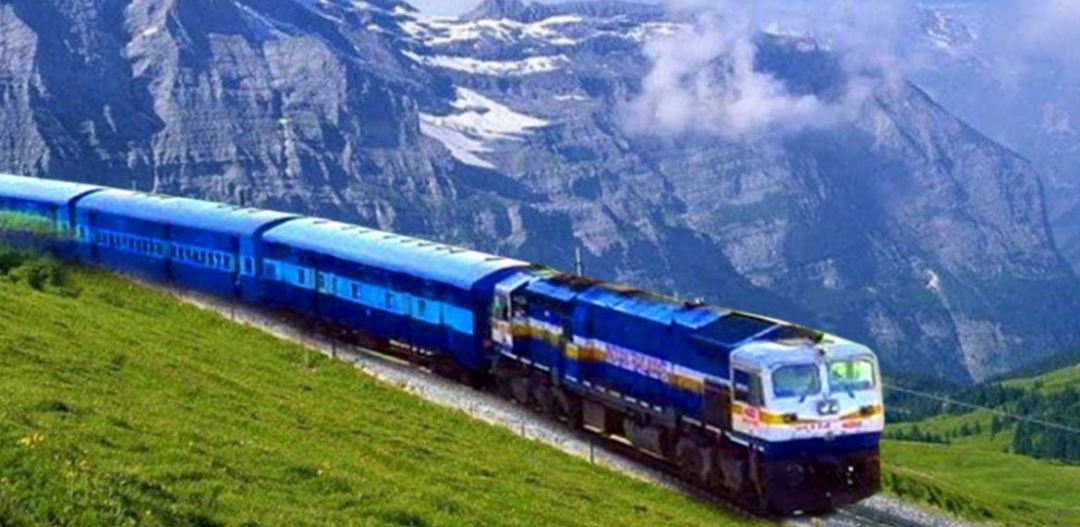
Heritage rails are more than just tourist attractions. Not only they helps create a romantic feel, but also give us a glimpse of the history of the land. Although heritage railways have renovated most of their trains for technical advancements and safety purposes, they still carry the old-school charm. The views on these routes are just unparalleled. Here’s a list of heritage trains that you need to definitely enjoy a ride on.
Kalka-Shimla Railway
This narrow gauge railway chugs between Kalka and Shimla, and is famous for offering beautiful views of forests and hill regions. It was built in 1898 to connect Shimla, the summer capital of India, with the rest of the Indian rail system. It is 2 ft 6 inch (762 mm) narrow gauge railway in North-West India, and was built by HS Harington. It is now operated by the Northern Railway. UNESCO added the Kalka-Shimla railway to mountain railways of India World Heritage Site in 2008.
Darjeeling Himalayan Railway
The toy train, this train travels between New Jalpaiguri station and Darjeeling station. The Darjeeling Himalayan Railway started in the end of the 19th century, and covers six zigzag routes and five large loops to reach higher altitudes. In 1999, this route was declared as a World Heritage Site; it has also been one of the country’s most famous tourist attractions. The setting of the train journey also has a vintage charm to it, a ride on this train will definitely change your outlook toward train travel.
Nilgiri Mountain Railway
The Nilgiri Mountain Railway is in Tamil Nadu, and was built in 1908 by the British. The route runs from Mettupalayam to Udhagamandalam (Ooty), and takes around 4.8 hours to complete. Most times, just one train travels on this route each way; however, during the peak summer season, four trains run each way, everyday. In July 2005, UNESCO designated it as a World Heritage Site, and is now operated by the Salem railway division.
Matheran Hill Railway
This train is on the tentative list of UNESCO World Heritage Sites, yet a ride on this train will be one of the best rides ever!. This narrow gauge train runs between Neral and Matheran in Maharashtra. Interesting thing to note here is that it chugs along the well-known Western Ghats, so in terms of views, you are in for a ride. Further, this 21 km long route has been in operation since 1907. The train starts its journey in Neral, and then ascends the Matheran hill by going through two large zig-zags before completing its 140 hours’ journey.
Poverty in India
Poverty one of the major problem in India. India is the second most populous country after China with 1.2 billion people and it is the seventh largest country in the world in terms of area.

Around ⅔rd of people in India live in poverty in which 68.9 % of Indian population lives on less than 2 dollar a day and over 30% even have less than 1.25 dollar per day. And thus they are considered extremely poor.
India subcontinent is one of the poorest country in the world.
The most poor section of our country is children and Womens. They are considered as the weakest member of Indian society and that’s why they suffer the most.
In India womens are not considered as the strongest member of the society because of a patriarchy.
Education and job for womens are not considered important in our society.
By preventing education for Childrens and womens leads to the poverty and poverty is also preventing children from getting an education
Poverty in India impacts children and families in a variety of different ways:-
- High infant mortality
- Child labour
- Malnutrition
- Lack of education
- Child marriage
High infant mortality rate
- India is one of the country with highest child mortality rate.
- Around 1.4 million children die each year in India their fifth birthday.
- Major causes of death are due to pneumonia, malaria, diarrhoeal diseases as well as chronic Malnutrition.
Child labour
- Child labour for children under the age of 14 in India is prohibited by law.
- According to official figures 12.5 nilganj children between the age of 5 to 14 are working.
- It is believed that Indian children’s contribute to the living wood of their poor family.
- Children’s work in the field in factories, in quarries, private households .
Malnutrition
- India is one of the world’s top countries when it comes to Malnutrition.
- 7.8 infants were found to have birth weight less than 2.5Kg
- More than 200 million people don’t have sufficient access food.
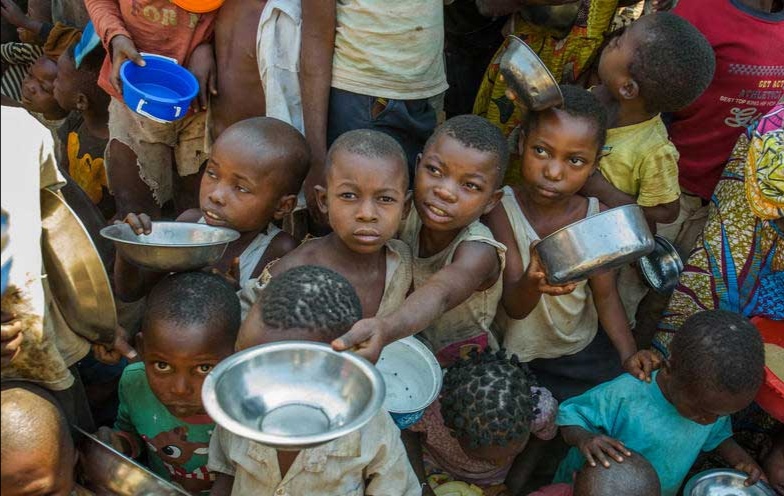
Lack of Education
- Most of childrens have no access to education in India.
- Girls are excluded from the school in higher numbers with respect to boys.
- We should have to treat them equally but it is believed to be inferior on lower caste.
- Without education, chances of finding living from employment in India is impossible.
- If educated peoples start teaching childrens at free of cost then it also be very useful in making a better world.
- Like If 30 college students are studying in 1 course and they start teaching poor childrens only 1 day per month then the childrens study 1 month at free of costs.
- We also have to put some efforts in making better world not for others, but for ourselves as well.

Child marriage
- As we know Child marriage is crime according to Child marriage Restraint Act, 1929.
- But it is still widespread in many regions of India.
- Poverty is also the main reason behind this.

Overpopulation
- Overpopulation leads to high competition in every aspects of life.
- We see lack of job opportunities, education.
- Food production is not as much to fulfill the need of this higher population.
- Due to overpopulation, and not doing work after having such high population in India is main reason behind poverty.
- If we utilise this overpopulation as the opportunity to increase country’s financial condition then it actually going to worth it.
Presence of Mind

A brave girl 10-year- old girl applied her school lessons and saved 16 lives even as the fire at Crystal Towers in the Parel area of central Mumbai killed four and injured another 16 people on Wednesday. Zen Sadavarte, who is a class 3 student, was sleeping when her mother spotted the smoke at around 8 am. Zen was trapped on the 12th floor of the 16 storied- building where the fire had started. However, without getting deterred Zen showed presence of mind and applied the safety tips taught to her in school to save the lives of her family members and neighbours. Upon spotting fire, as everybody rushed out for safety, an asthmatic girl was feeling breathless. Upon hearing her mother cry, Zen quickly took pieces of cloth from her house, went them and urged her family and neighbours to cover their noses with them and breathe through it.

LOOKING AT THE POSITIVE SIDE OF THE PANDEMIC
The coronavirus pandemic has left everyone stranded at their homes with nowhere outside to step. Even those little strolls in fresh mornings and calm evenings seem a distant possibility. The living place has become a whole working world with all systems decked up at home, and minimum necessity to step outside. But thanks to technology, everything is now possible at the click of a button or screen. From ordering basic groceries and food online to totally working online through a home office, everything from decently simple to twistingly complicated has become super easy. Technology was already in the developing stages of going virtual, but the pandemic has triggered advancements and pushed boundaries for us to survive and function smoothly without physically having to facilitate all this. Earlier, working from home or workations were very rare and mostly done if travelling from home was difficult or tedious. Today, working from home is the norm and people have got accustomed to this way of working. Albeit the comfort of doing everything without the effort of getting dressed in those uncomfortable formal dresses and travelling hours to work everyday, a few professionals think that bringing the workplace home has disrupted work-life balance and life has become more mundane, without any weekend chilling, fun activities at the workplace, social interaction and bonding or office parties. Only work and total lockdown have made the outgoing squad’s lives frustrating and outright boring. But fret not they say, because social media and entertainment platforms picked the right opportunity to bring back the fun in the routine lives of fun-loving people. They did it simple and big – give people the motivation and platform to showcase what they are good at, bring out the talent and innovation and publicize it through the right medium in the right way. Earlier, people hadn’t even pondered over if their pastime interests and mini-gigs could garner such appreciation and popularity over the internet. But the lockdown made internet stars out of next door neighbours. And not just the popularity that comes with it, people have actually started enjoying the process of being involved in doing something they like with such passion and happiness. It keeps them busy for the day and also serves as a welcome change from office work and stress. This has actually brought out the creativity of content creators who would otherwise have continued with their routine weekdays and weekends. Confinement has encouraged people to try out something which interests them – anything decent and simple good, and refreshing too. Typical 9 to 5 people have found something new and interesting to look forward to after work. What had been believed strictly professional once has become fun and exciting. From comedians to content creators, memers, lifestyle coaches, fashion trendsetters, culinary experts, motivation leaders, creative minds and bloggers, we have a whole set of feel-good people to watch perform, enjoy and seize the day, being at home. Trying out funny dance or comedy videos, innovating sustainable fashion with homely items, revamping the simple abode into a nice and cool place, preparing chef-style dishes at home are just some of the trends that have taken the attention of the millennials. And it’s true, they find satisfaction and solace in trying out these new things, posting their daily activities online. The attitude of people towards the definition of a fulfilling day has changed, too. Today, they believe that if they’ve had a happy time, it’s a day spent well, rather than running behind goals and the constant need of accomplishing something by the end of the day, and losing their calm and composure in the process. And they are right! In the end, all that counts is how much one has enjoyed thoroughly rather than what he/she has achieved. The lockdown has sure made normal life tumultuous to some extent, but if we look at the positive side of things, we are actually thriving well in tough times, and we’ve got to keep it up and strong till we overcome this situation testing our limits, and we will surely do it with the same ease and elegance as gracefully as we have come this far!
PARTICIPATION OF WOMEN IN WORKFORCE
Participation of women as the economically productive workforce:
53 percent of all the fresh graduates in India, in the year 2018-2019 were women. As per All India Survey of Higher education, the enrolment of women for higher education has increased to 49 percent in 2018 to 2019 as against 44 percent in the year 2011 to 2012 This is indeed is a clear indicator that India has made considerable progress in women education. Yet this pool of women talent transforming into the driving workforce is distressingly less. India’s Female Labour Force Participation Rate (LFPR) was 20.8 percent in 2019, as per data from the World Bank.
India has seen a steep decline in Female Labour Force Participation Rate (LFPR), It has fallen to 20.8 percent in 2019 as against 30.27 percent in 1990.India’s Female LFPR is very less
The fact that such a large pool of literate, qualified and talented women workforce is still aloof in the effort to boost economy is a clear indication to analyse how to judiciously harvest this talent or rather what might be the causes that women participation in the workforce is so low.
There might be two chief causes of this dwindling Female LFPR –
- Societal Norms
- Difficulties faced by women to enter and retain in the labour market
In some communities, women face a lot of resistance to work and participate in the workforce. This resistance is mainly due to societal taboo about women working outside the house. In addition to this the women might be subjected to take care of the household responsibly. Many women find it difficult to harmonize the trade off between family responsibilities and work. The unpaid house work and parenting are still seen as a woman’s primary duty while men are entitled as the bread winners of the family. This might be a chief cause which discourage women to participate in the labour pool.
Women with lower family incomes are subjected to forced labour due to financial pressures while a few women drop out once the income is stable. While few educated women in India still face mismatch in the opportunities and exposure provided to them based on their talent and skill set. Other concerns are safety at work place, security of tenure- owing to maternal leaves, the pay parity, maintaining work and household balance and societal pressure.
Regardless of the countless barrier women have faced to participate and retain in the workforce, women have found their way out and reached the pinnacle of their career. May these women be the torch bearers and inspire the future generations and create opportunities for them. For India cannot afford the productivity loss by missing out such a large chunk of women workforce. New laws, policies and change in societal outlook are kindling the spark for necessary transformation to include more and more women in productive workforce. But we still have a long way to go and encourage women participation as much as we can. And as they say, charity begins at home! Let us start by empowering ourselves and many more future generations to come, not for the sake of feminism or gender equality, but to lead a fulfilling, independent and exemplary life.
 Eduindex
You must be logged in to post a comment.