Jobs For People Who Don't Know What To Do.

First of all you need to evaluate what you love and what you want to do. Figure out your skills and interests and what you are good at. If you are not able to identify yourself then ask your friend or peers to help you out. Evaluating your past can also help you recall your critical moments you might have overlooked that would have made it clear you were not happy with your existing work. Also get in touch with personalities of the field in which you are interested and gain as much information as you can regarding demands from the job, their professional past and aspirations. Before actually pursuing that career you must attend workshops, take online classes, Read books and watch YouTube tutorials so that you may find out that you’re really into that career or not. Consider in which work environment you would like to work and which type of colleagues you want around, are you capable of cooperating with those people or not.
And in the end think, what is that one thing that you will love doing and willing to do it for free and then start connecting it to paid possibilities in the same field. A job must be something which you love to do and will also provide a great pay in return and let you lead a prestigious life. Below are some suggestions you are looking for.

First Step

There are times when one is not able to pursue career which they always wished to do. There could be many reasons behind this. Not getting successful, family issues, financial problem or any such circumstances. One should always be passionate about their career, as quoted by Australian leadership coach Simon Reynolds in his book Why People Fail, “We need to understand failure if we are ever to master success”. Sometimes youngsters get demotivated and don’t find future anymore in the career they wanted and wish to switch their career but have no clue about what to pursue next. Worry not! We are here to suggest you some amazing jobs that could do wonders in your career life. So let’s begin.

1) Medical and Health Services Manager

While they work in the Healthcare sector, Medical and Health Services managers don’t provide clinical care. Instead, they manage how Healthcare businesses are run. Their work is to prepare budgets, oversea stuffing decisions and develop strategic goals for a hospital clinic or a similar organisations they are also known as executives or administrators.
Medical and Health Services managers need a bachelor’s degree and largest organisations may prefer to hire someone with a masters degree. In some cases managers may begin in a clinical role such as nursing and later be promoted to an administrative position

2) Information Security Analyst
Median Salary : $99,730
Expected Job growth by 2029 : 31.2%

The technology industry is another sector that has many jobs with unfamiliar titles. They are specialised workers who design and implement security measures for computer systems and networks. They research the latest security technology and educate system users on security protocols.
Information Security analyst often have a bachelor’s degree in computer science or a similar field. Some companies may prefer to hire analysts who have a master’s degree.

3) Operations Research Analyst
Median Salary : $84,810
Expected Job growth by 2029 : 24.8%

Operations research analysts have a straightforward job. They are given a problem, such as how to reduce costs or improve efficiency and ask to solve it to do so they may need to conduct extensive research, use some software and run hypothetical models using a variety of scenarios. It can be a challenging job, and operations research analyst are paid well for their problem solving ability.
Workers in this occupation are expected to have at least a bachelor’s degree in a technical field such as engineering, analytics, computer science or mathematics. A few schools have dedicated degrees and operations research.

4) Computer System Analyst
Median Salary : $90,920
Expected Job Growth by 2029 : 7.4%

They are also known as System architects, computer systems analysts are responsible for ensuring a business or organisation’s technology is appropriate for its needs. They identify Technology requirements, configure Software and Hardware and make recommendations to help systems operate more efficiently and effectively.
A bachelor’s degree in a computer related field is the standard education for computer systems analyst. However, some employees may hire analyst with a variety of educational backgrounds.

5) Logistician
Median salary : $74,750
Expected Job Growth by 2029 : 4.4%

These professionals are experts in supply chains. In other words they are the people who make sure products move smoothly from suppliers to consumers. They can oversee all aspects of acquiring product materials, storing inventory and transporting it to buyers. Some logisticians may be responsible for moving people as well, such as military personnel.
Some people may become logisticians through work experience or by earning an associate degree. However, a bachelor’s degree is a more common entry point into this occupation.

6) Environmental science and protection technician
Median salary : $46,540
Expected Job Growth by 2029 : 8.4%

Environmental science and protection technicians may be employed by consulting firms, the government or testing laboratories. Technicians may collect air, soil and water samples for analysis and present their findings to verify a site’s compliance with environmental regulations.
To land one of these interesting jobs, workers typically need an associate degree or two years of post Secondary education. Majors in the field include environmental science environmental health and the public health.

7) Construction Managers
Medium annual pay : $93,370
Projected Job growth through 2026 : 11%
Also called general contractors or product managers these workers co-ordinate and supervise a wide variety of building projects from start to finish. the prepare cost estimates budgets and work time tables for the project collaborate with Architects engineers and other construction specialist select subcontractors and co-ordinate their activities in sure compliance with legal regulations and safety standards.
You can enter this occupation in a variety of ways but it is becoming increasingly important for construction managers to have a bachelor’s degree in construction science, construction management, architecture or engineering as construction processes become more Complex and employers plays greater importance on specialised education.

8) Detectives and criminal investigators
Median annual wage : $79.970
Projected job growth through 2026 : 5%

These types of law enforcement of officers collect evidence and gather facts for criminal cases. They conduct interviews, examine records, observe the activities of suspects and participate in raids and arrests. They typically specialize in one type of crime such as homicide or fraud and work on a case until an arrest and trial are completed or the cases is dropped.
To become a detective you will need at least a high school diploma, although many federal agencies and some police departments require collage coursework or a college degree.

9) Elevator installers and repairs
Median annual wage : $79,780
Projected job growth through 2026 : 12%
These workers install, fix and maintain elevators and escalators moving walkways, chairlift and other lift. Elevator repairers typically earn a little more as their job requires a greater knowledge of Electronics, hydraulics and electricity than do installers, since a large part of maintenance and repair work is troubleshooting.
Becoming an elevator installer or repairer starts with the four year apprenticeship program sponsored by union, industry association or individual contractor. To enter such a program, you will need a high school diploma, Even after the program, on-going training is required and 35 states, currently require an installer or repairer to be licensed.

10) First line supervisors of fire fighters
Median annual wage : $76,330
Projected job growth through 2026 : 7%

As the name suggests, these fire fighters are responsible for supervising and coordinating the actions of other fire fighters engaged in battling blazes for those working on the prevention measures. They may also need to oversee rescue operations. Enforcing correct departmental procedures fall to them as well.
To take this rank in a fire house, workers typically have attended some college but no degree is required and have done a fair bit of on-the-job training.

A LIST TO PREPARE

You must also know your skills and strengths, and not just the technical ones for that you must make a list as following:
•Great at leading others
•Organized
•Hard working
•Great at building new relationships
•Quick learner
•Excellent at multitasking
•Proficient at Excel
•Strong writing skills
•Public speaking
•Hard-working

Separating your career path from academics and identifying your key skills and positive past experiences will help you in exploring companies and reading through job descriptions. You might find yourself considering a role you did not even realise you were qualified for!

All the best for achieving great laurels in your near future.

Facts about Yagnaseni- Draupadi

Draupadi’s birth

Draupadi was the daughter of King Drupada of Panchala. Draupadi was an unwanted child born to him. She was not born from her mother’s womb. Instead, it is said that Draupadi was born out of revenge as an adult. King Drupada was defeated by the Pandava prince Arjuna on behalf of Drona, who then took half of his kingdom. By burning the fire of revenge, king Draupada performed tapas followed by a Yajna to obtain a boy child as a means of blessing who can take revenge from Guru Drona. Draupadi appeared as a beautiful dark-skinned young woman from the sacrificial fire after her sibling Dhrishtadyumna.

Various names of Draupadi

Draupadi is one of the leading characters of Mahabharata. Draupadi is known by several names and each name defines her different qualities.

  • Drupadi – daughter of king Drupad
  • Panchali – Princess of the kingdom of Panchala
  • Parshati – Granddaughter of Prishata
  • Yagnaseni – Born from the sacrificial fire
  • Sairandhri – An expert maid
  • Nityayuvani – One who remains young forever and never becomes old.
  • Malini – One who makes garlands.
  • Krishnaa – Represent for her dark complexion and pure skin, radiating purity, honor, and principality.

Draupadi condition for Pandavas

Draupadi agreed to become the wife of five Pandavas on one condition, i.e., she would never share her household with any other women, which means the Pandavas had no right to bring their other wives to Indraprastha.

Draupadi cursed the Dogs

Draupadi mentioned a condition in front of Pandavas that only one brother was allowed to enter her chamber at a time. The Pandava who will enter her chamber will keep his shoes outside the chamber. The one who will violate this condition will be sent to long-term exile.

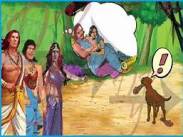
But one day, when Yudhisthar was in her chamber, the dog stole his shoes. Unaware of the fact Arjun entered the chamber of Draupadi seeing no shoes outside and saw his brother Yudhisthir with Draupadi copulating. Arjun was sent to exile as per the condition of Draupadi. Embarrassed Draupadi cursed dogs by saying: “All the world will see you copulate in public, stripped of all shame.”

Incarnation of Kali

There is a common belief in South India that Draupadi was also an incarnation of Maha Kali. She was born to assist Lord Krishna to destroy all the arrogant Kings. That is why they are considered brothers and sisters although Draupadi was born from fire.

Avatars of Draupadi

As per Narada Purana and Vayu Purana, she is the combined avatar of;

Goddess Shyamala (wife of Dharma)

Bharati (wife of Vayu)

Shachi (wife of Indra)

Usha (wife of Ashwin)

Parvati (wife of Shiva)

Draupadi blessed to be a virgin

Draupadi is one of Panchakanyas including- Sita( Kunti), Ahalya, Draupadi, Tara, and Mandodari , known as five virgins. She used to walk through fire to regain her virginity and purity before she moved to the next Husband.  Such rules were never perceived before this. Pandavas have other wives, but these wives used to stay with their parents and they used to travel to them to visit their wives in four years.

How to find a job during the pandemic?

Not only has the coronavirus pandemic had a big influence on the world economy, but it has also had a significant impact on your employment search. It has wreaked havoc on the stock market and harmed a variety of businesses. If you have a present employment, you are most likely working from home.

Small businesses have been forced to close temporarily, while large corporations have been impacted by the stress of losing customers and a disrupted supply chain. According to NBC News, there are estimates that the jobless rate in the United States will hit 20%.

Layoffs, furloughs, reduced hours and overtime pay, and hiring freezes have all been used by certain companies in response to the health crisis. Other businesses are actively hiring and publishing new job openings on a daily basis.

There’s a lot of uncertainty right now about what the national and global impact on hiring will be, but there are ways to stay positive and proactive about your job search at this turbulent time.

Photo by Andrea Piacquadio on Pexels.com

Engage your network

People recognise that this is a terrible time and want to assist in any way they can. Let your friends and relatives know you’re looking for work and tell them what kinds of employment you’re looking for and which companies you’re targeting so they can keep an eye out for openings. If they hear anything, they’ll let you know. 

Even if human resources isn’t through sorting through the applications that come in through the ATS, those email intros, or having individuals in your network send your resume and cover letter on your behalf, can boost your application to the top of the pile.

If you find openings at a company where you previously worked, don’t be afraid to contact former coworkers and superiors. Because they know your skills and work ethic, they are more inclined to hire you than the competition. Even if they aren’t hiring, they can serve as references for other applications you are submitting.

Because they work in the sector, they may be aware of other opportunities through their own network and can refer you.

Practice phone and video job interviews

Because so many people now work remotely, job interviews are now conducted over the phone or by video rather than in person. A phone interview can be more difficult because it is more difficult to understand someone’s reaction and establish a dialogue that flows organically.

It can be more difficult to do a video interview because being on camera can be uncomfortable.

Take on a temp or freelance gig

If you don’t have a job right now, look for temp and freelance employment to help pay the bills. When you impress your coworkers, it could lead to a full-time employment. Working for a temp agency is also a good way to pick up some in-demand skills.

Employers are searching for employees who are self-disciplined enough to work from home and have outstanding writing skills, so if you’re currently working from home, keep that in mind.

Photo by Pixabay on Pexels.com

Show off your transferrable skills

Because there is so much competition for jobs right now, it’s critical to step up your game. First, look for positions that have been posted recently, as this indicates that the organisation is looking to fill a current position. If a job posting has been up for several weeks, it may no longer be a top priority for the organisation.

When perusing job listings, remain confident in yourself and realise that you can still acquire a job.

Customize your application for each job

Spend more work on each cover letter and resume so that your resume and cover letter are noticed. Modifying them for each job application takes extra effort, but it is important. When you apply for a job online, your resume is typically entered into an Applicant Tracking System (ATS), which analyses your resume to see if you meet the job posting’s requirements. 

Don’t replicate everything word for word, but make sure your resume and cover letter include the bulk of the most significant parts of the job. According to Monster data, nearly 75% of applications that go through an ATS are rejected because they don’t fulfil the hiring manager’s standards, such as the correct abilities, education level, or job titles, so it’s critical to get your resume in the door.

Stay up to date

Read about the companies and the world of market. Make this a habit to stay up to date without any obstacle. This will help you to be spontaneous and aware.

References

http://www.monster.com

How Body Shaming affects one's well being

We all know and accept the fact that different humans will have different characterstics, likes and dislikes but what about the physical appearance. Why is it that a standard is set for people which everyone accept them to follow . The ones who fail to meet the standard criteria are then “shamed” on the pretext of motivation.

Crticising someone for their body fat, “thin” built, hair texture and colour, hair density or bald looks, too much height or “such a shorty”, different body shapes, size of various body parts like small or heavy breasts or hips, skin tone etc comes under the broad term of BODY SHAMING. Not only just the looks but people are shamed with the accessories they decide to decorate their body with like tattoos, piercings etc and also with the marks that the diseases or some accidents leave. The memories of diseases and the accidents are traumatic enough, in addition to this one has to bear the addition burden of someone not liking some marks on their bodies which they have learnt to make peace with hereby scratching the old wounds making the person relive the trauma.

A person is defined by its physical and mental health. While the latter includes moral virtues , the former stands for a healthy body where all oragans function properly. Different skin colors , height, length of hair until and unless you have got an illness is all okay and acceptable. Anything which doesn’t threaten the working of your organs is completely normal. Sadly, this is not the case today.

This blog will tell you what leads people to body shame others and affect it has on the victim.

What causes people to BODY SHAME

  • It is like a chain reaction which goes on in the society. There are some standards set by the people themselves which they expect everyone to follow to be “an epitome of PERFECTION”. For example – If you are a male , you ought to have good height, good muscles, lusty dense hairs and if you are a female, then the list extends to a great measure. A “good Indian girl” ought to have “fair ” skin , should not be covered in the layers of “fat”, should have markless, flawless skin, medium height , good natural color hair, tattoos makes one characterless and piercings except the traditional ear and nose also contribute to the former category. Now I ask, which text or rule book has defined these charactersticcs of a man or woman. The most funniest thing is the third gender is not even mentioned and talked baout anywhere instead they are shamed. Because some “boys” prefer wearing make up with female clothing and some girls keep short hairs and speak for themselves. The onlything which are ancient texts teaches us is to be honest , hardworking and possess good moral virtues there was never a mention about the physical appearnce. History is evident of the fact that people who were beyond this tandard criteria , proved better than the ones who followed it . The best example being Physics genius STEPHENS HAWKING. It is a sort of revenge game which continues.Because the people were teased and criticsed about their looks by the others they continue to do it with the rest to take out their frustration. The origin of this “toxic game” being unknown.
  • A default reaction to something which someone says or does and we dont like is to comment on their physical attributes making that person feel guilty about themselves . Like if someone acts in the manner which we dont like, people are often heard saying, “Obviously, she/he will do that. Didn’t you see how ugly they are”. This process of making a person guilty by remarking about their physical attributes is very common in today’s world specially in this age of social media.

Affects of BODY SHAMING

  • Reduction of self esteem, self confidence because you think you are not worthy or capable because someone told you that you are “unfit”. Everyone is unique with a different story behind each of their “not normal looks”, until and unless the third person knows about it they should not comment about it. This is very common to feel because confidence is the belief we have on ourselves which motivate and enable us to do the things properly and our confidence specially in the teen years is based on what the people around us friends, peers or family feels about us. In these growing years, one needs motivation and support in the form of words not the harsh words making people to change their appearance and hate themselves. This often leads to anxiety, stress, eating disorders bringing the ACTUAL DISEASES, depression sometimes leading people to self harm themselves. And then people says today’s youth is so reckless and “Teenagers attempt suicide because they were CORRECTED ABOUT SOMETHING or Scolded for their won well being”. Correcting someone’s natural built is equal to meddling with the nature and we have enough evidences of the consequences of meddling with the nature. This all is the result of the trauma which sometimes lead people into the actual bad habbits like alchol, drugs fastening the process towards their mortality.
  • In order to fit into the “standard criteria” , people undergo diets, proteins for increasing weights and heights, laser treatments for those who have thin hair or bald look, dozens of products containing many harmful chemicals to whiten their skin tone. This not only takes a toll on financial health , but also on the mental physical health. The treatments are not always effective , it causes more harm than good at times. The stress and anxiety in the anticipation of the result is a very acute thing which is actually to be worried about.

We need to stop criticising people on the pretext of looking after them If you really want to look after your “loved ones” , then it should be to take care of their health in all aspects not to bring them on the verge of madness.

Startup Stories – Vahak

The logistics sector has seen a growth of about 59% during the lockdown period. Primary reasons attributing to the growth of the sector is the order of essential services online to avoid the covid spread. While we were staying safe behind the doors, the logistics sector worked relentlessly to fulfill our needs. Ever wonder what’s happening in the logistics sector? There are certain hard challenges faced by the logistics sector. There were delays in the delivery and sometimes tracking of goods seem to be even more difficult. This is because of a lack of networking with the driver communities, following the superannuated process of tracking and competitive market. 

Vahak is a startup that has developed an online community wherein a customer can easily interact with the drivers,  book a lorry or a truck and thus transport their goods from point A to B. The app can be beneficial for both sides. The customer can get his booking done in no time with minimal calls and can place bids for the same. The drivers on the other hand can get the details in prior, have regular jobs, and assured payments. Sounds like a win-win situation right? Of course, it is. To add adornment to the user experience, vahak has made the service at zero commission. Their website design seems to be simple and appealing.

VAHAK – A SNEAK PEEK

Vahak was founded in 2017 has seen steady growth in both sales and finance since then. Adoption of new technology and addressing an issue prevailing in the market over the years would be salient in attracting investors. Vahak is never an exception in such a case. They have raised their initial round of seed funding from Leo capital venture. Recently they created a buzz in the market by raising a fund of about 5 million dollars in their pre-series A funding by Luxor Capital and its existing fund venture Leo capital. 

Team members of vahak said in an interview that “ the platform has around 10,000 active loads every day”. 

They are serving 3000+cities in and around India and they are aiming to develop their platform significantly in the near future. The fund would be utilized in a way that the network expands and henceforth the business flourishes. 

https://www.vahak.in/about-us

https://economictimes.indiatimes.com/tech/funding/vahak-raises-5-million-in-funding-led-by-rtp-global/articleshow/84230447.cms

Comprehending CHESS through 'Through the Looking Glass'

Chess was the most important indoor game of the nineteenth century in England. It enjoyed centuries-old privileged status. It was considered as a ‘rational recreation’. Chess, unlike any other game, deals more with logic and rationality rather than fun, as we know, Rationalism had taken over the Victorian era abundantly.

Alice, at once, recognizes the chess board stretched on the vast land in the Looking Glass World. It shows that although she is just seven and a half years, still familiar to the this game, which signifies the popularity of Chess in England in Victorian Era, especially among the bourgeois class(as it is also called ‘game of royals’) and Alice belonged to the same.

In life we make ‘choices’, in chess we make ‘moves’. In order to attain something valuable in life as to capture the opponent’s castle in chess, initiative has to be taken. Nobody can make decisions for me, I’ll have to play myself, it’s just suggestions that our people may put before us. Here, Alice makes a choice to participate in the game ‘imagining’ her goal where she wants to be in the end. Well, talking about imagination with reference to Victorian era, it significantly brought out a drastic change in society, though previously children along with adults were forced into realism. ‘Imagination’ is quite efficient to presume one’s position in the coming years and then working out to get there can be useful, because life makes it hard to calculate the further possibilities due to lack of information. Alice restrained herself asking the Queens about their arrival, thinking it would be obtrusive, which keeps her away from the information, also we see Alice not able to distinguish between Red Knight and White Knight and actually who’s there to save her declares her ignorance towards information.

Chess is symbolic to attributes of life, we see, there are (apparently) three stages in chess, that is, opening, middle game and the end game, similarly we have childhood, youth and adulthood in life. Alice joins the giant Chess game of life as a white pawn, that is, she holds very limited power and can move once at a time. We always need to start from the beginning, that is, from the very first ladder in order to earn it step by step. Alice has the freedom to setup her ‘goal’ to be a Queen, but she has no power over her inevitable maturation that’s leading her to womanhood. Within the framework of the chess game, Alice has almost no control over her path and she, with certain implied rules of the game, is driven by the corresponding characters in the book, as in chess, every piece moves in answer to the move of the other one. She is pushed towards her goal by the various situations occurring before her in every square, such as, the train ride, no-name forest, Humpty Dumpty and the White Knight. Thus, it can be traced from the narrative that in life, there is some invisible force that’s propelling every individual in the direction of set goal. It can be comprehended that collaboration is the biggest instrument to victory, for example, White Knight saved Alice from the attack of Red Knight without which it had been a Herculean task for her to reach to final square. We will have to rely on our people somehow, otherwise we can’t achieve our dreams just by our own self. In chess, one can take full credit for one’s victories, but in life it would be naive to say that what I achieved is all because of my sole efforts.

The game of Chess in Through The Looking Glass represents the interest of Carroll in logics and mathematics, and the agent is ‘Alice’. This game is not about luck unlike other indoor/board games, rather brainy. In the same way, Life is more about randomness, it’s not alone in the hands of fate, though life is much more unpredictable. We need statistics as well as probability in both chess and life. Also, chess possesses two different colors, that is, one is light and the other one is dark, where I suppose, they stand for logic and nonsense respectively. Based on this idea, Alice often proves to be smarter, more prudent than the so-called adults she confronts in the Looking Glass world. This might also be a reverse-reflection of actual world, I guess, where we see adults inclined towards logic and children uttering stuff and nonsense and vice-versa, here, in the world of mirror.

Life of the children in Victorian period was totally opposite to that of present-day children. They were considered as miniature adults and were expected to be highly sophisticated, more in the case of rich class children. Children were not allowed to shout, complain, interrupt or disagree with anyone. The children of rich parents were usually looked after by governesses, no matter humble or strict, and they only used to teach them manners and the way of living. Here, in Looking Glass world, Red Queen, the first character to guide Alice in the reverse world,

resembles very much like a governess of Alice when she teaches her how to not tweedle her fingers while speaking, how to behave, and to curtsey, and how Alice couldn’t go against her. She says, “when you’ve once said a thing, that fixes it, and you must take the consequences.”, because Alice is a Pawn and a Pawn cannot move backward, it is also allusion to the fact that once you have made the decision/choice, you can’t step back and stay committed bearing with it’s outcome, and she also asks Alice only to speak when she was asked to. Even we see TweedleDum-TweedleDee not ready to converse with Alice before she greets them. When Alice thinks that asking the Queens how they arrived would be impertinent, it shows again the social structure built for children in the real Victorian world.

When we are in a state of childhood, we want to turn into an adult soon. Similarly, Alice is excited about her lone-tour of adulthood through the Looking Glass world as she thinks she will be free of all the scolding, she says, “….no one here to scold me away from the fire….and can’t get me!” In the beginning, Alice was thrilled about her journey but as she is heading forward, she encounters the sense of loneliness in her journey to become a Queen(apparently) and acts adult herself. Though she is surrounded by different creatures many a times, but she feels alienated to their foreign ways. Hence, here Chess is a symbol of journey advancing from childhood to adulthood. She undergoes many crucial experiences, putting forward the idea of challenges one has to face in this journey of adulthood in one’s life. In the beginning, we see Alice being rude to Gnat about his jokes and later we see her kindness with White Knight that declares the change in her attitude as moving towards adulthood. When the Queen gives Alice directions as how to be a proper queen, it indicates that Alice wasn’t actually prepared to become a queen, just as it’s hard to prepare to be an adult in real world. Every square leads her to different characters and every character teaches Alice something significant, as we know, advice can come from the most unexpected places. For example, revelation of identity imposed by the situation in the woods of forgetfulness, the White Queen teaches her to believe in impossible, the fall of Humpty Dumpty symbolizes ‘the fall of man for pride’ and also ‘the fall of innocence’ proceeding towards maturity, and likewise all the other characters. These teachings help Alice to inherent the characteristics of adulthood within her. The crown here, symbolizes the transformation of Alice from childhood to adulthood.

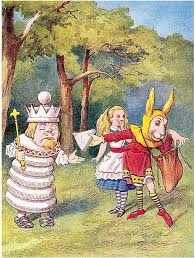
The Red King and the White King are almost doing nothing throughout the game as compared to their Queens. The Red King, as first encountered by Alice, is sleeping and his other pieces are performing their tasks to save him, whereas, the White King seems to be nervous not able to catch up with her Queen.

Now these characters resemble in moves of both as that of the White and Red King in the real chess board. These actions of Queens and Kings in the world behind the mirror, may portray the position of women in the Victorian era. Women, at that time, used to engage themselves working for their husband and family, and also middle class and the working class women were employed to earn bread for their family, in support of their husbands. Red Queen saying to Alice, “…if you want to get somewhere else, you must run at least twice as fast as that!” may ascertain the idea that in a male-dominated society, women need to work double/toil harder in comparison to men in order to attain recognition. Women in the nineteenth century were not given much of the rights and privileges. This period is named after Queen Victoria, who was in the place of power. It is strange to encounter such a frivolous situation of women at the time when a lady herself was reigning over the society. When we behold Alice as a little woman moving from actual world to Looking Glass world, it may seem as she is struggling to change her confided world. She starts her journey all by herself which reflects the essence of independence in her. The characters like Live flowers resemble the social class structure that pushes Alice to follow their rules. When she chooses to be a Queen, she establishes the path for women/girls to upgrade their status because Alice learns that she must have a powerful authority to control Looking Glass world when one of the servants at once answers her after she turns into a Queen, so is the case for women in Victorian era, for example, Queen Victoria.

We need not be afraid of our high-rated opponents and feel incapable before them and it is then only that Alice is able to shake Red Queen in frustration and raises her voice against her rather than stitching her lips out of fear as evident in the beginning, that is, crown here, symbolizes her transformation from childhood to womanhood, gives her voice and finally renovates her status from a pawn to a queen. All the exclusive pieces are placed right behind the pawns. And a Pawn in comparison to them is just an ordinary, common piece that can slowly and gradually become a Queen. Even a pawn can cut down a King, pertaining to life, a single human being, regardless of his status, is enough to bring about revolution in the society, and win the castle of life. Alice suffering through all the odds, obstructions eventually made it, checkmated the Red King and turned into a Queen.

As a Queen in the game, the Red Queen and the White Queen are able to move swiftly and effortlessly. The White Queen, as she says, “jam-tomorrow and jam-yesterday, but never jam-today.”, and screams before pricking her thumb, travels in past and future which is true for the Queen,

in general, in chess that she can freely move in every direction possible, but she is seen nervous and messy all the time here, and ultimately at two points passes up a chance to checkmate and on another occasion she missed the opportunity to capture the Red Knight. Similarly, the Red Queen said to Alice, “Speak when you’re spoken to!”, and having supporting her words, she doesn’t announce it after putting White King on the check, hence, the check is ignored. Their individual character traits restrained them from performing their duties. This also discovers their absent-mindedness and reverse effect of the mirror world.

The Knight in the chess moves very distinctively and is allowed to jump over any other pieces. Riding and falling of the White Knight in looking glass world is signifying it’s unique L-shape movement. The inventions of White Knight are here to present his powerful character trait, like in chess board Knight is an only piece imbibed with many powers, unlike other pieces, not even a Queen can move in same way as Knight, though his inventions are unprofitable disclosing the touch of the illusionary world, still it is pointing to the fact that precaution is must, so his horse wears spikes on it’s ankles to protect it from shark bites and he collects things that might be useful in the difficult situation. The White Knight is the only character that is benevolent with Alice and saves Alice from the attack of Red Knight (stopping her to be a Queen/upgrade the position of women in society), but it can be an example of gender-biased society where a man is shown as a powerful figure and woman belongs to a weaker section. Alice, here, is represented as a weak girl and this action of White Knight throws light on the concept of feminism, and make Alice learn that a woman must stand for herself and must discover her own capabilities.

Chess wasn’t just one of the themes in Carroll’s story, indeed, it was the ground for the novel’s structure. The game of chess in real world is ‘logical’ while in looking glass world it can be called as ‘maddening game of chess’. Also as an inverted image created by the mirror, this indoor game is displayed as an outer giant field of chess. The pieces are definitely running and moving under the implied rules, but the pattern is not applied evenly. This game sets the deterministic way of life. Both life and chess are, more or less, synonymous in almost every aspect.

Citation: https://www.smithsonianmag.com/arts-culture/the-64-square-grid-design-of-through-the-looking-glass-24546391/

IMPORTANCE OF NEWSPAPER

Newspapers provide general information and knowledge, such as news on the economy, sports, entertainment, trade, and commerce. In short, the newspaper is extremely important to humans; reading the newspaper on a daily basis can help us strengthen our reading habits, broaden our knowledge, and improve our fluency. For those who are interested in political news, there is a comprehensive list of what is happening on the national and worldwide political fronts. How significant was it for newspapers to report in depth. Assembly elections and Lok-Sabha bye-elections were recently held, and people on every street corner could be seen frantically trying to obtain a newspaper to learn the latest results.

Then there is worldwide political news, which keeps people informed about current events across the world. Some people’s first interest in sports is to turn to the newspaper’s Sports page. It also assists us in becoming more informed citizens. Newspapers keep us informed of any changes in the country’s rules and regulations. Furthermore, they are quite educational for students. Here, a learner can learn everything there is to know about general knowledge and current events. We keep up with technological advances, government legislation, research projects, and other topics.

Aside from that, newspapers feature fantastic pieces on social concerns, civilizations, the arts, and other topics. It informs the public about key problems and conveys public opinion. As a result, individuals will be able to conduct thorough assessments of the administration and its ministers. Likewise, newspapers provide excellent job prospects. Those looking for work read newspapers in order to find dependable job openings.Aside from that, newspapers feature fantastic pieces on social concerns, civilizations, the arts, and other topics. It informs the public about key problems and conveys public opinion. As a result, individuals will be able to conduct thorough assessments of the administration and its ministers. Likewise, newspapers provide excellent job prospects. Those looking for work read newspapers in order to find dependable job openings.

The Benefits of Reading Newspapers:

Some of the advantages of reading daily newspapers are as follows:

1.The world’s news is published in newspapers.

2.Newspapers are a source of general knowledge and information.

3.Newspapers cover topics such as the economy, sports, gaming, entertainment, trade, and business.

4.Reading the newspaper is a healthy habit that has been ingrained in modern society. This habit will broaden your horizons and deepen your understanding.

5.You may stay informed by reading the newspaper. It allows you to participate in any conversation about current events throughout the world.

6.Reading newspapers will boost your general knowledge and make it easier for you to relate to what is happening in the world.

7.Reading newspapers will boost your general knowledge and make it easier for you to relate to others who frequently discuss current events and politics.

8.You will have a clear notion and comprehension of what is going on in your country and throughout the world if you read newspapers.

A World Without Newspapers:

Everything is becoming digital as the globe advances swiftly. We can do everything on our cellphones or computers, from buying to reading the news. The newspaper industry has also been affected by digitisation. Because individuals can obtain fast updates about the newest news on their phones, newspaper sales have plummeted. Is this to say that the digital era will obliterate newspapers? Given the current situation, this prospect appears to be a distinct possibility. Are we, on the other hand, ready for a world without newspapers? Without newspapers, the world would be like a house without mirrors. We won’t be able to see our own reflection as a result of this.

Compare this condition to that of the rest of the globe and the newspaper. Imagine that the world has lost its national mirror, and you are unable to get an accurate image of what is going on around you. What’s worse, instead of the national mirror, we’re getting a fun-house mirror, which distorts information and causes you to perceive what isn’t genuine. In other words, politicians will have unrestricted access to the public to spread their ads and agendas. The data won’t be trustworthy, and it won’t even be examined. There will be no journalists to decode the government and corporate spin on stealing the average guy of his money.

𝑹𝑨𝑰𝑵𝒀 𝑺𝑬𝑨𝑺𝑶𝑵𝑺

Rain is not only drops of water. It’s the love of the sky for the 𝗘𝗔𝗥𝗧𝗛 They never meet each other but sends love this way.” 

A rainy day refrigerates the weather with showers and a warm breeze. It freshens everyone by making the climate fresh and pleasant and brings in a sigh of relief from the scorching heat.

It is a blessing for trees, birds, animals, plants and people during the summer. Trees look so fresh, colourful and refreshing after a shower. Rainy day is essential for farmers as it helps in the growth of crops.

Rainy days are different from any other day. They hold great importance for everyone differently. People have different reasons to wait for the 𝙍𝘼𝙄𝙉𝙔 𝙎𝙀𝘼𝙎𝙊𝙉 eagerly. After all, it brings a sigh relief for everyone. No matter what the weather may be, a rainy day relaxes and soothes our soul. There is no age limit to enjoy rainy days people of almost every age enjoy it equally. Thus, rainy days are very important for a number of reasons.

There are so much rainwater and fresh air in this season. That’s why the environment becomes very clear and enjoyable. People love this season a lot. Personally, I love a rainy time a lot and get wet in the rain.

The whole natural environment including trees, flowers, and other plants become so much green and full of life. They look so alive and beautiful. Most of the trees get new leaves and look very attractive. There are lots of festivals that people celebrate in this season.

My mother  cooks so many types of delicious food this season. I love eating them. A rainy day is really enjoyable for me, I love to listen song at this time. LIstening songs is one of my fav hobbies, Overall, the rainy season is really amazing.

I always think that the rainy season is the best season, because of its natural beauty. Most people refer to this season as their favorite one. Yeah, it’s my favorite season. After a long hot summer, people become restless for some cold air and clear rains. At that time, the 𝗥𝗮𝗶𝗻𝘆 𝘀𝗲𝗮𝘀𝗼𝗻  comes with so much pleasure and blessings.

It makes the whole environment cool and looks beautiful. Sometimes it becomes really boring for a long time rain, but most of the time I enjoy the rainy day. 

We don’t go to school if there are heavy rains outside. Most of the time we go to the roof to enjoy the rain. A few of my friends dance and sing, it is really great fun together on the roof. We mostly do this at the beginning of the season.

But gradually after a few weeks, we don’t care so much about rain. Overall, this season is really amazing and enjoyable. I love this season a lot because everything gets life with a touch of rainwater. That is an amazing scene for everyone…..

ARYABHATTA

Aryabhatta was the first Indian mathematician and astronomer. He had immense knowledge in the field of mathematics. Moreover, he did he may discoveries during his era. For instance, some of them were the discovery of algebraic identities, trigonometrical functions, the value of pi, Place value system, etc.

Furthermore, he wrote many books which still help us in performing various calculations. Aryabhatta was a great influence to many youngsters. For he excelled in academics from a very early age. Moreover, he contributed much to the society his works and theories are still remembered and honored till date.


EARLY LIFE

Aryabhatta was born in 475 A.D. Furthermore his birthplace eas not sure, but in his book the ‘Aryabhatiya’, he mentions that he was a native of Kusumapura the modern-day Patna. Moreover, from his historical records, the archaeologists believed that he continued his further studies in Kusumapura. Because in Kusumapura his major astronomical observatory was located.

Therefore, we can ascertain that Aryabhatta spent most of the time there. Further, some historians believe that he was also the head of Nalanda University in Kusumpura. Though these theories are all on a probable basis because no proper evidence was there except the books Arybhatta wrote in his lifetime. Yet some of his records were lost and are not found till date.


WORK OF ARYABHATTA

Aryabhatta contributed greatly to the field of mathematics. For instance, he was responsible for discovering various trigonometrical functions which are useful for us in the modern era too.

Furthermore, his discovery for the value of ‘pi’ eased the complications in mathematics. Above all, he founded the place value system and zero which are one of his major contributions in the history of mathematics. Most Noteworthy is that every theory is in his book ‘Aryabhatiya’ which states astronomical theories. Furthermore, his book divides into different sections of mathematics and astronomy.

Apart from his discoveries in the field of mathematics, Aryabhatta contributed immensely towards astronomy. He proposed the heliocentric theory which states the planets revolve around the Sun. with the help of this theory, he calculated the speed of the different planets with respect to the Sun.

Furthermore, he also calculated the sidereal rotation which is the rotation of the earth in reference to the stars. Moreover, he founded the sidereal year to be 365 days, 6 hours, 12 minutes and 30 seconds which varies with only 3 minutes and 20 seconds over the modern-day value.


CONTRIBUTIONS

Most noteworthy is that Aryabhatta correctly founded that the earth rotates on its axis. Furthermore, he also proposed the geocentric model of the solar system which described the earth to be the center of the universe. And the sun, the moon, and the planets revolve around it.

Aryabhata also explained the solar and lunar eclipses in his book. Consequently, he also proposed that the moon due to the reflection of the sunlight. He explained in his book that the lunar eclipse and the solar eclipse takes by the shadow-casting of the earth and the moon.

In conclusion Aryabhatta approximations in the field of astronomy were quite accurate. It provided the core to the computational paradigm which provides a base to the modern theories.

History of Tea in India

Though the Camellia synesis is also native to India, and grew in the wild long before its actual value was understood, it is thought that tea was carried to India by silk caravans travelling from China to Europe centuries ago.

Native Americans ate the leaves occasionally, but they were largely employed for their medicinal powers.

Photo by Lisa on Pexels.com

It took a long time for it to evolve into what is currently known as chai, a flavorful black tea sweetened with sugar and milk, along with spices like cardamom and ginger, and used in cooking, vegetable dishes, and soup.

Tea was initially introduced to Indians by the British and is now an integral component of daily life. Tea originated in India thanks to the British, who sought to break China’s tea monopoly after discovering that Indian soil was ideal for growing these plants.

The presence of native flora indicated that the soil was suitable for transplanting Chinese seedlings, and the Assam valley and Darjeeling’s towering mountains were chosen as early tea planting sites.

Tea manufacturing in India began to blossom after 14 years of fruitless attempts, allowing the manufacture of a tea that was equivalent to, if not better than, its Chinese counterpart.

The native tea species

When Scotsman Robert Bruce identified a native type of Camellia sinensis plant in Assam in 1823, commercial tea plantations were first created under British rule.

According to legend, a local merchant named Maniram Dewan brought Bruce to the Singpho people, who drank a tea-like beverage. The Singphos gathered fragile leaves from a wild plant and dried them in the sun.

It’s worth noting that, at the time these changes were taking shape, the East India Company was attempting to break the Chinese monopoly on the global tea trade due to a growing conflict of interests.

In response to this scenario, one of the Company’s initiatives was to begin producing tea in British possessions, particularly India.

Around the year 1840, India’s tea industry began to take shape. Chinary tea plants, which were first tested in Assam, were later tested in the high-elevation districts of Darjeeling and Kangra, where they thrived.

Tea planting in Darjeeling began in 1841, when Archibald Campbell, the first superintendent of Darjeeling, experimented by planting a few chinar trees.

Tea consumption has evolved in a variety of ways, with each region of this large country producing its own chai variations. On one end of the scale are the gourmet stores that sell and serve good Indian tea, while on the other are the simple roadside chaiwallas who offer hundreds of steaming cups to people from all walks of life.

Photo by Tatiana Syrikova on Pexels.com

While India is today known for its high-quality tea and the countless cups of chai consumed by Indians, the custom of drinking tea as a regular beverage did not begin in India.

Tea had been used as a medicinal drink in India since ancient times (nearly identical to China), but it had never been used as a beverage.

After years of selling tea to Portugal, Japan opted to seal its doors to the rest of the world and isolate itself, leaving the global tea trade in the hands of the Chinese. While China was willing to trade, it was adamant about keeping the secrets of tea cultivation.

Darjeeling tea estates began in the 1850s, and the world soon sampled the “Champagne of teas,” Darjeeling tea.

The Chinese tea monopoly was fully broken with the creation of Darjeeling tea and widespread marketing by the British, and Indian teas quickly seized both the market and the imagination of worldwide tea consumers; and the rest, as we all know, is history.

References

http://www.teatrunk.in

http://www.wikipedia.com

http://www.cafesrichard.com

http://www.teabox.com

Unification of Italy

(1815-1871)

Introduction

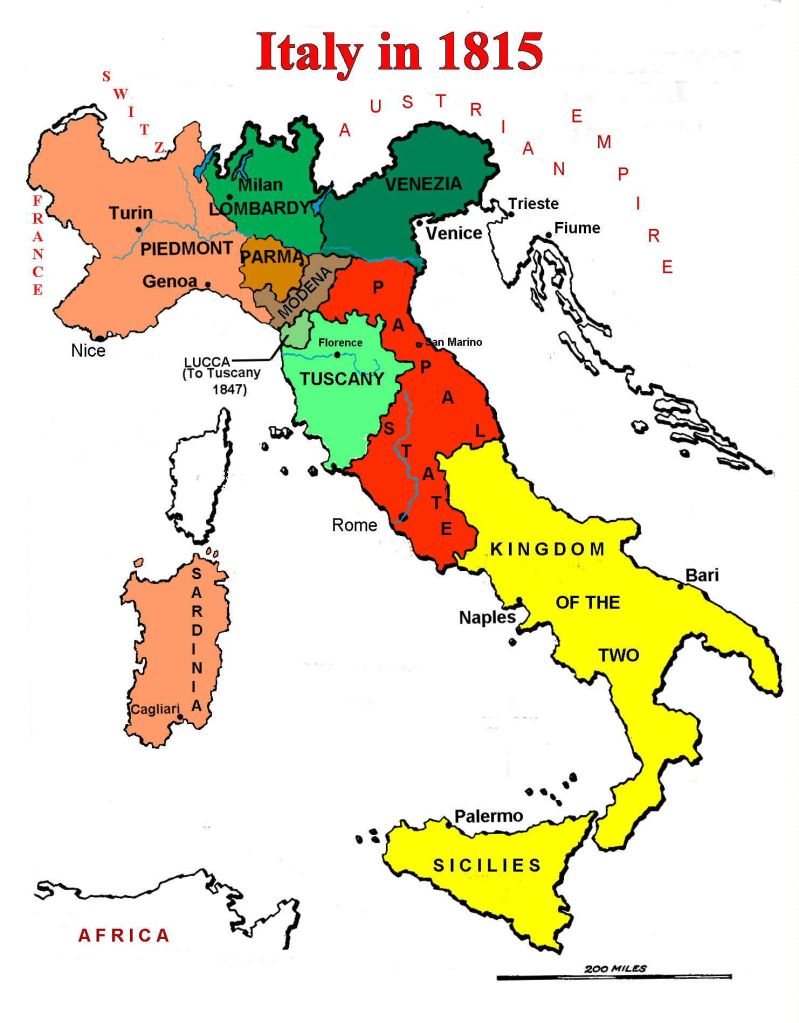
Nationalism arose mainly after the Napoleon attack in 1796. He consolidated the four major areas and people of Italy wanted revival of rich culture as during that of Renaissance period.

Congress of Vienna (1815)

As Italy was a large area, it could emerge as another powerful state. Therefore it was not declared as an independent state but distributed among kingdoms of France, Spain and Austria.

Like German unification, Italian unification was also done in three parts.

  • 1858-59 : War against Austria and integration of Lombardy
  • 1860 : Integration of Parma, Modena, Tuscany, Naples and Sicily
  • 1866 : Integration of Venice and in 1871, Rome.

(Nationalism arose in 1815 but actually started in 1858.)

Causes of Unification

  • Nationalism Wave of nationalism swept across Europe in nineteenth century, Language, Religion and Territory.
    • Italian thinkers, writers, artists started bringing up cultural traditions
    • Secret societies were formed for political change to overthrow Austrian government.
    • Carboneria was a secret organisation (1800-31) aimed simply ato remove foreign rule and tyranny.
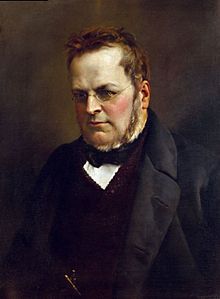
    • Guiseppe Mazzini was the first person who gave idea of unification. In 1831 formed YOUNG ITALY a nationalist group. He gave the Republican ideology and was exciled to France but smuggled patriotic pamphlets to Italy. However, all his insurrections sadly failed.
  • Cound Cavour who was the Prime Minister of Piedmont Sardinia (1852) under King Victor Emanuel II was the architect of Italian Unification.
    • He founded nationalistic newspaper Il Risorgiments. Gave civil rights freedom of press and economi development.

Cavour’s policies

  • Built up Sardinian economy
  • Believed unified Italy should be reborn as monarchy
  • Spread telling of unification to neighbouring states
  • Helped France and British soldiers in crimean War. At the conference, he highlighted Austria’s suppression over Italy. Thereby gained sympathy.

Phase I (1858-59)

  • Lombardy and Venice were instigated by cavour against Austria
  • Austria declared war on Sardinia
  • Italy with French helped emerged as victor and liberated Lombardy
  • But could not lierate Venice
  • Lombardy was therefore integrated

Phase II (1860)

  • Parma, Modena, tuscany was ruled by client state of Habsburg.
  • Plebiscite was conducted here and people voted to join Piedmont- Sardinia.
  • Some popal states were also unified.
  • Challenge: cavour had a deal with France only for Austria. the Southern Italy was under Bourbon dynasty who were relatives of Napoleon III. This could dismantle Cavour and Napoleon III’s relation.
  • Guiseppe Garibaldi came to rescue. Cavour asked him to lead Sardinian army against Sicily. these armies were called Red Shirts. With this, Naples and Sicily were also liberated.
  • On this Cavour said to Napoleon III- Bourban dynasty =had been overthrown by a revolutionary garibaldi. I will not attack Pope. Kindly ask pope yo let my army pass through so that I can go attack Sicily.
  • In 1861, Victor Emannuel II provclaimed the kingdom. Sadly Cavour died at the age of 50, due to over work.

Phase III 1866, 71

  • The King signed treaty with Prussia with following terms
    • both against Austria
    • Italy will help in Austria-Prussia war.
    • Venice will be given to Italy after any such war.
    • There was a Battle of Sodowa (1866) where Prussia won and Venice was given to Italy.
  • Papal State was still under France.
    • But in Franco Prussian war france lost. Napoleon III was captured.
    • Rome was captured and made capital of Italy.
    • But since they respected Pope, Vatican city is still under the control of Pope.

Gandhigiri With Munna Bhai: Valuable Lessons From The Film

Released in 2006, Lage Raho Munna Bhai is a movie directed by Rajkumar Hirani, screenplay by Vidhu Vinod Chopra, and starring talented actors like Sanjay Dutt, Arshad Warsi, Vidya Balan, Boman Irani, etc that proved to be a massive hit on the box office. The story begins with Munna Bhai being in love with the radio jockey Jhanvi. To win a chance to meet her, he cheats his way through the Mahatma Gandhi quiz and passes. When he finally meets Jhanvi, Jhanvi requests him to give a lecture on Mahatma Gandhi to the old people in her house. Munna who pretended to be a History professor and a Mahatma Gandhi fan has no choice left but to study all about Mahatma Gandhi for the remaining 3-4 days that he has left until the fixed date. This causes an extensive load on his brain due to which Munna Bhai starts hallucinating about Mahatma Gandhi’s persona.

The whole story moves forward with a battle against the corrupt Lucky Singh who deceives Munna and takes over the 2nd Innings House (of the old men) versus Munna Bhai who fights back using Gandhigiri. All along the movie Munna’s hallucinations of Gandhi continue to help him win and showcases Gandhi’s ethics that were long forgotten. Lage Raho Munna Bhai leaves its viewers with a deep sense of morality and Gandhigiri along with bouts of humor and comedy that keeps the audience engaged throughout the end, making it such a massive hit.!

The movie succeeds in reminding the long-forgotten ethics laid by Mahatma Gandhi for the country that he visioned. Below are the major matters that the movie tackles by implementing the concept of Gandhigiri. A neologism that refers to implementing and following the methods and guidelines laid and preached by Mahatma Gandhi. Throughout the movie, Munna acts as a spokesperson for Gandhiji’s values.

Here are some of the valuable lessons from the movie:

1. Truth – Truth is one of the fundamental teachings of Mahatma Gandhi. In this movie too, the value to always speak the truth no matter what is depicted firmly. There are 3 major instances when the characters are encouraged to speak the truth. The first instance is when Munna hides his real identity from Jhanvi and is later persuaded by Gandhi to tell Jhanvi the truth.

The second instance is when Munna and Jhanvi start their ‘Gandhigiri’ program to help people and a caller explains his desire to die as he doesn’t have the courage or way to return the hard-earned money of his father. To this Munna convinces the caller to tell his father the truth honestly and work hard to return the money. No matter how small the amount he earns or how long it takes to return the money Munna requests the caller to speak the truth.

The last instance is when Lucky’s daughter runs away from her wedding because she is upset about the lie that her father told her in-laws about her not being ‘Manglik’. Munna advocates her to face whatever it is and to tell the truth to her in-laws. Further, he comforts her by saying that if the boy loves her then he will not care about such stuff and will still marry her regardless of all this.

2. Non-Violence – This is the 2nd fundamental teaching of Mahatma Gandhi. Non-violence is also preached through the movie in a very subtle and effective way. The first example of non-violence in the movie is when Gandhi advocates Munna to turn to non-violence rather than hurting his enemy.

The second example is when another caller asks Munna for help to stop his fellow neighbour from spitting on his entrance wall. Munna suggests him to adopt the Non-Violent way and instead of beating or spewing bad words, he should clean up the spit every day with a smile on his face. This will reduce the hatred in the enemy’s heart and make him realize his mistake. And so, it happens!

3. Importance of values and respect for elders – At the start of the film, we see how children abandon their parents in their old age. This is a very heart-wrenching scene. Later Munna is seen remarking and rebuking the son of one of the old men. He scolds him saying that the parent who raised him with everything he got, is being abandoned today by his son when he needs him the most. This is a strong criticism towards people who, in their selfishness forgets the values and morals that one needs to follow in life.

4. Satyagraha and peaceful methods of protests – The very core theme of Lage Raho Munna Bhai movie explores the aspects of corruption and bribery. Gandhi Ji advocated the concept of Sarvodaya for everyone’s progress however, we know that the present world does not focus on equity but greed.

Corruption in the system is growing at a stark rate. By adopting the Gandhigiri way to fight against this, the peaceful methods of protests preached by Mahatma Gandhi are ignited again in this movie. First, Munna adopts the peaceful method of Satyagraha to fight against Lucky Singh’s corruption. In another instance, again through one of the callers, we are reminded about how to fight bribery and corruption in the system i.e. by making the other person feel ashamed in the most non-violent way.

5. Superstitious beliefs in India Lage Raho Munna Bhai smoothly tackles the superstitious problems that are still common in India. We see the plot of the movie revolve around Lucky Singh’s daughter being ‘Manglik’ and how Lucky Singh lies about it, which in the end is revealed to the in-laws by Lucky Singh’s daughter. It shows how most of the superstitions that Indians have is nothing but a way for the so-called ‘pandits’ and ‘Jyotish’ to extract money from people. Mahatma Gandhi never showed support for superstitious beliefs and always asked people to walk with reason, empathy, truth, and non-violence. Thus, this also remains an important point in Gandhian Philosophy.

The film succeeds in lining up with the expectations of people. Lage Raho Munna Bhai proves to be a great movie to convey the message of Gandhigiri to the audience in a serious yet humoristic way without being didactic. It not only shows Gandhi’s principles of thought but also shows a way to employ them in the present situations in India. The film is a great medium for anyone who wants to explore Gandhi Ji’s ideals without needing to have any prior knowledge about it.

Stopping by Woods on a Snowy Evening

BY ROBERT FROST

Whose woods these are I think I know.   

His house is in the village though;   

He will not see me stopping here   

To watch his woods fill up with snow.   

My little horse must think it queer   

To stop without a farmhouse near   

Between the woods and frozen lake   

The darkest evening of the year.   

He gives his harness bells a shake   

To ask if there is some mistake.   

The only other sound’s the sweep   

Of easy wind and downy flake.   

The woods are lovely, dark and deep,   

But I have promises to keep,   

And miles to go before I sleep,   

And miles to go before I sleep.

        Summary

The speaker thinks about who owns the woods that he is passing through, and is fairly sure of knowing the landowner. However, the owner’s home is far away in the village, and thus he is physically incapable of seeing the speaker pause to watch the snowfall in the forest.
The speaker thinks his horse must find it strange to stop so far from any signs of civilization. Indeed, they are surrounded only by the forest and a frozen lake, on the longest night of the year.
The horse shakes the bells on its harness, as if asking if the speaker has made a mistake by stopping. The only other sound besides, is that of the wind and falling snowflakes.
The speaker finds the woods very alluring, drawn both to their darkness and how vast and all-encompassing they seem. However, the speaker has obligations to fulfill elsewhere. Thus, though he or she would like to stay and rest, he knows there are many more miles to go before that is possible.

       Themes

  • Nature vs. Society
    The speaker reflects on the natural world and its implicit contrast with society.The natural world it depicts is “lovely” and overwhelming. The fact that it seemingly lures the speaker to linger in the dark and cold suggests that nature is both a tempting and a threatening force, a realm that resists people’s efforts to tame it while also offering respite from the demands of civilized life. The complete lack of signs of civilization, meanwhile, further emphasizes the distance between society and nature. Far from the sights and sounds of the village, the speaker stands alone “Between the woods and frozen lake” on the “darkest evening of the year.” Together all these details present nature as a cold and foreboding space distinct from society. At the same time, however, the woods are “lovely” enough that they tempt the speaker to stay awhile, complicating the idea of nature as an entirely unwelcoming place for human beings. However raw and cold, nature also allows for the kind of quiet reflection people may struggle to find amidst the stimulation of society. 
  • Social Obligation vs. Personal Desire(Hesitation vs. Choice)

Though the speaker is drawn to the woods and would like to stay there longer to simply watch the falling snow, various responsibilities prevent any lingering. The speaker is torn between duty to others and his wish to stay in the dark and lovely woods. The poem can thus be read as reflecting a broader conflict between social obligations and individualism. He seems worn by travel and social obligation, and the woods seem to represent his or her wish to rest. But this wish cannot be realized because of the oppressive “miles to go,” which must be traveled as a result of duty to others. He is  torn between the tiresome duties of society, and the desire for individual freedom, that is manifested in the woods. This poem points to the reality of making decisions in complex situations in order to fulfill our responsibilities.

SettingAs the title makes clear, the poem is set in the “woods on a snowy evening.” It’s the “darkest evening of the year,” which suggests that this might be the winter solstice.The setting is also mostly silent, with the exception of the sound of wind and snowfall. The woods are expansive, as evidenced in the description “dark and deep.”


Tone

The poem conjures a tone of quiet reflection and wintry reminiscence. The last lines are not of pain or sadness, but more of a meditative appreciation and realization that there’s still much to be done that day.While most readers agree that the general tone is calm and serene, quiet and contemplative, others argue that this is dark and depressing.

Poetic Devices

Metaphor: The last line of the third stanza, “sweep of easy wind and downy flake” and the second metaphor is used in the last line with repetition, “and miles to go before I sleep.” Here, miles represent life’s journey, while sleep represents death.

Personification: Frost has personified the thinking of the horse mildly in the second stanza when it stops, and in the third stanza he gives a sign to the rider. “He gives his harness bells a shake/ to ask if there is some mistake.” It shows as if the horse is a human being who understands his owner’s needs or inquires if they have to stop.

Imagery: The poet has used the images for the sense of sights such as woods, houses, lakes, and they help readers see the woods as a source of solace and comfort to a lonely traveler.

Alliteration: “watch his woods”, “sound’s the sweep”, “His house”.

Euphony: It refers to the sound that is pleasing to the ears. While the journey through the forest is of loneliness, according to Robert Frost woods are not haunting or even scary but provide comfort and calmness. The woods also represent an uncorrupted world that the traveler wishes to stay in. 

         Structure

The whole poem follows the AABA rhyme scheme. Frost has used end rhyme in every first, second and fourth line of the poem. The third line of each stanza rhymes with the next stanza. Such as, “know”, “though” and “snow” rhymes with each other in the first stanza and” here” rhymes with “near” in the second stanza.

Repetition (Refrain): There is a repetition of the verse “and miles to go before I sleep” “and miles to go before I sleep “which has created a musical quality in the poem

Dulce et Decorum Est

BY WILFRED OWEN

Bent double, like old beggars under sacks,

Knock-kneed, coughing like hags, we cursed through sludge,

Till on the haunting flares we turned our backs,

And towards our distant rest began to trudge.

Men marched asleep. Many had lost their boots,

But limped on, blood-shod. All went lame; all blind;

Drunk with fatigue; deaf even to the hoots

Of gas-shells dropping softly behind.

Gas! GAS! Quick, boys!—An ecstasy of fumbling

Fitting the clumsy helmets just in time,

But someone still was yelling out and stumbling

And flound’ring like a man in fire or lime.—

Dim through the misty panes and thick green light,

As under a green sea, I saw him drowning.

In all my dreams before my helpless sight,

He plunges at me, guttering, choking, drowning.

If in some smothering dreams, you too could pace

Behind the wagon that we flung him in,

And watch the white eyes writhing in his face,

His hanging face, like a devil’s sick of sin;

If you could hear, at every jolt, the blood

Come gargling from the froth-corrupted lungs,

Obscene as cancer, bitter as the cud

Of vile, incurable sores on innocent tongues,—

My friend, you would not tell with such high zest

To children ardent for some desperate glory,

The old Lie: Dulce et decorum est

Pro patria mori.

    Summary:

    The speaker begins with a description of soldiers, bent under the weight of their packs like beggars, their knees unsteady, coughing like poor and sick old women, and struggling miserably through a muddy landscape. They turn away from the light flares and begin to march towards their distant camp, as lethargic as the walking dead. Many have lost their combat boots, yet continue on despite their bare and bleeding feet. They are tired to the point of hindered eyesight, and don’t even notice the sound of the dangerous poison gas-shells dropping just behind them.
Somebody cries out an urgent warning about the poison gas, and the soldiers fumble with their gas masks, getting them on just in time. One man, however, is left yelling and struggling, unable to get his mask on. The speaker describes this man as looking like someone caught in fire or lime (an ancient chemical weapon used to effectively blind opponents). The speaker then compares the scene—through the panes of his gas-mask and with poison gas filling the air — to being underwater, and imagines the soldier is drowning.
The speaker jumps from the past moment of the gas attack to a present moment sometime afterward, and describes a recurring dream that he can’t escape, in which the dying soldier races towards him in agony.

  Theme:The Horror and Trauma of War
The banal daily life of a soldier is excruciating, the brutal reality of death is unimaginable agony, and even surviving a war after watching others die invites a future of endless trauma. 

The speaker thrusts the reader into the mundane drudgery and suffering of the wartime experience, as the speaker’s regiment walks from the front lines back to an undescribed place of “distant rest.” They are miserable: “coughing like hags,” cursing as they “trudge” through “sludge” with bloody feet. They march “asleep,” suggesting that these soldiers are like a kind of living dead. The terror and brutality of war have deadened them.
The poem reveals another aspect of the horror of war: even surviving war offers ceaseless future torment. The speaker’s sleep is permanently haunted by the trauma of the death he has witnessed.

The Enduring Myth that War is Glorious
This poem presents a vision of war—that is entirely brutal, bitter, and pessimistic. Owen wrote the poem with the belief that by highlighting the juxtaposition between a sanitized image of honorable death versus the messy, horrifying truth of actual war, perhaps the poem’s audience will change its attitude towards war and cease cheerfully sending young men to die in agony. The speaker suggests that if readers could experience their own such suffocating dreams,marching behind a wagon in which the other men have placed the dying soldier, seeing the writhing of the dying soldier’s eyes in an otherwise slack and wrecked face, and hearing him cough up blood from his ruined lungs at every bump in the path—a sight the speaker compares to the horror of cancer and other diseases that ravage even the innocent, they would not so eagerly tell children, hungry for a sense of heroism, the old lie that “it is sweet and fitting to die for one’s country.”

The poem demands that the readers face the truth and no longer be complicit with that old Lie, but even as it does so, it seems to bitterly perceive that nothing will change, because nothing ever has.


 Structure: 

The poem is a combination of two sonnets. In the first sonnet, the poet describes his experiences of the war, in the second sonnet he becomes analytic and attempts to correct the outlook of others about the war.

Sonnet: A sonnet is a fourteen-line poem in which a single idea floats throughout the poem.

Rhyme Scheme: The whole poem follows the ABAB, CDCD rhyme scheme.


Poetic Devices:

  1. Alliteration: “But someone still was yelling out and stumbling” and /w/ sound in “And watch the white eyes writhing in his face.
  2. Simile: Owen has used many self-explanatory similes in this poem such as,” Bent double, like old beggars under sacks”, “Knock-kneed, coughing like hags”, “like a man in fire or lime” and “like a devil’s sick of sin.”
  3. Metaphor: “Drunk with fatigue; deaf even to the hoots.” It presents the physical state of the men.
  4. Consonance: Consonance is the repetition of consonant sounds in the same line such as the /r/ sound in “Come gargling from the froth-corrupted lungs.”
  5. Synecdoche: It is a figure of speech in which a part is made to represent the whole. For example, the word “sight” in the second stanza represents the speaker.
  6. Imagery: Imagery is used to make the readers perceive things with their five senses. “old beggars under sacks”, “had lost their boots”, “His hanging face, like a devil’s sick of sin” and “white eyes.”

          Setting:

Wilfred Owen wrote “Dulce et Decorum Est” while he was fighting as a soldier during World War I. The use of “flares” and “gas-shells” are specific to World War I, since they had not been used in combat before this time.The majority of British troops in WWI were deployed to France. Chlorine gas, with its distinctive green color, was first deployed by the German army in Belgium in 1915.The “clumsy helmets,” or gas masks, were developed in response to the introduction of gas.  

Language:The way Owen uses language to put readers inside the experiences of a soldier helps them begin to understand the horrific experience of all of these awful aspects of war.If the audience could experience the trauma the speaker describes (“the white eyes writhing,” the “gargling from froth-corrupted lungs”), then they wouldn’t pass their patriotic militarism down to their children. But they don’t experience it, except through the language of the poem 

Tone

The tone of this poem is angry and critical. Owen’s own voice in this poem is bitter – perhaps partly fuelled by self-recrimination for the suffering he could do nothing to alleviate. Owen dwells on explicit details of horror and misery in order to maximise the impact he wishes to have on those who tell the ‘old Lie’. The way in which he addresses as ‘My friend’ those with whom he so strongly disagrees is ironic.

Medicinal plants

India is rich in its flora fauna, one of the advantages that this brings is ample variety of medicinal plants in different Indian terrains. The use of medicinal herbs can be traced back before prehistoric time. The presence and use of Ayurveda in treatment is mentioned in the literature and this knowledge is used to develop medicine and treatment techniques that are effective.
When COVID was at its peak people in India preferred Kardha and as prevention added herbs that have medicinal property in the food and beverages consumed on daily bases. Here is a list of some very common yet very useful medicinal plants-

• Tulsi (Holy Basil)
Holy Basil or Tulsi is a flowering plant that can be found in almost every India household, it is worshipped in Hinduism and is among the top medicinal herbs. The plant has few varieties and is widely available, it has aromatic leaves and beautiful green colour. It is used since ancient times in medicine making and treatments. Its medical property can help prevent common cough and cold etc.

• Sandal wood
Sandal wood also known as Chandan in Hindi is another aromatic variety that is used mainly in making medicine, sandalwood perfumes are quite famous but, additionally it also help in treatment of fever, urinary track infection, liver, cardiovascular diseases etc.
Sandalwood has multiple uses It is used in Hindu rituals and sometimes as a flavouring agent in food and beverages. Many products are made using sandal wood like- sandalwood oil, sandalwood powder etc thus, it is available in different forms.

• Turmeric
You must have heard of the colour Turmeric yellow; its yellow colour is its identity. The colour is extracted, and turmeric has many health benefits, as it is good for heart and prevent against serious diseases like cancer and Alzheimer’s. it is used in making medicine and easily available, apart from this it is good for skin when used in home -made face pack, keeps the blood sugar stable, and prevents inflammation.

• Neem
Neem trees are often known to provide clean and fresh environment wherever they are planted. The green leaves and bitter taste of neem are its identity. The most popular variety in medicinal plant used in treatment and even products like shampoo and soap, it has anti- bacterial quality it can treat skin ulcers, gum problems, improves body metabolism, cuts body fat etc. it is used in Ayurveda since a long time and the leaves, the bark of neem tree both are very useful. It is available in the form of powder, paste or can be used directly.

Cinnamon
Cinnamon is known as daalchini in Hindi, it looks like rolled pieces of wood, and has its own aroma, it has multiple uses and is also available in the form of powder, often used in cooking and baking. Cinnamon can give relief from digestion related problems and can prevent the body from bacteria and fungal infections, good for patients with type 2 diabetes it is anti-inflammatory and contains antioxidants as well.

The list is very long if we start counting and each medicinal plant or herb has its own unique quality. It is no less than a blessing of mother earth that we have access to such wide variety of resources.