Ever Heard The Term 'Foodaholic'?

Whooping Walter Hudson’.

You probably know the meanings of the words’ workaholic’ and ‘alcoholic’.

What do you think a ‘foodaholic’ is? Walter Hudson was one.

How much do you weigh? Walter Hudson weighed more, much more. This is his obituary.

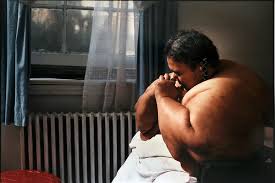
WALTER HUDSON, who has died at Hempstead, New York, age 46, was once listed in The Guinness Book of World Records as the heaviest man on earth. About 183 cm tall and 274 around, with cherubic features set off by pigtails braided in the Cherokee style, he long devoted himself to the pleasures of the table. Four years ago, Hudson-then tipping the industrial scales at his top weight of 543 kg gained worldwide notoriety (as “Whopping Walter”) when he became stuck in his bedroom door. He was wedged there for some four hours. It took eight firemen to free him.

Walter Hudson was born at Brooklyn in 1945 and, as he recalled, “began gorging at the age of six.” At 15 he was so obese his legs collapsed underneath him and he was confined to bed. Indeed, except for the time when his family moved to Hempstead in 1970 and he was transported by motor-car (his then 266kg broke the seat,) he remained inside. “I’m just a foodaholic,” he once confessed, “I have no excuse.”

Hudson’s eating habits were fuelled by food brought in by members of his family. He would generally start his day with a breakfast of two pounds of bacon, 32 sausages, a dozen eggs, a loaf of bread, jam and coffee.

For lunch, Hudson favoured four enormous bowls of rice, four double cheese- burgers, eight boxes of fried potatoes, six pies, and six large bottles of coca-cola. For dinner he would eat six roasted corns, half-a-dozen yams, and another six or seven baked potatoes, ending with a whole apple pie. Between these main meals, he would eat a chicken or two, followed by noodles, string beans, six large bottles of soda, not to mention colossal sandwiches, and copious amounts of ice-cream.

“All I cared about,” he recalled, “was food, FOOD!” When not eating and sleeping he would watch television, listen to tapes and read the Bible-he had a particular penchant for the psalms and was apt to recite Psalm 121. “I will lift up mine eyes unto the hills…”

Hudson, though, was advised against sitting up for longer than five minutes because of the risk of being smothered by flab. The only exercise he engaged in 8. was when he attended to his ablutions; it took him an hour to negotiate the six yards to the bathroom from his bedroom. Then in 1987, he found himself wedged in the door-way. “The day I got stuck in that door,” he recalled, “that when the Lord got me the help I needed.” The help to which he referred was offered by Dick Gregory, a comedian who masterminded the Slim Safe Diet Scheme.
“We think what might have happened,” said Gregory about his new client, “is that in 27 years of lying around he might, because of the reading of his Bible, have taken on the same characteristics as Buddhist monks – slowed down the biological processes. But we don’t know.” Gregory placed Hudson on a1,200 calorie-a-day diet of raw fruit and orange juice. For exercise he was advised to lie in bed waving his arms about like a conductor.

Hudson soon lost some four inches off his knees, and within three months had shed 178 kg. It began to look as if he might fulfil such ambitions as visiting his mother’s grave, riding on the New York subway, driving into the country-and even flying to a clinic in the Bahamas, from which he envisaged emerging as a sylph of 13 stones. 12. But it was not to be. At the time of his death, of an apparent heart attack, Hudson reportedly weighed 508 kg. Rescue workers had to cut a large hole in the wall of his bedroom to remove the body. He was unmarried.

SO HOW CAN OVERWEIGHT AND OBESITY BE REDUCED? It is not good for human body in this pandemic era……………….

Overweight and obesity, as well as their related noncommunicable diseases, are largely preventable. Supportive environments and communities are fundamental in shaping people’s choices, by making the choice of healthier foods and regular physical activity the easiest choice (the choice that is the most accessible, available and affordable), and therefore preventing overweight and obesity.At the individual level, people can:limit energy intake from total fats and sugars;increase consumption of fruit and vegetables, as well as legumes, whole grains and nuts; andengage in regular physical activity (60 minutes a day for children and 150 minutes spread through the week for adults).

WHAT IS A NOVEL

The novel owes its existence to man’s interest in other men and the great panorama of human passion and action. Both the drama and the novel are compounded of the same material but in drama and the literary element is bound up with the elements of stage settings and interpretations through acting. So, Marion Crawford terms the novel as “Pocket theatre”. The novel may be defined as long narrative prose detailing the actions of fictitious people. Meredith calls it a ‘summing of actual life’. The novel combines narration and description, history and philosophy, poetry and fantasy, social criticism, and a particular view of life.

Elements of the Novel:

The novel has various elements.

  1. In the first place, it should have a plot. The novel deals with elements and actions and how these are presented is the plot.
  2. Secondly, the men and women who are involved in these elements and actions appear as characters in the novel.
  3. The third element is the dialogue the mean of interaction among the characters.
  4. The fourth element is the scene and the time of action because the characters must interact, do or suffer at some place or time.
  5. The fifth element is the style in which the narration is done.
  6. The Sixth Element is the view of life presented by the novelist.

The Plot:

The plot in a novel is the organization of incidents. The theme should have substantial value and human interest. It is primarily concerned with the things which make life strenuous, intense, and morally significant.

There are two types of plots – organic and episodic. In the first, the characters and events are well interwoven that no character or incident can be removed from the novel without causing damages to the whole. The plot and Jane Austen novels are examples. The second type of plot is loosely formed and characters and incidents have no essential bearing on each other. The picaresque novels of Fielding and even some of the novels of Dickens have episodic plots. How the various elements in the plot or organized to achieve a definite artistic purpose is called the structure. Unity in structure and plot is to be observed.

The Characterization:

Characterization is the act of presenting the characters alive and real to our imagination. The men and women in the novel must move through it like living beings they should remain in the readers’ memory after the novel is laid aside. There are two types of characterization – the direct or the analytic and the indirect or dramatic. In the analytical method, the novelist portrays his Characters from outside, dissects their passion, thoughts, and feelings, and even passes judgment upon them.

The Dialogue:

Dialogue is well managed, gives vividness, and actually to the plot and the characters. Dialogue reveals the passion and the emotion of the character and advises the movement of the plot. Dialogue should Constitute an organic element in the story. It should be natural, appropriate, and dramatic. It should be in keeping with the personality of the speaker.

The Time and Place of Action:

Time and place of action in a novel refer to the whole setting of the story, both social and material. They are novels of sea life, military life, industrial life of district life, and life of different classes of people. There are novels with a regional background; there are novels written in the historical background. whatever may be the setting, the novelist should master its details and then present a lively picture of it.

The novel is concerned with life and so the novelist’s view of life may be revealed in the novel. A novelist may make creative observations on human life. By the selection and organization of the material, and by the presentation of character and development of the plot, the novelist can show us what he thinks of life. However, the novelist should not indulge in propaganda or preaching. His philosophy is a part of the structure of the novel and should reveal itself through the interpretation of life, thought, character, and temper of the work as a whole.

The chief characteristics of Shakespearean novels

Must read two books by Paulo Coelho-2

Saina Nehwal

Every parents want to fullfil their unfulfilled dreams through their children. Rani Nehwal, mother of Saina Nehwal was a state level badminton player and had always dreamt of becoming national level player. Though she couldn’t achieve it , her daughter Saina Nehwal did not back off from her dream.

Saina Nehwal was born on 17th March 1990 in Hisar, Haryana. When her father was transferred from Hisar to Hyderabad , she took badminton as a means to communicate with others, as she didn’t know their language. She started playing badminton at the age of eight. She took her passion further by participating at Under-19 National Championship. She created history by winning “Asian Satellite Badminton Tournament” twice at the age of 16 and became the first player to do so.

She is former no 1 and has won many international titles and superseries titles. She has represented India in Olympics for three times and won bronze at her second appearance.

Her father and mother were the biggest supporter in her journey. Her father Harvir Singh , used his provident fund so that Saina could get professional training. Saina has evein got her biopic played by Pareeniti Chopra which was released on 26 March 2021.

World After the COVID 19 Pandemic

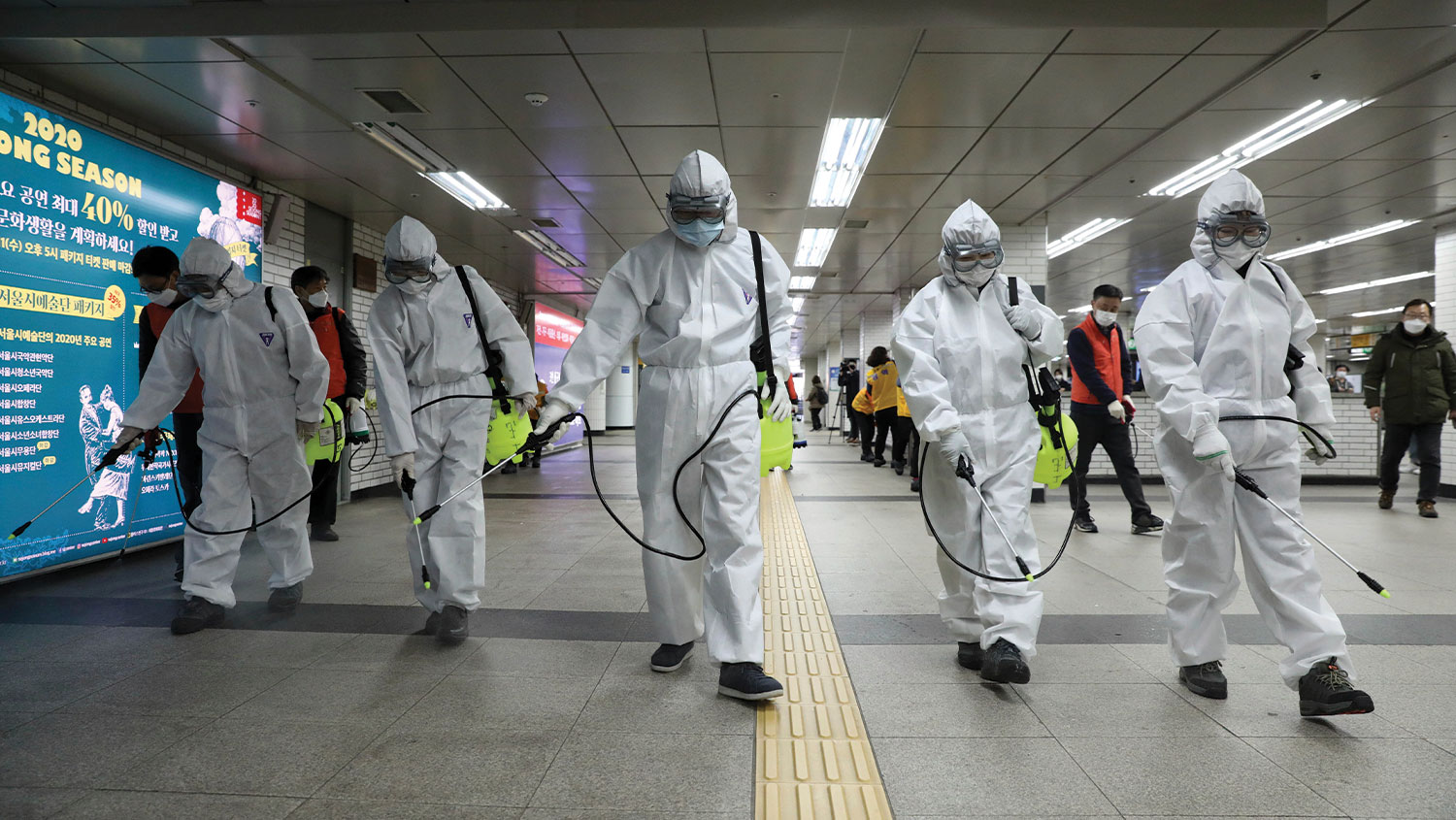
COVID-19 will reverse both of those trends, increasing the space both between countries and among people. Some will laud these changes for increasing safety and resilience. But a world that’s less global and fewer urban would even be less prosperous, less stable and fewer fulfilling. Future is shrouded in clouds of uncertainty, as resilient leaders steel oneself against all possible global outcomes, few are more prominent than others. These are two most predicted and certain scenarios of how the planet would begin of COVID 19. Less global, more isolated. Even before COVID-19, the decades-long trend toward ever-more globalization of trade, investment, supply chains and other people flow were starting to grind to a halt. We began to seem closer to range in terms of the products we produce and consume, the people with whom we interact, and where we get our energy and our money. In retrospect, we’ll come to look at the years right before the 2008 financial crisis as “peak globalization.” Since then, the mixture of recession, inequality and populism has created a growing anti-globalization and anti-immigration consensus in western countries, exemplified by the U.S. trade war with China. The reaction of developed economies to the coronavirus will only strengthen this consensus, as all things international are going to be viewed as incurring unnecessary and dangerous risks.

What WHO calling the coronavirus outbreak a pandemic means | Science News

What was a growing “anti-globalization” consensus is poised to crystalize into a “de-globalization” reality. We are being told this de-globalization will make us all more resilient. But it’ll also make us less prosperous — with less choice and better prices. it’s going to also make us less secure, as international cooperation will decrease and therefore the potential for international conflict will increase. Less density, more distance. Urbanization is probably going to be the opposite major casualty of the coronavirus. Unlike globalization, the trend of ever greater-urbanization was unaffected by the worldwide financial crisis. Even America — the land of all things suburban — joined the worldwide march into cities. People were interested in cities not just for economic opportunity but also for the urban lifestyle. After coronavirus, people are going to be more scared of crowded trains and buses, cafes and restaurants, theaters and stadiums, supermarkets and offices. Crowded spaces are the lifeblood of cities. But now crowds are seen as major health risks. People that have the power to exit the town will increasingly be tempted to try to do so. people that cannot leave will feel at increased risk, hunker down, and reduce their movements and contacts. it’s hard to believe Manhattan without the subway and 10-deep pedestrians on Fifth Avenue. But that will be the increasing post-COVID reality. De-urbanization would harm the economic process because cities generate enormous scale economies and have proved to be remarkably effective incubators of creativity and innovation. This might be particularly true in developing economies where the movement of individuals from rural areas to rapidly expanding cities has been perhaps the key driver of poverty reduction. But the shrinking of cities will produce other adverse effects too, from reducing cultural vibrancy and cosmopolitanism to exacerbating global climate change. Additionally, to be more productive, cities also tend to be more environmentally sustainable. A world that’s less global and fewer urban would be far less appealing to me, personally. But it’s also a world that might hurt economic prosperity, reduce shared understanding among disparate people, and increase the prospect of conflict among them. Our immediate reactions to COVID-19 will lead us to require both to de-globalize and to de-urbanize. But we must take fully under consideration the profound longer-term costs of doing so. Globalization and urbanization generate challenges we must confront, all the more so during a post-coronavirus world. the answer is to manage them, to not reverse them.

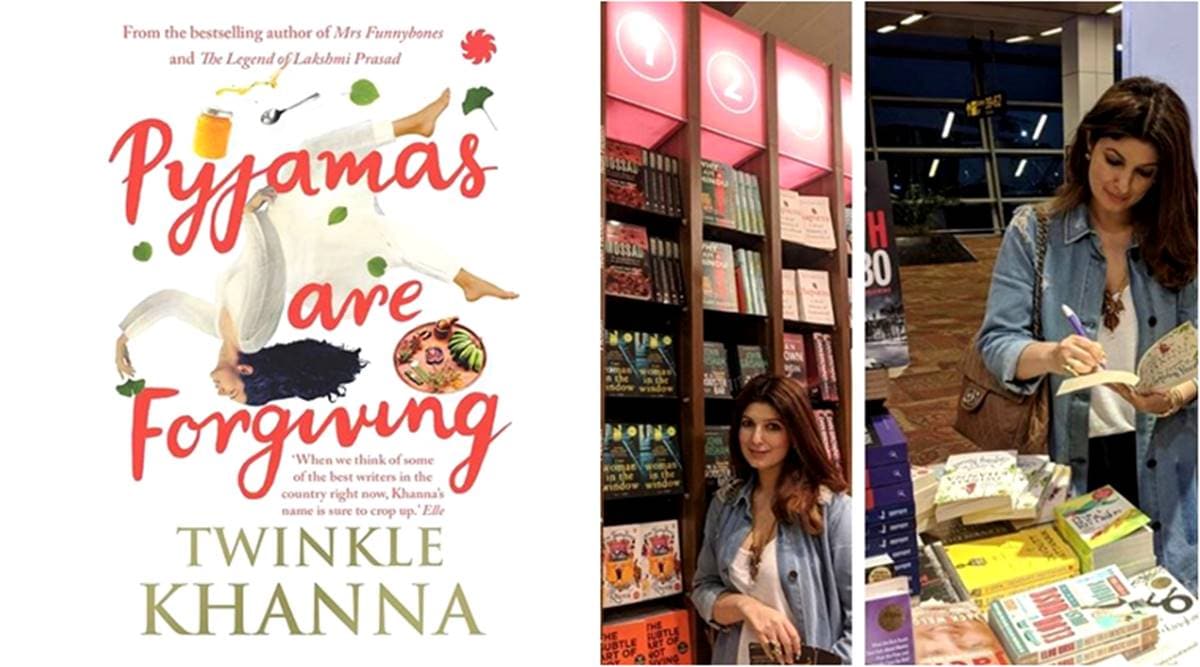
Comparing Writing forms of two Indian Writers- Twinkle Khanna and Dr. Shashi Tharoor

Twinkle Khanna has disarmed the audience with her thought- provoking writing and her charming wit. She is a popular newspaper columnist, Indian author, interior designer, film producer and a former Bollywood actress. She writes columns in The Times of India and Daily News Analysis (DNA), her discernible writing skills and her liberal opinions have captured the attention of her readers. Her craft of penning down funny fables and satirical writing has set her apart. She firmly believes that in life nothing is more sacred than laughter.

  • She writes anecdotes about everyday situations that a woman has to go through. The situations are mundane yet significant incidents in life. Her columns are random, though interesting, slice of life entries, adds life to her words through her self-deprecatory humour and unmatched wit with bits and pieces of life- learnings.
  • Her Popular works include – Mrs.Funnybones, Pyjamas are forgiving, The Legend of Laxmi Prasad
  • Her style of writing can be described as discernible, easy to read and has a smooth way of expressing herself through her writings. If a person is not an adamant reader, they will still be able to understand the picture that she is framing through her writings. Her flow of words is effortless.

 She deals with a wide range of topics from focusing on women empowerment, mental health and normalizing finding love at the age of sixty to WhatsApp forwards and her staff members being a menace to her. She masterfully manages to never belittle a problem or the issue and never diminishes their relevance in any way. Through her columns she can give words to your thoughts. Her columns are an amalgamation of intelligence, sarcasm, practicality and adulation.

  • Her choice of words is interesting, mostly uses expressive adjectives which intensifies her anecdotes. Includes – details that are distinctive, uses similes in her work which adds humor in situations and uses satire and irony which conveys absurdity and silliness of people, situations and things.
  • Her tone is joyful, sarcastic and cheerful.
  • Mood – she is comical, humorous and maddening.
Twinkle Khanna is ready with her third book and it is all about 'pyjama  girls' | Lifestyle News,The Indian Express

Dr. Shashi Tharoor is a best-selling author, columnist and a politician. He is currently member of parliament of Thiruvananthapuram. He has also served as a peacemaker and an administrator in the United Nations for over three decades. He certainly did not let his political career stop his pen. He is known to be the man of having many skills. Over the years he has made a reputation of an impactful orator and a prolific writer.

  • His popular work includes- The paradoxical prime minister, An era of darkness: The British Empire in India, Why I am a Hindu
  • He writes about politics and topical issues of caste system, society, democracy, foreign policy, patriotism, citizenship, nationalism and modern India. He chooses an immersive narrative for all his books and columns. His way of writing exhibits the qualities of good research and personal knowledge which gives a different and a new perspective to readers.

Readers who are looking for a refined viewpoint on the current events that unfold in our country’s political system must read his work. His ability to include the application of critical analysis creates better understanding of important matters that the country is facing or has faced.

  • He is known for having an inimitable style of writing. He has an extensive vocabulary and many people cannot perceive his work easily and often call it obscure in a way. His books are not an easy read and takes a time and efforts to understand vast concepts, debates, history and terminologies that he includes in his columns.
  • His choice of words is complex and informative. His work is recognized for brilliancy in the usage of satire to deliver serious messages. In his columns he has shown that a strong and thoughtful argument can be presented in a humorous way to prevent monotonousness, yet he manages to deliver the required message. By inculcating satire in his work, he candidly expresses himself.
  • His tone is firm, serious and formal.
  • Mood – critical and humorous  

The similarities in their work are that both have chosen topics that are relevant in our country. They both have strong stands and a sense of individuality which sets them apart in their felid of work. They are not hesitant to candidly express themselves and explain their point of views to the readers. Both have an interesting way to put across their messages. There writings include a few scathing statements but are thought-provoking and will entice the readers.

Sixth Schedule of the Indian Constitution: Articles 244(2)

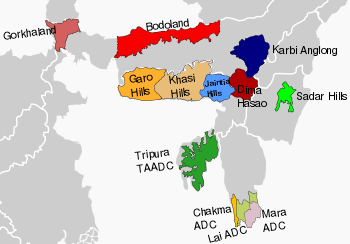
• Tribal Areas:- The tribal Areas in the States of Assam, Meghalaya, Tripura, Manipur are separately dealt with in Article 244(2), and provisions for their administration are to be found in the Sixth Schedule of the Indian Constitution.

• Sixth Schedule:- The 6th Schedule is related to the administration of the Tribal Areas in Assam, Meghalaya, Tripura, Manipur are specified in the table appended to the 6th Schedule( paragraph 20) of the Constitution, which has undergone several amendments originally. It consisted of two parts A and B. But since the creation of the State Nagaland, the table (as amended in 1972, 1984, 1988, 2003) includes 10 areas in four parts. These special provisions are provided under Article 244(2) and Article 275(1) of the Constitution.

Part I – (1) The North Cachar Hills District. (2) Karbi Anglong District. (3) Bodoland Territory Areas District.

Part II (I) – (1) Khasi Hills District. (2) Jaintia Hills District. (3) Garo Hills Districts (in Meghalaya)

Part II (A)- Tripura Tribal Areas District.

Part III – (1) The Chakma District. (2) The Mara District. (3) The Lai District

• Administration under Sixth Schedule:-

(1) Executive and Legislative powers- Under the provisions of the 6th Schedule of the Constitution of India, Autonomous District Councils can make laws, rules, and regulations in the areas like land management, water resources, forest management, agricultural, cultivation, formation of village councils, public health, sanitation, village, and town level planning, the appointment of traditional chiefs and headman, inheritance of property, marriage, and divorce, social customs, money-lending, mining and minerals.

• Judicial powers:- Autonomous District Councils have the powers to form courts to hear cases where both the parties are members of Scheduled Tribes and the maximum sentence, is less than 5years in prison. It has the power to settle certain types of civil and criminal cases also. Thus the councils under the 6th Schedule have been given more power than the local government under the 73rd and 74th Amendments of the Constitution 1992.

• Role of the Governor:- The Governor is empowered to determine areas under the administration of the councils. He has the authority to form a new Autonomous District. He can also increase or decrease the areas of any autonomous district, or district council. The act of Parliament or the State Legislature so not apply to Autonomous Districts and Autonomous Regions or apply by specified modifications and exceptions. He is also empowered to unite two or more districts or its part to carve out one autonomous district from it. The Governor can also define the boundaries or alter the name of any autonomous district.

• District Councils and Regional Councils:- Each District Council and Regional Council consists of not more than 30 members of which 4 are nominated by the Governor and the rest via elections. All of them remain in the power for a term of 5years. District Council and Regional Council under the 6th Schedule have the real power for making laws on various legislative subjects.

• Taxation Revenue:-

(1) The Regional Council and Autonomous District Councils have the powers to assess and collect revenue concerning such lands by the principles for the time being followed by the government of the State.

(2) They also have the power to levy/collect all taxes on lands, buildings, and tolls on a person resident within the area.

(3) It also has the power to levy/ collect all or any of the following taxes:

(i) Profession, trades, callings, employments.

(ii) Animals, vehicles, boats

(iii) Entry of goods into a market, and tolls on passengers, goods carried in ferries.

(iv) Maintenance of schools, dispensaries, or roads.

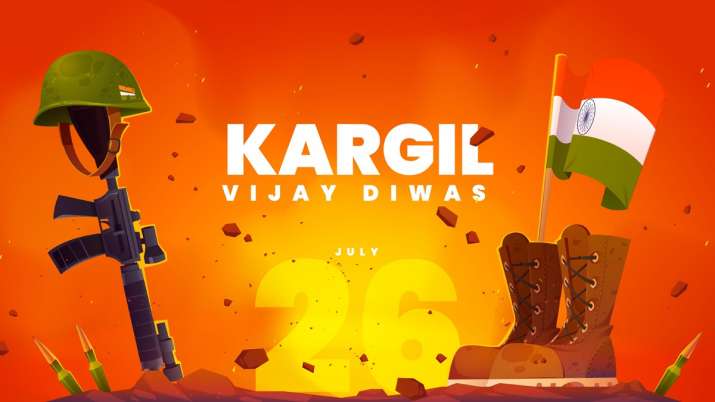
Kargil Vijay Diwas

Today marks the 22nd anniversary of Kargil Vijay Diwas, which is being observed across the country. On Kargil Vijay Diwas, the nation remembers its war heroes and pays respect to Martyrs.

The day commemorates the success of Indian military forces in Operation Vijay in 1999, when they drove infiltrators supported by the Pakistani army out of high positions in the Kargil area.

President Ram Nath Kovind will visit the Kargil War Memorial in Drass, Ladakh, today to pay tribute to the Indian Armed Forces’ unwavering heroism and sacrifice during the Kargil Conflict in 1999.

The Prime Minister also shared a clip from All India Radio’s Mann Ki Baat show from last year. He stated that India will never forget the circumstances surrounding the Kargil conflict.

On the occasion of Kargil Vijay Diwas, Defence Minister Rajnath Singh today paid tribute to the Indian Army’s unwavering courage and sacrifice. Prime Minister Narendra Modi paid tribute to all those who died while defending our country. President of India Ram Nath Kovind will attend the 22nd anniversary of the Kargil War.

He will be the first President to visit the Kargil War Memorial in Drass and take part in the festivities. Air Force Chief Air Chief Marshal R K S Bhadauria and Navy Vice Chief Vice Admiral G Ashok Kumar also expressed their condolences.

“Operation Vijay was a perfect combination of strong and resolute political, military, and diplomatic efforts that helped us to turn an unfavourable situation into a military and diplomatic victory,” wrote General VP Malik, the Indian Army Chief during the Kargil War, in a 2002 essay.

The Kargil War in 1999 was the world’s first and only conflict between two nuclear-armed states. Every year on Kargil Vijay Diwas, India commemorates the heroism of its defence troops, headed by the Indian Army, which pulled off numerous notable successes in the line of fire.

Despite strategic disadvantages and hostile weather, India successfully pushed back the enemy after a nearly three-month operation that included intense warfare, synchronised political and militaristic pressure, and, most importantly, the sacrifices of many lionhearted patriots who will be remembered for the rest of their lives.

Fifth Schedule of the Indian Constitution: Scheduled Areas Articles-244(1)

Scheduled Areas:- The Fifth Schedule Article-244(1), being a very important provision of the Constitution deals with the control and administration of the Scheduled Areas. The Constitution makes special provisions for the administration of certain areas called Scheduled Areas in the states other than Assam, Meghalaya, Tripura, Manipur despite such areas are situated within a State or Union Territory A- 244(1), probably because of the backwardness of the people of these areas.

Criterion:-

The criteria for declaring any areas as Scheduled Areas under the Fifth Schedule are as follows :

(1) Preponderance of Tribal population in such area.

(2) Compactness and reasonable size of the area.

(3) Viable administration entity such as a district, block, or Taluk, etc.

(4) Economic backwardness of the area as compared to the neighboring areas.

Features of the 5th Schedule-

(1) Declaration of Scheduled Areas- The Constitution empowers the President to declare any areas as Scheduled Areas. He can increase or decrease or even alter the boundaries of a Scheduled Area. He can also cancel such designation after consultation with the Governor of the concerned State or can make fresh orders to redefine any Scheduled Area.

(2) Executive powers of State and Union- Subject to the provisions of this schedule the executive powers of State extend to the Scheduled Areas therein. The executive powers of the Union are limited to giving directions to the State for the administration of such areas.

(3) Tribal Advisory Council- Any state having a Scheduled Area needs to establish a Tribal Advisory Council consisting of not more than 20 members of whom about 3/4 members should be the representative of the Scheduled Tribes in the Legislative Assembly of the State.

(4) Law Applicable to Scheduled Areas– The Governor is empowered to direct that any particular Act of Parliament or the Legislature of the State, does not apply directly to a Scheduled Area and is subject to such exceptions and modifications as he may specify in the notification:

(a) Prohibit the transfer of land by or among members of the Scheduled Tribe in such areas;

(b) Regulate the allotments of land to the members of the Scheduled Tribes in such areas;

(c) Regulate the carrying out of businesses as money lenders by persons who lend money to members of the Scheduled Tribes in such areas.

• States Under Fifth Schedule:-

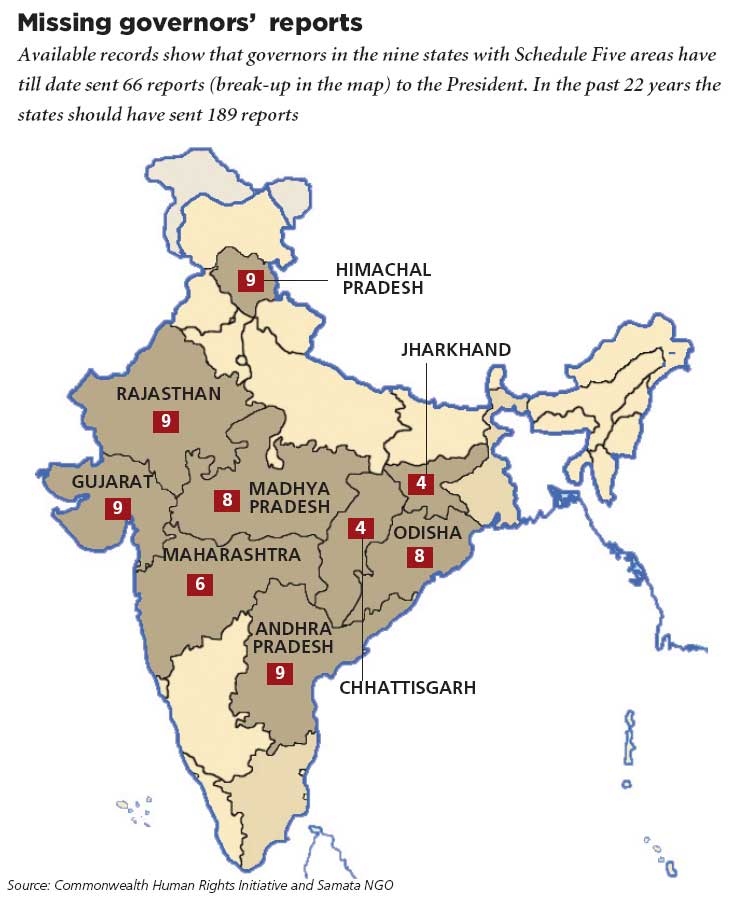
The Fifth Schedule designates Tribal majority areas in the ten Tribal minority States within peninsular India including:

(1) Andhra Pradesh

(2) Himachal Pradesh

(3) Madhya Pradesh

(4) Odisha

(5) Rajasthan

(6) Jharkhand

(7) Gujarat

(8) Chhattisgarh

(9) Telangana

(10) Maharashtra

Some Important points:-

(1) Tribal Advisory Council(TAC) in Scheduled Areas do not perform administrative actions directly and do not have much autonomy.

(2) Panchayat Extension to Scheduled Areas is applicable here.

(3) PRIs in non-6th Scheduled Areas are liberally funded so direct funding of the Council is done under Article 280 of the Constitution.

(4) The Council in the 5th Schedule is the creation of the State Legislature.

(5) 5th Schedule Areas have an implementation of various schemes like MGNAREGA ( Mahatma Gandhi National Rural Employment Guarantee Act) 2005.

The Curious Case of Benjamin Button

What is growing old? Is it accumulating experiences and memories or making memories? Scientifically growing old means your body accumulates damages and is no longer able to function normally. What if someone could grow younger instead of older? The movie plays with a similar idea, it focuses on a man that grows younger instead of older.

The movie starts with an elderly Daisy Fuller on her deathbed in august 2005, she tells her daughter about a clock that ran backwards. The clock was installed on a station in 1918 by a clock worker that wanted it to be an memorial to everyone who lost their lives in the second world war. On the evening of November 11 19118 a boy is born with the appearance of an old man, he is abandoned as an infant on the steps of a nursing home run by Queenie and Mr Weathers. They decide to raise the boy as their own in the nursing home.

Benjamin has to use a wheelchair till 1925 as he cant walk, he however learns to walk and is given crutches. Benjamin although physically old is mentally only about 7. He meets seven year old daisy and becomes good friends with her. Wishing to see more of the world he accepts work on a tugboat captained by Mike Clark, they form a close friendship while working together. Benjamin is contacted by Thomas Button a rich older man who seems to like his company, Thomas hides the fact that he his Benjamin’s father. Benjamin leaves with Mike on along-term work engagement.

In 1941 Benjamin meets Elizabeth Abbot in Murmansk and begins courting her, in December Japan attacks Pearl harbour bringing the War to United States. Captain Mike volunteers the boat for the U.S.Navy, the boat is assigned to salvage duties. After nearly dying in a fight against a German gunboat Benjamin and some surviving crewmen are rescued by a Navy ship, Benjamin returns to New Orleans in 1945 and reunites with Queenie. Benjamin learns that Mr Weathers passed away a while back. Benjamin meets Daisy and has dinner with her before she departs for New York. Benjamin is contacted by Thomas who reveals his relation and leaves his estate to Benjamin.

In 1947 Benjamin visits Daisy in New York but leaves once he realises that she has fallen in love with someone. He meets Daisy again in 1954 after her accident in Paris, a frustrated Daisy asks Benjamin to leave her life. In 1962 their paths cross again in New Orleans, they decide to give their relationship a shot as they are of similar physical age. The two move in together in 1967, Daisy give birth to their daughter Caroline. In 1968 believing that he cant be a proper father, Benjamin liquidates his assets and leaves their lives. Benjamin travels the world alone in the 1970s.

In 1980 Benjamin meets a married Daisy who introduces him as a family friend, they part once more after a short reunion. In 1990 a widowed Daisy is contacted by social workers who find a pre-teen Benjamin living in an abandoned building. Daisy moves into the nursing home and cares for Benjamin the rest of her life. Benjamin finally dies in 2002 as an infant but chronologically 84 years old. Daisy dies having revealed the truth about Benjamin to their daughter Caroline.

This is an amazing movie with a really unique concept which explore the possibility of ageing backwards. A must watch for fans of science fiction, the plot is amazing and makes you think. The cast is amazing as well Brad Pitt plays Benjamin Button and Cate Blachet plays Daisy.

#Thepurestbond : "A father-daughter bond"

Everyone has different relationship with their parents , but the most purest bond that one will find is of a father- daughter . Each one of have witnessed it , dads taking care of their little girls , making their hairs , paint their nails , trying new makeup hacks on their daddy , doing their dad’s makeup , etc. Their is something so sweet & beautiful to watch both of them interact . A father protects her daughter from every things which is bad for her , he tends to make her girl the prettiest & the most perfectionist in the world . It is important for girls to have good relationship with their father , as it impacts their personality , their success , their behavior.

FATHER DAUGHTER BOND IS THE PURREST !

Women who have a good relationship with their fathers are lucky enough to look back at their fond memories when they grow up. Having a good relationship with her father not only shapes a girl’s childhood experience but also influences her behavior towards other men later in life. If a girl’s father is erratic or completely absent by nature, then it creates a feeling of low self-esteem in her, and she might have trouble trusting men in general.

A girl’s father act as a hero for her , this is because he is the first man she is introduced to , he is the first man who holds her , her perception about a man is developed the way her father treats her . This perception is important for a girls’ growth . A girl calls her dad her hero because , he gives a sense of security , he tends to protect her from every thing , dads tends as he would take here girl’s each & every problem .

The father’s connection and communication will help the daughter make the right decisions. A father should provide stability and moral guidance to his daughter because that is the time( teenage ) when she is surrounded and tempted by bad influences. Daughters learn more about relationships by observing their father’s actions and behavior. They judge men based on the standard their father sets. Happy marriages are connected to a warm parent-child relationship. If the parents have marital problems, the girl tends to be insecure, anxious, and aggressive.

Father’s presence not only directs girls in the early stage of life but also assure her that what ever the problem is her father is standing as an iceberg in front of her & will protect her from every problem .

Consumer Rights and Responsibilities

Consumer Rights:

  1. Right to safety:- Means the right to be protected from the marketing of goods and services that endanger life and property. The items and services acquired should not only suit their current requirements, but also their long-term interests. Consumers should insist on the quality of the items as well as the guarantee of the products and services before making a purchase. They should rather choose quality-marked items such as ISI, AGMARK, and so on.
  2. Right to choose:- Means the right to be guaranteed, whenever feasible, of access to a diverse range of products and services at a reasonable price. In the case of monopolies, it entails the right to expect good quality and service at a reasonable price. It also covers the right to fundamental goods and services. This is because the minority’s unfettered ability to choose might imply a rejection of the majority’s fair share. This right is better exercised in a competitive market when a wide range of items are accessible at reasonable costs.
  3. Right to be informed:- Means the customer has the right to be informed about the quality, amount, potency, purity, standard, and price of goods in order to defend themselves from unfair commercial practises. Before making a choice or decision, consumers should insist on receiving all available information about the product or service. This will allow him to behave intelligently and responsibly, as well as avoid falling victim to high-pressure marketing methods.
  4. Right to consumer education:- The right to gain the information and skills necessary to be an educated consumer throughout one’s life. Consumer ignorance, particularly among rural customers, is largely to blame for their exploitation. They should be aware of their rights and should exercise them. Only then can successful consumer protection be achieved.
  5. Right to be heard:- This means that the interests of consumers will be taken into account in relevant forums. It also involves the right to be represented in different forums established to examine the welfare of consumers. Consumers should create non-political and non-commercial consumer groups that may be represented in various consumer committees formed by the government and other entities.
  6. Right to Seek redressal:- Means the right to seek remedy for unjust trade practises or unethical consumer exploitation. It also includes the consumer’s right to a fair resolution of legitimate issues. Consumers must file a complaint if they have legitimate issues. Many times, their complaint may be of minor importance, but its influence on society as a whole may be significant. They can also seek resolution of their concerns via consumer organisations.
  7. Consumer Protection Act:- An Act to provide for the protection of consumers’ interests and, for that purpose, to create agencies for the prompt and effective administration and resolution of consumer disputes, as well as for matters associated therewith.” (From the Consumer Protection Act of 2019.) “An Act to provide for greater consumer protection and to make provision for the formation of consumer councils and other agencies for the resolution of consumer disputes and for issues connected therewith.”(From the Consumer Protection Act of 1986.) The Consumer Protection Act of 1986 aims to promote and defend customers’ interests against inadequacies and faults in goods or services. It also aims to protect consumers’ rights against unfair or restrictive trade practises. This act was passed in the Lok Sabha on December 9, 1986, and the Rajya Sabha on December 10, 1986, and it was signed by the President of India on December 24, 1986, and it was published in the Gazette of India on December 26, 1986.

Consumer Responsibilities:

  1. Ask Yourself!:-
  • Have you had any issues as a consumer?
  • Have you ever complained about an issue like this?
  • Do you aware that you may seek the help of a consumer organization to safeguard your interests?

2. Be Critically Aware:- The responsibility to be more alert and to question more – about prices, about quantity and quality of goods bought and services used.

3. Be Involved:- The obligation to be forceful – to guarantee that you, as a customer, get a fair bargain. Remember that if you remain passive, you will most likely be exploited.

4. Be Organized:- The duty to join hands and raise one’s voice as a customer; to fight as a group and to build the power and influence necessary to promote and safeguard consumer interests.

5. Practice Sustainable Consumption:- The responsibility to be aware of the impact of your consumption on other citizens, especially the disadvantaged or powerless groups; and to consume based on needs – not wants.

6. Be Responsible to the Environment:- The obligation to be aware of and comprehend the environmental repercussions of our consumption. We must acknowledge our personal and social duty to conserve natural resources and maintain the environment for future generations.

Children & Trauma

Trauma in Children with Special Needs - My Mental Health

Most of the people have a thought that children don’t experience traumas but that’s
not the case in reality. Children that experience negative environmental conditions
during their early stages, continue to carry on that feeling till much later in life.
Infants, pre-schoolers, teenagers have totally different environmental conditions
around them in which they live and respond to hence the trauma can be felt and dealt
with differently. Attachments and having good relationships as a young individual is
very important to make a safe environment to be in when they deal with some fear.
Specially in an average Indian household where children’s mental health is not given
that much importance, it is very important to make parents aware about having a safe
and secure environment for their children in order to have a healthy future for them.
I personally know many people who have experienced childhood traumas and till
date it just takes a small thing to trigger that memory and make them go back to
where it was all started as if it was a fresh wound.
A small trauma can lead to serious issues and hence it should be prevented at all cost
specially in the childhood stage when the child is not capable of handling the
situation.
I want to give an example of my uncle here, he was 12 years old when this incident
happened. A very famous Durga temple conducts a function where lakhs of people
come to see, he was one of them and suddenly a fight broke out which turned furious
very fast that police had to intrude, he accidentally got stuck in the fight and got an
injury in his feet, he hid there in that temple for about 2 whole nights alone all scared.
luckily nothing serious happened to him and he safely reached home the 3rd day.
She got paranoid so bad that he is now 45 and still gets scared a Little when he goes
near that temple as he was scared for life being in that incident. That physical scar in
his feet still is very much visible and reminds him of what had happened. A 12 year
old kid accidentally carried away in a lathi charge and is left alone hiding from the
world for 48 hours is indeed traumatic.
Many scientific researches and surveys have been done in the same field and things
like mental health problems and PTSDs have been taken into key concentration
during the researches. Children exposed to such negative incidences are found to be
less efficient in school and lacks the skill of effective communication and is a vicious
cycle for a child’s development.
Another important discussion I would like to bring upon is that of an experience
called past life. Some people believe in it and some don’t but the ‘ past life regression
therapy’ is believed to be successful on clients even if the psychotherapist doesn’t
believe in it.
It is said that sometimes children would have developed a sense of fear, for example a
2 year old kid might have a fear of heights even though he would be experiencing a
sense of being on a high platform for the first time and such a fear can be a
consequence of something that happened in his/her past life.
This discussion is very much open to the floor and no one really have said to come to
a conclusion and I would like to research further on this issue

MOTHER SENTIMENT SONGS – Part 2

There is no life without a mother. She is a precious soul who is completely selfless when it comes to her child. This article is a continuation of part 1 of this article. This is a tribute to all the mothers out there and a realization post for all the sons and daughters through the best mom songs in Kollywood.

  • Song: Kalli kaatil  

Movie: Thenmerku paruvakaatru

Singer: Vijay Prakash

Lyricist: Vairamuthu

Composer: NR Raghunanthan

“Kalli kaatil pirantha thaaye enna kall odachi valartha neeye”

        This harmonious melody is a realization song for the children. It describes the hardships faced by a mother to raise her son. Everyone will realize the value of a mother in listening to this song. 

  • Song: Aararo aariraro 

Movie: Siruthai

Singer: Srivardhini 

Lyricist: Arivumathi

Composer: Vidyasagar

This song is a thallatu (lullaby) that a mother beautifully sings for her daughter. The song appears in a situation where a small girl listens to her mother’s song before sleep on a recorder as her mother is no more. Such a soothing lullaby that shows how her mother fosters her daughter.

  • Song: Kangal neeye 

Movie: Muppozhuthum un karpanaigal

Singer: Sithara

Lyricist: Thamarai

Composer: GV Prakash

It is the best mother song in recent times. It describes that a child is every single thing for a mother. This song comes in a scenario where a widow raises her son who cannot walk by carrying him on her shoulders. She works day and night to give treatment for her son to make him walk. Every single line in this song is a gem that expresses a mother’s heart for her child.

  • Song: Nooru saamigal irunthalum 

Movie: Pichaikkaran

Singer: Vijay Antony

Lyricist: Eknath Raj

Composer: Vijay Antony

This song expresses a child’s love for his/her mother. The movie revolves around a rich son who becomes a beggar and leaves all the luxury he has for some days just because to save his mother who was on the death bed. “Nooru saamigal irunthalum amma unnai pol aagiduma” meaning There may be 100s of gods but can they replace you, oh mother? This line is enough to know the worth.

  • Song: Amma amma 

Movie: Velai illa Pattadhari (VIP)

Singer: Dhanush, S. Janaki

Lyricist: Dhanush

Composer: Anirudh Ravichander

A melancholy that narrates the grief of a son on losing his mother. The situation is that the hero’s mother dies suddenly out of cardiac arrest. His mother tries calling him over the phone when she gets the attack. But he fails to pick the call. Maybe, he could’ve saved his mother if he had attended that call. This guilt and grief surround him and there goes this song. How would it feel when your mother who is our whole world, suddenly leaves you all alone?

  • Song: Ellu vaya pookalaye 

Movie: Asuran

Singer: Saindhavi

Lyricist: Yugabharathi

Composer: GV Prakash

An extremely sad song that comes when a son dies and that is not acceptable for his mother. Each word describes the grief of losing a child. No one can hear this song without tears in your eyes. Such a painful song that melts even a stone-heartened person.

So, these are some of the legendary mother sentiment songs that rule everyone’s playlist. Don’t miss to check its part-1.

"SHOULD OTT BE REGULATED ?"

Regulation of OTTS is a matter of great concern for government.

OTT platforms have grown rapidly in India, especially during the coronavirus-induced lockdown period, when the closure of film theatres led several production houses to release their films directly on OTT platforms. And this allows them to conveniently bypass even the basic scrutiny of a film regulatory authority. Many also believe that OTT platforms often perpetuate sexual crimes and soft porn, amplify bloodshed and gore which can potentially inflame passions, especially in young minds. Unregulated content can be damaging especially for a country like ours where communal tensions are not uncommon. Content on OTTs are age restricted , since their is no censor board for such & everyone can watch it , the content is influencing young minds in wrong way , which is why they need to be regulated.

Regulated OTT content could also imply missed opportunities for filmmakers and actors who are lured to the medium for the creative freedom it offers. This is the only drawback of regulation of OTTs . Filmmakers comes to this platform because this platform offers freedom of creativity , they can make whatever they want to , yes it is true that they make what is real , but this reality often brings problems among young minds because these minds are not able to take the message behind the content but grasp the things which are not meant for them .

In my view, self-regulation is highly preferred to strict censorship as the latter will curtail the creative freedom of OTT video platforms. If OTT platforms self-regulate and take adequate measures to ensure prohibited content is not watched by children and carry content descriptors, among other safeguards, they would emerge as the best platforms for content watchers

Broadcasters Association (NBA) regulates news channels, and the Central Board of Film Certification (CBFC) regulates film content. There is no such regulatory authority operating to scrutinize digital media content. So unregulated content that is now widely accessible owing to cheap data connections and the proliferation of smartphones has become a cause of concern. So there must be a regulatory body for OTTs , so that without violating the rules & guidelines & without showing content which is not good , they can give content which is meant for all & loved by all

MUSIC


“If music is the food of love, play on,
Give me excess of it; that surfeiting, The appetite may sicken, and so die.”

Quote by William Shakespeare

Music is
a vital part of different moments of human life. It spreads happiness and joy
in a person’s life. Music is the soul of life and gives immense peace to us. Music
is different for every individual. For some music is a way of escaping reality,
for some it is defining reality whereas for some it works as an unspoken voice.
Music, unlike literature, has no language and unites people all over the globe.

Some people cannot function if they don’t
listen to music one day. Hence, one can say that music does play an important
role.
Separating humans from art is a task in itself. Humans
always desire to create art no matter in which form and music is just another form
of art. Music appeals to man’s auditory senses, which is part of the five
senses and thus has a massive impact on our everyday lives.
Humanity’s
interaction with sound and the auditory senses cannot be avoided. Man either
creates music or is seen to take pleasure in it. Some people enjoy listening to
music for fun or emotional needs. Some make music to tell a story to the world,
whereas, some use music as a tool to send and spread social messages.

Since
music is not by language barriers, it has no boundaries and breaks the
imaginary territorial lines we have drawn to separate one man from another.

Listening to and playing different tunes
helps to de-stress, relax and it can also help to motivate in trying times.

I
believe music has the ability to convey all sorts of emotion. Whether the
emotion is joy and happiness or sadness and despair through rhythms, harmonies
and the lyrics music show it.
The musical images that
music and song are able to create are amazing. Music has the ability to
transport back in time just like a time machine. It lets me revisit lost and
forgotten moments in life.
Music is the best way to
be happy and busy in life.

Music is more than meditation and yoga, as
it benefits both our body and mind. We can listen to music anytime throughout
the day, listening to music in a moderate voice is a very good habit. Most
research studies indicate that background music can potentially improve your
learning outcomes affecting your cognitive abilities and mood. The most
fascinating characteristic of music is that it brings certain capacities of
humans in close coordination with each other. There is more to music than just
sound. It is also melody and rhythm, and often words. Thus, when people listen
to music, they move along with it, experience images, and feel emotions.
Moreover, there is a significant social component in it. Due to the impact that
music can have on people’s lives, it can be used in various areas.
There
are countless occasions of using music that people can come up with.