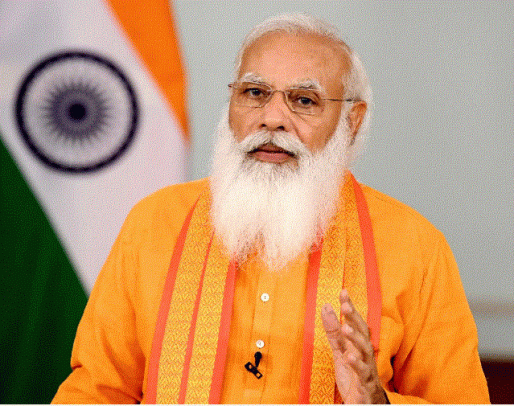
The Prime Minister in his Mann Ki Baat on Sunday urged the countrymen to be ready to celebrate India’s 74th Independence Day next month. And asked to support the athletes in the Tokyo Olympics.
Addressing the state through his month-to-month radio program Mann Ki Baat on Sunday, Prime Minister Narendra Modi said that every Indian felt proud to see the contingent at the Tokyo Olympics and urged people to make Team India happy and requested help. “To guide our Olympic group on social media, the ‘Victory Punch Campaign’ has started. You support your team and share the victory. And the Prime Minister said that you also share the victory of the country. And cheer for India,
Referring to August 15, PM Modi said this year’s Independence Day is special since India is entering the 75th year of its independence. He said that a website called Rashtragaan.in has been created, and urged people across the nation to send a recording of singing the national anthem of India.
During the address, the prime minister also urged people to read the story of Kargil ahead of Kargil Vijay Diwas tomorrow. “Tomorrow is Kargil Vijay Diwas. Kargil war is such a symbol of valour and discipline of our armed forces which the entire world has witnessed. I would like you to read the thrilling story of Kargil. Let us all salute the brave hearts of Kargil,” he said.
He also said that the Ministry of Culture had taken up a new initiative to mark Amrut Mahotsav. The idea behind this was to make people follow the path shown by the freedom fighters, he said.
Talking about the National Handloom Day which is celebrated on August 7, Modi spoke about the historical background, when the Swadeshi movement began in 1905. He urged people to support local entrepreneurs, artists, artisans, weavers by buying handloom and Khadi products. “Buy handloom products and share on social media with #MyHandloomMyPride,” Modi said.
PM Modi also spoke about how technology was being harnessed for the greater good, by speaking about the life journeys of two people from Andhra Pradesh and Odisha.
At the end of the speech, PM Modi said that the Covid – 19 pandemic was not over and asked the citizens to follow Covid-19 protocols and maintain social distancing.
Nepotism is a form of favoritism which is granted to relatives and friends in various fields, including business, politics, entertainment, sports, religion and other activities.The term originated with the assignment of nephews to important positions by Catholic popes and bishops. Nepotism has been criticized since the ancient times by several philosophers, including Aristotle, Valluvar, and Confucius, condemning it as both evil and unwise. Nepotism in India is common in politics, judiciary, business, the film industry, religious circles, arts, industry, and other types of organizations. Many judges and advocates of the high courts and the Supreme Court of India are alleged to be appointed by exercising casteism, nepotism,and favoritism, primarily due to the Supreme Court and the high court appointment process called Collegium which recommends to the President, in a legally binding manner, the names of judges to be appointed or promoted to the higher judiciary. The various judicial services exams are also infamous for these practices. Rahul Gandhi, Former President of the Indian National Congress party, is a descendant of Jawaharlal Nehru and Indira Gandhi, Rajiv Gandhi, Sonia Gandhi.
The Kapoor family, one of the most prolific generational families involved in Indian cinema, have been known for bringing their children into the industry with their endorsements and influence. In June 2020 a fresh debate on nepotism followed soon after the suicide of actor Sushant Singh Rajput, which fans believe was in reaction to efforts by Bollywood insiders to boycott him. Filmmaker Karan Johar, who Rajput had worked with in the Netflix film Drive, was quickly accused of nepotism by actress Kangana Ranaut, with Rajput’s fans calling for a boycott of Johar and his studio, Dharma Productions, as well as of actor Salman Khan and his brothers, who were accused of bullying outsiders in the past. Actors and actresses Alia Bhatt, Varun Dhawan, Janhvi Kapoor, Ishaan Khatter, Ananya Pandey, Athiya Shetty, Tiger Shroff, Arjun Kapoor and Sara Ali Khan, all of whom hail from film families, were also widely criticized. The term comes from Italian word nepotismo, which is based on Latin root nepos meaning nephew. Since the Middle Ages and until the late 17th century, some Catholic popes and bishops – who had taken vows of chastity and, therefore, usually had no legitimate offspring of their own – gave their nephews such positions of preference as were often accorded by fathers to sons.
Several popes elevated nephews and other relatives to the cardinalate. Often, such appointments were a means of continuing a papal “dynasty”. For instance, Pope Callixtus III, head of the Borgia family, made two of his nephews cardinals; one of them, Rodrigo, later used his position as a cardinal as a stepping stone to the papacy, becoming Pope Alexander VI. Alexander then elevated Alessandro Farnese, his mistress’s brother, to cardinal; Farnese would later go on to become Pope Paul III. Paul III also engaged in nepotism, appointing, for instance, two nephews, aged 14 and 16, as cardinals. The practice was finally limited when Pope Innocent XII issued the bull Romanum decet Pontificem, in 1692.The papal bull prohibited popes in all times from bestowing estates, offices, or revenues on any relative, with the exception that one qualified relative (at most) could be made a cardinal.
he Order is a Canadian-American horror drama streaming television series created by Dennis Heaton and written by Heaton, Shelley Eriksen, Rachel Langer, Jennica Harper, Penny Gummerson, and Jason Filiatrault. The series premiered on Netflix on March 7, 2019. The series stars Jake Manley, Sarah Grey, Matt Frewer, Sam Trammell, Katharine Isabelle, and Max Martini. The first season received positive reviews upon its release.
In March 2019, it was announced that the series was renewed for a 10-episode second season that was released on June 18, 2020. In November 2020, the series was canceled after two seasons.
Premise
The Order follows college student Jack Morton as he joins the Hermetic Order of the Blue Rose, a secret society that teaches and practices magic. As Jack goes deeper into the organization’s history, he uncovers dark family secrets and an underground battle between werewolves and the magical dark arts.
Plot
When Belgrave University student Jack Morton joins a fabled secret society, the Hermetic Order of the Blue Rose, he is thrust into a world of magic, monsters and intrigue. Out to avenge his mother’s death, he uncovers dark family secrets and lands in an underground battle being waged between werewolves and practitioners of dark magic. Assisting Jack in the fight is Alyssa, a tour guide at Belgrave and fellow member of the Order, which is led by Jack’s estranged father.
No. of episodes: 20 (list of episodes)
Original release: March 7, 2019 –; June 18, 2020
Executive producers: Chad Oakes; Michael Frislev; Dennis Heaton; Shelley Eriksen; David Von Ancken
Genre: Horror; Drama; Supernatural
why does it ended ?
No official reasons have been given for the show’s cancellation, but as usual it likely came down to viewership vs cost. The pandemic is also driving decisions, with production limitations now playing a part in companies cancelling shows – and even backtracking already-ordered seasons.
Is there a chance for another season ?
The third installment of the order season 3 is already canceled but the creator of the show i.e. Dennis Heaton has revealed what will have happened if there will be season 3. There will be a twist! Alyssa will come back but in another state. He explained it by saying that she “was going to come back wrong”.
so , currently its a no we can keep our fingers crossed and wait for netflix to give us a happy news
A black hole is a region of spacetime where gravity is so strong that nothing—no particles or even electromagnetic radiation such as light—can escape from it. The theory of general relativity predicts that a sufficiently compact mass can deform spacetime to form a black hole. The boundary of no escape is called the event horizon. Although it has an enormous effect on the fate and circumstances of an object crossing it, according to general relativity it has no locally detectable features. In many ways, a black hole acts like an ideal black body, as it reflects no light. Moreover, quantum field theory in curved spacetime predicts that event horizons emit Hawking radiation, with the same spectrum as a black body of a temperature inversely proportional to its mass. This temperature is on the order of billionths of a kelvin for black holes of stellar mass, making it essentially impossible to observe directly.
Objects whose gravitational fields are too strong for light to escape were first considered in the 18th century by John Michell and Pierre-Simon Laplace. The first modern solution of general relativity that would characterize a black hole was found by Karl Schwarzschild in 1916, and its interpretation as a region of space from which nothing can escape was first published by David Finkelstein in 1958. Black holes were long considered a mathematical curiosity; it was not until the 1960s that theoretical work showed they were a generic prediction of general relativity. The discovery of neutron stars by Jocelyn Bell Burnell in 1967 sparked interest in gravitationally collapsed compact objects as a possible astrophysical reality. The first black hole known as such was Cygnus X-1, identified by several researchers independently in 1971. Black holes of stellar mass form when very massive stars collapse at the end of their life cycle. After a black hole has formed, it can continue to grow by absorbing mass from its surroundings. By absorbing other stars and merging with other black holes, supermassive black holes of millions of solar masses may form. There is consensus that supermassive black holes exist in the centers of most galaxies.
The presence of a black hole can be inferred through its interaction with other matter and with electromagnetic radiation such as visible light. Matter that falls onto a black hole can form an external accretion disk heated by friction, forming quasars, some of the brightest objects in the universe. Stars passing too close to a supermassive black hole can be shred into streamers that shine very brightly before being “swallowed.” If there are other stars orbiting a black hole, their orbits can be used to determine the black hole’s mass and location. Such observations can be used to exclude possible alternatives such as neutron stars. In this way, astronomers have identified numerous stellar black hole candidates in binary systems, and established that the radio source known as Sagittarius A*, at the core of the Milky Way galaxy, contains a supermassive black hole of about 4.3 million solar masses.
While we’re in the midst of life’s stresses, we sometimes just want to feel happy immediately. Not only do studies indicate that cheerful individuals have many advantages in life as a result of their happiness, but happiness also just feels good.
Every area of your life is affected by your mood and mental health, from how you feel about yourself to your relationships with others and your physical health.
Though it may appear like happiness is just around the corner with a better career, a healthier relationship or a nicer house, the euphoria that comes with those accomplishments might be ephemeral. Furthermore, you don’t need to make major changes to be joyful; you can experience happiness even with doing miniscule task
There are several strategies to keep your brain and emotions in peak condition. Exercise, good nutrition, and stress-reduction strategies such as meditation or mindfulness may maintain your brain — and your body — in peak condition.
How to Quickly Improve Your Mood
Listen To Music
Music is believed to have the capacity to affect one’s mood, making it a great stress reliever. In reality, music has been utilised therapeutically in hospitals for pain management and mental well-being. Music has also been related to happiness, particularly specific genres of music, according to research. Music, particularly music with a major tone, is associated with reduced stress and feelings of enjoyment.
Incorporate Laughter In Your Life
As it’s so true, the saying “Laughter is the best medicine” has become a cliche. We know that laughing has several benefits other than improving one’s mood. Laughter has been shown to boost immunity and extend life. Laughter can not only be helpful for elevating your mood but the mere anticipation of laughter has been shown to have advantages.
Change Your Mindset
Changing your expectations and comparisons is a quick and easy approach to improve your attitude. Rather than focusing on what you don’t have, consider all you do have. There will always be those that will have more than you in some aspect of life, but so many would have less than you. Enjoy the advantages of thankfulness and shift your perspective on what you have, and you will feel happier right away.
Do a Good Deed
Many people have found that helping others makes them happy. Indeed, studies suggest that individuals who volunteer have higher levels of health and pleasure. This is believed to be true for a number of reasons. The first is that generosity itself has several advantages, including an increased degree of emotional well-being. If you are doing something kind for someone else, your attention shifts away from yourself and your issues and onto others and making them happy. A smile that you put on somebody else’s face is an infectious smile that spreads contagious happiness.
Practice Meditation
Although meditation appears to be more of a stress management strategy than one that may increase happiness, it has been shown to be an efficient approach for both. Meditation’s stress-reduction effects are well-known, but research also suggests that regular meditation can lead to higher levels of happiness.
If your attempts to improve your mood aren’t helping or you’re having difficulty giving yourself a very much needed boost, consider seeking help from a professional therapist. If your mood has been low for much more than two weeks or is affecting your relationships, job, or education, speaking with a therapist can help.
Engineers, as practitioners of engineering, are professionals who invent, design, analyze, build and test machines, complex systems, structures, gadgets and materials to fulfill functional objectives and requirements while considering the limitations imposed by practicality, regulation, safety and cost. The word engineer (Latin ingeniator) is derived from the Latin words ingeniare (“to create, generate, contrive, devise”) and ingenium (“cleverness”). The foundational qualifications of an engineer typically include a four-year bachelor’s degree in an engineering discipline, or in some jurisdictions, a master’s degree in an engineering discipline plus four to six years of peer-reviewed professional practice (culminating in a project report or thesis) and passage of engineering board examinations.
The work of engineers forms the link between scientific discoveries and their subsequent applications to human and business needs and quality of life. A professional engineer is competent by virtue of his/her fundamental education and training to apply the scientific method and outlook to the analysis and solution of engineering problems. He/she is able to assume personal responsibility for the development and application of engineering science and knowledge, notably in research, design, construction, manufacturing, superintending, managing and in the education of the engineer. His/her work is predominantly intellectual and varied and not of a routine mental or physical character. It requires the exercise of original thought and judgement and the ability to supervise the technical and administrative work of others. His/her education will have been such as to make him/her capable of closely and continuously following progress in his/her branch of engineering science by consulting newly published works on a worldwide basis, assimilating such information and applying it independently. He/she is thus placed in a position to make contributions to the development of engineering science or its applications. His/her education and training will have been such that he/she will have acquired a broad and general appreciation of the engineering sciences as well as thorough insight into the special features of his/her own branch. In due time he/she will be able to give authoritative technical advice and to assume responsibility for the direction of important tasks in his/her branch. Engineers develop new technological solutions. During the engineering design process, the responsibilities of the engineer may include defining problems, conducting and narrowing research, analyzing criteria, finding and analyzing solutions, and making decisions. Much of an engineer’s time is spent on researching, locating, applying, and transferring information. Indeed, research suggests engineers spend 56% of their time engaged in various information behaviors, including 14% actively searching for information. Engineers must weigh different design choices on their merits and choose the solution that best matches the requirements and needs. Their crucial and unique task is to identify, understand, and interpret the constraints on a design in order to produce a successful result.
Engineers apply techniques of engineering analysis in testing, production, or maintenance. Analytical engineers may supervise production in factories and elsewhere, determine the causes of a process failure, and test output to maintain quality. They also estimate the time and cost required to complete projects. Supervisory engineers are responsible for major components or entire projects. Engineering analysis involves the application of scientific analytic principles and processes to reveal the properties and state of the system, device or mechanism under study. Engineering analysis proceeds by separating the engineering design into the mechanisms of operation or failure, analyzing or estimating each component of the operation or failure mechanism in isolation, and recombining the components. They may analyze risk.
The Big Bang theory is the prevailing cosmological model explaining the existence of the observable universe from the earliest known periods through its subsequent large-scale evolution. The model describes how the universe expanded from an initial state of high density and temperature, and offers a comprehensive explanation for a broad range of observed phenomena, including the abundance of light elements, the cosmic microwave background (CMB) radiation, and large-scale structure. Crucially, the theory is compatible with Hubble–Lemaître law—the observation that the farther away a galaxy is, the faster it is moving away from Earth. Extrapolating this cosmic expansion backwards in time using the known laws of physics, the theory describes an increasingly concentrated cosmos preceded by a singularity in which space and time lose meaning (typically named “the Big Bang singularity”). Detailed measurements of the expansion rate of the universe place the Big Bang singularity at around 13.8 billion years ago, which is thus considered the age of the universe.
After its initial expansion, an event that is by itself often called “the Big Bang”, the universe cooled sufficiently to allow the formation of subatomic particles, and later atoms. Giant clouds of these primordial elements—mostly hydrogen, with some helium and lithium—later coalesced through gravity, forming early stars and galaxies, the descendants of which are visible today. Besides these primordial building materials, astronomers observe the gravitational effects of an unknown dark matter surrounding galaxies. Most of the gravitational potential in the universe seems to be in this form, and the Big Bang theory and various observations indicate that this excess gravitational potential is not created by baryonic matter, such as normal atoms. Measurements of the redshifts of supernovae indicate that the expansion of the universe is accelerating, an observation attributed to dark energy’s existence. Georges Lemaître first noted in 1927 that an expanding universe could be traced back in time to an originating single point, which he called the “primeval atom”. Edwin Hubble confirmed through analysis of galactic redshifts in 1929 that galaxies are indeed drifting apart; this is important observational evidence for an expanding universe. For several decades, the scientific community was divided between supporters of the Big Bang and the rival steady-state model which both offered explanations for the observed expansion, but the steady-state model stipulated an eternal universe in contrast to the Big Bang’s finite age. In 1964, the CMB was discovered, which convinced many cosmologists that the steady-state theory was falsified, since, unlike the steady-state theory, the hot Big Bang predicted a uniform background radiation throughout the universe caused by the high temperatures and densities in the distant past. A wide range of empirical evidence strongly favors the Big Bang, which is now essentially universally accepted.
According to the Big Bang theory, the universe at the beginning was very hot and very compact, and since then it has been expanding and cooling down. As the universe cooled, the rest energy density of matter came to gravitationally dominate that of the photon radiation. After about 379,000 years, the electrons and nuclei combined into atoms (mostly hydrogen), which were able to emit radiation. This relic radiation, which continued through space largely unimpeded, is known as the cosmic microwave background.
We have heard terms like liberty and freedom. Many times there had been protests, fights, wars in history for freedom and liberty. The process of getting freedom for a nation is quite difficult. For instance, India became free from the Britishers after a very long period of time. Being able to express yourself freely is freedom. But what is the difference between liberty and freedom. We have often confused ourselves with these two terms. They both might mean almost the same, but they do have some differences. But before moving on with the differences, let us first talk about the basic meaning of liberty and freedom.
Liberty
Liberty is defined as the situation in which a person has the right to act according to his/ her will. Liberty also means being free from any oppression. Well, it is interesting to know that liberty also has a symbolic meaning. In India, liberty is known as ‘mukti,’ i.e., dissolution with the divine. Different nations have different notions of liberty. Liberty means different in politics and biblical sense. For instance, in India, liberation also means being consciously aware of oneself. Since India is a land of mystics, there are different connotations attached to the term.
Freedom
Freedom is defined as the situation in which a person has the right to speak, act, and think according to his / her own way. The Constitution of India has several fundamental rights that define freedom. Freedom of speech and expression, freedom of religion, freedom of education, etc., are some of the fundamental rights of India. Well, it is interesting to note that freedom does not have a political realm, i.e., freedom can be practised in houses, among people, or nations. Now, let us discuss the basic points of contrast between liberty and freedom.
S.NO.
LIBERTY
FREEDOM
1.
Liberty is defined as the situation in which a person has the right to act according to his/ her will.
On the other hand, freedom is defined as the situation in which a person has the right to speak, act, and think in his/ her own way.
2.
There are no rights or laws written in the Constitution of India.
There are several fundamental rights provided in the constitution of India, like freedom of speech and expression, freedom of education, etc.
3.
Liberty can be considered as a situation wherein one is able to govern themselves, thereby taking responsibility for their action
Freedom is also known as free will. The ability of a person to make choices for themselves without being under oppression is called as freedom.
4.
The term liberty comes from the Latin word ‘libertatem,’ meaning being free or freeman.
On the other hand, freedom comes from an Old English term ‘freodom,’ meaning a state of deliverance or free will.
5.
Liberty can be categorized into two types, i.e., positive liberty and negative liberty.
There are two significant kinds of freedom, i.e., social freedom and natural freedom.
So, these are some of the major points of contrast between liberty and freedom. Freedom is the state of being free from any oppression, while liberty is the freedom to act in one’s own way. Liberty is a significant concept because people enjoying liberty have to take responsibility for their actions performed. Freedom, on the other hand, is a concrete concept. Freedom is synonymous with independence. Well, there are several types of liberty and freedom. So, let us take a look at them.Features of Java – Javatpoint
Types of Freedom
Freedom of Association: Freedom of Association is defined as the right to join a particular group or community in order to reach a common goal. The groups include labor unions, business groups, etc.
Freedom of Belief: Freedom is Belief is defined as the right to have faith in a particular thought. For instance, some people believe that are ghosts, while some believe there aren’t any ghosts.
Freedom of Speech & Expression: Freedom of Speech & Expression is defined as the right to speak freely about perspectives, ideas, and opinions.
Freedom of Religion: Freedom of Religion is defined as the right to practice any religion despite belonging to any community.
Freedom of Education: Freedom of Education is defined as the right to practice and learn various skills. Education is the right of every individual. Thus, the right to education implies that every individual be it poor or rich.
Types of Liberty
Natural Liberty: Natural Liberty is defined as the liberty in which a person can do anything he/ she wishes.
Civil Liberty: Civil Liberty is defined as the liberty in which the society enjoys the law or rights provided by the government.
Political Liberty: Political Liberty is defined as the liberty in which the people have the right to participate in the decision-making of the country.
Personal Liberty: Personal Liberty is defined as the liberty in which a person acts according to his/ her own wish.
Economic Liberty: Economic Liberty is the liberty wherein the people work hard in order to earn a living. This liberty goes beyond colour, creed, caste, or religion.
Domestic Liberty: Domestic Liberty is defined as liberty having equal rights for men and women. This kind of liberty includes protection from exploitation, violence, etc.
So, these are the significant types of liberties. Freedom and liberty is a significant topic that has gained attention time and again. The protests and wars had one primary aim, i.e., to gain freedom. Thus, freedom and liberty has been an essential concept in the history of nations.
Remember the feeling of nervousness and fearfulness on the first day of school/when going for a job interview/when moving to another city/when giving your first speech? Well, if you do then that feeling my friend is called Anxiety.
Anxiety is our body’s natural response to stress. It’s a feeling of fear or uncertainty about what’s to show up. However, if you feel anxious on a severe level and the feelings last longer than six months and are intruding with your life, you may have an anxiety disorder.
Anxiety is the most common mental illness. Also, you have heard a lot of things about anxiety, out of them some are facts and some are myths. So, let’s have a look at some of the myths and facts about Anxiety:-
I) What are the types of Anxiety?
Myth: All anxiety is the same.
Fact: There are multiple different types of anxiety disorders.
Anxiety affects people differently. For some people, anxiety may only be experienced in certain situations, while others experience it more often.
Common types of anxiety include:
★ General anxiety disorder
★ Panic disorder
★ Social anxiety disorder
★ Phobias
★ Obsessive-Compulsive Disorder
★ Post-Traumatic Stress Disorder
★ Separation anxiety
II) Who suffers from Anxiety?
Myth: Only adults suffer from anxiety.
Fact: Anxiety affects both children and adults.
The more Anxiety is common in Adults, the same it is for children. According to the Centers for Disease Control and Prevention (CDC), around 4.4 million children aged 3-17 have been diagnosed with anxiety.
Anxiety can affect children by causing; children behavioral, emotional, and physical symptoms, similar as they can in adults.
III) How serious is Anxiety?
Myth: It is not a big deal.
Fact: Anxiety can cause serious health problems.
As mentioned above anxiety can be different for everyone. Anxiety becomes a problem when it starts intruding on your day-to-day life.
Anxiety can cause emotional and behavioral problems like worries and fears. Also, it can cause physical problems like rapid breathing, sweating, headaches, and tense muscles. It also affects eating and sleeping patterns.
IV) Anxiety and Depression
Myth: Anxiety and depression are not related.
Fact: Many people who suffer from anxiety also undergo depression.
It is common to have both anxiety disorder and depression at the same time. 50% of people undergoing depression are also diagnosed with anxiety disorder, according to the Anxiety and Depression Association of America (ADAA).
Also, according to ADAA, anxiety is linked with numerous other mental and health conditions:
★ Headaches
★ Irritable bowel syndrome
★ Chronic pain
★ Eating disorders
★ Sleep disorders
★ Substance abuse
★ Bipolar disorder
★ Attention-deficit/hyperactive disorder
★ Fibromyalgia
Anxiety is a concerning issue, stop believing in myths, check your facts. And if it has started intruding your life, consult a doctor.
India is home to people following different religions and having different faiths. As per the census of India 2001, there are 6,639,626 people who follow other religions apart from the six major religions which are Hinduism, Jainism, Islam, Buddhism, Sikhism, and Christianity.
There are various divisions within a religion, for example, amongst Islam there are Shias, Sunnis, Hanafis and among Jains, there are the Digambara and Svetambara divisions. Divisions within a religion follow a different faith from other divisions by following different customs, practices, and traditions. So with such a diverse population, following different religions and beliefs, it becomes necessary to protect and secure rights regarding faith of each and every religion. Therefore, in India, legal rights are provided like the right to worship; right to visit religious places (like temple, mosque, church) to follow their faith and religion but it is subject to certain restrictions prescribed in the Constitution.
Revolt from the past on the violation of Freedom of Religion
It is evident from the past that Indians have been sensitive regarding their religious beliefs and customs. Whenever a foreign ruler tried to interfere with the people’s customs or religious practices, they became disgruntled and revolted. Even the immediate cause behind the Revolt of 1857 (the First War of Independence) was that Mangal Pandey was forced to act against his religious beliefs. He was forced to pull off the cartridge of the gun from his mouth which was believed to be greased with a mixture of cow and pig lard. In Hinduism, cows are worshipped like ‘mother’ whereas Muslims believe pigs are impure, they not only avoid to pronounce pig but also consider it as a sin to think about pig. When Britishers disrespected their faith, it became a serious cause of revolt and led people to revolt against the British Raj.
Indians are still the same when it comes to their faith and religion. Their religious sentiments are one of the most important concerns in their life. Even now if anyone messes up with their religion and culture, they consider it as their duty to protect their religion and get the accused punished for it. But it is not necessary that every act against someone’s faith and belief is wrong in the eyes of law. There may be instances where people’s religious sentiments are hurt without any legal wrong. Therefore, giving freedom of religion not only becomes necessary for securing the religious rights of people but also to define the scope of what could be considered as a legal wrong against religion.
What is the relation between Secularism and Freedom of Religion in India?
In 1976, by the 42nd Constitutional amendment word ‘secular’ was added to the preamble of the Constitution. India being a secular state, is a no state religion which means that it follows no particular religion.
What is Secularism?
In Ahmedabad St. Xavier’s College v. State of Gujarat, the Supreme Court held that Secularism neither means anti-god nor pro-god. It just ensures that no one is differentiated on the basis of religion eliminating the concept of God in matters of the state.
While dealing with the concept of ‘secularism’ in detail, the Supreme Court in S.R Bommai v. Union of India explained that under the Constitution, secularism does not mean an atheist society but a heterogeneous society providing equal status to all religions without favoring or discriminating against any one.
How India’s stance on freedom of Religion differs from the US?
Both India and the US are the secular countries. But, there exists a major difference between the concept of ‘secularism’ followed by both the countries.
What is that difference in the concept of Secularism?
Paresh Raval’s dialogue from Oh My God movie, “Mai sab dharmon ka aadar karta hoon aur kisi bhi dharam mein maanta nahin” which means that “I respect all religions and I don’t believe in any religion”. It defines the difference in approach of India and US towards the religion. The first part of the dialogue depicts the position of India where the principle of “Sarva Dharma Sambhava” which means “equal respect for all religions” whereas the second part of the dialogue represents the US ideology which has drawn a line between religion and state. In the US, the State works independent of religion and there exists a wall of separation between the Church and the State.
Secularism in India
Secularism in the US
Follows the concept of ‘neutrality’ and ‘positive role’ towards the religion.
Follows the principle of ‘non-interference’ in the matters of religion.
The State can introduce religious reforms, protect minority and formulate policies on religious matters.
The State cannot take any action in religious matters.
Which provisions under the Indian Constitution guarantee freedom of religion?
Articles 25 to 28 in the Constitution of India provide the right to freedom of religion.
In Ratilal Panachand Gandhi v. State of Bombay, the Supreme Court stated that Article 25 guarantees every person (not only citizens) the freedom of conscience and right to freely profess, practise and propagate religion imposed with certain restrictions by the State. These restrictions are:
Public order, morality and health and other provisions of the Constitution (Clause 1 of Article 25).
Laws relating to or restricting any economic, financial, political, or other secular activities associated with religious practices. (Clause 2(a) of Article 25).
Social welfare and reform that might interfere with religious practices.
Is it necessary that freedom of conscience is always related to religion?
No, freedom of conscience need not necessarily be connected with any particular religion or faith in God. It includes that the right of a person shall not be converted into another man’s religion or belief in any religion at all.
What does profess, practice and propagate mean?
The court in Stainislaus Rev v. State of MP explained that freedom of ‘profession’ means the right of the believer to state his creed in public whereas freedom of ‘practice’ means his right to give expression in forms of private and public worship. The court also explained that the right to propagate one’s religion means the right to communicate a person’s beliefs to another person or to expose the tenets of that faith, but shall not include the right to ‘convert’ another person to the former’s faith. In the Commissioner Hindu Religious Endowments Madras v. Sri L T Swamiar of Sri Shriur Matt, the Court held that ‘profess’ means ‘right to freely declare of one’s faith”.
Does Article 25 protect the performance of every religious practice?
No, Article 25 only protect those practices which are integral parts of a religion. It is the duty of the court to decide whether a practice is an essential practice or not depending on the evidence formulated by the conscience of the community and the tenets of the religion.
Some of the religious practices which were held essential by the Court:
Article 26 guarantees the following rights to a religious denomination with subject to public order, morality, and health:
To establish and maintain institutions for religious and charitable purposes.
To manage its own affairs in matters of religion.
To own, acquire and administer both movable and immovable property in accordance with law.
What is a Religious Denomination?
As the Constitution of India does not define religious denomination, judicial pronouncements are to be considered for understanding what qualifies as a religious denomination. In SP Mittal v. Union of India, the apex court laid down three conditions that need to be fulfilled by a religious denomination:
Collection of Individuals having a common faith.
A common organization.
Designation by a distinctive name.
Examples of religious denomination
In Hinduism, there is Shaivism, Shaktism, Vaishnavism, etc. as common denominations. In Islam, Shia and Sunni are the two well-known denominations.
Sects or sub-sects of a religion
The denomination can also be used for forming sect or sub-sect of a religion designated by a distinctive name. Examples of sects or sub-sects which are a religious denomination:
Vaishnavism sect in Hinduism.
Ramakrishna Math or Ramakrishna Mission.
Shia, Hanafi and Chishti sects in Mohammedan law.
Ananda Marg.
Examples of sects or sub-sects which are not a religious denomination:
Article 27 protects a person from forceful payment of taxes and proceeds which are for the promotion or maintenance of any particular religion or religious denomination.
Is Article 27 equally applicable to the fees charged by the Government for maintenance of religious institutions?
Article 28 provides freedom from any religious instruction in educational institutions which are maintained completely out of State funds. This article is not applicable to an educational institution if it is administered by the State, but was established under any endowment or trust requiring certain religious instruction to be imparted in that institution. This article also protects a person from taking part in any religious instruction or attending any religious worship which may be conducted in an institution recognized by State or receiving aid from State funds unless his guardian has consented.
Are moral instructions also prohibited under Article 28?
No. In Nambudripad Kidangazhi v. State of Madras, it was held that moral instructions are not prohibited. The court said that Article 28 only restricts religious and not moral education if it has no relation with any religious denomination.
Will an institution be considered ‘wholly maintained out of state funds’ if it receives fees apart from State grants?
Yes. In D.A.V. College v. State of Punjab, Supreme Court ruled out that even though an institution might be receiving fees for affiliation or holding examinations, it may be considered ‘wholly maintained out of State funds’ if it is receiving grants for its expenditure.
Major judicial pronouncements on Freedom of Religion
In this case, three children of Jehovah’s Witnesses sect were suspended from the school as they refused to sing the national anthem claiming that it is against the tenets of their faith. The court held that expulsion is violative of fundamental rights and the right to freedom of religion.
The Court held that Ananda Marga is not a separate religion but a religious denomination. And, the performance of Tandava on public streets is not an essential practice of Ananda Marga.
Petitioner challenged the validity of Section 295 of IPC which penalized the act or attempt of insult of a religion or religious beliefs of a class of citizens. The Court held that Section 295 is consistent with Article 25 and held it to be constitutional.
The validity of the Jagannath Temple Act, 1954 was challenged as it enacted provisions to manage the affairs of Puri temple on the grounds that it is being violative of Article 26. The court held that the Act only regulated the secular aspect of seva puja, therefore, it is not being violative of Article 26.
The petitioners contended that Durgah Khwaja Saheb Act, 1955 violated Article 25 and 26 which provided for the appointment of Hanafi Muslims as members of Committee none of them belonging to the Chishti sect. The Court held that the Chishti sect is a religious denomination but the act does not violate the right to freedom of religion as Chishti Sufis never had the right to manage the Durgah endowment.
In 2017, a PIL was filed under Article 32 by the petitioners challenging the practice followed in Sabarimala temple which did not allow the entry of women from the age group of 10-50 years. A constitutional bench was set up in 2018 which held that the practice was unconstitutional and uplifted the ban on entry of women stating that followers of Ayyappa do not form a separate religious denomination but are Hindus only and, such a ban is not an essential practice of the religion.
Has Sabarimala Judgment encroached the Freedom of Religion?
From the inception of Article 25 and 26 in the Constitution of India, the power of deciding whether a practice is essential to a religion or not was only with the court. In the Sabarimala judgment, the court exercised its power and decided against the old and rudimentary practice which holds no value in today’s society. India is developing and such practices which are gender biased, considering menstruating females to be impure have no place in the society.
Though the Sabarimala verdict has opened pandora’s box giving rise to a number of applications challenging practices which are biased mostly against women. The court has not been at fault in deciding in favor of women as the old custom was violative of right to equality and was arbitrary in nature. The court held the practice unconstitutional.
What is the current position of Freedom of Religion in India?
Currently, in India, the restriction of morality which was earlier of societal morality has changed into Constitutional Morality. But, this term is nowhere mentioned in the constitution. ‘Constitutional Morality’ is a judiciary invented term which gives too much power in the hands of the judiciary. Already, the doctrine of basic structure has left too much power in the hands of the judiciary to interpret the constitution and decide anything as basic structure according to their discretion as there is no strict formula for deciding the same. If all the past decided cases applying constitutional morality are analyzed, it can be inferred that it is trying to adapt the country to the present norms giving supremacy to ‘live with dignity’. Whether its declaration of Section 377 of IPC as unconstitutional or Sabarimala Judgment striking down the old practice of not allowing woman, constitutional morality is trying to uplift the society. The fact still remains the same that the court has a huge discretion of power in deciding cases. It is said: “Power corrupts and absolute power corrupts absolutely.” It would be interesting to note how the court is going to exercise the power it has got under Constitutional Morality’.
Conclusion
India being a secular state provides equal protection to all the religions. Equal protection does not mean that it always aids and promotes its citizens to follow a religion and its practice, but at times it means to interfere and bring positive reforms for the betterment of the society. A question which recent judgments have raised is whether it is necessary for the court to decide the constitutionality of a practice merely to establish a right even when it does not hurt a majority section of the society.
This new wave of modernism and feminism has set a trend of questioning customs to establish and showcase the right to equality available to us as a fundamental right. Though fighting for your right is not wrong, interfering in religious matters just to establish a right and hurting religious sentiments of certain followers is not something which a secular state should do. Unless there is grave harm which affects a section, faith and beliefs of the followers should not be hurt. For example, in many places, there is followed a practice of keeping menstruating girls away from the home and this practice took away the life a girl who was forced to stay in the hut due to her periods during Cyclone Ganja. Such practices need to be scrapped off no matter how many sentiments are hurt but at the same time when a temple which neither allows the entry of a man nor of woman then there need not be interference of the State to ensure the right to freedom of religion.
A memorable event organised by the management committee of Jyoti nivas college was the visit of the chief minister of Karnataka, B. S. Yediyurappa on 1st November 2019. The seminar was held in the jam-packed auditorium where the air was filled with ambition, enthusiasm and curiosity. Even though the audience was intrigued and was greatly looking forward to this event, they managed to maintain decorum and made sure that nobody was hurt in the process of entering the venue. This showed the positive spirit of the college and the students.
A memorable event organised by the management committee of Jyoti nivas college was the visit of the chief minister of Karnataka, B. S. Yediyurappa on 1st November 2019. The seminar was held in the jam-packed auditorium where the air was filled with ambition, enthusiasm and curiosity. Even though the audience was intrigued and was greatly looking forward to this event, they managed to maintain decorum and made sure that nobody was hurt in the process of entering the venue. This showed the positive spirit of the college and the students.
When the event began, there was a lamp lighting ceremony and was followed by a mesmerising performance by the classical dance team of the college. The principal Sister Dr. Elizabeth gave a very welcoming speech and the audience were looking forward to learn something meaningful from our beloved chief minister. The MC introduced the chief minister and requested him to share his knowledge with the audience. The entire audience was looking forward to those words of wisdom and gaining knowledge which might not be able to gain through textbooks.
As the event progressed, Mr.B.S. Yediyurappa gave a heartwarming speech about his attachment towards the language and the state Karnataka. It made the audience aware of how Karnataka has been neglected by its own people and how we need to respect and cherish more of it. He described how much the land meant to him, it’s special features and the beauty of the state.
The event was to help the students understand the importance of the language Kannada on the auspicious day of Kannada Rajyotsava(November 1). On that occasion we could see the joy and respect for our respected chief minister as there was pin drop silence as he kept us entertained with his experienced words and also at the same time educated us in a friendly manner. The great chief minister spoke true words which were from his heart and that was very visible as he spoke so fondly and proudly of his language and culture. The audience learnt so much that they were left speechless. He made sure we understand how important it is to be in touch with our culture and tradition and have deep respect for our language.
As the event came to an end, few teachers and volunteers distributed refreshments and beverages to the students who were part of the occasion. This acted as a morale booster as the students were excited to look forward to how to make use of the wise words from the principal and the esteemed guest.
Conclusion: At the end of the event, the entire audience was In awe and had even more respect for the language and the state. The event was very helpful and meaningful. It spread positivity among its audience and helped us gain perspective. It made us realize that it’s important to love yourself and your roots and not be ashamed of it. Being able to accept who you are is the truest way you can pay back for everything you have received from the nature and it’s resources.
For us to recall events, facts or processes, we have to commit them to memory. The process of forming a memory involves encoding, storing, retaining and subsequently recalling information and past experiences.
Cognitive psychologist Margaret W. Matlin has described memory as the “process of retaining information over time.” Others have defined it as the ability to use our past experiences to determine our future path.
When they are asked to define memory, most people think of studying for a test or recalling where we put the car keys. However, memory is essential in our everyday lives. We would not be able to function in the present or move forward without relying on our memory.
How we form memories
The process of encoding a memory begins when we are born and occurs continuously. For something to become a memory, it must first be picked up by one or more of our senses. A memory starts off in short-term storage. We learn how to tie our shoe, for example. Once we have the process down, it goes into our long-term memory and we can do it without consciously thinking about the steps involved.
Important memories typically move from short-term memory to long-term memory. The transfer of information to long-term memory for more permanent storage can be happen in several steps. Information can be committed to long-term memory through repetition — such as studying for a test or repeatedly taking steps until walking can be performed without thinking — or associating it with other previously acquired knowledge, like remembering a new acquaintance Mrs. Emerald by associating her name with an image of the green jewel.
Motivation is also a consideration, in that information relating to something that you have a keen interest in is more likely to be stored in your long-term memory. That’s why someone might be able to recall the stats of a favorite baseball player years after he has retired or where a favorite pair of shoes was purchased.
We are typically not aware of what is in our memory until we need to use that bit of information. Then we use the process of retrieval to bring it to the forefront when we need to use it. Again, much of this recall happens without having concentrate on it — particularly with common tasks such as shoe tying — but there are other types of memories that take more effort to bring to the forefront.
Memory loss is often associated with aging, but there are a number of things that can trigger short- and long-term memory loss, including injury, medications and witnessing a traumatic event.
Types of memory
While experts have varying definitions for short-term memory, it is generally described as the recollection of things that happened immediately up to a few days. It is generally believed that five to nine items can be stored in active short-term memory and can be readily recalled. Patients who suffer from short-term memory loss can’t remember who walked into the room five minutes before, but can remember their childhood friend from 50 years ago.
Implicit memory is sometimes referred to as unconscious memory or automatic memory. Implicit memory uses past experiences to remember things without thinking about them. Musicians and professional athletes are said to have superior ability to form procedural memories.
Procedural memory, which is a subset of implicit memory, is a part of the long-term memory responsible for knowing how to do things, also known as motor skills. You don’t have to delve into your memory to recall how to walk each time you take a step.
Some examples of procedural memory:
Playing piano
Ice skating
Playing tennis
Swimming
Climbing stairs
While implicit memory requires little if any effort to recall, explicit memory — sometimes referred to as declarative memory — requires a more concerted effort to bring the surface. Declarative memory involves both semantic and episodic memory.
While most people can tick off the days of the week from the time they are in grade school — which is implicit memory — it takes explicit memory to remember that your mother’s birthday is next Wednesday.
Semantic memory is not connected to personal experience. Semantic memory includes things that are common knowledge, such as the names of states, the sounds of letters, the capitals of countries and other basic facts that are not in question. Some examples of semantic memory include:
Knowledge that the sky is blue
Knowing how to use a knife and fork
Remembering what dog is
Recalling that President Kennedy was assassinated on Nov. 22, 1963
Episodic memory is a person’s unique recollections of a specific event or an episode. People are usually able to associate particular details with an episodic memory, such as how they felt, the time and place, and other particulars. It is not clear as to why some memories of events in our lives are committed to memory, while others don’t get recorded, but researchers believe that emotions play a critical role in what we remember.
Some examples of episodic memory:
Where you were and the people you were with when you found out about the Challenger space shuttle disaster
Your beach vacation last summer
The first time you traveled by plane
Your first day at a new job
The restaurant you went to on your first date with your spouse
Body mass index (BMI) is a calculation that takes a person’s weight and height into account to measure body size.
In adults, obesity is defined as having a BMI of 30.0 or moreTrusted Source, according to the Centers for Disease Control and Prevention (CDC).
Obesity is associated with a higher risk for serious diseases, such as type 2 diabetes, heart disease, and cancer.
Obesity is common. The CDC estimates that 42.4 percentTrusted Source of Americans 20 years old and older had obesity in 2017 to 2018.
But BMI isn’t everything. It has some limitations as a metric.
According to the CDCTrusted Source: “Factors such as age, sex, ethnicity, and muscle mass can influence the relationship between BMI and body fat. Also, BMI doesn’t distinguish between excess fat, muscle, or bone mass, nor does it provide any indication of the distribution of fat among individuals.”
Despite these limitations, BMI continues to be widely used as a way to measure body size.
From 2015 to 2016, 18.5 percentTrusted Source (or about 13.7 million) American youth between 2 and 19 years old were considered to have clinical obesity.
Eating more calories than you burn in daily activity and exercise — on a long-term basis — can lead to obesity. Over time, these extra calories add up and cause weight gain.
But it’s not always just about calories in and calories out, or having a sedentary lifestyle. While those are indeed causes of obesity, some causes you can’t control.
Depression can sometimes lead to weight gain, as some people may turn to food for emotional comfort. Certain antidepressants can also increase the risk of weight gain.
Quitting smoking is always a good thing, but quitting may lead to weight gain too. In some people, it may lead to excessiveTrusted Source weight gain. For that reason, it’s important to focus on diet and exercise while you’re quitting, at least after the initial withdrawal period.
Medications, such as steroids or birth control pills, can also raise your risk for weight gain.HEALTHLINE QUIZTake our free 3-question diet quiz
Our free assessment ranks the best diets for you based on your answers to 3 quick questions.FIND YOUR DIETS
Having a high ratio of body fat to muscle puts strain on your bones as well as your internal organs. It also increases inflammation in the body, which is thought to be a risk factor for cancer. Obesity is also a major risk factor for type 2 diabetes.
If you have obesity and been unable to lose weight on your own, medical help is available. Start with your primary care physician, who may be able to refer you to a weight specialist in your area.
Your doctor may also want to work with you as part of a team helping you lose weight. That team might include a dietitian, therapist, or other healthcare staff.
Your doctor will work with you on making needed lifestyle changes. Sometimes, they may recommend medications or weight loss surgery as well.
We assessed impacts on water use achieved by implementation of controlled experiments relating to four water conservation strategies in four towns within the Ipswich watershed in Massachusetts. The strategies included installation of weather-sensitive irrigation controller switches (WSICS) in residences and municipal athletic fields; installation of rainwater harvesting systems in residences; two outreach programs: free home indoor water use audits and water fixture retrofit kits and rebates for low-water-demand toilets and washing machines; and soil amendments to improve soil moisture retention at a municipal athletic field. The goals of this study are to summarize the effectiveness of the four water conservation strategies and to introduce nonparametric statistical methods for evaluating the effectiveness of these conservation strategies in reducing water use. It was found that the municipal WSICS significantly reduced water use; residences with high irrigation demand were more likely than low water users to experience a substantial demand decrease when equipped with the WSICS; rainwater harvesting provided substantial rainwater use, but these volumes were small relative to total domestic water use and relative to the natural fluctuations in domestic water use; both the audits/retrofit and rebate programs resulted in significant water savings; and a modeling approach showed potential water savings from soil amendments in ball fields.
Sanders was born in 1890 in Henryville, IN. When he was six years old, his father passed away leaving Sanders to cook and care for his siblings. In seventh grade, he dropped out of school and left home to go work as a farmhand. Already turning into a tough cookie.
At 16, he faked his age to enlist in the United States army. After being honorably discharged a year later, he got hired by the railway as a laborer. However, he got fired for fighting with a coworker. While he worked for the railway, he studied law–until he ruined his legal career by getting into another fight. Sanders was forced to move back in with his mom and get a job selling life insurance. And guess what? He got fired for insubordination. But this guy wouldn’t give up.
In 1920, he founded a ferry boat company. Later, he tried cashing in his ferry boat business to create a lamp manufacturing company only to find out that another company already sold a better version of his lamp. Poor guy couldn’t catch a break.
It wasn’t until age 40 that he began selling chicken dishes in a service station. As he began to advertise his food, an argument with a competitor resulted in a deadly shootout. Four years later, he bought a motel which burned to the ground along with his restaurant. Yet this determined man rebuilt and ran a new motel until World War II forced him to close it down.
Following the war, he tried to franchise his restaurant. His recipe was rejected 1,009 times before anyone accepted it. Sander’s “secret recipe” was coined “Kentucky Fried Chicken”, and quickly became a hit. However, the booming restaurant was crippled when an interstate opened nearby so Sanders sold it and pursued his dream of spreading KFC franchises & hiring KFC workers all across the country.
After years of failures and misfortunes, Sanders finally hit it big. KFC expanded internationally and he sold the company for two million dollars ($15.3 million today). Even today, Sanders remains central in KFC’s branding and his face still appears in their logo. His goatee, white suit and western string tie continue to symbolize delicious country fried chicken all over the world.
At age 90, Sanders passed away from pneumonia. At that time, there were around 6,000 KFC locations in 48 countries. By 2013, there were an estimated 18,000 KFC locations in 118 countries. WOW.
If you’re overwhelmed by rejection or discouraged by setbacks, remember the story of Colonel Harland Sanders. Fired from multiple jobs, ruined his legal career, was set back by the Great Depression, fires and World War II, yet still created one of the largest fast food chains in the world. Sanders wouldn’t let anything or anyone defeat him.
KFC
KFC (abbr. for Kentucky Fried Chicken) is an American fast food restaurant chain headquartered in Louisville, Kentucky that specializes in fried chicken. It is the world’s second-largest restaurant chain (as measured by sales) after McDonald’s, with 22,621 locations globally in 150 countries as of December 2019. The chain is a subsidiary of Yum! Brands, a restaurant company that also owns the Pizza Hut, Taco Bell and WingStreet chains.
KFC was founded by Colonel Harland Sanders, an entrepreneur who began selling fried chicken from his roadside restaurant in Corbin, Kentucky during the Great Depression. Sanders identified the potential of the restaurant franchising concept and the first “Kentucky Fried Chicken” franchise opened in Utah in 1952. KFC popularized chicken in the fast-food industry, diversifying the market by challenging the established dominance of the hamburger. By branding himself as “Colonel Sanders”, Harland became a prominent figure of American cultural history and his image remains widely used in KFC advertising to this day. However, the company’s rapid expansion overwhelmed the aging Sanders and he sold it to a group of investors led by John Y. Brown Jr. and Jack C. Massey in 1964.
KFC was one of the first American fast-food chains to expand internationally, opening outlets in Canada, the United Kingdom, Mexico and Jamaica by the mid-1960s. Throughout the 1970s and 1980s, it experienced mixed fortunes domestically, as it went through a series of changes in corporate ownership with little or no experience in the restaurant business. In the early 1970s, KFC was sold to the spirits distributor Heublein, which was taken over by the R. J. Reynolds food and tobacco conglomerate; that company sold the chain to PepsiCo. The chain continued to expand overseas, however, and in 1987 it became the first Western restaurant chain to open in China. It has since expanded rapidly in China, which is now the company’s single largest market. PepsiCo spun off its restaurants division as Tricon Global Restaurants, which later changed its name to Yum! Brands.
KFC’s original product is pressure fried chicken pieces, seasoned with Sanders’ recipe of 11 herbs and spices. The constituents of the recipe are a trade secret. Larger portions of fried chicken are served in a cardboard “bucket”, which has become a feature of the chain since it was first introduced by franchisee Pete Harman in 1957. Since the early 1990s, KFC has expanded its menu to offer other chicken products such as chicken fillet sandwiches and wraps, as well as salads and side dishes such as French fries and coleslaw, desserts and soft drinks; the latter often supplied by PepsiCo. KFC is known for its slogans “It’s Finger Lickin’ Good!”, “Nobody does chicken like KFC” and “So good”.









 Eduindex News
You must be logged in to post a comment.