What is The Best Way to Accept Crypto Payments?

Cryptocurrencies, such as Bitcoin, are changing the way we think about money. These digital currencies use advanced technology and offer a new, decentralized way of handling transactions. This means that payments can be made directly between people, without the need for banks or other middlemen.

As cryptocurrencies become more popular, many businesses are looking to accept them as a form of payment. This can bring several benefits, including lower transaction fees and access to a wider range of customers globally. For businesses looking to stay ahead, it’s important to understand the best methods for accepting crypto payments.

This article will focus on the most effective ways for businesses to integrate cryptocurrency payments. We will explore the tools and strategies needed to make this process smooth and secure, ensuring that businesses can benefit from the unique advantages that crypto payments offer.

What Are Crypto Payments?

Crypto payments refer to transactions made using cryptocurrencies, which are digital or virtual forms of currency. Unlike traditional currencies, cryptocurrencies operate on a blockchain, a decentralized ledger that records all transactions across a network of computers. This technology ensures the security, transparency, and immutability of transactions. Popular cryptocurrencies like Bitcoin, Ethereum, and Litecoin are often used for these types of payments.

Crypto payments offer a modern, efficient alternative to conventional banking and financial systems. They are particularly appealing for their lower transaction fees, faster processing times, and reduced need for intermediaries compared to traditional models, where factors like forex white label cost come into play. This makes them an attractive option for both online and offline businesses, allowing them to tap into a global customer base that prefers using digital currencies for their transactions.

How do Crypto Payments work?

Crypto payments work by transferring cryptocurrency from one digital wallet to another through blockchain technology. When a customer decides to make a payment using cryptocurrency, they send the digital currency to the recipient’s wallet address. This transaction is then verified and recorded on the blockchain, a public ledger that is maintained by a network of computers (nodes). Each transaction is encrypted and added as a new block to the blockchain, ensuring its security and permanence.

The process is decentralized, meaning it does not rely on any central authority like a bank to verify or process the transaction. Instead, the verification comes from the consensus of multiple nodes in the network. Once the transaction is confirmed, it cannot be reversed or altered, which adds a layer of fraud protection.

Benefits of Accepting Crypto Payments for Businesses

Global Market Reach 

By accepting cryptocurrencies, businesses can tap into a global market without the limitations of traditional currency exchange rates and international banking fees. Cryptocurrencies are borderless, enabling transactions with customers from any part of the world where they are used. This opens up new opportunities for businesses to expand their customer base and enter markets that were previously inaccessible due to financial barriers or currency restrictions.

Enhanced Payment Security

Crypto payments offer enhanced security features compared to traditional payment methods. Transactions on the blockchain are encrypted and immutable, meaning once they are recorded, they cannot be altered or tampered with.This significantly reduces the risk of fraud and chargebacks, offering peace of mind to both businesses and their customers. Additionally, since cryptocurrencies operate on decentralized networks, they are less susceptible to systemic failures compared to centralized financial systems.

Cost-Effective Transactions

Cryptocurrencies typically have lower transaction fees compared to conventional payment methods like credit cards and bank transfers. This cost-effectiveness is mainly due to the absence of intermediaries in the blockchain network. For businesses, this means more savings on transaction fees, especially for international transactions, which traditionally incur higher costs.

Quick and Efficient Crypto Settlements

Transactions with cryptocurrencies are known for their speed and efficiency. Unlike traditional banking transactions, which can take days to process, especially for international transfers, crypto transactions are settled almost instantly. This quick settlement time improves cash flow for businesses, allowing them to access their funds faster and use them for further investments or operational needs. This efficiency is particularly beneficial for businesses with high transaction volumes or those requiring quick turnaround times.

The Best Way to Accept Crypto Payments 

Choosing a Crypto Gateway

A crypto payment gateway is a service that enables merchants to accept transactions in cryptocurrencies. It’s important to choose a gateway that supports multiple cryptocurrencies, provides robust security features, and is user-friendly. Additionally, the gateway should offer seamless integration with your existing payment systems and ensure compliance with relevant regulations.

Creating a Digital Wallet

To receive cryptocurrency payments, a business must have a digital wallet. A digital wallet is like an online bank account for cryptocurrencies, allowing you to store, send, and receive digital currencies. It’s important to choose a wallet that is secure, easy to use, and compatible with the cryptocurrencies you plan to accept. Consider wallets that provide additional features like backup options and multi-factor authentication for enhanced security.

Adding Payment Plugins

For online businesses, integrating crypto payments into your website can be achieved through payment plugins. These plugins can be easily installed on various e-commerce platforms and enable customers to choose cryptocurrencies as a payment option at checkout. Ensure that the plugin you choose is compatible with your e-commerce platform and crypto gateway for a seamless transaction experience.

Using QR Codes

QR codes offer a convenient way for customers to make crypto payments, especially in physical stores or for in-person services. When a customer scans the QR code with their smartphone, it automatically populates the payment amount and the merchant’s wallet address. This method simplifies the payment process, reducing the chance of errors while enhancing transaction speed.

Implementing Multi-Signature Security

For added security, businesses should consider implementing multi-signature (multi-sig) wallets. A multi-sig wallet requires multiple keys to authorize a transaction, which can prevent unauthorized access and enhance the security of the funds. This is particularly important for businesses that handle large volumes of transactions or store significant amounts of cryptocurrencies. Implementing multi-sig security can provide peace of mind for both the business and its customers, knowing that transactions are protected against potential threats.

In conclusion, the best way to accept crypto payments is to carefully choose a payment system that supports different types of digital currencies and works well with your business setup. It’s important to have a secure online wallet for your business and to use tools that make it easy for customers to pay you online. Additionally, having extra security, like needing more than one approval for big transactions, keeps your business safe. This approach helps businesses stay up-to-date with digital payments, attract more customers, and make transactions faster and cheaper. Adopting these steps can really help your business grow in today’s digital world.

Trading Account: Definition, How To Open, Margin Requirements

 A trading account is like your personal gateway to buying and selling different things like stocks or commodities. In this guide, we’ll explore what a trading account is, how to open one, and understand an important part called margin requirements. Whether you’re new to investing or have some experience, knowing about trading accounts is crucial for making smart decisions in the ever-changing world of finance. 

What is a Trading Account?

A Trading Account is like your passport to the financial markets, serving as a digital hub where you can buy and sell various financial instruments. It’s essentially a digital ledger that allows individuals to buy and sell various financial instruments, such as stocks, bonds, commodities, and currencies. Specifically, for day traders, a Trading Account is their primary tool for engaging in the fast-paced world of short-term trading. When day traders open a Trading Account, they are essentially gaining access to a platform that allows them to execute quick and frequent transactions within the same trading day. This account is equipped with features tailored for day trading, such as real-time market data, rapid order execution, and advanced charting tools.

Moreover, a trading account extends beyond mere buying and selling. It often incorporates advanced features like margin trading, enabling users to leverage their positions by borrowing funds. This leverage amplifies both potential gains and losses, adding a layer of complexity to the trading process. Additionally, trading accounts frequently offer tools for technical and fundamental analysis, empowering users to make informed decisions based on market trends and economic indicators.

How does a Trading Account work?

A Trading Account is like your virtual workspace for navigating the financial markets, and it plays a crucial role in day trading. Imagine it as your control center where you can swiftly buy and sell financial instruments like stocks or currencies. If you’re interested in day trading forex, you would fund your Trading Account with the amount you’re comfortable investing. Let’s say you want to take advantage of short-term price movements in a particular currency pair. Using the Trading Account, you can place quick buy or sell orders in response to real-time market data, allowing you to capitalize on fluctuations throughout the trading day. Some Trading Accounts even offer features like margin trading, which lets you borrow funds to increase your buying power. However, it’s important to use this feature cautiously, as it can amplify both gains and losses. If you’re exploring how to open a forex broker, this process would typically involve selecting a reputable brokerage, completing the necessary paperwork, and funding your trading account to begin participating in the forex market.

How to Open a Trading Account

Opening a trading account involves several steps that pave the way for your participation in financial markets:

Research and Select a Brokerage: Conduct thorough research to choose a brokerage that aligns with your trading goals. Consider factors such as fees, available financial instruments, educational resources, and user interface.

Visit the Brokerage’s Website: Navigate to the official website of the chosen brokerage to start the account opening process.

Create an Account: Initiate the account creation by filling in your personal information, including your full name, contact details, and email address.

Verify Your Identity: Most brokerages have identity verification procedures. Follow the instructions to provide necessary documents, such as a copy of your ID, proof of address, and possibly a photo.

Choose an Account Type: Select the type of trading account that suits your needs. Brokerages often offer various account types, such as standard, margin, or retirement accounts.

Review and Accept Terms and Conditions: Thoroughly read and understand the terms and conditions of the brokerage. Agree to the terms if they are acceptable to you.

Deposit Funds: Fund your trading account by depositing the desired amount. Brokerages typically offer multiple funding methods, such as bank transfers or credit/debit cards.

Explore the Trading Platform: Log in to your newly created trading account and explore the platform. Familiarize yourself with features such as real-time market data, charting tools, and order execution options.

Utilize Educational Resources: Take advantage of any educational resources provided by the brokerage. Many platforms offer tutorials, webinars, and articles to help you understand the basics of trading.

Start Trading Responsibly: Once you’re comfortable, start making small trades to gain practical experience. Monitor your account regularly, stay informed about market conditions, and adjust your strategy as needed.

Margin Requirements for Trading Accounts

Overview of Maintenance Requirements

Maintenance requirements are the ongoing minimum account balances that traders must maintain to keep their leveraged positions open. Once a position is opened with borrowed funds, there is a minimum level of equity that must be maintained to prevent a margin call. Maintenance requirements act as a safeguard, ensuring traders have sufficient funds to cover potential losses. It’s important for traders to monitor their account balances regularly, as falling below the maintenance requirements could lead to the closure of positions or additional margin calls.

Day Trading Buying Power 

Day trading buying power is the amount of capital available to day traders for executing trades on a given trading day. It takes into account both the trader’s existing cash and any margin provided by the brokerage. Day traders can use this buying power to open and close multiple positions within the same day, capitalizing on short-term market movements. However, you need understand the risks associated with day trading buying power, as losses can accumulate rapidly due to the high frequency of trades. Traders should use this buying power judiciously, implementing risk management strategies to protect their capital.

Risks and Consequences of Margin Calls

Margin calls occur when a trader’s account equity falls below the required maintenance level. This triggers a demand from the brokerage for additional funds to bring the account back to the required level. Failing to meet a margin call can result in the forced liquidation of positions, potentially locking in losses. 

Traders should be aware of the risks and consequences of margin calls, as they can significantly impact their overall portfolio. Proper risk management, including setting stop-loss orders and understanding margin requirements, is essential to mitigate the risks associated with margin trading and avoid potential financial consequences.

Why You Need a Trading Account

A trading account is more than just a tool for buying and selling securities; it opens up a world of advantages for traders. Firstly, it allows traders to engage in multiple stock exchanges without needing to be physically present on a trading floor. Through online trading accounts, traders can access various stock exchanges globally, manage funds, place orders, and monitor trades conveniently from any location. 

Secondly, trading accounts provide valuable access to real-time business news and financial reports of top companies. This information empowers traders to stay updated on market happenings and assess the financial performance of companies. Armed with insights from research reports, traders can make informed decisions about potential stocks that align with their financial goals, making a trading account an indispensable tool in the dynamic realm of financial markets.

In conclusion, a trading account is the fundamental tool for engaging in financial markets, providing individuals with the means to buy and sell various securities. Understanding how to open a trading account is pivotal, involving selecting a reputable brokerage, completing necessary documentation, and funding the account. Whether for long-term investments or short-term trades, a trading account acts as a digital gateway, offering access to global markets and providing essential features like real-time data and research resources. As traders navigate the dynamic landscape of finance, a well-managed trading account becomes the cornerstone of their success.

Two Unique Satras of Majuli (largest river Island in the world), Assam: My Observations

This article is about two Satras (Religious places) from Majuli, a district in Assam, the most beautiful and largest river Island in the world. In this article, I intend to present cases of two Satras out of many Satras in Majuli. Satras are indigenous social institutional centres mainly associated with the Ekasarana tradition of Vaishnavism. Mahapurush Srimanta Sankardev initiated establishing Satra institutions to fulfil the religious and socio-cultural needs of the people. The word ‘Satra’ originates in the Bhagavata Purana in the Sanskrit term ‘Sattra’, meaning ‘an assembly of devotees’.
The Satra consists of a large prayer hall facing a simple shrine, surrounded by dormitories and bathing tanks for monks known as ‘Bhakats’. In many Satras, Bhakats cannot marry (strictly bachelors), known as ‘Udakhain Vaishnav’. They themselves stay on the premises of Satras and eat by self-cooking. Sometimes, one person cooks for some other ‘Udakhain Vaishnavs’. In this article, cases of two Satras are presented. Both are unique in their own ways. It is pertinent to mention that the author visited the Satras on December 13, 2023, and held discussions with the monks/Bhakats of the Satras. It is noteworthy to mention that the head of the Satra is known as Satradhikari.
Dakhsinpath Satra: This is one of the oldest Satras of Assam, established in 1654 by Satradikhar Sri Sri Banamali Dev Goswmi under the patronization of Ahom King Jayadhwaj Singha. This Satra is worth witnessing during the festival of ‘Raslila’ (associated with Bhagawan Sri Krishna). In this Satra in addition to the Puja room and Namghar (where devotees sit and chant devotional songs), there is a museum; when the author visited on December 13, 2023, came to know that many items of Ahom Kings, such as golden pots, big metallic dishes, silver utensils, beetle nut cutting instruments, etc., would be preserved in a museum under UNESCO tags (already the works have been done). The items are kept in a normal room with a lock and key. During the visit, a ‘Udakhain Vaishnav’ of Satra Sri Naren Kataky (81 years old) was contacted for the information. According to him, 80 ‘Udakhain Vaishnavs’ live on this campus, and rooms are available. More than 11 lakh disciples under the Satra live in different areas of Assam. These disciples lead normal lives by marrying, etc. Sri Kataky informed that there are four tea gardens and some lands under this Satra (a total of 7,000 acres of land). Earnings from all these sources are used for different activities of Satras, including for maintenance of 80 ‘Udakhin Vaishnavs.’ Also, he informed that the minimum age of a ‘Udakhin Vaishnav’ in the Satra was 11 years, and the maximum age was 83 years.

Chamaguri Satra: Chamaguri Satra is one of the attractions of Majuli. The Satra is considered an important centre of art and cultural and classical studies. This Satra is a leading institution where old craftsmanship, such as mask making and training in cane and bamboo items, are taught. The author had interacted with Sri Prasanna Goswami, who was one of the members of the Satra and competent to make masks, informed that in earlier days, by wearing masks, dramas were performed to educate people about the importance of religions and other issues. And still masks (made of clay) are made, which have high demand in the national and international markets. Further, Sri Goswami said anyone under the Satra need not be a bachelor, which means they can marry and lead normal lives. That is, the ‘Udhakhin Vaishnav’ concept is not applicable here.
I have shared my observations so that readers can understand the two Satras. I suggest readers visit Majuli as this is a different place with pollution-free, environmentally friendly, and amicable people. The people know English, Hindi, Assamese and the local tribal language. Further, fresh vegetables and fresh fish are available. Many of us live in the ‘Concrete jungle,’ so Majuli is different. When I visited, I found some ladies from France and Germany were also present in one Satra, and they appreciated Majuli and Satras, which were new to them.
Prof Shankar Chatterjee, Hyderabad

Theory of Social Evolution :- Herbert Spencer

Evolution was in the air and developmental thinking can be found in
a variety of different fields.

The word evolution was borrowed from Latin ēvolūtiō, ēvolūtiōnis, which means , “the act of unrolling, unfolding or opening .

Evolution is a process full of complexity .
Evolution is a principle of internal growth . It shows not merely what happens to a thing but also what happens within it .

Their term evolution is borrowed from the biological science of sociology ,Frome the term ” organic evolution ” .
Whereas organic evolution is used to denote the evolution of organisms ,social evolution is used to denote the evolution of human society .

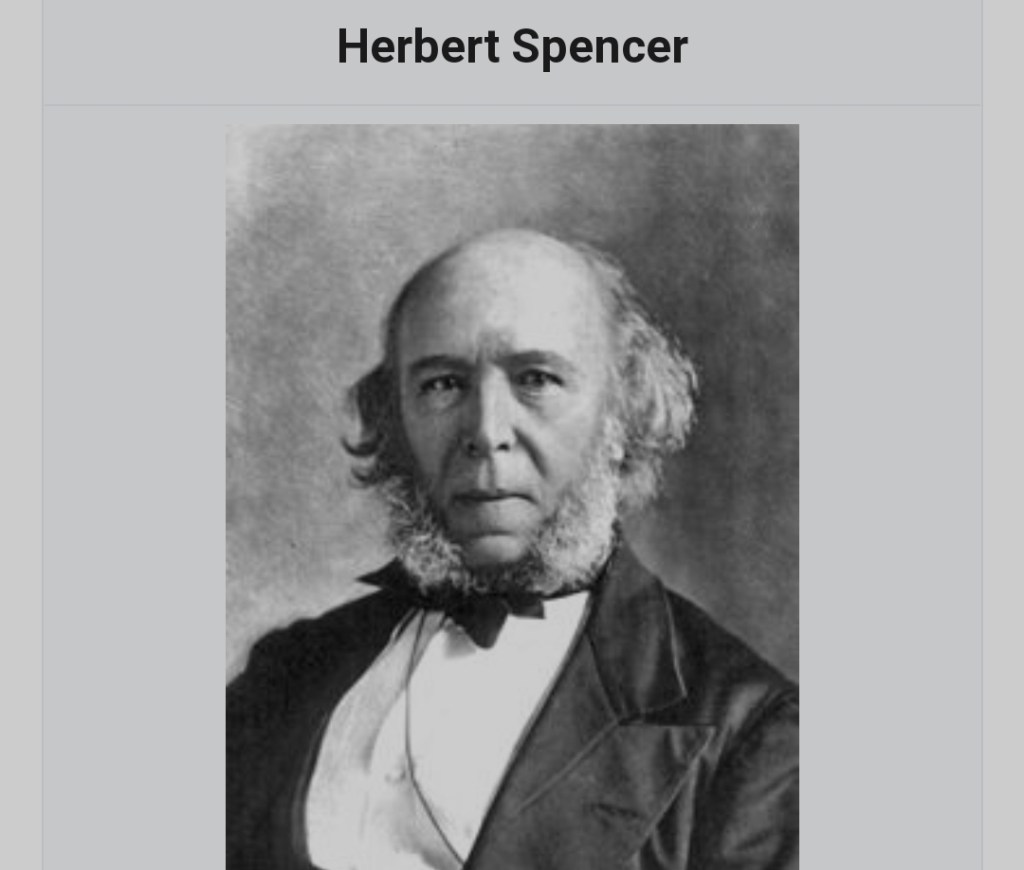
Herbert Spencer (27 April 1820 – 8 December 1903) was an English philosopher, biologist, anthropologist, and sociologist famous for his hypothesis of social Darwinism.

Spencer in his essay “The Social Organism”,
stated that the social organism itself is subject to evolutionary developments as a separate entity and much of the idea that societies, like individual organisms, “spontaneously evolved” .

On passing from Humanity under its individual form, to Humanity as socially
embodied, social evolution can be exemplified .

Spencer said , “Evolution is an integration of matter and concomitant dissipation of motion, during which the matter passes from an indefinite, incoherent homogeneity to a definite, coherent heterogeneity and during which the retained motion undergoes a parallel transformation.”

One of the most important contribution of Herbert Spencer to Sociology is the theory of evolution

His principles included physical and biological evolution in order to elaborate and explain his theory of Social evolution.
He sketches a comprehensive account of evolution of the inorganic, organic, and
human and social realms.

He stated ,
In respect to that progress which individual organisms display
in the course of their evolution,”

He explained this course of evolution through , the development of a seed into a tree, or an ovum into an animal, constitute an
advance from homogeneity of structure to heterogeneity of structure .

He continue with, the change
from the homogeneous to the heterogeneous is displayed in the progress of civilization as a whole, as well as in the progress of every nation; and is still going
on with increasing rapidity.

Spencer adopted his principle of evolution from naturalist Charles Darwin, who developed the concept of evolution in his “Origin of Species” in 1859.

Herbert Spencer, used Darwin’s theory and applied it to how societies change and evolve .According to Spencer societies were bound to change automatically .

Spencer in his theory applied a comparison of societies with organisms that progress through changes similar to that of a living species.

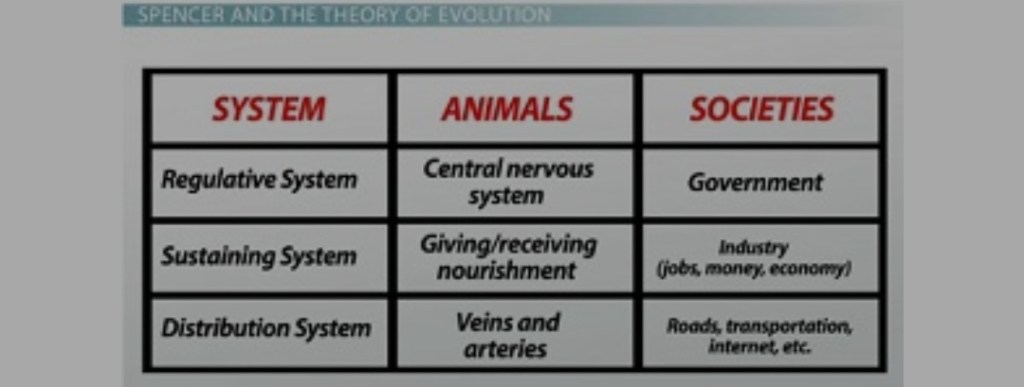
He included three types of systems where societies can be compared to organisms .

The first system is the regulative system.
In animals, that would be the central nervous system and in societies, it would be a government that regulates everything.

The second system is the sustaining system.
For animals, that’s the giving and receiving of nourishment. For societies, that would be industry – jobs, money, economy and those sorts of things.

The third system would be the distribution system.
In animals, that would be the veins and arteries. In societies, it would be roads, transportation, internet – anything in which information and goods and services are exchanged.

Survival of the fittest” expounded by Darwin was highly believed by him . According to Spencer only strong creatures survive and evolve; only strong makes progress. And that animal has to struggle to preserve its existence.

All universal phenomena-inorganic, organic, super organic—are subject to the natural law of evolution.

A definite pattern of change is followed by all the phenomena of nature—the stars and planetary systems, the earth and all terrestrial phenomena, biological organisms and the development of species, all the psychological and sociological processes of human experience.

Herbert Spencer includes physical evolution in the form of indefinite incoherent situations to definite and coherent situations.
The underlying principles of physical evolution are a movement from simple to complex and homogeneity to heterogeneity.

According to him , following the Darwin theory of ” Survival of fittest ” the biological evolution only those creatures survive in the struggle for existence who are able to make effective adjustment with changing circumstances.

Herbert Spencer utilized these two principles, physical and biological evolution in order to explain social evolution.

Spencer’s theory of social evolution points out to two stages:

1. The movement from simple to compound societies.

This movement from simple to compound societies can be seen in four types of societies in terms of evolutionary levels

• Simple Society:
• Compound societies
• Double Compound societies
• Trebly Compound societies

2. Change from militant society to industrial society.

According to Spencer, the law of evolution is the supreme law of every becoming.
From the analysis of biological evolution Spencer established the theory of evolution.
He argued that the evolution of human societies, far from being different from other evolutionary phenomena. It is a special case of a universally applicable natural law.

According to some social thinkers Herbert Spencer’s has several criticism ,
They said that theory lacks practicability and is realistic.
It also lacks uniformity.
Qualities like sympathy, sacrifice, kindness, love etc. are of much Importance in human survival . These are quite different from the struggle for existence.

Despite of several criticism Spencer Theory of Evolution is the fundamental base for understanding evolution of man and society .

Seven Ages of Man: Summary

In the poem, Seven Ages of Man Shakespeare compares the entire world to a theatrical stage, where all the human beings perform their allotted role given by the God. Every individual has to go through seven acts that are seven stages of man’s life. Shakespeare has divided human life into seven stages, with each stage having its own qualities and characteristics. Shakespeare considers the world a stage and men and women actors on the stage of life. They play seven roles on the stage depending upon their age.

The first stage, in this phase of his life man, appears as a child in the world. As a child, he is a helpless creature. He cries in the arms of his nurse for one reason or the other. He cries and vomits.

The next phase of his life man appears as a child in the world. He goes to school with a bag hanging from his shoulder. He goes to the school creeping like a snail. He marches to the school unwillingly.

In the third stage of his life, a man plays the part of a lover. He grows into a young man full of desires, ambitions, and dreams. He becomes a romantic young man. He falls in love and sights like a furnace. He begins to write sad poems to his beloved he cannot control his sad feelings.

In the fourth stage of his life man becomes a foul-mouthed soldier who has learned queer words at this stage, he tries to give himself a formidable look with a beard like a part. He is emotional and jealous. He quarrels with others for his honor and grace. He hankers after temporary and bubble fame.

In the fifth stage of his life, he becomes a judge. He becomes mature and experienced in his thoughts. The heat of youth has completely cooled down and he becomes very realistic. He wishes to grab wealth by foul or fair means. He begins to accept bribe and thus adds much to his material comforts. He becomes ease-loving and therefore becomes fat. His belly becomes round. He eats healthy fowls and chicken presented to him as a bribe. His eyes become severe and he grows the beard of formal cut.

Then, in the sixth stage of his life, man grows old. He looks quite ridiculous in his movements. He wears glasses because his eyesight is weak. His shoes become wide for his feet. His voice suffers a change. It becomes a shrill and quivering whistle

However, in the final stage, the man turns into a child once again. He seems to forget everything. He becomes ‘toothless’. His eyesight is weakened and he is deprived of taste. He is ready to leave this world.

Shakespeare has the seven stages of man’s life with a touch of satire and cynicism. In each stage, man imagines himself great and important, but there is something ridiculous in his behavior all through his life. Shakespeare has described each of the man’s life stage with great economy of words. He uses living and concrete images to describe the different stages of life. The use of the word ‘mewling’ of the infant’s cry and the school boy’s reluctance for going to school described in phases ‘creeping like a snail’ are examples of living images.

Opportunity Cost Theory ( Assumptions , Explanation , Criticism )

Innumerable theories are formulated by Haberler , Ohlin , Samuelson , Leontief , Hecksher and many others dealing with the macro and micro parts of international trade .

The principle of Comparative Cost theory by Ricardo, despite being the basis of international trade, has been criticized by many economists .
Ricardo’s theory of comparative cost is based on the labour theory of value which means that labour is the only factor of production and labour is homogeneous .
Such assumptions are found to be unrealistic .

Gottfired Haberler ‘ s theory of opportunity cost overcomes these shortcomings and explains the doctrine of the theory in terms of ” the substitution curve’ ‘ or as Samuelson entitled it as ” production possibility curve “or “transformation curve ” .

Lerner called it the ” production indifference curve ” or ” production frontier .”

Haberler’s theory is found to be more realistic .

The Theory of Opportunity cost

Opportunity cost is the value of loss when choosing between two or more commodities.

To elaborate more ,
The opportunity cost theory says that if a country can produce either commodity X or Y , the opportunity cost of commodity X is the amount of the other commodity Y that must be given up in order to get one additional unit of commodity X .

The exchange ratio between the two commodities is expressed in terms of their opportunity costs .
The decrease in the quantity of the second commodity represents the opportunity cost of the additional quantity of the given commodity.

Haberler used the concept of opportunity cost with production possibility curves to illustrate international trade theory.

Assumptions :-

The following assumptions are formulated by Haberler to illustrate the theory :-

• There are only two countries , (A,B)
• Each country possesses two factors of production – labour and capital.
• Each country can produce two commodities , ( X and Y ,)
• There is perfect competition in both the factor and commodity markets .
• The price of each commodity equals its marginal money costs .
• The price of each factor equals its marginal value productivity in each employment .
• The supply of each factor is fixed .
• Factors are immobile between the two countries.
•. There is no change in technology .
• Trade between the two countries is completely free and unrestricted.

Key terms :-

Production possibility curve :-

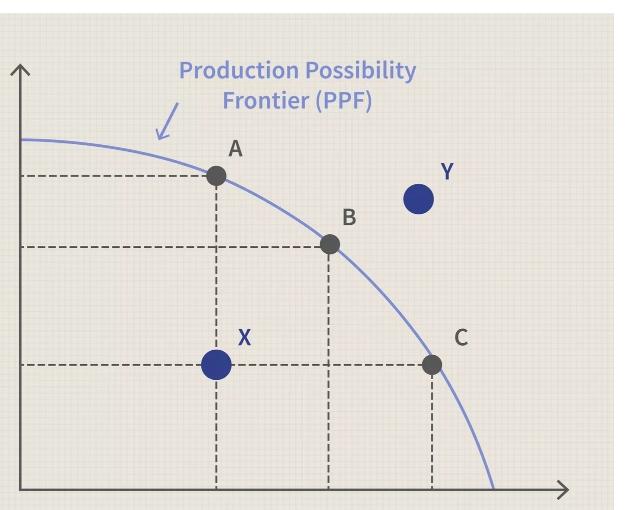
A production possibility curve or transformation curve is the curve that shows various combinations of two goods that can be produced with available amounts of resources .
Production possibility curve shows that if an economy wants to produce more of one commodity ,it will have to transfer or divert resources from the production of another commodity to produce the one .

Different points on the production possibility curve show different combinations of the two goods . Points outside the curve are unattainable because of the scarce quantity of resources available.

Marginal Cost of Production :-
The marginal cost of production measures the change in the total cost of a good that arises from producing one additional unit of that good.

Marginal Rate Of Transformation :-
The marginal rate of transformation is the number of units of one product that can be increased by reducing the quantity of another product. It shows the number of goods that will be foregone to produce an additional unit of other goods while keeping the factors of production constant.

Comparative advantages: – A country can produce one commodity at a lower cost
than the other because of comparative advantages such
as favourable climate, natural resources, geographical
situation and efficiency of labour.

Explanation Of the Opportunity Cost Theory

The production possibility curve indicates such combinations of two commodities .
The shape of the production possibility curve determines the basis and the gain from international trade under the theory of opportunity curve .

The slope of the production possibility curve is determined by the ratio of units of the commodity given up in order to have one unit of the other commodity i.e by Marginal rate of transformation. (MRT)

MRT xy = ∆Y/ ∆X , where ,

X and Y are being produced by a country and some quantities of labour and capital input are used from the production of Y into the production process of commodity X.

Trade can take place only when each nation has a different MRT. The gains from trade for a particular nation depend on how much the
international exchange rates differ from that nation’s MRT. The greater the difference, the
greater is the gains from trade. The gains from trade rest further upon the amount of trade taking place. A larger volume of trade allows larger gains from trade and a greater
increase in the standard of living.

Following the assumptions , two countries say A and B enter into a trade together .

Two commodities X and Y are being produced by using various alternative combinations that a country can produce most efficiently by fully utilising it’s factor of production i.e labour and capital ,are homogeneous , with the available technology in the fixed proportion due to perfect substitutability .

Conditions :-

1:
Trade under Constant Opportunity Cost

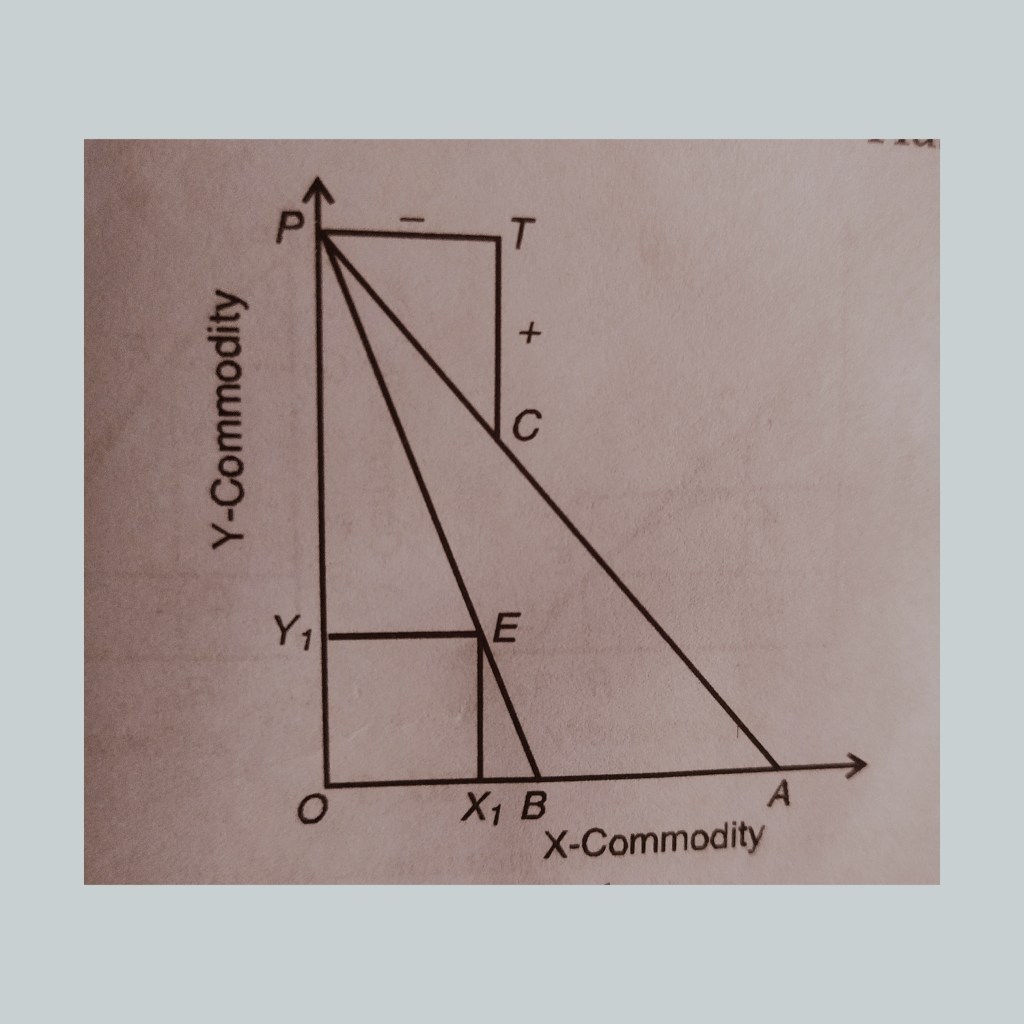
The production possibility curve under constant opportunity cost is a straight line .

In the figure ,
PA is the production possibility curve of country A ,
PB is the production possibility curve of country B .

Country A can produce either
OP of Y , or
OA of X

Similarly , Country B can produce
OP of Y
OB of X .

The slope of the production possibility curve determines the relative price of the two commodities , since the opportunity cost of leaving a unit of one commodity in order to have an additional unit of another is constant , the cost ratio ( relative price ) is the same on all the points on the production possibility curve.

Since , the MRT is constant i.e the slope of the production possibility curve is also constant, trade between the two countries is not possible as no country stands to gain through the trade .

Trade Under Increasing Opportunity Cost :-

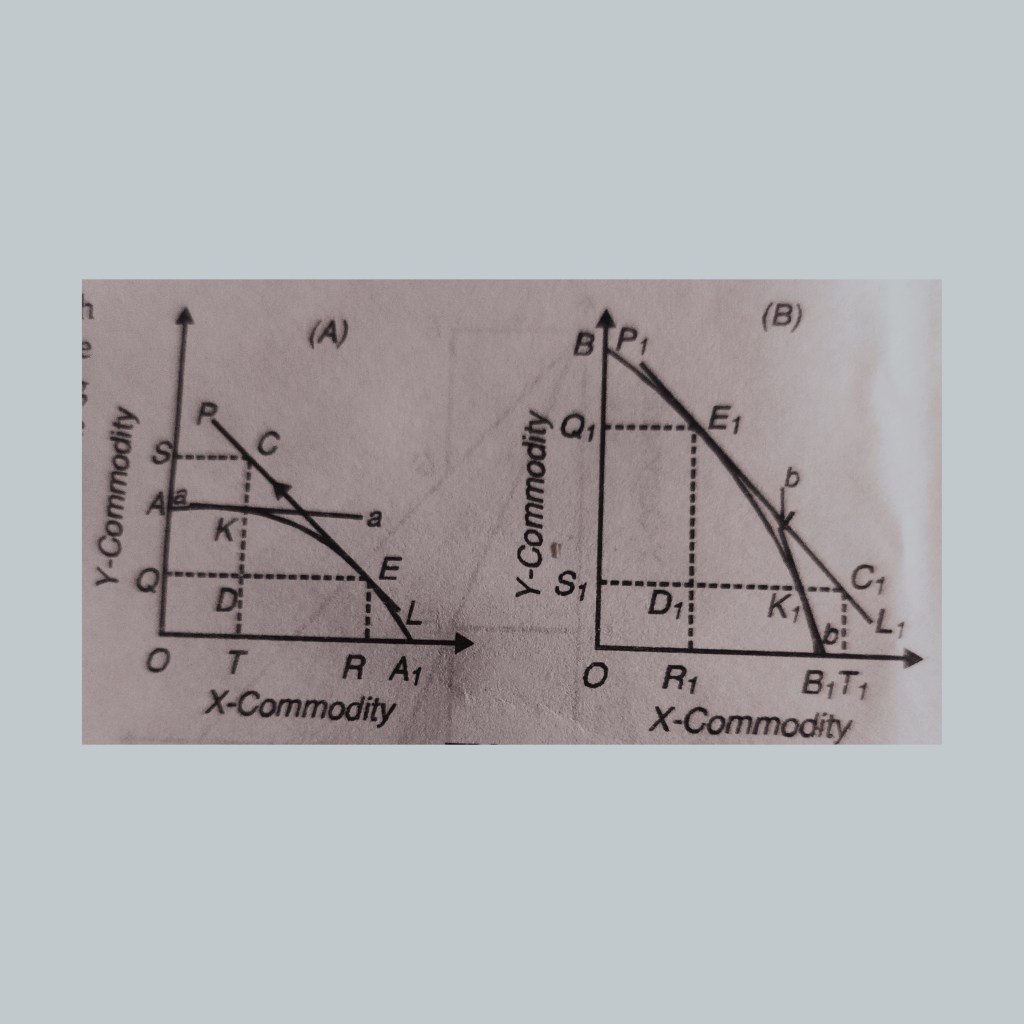
The production possibility curve under the increasing opportunity cost is concave to the origin because when a country specialises in the production of one commodity ,in which it possesses comparative advantage ,its opportunity costs increase .

In the above figure ,
AA1 is the production possibility curve of country A which is concave to the origin .
The slope of this curve shows that country A will specialise in the production of commodity X .
The larger amount of commodity Y will be given up to have additional amount of commodity X as we move from point A to A1
Thus ,the country faces increasing opportunity costs .

BB1 is the production possibility curve of a country which is concave to the origin .
The slope of this curve shows that country B will specialise in the production of commodity Y.
The larger amount of commodity Y will be given up to hsv additional amount of commodity Y as we move from B1` to B .
Thus , the country faces increasing opportunity costs.

Let us assume the international price ratio is given by the line PL in country A ,
and PL1 in country B.

The slope of line PL is greater than domestic price line aa ,making commodity X expensive in international market than in domestic market and resulting in the interest of country A to shift some factor of production from the production of commodity Y to commodity X , moving it’s production level from point K to point E.

It will export TR of X and import QS of Y ,
domestically consuming OT of X ,and OQ of Y .
The export and import can be shown by the “trade triangle ” CDE .

The slope of line PL1 is less steep than domestic price line bb ,making commodity Y expensive in international market than in domestic market and resulting in the interest of country B to shift some factor of production from the production of commodity X to commodity Y , moving it’s production level from point K1 to point E1

It will import D1C1 of X and export D1E1 of Y ,
domestically consuming OS1 of Y ,and OR1 of X.
The export and import can be shown by the “trade triangle ” C1E1D1.

Trade Under Constant Decreasing :-

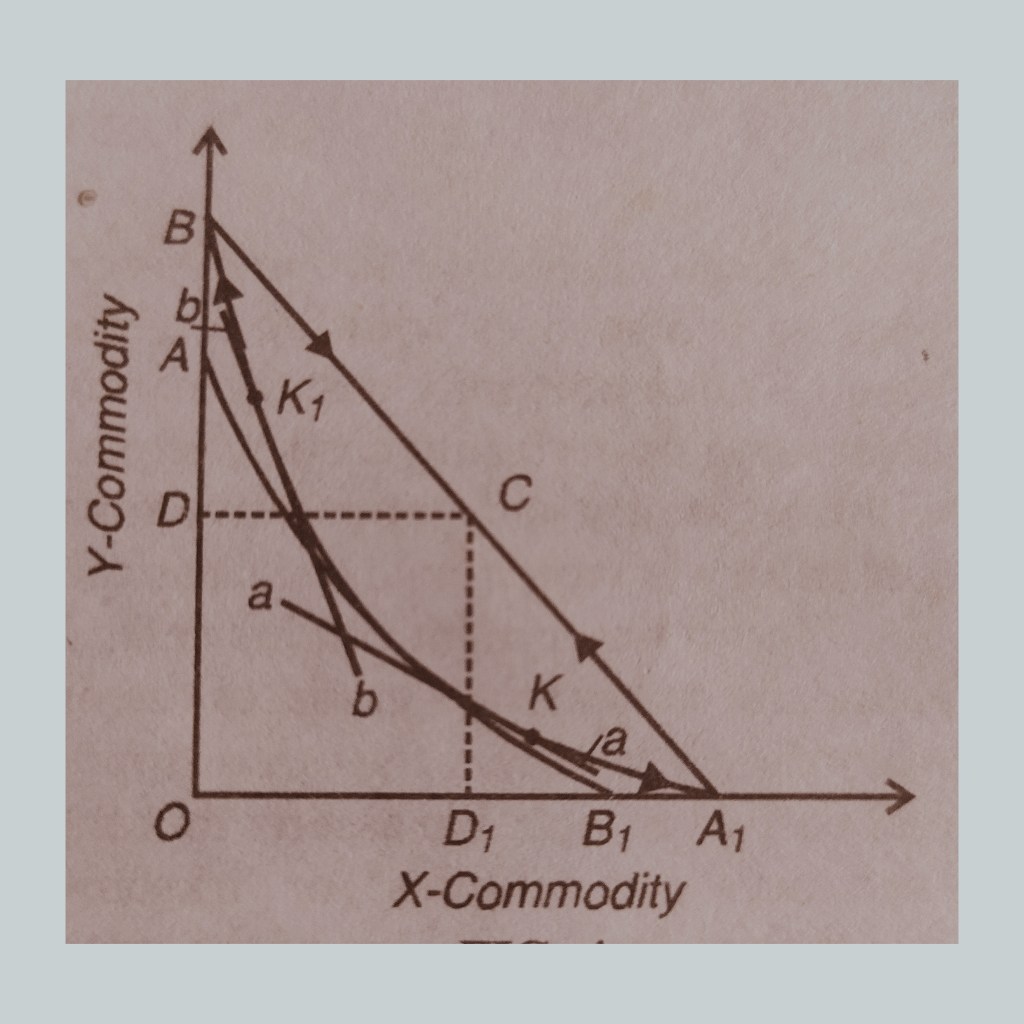
When two countries experience decreasing opportunity costs their production possibility curves are convex to the origin.
Under decreasing opportunity costs , each country completely specialises in the production of only one commodity after trade because there are increasing returns based on internal economies of production .

In the figure ,
The production possibility curve of country A is AA 1 and B is BB1.

The pre trade production and consumption point of country A is K where it’s domestic price line aa is tangent to its production possibility curve and country B is K1 , where it’s domestic price line bb is tangent to its production possibility curve.

The international price line being BA1, if both the countries enter the trade ,
BA1 is steeper than the domestic line of country A , making X more expensive in the international market and resulting in shifting of resources of production to X from K to A1 .

On the other hand , the international price line BA1 is flatter than the domestic price line bb of the country making Y commodity expensive in the international market than in the domestic market and resulting in shifting of resources of production to commodity Y and moving from K1 to B .

Thus , country A will completely specialise in commodity X and B in commodity Y .
Now both the countries will move along with the international price line BA1,
Country A from A to point A1 upward , country B from B to point B1 downward and reach point C in consumption.

Note :-

The straight line tangent represents :-

‘A straight line tangent to the transformation curve indicates the ratio of market prices
of the two commodities, and the condition of tangency expresses equilibrium in production, that is, equality between prices and marginal costs stated in opportunity terms. Domestic demand conditions enter into this construction via community indifference curves, or simply
as a consumption point determined by a given arrangement of production and income distribution.”

Finally, tangency of a line representing the equilibrium international price ratio to
both transformation function and community indifference curve indicates equilibrium in
exchange, that is:

(i) Equality domestically between the marginal rate of substitution in consumption and marginal rate of transformation in production, and

(ii) Equality of the value of exports and the value of imports.

Critical Appraisal

As an alternative to classical comparative theory , the opportunity cost theory is more realistic .

The opportunity cost theory analyses pre- trade and post – trade situations under constant , increasing and decreasing opportunity cost whereas comparative advantage theory is based on constant cost of production within a country and comparative advantage and disadvantage between two countries.

Jacob Viber in his ” Studies in The Theory of International Trade ” ( 1937) criticized the opportunity cost theory of values which is the basis of Haberler’s theory .
Some of his criticism were :-

• Neglecting of welfare
• Failure in measuring in terms of strain , sacrifice or disutility.
• Neglecting Change in Factors of Supplies .
• Unrealistic Assumptions .

Despite criticism ,the opportunity cost theory has been regarded as more fertile because it can be readily extended into a general equilibrium system .

poornachandra tejaswi

ABOUT TEJASWI

Poorna Chandra Tejaswi was renown Indian author and novelist in kannada with a pen name poochanthe. He is son of jnanapith awardee, a famous kannada poet, Raashtrakavi kuvempu and Hemavati. Tejaswi was born on 8 September 1938 in kuppalli in Shimoga district of Karnataka state. Tejaswi has written poems, short stories, novels and also translated many English works into kannada.

His first story is “Linga Banda” which described about the western Ghats from a small boy`s perspective. The story got best story award by newspaper Prajavaani. He graduated from from Maharaja college Mysore and moved to Mudigere Chikmagalur district in Karnataka. because of his immense interest in nature Tejaswi took up farming. If you read his works you will understand the immense love he had for nature. He makes you roam Mudigere while you are sitting in your room through is works.

Tejaswi is known as a navya sahithi, a writer of navya period. He is also a Bandaya poet, a genre of protest literature. He was a polymath. He did farming, writing, photography, painting and many more things. Tejaswi has won many awards like Rajyotsava award, Pampa award, kannada sahithya academy award, Karnataka state film award for his many of his works. Some of his famous works include karvalo, Chidambara rahasya, Jugari cross, huliyoorina sarahaddu, Bellandoorina narabhakshaka, Sahaja krushi, Missing link, Hejje Moodada haadi, Papillon and many more.

He is married to Rajeshwari Tejaswi. Susmitha Tejaswi and Eshanye Tejaswi are his children. He died of cardiac arrest on 5 April 2007 at his farmhouse Niruttara, Mudigere, Chikmagalur district.

Why Tejaswi is everyone’s favorite?

Yes, Tejaswi is everyone’s favorite and mine too. That’s mainly because of his storytelling technique. You go into the dark thick forest while reading his books. You feel the presence of that human eating tiger when he describes it. You are in the adventure while reading his books. He hooks the reader right from the start. he is honest, hilarious and clever at the same time.

Lets take a book called karvalo. In the book they take an adventure to find a strange flying lizard Draco dussumieri, a flying lizard which is capable of gliding from tree to tree found in western Ghats. at the end when the characters, scientist karvalo, the farmer and his fellowmen try to catch the weird creature, but it escapes through the jungle. But the reader, you will feel the fatigue of the efforts they made, you will be annoyed because they didn’t able to catch it.

Not only his storytelling, the other thing that make you read Tejaswi again and again is the knowledge he hides in his books. His book missing links talks about human evolution. The set of three books headed Vismaya , talks about variety of species and facts about them you wouldn’t know ever existed. He doesn’t only entertain you, but he gives nutritious food to your brain.

Tejaswi always links science and philosophy. The incidents that happen in his stories become guard and guide your life. he grows morals in the reader. He grows love and appreciation for nature. Tejaswi puts you in a sense of responsibility towards nature. He makes you believe in simple living. He will push you to think about problems of agriculturists. He talks about culture and and history. He perfectly reaches out to youth.

HEALTHY FOOD 2 HEALTHY LIFE

HEALTHY FOOD 2 HEALTHY LIFE, the food we eat is the can be either the safest and the most powerful form of medicine for our body or it can be the worst and slowest form of poison for our body. The food we choose makes a lot of difference in our health as eating healthy, clean and nutrient rich food fills your body with energy nutrients and antioxidants which is the vital part for our life. It is most important to take care of what we intake because when our diet goes wrong even expensive medicines can not help us to make a healthy living and when our diet is perfect there is no talk of medicine.

“THE TRUE HAPPINESS LIES IN BEING HEALTHY!”

Nurturing yourself is not selfish as it is very essential for your survival and for healthy living. It is very true that we can not control everything happening outside but we can definitely control what we allow to go into our body. Taking care of your body must be everyone’s first and foremost priority as it is the only place we have to live in.  Today more than 95% of all the chronic disease is caused because of our choices we make in consuming our food, toxic food ingredients , nutritional deficiencies and lack of physical exercise. Our body can definitely do it but it is the point of our mindset and we must train our mind to have healthy food.

We forget our health in order to have money in abundance but we always forget that we can’t enjoy the amount we earned without health as health is the true bank account where proper diet is your savings. The most common mistake we all commit is we focus on how much we eat rather than focusing on what we eat. The food we eat and about 80% of the food on shelves of supermarket today really didn’t exist a century back. When you change your diet congrats you have taken a step forward to change your entire physiology and you can heal!

HEALTHY FOOD 2 HEALTHY LIFE: LAUGHTER THE BEST MEDICINE

Obviously the best way to live a healthy life is healthy diet but there is yet another cheapest medicine “LAUGHTER” which anyone can afford this prescription. We human beings are the luckiest in the world as we have the great gift of laughing but there are very few people who really enjoy its advantages. Laughing is also a therapy which can heal many of our health problems. We must definitely do and the best part is you can do it right now!

HEALTHY FOOD 2 HEALTHY LIFE: HOW HAPPINESS IS LINKED?

   Eating healthy and right makes us feel very energetic and active through out the day and the best and most efficient pharmacy is within our own system. Health is a state of being in complete harmony of the body, mind and spirit and when one is free from physical disabilities and mental distractions the gate of happiness (check out my previous article IKIGAI-JAPANESE SECRET 4 HAPPY LIFE) opens. It is a great asset but the part to worry is that we don’t recognize appreciate and be grateful about unless we have been depleted it. So it is very clear that health and happiness are connected more so than we are often not aware of

HEALTHY FOOD 2 HEALTHY LIFE: FOR SUCCESS!

Healthy lifestyle gives us clear mind and clean soul. The creativity is the fragrance of the true health. When a person is truly healthy and whole creativity comes in every field of his or her work ,naturally with him and thus increases the chances of success. do check out how easy to have healthy diet https://www.webmd.com/diet/features/11-simple-steps-to-a-healthier-diet#1

Toruń – The Polish town stuck in the medieval ages

Meet Toruń, the Polish town coined by UNESCO to be a remarkably well preserved example of a medieval European trading and administrative centre. Situated on the banks of Vistula River, Toruń was founded when Christianity was being spread through Eastern Europe by the military monks of the Teutonic order and expanding trade between the countries of the Baltic Sea and Eastern Europe was being driven forward by the Hanseatic League (The Hanseatic League was a commercial and defensive confederation of merchant guilds and market towns in Northwestern and Central Europe in the 1100s). The town went on to become a leading member of the Hanseatic League in the territories ruled by the Teutonic Order.

An image of the city of Toruń on the banks of Vistula River
Toruń by the Vistula River

The town can be divided into three parts – The Teutonic Castle, the Old Town and the New Town. The combination of the castle with the two towns, surrounded by a circuit of defensive walls, represents a rare form of medieval settlement agglomeration.

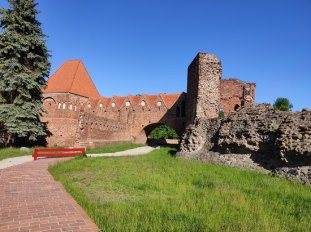
The Toruń Castle

The castle was one of the pioneering ones built by the Teutonic order in the land succeeded to them by the Duke Conrad of Mazovia. The castle took a hundred years to build, since it’s conception in the 13th century. The palace’s historic value comes from the fact that it was the base for the Teutonic Knights when they began their first mission to colonize pagan Old Prussians, and subsequently the formation of the Teutonic state. The majority of the castle – which was built in a horseshoe-shaped plan in the mid-13th century as a base for the conquest and evangelization of Prussia was destroyed during an uprising in 1454, when the local townspeople revolted against the Teutonic Order. The city rebelled on 4 February, and a few days later the small Teutonic garrison negotiated a surrender. They were allowed to leave the castle and the city. Shortly afterward, on 8 February, the castle was plundered, and then the Toruń city council decided that it would be demolished to prevent the Teutonic Knights from reoccupying it. This event marked the beginning of the Thirteen Years’ War.

The ruins and the archaeological remains have been excavated and safeguarded.

A picture of the exterior of the Toruń castle
The Medieval Toruń castle


The Old Town and New Town

The Old Town was granted an urban charter in 1233, which swiftly led to its expansion as a major commercial trading centre. The adjacent New Town developed from 1264, mainly as a centre for crafts and handiwork. Both urban areas bear witness to the interchange and creative adaptation of artistic experience that took place among the Hanseatic towns.

An exceptionally complete picture of the medieval way of life is illustrated in the original street patterns and early buildings of Toruń. Both the Old Town and the New Town have Gothic parish churches and numerous fine medieval brick townhouses, many of which have retained their original Gothic facades, partition walls, stucco-decorated ceilings, vaulted cellars, and painted decoration. Many townhouses in Toruń were used for both residential and commercial purposes. A fine example is the house in which Nicolas Copernicus was reputedly born in 1473.

Medieval nature of the town

All the elements that sustain the Outstanding Universal Value of the Medieval Town of Toruń are located within the boundaries of the property. The property’s medieval urban layout encircled by a ring of defenses remains intact, including two market squares, Town Hall, townhouses, churches, and the Teutonic Castle. This layout and Toruń’s compact, cohesive architectural fabric are substantially of medieval origin. The historic panoramas of the town are unaltered, shaped by the monumental silhouettes of the Gothic churches and Town Hall that dominate the skyline, rising above multiple varieties of townhouses with diverse facades and various geometries of ceramic-tiled roofs. The administrative, commercial, and tourist functions of contemporary Toruń (concentrated within the Old Town) do not pose a threat to the property, which does not suffer from adverse effects of development and/or neglect.

The Medieval Town of Toruń is remarkably authentic in terms of its location and setting, forms and designs, and materials and substances. It is an original, unchanged example of medieval town planning based on a regular grid of quarters, streets, and building blocks, designed in keeping with 13th-century regulations and extant in a recognizable form. The authenticity of the Teutonic Castle, built in a horseshoe-shaped plan surrounded by a curtain wall and moats, is attested by conservation records, its structure, the functions of its rooms, and its historic fabric, even though the castle survives only in the form of ruins. Its location between two medieval towns, set on the high bank of the Vistula River, is entirely authentic. The material substance of the buildings is likewise authentic: the Gothic origins of the city walls, gates, towers, churches, walls defining building plots, and townhouses are evidenced by their structures, cellars, interior walls, elevations, architectural details, and interior decor.

The authenticity of the urban planning concept linking Toruń with Hanseatic Europe, and of the surviving architectural structures, provide evidence of the continuity of traditional construction techniques and technologies incorporating templates, forms, and colour schemes widely used throughout the city and region.

Oh, and did I mention, Toruń is a UNESCO World Heritage site, making it a must see for all wanderlusters.


1 SKILL FOR INFINITE INTELLIGENCE

1 SKILL FOR INFINITE INTELLIGENCE, the great secret possessed by the great men of all the ages was their ability to contact and release the power of their subconscious mind. Subconscious mind is the true infinite intelligence which can make you or break you in your life. It has a wonderful capacity to reveal everything you need to know at the moment of time. Through the wisdom of your subconscious mind you can receive the new thoughts and discoveries. Moreover, the infinite intelligence in your subconscious mind can impart the amazing kinds of knowledge.

“95% OF YOUR LIFE IS DRIVEN BY SUBCONSCIOUS MIND”

The subconscious mind is the infinite riches all around you which can bring more health, more wealth and complete happiness (do check out my previous article on IKIGAI-JAPANESE SECRET 4 HAPPY LIFE)in your life.  Within our subconscious mind there is marvelous and  miracle working power. It is the one stop solution to all our questions. The subconscious mind is the builder of your body which can completely heal you. There are two levels of mind one is the conscious and the other is the subconscious or also known as the irrational level.

Conscious mind is that level of mind which is the reasoning mind on the other hand subconscious mind is the seat for emotions and is the creative mind. The process of digestion, circulation and breathing are carried by our subconscious mind. It always accepts the perceptions believed in your conscious mind. The subconscious mind is same as a soil which accepts any kind of seed no matter whether it is good or bad because it really can’t differentiate between the good or bad it blindly accepts what you believe.

1 SKILL FOR INFINITE INTELLIGENCE: HOW SCIENTISTS MADE USE OF?

Nikola tesla was a brilliant scientist who worked in the field of electricals and brought forth the most amazing innovations. When an idea for a new invention came to his mind he would always build it up in his imagination because he was very much aware of the power of this subconscious mind. He would reconstruct and reveal to his conscious mind about all the parts needed for the invention’s manufacture in a very concrete manner.

1 SKILL FOR INFINITE INTELLIGENCE: HOW TO RECEIVE THE BEST GUIDANCE

When you have the term a difficult situation or decision to make or even when you fail to see the solution to your problem begin at once to think constructively about it. Here is an absolutely easy technique which one can use to make or receive the best path on any subject. Quiet the mind and still your body. instruct your body to get relaxed it must obey you. Mobilize your attention and focus on the solution to your problem. do check out the 10 best ways to use your subconscious mind https://www.artofliving.org/in-en/lifestyle/success/power-of-subconscious-mind

1 HIDDEN SKILL WITHIN

1 HIDDEN SKILL WITHIN, it is the art of giving power to words to influence, inspire and transform the lives of the people which is none other that “PUBLIC SPEAKING”. Public speaking is where if one can speak then one can definitely influence and when they can influence they can change the lives of the entire world. The speech is power and it is the power to persuade as the skill of public speaking is highly based on the quality of their thoughts and perception.

” THEY MAY FORGET WHAT YOU SAID BUT THEY WILL DEFINETLY REMEMBER HOW YOU MADE THEM FEEL!”

One of the best skill we develop inside apart from listening, reading and writing is the skill to speak. The skill of speaking in the public is the natural fundamental skill to express our inner feelings and perception on any topic. It is the beautiful ability of people to distinguish the sounds in form of alphabets. Public speaking as the name suggests it is the skill of speaking in front of a group of people for persuasive, informative and most importantly expository purposes. Public speaking’s main objective is to stress on a idea and assert it so as to make the audience think and react over it.

1 HIDDEN SKILL WITHIN: HOW TO OVERCOME ITS FEAR

Face Everything And Rise or Forget Everything and Run , the definition of fear is completely dependent on one’s own perspective. It is often said that the fear of public speaking is a fear greater than the death for most of the people. According to research and psychiatrists the fear of this public speaking is caused by the fear of standing out, fear of ostracism, the fear of criticism, the fear of riddle and last but not the least the fear of being an outcast.

do check out how to master public speaking with these 5 simple tips:   https://www.huffpost.com/entry/confident-public-speaking_b_4058830#:~:text=5%20Secrets%20to%20Looking%20Confident%20While%20Speaking%20in,4%20Practice%2C%20practice%2C%20practice.%20…%20More%20items…%20

It is very true that we need not be pro while starting any task but we need to start to be pro in that task and also all speakers were not so good at the beginning. The best way to overcome the fear of public speaking is to speak looking at your audience straight in to their eyes with boldness and confidence. Self confidence is the key role playing and the way you express and with the ease the every single member in crowd understands tells how comfortable you are. When you speak about something you are passionate about you will be more comfortable and confident.

If you are willing to work at it you can rapidly improve the quality of every part of your life. According to research listening to music before taking can not just elevate your mood but also calms your mind do check out my previous article on MAN’S GREATEST CREATION: MUSIC

1 SKILL 4 LIFE: PERSONALITY DEVELOPMENT

1 SKILL 4 LIFE: PERSONALITY DEVELOPMENT, is a journey which has a great power to lift as knowing one self is the true power. Personality development is the conscious choices taken to improve one’s life to become a better person than yesterday and to grow as an individual. Life is all about growing every single day and thus it is beautifully said that the best investment one makes in life is investing on one self because it not only improves one’s own life but also improves the lives of all those people who are surrounded by you.

“PERSONALITY IS AN UNDERSTANDING OF TRUE FORM OF YOURSELF WITHOUT ANY LIMITATIONS”

Personality development is a set of qualities that makes a person distinct or unique from the rest of the crown. It is a steady journey which is highly concerned about the psychological patterns of an individual’ s thoughts, emotions and feelings. The character, attributes and the trait of the person are totally responsible for molding their personal development. It is the sum of their characteristics that constitute the mental and physical being of a person which includes their daily habit. It is the belief that you worth effort, time and energy needed to develop yourself.


Personality development is the bridge that carries you towards the goal you are yet to reach. The better we become in our personality the lesser time it takes us to achieve our goals. Thus the growth is the bench mark which is the great separator between those who succeed and those who do not. It is very easy to judge the mistakes of other people but difficult to recognize our own mistakes. We must take the personal responsibility to change our self , we can not change the circumstances under going but we can definitely change our personality.

1 SKILL 4 LIFE: PERSONALITY DEVELOPMENT BY SWAMI VIVEKANANDA

According to the Vedantic concept advocated by Swami Vivekananda the all round development of in regards with harmony and spiritual development is possible when proper attention is given to developing one’s own personality . This skill is not an overnight task it requires a sufficient amount of time and effort to groom and shape personality.

KEY FACTORS REQUIRED FOR PERSONALITY DEVELOPMENT

    • WILL POWER: It is the important key factor to develop as it needs to come from within , the will power is what drives us to develop our personality in a faster way. All the great men of the world who rose to a great height of success were men of strong will.
    • SELF CONFIDENCE: It is another important factor to succeed in life. A person with self confidence will never give him in the phase of difficulties. do check out my previous article on THE POWER OF PERSEVERANCE 2 SUCCESS. Failures and hardships never discourage a confident person
    • CONCENTRATION: This is yet another important ingredient for personality development as it helps us in bringing the hidden potential in human beings. It is the power of concentration which gives strength in the darkest moments of life. One must do yoga and meditation do attain concentration(do check out my previous article on YOGA AND MEDITATION: 2 PILLARS OF HEALTHY LIFE)
    • KEEP SMILING: A humorous person keeps one self always above the worries and spreads the cheerfulness in his surroundings.

do check out the learnings from the personality of great people 50 Inspiring & Great Personalities of India and the World! – Leverage Edu

Indian Council of Medical Research (ICMR)

Centre has reconstituted the six Empowered Groups into ten groups to tackle the COVID situation in the country. The decision is aimed at further improving the efforts in catering the current need of COVID management. NITI Aayog Member (Health) Dr VK Paul will head the Emergency Management Plan Group and the ten-member panel on Vaccination.

Health Secretary Rajesh Bhushan will be the convener of the Empowered Group on Emergency Response Capabilities. It will look into the issues related to hospitals, equipment and medicines. A separate Empowered Group has been formed under the chairmanship of Road and Transport Secretary, Giridhar Aramane on oxegen production, import and other related issues.

Indian Council of Medical Research (ICMR) Director General Balram Bhargava has been made the convener of the panel on COVID testing, while NITI Aayog CEO Amitabh Kant will head the group which will take care of work of private sector, NGOs and international organisations.

Economic and Welfare Measures group which has been tasked with emerging issues related to growth and employment, will be headed by Department of Economic Affairs Secretary Ajay Seth.

Home Secretary Ajay Bhalla will be the convenor of 12 member Empowered Group on Pandemic Response and Coordination. An 11 member group headed by Information and Broadcasting Secretary Amit Khare will look after the steps on information, communication and public engagement.

THE POWER OF PERSEVERANCE 2 SUCCESS

THE POWER OF PERSEVERANCE 2 SUCCESS, the journey to our dreams and great ambition are often mixed with hardships and failures and this where the true test of perseverance unfold. Perseverance is the stubbornness with a great purpose. Perseverance is to persist in anything undertaken, maintain their purpose no matter how much difficulty or obstacles may occur in their path and it is the perseverance and courage which make their difficulties magically disappear.

“THE WILL TO PERSEVERANCE IS OFTEN THE DIFFERENCE BETWEEN FAILURE AND SUCCESS”

Perseverance is the ability to go on when the things seem to be completely hopeless and the continuous effort is the key to unlock our inner potential. To achieve our great dreams there are no shortcuts and no easy way outs. Against all the odds perseverance reminds us of the highest hopes and reminds us the picture of our dreams and provokes us to forge ahead despite setbacks that threaten to undermine all efforts to succeed.

The essence of perseverance is rising every time we fail and finding a strong will to get up more intelligently and wisely even though you know you are knocked down. The goals need hard work to be accomplished and when you work hard even after you are discouraged and tired of doing the same is perseverance. The great scientist Thomas Alva Edison is the true inspiration for perseverance who failed ninety nine times and got up more wisely than before and made it happen in the hundred time so a little more effort and persistence made him achieve what seemed to be impossible.

THE POWER OF PERSEVERANCE 2 SUCCESS IN THE FLOW OF WATER

Perseverance is largely influenced by the flow of water. Water does not stop flowing rather it always keep moving. When you try stopping the flow by putting your hands into it all you feel is the water flowing. So the water beautifully tries us to explain that “if you cant go through the obstacle then go around it.” A person with perseverance and patience never admits his or her defeat as a failure rather they take it as their learning and come up more wisely.

THE POWER OF PERSEVERANCE 2 SUCCESS: HOW TO BE PERSEVERANT?

    1. Be clear with your desires
    2. Be optimistic : do checkout OPTIMISM- THE NEED OF THE HOUR
    3. Believe in yourself
    4. Don’t get easily dragged by misguiders
    5. Listen to your conscience
    6. Learn from your mistakes and never repeat them
    7. Give your health the first priority to keep your mind clear:  do checkout YOGA AND MEDITATION: 2 PILLARS OF HEALTHY LIFE

THE POWER OF PERSEVERANCE 2 SUCCESS: SUCCESS STORIES WITH PERSEVERANCE

  1. JACK MA :   He is the richest man in the entire Asia but this took him a lot of effort and perseverance as he didn’t do overnight . He faced a lot of rejections , each and every step he faced a lot of failures and handful of rejections but the best part was he NEVER GAVE UP.
  2. COLUMBUS:  He is yet another example of perseverance. He struggled a lot to reach his destination and never gave up whenever he had a low motivation . In a long run he discovered the way from Spain to America and surprised the world with a new route of communication with America             
  3. WALT DISNEY: While everyone knows the iconic brand of Disney, the story of how Walt Disney created the empire is very inspiring. At young age Walt Disney was fired from a local newspaper as his boss was not satisfied with his work. After failing in the company he was not able to pay his bills and struggled a lot but he too never gave up and went on to grow the company with amusement parks, feature films, and is known as a cultural icon.

do checkout some more stories of perseverant people: https://www.growthink.com/content/7-entrepreneurs-whose-perseverance-will-inspire-you

Man’s success stories does not depend on his achievements rather the failures which they used as a learning tool and never gave up. The key to success is action and the essential in action is perseverance.