Kashi Tamil Sangamam Phase II

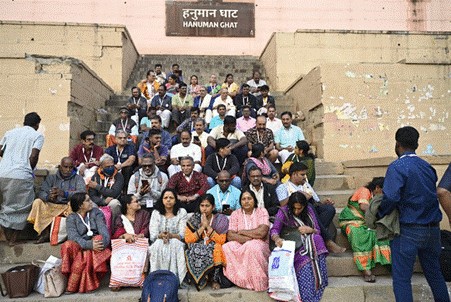
The delegation group comprising teachers (Yamuna) of the Kashi Tamil Sangamam II visited Hanuman Ghat and learnd about the history of various ghats of Ganga from the Acharyas.

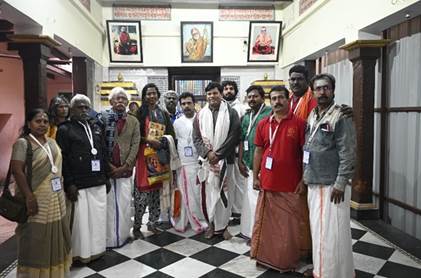
Later, the delegates visited the ancient temples on the ghats and learned about their history, divinity and grandeur. The group also visited the residence of Shri Subramanya Bharati located at Hanuman Ghat and met the family members. The group visited the Kanchi Math and learnt about its history.

The group learnt about the deep connection between Kashi and Tamil Nadu and visited the areas around the Hanuman Ghat, Kedar Ghat, and Harishchandra Ghat where several Tamil families have been residing for many years, exemplifying the spirit of Kasi Tamil Sangamam.

The second phase of the Kashi Tamil Sangamam will continue till 30th December 2023. Last year, the first phase of Kashi Tamil Sangamam was organized from 16th November to 16th December 2022. Nearly 1400 (7 Groups of 200 persons each) people are expected to be travelling from different parts of Tamil Nadu, representing varied walks of life. The first two groups have already arrived at Varanasi. During their stay in Kashi, as per their tour itinerary, they will also visit Prayagraj and Ayodhya.

***

Steady improvement in indicators for malnutrition

The indicators for malnutrition like underweight, stunting and wasting have shown a steady improvement in the National Health Family Survey (NHFS) conducted by the Ministry of Health & Family Welfare. As per the recent report of NFHS-5 (2019-21), the nutrition indicators for children under 5 years have improved as compared with NFHS-4 (2015-16). Stunting has reduced from 38.4% to 35.5%, while Wasting has reduced from 21.0% to 19.3% and Underweight prevalence has reduced from 35.8% to 32.1%.

As per the data of Poshan Tracker for the month of November 2023, around 7.44 crore children under 6 years were measured, out of whom 37.51% were found to be stunted, 17.43% were found to be underweight and 6% children under 5 years were found to be wasted. The levels of underweight and wasting are much less than that projected by NFHS 5.

The Government has accorded high priority to the issue of malnutrition and is implementing several schemes/programmes of different Ministries/Departments through States/UTs to address various aspects related to nutrition. In the 15th FC, components of nutritional support for children below the age of 6 years, pregnant women and lactating mother, Adolescent Girls (14 – 18 years); Early Childhood Care and Education [3-6 years]; Anganwadi infrastructure including modern, upgraded Saksham Anganwadi, POSHAN Abhiyan and Scheme for Adolescent Girls have been reorganised under Mission Saksham Anganwadi and Poshan 2.0 (Mission Poshan 2.0). Mission Poshan 2.0 focuses on Maternal Nutrition, Infant and Young Child Feeding Norms, Treatment of MAM/SAM and Wellness through Ayush practices to reduce wasting and under-weight prevalence besides stunting and anemia.

Under Mission Poshan 2.0, Supplementary nutrition is provided to beneficiaries 300 days in a year through the network of 13.97 lakh AWC located across the country for bridging the gap in the intake as compared to the recommended dietary intake. Only fortified rice is being supplied to AWCs to meet the requirement of micronutrient and control anemia among women and children. Greater emphasis is being given on the use of millets for preparation of Hot Cooked Meal and Take Home rations (THR-not raw ration) at Anganwadi centres for Children below 6 years of age, Pregnant Women, Lactating Mothers.

The objectives of Poshan 2.0 are as follows:

  • To contribute to human capital development of the country
  • Address challenges of malnutrition
  • Promote nutrition awareness and good eating habits for sustainable health and well-being; and
  • Address nutrition related deficiencies through key strategies.

Steps have been taken to improve nutritional quality and testing in accredited labs, strengthen delivery and leverage technology under Poshan Tracker to improve governance. States/UTs have been advised to promote use of AYUSH systems for prevention of malnutrition and related diseases. A programme to support development of Poshan Vatikas at Anganwadi Centres to meet dietary diversity gap leveraging traditional knowledge in nutritional practices has also been taken up.

Government issued Streamlining Guidelines on 13th January, 2021 to ensure greater transparency and accountability and quality in nutrition service delivery under the ‘Poshan Tracker’, a robust ICT enabled platform to improve governance with regard to real time monitoring of provisioning of supplementary nutrition for prompt supervision and management of services.

Under Poshan 2.0, one of the major activities undertaken is Community Mobilization and Awareness Advocacy leading to Jan Andolan to educate the people on nutritional aspects. IEC material in the form of videos, pamphlets, flyers etc., in regional languages have also been developed around critical themes. Social & Behavioural Changes have been inculcated through conducting Community Based Events, Poshan Maah and Poshan Pakhwada in convergence with various Ministries/ Departments and other stakeholders. So far, more than 90 crore sensitisation activities have been reported by States/ UTs under community engagements programmes through 11 Poshan Maahs and Poshan Pakhwadas celebrated in the months of September and March-April respectively. Community Based Events (CBEs) have served as a significant strategy in changing nutrition practices. CBEs help to celebrate critical milestones in the life of pregnant women and children below two years of age and to disseminate critical information on, inter alia, right time to ensure appropriate complementary feeding with diet diversity. Close to 3.70 crore Community Based Events have been held so far.

A Green and Sustainable Growth Agenda for the Global Economy

Shri Bhupender Yadav, Hon’ble Minister, Ministry of Environment, Forest & Climate Change and Ministry of Labour & Employment launched a G20 report, ‘A Green and Sustainable Growth Agenda for the Global Economy’ today in New Delhi in the presence of Shri Amitabh Kant, Sherpa, G20 India, Shri Suman Bery, Vice Chairman, NITI Aayog, Shri B.V.R. Subrahmanyam, CEO, NITI Aayog, Shri Ajay Seth, Secretary, Department of Economic Affairs and Shri Kapil Kapoor, Regional Director for Asia, International Development Research Centre. His Excellency Kenneth Félix Haczynski da Nóbrega, Ambassador of Brazil to India participated in the panel discussion after the launch. The event also witnessed the presence of Prof. Ramesh Chand, Member, NITI Aayog, and Dr. V. K. Paul, Member, NITI Aayog who made important interventions related to agriculture and One Health, respectively.

In a significant collaborative effort, NITI Aayog, in partnership with the International Development Research Centre (IDRC) and the Global Development Network (GDN), published a report, ‘A Green and Sustainable Growth Agenda for the Global Economy’ based on the proceedings of the G20 international conference held in New Delhi on 28-29 July 2023, featuring 40 leading experts from 14 countries across the world.

Addressing the gathering, Bhupender Yadav, Hon’ble Minister, Environment, Forest & Climate Change and Labour & Employment, extended his congratulations to NITI Aayog for putting together the publication and releasing it at a crucial time when Brazil has just taken over the G20 presidency from India. He further stated, “India has put forth the resolve to make climate action a collaborative process based on common but differentiated responsibilities. A swift, just and equitable transition to renewable energy sources must be underpinned by deep emission cuts and scaled-up finance. India has maintained that climate finance and technology are essential for enabling the Global South to achieve the twin objectives of sustainable and green growth. The countries of the Global South have had little to no contribution to the climate crisis. It is therefore imperative for the developed countries to help them combat climate change. The G20 New Delhi Leaders’ Declaration stated that implementing the climate agenda requires several trillion dollars by 2030. At COP28, Hon’ble PM emphasized that the developed world must ensure a steady flow of climate finance that is accessible and affordable.”

Addressing the gathering at the event, Amitabh Kant, India’s G20 Sherpa, stated, “Let me complement NITI Aayog for organizing the international G20 conference in July and now releasing its this publication. Since I actively participated in the July conference, several inputs shared by the experts were incorporated into the New Delhi Leaders’ Declaration. The Declaration highlighted the urgency and importance of accelerating the pace of global growth, for which free trade is critical as it has lifted vast segments of the population above the poverty line. The World Trade Organisation needs to be revitalized for this purpose.”

Commenting on the significance of the launch of the G20 report, Suman Bery, Vice Chairman, NITI Aayog, said, “I would say that today was both a closure, but also a fresh start with respect to what this means for NITI Aayog and India. This report is being released to enable the transfer of knowledge that came out of the G20 international conference organized by NITI in July to Brazil so that they can benefit from the ideas in the volume.”

The report launch was followed by a video message from Global Development Network, a brief introduction to the report, and an interactive panel discussion with experts on the issues covered in the volume, moderated by Suman Bery, Hon’ble Vice Chairman, NITI Aayog.

The discussions at the event underscored the theme of a just transition as a critical pathway to mitigating climate change, emphasizing its potential positive economic impact for developed and emerging economies. The event was a testament to the commitment of the participating stakeholders to collectively shaping a more sustainable and equitable world.

***

First Mile Connectivity Projects for Seamless Movement of Coal

First Mile Projects facilitate seamless movement of coal from the mine to the despatch point along with computerized loading into railway rakes with minimum manual intervention, obliterate traffic congestion and road accidents, and thus mitigate the adverse impact on environment and health around the coal mining projects.

There is no FMC Project implemented /being implemented in Rajasthan.

The all India target of Production of coal for 2023-24 has been fixed 1012.14 Million Tonnes.

The following steps have been taken by the Government to enhance the production to fulfill the domestic coal demand:

  1. Opening of new coal mine projects and expansion of existing projects
  2. Regular reviews by Ministry of Coal to expedite the development of coal blocks.
  3. Enactment of Mines and Minerals (Development and Regulation) Amendment Act, 2021 for enabling captive mines owners (other than atomic minerals) to sell up to 50% of their annual mineral (including coal) production in the open market after meeting the requirement of the end use plant linked with the mine in such manner as may be prescribed by the Central Government on payment of such additional amount.
  4. Single Window Clearance portal for the coal sector to speed up the operationalization of coal mines.
  5. Project Monitoring Unit for hand-holding of coal block allottees for obtaining various approvals / clearances for early operationalization of coal mines.
  6. Auction of coal blocks for commercial mining on revenue sharing mechanism was launched on 18.06.2020. Terms and conditions of commercial coal mining are very liberal with no restriction on utilization of coal, allowing new companies to participate in the bidding process, reduced upfront amount, adjustment of upfront amount against monthly payment, liberal efficiency parameters to encourage flexibility to operationalize the coal mines, transparent bidding process, 100% Foreign Direct Investment (FDI) through automatic route and revenue sharing model based on the National Coal Index.
  7. Under commercial mining scheme, rebate of 50 % on final offer would be allowed for the quantity of coal produced earlier than scheduled date of production. Also, incentives on coal gasification or liquefaction are granted (rebate of 50 % on final offer) to commence early production.

In addition to above, coal companies have also taken following steps to increase the domestic coal production:

  1. Coal India Limited (CIL) has identified and initiated actions for fulfilling all the resources required like Environment Clearance / Forest Clearance, land acquisition, evacuation infrastructures such as mechanised loading through Coal Handling Plant (CHP) / SILO, Rail Projects etc. for enabling projects to contribute to its target as per 1 BT production plan.
  2. Singareni Collieries Company Limited (SCCL) has planned to produce 70 MT by 2023-24 from the present level of 67 MT. Regular liaison is being undertaken for grounding of new projects and operation of existing projects. SCCL has initiated action for developing infrastructure for evacuation of coal like CHPs, Crushers, Mobile Crushers, Pre-weigh-bins etc.

This information was given by Union Minister of Coal, Mines and Parliamentary Affairs Shri Pralhad Joshi in a written reply in Lok Sabha today.

****

India launched 396 foreign and 70 domestic satellites during the period 2014-23

The number of foreign and domestic satellites launched by India during period 2014-23 were 396 and 70 respectively, Union Minister Dr Jitendra Singh said today, while the number of foreign and domestic satellites launched by India during period 2003-13 were 33 and 31 respectively.

In a written reply in the Lok Sabha today, the Union Minister of State (Independent Charge) Science & Technology; MoS PMO, Personnel, Public Grievances, Pensions, Atomic Energy and Space, said the revenue generated from satellite launches during decade 2014-23 is USD157 Million and 260 Million Euros. The corresponding figure during decade 2003-13 were USD15 Million and 32 Million Euros, he said.

Dr Jitendra Singh said, annual Budget allocated to Department of Space has grown from Rs. 6,792 Crores for FY 2013-14 to Rs. 12,544 Crores for FY 2023-24.

As per various global estimates and news outlets, the sector is projected to grow at 6-8% in coming years, he said.

 ****

CWIT Short Research Grants

CWIT, or the Center for Women and Information Technology, Short Research Grants are initiatives designed to foster and support research endeavors that explore the intersection of gender and technology. These grants are often aimed at researchers, scholars, and practitioners eager to investigate various facets of gender inclusivity, equity, and diversity within the realm of technology.

The primary focus of CWIT Short Research Grants lies in promoting understanding and addressing the challenges and opportunities faced by women and other underrepresented groups in the field of information technology. This could encompass a wide array of topics, such as:

  1. Gender Disparities in Tech: Research might delve into the reasons behind the gender gap in STEM fields, exploring socio-cultural, educational, or workplace factors contributing to this divide.
  2. Inclusive Practices: Projects might investigate strategies and practices that foster inclusivity in tech, including examining successful initiatives or proposing new approaches for cultivating diverse and inclusive environments.
  3. Impact of Representation: Exploring the impact of representation—both in terms of role models and diverse perspectives—on encouraging more women and minorities to pursue careers in information technology.
  4. Bias and Discrimination: Investigating biases and discrimination within tech environments, whether in algorithms, hiring processes, or workplace culture, and proposing solutions to mitigate these issues.
  5. Technology and Social Change: Research might also explore how technology can be a tool for social change, examining its role in promoting gender equality and equity.

The grants offered by CWIT often provide financial support, resources, and sometimes mentorship or networking opportunities for researchers embarking on these investigations. The ultimate goal is to not only shed light on existing challenges but also to propose actionable solutions and contribute to a more inclusive and diverse tech landscape.

These grants play a crucial role in fostering a more diverse and equitable tech industry by supporting the research that drives understanding and change. Through the insights gained from these projects, it’s possible to implement policies, strategies, and practices that create more inclusive environments where everyone, regardless of gender or background, can thrive and contribute to the ever-evolving field of technology.

CWIT gives around 15 grants each year for short-term research (usually around three weeks). These grants are primarily for academic researchers, however, professionals working in the arts or conservation sectors may also apply. From 2022 we are no longer accepting emailed applications. Please refer to the  CWIT website page here check the guidelines carefully before you apply. 

Only applications submitted online via the CWIT website before 17.00 hours (IST) on 28 February 2024 will be considered eligible.  Successful applicants will be awarded a one-off grant of £1,500 towards the costs of their short stay in the UK. 

The grants are payable on arrival in the UK and do not cover international fares

Please note researchers planning to use libraries like the British Library can often prepare extensively from on line sources thus maximizing their use of time in the UK. Those with questions about material held in the Oriental and India Office Collection at the British Library should e-mail ior@bl.uk

Applications are welcome from those doing archival research, consulting colleagues or preparing for publication. Preference is given to postdoctoral applicants though applicants in the later stages of their doctorates will also be considered.

Applicants planning to stay in the UK for longer than three weeks will need to supplement the CWIT grant from other sources e.g a grant from the Indian Council for Historical Research.

Applications for Charles Wallace India Trust short term research grant are now Open, last date to apply 28 February 2024.

Fields covered:

History, literature, archaeology, history of art, philosophy, performing and creative arts

Fields not covered:

Management, science, economics, law, development studies, anthropology, contemporary international relations, publishing

This in an illustrative list,intended as a guide. If you are doubtful about eligibility please ask.

For more information, please write to cwit@in.britishcouncil.org

Application guidelines

Applications should include:

  • Brief CV including e-mail and postal address and photo
  • Emergency name and contact details in India
  • A clear statement of what you want to achieve in the UK, and for academic researchers what sources you wish to consult- be as specific as possible and don’t write more than 2-3 pages
  • An indication of how much time you wish to spend in the UK- remember the CWIT grant is reckoned to be sufficient for about 3 weeks
  • Names and addresses of two referees who know your work well and who have agreed to be referees
  • An assurance that you are within the eligible age range and haven’t received a CWIT grant within the last 5 years

Eligibility

Applicants should:

  • be Indian citizens living in India
  • be between 25 and 45
  • have good knowledge of English
  • have completed their studies and have 4 or more years of research or experience in their specialization, or be in the final stages of their doctorate
  • state clearly and exactly what they want to do in the UK and which archival material they wish to consult
  • where relevant say whether they have contacted academic or professional contacts who have agreed to meet them
  • state how they plan to use the experience on their return to India
  • not have received a CWIT grant within the previous 5 years.

Downloads

The Archies : Another Product Of Nepotism !

Zoya Akhtar has announced her new project in collaboration with Netflix India –  THE ARCHIES. . The movie is receiving heavy  backlash as its cast is full  of STAR KIDS. People have gathered together to troll the plot and cast of the film. Archies has given Kangana Ranaut and other Indians to initiate a debate again on Nepotism.  Let’s know more about it; What is The Archies ? So basically,  it’s a Live Action Musical based on the scenarios of 60’s. It’s inspired from a famous American magazine called Archies .It is a musical experience bursting with youth  friendships, uprising, first love and everything related to young and adult. It has something for every generation. It perfectly matches the youth’s energy, hope and excitement of the sixties era. Why is the project receiving backlash and hatred? Zoya Akhtar has announced the launch of 3 new Star kids through The Archies.  They are Suhana Khan( Shahrukh khan’s daughter) , Khushi Kapoor ( Bony Kapoor’s daughter) and Agastya Nanda ( Amitabh Bachhan’s grandson ) . This has given the citizens to troll the movie. Also , they movie has been seen to promoting American culture . This is another reason for the citizens to gather against the film . What is Nepotism? Favoritism granted to relatives using power and influence unfairly.  Nepotism can occur in various fields like politics , entertainment , business and religions. Does Nepotism ensures success? It’s not always that the star kids get successful in their careers. Many  star kids like Sonam Kapoor , Karan Deol , Mahaakshya Chakraborty were launched with the help of their parent’s contacts but due to the lack of talent , they could not outshine themselves. However,  some star kids like Hritik Roshan and Farhan Akhtar have proved that not only contact but  talent is also equally necessary for success. What are the Expectations from Zoya Akhtar and  The Archies ? Even if the movie is receiving hatred , many people have high expectations from Zoya Akhtar as her previous track record is not to be neglected.  Movies like Zingagi Na Milegi Dobara , Dil Dhadakne Do , Gully Boy has done exceptionally well and this fact cannot be ignored that all these movies are all directed by Zoya Akhtar.  Now the citizens have high hopes from the film.  The movie is releasing on Netflix in 2023. The Archies : Another Product Of Nepotism !Zoya Akhtar has announced her new project in collaboration with Netflix India –  THE ARCHIES. . The movie is receiving heavy  backlash as its cast is full  of STAR KIDS. People have gathered together to troll the plot and cast of the film. Archies has given Kangana Ranaut and other Indians to initiate a debate again on Nepotism.  Let’s know more about it; What is The Archies ? So basically,  it’s a Live Action Musical based on the scenarios of 60’s. It’s inspired from a famous American magazine called Archies .It is a musical experience bursting with youth  friendships, uprising, first love and everything related to young and adult. It has something for every generation. It perfectly matches the youth’s energy, hope and excitement of the sixties era. Why is the project receiving backlash and hatred? Zoya Akhtar has announced the launch of 3 new Star kids through The Archies.  They are Suhana Khan( Shahrukh khan’s daughter) , Khushi Kapoor ( Bony Kapoor’s daughter) and Agastya Nanda ( Amitabh Bachhan’s grandson ) . This has given the citizens to troll the movie. Also , they movie has been seen to promoting American culture . This is another reason for the citizens to gather against the film . What is Nepotism? Favoritism granted to relatives using power and influence unfairly.  Nepotism can occur in various fields like politics , entertainment , business and religions. Does Nepotism ensures success? It’s not always that the star kids get successful in their careers. Many  star kids like Sonam Kapoor , Karan Deol , Mahaakshya Chakraborty were launched with the help of their parent’s contacts but due to the lack of talent , they could not outshine themselves. However,  some star kids like Hritik Roshan and Farhan Akhtar have proved that not only contact but  talent is also equally necessary for success. What are the Expectations from Zoya Akhtar and  The Archies ? Even if the movie is receiving hatred , many people have high expectations from Zoya Akhtar as her previous track record is not to be neglected.  Movies like Zingagi Na Milegi Dobara , Dil Dhadakne Do , Gully Boy has done exceptionally well and this fact cannot be ignored that all these movies are all directed by Zoya Akhtar.  Now the citizens have high hopes from the film.  The movie is releasing on Netflix in 2023. The Archies The teaser of The Archies was revealed on social media along with its first look. Set in the 1960’s era the drama is directed by Zoya AkhtharThe filmmakers has collaborated with Netflix. The drama is based on The Archies comic which is an ongoing comic book series featuring the Archie Comics character Archie Andrews. The character first appeared in Pep Comics . Archie proved to be popular enough to warrant his own self-titled ongoing comic book series which began publication in the winter of 1942 and ran until June 2015. Now the comic is being converted into a drama starring Suhana Khan, Khushi Kapoor and Agastya Nanda and it is all set to release in 2023 .The poster of the drama is all soaked in nostalgia.

Equality?

Even in 2022 , where everybody preaches equality , Dalits are  still considered as a lower cast and have to face discrimination from society.  But some of them have started to stand for themselves as they don’t want to let their children and family go through the humiliation that they’ve faced in past. Such is a case of Natu Parmar. Only on the basis of his cast , he wasn’t allowed to arrive on a horse at his marriage due to the fear of negative reaction from the upper castes people of his village. He decided he would not let such a thing to happen to his daughter.  He set a perfect example of women’s empowerment by making his daughter sit not on a horse but on an elephant during her wedding procession. This Friday , he made his daughter Bharti take out her pre wedding procession sitting on an elephant . The elephant was called from Ahemdabad and was decorated with beautiful vibrant colors. The animal had banners that read ‘Let the child teach’ and ‘Give rights to the daughter’. There was also a photo of Dr. Babasaheb Ambedkar that went on to give the message of equal rights to all irrespective of caste and gender. Parmar said, “Police permission is required to use the elephant but no police protection was taken at the event. We want to give a message to the Dalit society to not be afraid of anyone as all of us are equal and laws are there to protect us. Parmar has also protested at the collector’s office with a cow carcass while opposing the 2016 Una flogging incident. He has an NGO called Navnirman Trust which works for the cause of Dalits and the service of sick cows. The trust also has a museum to keep all the plastic consumed by cows in order to give society a strong message. Parmar has two sons aged 19 and 21 years, who like their elder sister, are pursuing a course in nursing. “The boys have got their mother’s name written in their school records instead of their father’s, to give the message of women empowerment,” said Parmar.  Bharti is currently working as a general staff nurse in Limdi General Hospital with a degree in nursing and midwifery. Bharti’s in laws are also aware of Parmar’s love for Bharti and his ways of social welfare

WHAT RESPONSIBILITIES IN CONNECTION WITH THE ENVIRONMENT AND SUSTAINABILITY, IF ANY, SHOULD THE LAW ASSIGN TO OWNERS AND TO OCCUPIERS OF LAND?’

By: Moksha Grover

INTRODUCTION

In today’s world, where the environment is being exhausted day by day because of certain human activities which are directly or indirectly impacting the globe, environmental law enforcement agencies have been grappling with a million-dollar question: what responsibilities in connection with the environment and sustainability, if any, should the law assign to owners and to occupiers of land?  This paper emphasizes the extent to which owners and occupiers of land should be held accountable for contamination of land, thereby, highlighting the importance of holding them responsible. This paper also addresses various questions that can arise in relation to and in contradiction to the writer’s idea and postulates the importance of re-defining the concept of property and ownership in the context of environmental concerns.

LIABILITIES AND PENALTIES

Every individual has a vital role to play in preserving the environment and guaranteeing its long-term viability. Land contamination is currently a big concern in several nations, including the United Kingdom and India.  Contaminated lands pose unacceptable risks to human health, property and protected species. It can also result in considerable deflation of other natural resources such as water and air. This necessitates reducing land pollution and enacting environmental legislation, as well as certifying sustainability. However, the biggest question that arises is, who are the people who are liable to clean up the contaminated land and ensure their commitment to the prevention of land contamination?

The writer believes that the person who has first caused harm to the land should be penalised. The person should first be sent a remediation notice directing the person to pay a certain amount of charge and clean up the land within 10 days. Any non-compliance of notice and violation of legal rules committed by the person should be addressed through strict action. The following measures can be taken in case of violation.

  1. Imprisonment of up to 5 years and a fine of $1,50,000 or both
  2. In case of any other violation followed after the above clause or any sort of failure, an additional amount of $500 can be charged for each day.

However, what if such a person is nowhere to be found? Will then the owners or the occupiers of land be considered liable? Why do the owners have to be considered liable even when they have not caused any harm to the land? Let us know and look for the answers to all such questions.

If a person belonging to class A (class A includes people who have initially caused harm to the land and contaminated it)  is nowhere to be found and no one can be located in his hierarchy then the owners or the occupiers of the land should be considered liable as the land belongs to them and they have the prime obligation of maintaining their land. Such a liability enforced upon them will make them warier of their land as well as the environment and will also alarm them about the increasing rates of pollution and the need for protection and conservation. Such liability, however, should be limited to the extent of only the cleaning up of the land and no fee should be charged from the owner in case the owner is proved to be innocent. The owner will clean up the land initially and if the person who initially caused the harm is found then the owner will be paid for the damages to his land by the person of class A.

 The presence of malafide intention or actus reus is important to hold a person liable in the case of the owner.

QUESTIONS FOR AND AGAINST THE MOTION

While, to many, the writer’s strategy can be a skyrocketing one, however many will oppose this idea and many will be sceptical of this strategy.

Let’s take up the following questions for more lucidity and transparency

  1. Is historical deflation included in the purge-up liability? If not, who will be responsible for the clean-up?

History contamination of land should be included in the clean-up liability. In such a case, the owner might transfer the liability or responsibility of the clean-up of land to the accused who might have committed the offence in the history or hierarchy.

  • Is the contamination of land a criminal offence?

Contamination of land will not be considered a criminal offence only if the person liable cleans up the land within the time period of the notice and does not prohibit any law. In the pretext of owners, there shouldn’t be any sort of malafide intention or actus reus.

 In case of non-compliance, the contamination of land will be treated as a criminal offence.

  • Any defences?

A person has defences if he/she proves that they are innocent. A person can be proved innocent only if the person had taken precautionary measures to prevent the contamination and if he proves that the defilation of land is due to causes over which he had no control.

  • Is it legally compulsory to perform investigations of defilation in relation to the sale of the property?    

No, it is not legally necessary to perform investigations of defilation in                                                 

relation to the sale of the property. However, it is highly recommended.

In Western Australia, any transaction that will involve the sale, lease or mortgage of a site that has been classified as contaminated or possibly contaminated under the relevant legislation must include formal disclosure of the contamination at least 14 days before completion[1].

In Queensland, it was recently held that a vendor is required to give written notice to any buyer or lessee of land that has been recorded on the Contaminated Land Register[2].

  • Can the party responsible for the clan up of the land transfer his liability to the purchaser of the land?

This is possible only through a contractual agreement. If the buyer agrees to take up the clean-up work of the contaminated land through a contract agreement only then can the responsibility be transferred? However, if the owner has caused harm to the land and if he is transferring his liability, he still ought to pay the fee charged for the offence.

  • If the polluters are both the owner and the occupier (e.g., the landlord and a tenant), how is the liability apportioned between them?[3]

In such a case, the liability can be apportioned based on the degree of participation of the owner and the occupier in the polluter’s operation[4].

  • How do determine whether the clean-up is required or not and the level of purge-up that is required?

Pesticides, petroleum products, radon, asbestos, lead, chromate

copper arsenate and creosote. If any of the following substances are found in the land exceeding the relevant limits, then this means that there is an unacceptable risk to human health and the land requires immediate clean-up. In such a case, the person who is liable to purge the contaminated land has to first notify the legal body/authority/governor in his area. Any development on the land which has not been fully contaminated and does not pose any risk to human health should also be notified to the governing body.

When it comes to the level of purge-up required, the level can differentiate in accordance with different lands. It depends on a variety of factors like the amount and the type of substances found in the land, whether such substances can be proved to be hazardous for humans and what’s the present use of land. The prime importance of cleaning up contaminated land is to protect humans and their health. During the process of clean-up, the liable person can take the help of the governor/ officer to ensure that the land is purged up to the mark.

WHAT IF THE OCCUPIERS OR THE OWNERS OF LAND ARE NOT ASSIGNED ANY RESPONSIBILITY?

If the holders of land are not assigned any responsibility then how will they realise their duties towards the environment? It’s a human’s virtue to make mistakes. However, if humans are not made to realise their mistakes how will they improve upon them? The prime objective of the laws relating to the liabilities of the possessors of land and its occupiers is to make these people realize their responsibilities towards the environment and the importance of sustainability. When coming to the practical approach, if the person who initially caused harm to the land is nowhere to be found, who will clean up the land? Will the land be left for showcasing its hazardous effects on humans and depleting the environment? Therefore, it is important to enforce and implement such laws for the welfare of the people as well as to conserve the environment.

THE IMPORTANCE OF RE-DEFINING THE CONCEPT OF PROPERTY AND OWNERSHIP IN THE CONTEXT OF ENVIRONMENTAL CONCERNS

Research shows that property rights can actually help in saving the environment. Garrett Hardin identified private property (or something formally like it) as a solution to the “tragedy of the commons,” and suggested that this sort of approach has been under-utilized in modern environmental policy[5]. However, in many countries, absolute rights over the land have led to its ecological impoverishment, as land is cleared for economic benefits and put to “productive use”[6]. It is now being essential that new obligations be imposed on landowners, to ensure that environmental considerations are applied before the land is transformed for productive use[7]. The conventional idea of ownership of land and the landholder’s unlimited rights to do whatever he wants with his land must clearly lead to broader concepts of stewardship today. Supervision concepts like these are based on a deeper insight into the worth of land and its physical operations, which comes with new scientific knowledge.

In several common law countries, the Roman notion of public trust has been adopted, owing to the necessity to safeguard the environment. The generational trust was born out of the understanding that future generations may have locus standi to take action for environmental conservation. Both are encroachments on conventional concepts of “absolute” ownership, imposing, as they do, a new standard of “absolute” ownership.

CONCLUSION

To sum up, the writer would like to conclude that we human beings share the earth with billions and trillions of other species. Therefore, it gives us no right as human beings to sabotage the environment around us in any way either through direct or indirect actions. As a result, the law must take rigorous measures to safeguard the environment’s safety and long-term viability for future generations. For the last few decades, land pollution has been a major issue that the world has been grappling with. The article discusses several countermeasures and penalties that may be used to stop individuals from defiling land and ensuring due diligence. This essay also emphasises the relevance of indicating such obligations and the value of implying such responsibilities.


[1] ‘Contaminated Land 2015’, Baker & McKenzie (2015) < https://www.bakermckenzie.com/-/media/files/insight/publications/2015/10/international-contaminated-land-guide/qrg_environmental_contaminatedlandguide_oct15.pdf?la=en> accessed 12th April,2022.

[2] Ibid.

[3] Ibid.

[4] Ibid.

[5]  Megan McArdle, ‘How Property Rights Could Help Save the Environment’, The Atlantic (May 29, 2012) < https://www.theatlantic.com/business/archive/2012/05/how-property-rights-could-help-save-the-environment/257756/> accessed 12th April,2022.

[6] LYE Lin Heng, ‘Land Law And The Environment’, JournalsOnline (2010) accessed 12th April,2022.

[7] Ibid.

Love Is Love

Pride in celebrated all across the globe in June. Pride month is the time to wave the rainbow flag. Every June the LGBTQIA+ community worldwide comes together for a month long celebration of love, diversity, acceptance and unashamed self-pride.This month is part activism and part celebration of all that the community has achieved over the years. The month is all about equality and educating the world about the historical impact of the LGBT advocates. But why particularly June? June was chosen as the Pride month to remember the 1969 Stonewall Riots held against a police raid  that took place at a club called Stonewall Inn in New York City on June 28 claiming that the bar was running without a proper legal license. These raids were nothing but violently harassing and arresting the LGBTQ community from the few places where they really felt safe. In 1969 when homosexuality was banned in America, the NY police would frequently raid queer bars and harass the community. Similar raids that taken place for decades on gay friendly businesses. But Stonewall Inn, was the first time when the patrons fought back. All hell broke loose on June 28 when the queer community fought back and protested hard for several days. People clashed with the officers, Objects were thrown and the Riots came to be known as the Stonewall Riots. The incident changed the world forever.  And the first official Pride parade was carried out the following year. From then on , the tradition of the Pride month began. Pride parades arw carried out all across the globe , of course in India as well. June is not only a month to celebrate but also to educate the generations on the LGBTQ, their struggles and history.

Serves extraordinary researchers

Jaipur: science and research have a huge importance in building up the strong nation. India contains many famous and prestigious government research institutes. Research institutes provide important impulses for the development of new products and cooperate in nearly every stage of the innovation process. It is a platform for new ideas, skills and innovations. The major benefits of studying in research institutions are having improved course selection, a chance to follow your passion and make a difference, high-level credentials, educational and career opportunities, and study under passionate educators.Government of India and some National agencies established many national and central institutes. These institute or centers improves services and treatments not just for you but also for future generations.Some national agencies are Council of scientific and Industrial Research (CSIR) is one of the world’s largest publicly funded Research and Development organization. It is a premier national R&D organization that has a number of institutes under it. Department of biotechnology (DBT) is responsible for administrating development and commercialization in the field of modern biology and biotechnology in India. Department of Science and Technology (DST) has responsibility of formulation S&t policies and their implementation, identification, and promotion of thrust areas of research in different sectors of Science & Technology(S&T); technology information, forecasting, and assessment; international collaboration, promotion of science & society programs and coordination of S&T activities in our country. Indian Council of Medical Research (ICMR) is the oldest medical research bodies in the world which formulate, coordinate and promote biomedical research. Indian Council of Agricultural Research (ICAR)This body is responsible for coordinating agricultural education and research in India. These institutions offer a unique and amazing career opportunities for the students. Students can develop effective communication, research, and analytical skills, and critical thinking expertise through detailed research. Students develop over all as there thinking skills, analytical skills and communication skills develops.

Movies like devdass, kai po che, 3idiots are based on interesting novels.

Millions of people watch cinema everyday. Cinema is not only as a means of entertainment, but also as an escape from the monotony, boredom, anxiety and troubles of life. But do you know some of the blockbuster movies which Indian cinema given to us are based on some interesting novels. Does the movie represent the thing as it is which were written in the novel itself?There are some variations in the movies. Devdas movie was based on a bengali romantic novel written by Sarat Chandra Chattopadhyay. The lead roles were played by Sharukh Khan, Madhuri Dixit and Aishwarya Rai. This movie was not as it is as written in novel. There were many variations in movie. If we talk about Kai Po Che which was directed by Abhishek Kapoor and was based on Chetan Bhagat’s novel The Three Mistakes Of My Life. The main lead of the movie were Shushat Singh Rajpur, Rajkumar Rao, Amit Sadh and Amrita Puri. Some major differences which movie and novel had were the climax, narrator and the added scenes which were not mentioned in the book.and last but not the least the highest gross movie of Bollywood which broke all box office records, movie which will always rule our hearts. 3idiots directed by Rajkumar Hirani was loosely adapted from the best selling novel of Chetan Bhagat named Five Point Someone. Lead stars of the movie are Aamir Khan, Karina Kapoor, Sharman Joshi, R Madhavan and Boman Irani. The movie have the biggest difference in the second half. While the book finishes at graduation, the film goes beyond it and builds on the future of the characters till 10 years later. It talks about how their careers have shaped and how their mediocrity in college played into the future. So, yes movie based on novel too have many variations in character, storyline and climax.

Good news for cricket fans, India to host 2025 Women&#39;s World Cup

The International Cricket Council (ICC) on Tuesday unveiled the host countries for the next major ICC tournaments in the women’s category. It is a matter of happiness for the Indian fans that India has got the host of the 2025 Women’s World Cup. The next ICC Women’s Cricket World Cup in 2025 will be hosted by India and Sri Lanka will host the ICC Women’s T20 Champions Trophy in 2027, provided they qualify for the event. Bangladesh will host the Women’s T20 World Cup for the second time. The hosts were selected through a competitive bidding process under the supervision of a board sub-committee chaired by Martin Snedden with Sourav Ganguly and Ricky Skerritt along with Claire Connor. The ICC Board accepted the recommendations of the committee and thus got three Asian countries hosting. The BCCI has already said that it wants to take all forms of cricket forward. Whether it is the issue of holding the women’s IPL or the return of cricket after 24 years in the Commonwealth, these are all indications that no stone is being left unturned to take women’s cricket forward. On this occasion, BCCI President Sourav Ganguly said that “We were keen to host the ICC Women’s Cricket World Cup 2025 and we are happy that we have won the rights to host the Women’s Cricket World Cup. India won the 50-over Women’s World Cup in 2013. The game has changed tremendously since hosting the Cup.” After receiving the host, BCCI Sachin Jay Shah has said that “We are delighted to host the 2025 ICC Women’s Cricket World Cup and let me tell you that BCCI will leave no stone unturned to make it a memorable event. We will try to enhance the game. Many steps are being taken.The popularity of the game in the country will increase further by hosting the World Cup at the grassroots level.

Yamaha Electric Scooter: Yamaha has released the timeline of its first electric scooter in India, may knock by 2025

Yamaha Electric Scooter: Yamaha India has been working on its first electric scooter for a long time.It may come to India under the name Neo.Now the company has released a timeline regarding the time of its launch, in which it has been said to launch it by 2025.Along with this, the company is in the process of deciding whether to assemble it in India itself or bring it through the CBU route.Let us tell you that Yamaha is also working on a new E01 electric scooter, which was showcased a while back.Yamaha Electric Scooter: Engine Power This electric scooter from Yamaha will be brought with a removable battery pack.In this, you will get two battery packs of 50.4 V and 19.2 V and will be connected to a 2.5 kW electric motor.Talking about its range, the company has claimed that you can run this electric scooter up to 70 kilometers on a single charge. Yamaha Electric Scooter: Design Yamaha’s electric scooter is already sold in some of the European markets coming to Taiwan, which gives little information about its looks. The model sold in the global market comes in a slick look.In terms of design, the scooter gets a host of features including an all-LED lighting system, alloy wheels and 27-litre underseat storage.At the same time, features like fully digital LCD instrument console, smart key integration with smartphone connectivity are also seen in this e-scooter.Reportedly called the Neo, the electric scooter also gets conventional telescopic front forks and a rear monoshock.It was launched in the European market with a price of 3,099 Euro (about Rs 2.58 lakh).Because of this, the Indian variant is expected to fall in the affordable range.

City Life- A Poem

All my life, I have lived in a city

In constant noise, I have found home

I love how there’s always something to do

I love how there’s always somewhere to roam

The busy air would drive some crazy

But the constant movement is my happy zone

Whenever one feels sad or lonely

They can find a family like the ones they’ve always known