Prime Minister’s remarks at the conclusion of 50th edition of Governor’s Conference

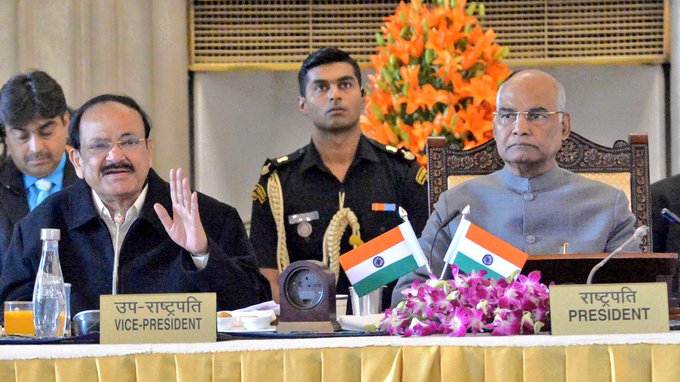
The 50th Conference of Governors concluded at Rashtrapati Bhavan today  laying emphasis on tribal welfare and issues related to water, agriculture, higher education and ease of living.

Five sub-groups of Governors submitted their reports on these issues, and deliberated and identified actionable points in which governors can play a facilitating role. The conference took keen interest in tribal welfare issue and pointed out that policies for tribal upliftment had to be tailored in accordance with local requirements.

In his remarks, Prime Minister of India Shri Narendra Modi while congratulating the gathering for the successful conclusion of the 50th edition of the Conference, emphasized that for the future,  even as it evolves with the times, the institution of this Conference should remain focused on ensuring national development and meeting the needs of common man.

While lauding the participants for coming up with valuable suggestions, Prime Minister urged the Governors, as first citizens, to enable  discussions at state level so that ideas suitable to their local conditions are pursued vigorously.

With respect to development of tribal areas, the Prime Minister urged for the use of appropriate use of technology and adoption of progressive schemes in the sphere of sports and youth development. Prime Minister also asked for a mission mode focus to be given to meeting the development needs of the 112 aspirational districts, particularly those that fall in the tribal areas of the country and to ensure that they come up above the state and national averages on the relevant development indices at the earliest.

The Prime Minister said that the discussion on Jal Jeevan Mission in the Conference reflected the priority given by the Government to water conservation and water management techniques that emphasized functionality and were tailored to local conditions. In their role as Chancellors of Universities, the Prime Minister requested Governors to inculcate this message of good habits of water conservation amongst the youth and student community as well. Prime Minister also requested Governors to seek out ways of helping to publicize the message of traditional water related festivals like ‘Pushkaram’.

On the New Education Policy and the higher education sector, Prime Minister highlighted the important role that Governors could play to ensure that universities invest in high quality research that harnesses cost effective innovations and technology that uses platforms  like hackathons etc. to foster a start-up culture, and also leads to job creation for the youth.

On Ease of Living initiatives, Prime Minister observed that state institutions need to strike the right balance between cutting red-tape and too much regulations on one hand and at the same time ensure that the primary needs related to basic sectors like health care and education were met in an affordable manner.

On agriculture, the Prime Minister advocated for a focus on development of agrarian economy by following a cluster approach that offered nuanced solutions. He requested that Governors could help to ensure adoption of international best practices through introduction of viable Demonstration projects where agriculture universities played a lead role.

President, Vice President and Home Minister also addressed the concluding session.

****

The Qualities of a Change-Maker

Improving educational quality ends up being about change rather than tinkering with some elements. 

What then are the qualities of those involved in bringing about this change? 

Here are my guesses. As can be expected, this is a long wish-list! I need your help to identify which ones are really important. And suggestions, too, about how to generate these qualities in the people we work with.
A change-maker:
  1. is sharp, can quickly see what needs to be changed, and has effective ways of helping others see this too, but without getting into a conflict!
  2. can spot opportunities for introducing change
  3. does not have a sense of hierarchy; does not discriminate
  4. has a sense of humour, which gives her/him the ability to live with the difficulties and slow pace of change
  5. at the same time, s/he can take quick decisions and act fast if needed
  6. is aware that he may himself by a victim of the old ways of thinking and living; so is constantly examining himself and trying to improve himself
  7. can help a person see what is wrong without feeling bad or without that person feeling he is being disliked.
  8. has a sense of strategy – that is, of actions that will slowly, perhaps indirectly, bring about the change desired, in stages
  9. is honest and has the greatest accountability to herself, on behalf of those she works for
  10. is aware that there will be some conflicts, and has a plan and ability to deal with this; if necessary, generates conflict, though in a calibrated manner
  11. is aware that his role is that of enabling others to deliver rather than deliver on their behalf
  12. knows how long change takes, and does not give up
  13. Can work as a team member, and also get others to work as a team – for which, helps by:
  • Sharing goals

  • Sharing information

  • Recognizing, utilizing and balancing the strengths and weaknesses of the group

  • Ensuring recognition as a team


What kind of process would help develop these qualities? 
What kind of reflection, debate and conversation do you think is needed? 
And can it be done in the kind of time-frames we usually have?

What is (more) \’Educationally Responsible\’?

What is more educationally responsible from among the alternatives below. Anytime you feel it\’s all very clear, don\’t ignore the possibility that there may a trap somewhere…

  • Encouraging someone to ask questions or give answers to questions no one is asking?
  • Helping learners discover worlds of fascinating and worthwhile knowledge around them versus providing them information from books?
  • Setting challenging tasks versus \’telling\’ children, giving explanatory lectures ?
  • Encouraging reflection or ensuring memorization of the right answers?
  • Preventing errors or letting children discover for themselves when they\’ve made a mistake?
  • Giving feedback versus giving marks (and remarks)?
  • Ensuring all children get the same opportunity versus ensuring different children get different opportunities?
  • Doing everything oneself (if you\’re a teacher) versus passing on some of your tasks to children (e.g. marking attendance, ensuring participation of peers)
  • Maintaining all provided materials in good shape or using them at the risk of their getting spoilt, torn, etc.?
  • Asking community to help with their knowledge heritage versus asking community to contribute to improvement in mid day meal?
  • Using a textbook as a resource versus using a textbook as a definitive material (i.e. assuming it is the curriculum)
  • Reading this blog or reading a useful book on education?!

So what is more educationally responsible? Let me have more such pairs / alternatives to choose from, and also your views on the above!

What is (more) \’Educationally Responsible\’?

What is more educationally responsible from among the alternatives below. Anytime you feel it\’s all very clear, don\’t ignore the possibility that there may a trap somewhere…

  • Encouraging someone to ask questions or give answers to questions no one is asking?
  • Helping learners discover worlds of fascinating and worthwhile knowledge around them versus providing them information from books?
  • Setting challenging tasks versus \’telling\’ children, giving explanatory lectures ?
  • Encouraging reflection or ensuring memorization of the right answers?
  • Preventing errors or letting children discover for themselves when they\’ve made a mistake?
  • Giving feedback versus giving marks (and remarks)?
  • Ensuring all children get the same opportunity versus ensuring different children get different opportunities?
  • Doing everything oneself (if you\’re a teacher) versus passing on some of your tasks to children (e.g. marking attendance, ensuring participation of peers)
  • Maintaining all provided materials in good shape or using them at the risk of their getting spoilt, torn, etc.?
  • Asking community to help with their knowledge heritage versus asking community to contribute to improvement in mid day meal?
  • Using a textbook as a resource versus using a textbook as a definitive material (i.e. assuming it is the curriculum)
  • Reading this blog or reading a useful book on education?!

So what is more educationally responsible? Let me have more such pairs / alternatives to choose from, and also your views on the above!

What is (more) \’Educationally Responsible\’?

What is more educationally responsible from among the alternatives below. Anytime you feel it\’s all very clear, don\’t ignore the possibility that there may a trap somewhere…

  • Encouraging someone to ask questions or give answers to questions no one is asking?
  • Helping learners discover worlds of fascinating and worthwhile knowledge around them versus providing them information from books?
  • Setting challenging tasks versus \’telling\’ children, giving explanatory lectures ?
  • Encouraging reflection or ensuring memorization of the right answers?
  • Preventing errors or letting children discover for themselves when they\’ve made a mistake?
  • Giving feedback versus giving marks (and remarks)?
  • Ensuring all children get the same opportunity versus ensuring different children get different opportunities?
  • Doing everything oneself (if you\’re a teacher) versus passing on some of your tasks to children (e.g. marking attendance, ensuring participation of peers)
  • Maintaining all provided materials in good shape or using them at the risk of their getting spoilt, torn, etc.?
  • Asking community to help with their knowledge heritage versus asking community to contribute to improvement in mid day meal?
  • Using a textbook as a resource versus using a textbook as a definitive material (i.e. assuming it is the curriculum)
  • Reading this blog or reading a useful book on education?!

So what is more educationally responsible? Let me have more such pairs / alternatives to choose from, and also your views on the above!

Using Performance Standards to Improve Teacher Effectiveness

Here are some of the key principles that emerged from the ADEPTS experience over the last few years. ADEPTS (or Advancement of Educational Performance through Teacher Support) is an approach or a way of working, based on the use of performance standards. [More details and the standards themselves can be shared with those interested! In the meantime, here are some of the insights that emerged – feedback and your views are welcome.]
  
  1. The most important way to generate teacher motivation is to enable them to experience success in the classroom. Hence a set of minimum enabling conditions being in place make a huge difference. 
  2. Teachers change when they experience the standards, rather than simply being told about them – towards this, the in-service courses themselves need to incorporate the standards expected of teachers. (A few of the states have begun this process of improving their own inputs to teachers.)
  3. There is a sequence in which teachers learn (and indeed institutions and systems learn). It is also better to avoid overcrowding expectations. It would therefore be best to plan improvement in terms of stages of teacher development, broken down into three-month phases, each of which has a very limited number of indicators to be attained (4-8). As teachers attain one set of indicators, this motivates them as well as prepares them for the next, higher order, set. The support institutions, too, learn along with the teachers and grow phase-wise in turn.
  4. Standards and indicators can tend to be vague! It is important to convert them into concrete steps that can actually be implemented by teachers. Thus, if an indicator agreed upon is ‘children ask questions freely, without fear’ there is a need to make clear exactly what the teacher needs to do for this to happen. Hence, as part of the roll out, all teams need to detail the concrete steps involved in converting the expectations into actionable steps.
  5. Implementer choice and partnering with teachers is more likely to yield results than passing on a set of instructions. In sub-district meetings, teachers should get to choose the indicators they want to attain (from a given list of potential indicators for that stage, though) and identify / develop the steps needed to attain these. Their performance will be assessed against the indicators chosen by them. If possible, peer assessment will be introduced.
  6. ‘Target setting’ in terms of the degree of improvement in performance can now be practiced. Teachers and their resource persons can use the standards document to fix the degree of change they seek to bring about over, say, a year or six months. They can then assess their progress against this. As this was not possible earlier, improvement efforts tended to lose their way very soon.
  7. Taking a ‘low-interference’ approach helps – that is, there is no pressure on the system to change curriculum or textbooks or introduce new model of teaching. It is more a case of ‘doing the same as before, but a little differently’; this reduces systemic stress and enables rapid implementation.

IMPLICATIONS OF PRAGMATISM IN MODERN EDUCATIONAL SYSTEM

Education and philosophy are closely inter-related. Philosophy is the corner stone of the foundation of the education. Philosophy answers thousands of questions in the field of education.
     Pragmatism is recognized as the native philosophy of America. Historically the Pragmatic approach can be traced to Protagoras, a sophist Philosopher of ancient Greece who said “Man is the measure of all things”.

    John Dewey (1859-1952) becomes its leading and most influential exponent. He practised it in his laboratory school set up in Chicago in 1896.His purpose was to train pupils in co-operation and mutually useful living.

   The term Pragmatism is sometimes called “Progressivism”. “Progress implies Change. Change further implies novelty”. So education cannot be convenience of as acquired once for all. Life has become as complex as is subject to rapid modifications that the child has to face new problems and education should enable the child to learn new techniques and problematic situations. Problem solving is at the core of all the education. The educative process becomes empirical, experimental and piecemeal: in a word Pragmatism.
 BASIC PRINCIPLES
Ø    Pragmatists believe that man is primarily a biological and sociological organism. Past, for man is dead and go on. Tomorrow would come with its own problems and with their own problems.
Ø    Human beings are essentially active. Here emphasis is on action and learning by doing. Action is real and ideas are tools.
Ø    There are no absolute values of life. Values are flexible. They change with time and circumstances.
Ø    Mind is dynamic process, which functions within a man. The human mind is the product of change. The growth of personality is the product of action and discovery. Development of personality is possible only in social context.
Ø    Truth is that which works in practical situations. It is workable.
Ø    Thought and knowledge emerges from search and enquiry.
Ø    Pragmatism makes activity; the basis of all teaching prefers self activity in the context of co-operative activity.

AIM OF EDUCATION
        According to the pragmatic view the function of education is to bring about certain changes in the behaviour of the individual. These changes relate to the physical, intellectual, and the moral development of the human beings. They reflect the growth of the individual, as the process of education goes on and the individual continues growing physically, mentally, and morally. Since this process starts from birth and continues throughout life. Education is broadly conceived as a life-long process.
                 Pragmatism rejects the idea of accepting eternal truths       and fixed principles. Truths are good and proved by human experience. In the process of education values and truths are discovered at each stage and as the individual goes on discovering them he goes on acquiring more and more self-confidence and breadth of vision which is indicative of his growth and realization of some objectives.
Educational aims are not at the end of process of education. They are rather within the process and as the individual go on achieving some educational objectives.
 CURRICULUM
       Pragmatism stresses experience based curriculum (activity based curriculum).
v  It assigns due place to the interests of the child.
v  It gives integrated knowledge around a particular problem of life.
v  It provides problem solving activities.
v  The pragmatists’ curriculum consists of totality of experiences that the pupil receives through the manifold activities in the school, in the classroom library, laboratory, and play ground. 
v  It emphasizes subjects and studies like social studies,   physical training, hygiene, mathematics and science.
DISCIPLINE
In pragmatism, there is no place for rewards and punishments. It stresses social discipline. Pragmatism believes that discipline comes through purposive and cooperative activities. According to John Dewey, discipline is the proper use of one’s energy and power. It advocates self discipline.
PRAGMATISM AND THE EDUCATIVE PROCESS
Activity is the central point in the whole educative process. In all creative learning two agencies are evolved-the educator and educand. No real learning is conceived without the co-operation between the two to achieve their common purposes and goals. Co-operation of the two in pursuing an activity gives rise to the process of education.
Action is the primordial; unless there is any action, there is no thinking. Real education is not mere imparting of bookish information; real education means pled up in many continues experience or activities. The basis of all teaching is the activity of the child.
METHODS OF TEACHING
v  The whole emphasis of method of teaching in Pragmatism is on child, not the book, or the teacher, or the subject
v  The dominant interest of the child is “to do and to make”.
v  The duty of the teacher to teach his pupils to do, rather than to know.
v  The method should be flexible and dynamic. It must be adaptable and modifiable to suit the nature of the subject matter and the potentiality of the students.
v  The pragmatist’s curriculum provides for creative and purposeful activities in the teaching-learning process.
v  Pragmatism regards teacher as a helper, guide and philosopher.
v  Pragmatist’s suggests Project method, consisting of purposeful activity carried out in a social environment, pupils learns by doing.
v  Learning by doing makes the pupil creative, confident and co-operative.
v  Methods like problem solving, play-way, experimental and laboratory techniques which follows the principles of learning by doing.
IMPLICATIONS OF PRAGMATISM IN   EDUCATION
a) EDUCATION AS LIFE
              Old and traditional education is lifeless. To them education is a continuous re-organizing reconstructing, integrating the experience and activities of race. They want to conserve the worthwhile culture of the past. Real knowledge can be gained only be activity, experiments and real life experience. Thus in order to develop the child fully that he should be provided opportunities to participate more in activities and experiments so that he creates his own values and lead better, richer and happiest life.
b) EDUCATION AS GROWTH
                The child is to develop and life for the society, so his personality can be best developed in social environment. If it were not for his contact with other peoples he would never achieve a personality at all. The person who interacts with others has the ability to examine one’s needs in an objective way and he has the capacity for reflection and intelligent action. They are inconceivable without the give and take of the social environment.
              Thus education will be useful if it brings about the growth and development of the individual as well as the society which he lives. Each child is born with inherent capacities, tendencies and aptitudes which are drawn out through education.
c)  EDUCATION AS A SOCIAL PROCESS
               In the words of Dewey “Education is the social continuity of life”. To pragmatist education is life itself and not preparation for life. Thus it wants to clear to the educator that the four things are inseparable i.e. man and nature, individual and society, mind and body, and thought and action. In the words of Prof. V. R. Tenaja ‘The pragmatists wish that the educator should have realisable aims in order to meet the struggle of life in a rational way.
d) EDUCATION A CONTINUOUS RESTRUCTURING OF   EXPERIENCE
           Education is a process of development. Knowledge changes with circumstances and it gained by continuous experiments and experiences leads to one to another and so on and the area of knowledge is widened. The process of reconstruction of experiences goes on and leads to adjustment and development of the personality. For pragmatists educational process has no end beyond itself. In addition to the individual it is continuous, reorganising, reconstructing and integrating the experiences and the activities of the race.
 e) EDUCATION THE RESPONSIBILITY OF STATE
             Education is the birth right of each individual, so the state should shoulder the responsibility. It is for the state to make the child capable and confident to meet the problems and challenges of life successfully.
LIMITATIONS
It does not raise the question of ultimate reality behind things. According to it whatever is apparent is real. There is no place for spirit or essence. Humanities and cultural activities find no place in the pragmatic scheme of education. It ignores the past as well as the experience of the past. It lays emphasis on the present and the future. It does not provide regular and systematic instructions. It is less practicable in the Indian schools. The curriculum is haphazard. It is difficult to include all the basic skills and knowledge required by the learner. It does not give fixed ideals of education such as education does not help much.
CONCLUSION
        Pragmatic philosophy is a practical philosophy, having no fixed or absolute standards. Man always creates new value and education should help him in doing so. Being a practical and utilitarian school of philosophy, pragmatism has influenced education to the maximum extent.


Screw around with Kraft

What do you call something who is passed from hand to hand ? Used goods ? Probably something worse ? Well, that is what we have to call Kraft these days.
With a touch of slight (?) exaggeration, you could say that the land of mom and apple pie, could be stretched to include Kraft too ! Read on to see the list of brands this company owned at one time or the other, and even the Professor – he of the class war against processed foods – would have had one of those some time or the other. Its a quintessentially American company. And yet the way it has been sold and bought and sold and bought again makes somewhat depressing reading.
As is usual with many of the well known companies, there is always a visionary entrepreneur in the beginning. There was a James L Kraft. He was born in Canada, but emigrated to the Chicago in 1903 and started selling cheese from a horse drawn cart. In 1916 they developed a new process for pasteurising cheese, enabling it to be shipped long distances and patented it. Then came World War I, the need to provision the army and Kraft took off. In 1928 came Philadelphia cheese. In 1930 it merged with National Dairy, then the leading ice cream company in the US and became a full fledged Dairy Products company. 1926 saw Breyers, a famous ice cream brand;  1935, Sealtest, another iconic ice cream brand.  It grew and grew and became a globally recognised company and one of the giants of the food industry.
Then came 1980 and the barbarians. Wall Street types seem to have a peculiar fascination for Kraft and it become the favourite darling of deals. In 1980 a merger was engineered with Duracell and Tupperware. Immediately thereafter it sold all the non food businesses including Tupperware, but retained Duracell. In 1988 it sold Duracell to private equity firm KKR. In that mad winter of 1988, when dizzying deals were done, Kraft itself was acquired by Philip Morris (the largest tobacco company in the world) . Philip Morris merged Kraft with its General Foods business (of Maxwell House, Jell O, Kool Aid and Tang fame ) and created Kraft General Foods.  In 1990 they bought Jacob Suchard a big European coffee company and also the owner of TobleroneIn 1993 came Shredded Wheat. In 2000, Philip Morris acquired Nabisco and merged it with Kraft. Into the fold came Oreo, Chips Ahoy, Ritz, etc. In 2001 Philip Morris IPOed Kraft and it became an independent company again. In 2009, Kraft acquired Cadbury. In 2011 it split itself into two companies – the North American Kraft and the global Mondelez. And then last week, Warren Buffett and 3G bought out Kraft and will now run it together with Heinz which they already own.
Whew. That is a dizzying pace of changing of hands. How can a business survive this level of buying, adding, stripping and selling all the time. I wonder what the suppliers, consumers and employees make of all this. Businesses need some stability. Wall Street types doing financial engineering, don\’t do much for the long term health of the business.
There is one saving grace. Warren Buffett is not a wheeler dealer. He holds for the long term. Maybe Kraft will get some stability now.

Companies don\’t make investment decisions based on tax rates

If you cut tax rates, will companies invest more ? This is almost a religious belief in a certain party in a certain country in the world. Is it justified  ?
The answer, in my opinion, is mostly No.
Companies make investment decisions based on markets, sales projections, competitive advantage, margin potential, scalability and the like.  These are extremely complex business variables and occupy 90% of the time and effort that goes into a business decision.
The tax line is one of the last lines in the cash flows of an investment proposal. It is certainly important, but hardly a determiner of whether the investment goes ahead or not.
There are a few instances when the tax rate indeed becomes a determining variable in the decision. For example, in India, there have been many instances where the government, in an effort to stimulate an underdeveloped part of the country has allowed zero income tax rates for operations located in those areas. In such a case, the tax rate becomes a determiner of the location of the investment; not the investment per se. Nobody puts up a factory just because the tax rate is zero. They put up a factory because the business opportunity is compelling. Having decided to invest, they may choose to locate it in a low tax zone.
The other instance when a tax rate becomes a determiner of investment is if the tax rate is ridiculously high.  For example if the marginal tax rate is 90%, nobody will invest even if the business opportunity is compelling (M. Melenchon\’s supporters, are you listening ?). But if you cut the tax rate from 35% to 15% , it\’s a nice bonus, but it will not add one dollar of investment which otherwise would not have been made.
Further, companies make investments based on a 7 or 9 year time horizon. If one President cuts tax rates this year, what stops the next President from increasing it 3 years from now. So its almost inconceivable that a company which would otherwise have not made the investment, will rush to now make it because of the tax cut.
The argument that a major tax cut on companies, will spur investment growth is mostly flawed. It will however have the following consequences
It will improve corporate profits (for after all tax is a cost) and therefore both the investible surplus and/or dividends in the hands of shareholders. It will increase the wealth in the hands of those who are shareholders. They may spend it which will have a beneficial impact on the economy.
It will correspondingly increase the deficit that the government runs, and therefore the nation\’s borrowings. That will push the cost of borrowing and inflation.
But will it also increase tax revenues and therefore make the measure revenue neutral. Mostly No. But there is one big exception in the US, which will be the subject matter of the next post.

Companies don\’t make investment decisions based on tax rates

If you cut tax rates, will companies invest more ? This is almost a religious belief in a certain party in a certain country in the world. Is it justified  ?
The answer, in my opinion, is mostly No.
Companies make investment decisions based on markets, sales projections, competitive advantage, margin potential, scalability and the like.  These are extremely complex business variables and occupy 90% of the time and effort that goes into a business decision.
The tax line is one of the last lines in the cash flows of an investment proposal. It is certainly important, but hardly a determiner of whether the investment goes ahead or not.
There are a few instances when the tax rate indeed becomes a determining variable in the decision. For example, in India, there have been many instances where the government, in an effort to stimulate an underdeveloped part of the country has allowed zero income tax rates for operations located in those areas. In such a case, the tax rate becomes a determiner of the location of the investment; not the investment per se. Nobody puts up a factory just because the tax rate is zero. They put up a factory because the business opportunity is compelling. Having decided to invest, they may choose to locate it in a low tax zone.
The other instance when a tax rate becomes a determiner of investment is if the tax rate is ridiculously high.  For example if the marginal tax rate is 90%, nobody will invest even if the business opportunity is compelling (M. Melenchon\’s supporters, are you listening ?). But if you cut the tax rate from 35% to 15% , it\’s a nice bonus, but it will not add one dollar of investment which otherwise would not have been made.
Further, companies make investments based on a 7 or 9 year time horizon. If one President cuts tax rates this year, what stops the next President from increasing it 3 years from now. So its almost inconceivable that a company which would otherwise have not made the investment, will rush to now make it because of the tax cut.
The argument that a major tax cut on companies, will spur investment growth is mostly flawed. It will however have the following consequences
It will improve corporate profits (for after all tax is a cost) and therefore both the investible surplus and/or dividends in the hands of shareholders. It will increase the wealth in the hands of those who are shareholders. They may spend it which will have a beneficial impact on the economy.
It will correspondingly increase the deficit that the government runs, and therefore the nation\’s borrowings. That will push the cost of borrowing and inflation.
But will it also increase tax revenues and therefore make the measure revenue neutral. Mostly No. But there is one big exception in the US, which will be the subject matter of the next post.

Companies don\’t make investment decisions based on tax rates

If you cut tax rates, will companies invest more ? This is almost a religious belief in a certain party in a certain country in the world. Is it justified  ?
The answer, in my opinion, is mostly No.
Companies make investment decisions based on markets, sales projections, competitive advantage, margin potential, scalability and the like.  These are extremely complex business variables and occupy 90% of the time and effort that goes into a business decision.
The tax line is one of the last lines in the cash flows of an investment proposal. It is certainly important, but hardly a determiner of whether the investment goes ahead or not.
There are a few instances when the tax rate indeed becomes a determining variable in the decision. For example, in India, there have been many instances where the government, in an effort to stimulate an underdeveloped part of the country has allowed zero income tax rates for operations located in those areas. In such a case, the tax rate becomes a determiner of the location of the investment; not the investment per se. Nobody puts up a factory just because the tax rate is zero. They put up a factory because the business opportunity is compelling. Having decided to invest, they may choose to locate it in a low tax zone.
The other instance when a tax rate becomes a determiner of investment is if the tax rate is ridiculously high.  For example if the marginal tax rate is 90%, nobody will invest even if the business opportunity is compelling (M. Melenchon\’s supporters, are you listening ?). But if you cut the tax rate from 35% to 15% , it\’s a nice bonus, but it will not add one dollar of investment which otherwise would not have been made.
Further, companies make investments based on a 7 or 9 year time horizon. If one President cuts tax rates this year, what stops the next President from increasing it 3 years from now. So its almost inconceivable that a company which would otherwise have not made the investment, will rush to now make it because of the tax cut.
The argument that a major tax cut on companies, will spur investment growth is mostly flawed. It will however have the following consequences
It will improve corporate profits (for after all tax is a cost) and therefore both the investible surplus and/or dividends in the hands of shareholders. It will increase the wealth in the hands of those who are shareholders. They may spend it which will have a beneficial impact on the economy.
It will correspondingly increase the deficit that the government runs, and therefore the nation\’s borrowings. That will push the cost of borrowing and inflation.
But will it also increase tax revenues and therefore make the measure revenue neutral. Mostly No. But there is one big exception in the US, which will be the subject matter of the next post.

Are teachers villains or victims?

At some point or the other in their lives, almost everyone has held the view: \’If only teachers did their work better, so many problems would be solved…\’  Schools would be so much better off, isn\’t it? Education would be great and our lives very different as a result; in fact, society itself would change, if only teachers did their work better.

People who think thus are, of course, only being \’nice\’. Because there are any number of others who have less \’nice\’ ways of putting it. \’Bloody teachers, curse them, they don\’t work at all. They\’re never there in school, and when they\’re there they don\’t teach. And if they teach, they don\’t teach properly, beat children, and don\’t even know themselves what they\’re supposed to teach. All they\’re interested in is their salaries, and making money from the grants that flow to the school.\’

In fact, this is unfortunately a very widely held view, especially among officials, supervisors, trainers and others who are in any way responsible for and towards teachers. Condemn them, point out all their flaws (exaggerate where it helps) and hold them accountable for all the ills of the education system. Teacher condemnation remains the starting point of many discussions related to improving education.

Anyone who spends time in school trying to implement what teachers are asked do on a daily basis soon finds that motivation has a way of evaporating rather rapidly. You\’re supposed to teach children of one class, but you find yourself teaching more than one class, of children at different ages, with huge variations among them.  Often, you don\’t know their language, and whatever you do, so many of them seem not to be getting it at all (partly also because they cannot attend regularly). Far from support, you get indifference (often derision) from those who are supposed to support you (head teachers, community representatives, supervisors, officials). Soon, if you happen to be from another area than your posting, you start trying to get yourself transferred.

Those \’above\’ them are not immune to exploiting teachers either – using their services to support their own administrative tasks, or even asking them to pay bribes for getting their travel allowance or even school grants (I came across a state where teachers used to be paid only Rs.400 as the TLM grant, with someone siphoning off Rs.100!).

But this doesn\’t mean teachers should absent themselves from school or beat children up, you would say. It\’s true, they shouldn\’t. It\’s just that it\’s so hard (and rare) to experience success as a teacher that it\’s not so surprising. Perhaps our system is victimizing teachers such that they\’re becoming villains? Or do you think they\’re only victims? Or are they really villains?

Turn the world vegetarian

Humans love eating meat. Vegetarians and vegans (this blogger is a vegetarian) don’t stand a chance. In quite a few countries in the world, you simply have to starve if you are a vegetarian.  In many others, your only ordering choice in a restaurant is likely to be an apology of a salad, that could more appropriately be fed to a cow !
Any chance that you can turn the human race into vegetarians ? Well, at least one company thinks so. The aptly named Impossible Foods based in California (where else)  would like to try. An interesting Q&A with the founder that I read in the Guardian, prompted this post.
The logic for turning the human race vegan is impeccable. The largest environmental impact that humans have created is from rearing animals for food – cows being the primary culprit. The resources utilised – water, land, etc – per pound of meat is also the largest. The absolutely atrocious conditions in which we rear and kill farm animals has to be a permanent blot on the human species (pig farmers in Iowa – are you listening ?) And if the population of farm animals decreases, there is a better chance of wildlife prospering,  as one of the chief causes of habitat loss is grazing. 
Of course, this is not going to happen. Go back to the first sentence of this post. 
I however have this feeling, totally unsubstantiated by data, that this might be a long term trend. Technology in food production is on the cusp of a revolution. After all humans don’t eat meat because they like to kill animals. They eat it because they love the taste. If, and when, plant based foods are engineered to taste like meat, there is every chance that people will start to switch. Especially if it is cheaper.  And then, slowly, the ethical side of it will start to play a part. If you can satisfy your nutrition and the craving for taste without killing, why wouldn’t you do it. After all, if many of the meat eaters actually saw how their meat was being produced, a good proportion will turn vegetarians immediately !
But this is not going to happen in a hurry. Impossible Foods is just a fad and, this being California, fads are always welcome. But good luck to them. I might even come out of retirement and open the India branch – at least it will get me into the good books of the awful gau rakshaks !
But one day, in the distant future, maybe 100 generations later, our descendants will look upon with horror at “prehistoric man” for killing and eating animals. And maybe somebody will read my post from the archeological archives and pronounce me as a prescient wise man !
By the way, the photo is that of a veggie burger .

Ensure that the Government’s transformational programmes taken up are effectively implemented – Vice President

The Vice President, Shri M. Venkaiah Naidu said today that India is witnessing a rapid transformation in all spheres and that the Prime Minister’s clarion call of ‘reform, perform and transform’ has given a new sense of urgency and direction to the country, and the Governors should ensure that the momentum is maintained and tangible outcomes are achieved through collective and collaborative efforts.

Addressing the concluding session of 50th Governors’ Conference at Rashtrapati Bhawan today, Shri Naidu said that Governors, with their vast experience, can play an active role in shaping India’s development path.

Shri Naidu said that there cannot be a better time than now for us to make our “Ek Bharat” a “Shrestha Bharat”. The Vice President called upon the Governors to promote this spirit of ‘Bharatiyata’.

He drew their attention towards the rich cultural traditions and linguistic, literary heritage of each state, and stressed the need for its preservation.

“You must support efforts to preserve local culture, festivals and food varieties. You must encourage healthy foods and healthy lifestyle. You must encourage the preservation of local art forms and programmes that support local artisans and craftsmen”, he told the Governors.

He also asked them to ensure that local languages get their due place in administration and wherever public interfaces exist.

Calling the language as the repository of the culture of a region, Shri Naidu urged the Governors to actively encourage state governments to preserve and promote mother tongues and use them as a medium of instruction at least at the primary school level.

Shri Naidu also drew the Governors’ attention to certain colonial practices which need to be reviewed. For example, addressing high dignitaries as Excellency and adopting the cap and gown dress in the university convocations can be modified to bring in an essential Indian touch.

Expressing concern over the unsustainable water use, the Vice President called for urgent need for water conservation.

Lauding the Government’s aim to double farmers’ incomes and make agriculture remunerative and sustainable, he mentioned several structural reforms being introduced in farm sector.

Calling ‘agriculture as the basic culture’ of the country, he emphasised a greater need for effective ‘lab-to-land’ transmission of knowledge and promotion of diversification of crops, as well as supplementation of on-farm income through horticulture, dairy, poultry and pisciculture.

The Vice President further said that in the field of higher education, the focus will have to be on encouraging innovation and continuous quest for excellence. Research and teaching facilities have to be benchmarked against the best in the world, he added.

The two-day conference at Rashtrapati Bhavan was presided over by the Hon’ble President of India, Shri Ram Nath Kovind. Shri Amit Shah the Union Home Minister, Shri Ravi Shankar Prasad, Minister of IT & Communication, Law and Justice, Shri Gajendra singh Shekhawat, Minister of Jal Shakti, Shri Narendra Singh Tomar, Minister of Agriculture and Farmer Welfare , Shri Arjun Munda, Minister of Tribal affairs as well as the Governors of States and Lt. Governors and Administrators of UTs were among the dignitaries who attended the Conference.

*****