Performance Grading Index (PGI) 2019-20 for States and Union Territories

 Union Education Minister, Shri Ramesh Pokhriyal ‘Nishank’  approved the release of Performance Grading Index (PGI) 2019-20 for States and Union Territories of India today. The Government has introduced the Performance Grading Index with a set of 70 parameters to catalyse transformational change in the field of school education.

The PGI for States and Union Territories was first published in 2019 with reference year 2017-18. The PGI : States/UTs for 2019-20 is the third publication in this series. The PGI exercise envisages that the index would propel States and UTs towards undertaking multi-pronged interventions that will that will bring about the much-desired optimal education outcomes. The PGI helps the States/UTs to pinpoint the gaps and accordingly prioritise areas for intervention to ensure that the school education system is robust at every level.

Punjab, Chandigarh, Tamil Nadu, Andaman & Nicobar Islands and Kerala occupy the highest grade (Grade A++) for 2019-20.

Most of the States/UTs have improved their grade in PGI 2019-20 compared to the earlier years.

Andaman & Nicobar Islands, Arunachal Pradesh, Manipur, Puducherry, Punjab and Tamil Nadu have improved overall PGI score by 10%, i.e., 100 or more points.

Andaman & Nicobar Islands, Lakshadweep and Punjab have shown improvement by 10% (8 points) or more in the PGI domain: Access.

As many as thirteen States and UTs have shown improvement by 10% (15 points) or more in the PGI domain: Infrastructure and Facilities. Andaman & Nicobar Islands and Odisha have shown improvement by 20% or more. 

Arunachal Pradesh, Manipur and Odisha have shown more than 10% improvement in the PGI domain: Equity.

Nineteen States and UTs have shown improvement by 10% (36 points) or more in the PGI domain: Governance Process. Andaman & Nicobar Islands, Andhra Pradesh, Arunachal Pradesh, Manipur, Punjab, Rajasthan and West Bengal have shown improvement by at least 20% (72 points or more).

For details, see the link below.

https://www.education.gov.in/hi/statistics-new?shs_term_node_tid_depth=391

*****

guidelines for the development of e-Content for Children with Disabilities

 Union Education Minister Shri Ramesh Pokhriyal ‘Nishank’ today approved the release of the guidelines for the Development of e-Content for Children with Disabilities today.

A comprehensive initiative, PM e-VIDYA was launched on 17th May 2020, with an aim to unify all efforts related to digital/online/on-air education. The programme interaliaenvisages development of special e-content for the Divyang (Children with Disabilities-CwDs).  In pursuance of this vision, the Department of School Education and Literacy, Ministry of Education had constituted a Committee of experts, for recommending guidelines for developing e-content for these children.

For the first time, an attempt was made to prepare guidelines for CwD also referred to as Children with Special Needs (CWSN) children so that the goal of inclusive education is fulfilled. The Committee submitted a report titled “Guidelines for the Development of e-Content for Children with Disabilities” comprising of eleven Sections and two Appendices. This report was shared, presented, discussed and accepted by the MoE.

The salient highlights of the e- content guidelines in the report are: 

  • e-Content for CwDs should be developed based on the four principles namely: perceivable, operable, understandable and robust.
  • e-Content including text, tables, diagrams, visuals, audios, videos etc. should comply with accessibility standards: national standards (GIGW 2.0) and international standards (WCAG 2.1, E-Pub, DAISY  etc).
  • Distribution platforms on which content is uploaded (e.g. DIKSHA) and Reading platforms/devices on which content is accessed and interacted (e.g. e-pathshala) must comply with technical standards
  • Reasonable pedagogical accommodations have been recommended to meet specific needs of CwDs
  • The technical standards and guidelines have been detailed out in Section 4 of the report.

The Committee has also recommended that in a phased manner textbooks may be adapted into Accessible Digital Textbooks (ADTs). The content of ADTs should be provided in multiple formats (text, audio, video, sign language etc) with turn-on and turn-off features. Further ADTs should provide flexibility to CwDs to respond to its content/exercises in multiple ways. The detailed guidelines for developing ADTs along with existing international and national experience, in the development of prototypes including the recent NCERT’s experience: Barkha:A Reading Series for All (in print and digital forms),  Accessible Textbooks for All and UNICEF’s “Accessible Digital Textbooks using Universal Design for Learning ( for Learners with and without  Disabilities ) have been presented in Section 5 of the report.

  • In addition to ADTs, in Sections 6 to 9 the Committee has recommended specific guidelines for development of supplementary e-Content as per 21 disabilities specified in the RPWD Act 2016 for students having Intellectual and Developmental Disabilities, Multiple Disabilities, Autism Spectrum Disorders, Specific Learning Disabilities, Blindness, low vision, Deafness and Hard of Hearing and others.
  • A summary of the recommendations has been presented in Section 10 of the report for sharing widely with content creators, content designers, developers, publishers.
  • The implementation roadmap along with the suggestions to strengthen compliance to the accessibility guidelines have been presented in Section 11 of the report.
  • Comprehensive guidelines and technical standards for the production of Sign Language videos have been provided at Appendix-1 of the Report.
  • Universal Design for Learning( UDL)guidelines for content development and pedagogical accommodations are given in Appendix 2 of the report. 

These guidelines will initiate the creation of high quality content for digital education toChildrenwith Special needs. They are dynamic by nature, to be improved based on experience and advent of better technology.

click here for accessing the guidelines


*****

KP/AK

Indian universities achieve top-200 positions in QS World University Rankings 2022

 Three Indian Universities have achieved top-200 positions in QS World University Rankings 2022. IISc Bengaluru ranked number 1 in the world for research. QS Quacquarelli Symonds, global higher education analysts has today released the 18th edition of the world’s International University rankings.

Union Education Minister Shri Ramesh Pokhriyal ‘Nishank’ congratulated IIT Bombay for securing 177th position , IIT Delhi for securing 185th rank  and  IISc Bengaluru for securing 186th position in universities rankings. 

Shri Pokhriyal said that India is taking a leap in the field of Education & Research and is emerging as a Vishwaguru. We are equally proud to have a Guru like Prime Minister Shri Narendra Modi who has constantly been thinking about the welfare of students, faculty staff and all other stakeholders associated with the Indian Education sector, he added.

The Minister further said that the initiatives such as National Education Policy – 2020 and Institute of Eminence are instrumental in ranking our colleges and institutes globally. This can be felt by looking at the university rankings declared by QS & Times Group, he added.

*****

All about Drought


What is Drought?

It is an extended period of time when there is shortage of water availability with respect to atmospheric (below average precipitation), surface water or ground water. It can last for months or years.

source: worldatlas.com


Types of Drought

It is classified mainly into three types, they are as follows:

  1. Meteorological Drought :- It is a condition when there is a prolong period of inadequate precipitation. It usually precedes other kind of drought.

  2. Agricultural Drought :- It can be also called as Soil Moisture Drought, characterized by low soil moisture that is necessary to support crops. Due to which there is crop failure in the area affected by this drought. There are many reasons for this drought to occur such as erosion, and events that cause depletion in nutritious content of soil.

  3. Hydrological Drought :- It is a situation where availability of water in reserves like aquifiers, lakes and reservoirs falls below the level, which precipitation can replenish. This drought tends to show up more slowly.

Causes

There are many causes of drought, some are explained below:

  • Precipation Deficiency :- Precipation can be of three types, they are ice, liquid water and water that freezes on contact. Low level precipation can lead to drought. It mainly occurs in region where normal level of rainfall is low.

  • Dry Season :- Dry season causes drying of rivers, lakes and other water bodies due to which it increases drought occurences.

  • Human Activities :- The ability of land to capture and hold water reduces due to overfarming, excessive irragation, deforestation and erosion. As water holding capacity of land is reduced there is depletion in ground water levels which further affects vegetation.

Can First Rainfall break the drought?

As mentioned above drought is a situation where there is shortage of water for an extended period of time, So First rain cannot break the drought but it is capable of providing temporary relief. A light or moderate rainfall can reduce temperature and provide cooling whilethe rain will be quickly evaporated or used by plants as it seeps into soil, which will provide more relief. Soaking of rain in land is best against drought as it increases ground water due to which plants can grow properly; It also feeds streams i.e. provides water to lakes, rivers, etc.

Consequences

There are many consequences some are mentioned below:

  • Famine :- Drought destroys food sources, as it has less water to support plants, crops, fodder crops, etc. Due to which animals, cattles, poultry cannot have enough food to eat. Even human beings has less food available. When this condition continues for long time period then it may lead to famines.

  • Decrease in drinking water :- Most of natural and man-made reserves dry up or has very less water to quench thirst of living beings. At this times many animals and birds either die or migrate to some other places.

Measures

  • Dams :- additional water can be supplied at time of drought with help of dams.

  • Desalination :- sea water can be used for irrigation or consumption.

  • Inter-connectivity of water bodies can help reduce severity of drought. For example if there is a drought like situation then water from other bodies can be provided to that region so that upto some extent water needs can be fulfilled.

  • Drought severity can be reduced by rainwater harvesting on individual basis.

p { margin-bottom: 0.25cm; line-height: 115% }

Rapid Antigen Test Kit for COVID-19 developed by IIT Delhi

 Union Education Minister Shri Ramesh Pokhriyal ‘Nishank’ virtually addressed students, teachers and stakeholders regarding Board Examinations today.

Shri Pokhriyal expressed deep gratitude and thanked Prime Minister Shri Narendra Modi for taking a decision to cancel the class 12 CBSE Board Exam in the interest of the students keeping in view their health and safety in the wake of Covid.

In his address, Shri Pokhriyal stated that CBSE has already issued comprehensive guidelines on assessment and evaluation for Class 12th Board examinations. He assured that those students who are not satisfied with the assessment, will be provided with an option to take the exams, whenever the situation becomes conducive, in August.

The Minister reiterated that safety, health and the future of the students are the top priorities of the government.

*****

Convocation of Indian Institute of Information Technology (IIIT) Sri City Chittoor

 Minister of State for Education Shri Sanjay Dhotre virtually addressed the students at the convocation of Indian Institute of Information Technology (IIIT) Sri City Chittoor today. Chairman of the Board of Governors of IIIT Sri City Mr. Balasubramaniam was present on the occasion. During the convocation, a total of 261 students comprising 164 Computer Science and Engineering students and 97 Electronics and Communication Engineering students received degrees. This includes 28 Honours students from both disciplines.  

Shri Dhotre said that National Education Policy 2020 aims at making India a global knowledge super power. It endeavours to develop scientific temper, rational and critical thinking in students, ensure students are endowed with 21st Century knowledge and skills, while displaying a strong character, filled with humanistic values, that flow from the ethos of India, i.e.Bharat.  He further added that our students will not only be the top-class students, they will also be the top-class citizens of this country and the world.

Speaking on the importance of Technology, Shri Dhotre urged students to explore how these technologies can be used to solve common man’s problems, such as to improve farming efficiency, and in turn improving his income; in  ensuring energy security, in ensuring piped water to every household in an efficient way.

Minister noted that Technology is playing a massive role in transforming the whole world economy. While working to achieve a goal of a 5 trillion-dollar economy, India is actively focusing on the strength of the digital economy.  He further added that this new India needs young technocrats to provide smarter solutions to the problems. He urged the students to play their part and contribute in making our country a world leader in every aspect of digital technology.

Shri Balasubramaniam said, “The remarkable growth of the fast-growing 180 billion USD IT/ITES industries in India over the past decade has shown the world India’s scientific, engineering and technological prowess and capabilities. The best multinationals of the world are leveraging Indian talent and rushing to set up large R&D hubs in India. We need to be self-reliant as Aatmanirbhar Bharat has now turned the gaze of this world-class innovative talent inwards, to create products and services for the Indian market at par with other countries.”

Dr. G. Kannabiran, Director said that “We propose to significantly improve faculty-student ratio, augment R&D infrastructure and focus on student development initiatives.  We plan to launch online BTech programmes and other continuing education programmes at the certificate, diploma and MTech levels in our key areas of strength.  We also plan to take up in-house corporate training in emerging technology areas, joint degree programmes with suitable overseas universities, enhance our campus infrastructure for next generation students.   We will continue as a family to make IIIT Sri City as a Nationally Relevant and Globally Recognized Entrepreneurial Institution.” 

IIIT Sri City is presently serving as the Secretariat of IIIT Coordination Forum. Besides enabling and coordinating regular meetings, few key activities are being taken up by the Secretariat for the member institutions, including FICCI-Panel discussion with Industry Leaders, Faculty Development Programme on E-Content Development and NOSSCOM Conference for IIIT Directors to benefit the member institutions.

*****

KP/AK

Swachh Vidyalaya Puraskar 2021 – 2022

 Shri Subhas Sarkar, Minister of State for Education today virtually launched Swachh Vidyalaya Puraskar (SVP) 2021 – 2022. The event was attended by Mrs Anita Karwal, Secretary (SE&L), and representatives from all States and UTs and UNICEF.

Shri Sarkar while launching the awardsunderlined the importance ofWater, Sanitation and Hygiene in Schools as it plays a significant role in determining the health of students, their attendance, dropout rate, and learning outcomes. The provision of water, sanitation and hygiene facilities in schools secures a healthy school environment and protects children from illness (including COVID-19) and exclusion, he added. Shri Sarkar emphasized that the SwachhVidyalayaPuraskarrecognise, inspire and award the schoolswho have undertaken exemplary work in the field of water, sanitation and hygieneand also provides a benchmark and roadmap for schools to make further improvements in future.

In order to create self-motivation and awareness about sanitation the SwachhVidyalayaPuraskar (SVP) was first instituted by the Department of School Education and Literacy, in 2016-17.

The SVP 2021-22 is open to all categories of schools. i.e. Government, Government aided and Private schools in both rural and urban areas. The schools will be assessed through an online portal & mobile app in 6 sub-categories: Water, Sanitation, Hand Washing with soap, Operation and Maintenance, Behaviour Change and Capacity Building and the newly added category on COVID-19 Preparedness and Response and the system will generate the overall score and rating automatically.The schools have been given sufficient time till March 2022 to apply for the awards so that they can do so at an appropriate and safe time.

Schools shall be awarded at the District, State and National level based on an internationally recognized five star rating system. Also, every school will get a certificate of participation showing the category-wise scores and overall rating of the school. This will help in promoting sustainable practices of improved Water, Sanitation & Hygiene in schools.

At the National level, 40 schools will be selected for awards this year under the overall category. The award money for the schools has been enhanced this year from Rs. 50,000/- to Rs. 60,000/- per school, under Samagra Shiksha scheme. Also, 6 sub-category wise awards have been introduced for the first time, with award money of Rs. 20,000/- per school.


* * * * *

Wider participation in Pariksha Pe Charcha 2022

 Union Education and Skill Development Minister Shri Dharmendra Pradhan invited students, teachers and parents to participate in the 5th edition of  “Pariksha Pe Charcha 2022 and get a chance to be mentored by Prime Minister Shri Narendra Modi.

Prime Minister Shri Narendra Modi conceptualized a unique interactive program – Pariksha Pe Charcha wherein students, parents, teachers across the nation and also from overseas interact with him to discuss and overcome the stress emerging out of examinations in order to celebrate life as an Utsav. This event was organized successfully for the last four years by the Department of School Education & Literacy, Ministry of Education.

The format of this programme is proposed to be in online mode like in 2021. An online creative writing competition is being conducted at https://innovateindia.mygov.in/ppc-2022/ on various topics from 28th December to 20th January 2022 to select participants. Questions asked by selected winners will be featured in Pariksha Pe Charcha programme.

School students of classes 9 to 12, teachers and parents shall be selected through an online competition. Registrations on https://innovateindia.mygov.in/ppc-2022/ are live from 28th December 2021 till 20th January 2022 on a bouquet of themes listed below:

● Themes for Students:

  1. Exam stress management strategies during COVID-19
  2. Azadi Ka Amrit Mahostav
  3. Self-reliant School for Self-reliant India
  4. Clean India, Green India
  5. Digital Collaboration in Classrooms
  6. Environmental conservation and climate change resilience

● Themes for Teachers:

a. National Education Policy (NEP) for Naya Bharat

  1. The COVID-19 Pandemic: opportunities & challenges

● Themes for Parents:

  1. Beti Padhao, Desh Badhao
  2. Local to Global – Vocal for Local
  3. Lifelong Students’ Yearning for Learning

About 2050 participants selected through competitions on MyGov will be presented with a certificate of appreciation from Director, NCERT and a special Pariksha Pe Charcha kit comprising of Exam Warriors book in Hindi and English, written by the Prime Minister.There is enthusiastic participation of students,  teachers and parents from all over the country.

****

Webinar on “Cyber security empowerment of Higher Education Institutions (HEIs)”

 The Government of India has launched a 75-week long campaign Azadi ka Amrit Mahotsav; to celebrate the achievements of the country and its people. The University Grants Commission (UGC) as part of  this campaign  is conducting a series of activities beginning with the a sensitisation webinar on “Cyber security Empowerment of Higher Education Institutions (HEIs)”an effort towards making cyber security more accessible, available, and adaptable for HEIs.

Delivering the welcome address, Prof. Rajnish Jain, Secretary, UGC welcomed and introduced all panelists. He set the context for the webinar, stressing on the need for cybersecurity awareness with the increased dependence on IT post pandemic. He emphasised on the fact that the pandemic has put Higher Education in the cyber space which has led HEIs to be subject to increased cybersecurity issues. He said that there is a need to understand how cyber security issues may be addressed and how cyber hygiene may be managed.

The keynote address was delivered by Lt. Gen. (Dr.) Rajesh Pant, Chief (retd.), National Cyber Security Coordinator, National Cyber Coordination Centre, PMO. He emphasized and reiterated the threat cybercrime poses to economy and national security. He focused on cybersecurity for HEIs that are base of personal information and intellectual property. He highlighted the structure of institutions that make them susceptible to cybercrimes and the measures to be taken to address these issues. He shared the ongoing and proposed government initiatives of cyber swacchta kendra and the malware posh and national blockchain project given to IIT Kanpur.  He concluded with two mantras for survival in the new normal: personal hygiene and cyber hygiene. 

Shri Abhishek Singh, CEO, My Gov and President & CEO NeGD, Ministry of Electronics & Information Technology delivering his address emphasised on the importance of cyber security due to the increased dependency and use of the cyber space. He focused on the issues of cybersecurity; cyberattacks, frauds and use of cyber warfare, further emphasising the steps and measures to be taken by HEIs to stay safe. He touched upon the various aspects of cybercrimes and measures to be taken and the processes for reporting cybersecurity issues. He spoke of Cyber Surakshit Bharat of Government of India aimed at educating people on cybersecurity.

Shri Deepak Virmani, Deputy Secretary, Indian Cyber Crime Coordination Centre (I4C) , Cyber & Information Security, Division, Ministry of Home Affairs spoke about the initiatives of Ministry of Home Affairs’ CIS and its efforts in controlling Cybercrimes. He shed light on the Indian Cyber Crime Coordination Centre schemes (I4C) of MHA that aims to prevent cybercrimes. He discussed in detail the 7 verticals of the scheme that also involve the training of police personnel and government functionaries. He further shared about the various portals and helpline numbers that can be availed by the citizens and the initiative Cyber Jaagrookta Diwas, celebrated every month since October 2021. Further delivering his address, he hailed UGC for its initiatives for promoting and sensitizing HEIs regarding Cyber security through the proposed handbook on cyber hygiene and cybersafe curriculum. 

Dr. Charru Malhotra , Coordinator, Centre of e-Governance, Indian Institute of Planning and Administration, New Delhi  brought out the findings on Cybersecurity through analysis of a pre webinar questionnaire which had been shared with HEIs. She highlighted the current status amongst HEIs about cyber security and their preparedness.

Prof. Naveen Chowdhary, National Forensic Science University, Gandhinagar through his address shared the cybersecurity threat landscape highlighting cases of compromises on cybersecurity in Educational Institutions, research facilities.  He provided a detailed outlook and a framework for cybersecurity.

Dr. Atul Kumar Pandey, Chairperson , Rajiv Gandhi National Cyber Law Centre, NLIU, Bhopal spoke about the threat landscape in HEIs and the importance of cybersecurity in HEIs. In his address he shed light on various components like content protection and privacy and capacity building for addressing cybersecurity.

The address by the panelists was followed by a Question and Answer session from the faculty members from HEIs.

The webinar discussed pertinent issues of cyber security with prioritizing its impact on HEIs and the necessary. The Webinar was the first step towards Cyber security empowerment of HEIs and provided an opportunity for sensitization and awareness on cyber security.  

*****

Girls and women across the country

 As per All India Survey on Higher Education (AISHE), the overall enrolment of female students in higher education has been consistently increasing over the years. Table below gives female, male and total enrolment in higher education between 2015-16 and 2019-20. The enrolment of females has increased by about 18% from 1.60 crore in 2015-16 to 1.89 crore in 2019-20.

Enrolment in Higher Education from 2015-16 to 2019-20

Year


Enrolment

Growth (%) in enrolment over the previous year

% Female enrolment 

Female

Male

Total

Female

Male

Total

2015-16

15990058

18594723

34584781


46.2

2016-17

16725310

18980595

35705905

4.6

2.1

3.3

46.8

2017-18

17437703

19204675

36642378

4.3

1.2

2.5

47.6

2018-19

18189500

19209888

37399388

4.3

0.0

2.2

48.6

2019-20

18892612

19643747

38536359

3.9

2.3

3.0

49.0

Growth (%) in enrolment during 2015-16 to 2019-20

18.2

5.6

11.3


(source: Compiled from  AISHE reports of different years)


The steps taken/being taken by the Government to promote education among girls and women are as follows:

      1. Issuing of new UGC regulation for Open and Distance Learning that allows entry of reputed institutions to offer education on the distance mode.
      2. Use of ICT technology- SWAYAM portal to take the best teaching resources to all, including the most disadvantaged.
      3. Opening of more centrally funded institutions.
      4. Encouraging opening of institutions by State Governments through the Rashtriya Uchchatar Shiksha Abhiyan (RUSA) which aims to achieve equity, access and excellence in higher education. The scheme supports components such as upgrading autonomous colleges to universities, clustering colleges to establish a university, setting up of new professional colleges in un-served and underserved areas as well as providing infrastructure grants to universities and colleges to scale up capacity.
      5.  More scholarship programmes to supplement the cost of education.
      6. Additionally, as per the recommendations of National Education Policy (NEP), 2020, the following steps are being initiated by the Government to ensure equitable access to the highest quality of education for all learners, especially women, regardless of social or economic background:
        1. A Gender Inclusion Fund will be constituted by Government of India to provide quality and equitable education to all girls. The fund will focus on ensuring 100% enrolment of girls in Schooling and a record participation rate in higher education. 
        2. Free hostel facilities will be made available for all women.
        3. New multi-disciplinary HEIs (including those specially for women) will be opened in or near every district.
        4. Special scholarships for women/transgender/ divyang will be introduced.
        5. Guidelines and advisories will be issued and monitoring mechanism will be put in place to ensure basic facilities amenities and safe, secure environment in all HEIs for women. 


Earthquake Simplified

What is an Earthquake?

Earthquake occurs when two blocks of Earth suddenly slip over each other. The surface where slips occurs is called fault or fault plane. The location at which earthquake starts below the earth surface is called as Focus, and the location exactly above it of earth’s surface is called as Epicenter.


source: worldatlas.com

Why and where it occurs?

The earth is divided into three major layers they are as follows:

  • Crust :- Thickness of this layer ranges from 5 to 70 km. It is 1% of the whole earth.

  • Mantle :- The thickness of Mantle is 2900 km. It is 84% volume of earth.

  • Core :- It is 15% volume of earth. It is further divided into two parts as follows:

    a) Outer Core

    b) Inner Core

The crust and upper layer of mantle is divided into tectonics plate, and the edge of plate is called as plate boundaries. The plate boundaries consists of faults and most of the time earthquake occurs on these faults. The edges of plates are rough so they stick to each other. Even edges are stuck, the remaining part of plate keeps moving. When the plate has reached far enough at that time edges cannot hold each other and they unstick and move. Due to this Earthquake occurs.

Types of Earthquake Waves

Earthquake wave are of majorly three types. They are as follows:

  1. P wave or Longitudinal waves :- It is similar to sound wave. It can travel through solid, liquid and gases state.

  2. S wave or Transverse wave :- It can travel only through solid.

  3. L wave or Surface wave :- When body wave i.e. P and S wave, when interacts with surface of earth it is called Surface wave.

Effects of Earthquake

Earthquake has many effects and it can also lead to another diaster which can be caused due to earthquake as root cause

  • On ground :- Fissures settlements, Landslides, Liquefication, earth pressure and many more.

  • On manmade structures :- Cracking, Collapse of building, Buckling and many more.

  • On water :- Tsunami, Waves Hydro-Dynamic Pressure, etc.

Measurement of Earthquake

Siesmograph is used to measure earthquake.

Richter scale :- It is used to measure magnitude of earthquake and it ranges from 0-10.

Mercalli scale :- It is used to measure intensity of earthquake and it ranges from 1-12.

Why earthquake is a matter of concern to world?

Earthquakes occur suddenly at a place and it spreads to nearby places so very less time is provided to people to respond to it. The damage depends on severity of earthquake. It causes much damage to environment. Many lives of human, animals, birds and other living beings of an area are lost where earthquake occured with severity and less damage occurs where it occured with less severity. There are much loss causedfinancially to a country such as building collapse, cracks or hole in roads. The place where earthquake occurs resident people have to deal with so much of physical and mental pain and pressure. So earthquake is one of the dangerous natural disaster.

p { margin-bottom: 0.25cm; line-height: 115% }

United District Information System for Education Plus (UDISE+)

 Union Education Minister, Shri Ramesh Pokhriyal ‘Nishank’ today released the Report on United Information System for Education Plus (UDISE+) 2019-20 for School Education in India.

As per the UDISE+ report 2019-20, Gross Enrolment Ratio at all levels of school education has improved in 2019-20 compared to 2018-19. Pupil Teacher Ratio (PTR) has improved at all levels of school education.

According to the report, in 2019-20, enrolment of girls from primary to higher secondary is more than 12.08 crore. This is a substantial increase by 14.08 lakh compared to 2018-19. Between 2012-13 and 2019-20, the Gender Parity Index (GPI) at both Secondary and Higher Secondary levels have improved.

The UDISE+ report shows a remarkable improvement in the number of schools with functional electricity, with functional computers, internet facility in 2019-20 over the previous year.

Another major improvement is seen in the number of schools with hand wash facility. In year 2019-20, more than 90% schools in India had hand wash facility as compared to only 36.3% in 2012-13.

The UDISE+ system of online data collection from the schools was developed in the year 2018-19 to overcome the issues related to manual data filling in paper format and subsequent feeding at the block or district level, which was in practice in the UDISE data collection system from 2012-13. The present publication relates to UDISE+ data for the reference year 2019-20.

Highlights of Report on United District Information System for Education Plus (UDISE+) 2019-20:

  • In 2019-20, total students in school education from pre-primary to higher secondary have crossed 26.45 crore. This is higher by 42.3 lakh compared to 2018-19.


  • Gross Enrolment Ratio at all levels of school education has improved in 2019-20 compared to 2018-19.


    • Gross Enrolment Ratio increased to 89.7% (from 87.7%) at Upper Primary level, 97.8% (from 96.1%) at Elementary Level, 77.9% (from 76.9%) at Secondary Level and 51.4% (from 50.1%) at Higher Secondary Level in 2019-20 (from 2018-19).
    • Gross Enrolment Ratio (GER) has improved by nearly 10% in secondary between 2012-13 and 2019-20. GER for secondary has reached nearly 78% in 2019-20, compared to 68.7% in 2012-13.
    • Gross Enrolment Ratio (GER) has improved by more than 11% in higher secondary between 2012-13 and 2019-20. GER for higher secondary has reached 51.4% in 2019-20, compared to 40.1% in 2012-13.


  • In 2019-20, 96.87 lakh teachers have been engaged in school education. This is higher by about 2.57 lakh compared to 2018-19.
  • The Pupil Teacher Ratio (PTR) has improved at all levels of school education.
    • In 2019-20, the PTR for primary has become 26.5, PTR for upper primary and secondary has become 18.5 and PTR for higher secondary has become 26.1.
    • In 2019-20, the PTR for primary has become 26.5, whereas it was 34.0 in 2012-13. In 2019-20, the PTR for upper primary has become 18.5, whereas it was 23.1 in 2012-13.
    • In 2019-20, the PTR for secondary has become 18.5, whereas it was 29.7 in 2012-13.
    • In 2019-20, the PTR for higher secondary has become 26.1, whereas it was 39.2 in 2012-13.
  • To ensure universal accessibility of education for persons with disabilities, all-out efforts have been made. Enrolment of Divyang students has increased by 6.52% over 2018-19.
  • In 2019-20, enrolment of girls from primary to higher secondary is more than 12.08 crore. This is an increase by 14.08 lakh compared to 2018-19.


    • Gross Enrolment Ratio of girls has increased to 90.5% (from 88.5%) at Upper Primary level, 98.7% (from 96.7%) at Elementary Level, 77.8% (from 76.9%) at Secondary Level and 52.4% (from 50.8%) at Higher Secondary Level in 2019-20 (from 2018-19).
    • Gross Enrolment Ratio of girls at higher secondary level has increased by 13% between 2012-13 and 2019-20. It was 39.4% in 2012-13 and has become 52.4% in 2019-20. The increase is more than that of the boys. GER of boys for higher secondary is 50.5% in 2019-20, it was 40.8% in 2012-13.
    • Between 2012-13 and 2019-20, the GER for girls at both secondary and higher secondary level has increased more than that of the boys.
    • GER for girls at secondary level has gone up by 9.6% to reach 77.8% in 2019-20, it was 68.2% in 2012-13.


  • Between 2012-13 and 2019-20, the Gender Parity Index (GPI) at both Secondary and Higher Secondary levels have improved. Improvement of GPI has been most pronounced at the higher secondary level, which has gone up to 1.04 in 2019-20 from 0.97 in 2012-13.


  • More than 80% schools in India in 2019-20 had functional electricity. This is an improvement by more than 6% over the previous year 2018-19.


  • Number of schools having functional computers increased to 5.2 lakh in 2019-20 from 4.7 lakh in 2018-19.


  • Number of schools having internet facility increased to 3.36 lakh in 2019-20 from 2.9 lakh in 2018-19.


  • More than 90% schools in India had handwash facility in 2019-20. This is a major improvement, as this percentage was only 36.3% in 2012-13.


  • More than 83% schools had electricity in 2019-20, an improvement by almost 7% over the previous year, 2018-19. In 2012-13, about 54.6% schools had electricity.


  • More than 82% schools conducted medical check-up of students in 2019-20, an increase by more than 4% compared to previous year 2018-19. In 2012-13, about 61.1% schools conducted medical checkups.


  • More than 84% schools in India had a library/reading room/ reading corner in 2019-20, an improvement of nearly 4% compared to the previous year. In 2012-13, about 69.2% schools had library/ reading room/ reading corner.


For details, see the link:

https://www.education.gov.in/hi/statistics-new?shs%20term%20node%20tid%20depth%20=394&Apply=Apply


*****

R&D institutions will play a major role in the upcoming decade

 Prime Minister Shri Narendra Modi interacted with Directors of Centrally Funded Technical Institutions on 8th July 2021 via video conferencing. More than 100 Heads of Institutions joined the Prime Minister for this interaction. Union Minister for Education and Minister of Skill Development & Entrepreneurship Shri Dharmendra Pradhan, MoS Smt. Annpurna Devi, MoS Dr. Rajkumar Ranjan Singh and MoS Dr. Subhas Sarkar and senior officials of the Ministry were also present during the interaction.
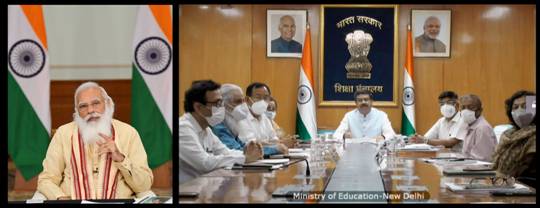
Prime Minister lauded the R&D work done by these institutions towards meeting the challenges posed by Covid. He appreciated the efforts of young innovators towards providing quick technological solutions.

Prime Minister said that there is a need to adapt higher education and technical education to keep in tune with the changing environment and emerging challenges. He added that this requires the institutions to reinvent and re-evaluate themselves, develop alternative and innovative models in accordance with the present and future needs of the country and society. He emphasized that our higher educational and technical institutions need to prepare our youth for continuous disruptions and changes, keeping in mind the fourth industrial revolution.

Prime Minister underlined the need to progress towards education models that are flexible, seamless, and able to provide learning opportunities as per the requirements of the learners. He said that access, affordability, equity, and quality should be the core values of such education models.

Prime Minister appreciated the improvement in the Gross Enrolment Ratio (GER) in higher education in the past few years & emphasized that digitization of higher education can play a big role in increasing GER, and students will have easier access to good quality and affordable education. Prime Minister also lauded the various initiatives taken by the institutions to increase digitization such as that of online bachelor and master degree programmes.

PM added that we need to develop an ecosystem of technological education in Indian languages and translate global journals into regional languages.

Prime minister said that ‘Aatmanirbhar Bharat Abhiyan’ will form the basis of dreams and aspirations of India in the coming 25 years when we celebrate 100 years of Independence. He added that technological, R&D institutions will play a major role in the upcoming decade, which is also being called as “India’s Techade”.

Prime Minister said that we need to focus on developing futuristic solutions in fields of education, healthcare, agriculture, defense, and cyber technologies.

Speaking on the occasion Shri Pradhan stated that India has got a New Education Policy after a period of 34 years. With the introduction of National Educational Policy-2020, the Indian education system has taken a giant leap in fostering an environment for a future-ready 21st century India, he added. He further said that the Government is committed to make students and youth the primary stakeholders in propelling India towards an equitable knowledge society.

Shri Pradhan emphasized that NEP will be instrumental in meeting the expectations of the Prime Minister from innovators, researchers and scientists. The Minister expressed his confidence that under the guidance of Prime Minister Shri Narendra Modi and the support of our academic institutions, Government will continue to set new benchmarks in integrating education with employment & making it more inclusive, holistic, multi-disciplinary and at par with global standards.

During the interaction, Prof Govindan Rangarajan of IISc Bangalore, Prof Subhasis Chaudhuri of IIT Bombay, Prof. Bhaskar Ramamurthi of IIT Madras, and Prof Abhay Karandikar of IIT Kanpur, gave presentations to the Prime Minister and highlighted various ongoing projects, academic work, and new research being done in the country. The Prime Minister was apprised about the Covid related research being done that encompasses developing new techniques for testing, Covid vaccine development efforts, indigenous oxygen concentrators, Oxygen generators, Cancer Cell Therapy, Modular hospitals, Hotspot prediction, Ventilators production, Efforts in the fields of Robotics, Drones, Online education, Battery technology. The Prime Minister was also informed about new academic courses, especially the online courses that are being developed, as per the changing nature of the economy and technology.

*****

Digital Education initiatives of the Ministry

 Union Education Minister Shri Dharmendra Pradhan reviewed the Digital Education initiatives of the Ministry of Education including PM e-Vidya, National Digital Education Architecture (NDEAR), Swayam, among others. Minister of State Smt Annpurna Devi;  MoS Shri Rajkumar Ranjan Singh and MoS Dr Subhas Sarkar also attended the meeting. Senior officials of the Ministry briefed the Ministers about these initiatives.

Emphasizing the importance of leveraging technology in Education, Shri Pradhan said that technology would help in achieving the goals of an open, inclusive and accessible education. A vibrant digital ecosystem in education will expand learning opportunities for the students, spur innovation and entrepreneurship in the Education sector, he added.

The Minister noted that COVID-19 pandemic necessitated a shift towards digital medium of education and assured that Digital initiatives taken by the Ministry to ensure continuity of Education will be further strengthened and institutionalised.

*****

School Innovation Ambassador Training Program

 Union Education Minister Shri Dharmendra Pradhan and Tribal Affairs Minister Shri Arjun Munda jointly launched the ‘School Innovation Ambassador Training Program’ for 50,000 school teachers today. MoS, Smt Annpurna Devi; MoS Shri Rajkumar Ranjan Singh and MoS Dr Subhas Sarkar were also present along with senior officials of the Ministry of Education and Ministry of Tribal Affairs.

Speaking on the occasion, Minister Pradhan said that teachers are the biggest influence in our lives. He said that we aim to make our teachers, change-agents and ambassadors of innovation to make our students future-ready.

Shri Pradhan stressed that technology is reshaping the world and our students have the potential to not only address domestic but also the global challenges. The program launched today is a collaborative effort by the Ministry of Education’s Innovation Cell, Ministry of Tribal Affairs, CBSE and AICTE, which will in turn nurture lakhs of students with innovation capabilities, develop a culture of innovation and lay the foundation of a new and vibrant India, he added.

The Union Minister for Tribal Affairs, Shri Arjun Munda expressed his gratitude that the Ministry of Education has launched its new initiative in the field of innovation in collaboration with Tribal Affairs Ministry which will benefit the large number of schools for tribal children across the country. This programme will have far reaching consequences which will help to fulfil the Prime Minister’s vision of a New Indiathe Minister elaborated.

Sh Arjun Munda further said that ‘SIATP’ will give wings to the creativity of the children and provide a platform so that they can give something new to the world with their ideas. Eklavya Model Residential Schools (EMRS) for tribal children is another ambitious programme of the Prime Minister under which 740 EMRS will be established in tribal dominated areas over the next three years, he said. The students of EMRS will greatly benefit from SIATP since it is also the endeavour of Tribal Affairs Ministry to give the best possible education to the tribal children. Sh Arjun Munda explained that through this unique capacity building programme for teachers, prominence has been given to development of creativity, collaboration , critical thinking and communication skills among children and the integration of Eklavya Schools into the entire programme is a big step in this direction for the meaningful development of tribal children.

Speaking on the occasion, Secretary, Tribal Affairs, Shri Anil Kumar Jha said that encouraging innovation is at the core of the New Education Policy. Teachers will need to evolve new methods of teaching; they will need to first transform themselves into guides from being instruments of written text books. Shri Jha further said that apart from running Ekalavya World Education School, the Ministry of Tribal Affairs has been supporting initiatives of States/Union Territories in spreading scientific education to tribal students and the new initiative will help promote quality education among tribal children. The Ministry of Tribal Affairs has launched an Adi-Prashikshan portal which is also a repository of training inputs. It will be of great benefit if SIAP training module also gets connected to this portal, he said.

The innovative and one-of-its-kind training program for school teachers, it aims at training 50,000 School Teachers on Innovation, Entrepreneurship, IPR, Design Thinking, Product development, Idea generation, among others.

The program has been designed by the Innovation Cell of the Ministry of Education and AICTE for school Teachers based on its “Innovation Ambassador Training Program for Higher Educational Institution’s faculty members”. The training will be delivered in online mode only.

*****
