“Black Fungus” Epidemic ?

“Black Fungus” or Mucormycosis is a disease that causes blackening or discoloration over the nose, blurred or double vision, chest pain, breathing difficulties, and coughing blood. This disease usually infects people with a weaker or subdued immune system. As the second wave of the deadly Covid-19 virus batters India, a new disease has caused a new burden on the already tensed healthcare system. ICMR has informed that black fungus is very vulnerable to people with diabetes and people who have recovered from severe covid-19 infection.

The black fungus has already infected a large number of people from thirteen states and the union territory of India, it has also killed a significant number of people. For now, the number of case stand at 7,250 and the death toll stands 219.

Black Fungus

The central government has already asked four states and one union territory to declare black fungus an epidemic as these places continue to see exponential growth in no of infections.

The central government has said in a press conference that, in the normal course, our body’s immune system successfully fights such fungal infections. However, we know that COVID-19 affects our immune system. Moreover, the treatment of COVID-19 patients involves the intake of drugs like dexamethasone, which suppresses our immune system response.

Due to these factors, COVID-19 patients face a renewed risk of failing the battle against attacks mounted by organisms such as micromycetes. The government spokesperson also said that there is a risk for the covid patients who are undergoing oxygen therapy to catch this disease has it has a humidifier where this fungus can easily grow. ICMR has found that this disease is very uncommon in patients without diabetes and has said that recovery depends upon early diagnosis and treatment.

White Fungus another disease on rising?

 How to Treat Black Fungus?

According to the procedure suggested by ICMR, the infection can start with an infection of the skin, it can spread to other parts of the body. Treatment involves surgically removing all dead and infected tissue. In some patients, this may result in loss of the upper jaw or in some cases even the eye. Remedies can also include a 4-6 week course of anti-fungal treatment. As it affects various parts of the body, treatment requires a team of young biologists, internal medicine specialists, intensivist neurologists, ENT specialists, veterinarians, dentists, surgeons, and others.

ICMR also stressed Covid-19 patients with diabetes to take utmost care. It has also asked all the covid-19 recovered patient’s to not lower their guard and take high precautions.

ICMR has asked the doctors to give a controlled prescription of steroids and Covid-19 drugs like Tocilizumob, Itolizumab as these drugs are known to suppress immunity. Hospitals are strictly advised to keep hygienic and sanitary conditions all the time to keep the fungal infection away. Covid-19 patients on oxygen support in ICU with humidifiers are advised to ensure the water in the humidifier is kept clean and refilled regularly. Hospitals are advised to avoid wet surfaces where fungus can breed. Patients are advised to wash hands regularly and keep their body clean.

The press statement released by the government on “Black Fungus”.

Black Fungus Disease

What is mucormycosis or “black fungus” in Covid-19 patients?

Mucormycosis (previously zygomycosis), a rare but serious fungal infection, is affecting some COVID-19 patients. The disease manifests in the skin, affects lungs and brain, and can lead to loss of the upper jaw or eye. if’s been declared a notified disease in Haryana, the national COVID-19 task force has issued an advisory, and the Union health ministry has asked states/UT s to declare Black Fungus as an epidemic

who is at risk?

Infection is caused by mucormycetes, a group of molds/fungus abundant in environment. It mainly affects sinuses/lungs of people with health problems or on medicines which lower body’s ability to fight germs/sickness, including those with diabetes, cancer, organ transplant, hospitalised or recovering CoVID-19 patients (treated with steroids and other anti-inflammatory drugs)

Sympyoms

Pain, redness around eyes and/or nose, fever, headache, coughing, shortness of breath, bloody vomits, and altered mental status. Warning signs: toothache, loosening of teeth, blurred or double vision with pain, sinusitis (nasal blockade or blackish/bloody discharge), cheekbone or one-sided facial pain or swelling, blackish discoloration of nose bridge/palate, thrombosis, skin lesion, chest pain

Prevention

Use masks if you are visiting dusty construction sites. Wear shoes, long trousers, long-sleeved shirts and gloves while gardening. Maintain personal hygiene (scrub bath). Control diabetes, monitor blood glucose level after COVID-19 treatment discharge, reduce steroid use, discontinue immunomodulating drugs, hydrate adequately

Treatment

Some cases require surgery. For others, respiratory-tract-fluid samples may be tested, tissue biopsy or CT scan (lungs/sinuses) may be conducted. Normal saline (IV) infusion is given before 4-6 weeks of antifungal Amphotericin B dose (3-4 mg per kg of body weight per day), which is out of stock or in short supply with pharmacies/distributors

#stay home stay safe


Countrywide Ayush COVID-19 counselling helpline on toll-free number 14443 operationalised

Countrywide Ayush COVID-19 counselling helpline has been operationalised. The toll-free number is 14443.

The helpline is operational pan-India from 6 a.m. to 12 midnight-all seven days of a week.

Through the helpline 14443, experts from different streams of Ayush, namely Ayurveda, Homeopathy, Yoga, Naturopathy, Unani and Siddha would be available to address queries of the general masses.

These experts would not only be providing counselling and feasible remedies to the patients but would also guide them about the availability of nearby Ayush facilities.

The experts would also be suggesting Post-COVID-19 rehabilitation and management approaches to the patients.

The helpline is IVR (Interactive Voice Response) equipped and currently available in Hindi and English languages.

The helpline will initially take 100 calls simultaneously and the capacity would be increased in future, as per requirements.

Through the helpline, the Ministry of Ayush aims to contribute to the community-wide effort to limit the spread of COVID-19.

The effort is supported by the NGO Project StepOne.

Centre issues advisory to States, UTs to protect vulnerable sections of society affected by pandemic

The Centre has issued an advisory to States and Union Territories to take immediate steps for the protection of vulnerable sections of society including women, senior citizens and children who have been orphaned due to COVID-19 pandemic.

In its advisory, Home Ministry said, several States and UTs have initiated action and strengthened their machineries to support the vulnerable groups and various success stories and best practices are now available where emergency services have been provided to the vulnerable groups impacted by COVID-19.

However, in order to meet the new challenges arising out of the recent wave of COVID-19, the Ministry has urged to undertake an immediate review of the existing facilities for vulnerable groups especially for children who have been orphaned, senior citizens who may require timely assistance and members of SC and ST communities who may need guidance to access Government support facilities.

It has asked that the review may include steps taken for sensitization of police personnel, coordination with agencies and departments concerned as well as communities and civil society organizations.

In its advisory, the Ministry also cited over 107 crore rupees released to States and UTs for setting up and strengthening Women Help Desks in Police Stations.

The Desk envisages to have enlisted panel of experts including lawyers, psychologists and NGOs who can assist in accessing support, provide shelter and rehabilitation and help in registration and follow-up in the cases.

In order to address issues related to trafficking, 100 crore has also been released as grants to the States Union Territories to set up and strengthen Anti- Human Trafficking Unit (AHTU) in every District.

These AHTUs would be integrated task forces, consisting of police and other line departments dealing with prevention and combating trafficking.

The advisory added that these units are highly relevant, especially in the current COVID-19 pandemic where children may have been orphaned due to demise of their parents.

States and Union Territories have been asked to put in place suitable mechanisms for ensuring greater awareness on the anti-trafficking.

Union Health Ministry asks State Govts to emulate best practices in various districts to tackle COVID pandemic

May 21, 2021
,
2:05PM

Union Health Ministry asks State Govts to emulate best practices in various districts to tackle COVID pandemic

mohfw.gov.in

Union Health Ministry has asked State Governments to emulate the best practices shared by various district and field officials to effectively tackle COVID pandemic.

In a letter written by Union Health Secretary Rajesh Bhushan to all the State Health Secretaries, he has suggested them to replicate the innovative practices by customizing them to the local needs.

Prime Minister Narendra Modi interacted with the district and field officials of nearly 20 States and Union Territories on Tuesday and Thursday and discussed in detail the innovative strategies adopted by them to effectively manage COVID related issues in their area.

He had also asked them to share the best practices to the Central Health Ministry so that these innovative ideas can be further adopted by more states and districts.

AIR correspondent takes a look at few of the novel ideas shared by the states and district officials.

Marching ahead with the vision that new challenges need new solutions, several States and District Administrations are lauded for their exemplary work in handling the COVID related situation.

Among them includes the idea of active cooperation of RWAs in establishing COVID Care Centres and Isolation Centres effectively demonstrated by Gautam Budh Nagar Administration of Uttar Pradesh.

Where on one hand, Madhya Pradesh shared their prompt isolation and containment measures, Haryana depicted their work-site and drive through Vaccination Centre model and digital solution to health emergencies.

District Administration of Varanasi shared the effective use of Kashi COVID Response Centre (KCRC) to provide one-stop solution for all COVID related queries of common citizens.

Chennai shared their effective use of Taxi Ambulances whereas Chandigarh showed utilisation of Ayush medicines and Ayush Health facilities for COVID management.

Janjgir Champa in Chhattisgarh demonstrated their push to promote Ayush Kadha and Ahmednagar in Maharashtra shared their tiffin box service at the COVID Care Centres.

Mobile OPD, Oxygen Mitra, Oxygen Nurses, Door to door RT-PCR & Rapid Antigen Testing were also among the best practices shared with the states which focus not only on effective COVID management but also on minimising wastage of essential medical necessities.

PM Modi interacts with doctors, health workers of Varanasi; Gives new Mantra of ‘ Jahan Bimar, Vahin Upchar ‘ in fight against COVID

Prime Minister Narendra Modi today gave a new Mantra of ‘ Jahan Bimar, Vahin Upchar ‘ in the fight against COVID pandemic and said that we have to secure our children from the clutches of this pandemic and get ourselves prepared for this fight.

He was interacting with the doctors and para medical staff and frontline workers of his Parliamentary Constituency Varanasi in Uttar Pradesh a short while ago.

Mr Modi said that our fight is against a regular face-changing and cunning virus and we need to prepare ourselves for this.

Emphasizing on the need for vaccination, the Prime Minister said that we must get ourselves vaccinated when the turn comes and must make vaccination a collective responsibility.

He said that the importance of yoga and AYUSH in the fight against this virus is proving now worldwide.

Praising the Varanasi Model in fight with the pandemic, the Prime Minister said that everybody in the country is talking about the way the city fought with this pandemic.

New machines for testing, facilities for oxygen supply and other health infrastructure related things have become an example for others.

He especially mentioned ‘Kashi Kavach’ and said that it is also an innovative experiment of the administration which is helping people get the facility of telemedicine, medicines and other related things necessary for fighting against this pandemic.

He said that it’s not the time for rest, instead we have to fight a long battle with COVID in the Varanasi and other rural areas of Purvanchal.

The Prime Minister said that not just the people of Varanasi but people from Purvanchal and even from Bihar come for the treatment at hospitals of the city and in the last seven years there has been tremendous work for the development of health infrastructure in the city which helps during this crisis.

Mr Modi started his interaction by paying tribute to those who lost their lives during the battle with COVID in the city and in the end.

He said that our collective efforts will definitely give results and with the blessings of Baba Vishwanath of Kashi will successfully win the fight against COVID-19.

Indian Colourism: Origins and its residual effects


While some people might not be familiar with the concept or term colourism, rest assured for everyone has indulged in it. The oxford dictionary defines colourism as “prejudice or discrimination against individuals with a dark skin tone, typically among people of the same ethnic or racial group.” Perpetuated by both the oppressed and the oppressor alike, it is deeply entrenched in the average person’s psyche. Discussions of such topics are often littered with defensive stances and refusal to believe in one’s own fallacy. People tend to gloss over the microaggressions they partake in every day unbeknownst to themselves.


If we try to look at the roots of the issue and where its origins lie, if there are any, one will find being ruled by fairer-skinned Aryans, Mughals, and Europeans a recurring theme. However, was there no discrimination on the basis of skin in ancient India? The ancient texts portrayed dark-complexioned princes and princesses, gods and heroes in the same light as their fairer counterparts. They were allowed to be heroic and dark and beautiful not in spite of their skin tone but because of it. Lord Krishna’s—whose name means black itself—statues could be dark while Radha’s were made from marble. Times seem to have changed with idols carved in lighter stones selling exponentially more. India’s fanatic obsession hasn’t exempted even gods.


The Britishers moulded the pliable atmosphere after the end of the Mughal rule to their benefit. They were modernized and scientific here to save the uncivilized natives from our erroneous ways. They were symbols of power, class, and status. Who wouldn’t want to be like them? If dogs and Indians were not allowed inside exclusive clubs, who wouldn’t want to shed a part of them for a better life? Thus, colourism unfurled its tendrils. If you weren’t white, be the next best thing. Being white adjacent would land you better opportunities. With the English came the Eurocentric beauty standards. Other places have loosened these to let in talents from diversified backgrounds, but India is still stuck with the remnants of British rule.  


  Manufacturers seized the perfect opportunity by preying on the insecurities of the general public who desperately longed for upward mobility to escape from their circumstances. In 2019, the Indian skin lightening industry was reportedly worth nearly Rs 3000 crore. Bollywood jumped on the bandwagon and ingrained in all our minds that only fair can be attributed to lovely. With whitewashing actors in commercials and casting only fair actresses as love interests, the message was clear: there is no space for dark-skinned actors to be leads in a country of dark-skinned people.


We have internalized the messaging and bigoted ideals. So much to find fair attached to qualities in every matrimonial. To use skin bleaching and lightening products even after knowing their harmful effects. We have attached our self-worth and ability to be seen as desirable and worthy of respect and love to the shade of our skin. We have broken the hearts of millions of innocent kids who would grow to doubt themselves because what they see in the mirror will always resemble the dirt beneath their feet more than it ever does their favourite actor. Change is long overdue.  


War (युद्ध )

 युद्ध शब्द का अर्थ है राज्य संगठनों या देशों के बीच संघर्ष या लड़ाई की स्थिति।  देशों के बीच युद्ध को विश्व युद्ध के रूप में भी जाना जाता है जो बहुत बड़े पैमाने पर होता है और इसमें बड़ा विनाश होता है और देश के बुनियादी ढांचे और विकास और युद्ध हारने वाले देश के लोगों को भी भारी नुकसान होता है।  युद्ध न केवल युद्ध हारने वाले देश को बल्कि युद्ध जीतने वाले देश को भी नुकसान पहुंचाता है क्योंकि युद्ध के दौरान बहुत विनाश होता है।एक कहावत है कि युद्ध कभी अच्छा नहीं होता, शांति कभी बुरी नहीं होती।  लेकिन अगर हम मानव जाति के इतिहास में पीछे मुड़कर देखें, तो यह स्पष्ट हो जाएगा कि प्रागैतिहासिक काल से युद्ध होते रहे हैं।  हालांकि इसे खत्म करने के प्रयास किए गए हैं, लेकिन अब तक सफलता नहीं मिली है।  इस प्रकार, शाश्वत शांति हमारी पहुंच से परे प्रतीत होती है।  ऐसे लोग हैं जो युद्धों को सही ठहराते हैं और कहते हैं कि यह आवश्यक है क्योंकि यह प्रकृति का नियम है।

 वे चार्ल्स डार्विन को अपने सामने रखकर अपनी बात को उजागर करते हैं।  उन्होंने ही योग्यतम की उत्तरजीविता के सिद्धांत की स्थापना की।  उन्होंने बताया कि चेतन और निर्जीव दोनों प्रकृति में जीवित रहने के लिए निरंतर संघर्ष है।  इस संघर्ष में वही सफल होंगे जो योग्यतम होंगे।  इस प्रकार, युद्ध को आवश्यक माना जाता है जिसके बिना मानवता का कोई विकास नहीं होगा।लेकिन ऐसे लोग भूल जाते हैं कि युद्ध हमेशा बड़े पैमाने पर विनाश लाता है।  वे महात्मा गांधी की अहिंसा की शिक्षा को भूल जाते हैं, जिसके बाद उन्होंने अपनी मातृभूमि को गुलामी की बेड़ियों से मुक्त कराया।  वे भूल जाते हैं कि यदि गांधी अहिंसा के बल पर शक्तिशाली अंग्रेजों को बाहर कर सकते थे, तो अन्य लोग उसी पदचिन्ह पर क्यों नहीं चलते। 
युद्ध शब्द की उत्पत्ति जर्मन भाषा के पुराने शब्द ‘वेरन’ से हुई है जिसका अर्थ है भ्रमित करना या बनाना और निष्कर्ष निकालना।  यह पाया गया कि युद्ध आज से लगभग  14000 साल पहले से हुआ है, मेसोलिथिक कब्रिस्तान स्थल में लगभग 45% कंकाल युद्ध के कारण हिंसक मौत के संकेत प्रदर्शित करते हुए पाए गए थे।  पुराने जमाने में इस्तेमाल होने वाले हथियार आज उपलब्ध हथियारों की तरह नहीं थे, वे ज्यादातर धनुष और तीर का इस्तेमाल करते थे, और वे एक दूसरे से लड़ने के लिए भाले का भी इस्तेमाल करते थे और खुद को बचाने के लिए भी वे युद्ध के दौरान ढाल का इस्तेमाल करते थे।  लेकिन आजकल हथियार बहुत आधुनिक हो गए हैं और उनके पास नई तकनीक भी है जो एक बड़ी आपदा पैदा कर सकती है।
युद्ध के विभिन्न कारण हैं;  यह न केवल एक कारण कर्तव्य लेता है, बल्कि इसके कई कारण हैं।  युद्ध का मुख्य कारण एक श्रेष्ठ देश बनना है जिसके कारण वे विरोधी देश पर हावी हो जाते हैं।  विरोधी देश पर प्रभुत्व विभिन्न तरीकों से किया जाता है जैसे कि क्षेत्र बढ़ाने के लिए लड़ना या दूसरे देश से आर्थिक विकास हासिल करना और देशों को अच्छी तरह से और देश के संसाधनों पर नियंत्रण करना।  राष्ट्रवाद युद्ध का एक अन्य प्रमुख कारण है जिसमें देश अपने देश को विश्व से श्रेष्ठ बनाकर अपना राष्ट्रवाद सिद्ध करना चाहता है।  लेकिन कभी-कभी युद्ध इसलिए किया जाता है क्योंकि वे पहले किए गए थे जिनमें वे हार चुके हैं, और वे बदला लेने के लिए फिर से युद्ध करना चाहते हैं।
युद्ध के प्रभाव:

दोनों देशों या राज्य पर युद्ध के विभिन्न हानिकारक प्रभाव पड़ता हैं क्योंकि युद्ध के दौरान बहुत सारे संसाधन का प्रयोग किया जाते हैं विशेष रूप से मानव संसाधन जिसमें युद्ध के दौरान नुकसान के कारण कई मनुष्यों की मृत्यु हो जाती है।  युद्ध के दौरान हुए नुकसान से उबरने में काफी समय लगता है और कई बार इससे उबरना नामुमकिन हो जाता है।युद्ध आवश्यक बुराइयाँ हैं और उनकी भयावहता इतनी अधिक है कि उन्हें शब्दों में वर्णित नहीं किया जा सकता है।  हमें दो विश्व युद्धों की भयावहता को नहीं भूलना चाहिए।  वहां के युद्धों में, ये सामूहिक हत्याएं और संपत्ति का विनाश था।  हजारों को विधवा और अनाथ बना दिया गया।  युद्ध नफरत लाता है और झूठ फैलाता है।  लोग स्वार्थी और क्रूर हो जाते हैं।  इसका खामियाजा मानवता और नैतिकता को भुगतना पड़ता है। युद्ध पूरी मानवता और मानव सभ्यता का दुश्मन है।  इससे कुछ भी अच्छा हासिल नहीं किया जा सकता है।  अत: इसकी किसी भी रूप में महिमा नहीं की जा सकती।  यह न केवल राष्ट्र के विकास में बाधा डालता है बल्कि सामाजिक एकता को भी नष्ट करता है।  यह मानव जाति की प्रगति की गति को धीमा कर देता है। युद्ध समस्याओं का समाधान नहीं हैं।  इसके बजाय वे समस्याएं पैदा करते हैं और राष्ट्रों के बीच नफरत पैदा करते हैं।  युद्ध एक मुद्दे को तय कर सकता है लेकिन कई को जन्म देता है  हिरोशिमा और नागासाकी युद्धों के परिणाम के सबसे भयानक चेहरे हैं। 80साल बाद भी लोग युद्ध के दुखों से जूझ रहे हैं।  युद्ध का कारण जो भी हो, इसका परिणाम हमेशा बड़े पैमाने पर जीवन और संपत्ति का विनाश होता है.

Hope – The essence of our soul

https://tse1.mm.bing.net/th?id=OIP.z5zfExYtgomYCLt-GK059gHaDy&pid=Api&P=0&w=303&h=156

“ Hope is being able to see that there is light despite all the darkness. It whispers, You will overcome this hardship. It reassures us, soothing our minds by reminding, life will improve.”                                                                           – Desmond Tutu

As I was reading a newspaper, a thought came to my mind that made me conscious of the fact that almost every other page in the newspaper nowadays has headline surrounded by depressing and terrifying words. Every day we come across such articles that leave us thoughtful and make our mind accustomed to these negativities that we are surrounded by in the present times. The news of rising cases, increasing death rates and lack of infrastructure facilities makes our feelings frightening and dejected. Everyday we question ourselves when will this be over and when can we get back to our normal lives.

As lord Krishna has rightly said “Change is the law of universe. What you think of as death, is indeed life. In one instance you can be a millionaire, and in the other instance you can be steeped in poverty”. Times have shown that humanity has always adapted itself to extraordinary circumstances. The present ongoing pandemic situation has proved that no matter what the situation becomes our lives will always be governed by hope and affirmation.

Hope is a feeling of expectation and desire for a certain thing to happen. Hope is a symbol of positivity, expectations and joy. It is closely linked to our health, well-being, mental state and situations that surround us. It is like a flower blossoming with the thorns. Hope is linked to trust. When you are hopeful you are believing that something positive will happen, when you are hopeful about future you trust your own choices and decisions, when you trust someone you have a hope that they will never betray your trust. Every action of ours signifies hope, the trust that when you go to bed you will wake up with cheerful mind is itself a hope.

Hope makes us believe that things will get better, that every situation in life is temporary and every dark day is accompanied by positivity and happiness. It changes our perspective and allows for healing and wholeness for ourselves and for others.

According to Charles R Snyder, a psychologist, hope includes three elements: a goal, a path and freedom of choice. A person who is hopeful believes that he/she will succeed. The person has a specific destination and knows the route that he has to take to reach the desired outcome. Hope is a mindset, determination and will to believe that you can overcome your difficulties.

Hope acts as a remedy for all sorts of hardships and misfortunes. It enables us to cope with stressful events, like demise of our near and dear ones. It motivates us to carry on our activities with zeal and enthusiasm. It assists the sick person in getting well, encouraging them to do what it takes to recover. It makes our mind believe that everything will get better with time.

The more you look for hope the more you find it. We can find hope and joy in many things .

Mind is a powerful weapon, it is with us to control it. The type of thoughts and emotions that we want our mind to get used to requires practice. The more we look for positive things in every aspect of life the more we get our minds acquainted to it.

By recalling past instances where you have been hopeful and this hopefulness has led you to accomplish something good can rejuvenate this hope again.

Hope comes with expectations, if you expect good about something you will be hopeful. Hope comes in feeling grateful for things that you have. It comes in closely associating yourself with nature, having an emotional connect with it and feeling embraced.

We should be grateful for the life that we have, we must be happy that at least we have a roof under our heads to keep us safe in these destressing times, that we are not surrounded by miseries faced by those in the hospital yearning for an empty bed, those who don’t have a job or a shelter, or those who are still struggling for meal once a day and are living their life only because they have hope of betterment.


poverty and social life ( गरीबी और समाजिक जीवन)

 गरीबी एक व्यक्ति की वह स्थिति है जब वह अपने जीवन की मूलभूत आवश्यकताओं जैसे भोजन, वस्त्र और आवास को पूरा नहीं कर पाता है। गरीबी किसी भी व्यक्ति के बहुत गरीब होने की स्थिति है। यह एक चरम स्थिति है जब व्यक्ति जीवन को जारी रखने के लिए आवश्यक वस्तुओं जैसे आश्रय, पर्याप्त भोजन, कपड़े, दवाओं आदि की कमी महसूस करता है। गरीबी के कुछ सामान्य कारण अतिवृद्धि, घातक और महामारी रोग और प्राकृतिक आपदाएं हैं। हम गरीबी को भोजन, उचित आश्रय, कपड़े, दवाओं, शिक्षा और समान मानवाधिकारों की कमी के रूप में परिभाषित कर सकते हैं। गरीबी एक व्यक्ति को बिना आश्रय के, बिना कपड़ों, शिक्षा और उचित अधिकारों के भूखा रहने के लिए मजबूर करती है।

महामारी रोगों का प्रसार किसी भी देश में गरीबी का कारण है क्योंकि गरीब लोग अपने स्वास्थ्य की स्थिति का ध्यान नहीं रख सकते हैं। गरीबी लोगों को डॉक्टर के पास जाने, स्कूल जाने, पढ़ने, ठीक से बोलने, दिन में तीन बार भोजन करने, जरूरत के हिसाब से कपड़े पहनने, खुद का घर खरीदने, नौकरी के लिए उचित वेतन पाने आदि में असमर्थ बनाती है। गंदा पानी पीने, गंदी जगहों पर रहने और अनुचित भोजन करने से व्यक्ति बीमारी की ओर जा सकता है।
हम गरीबी को उस स्थिति के रूप में परिभाषित कर सकते हैं जहां एक परिवार की बुनियादी जरूरतें, जैसे भोजन, आश्रय, कपड़े और शिक्षा पूरी नहीं होती हैं।  यह अन्य समस्याओं जैसे खराब साक्षरता, बेरोजगारी, कुपोषण आदि को जन्म दे सकता है। एक गरीब व्यक्ति पैसे की कमी के कारण शिक्षा प्राप्त करने में सक्षम नहीं है और इसलिए बेरोजगार रहता है।  एक बेरोजगार व्यक्ति अपने परिवार और उनके स्वास्थ्य में गिरावट के लिए पर्याप्त और पौष्टिक भोजन नहीं खरीद पाता है।  एक कमजोर व्यक्ति में कार्य के लिए आवश्यक ऊर्जा की कमी होती है।  बेरोजगार व्यक्ति ही गरीब रहता है।  इस प्रकार हम कह सकते हैं कि गरीबी अन्य समस्याओं का मूल कारण है।
 देश में कम कृषि उत्पादन, रोजगार की कमी, जातिवाद, निरक्षरता, लैंगिक असमानता, पर्यावरणीय समस्याएं। देश में अर्थव्यवस्था के बदलते रुझान, उचित शिक्षा की कमी, अस्पृश्यता, लोगों के अपने अधिकारों तक सीमित या अपर्याप्त पहुंच, राजनीतिक हिंसा, संगठित अपराध, भ्रष्टाचार, प्रेरणा की कमी, आलस्य, पुरानी सामाजिक मान्यताएं आदि। भारत में गरीबी को प्रभावी समाधान के बाद कम किया जा सकता है, लेकिन सभी नागरिकों के व्यक्तिगत प्रयासों की जरूरत है।
गरीबी के प्रभाव:

गरीबी एक गरीब परिवार के जीवन को प्रभावित करती है।  एक गरीब व्यक्ति उचित भोजन और पोषण नहीं ले पाता है और उसकी काम करने की क्षमता कम हो जाती है।  काम करने की क्षमता कम होने से उसकी आय और कम हो जाती है, जिससे वह गरीब हो जाता है।  गरीब परिवार के बच्चों को कभी भी उचित स्कूली शिक्षा और उचित पोषण नहीं मिलता है।  उन्हें अपने परिवार का समर्थन करने के लिए काम करना पड़ता है और इससे उनका बचपन नष्ट हो जाता है।  उनमें से कुछ चोरी, हत्या, डकैती आदि जैसे अपराधों में भी शामिल हो सकते हैं। एक गरीब व्यक्ति अशिक्षित रहता है और मलिन बस्तियों में अस्वच्छ परिस्थितियों में रहने को मजबूर होता है।  मलिन बस्तियों में साफ-सफाई और पीने के पानी की कोई उचित व्यवस्था नहीं है और वह अक्सर बीमार रहता है और उसका स्वास्थ्य बिगड़ता जाता है।  एक गरीब व्यक्ति आमतौर पर जल्दी मर जाता है।  तो, सभी सामाजिक बुराइयों का संबंध गरीबी से है।
 निरक्षरता: गरीबी लोगों को पैसे की कमी के कारण उचित शिक्षा प्राप्त करने में असमर्थ बनाती है।
 पोषण और आहार: गरीबी आहार की अपर्याप्त उपलब्धता और अपर्याप्त पोषण की ओर ले जाती है जो कई घातक बीमारियों और कमी वाली बीमारियों को जन्म देती है।
बाल श्रम: यह निरक्षरता के एक बड़े स्तर को जन्म देता है क्योंकि देश का भविष्य कम उम्र में ही बाल श्रम में शामिल हो जाता है।
बेरोजगारी: बेरोजगारी गरीबी का कारण बनती है क्योंकि यह पैसे की कमी पैदा करती है जो लोगों के दैनिक जीवन को प्रभावित करती है।
 यह लोगों को उनकी इच्छा के विरुद्ध अधूरा जीवन जीने के लिए मजबूर करता है।
सामाजिक तनाव: यह अमीर और गरीब के बीच आय असमानता के कारण सामाजिक तनाव पैदा करता है।
आवास की समस्या: इससे लोगों का घर के बाहर फुटपाथ, सड़क मार्ग, अन्य खुली जगहों, एक कमरे में कई सदस्यों आदि पर रहने के लिए एक बुरी स्थिति पैदा होती है।
रोग: यह विभिन्न महामारी रोगों को जन्म देता है क्योंकि पैसे की कमी वाले लोग उचित स्वच्छता और स्वच्छता नहीं बनाए रख सकते हैं। इसके अलावा वे किसी भी बीमारी के समुचित इलाज के लिए डॉक्टर का खर्च नहीं उठा सकते।
 गरीबी उन्मूलन: लैंगिक असमानता के कारण गरीबी महिलाओं के जीवन को काफी हद तक प्रभावित करती है और उन्हें उचित आहार, पोषण, दवाओं और उपचार से वंचित करती है।
गरीबी के कारण:

किसी भी देश में गरीबी का मुख्य कारण बढ़ती जनसंख्या, खराब कृषि, भ्रष्टाचार, पुराने रीति-रिवाज, गरीब और अमीर लोगों के बीच एक बड़ी खाई, बेरोजगारी, अशिक्षा, महामारी रोग आदि हैं।
भारत में लोगों का एक बड़ा प्रतिशत कृषि पर निर्भर है जो कि गरीब है।खराब कृषि और बेरोजगारी के कारण लोगों को आमतौर पर भोजन की कमी का सामना करना पड़ता है।
 लगातार बढ़ती जनसंख्या भी भारत जैसे देश में गरीबी का कारण है;  अधिक जनसंख्या का अर्थ है अधिक भोजन, धन और घर।
बुनियादी सुविधाओं के अभाव में गरीबी तेजी से बढ़ती है, अतिरिक्त अमीर और अतिरिक्त गरीब बनने से अमीर और गरीब लोगों के बीच एक बड़ी खाई पैदा हो जाती है।
अमीर लोग अमीर हो रहे हैं और गरीब लोग गरीब होते जा रहे हैं जिससे आर्थिक अंतर पैदा होता है।
गरीबी के नियंत्रण के उपाय:

कुछ उपाय जो गरीबी की समस्या के समाधान में बड़ी भूमिका निभा सकते हैं, वे हैं:
किसानों को अच्छी कृषि के साथ-साथ उसे लाभदायक बनाने के लिए उचित और आवश्यक सुविधाएं मिलनी चाहिए।
जो अनपढ़ हैं उन्हें जीवन की बेहतरी के लिए आवश्यक प्रशिक्षण दिया जाना चाहिए।
बढ़ती जनसंख्या और इस प्रकार गरीबी की जाँच के लिए लोगों को परिवार नियोजन का पालन करना चाहिए।
गरीबी को कम करने के लिए दुनिया भर में भ्रष्टाचार को खत्म किया जाना चाहिए।
हर बच्चे को स्कूल जाना चाहिए और उचित शिक्षा लेनी चाहिए।
रोजगार के ऐसे अवसर होने चाहिए जहां सभी वर्ग के लोग एक साथ काम कर सकें।
निष्कर्ष:

गरीबी केवल एक व्यक्तिगत समस्या नहीं है बल्कि एक राष्ट्रीय समस्या है;  कुछ प्रभावी समाधानों को लागू करके इसे तत्काल आधार पर हल किया जाना चाहिए। गरीबी को कम करने के लिए सरकार द्वारा कई कदम उठाए गए हैं लेकिन कोई स्पष्ट परिणाम नहीं हैं। लोगों, अर्थव्यवस्था, समाज और देश के सतत और समावेशी विकास के लिए गरीबी उन्मूलन आवश्यक है। प्रत्येक व्यक्ति के संयुक्त प्रयासों से गरीबी को प्रभावी ढंग से समाप्त किया जा सकता है। 
“गरीबी हिंसा का सबसे बुरा रूप है”।  – महात्मा गांधी।

Cyber bullying (साइबरबुलिंग)

 आज के युवा पहले से कहीं अधिक इंटरनेट के उपयोग से प्रभावित हैं।  वे इंटरनेट और मोबाइल फोन सिस्टम को संचार के दो सबसे बड़े ढांचे के रूप में मानते हैं जो हमारी दैनिक गतिविधियों और पहचान के विकास में महत्वपूर्ण भूमिका निभाते हैं।

दूसरी ओर, इन तकनीकों का अक्सर नकारात्मक उपयोग किया जाता है। कई लोग इंटरनेट को लोगों को ठगी के लिए उपयोग करते हैं। साइबर बुलिंग एक व्यक्ति को धमकाने के लिए इलेक्ट्रॉनिक संचार का उपयोग है, आमतौर पर डराने या धमकी देने वाले संदेश भेजकर।  आजकल किसी के लिए साइबर बुली का शिकार होना या किसी के लिए साइबर बुली होना इतना आसान हो गया है।  ऐसे कई तरीके हैं जिनसे किसी व्यक्ति को साइबर बुली किया जा सकता है।  उदाहरण के लिए, कोई व्यक्ति नकली फेसबुक अकाउंट बनाकर ऑनलाइन किसी व्यक्ति की पहचान चुरा सकता है और ऐसी चीजें कहना और पोस्ट करना शुरू कर सकता है जो आप नहीं करेंगे या कहेंगे। 
इसके बाद, साइबरबुलिंग विभिन्न रूपों में आती है।  जरूरी नहीं कि इसका मतलब किसी की प्रोफाइल हैक करना या किसी और के होने का दिखावा करना हो।  इसमें किसी के बारे में नकारात्मक टिप्पणी पोस्ट करना या किसी को बदनाम करने के लिए अफवाहें फैलाना भी शामिल है।  जैसा कि हर कोई सोशल नेटवर्क पर पकड़ा जाता है, इससे किसी के लिए भी इस एक्सेस का दुरुपयोग करना बहुत आसान हो जाता है।
 दूसरे शब्दों में, साइबरबुलिंग आजकल बहुत आम हो गई है।  इसमें किसी भी व्यक्ति को हेरफेर करने, परेशान करने और बदनाम करने की कार्रवाई शामिल है।  ये शत्रुतापूर्ण कार्य गंभीर रूप से हानिकारक हैं और किसी को भी आसानी से और गंभीर रूप से प्रभावित कर सकते हैं।  वे सोशल मीडिया, सार्वजनिक मंचों और अन्य ऑनलाइन सूचना वेबसाइटों पर होते हैं।  एक साइबरबुली जरूरी नहीं कि एक अजनबी हो;  यह कोई आपका परिचित भी हो सकता है।
साइबर बुलिंग खतरनाक है
 साइबरबुलिंग एक बहुआयामी समस्या है।  हालाँकि, इस गतिविधि का इरादा एक ही है।  लोगों को चोट पहुँचाने और उन्हें नुकसान पहुँचाने के लिए।  साइबरबुलिंग कोई हल्की बात नहीं है।  इसे गंभीरता से लेने की जरूरत है क्योंकि पीड़ित पर इसका बहुत खतरनाक प्रभाव पड़ता है।
 इसके अलावा, यह व्यक्ति के मन की शांति को भंग करता है।  बहुत से लोग साइबरबुलिड होने के बाद अवसाद का अनुभव करने के लिए जाने जाते हैं।  इसके अलावा, वे आत्म-नुकसान में लिप्त हैं।  उनके बारे में किए गए सभी अपमानजनक कमेंट उन्हें हीन महसूस कराते हैं।
 इसके परिणामस्वरूप बहुत सारी असुरक्षाएं और जटिलताएं भी होती हैं।  उत्पीड़न के रूप में साइबरबुलिंग का शिकार होने वाली पीड़िता को आत्म-संदेह होने लगता है।  जब कोई आपकी असुरक्षा की ओर इशारा करता है, तो वे केवल वृद्धि करते हैं।  इसी तरह, पीड़ित चिंता करते हैं और अपनी आंतरिक शांति खो देते हैं।इसके अलावा साइबर बुलिंग से व्यक्ति की छवि भी खराब होती है।  यह उनके बारे में फैली झूठी अफवाहों से उनकी प्रतिष्ठा को बाधित करता है।  सोशल मीडिया पर सब कुछ जंगल की आग की तरह फैल जाता है।  इसके अलावा, लोग अक्सर विश्वसनीयता पर सवाल उठाते हैं।  इस प्रकार, एक झूठी अफवाह लोगों के जीवन को तबाह कर देती है।
साइबर बुलिंग को कैसे रोकें?
 साइबरबुलिंग की रोकथाम समय की मांग है।  इस पर नजर रखने और इसे खत्म करने की जरूरत है।  साइबरबुलिंग से निपटने के कई तरीके हैं।  हम उन्हें व्यक्तिगत स्तरों के साथ-साथ आधिकारिक स्तरों पर भी लागू कर सकते हैं।
सबसे पहले, हमेशा अपने बच्चों को व्यक्तिगत जानकारी ऑनलाइन साझा न करना सिखाएं।  उदाहरण के लिए, यदि आप अपने घर का पता या फोन नंबर वहां सूचीबद्ध करते हैं, तो यह आपको आसानी से साइबरबुलिंग का संभावित लक्ष्य बना देगा।
दूसरे, अपनी स्पष्ट तस्वीरें ऑनलाइन पोस्ट करने से बचें।  साथ ही सोशल मीडिया पर कभी भी पर्सनल मसलों पर चर्चा न करें।  दूसरे शब्दों में, जानकारी को अपने मित्रों और परिवार के समूह में सीमित रखें।
 सबसे महत्वपूर्ण बात यह है कि कभी भी अपना इंटरनेट पासवर्ड और खाता विवरण किसी के साथ साझा न करें।  यह सारी जानकारी अपने तक ही सीमित रखें।  सतर्क रहें और किसी  लिंक्स पर क्लिक न करें, वे खतरनाक हो सकते हैं।  इसके अलावा, अपने बच्चों को साइबरबुलिंग के बारे में सिखाएं और उन्हें इस बात से अवगत कराएं कि क्या गलत है और क्या सही।
अंत में, जागरूकता ऑनलाइन उत्पीड़न को रोकने की कुंजी है।  हमें बच्चों को कम उम्र से ही जागरूक करना चाहिए ताकि वे हमेशा सतर्क रहें।  इसके अलावा, माता-पिता को अपने बच्चों की ऑनलाइन गतिविधियों की निगरानी करनी चाहिए और उनके उपयोग को सीमित करना चाहिए।  सबसे महत्वपूर्ण बात यह है कि साइबरबुलिंग को बिना देर किए तुरंत सूचित किया जाना चाहिए।  इससे आगे की घटनाओं को रोका जा सकता है।

Racism (नस्लवाद)

 नस्लवाद को इस विश्वास के रूप में परिभाषित किया जा सकता है कि लोगों की अलग-अलग जातियों में विशिष्ट सांस्कृतिक विशेषताएं होती हैं जो वंशानुगत कारकों द्वारा निर्धारित होती हैं और इसलिए कुछ जातियों को स्वाभाविक रूप से दूसरों से श्रेष्ठ बनाती हैं।  यह विचार कि एक जाति में दूसरों की तुलना में स्वाभाविक श्रेष्ठता है, अन्य जातियों और सांस्कृति के सदस्यों के प्रति अपमानजनक व्यवहार पैदा करता है।  नस्लवाद, जातिवाद महिलाओं के प्रति भेदभाव की तरह, भेदभाव और पूर्वाग्रह का एक रूप है।

जातिवाद और नस्लवाद एक अतार्किक मान्यता है कि एक विशेष जाति में विशिष्ट सांस्कृतिक लक्षण होते हैं जो आनुवंशिक कारकों के कारण संपन्न होते हैं जो व्यक्तिगत नस्लों को दूसरों से स्वाभाविक रूप से श्रेष्ठ बनाते हैं और उन्हें निम्न जातियों, समुदायों का शोषण करने का अधिकार देते हैं।  जब हम खुले तौर पर नस्लवाद का अर्थ बताते हैं, तो हम देख सकते हैं कि ऐसा विचार कितना अकथनीय और अकल्पनीय है।  लेकिन, नस्लवाद हमारी चेतना और अवचेतन में इतना गहरा बैठा है कि हम लंबे समय से ऐसे क्रूर आदर्शों के आगे झुक गए हैं।
एक समाज के भीतर सूक्ष्म नस्लवाद के ऐसे उदाहरण बड़े पैमाने पर होते हैं और दूसरों के प्रति लोगों के अक्षम्य व्यवहार को जन्म देते हैं।  इस तरह का अनुचित व्यवहार और कार्य मानसिक तनाव, सामाजिक उत्पीड़न और यहां तक ​​कि शारीरिक हमले जैसी चीजें हैं।  चूंकि हमने जातिवादी और नस्लवादी टिप्पणियों और गतिविधियों पर ध्यान नहीं दिया है, इसलिए इसे अनुपचारित छोड़ दिया जाता है और विभिन्न पृष्ठभूमि के दो अलग-अलग लोगों के बीच और अधिक विभाजन और क्रोध की ओर जाता है।  यह एक कभी न खत्म होने वाला दुष्चक्र है और आज की दुनिया में एक बड़ा संकट है। नस्लवाद लोगों को एक खास तरह से पैदा होने के लिए, एक विशेष त्वचा के रंग के लिए खेद महसूस कराता है।  नस्लवाद की कोई वैज्ञानिक व्याख्या नहीं है, और नस्लवादी लोग अन्य मनुष्यों की भावनाओं से पूरी तरह अनभिज्ञ हैं।
 कोई भी व्यक्ति काला, सफेद, काला, गोरा या विशेष रूप से कुछ भी नहीं चुन सकता है।  भगवान ने हमें बनाया है, और ऐसा कुछ भी नहीं है जो हमें इसके लिए दोषी महसूस कराए।  लोगों की सांस्कृतिक पृष्ठभूमि या त्वचा के रंग के कारण उनका मज़ाक उड़ाना हास्यास्पद और अमानवीय है।हम इस बारे में बात करते रहते हैं कि कैसे आधुनिक समाज विविध संस्कृतियों और विविध लोगों को गले लगाता है।  हम विश्व शांति जैसी विशाल चीजों को हासिल करने की कोशिश करते हैं, भूख और गरीबी को मिटाते हैं, लेकिन हम ऐसे बदलाव करने के लिए एकजुट होने के लिए तैयार नहीं हैं।
 नस्लवाद हमारे समाज की सामाजिक उन्नति के बीच एक बाधा है।  ऐसे संकीर्ण विचारों वाले और अनन्य आदर्शों से कुछ महान प्राप्त करना असंभव है।  यह एक नाजुक विषय है और लोगों को खुले दिमाग रखने और परिवर्तनों को अपनाने की आवश्यकता है।हमारे समाज में नस्लवाद का उन्मूलन संभव है यदि हम इस तरह के संवेदनशील विषयों के बारे में अधिक खुले हैं और इस तरह के सरल मामलों पर विचार करते हैं।  हममें से अधिकांश लोग इस तरह की बाधाओं के बारे में सोचने के लिए बहुत अधिक आत्मकेंद्रित होते हैं।  यह इतना सामान्य व्यवहार है कि हम इसके दुष्परिणामों को भूल जाते हैं।  यह सही समय है जब हमने बदलाव किया है।
 चूंकि नस्लवाद इतना गहरा विश्वास है, इसलिए हमें बदलने के लिए कुछ समय की आवश्यकता होगी।  लेकिन अगर हम ठान लें तो कुछ भी हासिल किया जा सकता है।  हमें बांटने के लिए नस्लवाद की जरूरत नहीं है।  लोगों को इस तथ्य को स्वीकार करना चाहिए कि कुछ भी महत्वपूर्ण हासिल करने के लिए।  हमें संकीर्ण सोच को त्यागना होगा।  तभी हम विश्व के एक समाज के रूप में आगे बढ़ सकते हैं।
नस्लवाद हमारे समाज के आधुनिकीकरण के बीच एक बाधा है।  हमारे समाज में इस तरह के अनुचित व्यवहार के लिए कोई जगह नहीं होने चाहिए।

जलवायु परिवर्तन

 जलवायु परिवर्तन क्या है और यह आपको कैसे प्रभावित करता है?

जलवायु परिवर्तन से तात्पर्य पृथ्वी की पर्यावरणीय परिस्थितियों में परिवर्तन से है।  यह कई आंतरिक और बाहरी कारकों के कारण होता है।  पिछले कुछ दशकों में जलवायु परिवर्तन एक वैश्विक चिंता का विषय बन गया है।  इसके अलावा, ये जलवायु परिवर्तन पृथ्वी पर जीवन को विभिन्न तरीकों से प्रभावित करते हैं।  ये जलवायु परिवर्तन पारिस्थितिकी तंत्र और पारिस्थितिकी पर विभिन्न प्रभाव डाल रहे हैं।  इन परिवर्तनों के कारण, पौधों और जानवरों की कई प्रजातियां विलुप्त हो गई हैं।
अविश्वसनीय स्रोतों या जानबूझकर गलत सूचना के कारण बहुत से लोग नहीं जानते कि यह वास्तव में क्या है, जिसके कारण जलवायु परिवर्तन के बारे में कई मिथक हैं।  इन पृष्ठों में, हम विषय को एक उद्देश्य, वैज्ञानिक दृष्टिकोण से देखते हैं, जलवायु परिवर्तन के कारणों और परिणामों पर चर्चा करते हैं और इससे कैसे निपटा जाना चाहिए।
 सबसे पहले, हमें दो अवधारणाओं को स्पष्ट करना होगा जिन्हें अक्सर समानार्थक शब्द समझ लिया जाता है: जलवायु परिवर्तन और ग्लोबल वार्मिंग।  हालाँकि, उनके बीच एक महत्वपूर्ण अंतर है, यह देखते हुए कि यह ग्लोबल वार्मिंग है जो जलवायु परिवर्तन का कारण बनती है।  जैसे-जैसे ग्रह का तापमान स्वाभाविक रूप से अधिक बढ़ता है, जलवायु बदलती रहती है।
हालांकि यह निश्चित है कि पृथ्वी स्वाभाविक रूप से गर्म हो गई है और अन्य युगों के दौरान ठंडी हो गई है, ऐसे चक्र हमेशा बहुत धीमे रहे हैं, लाखों साल लगते हैं, जबकि अब, केवल 200 वर्षों की अवधि के भीतर, हम उस स्तर तक पहुंच रहे हैं जो अतीत में लाया था  विलुप्त होने के बारे में।
जलवायु परिवर्तन के कारण और परिणाम

जलवायु परिवर्तन का मुख्य कारण ग्लोबल वार्मिंग है, जिसके भौतिक, जैविक और मानव प्रणालियों के साथ-साथ अन्य प्रभावों पर कई नकारात्मक परिणाम होते हैं।
ग्लोबल वार्मिंग ग्रीनहाउस प्रभाव के कारण होता है, एक प्राकृतिक प्रक्रिया जिसके द्वारा वातावरण सूर्य की कुछ गर्मी को बरकरार रखता है, जिससे पृथ्वी को जीवन की मेजबानी के लिए आवश्यक परिस्थितियों को बनाए रखने की अनुमति मिलती है।  ग्रीनहाउस प्रभाव के बिना, ग्रह का औसत तापमान -18ºC होगा।
समस्या यह है कि दैनिक मानवीय गतिविधियाँ ग्रीनहाउस प्रभाव को अधिकतम करती हैं, जिससे ग्रह का तापमान और भी अधिक बढ़ जाता है।
इन जलवायु परिवर्तनों का पर्यावरण पर नकारात्मक प्रभाव पड़ता है।  समुद्र का स्तर बढ़ रहा है, ग्लेशियर पिघल रहे हैं, हवा में CO2 बढ़ रही है, जंगल और वन्यजीव घट रहे हैं, और जल जीवन भी जलवायु परिवर्तन के कारण परेशान हो रहा है।  इसके अलावा, यह गणना की जाती है कि यदि यह परिवर्तन जारी रहा तो पौधों और जानवरों की कई प्रजातियां विलुप्त हो जाएंगी।  और पर्यावरण को भारी नुकसान होगा।
ग्रीन हाउस गैसें

कार्बन डाइऑक्साइड, मीथेन, नाइट्रोजन ऑक्साइड, एचसीएफसी: मुख्य रूप से बिजली उत्पादन, परिवहन, हीटिंग, उद्योग और निर्माण में जीवाश्म ईंधन के जलने के कारण होता है।  इसके अलावा पशुधन, कृषि (मुख्य रूप से चावल की खेती), अपशिष्ट जल उपचार और दूसरों के बीच लैंडफिल के कारण होता है।
भूमि पारिस्थितिकी प्रणालियों और वनों की कटाई का विनाश
वनों की कटाई जलवायु परिवर्तन के सबसे महत्वपूर्ण कारणों में से एक है।  जंगल और वर्षावन ख़तरनाक गति से गायब हो रहे हैं।  पिछले 10 वर्षों में, उन्होंने कम से कम 13 मिलियन हेक्टेयर को नष्ट कर दिया है।
जनसंख्या वृद्धि

मानव जनसंख्या बेतहाशा बढ़ रही है।  आज, बमुश्किल २५० साल बाद, हम ७.७ अरब से अधिक हैं और २०५० तक कम से कम २ अरब तक बढ़ते रहेंगे।  बढ़ती हुई जनसंख्या को अधिक से अधिक संसाधनों की आवश्यकता है, जो सभी उत्पादन प्रक्रियाओं से ग्रीनहाउस गैस उत्सर्जन में वृद्धि को गति देता है।
जलवायु परिवर्तन के परिणाम

 वैश्विक तापमान में वृद्धि विनाशकारी परिणाम लाती है, जिससे मानव सहित पृथ्वी के वनस्पतियों और जीवों का अस्तित्व खतरे में पड़ जाता है।  सबसे खराब जलवायु परिवर्तन प्रभावों में ध्रुवों पर बर्फ के द्रव्यमान का पिघलना शामिल है, जो बदले में समुद्र के स्तर को बढ़ाता है, बाढ़ पैदा करता है और तटीय वातावरण को खतरे में डालता है जिसके माध्यम से छोटे द्वीप राज्यों के पूरी तरह से गायब होने का जोखिम होता है।
 जलवायु परिवर्तन अधिक हिंसक मौसम की घटनाओं, सूखे, आग, जानवरों और पौधों की प्रजातियों की मृत्यु, नदियों और झीलों से बाढ़, जलवायु शरणार्थियों के निर्माण और खाद्य श्रृंखला और आर्थिक संसाधनों के विनाश की उपस्थिति को भी बढ़ाता है, खासकर विकासशील देशों में।
अगर हम कुछ नहीं करते हैं और चीजें अभी की तरह चलती रहती हैं तो भविष्य में एक दिन आएगा जब इंसान पृथ्वी की सतह से विलुप्त हो जाएगा।  लेकिन इन समस्याओं को नज़रअंदाज करने के बजाय हम इस पर काम करना शुरू कर देते हैं तभी हम पृथ्वी और अपना भविष्य बचा सकते हैं।हालांकि इंसान की गलती ने जलवायु और पारिस्थितिकी तंत्र को काफी नुकसान पहुंचाया है।  लेकिन, फिर से शुरू करने और पर्यावरण को नुकसान पहुंचाने के लिए हमने अब तक जो किया है उसे पूर्ववत करने का प्रयास करने में देर नहीं हुई है।  और अगर हर इंसान पर्यावरण में योगदान देना शुरू कर दे तो हम भविष्य में अपने अस्तित्व के बारे में सुनिश्चित हो सकते हैं।

Garden City

 The garden city movement is a method of urban planning in which self-contained communities are surrounded by “greenbelts”, containing proportionate areas of residences, industry and agriculture. The idea was initiated in 1898 by Sir Ebenezer Howard in the United Kingdom and aims to capture the primary benefits of a countryside environment and a city environment while avoiding the disadvantages presented by both. 

Inspired by the utopian novel “Looking Backward” and Henry George’s work “Progress and Poverty”, Howard published the book “To-morrow: a Peaceful Path to Real Reform” in 1898 (which was reissued in 1902 as “Garden Cities of To-morrow”). His idealized garden city would house 32,000 people on a site of 6,000 acres, planned on a concentric pattern with open spaces, public parks and six radial boulevards, 120 ft (37 m) wide, extending from the centre. The garden city would be self-sufficient and when it reached full population, another garden city would be developed nearby. Howard envisaged a cluster of several garden cities as satellites of a central city of 58,000 people, linked by road and rail. 

Howard believed that all people agreed the overcrowding and deterioration of cities was one of the troubling issues of their time. It is important to understand the context to which Howard’s work was a reaction. London (and other cities) in the 19th century were in the throws of industrialization, and the cities were exerting massive forces on the labour markets of the time. 

Massive immigration from the countryside to the cities was taking place with London. This situation was unsustainable and political commentators of all parties sought “how best to provide the proper antidote against the greatest danger of modern existence”. To Howard the cure was simple – to reintegrate people with the countryside. 

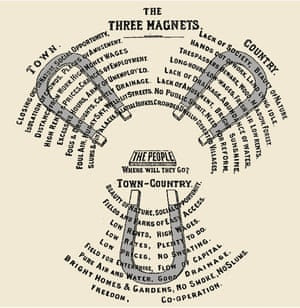
Concept of Three magnets 

He had no training in urban planning or design but excelled in creating places which he called “magnets” where people would want to come to reside and work. His garden cities were planned, contained communities surrounded by a green belt (parks), containing proportionate areas of residences, industry and agriculture. Garden city movement aimed at addressing the urban problems plaguing the industrial city of that time. Garden city concept was an effective response for a better quality of life in overcrowded and dirty industrial towns which had deteriorated the environment and posed serious threat to health. 

Garden city movement had the “Three Magnets” to addresses the question ‘Where will the people go?’ the choices being ‘Town’, ‘Country’ or ‘Town Country’.

Concept of three magnets

Town 

The pull of ‘Town Magnet’ are the opportunities for work and high wages, social opportunities, amusements and well – lit streets. It was closing out of nature, offered isolation of crowds and distance from work. But it came at a cost of foul air, costly drainage, murky sky and slums. Town life has good and bad characteristics. Positive and negative aspects of town include; 
  •  Social opportunity 
  •  Closing out of nature 
  •  Isolation of crowds 
  •  High rents and prices 
  •  Places of amusement 
  •  Foul air and murky sky 
  •  Chances of employment 
  •  Slums and gin palaces 
  •  High money wages 
  •  Costly drainage 
  •  Well-lit streets 
  •  Palatial edifices 

Country 

The pull of ‘Country Magnet’ is in natural beauty, fresh air, healthfulness. It offered natural beauty, low rents, fresh air, meadow but had low wages and lack of drainage. Country has dullness, lack of society, low wages, lack of amusements and general decay. Positive and negative aspects of town include; 
  •  Beauty of nature 
  •  Lack of society 
  •  Land lying idle 
  •  Hands out of work 
  •  Wood, meadow, forest 
  •  Trespassers beware 
  •  Fresh air 
  •  Low wages 
  •  Low rents 
  •  Lack of drainage 
  •  Abundance of water 
  •  Lack of amusement 
  •  Bright sunshine 
  •  No public spirit 
  •  Need for reform 
  •  Crowded dwellings 
  •  Deserted villages

Town- Country 

It was a combination of both town and countryside with aim of providing benefits of both and offered beauty of nature, social opportunity, fields if easy access, low rent, high wages and field of enterprise. Thus the solution was found in a combination of the advantages of Town and Country – the ‘Town Country Magnet’ – it was proposed a town in the country, and having within it the amenities of natural beauty, fresh air and healthfulness. Thus advantages of the Town – Country are seed to be free from the disadvantages of either. Town-country combination has the advantages of both aspects. 

  •  Beauty of nature 
  •  Peace all-over the places 
  •  Social opportunity 
  •  Cumulative growth 
  •  Fields and parks of easy access 
  •  Equal chances 
  •  Low rents- high wages 
  •  Low rates- plenty to do 
  •  Low prices- no sweating 
  •  Field for enterprise- flow of capital 
  •  Pure air and water- good drainage 
  •  Bright homes & gardens- no smoke, no slums 
  •  Freedom- co-operation

Principles of Garden City 

  • Co-operative holding of land to insure that the advantage of appreciation of land values goes to the community, not the private individuals 
  • Economic and social advantages of large scale planning 
  • Establishment of cities of limited size, but at the same time possessing a balanced agricultural industrial economy 
  • Urban decentralization 
  • Use of a surrounding green belt to serve as an agricultural recreational area

Features of Garden City 

An ideal garden city is a compact town of 6000 acres, 5000 of which is permanently reserved for agriculture. It accommodates a maximum population of 32,000. There are parks and private lawn everywhere. Also the roads are wide, ranging from 120 to 420 feet for the Grand Avenue, and are radial rather than linear. 
Commercial, industrial, residential, and public uses are clearly differentiated from each other spatially. Additional elements include unified land ownership –co-operatives, there was no individual ownership of land. Local community also participated in the decision making regarding development. As we can see in the diagram, there is a central park containing public buildings. It is surrounded by shopping streets which are further surrounded by dwelling units in all directions. The outer circle contains factories and industries. Rail road’s bypasses the town, meeting the town at tangent.
After a city reaches its target population, new interconnected nodes can be developed. A Garden city is built up and its population has reached 32,000. It will grow by establishing another city some little distance beyond its own zone of ‘country’, so that the new town may have a zone of country of its own.
Sir Ebenezer Howard’s Garden city

Circular city growing in a radial manner or pattern

  • Divided into six equal wards, by six main Boulevards that radiated from the central park/garden 
  • Civic institutions (Town Hall, Library, Hospital, Theatre, Museum etc. ) are placed around the central garden
  • The central park enclosed by a crystal palace acts as an arcade for indoor shops and winter gardens 
  • The streets for houses are formed by a series of concentric ringed tree lined avenues 
  • Distance between each ring vary between 3-5km 
  • A 420 feet wide, 3 mile long, Grand avenue which run in the center of concentric rings , houses the schools and churches and acts as a continuous public park 
  • The municipal railway was placed in another ring closer to the industrial ring, so that the pressure of excess transport on the city streets is reduced and the city is connected to the rest of the nation.

Main components of Howard’s Garden city movement 

1) Planned Dispersal 

The organized outward migration of industries and people to towns of sufficient size to provide the services, variety of occupations and level of culture needed by a balanced cross – section of modern society. 

2) Limit of Town Size 

The growth of towns to be limited, in order that their inhabitants may live near work, shops, social centers and each other and also near open country. 

3) Amenities 

The internal texture of towns to be open enough to permit of houses with private gardens, adequate space for schools and other functional purposes, and pleasant parks and parkways. 

4) Town and Country Relationship 

The town area to be defined and a large area around it reserved permanently for agriculture; thus enabling the farm people to be assured of a nearby market and cultural center, and the town people to have the benefit of a country situation. 

5) Planning Control 

Pre – planning of the whole town framework, including the road – scheme and functional zoning; the fixing of maximum densities; the control of building as to quality and design, but allowing for individual variety; skillful planting and landscape garden design. 

6) Neighborhoods 

The town to be divided into wards, each to some extent a developmental and social entity. Two garden cities were built using Howard’s garden city movement concept are Letchworth Garden City and Welwyn Garden City, both in Hertfordshire, England. 

Letchworth Garden City 

The first garden city developed in 1903 by Barry Parker and Raymond Unwin was Letchworth garden city. It is 34 miles away from London. It has an area of 5000 acres with 3000 acres of green belt. It had an agricultural strip at periphery to check the invasion of urban area i.e. the sprawling. It showed Howard’s general principles, including the communal ownership of the land and the permanent green belt has been carried through. It was a town of homes and gardens with ample open spaces and a spirited community life. A great attention was paid to landscaping and planting.
  • Its plan was based on population of 30000 with living area of 1250 acres and 2500 acres of rural green belt. 
  • Communities ranged from 12000 – 18000 people, small enough which required no vehicular transportation. 
  • Industries were connected to central city by rapid transportation. 
  • In 30 years, the city developed with 15000 population and 150 shops, industries. 

Welwyn Garden City

It was the second garden city founded by Sir Ebenzer Howard and designed by Louis De Soissions in 1920 and was located 20 miles from London. It was a town visually pleasing and was efficient technically and was human in scale. 
  • It started with area of 2400 acres and 40000 populations. 
  • Had a parkway, almost a mile long central mall. 
  • Town laid out along tree-lined boulevards with Neo Georgian town center. 
  • Every road had a wide grass verge. 
  • In 15 years – developed with 10000 population and 50 shops, industries. 

Failure of Garden Cities

Letchworth slowly attracted more residents because it was able to attract manufacturers through low taxes, low rents and more space. Despite Howard’s best efforts, the home prices in this garden city could not remain affordable for workers to live in. Although many viewed Letchworth as a success, it did not immediately inspire government investment into the next line of garden cities. In frustration, Howard bought land at Welwyn to house the second garden city in 1919. The Welwyn Garden City Corporation was formed to oversee the construction. But Welwyn did not become self-sustaining because it was only 20 miles from London. Even until the end of the 1930s, Letchworth and Welwyn remained as the only existing garden cities.

Land Use and Land Value Theory of William Alonso

 William Alonso (Location and Land Use: Toward a General Theory of Land Rent, 1964) attempted to apply accessibility requirements to the city centre for various types of land use (housing, commercial, and industry). According to his theory, each land use type has its own rent gradient or bid rent curve. The curve sets the maximum amount of rent any land use type will yield for a specific location. Households, commercial establishments, and industries compete for locations according to each individual bid rent curve and their requirements for access to the city centre. 

All households will attempt to occupy as much land as possible while staying within their accessibility requirements. Since land is cheaper at the fringe of the city, households with less need for city centre accessibility will locate near the fringe; these will usually be wealthy households. Poor households require greater accessibility to the city centre and therefore will locate near the centre, competing with commercial and industrial establishments. This will tend to create a segregated land use system, because households will not pay commercial and industrial land prices for central locations In 1960 William Alonso completed his dissertation which extended the von Thünen model to urban land uses. His model gives land use, rent, intensity of land use, population and employment as a function of distance to the CBD of the city as a solution of an economic equilibrium for the market for space.

                                                                                  Bid rent curve

Land Value 

Land value can be defined as the monetary cost of the land. It can be the cost of undeveloped land or a built property, but land value is primarily associated with a vacant plot. When discussing the importance of a built structure the term “property value” is more appropriate. 

Factors Affecting Land Value 

The land value is determined by the economic principle of highest and best use of land which produces the highest net return in any term, over a period. The property value is dependent on the structural attributes, land rates, land use and the location of the land. It is determined by the specific character of the land such as land use, location, accessibility, aesthetics, etc 

1) Physical Attributes 

These include quality of location, topography, climate, availability of water, sewer lines, etc. More and better facilities are attributed to a higher price of land. Topography further has a direct effect on the construction cost and thus the overall development cost. The facilities thus developed on an uneven land will have a much higher cost as compared to the flat plain. 

2) Accessibility to Economic Activities 

The more easily economic activity is accessible, the more is the value of the land. For example, most of the metropolitan cities have the maximum land values at the center, or at the central business district of the city. This is because of the nearness to the economic activities and workplace. This factor affecting land value is the sole most important factor which led to the development of various land price models in urban economics. 

3) Neighborhood Amenities 

The cost of land is also affected by the availability of the facilities such as shopping areas, medical facilities, school, parks& playgrounds, and other basic need of the humans. This helps in saving the time of people every day, the time saved adds up the cost of land. Also, the reduced travel and reduced trip distance will directly have the monetary benefits of the person residing in an area with many such facilities in proximity. 

4) Present and Future Land Use 

The value of the land is also determined by the land use permitted in the land premises. For example, if we compare the values of two lands of same prices and same location but the land use permitted in the lands are different, one is commercial and one is residential. In such case the value of the land with the land use which has more rate of return over a period of time will be valued more. People are willing to pay a higher amount for commercial land, in some cases industrial or institutional land use might attract even. 

5) Demand and Supply Function 

With the significant demographic changes in the cities with time, the need for land also increases with the same factor, with the increase in population there is an increase in economic and other activities. This directly increases the demand in the of the land components. The anticipation of high yields may also induce false scarcity of land; hence the location advantages of the properties at any time within the urban boundaries and hence causes economic values of land to be increased. For any site, there are specific points of transition in use, closely related to the infrastructure and services, where a jump in property value is likely to happen.

6) Location and Transport Linkages 

The property located in the area of high level of infrastructure facilities or the one located in or adjacent to the area of intensive economic activities such as markets or industries have higher values. Transport linkages are also crucial since they govern the mobility and ease of movement to and from the area. Clearly defined hierarchy of roads, efficient public transportation and lack of congestion are some of the desired transportation attributes of any area. 

Residential land values are also observed to be in direct proportion to the hierarchical order of the adjacent road. The valuation of land is done keeping in mind the factor mentioned above; however, the actual selling price of an area is ultimately determined by the paying capacity of the buyer. All the factors mentioned above-affecting land value might give a price which no one is willing to pay, and thus the actual amount paid becomes the price instead of the evaluated price. 

Land Use 

Land use involves the management and modification of natural environment or wilderness into built environment such as settlements and semi-natural habitats such as arable fields, pastures, and managed woods. 

  • Residential land use 
  • Commercial land use 
  • Industrial land use 
  • Agricultural land use 
  • Recreational land use 
  • Transport space 
  • Public land use or Open space