

Author: Admin
Track2Training for students. Learn more on https://track2training.com
Benefits and Problems of Environmental Impact Assessment
Municipal Wastewater Treatment System
How to ensure Public Participation in Plan Formulation and Implementation
Public participation has gradually emerged in urban planning since 1960’s. China has introduced public participation concept in urban planning practices for over 20 years. The purpose of public participation is to change the pattern of elite planning, ensure the public benefits and democratic rights, improve the feasibility and practicability of the planning schemes together with the democracy in the planning decision making process.

The approach of planning should be shifted from top‐down to bottom‐up approach to make planning process more inclusive, comprehensive, and sustainable. Greater public acceptability is desirable, to ensure that plans are relevant. People can participate in the development process in the following realms:
- Pre‐plan participation in decision making in vision development, for identification of development priorities.
- Post‐plan participation before finalization and implementation of development programmes and priorities.
- Participation during implementation and evaluation of development programmes and project.
- Participation and sharing the benefits of development, managing the assets etc.
- e‐Platform and crowd sourcing are coming up as new modes of obtaining feedback speedily.
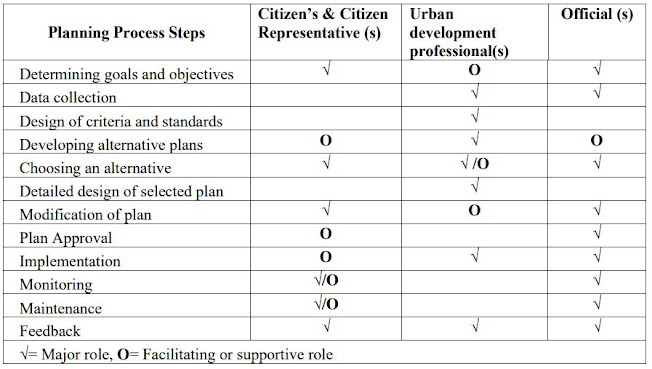
Taking into account the interest, attitude and behaviour of the people, role of urban development professionals and obligations of local authority, a system of participatory plan approach has been suggested.
The suggested indirect participation of the people is ensured through elected representatives in the Municipal Council / Corporation and Ward committees. The direct participation can be through individuals, citizens, neighbourhood, business, consumer and other such groups. There are several mechanisms and avenues for people’s participation available today, few of these have been presented below. Such mechanisms and avenues can be used to bring wider and more interactive participation of public in planning and developmental process.
Participatory planning approach
1) Community Design Characteristics
It is a multiple day interactive meetings, workshops and site walks/visits that fosters diverse and community sourced ideas.
2) Advisory Committees
Committees made up of representatives guide planning efforts over an extended period of time while regularly meeting during the planning process.
3) Low cost Demonstrations and Transformations
Use of blocks and day to day objects to create a low cost model of proposals for visual understanding. Relatively inexpensive temporary transformations are made to test the project and experience changes.
4) Focus Groups
Allow small groups of stakeholders to provide their knowledge of a project area and discuss their concerns and issues with local authority staff, planning consultants etc.
5) Other
Citizens report card, participatory mapping and participatory budgeting etc.
People can make contributions to the planning process at the implementation stage only if they are presented with a well-articulated and feasible framework of approaches, objectives, alternatives, etc. The participation of the people in local development programme provides the best guarantee that adequate action will be taken in the area itself. Public participation also creates an awareness of the problem and possible solutions among the people and thereby equip them as citizens to exercise choices relevant to development in a rational manner. When such a participation is institutionalized a stable base is created for decentralized exercise of power both on territorial as well as functional bases.
People’s participation has acquired greater significance in a country like ours which is striving hard since independence to bring an overall socio-economic change through democratic processes. Community development and Panchayati Raj were aimed at securing people’s participation in the planning and execution of the programme as a vital aspect of community development. To expand the democratic basis of development policies and administrative actions public cooperation has assumed great significance. Public cooperation is sought in almost each phase of governance and the entire multifaceted development of the people m the various fields, viz., social, economic, educational, cultural and moral. Involvement and sharing of the people in the process of development, particularly m decision making, planning and implementation is in the interest of good government and good administration
In a democratic society participation gives the ordinary citizen a means of voicing his opinion and of showing by his behaviour and action that he is able to take on responsibilities. It gives the ordinary citizen a chance to show his willingness to carry out constructive public work and to demonstrate his good citizenship by other means than periodically exercising his right to vote. Participation involves a factor of determination on the part of the person participating. It is in the sense participation means self-motion. People’s participation or involvement can be better understood in four senses:Participation in decision making
- Participation m implementation of development programme and projects
- Participation m monitoring and evaluation of development programmes and projects
- Participation in sharing the benefits of development principles
Public participation is the involvement of people in the creation and management of their built and natural environments. Its strength is that it cuts across tradition professional boundaries and cultures. The activity of community participation is based on the principle that the built and natural environments work better if citizens are active and involved in its creation and management instead of being treated as passive consumers. The main purposes of participation are :
To involve citizens in planning and design decision making processes and, as a result, make it more likely they will work within established systems when seeking solutions to problems
- To provide citizens with a voice in planning and decision making in order to improve plans, decisions, service delivery and overall quality of the environment
- To promote a sense of community by bringing together people who share common goals
Participation should be active and directed, those who become involved should experience a sense of achievement. Traditional planning procedures should be re-examined to ensure that participation achieves more than a simple affirmation of the designers or planners intentions.
Spatial Standards for Residential Area
- Accessibility (mainly involve road networks for the residence or inhabitants)
- Availability of infrastructure (drainage, sewerage, water supply)
- Institutional facilities (health and education)
- Site must be away from industrial areas
Table 1 Residential plot sizes for towns in India

Table 2 Plot area coverage and Floor Area Ratio
(Residential Building)

Table 3 Setback for residential buildings
(Front and Rear Setbacks)

Table 4 Setback for residential buildings
(Side Setbacks)

Table 5 Housing

Table 6 Density of Dwellings

Biological disasters
Biological disasters are causative of process or phenomenon of organic origin or conveyed by biological vectors, including exposure to pathogenic micro-organisms, toxins and bioactive substances that may cause loss of life, injury, illness or other health impacts, property damage, loss of livelihoods and services, social and economic disruption, or environmental damage. Examples of biological disasters include outbreaks of epidemic diseases, plant or animal contagion, insect or other animal plagues and infestation. Biological disasters may be in the form of:-
Epidemic affecting a disproportionately large number of individuals within a population, community, or region at the same time, examples being Cholera, Plague, Japanese Encephalitis (JE)/Acute Encephalitis Syndrome (AES); or,
Pandemic is an epidemic that spreads across a large region, that is, a continent, or even worldwide of existing, emerging or reemerging diseases and pestilences, example being Influenza H1N1 (Swine Flu).
Emergency Kit
- Oral Rehydration Solution (ORS) sachets.
- Tablet Paracetamol.
- Tablet Anti-diarrhoea.
- Tablet Anti-spasmodic.
WHAT IS AIR QUALITY AND HOW TO IMPROVE THE AIR QUALITY THROUGH PLANNING
THE MAIN ISSUES OF PSYCHOLOGY AND PEDAGOGY
| E-ISSN | 1829-1295 |  |
| P-ISSN | ||
| Publisher Name | Armenian State Pedagogical University after Khachatur Abovyan | |
| intercoop85@mail.ru | ||
| Language | Armenian,English,Russia | |
| Starting Year | 2007 | |
| Discipline | Psychology | |
| Frequency | Quaterly | |
| Website | http://www.miopap.com/en/em.html | |
| Country | Armenia | |
| Accessing Method | Online | |
| Articles Format | Hard Copy | |
| License Type | Normal | |
| Impact Factor |
1.569 (2015)0.58 |
|
| Description | ||
Demandas para a educação a distância no Brasil no século XXI
| E-ISSN | 978-85-93243-32-5 | |
| P-ISSN | ||
| Publisher Name | Antonella Carvalho de Oliveira | |
| selecao@atenaeditora.com.br | ||
| Language | Português | |
| Starting Year | 2017 | |
| Discipline | Educação | |
| Frequency | Semi Annually | |
| Website | http://www.atenaeditora.com.br/wp-content/uploads/2017/07/E-book-EAD-Vol-1.pdf | |
| Country | Brazil | |
| Accessing Method | Internet | |
| Articles Format | ||
| License Type | Normal | |
| Impact Factor |
0.88 |
|
| Description | A Atena Editora tem a missão de disseminar o conhecimento científico por meio da editoração e publicação de livros de qualidade. Seu trabalho, reconhecido nacionalmente, conta com a parceria de pesquisadores em diferentes áreas do conhecimento, o que potencializa reflexões e discussões com vistas a promover o desenvolvimento científico, econômico e sociocultural da sociedade dos dias de hoje, uma sociedade baseada no conhecimento. Nessa perspectiva, esta publicação aproximou pesquisadores, editores e estudiosos da área da Educação e movimentou iniciativas e desafios quanto às demandas de educação a distância no País. Este e-book, denominado Demandas para a EaD no Brasil no Século XXI, é o resultado desse movimento. O volume 1 desta obra está organizado em três eixos temáticos. O primeiro eixo, práticas pedagógicas, traz pesquisas e experiências de concepção, desenvolvimento e execução de soluções educacionais em diferentes contextos com o objetivo de ampliar a oferta de formação a distância, porém, não distante. Isso possibilita desenvolvimento contínuo do estudante, além de inclusão e formação ativa do aluno, e também exige capacitação docente, políticas definidas e recursos educacionais diversos. O segundo eixo, avaliação, apresenta uma análise do conceito que essa discussão envolve. Ainda é feita a descrição de práticas e tecnologias com o intuito de avaliar para além do quantitativo, o que permite a seguinte reflexão: avaliar, no século XXI, deve contemplar a verificação de mudanças cognitivas e comportamentais a partir do estímulo à autonomia nos estudos, que devem acontecer de modo ativo e participativo, em um contexto no qual aluno e professor comprometem-se com a formação. O terceiro eixo, evasão, destaca causas relevantes que interferem diretamente na evasão no processo de formação a distância. Com base em um olhar teórico e prático, destacam-se algumas estratégias de intervenção, como tecnologias educacionais e interatividade, para potencializar a permanência e o aproveitamento do aluno no curso. Considera-se que a oferta de formação exige o acompanhamento com políticas claras de formação e desempenho, independentemente da modalidade. O problema da evasão pode afetar diretamente a segurança e autoconfiança do indivíduo, bem como acarretar a subutilização de recursos pessoais e materiais da instituição ofertante. Assim, apresenta-se este e-book como uma oportunidade para refletir sobre os rumos tomados pela EaD no Brasil, assim como sobre as iniciativas e práticas de grupos em prol da efetivação e congruência dessa modalidade de ensino como uma oportunidade de formação continuada e inovação nas práticas educacionais. | |
Those Misbehaving With Speaker Must Be Permanently Barred
Coming straight to the nub of the matter, let me begin by first and foremost expressing my utmost disgust at the manner in which Members of Parliament (MPs) repeatedly misbehave with the Speaker and still get away with either very light punishment or no punishment at all! This must end now once and for all. No more condoning of such unruly behaviour by MPs who are a disgrace to the entire nation! At the first place, why is there so much of tolerance for such a shameful behaviour?

To put things in perspective, it may be recalled here that Samajwadi Party lawmaker Akshay Yadav was censured last year after he threw bits of paper at Speaker – Sumitra Mahajan as Opposition parties continued their protests against the old 500 and 1000 notes ban by the Centre when the Parliament convened. We all saw how an angry Ms Mahajan adjourned the House. She was visibly upset by such atrocious conduct!
Be it noted, when the House reassembled, the Speaker Sumitra Mahajan reprimanded Akshay Yadav for his conduct. Sumitra minced no words in saying that, “This conduct is not proper on the part of the member and also for the dignity and prestige of the House.” He was let off lightly after a warning from Speaker to refrain from such activities in future.
Let me be direct in asking: Why should MPs be let off even after they misbehave with Speaker? Why are they being encouraged to indulge in such reprehensible acts by letting them off very lightly? Why should they not be permanently barred from entering Parliament or at least barred for the remainder of their term?
Let me also ask some more unpalatable but pertinent questions here: Why in other services like Army or Civil Services are the officers immediately dismissed if they dare to throw papers at their seniors as it is deemed to be “gross misconduct”? Why only are politicians who become MPs or MLAs exempted from it? Why are they treated in such a VVIP manner even though they never tire in calling themselves “public servants”?
Why are they also not immediately barred from entering Parliament or State Assembly again? Why should they be let off after a mere warning or expulsion for just a few days which has just no effect on them which alone explains why Speaker has to repeatedly face insult and humiliation from MPs? Why Centre is not making any strict law in this regard? Why is it taking all this for granted?
Let me be upfront in asking: Why if Speaker refuse to concede to the demands of MPs which is the exclusive prerogative of Speaker to concede or not to concede do they start throwing papers at Speaker? Why can’t MPs be more civilized in their behaviour? Why do they have the liberty to insult Speaker as and when they like and yet continue to enjoy all the privileges of MPs and at the most get expelled for just few days not even months or years or for life?
Let me also be upfront in asking: Why some MPs think that it is their fundamental right to throw papers at Speaker? Why PM, Opposition Leader and MPs feel that throwing of papers should be taken very lightly and under no circumstances should they be expelled except for some few days? Are they not guilty of abetting MPs to time and again indulge in such unruly acts? Why they feel that issue should not be made of it and slight condemnation is enough? Why strict rules are not being framed so that those who don’t know how to behave properly are barred from ever entering Parliament again?
No prizes for guessing that once again on July 24 the Lok Sabha Speaker had to face unruly behaviour from MPs. Topics such as open defecation problem, mob lynchings and attack on Dalits were sought to be highlighted by the Opposition. Congress leader Mallikarjun Kharge put forward an adjournment motion notice pertaining to mob lynchings and attacks on Dalits which was rejected by the House. He claimed the Opposition was not given a chance to speak.
Let me be quick to ask here: Does this give an unfettered licence to MPs to indulge in gross misconduct by throwing papers at Speaker or start shouting at the top of their voices or tearing papers and throwing them all around in Parliament? Why all politicians feel that all this should be overlooked as MPs enjoy certain privileges? Should this be considered a privilege that MPs insult and humiliate a Speaker and that too a woman Speaker? Why is PM Narendra Modi silent on it?
What is most shocking is that 6 Congressmen who misbehaved were suspended for just 5 days which means that they have been given the unfettered licence to again after coming to Parliament indulge in similar misbehaviour and again face expulsion for just 5 days or so or even let off after a light reprimand which makes no difference to them at all! The suspended members are G Gogoi, K Suresh, Adhiranjan Chowdhary, Ranjeet Ranjan, Sushmita Dev and MK Raghavan.
Let me now also ask some more thought provoking questions: Should all Indians be proud that these 6 Congressmen who had the gall to misbehave with Speaker have been expelled for just 5 days? Why are there no strict rules that if any MP ever dares to throw papers at Speaker, he/she would be barred for life from entering Parliament? Why so lenient rules for MPs? Are such lenient rules not encouraging them to time and again storm to the well of the House and openly misbehave with Speaker as they like and yet continue being the Hon’ble MP?
Let me also not shy away from asking here some more pertinent questions: Why are all MPs including Speaker so conspicuously silent on it? Why should MPs be allowed to throw papers at Speaker and then get away with it by just a slight reprimand or expulsion at the most for few days as we saw recently in the case of these 6 Congressmen? When will this shameful mockery end? How long will the reputed Chair of Speaker be insulted by MPs so brazenly only to come back again to Parliament and repeat the same act?
Can anyone tell me: Why MPs have the liberty to shout as much as they like in Parliament and instead of spending time on relevant things waste time by shouting due to which crores of taxpayers money are frittered away at the drop of a hat and not stopping here further throw papers at Speaker and still continue being MPs for the rest of their life and get away with just a reprimand or few days expulsion from the House? Why should such unruly MPs not be banned for life from entering Parliament? Why should they not be jailed for few years for insulting Speaker? Why should they be paid any salary for being an MP when they don’t even know how to behave inside Parliament?
Truth be told, Sumitra Mahajan was candid enough to say that, “Sad with what happened. Question Hour should never be disrupted. Had told Kharge Ji, I will allow him to speak after Question Hour.” She also said that, “Creating ruckus at Well is non-disciplinary in itself but tearing up paper and throwing it on Speaker 4 times was worse.” Needless to say, the MPs threw pieces of paper and disrupted proceedings during the zero hour. The Speaker suspended them and adjourned the Lok Sabha till 2.30.
Truly speaking, this is not the first time that Congress MPs have been suspended for few days for their unruly behaviour. It may be recalled here that in 2015 also, the Lok Sabha Speaker Sumitra Mahajan had suspended 25 Congress MPs again for just five days for “persistently and willfully obstructing” the House. For how long will this be tolerated quietly? For how long will PM Narendra Modi keep a deafening silence on it?
All Indians must also ask themselves these highly relevant but totally neglected questions: For how long will MPs continue to throw papers and insult Speaker and laugh at being expelled for just few days not more than 5 days as we saw just recently and as we saw in 2015? Should we all be proud of this? Should such unruly MPs not be shown the door for the whole life or at least expelled for the remaining term? How long will Centre take no action on this which concerns the high office of Speaker itself? Who will like to become Speaker if such reprehensible acts are allowed to continue unabated and unpunished?
As if this is not enough, let me also ask here: Why is no news channel or no magazine or no one in media is debating it seriously? Why MPs have the privilege to throw papers at Speaker and escape with just 5 days expulsion from the House? Why even after 70 years of independence we see no strict rules being framed in this regard? This open mockery and most reprehensible act cannot be just condoned by expelling them for a few days.
It needs no rocket scientist to conclude that it is high time and now they must be barred for the rest of their life so that the right message goes out to all MPs that those who can’t respect Speaker have no right to be a MP! How many of us are aware that Speaker office comes above even the CJI? Should it be still insulted in such a brazen manner by MPs on the ground that they have been elected to represent people and raise their voice in Parliament?
Let me hasten to add here: Protest has to be done in a well dignified manner as we see in case of eminent MPs from all parties who never indulge in such unruly behaviour! Let there be no doubt on this! Mayawati also protested and even resigned but she didn’t throw papers at Speaker! That is the proper way!
All said and done, Parliament cannot be allowed to become a dirty fish market where conduct does not matter at all! Most unfortunately, this is what we are seeing in Parliament right now! How long will this reprehensible status quo continue? All MPs must realize this! The earlier they do, the better it shall be for the healthy functioning of our democratic system.
Parliament is the biggest citadel of democracy and few MPs cannot be allowed to hijack it and run it as they like without being checked by anyone or being allowed to escape very lightly! Such unruly MPs must be barred permanently from entering Parliament because they are just not fit for it! When once MPs will be shown the door for life for misbehaving with Speaker, no MP will have the audacity to ever dare to again misbehave with Speaker right inside the House!
But the moot question that arises here is: Will majority of MPs ever allow this to happen has it is they themselves who will be directly affected by such strict rules? MPs only know how to make rules for another but when it comes to them they are not ready for any change and feel that MPs have the right to contest from jails and even if some one is barred from all government jobs because he/she has criminal cases pending against him/her even though they may be false but when it comes to becoming MPs then even dacoits like the former bandit queen Phoolan Devi or anyone else have every right to become an MP! Can this ever be justified? Still our MPs justify this and say that all cases against them are “politically motivated”!
But what about unruly behaviour inside Parliament? For this also they will give hundred reasons! Most unfortunately, here too they are allowed to have the last laugh and continue as MP in spite of misbehaving with Speaker! Why no serious attempt has ever been made by any government to permanently disqualify all such MPs who misbehave with not just Speaker but with anybody else?
Why we see MPs hurling abuses on aeroplane while interacting with some staff official as we saw recently when a Shiv Sena MP slapped an official and even hurled abuses or with anyone else and yet not be expelled from Parliament? Why strict rules and regulations are there for only all other services and departments? Why similar rules not for MPs and MLAs?
Why they are treated as being above law? Why they are allowed to decide their own salary when we don’t see this happening in any other department? We have seen how they raise their salary 100 times or 10 times as per their whims and fancies! This too must end!
On a concluding note, it must be said that a beginning can be made in this direction by at least banning all those MPs and MLAs who misbehave with Speaker or with anyone who is presiding the concerned House! But again the moot questions are: Will this beginning ever be made? Will MPs and MLAs ever allow it to happen? Will the time ever come in our nation when those misbehaving with Speaker or with anyone presiding the House would be barred for life so that only those who display exemplary conduct are allowed to continue as MPs and MLAs? It is our national image that will enhance if this happens and huge taxpayers money won’t be wasted because of the shouting brigade who would then find no place in Parliament or in any State Assembly to sit and create a ruckus, throw papers at Speaker or at anyone who is presiding the concerned House and yet continue as Member of that House!
Sanjeeev Sirohi, Advocate,
s/o Col BPS Sirohi,
A 82, Defence Enclave,
Sardhana Road, Kaankerkhera,
Meerut – 250001, Uttar Pradesh.
Women Are Most Unsafe In Lawless West UP And UP
Let me begin on a very bitter note by pointing out that crime against women are multiplying most rapidly in UP and this is most felt in West UP which is the worst affected of all the regions of UP. Throwing of acid on woman or rape, gang rape, molestation and all other forms of crimes against women and girls are openly being perpetrated in West UP especially as also in UP which is certainly most concerning! This West UP with 26 districts has an area of 98,000 square km which is more than the area of many other states and has a population of more than 9 crore which is more than any other state except Maharashtra and Bihar. Here too areawise West UP is bigger than Bihar which has an area of 94,000 square km.

It is most hurting to read that dacoits are fearlessly killing innocent people on highway as happened most recently on May 25 and then in front of their men had the guts to gang rape the 4 women accompanying them just a kilometer away from the Yamuna Expressway in Greater Noida and when one man resisted he was shot in the chest from point blank range who died and others were thrashed badly! This clearly demonstrates that women are not safe even when accompanied with their entire family! Such incidents keep happening on a regular basis in West UP especially! 2 minor girls were gangraped recently in Moradabad! Criminals fully know that West UP has no high court bench and Allahabad High Court tops in the number of pending cases about 10 lakh pending cases and it would take ages before the cases are finally decided as they keep on lingering interminably and by the time they are decided they would die a natural death and victims would suffer endlessly travelling again and again 800-900 km away from West UP to Allahabad as West UP with 26 districts have no high court bench! This must change now if the fear of law is to be ingrained permanently in the minds of such criminals! We all know fully well that how a similar incident had triggered huge protests in July 2016 when a mother and daughter were gangraped in Bulandshahar! The newly appointed Chief Justice of Allahabad High Court Justice Dilip Babasaheb Bhonsle rightly lashed out at the law and order situation in UP and said that in Maharashtra women or girl venture out in night anywhere yet never such incidents of gang rape occur!
Still you see the irony! Maharashtra has 3 high court benches at Nagpur, Aurangabad and Goa apart from high court at Mumbai but West UP has not even a single bench of high court! In UP itself both high court at Allahabad and a single bench at Lucknow are located so close to each other with a distance of just about 150-200 km. Why not a single bench of high court was created in West UP even though Justice Jaswant Singh Commission appointed by former PM late Mrs Indira Gandhi very strongly recommended 3 benches for West UP and hilly areas adjoining it which now form a separate state – Uttarakhand at Agra, Nainital and Dehradun even though bench were created at Aurangabad in Maharashtra on its recommendations? Benches were also approved for Jalpaiguri in West Bengal and Madurai in Tamil Nadu! Why women victims have to travel so far away to Allahabad which is about 700-800 km away from most of the districts of West UP and be made to suffer so much for the inordinate delay and made to bear the huge expenses in fighting the case for her right in making sure that sexual offenders are sent behind bars?
It is so shocking and disgusting to see that West UP is fast becoming the epicenter of all kinds of crimes, rapes, gangrapes, brutal murders, mass murders, dacoity, robbery and what not! What is even more shocking to see is that all political parties barring Samajwadi Party have openly espoused the creation of a high court bench in West UP but still even after seventy years of independence we see no sign of it happening anytime soon! What is most shocking is that inspite of West UP accounting for more than half of the crime cases all over UP, not a single high court bench has been created here since 1947 till now even though a high court bench was created at Lucknow so close to Allahabad way back on July 1, 1948!
What an unbeatable irony that Allahabad High Court tops with maximum pending cases at 10 lakh and still it has least high court benches – only one at Lucknow for just 8 districts! No other High Court in India has 10 lakh or 9 lakh or 8 lakh or 7 lakh or 6 lakh or 5 lakh or 4 lakh or 3 lakh or even 2 lakh cases pending and still some of them have got 3 high court benches like Karnataka, Maharashtra and others but UP has just one Bench only! Why this step-motherly treatment for UP?
What a shame that man and boys in West UP have the guts to indulge in molestation as they 14 of them did in Rampur district in West UP when they molested and assaulted 2 girls in broad daylight in a village under Tanda police station in Rampur and also filed the act on their cellphone cameras and later put it on Facebook! One accused even lifts her. While the girls are seen pleading with them to let them go, the youths are seen laughing and misbehaving with them! Yet we hardly see any strict action! They have just no fear of law!
Such criminals know fully well that Allahabad High Court has the highest number of pending cases – about 10 lakh as compared to other states where the number of pending cases don’t exceed 1 lakh or at the most 2 lakhs cases! They know that they will easily get bail and by the time cases are finally decided they will die a natural death.
But see the unpalatable irony! Politicians are not prepared to create even a single bench anywhere in UP leave alone West UP! It is a matter of great shame that Allahabad High Court which last year on March 17 had completed its 150th year of establishment has the least benches in India – only one at Lucknow and that too just about 150-200 km away from Allahabad! Why no high court bench in West UP at Meerut or Agra or at Jhansi or some other place? We all know that Allahabad High Court is the biggest court in whole of Asia and also the oldest court! Still why it has least benches in India only one which is so close to Allahabad? If Lucknow is capital of UP, Bhopal is also capital of MP, Bhubaneshwar is also capital of Odisha and so is the case with many other big cities which neither have high court nor bench!
Why politicians have ensured that a high court bench was created for Lucknow about 69 years back on July 1, 1948 but not at any other place especially in West UP, Bundelkhand and Gorakhpur even 70 years later? Why Centre decided to create 2 more benches for Karnataka at Dharwad and Gulbarga for just 4 and 8 districts but not a single for West UP with 26 disricts? Why 230th report of Law Commission submitted in 2009 which recommended creation of more benches has only been implemented in Karnataka alone and not in UP, Bihar or other big states?
Why when UP which is among the largest States, has maximum population – more than 22 crore as CM Yogi Adityanath keeps pointing out every now and then, maximum districts – 75, maximum constituencies, maximum MPs – 80, maximum MLAs – 404, maximum PM including Narendra Modi, maximum pending cases – more than 10 lakh and here too West UP accounts for more than half of pending cases as noted by Justice Jaswant Commission about 57%, maximum Judges which earlier was 160 and increased to 200 in high court, maximum vacancies of Judges – 75 in high court, maximum poverty, maximum villages more than one lakh, maximum cities more than 700, maximum fake encounters killings, custody killings, maximum dowry cases, maximum rape and gang rape cases, maximum bride burning cases, maximum cases of human rights violations, maximum undertrials, maximum cases of crime, loot, arson and riots and here too West UP tops with Saharanpur riots, Meerut riots, Muzaffarnagar riots tarnishing our international reputation to the extent that former UN Secretary General Ban ki Moon termed UP as “crime and rape capital” of India and what not yet Centre is not prepared to create even a single bench for not just West UP but entire UP? Why when UP sends maximum MPs to Lok Sabha – 80, maximum MPs to Rajya Sabha – 30, maximum MLAs to State Assembly – 404 MLAs and maximum members to State Legislative Council – 100 MLAs and yet has least benches – only one and that too just 150 km away from Allahabad at Lucknow?
Rajnath Singh who is Union Home Minister while addressing public gathering in Patiyali constituency of Kasarganj district is on record stating in February 2017 that UP reported 7,673 riots, 4660 murder, 4096 robberies and 260 dacoities in just one year and has pledged on numerous occasions his unstinted support for a high court bench in West UP but even after his BJP led government is nearing 3 years in power yet it has failed to create even a single more bench of high court not just in West UP but anywhere in UP! Why?
Our former PM Atal Bihari Vajpayee had himself raised the demand for a high court bench for West UP in 1986 inside Parliament but even after more than 30 years we are nowhere!
Women are most unsafe in lawless West UP and UP! This alone explains why former UN Secretary General Ban ki Moon termed UP as “rape and crime capital” of India! More steps need to be taken to ensure safety of women. Central government led by PM Narendra Modi should stop coughing excuses now and note that it has completed 3 years in power and now its government is in power in UP also which makes it further easier to create more benches here! Dr Satyapal Singh Malik who is BJP MP had raised the bench issue in Parliament last year and demanded creation of 5 more benches but till now not even a single bench created here! Another Central minister and BJP MP Sanjeev Baliyan had raised the hope that a bench would be created in West UP before 2016 ends by reassuring the people but even now as 2017 has half ended we see no process in place for creating more benches in West UP or at any other place in whole of UP!
Why are all parties hell bent that under no circumstances should the unique record set by our first PM Jawaharlal Nehru of creating a high court bench at Lucknow on 1 July 1948 be broken before at least 100 years are completed? Seventy years have already been completed since independence! When Nehru allowed the creation of a bench at Lucknow so close to Allahabad way back in 1948 why no other politician allowed creation of a bench atr any other place till now? It was way back in 1955 that Dr Sampoornanand had recommended a high court bench for West UP at Meerut but even after 62 years we see no bench as Centre had refused then! Similarly many other UP CM had also recommended the creation of a high court bench here but to no avail! Why?
Lawyers of West UP have been striking work for 6 months without break several times demanding high court bench as they did in 2001 and for 3 months as they did in 2014-15 and we keep seeing strike nearly every month apart from the strike of Saturdays yet no bench! They even go on strike everySaturday since May 1981 to protest West UP not being given a bench even though Justice Jaswant Commission had explicitly recommended 3 benches! What they get is just fake assurances sometimes from Centre and sometimes from State! Nothing else!
Finally and most importantly, now no more delay and no more lame excuses! Now only and only more benches for UP! Only then will the more than 22 crore people of UP get some relief especially women and girls who are most vulnerable to all types of crimes and will not have to waste huge money and time to get justice which they don’t get usually in their lifetime as Allahabad High Court is overloaded with more than 10 lakh pending cases and more than half of High Court Judges post are still lying vacant! This open endless sham must end now!
If a high court bench is created it is “poorest of poor” and the most deprived and hapless women who will benefit most as they will be saved from the unnecessary trouble of travelling so far and spending so much extra money, time etc to just attend one hearing alone! Centre must have some pity on woman at least who are most unsafe in lawless UP and especially West UP and immediately order creation of more benches not just in West UP but also in other parts of UP where the crime rate is high! Crime rate is highest in West UP which necessitates creation of bench here on a war footing!
Sanjeev Sirohi, Advocate,
s/o Col BPS Sirohi,
A 82, Defence Enclave,
Sardhana Road, Kankerkhera,
Meerut – 250001, Uttar Pradesh.
Calcutta High Court Lashes Out At Centre Over Judges’ Shortage
Introduction
Coming straight to the nub of the matter, in a scathing attack on the Centre for delaying the appointment of Judges, the Calcutta High Court Bench comprising of Justices Dipankar Datta and Debi Prosad Dey onJuly 12 while hearing a bail plea for actor Vikram Chatterjee involving the death of a model Sonika Chauhan termed the shortage of Judges as a “very major problem” that the oldest high court of the country was encountering. The observations came as the Bench noted that the actor’s bail application could not be listed on time by the court due to which he was arrested leaving his plea infructuous. The Calcutta High Court while casting Centre’s nonchalant approach on such a key issue said it was working with a little less than 50 percent strength as the functional strength of Judges in the court was only 34, while the sanctioned number was 72.

Appoint More Judges
Neeedless to say, the Calcutta High Court has warned of “appropriate action” if urgent steps are not taken on it, while asking whether the nation could think of the Parliament functioning with half its strength. The Bench did not hesitate in making it absolutely clear that, “The time is now ripe for speaking our mind out or else this premier institution, which has stood tall despite several odds, would gradually cease to lose its efficacy. The Bar and the litigant public have been tolerant so long, but this Bench cannot remain a silent spectator waiting for the inevitable ire to explode.” Centre must stop coughing up a long list of excuses and should immediately sit on the drawing board and draw up plan to fill up all the vacancies of Judges in different High Courts without wasting any more time! There are more than 400 posts of High Court Judges that lie vacant across the country.
Not The First Time
Without mincing any words, let me say this point blank: This is not the first time this concern has been expressed. We all know it fully well that how earlier also former Chief Justice of India TS Thakur had expressed his utmost unhappiness over delay in appointment of Judges and said courts in the country now require more than 70,000 Judges to clear the pending cases. “While we (judiciary) remain keen to ensure that Judges appointments are made quickly, the machinery involved with the appointment of Judges continues to grind very slowly. The confidence of people on the judiciary has, over the years, multiplied. Over three crore cases are pending in various courts across the country,” said former CJI TS Thakur while speaking on the opening day of the centennial celebration of the Odisha High Court at Cuttack. A standoff between the judiciary and the government in the last 18 months over drafting of the new Memorandum of Procedure, the guidelines for appointing Judges, has further added to the problem. It is pending mainly due to differences on its content between the executive and the collegiums. It is a matter of grave concern that the friction between the two sides which repeatedly hit the headlines during the previous Chief Justice of India TS Thakur’s time is continuing even till now!
Be it noted, the former CJI TS Thakur said around 170 proposals for appointment of High Court Judges were now pending with the government. “Access to justice is a fundamental right and the government cannot afford to deny the people their fundamental right,” he said. Former CJI Thakur said shortage of Judges was one of the formidable challenges faced now. Of some 900 sanctioned posts of Judges in different High Courts of the country, there are over 450 vacancies, which need to be filled up immediately. He said while the Law Commission of India in 1987 had suggested having 44,000 Judges to effectively tackle the then number of pending cases, the country today has only 18,000 Judges. He also lamented earlier at a function in Delhi that the judiciary had been made the scapegoat for the mounting pendency of cases.
Fill Vacancies In All High Courts
It must also be reiterated here that the Judges shortage problem is not just confined to Calcutta High Court alone. It is also spread over all other major states barring one or two smaller high courts in smaller states. Why even in UP we see that Allahabad High Court has sanctioned strength of 160 Judges yet not even half the vacancies are filled up? This has been going on for many decades. This must end now and vacancies must all be filled up on a war footing!
Truly speaking, Centre cites hundred reasons as to why more benches cannot be set up in big states like UP like the one that there is lot of opposition from the High Court itself. Agreed! But who will dispute that the huge vacancies in all big courts like Allahabad High Court where more than 10 lakh cases are pending must be filled up completely. Not even one seat should be left vacant! But what we see instead is that more than half seats keep lying vacant and Centre is always ready to cite hundred reasons for not filling up the vacancies! This is just not in order! There is no shortage of talented lawyers who are fit to become High Court Judges. But Centre is not ready to fill the vacancies. Centre is also the biggest litigator due to which we see so many cases piling up in courts! Though there are no official figures, the government is the country’s biggest litigator, being a party in about half of the country’s 27 million pending cases.
Immediate Action
Now coming back to the main subject, the Calcutta High Court has criticized the Centre over alleged delay in appointment of Judges, while asking whether the nation could think of the Parliament functioning with half its strength. A Division Bench of Justices Dipankar Dutta and DP Dey said that, “Immediate action is called for to appoint maximum number of Judges to prevent the justice delivery system from collapsing, which seems to be imminent.” At the first place such a despicable situation should never have cropped up!
Top Priority To Appointing Judges
While craving for the exclusive indulgence of my esteemed readers, let me inform them that the Bench of Calcutta High Court has said that the functional strength of Judges in the Calcutta High Court was 34, while the sanctioned strength was 72. It said that, “The present functional strength is, therefore, a little less than 50 percent of the sanctioned strength.” The Calcutta High Court asked the Union Law Minister to intervene and give top priority to appointing Judges in the Calcutta High Court.
As things stand, the Bench observed that, “With less than half the sanctioned strength, the Calcutta High Court is reeling under an acute shortage of Judges to carry out judicial operations.” It also observed that, “The sanctioned strength of Judges in this Court is 72. Till a couple of years ago, the sanctioned strength was 58. Today, this Court has a functional strength of 34 Judges only. The present functional strength is, therefore, a little less than 50 percent of the sanctioned strength.”
Centre Must Act And Not Remain Silent
For my esteemed readers exclusive indulgence, let me also inform them that the Calcutta High Court minced no words in making it absolutely clear that, “The politeness of this Bench may not be understood as weakness on its part to be firm. It is made clear that continued silence of the central government in the matter of appointment of Judges in the near future, despite the concerns expressed in this order, would certainly be viewed seriously as interference in the course of administration of justice and followed by appropriate action as authorized in law”. Very rightly said!
Thought Provoking Questions On Vacancies
Let me be direct in asking: Why Centre is not ensuring that the vacancies of High Court Judges are not filled up completely? Why is Centre not serious on this? Why Centre does not realize that just paying lip service alone that it is dedicated to reduce the huge pending cases by appointing more Judges without translating it into action will lead the nation to nowhere except disaster as we are seeing right now which alone explains why Calcutta High Court felt constrained to speak out so hardly?
Let me also be direct in asking: Why Centre does not realize that the judicial system ,ay lose its efficacy if urgent measures were not taken as pointed out by Calcutta High Court? Why Centre does not realize that Calcutta High Court is reeling under an acute shortage of Judges which should have been filled up a lot earlier? Why Calcutta High Court is compelled to slam Centre for neglecting the so sensitive issue due to which it has accused the executive of being “authoritarian”?
To put things in perspective, the Calcutta High Court Bench’s observations came after it could not hear an anticipatory bail plea for more than a month after it was filed on June 5. The petitioner was arrested on July 6 and the plea was junked by the Bench on July 12 as infructuous. The Bench said that by February 2018, 10 Judges of the Calcutta High Court will retire, cutting the strength to 24 if no fresh appointment is made by that time.
Truth be told, the Calcutta High Court Bench very rightly asserted that, “Working at less than 50 percent strength, disposal of proceedings in this court have been quite high in the sense that it is complete with disposals of High Courts functioning with greater strength of Judges.” Having said this, it also made it amply clear that, “Nonetheless, it cannot be doubted that whatever is being achieved is far below the expectation of the litigants”. There can be no denying this.
Dearth Of Judges
The billion dollar question that the Bench of Calcutta High Court asked and then itself replied while pulling up Centre for continued neglect was “Can the nation think of the Lok Sabha in a functional state with half of its elected members? Similarly, can legislative assemblies function at half-strength? The answer cannot be in the affirmative.” Very rightly said. It also rightly said that, “The Lok Sabha and/or the Legislative Assemblies are important Constitutional entities and it would be a disgrace for the largest democracy of the world if elections were not conducted on time.” The Bench very rightly observed while slamming Centre for “neglecting” the problem for long and accusing the executive of being “authoritarian” that, “It does not require one to be super intelligent to make the right guess. It is the problem of dearth of adequate number of Judges in this Court. It has continued from yesteryears and assumed the character of a perpetual concern, which the powers that be having the wherewithal to address and resolve have neglected by their various shades of authoritarianism.”
High Courts Being Left In Lurch
It also cannot be lost on us that the Bench of Calcutta High Court said the Centre wastes no time in filling up vacancies in bureaucratic posts. It also hammered home the crucial point that, “This Bench is thus left to wonder as to why only in respect of filling up of vacancies in the High Courts, which are also high Constitutional authorities, there is such a brazen apathy and indifference of the political executive.” We thus see that the Calcutta high Court rebukes the Union Law Ministry for “brazen apathy, indifference”. Why only High Courts are being left in the lurch?
Independence Of Judiciary
Calling out the “brazen apathy and indifference of the political executive”, the Calcutta High Court Bench argued very strongly and effectively that, “The independence of the judiciary is regarded as a basic structure of the Constitution, rendering a particular High Court ineffective by adopting a step-motherly attitude cannot but draw the frown of a civilized society.” While delivering a stern warning for the Centre to pull its act together, the Court also asked the Registrar General to intimate the Union Law Ministry about the order on priority. The Court also directed that a copy of the order must be sent to Union law Minister Ravi Shankar Prasad “so that the matter relating to appointment of Judges in this court is given topmost priority”.
Conclusion
It needs no rocket scientist to conclude that there is lot of merit in what the Calcutta High Court Bench has said. Centre must take immediate action in this regard and fill up all the vacancies of Judges not just in Calcutta High Court but also in other High Courts. It is the common man especially undertrials who suffers the most due to lack of Judges and often end up being in jail for more the time than the offence which they are accused of and which if they had committed would still have come out of jail after completing their jail term! No more excuses! No more delays! The vacancies in High Courts must be filled up in all States without exception. This is the bounden duty of the Centre and it is not doing any favour on anyone by filling up the vacant posts.
Written by:
Sanjeev Sirohi, Advocate,
s/o Col BPS Sirohi,
A 82, Defence Enclave,
Sardhana Road, Kankerkhera,
Meerut – 250001,
Uttar Pradesh.
Popular Agriculture Related Schemes of Central and State Government in India
This section provides you useful links to avail various Citizen Services being provided by the Central and State/UT Governments in India. The list, however, is not exhaustive, as we are committed to adding more and more information about other services for which citizens and other stakeholders need to interact with the Government.

Schemes for Development of Agriculture and Farmers’ Welfare
The Department of Agriculture & Cooperation was earlier implementing 51 schemes for development of agriculture and welfare of farmers in the country. These schemes have recently been restructured into 5 Centrally Sponsored Missions, 5 Central Sector Schemes and 1 State Plan Scheme as given below:

I. Centrally Sponsored Missions
1. National Food Security Mission (NFSM)
2. National Mission on Sustainable Agriculture (NMSA)
3. National Mission on Oilseeds and Oil Palm (NMOOP)
4. National Mission on Agricultural Extension and Technology (NMAET)
5. Mission of Integrated Development of Horticulture (MIDH)
II. Central Sector Schemes
6. National Crop Insurance Programme (NCIP)
7. Integrated Scheme on Agriculture Cooperation (ISAC)
8. Integrated Scheme for Agriculture Marketing (ISAM)
9. Integrated Scheme on Agriculture Census, Economics & Statistics (ISACE&S)
10. Secretariat Economic Service (SES)
III. State Plan Scheme
11. Rashtriya Krishi Vikas Yojna (RKVY)
The schemes are constantly reviewed and evaluated at National, State and Zonal levels and taken up during meetings with States and during Zonal and National Rabi/Kharif season Conferences to identify the deficiencies in the implementation of the schemes. The deficiencies so identified are taken up with the State Governments concerned for remedial measures, viz modification of the schemes and/or its guidelines, for effective implementation.
Brief Details of Missions/Schemes
I. Missions
1. National Food Security Mission (NFSM)
NFSM aims to increase the production of rice, wheat, pulses and Coarse Cereals through area expansion and productivity enhancement; restoring soil fertility and productivity; creating employment opportunities; and enhancing farm level economy. The basic strategy of the Mission is to promote and extend improved technologies, i.e., seed, micronutrients, soil amendments, integrated pest management, farm machinery and resource conservation technologies along with capacity building of farmers.
2. National Mission on Sustainable Agriculture (NMSA)
NMSA has been formulated to make agriculture more productive, sustainable, remunerative and climate resilient by promoting location specific integrated/Composite Farming Systems; conserve natural resources through appropriate soil and moisture conservation measures; adopt comprehensive soil health management practices; optimize utilization of water resources through efficient water management to expand coverage for achieving ‘more crop per drop; develop capacity of farmers & stakeholders, in conjunction with other on-going Missions and pilot models in select blocks for improving productivity of rainfed farming by mainstreaming rainfed technologies.
3. National Mission on Oil seeds and Oil Palm (NMOOP)
The Mission aims to expand area under oilseeds, harness the potential in the area/ districts of low productivity, strengthening inputs delivery mechanism, strengthening of post harvest services besides a focus on tribal areas for tree bourn oilseeds.
4. National Mission on Agricultural Extension & Technology (NMAET)
The Mission has four components viz : Sub Mission on Agriculture Extension, (SMAE) Sub Mission on Seed and Planting Material (SMSP), (iii) Sub Mission on Agricultural Mechanization (SMAM) and (iv) Sub Mission on Plant Protection and Plant Quarantine (SMPP). The Mission aims to disseminate information and knowledge to the farming community in local language/ dialect in respect of agricultural schemes.
5. Mission of Integrated Development of Horticulture (MIDH)
The Missions aims to promote holistic growth of horticulture sector, including bamboo and coconut through area based regionally differentiated strategies, which includes research, technology promotion, extension, post harvest management, processing and marketing, in consonance with comparative advantage of each State/ region
and its diverse agro-climatic features; encourage aggregation of farmers into farmer groups like FIGs/FPOs and FPCs to bring economy of scale and scope; enhance horticulture production, augment farmers, income and strengthen nutritional security and improve productivity by way of quality germplasm, planting material and water use efficiency through Micro Irrigation.
II. Central Sector Schemes
1. National Crop Insurance Scheme (NCIP)
The Scheme aims to provide insurance coverage and financial support to the farmers in the event of crops failure as a result of natural calamities, pests and diseases as also to encourage farmers to adopt progressive farming practices, high value inputs and higher technology in agriculture.
2. Integrated Scheme on Agriculture Cooperation (ISAC)
The objective of the scheme is to provide financial assistance for the activities of cooperatives like agro-processing, marketing of food grains, input supply, development of weaker section cooperatives, computerization of co-operatives etc. as also to develop cooperative awareness amongst the people and to cater to the education and training requirements of cooperative personnel and State Government officials.
3. Integrated Scheme on Agriculture Marketing (ISAM)
The Scheme aims to to promote creation of agricultural marketing infrastructure by providing backend subsidy support to State, cooperative and private sector investments; to promote creation of scientific storage capacity and to promote pledge financing to increase farmers’ income; to promote Integrated Value Chains (confined up to the stage of primary processing only) to provide vertical integration of farmers with primary processors; to use ICT as a vehicle of extension to sensitize and orient farmers to respond to new challenges in agricultural marketing; to establish a nation-wide information network system for speedy collection and dissemination of market information and data on arrivals and prices for its efficient and timely utilization by farmers and other stake holders; to support framing of grade standards and quality certification of agricultural commodities to help farmers get better and remunerative prices for their graded produce; to catalyze private investment in setting up of agribusiness projects and thereby provide assured market to producers and strengthen backward linkages of agri-business projects with producers and their groups; and to undertake and promote training, research, education, extension and consultancy in the agri marketing sector.
4. Integrated Scheme on Agriculture Census, Economics and Statistics (ISACE&S)
The Scheme aims to collect/ compile data of operational holdings in the country to provide aggregates for basic Agricultural Characteristics for use as the benchmark for inter-census estimates.
5. Secretariat Economic Service (SES)
The Scheme aims to provide support and services to the employees/ officers of the Department of Agriculture & Cooperation including provision of office equipments, furniture, office accommodation, renovation of rooms, transport services, newspaper, Magazines, Publicity and Advertisement expenditure, etc.
III. State Plan Scheme
Rashtriya Krishi Vikas Yojana (RKVY)
The Scheme aims to incentivize the States to increase investment in Agriculture and allied sectors to achieved 4% growth in agriculture sector. The scheme is available for any agriculture activity that can increase production growth in the agriculture and allied sectors.
This information was given today by the Minister of State for Ministry of Agriculture and Food Processing Industries, Dr. Sanjeev Kumar Balyan in a written reply to Lok Sabha question.
How to make agriculture a profitable sector
The agriculture sector contributed 51.9 percent to India’s GDP in 1950. Since then it has been on a downside and it currently stands at 13.9 percent. However, a change from an agrarian-centric economy to an industry-centric economy is inevitable with the advent of industries. With industries growing at a faster pace than the rate at which trees are being planted, will there be a time when agriculture’s productivity dwindles to a null? If yes, is it already here?
Living in a country where the cattle is worshipped as a goddess, about 60 percent of the population was banking on agriculture for their main source of income during the 1950s. Despite half of the population still continuing with the profession, the returns are low. While urbanisation might be cited as a reason, it is hard not to neglect the fact that agriculture is no more a profitable sector. Infrastructure costs have started running high, with its maintenance cost and capital investment only adding on to the farmers’ misery. According to an article by The Hindu, the average recovery rate of the investments made by Indian farmer is only 30 percent.

Another cause for low productivity is small holdings of land with farmers. By owning a fragmented land, effective irrigation and optimum usage of fertilisers for crops becomes difficult, thus resulting in lower yields. In India, more than two-thirds of the crops lack proper irrigational facilities, albeit India being the second largest irrigated country after China. But improper irrigation can also lead to other problems affecting yield like soil erosion, salinity, etc.
In the wake of agriculture losing its lucrative appeal, budget 2016-17 has proposed to bring 2.85 million hectares under irrigation, Rs 2,87,000 to be donated and 100 percent electrification to all villages by May 2018. The government has also announced a couple of initiatives to resolve the farmers’ plight.
Some of the recent developments in the agriculture and allied sector are enumerated below:
Launch of Pradhan Mantri Fasal Bima Yojana
Farming has become an unreliable sector. Farmers are always unsure of the yield they’ll reap, but strive to draw the maximum benefits out of their investments and effort. Often farmers might be at the receiving end, with natural calamities like droughts and floods affecting their yield adversely. To resolve the problem of unpredictable nature of farming and prevent farmer suicides in the country, the Government launched PM Mantri Fasal Bima Yojana in early 2016. It’s a crop insurance policy with relaxed premium rates on the principal sum insured for farmers. Implemented with a budget of Rs 17,600 crore, this scheme will provide financial support to farmers and cover for their losses. This initiative is expected to go on floors from the next Kharif season of farming, that is from June 2016.
After green, white, and golden, it’s time for blue
The Cabinet Committee on Economic Affairs (CCEA) has approved Blue Revolution in India. It’s an integrated scheme designed to increase the productivity and profitability from aquaculture and fisheries resources, inclusive of both inland and marine. With a budget of Rs 3,000 crore offered by the government for the next five years, this scheme aims to maintain an annual growth rate of six to eight percent of the agriculture and allied sector.
Government to invest Rs 221 crore to improve milk productivity
India boasts of being the largest producer of milk in the world with an annual output of 130 million tonnes. However, with a milk-producing animal population of more than 118 million, the milk yields per animal is very low. To meet the steadily growing demand for milk, the National Dairy Development Board (NDDB) has announced 42 dairy projects, under a budget of 221 crore. These projects shall focus on improving the milk productivity of major milk-producing states like Uttar Pradesh, Maharashtra, Karnataka, Tamil Nadu and the likes.
Energy-efficient irrigation to be implemented
A report says that in India more than two-thirds of the arable area lacks proper irrigational facilities. Taking note of this, Power Minister Piyush Goyal said that the government is planning on investing Rs 75,000 crore to provide energy-efficient irrigational facilities to farmers, over the next three to four years. Under this scheme, close to 30 million energy-saving pump sets would be given to farmers and this cost would be recovered via savings in the electricity consumed. This would result in about 46 billion kWh of power being saved and creation of 20 lakh jobs.
Launch of Paramparagat Krishi Vikas Yojana
The government has launched Paramparagat Krishi Vikas Yojana in order to address the critical importance of soil and water for improving agricultural production. The government would support and improve the organic farming practices prevalent in India. Following cluster approach mode of farming, at least 50 farmers would form a group having 50 acres of land to implement organic farming. The government aims to cover 10,000 clusters and five lakh hectares of arable land under organic farming within three years.
Recently, the government has been active in investing in agricultural infrastructure such as irrigational facilities, mechanised farming, and warehousing. The growing use of genetically modified crops will also improve the sector’s contribution to GDP. While all of these initiatives look promising, in what way are they going to affect the current scenario is something interesting to watch out for.
 Eduindex
You must be logged in to post a comment.