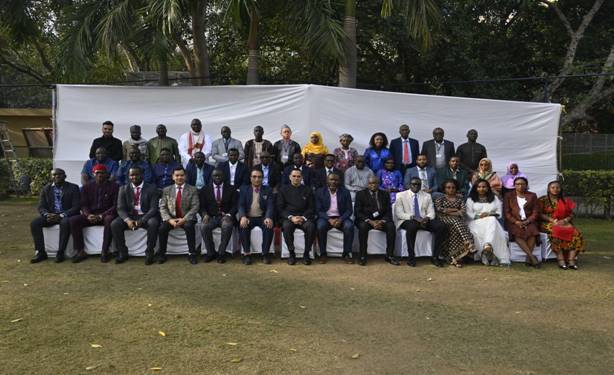
DoNER organises ‘North – East Sammelan’

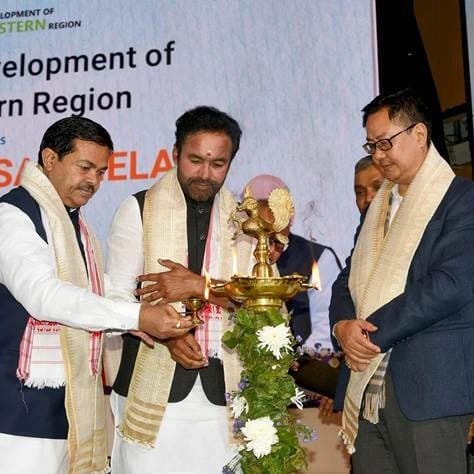
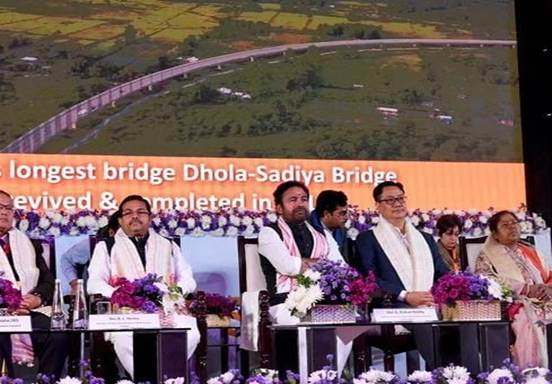
 Ministry of DoNER organized a North East Sammelan on February 4th, 2024 at Ambedkar International Centre, New Delhi. Minister for DoNER, Tourism and Culture Shri G. Kishan Reddy was the chief guest for the event and virtually laid foundation stone of the North Eastern Cultural and Social Institute in Dwarka built at the cost of Rs 116.38 crore and inaugurated the Barak Hostel at JNU, New Delhi, worth Rs 28.67 crore, in presence of Minsiter for Earth Science Shri Kiren Rijiju ji, Minister of State DoNER Shri B.L. Verma, Minister of State for Social Justice and Empowerment Km. Pratima Bhoumik and Minister of State for External Affairs and Education, Shri Rajkumar Ranjan Singh and other dignitaries.

The event garnered the presence of esteemed dignitaries, including Union Ministers, Members of Parliament from the North East, and MLAs from the North Eastern States. Noteworthy attendance comprised officers representing various cadres in the North East region, alongside officers from diverse backgrounds. The gathering, comprising an audience of 1000, notably included a substantial contingent of students from the North East studying in institutions across Delhi. The distinguished presence of Smt. Sangkhumi Bualchhuak, a recipient of the Padma Shri award for her commendable efforts in women empowerment, added a significant dimension to the occasion.

The North Eastern Cultural and Social Institute in Dwarka, with a budget of Rs. 116.38 crore, will feature diverse amenities, including an auditorium, a library-cum-reading room focused on materials related to the North Eastern Region, an Art Gallery showcasing the region, an exhibition hall, research center, sale outlets and a Guest House. The center will also house facilities like a State Handloom Display, a food court, and exhibition spaces. Concurrently, the construction of Barak Hostel for North-East Students at JNU, New Delhi, with an estimated cost of Rs. 28.675 Crore, featuring 214 rooms for both genders equipped with modern amenities, aims to enhance hostel accommodations for a larger population of North-East students.

During the unveiling ceremony of the two projects, Shri G. Kishan Reddy expressed that these initiatives have been long-awaited and will serve as focal points for cultural and regional integration. He emphasized that the North Eastern Cultural and Social Institute in Dwarka is anticipated to facilitate extensive discussions, meaningful discourse, and constructive exchanges aimed at promoting the holistic development of the North Eastern Region.

During his address at the Sammelan, the Union Minister for Development of North Eastern Region, Culture, and Tourism, Shri G Kishan Reddy, highlighted the North East Sammelan as a remarkable platform to spotlight the abundant opportunities and rich cultural diversity inherent in the North Eastern Region. He emphasized the unprecedented growth and development witnessed over the last decade, transforming the region from a neglected area to the Ashtalakshmi of Bharat

Shri Reddy underscored the significant investments made, amounting to over Rs. 5 Lakh Crores since 2014, driving comprehensive and inclusive development across the region. He also lauded the remarkable progress in maintaining peace and security, evident in the notable reduction of insurgency incidents and civilian casualties, reflecting the government’s steadfast commitment to fostering stability.

Furthermore, Shri Reddy highlighted the establishment of state-of-the-art cancer hospitals catering to the healthcare needs of the populace, underscoring the government’s dedication to enhancing healthcare infrastructure. Shri Reddy emphasized the substantial financial infusion into the region over the past decade, ensuring unhindered development. He noted a considerable increase of approximately 233% in expenditure, from Rs. 24,819 Crores in 2014-15 to Rs. 82,690 Crores in 2022-23, allocated by 54 Central Ministries to the North Eastern Region under 10% GBS (Gross Budgetary Support).

Union Minister for Earth Sciences, Shri Kiren Rijiju in his address said that he extended his heartfelt congratulations to the people of the North East as we witness the significant launch of Barak Hostel at JNU for NE students and the foundation stone laying of the North Eastern Culture and Social Institute in Dwarka, New Delhi. Shri Kiren Rijiju, further added that North East Region is witnessing a transformative phase of development be it physical infrastructure, connectivity with rest of India or emotional and cultural integration. He added that the government ensures monthly visits of union ministers to different States of NER to ensure that the grievances and issues are addressed at the highest level. He further said that the Government, under the visionary leadership of PM Shri Narendra Modi Ji is taking forward the developmental activities on the vision of ‘Ek Bharat Shreshtha Bharat’. He underscored the vital link between peace and Northeast development and highlighted the pivotal role of youth and emphasized that genuine progress in the region can only occur through people-led development, underscoring the critical need for sustained peace in the area.

Addressing the audience at the North East Sammelan, Union Minister of State Shri B.L. Verma highlighted that Prime Minister Shri Narendra Modi Ji has not only recognized but also underscored the crucial role of the North-East in the Nation’s development, setting the stage for comprehensive national prosperity. This emphasis signifies a dedicated commitment to uplifting the region and fostering inclusive growth for the entire country especially commending effective governance and initiatives for the Ashtalakshmi’s over all development.

The dignitaries inspected the stalls and exhibitions put up by PSUs of DoNER North Eastern Regional Agricultural Marketing Corporation (NERAMAC), North Eastern Handicrafts and Handloom Development Corporation (NEHHDC) showcasing the initiative sand achievements towards welfare of farmers and artisans of the region. A stall by the North Eastern Development Finance Corporation Ltd was also put up which showcased the milestones achieved in promoting SHGs, Small and micro enterprises and young entrepreneurs. The Ministers took the opportunity to engage with artisans and entrepreneurs present.

The Sammelan featured special videos that showcased PM Shri Narendra Modi Ji’s vision for roadmap and development for North Eastern Region. The event also featured videos highlighting the following achievements in the North-Eastern Region over the past decade.

The event concluded with a well-received cultural performance showcasing diverse traditional dances. Today’s initiatives collectively channel Government of India’s efforts to unlock the unparalleled potential of the North-East. The achievements outlined are not merely milestones but a testament to the Government’s commitment to a brighter and more prosperous future for the region.

***

DRDO carries out successful flight trials of High-speed Expendable Aerial Target ‘ABHYAS’

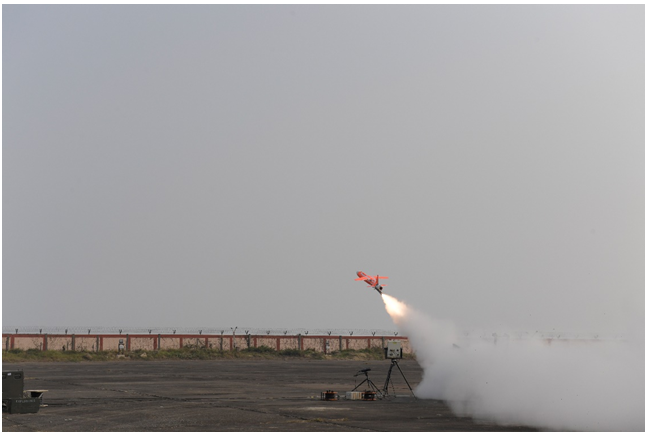
 Four flight trials of High-speed Expendable Aerial Target (HEAT) – ABHYAS were successfully carried out by Defence Research & Development Organisation (DRDO) from the Integrated Test Range, Chandipur in Odisha during January 30 to February 02, 2024. The trials were conducted with four different mission objectives in a revised robust configuration using a single booster designed by Advanced Systems Laboratory, Hyderabad to provide reduced launch acceleration.

The objectives like safe release of booster, launcher clearance and attaining the required end of launch velocity were achieved. During the flight trials, various parameters like required endurance, speed, manoeuvrability, altitude and range were successfully validated.

Designed by DRDO’s Aeronautical Development Establishment (ADE), ABHYAS offers a realistic threat scenario for practice of weapon systems. It is designed for autonomous flying with the help of an auto pilot indigenously made by the ADE. It has Radar Cross Section, Visual and Infrared augmentation system required for weapon practice. It has a laptop-based Ground Control System with which the aircraft can be integrated and pre-flight checks, data recording during the flight, replay after the flight and post-flight analysis can be carried out. ABHYAS requires minimum logistics and is cost effective compared to imported equivalents.

The systems tested recently were realised through Production Agencies – Hindustan Aeronautics Limited (HAL) and Larsen & Toubro (L&T) Defence. With identified production agencies, ABHYAS is ready for production. The system has export potential and can be offered to friendly countries.

Raksha Mantri Shri Rajnath Singh has congratulated the DRDO, the Armed Forces and the Industry for the successful flight trial of ABHYAS. The development of this system will meet the requirements of aerial targets for the Armed Forces, he said.

Secretary, Department of Defence R&D and Chairman DRDO Dr Samir V Kamat appreciated the efforts of the teams associated in the design, development and testing of the system.

***

MERA GAON MERI DHAROHAR

 The Government of India has decided to map and document all villages under Mera Gaon, Meri Dharohar (MGMD) Programme.  A web portal on MGMD has also been launched on 27.07.2023.  The MGMD seeks to compile comprehensive information detailing the life, history, and ethos of Indian villages and to make the same available to virtual and real-time visitors. Under the MGMD, information is collected under seven broad categories as given below-

  • Arts and Crafts Village
  • Ecologically Oriented Village
  • Scholastic Village linked with Textual and Scriptural Traditions of India
  • Epic Village linked with Ramayana, Mahabharata and/or Puranic legends and oral epics
  • Historical Village linked with Local and National History
  • Architectural Heritage Village
  • Any other characteristic that may need highlighting such as fishing village, horticulture village, shepherding village etc.

The Ministry of Culture is implementing a Scheme of Financial Assistance for Promotion of Art and Culture consisting 08 components through which cultural organizations are given financial assistance for the promotion of art and culture. The details of the Schemes, through which cultural organizations are given financial assistance under scheme of Financial Assistance for Promotion of Art and Culture are placed at Annexure-I.

Financial outlay of Rs.353.46 Crores is approved under the scheme of Financial Assistance for Promotion of Art and Culture consisting 08 scheme components for a period of five financial years w.e.f 2021-2022 to 2025-2026.

Government of India decided to celebrate Azadi Ka Amrit Mahotsava in befitting manner at national and international level during 15th August 2022 to 15th August 2023. Azadi ka Amrit Mahotsav has been formally launched on 12th March, 2021 viz 75 weeks prior to 15th August 2022.  Under the “Azadi Ka Amrit Mahotsav”, Govt. of India celebrated Janjatiya Gaurav Diwas, vide which, the contribution of Tribal freedom fighters was highlighted, and commemorations were held in remembrance of freedom fighters.

      Through the campaigns Qila aur Kahaniya and Wonder Caves, the contribution of India’s forts and caves to the freedom struggle were highlighted. Through Janjatiya Gaurav Diwas, the contribution of Tribal freedom fighters was also highlighted, and commemorations were held in remembrance of freedom fighters.

      Centenary of Jallianwala Bagh massacre commemorated from 13.4.2019 to 13.4.2020. A tribute paying ceremony on 13.4.2019 was led by Hon’ble President at the Memorial site where commemorative coin and postage stamp were released. Memorial has been renovated. Museum and Light & Sound show has been set up. Inauguration ceremony of renovated Jallianwala Bagh National Memorial, Amritsar was presided over by Hon’ble Prime Minister on 28.8.2021. 

     Government of India commemorated 125th birth anniversary of Netaji Subhash Bose from 23rd January, 2021 to 23rd January, 2023.  To mark the 125th Birth Anniversary of Netaji Subhash Chandra Bose, on September 8, 2022, Hon’ble PM unveiled Netaji Subhas Chandra Bose’s 28ft jet black granite statue near India Gate. Government of India also declared 23rd January as Parakram Divas.

ANNEXURE – I


A. SCHEME OF FINANCIAL ASSISTANCE FOR PROMOTION OF ART AND CULTURE:   The scheme consists of the following scheme components:


  1. Financial Assistance to Cultural organizations with National Presence

            The objective of the scheme component is to provide financial assistance  to reputed cultural organizations with national presence (‘not-for-profit’ organizations, NGOs, Societies, Trusts, Universities, etc.) with a view to disseminate and propagate art & culture by organizing various cultural activities at National/International level for promotion of art and culture of the country. This grant is given to such organizations which has a properly constituted managing body, registered in India having an All India Character with National Presence in its operation, adequate working strength and have spent Rs. 1crore or more during any 3 of the last 5 years on cultural activities. The Quantum of assistance under this scheme is up to Rs. 1 Cr.


  1. Cultural Function & Production Grant (CFPG)

            The objective of this scheme component is to provide financial support to NGOs/ Societies/ Trusts/ Universities etc. for Seminars, Conference, Research, Workshops, Festivals, Exhibitions, Symposia, Production of Dance, Drama-Theatre, Music etc.  The maximum grant provided under CFPG is Rs.5 Lakh which can be increased to Rs. 20 Lakh under exceptional circumstances.


  1. Financial Assistance for the Preservation & Development of Cultural Heritage of the Himalayas

            The objective of this scheme component is to promote and preserve the cultural heritage of the Himalayas through research, training and dissemination through audio visual programmes. The financial support is provided to the organizations in the States falling under the Himalayan Region i.e. Jammu & Kashmir, Himachal Pradesh, Uttarakhand, Sikkim and Arunachal Pradesh.  The quantum of funding is Rs. 10.00 lakhs per year for an organization which can be increased to Rs. 30.00 lakhs in exceptional cases.


  1. Financial Assistance for the Preservation & Development of Buddhist/Tibetan Organization

            Under this scheme component financial assistance is provided to the voluntary Buddhist/Tibetan organizations including Monasteries engaged in the propagation and scientific development of Buddhist/Tibetan Cultural and tradition and research in related fields. The quantum of funding under scheme component is Rs. 30.00 lakhs per year for an organization which can be increased to 1.00 crore in exceptional cases.

  1. Financial Assistance for Building Grants including Studio Theatres

            The objective of this scheme component is to provide financial support to NGO, Trust, Societies, Govt. Sponsored bodies, University, College etc. for creation of Cultural infrastructure (i.e. studio theatre, auditorium, rehearsal hall, classroom etc.) and provision of facilities like electrical, air conditioning, acoustics, light and sound systems etc. Under this scheme component, the maximum amount of grant is up to Rs.50 Lakh in metro cities and up to Rs.25 Lakh in non- metro cities.

(vi)       Financial Assistance For Allied Cultural Activities

The objective of sub-component is to provide financial assistance to all eligible  organizations  for  creation  of  assets  for  enhancing  the  audio-visual spectacle  for  allied  cultural  activities  to  give  firsthand  experience  of  live performances  on  regular  basis  and  during  festivals  in  open/closed areas/spaces  where  large  numbers  of  tourists/visitors  come  regularly  and during major events/festivals the number of visitors swells to lakhs. Grants are given to projects for procurement of audio-video equipment etc. Maximum  assistance  under  the  scheme  component,  including applicable duties & taxes and also Operation & Maintenance (O&M) costing for  five  years,  will  be  as  under:- (i)  Audio: Rs.1.00  crore;  (ii)  Audio+Video: Rs. 1.50 crore.

(vii)      Scheme for Safeguarding the Intangible Cultural Heritage:

This  scheme  was  launched  by  the  Ministry  of  Culture  in  2013  for safeguarding the intangible cultural heritage and diverse cultural traditions of the  country  with  the  objective  of  reinvigorating  and  revitalizing  various institutions, groups, NGOs, etc. so that they may engage in activities/projects for  strengthening,  protecting,  preserving  and  promoting  the  rich  intangible cultural heritage of India.

B.        Domestic Festivals and Fairs

The objective of this scheme is to provide assistance for holding the ‘Rashtriya Sanskriti Mahotsavs’ organized by Ministry of Culture.

This information was given by Union Minister for Culture, Tourism And Development of North Eastern Region Shri G.Kishan Reddy in Lok Sabha today.

***

FUNDS TO MAKE HERITAGE BUILDINGS ACCESSIBLE

 All ancient monuments and archaeological sites and remains declared as national importance are accessible to public.

So far as provisions for disability are concerned the activity of Archaeological Survey of India (ASI) are regulated by provisions of the Ancient Monuments and Archaeological Sites and Remains Act, 1958 considering feasibility, scope and norms to maintain original character of the monument Various facilities are provided at protected monuments, details thereof are at Annexure.

There is no separate provision for the said activities. However, the expenditure is met out from overall budget of ASI allocated for the conservation and maintenance. The expenditure incurred on the same including providing amenities during last 5 years is as under:

                                    (Amount in  Crore)

Year

Expenditure

2018-19

406.38

2019-20

435.61

2020-21

260.90

2021-22

270.00

2022-23

392.71


The Right of Persons with Disabilities Act, 2016 provides provision for the same.


DETAILS OF AMENITIES / FACILITY AVAILABLE FOR DIFFERENTLY ABLED-PERSONS (DIVYANG) AT PROTECTED MONUMENTS

SL.

NO.

STATE/UT

RAMP

WHEEL CHAIR

DIFFERENTLY ABLED (DIVYANG) TOILETS

SIGNAGE IN BRAILLE

AUDIO GUIDE

PATHWAY WITH TACTILE STRIP


Andhra Pradesh

3

8

10


Assam

3

5

6

2


Bihar

2

5

4

2

2

1


Chhattisgarh

1

3

10

2

1


Daman & Diu, Dadar Nagar Haveli (UT)

1


Goa

12

5

3


Gujarat

6

15

12

5


Haryana

4

6

5


Himachal Pradesh

3

3

2

1

1


Jammu & Kashmir (UT)

2

13

4

6


Jharkhand

1

4


Karnataka

21

40

25

13

1

1


Kerala

8

29

7


Ladakh (UT)

1

2

1


Madhya Pradesh

14

33

5

27

2

8


Maharashtra

4

14

13

3

25

1


Manipur

1

1


Mizoram

1

1

1


NCT Delhi

6

41

10

7

1

1


Odisha

11

8

9

7


Punjab 

3

7

4


Rajasthan

27

13

9

1

4


Tamil Nadu

27

47

38

22

9


Telangana

6

11

4


Tripura

3

3

2

6


Uttar Pradesh

14

31

31

20

1


Uttarakhand

20

25

10

11

2


West Bengal

7

30

10

27

11


Total

211

403

235

154

34

47

This information was given by Union Minister for Culture, Tourism And Development of North Eastern Region Shri G.Kishan Reddy in Lok Sabha today.

***

AZADI KA AMRIT MAHOTSAV

 Under Azadi Ka Amrit Mahotsav (AKAM) about 2.00 lakh events/ programmes have been organised in last two years. The entire country has participated in these events. The main events/programes organised under AKAM including honouring freedom fighters are as under:

1.     The Ministry of Culture organized the 217th Pazhassi Veerahuthi Raja Day on November 30th, 2022 and celebrated the contributions of Pazhassi Raja in Valliyoorkavu Temple ground, Mananthadavy.

2.      Har Ghar Tiranga –    The Hon’ble Prime Minister announced the Har Ghar Tiranga campaign on 22nd July 2022, encouraging people to bring home the National Flag to mark the 75th year of independence. More than 20 crore households hoisted the flag from 13th to 15th August 2022 and in the year 2023, more than 10 crore people uploaded their selfies with Tiranga  on harghartiranga.com.

3.     Rani Durgavati Commemoration: Hon’ble Prime Minister, Shri Narendra Modi performed ‘bhoomi poojan’ of ‘Veerangana Rani Durgavati Smarak aur Udyaan’ in Jabalpur in line with the 500th birth centenary celebrations of Rani Durgavati.

4.     SWASTI Zonal Rashtriya Sanskriti Mahotsav was organized from 29th September – 2nd October 2023 at Central Park, Connaught Place. Hon’ble Union Home Minister and Minister of Cooperation Shri Amit Shah graced the occasion on 2nd October with his presence.

5.      To mark the 125th Birth Anniversary of Netaji Subhash Chandra Bose, on September 8, 2022, PM unveiled Netaji Subhas Chandra Bose’s 28-ft jet black granite statue near India Gate. Govt. of India also declared 23rd January as Parakram Divas.

6.       On the special occasion of 150th Birth Anniversary of Sri Aurobindo, Hon’ble Prime Minister released a commemorative stamp and coin in honour of Sri Aurobindo’s memory.

7.      Shruti Amrut – Campaign under the theme “Cultural Pride” is a musical fiesta dedicated to honor the memories of unsung heroes. The performances by renowned singers is being organized across the nation from 1st October 2022 to 5th February 2023.

8.      An exhibition on Women Freedom Fighters was organised in Rampur Raza Library, Rampur on the occasion of birth anniversary of Rani Laxmi Bai from 19th to 29th November, 2022. From the start, Azadi Ka Amrit Mahotsav has made special effort to increase the awareness and spotlight unsung heroes of freedom struggle and enable people to pay their tributes to those who made out freedom possible.

9.     Large scale efforts such as Azadi ki Railgaadi aur station, events in Meghalaya commemorating Tirot Sing, national events connected to Lachit Borphukan, inauguration of Biplabi Bharat Gallery in Victoria Memorial are some of the key initiatives in this direction.

10.     Under the aegis of Azadi Ka Amrit Mahotsav,  an outreach program called KRANTITEERTH planned across India to commemorate unsung heroes, organisations, and places related to the freedom movement. The idea was to explore the marginalized or hidden histories of the leaders of India’s freedom struggle and bring out their historical contribution to the mainstream narratives. More than 190 events have been organized across Bihar, Uttar Pradesh, Jammu and Kashmir, Ladakh, Madhya Pradesh, West Bengal, Tripura, and Odisha and included painting competitions, debates, essay writing competitions, seminars, nukkad naataks, institutional activities for students and youths. Families of martyrs were also honoured and felicitated under Krantiteerth. More such events are still being organized.

11.    Digital Jyot campaign: Through a sky beam light installed in Central Park, Delhi, people paid their tributes to the sacrifices made by our Bravehearts. A website was created for people to pay their tributes digitally, and more approx. 97 lakh people paid their tributes.

12.    Meri Maati Mera Desh: A program that connected Indians with their land, history, and heritage – fostering national pride and conservation of India’s cherished cultural heritage. More than 2.33 lakh Shilaphalakams have been built across 36 States/UTs till date. Almost 4 crore Panch Pran pledge selfies have been uploaded on website till date. More than 2 lakhs Braveheart felicitation programmes have been organized across the country. On 31st October, Hon’ble Prime Minister poured mitti in the Amrit Kalash, paying his tribute to the Bravehearts of our country.

13.    Through the campaigns Qila aur Kahaniya and Wonder Caves, the contribution of India’s forts and caves to the freedom struggle were highlighted. Through Janjatiya Gaurav Diwas, the contribution of Tribal freedom fighters was also highlighted, and commemorations were held in remembrance of freedom fighters.

14.    Karpoori Thakur: Ministry of Culture celebrated the life and sacrifices of Karpoori Thakur ji on the occasion of his 100th birth anniversary on 24th January 2024. His contribution to freedom struggle and his honest public life as a politician were portrayed through an exhibition and a commemorative stamp and coin were released. On the eve of his birth centenary, the Government of India announced that Shri Karpoori Thakur Ji will be conferred with the Highest Civilian Honour, Bharat Ratna posthumously.

15.    A Digital District Repository has been compiled to discover and document stories of people, events, and places linked to the freedom struggle of India at the micro level of the district. As on date, about 14500 stories have been compiled and uploaded on the portal. These stories are broadly classified under the heading – People & Personalities, Events & Happenings, Hidden treasures -Built & Natural Heritage, and Living Traditions & Art Forms.

All Ministries/Departments, State Governments, UTs and their Attached/Subordinate/Autonomous Bodies, PSUs etc. Incur the expenditure on the events organised by them from their respective budget heads and there is no separate budget for AKAM.

This information was given by Union Minister for Culture, Tourism And Development of North Eastern Region Shri G.Kishan Reddy in Lok Sabha today.

***

ARUN JAITLEY NATIONAL INSTITUTE OF FINANCIAL MANAGEMENT

 The officer trainees of 31st batch of Probationers Training Course at the Arun Jaitley National Institute of Financial Management called on the President of India, Smt Droupadi Murmu at Rashtrapati Bhavan today (February 5, 2024). These officers are from Indian Civil Accounts Service, Indian Defence Accounts Service and Indian P&T (Finance and Accounts) Service.

Addressing the officers, the President said that it is a well-known fact that a good public financial management system is the very basis of good governance. The organized financial services that they represent have the onus to build and maintain a financial management system that helps in carrying out efficient functioning of the government. Therefore, their role in administration is of immense importance as they have to ensure propriety and prudence in governance. She urged them to shoulder this responsibility with utmost sincerity by acquiring and utilizing their abilities.

The President said that they have joined at a time when the country is undergoing digital transformation. There is a rising expectation among the public for greater efficiency in service delivery, while ushering in transparency and accountability. To address these concerns, it is imperative for the government departments to make the best use of technology and make the governance system citizen-centric, efficient, and transparent.  She said that their job is not only limited to the maximization of the utility of financial resources but also includes analysing the impact of policy changes and proposing reforms to improve the various systems of governance including the financial management systems. She advised them to keep pace with the world of ever-changing and advancing technology to undertake these tasks. She stated that their efforts and endeavours should be to devise mechanisms to use the latest technology and make our accounting and auditing systems seamless.

Please click here to see the President’s Speech –

Benefits of Working with NGO

 Collaborating with a Non-Governmental Organization (NGO) offers a multitude of benefits, both personally and professionally. Here are some key advantages of working with an NGO:

  1. Fulfillment of Social Responsibility:

    • Contributing to a cause: Working with an NGO allows you to actively participate in addressing social issues and contributing to positive change. It provides a sense of purpose and fulfillment as you align your efforts with a cause that resonates with your values.
  2. Skill Development and Networking:

    • Diverse roles and responsibilities: NGOs often operate with limited resources, providing opportunities to wear multiple hats and develop a broad skill set. You may find yourself involved in project management, fundraising, advocacy, communication, and more.
    • Networking opportunities: Engaging with an NGO exposes you to a diverse network of individuals, including professionals, activists, and volunteers. Building these connections can open doors to new opportunities and collaborations.
  3. Personal Growth and Learning:

    • Exposure to real-world challenges: NGOs often work on the front lines of social issues, exposing you to the realities of the challenges faced by communities. This hands-on experience fosters personal growth, resilience, and adaptability.
    • Continuous learning: Working with an NGO offers a dynamic environment where you are continually learning, adapting to new situations, and gaining a deeper understanding of social issues.
  4. Global Perspective:

    • Exposure to global issues: Many NGOs operate on an international scale, allowing you to gain insights into global challenges and solutions. This exposure broadens your perspective and fosters a more comprehensive understanding of diverse cultures and societies.
  5. Advocacy and Impact:

    • Platform for advocacy: NGOs often serve as platforms for advocating social change. By working with an NGO, you have the opportunity to amplify your voice and contribute to shaping policies and practices that impact communities.
    • Tangible impact: NGOs are driven by a mission to create positive change. Being part of such an organization allows you to witness and contribute to tangible outcomes, making a meaningful difference in the lives of individuals and communities.
  6. Sense of Community and Belonging:

    • Shared values: NGOs attract individuals who are passionate about similar causes. Working with like-minded people creates a sense of community and belonging, fostering a positive and supportive work environment.
  7. Professional Development and Resume Enhancement:

    • Resume enrichment: Involvement with an NGO enhances your resume by showcasing your commitment to social responsibility and your ability to work in diverse and challenging environments.
    • Leadership opportunities: NGOs often provide leadership roles, allowing you to develop and showcase your leadership skills, which can be valuable for future career advancement.
  8. Positive Impact on Mental Health:

    • Altruistic satisfaction: The sense of altruism gained from working with an NGO can positively impact mental well-being, providing a deeper sense of purpose and satisfaction in your professional life.

In summary, collaborating with an NGO offers a holistic and enriching experience, providing not only professional growth but also the satisfaction of contributing to positive social change.


Two-Week Advanced Leadership Development Programme on Public Policy and Governance for Senior Civil Servants of the African Region in Delhi in partnership with MEA

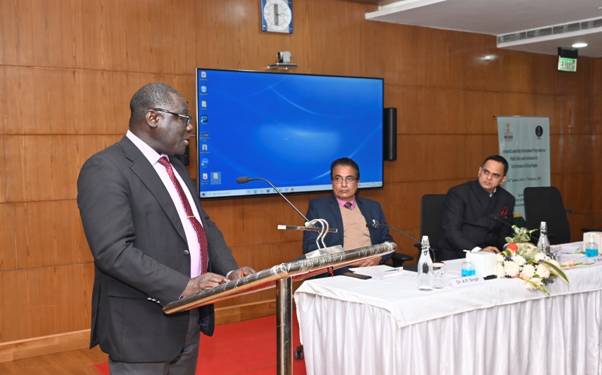
 The National Centre for Good Governance (NCGG), an apex-level autonomous institution of the Government of India, completed the Two-week Advanced Leadership Development Programme on Public Policy and Governance for Civil Servants of the African Region on 2-01-2024 that was organised for the first time by the centre. 34 senior officers from five African countries, Eritrea, Kenya, Ethiopia, Tanzania, and Gambia participated in the program. The participants included Mr. Tamsir Ann Presidential Advisor, Office of President, Government of Gambia, Mr. Mahat Abukar Yussuf Director Garissa County Government of Kenya, Mrs. Tumaini Luanda Mtetemela Principal Examination Officer University of Dododma Government of Tanzania, Mrs. Rahel Beyene Teklu Protocol Officer Ministry of Foreign Affairs Government of Eritrea, Mrs. Etmet Assefa Asamrie, Presiding Judge Federal Supreme Court of Ethiopia.

Shri V. Srinivas, Director General, National Centre for Good Governance & Secretary, Department of Administrative Reforms and Public Grievances (DARPG), addressed the valedictory session. The historic relationship between India and Africa and the efforts made under Prime Minister Modi to strengthen relations was presented. The valedictory session also discussed the Digital Public Infrastructure policies of India as a shared global public good for bringing citizens and government closer using technology, improving justice delivery systems in land administration, effective redressal of public grievances and the creation of a MyGov portal in Gambia with Indian collaboration. The delegates expressed the need to collaborate with various institutions of India which will help in providing people-centric governance to improve the quality of life of people in their respective country. They also requested to organize some more training programmes in future to Civil servants of African region having duration of two weeks. 

Dr. A.P Singh, Course Coordinator and Associate Professor NCGG, gave the welcome address and provided a comprehensive overview of the two-week program, detailing the diverse topics covered during the training. The program includes sessions on Changing paradigms of governance, Aadhar : a tool for good governance, Land record modernization, GeM, Swamitva Scheme, Public-private partnerships, Climate change policies, Sustainable development goals among others. He also highlighted that the participants of the programme had the valuable opportunity to partake in exposure visits, which proved to augment their overall learning journey. Among the planned visits were the Ministry of Rural Development, DMRC, AIIMS, PM Sangrahalaya, and Taj Mahal among others. 

The capacity-building program was supervised by Dr A.P Singh, Course Coordinator, Dr. Mukesh Bhandari, Associate Course Coordinator, Shri Sanjay Dutt Pant, Programme Assistant, and the dedicated capacity-building team of NCGG. The successful conduct of the 5-Nation Africa program represents a milestone for National Centre for Good Governance in its efforts as an apex capacity building institution for international civil servants under the ITEC program.

<

The Art of Writing: A Creative Odyssey

By Shashikant Nishant Sharma

 Writing is more than just words on paper; it’s an art form that allows individuals to express their thoughts, emotions, and imagination in a unique and captivating way. The art of writing is a dynamic and evolving process that involves creativity, discipline, and a deep understanding of language. In this article, we will explore the key elements of the art of writing and how aspiring writers can hone their craft.

  1. Embrace Creativity:
    At the heart of the art of writing is creativity. Allow your imagination to roam freely, breaking free from the constraints of reality. Create vivid worlds, intriguing characters, and compelling narratives that transport your readers to new realms. Embracing creativity means being open to unconventional ideas and finding inspiration in the mundane and extraordinary alike.

  2. Master the Craft of Language:
    Language is the painter’s palette, and words are the colors. Mastering the craft of language involves understanding the nuances of grammar, syntax, and vocabulary. Develop a rich and varied vocabulary to paint detailed images with your words. Experiment with different writing styles, tones, and voices to discover your unique literary fingerprint.

  3. Find Your Voice:
    Every writer has a distinct voice that sets them apart. It’s the tone, style, and perspective that make your writing uniquely yours. Finding your voice requires self-discovery and a willingness to be authentic in your expression. Don’t be afraid to experiment until you discover the voice that feels most natural and resonant with your inner self.

  4. Cultivate Discipline:
    While creativity fuels the art of writing, discipline provides the structure. Set aside dedicated time for writing, establish goals, and stay committed to your craft. Discipline is the force that turns fleeting ideas into tangible stories. Whether it’s a daily writing routine or a structured timeline for completing projects, cultivating discipline is essential for consistent and meaningful output.

  5. Edit and Revise:
    The first draft is just the beginning. The true art of writing involves the meticulous process of editing and revising. Be prepared to scrutinize your work, refine your language, and polish your prose. Editing is where the raw material transforms into a polished masterpiece. Embrace feedback from others and be open to making necessary changes to enhance the overall impact of your writing.

  6. Emotionally Connect with Your Audience:
    Great writing is not just about conveying information; it’s about evoking emotions. Whether it’s laughter, tears, or contemplation, strive to emotionally connect with your audience. Infuse your writing with authenticity and vulnerability, allowing readers to relate to the human experience within your words.

Conclusion:
The art of writing is a dynamic and deeply personal journey. It involves a harmonious blend of creativity, language mastery, self-discovery, discipline, and emotional connection. Aspiring writers should approach their craft with a sense of wonder and a commitment to continuous growth. Through the art of writing, individuals have the power to inspire, challenge, and transport readers to new worlds, making it a truly transformative and timeless form of expression.

References

Raimes, A. (1998). Teaching writing. Annual review of applied linguistics18, 142-167.

Sharma, S. N. How to Write a Grant Proposal in an Effective Manner to get Projects.

Weigle, S. C. (2002). Assessing writing. Cambridge University Press.


Creating a Blogger theme based on another platform&#39;s theme, like Colinear for WordPress

 Creating a Blogger theme based on another platform’s theme, like Colinear for WordPress, involves understanding the structure and design elements of the original theme and then adapting them to fit Blogger’s template system. While I can’t provide you with a fully functional Blogger theme here, I can guide you on how to get started.

Here are the general steps you can follow:

1. Understand Colinear Theme:

Visit the Colinear WordPress theme’s official page or documentation to understand its structure, features, and design elements. Note down key components like header, footer, sidebar, and main content area.

2. Set Up a New Blogger Blog:

If you don’t have a Blogger blog, create one. Go to Blogger and sign in with your Google account. Click on “Create a blog” to set up a new blog.

3. Access Blogger Theme Editor:

Once your blog is set up, go to the Blogger dashboard, and navigate to the “Theme” section.

4. Back Up Existing Theme:

Before making any changes, it’s a good practice to back up your existing Blogger theme. Click on the “Backup/Restore” button and download the current template.

5. Analyze Blogger Template Structure:

Familiarize yourself with the structure of the default Blogger template. Understand how it uses XML and widgets to define the layout.

6. Create HTML Structure:

Take the HTML structure from Colinear’s theme and modify it to fit Blogger’s XML format. Pay attention to the placement of widgets, headers, footers, and other key elements.

7. Add CSS Styles:

Blogger uses CSS for styling. Copy the CSS styles from Colinear’s theme and adapt them for Blogger. Ensure that the styling matches the HTML structure you created.

8. Customize Widgets:

Blogger uses widgets for various elements like the sidebar, header, and footer. Add and customize widgets based on the ones used in the Colinear theme.

9. Test Responsiveness:

Ensure that your Blogger theme is responsive. Test it on different devices and screen sizes to make sure it looks good everywhere.

10. Test Functionality:

Test all the functionality of your Blogger theme, including navigation, links, and any custom features.

11. Optimize for SEO:

Make sure your theme is optimized for search engines. Add relevant meta tags and descriptions.

12. Publish Your Theme:

Once you’re satisfied with your Blogger theme, click the “Apply to Blog” button to publish it.

Remember that creating a Blogger theme based on another platform’s theme requires careful consideration of the differences between the two platforms. Additionally, respect copyright and licensing terms if you’re using someone else’s design as a base.

Epic Explorer -Abd Al Razzaq

 By Yoshika Sharma

India has experienced many foreign footsteps on its land , some were explorers , some came from the invading purpose. Ancient and mediveal India experienced a lot of such explorers , one of them was Abd Al Razzaq ( 1413 AD ) . Razzaq was from Persia ad was a scholar in the court of king of Persia , Mirza Shah rukh of Timrud Dynasty between 1405 AD – 1482 AD . Mirza wanted to send a messenger to India and so he appointed Razzaq , nbut Razzaq refused to go as he was afraid of travelling , but after many requests by Mirza , Razzaq agreed to comme to India . 

Razzaq by road travelled from Herat to Hormuz and from Port of Hormuz he landed on the land of kozhikode , where he wanted to learn about the government and functioning of the area , but Razzaq was not allowed to meet the king for atleast 3 months and thus he thought of his mission as messenger was a failure. Just then the king of Vijaynagar empire Dev Raya II invited Razzaq to visit vijaynagar , Razzaq  was welcomed at Hampi ( the capital of vijaynagar) and was surprised to see the architectural glory of the buildings of the city . The city had 7 concentric circular walls and at the centre was the huge miraculous palace of the king . The walls were made such that there were houses and farms between the first and second walls , market and coin making factories between the third and fourth walls . Razzaq was greatky welcomed by the king Dev Raya II . As Dev raya wanted to learn more about their government and functioning . As time passed Razzaq was one of the most favourite courtiers of Dev Raya , Dev Raya also gifted Razzaq mansion to live , soon this favouritism towards Razzaq was not excepted by other courtiers and resulting in spread of fake rumours claiming that Razzaq is a spy and not a messenger from Persia . These news spread like wildfire  and finllay reached through the ears of king in which the king said that ” It had been asserted that you were not really sent here by Shah Rukh or else we would have shown you greater attention , if you come back on a future occasion into my territoies you shall meet with a worthy reception” ; by Dev Raya II ( from the book of Abd Al Razzaq . After which Razzaq was forced to flee vijaynagar and was sent back to Persia in 1445 . Razzaq the told all these happenings to Mirza  Shah rukh and then he himself sent an official letter to Dev Raya II regarding the visit of Razzaq . 

Razzaq ‘s experience as a traveller was great this experience made Razzaq a travel enthusiast from a reluctant traveller .

References

Hill, E. (1987). al-Sanhuri and Islamic law: the place and significance of Islamic law in the life and work of’Abd al-Razzaq Ahmad al-Sanhuri, Egyptian jurist and scholar 1895-1971.


Climate Impacts Awards: Unlocking urgent climate action by making the health effects of climate change visible

 The aim of this scheme is to make the impacts of climate change on physical and mental health visible to drive urgent climate policy action at scale. We will fund transdisciplinary teams to deliver short-term, high-impact projects that maximise policy outcomes by combining evidence generation, policy analysis, engaged research approaches and communication strategies.

Career stage:
Mid-career researcherEstablished researcher
Where your administering organisation is based:
Anywhere in the world (apart from mainland China)
Level of funding:

Up to £2.5 million

Duration of funding:

Up to 3 years

Next deadline

Next deadline

Full application deadline: 3 April 2024

View all key dates

About this scheme

In 2023, Wellcome launched the Climate Impacts Awards and funded 11 innovative global projects.

In 2024, we will fund projects that generate context-specific evidence using community knowledge and experiences to deliver actionable policy outcomes that can be scaled to multiple settings. We will prioritise funding for research that involves and serves the needs of communities most impacted by the health effects of climate change, and advances stories and narratives that tend to be absent in the media or underrepresented in public discourse (Perga et al, 2023). This will include generating and/or synthesising relevant data and insights (preferably across multiple sites or countries) on significant health issues arising from climate impacts.

We are looking for proposals with a clear theory of change and strong understanding of policy levers. Policy outcomes should be achievable within the award period, innovative in their design and should support meaningful and sustainable change. Proposals should describe the intended policy outcomes and how new insights and effective communication will influence these outcomes.

Teams must have prior demonstrable success in work that combines science, policy and society (Serrao-Neumann, et al 2021). We use the Organisation for Economic Co-operation and Development (OECD) definition of transdisciplinary research. Transdiscipilary research combines knowledge from different scientific disciplines, citizens, public and private sector stakeholders to address complex societal challenges. By engaging key stakeholders from the outset and embedding different expertise in the research design, we expect that teams will use evidence and impactful narratives on the effects of climate change on health to drive urgent policy change that supports collaborative solutions for climate change adaptation and mitigation. 

This scheme aims to make the impacts of climate change on health visible. There are many reasons the impacts of climate change could be invisible.

These include but are not limited to:

  • distance: decision makers not being based where the impacts are happening
  • ideology: political polarisation results in missing voices, disinformation or lack of information
  • unseen: some of the climate impacts of environmental drivers of health outcomes (for example, certain chemicals, pollutants or microscopic organisms) may not be visible and therefore may be ignored
  • linkage: the links between climate change and health effects not being explicitly made or understood
  • low priority: climate change’s effects on health are not given much focus due to competing priorities, unconvincing analyses and communications challenges.

Motivation for this scheme

Proposals that this funding will support

Eligibility and suitability

Who can apply, who can’t apply, what’s expected of your organisation

About you

You can apply for this award if you are a team leader who wants to advance transdisciplinary research on the impacts of climate change on health.

As the lead applicant, you will be expected to:

  • have experience leading transdisciplinary teams and working in the science-policy-society interface
  • have prior experience of research engaging with policy partners
  • have knowledge brokering skills such as the ability to bring together research teams and impacted communities
  • actively promote a diverse, inclusive and supportive environment within your team and across your organisation.

Your team can include researchers from any discipline (natural, physical and social sciences as well as technology) but must be transdisciplinary (using the OECD definition) and include expertise in policy, public engagement and communications. In addition to strong health expertise, we are particularly interested in teams that can demonstrate strong climate expertise.

During your award we expect you to:

  • fill an important evidence gap where the data and insights generation and/or synthesis could help drive urgent action
  • work across a transdisciplinary team involving researchers, policymakers, communicators, and other key stakeholders including impacted communities
  • co-develop and co-produce evidence to fill the identified gap with the involvement of impacted populations and communities (Vargas et al, 2022)
  • deliver a public engagement and communications strategy that embeds key stakeholders within the design and maximises the intended policy outcomes
  • provide evidence that can help support collaborative solutions to drive urgent climate action.

The award will be held by a lead applicant from an eligible administering institution, on behalf of a team of coapplicants.

At the time of submission the lead applicant:

  • must be able to demonstrate that they have a permanent, open-ended, or long-term rolling contract for the duration of the award
  • must be able to contribute at least 20% of their time to this award
  • must be based at an eligible administering organisation that can sign up to Wellcome’s grant conditions
  • can only be a lead applicant on one application to this scheme. Lead applicants can be included as a coapplicant on one other application, but they must be able to demonstrate that they have sufficient capacity for both projects if funded.

Wellcome cannot make awards to teams with co-lead applicants.

Coapplicants

  • Can be based anywhere in the world (apart from mainland China).
  • Must be able to contribute at least 20% of their time to this project.
  • Must be essential for delivery of the proposed project and provide added value to the team. For example designing the research, writing the application, providing training, knowledge brokering or managing the programme.
  • Must have a guarantee of workspace from their organisation for the duration of the award.
  • Must be based at an eligible organisation that can sign up to Wellcome’s grant conditions.
  • Must include in-country policy actors and/or practitioners, civil servants, private sector, civil society actors.
  • Do not need to have a permanent, open-ended, or long-term rolling contract at their organisation.
  • Can be at any career stage (please clearly outline the career stage of all coapplicants in the application). We would encourage research teams to consist of at least 1 early-career stage researcher.
  • Coapplicants can be listed on a maximum of two applications only. 

Your application can have a maximum of 7 coapplicants. Lead applicants should ensure that each coapplicant provides added value to the team in terms of the expertise and experience outlined in the criteria.

The team

Team members (coapplicants, staff, consultants) must combine researchers from different disciplines, policymakers, community stakeholder representatives and/or engagement experts. We are looking for transdisciplinary teams that can demonstrate strong health as well as climate expertise (particularly climate and meteorological science).

Additional expertise could span across:

  • specific sectors (for example, housing or agriculture)
  • economics
  • political science
  • private sector
  • public engagement
  • media or communications.

Your team should be able to demonstrate:

  • a history of collaborating together and successfully delivering projects among members of the team
  • a strong record of working in climate change and health research
  • a strong record of working with communities most affected by climate change
  • a strong record of working in collaboration with policymakers or decision makers involved in delivering climate solutions
  • experience designing and planning research projects with major policy implications
  • experience designing and delivering communications and/or public engagement activities, co-produced with impacted communities and key stakeholders with clear policy impact.

We will be looking across the team (including lead applicant and coapplicants) for the criteria identified on this page.

Administering organisations

The lead applicant must be based at an eligible administering organisation that can sign up to Wellcome’s grant conditions (can be based in any country apart from mainland China). The project must have a lead applicant based in all countries where the research activities are taking place.

Eligible administering organisations for the proposal can be:

  • higher education institutions
  • research institutes
  • non-academic healthcare organisations
  • not-for-profit or non-governmental organisations

One organisation can submit multiple different applications. 

What’s expected of the administering organisation:

We also expect your administering organisation to:

  • give you, and any staff employed on the grant, at least 10 days a year (pro rata if part-time) to undertake training and continuing professional development (CPD) in line with the Concordat. This should include the responsible conduct of research, research leadership, people management, diversity and inclusion, and the promotion of a healthy research culture
  • provide a system of onboarding, embedding and planning for you when you start the award
  • provide you with the status and benefits of other staff of similar seniority
  • if your administering organisation is a core-funded research organisation, this award should not replace or lead to a reduction in existing or planned core support.

Time spent away from research and part-time working

You can apply if you’ve been away from research (for example, a career break, maternity leave or long-term sick leave). We’ll allow for this when we consider your application. Lead and coapplicants can be part-time. There is no formal minimum, but part-time working needs to be compatible with delivering the proposal successfully.

Inclusive research design

The proposed research should be equitable, diverse and inclusive in a way that is appropriate to the place in which the research is conducted and the aims of the research or other activities.

This should focus on:

  • Who defines and does the research: we expect our partners to demonstrate to us that their research community has substantive input from, and engagement with, the primary end users or subjects of their research, be they patients, participants or policymakers.
  • How the research is done: we expect our partners to demonstrate to us that their research agenda and the design and conduct of their research substantively engages with the needs and values of the people and communities who are participating in, or are the subject of, their research.
  • Who benefits from the research: Wellcome already has a commitment to focusing on those most affected by our health challenges. Accordingly, we expect our research partners to be able to demonstrate within their research and activity plans that their outputs will be made meaningfully accessible and used by those who most need it and, if appropriate, those who participated in the research.

Who can’t apply

You cannot apply if you intend to carry out activities that involve the transfer of grant funds into mainland China.

Other Wellcome awards

  • An early-career researcher can be a lead applicant on one Wellcome award and a coapplicant on one other Wellcome award, or a coapplicant on two Wellcome awards.
  • A mid-career researcher can be a lead applicant on one Wellcome award and a coapplicant on two other Wellcome awards, or a coapplicant on three Wellcome awards.
  • An established researcher can be:
    • a lead applicant on two Wellcome awards, one as the sole applicant and one as lead applicant for a team, or both as the lead applicant for a team. They can also be a coapplicant on two other Wellcome awards; or
    • a lead applicant on one Wellcome award, as the sole applicant or lead for a team, and a co-applicant on three other Wellcome awards; or
    • a coapplicant on four Wellcome awards.  

The awards should be for different research projects, with no overlap in work packages.

Resubmissions

For teams that were shortlisted in the 2023 Climate Impacts Awards, we will only accept resubmissions if there are significant amendments to the application based on the feedback provided.

About your proposal

What is in scope and full application assessment criteria

Wellcome’s Climate & Health team will continue to modify the award each year, guided by learnings and insights from the past year and broader trends in the climate and health space. What is in/out of scope this year may not be the same in subsequent years, as well as the remit and criteria. 

In scope

  • Proposals where the primary focus is on the current or future direct and environmentally mediated physical or mental health outcomes attributable to climate change (Haines & Ebi 2019 for definitions), making the health effects of climate change visible.
  • Proposals that include the four key elements of:
    1. an evidence gap that can be filled in the short time available
    2. a clear policy pathway
    3. engaged research approach with key stakeholders identified
    4. a communications strategy that can drive change.

Out of scope

  • Proposals where the primary focus is on:
    • Socially mediated health effects (such as migration and livelihoods) – we are aware that all health outcomes have a social context but are looking for research where environmentally driven aspects of climate change are the primary driver(s) of a given health outcome.
    • Current or future health effects attributable to the consequences of climate change action (mitigation or adaptation). Wellcome is not looking to fund research on these unintended consequences of maladaptation through this award. We may consider funding opportunities on those topics in the future.
    • Current or future health effects attributable to the drivers of climate change (for example, fossil fuel emissions).
  • Proposals where the goal of the project is general advocacy for a specific issue, rather than specific policy opportunities that can be achieved in a realistic timeframe through targeted and co-produced evidence and communications activities.
  • Proposals where the four key elements are not articulated.
  • Proposals submitted in the first round of the scheme that were not shortlisted.
  • Proposals that were shortlisted in the first round that have not undergone major revision.

How applications will be assessed

Applications will be triaged internally at Wellcome with expert methods advisors. Shortlisted applications will be submitted for review by the Funding Advisory Committee which will make funding recommendations to Wellcome’s Climate & Health team. The team will use these as a basis for final funding decisions. The total number of projects we fund through this award will depend on several factors, such as the number and quality of applications received.

Wellcome has a preference for proposals focused on policy outcomes informed by communities most impacted by climate change in both HICs and LMICs. Wellcome does not have a preference for single or multi-country studies but does have a preference for proposals that aim to demonstrate the scale of the problem and the potential for climate action at scale.

There is no preference for proposals that generate new data versus synthesise available data. Data should be managed/collected following the FAIR Guiding Principles for scientific data management and stewardship.

The Funding Advisory Committee will assess applications based on the following criteria:

Theory of change (25%):

  • Problem articulation: ability to articulate the problem and identify the evidence gap. For example, if your proposal outlines a solution/s, guided by policy analysis and insight. Clarity about the policy opportunity and implications of the proposed activities.
  • Potential to have policy impact in the timeframe of the award. For example, is this work scalable or transferable?
  • Evidence of demand for this research.
  • Relevance of the proposed work in driving context-specific climate action.

Approach and methods (50%):

  • The quality, innovation and mix of methodologies proposed. For example, is the presented theoretical and conceptual framework informed by different perspectives (such as natural sciences, social sciences, epidemiological analysis, economic analysis, political analysis and climate sciences).
    • Justification for the chosen methods, including qualitative and quantitative work packages.
  • Relevance and innovation of the proposed communication strategy. For example, the ability to communicate the policy opportunity, implications of the proposed activities and engagement with key stakeholders.
  • The approach to engaged research:
    • Clear identification and justification of key stakeholders and impacted communities’ involvement (for example, local, or national governments, civil society, community-based organisations, international or multilateral organisations, private sector, local or national government).
    • Evidence of stakeholders and impacted communities contributing to the research design and research questions and their involvement is clearly shown throughout the lifespan of the proposed activities. For example, if the project responds to the needs, interests and capacities of the stakeholders and impacted communities.
    • The engagement methods and framework that will be used and how these are integrated and beneficial to the wider ambitions of the project.
  • Monitoring and evaluation to track and assess the results of planned activities throughout the lifetime of the project.

Team, skill and experience (25%):

  • Transdisciplinary teams: the team composition includes an appropriate combination of individuals and organisations with the capacity, skills and experience to deliver the project and its intended outcomes. Outline how your team will work across the science-policy-society interface and has expertise in climate and health.
  • Successful partnerships: evidence of a history of working together and using a transdisciplinary approach.
  • Evidence that the team has the relevant expertise to deliver the approach and methods outlined. For example, triallists, policy analysis, policy practice, engagement practices and communication strategies.
  • Evidence of a commitment to equity, diversity and inclusion. For example, your approach to recruiting a diverse team and how you will promote inclusion of members in the research and outputs produced.
  • Clear articulation of what a positive research culture is and how teams will foster this through their future work.

The maximum word count for the programme of work description is 3,000 words.

Applicants do not need to submit ethics approval to the administering organisation by the deadline but should give some consideration to potential ethical issues that may arise through the proposed work in the application.

Please provide any relevant links including publications, websites, social media and videos. We advise you to use links strategically, and be sure to include all of the crucial information in the text of the application as the reviewers are not required to go through each link. Any links must be written out in full URL format.

How to apply

Stages of application

1. Before you apply

2. Submit your application to your administering organisation for approval

  • Complete your application on Wellcome Funding.
  • View the sample application form.
  • Submit it to the ‘authorised organisational approver’ at your administering organisation for approval. Make sure you leave enough time for the approver to review and submit your application before the deadline. The approver may ask you to make changes to your application.

3. Administering organisation reviews your application and submits it to us

  • Your application must be submitted by 17:00 BST on the deadline day.  

4. Shortlisting

  • Shortlisting will be carried out internally as the application assessment criteria outlines above.  

5. Funding decision

  • An external expert committee will make funding recommendations to us based on which we will make final funding decisions.
  • You will receive an email notification of the funding decision soon after the decision has been made.
  • The reasons for a decision will be provided to unsuccessful applicants in writing.

Log in to our online grants system. You can save your application and return to it any time.

Top Fully Funded PhD and Postdoctoral Programs in Environment and Sustainable Development

By Shashikant Nishant Sharma

 As the global community continues to grapple with pressing environmental challenges, the need for qualified professionals in the field of environment and sustainable development becomes increasingly crucial. Pursuing a PhD or postdoctoral program in this field not only offers individuals the opportunity to contribute meaningfully to addressing environmental issues but also opens doors to diverse career paths in academia, research, policy, and more. In this article, we will explore some of the top fully funded PhD and postdoctoral programs in environment and sustainable development.

  1. Fulbright Scholar Program

The Fulbright Scholar Program is renowned for providing fully funded opportunities for scholars, including those in the field of environment and sustainable development. This program promotes international collaboration and cultural exchange, allowing scholars to conduct research, teach, or pursue advanced studies in the United States and other countries.

  1. European Environmental Agency (EEA) PhD Studentship Program

The EEA offers fully funded PhD studentships in collaboration with various universities across Europe. These programs focus on a wide range of environmental topics, including climate change, biodiversity conservation, and sustainable resource management. Scholars benefit from access to cutting-edge research facilities and a collaborative network of experts.

  1. Swiss Federal Institute of Technology (ETH Zurich) – Doctoral Programs

ETH Zurich is a prestigious institution known for its commitment to sustainability and environmental research. The university offers fully funded doctoral programs in environmental science and engineering, providing students with the opportunity to work on interdisciplinary projects and contribute to sustainable development.

  1. MIT Environmental Solutions Initiative – Postdoctoral Fellowships

The Massachusetts Institute of Technology (MIT) Environmental Solutions Initiative offers postdoctoral fellowships for researchers interested in addressing global environmental challenges. This program provides funding and mentorship to scholars working on innovative and impactful projects related to environmental sustainability.

  1. Australian Research Council (ARC) Centre of Excellence for Environmental Decisions – Postdoctoral Fellowships

The ARC Centre of Excellence for Environmental Decisions in Australia provides postdoctoral fellowships for researchers in the field of environmental science and sustainable development. This program supports projects aimed at enhancing decision-making processes for biodiversity conservation and ecosystem management.

  1. Chinese Academy of Sciences (CAS) – International Postdoctoral Exchange Fellowship Program

The CAS International Postdoctoral Exchange Fellowship Program encourages international collaboration in environmental research. This fully funded program allows postdoctoral researchers to work with leading Chinese institutions on projects related to environmental protection, climate change, and sustainable development.

  1. United Nations University – PhD Fellowships in Sustainability Science

The United Nations University offers fully funded PhD fellowships in Sustainability Science, focusing on research that addresses global sustainability challenges. Fellows have the opportunity to work with leading experts and contribute to policy-relevant research in areas such as climate change, sustainable development, and natural resource management.

Conclusion

Embarking on a fully funded PhD or postdoctoral program in environment and sustainable development opens up exciting opportunities for researchers to make meaningful contributions to the global effort to address environmental challenges. These programs not only provide financial support but also offer access to cutting-edge research facilities, expert mentorship, and a network of like-minded professionals. As the demand for skilled individuals in this field continues to grow, these top programs play a crucial role in nurturing the next generation of leaders and innovators committed to creating a more sustainable and resilient world.

References

Åkerlind*, G. S. (2005). Postdoctoral researchers: roles, functions and career prospects. Higher Education Research & Development24(1), 21-40.

Fairman, J. A., Giordano, N. A., McCauley, K., & Villarruel, A. (2021). Invitational summit: Re-envisioning research focused PHD programs of the future. Journal of Professional Nursing37(1), 221-227.

Ginther, D. K., & Heggeness, M. L. (2020). Administrative discretion in scientific funding: Evidence from a prestigious postdoctoral training program✰. Research policy49(4), 103953.

Gould, J. (2015). How to build a better PhD. Nature528(7580), 22.

Universities offering doctoral and post doctoral courses in health economics and sustainable development. (2024, January 29). Edupub.org. https://articles.edupub.org/2024/01/universities-offering-doctoral-and-post.html


Impact of Financial Literacy on Retirement Planning of Women Employees in Public Electricity Companies in Telangana

By S. Kavitha Devi & M. Priyanka

Abstract:

The purpose of this research is to investigate the Impact of financial literacy on retirement planning of women employees in public Electricity companies in Telangana. The current research study is an investigative and exploratory research. It uses primary data. The study examined partial least square-structural equation modelling (PLS-SEM) obtained by sampling data from 406 women employees of Public Electricity Companies in Telangana. The findings of this study have important inferences for both researchers and practitioners in the field of personal finance. They highlight the significance of FL in influencing individuals’ Retirement Planning. Moreover, the role of psychological factors emphasizes the need to consider these factors when examining the relationship between FL and Retirement Planning. These findings suggest that interventions aimed at improving FL should also focus on enhancing individuals’ Psychological Factors and cultivating positive Retirement Planning Behavior.


Keywords:  financial literacy; financial risk tolerance; retirement planning; herding behavior.

Introduction

Financial education or financial literacy has gained relevance in recent years as a result of the rising complexity of the financial products and services available, as well as information asymmetry between financial service providers and consumers. Financial education is the process of obtaining the information and abilities needed to handle and use money in an educated and efficient manner. It is a lifelong process that assists people and households in becoming more knowledgeable about the financial goods and services offered in the market in order to make wise decisions regarding their use. Financial education is broadly defined as the understanding of financial market products, particularly rewards and risk, in order to make educated decisions. Organisation for Economic Co-operation and Development (OECD, 2013) has defined financial education as “the process by which financial consumers/ investors improve their understanding of financial products, concepts and risks through information, instruction and/or objective advice, develop the skills and confidence to become more aware of financial risks and opportunities, to make informed choices, to know where to go for help, and to take other effective actions to improve their financial well-being”. According to Standard & Poor’s Ratings Services Global Financial Literacy Survey, 2014 “76% of Indian adults do not understand key financial concepts like inflation, compounded interest rate, and risk diversification adequately. This finding says that financial literacy is lower than the worldwide average”. Authors Lusardi and Mitchell, 2011, Bucher-Koenen and Lusardi, 2011, Grohmann et al. have revealed in their papers that there is a positive impact of financial literacy on retirement planning.

The development and expansion of any country is heavily influenced by its economic condition. Proper capital formation is necessary to stimulate the process of economic growth. The financial market is crucial in accelerating capital development by encouraging savings and using investment alternatives, which contributes to speeding up the process of wealth creation.

Being a developing country, India needs rapid capital generation. This could only be accomplished by encouraging smart planning and guiding people’s financial habits. The Indian economy has expanded at a quicker rate from the previous decade, however in order to achieve the goal, economic growth alone is not enough must improve citizen living standards. According to Singh (2008) “development cannot be measured only in terms of growth, instead the objective must be to achieve the improvement in the standard living of people.”

According to Ahuwalia (2008) “Indians are poor investors but smart savers. They do not prepare for the long term and do not invest in long-term investment products. Furthermore, it was stated that Indians like to save their money into their houses instead of saving in banks or other investments. This will be a major issue in India, where social security is non-existent”.

Indian Population Context:


(Source: IMPORTANCE OF SAVINGS FOR RETIREMENT AND EARLY DECISION

MAKING IN HUMAN LIFE, N Sheikh & S Karnati – 2021)

India is young demographically with 90% of population under the age of 60 years but ageing gradually, it is estimated that persons above the age of 60 would increase from ~8.9% of the population now to ~15% by 2050. Those above 80 are likely to increase from ~0.9% to ~2.8%. According to United Nations World Population Prospects, India’s 60-plus population is expected to reach 323 million by 2050 – a number greater than US Population of 2012.

Figure above shows historical data and future forecasts on the Indian population’s dependency from 1980 to 2050. It can be seen that the percentage of dependent people gradually increased between1980 to 2015. However, the share of the dependent population is predicted to rise faster between 2015 and 2050. In 2050, 15% of India’s elderly population would be dependent on the working population.

Despite the fact that the transition from a young to an older age structure indicates a successful and satisfying outcome of health improvement, the rate of old and the size of the Older population with diverse requirements and resources creates various obstacles for health care providers and Government officials. The percentage of old age people has increased and is expected to increase further, while the percentage of the young age group is decreasing, resulting in a slow but continuous shift to an older population structure in the country. Furthermore, the transition from a young age structure is not uniform across the country. A rising old population requires increased quantity and quality of elder services, income security, and overall improved quality of life. The necessity for social pension payments and the resulting financial outlays to meet expanding old-age dependency and a decreasing support base is more demanding for policy consideration now and in the future.

Research Gap

According to the review of the literature, even though women’s literacy rates have improved significantly in recent years, there are still significant gender gaps in financial education in

India. More research is needed on the factors that contribute to these gaps and an apparent gap is observed in understanding the retirement financial planning of women in India. Previous research on financial literacy usually focuses on its potential effects on financial decision-making; however, little research is done on its effects on retirement planning. Therefore, the present study having spotlight on Financial Literacy and Retirement planning aimed and focused on women employees in electricity companies in Telangana. Majorly it considers respondents awareness levels towards financial literacy and retirement planning decisions of respondents using three components to calculate the financial literacy (financial knowledge, financial attitude and financial behaviour) of women employees to assess the holistic impact on retirement planning decisions. We examine the potential effects of financial literacy on retirement planning of women employees in Public electricity companies in Telangana. This study will fill in this research gap. 

Objectives of Research

1)         To find the relationship between financial literacy levels and retirement financial planning.

2)         To study the impact of psychological constructs variables on the retirement planning of women employees in public electricity companies of Telangana and analyses the financial literacy levels.

Hypotheses

Hypotheses are considered to be the most significant tool in a research study. It makes a difference in representing new tests and their views. Hypotheses are based on fundamental assumptions in every research study. Following a thorough analysis of the relevant literature, an attempt was made to create the conditional assumption in constructing the test and its reasonable consequences. The following hypotheses have been developed for the aim of the research.

H01: There is no significant relationship between financial literacy levels and retirement financial planning.

H02: There is no significant influence of psychological constructs on retirement financial planning.

H02a: There is no significant influence of Future time prospective on retirement financial planning.

H02b: There is no significant influence of Attitude towards Retirement on retirement financial planning.

H02c: There is no significant influence of Risk tolerance on retirement financial planning.

H02d: There is no significant influence of Retirement Goal Clarity on retirement financial planning.

Methodology

Primary Data

Primary Data collected through a Survey Questionnaire from the respondents of women employees in Public Electricity Companies in Telangana

For current study both convenience and snowball sampling methods (non-probability) sampling techniques were used to recruit potential samples for the achievement of the research objectives. Convenience sampling refers to the collection of data from immediately available representative respondents of the population of the study. Convenience sampling would help a researcher when he could not have access to the entire population of the study and/or when a researcher had difficulty identifying the representative sample of the study.

Snowball sampling refers to the researcher initially recruiting participants, and these initial participants help to recruit future respondents for the study. This technique helps the researcher when he is facing challenges or difficulties to collect data from the target potential population of the study. The researcher may be face difficulty due to unknown to the respondents and hesitate to give important personal information to strangers.

This study involved the collection of personal and financial information of the respondents. Some respondents may be unwilling to provide their personal and financial information.

Therefore, convenience and snowball sampling techniques were employed in this study to gather the data to evaluate the research hypothesis. The blend of convenience and snowball sampling methods helps to achieve reliable results for the research investigation.

Secondary Data:

Secondary data collected from various Publications, Journals, Articles, Newspapers and official websites Viz. RBI, SEBI, IRDAI, PFRDA, NCFE, etc.,

Period of the study is between July 2022 and November 2022.

Calculation of Sample Size

The present research study is an investigative in nature, the study is done based on four public electricity companies in Telangana selected on the basis of population as criteria. In order to study the perception of women employee’s financial retirement planning from each company, sample variables are selected proportionately. Hence the total sample size is 406.

Sl.

No.

Name of the        company

Population (women

employees)

1

TSSPDCL

1320

2

TSNPDCL

1182

3

TSGENCO

2429

4

TSTRANSCO

2125

TOTAL

7056

                          (Source: collected from respective HR Department by Researcher)


The total women employees of Public Electricity Companies in Telangana is 7056, out of that population the sample is detrained and drawn according to Krejcie Morgan table, at Confidence Level of 95%, Confidence Interval is 4%, Proportion is 5% and if Population is below 8000,

Sample size determined is 367 respondents. In present study 430 respondents sample size was taken, among them 406 were found to be relevant for study.

Proportionately the sample is determined from each company as follows:


Sl.


No.

Name        of        the company

Population

(womenemployees)

Proportionatesample

1

TSSPDCL

1320

80

2

TSNPDCL

1182

72

3

TSGENCO

2429

131

4

TSTRANSCO

2125

123

TOTAL

7056

406


Measurement of Reliability

Cronbach’s Alpha

No of Items

0.867

45

The degree of consistency between multiple measurements of variables was measured by the reliability test. Reliability calculates the accuracy and precision of a measurement procedure. Cronbach’s Alpha is widely used to measure thereliability of data. The coefficient of Cronbach’s Alpha value for financial literacy and retirement planning of womenemployees in public electricity companies of Telangana for 45 variables was 0.867 as presented in the above table.

Analytical Tools and Software

The current research study is an investigative and exploratory research. It uses primary data. Thus data would be analyzed through descriptive statistics, structural equation modeling, factor analysis and frequency tables etc, The software package like SmartPLS is used to analyze the data.

Data Analysis and Results:

Correlation Between Latent Constructs

Correlation refers to the extent to which two variables move together in a systematic way. It quantifies the strength and direction of the relationship between variables. Correlation coefficients, often represented as path coefficients in SEM, indicate the extent to which the latent constructs are related.

 Correlation between latent constructs

Constructs

Financial Literacy

FUTURE TIMEPERSPECTIVE

ATTITUDETOWARDSRETIREMENT

RISKTOLERANCE

RETIREMENTGOALCLARITY

SOCIALGROUPSUPPORT

PLANNINGACTIVITY

SAVINGS

Financial Literacy

1.000

0.320

0.303

0.417

0.272

0.449

0.443

0.268

FUTURE TIMEPERSPECTIVE

0.320

1.000

0.326

0.299

0.293

0.322

0.318

0.288

ATTITUDETOWARDSRETIREMENT

0.303

0.326

1.000

0.284

0.277

0.305

0.301

0.274

RISKTOLERANCE

0.417

0.299

0.284

1.000

0.255

0.420

0.414

0.251

RETIREMENTGOALCLARITY

0.272

0.293

0.277

0.255

1.000

0.274

0.270

0.245

SOCIALGROUPSUPPORT

0.449

0.322

0.305

0.420

0.274

1.000

0.445

0.270

PLANNINGACTIVITY

0.443

0.318

0.301

0.414

0.270

0.445

1.000

0.266

SAVINGS

0.268

0.288

0.274

0.251

0.245

0.270

0.266

1.000


These correlations provide insights into the relationships between the latent constructs. For example, Retirement Planning is positively associated with Financial Literacy. As well as, FTP, ATR, RT, RGC, SGS, PA and Savings shows positive associations with Financial Literacy. However, it’s important to note that correlation does not imply causation, and further analysis is needed to understand the underlying factors influencing these relationships.

Common Method Bais (CMB)

The Common method bias can be caused by different groups responding differently to the same questions or scales, leading to inaccurate results(Podsakoff & Organ, 1986). Another source of bias is the researcher’s own expectations or preconceptions about the data. This could lead to a researcher interpreting the data in a way inconsistent with the actual results. (MacKenzie & Podsakoff, 2012)  (Spector, 2006).

Inner Model VIF Values using Random Variable method

Constructs

Random Variable

Financial Literacy

1.720

Future Time perspective

1.303

Attitude Towards Retirement

1.507

Risk Tolerance 

1.635

Retirement Goal Clarity

1.121

Social Group Support

1.565

Planning Activity

1.626

Savings

1.747


To mitigate the CMB, used different anchors of constructs while collecting the data from respondents, different scales were also adopted, research instrument was pre-tested with two academicians in the field and six respondents. and report a full collinearity measure by reporting that all inner and Outer VIF values are less than 3.3(Kock & Lynn, 2012) (Kock, 2015). 

Hence the model is free from CMB.

Factor Loading and AVE ( From author collected data)


These results indicate that the indicators generally have strong to moderate relationships with their respective constructs, and the constructs explain a substantial amount of variance in their indicators.

Model Assessment Procedure:

The Model Assessment Procedure introduced by Hair et al. in 2017a is a methodology used to evaluate the performance and validity of a statistical model. This procedure involves several steps to ensure the accuracy and reliability of the model’s results. The Model Assessment Procedure by Hair et al. provides a systematic framework for developing and evaluating statistical models, ensuring that they are robust, reliable, and appropriate for the research objectives at hand.

1.     Evaluation of the Measurement Model:

1.1.Internal Consistency & Reliability: Internal consistency and reliability are important concepts in the field of measurement and psychometrics. They refer to the extent to which a measurement instrument, such as a questionnaire or a test, consistently and reliably measures a particular construct or attribute.


Reliability Thresholds

Constructs

Cronbach’s alpha

Composite reliability (rho_a)

Composite reliability (rho_c)

Future Time Prospective

0.702

0.783

0.812

Attitude Towards Retirement

0.700

0.711

0.752

Risk Tolerance

0.720

0.743

0.753

Retirement Goal Clarity

0.909

0.923

0.931

Social Group Support

0.702

0.719

0.749

Planning Activity

0.726

0.730

0.731

Savings

0.715

0.721

0.765

Cronbach’s alpha values greater than 0.60 for the early stages of the research, values of at least 0.70 required, values higher than 0.95 are not desirable(Nunnally,1978)

Cronbach’s alpha can be considered the lower bound and composite reliability(rho_c) the upper bound of the exact internal consistency and reliability.                               

1.2.Discriminant validityDiscriminant validity is a concept in measurement and psychometrics that assesses the extent to which different measures or indicators of distinct constructs are distinct or discriminate from each other. It examines whether measures designed to capture different constructs are truly measuring separate concepts and not converging or overlapping.

                                                Heterotrait-Monotrait Ratio (HTMT)

Constructs

Attitude Towards Retirement

F L

F T P

P A

R G C

R P

R T

Savings

Financial Literacy

0.61


Future Time Prospective

0.60

0.84


Planning Activity

0.57

0.83

0.86


Retirement Goal Clarity

0.52

0.76

0.41

0.80


Retirement Planning

0.51

0.65

0.54

0.72

0.74


Risk Tolerance

0.49

0.97

0.69

0.53

0.63

0.66


Savings

0.45

0.66

0.57

0.85

0.55

0.59

0.68


Social Group Support

0.44

0.71

0.60

0.65

0.54

0.62

0.61

0.78


Based on the HTMT values and their confidence intervals, it can be concluded that all the constructs (Financial Literacy, Future Time Prospective, Planning Activity, Retirement Goal Clarity, Retirement Planning, Risk Tolerance, Savings, Social Group support) exhibit discriminant validity. This suggests that these constructs are distinct from each other and do not overlap significantly in measurement.


2.     Evaluation of the Structural model:

Evaluation of the Structural Model involves assessing collinearity among constructs, significance and relevance of path coefficients, predictive accuracy (R-squared, F-squared, Q-squared, PLS predict), predictive model selection, and goodness-of-fit.

2.1. Collinearity among constructs:

The Variance Inflation Factor (VIF) is a measure of the degree of multicollinearity between predictor variables in a linear regression model. A VIF of 1 indicates no correlation between the predictor variable and other predictor variables in the model, while a VIF more significant than 1 indicates some degree of multicollinearity. Typically, a VIF value of 5 or greater indicates high multicollinearity and may require corrective action. The VIF values were, listed in Table 5.6, below 5 confirm there was non-existence of multi-collinearity between constructs in this study. . For this, we report a full collinearity measure by reporting that all inner VIF values are less than 3.3 (Kock & Lynn, 2012)(Kock, 2015).

Inner Model VIF Values

Constructs

Attitude Towards Retirement

F L

FTP

PA

RGC

RP

RT

Savings

SGS

Financial Literacy


1.458


Retirement Planning

1.659


1.885

1.215

1.632


1.145

1.745

1.656

Source: Calculated by Author

In summary, based on the VIF values provided, there is no substantial collinearity issue among the constructs in the model. The VIF values are all relatively low, indicating that the variables are not highly correlated, and the model is not affected by multicollinearity.

2.2.  Hypotheses Testing:


After confirmation of the reliability and validity of the outer model, the significance of research model (hypothesized) relationships was examined with standardized path coefficient (b) and critical value (T-Value) at the significant level of 5 % (P-Values) by using the PLS bootstrapping. 

The first hypothesis (H1) is supported by (β=0.626, P<0.05) Financial Literacy positively effects Retirement Planning.The second hypothesis (H2) is supported by (β=0.932, P<0.05) Retirement Planning positively effects Future Time Prospective.The third hypothesis(H3) is supported by (β=0.905, P<0.05)  Retirement Planning positively effects Savings. The fourth hypothesis(H4) is also supported (β=0.817, P<0.05) as Retirement Planning has a positive significant effect on ATR. The fifth hypothesis (H5) is also supported (β=0.874, P<0.05) as Retirement Planning has a positive significant effect on Planning Activity.

The sixth hypothesis (H6) is also supported (β=0.839, P<0.05) as Retirement Planning has a positive significant effect on Risk Tolerance. 

The seventh hypothesis (H7) is supported by (β=0.921, P<0.05), as Retirement Planning has a positive significant effect on Retirement Goal Clarity. 

The eighth hypothesis(H8) is supported by (β=0.892, P<0.05), as Retirement Planning has a positive significant effect on Social Group Support.

Hypothesis Results

Hypothesis

Relationship

Path Coefficients  (b)

Standard Deviation (STDEV)

T Value (|b/STDEV|)

P Values

Decision

H1

Financial Literacy – Retirement Planning

0.626

0.057

10.982

0.000

supported

H2

Retirement Planning Future Time Prospective

0.932

0.043

21.674

0.000

supported

H3

Retirement Planning –Savings

0.905

0.039

23.205

0.000

Supported

H4

Retirement Planning-> Attitude Towards Retirement

0.817

0.046

17.760

0.001

supported

H5

Retirement Planning-> Planning Activity

0.874

0.048

18.208

0.000

supported

H6

Retirement Planning- Risk Tolerance

0.839

0.071

11.816

0.012

supported

H7 

Retirement planning-Retirement Goal Clarity

0.921

0.083

11.096

0.000

supported

H8 

Retirement planning- Social Group Support

0.892

0.049

18.204

0.000

supported

2.3.Goodness-of-fit: For PLS-SEM SRMR will give a goodness-of-fit index.

Standardized root mean square residual (SRMR): squared discrepancy between the observed correlations and the model implied indicator correlations.

SRMR assessing the quality of the whole model results (i.e., jointly evaluating the outer and inner model results). It Should be less than 0.08 (Hair et al.,2019).

As per PLS algorithm results, the research model’s SRMR is 0.075, which is less than the threshold limit (0.08). Hence it is concluded as our model has a good fit.

Discussion:

The frequency statistics of age represent that most of the women working in Public Electricity companies in Telangana were aged between 31 to 40 years representing almost 32.5 %; aged between 41 to 50 years represented 29.3 %, 21.2 % of respondents were from the age group of 51-60 years and 7 % of respondents were above the age 60 who were near to retirement and 10.0% of individuals falls under the age group 20 to 30 years. All the respondents were below their retirement age. The Profession of the respondents were either financial or non-financial. Maximum respondents i.e., 61.33% respondents were from non-financial background. The rest 38.66% respondents were from financial background. Findings of the study reveal that most of the respondents were from non-financial background. 

The findings of this study have important inferences for both researchers and practitioners in the field of personal finance. They highlight the significance of FL in influencing individuals’ Retirement Planning. Moreover, the role of psychological factors emphasizes the need to consider these factors when examining the relationship between FL and Retirement Planning. From a practical standpoint, these findings suggest that interventions aimed at improving FL should also focus on enhancing individuals’ Psychological Factors and cultivating positive Retirement Planning Behavior. This could be achieved through targeted educational programs, financial counselling, and promoting a financial environment that fosters positive financial behaviors.

Conclusion:

Result shows that those who practice constructive financial habits tend to achieve good Retirement Planning. The well Retirement Planning can be enhanced through sound FL, FTP, ATR, SGS, RGC, Planning Activity, Savings. Among the predictors of Retirement Planning, Psychological factors has a higher impact followed by financial literacy of women employees. It is very important to understand the concepts like the impact of simple and compound interest rates, understands inflation, risk diversification, and the time value of money, have a positive perception of money, budget money in a planned manner, and explore financial products/services like a savings account, debit card, credit card, and insurance, to achieve the Retirement Planning of women employees.  The research model has explained 39.2% of the variance in financial wellbeing. So, it can be concluded as Retirement Panning is a long-term goal to achieve by admitting financial literacy, psychological factors. By prioritizing financial literacy, psychological factors individuals can achieve Retirement Planning and improve their overall quality of life.

References:

[1.]       Hogarth, R. M., & Karelaia, N. (2006). “Take-the-best” and other simple strategies: why and when they work “well” with binary cues. Theory and Decision61, 205-249.

[2.]       Lusardi, A., & Tufano, P. (2015). Debt literacy, financial experiences, and overindebtedness. Journal of Pension Economics & Finance14(4), 332-368.

[3.]       Lusardi, A. (2008). Financial literacy: an essential tool for informed consumer choice? (No. w14084). National Bureau of Economic Research.

[4.]       Lusardi, A. (2008). Household saving behavior: The role of financial literacy, information, and financial education programs (No. w13824). National Bureau of Economic Research.

[5.]       Thomson, S., De Bortoli, L., Underwood, C., & Schmid, M. (2020). PISA 2018: Financial Literacy in Australia.

[6.]       Awais, M., Laber, M. F., Rasheed, N., & Khursheed, A. (2016). Impact of financial literacy and investment experience on risk tolerance and investment decisions: Empirical evidence from Pakistan. International Journal of Economics and Financial Issues6(1).

[7.]       Garman, E. T., MacDicken, B., Hunt, H., Shatwell, P., Haynes, G., Hanson, K. C., … & Woehler, M. B. (2007). Progress in measuring changes in financial distress and financial well-being as a result of financial literacy programs. Consumer interests annual53, 199-211.

[8.]       Beal, D., & Delpachitra, S. (2003). Financial literacy among Australian university students. Economic Papers: A journal of applied economics and policy22(1), 65-78.

[9.]       Bianchi, M. (2018). Financial literacy and portfolio dynamics. The Journal of Finance73(2), 831-859.

[10.]    Bialowolski, P., Cwynar, A., Xiao, J. J., & Weziak‐Bialowolska, D. (2020). Consumer financial literacy and the efficiency of mortgage‐related decisions: New evidence from the Panel Study of Income dynamics. International Journal of Consumer Studies.

[11.]    Lusardi, A., & Tufano, P. (2015). Debt literacy, financial experiences, and overindebtedness. Journal of Pension Economics & Finance14(4), 332-368.

[12.]    Taft, M. K., Hosein, Z. Z., Mehrizi, S. M. T., & Roshan, A. (2013). The relation between financial literacy, financial wellbeing and financial concerns. International journal of business and management8(11), 63.

[13.]    Chu, Z., Wang, Z., Xiao, J. J., & Zhang, W. (2017). Financial literacy, portfolio choice and financial well-being. Social indicators research132(2), 799-820.

[14.]    Frijns, B., Gilbert, A., & Tourani-Rad, A. (2014). Learning by doing: The role of financial experience in financial literacy. Journal of Public Policy34(1), 123-154.

[15.]    Ameliawati, M., & Setiyani, R. (2018). The influence of financial attitude, financial socialization, and financial experience to financial management behavior with financial literacy as the mediation variable. KnE Social Sciences, 811-832.

[16.]    Khan, F., & Surisetti, S. (2020). Financial well-being of working women: mediating effect of cashless financial experience and digital financial self-socialization. Khan, F and Surisetti, s. Financial well-being of working women: mediating effect of cashless financial experience and digital financial self-socialization. MDIM Business Review, 1(2), 51-68.

[17.]    Nikolaos D. Philippas & Christos Avdoulas (2020) Financial literacy and financial well-being among generation-Z university students: Evidence from Greece, The European Journal of Finance, 26:4-5, 360-381, DOI:  10.1080/1351847X.2019.1701512

[18.]    Yakoboski, P. J., Lusardi, A., & Hasler, A. Financial literacy and well-being in a five generation America.

[19.]    Pandey, A., Ashta, A., Spiegelman, E., & Sutan, A. (2020). Catch them young: Impact of financial socialization, financial literacy and attitude towards money on financial well‐being of young adults. International Journal of Consumer Studies44(6), 531-541.

[20.]    Chhatwani, M. (2022). Mortgage delinquency during COVID-19: do financial literacy and personality traits matter?. International Journal of Bank Marketing.

[21.]    Thongrak, N., Chancharat, S., & Kijkasiwat, P. (2021). Financial Literacy: Does It Improve Well-being? A Case Study of Farmers in Khon Kaen, Thailand. In Environmental, Social, and Governance Perspectives on Economic Development in Asia. Emerald Publishing Limited

[22.]    Nunnally, J. C. (1978). Psychometric Theory 2nd ed. Mcgraw hill book company.

[23.]    Gutiérrez‐Nieto, B., Serrano‐Cinca, C., & de la CuestaߚGonzález, M. (2017). A multivariate study of over‐indebtedness’ causes and consequences. International Journal of Consumer Studies41(2), 188-198.

[24.]    Huston, S. J. (2010). Measuring financial literacy. Journal of consumer affairs44(2), 296-316.

[25.]    Fornero, E., Monticone, C., & Trucchi, S. (2011). The effect of financial literacy on mortgage choices.

[26.]    Lusardi, A., & Mitchell, O. S. (2014). The economic importance of financial literacy: Theory and evidence. Journal of economic literature52(1), 5-44.

[27.]    Bhalla, G. S., & Chadha, G. K. (1982). Green Revolution and the Small Peasant: A Study of Income Distribution in Punjab Agriculture: II. Economic and Political Weekly, 870-877.

[28.]    Madi, A., & Yusof, R. M. (2018). Financial Literacy and Behavioral Finance: Conceptual Foundations and Research Issues. Journal of Economics and Sustainable Development9(10), 81-89.

[29.]    Wolfe-Hayes, M. A. (2010). Financial literacy and education: An environmental scan. The International Information & Library Review42(2), 105-110.

[30.]    Amisi, S. A. R. A. H. (2012). The effect of financial literacy on investment decision making by pension fund managers in Kenya (Doctoral dissertation).

[31.]    Musundi, K. M. (2014). The effects of financial literacy on personal investment decisions in real estate in Nairobi count (Doctoral dissertation, University of Nairobi).

[32.]    Financial Express Bureau, November 24,2020

[33.]    Atkinson, A., & Messy, F. A. (2012). Measuring financial literacy: Results of the OECD/International Network on Financial Education (INFE) pilot study.


LINK to DOWNLOAD PDF

The Relationship Between Job Satisfaction and Discipline Employee Work

By Bella Desi Kusumawardani & Sendi Satriadi


ABSTRACT

This study aims to determine the effect of the relationship between quality This study aims to analyze the relationship between job satisfaction and employee work discipline. The method used is a quantitative method with the subject of 130 operator employees or workers who directly hold the smooth running of machines in the company who work in production, maintenance, and utility, both men and women. The job satisfaction scale in this study was compiled based on aspects of job satisfaction according to Jewel and Siegall (1998) and the work discipline scale was prepared based on aspects of work discipline according to Amriyani (2004).  The data analysis technique used is Karl Pearson’s Product moment correlation with a bivariate correlation test. Based on the results of the analysis, an r of 0.301 was obtained with p < 0.05 which means that the hypothesis is accepted. The results show that there is a positive relationship between job satisfaction and employee discipline where the higher the employee's job satisfaction, the better the employee's work discipline and vice versa the lower the employee's job satisfaction, the worse the employee's work discipline.


Keywords : Job Satisfaction, Work Discipline, Employee


Background of the Problem

            In this era of globalization, many foreign companies invest their money or capital in Indonesia in the form of companies such as textiles, garments, residential property, and others. These companies compete with each other to produce the best quality so that buyers feel satisfied and the company gets a big profit and the company is looking for employees or employees who are experts in their fields. The number of companies that exist at this time many employees go in and out of one company to another, it is due to the lack of expertise they have, income that is not sufficient for their needs, work atmosphere that is not conducive or uncomfortable and so on. The element of human resources is needed and the most important thing in a company is human resources or employees because if there are no human resources then the company will not run smoothly and if the selection of human resources is not done correctly in selecting employees then the company will not achieve its targets and the goals set by the company can be achieved. According to Ayu (2012) in every company there is usually a separate section that manages the field of employment and is commonly referred to as the personnel section, therefore it is the task of the personnel section which is responsible from recruiting employees to development in improving the quality of work to the dismissal of employees.

Employees are company assets because if there are no employees, the goods to be produced will not be finished, therefore employees who are serious in working will produce good quality goods. According to Ayu (2012) labour or employees are very important resources. Without a skilled and professional workforce, it is impossible for company activities to run well and smoothly. This can be seen from the company’s activities in achieving goals depending on the role of the labour used.

            In every company all parts play an important role for the continuation of every job from one part to another is very influential and related, if one of the machines stops then the company cannot run smoothly as usual. There are several parts that are very important and influential in a company, namely the production section. For every company, production employees are a resource that is no less important than other company resources. In fact, production employees are in control of the production process. In other words, whether or not a production process runs smoothly will depend on the production employees (Muhaimin, 2004).

If an employee works with a pleasant feeling and there is satisfaction in him accompanied by a work environment, family friends and safe and comfortable facilities that he gets, the employee will work well. According to Siagian (in Widodo, 2015) argues that job satisfaction is a person’s perspective, both positive and negative about his job. The company will progress, develop rapidly and achieve the goals that have been set is greatly influenced by the quality of the people or employees who work in it.

To strengthen the evidence that there is a relationship between job satisfaction and employee work discipline, according to Muhaimin (2004), in a study conducted at PT Primarindo Asia Infrastructure Tbk Bandung, a company engaged in the production of goods in the form of shoes, and the results of the study there is a significant positive relationship between employee job satisfaction and employee work discipline of shawing computer operator employees in production. The higher the employee job satisfaction, the better the employee work discipline and vice versa the lower the employee job satisfaction, the worse the employee work discipline.

Employee job satisfaction is influenced by needs, how far these needs have been met or not met. Therefore, the author is interested in conducting a study entitled “The relationship between job satisfaction and employee discipline at PT Kondobo Textindo” in order to take more recent data and in a different place, namely at a textile company located in the Subang-West Java area with the same subject, namely operators, by taking random from several employees from each section, namely production, maintenance and utility.


Research objectives

 This study aims to examine the relationship between job satisfaction and employee discipline at PT Kondobo Textindo.


Definition of Job Satisfaction

Sutrisno (2009) states that job satisfaction is an employee’s attitude towards work related to work situations, cooperation between employees, rewards received at work, and matters concerning physical and psychological factors. This attitude towards work is the result of a number of specific attitudes of individuals and individual social relationships outside of work, giving rise to a general attitude of individuals towards the work they face.


Aspects of Job Satisfaction 

According to Jewell and Siegall (1998), there are several aspects in measuring job satisfaction: 

a.   Psychological aspects

Related to the psychology of employees including interest, work peace, attitude towards work, talent and skills.

b.  Physical aspects 

Related to the physical condition of the work environment and the physical condition of employees, including the type of work, work time arrangements, rest time arrangements, room conditions, air temperature, lighting, air exchange, employee health conditions and age. 

c.  Social aspects 

Relates to social interactions, both between fellow employees and superiors and between employees of different types of work and relationships with family members.

d.  Financial aspect

Relates to the security and welfare of employees, which includes the system and amount of salary, social security, benefits, facilities and promotions.


Definition of Work Discipline

According to Rivai (2004) work discipline is a tool used by managers to communicate with employees so that they are willing to change a behaviour and as an effort to increase a person’s awareness and willingness to obey all company regulations and applicable social norms.


Aspects of Work Discipline Measurement 

Amriyani (2004) concluded that the aspects of work discipline include: 

a.  Obedience to orders

Compliance occurs when a person does what he is told. 

b.  Working time

Working time as the period of time during which the worker concerned must be present to start work and he may leave work. 

c.  Compliance with rules

A set of rules that the group in the organisation has may be a pressure for a person or employee to comply.

d.  Careful use of uniforms or work tools

Every employee, especially in a work environment, receives a uniform every two years.


Definition of Employee

According to MacMillan (in Rachmawati, 2008) employees are people who are paid regularly to work for someone or a company.

Employees are people who have obligations and rights, which arise as a consequence of the employment relationship, namely the relationship between employees and employers or companies in terms of employment. Both parties have entered into an agreement to enter into an agreement, either written or oral, either individually or jointly regarding work according to Mulianto (2011).


The Relationship Between Job Satisfaction and Employee Work Discipline

According to Ayu (2012) labour or employees are very important resources. Without a skilled and professional workforce, it is impossible for company activities to run well and smoothly. This can be seen from the company’s activities in achieving goals that are highly dependent on the role of the workforce used.


Hypothesis

The hypothesis in this study is that there is a positive relationship between job satisfaction and employee discipline at PT Kondobo Textindo, the higher the job satisfaction, the higher the work discipline of employees and vice versa, the lower the job satisfaction, the lower the work discipline of employees.


Normality Test

For the normality test, the SPSS 20.0 for windows programme tool is used, namely the Kolmogorov-Smirnov test to test the normality of the aitem distribution.

Based on normality testing on the work discipline variable has a significance of 0.000 and on the job satisfaction variable has a significance of 0.200. Then it can be said that the distribution of items on the work discipline scale is abnormally distributed because it is less than 0.05 and job satisfaction is normally distributed because it is more than 0.05. The test results can be seen in table 7 below:


Linearity Test

Based on linearity testing on work discipline variables with job satisfaction has a significance of 0.001 (p <0.05). This shows that there is a linear (direct) relationship between the variable and the variable job satisfaction in operator employees, because the significance value of the two variables is less than 0.05.


Hypothesis Test

Based on the results of the correlation analysis, it is found that there is a significant relationship between work discipline and job satisfaction with a significance value of 0.001 (p < 0.05), and the correlation coefficient (R) value of 0.301 which indicates that there is a positive relationship between work discipline and job satisfaction because the R value is close to +1. Thus, the hypothesis in this study is accepted, that there is indeed a relationship between job satisfaction and employee discipline.


Statistical Description 

Based on the results of descriptive statistics, it is known that the average score of work discipline of 130 operator employees is 69.88 with a standard deviation of 6.676, and the average score of job satisfaction is 116.98 with a standard deviation of 9.652. The maximum and minimum scores for work discipline are 88 and 58, and the maximum and minimum scores for job satisfaction are 142 and 91.


Work discipline 

The number of well-discriminated items on the work discipline scale is 21 items using a score criterion of 1 to 4, this means the smallest score is 1 and the largest score is 4. The minimum total score is the smallest score multiplied by the number of well-discriminated items (1×21=21), then it can also be known that the maximum total score is the largest score multiplied by the number of well-discriminated items (4×21=84), so that a range of 21 to 84 is obtained with a distribution distance of 84-21=63, thus the standard deviation is 63÷6=10.5. score 6 is obtained from a normal distribution curve which is divided into 6 regions, namely 3 positive areas and 3 negative areas. After getting the standard deviation, then find the hypothetical mean by multiplying the middle score on the scale score by the number of well-discriminated items (2.5×21=52.5). The score of 2.5 is obtained from the median or middle score of the score criteria used between 1 and 4, namely 2.5.


Job satisfaction 

The number of well-discriminated items on the job satisfaction scale is 31 items using the score criteria of 1 to 4, this means that the smallest score is 1 and the largest score is 4. The minimum total score is the smallest score multiplied by the number of well-discriminated items (1×31=31), then it can also be known that the maximum total score is the largest score multiplied by the number of well-discriminated items (4×31=124), so that a range of 31 to 124 is obtained with a distribution distance of 124-31=93, thus the standard deviation is 93÷6=15.5. The score of 6 is obtained from the normal distribution curve which is divided into 6 regions, namely 3 positive regions and 3 negative regions. After getting the standard deviation, then find the hypothetical mean by multiplying the middle score on the scale score by the number of well-discriminated items (2.5×31=77.5). The score of 2.5 is obtained from the median or middle score of the score criteria used between 1 and 4, namely 2.5.


Discussion

This study aims to empirically test the relationship between job satisfaction and employee discipline at PT Kondobo Textindo. Based on the results of the analysis that has been carried out, it shows that the hypothesis that has been formulated is accepted, which means that there is a positive relationship between job satisfaction and employee discipline at PT Kondobo Textindo. The existence of a relationship or accepted hypothesis can be seen in the bivariate correlation table above with a significance level of 0.001 (p <0.05), so the alternative hypothesis is accepted. The positive relationship between job satisfaction and employee discipline at PT Kondobo Textindo (0.301), shows that the higher the job satisfaction, the higher the work discipline.


Conclusion

Based on the results of the study, it can be seen that the hypothesis proposed in this study is accepted, namely that there is a very significant relationship between job satisfaction and employee discipline at PT Kondobo Textindo which is positive. This means that the higher the job satisfaction, the higher the work discipline of employees. Conversely, the lower the level of job satisfaction, the lower the work discipline of employees at PT Kondobo Textindo.

Based on descriptive analysis, it is known that most of the samples have very high work discipline. This can be possible because employees have job satisfaction and good working time as a period of time when the worker concerned must be present to start work and compliance with regulations between employees and superiors.


References


Agustina, W,. Bismala, L. (2014). Dampak pengawasan dan kepuasan kerja dalam mempengaruhi disiplin kerja karyawan pt. Perkebunan nusantara IV (persero) Medan. Diakses pada 1 Maret 2014. Diakses dari 


Almigo, N. (2004).Hubungan Antara Kepuasan Kerja Dengan Produktivitas Kerja Karyawan (The Relation Between Job Satisfaction and The Employees Work Productivity). Jurnal PSYCHE Vol.1No.1, Desember 2004.


Amriyani, F. (2004). Iklim Organisasi yang Kondusif Meningkatkan Disiplin Kerja. Indonesian Psychological Journal Vol 19 No 2.


Ayu, M. (2012). Hubungan Kompensasi dengan Disiplin Kerja Karyawan pada PT. Rizka Tama Line di Bandar Lampung. Jurnal organisai dan manajemen Vol 2 No 2, Oktober 2012.


Azwar, S. (2012). Metode penelitian. Yogyakarta: Pustaka Pelajar.


Azwar, S. (2013). Penyusunan skala psikologi edisi dua. Yogyakarta: Pustaka Pelajar.


Crow, A,. Crow, D. L. (2000). Psikologi Pendidikan. Surabaya : PT. Bina Ilmu


 Fathoni, A. (2006). Organisasi dan manajemen sumber daya manusia. Jakarta : Rineka Cipta.


Jehani, L. (2007). Hak-hak karyawan kontrak. Forum Sahabat.


Jewell, L. N. & Siegall, M., (1998). Psikologi industri organisasi modern edisi kedua. Jakarta: Arcan.


Mangkunegara, A, A. (2007). Manajemen sumber daya manusia cetakan ke tujuh. Bandung : Reja Rosdakarya.

Mangkunegara, A,P & Octorend, T, R. (2015) Effect of Work Discipline, Work Motivation and Job Satisfaction on Employee Organizationl Commitment in the Company (Case Study in PT. Dada Indonesia). Vol 3 No 8.


Martoyo, S. (2002). Sumber daya manusia dan produktivitas kerja cetakan kelima. Bandung : Bina Aksara.


Muhaimin. (2004). Hubungan antara kepuasan kerja dengan disiplin kerja karyawan operator shawing computer bagian produksi pada PT Primaindo asia infrastruktur tbk di Banudng. Vol 1 nomer 1. Diakses pada 1 Desember 2004. Diakses dari https://jurnalilmiahmanajemen.files.wordpress.com/2011/03/hubungan-antara kepuasan-kerja-dengan-disiplin-kerja-karyawan-operator-shawing-computer-bagian-produksi.pdf&ved=0CBwQFjAA&usg=AFQjCNFNV6iu8kxIQymjRUoHUOBqAwjlOg.


Mulianto, S. (2011)PL supervisi perspektif syariah. Elex Media Kumputindo. Jakarta.


Rachmawati, S. (2008). Pengaruh Faktor Internal dan Eksternal Perusahaan terhadap Audit report lag dan Timeliness. Jurnal Akuntansi dan Keuangan. Vol.10. No.1. 


Rivai, V. (2004). Manajemen sumber daya manusia untuk perusahaan dari teori ke praktek cetakan pertama. Jakarta, Raja Grafindo Persada.


Rivai, V. (2009). Kepemimpinan dan perilaku organisasi edisi Kedua. Jakarta : PT. Raja Grafindo.


Robbins, P.S. (1996). Perilaku organisasi konsep kontroversi dan aplikasi edisi keenam. Jakarta : Penerbit PT.Bhuana Ilmu Populer.


Robbins, P.S. (2003). Perilaku organisasi konsep kontroversi dan aplikasi edisi kesembilan. Jakarta : PT.Bhuana Ilmu Populer.


Sastrodiwiryo, S. (2002). Prinsip-prinsip perilaku organisasi, penerjemah Dewi sartika, edisi ke 2. Jakarta: Erlangga.


Sudjadi, (2005). Manajemen organisasi. . Jakarta : Pustaka Aksara.


Sugiyono. (2014). Metode penelitian pendidikan pendekatan kuantitatif, kualitatif dan R&D. Bandung: Alfabeta.


Sukirman, (2011).Hubungan Kepuasan Kerja dan Disiplin Kerja Karyawan bagian Produksi PT Bintratex Semarang. Jurnal Sosial dan Budaya. Vol. 4. No. 1. 

Sunyoto, A. (2001). Psikologi industri dan organisasi. Jakarta: Universitas Indonesia.


Sutrisno, E. (2009). Manajemen sumber daya manusia. Jakarta : Kencana.


Widodo,  SE. (2015).  Manajemen pengembangan sumber daya manusia.  Yogyakarta: Pustaka Pelajar.


Wiliandari, Y. (2015) Faktor-faktor Yang Membentuk Kepuasan Kerja Dosen Pada Jurusan IPS-Ekonomi Fakultas Ilmu Tarbiyah Dan Keguruan IAIN Mataram. Jurusan IPS-Ekonomi. Vol. 1. No. 2, April 2015.


LINK to DOWNLOAD PDF