Pension & Pensioners’ Welfare

 Chintan Shivir under the auspice of Prime Minister Shri Narendra Modi

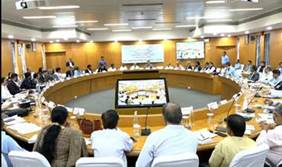
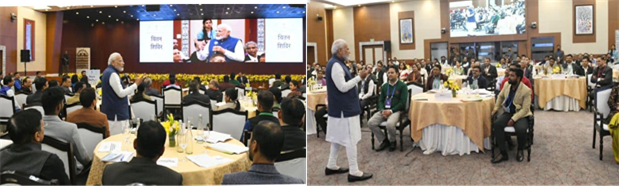
The Department of Pension and Pensioners’ Welfare organized a Chintan Shivir on February 17th and 18th, 2023, in New Delhi. Various discussion groups were formed, each focusing on different aspects of the department for meaningful contemplation. The first day commenced with sessions on yoga and meditation, leading into thoughtful discussions on various departmental topics.

On February 18th, 2023, the Prime Minister addressed an interactive session with employees from the Department of Personnel and Training (DoPT), Department of Administrative Reform & Public Grievances (DARPG) and the Department of Pension and Pensioners’ Welfare (DoPPW). PM directed department to focus on digital empowerment of pensioners and bringing Government closer to pensioners.
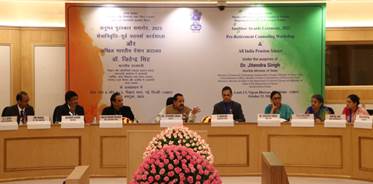
Pre-Retirement Counseling (PRC) Workshop

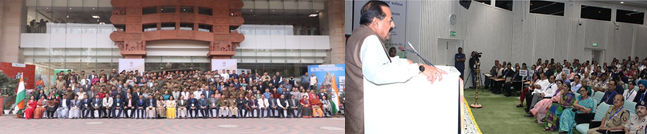
Under the initiative ‘Sankalp’, the Department of Pension & Pensioners’ Welfare has been conducting Pre-Retirement Counselling workshops, throughout the country to facilitate officials who are about to retire, in the superannuation process.

The Workshop, held for the benefit of retiring employees of the Government of India, is a revolutionary step in direction of ‘Ease of Living’ of the pensioners. In the workshop, soon to be retiring employees, were provided relevant information related to the retirement benefits and pension sanction process. Department of Pension & Pensioners organized 3 PRCs in the year 2023. Till now, total 52 PRCs have been conducted which benefitted 8922 officials.
 

ANUBHAV Award 2023

On the directions of the Prime Minister, Department of Pension & Pensioners’ Welfare had launched an online platform entitled ‘Anubhav’ in March 2015 for sharing experiences of retiring government employees while working with the Government. Under Anubhav Awards Scheme, 2023, in addition to Anubhav Awards, it was decided to confer ‘Jury Certificates’ also for the first time, to ensure wider publicity & enhanced participation of the retiring/retired employees. Due to outreach campaign, an all-time high of 1901 write-ups were published by 30 Ministries/Departments with 151 write-ups from the officers having pay level 13 and above. In the ceremony held on 23.10.2023, 04 Anubhav Awards and 09 Jury Certificates were conferred by Dr. Jitendra Singh, MoS (PP).

ANUBHAV Awardee Speak Webinar

A monthly webinar series featuring Anubhav awardees and prominent retired personalities was conducted to motivate the retiring employees and sharing their experiences while working in Government. The series completed its 13th edition in December, 2023 and total 24 speakers from 12 different Ministries/ Departments has participated the audiences. It has been well received by the audiences and retiring employees join the webinar series from more than 500 locations spread across the country.

Monthly Report on CPENGRAMS & BHAVISHYA

The department analyzes the data available on the CPENGRAMS portal on important parameters on monthly basis viz. grievances/appeals- received, redressed, redressal time and pendency. Accordingly, ranking is assigned to the Ministries/Departments. Similarly, the tracking of the PPOs on the Bhavishya portal is done and the data regarding delayed PPOs including the PPOs of the employees who are going to retire in next 15 months is incorporated in the report. This report is sent to all the Secretaries of Government of India for necessary action. 

Nationwide Digital Life Certificate Campaign 2.0

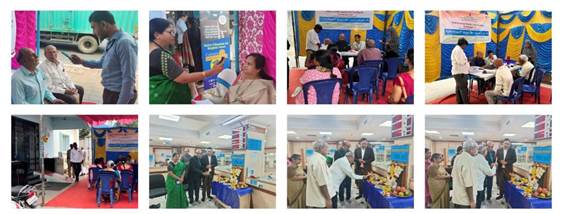
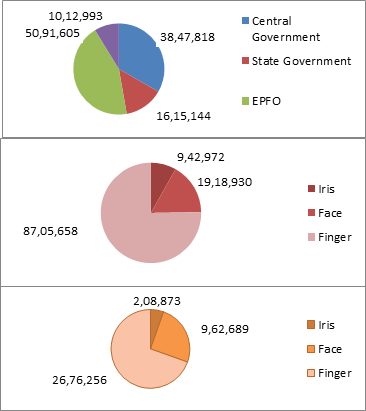
The Campaign was held from 1st to 30th November, 2023 at 602 locations of 105 cities across the country in collaboration with 16 Pension Disbursing Banks, Ministries/ Departments, 44 Pensioners’ Welfare Associations, UIDAI, MeitY, PIB and DD News. In November 2023, the campaign generated more than 1.15 Crore DLCs. Face Authentication Technology. launched in November 2021, allows pensioners to submit Digital Life Certificates using Android smartphones, reducing dependence on external devices.

The November 2023 campaign contributed over 1.15 Crore DLCs, with Face Authentication Technique used in more than 19.18 lakhs. Feedback indicates satisfaction and reduced time for DLC generation, enhancing pensioners’ ‘Ease of Living’.
M.jpg


National DLC Portal

A National DLC portal was launched for monitoring of Nationwide DLC Campaign 2.0. 290 nodal officers of all Min/ Depts, Banks and PWAs are registered on this portal.

Out of 70 Lakh Central Government Pensioners, more than 38 lakhs have submitted DLCs, including 9.60 lakhs with Face Authentication. DLC submission is ongoing, with an expected total submission crossing 50 Lakh by March 2024. The campaigns serve as a significant means of spreading information about government initiatives, bringing government and pensioners closer.
 

CCS (Extra Ordinary Pension) Rules, 2023

Families of Central Government civilian employees who die on account of injury or disease attributable to Government services, are eligible for Extra-ordinary family pension under the CCS (Extraordinary Pension) Rules, 2023. Similarly, employees who get disabled due to an injury or disease on account of causes attributable to or aggravated by Government Service are eligible for Disability pension under CCS (Extraordinary Pension) Rules, 2023. Department released new CCS EOP rules after 84 years.

All India Pension Adalats

The Department, with a focus on addressing pensioners’ grievances, initiated system of pension Adalats. The first Adalat took place on September 20, 2017, in New Delhi, and the most recent one occurred on October 23, 2023. These adalats offer an additional platform for addressing pension-related grievances, aiming to eliminate the need for recourse to the Court or Central Administrative Tribunal (CAT). This approach is expected to save both time and resources for the government in handling legal matters. In 2023, two (2) Pension Adalats were held on 17th May, 2023 and 23rd October, 2023, 603 cases were taken up during the two Pension Adalats in which 440 cases were resolved on the spot.
 

Bankers’ Awareness Programs

The Department has commenced a series of Bankers’ Awareness Workshops for field functionaries handling pension business at CPPCs and Bank branches with the objective of providing information, about the latest pension Rules/procedure and initiatives taken by DoPPW. The Department organized 02 Bankers’ Awareness Programs with Pension Disbursing Banks in Srinagar with the coordination of State Bank of India on 10-11th July, 2023 and in Lucknow with the coordination of Punjab National Bank on 17-18th August, 2023.


Integrated Pensioners’ Portal (IPP)

The Pensioners’ Portal scheme was evolved to provide updated information on pension and to help bridge the communication gaps between the pensioners and the Government. As per the National e-Governance Service Delivery Assessment (NeSDA) 2021, the BHAVISHYA Portal has been awarded the 3rd Rank among all the Central Government e-Governance Service Delivery Portals. As directed by MoS (PP), the Department of Pension & Pensioners’ Welfare has developed an “Integrated Pensioners’ Portal” using Bhavishya platform as the base to provide a Common Single Window Portal for pensioners and elder citizens. State Bank of India, Canara Bank, Punjab National Bank and Bank of Baroda had already integrated their Pension Portals with the Integrated Pensioners’ Portal. Presently, 4 facilities viz. Monthly Pension Slip, Status of Life Certificate, Submission Form16 of the Pensioner and Due & Drawn Statement of pension arrears paid, are being provided by these Banks.


Meetings with Pensioners’ Welfare Associations

The department has taken steps to reach out to all pensioners through various modes and spread awareness about its initiatives, thus enabling all pensioners to use the benefits designed for them. As part of the outreach program to pensioners, DoPPW has commenced a series of meetings with the registered Pensioners’ Associations, online as well as physically, at regular intervals. Department of Pension & Pensioners’ Welfare (DoPPW) conducted 5 meetings in 4 cities i.e., Delhi, Bangalore, Pune and Jammu with Pensioners Welfare Associations.


Department of Pension & Pensioners’ Welfare (DoPPW) visited Banks’ CPPCs

The Central Pension Processing Centres (CPPC) of banks are the back offices which handle pension processing, commencing with opening of a pension account on receipt of PPOs in physical or electronic form to disbursement of pension. State Bank of India has 18 CPPCs and Punjab National Bank has 10 CPPCs across the country. Department visited State Bank of India & Punjab National Bank CPPCs & review their functioning.

Central Government Pensioners’ Grievances

The Department received more than 78,000 grievances from the Central Government pensioners of 148 Ministries/Departments with a monthly average of 6,500 grievances. Out of these, more than 81% grievances have been filed online through Centralized Pension Grievance Redress and Monitoring System (CPENGRAMS), a digital initiative for quality and expeditious redressals of Pensioners’ Grievances. The remaining 19% grievances have been filed with the active assistance of Integrated Grievance Cell and Call Centre, operated by DoPPW. Out of these, 72,110 grievances were disposed in 01 year. Due to constant monitoring and follow up, the redressal time has decreased from 36 days in 2018 to 26 days in 2023 with only 0.32% grievances pending for more than 6 months. Also, more than 12,000 appeals have been filed on the portal and more than 11,000 appeals have been disposed of.


Grievance Feedback Unit

The department has constituted Feedback Unit in the month of September, 2023 which has been assigned the task of examining and analyzing the grievances, disposed by various Ministries/Departments including the disposals graded as ‘Poor’ and ‘Average’ by the complainants. It has been given the mandate to re-register the cases in the suitable grievances. Till date 11,524 cases have been examined and re-registration in more than 400 cases has been done. This initiative has benefited numerous pensioners as they have received pensioner benefits.


PUBLICATION OF CIRCULARS

Department of Pension and Pensioners’ Welfare had issued instructions vide OM No. 57/04/2019-P&PW(B) dated 17.02.2020 giving one time option to Central Government employees who were declared successful for recruitment in the results declared on or before 31.12.2003 against vacancies which occurred before 01.01.2004 and were covered under the National Pension System on joining service on or after 01.01.2004, to be covered under the CCS(Pension) Rules, 1972 (now 2021).

Thereafter, instructions have been issued vide OM No. 57/05/2021-P&PW(B) dated 03.03.2023 that in all cases where the Central Government civil employee has been appointed against a post or vacancy which was advertised/notified for recruitment/appointment, prior to the date of notification for National Pension System i.e. 22.12.2003 and are covered under the National Pension System on joining service on or after 01.01.2004, may be given a one-time option to be covered under the CCS(Pension) Rules, 1972 (now 2021).

Central Civil Services (Implementation of NPS) Rules, 2021- Department of Pension and Pensioners’ Welfare had notified CCS (Implementation of NPS) Rules, 2021 to govern the service related matters of Central Government employees covered under NPS. These rules are being updated time to time for ease of implementation by Ministries / Departments.

***

Council of Scientific and Industrial Research (CSIR)

 Significant Scientific & Technical Attainments during the year

  • CSIR’s HANSA-NG Aircraft Type Certified: India requires large number of pilot trainer aircraft to cater to the needs of the aviation sector. CSIR-NAL has indigenously designed and developed light aircraft Hansa-New Generation (NG) with advance features. Aircraft is Type Certified by the DGCA on 20th February 2023 for DAY-VFR & NIGHT-VFR operations under JAR-VLA. CSIR-NAL has received Letter of Intents (LoI) for procurement of nearly 110 aircrafts from Flying clubs across the country.

Image

  • CSIR-CIMAP research lowers Nicotine content in Tobacco plant: CSIR-CIMAP has successfully lowered Nicotine content in the Petit Havana Tobacco plant variety by using a genome editing tool and reduced 60-70 per cent Nicotine in it, compared to Nicotine content in wild-type plants. CSIR-CIMAP further plans to lower Nicotine in commercial varieties to help people quit the habit by working on tobacco plant varieties used in cigarettes, cigars, beedi.
  • First consignment of import substitute Hydrogen Hydrate dispatched: Gujarat Alkalies and Chemicals Limited (GACL) and CSIR-Indian Institute of Chemical Technology (IICT), Hyderabad, have jointly received patents for the indigenous process to manufacture Hydrazine Hydrate (H6N2O). A commercial plant of 10,000 TPA 80% Hydrazine Hydrate was designed by CSIR-IICT and was established by GACL at their Dahej complex. The first batch of the product was flagged off and was attended by Director, CSIR-IICT, MD-GACL and other officials.
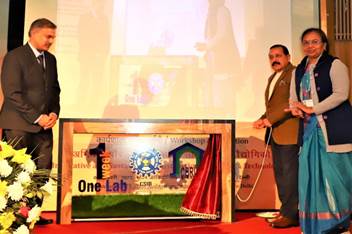
  • CSIR-NAL launches Q Plane and JALDOST Airboat: In a significant step towards advancing the capabilities of Unmanned Aerial Vehicles (UAVs) in India, the CSIR-NAL unveiled the Q Plane – a lightweight all-electric hybrid UAV with vertical-take-off-and-landing capability during the curtain raiser of One Week, One Lab, on 2nd August 2023. Designed for autonomous flight, the UAV has a range of 30 kilometres and endurance of up to 70 minutes. CSIR-NAL’s JALDOST, an airboat that operates on water and removes excess aquatic weed & floating waste from water bodies, was also launched. The JALDOST has a closed airtight pontoon type hull to make it inherently unsinkable. It has a hybrid propulsion system, comprising air propulsion and paddle wheel propulsion. CSIR-NAL has developed two versions of the airboat — JALDOST Mark-1 and an upgraded version JALDOST Mark-2. The JALDOST Mark-2 has been designed on the specifications given by BBMP and can be used to clean lakes in Bengaluru. It was also launched on 2nd August 2023, during the curtain raiser of One Week, One Lab, of CSIR-NAL.
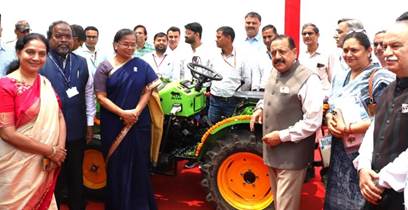
  • Launch of CSIR’s Indigenous E-Tractor, CSIR Prima ET11: The Minister of State (Independent Charge), Science and Technology and Vice-President, CSIR, Dr. Jitendra Singh, on August 21st, 2023, launched the compact E-Tractor CSIR PRIMA ET11, indigenously designed and developed by CSIR-CMERI to cater to small and marginal farmers of India.

  • Installation of 10 TPD Biogas plant at Bowenapally Vegetable Market, Hyderabad: With the financial support from the Department of Biotechnology (DBT), GoI, CSIR-IICT has installed and operated a 10 ton per day biogas plant at Dr. BR Ambedkar Vegetable Market in Bowenpally where 10 tons of waste is converted to 500 – 600 m3/day of biogas everyday along with liquid digestate that can be used as organic fertilizer. The biogas is used to replace grid power (approx. 400 kWh/day) and LPG consumption (28 – 30 kg/day).
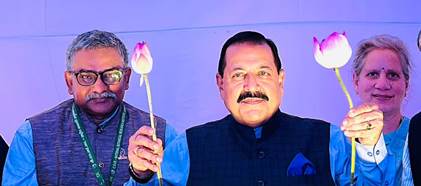
  • Launch of improved lotus variety ‘Namoh 108′CSIR-NBRI launched an improved variety of the national flower Lotus with 108 petals called ‘Namoh 108’ on 14th August 2023 during the inaugural of the One Week, One Lab campaign of CSIR-NBRI. The Lotus variety is more weather resilient and can flower from March to December. This lotus was brought by NBRI scientists from Manipur to conduct research on it. This is the first Lotus variety whose genome is completely sequenced. CSIR-NBRI also released apparels made from lotus fibre and perfume ‘Frotus’ developed from Lotus plants in collaboration with FFDC, Kannauj.

Image

  • Approval for Clinical Trials of Oral Contraceptive Pill ‘Levormeloxifene’: The Drugs Controller General of India (DCGI) approved the clinical trials of an oral contraceptive pill ‘Levormeloxifene’ jointly developed by CSIR-Central Drug Research Institute (CDRI) and the technology partner.
  • Technology to Produce Vegan Leather: CSIR-CLRI’s developed technology is used to produce eco-friendly vegan alternative to synthetic leather using mango fruits. India produces 20 million tons of mango a year, making it the world’s largest producer of mango. In India up to 40% of mangoes are abandoned in the fields because they do not meet regulatory and market standards, so they can be used to produce alternative material to leather. The new material is made of 50% mango and degrades faster than polyurethane leather.
  • CSIR-NGRI does a drone survey at LadakhCSIR-NGRI successfully conducted a drone based magnetic survey in the Ladakh region in September 2022 for the first time for an area of about 45 sq.km and the data is currently being analysed by the scientists at CSIR-NGRI. The institute has used a five kilo payload capacity drone carrying an important sensor to record the data for sub-surface level area.
  • CSIR’s first battery recycling pilot facility commissioned in JamshedpurThe CSIR-National Metallurgical Laboratory (NML) has commissioned the first Battery Recycling Pilot Facility of the CSIR at Jamshedpur to extract critical metals such as Lithium, Nickel, Manganese and Cobalt. It encompasses 1 Ton per day (TPD) battery dismantling and cathode material separation setup, apart from the integrated large-scale hydrometallurgical facility for extraction and separation of those critical metals.
  • CSIR-NIO discover active submarine volcano in Andaman SeaCSIR-National Institute of Oceanography (NIO) has discovered an active submarine volcano (Crater Seamount) in the Andaman Sea, which has been at the epicentre of the seismic zone since it was first observed in 2007. Crater Seamount has the potential to erupt at any time leading to earthquakes and even tsunamis in the Java-Sumatra region. The timing of the eruption, however, cannot be ascertained.
  • Research on ongoing declines for the world’s amphibians: A groundbreaking paper published in Nature on 4th October 2023 reveals climate change as a major driver of amphibian decline. Climate change was the primary threat for 39% of species pushed toward extinction since 2004. Scientist from CSIR-CCMB was a part of this global study.
  • CSIR-NAL hands over AMCA’s carbon composite flaperon test box to ADA: The CSIR-NAL in collaboration with Aeronautical Development Agency (ADA), has successfully designed and developed a cutting-edge Flaperon Structural Assembly for the Advanced Medium Combat Aircraft (AMCA) program, India’s to-be 5th generation stealth fighter jet, achieving a breakthrough in composite technologies. CSIR-NAL handed over the jointly developed IM7 carbon composite based flaperons for the AMCA Project to ADA. This milestone was marked by the completion of the AMCA’s Flaperon Test Box Assembly on October 5, 2023, a significant day for the Indian aerospace industry. The assembly has been officially handed over, symbolising a milestone in this collaborative effort.
  • A new multi-component alloy-based catalyst designed for efficient production of Green Hydrogen: A newly designed catalyst consisting of an alloy of cobalt, manganese, and tin is more stable and can produce hydrogen through electrolysis of water more efficiently than the individual metals or binary (Co-Mn, Mn-Sn or Co-Sn) alloys. Scientists from the Centre for Nano and Soft Matter Sciences (CeNS), Bangalore, and the National Chemical Laboratory (CSIR-NCL), Pune, have developed a promising catalyst for the hydrogen evolution reaction (HER), a crucial step in water electrolysis for producing hydrogen. This newly designed catalyst, a mixture of Cobalt, Manganese, and Tin known as Co-Mn-Sn alloy, has shown better efficiency and stability in generating hydrogen as compared to the individual metals or binary (Co-Mn, Mn-Sn or Co-Sn) alloys. The presence of Manganese and Tin in the alloy played a synergistic role in boosting its performance. As the Co-Mn-Sn alloy does not contain any platinum group metal it offers exciting prospects.
  • Indian sign language brings hope for deaf students aspiring to learn STEM subjectsTo give wings to the dreams of deaf science aspirants, the Central Government has got onboard scientists and deaf special education experts to train sign language interpreters and create signs on terms and concepts on STEM (science, technology, engineering and math) for enabling higher education in the Indian Sign Language (ISL). Showing the way forward is the first of its kind project in the country ‘Indian Sign Language Enabled Virtual Laboratory’ (ISLEVL) under the CSIR’s ‘JIGYASA’ programme under which experts are creating specialised digital content to educate the deaf by ISL translated contents in STEM. 103 new signs and 200 content videos on scientific concepts have been developed by CSIR-IMTech team, with the assistance of deaf special education experts.

  • Tapping the underwater fish chorus symphony, with help of AI: CSIR-National Institute of Oceanography (NIO), Goa, has, for the first time, recorded the captivating sounds of marine life with the help of Artificial Intelligence. Recent passive acoustic recordings by the CSIR-NIO have uncovered a veritable “symphony” of sounds produced by fish, shedding light on their complex underwater communication.

Major International and National Events

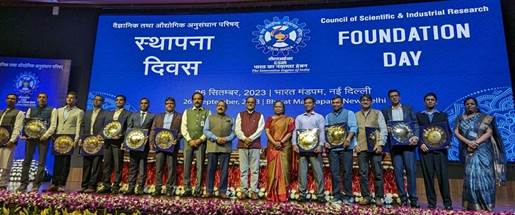
  • ‘One Week, One Lab’ campaign of CSIR: The ‘One Week, One Lab’ (OWOL)  campaign of CSIR was launched by the Minister of State (I/C) S&T, Dr Jitendra Singh, on January 6th, 2023, to showcase the diverse legacies, exclusive innovations and technological breakthroughs of the network of 37 CSIR labs situated across the Nation, working in diversified domains of S&T. Dr N Kalaiselvi, Secretary, DSIR & DG, CSIR, called the campaign, a celebration of Science & Technologies for CSIR labs and new initiative in the Amrit Kaal, to leverage the technologies of CSIR. CSIR-CBRI, Roorkee was the first lab to organise the OWOL campaign. Almost every week after that the campaign was organised by other CSIR laboratories and was concluded with CSIR-NAL, Bengaluru. The OWOL Campaign of CSIR culminated on 26th September 2023 during the Foundation Day Celebrations of CSIR.

https://static.pib.gov.in/WriteReadData/userfiles/image/4XEFX.jpg

  • CSIR participates in 108th Indian Science Congress (ISC): CSIR and its laboratories participated in the ‘Pride of India Mega Expo’ in 108th Indian Science Congress – 2023 organised at RTMNU, Nagpur, Maharashtra, during January 3-7, 2023. The Expo was inaugurated by the Minister of State (I/C) S&T, Dr Jitendra Singh, along with Deputy CM, Maharashtra, Shri Devender Fadnavis. The Secretary DSIR & DG, CSIR, Dr N Kalaiselvi, visited CSIR Pavilion at the ‘Pride of India Mega Expo’ and interacted with delegates, students, start-ups and beneficiaries. CSIR bagged the ‘Best Exhibitor of the Year’ Award at ISC 2023.
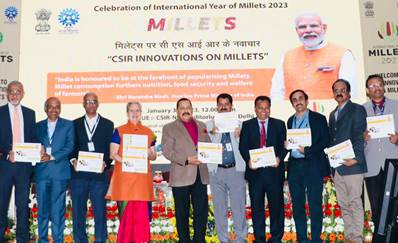
  • CSIR commemorates the International Year of Millets: CSIR-CFTRI organised an exclusive event, “CSIR Innovations on Millets” commemorating the International Year of Millets on January 10th, 2023. The event was inaugurated by the Minister of State (I/C) S&T, Dr Jitendra Singh. He said that the United Nations declared 2023 as the “International Year of Millets” at the initiative of the Indian Government last year and was backed by 72 other countries. An exhibition on millet products and a Desktop Calendar 2023 on millets was also released as part of the celebrations of “International Year of Millets-2023”. The Exhibition had a display of products and technologies developed in CSIR-CFTRI, Mysuru, CSIR-NIIST, Thiruvananthapurm and CSIR-IHBT, Palampur, and showcased the capabilities of CSIR laboratories in Millets R&D and reach out to various stakeholders on the institute’s Millet-based Technologies at national Level.

  • CSIR participates in IISF 2022: CSIR and its laboratories participated in the ‘Mega Science & Technology Expo’ of India International Science Festival (IISF) 2022, held at Maulana Azad National Institute of Technology (MANIT), Bhopal, Madhya Pradesh during January 21-24, 2023. The Mega S&T Expo was inaugurated by the Minister of State (I/C) S&T, Dr Jitendra Singh, along with the Chief Minister of Madhya Pradesh, Shri Shivraj Singh Chouhan and the Minister S&T of Madhya Pradesh, Shri Om Prakash Saklecha. The Ministers along with Dr N Kalaiselvi, Secretary, DSIR & DG, CSIR visited CSIR Pavilion at the ‘Mega S&T Expo’. CSIR Pavilion won the ‘Best Pavilion in the Expo’ Award at the Mega S&T Expo of IISF 2022. Other programs organised by CSIR Labs during IISF 2022 were “Vigyanika – Science Literature Festival” by CSIR-NIScPR, “Artisan’s Technology Village-Vocal for Local” by CSIR-AMPRI and “Science through the Games and Toys” by CSIR–4PI.
  • Young Start-Up Conclave organised by CSIR at Kathua, J&K: The Minister S&T, Dr Jitendra Singh on 28th January 2023, unveiled the Young Start-Up Conclave at Kathua, J&K organised by CSIR. The conclave witnessed the presence of renowned entrepreneurs, industry leaders, academicians, representatives of leading venture capital firms, incubators and accelerators. During the conclave, the local progressive farmers also shared their success stories and experience and expressed gratitude to CSIR for making it possible through proper hand holding and considerable support in their endeavours.
  • Kisan Mela organised in Lucknow: CSIR-CIMAP, as a part of the One Week, One Lab campaign, organised a Kisan Mela during 31st January 2023 till 4th February 2023. Shri Surya Pratap Shahi, Cabinet Minister, Govt of UP inaugurated the CIMAP Kissan Mela and addressed the farmers, entrepreneurs and staff of the institute. More than 3,000 farmers and entrepreneurs participated in the mela. During the Kisan Mela “Aus Gyanya”, UV protection herbal product ‘CIM-Kayakawach’, handbook of alternative cultivation of mentha and QR-code for information on MAPs varieties were released. A farmers meet and awareness programme was also conducted at CSIR-CIMAP Research Centres in Bengaluru and Hyderabad on 2nd February 2023.
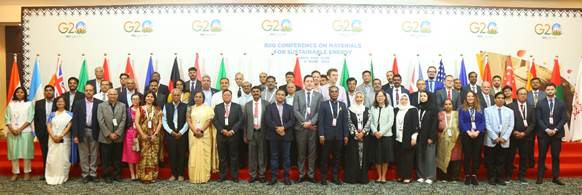
  • CSIR organises G20 RIIG Conference on Materials for Sustainable Energy: CSIR organized the Research and Innovation Initiative Gathering (RIIG) Conference on “Materials for Sustainable Energy” during 2-3 March, 2023 at Ranchi under India’s G20 Presidency. Various facets of ‘Materials for Sustainable Energy’ were discussed under three sessions, viz., (i) 21st Century Challenges Related to Energy Materials & Devices, (ii) Solar Energy Utilisation and Photovoltaic Technology, and (iii) Materials and Processes for Green Energy. Leading experts were drawn from institutions such as IITs, IISERs, CSIR Labs; industries; think tanks including NITI Aayog; and Indian Energy Storage Alliance. Twenty foreign delegates from ten G20 member countries, six invited guest countries and an international organisation joined the two-day conference. From India, 38 delegates and special invitees from scientific departments, research and academic institutions and industry participated in the RIIG Conference.

  • International Women’s Day celebrations at CSIR: The CSIR family celebrated International Women’s Day on March 9th, 2023, to honour the Pride of Women in CSIR contributing directly or indirectly in the progress of science & society. The celebration had Mrs Manju Singh, an educationist and Dr Jitendra Singh, Minister of State (I/C) S&T, gracing the occasion as the Chief Guests. Ms Nivruti Rai, VP, Intel Foundry Services, Intel Corporation & Country Head, Intel India, joined as the Guest of Honour and delivered a special talk on “Breaking Barrier: Advancing Women in Science & Technology”. The celebration was also graced by the presence of the Principal Scientific Advisor (PSA) to the Govt. of India, Prof A. K. Sood and Dr M. Ravichandran, Secretary, MoES & Dr Rajesh Gokhale, Secretary, DBT, too joined together with their families. Directors of CSIR laboratories and Heads of CSIR Headquarter Directorates along with their spouses; and many CSIR staffs joined physically as well as online for the celebration.
  • CSIR YUVA Portal Launched: To contribute in the Digital India Initiative of the government of India, CSIR launched YUVA (Yuva Vaigyanik Anveshan) Portal for inviting online applications from young postgraduates and doctorates researchers on 17th April 2023. The YUVA portal will digitally empower the young researchers who will contribute in the scientific, technological development and knowledge economy of the country in the near future.
  • CSIR participated in the National Technology Week 2023 celebrations: Prime Minister Shri Narendra Modi on 11th May 2023 inaugurated the five-day National Technology Week celebrations jointly observed by all Science Ministries and Departments in New Delhi. CSIR showcased its technologies and innovations in the exhibition. Expert talks by CSIR leaders were also organised during the event.
  • Lavender Festival in Bhaderwah, J&K: Union Minister of State (I/C) S&T, Dr Jitendra Singh on 4th June 2023 inaugurated the two-day Lavender festival organised at Bhaderwah in Jammu, as part of One Week, One Lab campaign of CSIR-IIIM, Jammu. The Lavender festival involved hundreds of farmers, agri-industrialists, entrepreneurs etc. The farmer -industry meet, Agri-startup expo and cultural programme were the significant highlights of the festival.

Image

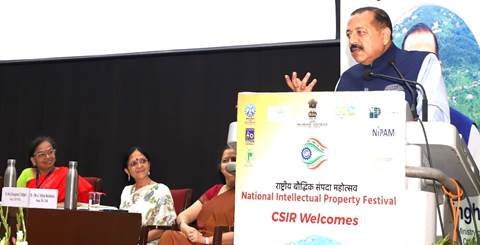
  • Rashtriya Boudhik Sampada Mahotsav: Under the aegis of Azadi Ka Amrit Mahotsav (AKAM), Department of Scientific and Industrial Research (DSIR) & Department for Promotion of Industry and Internal Trade (DPIIT) along with the partners Council of Scientific and Industrial Research (CSIR), O/o Controller General of Patents, Designs and Trade Marks (CGPDTM), Protection of Plant Variety and Farmers’ Rights Authority (PPVFRA), National Research Development Corporation (NRDC) and Sanrachna Foundation launched a month-long celebrations of Rashtriya Boudhik Sampada Mahotshav (RBSM) – National Intellectual Property Festival from 1st July 2023 to 31st July 2023. The campaign was launched by Dr. Jitendra Singh, Minister of State (I/C), S&T and Chairman, National Implementation Committee (NIC) at CSIR-NPL, New Delhi on 30th June 2023. CSIR through its 37 constituent laboratories, conducted 184 events all across the country with more than 1,25,000 participants during the campaign. CSIR-IMMT, Bhubaneshwar and CSIR-CECRI, Karaikudi flagged off “CSIR- IP Rath” for disseminating IP knowledge to greater masses.

https://static.pib.gov.in/WriteReadData/userfiles/image/1.05MSC.JPG

  • Pushp Krishi Mela organised under CSIR Floriculture Mission II: CSIR-IHBT organised “Pushp Krishi Mela” under CSIR Floriculture Mission II on 10th August, 2023 at DIHAR, DRDO, Leh. It was inaugurated by Lt. Governor Brig. (Dr.) B. D. Mishra (Retd.). Chief Executive Councillor, LAHDC, Leh, Advocate Tashi Gyalson, Member of Parliament, Ladakh, Shri Jamyang Tsering Namgyal, Shri Ravinder Kumar (IAS), Secretary Agriculture/Horticulture UT Ladakh and Dr. O.P Chaurasia, Director, DIHAR, DRDO, Leh, Ladakh were present as Guest of Honour.
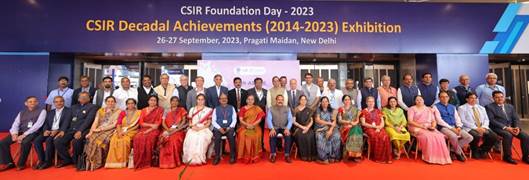
  • Mega Exhibition on CSIR Decadal Achievements: On the occasion of the 82nd Foundation Day of CSIR, a two-day event to showcase the decadal achievements of CSIR was organized at Pragati Maidan, New Delhi, on 26 & 27 September 2023. The exhibition was inaugurated by Minister S&T, Dr Jitendra Singh. All 37 CSIR laboratories participated in the exhibition and displayed their achievements through posters, exhibits, products, prototypes, etc. At the event’s backdrop, a CSIR-Industry Meet was organized and attended by the industry partners of various laboratories of CSIR.

  • Flag Off of “Recycling on Wheels Smart-ER” to Promote Cleanliness and Environmental Responsibility under Swachhata Hi Seva (SHS) campaign: In alignment with the Swachhata Hi Seva (SHS) campaign, celebrated from September 15th to October 2nd 2023, Minister S&T, Dr Jitendra Singh inaugurated the “Recycling on Wheels Smart-ER” at CSIR Headquarters in New Delhi on October 2nd 2023. Dr Kalaiselvi, DG, CSIR and Secretary, DSIR, addressing during the inauguration of the Special Campaign 3.0 for institutionalizing Swachhata said that all the 37 CSIR labs across the country are engaged with both physical cleaning and e-cleaning that is processing and weeding out of obsolete files.
  • Director General, WIPO visits CSIR-Traditional Knowledge Digital LibraryMr. Daren Tang, Director General, World Intellectual Property Organization (WIPO) and other distinguished delegates from the WIPO visited the CSIR-Traditional Knowledge Digital Library (TKDL) facility on 12 October 2023 and participated in discussions on the CSIR Innovation System, TKDL, CSIR Technologies, and CSIR’s Current IP Strength & Strategy. The CSIR team was led by Dr. (Mrs.) N. Kalaiselvi, Secretary, DSIR and Director General, CSIR. The distinguished guests included Prof. Unnat P. Pandit, Controller General of Patents, Designs & Trade Marks (CGPDTM), and representatives from the Department for Promotion of Industry and Internal Trade (DPIIT), the office of the CGPDTM, and Ministry of AYUSH.
  • CSIR innovation showcase in World Food India 2023The World Food India 2023 event, organised by the Ministry of Food Processing Industry, at Pragati Maidan, New Delhi from November 3-5, 2023, was inaugurated by Prime Minister Shri Narendra Modi. The CSIR pavilion at World Food India-2023 expo was inaugurated by Dr. N. Kalaiselvi, the Director General, CSIR, and Secretary, DSIR, New Delhi in the presence of three CSIR constituent laboratories’ Directors, Dr. Sridevi Annapurna Singh, Director, CSIR-CFTRI, Mysuru; Dr. Sudesh Kumar Yadav, Director, CSIR-IHBT, Palampur (HP); and Dr. C. Anandharamakrishnan, Director, CSIR-NIIST, Thiruvananthapuram, and scientists from the labs and the CSIR Headquarters. The CSIR labs, CFTRI, IHBT and NIIST participated in the World Food India event and showcased their scientific innovations in food sector.
  • Union S&T Minister addresses the 7th Convocation of AcSIRFrom the educated unemployed of the past, we are now seeking to move on into an era of educated employable Science entrepreneurs with the introduction of i-PhD which would in other words be an Industry linked degree in PhD. Addressing the 7th Convocation of Academy of Scientific and Innovative Research (AcSIR) in New Delhi on November 9th, 2023, Union Minister Dr Jitendra Singh said, this Academy is a unique academic platform which awards a Degree in Science that is employable and includes a curriculum underlined by the nuances of entrepreneurship.
  • CSIR-CBRI organised Technology Transfer Mela: CSIR-Central Building Research Institute, Roorkee, organized a Technology Transfer Mela on 24th November 2023 at the India Habitat Centre, New Delhi. The Mela was inaugurated by Minister S&T and VP, CSIR, Dr. Jitendra Singh. A Technology Compendium was also released on this occasion.
  • CSIR participates in Global Bio-India 2023: CSIR laboratories participated in the Global Bio-India 2023 organised by the Department of Biotechnology (DBT), in collaboration Biotechnology Industry Research Assistance Council (BIRAC), during 4-6 December 2023 at Pragati Maidan, New Delhi and showcased their innovations and developments in the fields of bio-technologies and biosciences.
  • International Food Convention in Mysuru: The 9th International Food Convention (IFCoN-2023) got off to a start on 7th December 2023 with food scientists and technologists from across the country and also abroad attending the four-day mega event – organised once in five years by the Association of Food Scientists and Technologists (India) with the collaboration of Central research institutions. This year’s theme of the convention is “TRIMSAFE – Technology Re-engineering for Innovation and Mitigating the risk for a Safe, sustainable, Affordable and secure Food Eco-system”. The CSIR-CFTRI, DRDO-DFRL, and CSIR-IITR supported the AFSTI in organising the convention.

MoUs signing and collaborations

  • MoU signing between CSIR, India and AMEXCID, Mexico on research, technology and innovation collaborations: In a landmark milestone in S&T Cooperation between India and Mexico, an MoU on Research, Technology & Innovation cooperation was signed between CSIR, India and the Mexican Agency for International Development Cooperation (AMEXCID) of the Ministry of Foreign Affairs of the United Mexican States on March 4th, 2023. The MoU shall facilitate cooperation in the areas of research, technological development/deployment, innovation and capacity building, with an objective to expand knowledge and strengthen Intuitional capacities in both the countries.
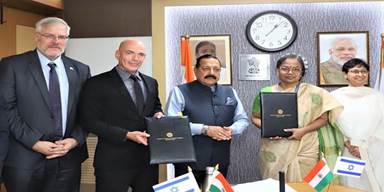
  • Multi-Sectoral Agreement signed between CSIR and DDR&D, Israel: A Multi-Sectoral Agreement was signed between CSIR and Directorate of Defense Research and Development (DDR&D), Ministry of Defense of the State of Israel, in the august presence of Minister S&T, Dr Jitendra Singh at the CSIR-Science Centre on 2nd May 2023. The MoU has been signed on Industrial Research and Development Cooperation with focus on several key technology areas.

https://static.pib.gov.in/WriteReadData/userfiles/image/image002SWGZ.jpg

  • Exchange of CSIR-DAAD Agreement of Cooperation: A German delegation headed by Dr. Michael Harms, Deputy Secretary General, German Academic Exchange Service (DAAD), Federal Republic of Germany visited CSIR for exchange of CSIR-DAAD Agreement of Cooperation as for exploring collaboration discussions with AcSIR.
  • CSIR signs MoU with HQIDS: An MoU between the Headquarters, Integrated Defence Staff (HQIDS) and the Council of Scientific and Industrial Research (CSIR) was signed on 23rd November 2023 for technical collaboration and joint research and development in the field of Defence Technology. The MoU aims to provide an umbrella framework for initiating collaborative interaction between CSIR Labs, HQ IDS and Armed Forces, namely Indian Army, Indian Navy and Indian Air Force, for enhancing scientific understanding of technologies related to defence and undertaking joint research and development in dual use technologies.
  • CSIR-CDRI and pharma firm Dr Reddy’s Laboratories Ltd tie-up for generic medsCSIR- Central Drug Research Institute (CDRI), Lucknow and Dr Reddy’s Laboratories Ltd, a global pharmaceutical company headquartered in Hyderabad, signed an agreement for the development of cost-effective generic medicine with an aim to develop cost-effective and industrially viable processes for selected generic drugs.

Awards and Accolades

  • Shanti Swarup Bhatnagar Prizes presentedThe Union Minister S&T, Dr Jitendra Singh on 26th September 2023, presented the Shanti Swarup Bhatnagar National Awards to eminent Scientists below the age of 45, at a largely attended 82nd Foundation Day Celebrations Function of CSIR at Bharat Mandapam in New Delhi.

  • CSIR-AMPRI Awarded with CII 3R Awards 2023: The CSIR-AMPRI won the Confederation of Indian Industry – Reduce, Reuse, Recycle (CII 3R) Awards 2023. The Award has been conferred for the institute’s excellence in managing wastes through innovative solutions/technologies.
  • PETA India announces Vegan Fashion Awards 2023People for the Ethical Treatment of Animals (PETA), India, announced the winners of its 2023 Vegan Fashion Awards. Best Vegan Fashion Moment awarded to CSIR-Central Leather Research Institute (CLRI), Chennai, for developing technology to make vegan leather products using mango pulp. Best Innovation in Textiles awarded to CSIR-National Institute for Interdisciplinary Science and Technology (NIIST), Thiruvananthapuram, for developing vegan leather from agricultural waste, including mango and pineapple peels, cactus, rice straw, and vetiver grass.

***

Development and Progress by Panchayati Raj

 Since 2014 the Government of India has intensified its efforts to support the Panchayati Raj Institutions (PRIs) in the best manner possible to ensure that the basic objectives of the Panchayati Raj are achieved in true letter and spirit. The country has witnessed a quantum leap in the allocation of fiscal resources to Panchayati Raj Institutions to support various infrastructure requirements and developmental activities in rural areas. The Ministry of Panchayati Raj has been taking several initiatives for strengthening and empowering Panchayati Raj Institutions, increasing the capacity of representatives of PRIs to fulfill their roles and responsibilities and improving the efficiency, transparency of functioning and accountability of PRIs to contribute towards inclusive development, economic growth and achieving the Sustainable Development Goals (SDGs). The details of important activities carried out and progress made during the year 2023 are as follows:

1.      SVAMITVA (Survey of Villages and Mapping with Improvised Technology in Village Areas)

1.1    SVAMITVA Scheme was launched by the Prime Minister on National Panchayati Raj Day, 24th April 2020 with a resolve to enable economic progress of Rural India by providing “Record of Rights” to every rural household owner. The scheme aims to demarcate inhabited (Abadi) land in rural areas through the latest surveying drone-technology, is a collaborative effort of the Ministry of Panchayati Raj, State Revenue Departments, State Panchayati Raj Departments and Survey of India. The scheme covers multifarious aspects viz. facilitating monetisation of properties and enabling bank loan; reducing property related disputes; comprehensive village level planning, assuring the rural local government a good source of revenue would be the stepping-stone towards achieving Gram Swaraj in true sense and making rural India Atmanirbhar. The duration of implementation of the scheme is 2020-21 to 2024-25.


1.2 Achievements under the Scheme during the year 2023

  1. As on December 2023, drone flying has been completed in 2.89 lakh villages.
  2. Drone flying has been saturated in Madhya Pradesh, Uttar Pradesh, Ladakh, Lakshadweep, Delhi and Dadra and Nagar Haveli and Daman and Diu.
  3. Scheme has been saturated in Haryana, Uttarakhand, Puducherry, Goa, Andaman, and Nicobar Islands.
  4. About 1.63 crore property cards have been prepared for 1.06 lakh villages. 
  5. As per Memorandum of Understanding between Survey of India and States/UTs, the scheme coverage is as below:

1.3 Only pilot villages covered in Sikkim, Tamil Nadu and Telangana. The States where the scheme has not been implemented include Bihar, Jharkhand, Nagaland, Meghalaya, and West Bengal.  Assam and Odisha – Only unmapped villages to be covered.


1.4.A Round Table discussion on the Bankability of SVAMITVA property cards was held at Bankers Institute of Rural Development (BIRD), Lucknow, Uttar Pradesh in August 2023.

1.5 A training was held on 15 – 16th October 2023 at National Remote sensing Centre (ISRO) Training & Research Institute, Hyderabad, followed by the Geosmart India Conference on 17 – 19th October 2023 at HICC, Hyderabad with collaborative efforts of Ministry of Panchayati Raj and Geospatial World. The Agenda of the Conference focused on knowledge sharing, showcasing various technological interventions, impact assessment and possible solutions for land and property management.

1.6.   Awards and Recognition

National Awards for e-Governance 2023: SVAMITVA Scheme won Gold Prize in use of Emerging Technology for providing citizen centric services organized by DARPG at Indore, Madhya Pradesh in October 2023.

SVAMITVA Scheme also conferred with Gold award for Innovative Use of Technology in e-Governance for Digital Transformation at Digitech Conclave 2023 organized at Goa in August 2023.

1.7.   Endorsement by the Prime Minister

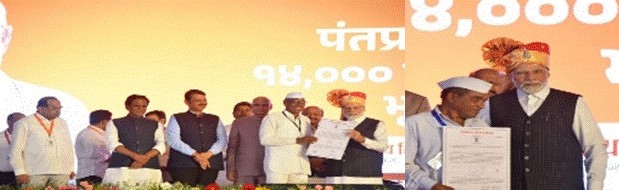
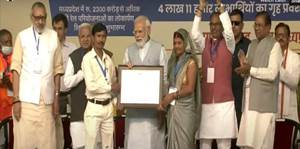
  • Prime Minister distributed 35 lakh property cards prepared under SVAMITVA Scheme on the occasion of National Panchayati Raj Day on 24th April 2023 held at Rewa, Madhya Pradesh.
  • Prime Minister highlighted the importance of the scheme during India Today conclave 2023

2.      Capacity Building & Training (CB&T)

2.1     The Capacity Building and Training (CB&T) of Panchayati Raj Institutions (PRIs) has been one of the major activities of MoPR. The Ministry has been providing programmatic, technical and institutional support for strengthening of PRIs.

2.2     The Centrally Sponsored Scheme (CSS) of Rashtriya Gram Swaraj Abhiyan (RGSA) was implemented during 2018-19 to 2021-22.  The scheme was revamped further for implementation during 2022-23 and 2025-26 at a total cost of Rs.5911 crore including Central Share of Rs.3700 crore and State share of Rs.2211 crore.

2.3     Achievements under the scheme of RGSA:

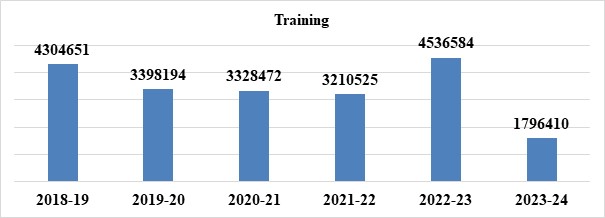
  • During 2018-19 to 2021-22, 1.43 crore participants comprising elected representatives of the PRIs and their functionaries and other stakeholders of Panchayats, provided trainings.
  • During 2022-23, 43,36,584 participants were trained.
  • During the current year as on 28.12.2023, 17,96,410 participants have been trained.


20th December, 2023 uploaded on Training Management portal

3.      Localization of Sustainable Development Goals (LSDGs) through Panchayati Raj Institutions (PRIs):

3.1     Ministry has adopted 9 thematic approach for LSDGs leveraging wide network of third tier of Government including Traditional Bodies of non-part IX areas. The goals on these themes to be attained by 2030 in graduated manner by embracing following approach:

  1. Convergence of all flagship developmental and welfare programmes at Panchayat level,
  2. Saturation of various activities in all villages in phased manner.
  3. Usage of digital technology for ensuring transparency and accountability of all concerned.

3.2    Progress on Localization of SDGs:

  1. Status of uploading thematic Gram Panchayat Development Plan (GPDP), Block Panchayat Development Plan (BPDP) and District Panchayat Development Plan (DPDP) for FY 2023-24:

GPDP uploaded on portal

BPDP uploaded on portal

DPDP uploaded on portal

250449

(93.06% of GP)

5705

(84.47% of BP)

492

(72.46 of DP)

Source: eGramSwaraj portal as on 20th December, 2023.


  1. People’s Plan Campaign (PPC)–2023: PPC–2023 was rolled out as ‘Sabki Yojana Sabka Vikas’ from 4th September, 2023 as a strategy for preparation of participatory GPDP in campaign mode with voluntary involvement of community, elected representatives, frontline workers, SHGs, and other stakeholders for preparing the thematic GPDP for the next financial year i.e. 2024-25.
  2. Project Driven District and Block Panchayat Development Plan:
  3. The report on formulation of project driven Block and District Panchayat Development Plan released in the workshop held during 4th – 5th September, 2023.
  4. Based on the recommendations of the report the States /UTs have been advised to prepare project driven Block and District Panchayat Development Plans.


  1. Thematic National Workshop: Around 1400 Participants from Central Ministries, 30 States (including ERs, Functionaries), UNICEF, UN women and other NGOs attended three-day national workshop on Theme 3-Child Friendly Village and Theme 9-Women Friendly Village of LSDGs held in Odisha during 17 – 19 February, 2023.


  1. Two-days National workshop on Quality/ISO Certification:
  1. Around 100 participants from 25 States / UTs attended two-days national workshop on Quality/ISO Certification held in Kerala Institute of Local Administration (KILA), Kerala during 6th to 7th July, 2023 on “ISO Certification of Panchayats”. 
  2. The follow up on the same has resulted in efforts for quality/ISO certification of Panchayats in various States. With standardized procedures of services, it is expected to improve the quality of service delivery at Panchayat level.


  1. Three-day National Workshop on Theme 8-Panchayat with Good Governance of LSDGs held in Srinagar, Jammu &Kashmir during 21 – 23 August 2023. During the workshop following were released:
      1. Meri Panchayat App
      2. Operating Guidelines of National Capacity Building Framework 2022.
      3. Service Level Benchmark, Self -assessments and Model Contract prepared by the MoPR in coloration with the UNICEF.


  1. Panchayat Development Index (PDI):

To measure the progress on LSDGs and to carry out assessment to prepare evidence-based policy, MoPR constituted a Committee to prepare mechanisms for computation of PDI. 

  1. The report was released by Minister of State for Panchayati Raj in a National Workshop held in Delhi on 28th June, 2023. Report of the Committee can be accessed on the Ministry’s Website at the URL: https://panchayat.gov.in/pdi-committee-report-2023/.
  2. The Committee has laid a framework for computation of PDI, which will be useful tool for Union Ministries/Departments as well as the State Governments and PRIs to assess the outcome of their schemes and plan future developments based on evidence.
  3. Two-Day National Write-Shop has been organized on PDI Portal for preparation of Baseline Report and computation of PDI in Delhi during 10-11 August, 2023.
  4. A portal (www.pdi.gov.in) for preparation of PDI has been developed. Around 140 data points received from UDISE+, JJM, SBM, NSAP, PMAY, MGNREGS, Mission Antyodya and eGramSwaraj have been ported in PDI portal, rest will be entered by the Gram Panchayats and Line Departments at GP level.  
  5. Workshops have been held in most of the States to orient the concerned Line Departments and Panchayat officials on the mechanism of data collection and validation for the purpose of preparation of PDI.
  6. The thematic scores of Gram Panchayat across nine themes as well as the composite PDI score based on thematic score will be used for incentivization of Panchayats.


4.      Institutional mechanism for strengthening PRIs

  1. School of Excellence of Panchayati Raj (SoEPR) has been setup in NIRD&PR for strengthening of PRIs. It will strengthen the SIRD&PRs as well as support the research on the subjects of Panchayati Raj at the National Level.
  2. Meri Panchayat Application has been launched in August 2023 to facilitate easy access of the information to public about functioning of panchayats to enhance transparency and accountability. The downloading of the said application has crossed 13 lakh.
  3. The assessment module for the trainings has been made functional in the Training Management Portal (TMP). It will facilitate the assessment of learning outcomes of the participants of trainings. 


5.      Incentivisation of Panchayats

5.1     Ministry of Panchayati Raj (MoPR) confers the National Panchayat Awards annually to best performing Panchayats across the country which are a strong source of motivation for them to further improve upon their efforts in development at local level. These awards are usually conferred annually on 24thApril, celebrated as National Panchayati Raj Day.

5.2     MoPR has subsumed 17 SDGs into 9 Localization of SDGs (LSDGs) themes. Accordingly, National Panchayat Awards have been revamped aligning with the LSDGs with effect from the year 2023. The NPA are conferred under the 9 LSDGs based themes namely, (i) Poverty free and enhanced livelihoods Panchayat (ii) Healthy Panchayat (iii) Child friendly Panchayat (iv) Water sufficient Panchayat (v) Clean and Green Panchayat (vi) Self-sufficient infrastructure in Panchayat (vii) Socially Secured Panchayat (viii) Panchayat with Good Governance and (ix) Women-friendly Panchayat

5.3     In addition to 9 themes, Ministry of Panchayati Raj also conferred special categories of awards to best performing Gram Panchayats (GPs) i.e. (1) Gram Urja Swaraj Vishesh Panchayat Puraskar for their performance regarding adoption and usage of renewable sources of energy and (2) Carbon Neutral Vishesh Panchayat Puraskar for exemplary work towards achieving Net-Zero carbon emissions.

5.4 A total 42 Panchayats were awarded in the year 2023 based on their performance.

https://static.pib.gov.in/WriteReadData/Gallery/PhotoGallery/2023/Apr/H20230417130381.JPG

6.      Celebrations of National Panchayat Awards Week (17th – 21st April, 2023)

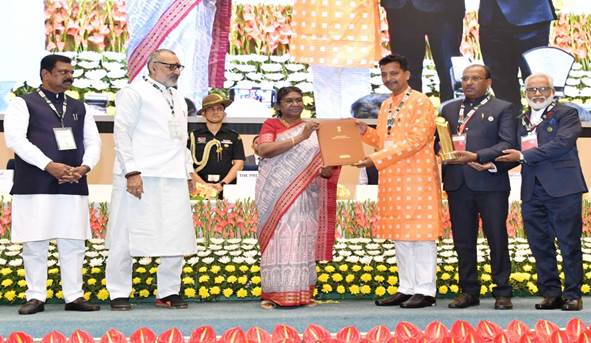
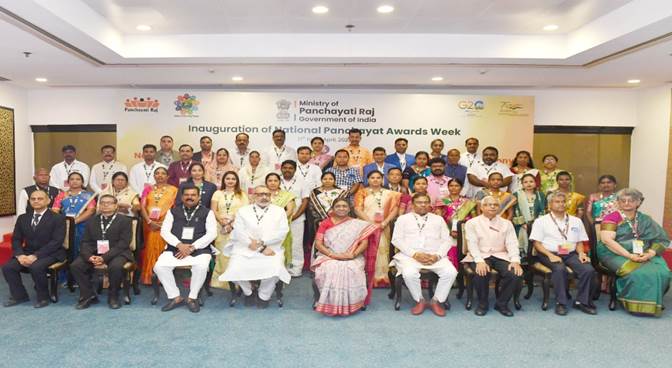
6.1     The President of India, Smt. Droupadi Murmu inaugurated the National Panchayat Awards Week Celebrations and presented the National Panchayat Awards–2023 to the best performing Panchayats at the National Conference on Incentivization of Panchayats at Vigyan Bhavan, New Delhi on 17th April, 2023.

https://static.pib.gov.in/WriteReadData/Gallery/PhotoGallery/2023/Apr/H20230417130375.JPG

6.2 On this occasion, Union Minister of Panchayati Raj Shri Giriraj Singh launched the GS NIRNAY, National Initiative for Rural India to Navigate, InnovAte and Resolve PanchaYat decisions, a mobile application of the Ministry of Panchayati Raj aimed at empowering rural communities.

7.      Commemoration of National Panchayati Raj Day – 24th April, 2023

7.1     Prime Minister participated in the celebration of this year’s National Panchayati Raj Day and addressed all the Gram Sabhas and Panchayati Raj

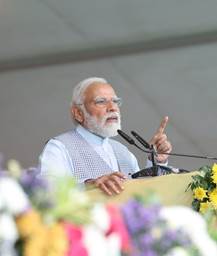
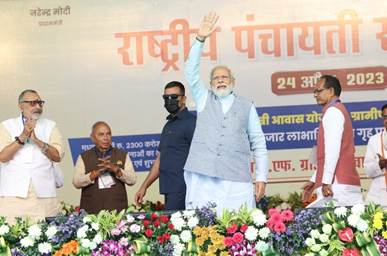
 Institutions across the country. Prime Minister addressed a large public gathering including Panchayat representatives on the occasion of the National Panchayati Raj Day on 24th April, 2023 in Rewa, Madhya Pradesh.

7.2     This year’s celebration of National Panchayati Raj Day at Rewa in Madhya Pradesh witnessed participation of more than one lakh participants, including representatives of Panchayati Raj Institutions, other stakeholders and local residents / rural masses from the District of Rewa and other neighboring Districts.

7.3     Addressing the gathering on the occasion of National Panchayati Raj Day, Prime Minister noted the virtual presence of more than 30 lakh Panchayat representatives from all over the country and said that it presents a bold picture of Indian democracy.

7.4     During the event, Prime Minister inaugurated an integrated eGramSwaraj and GeM portal for public procurement at Panchayat level. The objective of eGramSwaraj – Government eMarketplace integration is to enable the Panchayats to procure their goods and services through GeM, leveraging the eGramSwaraj platform.   

7.5     Prime Minister also handed over around 35 lakh SVAMITVA Property Cards to beneficiaries. Post this programme, around 1.25 crore property cards were distributed under SVAMITVA Scheme in the country, including those distributed in Madhya Pradesh.

8.      e-Gram Swaraj e-Financial Management System

8.1     eGramSwaraj, a Simplified Work Based Accounting Application for Panchayati Raj assists in enhancing the credibility of Panchayat through inducing greater devolution of funds to PRIs. Some of the salient features existing in eGramSwaraj Application are:

  • Workflow Enabled
  • Assets available on Gram Manchitra GIS
  • Supports multi-tenancy; multiple tenants in the same instance and
  • Strong Authentication Mechanism based on open-source technologies
  • eGS-PFMS integration – Automation of accounting done by the Panchayats under XV Finance Commission grants.

8.2    New feature launched this year (2023)

eGS-GeM interface – Facilitates the Panchayats in procurement of items/services through GeM at standardized rates and seamless payment through eGS-PFMS interface, thus establishing a transparent procurement system.

8.3    Current progress of the adoption of e-GramSwaraj (including eGramSwaraj-PFMS &eGS-GeM Interface):

Action Point

Status

Panchayat Planning

2.5 lakh Gram Panchayats have uploaded approved GPDP, more than 5 thousand Block Panchayats have uploaded approved BPDP and 492 DPDP have been uploaded by the District Panchayats.

Physical Progress

1.03 lakhs GPs have reported physical progress of activities under GPDP

LGD code compliant

100% GPs (including TLBs) in States receiving CFC Grants are LGD compliant.

eGramSwaraj – PFMS integration

2.52 Lakh GPs have been ported from PFMS to eGramSwaraj.

2.55 Lakh Gram Panchayats have onboarded eGramSwaraj PFMS for 2023-24

2.36 Lakh GPs have commenced online payments in 2023–2024. Nearly Rs.25,880 crores worth payments have been successfully transferred by the Panchayats to their respective beneficiaries/vendors.

Account closure for 2021-22

For 2021-22, 94% of Gram Panchayats have closed their year books.

Account Closure for 2022-23

For year 2022-23, 92% of Gram Panchayats have closed month books.

Registration on eGramSwaraj – GeM Interface

More than 72,000 Panchayats across 22 States have registered themselves on this interface (as of December 2023).


    1. Integration of Beneficiary details with eGramSwaraj:

As of December 2023, beneficiary details of sixteen scheme of six Union Ministries/ Departments are integrated with eGramSwaraj Application as mentioned below.


Ministry/Department

Scheme

Ministry of Rural Development

PM Awas Yojana-Gramin (PMAY-G)

Indira Gandhi National Old Age Pension Scheme (IGNOAPS)

Indira Gandhi National Widow Pension Scheme (IGNWPS)

Indira Gandhi National Disability Pension Scheme (IGNDPS)

Indira Gandhi National Family Benefit Scheme (IGNFBS)

Mahatma Gandhi National Rural Employment Guarantee Act (MGNREGA)

National Family Benefit Scheme (NFBS)

National Rural Livelihood Mission (NRLM)

Department of Animal Husbandry and Dairying

National Artificial Insemination Programme Project (NAIP)

National Animal Disease Control Programme (NADCP I & II)

Ministry of Agriculture and Farmers’ Welfare

Pradhan Mantri KISAN Samman Nidhi (PMKSN)

Pradhan Mantri Krishi Sinchayee Yojana

Ministry of Education

Samagra Shiksha

Department of Drinking Water and Sanitation

Swachh Bharat Mission (Gramin)

Jal Jeevan Mission (Gramin)

Ministry of Petroleum & Natural Gas

Pradhan Mantri Ujjwala Yojana


9.      Geo-tagging of assets:

Ministry of Panchayati Raj has developed “mActionSoft” – a mobile based solution to help in capturing photos with Geo-Tags (i.e. GPS Coordinates) for the works which have asset as an output. Geo-tagging of the assets is done in all three stages viz. (i) before start of the work, (ii) during the work and (iii) on completion of work. As of December 2023, 2.5 lakh photographs of the assets have been uploaded by the Gram Panchayats for the activities taken under Fifteen Finance Commission in the current year.

10.    Citizen Charter

As of December 2023, 215628 Gram Panchayats approved and uploaded their Citizen Charters promising to deliver 954 services to their people of which 261 are offered on online.

11.    Audit Online

As a part of the critical institutional reform, XV FC has stipulated that the audited reports of Panchayat accounts need to be made available in the public domain, as an eligibility criterion. “Audit Online” application facilitates carrying out online audit of Panchayat accounts pertaining to Central Finance Commission Grants.

Activity

2019-20

2020-21

2021-22

2022-23

No. of Auditors enlisted

10,269

10,269

10,269

10,268

No. of Auditees enlisted

2,59,758

2,60,603

2,59,920

2,59,812

No. of GPs – Audit plans prepared

1,44,613

2,40,988

2,48,257

1,77,883

No. of Audit observations recorded

12,58,266

21,90,446

23,83,415

5,25,737

No. of Audit reports generated

1,30,222

2,18,086

2,40,515

51,815


12.    Central Finance Commission Grants to Rural Local Bodies

12.1   The Fifteenth Finance Commission (XV FC) submitted its interim report for the financial year 2020-21 and the final report for the period 2021-26.  The XV FC Grant-in-aid is allocated to all tiers of the Panchayati Raj including the Traditional Bodies of Non Part IX States and Fifth and Sixth Schedule areas in two parts, namely, (i) Basic (Untied) Grant (50 % for 2020-21 and 40 % for 2021-22 to 2025-26) and (ii) Tied Grants. (50 % for 2020-21 and 60 % for 2021-22 to 2025-26). 

12.2   The total size of the XV FC Grant to the Rural Local Bodies is Rs.60,750 Crore for the period FY 2020-21 and Rs.2,36,805 crores for the period 2021-22 to 2025-26. Rs.15,319 Crore in respect of the current Financial year 2023-24 have been released thus resulting into cumulative release so far of, Rs.1,63,850 Crores out of total allocation of Rs.2,97,555 Crores, i.e. 55.07 %. These grants are released to the States for development works in the Rural Local Bodies.

13.    Gram Urja Swaraj Abhiyaan

13.1   The Ministry of Panchayati Raj has collaborated with the Ministry of New and Renewable Energy to include the Gram Panchayats under all its schemes focusing on adoption of renewable energy. This will enable that in the upcoming years, Gram Panchayats would evolve as self-sufficient in terms of energy and become producers of energy instead of only being consumers. Moreover, widespread adoption of renewable energy applications in rural areas would enable the Gram Panchayats to develop Own Sources of Revenue (OSR) and employment opportunities for local youth of the villages.

13.2   Under the Gram Urja Swaraj Abhiyaan, GPs have developed their own implementation models with the support of Renewable energy development Agencies of the states. For example, Odanthurai Panchayat in Tamil Nadu has its own windmill, Thikekarwadi Gram Panchayat in Maharashtra has established Biogas plant in PPP mode and Meenvallam, Project of Palakkad district Panchayat in Kerala is the first initiative of a Panchayat under micro hydel. Many panchayats have taken up solar energy models such as solar roof top models, solar kitchens, solar street lighting and solar high mast light owned by the panchayats.

13.3   Under the Gram Urja Swaraj Abhiyaan, as on date, 2,080 Gram Panchayats have taken up and implemented Renewable Energy Projects. Close to 2020 Gram Panchayats have solar energy systems that are installed and are fully functional. Around 60 – 70 Gram Panchayats have hydel Energy systems and Wind Energy Systems that are installed and there are 106 GP’s with existing Biogas Energy Systems.

***

Review Public Sector Banks (PSBs) on various parameters

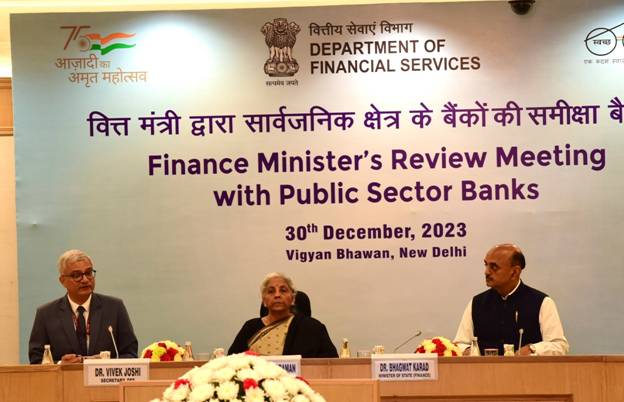
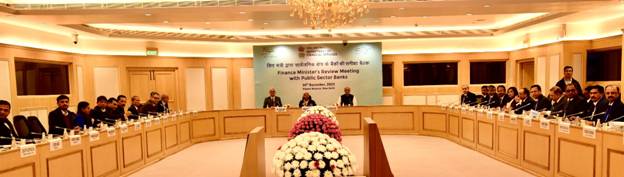
 Union Minister for Finance and Corporate Affairs Smt. Nirmala Sitharaman chaired a meeting to review the performance of Public Sector Banks (PSBs) on various parameters, in New Delhi, today. The meeting was also attended by Union Minister of State for Finance Dr Bhagwat Kishanrao Karad; Dr Vivek Joshi, Secretary, Department of Financial Services; Heads of Public Sector Banks besides senior officials of the Department of Financial Services.


The progress on the acquisition of accounts by the National Asset Reconstruction Company Ltd (NARCL) was also deliberated. The Finance Minister directed that the acquisition of stressed accounts by NARCL needs to improve further, and necessary efforts must be made in this direction. It was advised that NARCL and banks should hold regular meetings to expedite the on-boarding of stressed accounts.

In addition to the above measures, Smt. Sitharaman emphasised the importance of mobilising deposits, urging PSBs to innovate and offer attractive deposit schemes to enhance their deposit base, which will also enable them to extend more credit.

During deliberations on the fraud related matters, the Union Finance Minister, while expressing satisfaction at the improved performance of the Public Sector Banks, stated that bank frauds pose a critical threat to the security of both individual customers and the financial institutions themselves, which can lead to financial losses and reduced public trust in the banking system.

Smt. Sitharaman asked PSBs to concentrate on fraud prevention activities concerned with both large corporate frauds and wilful defaults, as well as on actions that defraud individual customers. The Union Finance Minister instructed the banks to adopt advanced fraud prevention and detection mechanisms and ensure that the customers are further educated about safe banking practices.

The Union Finance Minister directed Banks to undertake consumer education measures for protection from malicious fraud calls and to make efforts for timely identification of accounts as fraud and their subsequent investigation. Banks were also advised to put more effort into recovery from accounts declared as fraud and willful default. The Union Finance Minister also asked banks to monitor the early warning signals to check potential frauds.

Recognising that the effectiveness of legal action against defaulters before courts and tribunals largely depends on effective representation by lawyers and attorneys assisted by bank officials, the Union Finance Minister called for a performance review of counsel representing PSBs to ensure better legal outcomes.

Smt. Sitharaman stated that the willful defaults not only strain the banks’ financial health but also hamper the flow of credit in the economy and urged the PSBs to adopt responsible lending practices across the board. The Union Finance Minister instructed the PSBs to enhance due diligence before loan disbursement, ensure regular monitoring of large loan accounts, and undertake swift and thorough legal action in cases of such default.

Smt. Sitharaman also exhorted the banks to take strict administrative action against the conniving officials of the banks who enable fraud and wilful defaults.

Other issues related to cyber security were also deliberated in the meeting. The preparedness of all the PSBs in addressing cyber security risks was reviewed by the Union Finance Minister and PSBs were directed to ensure privacy of customer data.

Smt. Sitharaman stated that issues of cyber security should be seen from a system perspective as a small vulnerability can be used by nefarious elements to create system-wide risks.

Further, the Finance Minister noted the need to adopt proactive cybersecurity measures and implement stringent security protocols to protect sensitive financial information and systems from cyber-attacks and exhorted the banks to adapt to the evolving digital landscape, ensuring that the integrity of domestic financial systems remains uncompromised.

The Union Finance Minister also emphasised the importance of collaboration and mutual learning among the PSBs and coordination between banks, security agencies, regulatory bodies and technology experts to create a more resilient financial ecosystem against potential cyber-security threats.

***

Welfare of fallen heroes’ families as well as soldiers, ex-servicemen & their dependents

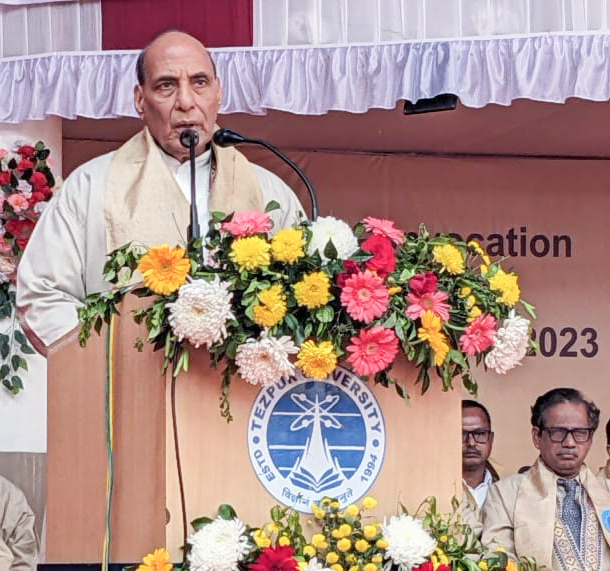
 It is the collective responsibility of the nation to ensure the welfare of the families of the fallen heroes, serving & retired soldiers as well as their dependents, whose unmatched sacrifice, commitment & patriotism is the bedrock of a safe and prosperous India. This was stated by Raksha Mantri Shri Rajnath Singh while addressing an event, organised by an NGO in Surat, Gujarat on December 30, 2023, to honour the valour & sacrifices of the fallen heroes, and extend support to their families.

Paying rich tributes to these bravehearts, Shri Rajnath Singh asserted that the nation will forever remain indebted to the soldiers who safeguard the unity, integrity and sovereignty of the motherland. He commended the Armed Forces personnel for successfully discharging their duties with the Government’s ‘India first, security first’ approach, stating that the people are able to contribute to nation building as they know that the borders are secure. He also expressed gratitude to the family members for producing “these diamonds whose shine illuminates the entire country”.

The Raksha Mantri drew parallels between the process of creating diamonds and the transformation of youth into extraordinary soldiers. “Just as very high temperature and pressure transforms carbon atoms into diamonds, the challenging circumstances, under which the soldiers serve the nation, shape the ordinary youth into diamonds. With their shine, these diamonds then protect us from darkness,” he said.

Shri Rajnath Singh took the opportunity to encourage business leaders to prioritise nation building over personal gains, emphasising that money should be viewed as a means and not the ultimate life goal. He also spoke of the historical significance of Gujarat and its role in the progress of the nation. “Gujarat is the birthplace of prominent figures such as poet Narsingh Mehta who united the then society through his devotion and literature; Father of the Nation Mahatma Gandhi whose ideals & principles ensured our freedom; Iron Man of India Sardar Vallabhbhai Patel who strengthened the unity & integrity of the nation; and Prime Minister Shri Narendra Modi who has raised India’s stature at the international level and has taken the nation forward on the path of prosperity and security. Last but not the least, it is also the birthplace of countless soldiers who bolster the security of our borders by risking their lives,” he said.

The Raksha Mantri added that the Government stands with the Armed Forces and is equipping them with the latest weapons and platforms to protect the nation from threats. He assured the nation that the military is ready to face every challenge and it will give a befitting reply to anyone who tries to cast an evil eye.

**

Promote traditional Ayush systems like Siddha

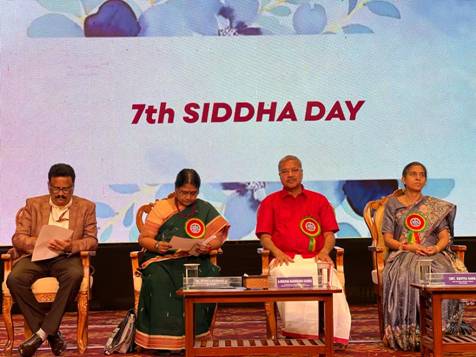
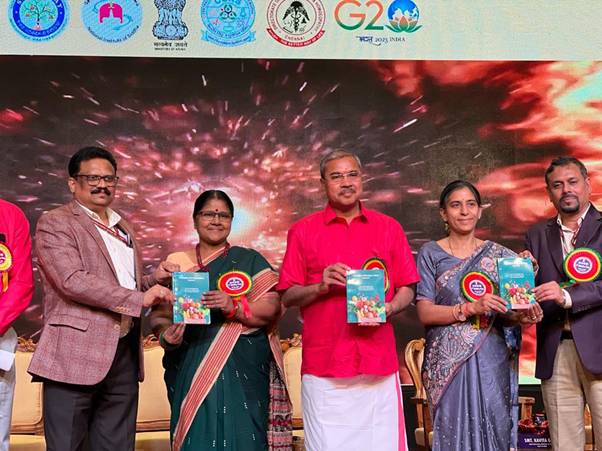
 The knowledge gathered by the ancient ‘Siddha’ practitioners needs to be taken further to safeguard human health – Dr. Munjapara Mahendra Bhai, Union Minister of State for Ayush and Woman and Child Development today spoke over the theme ‘Ancient Wisdom and Modern Solutions’ on the occasion of National Siddha Day. Dr. Munjpara also said that there is a need to propagate all traditional Ayush systems like Siddha in India. The study of Ayush systems and disciplines will help in creating an ecosystem for the effective treatment of many diseases.


The Minister said that the National Institute of Siddha (NIS) was recognized as an apex institution for teaching under the Siddha system, and now contributes actively to training research and the development of standards set by the Ministry of Ayush. The institute offers a wide range of academic programs including Ph.D in BSMS, MD, and Siddha, and also provides great career-building opportunities to the Siddha practitioners. The main hospital of the institute caters to 2500 patients per day and also has a 200-bed inpatient department at affordable rates.
Dr. Munjpara expressed satisfaction over the efforts of the Directorate of Indian Medicine and Homoeopathy, Government of Tamil Nadu to promote indigenous medicine. The State has established 1079 Siddha Units by expanding the Siddha medical health care to the general public.

Dr. Munjapara Mahendrabhai highlighted the important role of the Central Council for Research in Siddha (CCRS) and said that the Council is active with its activities in 11 units in Tamil Nadu, Kerala, Karnataka, Andhra Pradesh, Pondicherry and New Delhi. This expansion has also recently reached Goa and the states in the North-East.

Union Ayush Minister of State was present on the occasion along with other dignitaries Kavita Garg,  Joint Secretary, Ministry of Ayush, Dr. K. Jagannathan President, Unani, Siddha, and Sowa Rigpa NCISM,  Dr. Meena Kumari, Director, National Institute of Siddha were present along with her officers and support staff of NIS.

****

Key Initiative and Achievements of Department of Social Justice and Empowerment- 2023

 Key Initiative and Achievements of Department of Social Justice and Empowerment under Ministry of Social Justice and Empowerment in the year 2023 are-


  1. Initiatives for the welfare of Scheduled Caste


  1. Pre-Matric and Post Matric scholarship scheme for SC students

The Department of Social Justice and Empowerment with an objective of appreciably increasing the Gross Enrolment Ratio of SC students in higher education, with a focus on those from the poorest households, has been implementing Centrally Sponsored Scheme “Post-Matric Scholarships to the students belonging to Scheduled Castes for studies in India”.

DoSJE introduced Centrally Sponsored Scheme of Pre-Matric Scholarship for SC students & Others which aims to support, through financial assistance, parents of children belonging to Schedules Caste and other disadvantaged categories for education of their wards studying at the pre-matric stage.


Achievements under the schemes:

  • During the year 2023 to till date (22.12.2023), a total of 34,58,538 SC beneficiaries have been released scholarship amounting to Rs. 3546.34 Cr under Post-Matric scholarship scheme for SC students;
  • During the year 2023 to till date (22.12.2023), a total of 18,32,628 beneficiaries have been released scholarship amounting to Rs. 369.03 Cr under Pre-Matric Scholarship scheme for SC students;
  • Aadhaar- based payment system is being utilized to ensure that the scholarship funds are received by the student through DBT directly into his/her aadhaar seeded account;
  • Some of the States/ UTs viz. Tamil Nadu, Karnataka have automated the process of receipt and processing of applications by digitalization of certificates and auto- fetching of eligibility data to ensure minimum manual intervention and increased transparency;
  • Seven States/UTs viz. Assam, Chandigarh, Gujarat, Himachal Pradesh, Jharkhand, Karnataka and Odisha have covered more beneficiaries as against their annual targets under Post Matric SC scheme for the year 2022-23;
  • Under Component-II of the Pre-matric Scheme which deals with children whose parents are engaged in cleaning and hazardous occupations, numbers of participating States have increased from one in 2022 to nine in 2023 to provide scholarship to disadvantaged students.


  1. Scholarships for Higher Education for Young Achievers Scheme (SHREYAS) for SCs

The Department conceptualized Umbrella scheme namely ‘Scholarship for Higher Education for Young Achievers Scheme (SHREYAS)’ to ensure convergence of resources across the four smaller Central Sector Schemes of the Department catering to SC/OBC students desirous of pursuing higher education (in India and abroad) and/or obtaining employment in Group A/Group B services of centre or State Governments. The schemes has the following components –


  1. Top Class Education for SCs:
  • The Scheme Guidelines of the scheme have been revised by this Department and 44 new institutes have been empanelled under the scheme raising the total count of institutes to 266
  • Scholarship benefits have been provided to 3999 beneficiaries till date.
  1. Free Coaching scheme for SCs and OBCs:
  • The Scheme Guidelines of the scheme have been revised by this Department and from F.Y 2023-24 the scheme will be run by Dr. Ambedkar Foundation (DAF) through empanelled Central Universities.
  • Scholarship benefits have been provided to 483 beneficiaries from January 2023 till date.
  • III. National Overseas Scholarship for SCs:

Under NOS Scheme financial assistance is provided to the selected students from SCs (115 slots); De-notified, Nomadic and Semi-Nomadic Tribes (6 slots); landless agricultural labourers and traditional artisan categories ( 4 slots), for pursuing masters and Ph.G. level courses abroad. Presently, 125 slots are allotted under the scheme. 107 students has been awarded scholarship out of 125 for the S.Y. 2023-24 till date.

  1. National Fellowship for SCs:

The objective of the Scheme is to provide fellowships in the form of financial assistance to students belonging to Scheduled Caste category to pursue higher studies leading to M. Phil., Ph.D. in Science, Humanities and Social Science streams, in Indian Universities/Institutions/Colleges recognized by University Grants Commission (UGC).


Under NFSC scheme fellowship is provided to Scheduled Castes students for pursuing higher education leading to M.Phil/Ph.D degrees in Sciences, Humanities and Social Sciences in Indian Universities/Institutions/Colleges recognized by University Grants Commission. The scheme is being implemented by National Scheduled Castes Finance and Development Corporation. The scheme provides for 2000 new slots per year who have qualified the National Eligibility Test-Junior Research Fellowship (NET-JRF) of UGC and Junior Research Fellows for Science stream qualifying UGC-Council of Scientific and Industrial Research (UGC-CSIR) Joint Test. The rates under the scheme has been revised i.e. Rs. 37,000/- p.m. for JRF and Rs. 42,000/- p.m. for SRF w.e.f. 01.01.2023.


  1. SHRESHTA (RESIDENTIAL EDUCATION FOR STUDENTS IN HIGH SCHOOLS IN TARGETED AREAS)

The department has been implementing Scheme for Residential Education for Students in High Schools in Targeted Areas (SHRESHTA) to enhance the reach of development Intervention of the Government and to fill the gap in service deficient SCs dominant areas, in the sector of education through the efforts of grant-in-aid institutions (run by NGOs) and residential high schools offering high quality education and to provide environment for socio economic upliftment and overall development of the Scheduled Castes (SCs).

The scheme is being implemented in two modes. In mode-I, each year a specified number (3000) of meritorious SC students in States/UTs are selected through the National Entrance Test for SHRESHTA (NETS) conducted by the National Testing Agency (NTA) and admitted in the best private residential schools affiliated by CBSE/State Boards in classes 9th and 1lth. In mode-2, financial assistance is provided to the NGOs for running the schools/hostel projects related to Education sector to Scheduled Caste students. The Scheme broadly covers 3 types of projects namely (i) Residential Schools (ii) Non- Residential Schools and (iii) Hostels, both for Primary and Secondary Students.


Achievements under the scheme:

Under this scheme, total 2564 students were admitted in 142 Private Residential Schools affiliated by CBSE/State Boards for academic session 2023-24 and school fee of an amount of Rs. 30.55 Crore is reimbursed by this Department.

Details of funds released and number beneficiaries during F.Y. 2023-24 is under:

(Rs. In Lakh)

Sr. No.

2023-24

Total

Amount

released

2023-24

Total No of Students

1

Amount Released to

Private

Residential

Schools

(Mode-1)

No. of

Students

Fund

released to

NGOs/VOs

(Mode -2)

No. of

Students


4921.28

4134*

236.11

3409

5157.39

7543


*(as on 10.12.2023)

*2564 students selected during 2023-24 and 1570 studentys carry forward from selected during 2022-23 and 2021-2022 in mode-1


  1. Pradhan Mantri AnusuchitJaati Abhyuday Yojana (PM-AJAY)


The Department under Pradhan Mantri AnusuchitJaati Abhyuday Yojana (PM-AJAY) merged 03 erstwhile Centrally Sponsored Schemes, namely, Pradhan Mantri Adarsh Gram Yojana(PMAGY), Special Central Assistance to Scheduled Castes Sub Plan(SCA to SCSP) and Babu Jagjivan Ram Chhatrawas Yojana(BJRCY) with an aim to reduce poverty of the SC communities by generation of additional employment opportunities through Skill development, income generating schemes and other initiatives; and to improve socio-economic developmental indicators by ensuring adequate infrastructure and requisite services in the SC dominated villages. the Scheme has now the following three components:

  1. Development of SC dominated villages into an ‘Adarsh Gram’
  2. Grants-in-aid for District/State-level Projects for socio-economic betterment of SCs
  3. Construction of Hostels in Higher Educational Institutions


Achievements under the scheme:


  • Grants-in-Aid’ component: Since 1st January, 2023, a total of 3132 projects have been approved and sanctioned benefitting a total number of 1,14,722 beneficiaries. During the period, a total fund of Rs. 117.54 Cr. has been released to the State Governments/ UTs.
  • ‘Hostel’ component: Since 1st January, 2023, Rs. 56.04 Cr. Has been released for construction of 20 girls’ hostel and 10 boys’ hostel.
  • ‘Adarsh Gram’ Component: Since 1st January, 2023, a total of 1786 Village Development plans (VPDs) have been generated and 1899 villages have been declared Adarsh Gram. A total fund of Rs. 106.01 Cr. has been released to States/ UTs.


  1. The protection of Civil Rights Act, 1955 and the Scheduled Castes and the Scheduled Tribes (Prevention of Atrocities) Act, 1989:


  • Central Assistance of Rs. 496 Crores (approx..) has been released to the States/UTs under the Centrally Sponsored Scheme for the implementation of the PCR Act, 1955 and the SC/ST (PoA) Act, 1989 for effective implementation of these Acts in the year 2023.
  • Approx 92093 number of atrocity victims/dependents have been provided relief in the year 2023 under the scheme.
  • Approx. 20000 inter-caste marriage couples have been provided incentive in the year 2023 under the scheme.
  • Meeting of the committee constituted for effective coordination to devise ways and means to curb offences of untouchability and atrocities against SCs and STs and effective implementation of the PCR Act, 1955 and PoA Act, 1989, has been held on 21.11.2023 under the Chairpersonship of the Hon’ble Union Minister for Social Justice & Empowerment, under which the implementation of the PCR Act, 1955 and the SC/ST (PoA) Act, 1989 in all the States/UTs has been reviewed.


  1. Initiatives for the welfare of Backward Class


  1. PM-YASASVI


The DoSJE devised an umbrella scheme namely; PM-YASASVI for OBC, EBC and DNT students with five sub-schemes to streamline scholarship schemes for students from OBC, EBC and DNT communities to ensure timely disbursement to them. The erstwhile Schemes of Dr. Ambedkar Scheme of Post-Matric Scholarship for Economically Backward Classes (EBCs), Dr. Ambedkar Scheme of Pre-Matric and Post-Matric Scholarship for DNTs have been subsumed in the umbrella Scheme of PM YASASVI with effect from 2021-22.

    1. Pre-Matric Scholarship for OBC/EBC & DNT Boys and Girls
    2. Post- Matric Scholarship for OBC/EBC & DNT Boys and Girls
    3. Construction of hostels for OBC Boys and Girls
    4. Central Sector Scheme of Top Class Education in College for OBC,EBC and DNT students
    5. Central Sector Scheme of Top Class Education in Schools for OBC,EBC and DNT students
  1. SHREYAS

The Department for Educational Empowerment of OBC & EBC students by way of awarding fellowship (financial assistance) in obtaining quality higher education and interest subsidy on educational loan for overseas studies, has been implementing Scholarships for Higher Education for Young Achievers Scheme- SHREYAS with two ongoing Central Sector schemes as components

      1. National Fellowship for OBC students
      2. Dr. Ambedkar Central Sector Scheme on Education loans for Overseas Studies for OBC & EBC

Achievements under PM-YASASVI and SHREYAS:


  • Under Pre-Matric Scholarship for OBC, EBC & DNT students Rs. 383.24 lakh has been released from 01.01.2023 to 22.12.2023 and no. of beneficiaries are 21.727 lakh for 2022-23 and beneficiaries for 2023-24 will be provided with subsequent year’s proposal.
  • Under Post-Matric Scholarship for OBC, EBC & DNT students Rs. 1064.26 lakh has been released from 01.01.2023 to 22.12.2023 and no. of beneficiaries are 25.55 lakh for 2022-23 and beneficiaries for 2023-24 will be provided with subsequent year’s proposal.
  • Under Construction of hostels for OBC Boys and Girls Rs. 21.6365 lakh has been released from 01.01.2023 to 22.12.2023 for 1800 No. of Seat for 2022-23 and 496 No. of Seats for 2023-24.
  • Under Central Sector Scheme of Top Class Education in Schools for OBC, EBC and DNT students Rs. 1.891 lakh has been released from 01.01.2023 to 22.12.2023 for 1291 students.
  • Under Dr. Ambedkar Scheme of Interest Subsidy for Overseas Studies for OBC/EBC students Rs. 48.09 lakh has been released for 1570 students in 2022-23.
  • Under National Fellowship for OBC students Rs. 56.38 lakh has been released for 2734 beneficiaries (upto 31 Dec. 2022).


  1. Initiatives for Welfare of Safai Karamchari


  1. National Action for Mechanized Sanitation Eco-system (NAMASTE).


Self Employment Scheme for Rehabilitation of Manual Scavengers (SRMS) has been modified during the FY 2023-24 with a new nomenclature i.e. National Action for Mechanized Sanitation Eco-system (NAMASTE). NAMASTE is a joint initiative of the Ministry of Social Justice and Empowerment (MoSJE) and Ministry of Housing & Urban Affairs (MoHUA) and NSKFDC is the implementing agency.


The primary target of NAMASTE is the sewer and septic tank sanitation Workers (SSWs) involved in hazardous cleaning operations and directly dealing with human faecal matter. Interventions for rehabilitation of manual scavengers under SRMS will continue under NAMASTE.


Achievements under NAMASTE


  • Online training on the NAMASTE Mobile App for the profiling of sewer and septic worker has been conducted in 27 State/UTs
  • Profiling camps for identification of SSWs have commenced in Delhi and Chandigarh in the month of December.
  • Skill Development Training has commenced for 1306 candidates
  • Rs. 0.85 Crore has been released as Capital Subsidy for self employment projects for 79 Manual scavengers/dependants
  • Rs. 3.21 Crore has been released as Capital Subsidy for 84 beneficiaries for Sanitation related projects. In addition Rs.0.51 Crore released for 16 projects of previous year which could not be released due to PFMS problem.
  • 307 Workshops have been conducted in various ULBs on Prevention of hazardous cleaning of sewer and septic tanks


  1. Initiatives for Welfare of Senior Citizens


  1. Atal Vayo Abhyuday Yojana (AVYAY)

The department under Integrated Programme for Older People (IPOP) component of the scheme provides basic amenities like shelter, food, medical care and entertainment opportunities and by encouraging productive and active ageing through providing support for capacity building of Government/ Non-Governmental Organisations/Panchayati Raj Institutions/ local bodies and the Community at large. Assistance under the scheme will be given to the Panchayati Raj Institutions/local bodies and eligible Non-Governmental Voluntary Organisations.


  1. RashtriyaVayoshri Yojana (RVY)- launched in 2017 to assist BPL senior citizens suffering from age related disabilities/ infirmities. Assistive Devices distributed free of cost.


Achievements under AVYAY and RVY


  • The meeting of EFC of the schemes to be funded from the Senior Citizens Welfare Fund (SCWF) amounting Rs. 979.85 Crore for the year 2021-22 to 2025-26 was held on 09th August, 2023 under the Chairmanship of Finance Secretary.
  • The guidelines for implementation of the Atal Vayo Abhyuday Yojana(AVYAY)-CS was revised in respect of the components to be funded from the Senior Citizens’ Welfare Fund(SCWF) in line with the recommendations of the EFC in its meeting held on 09th  August, 2023.
  • In respect of the scheme of Elderline: National Helpline for Senior Citizens, the Request for Proposals (RFP) procedure has been finalized.
  • Distribution camps at 28 locations were conducted on 24.09.2023 under the scheme of RashtriyaVayoshri Yojana (RVY) wherein assistive devices worth Rs. 9.05 Crore have been provided to 12562 (approx.) senior citizens.
  • Under the scheme of Training of Geriatric Care Givers, applications of training partners/training institutes were invited till 20.10.2023. Applications have been scrutinized and MOU along with work order has been processed for 36 training partners and Training Institutes including NISD and RRTCs.
  • Under the Integrated Programme for Senior Citizens (IPSrC), a total of 88 new old age homes included during past 2 financial years.
  • With National level conferences and regular monthly meetings, the participation of the State Governments has increased.
  • The Screening Committee of Department has recommended a total amount of Rs.76.95 Crore under the State Action Plan for Senior Citizens(SAPSrC).


  1. Initiatives for prevention of Drug Abuse


The Ministry of Social Justice and Empowerment has launched the National Action Plan for Drug Demand Reduction (NAPDDR) which is an umbrella scheme under which financial assistance is provided to (i) ‘State Governments/ Union Territory (UT) Administrations for Preventive Education and Awareness Generation, Capacity Building, Skill development, vocational training and livelihood support of ex-drug addicts, Programmes for Drug Demand Reduction by States/UTs etc. and (ii) NGOs/VOs for running and maintenance of Integrated Rehabilitation Centers for Addicts (IRCAs), Community based peer Led Intervention (CPLI) for early Drug Use Prevention among Adolescents, Outreach and Drop In Centers (ODIC), District De-Addiction Centers (DDACs); and (iii) Addiction Treatment Facilities (ATFs) in Government hospitals .

The Ministry has initiated the Nasha Mukt Bharat Abhiyan with the aim of creating awareness about the adverse effects of substance abuse among youth in all districts across countries.

Achievements Under NAPDDR

  • The Ministry has released an amount of Rs. 95.97Cr. to NGOs/VOs/SAPs under NAPDDR scheme during calendar year 2023.
  • During the saidperiod, fund have been sanctioned to 310 Organizations and a total of 740616 beneficiaries have been benefited under the Scheme.
  • The Ministry has sanctioned setting up of 47 DDACs (District De-addiction centre) in the GAP districts across the country during the year.
  • 25 ATFs were dedicated to the nation during the year.
  • Expert Working Group meeting on Drug Demand Reduction held on 7.4.2023 under India’s Chairmanship of Shanghai Cooperation Organization (SCO) Council of Heads of State. All Member States participated in the meeting online through Zoom platform.

Achievements of NMBA

  • Since launch of NMBA and till now, through the various activities undertaken on-ground, 10.74+ crore people have been sensitized on substance use including 3.38+ Crore Youth and 2.27+ Crore Women.
  • Participation of 3.28+ Lakh educational institutions has ensured that the message of the Abhiyaan reaches children and youth of the country.
  • A strong force of 8,000+ Master Volunteers (MVs) have been identified and trained.
  • Awareness through official Social Media accounts of the Abhiyaan on Twitter, Facebook & Instagram.
  • NMBA Mobile Application developed to gather and collect the data of NMBA activities and represent on the NMBA Dashboard at district, state and national level.
  • NMBA Website (http://nmba.dosje.gov.in) provides detailed information and insights to the user/viewer about the Abhiyaan, an online discussion forum, NMBA dashboard, e-pledge.


  1. Welfare of Transgenders and Persons engaged in Begging


Support for Marginalized Individuals for Livelihood and Enterprise (SMILE)


  1. Comprehensive Rehabilitation of persons engaged in the act of Begging’
  • Department has approved the revised scheme guidelines (23.10.2023)
  • Department identified 30 cities/places and received consent, action plan and other documents
  • Conducted orientation programme with Nodal officers from all 30 cities.
  • 25 cities submitted their consent to implement the scheme.
  • Rs. 5.00 crore has been released to CNA (NISD) towards 1st instalment to implementing agencies.
  1. Comprehensive Rehabilitation for Welfare of Transgender Persons


  1. Pradhan Mantri Dakshta Aur KushaltaSampannHitgrahi (PM-DAKSH)

PM-DAKSH Yojana, a Central Sector Scheme, was launched during 2020-21. The main objective of the Scheme is to enhance competency level of the target groups (SCs, OBCs, EBCs, DNTs, Safai Karamcharis including waste pickers etc) to make them employable both in self- employment and wage-employment for their socio-economic development.


Achievement under the scheme:

  • During 2023-24, 28 Government and 84 private training institutes have been empanelled for implementation of the Scheme.   More than 95000 trainee targets have been distributed among these 112 empanelled training institutes.
  • The practice of empanelling institutes on yearly basis has been discontinued and now the institutes are empanelled for minimum period of three years subject to satisfactory physical and financial progress and non-indulgence of institutes concerned in any malpractices relating to implementation of the scheme.
  • For the first time, while allotting the States, Districts, job roles etc., a transparent process was adopted due to which 411 Districts including 82 Aspirational Districts have been covered for implementation.
  • Further, latest job roles have been allotted to these training institutes.
  • Out of existing 38 training sectors, 32 sectors have been covered which are likely to diversify the training opportunities to the desirous trainee candidates and will also facilitate better employment opportunities to them.  
  • More than 55,000 applicants have already applied on the PM-DAKSH portal for 821 centers seeking training in 247 different courses. 
  • Out of these 55,000 plus applicants more than 37,000 applicants are female who are one of the important target groups for the training. 
  • 574 batches for training have already been formed and they are ready for commencement of training. 
  • The training is likely to commence in all sanctioned centers in the month of December, 2023 itself.

****   

Kisan Credit Card (KCC) to beneficiaries like fishermen, aqua farmers and other stakeholders

 Union Minister for Fisheries, Animal Husbandry and Dairying Shri Parshottam Rupala along with Minister of State Dr. L Murugan will participate in the Sagar Parikrama (Phase X) event being organized from 1st January 2024 to 6th January 2024 at various locations of Andhra Pradesh and Puducherry.

Union Ministers will distribute Kisan Credit Card (KCC) to beneficiaries like fishermen, aqua farmers and other stakeholders during the events to progressive fishermen, particularly coastal fishermen and fish farmers, young fisheries entrepreneurs etc. Best practices and initiatives taken through Pradhan Mantri Matsya Sampada Yojana (PMMSY) scheme, KCC and other schemes will be widely disseminated to fishermen for their benefits. Senior officials from Department of Fisheries, Government of Andhra Pradesh, National Fisheries Development Board, Indian Coast Guard, Fishery Survey of India, fishermen association and other dignitaries will also participate in the event.

The Sagar Parikrama Yatra features the interactions of Minister with fishermen, fish farmers and other relevant stakeholders. Campaigns on KCC and other activities are also being conducted across the coastal districts of Andhra Pradesh and Puducherry. State fisheries officials, fishermen representatives, fish-farmers, entrepreneurs, fishermen cooperative society leaders, professionals, scientists, and other stakeholders from across the nation will accompany the events.

The journey of first phase of “Sagar Parikrama” started from Mandvi, Gujarat on 5th March 2022 and so far, the total nine phases of Sagar Parikrama have been covered in the coastal States/UTs of Gujarat, Daman & Diu, Maharashtra, Goa, Karnataka, Andaman & Nicobar, Kerala, Tamil Nadu, Puducherry, and part of Nellore district of Andhra Pradesh during initiation of its tenth phase. Sagar Parikrama Phase-X will continue and cover the remaining coastal districts of Andhra Pradesh namely Nellore, Prakasam, Bapatla, Krishna, WestGodavari, Konaseema, Kakinada,Visakhapatnam, Vizianagaram, Srikakulam and Yanam (Union Territory of Puducherry).

Andhra Pradesh state is blessed with potential and diversified water resources with 974 kms of coastline, 33,227 kms of continental shelf area, 555 marine fishermen villages, 2 fishing harbours, 350 fish landing centres, 31147 fishing crafts, 65 cold storages, 64 processing plants, 235 ice plants, 28 feed mills, 357 hatcheries and 234 Aqualabs.

In Andhra Pradesh, under Govt of India Flagship Scheme Pradhan Mantri Matsya Sampada Yojana (PMMSY), total investment envisaged in the fisheries sector for 5 years is Rs. 2300 Crore. Some of the important projects undertaken  under PMMSY includes Construction of Fish Landing Centres, Construction of fishing harbours, Construction of Cold storages/Ice plants, acquisition of new Deep sea fishing vessels for traditional fishermen, Construction of Brood Bank, Construction of Freshwater finfish and brackishwater hatcheries, Expansion area for aquaculture, Stocking of fingerlings, Establishment of Disease diagnostic and quality testing labs, Communication and tracking  Devices for traditional and motorised vessels like VHF /Transponders etc.

Sagar Parikrama is a testament to the transformative power of visionary leadership for welfare of fishing community and coastal development. It is an initiative taken by Government, with an aim to resolve the issues of the fishers, other stakeholders and facilitate their economic upliftment through various fisheries’ schemes and programs being implemented by the Government such as Pradhan Mantri Matsya Sampada Yojana (PMMSY) and Kisan Credit Card for Fisheries (KCC).

Sagar Parikrama is making an impact in improving the quality of life and economic wellbeing of people by understanding their issues and it gives an immense opportunity to fishermen to interact with Ministers and Senior Government officials at their doorstep.  Sagar Parikrama will continuously support in resolving the issues of fishermen, fish farmers and facilitate their economic upliftment through various fisheries schemes such as Pradhan Mantri Matsya Sampada Yojana (PMMSY), Kisan Credit Card (KCC) and other program implemented by Government of India.

***

Government of India constitutes Sixteenth Finance Commission with Dr. Arvind Panagariya as its Chairman

 The Government of India, with the approval of the President of India, has constituted the Sixteenth Finance Commission, in pursuance to Article 280(1) of the Constitution.

Dr Arvind Panagariya, former Vice-Chairman, NITI Aayog, and Professor, Columbia University will be the Chairman.  Members of the Sixteenth Finance Commission would be notified separately. Shri Ritvik Ranjanam Pandey has been appointed as Secretary to the Commission.  Detailed terms of reference for Sixteenth Finance Commission have also been spelt out in the notification issued today.

The Sixteenth Finance Commission shall make recommendations as to the following matters, namely: —


(i)        The distribution between the Union and the States of the net proceeds of taxes which are to be, or may be, divided between them under Chapter I, Part XII of the Constitution and the allocation between the States of the respective shares of such proceeds;

(ii)       The principles which should govern the grants-in-aid of the revenues of the States out of the Consolidated Fund of India and the sums to be paid to the States by way of grants-in-aid of their revenues under article 275 of the Constitution for the purposes other than those specified in the provisos to clause (1) of that article; and

(iii)      The measures needed to augment the Consolidated Fund of a State to supplement the resources of the Panchayats and Municipalities in the State on the basis of the recommendations made by the Finance Commission of the State.


The Sixteenth Finance Commission may review the present arrangements on financing Disaster Management initiatives, with reference to the funds constituted under the Disaster Management Act, 2005 (53 of 2005), and make appropriate recommendations thereon.

The Sixteenth Finance Commission has been requested to make its report available by 31st day of October, 2025 covering a period of five years commencing on the 1st day of April, 2026.

CLICK HERE FOR GAZETTE NOTIFICATION

****

Domestic defence industrial ecosystem

 Raksha Mantri Shri Rajnath Singh has said that the Government is developing a strong base of domestic defence industrial ecosystem to make India a strategic economy. Addressing the 21st convocation ceremony of Tezpur University on December 31, 2023 at Tezpur, Raksha Mantri said, the ministry is making all efforts to achieve the target of becoming self-reliant in the defence sector.

Highlighting the various steps taken by the Ministry of Defence to achieve Aatmnirbharta in defence, Shri Rajnath Singh stressed that for the first time, the import of arms was restricted. “We issued five positive indigenization lists, under which 509 such defence equipment have been identified, whose manufacturing will now be done indigenously. In addition, we have also issued 4 positive indigenization lists of Defence Public Sector Undertakings, in which 4,666 items have been identified which will now be manufactured in our country,” said Raksha Mantri.

Underscoring the government’s focus on domestic defence manufacturing, he quoted that for the first time, the production has crossed the record figure of Rs. One Lakh Crore. “The total value of India’s defence exports, which was Rs 1,521 crore in 2016-17, has increased almost 10 times to reach a record level of Rs 15,920 crore in 2022-23,” he stated.

Shri Rajnath Singh elaborated on the proactive attitude of the present government in tackling any situation, which has replaced the crisis of credibility with a culture of confidence. “India is no more tolerant of the “let-it-be” approach. Today, under the leadership of Prime Minister Shri Narendra Modi, the new India believes in “let’s-do-it” approach,” he said.

On the issue of women empowerment, Shri Rajnath Singh said, the government has taken steps to ensure proper representation of women in all sectors including the military. “Today, women are walking shoulder to shoulder with men in every field in the country. From fighter planes to Chandrayan, there is no field in which the presence of women is not seen,” said Raksha Mantri.

Underscoring the significant role of youth in making the country Viksit Bharat, Raksha Mantri said, the idea of making India an economic and military superpower is based on confidence in the capabilities of talented youth. “To empower the youth and enhance their capabilities, our government has promoted start-up culture and innovation ecosystem”, he added.

Mentioning the start-up culture initiated by the Ministry in the Defence Industrial Sector, Shri Rajnath Singh said the Innovation for Defence Excellence (iDEX) has been successfully promoting innovative ideas since its inception. “Because of the various efforts by the Government to promote entrepreneurship among youth, today there are over one lakh start-ups in the country,” he said.

ABB/Anand

Scholar Profile

 A comprehensive scholar profile typically includes various elements that provide a holistic view of the scholar’s academic and professional background, achievements, and contributions. Here’s a list of what is commonly included in a scholar’s profile:

  1. Personal Information:

    • Name
    • Contact Information (email, phone)
    • Profile Picture
  2. Professional Details:

    • Affiliation (current institution/organization)
    • Position/Title
    • Department
  3. Biography or Summary:

    • Overview of the scholar’s academic journey
    • Research interests and expertise
    • Career highlights
  4. Publications:

    • List of Published Papers/Articles
    • Books authored or co-authored
    • Contributions to scholarly journals, conferences, etc.
  5. Conference Presentations:

    • Details of presentations or talks given at conferences or seminars
  6. Citations and Metrics:

    • Citations count
    • h-index, i10-index (citation metrics)
    • Impact of the scholar’s work
  7. Academic Achievements:

    • Awards, honors, and recognitions received
    • Grants and fellowships obtained
  8. Professional Affiliations:

    • Membership in academic or professional organizations
  9. Teaching Experience:

    • Courses taught
    • Academic supervision/mentorship
  10. Collaborations and Projects:

    • Collaborative research projects
    • Partnerships with other scholars or institutions
  11. External Profiles:

    • Links to profiles on platforms like Google Scholar, ResearchGate, ORCID, etc.
  12. Social Impact and Outreach:

    • Contributions to community or societal impact
    • Outreach activities, public talks, media engagements related to research
  13. Skills and Expertise:

    • Specific skills, methodologies, technologies the scholar specializes in
  14. Education:

    • Degrees earned
    • Educational institutions attended

The specifics may vary depending on the field, level of expertise, and the scholar’s career stage. Providing comprehensive, accurate, and up-to-date information is crucial for networking, collaborations, and establishing credibility in the academic community.

Recalibrating Digital Jurisprudence: Legislative and Judicial Trajectories of Information Technology Law in India in 2022

Patel, S. A. (2023). Recalibrating Digital Jurisprudence: Legislative and Judicial Trajectories of Information Technology Law in India in 2022. https://doi.org/10.26643/jsmap/2023/12/1

Sajid A. Patel

Assistant Professor in Mercantile Law,

D.A.V. Velankar College of Commerce, Solapur

sajid123490@gmail.com

Abstract

The intersection of information technology and law in India has become increasingly significant in the wake of rapid digitalization. The year 2022 marked a critical juncture, with legislative amendments, judicial innovations, and policy debates shaping the contours of India’s digital governance framework. This paper examines the evolution of law relating to Information and Technology in India during in the form of an amendment in 2022, focusing on statutory amendments, judicial responses, and emerging challenges in cyber regulation.

Keywords: Digital Jurisprudence, Information Technology Law, Information Technology Act, 2000, Intermediary Liability, Data Protection, Digital Privacy, Cyber Governance.

Introduction

India’s legal framework has long struggled to strike an equilibrium between fostering technological progress and ensuring adequate regulatory safeguards. The Information Technology Act, 2000 (IT Act) emerged as the foundational statute for governing cyberspace, yet the rapid proliferation of digital platforms, the exponential expansion of data exchanges, and the surge in online commercial activity soon revealed its limitations. These developments created an urgent need for reform to address new forms of cyber threats and digital complexities. In response, 2022 witnessed significant parliamentary initiatives aimed at fortifying provisions against cybercrime, while the judiciary simultaneously embraced digital tools and platforms to streamline processes, enhance accessibility, and improve overall efficiency in the administration of justice.

Background

India’s legal system has historically grappled with the delicate task of balancing technological innovation with regulatory safeguards, a tension that has only intensified in the digital age. The enactment of the Information Technology Act, 2000 (IT Act) was a landmark moment, establishing the first comprehensive framework for addressing cybercrimes, electronic commerce, and digital authentication. Yet, the exponential growth of digital platforms, the proliferation of cross border data flows, and increased online transactions have exposed gaps in the original statute. The IT Act, conceived at the dawn of India’s internet revolution, was not designed to anticipate the complexities of artificial intelligence, algorithmic governance, or the challenges of protecting personal data in a globalized digital economy. By 2022, these pressures had reached a critical point. The Indian Parliament introduced amendments aimed at strengthening cybercrime provisions, expanding definitions to encompass emerging technologies, and enhancing penalties for offenses such as identity theft, online fraud, and child exploitation in cyberspace. These legislative efforts reflected a recognition that cyber threats were no longer confined to isolated incidents but had evolved into systemic risks capable of undermining national security, financial stability, and individual rights. At the same time, the judiciary began to rely more extensively on digital tools to enhance efficiency and accessibility. The Supreme Court and several High Courts institutionalized hybrid hearings, integrating virtual platforms into routine judicial practice. This digital transformation of the courts was not merely a response to pandemic exigencies but a structural innovation aimed at reducing backlog, democratizing access to justice, and aligning India’s judicial system with global trends in e-governance.

However, these developments also raised profound constitutional and policy questions. How should India reconcile the imperatives of cyber security with the fundamental right to privacy recognized in Justice K.A. Puttaswamy v. Union of India (AIR 2017 SC 4161); to what extent should regulatory frameworks impose obligations on intermediaries and digital platforms without stifling innovation?; and how can judicial reliance on technology avoid exacerbating the digital divide, particularly for marginalized communities with limited access to digital infrastructure? The year 2022 thus marked a pivotal juncture in India’s cyber law trajectory one in which legislative ambition and judicial innovation converged, but also revealed the enduring challenges of crafting a digital legal order that is both effective and equitable.

Legislative Developments in 2022

Information Technology Act, 2000 was amended in the year 2022 by Information Technology (Amendment) Bill, 2022 which came to be applied form 28th October 2022 so as to include new provisions in following manner

  1. Definition of Intermediary expanded (Section 2): – The scope of definition of “Intermediary” has been increased to include online gaming platforms and certain digital media services. By expanding the scope of definition, the law encompasses new categories of digital actors, ensuring they fall under the regulatory net.
  2. Exemption from Liability of Intermediary (Section 79):- By new Amendment Act, 2022 intermediaries retain conditional immunity from liability, but only if they comply with due diligence obligations under the amended rules. Platforms must act on user complaints within strict timelines which is prescribed 24 hours for acknowledgement and 15 days to resolve the complaint. This amendment shifts the balance toward conditional responsibility, reinforcing accountability from broad immunity.
  3. Grievance Redressal Mechanism (Section 79 (2) and Amendment Rules 2022):- For redressal of grievance relating to Intermediary under the Information Technology Act Grievance Officer is to be appointed by intermediary. Establishment of Grievance Appellate Committees under government oversight has also been prescribed. By virtue of this provision a quasi-judicial oversight structure under state authority upon private platform governance has been established.
  4. Due Diligence Required (Section 79 (3)):- Now Platforms will have to proactively monitor unlawful content, publish compliance reports, and provide clear user complaint mechanisms. This provision is in tune with European Union’s Digital Services Act.
  5. Cheating by Personation Using Computer Resources (Section 66 D):- By the Amendment Rules 2022 intermediary obligations has been extended to prevent impersonation and fraud in gaming environments.
  6. Compensation for Failure to Protect Data (Section 43-A):- Intermediaries have been made responsible to compensate for their failure to protect the data.
  7.  Monitoring and Collection of Traffic Data (Section 69 B):-The Central Government may, by notification in the Official Gazette, authorize any agency to monitor and collect traffic data or information generated, transmitted, received, or stored in any computer resource. Any intermediary or person in charge of a computer resource must provide technical assistance and facilities to the authorized agency for online access or securing such data. The object of this provision is to enhance cyber security, identifying and preventing intrusions, and stopping the spread of computer contaminants.
  8. Cyber Terrorism (Section 66 F):- This provision was proposed to criminalize acts of cyber terrorism, including unauthorized access to computer resources with intent to threaten national security or disrupt essential services. It broadened the scope beyond hacking to cover coordinated cyber-attacks on infrastructure.
  9. Identity Theft and Fraudulent Digital Practices (Section 66 G):- The Amendment Act, 2022 prohibits identity theft in digital transactions, including misuse of biometric data, Aadhaar-linked services, and online banking credentials. It recognized the growing problem of impersonation in e-commerce and fintech platforms.
  10. Protection of Children (Section 67 B):- The Amendment Act, 2022 prohibits publishing or transmitting sexually explicit material involving children. The amendment emphasized stricter penalties and expanded definitions to include grooming and online solicitation.
  11. Emerging Digital Harm (Section 67 BA):- The Amendment Act, 2022 encompasses new categories of newly invented harmful online content, such as deep fakes, synthetic media, and digitally manipulated obscene material.

Reforms in Judicial and Institutional Developments

            By virtue of Amendments made in the year 2022 judicial and institutional developments have been reformed.

  1. Digitalization of Courts:- In 2022 the judiciary accelerated through e-filing, online cause lists, and virtual hearings. The Supreme Court institutionalized hybrid hearings, balancing physical and digital participation.
  2. Online Dispute Resolution:- Particular types of disputes like Consumer disputes, small claims, and fintech-related grievances are increasingly moved to Online Dispute Resolution platforms, reducing backlog and improving efficiency.
  3. Use of Artificial Intelligence in legal research:- A.I. tools and techniques have been started to be used to help courts and law man in solving the cases.

Challenges Ahead

  1. The amendments allow government officials to order the removal of online content within very short periods, sometimes as little as two to three hours in urgent cases. This has raised worries that such broad powers, without proper judicial checks, could weaken fair legal procedures and constitutional protections.
  2. Social media sites, messaging apps, and other online platforms are under heavy pressure to meet strict deadlines prescribed under the law. Smaller platforms especially struggle because they don’t have the technical systems needed to act so quickly, which makes compliance difficult and increases the chance of content being removed unfairly.
  3. To avoid being penalized, online platforms often play it safe by removing content even when it’s unclear whether it is actually illegal. This can end up silencing genuine speech, discouraging people from freely expressing themselves, and weakening healthy democratic discussion.
  4. When government officers issue a “reasoned intimation” to flag content, the process is not fully open or clear. People and platforms often don’t understand why certain content is targeted, and since there is no strong system for appeal or review, accountability becomes weak.
  5. Words like “harmful,” “unlawful,” or “misinformation” are not clearly defined. Because of this vagueness, authorities have wide freedom in how they enforce the rules, which can be misused for political or ideological reasons.
  6. The amendments raise important constitutional concerns under Article 19(1) (a), which protects freedom of speech and expression. Courts have earlier stressed that any restrictions must be necessary and proportionate, but these new rules may not fully meet those standards.
  7. Online platforms must appoint grievance officers and quickly handle user complaints. But because there are so many complaints and no clear system to decide which ones should be addressed first, this becomes difficult, leading to inefficiency and chances of misuse.
  8. Global online platforms working in India face conflicting rules between Indian law and international standards, such as Europe’s GDPR. This makes compliance complicated and could discourage investment and innovation in India’s digital sector.
  9. Even after much discussion, a full Data Protection Act was not passed in 2022, which left personal data exposed and unprotected.
  10. Concerns grew about the use of opaque algorithms in areas like fintech, hiring, and law enforcement, as they raised doubts about fairness and accountability.

Conclusion

The year 2022 marked a turning point in India’s information technology law and digital governance framework. On one hand, legislative amendments to the IT Act reflected the government’s intent to modernize outdated provisions and respond to the rapid growth of digital platforms. On the other, judicial institutions began embracing digitalization, signalling a broader transformation in how justice and governance interact with technology. These developments highlight India’s recognition of the digital sphere as central to its socio-economic future. Yet, despite these important steps, several challenges remain unresolved. The absence of a comprehensive Data Protection Act left personal data exposed, raising serious concerns about privacy and individual rights. Cyber security threats continued to evolve in complexity, testing the resilience of India’s digital infrastructure. At the same time, issues of equitable access persisted, with rural and marginalized communities often excluded from the benefits of digital transformation. The reliance on opaque algorithms in areas such as fintech, recruitment, and law enforcement further raised questions of fairness, accountability, and transparency. These gaps underscore the urgent need for a holistic, rights-based approach to digital governance. Future reforms must not only encourage innovation and technological growth but also embed constitutional safeguards to protect freedom of speech, privacy, and equality. A balanced framework is essential one that promotes efficiency and modernization while ensuring that democratic values are not compromised.

India’s digital journey is at a crossroads. The choices made in the coming years will determine whether technological progress serves only a privileged few or becomes a tool for inclusive and just development. By aligning innovation with constitutional principles, India can build a digital ecosystem that is secure, transparent, and accessible to all, thereby ensuring that its digital transformation strengthens democracy rather than undermines it.

References

Aishwarya Agrawal, How Technology is Changing Law in India, Law Bhoomi (2022).

Bar & Bench, Judicial Innovations in Virtual Hearings (2022).

Derek RSN, Information Technology (Amendment) Bill, 2023 – Definitions Expansion (2023).

Internet Freedom Foundation, Analysis of IT Rules and Amendments (2022).

Juned, Brief Summary of Information Technology (Amendment) Bill, 2022 (2022).

Ministry of Electronics & Information Technology (MeitY), Cybersecurity Breach Reports (2022).

NITI Aayog, Responsible AI for All: Strategy Paper (2022).

Press Information Bureau, Cybercrime Against Women – IT Act Provisions (2022).

Supreme Court of India, Annual Report on E-Courts Project (2022).

Yadul Krishna, New Technology Laws Raise Old Concerns, Times of India (2022).

https://analyticsindiamag.com/ai-features/indias-new-it-act-amendments-reopen-an-unsettled-debate

https://analyticsindiamag.com/ai-features/indias-new-it-act-amendments-reopen-an-unsettled-debate

https://broadbandindiaforum.in/wp-content/uploads/2023/03/IT-Act Amendment_Online-28-MAR-23.pdf

HFSP Research Grant Program

The HFSP Research Grant Program stands out for its distinctive features that prioritize innovative basic research with a strong emphasis on interdisciplinary collaboration and international scientific exchange. By fostering novel approaches and encouraging scientists from diverse disciplines to work together, HFSP aims to address fundamental biological questions that transcend traditional boundaries. Here are the distinguishing features of the HFSP Research Grant Program:

1. Interdisciplinary Approach:

HFSP Research Grants promote interdisciplinary collaboration by actively encouraging the participation of scientists from fields beyond traditional life sciences. This includes but is not limited to disciplines such as biophysics, chemistry, computational biology, computer science, engineering, mathematics, nanoscience, and physics. The program recognizes that innovative solutions often emerge from the convergence of diverse scientific perspectives.

2. International Collaboration:

The program facilitates international scientific collaborations by supporting teams of researchers from different countries. This emphasis on global collaboration aims to leverage the collective expertise of scientists from various cultural and academic backgrounds. The inclusion of international perspectives enhances the potential for groundbreaking discoveries and insights.

3. Innovative Research Focus:

HFSP Research Grants prioritize innovative research with a focus on addressing fundamental biological problems. Unlike some grant programs, preliminary results are not a prerequisite for application. Instead, applicants are expected to develop new lines of research through collaborative efforts, promoting exploration into uncharted territories of scientific inquiry.

4. Risk-Taking Culture:

The program acknowledges the inherent risks associated with pioneering research and encourages applicants to explicitly address these risks in their proposals. HFSP expects research teams to outline mitigation strategies for potential failures while emphasizing how they intend to achieve their research goals. This risk-taking approach fosters a culture of scientific exploration and resilience.

5. Exclusion of Applied Research:

The HFSP Research Grant Program explicitly excludes applications for applied research, especially those typically funded by national medical research bodies. This focus on basic research aligns with the program’s commitment to supporting projects that contribute to a deeper understanding of the fundamental aspects of living organisms and their interactions.

6. Two Types of Grants:

HFSP offers two distinct types of grants: Research Grants – Early Career and Research Grants – Program. The former is designed for team members with doctoral degrees who lead their own research groups, while the latter targets teams of independent researchers at any stage of their careers. Both grant types provide three years of support for 2 to 4 member teams, with fixed sums dependent on team size.

7. Support for Career Development:

The Research Grants – Early Career are specifically aimed at individuals directing research groups and seeking to develop independent lines of research. While HFSP does not intend to create scientific independence through these awards, it recognizes the importance of supporting early-career scientists in building their research careers.

In conclusion, the HFSP Research Grant Program’s distinguishing features reflect a commitment to fostering innovation, international collaboration, and interdisciplinary research. By encouraging risk-taking and providing support for teams with diverse expertise, the program contributes to advancing our understanding of complex biological phenomena and promotes excellence in scientific exploration.

Distinguishing Features of the HFSP Research Grant Program
HFSP Research Grants support innovative basic research into fundamental biological problems with emphasis placed on novel and interdisciplinary approaches that involve scientific exchanges across national and disciplinary boundaries (see guidelines).
Participation of scientists from disciplines outside the traditional life sciences such as biophysics, chemistry, computational biology, computer science, engineering, mathematics, nanoscience or physics is recommended because such collaborations have opened up new approaches for understanding the complex structures and regulatory networks that characterize living organisms, their evolution and interactions.
Research grants are provided for teams of scientists from different countries who wish to combine their expertise in innovative approaches to questions that could not be answered by individual laboratories. Preliminary results are not required and applicants are expected to develop new lines of research through the research collaboration.
It is understood that such research inherently contains risks and HFSP expects that teams of applicants address the risks and outline mitigation strategies for their research in case of failure and how they intend to achieve their goals.
Applications for applied research, including medical research typically funded by national medical research bodies, will be deemed ineligible (see guidelines).
Two types of Grant are available: Research Grants – Early Career and Research Grants – Program.
Research Grants – Early Career*
All team members are expected to direct a research group (however small) and must have a doctoral degree (PhD, MD or equivalent). They must be in a position to initiate and direct their own independent lines of research. The HFSP award is not intended to create scientific independence, this is a decision of the research institute prior to the application.
Research Grants – Program
Awarded to teams of independent researchers at any stage of their careers. The research team is expected to develop new lines of research through the collaboration. Applications including independent investigators early in their careers are encouraged.
Both provide three years support for 2 – 4 member teams.
Awards are fixed sums dependent upon team size.

Dr. Nalla Bala Kalyan

Name of Scholar: Dr. Nalla Bala Kalyan
Brief About Scholar:
Name of Institution: Sri Venkateswara College of Engineering, (Autonomous), Karakambadi Road, Tirupati
Published Research Papers: Research Paper Entitled “Jeopardy and Arrival Analysis of Certain Cement Securities in India”, Published in International Journal of Advanced Science and Technology Vol. 29, No. 5, (2020), pp. 3806-3820, ISSN: 2005-4238 IJAST, Indexed by Scopus. Research Paper Entitled “Competitive Performance of Micro, Small and Medium Enterprises in India”, published in Asian Journal of Social Sciences, Vol. III (1), pp.128-146, Jan-June, 2011, ISSN: 0975-5942, Citations: 33. Research Paper Entitled “Micro, Small and Medium Enterprises in the 21st Century”, Published in Zenith International Journal of Business Economics & Management Research, Vol.2 Issue 5, pp.23-38, May, 2012, *UGC Approved Journal, ISSN: 2249 8826, Cita tions: 28. Research Paper Entitled “A Comparative Study on Risk & Return Analysis of Selected Stocks in India”, published in International Journal of Management and Economics Invention, Volume 04, Issue 05, May 2018, pp.1730-1736, ISSN: 2395-7220, Citations: 16. Research Paper Entitled “A Study on Risk & Return Analysis of Selected Securities in India”, published in International Journal of Engineering Technologies and Management Research, 5(4), 79-86, April 2018, Citations: 11. Research Paper Entitled “Sickness of Micro, Small and Medium Enterprises in India”, Published in International Journal of Business Management & Economic Research, Vol. 2 (6), pp.345-351, Nov-Dec, 2011, ISSN: 2229-6247, Citations: 10 Research Paper Entitled “A Study on Risk & Return Analysis of the Selected Mutual Funds Schemes in India”, published in International Journal of Research in Social Sciences, Vol. 8 Issue 5, May 2018, pp.212-221, ISSN: 2249-2496, *UGC Approved Journal, Citation s:9 Research Paper Entitled “Inventory Management Pattern of Steel Industry in India”, published in Organizations& Markets: Policies& Processes e journal, Vol.6, No.62, May, 2020, ISSN: 1556-5068, Citations: 6. Research Paper Entitled “Banking Sector Reforms in India”, Published in International Journal of Management and Humanities Research Script, Volume 4, Issue 4, December, 2017, pp.13-18, ISSN: 2349-7289, Citations: 7. Research Paper Entitled “Evaluation of Portfolio Analysis on Selected Securities of NSE in India”, Published in International Journal of Applied Engineering Research, Volume 14, Number 4 (2019) pp. 859-868, Research India Publications, ISSN 0973-4562, , UGC Approved Journal, Citations: 5. Research Paper Entitled “Marketing Strategies and Problems of Micro, Small and Medium Enterprises in Andhra Pradesh”, published in TIJ’s Research journal of Economics and Business Studies, Volume; 01, Number: 02, pp.58-65, December, 2011, *UGC Approved Journal , ISSN: 2251-1555, Citations: 4. Research Paper Entitled “A Case Study on Benefits for Quality of Work Life to Employees and Organizations in India”, published by (Iconic Research and Engineering Journals) IRE Journals, Volume 3, Issue 6, Dec 2019, ISSN: 2456-8880, Citations: 3. Research Paper Entitled “Problems and Prospects of Micro, Small and Medium Enterprises in Chittoor District”, Published in Abhinav National Journal of Research in Commerce & Management, Volume 6, Issue 10, pp.113-119, October, 2017, *UGC Approved Journal, ISSN-2277-1166, Citations: 3. Research Paper Entitled “Features of Entrepreneurship in India”, Published in “International Journal of Research” Volume 5, Issue1, pp.3752-3759, January 2018, IF: 5.60, *UGC Approved Journal, ISSN: 2348-6848, Citations: 2. Research Paper Entitled “Employment and Unemployment in India”, Published in Bookman International Journal of Accounts & Business Management, Vol.1 No.1, pp.1-6, September 2012, ISSN: 2319-426X, Citations: 2. Research Paper Entitled “A Study on Financial Derivatives With reference to Tata Motors Limited, Chittoor District of AP, India”, published in Global Journal for Research Analysis, Vol. 7, Issue-4, April-2018, pp.430-433, ISSN:2277 — 8160, Citations: 2. Research Paper Entitled “An Empirical Study on Development of the MSME Sector in Chittoor District of Andhra Pradesh, India”, Information Systems e journal, Vol.3, No.48, May1, 2020, ISSN: 1556-5068, SSRN Elsevier, Citations: 2 Research Paper Entitled “Ergonomics at Work Environment in India”, published in Applied & Practicing Anthropology e Journal, Vol. 4, No. 28: Apr 16, 2019, ISSN:1556-5068, SSRN Elsevier, Citations: 1. Research Paper Entitled “An Experiential Examination of Financial Performance of Foremost Power Segment Organization — APSPDCL”, published in Energy Policy and Economics e Journal, Vol.3, No.19: July 27, 2020, ISSN:1556-5068, SSRN Elsevier, Citations:1 Research Pa per Entitled “Magnification and Performance of Various Derivatives in India”, Published by Journal of Emerging Technologies and Innovative Research (JETIR), July 2021, Volume 8, Issue 7, ISSN-2349-5162, UGC Approved Journal no 63975, Citations:1. Indexed by Google Scholar Research Paper Entitled “A Study on Performance of SBI Blue Chip Fund at SBI Mutual Funds in India” Published in “International Journal of Advance Research, Ideas and Innovations in Technology”, Volume3, Issue6, pp.44-53, November, 2017, ISSN: 2454-132X Research Paper Entitled “Performance of Selected Stocks in Old Generation Private Sector Banks in India” published in International Journal of Management (IJM), Volume 9, Issue 2, March—April 2018, pp. 43—55, ISSN:0976-6510 Research Paper Entitled “Recital Assessment of Selected Balanced Funds of Various Companies in India” Published in IOSR Journal of Business and Management, Volume 19, Issue 11, pp.74-80, November, 2017, ISSN: 227 8-487X Research Paper Entitled “Macroeconomic Factors Influence on Stock Exchange in India” Published in International Journal for Science and Advance Research in Technology, Vol.4, Issue 6, pp.696-701, June 2018, ISSN:2395-1052 Research Paper Entitled “A Study on Performance Appraisal System in Service Sector Organizations in India” Published in “International Journal of Research in Computer Application& Management” Vol.8, Issue No.1, pp.20-24, January, 2018, ISSN: 2231-1009 Research Paper Entitled “A Study on Working Culture of Ergonomics in India” Published by International Journal of Innovative Research in Technology, April 2019, Volume 5 Issue 11, ISSN: 2349-6002 Research Paper Entitled “A Study on Employment Trends in India” Published in “Global Advanced Research Journal of Management and Business Studies”, Vol.1 (6), pp.173-180, July, 2012, ISSN: 2315-5086 Research Paper Entitled “A Study on Factors Influencing Brand Switching in Telecom Industr y in India” Published in International Journal of Latest Technology in Engineering, Management & Applied Science, Volume VII, Issue IX, September 2018, ISSN 2278-2540 Research Paper Entitled “A Study on Leadership Styles Adopted at V-Trans in India” Published in International Journal of Engineering and Management Research, Volume-8, Issue-6, December 2018, 135-141, ISSN: 2250-0758 Research Paper Entitled “Analysis of Financial Statement of NRC Agro with Special Reference to Goods and Service Tax” Published in IJSRST, Volume 6, Issue 1, ISSN: 2395-602X Research Paper Entitled “A Study on Competency Mapping at BGR Energy in India” Published by International Journal of Scientific Research and Engineering Development, Volume2 Issue 2, Mar —Apr 2019, ISSN: 2581-7175 Research Paper Entitled “Competitive Performance of Micro, Small and Medium Enterprises in India” Published in “Asian Journal of Social Sciences”, Vol. III (1), pp.128-146, Jan-June, 2011, ISSN: 0975-5942 Research Paper Entitled “A Study on Intellectual Property Rights (IPR) for Micro, Small and Medium Enterprises in India” Published in “IRE Journals, Volume 1, Issue 7, pp.1-5, January, 2018, ISSN: 2456-8880 Research Paper Entitled “Marketing Management for Micro, Small and Medium Enterprises in India” published in Journal of Research, Extension and Development, Vol.1, No.7, March 2013, pp.69-73, ISSN:2319-1899 Research Paper Entitled “Problems and Prospects of Micro, Small and Medium Enterprises in Chittoor District” Published in “Abhinav National Journal of Research in Commerce & Management”, Volume 6, Issue 10, pp.113-119, October, 2017ISSN-2277-1166 Research Paper Entitled “A Case Study on TQM for Micro, Small and Medium Enterprises in India” Published in Journal of Exclusive Management Science”, Volume 4, Issue 9, pp.1-6, September, 2015, IF: 2.78, ISSN 2277 -5684 Research Paper Entitled “A Case Study on Budding Inventive Trends in Market ing Products of Small-Scale Industries in India”, Published by International Journal of Creative and Innovative Research in All Studies, December 2019, Vol.2, Issue 7, ISSN: 2581-5334