WORMHOLE-That helps you to teleport

Wormhole theory

Wormholes were first theorized in 1916, though that wasn’t what they were called at the time. While reviewing another physicist’s solution to the equations in Albert Einstein’s theory of general relativity, Austrian physicist Ludwig Flamm realized another solution was possible. He described a “white hole,” a theoretical time reversal of a black hole. Entrances to both black and white holes could be connected by a space-time conduit.

In 1935, Einstein and physicist Nathan Rosen used the theory of general relativity to elaborate on the idea, proposing the existence of “bridges” through space-time. These bridges connect two different points in space-time, theoretically creating a shortcut that could reduce travel time and distance. The shortcuts came to be called Einstein-Rosen bridges, or wormholes.

“The whole thing is very hypothetical at this point,” said Stephen Hsu, a professor of theoretical physics at the University of Oregon, told our sister site, LiveScience. “No one thinks we’re going to find a wormhole anytime soon.”

Wormholes contain two mouths, with a throat connecting the two. The mouths would most likely be spheroidal. The throat might be a straight stretch, but it could also wind around, taking a longer path than a more conventional route might require.

Einstein’s theory of general relativity mathematically predicts the existence of wormholes, but none have been discovered to date. A negative mass wormhole might be spotted by the way its gravity affects light that passes by.

Certain solutions of general relativity allow for the existence of wormholes where the mouth of each is a black hole. However, a naturally occurring black hole, formed by the collapse of a dying star, does not by itself create a wormhole.
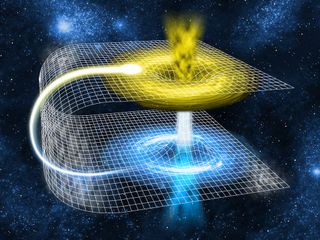
Wormhole

Through the wormhole

Science fiction is filled with tales of traveling through wormholes. But the reality of such travel is more complicated, and not just because we’ve yet to spot one.

The first problem is size. Primordial wormholes are predicted to exist on microscopic levels, about 10–33 centimeters. However, as the universe expands, it is possible that some may have been stretched to larger sizes.

Another problem comes from stability. The predicted Einstein-Rosen wormholes would be useless for travel because they collapse quickly. 

“You would need some very exotic type of matter in order to stabilize a wormhole,” said Hsu, “and it’s not clear whether such matter exists in the universe.”

But more recent research found that a wormhole containing “exotic” matter could stay open and unchanging for longer periods of time.

Exotic matter, which should not be confused with dark matter or antimatter, contains negative energy density and a large negative pressure. Such matter has only been seen in the behavior of certain vacuum states as part of quantum field theory.

If a wormhole contained sufficient exotic matter, whether naturally occurring or artificially added, it could theoretically be used as a method of sending information or travelers through space. Unfortunately, human journeys through the space tunnels may be challenging.

“The jury is not in, so we just don’t know,” physicist Kip Thorne, one of the world’s leading authorities on relativity, black holes and wormholes, told Space.com. “But there are very strong indications that wormholes that a human could travel through are forbidden by the laws of physics. That’s sad, that’s unfortunate, but that’s the direction in which things are pointing.”

Wormholes may not only connect two separate regions within the universe, they could also connect two different universes. Similarly, some scientists have conjectured that if one mouth of a wormhole is moved in a specific manner, it could allow for time travel

“You can go into the future or into the past using traversable wormholes,” astrophysicist Eric Davis told LiveScience. But it won’t be easy: “It would take a Herculean effort to turn a wormhole into a time machine. It’s going to be tough enough to pull off a wormhole.”

However, British cosmologist Stephen Hawking has argued that such use is not possible. [Weird Science: Wormholes Make the Best Time Machines]

“A wormhole is not really a means of going back in time, it’s a short cut, so that something that was far away is much closer,” NASA’s Eric Christian wrote.

Although adding exotic matter to a wormhole might stabilize it to the point that human passengers could travel safely through it, there is still the possibility that the addition of “regular” matter would be sufficient to destabilize the portal.

Today’s technology is insufficient to enlarge or stabilize wormholes, even if they could be found. However, scientists continue to explore the concept as a method of space travel with the hope that technology will eventually be able to utilize them.

“You would need some of super-super-advanced technology,” Hsu said. “Humans won’t be doing this any time in the near future.”

Additional resources:

Provide Poor Lunch Organization(PPLO)

PPLO is started by G.Sanjay on 2019 as an initiative to serve the lunch to the poor people who starve for food.

PPLO’s motive is to “Reduce Shortage by Donating the Wastage“.

FOOD WASTAGE- A SHORT GLIMPSE AND STATS:

Having food is something to celebrate but have you ever wondered consciously just much food you waste. Have you ever stopped to analyze just how much food is wasted in your household, society, country and the world? It is not something that people, who have food readily available whenever they feel hungry, worry about. However, for people who are not even able to eat one meal a day, often wonder if all the food that is being wasted around them on a daily basis could have filled their stomach.

Food waste is an issue of importance to global food security and the environment. But what a lot people may not realise is that is impacts a country’s economy as well. Every day, food suitable for human consumption is wasted in large quantities in medium and high-income countries at the retail and consumer level. In fact, a significant food loss and waste occur at the production to processing stages in the food supply chain in low-income countries. 

Food Wastage in India:

Contrary to the belief of Indians that we don’t waste food, data showed that India wastes as much food as the whole of United Kingdom consumes. In fact, food wastage is an alarming issue in India and country’s streets, garbage bins and landfills have sufficient evidence to prove this. According to the United Nations Development Programme, up to 40 per cent of the food produced in India is wasted and about 21 million tonnes of wheat are wasted annually. 

You don’t even have to scour through several resources to see how much food is wasted in the country. During the nationwide lockdown this year, India registered high wastage because of a poor supply chain. Food delivery website MilkBasket lost 15,000 litres of milk and 10,000 kg of vegetables in a single day after delivery agents were denied entry in societies due to lockdown. Farmers in Belagavi district of Karnataka spilt thousands of litres of milk in a river after they could not reach the people due to the lockdown. Several other reports surfaces which showed how much food was wasted.

Food Wastage stats:

  • Around 67 million tonnes of food is wasted in India every year which has been valued at around Rs 92,000 crores. For context, this amount is enough to feed all of Bihar for a year
  • Annually, nearly 21 million metric tonnes of wheat rots in India. This figure is equal to Australia’s total annual production
  • According to old 2018 BMC data, Mumbai generates close to 9,400 metric tonnes of solid waste per day, from which 73% is food, vegetable, and fruit waste, while only 3% is plastic. 
  • National Delhi also generates around 9,000 metric tonnes of waste per day, with the country’s largest landfill located in East Delhi.

Economic Impact:

Food Wastage not only leads to negative environmental impact but also causes economic loss. According to an FAO report, approximately one-third of all food produced for human consumption is lost or wasted. The economic costs of this food wastage are substantial and amount to about $1 trillion each year. However, the hidden costs of food wastage extend much further.  In addition to the $1 trillion of economic costs per year, environmental costs reach around $700 billion and social costs around $900 billion.

Global food wastage costs as per FAO report:

  • 3.5 Gt CO2e of greenhouse gas emissions. Based on the social cost of carbon, these are estimated to cause $394 billion of damages per year.
  • Increased water scarcity, particularly for dry regions and seasons. Globally, this is estimated to cost $164 billion per year.
  • Soil erosion due to water is estimated to cost USD 35 billion per year through nutrient loss, lower yields biological losses and off-site damages. The cost of wind erosion may be of a similar magnitude.
  • Risks to biodiversity including the impacts of pesticide use, nitrate and phosphorus eutrophication, pollinator losses and fisheries overexploitation are estimated to cost $32 billion per year.
  • Increased risk of conflict due to soil erosion, estimated to cost $396 billion per year.
  • Loss of livelihoods due to soil erosion estimated to cost $333 billion per year.
  • Adverse health effects due to pesticide exposure, estimated to cost $153 billion per year.

Earlier this year, former Union Minister of Consumer Affairs, Food and Public Distribution Ram Vilas Paswan said that in financial year 2019-20, foodgrain wastage in the country stood at 1,930 tonnes, which was 0.002 per cent of the total procurement. The total procurement in FY 2019-20 was 751.72 LMT (Lakh Metric Tonnes). The minister shared the data on Twitter and asserted that the notion that foodgrain wastage is high in FCI (Food Corporation of India) godowns is not true. While he was right, the truth is that over a thousand tonnes of foodgrains was wasted which could have fed millions of people. 

Now that it is clear that food wastage cripples a country’s economy to an extent that most are unaware, some measures that the government needs to take is to include containing wastage in transportation, improve storage facilities. Food processing also needs to be sped up so food is saved and wasted less to feed more. 

PPLO’s WORK:

In PPLO Sanjay and his friends collects the food wasted by common people from their schools and houses and test the quality of the food ensuring that only healthier and good food will be served. We then serve the lunch for the poor people in need instead of throwing to the dusbin. If we find the food has been contaminated we convert the food into a manure by composting.

So in PPLO we ensure that the food is not wasted and it is either used to feed humans or to nurture plants.

Chennai: Fish sales remain extremely poor

Why eat lunch?

Lunch is an important meal for everyone. It provides energy and nutrients to keep the body and brain working efficiently through the afternoon. A packed lunch made at home can be a healthy and delicious choice and gives you control over the foods and ingredients included so the mothers or fathers or children who cook their food for loved ones can able to help the people in need by donating their wastage. So, we took a step to serve the lunch to the needs.

We were able to provide lunch for the slum consisting of 370 people from food collected from a single school. So, we can able to feed the whole world if the wastage is managed properly.

Food waste as fertilizer.

Foods which we find contaminated are transformed to manure to Grow plants. We could use all the food waste and prepare a compost out of them which can be used as organic fertilizer. This way we save the earth from the pollution caused by food waste and also do something productive.

Food waste is unique as a composting agent, it is the main source of organic matters. Fruits, vegetables grains, coffee filters, eggshells can be composted.

PPLO MISSION:

FOOD FOR ALL AND WASTE FOR NONE.

PPLO ACCOMPLISHMENT:

PPLO was successful in providing lunch for nearly 400 people from the food remains generated by a school of 527 students.

If you would like to support PPLO or if you need support from PPLO

Please Contact: s98208366@gmail.com

MESSIER 87-The Galaxy that gives Hope

M87
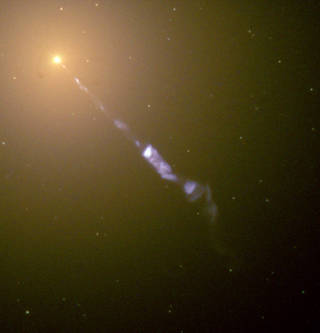
The elliptical galaxy M87 is the home of several trillion stars, a supermassive black hole and a family of roughly 15,000 globular star clusters. For comparison, our Milky Way galaxy contains only a few hundred billion stars and about 150 globular clusters. The monstrous M87 is the dominant member of the neighboring Virgo cluster of galaxies, which contains some 2,000 galaxies. Discovered in 1781 by Charles Messier, this galaxy is located 54 million light-years away from Earth in the constellation Virgo. It has an apparent magnitude of 9.6 and can be observed using a small telescope most easily in May.
This Hubble image of M87 is a composite of individual observations in visible and infrared light. Its most striking features are the blue jet near the center and the myriad of star-like globular clusters scattered throughout the image.
The jet is a black-hole-powered stream of material that is being ejected from M87’s core. As gaseous material from the center of the galaxy accretes onto the black hole, the energy released produces a stream of subatomic particles that are accelerated to velocities near the speed of light.
At the center of the Virgo cluster, M87 may have accumulated some of its many globular clusters by gravitationally pulling them from nearby dwarf galaxies that seem to be devoid of such clusters today.
For more information about Hubble’s observations of M87, see:
http://hubblesite.org/news_release/news/2008-30
http://hubblesite.org/news_release/news/2000-20
http://hubblesite.org/news_release/news/2013-32
locator star chart for M87

Wireless Energy Transfer-Tesla’s Dream

WPT- Wireless Power Transmission
Wireless Power Transfer holds the promise of freeing us from the tyranny of power cords. This technology is being incorporated into all kinds of devices and systems.

Wireless Power Transfer holds the promise of freeing us from the tyranny of power cords. This technology is being incorporated into all kinds of devices and systems. Let’s take a look!
The Wired Way
The majority of today’s residences and commercial buildings are powered by alternating current (AC) from the power grid. Electrical stations generate AC electricity that is delivered to homes and businesses via high-voltage transmission lines and step-down transformers.
Electricity enters at the breaker box, and then electrical wiring delivers current to the AC equipment and devices that we use every day—lights, kitchen appliances, chargers, and so forth.
All components are standardized and in agreement with the electrical code. Any device rated for standard current and voltage will work in any of the millions of outlets throughout the country. While standards differ between countries and continents, within a given electrical system, any appropriately rated device will work.
Here a cord, there a cord. . . . Most of our electrical devices have AC power cords.


Wireless Power Technology
Wireless Power Transfer (WPT) makes it possible to supply power through an air gap, without the need for current-carrying wires. WPT can provide power from an AC source to compatible batteries or devices without physical connectors or wires. WPT can recharge mobile phones and tablets, drones, cars, even transportation equipment. It may even be possible to wirelessly transmit power gathered by solar-panel arrays in space.
WPT has been an exciting development in consumer electronics, replacing wired chargers. The 2017 Consumer Electronics Show will have many devices offering WPT.
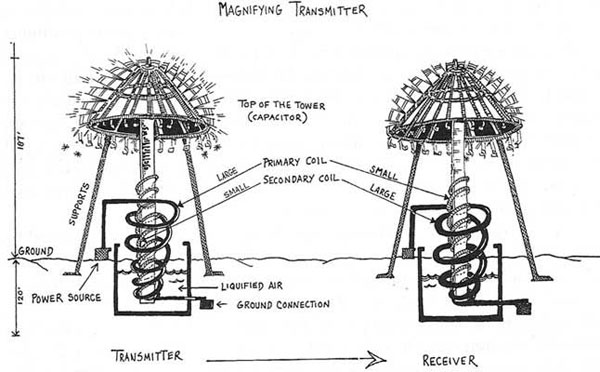
The concept of transferring power without wires, however, has been around since the late 1890s. Nikola Tesla was able to light electric bulbs wirelessly at his Colorado Springs Lab using electrodynamic induction (aka resonant inductive coupling).
 

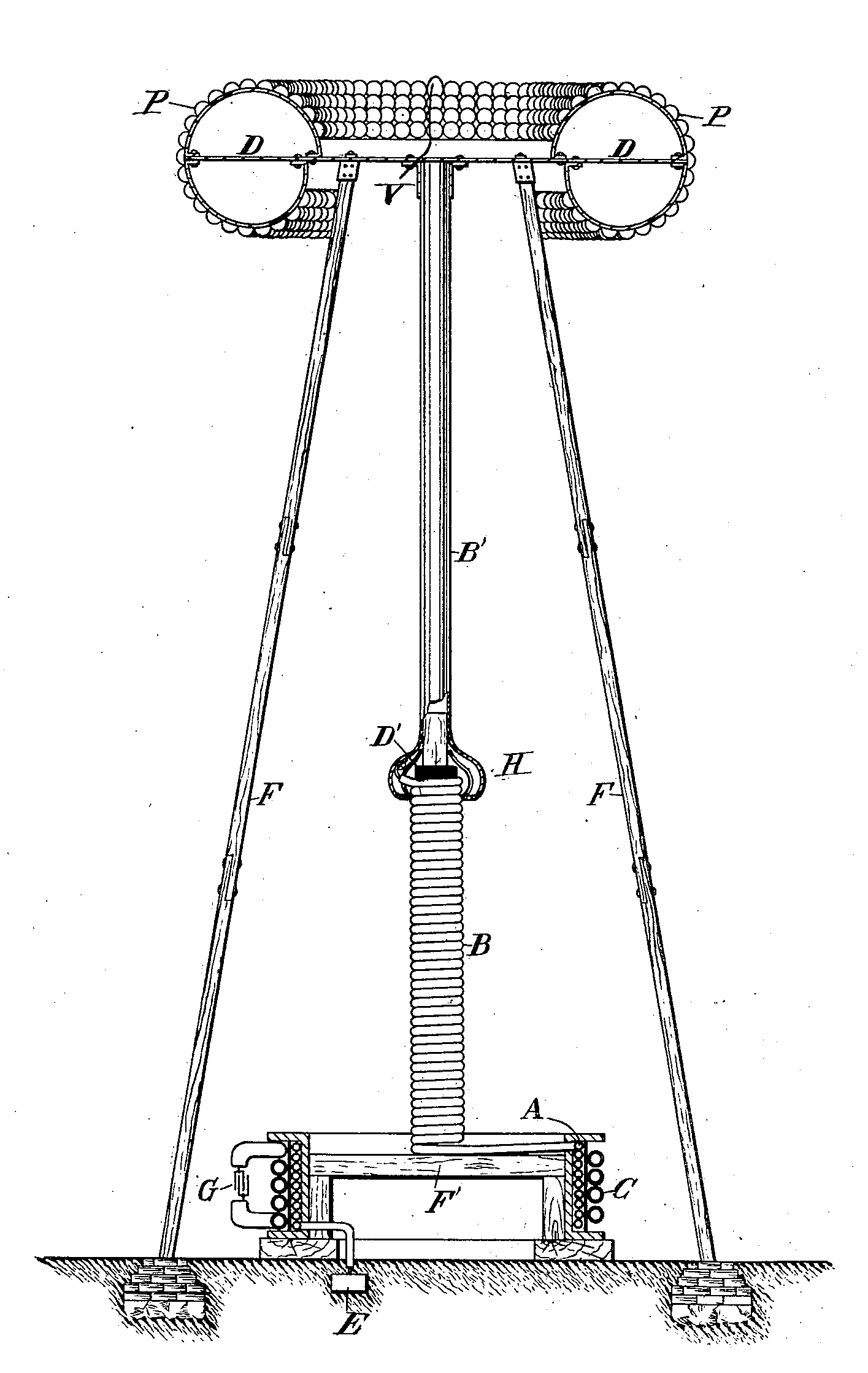
An image from Tesla’s patent for an “apparatus for transmitting electrical energy,” 1907.
 
Three light bulbs placed 60 feet (18m) from the power source were lit, and the demonstration was documented. Tesla had big plans and hoped that his Long Island-based Wardenclyffe Tower would transmit electrical energy wirelessly across the Atlantic Ocean. That never happened owing to various difficulties, including funding and timing.
WPT uses fields created by charged particles to carry energy between transmitters and receivers over an air gap. The air gap is bridged by converting the energy into a form that can travel through the air. The energy is converted to an oscillating field, transmitted over the air, and then converted into usable electrical current by a receiver. Depending on the power and distance, energy can be effectively transferred via an electric field, a magnetic field, or electromagnetic (EM) waves such as radio waves, microwaves, or even light.

 
Qi Charging, an Open Standard for Wireless Charging
While some of the companies promising WPT are still working to deliver products, Qi (pronounced “chee”) charging is standardized, and devices are currently available. The Wireless Power Consortium (WPC), established in 2008, developed the Qi standard for battery charging. The standard supports both inductive and resonant charging technologies.
Inductive charging has the energy passing between a transmitter and receiver coil at close range. Inductive systems require the coils to be in close proximity and in alignment with each other; usually the devices are in direct contact with the charging pad. Resonant charging does not require careful alignment, and chargers can detect and charge a device at distances up to 45mm; thus, resonant chargers can be embedded in furniture or mounted in shelving.
 

The Qi logo displayed on the Qimini wireless charging plate. Image courtesy of Tektos.
 
The presence of a Qi logo means the device is registered and certified by the Wireless Power Consortium.
When first introduced, Qi charging was low power, about 5W. The first smartphones using Qi charging were introduced in 2011. In 2015, Qi was expanded to include 15W, which allows for quick charging.
Only devices listed in the Qi Registration Database are guaranteed to provide Qi compatibility. There are currently over 700 products listed. It is important to recognize that products with the Qi logo have been tested and certified; the magnetic fields they use will not cause problems for sensitive devices such as mobile phones or electronic passports. Registered devices are guaranteed to work with all registered chargers.  
For more information on Qi wireless charging, check out this article, and for an introduction to and technical evaluation of Qi-compatible transmitter/receiver WPT evaluation boards, click here and here.
 
The Physics of WPT
WPT for consumer devices is an emerging technology, but the underlying principles and components are not new. Maxwell’s Equations still rule wherever electricity and magnetism are involved, and transmitters send energy to receivers just as in other forms of wireless communication. WPT is different, though, in that the primary goal is transferring the energy itself, rather than information encoded in the energy.


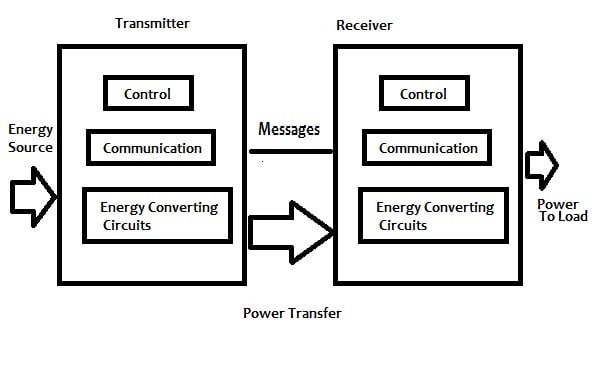
WPT transmitter/receiver block diagram.
The electromagnetic fields involved in WPT can be quite strong, and human safety has to be taken into account. Exposure to electromagnetic radiation can be a concern, and there is also the possibility that the fields generated by WPT transmitters could interfere with wearable or implanted medical devices.
The transmitters and receivers are embedded within WPT devices, as are the batteries to be charged. The actual conversion circuitry will depend on the technology used. In addition to the actual transfer of energy, the WPT system must allow the transmitter and receiver to communicate. This ensures that a receiver can notify the charging device when a battery is fully charged. Communication also allows a transmitter to detect and identify a receiver, to adjust the amount of power transmitted to the load, and to monitor conditions such as battery temperature.
The concept of near-field vs. far-field radiation is relevant to WPT. Transmission techniques, the amount of power that can be transferred, and proximity requirements are influenced by whether the system is utilizing near-field or far-field radiation.
Locations for which the distance from the antenna is much less than one wavelength are in the near field. The energy in the near field is nonradiative, and the oscillating magnetic and electric fields are independent of each other. Capacitive (electric) and inductive (magnetic) coupling can be used to transfer power to a receiver located in the transmitter’s near field.
Locations for which the distance from the antenna is greater than approximately two wavelengths are in the far field. (A transition region exists between the near field and far field.) Energy in the far field is in the form of typical electromagnetic radiation. Far-field power transfer is also referred to as power beaming. Examples of far-field transfer are systems that use high-power lasers or microwave radiation to transfer energy over long distances.
 
Where WPT Works
All WPT technologies are currently under active research, much of it focused on maximizing power transfer efficiency (PDF) and investigating techniques for magnetic resonant coupling (PDF). In addition to the idea of walking into a room equipped for WPT and having your devices charge automatically, much more ambitious projects are in place.
Across the globe, electric buses are becoming the norm; London’s iconic double-decker buses are planning for wireless charging, as are bus systems in South KoreaUtah, and Germany.
Using WiTricity, invented by MIT scientists, electric cars can be charged wirelessly, and those cars can wirelessly charge your mobiles! (Using Qi charging, of course!) This wireless technology is convenient, to be sure, but it may also charge cars faster than plug-in charging can.
 

Graphic of a wireless parking charge setup built into a parking space. Image courtesy of Toyota.
 
An experimental system for wirelessly powering drones has already been demonstrated. And as mentioned above, ongoing research and development is focused on the prospect of supplying some of Earth’s energy needs using WPT in conjunction with space-based solar panels.
WPT works everywhere!
 
Conclusion
While Tesla’s dream of having power delivered wirelessly for everyone’s use is still far from feasible, many devices and systems are using some form of wireless power transfer right now. From toothbrushes to mobile phones, from cars to public transportation, there are many applications for wireless power transfer.

TIME DILATION-That makes you age faster

Dark energy explained by relativistic time dilation? – Astronomy Now

Time Dilation

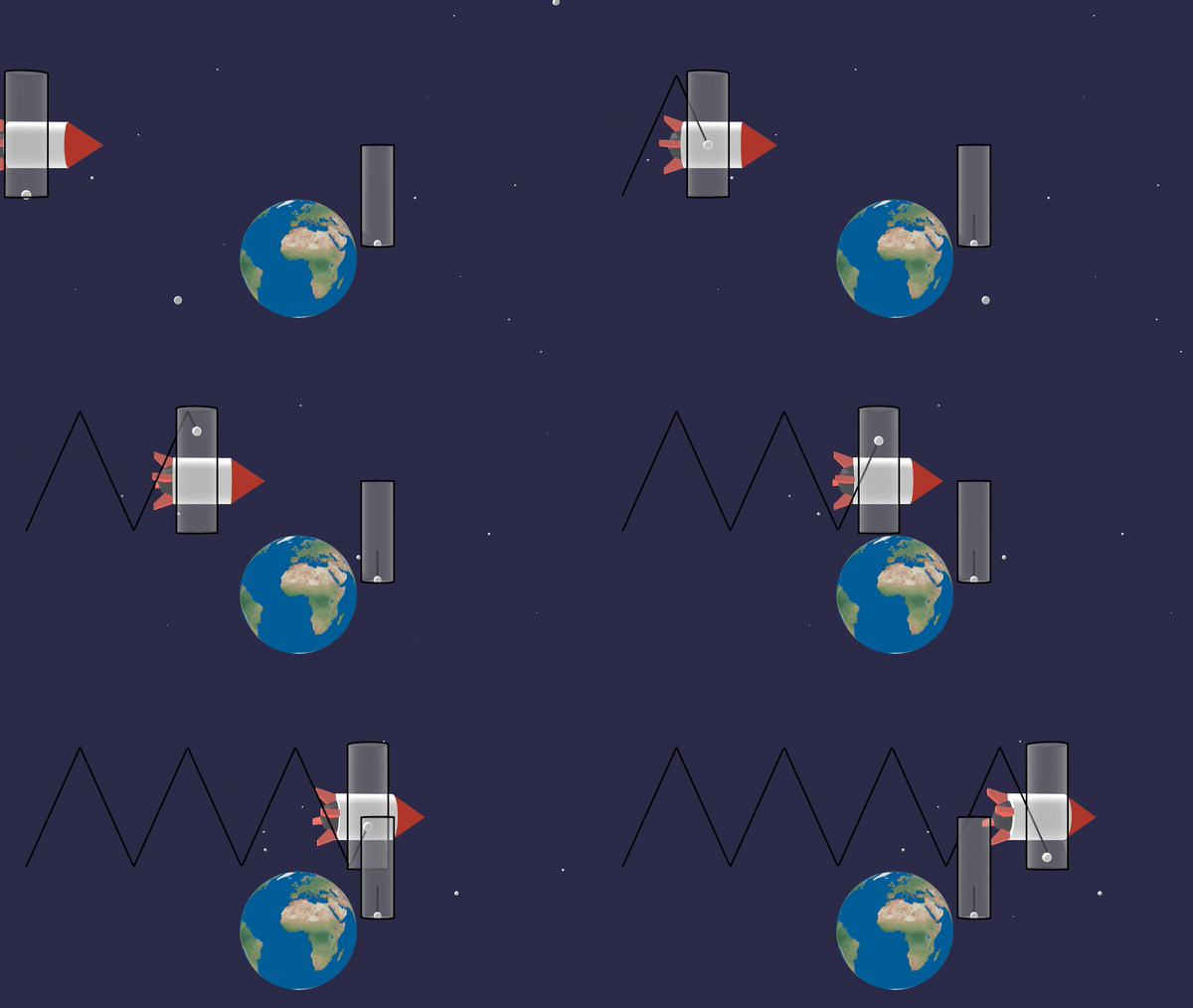
It turns out that as an object moves with relativistic speeds a “strange” thing seems to happen to its time as observed by “us” the stationary observer (observer in an inertial reference frame). What we see happen is that the “clock” in motion slows down according to our clock, therefore we read two different times. Which time is correct??? well they both are because time is not absolute but is relative, it depends on the reference frame. Let’s look at the following classic example. There is a set of twins, one an astronaut, the other works for mission control of NASA. The astronaut leaves on a deep space trip traveling at 95% the speed of light. Upon returning the astronauts clock has measured ten years, so yhe astronaut has aged 10 years. However, when the astronaut reunites with his earth bound twin, the astronauthe sees that the twin has aged 32 years! This is explained due to the fact that the astronaut’s twin is traveling at relativistic speeds and therefore his “clock” is slowed down.

Let’s see how we can calculate the time “difference”. The equation for calculating time dilation is as follows:

t = t0/(1-v2/c2)1/2

where: t = time observed in the other reference frame

t0 = time in observers own frame of reference (rest time)

v = the speed of the moving object

c = the speed of light in a vacuum

so in our problem we will let v = .95c, t0 = 10 years and we will solve for t which is the time that the earth bound brother measures.

t = 10/(1- (.95c)2/c2)1/2

t = 10/(1- .952)1/2

t = 10/ .312

t = 32 years
(the time the earth bound brother measures)

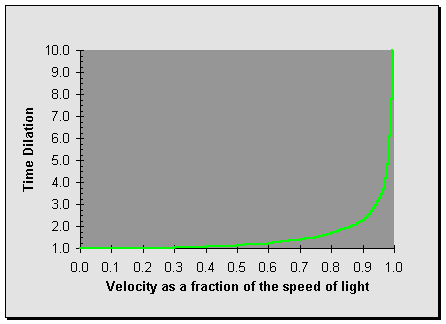
Now let’s have a closer look at the equation and determine just what impact the speed of the object has on time dilation. We can see that is the velocity is small compared to the speed of light the quantity v2/c2 approaches 0 and the equation simplifies t0: t = t0/1 which is simply t. So at relatively slow speeds (our everyday speeds) time dilation is not a factor and Newton’s Laws are still applicable. Now let’s look at high speeds (close to the speed of light), from the equation that as velocity increases the quantity v2/c2 approaches 1 (but will never quit reach it), causing the quantity(1-v2/c2)1/2 t0 become smaller and smaller….therefore causing the time measured by the other observer t0 become greater thus making our time appear slower (refer back to the example). I know its so confusing!!! read it again, think about it, then study the graph below. As one can see in the graph time dilation starts t0 “show up” between .4c and .5c. Also notice that the closer one gets to the speed of light the greater impact speed has on time dilation (notice how steep the curve gets towards the end)..

Antikythera-The Modern Invention in the Past.

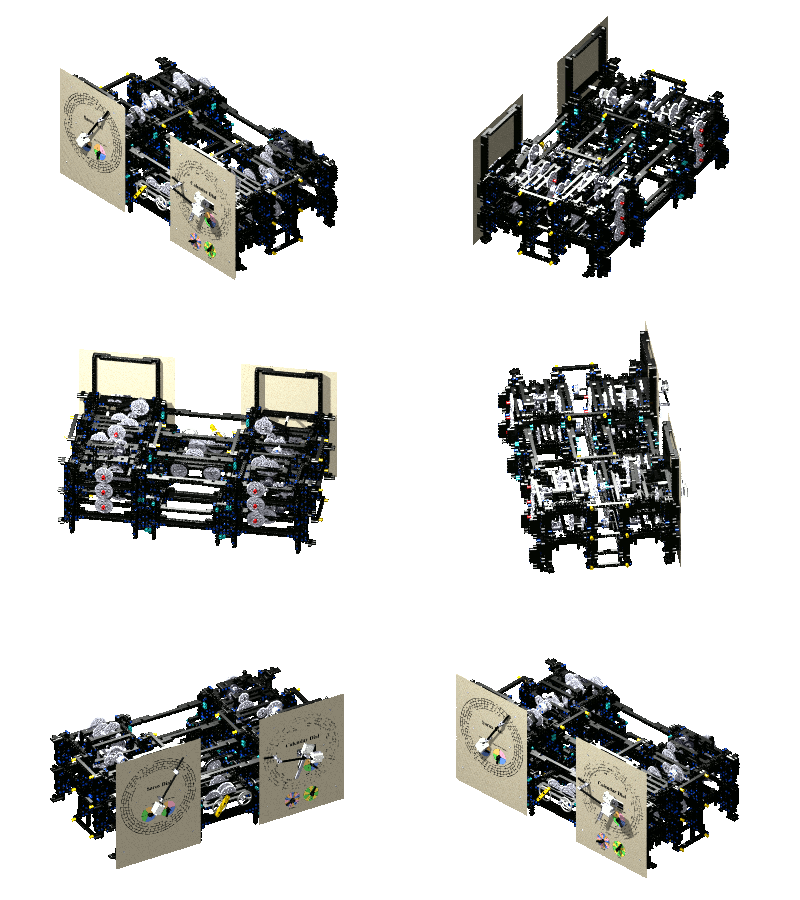
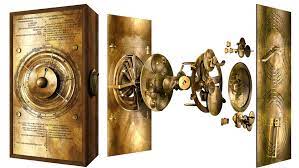
After 2,000 years under thesea, three flat, misshapen pieces of bronze at the National Archaeological Museum in Athens are all shades of green, from emerald to forest. From a distance, they look like rocks with patches of mold. Get closer, though, and the sight is stunning. Crammed inside, obscured by corrosion, are traces of technology that appear utterly modern: gears with neat triangular teeth (just like the inside of a clock) and a ring divided into degrees (like the protractor you used in school). Nothing else like this has ever been discovered from antiquity. Nothing as sophisticated, or even close, appears again for more than a thousand years.

For decades after divers retrieved these scraps from the Antikythera wreck from 1900 to 1901, scholars were unable to make sense of them. X-ray imaging in the 1970s and 1990s revealed that the device must have replicated the motions of the heavens. Holding it in your hands, you could track the paths of the Sun, Moon and planets with impressive accuracy. One investigator dubbed it “an ancient Greek computer.” But the X-ray images were difficult to interpret, so mainstream historians ignored the artifact even as it was championed by fringe writers such as Erich von Däniken, who claimed it came from an alien spaceship. It wasn’t until 2006 that the Antikythera mechanism captured broader attention. That year, Mike Edmunds of Cardiff University in Wales and his team published CT scans of the fragments, revealing more details of the inner workings, as well as hidden inscriptions—and triggering a burst of scholarly research. 

The Antikythera mechanism was similar in size to a mantel clock, and bits of wood found on the fragments suggest it was housed in a wooden case. Like a clock, the case would’ve had a large circular face with rotating hands. There was a knob or handle on the side, for winding the mechanism forward or backward. And as the knob turned, trains of interlocking gearwheels drove at least seven hands at various speeds. Instead of hours and minutes, the hands displayed celestial time: one hand for the Sun, one for the Moon and one for each of the five planets visible to the naked eye—Mercury, Venus, Mars, Jupiter and Saturn. A rotating black and silver ball showed the phase of the Moon. Inscriptions explained which stars rose and set on any particular date. There were also two dial systems on the back of the case, each with a pin that followed its own spiral groove, like the needle on a record player. One of these dials was a calendar. The other showed the timing of lunar and solar eclipses.

Experts have been working to decipher inscriptions hidden inside the mechanism, in particular to understand the mechanism’s missing pieces, some destroyed, some probably still at the bottom of the sea. Though the pointers on the front face don’t survive, Alexander Jones, a historian at the Institute for the Study of the Ancient World in New York, says an inscription reveals that they carried colored balls: fiery red for Mars, gold for the Sun. 

Also missing are the parts that drove the planetary pointers, leading to debate about exactly how they moved. Because planets orbit the Sun, when viewed from Earth they appear to wander back and forth in the sky. The Greeks explained this motion with “epicycles”: small circles superimposed on a larger orbit. According to Michael Wright, a former curator at London’s Science Museum who has studied the mechanism longer than anyone, it modeled epicycles with trains of small gears riding around larger ones. Though some experts have dismissed this as beyond the Greeks’ abilities, Jones says he will publish evidence supporting the idea later this year.

Other inscriptions hint at where the mechanism was made. Paul Iversen, a classicist at Case Western Reserve University in Cleveland, reports that the calendar includes month names used in Corinth and its colonies in northwest Greece. A dial that displayed the timing of major athletic festivals, including the Olympics, lists Naa, a festival held in northwest Greece, and Halieia, held to the south on the island of Rhodes. Perhaps the mechanism hailed from Rhodes and was being shipped north. The ancient philosopher Posidonius had a workshop in Rhodes that could have been the source; according to Cicero, Posidonius made a similar model of the heavens in the first century B.C.

The tradition of making such mechanisms could be much older. Cicero wrote of a bronze device made by Archimedes in the third century B.C. And James Evans, a historian of astronomy at the University of Puget Sound in Tacoma, Washington, thinks that the eclipse cycle represented is Babylonian in origin and begins in 205 B.C. Maybe it was Hipparchus, an astronomer in Rhodes around that time, who worked out the math behind the device. He is known for having blended the arithmetic-based predictions of Babylonians with geometric theories favored by the Greeks. 

Regardless, the Antikythera mechanism proves that the ancient Greeks used complex arrangements of precisely cut wheels to represent the latest in scientific understanding. It’s also a window into how the Greeks saw their universe. They came to believe that nature worked according to predefined rules, like a machine—an approach that forms the basis of our modern scientific views. Edmunds argues that this “mechanical philosophy” must have developed as a two-way process. The ancient mechanics who captured the cosmos in bronze weren’t just modeling astronomical theories but were also inspiring them.

FEB15_J03_Antikythera.jpg

Leonardo Da Vinci’s Human Powered Helicopter Becomes Reality

Leonardo Da Vinci's Aerial Screw

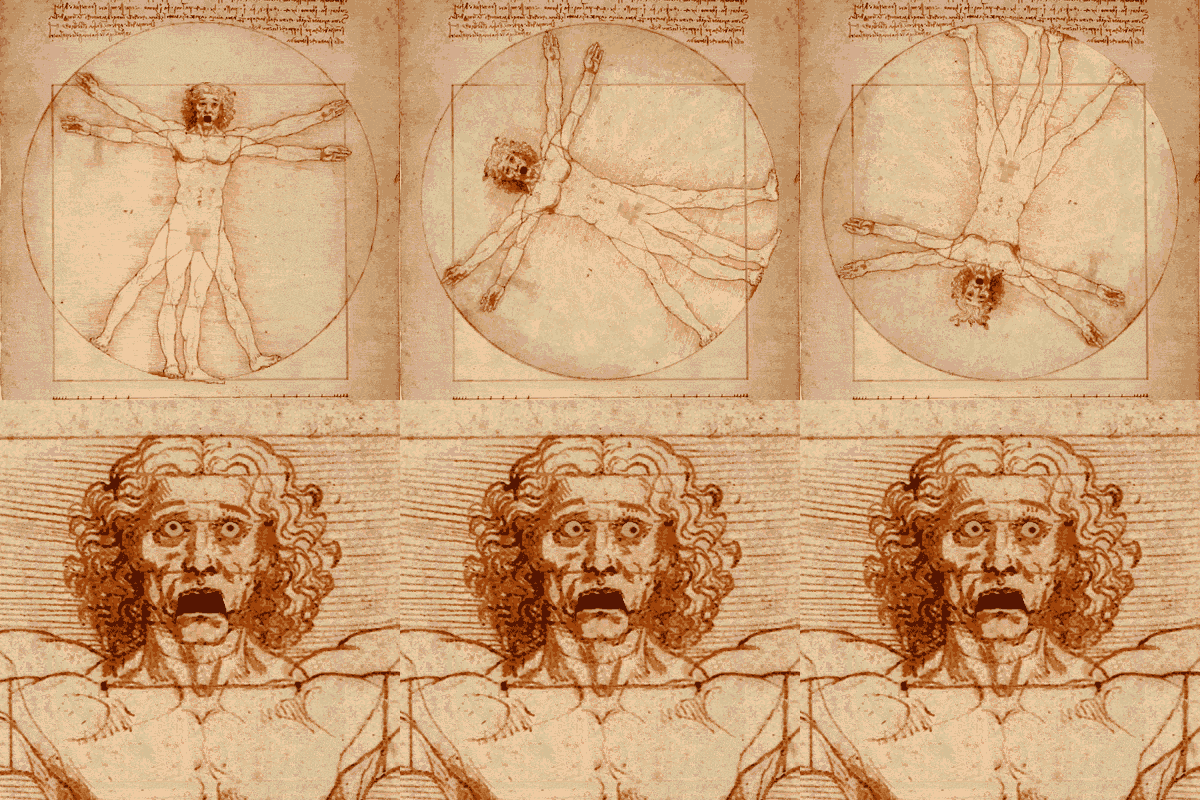
It would be hard to call Leonardo Da Vinci anything other than a man ahead of his time.  Between 1452 and 1519, Leonardo did just about everything. He is most famous today for his skills as a painter, where he painted some small works- like the Mona Lisa and The Last Supper. His sketches of man were the most anatomically correct to date (The Vitruvian Man). He was also a famed sculptor, musician, architect, anatomist, geologist, cartographer, botanist, writer mathematician, engineer and inventor. He conceptualized things far beyond his time, including concentrated solar power, a calculator, the double hull for ships, a tank and, most interesting to those of us in the aviation industry, a helicopter.

Over 420 years before the first helicopter was built, Leonardo Da Vinci sketched out what he called the Aerial Screw. This aerial screw was a man powered helicopter that required four men to spin cranks fast enough to generate enough lift to get off the ground.

Now, fast forward to 1980, 461 years after Leonardo passed away.  The American Helicopter Society sought to finally see the first human powered helicopter take flight. To win the prize money, which started at $10,000, the helicopter needed to reach at least 3 meters in the air (9.8 feet) for 60 seconds while being stable enough to have the center of the helicopter stay within a 10 x 10 meter box (32.8 x 32.8 feet). It would take 9 years from then before the first human powered helicopter even got off the ground when students at Cal Poly San Luis Obispo got their human powered helicopter 8 inches off the ground for all of 7.1 seconds. In the next 20 years, not much progress would be made so the Sikorsky Aircraft Corporation pledged additional prize money to try to see if that would inspire more innovation.

Sure enough, it did. Two teams, one from the University of Maryland and the other AeroVelo, were locked in a tight race to win. The university of Maryland got their man powered helicopter to fly for 65 seconds but it only reached 8 ft (about 1.8 feet short of where they needed to be) in August of 2012.

Finally, this July in Toronto, Aerovelo took the $250,000 in prize money with this flight:

While we don’t expect to see these Atlas human-powered helicopter’s flying around a city near you soon, this was a remarkable achievement. Congratulations to the Aerovelo team! And, over 480 years later, Leonardo Da Vinci’s vision of a human powered helicopter came to fruition.

Bose-EinsteinCondensate The 5th Matter

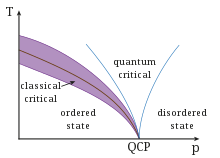
QuantumPhaseTransition.svg

In condensed matter physics, a Bose–Einstein condensate (BEC) is a state of matter (also called the fifth state of matter) which is typically formed when a gas of bosons at low densities is cooled to temperatures very close to absolute zero (−273.15 °C or −459.67 °F). Under such conditions, a large fraction of bosons occupy the lowest quantum state, at which point microscopic quantum mechanical phenomena, particularly wavefunction interference, become apparent macroscopically. A BEC is formed by cooling a gas of extremely low density (about one-hundred-thousandth (1/100,000) the density of normal air) to ultra-low temperatures.

This state was first predicted, generally, in 1924–1925 by Albert Einstein following and crediting a pioneering paper by Satyendra Nath Bose on the new field now known as quantum statistics.

This transition to BEC occurs below a critical temperature, which for a uniform three-dimensional gas consisting of non-interacting particles with no apparent internal degrees of freedom is given by:{\displaystyle T_{\rm {c}}=\left({\frac {n}{\zeta (3/2)}}\right)^{2/3}{\frac {2\pi \hbar ^{2}}{mk_{\rm {B}}}}\approx 3.3125\ {\frac {\hbar ^{2}n^{2/3}}{mk_{\rm {B}}}}}{\displaystyle T_{\rm {c}}=\left({\frac {n}{\zeta (3/2)}}\right)^{2/3}{\frac {2\pi \hbar ^{2}}{mk_{\rm {B}}}}\approx 3.3125\ {\frac {\hbar ^{2}n^{2/3}}{mk_{\rm {B}}}}}

where:

{\displaystyle \,T_{\rm {c}}}is the critical temperature,
\,nthe particle density,
\,mthe mass per boson,
\hbar the reduced Planck constant,
{\displaystyle \,k_{\rm {B}}}the Boltzmann constant and
\,\zeta the Riemann zeta function; {\displaystyle \,\zeta (3/2)\approx 2.6124.}\,\zeta(3/2)\approx 2.6124. 

Interactions shift the value and the corrections can be calculated by mean-field theory. This formula is derived from finding the gas degeneracy in the Bose gas using Bose–Einstein statistics.

Superfluidity of BEC and Landau criterion

The phenomena of superfluidity of a Bose gas and superconductivity of a strongly-correlated Fermi gas (a gas of Cooper pairs) are tightly connected to Bose–Einstein condensation. Under corresponding conditions, below the temperature of phase transition, these phenomena were observed in helium-4 and different classes of superconductors. In this sense, the superconductivity is often called the superfluidity of Fermi gas. In the simplest form, the origin of superfluidity can be seen from the weakly interacting bosons model.

TACHYON A PARTICLE THAT HELPS US TO TIME TRAVEL…

Tachyonhypothetical subatomic particle whose velocity always exceeds that of light. The existence of the tachyon, though not experimentally established, appears consistent with the theory of relativity, which was originally thought to apply only to particles traveling at or less than the speed of light. Just as an ordinary particle such as an electron can exist only at speeds less than that of light, so a tachyon could exist only at speeds above that of light, at which point its mass would be real and positive. Upon losing energy, a tachyon would accelerate; the faster it traveled, the less energy it would have.

The name ‘tachyon’ (from the Greek ‘tachys,’ meaning swift) was coined by the late Gerald Feinberg of Columbia University. Tachyons have never been found in experiments as real particles traveling through the vacuum, but we predict theoretically that tachyon-like objects exist as faster-than-light ‘quasiparticles’ moving through laser-like media. (That is, they exist as particle-like excitations, similar to other quasiparticles called phonons and polaritons that are found in solids. ‘Laser-like media’ is a technical term referring to those media that have inverted atomic populations, the conditions prevailing inside a laser.)

an experiment at Berkeley to detect tachyon-like quasiparticles. There are strong scientific reasons to believe that such quasiparticles really exist, because Maxwell’s equations, when coupled to inverted atomic media, lead inexorably to tachyon-like solutions.

“Quantum optical effects can produce a different kind of ‘faster than light’ effect (see “Faster than light?” by R. Y. Chiao, P. G. Kwiat, and A. M. Steinberg in Scientific American, August 1993). There are actually two different kinds of ‘faster-than-light’ effects that we have found in quantum optics experiments. (The tachyon-like quasiparticle in inverted media described above is yet a third kind of faster-than-light effect.)

“First, we have discovered that photons which tunnel through a quantum barrier can apparently travel faster than light (see “Measurement of the Single-Photon Tunneling Time” by A. M. Steinberg, P. G. Kwiat, and R. Y. Chiao, Physical Review Letters, Vol. 71, page 708; 1993). Because of the uncertainty principle, the photon has a small but very real chance of appearing suddenly on the far side of the barrier, through a quantum effect (the ‘tunnel effect’) which would seem impossible according to classical physics. The tunnel effect is so fast that it seems to occur faster than light.

“Second, we have found an effect related to the famous Einstein-Podolsky-Rosen phenomenon, in which two distantly separated photons can apparently influence one anothers’ behaviors at two distantly separated detectors (see “High-Visibility Interference in a Bell-Inequality Experiment for Energy and Time,” by P. G. Kwiat, A. M. Steinberg, and R. Y. Chiao, Physical Review A, Vol. 47, page R2472; 1993). This effect was first predicted theoretically by Prof. J. D. Franson of Johns Hopkins University. We have found experimentally that twin photons emitted from a common source (a down-conversion crystal) behave in a correlated fashion when they arrive at two distant interferometers. This phenomenon can be described as a ‘faster-than-light influence’ of one photon upon its twin. Because of the intrinsic randomness of quantum phenomena, however, one cannot control whether a given photon tunnels or not, nor can one control whether a given photon is transmitted or not at the final beam splitter. Hence it is impossible to send true signals in faster-than-light communications.

Pin on The Laws of Relativity

Recently Discovered Letter Written by Albert Einstein Discusses Link Between Physics and Biology – Seven Decades Before Evidence Emerges

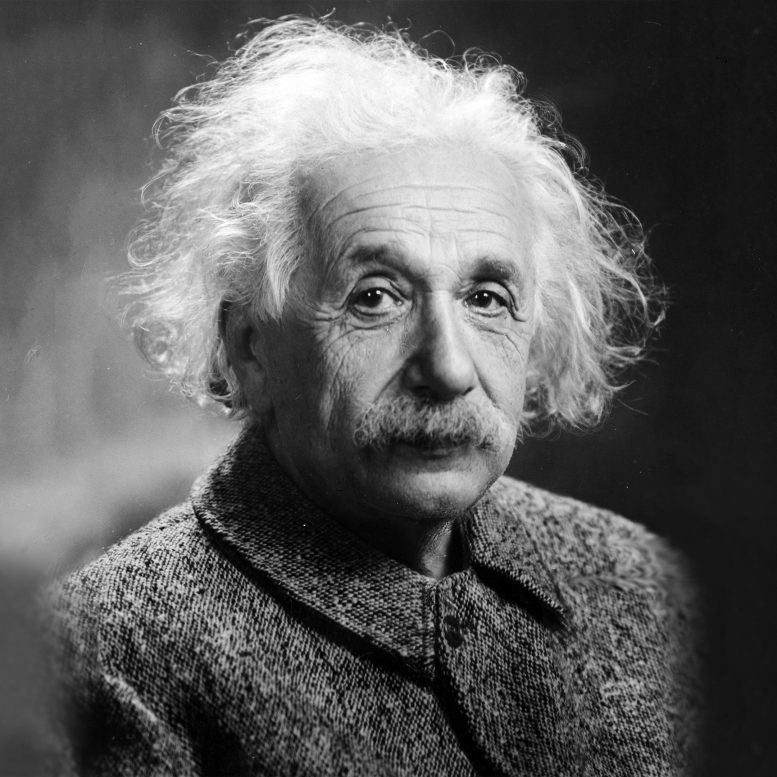
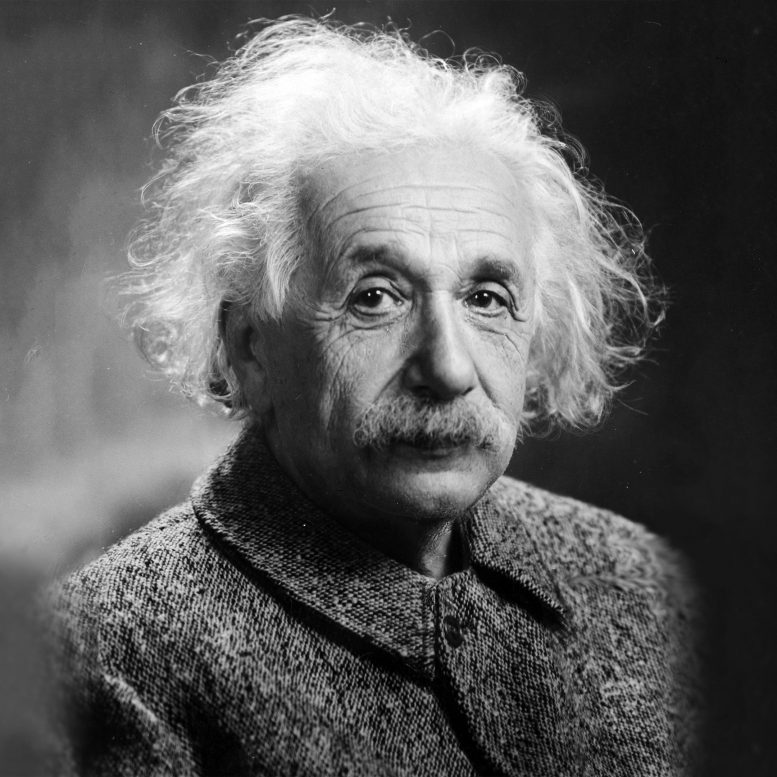
Albert Einstein Portrait

Previously Unknown Letter Reveals Einstein’s Thinking on Bees, Birds and Physics

The 1949 letter by the physicist and Nobel laureate discusses bees, birds, and whether new physics principles could come from studying animal senses.

It’s a position still being realized within physics to this day, with a growing body of research and understanding of how animals such as birds and bees find their way around.

Now a study led by RMIT University in Melbourne, Australia, discusses how recent discoveries in migratory birds back up Einstein’s thinking 72 years ago.

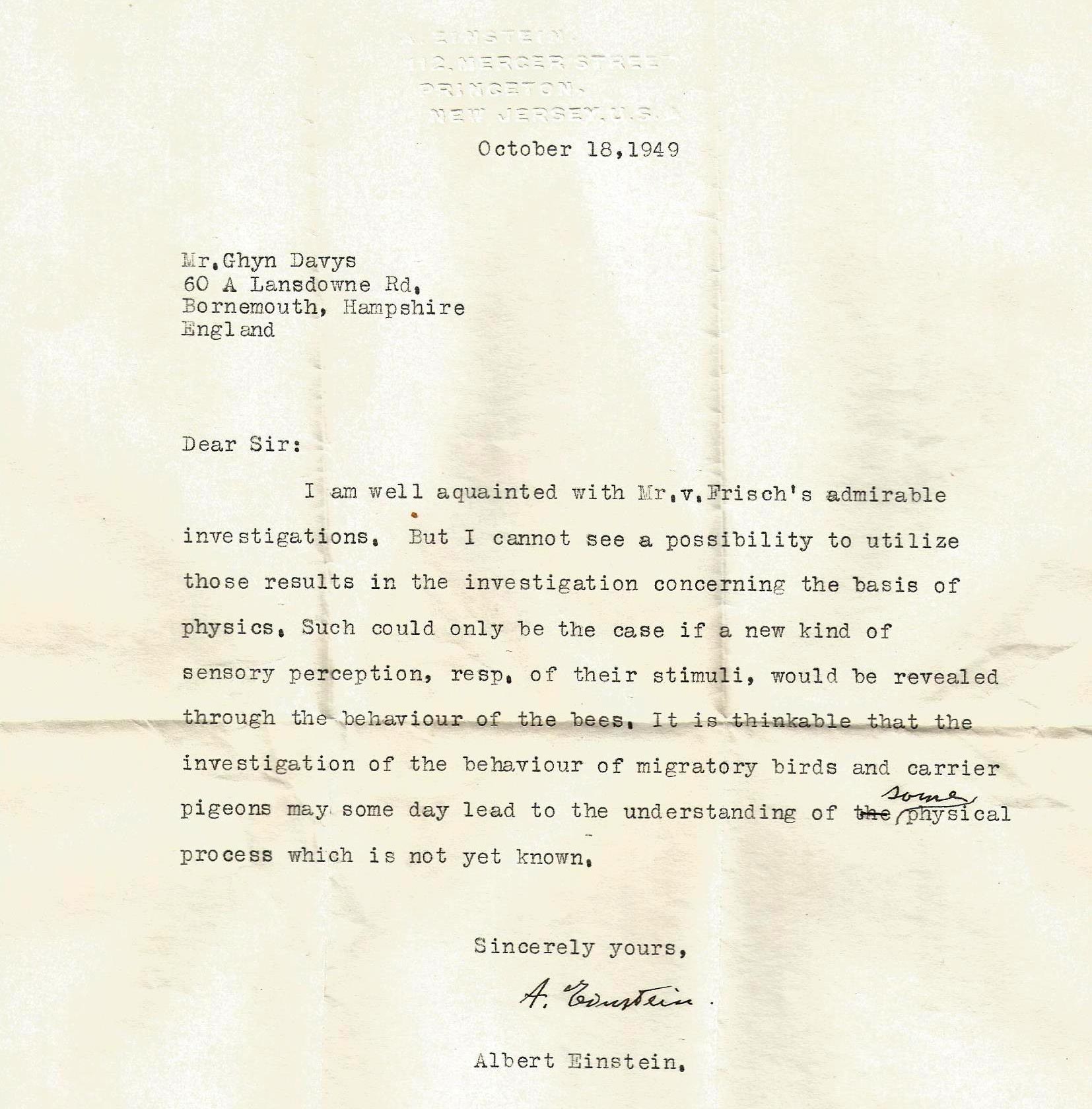
The previously unpublished letter was shared with researchers by Judith Davys — Einstein had addressed it to her late husband, radar researcher Glyn Davys.

RMIT’s Associate Professor Adrian Dyer has published significant studies into bees and is the lead author of the new paper on Einstein’s letter, published in the Journal of Comparative Physiology A.

Letter by Albert Einstein, validated by The Hebrew University of Jerusalem, where Einstein bequeathed his notes, letters and records. Credit: Dyer et al. 2021, J Comp Physiol A / The Hebrew University of Jerusalem

Dyer said the letter shows how Einstein envisaged new discoveries could come from studying animals.

“Seven decades after Einstein proposed new physics might come from animal sensory perception, we’re seeing discoveries that push our understanding about navigation and the fundamental principles of physics,” he said.

The letter also proves Einstein met with Nobel laureate Karl von Frisch, who was a leading bee and animal sensory researcher.

In April 1949, von Frisch presented his research on how honeybees navigate more effectively using the polarization patterns of light scattered from the sky.

The day after Einstein attended von Frisch’s lecture, the two researchers shared a private meeting.

Although this meeting wasn’t formally documented, the recently discovered letter from Einstein provides insight into what they might have talked about.

“It is thinkable that the investigation of the behavior of migratory birds and carrier pigeons may someday lead to the understanding of some physical process which is not yet known,” Einstein wrote.

Professor Andrew Greentree, a theoretical physicist at RMIT, said Einstein also suggested that for bees to extend our knowledge of physics, new types of behavior would need to be observed.

“Remarkably, it is clear through his writing that Einstein envisaged new discoveries could come from studying animals’ behaviors,” Greentree said.

More than 70 years since Einstein sent his letter, research is revealing the secrets of how migratory birds navigate while flying thousands of kilometers to arrive at a precise destination.

In 2008, research on thrushes fitted with radio transmitters showed, for the first time, that these birds use a form of magnetic compass as their primary orientation guide during flight.

One theory for the origin of magnetic sense in birds is the use of quantum randomness and entanglement. Both of these physics concepts were first proposed by Einstein.

Reference: “Einstein, von Frisch and the honeybee: a historical letter comes to light” by Adrian G. Dyer, Andrew D. Greentree, Jair E. Garcia, Elinya L. Dyer, Scarlett R. Howard and Friedrich G. Barth, 10 May 2021, Journal of Comparative Physiology A.
DOI: 10.1007/s00359-021-01490-6

The letter to Glyn Davys shows the openness of Einstein’s mind to novel possibilities observed in nature and the evidence that he took an interest in von Frish and his bee research.

Today’s Kalam Foundation

Today’s Kalam Foundation was started in the year 2016 in Hyderabad, by a group of intellectuals inspired by Dr. A.P.J.Abdul Kalam, with the main objective of creating more Kalams to lead the way forward.

Mission

  • To impart quality education and enhance employability
  • To improve lives by effective health management
  • To empower women to stand on their own feet
  • To inspire and bring together intellectuals to contribute in community development

Vision

A reformed society, contributing to national development.

Activities

As of today, 15 Kalam Centers have been set up with over 450 children attending every day. Important national festivals like Independence Day, Republic Day etc are celebrated with gusto.

Currently, Today’s Kalam Foundation is focusing on expanding its activities to reach out to more underprivileged children in the Old City and reduce the consequences of lack of education. They plan to set up 50 more Kalam Centers which will touch the lives of over 1500 deprived children and give them access to education and life skills. Towards this, we are seeking volunteers based out of Hyderabad, trainers who could train volunteers and individual as well as corporate sponsorship

Become a Volunteer Today

Volunteer to teach children in our Kalam centers – Spoken English, Computers, Art & Craft. You can also be a part of the health camps and awareness sessions we conduct.

If you wish to help the poor please donate at

https://milaap.org/fundraisers/GSanjay

Please Support. Even 1 Rupee could bring a change.

100% of your contribution will go for this cause.

Today’s Kalam Foundation has been running Kalam Centers for Slum Children since 2017 and benefitting 450 children on daily basis.
Kalam Center :
TKF volunteers go to slums and choose a group of students who study in Govt. schools or who don’t go to schools. From the same slum a Mentor is employed and a “Kalam center” is established either in the nearby community hall/school premises/rented place. Generally, the Mentors are under/postgraduates. In these centers, the respective Mentors provide after – school support to the students for 2 hours per day.
Kalam Centers aims towards the holistic development of children, hailing from an under-resourced section of the society. The project covers various aspects viz., academic education, vocational training, personality development, health tips, hygiene & nutrition awareness, career counseling, and extra curriculum activities.
We are run Centers in Riyasatnagar,Hussainialam,Dabeerpura,N.M.Guda, MM Pahadi,Farath nagar,Edi Bazaar,Falaknama,Kanchanbagh,Moinbagh,  Bapu nagar,Talabkatta& Babanagar.
Background of Children:
Most of the Children parents are Daily wagers men go for civil works,auto,road side shops ..etc.Few mothers go for Bangle Making and embroidary works or as servants to other houses.
Effect of Corona 2nd Wave:

In the Corona 2nd wave we have seen lot of positive cases in our Kalam Center Children families and as the family is dependant on elders and their income was affected .We have decided to support Corona Positive families with Sustenance  Kits.
Our Work:

We have good wrapo with the families of Kalam Center Children from 2 years and can understand their pain.So we have decided to be with them during these hard times and decided to support Ration required for Corona Affected Families.

Request:

Sustenance Kit Rs 1000Home Isolation Kit Rs 800
For more details you can check our website http://www.todayskalam.org

Thank You

100% of your contribution will go for this cause.  

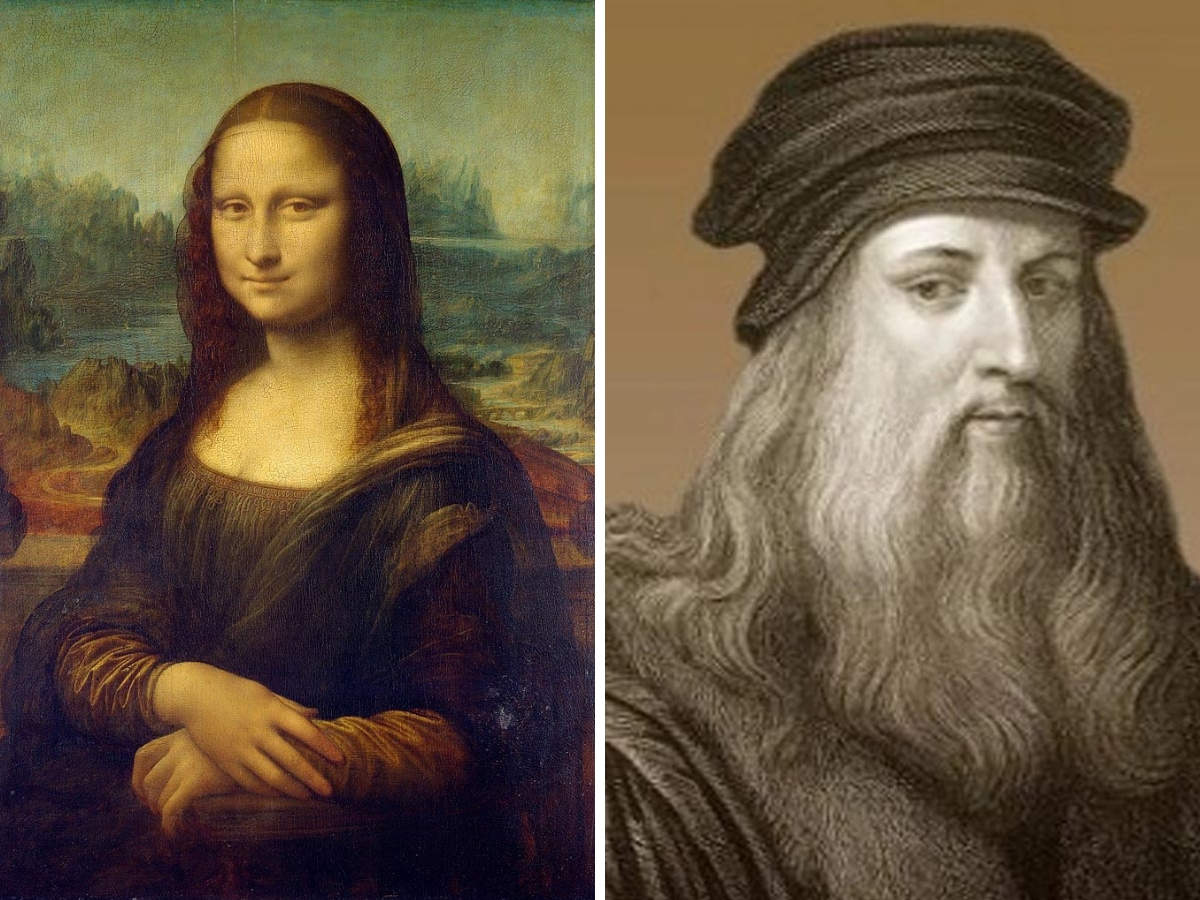
Leonardo da Vinci -The Man Behind Mona Lisa

Leonardo da Vinci: Leonardo Da Vinci may have had a condition that  prevented him from finishing Mona Lisa - The Economic Times

Leonardo da Vinci (1452-1519) was a painter, architect, inventor, and student of all things scientific. His natural genius crossed so many disciplines that he epitomized the term “Renaissance man.” Today he remains best known for his art, including two paintings that remain among the world’s most famous and admired, Mona Lisa and The Last Supper. Art, da Vinci believed, was indisputably connected with science and nature. Largely self-educated, he filled dozens of secret notebooks with inventions, observations and theories about pursuits from aeronautics to anatomy. But the rest of the world was just beginning to share knowledge in books made with moveable type, and the concepts expressed in his notebooks were often difficult to interpret. As a result, though he was lauded in his time as a great artist, his contemporaries often did not fully appreciate his genius—the combination of intellect and imagination that allowed him to create, at least on paper, such inventions as the bicycle, the helicopter and an airplane based on the physiology and flying capability of a bat.

Leonardo da Vinci: Early Life and Training

Leonardo da Vinci (1452-1519) was born in Anchiano, Tuscany (now Italy), close to the town of Vinci that provided the surname we associate with him today. In his own time he was known just as Leonardo or as “Il Florentine,” since he lived near Florence—and was famed as an artist, inventor and thinker.

Did you know? Leonardo da Vinci’s father, an attorney and notary, and his peasant mother were never married to one another, and Leonardo was the only child they had together. With other partners, they had a total of 17 other children, da Vinci’s half-siblings.

Da Vinci’s parents weren’t married, and his mother, Caterina, a peasant, wed another man while da Vinci was very young and began a new family. Beginning around age 5, he lived on the estate in Vinci that belonged to the family of his father, Ser Peiro, an attorney and notary. Da Vinci’s uncle, who had a particular appreciation for nature that da Vinci grew to share, also helped raise him.

Leonardo da Vinci: Early Career

Da Vinci received no formal education beyond basic reading, writing and math, but his father appreciated his artistic talent and apprenticed him at around age 15 to the noted sculptor and painter Andrea del Verrocchio, of Florence. For about a decade, da Vinci refined his painting and sculpting techniques and trained in mechanical arts. When he was 20, in 1472, the painters’ guild of Florence offered da Vinci membership, but he remained with Verrocchio until he became an independent master in 1478. Around 1482, he began to paint his first commissioned work, The Adoration of the Magi, for Florence’s San Donato, a Scopeto monastery.

However, da Vinci never completed that piece, because shortly thereafter he relocated to Milan to work for the ruling Sforza clan, serving as an engineer, painter, architect, designer of court festivals and, most notably, a sculptor. The family asked da Vinci to create a magnificent 16-foot-tall equestrian statue, in bronze, to honor dynasty founder Francesco Sforza. Da Vinci worked on the project on and off for 12 years, and in 1493 a clay model was ready to display. Imminent war, however, meant repurposing the bronze earmarked for the sculpture into cannons, and the clay model was destroyed in the conflict after the ruling Sforza duke fell from power in 1499.

Leonardo da Vinci: ‘The Last Supper’ and ‘Mona Lisa’

Although relatively few of da Vinci’s paintings and sculptures survive—in part because his total output was quite small—two of his extant works are among the world’s most well-known and admired paintings.

The first is da Vinci’s “The Last Supper,” painted during his time in Milan, from about 1495 to 1498. A tempera and oil mural on plaster, “The Last Supper” was created for the refectory of the city’s Monastery of Santa Maria delle Grazie. Also known as “The Cenacle,” this work measures about 15 by 29 feet and is the artist’s only surviving fresco. It depicts the Passover dinner during which Jesus Christ addresses the Apostles and says, “One of you shall betray me.” One of the painting’s stellar features is each Apostle’s distinct emotive expression and body language. Its composition, in which Jesus is centered among yet isolated from the Apostles, has influenced generations of painters.

When Milan was invaded by the French in 1499 and the Sforza family fled, da Vinci escaped as well, possibly first to Venice and then to Florence. There, he painted a series of portraits that included “La Gioconda,” a 21-by-31-inch work that’s best known today as “Mona Lisa.” Painted between approximately 1503 and 1506, the woman depicted—especially because of her mysterious slight smile—has been the subject of speculation for centuries. In the past she was often thought to be Mona Lisa Gherardini, a courtesan, but current scholarship indicates that she was Lisa del Giocondo, wife of Florentine merchant Francisco del Giocondo. Today, the portrait—the only da Vinci portrait from this period that survives—is housed at the Louvre Museum in Paris, France, where it attracts millions of visitors each year.

Around 1506, da Vinci returned to Milan, along with a group of his students and disciples, including young aristocrat Francesco Melzi, who would be Leonardo’s closest companion until the artist’s death. Ironically, the victor over the Duke Ludovico Sforza, Gian Giacomo Trivulzio, commissioned da Vinci to sculpt his grand equestrian-statue tomb. It, too, was never completed (this time because Trivulzio scaled back his plan). Da Vinci spent seven years in Milan, followed by three more in Rome after Milan once again became inhospitable because of political strife.

Leonardo da Vinci: Philosophy of Interconnectedness

Da Vinci’s interests ranged far beyond fine art. He studied nature, mechanics, anatomy, physics, architecture, weaponry and more, often creating accurate, workable designs for machines like the bicycle, helicopter, submarine and military tank that would not come to fruition for centuries. He was, wrote Sigmund Freud, “like a man who awoke too early in the darkness, while the others were all still asleep.”

Several themes could be said to unite da Vinci’s eclectic interests. Most notably, he believed that sight was mankind’s most important sense and that “saper vedere”(“knowing how to see”) was crucial to living all aspects of life fully. He saw science and art as complementary rather than distinct disciplines, and thought that ideas formulated in one realm could—and should—inform the other.

Probably because of his abundance of diverse interests, da Vinci failed to complete a significant number of his paintings and projects. He spent a great deal of time immersing himself in nature, testing scientific laws, dissecting bodies (human and animal) and thinking and writing about his observations. At some point in the early 1490s, da Vinci began filling notebooks related to four broad themes—painting, architecture, mechanics and human anatomy—creating thousands of pages of neatly drawn illustrations and densely penned commentary, some of which (thanks to left-handed “mirror script”) was indecipherable to others.

The notebooks—often referred to as da Vinci’s manuscripts and “codices”—are housed today in museum collections after having been scattered after his death. The Codex Atlanticus, for instance, includes a plan for a 65-foot mechanical bat, essentially a flying machine based on the physiology of the bat and on the principles of aeronautics and physics. Other notebooks contained da Vinci’s anatomical studies of the human skeleton, muscles, brain, and digestive and reproductive systems, which brought new understanding of the human body to a wider audience. However, because they weren’t published in the 1500s, da Vinci’s notebooks had little influence on scientific advancement in the Renaissance period.

Leonardo da Vinci: Later Years

Da Vinci left Italy for good in 1516, when French ruler Francis I generously offered him the title of “Premier Painter and Engineer and Architect to the King,” which afforded him the opportunity to paint and draw at his leisure while living in a country manor house, the Château of Cloux, near Amboise in France. Although accompanied by Melzi, to whom he would leave his estate, the bitter tone in drafts of some of his correspondence from this period indicate that da Vinci’s final years may not have been very happy ones. (Melzi would go on to marry and have a son, whose heirs, upon his death, sold da Vinci’s estate.)

Da Vinci died at Cloux (now Clos-Lucé) in 1519 at age 67. He was buried nearby in the palace church of Saint-Florentin. The French Revolution nearly obliterated the church, and its remains were completely demolished in the early 1800s, making it impossible to identify da Vinci’s exact gravesite.

The Truth About Crop Circles

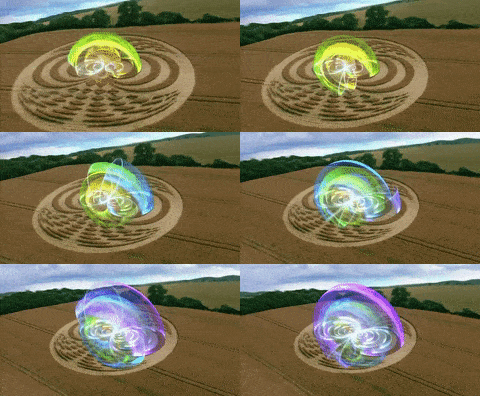
Garden-variety crop circle.

Crop circles have been appearing in grain fields all over the earth during the last few decades. They appear suddenly, usually at night. At first they were simple circles of bent-over grain stalks. Soon a new crop of more elaborate designs evolved—geometric forms reminiscent of profound mathematical theorems.

Some cerealogists (people who study crop circles) say that these diagrams must be created by intelligent alien beings from elsewhere. Even though these diagrams must be constructed in a very short timespan, the genuine crop circles never show any serious mistakes or blunders of execution. Cerealogists see this as evidence that the aliens must be very intelligent and much more advanced than we are. That’s mere speculation, of course. Others say the real reason is that there’s a worldwide conspiracy to hide the fact that the aliens sometimes do make mistakes. This coverup is carried out by people who want to preserve the myth that the aliens are a perfect race. The fact that you’ve never heard of such crop circle blunders just shows how effective this coverup is, they say. Mistakes are repaired at the site, or sometimes photographs of the circles are retouched. This has about as much to recommend it as any of the other conspiracy theories accepted and believed by simple-minded people.

Let’s look at more plausible explanations. Actually, a few designs do seem at first to have apparent irregularities or flaws. Some of these are surely caused by wind or rain, careless hoaxers or the trampling feet of crop circle buffs. But let’s set those aside and look only at those that are genuine and undisturbed. What appear at first to be iregularities or errors, may only be perfection of a higher and subtler kind, that we do not as yet understand.

Crop circles made by aliens?

Why should supposedly intelligent aliens travel huge cosmic distances across the galaxy just to doodle in our grain fields? What an absurd idea! [1] No one has ever seen them doing it, have they? Usually there aren’t even any ufo sightings associated with the circles, except for those reported after the fact by people with overactive imaginations. Surely intelligent aliens have better things to do. The true origin of crop circle designs may be nearer to home.

The whole thing begins to make sense once we realize that the earth is flat. We live on the backside of a huge flat blackboard (whiteboard, scratch paper, or whatever) used by aliens in their schools and universities. There are many of these in the universe. The flat disk of the earth is thin enough that student doodles made in alien art and math classes “bleed through” to our side. This happens because their writing instruments emit mitogenetic radiation (M-rays) that are well known to affect some living plants, especially wheat, barley, oats and corn. [2] M-rays weaken the stalk structure near the ground, and the stalks bend over gently to lie flat on the ground, showing no evidence of forceful breaking. So the crop circles in grain fields are nothing more than the reverse pattern of alien students’ diagrams made in geometry class.

Look carefully at photos of crop circles in books and on the internet, and a striking fact emerges. Crop circle designs are constructed from circular arcs and straight lines. Even the more complex crop circles, including those made to look like Mandelbrot sets, or the head of Mickey Mouse ©, conform to this rule. All crop circles can be constructed using the standard methods of Euclidean geometry. This should tell us something. The aliens making these drawings must be using ungraduated rulers and compases. [3] Has anyone ever seen a crop circle based on the form of a pentagon?

It’s true that a few designs have straight lines and curves that seem at first to be more complex than circles. But we must remember that straight lines are simply circles of infinite radius. Any complex curves can be constructed approximately from circular arc segments of different radius.

Did they use a ruler?

There’s good evidence that aliens have been defacing the earth’s surface with geological grafitti for a very long time. The curious lines and drawings on the Nazca plain in Peru likely have the same cause. At that earlier time in history the aliens had only primitive writing instruments. They were still using “pens” made of inorganic material, that emit E-rays (Earth rays). These only affect non-living things. Sand on flat ground is easily moved around with very little energy. The sandy surface of the Nazca plain acted like a giant Etch-A-Sketch ®. No advanced mathematical figures are found at Nazca, only long straight lines, pictures and geometric doodles. Obviously the aliens weren’t as scientifically advanced then. Then why are the lines so perfect, and the straight lines so straight? The reason is quite simple: on their side of the blackboard the aliens used rulers.

School kid’s prank?

A number of commentators claim to have proven to their own satisfaction that the Ancient Egyptians didn’t have the resources or technology to build the pyramids. Could it be that the pyramids of Egypt were built by alien kids, who, in a playful mood, pushed their play blocks into their blackboard, all the way through, coming up point first on our side? Following this line of reasoning, perhaps Stonehenge and similar structures are the result of an alien children’s game in which stone pegs are pushed into a geometric array of holes

Tamil at Harvard University

Inauguration of Tamil Club and Kavidhai Club - Sevalaya

What is Tamil Chair?

Tamil Chair Inc. is a non-profit organization registered in the state of Maryland (USA) that is currently working on fund raising for Harvard Tamil Chair

6m $ is required to establish it

Tamil is one of the very few languages of the world with a classical past and a robust literary tradition that has continued to this day. Despite many foreign occupations of the Tamil country and other outside influences, this noble language has always shined, producing vibrant literature for over 2 thousand years.

In addition to the literature, there have been numerous grammar books, commentaries, religious works, didactic books, secular literature and works from many other genres.

This is what the Tamil chair of Harvard university states about tamil

What is the need for a Tamil Chair?

  1. Tamil language has one of the oldest written traditions in all of Asia and boasts a rich body of literary work dating back 2,500 years. Tamil has been accorded with a prestigious recognition as one of the seven classic languages (Greek, Sanskrit, Latin, Hebrew, Persian, Tamil and Chinese), and it is one of the very few that has survived all the way through to the modern world since its beginning.
  2. Currently, Tamil is the 20th most commonly-spoken language (by 80 million people) in the world, with vibrant literatures for over 2 thousand years. Literature represents the culture and tradition of a language or people, and it provides a kind of blueprint of human civilization.
  3. Thus far the global reach of Tamil literature is so limited, and for its ancient and Classic standing, Tamil literature deserves to be critically looked from new and diverse perspectives and the resulting knowledge needs to be shared across other cultures for mutual benefits.
  4. So the purpose of this chair is multifold. First, it is a matter of great prestige for Tamils to have our language taught at the world’s most prestigious university which attracts brilliant students from all over the world.
  5. There is also a need for research in ancient classical Tamil literature. Harvard will produce Tamil scholars who will be trained in research methodologies.

IMPORTANCE OF TAMIL CHAIR IN HARVARD UNIVERSITY AND THE WAY IT ENRICHES THE LANGUAGE

  1. Helps building History

History can be written on the basis of outputs from researching a language.

Research about a language is a step to build a history.

Ex: In recent, historians of India use vedic texts of sanskrit to build the own history.

They build Indian history with vedas as base.

If more outputs from researching tamil comes out it will help build Indian History which may be seen from view of tamil literature.

2. Helps developing the language

In India Hindi and sanskrit are given importance by central government for promoting and developing them. These types of actions from Indian government limits Tamil as a regional language and major funding is deprieved.

Promoting through a reputed university will ensure good amount of funding for research.

It will help explore the Tamil studies on a much deeper level through a rigorous approach executing formal academic research processes to bring out the traditions, the cultural, intellectual, and social practices of the Sangam period that are barely explored as of now. This will elicit Tamil’s long tenured literary tradition to the peer academic communities and establish it’s much deserved recognition as a Classic language.

3. Competition with Sanskrit and other classical languages

Indian goverment in name of Hindu Nationalism promotes only sanskrit.

For all other Classic and widely spoken languages like Sanskrit, Greek etc , there is so much research and progressive work that is done at various international academic centers. It is quite urgent and highly imperative that the same world class effort is put forth for Tamil to expand its stature and reach. It will enhance not only the chances for continual use but also the newly embraced recognition from the global populace.

4. Intensive Research and development

Any developments on language of Tamil is stopped by Indian government . Without funds researchers are suffering. Even if someone come out with good research it is deemed valued by Hindutuvas/Hindi Nationalist Indian government

Independent research in a foreign country will only enrich it for good without influence by Indian Government.

5. Gets world wide interest and new learners

Developing the language in a well known University will gather world wide interest for the language and gather new learners.

May revoke intersets in researchers to resume archaelogical excavations a, Keezhadi, Poombukar, Adhichanallur which were currently banned by Indian government for excavating. Because they provide excessive proofs to Independent tamil culture in Sangam period, so that it will affect sanskrit’s claim on Tamil.

Assures Tamil language’s legacy to survive and grow.

This endeavour will cerainly increase the horizon of Tamil

Turning heat into electricity.

Study finds topological materials could boost the efficiency of thermoelectric devices.

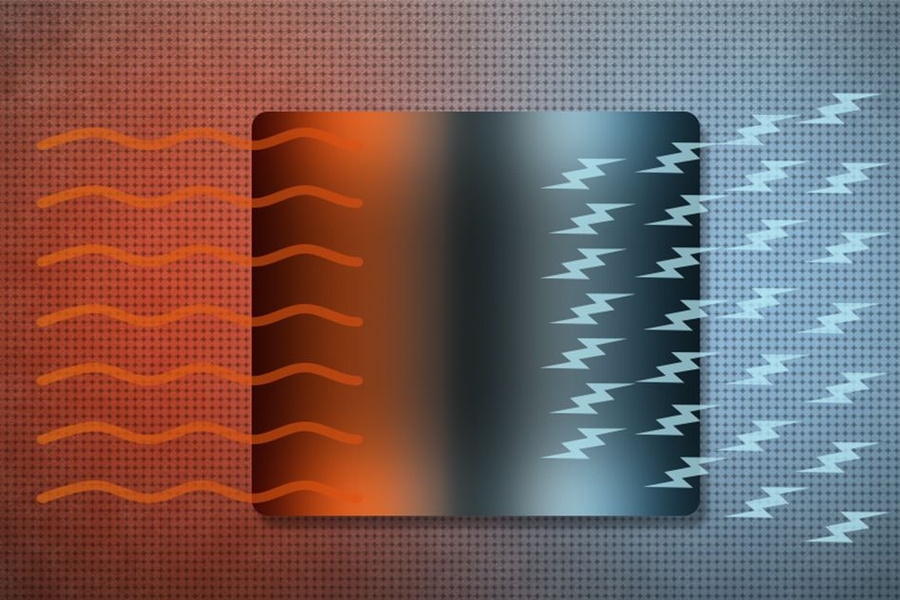
MIT researchers, looking for ways to turn heat into electricity, find efficient possibilities in certain topological materials.

What if you could run your air conditioner not on conventional electricity, but on the sun’s heat during a warm summer’s day? With advancements in thermoelectric technology, this sustainable solution might one day become a reality.

Thermoelectric devices are made from materials that can convert a temperature difference into electricity, without requiring any moving parts — a quality that makes thermoelectrics a potentially appealing source of electricity. The phenomenon is reversible: If electricity is applied to a thermoelectric device, it can produce a temperature difference. Today, thermoelectric devices are used for relatively low-power applications, such as powering small sensors along oil pipelines, backing up batteries on space probes, and cooling minifridges.

But scientists are hoping to design more powerful thermoelectric devices that will harvest heat — produced as a byproduct of industrial processes and combustion engines — and turn that otherwise wasted heat into electricity. However, the efficiency of thermoelectric devices, or the amount of energy they are able to produce, is currently limited.

Now researchers at MIT have discovered a way to increase that efficiency threefold, using “topological” materials, which have unique electronic properties. While past work has suggested that topological materials may serve as efficient thermoelectric systems, there has been little understanding as to how electrons in such topological materials would travel in response to temperature differences in order to produce a thermoelectric effect.

In a paper published this week in the Proceedings of the National Academy of Sciences, the MIT researchers identify the underlying property that makes certain topological materials a potentially more efficient thermoelectric material, compared to existing devices.

“We’ve found we can push the boundaries of this nanostructured material in a way that makes topological materials a good thermoelectric material, more so than conventional semiconductors like silicon,” says Te-Huan Liu, a postdoc in MIT’s Department of Mechanical Engineering. “In the end, this could be a clean-energy way to help us use a heat source to generate electricity, which will lessen our release of carbon dioxide.”

A path freely traveled

When a thermoelectric material is exposed to a temperature gradient — for example, one end is heated, while the other is cooled — electrons in that material start to flow from the hot end to the cold end, generating an electric current. The larger the temperature difference, the more electric current is produced, and the more power is generated. The amount of energy that can be generated depends on the particular transport properties of the electrons in a given material.

Scientists have observed that some topological materials can be made into efficient thermoelectric devices through nanostructuring, a technique scientists use to synthesize a material by patterning its features at the scale of nanometers. Scientists have thought that topological materials’ thermoelectric advantage comes from a reduced thermal conductivity in their nanostructures. But it is unclear how this enhancement in efficiency connects with the material’s inherent, topological properties.

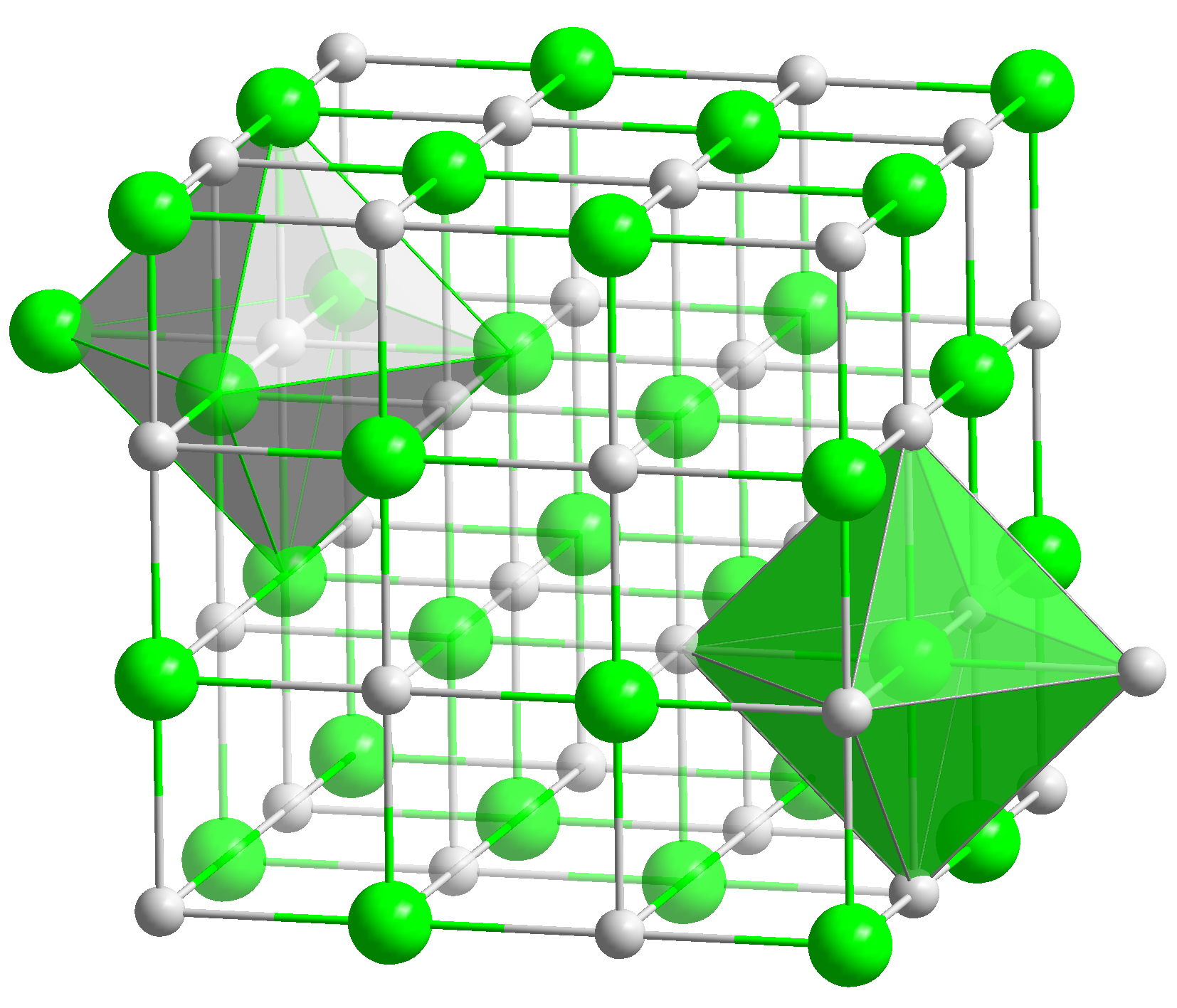
To try and answer this question, Liu and his colleagues studied the thermoelectric performance of tin telluride, a topological material that is known to be a good thermoelectric material. The electrons in tin telluride also exhibit peculiar properties that mimic a class of topological materials known as Dirac materials.

The team aimed to understand the effect of nanostructuring on tin telluride’s thermoelectric performance, by simulating the way electrons travel through the material. To characterize electron transport, scientists often use a measurement called the “mean free path,” or the average distance an electron with a given energy would freely travel within a material before being scattered by various objects or defects in that material.

Nanostructured materials resemble a patchwork of tiny crystals, each with borders, known as grain boundaries, that separate one crystal from another. When electrons encounter these boundaries, they tend to scatter in various ways. Electrons with long mean free paths will scatter strongly, like bullets ricocheting off a wall, while electrons with shorter mean free paths are much less affected.

In their simulations, the researchers found that tin telluride’s electron characteristics have a significant impact on their mean free paths. They plotted tin telluride’s range of electron energies against the associated mean free paths, and found the resulting graph looked very different than those for most conventional semiconductors. Specifically, for tin telluride and possibly other topological materials, the results suggest that electrons with higher energy have a shorter mean free path, while lower-energy electrons usually possess a longer mean free path.

The team then looked at how these electron properties affect tin telluride’s thermoelectric performance, by essentially summing up the thermoelectric contributions from electrons with different energies and mean free paths. It turns out that the material’s ability to conduct electricity, or generate a flow of electrons, under a temperature gradient, is largely dependent on the electron energy.

Specifically, they found that lower-energy electrons tend to have a negative impact on the generation of a voltage difference, and therefore electric current. These low-energy electrons also have longer mean free paths, meaning they can be scattered by grain boundaries more intensively than higher-energy electrons.

Tin telluride - Wikipedia

Sizing down

Going one step further in their simulations, the team played with the size of tin telluride’s individual grains to see whether this had any effect on the flow of electrons under a temperature gradient. They found that when they decreased the diameter of an average grain to about 10 nanometers, bringing its boundaries closer together, they observed an increased contribution from higher-energy electrons.

That is, with smaller grain sizes, higher-energy electrons contribute much more to the material’s electrical conduction than lower-energy electrons, as they have shorter mean free paths and are less likely to scatter against grain boundaries. This results in a larger voltage difference that can be generated.

What’s more, the researchers found that decreasing tin telluride’s average grain size to about 10 nanometers produced three times the amount of electricity that the material would have produced with larger grains.

Liu says that while the results are based on simulations, researchers can achieve similar performance by synthesizing tin telluride and other topological materials, and adjusting their grain size using a nanostructuring technique. Other researchers have suggested that shrinking a material’s grain size might increase its thermoelectric performance, but Liu says they have mostly assumed that the ideal size would be much larger than 10 nanometers.

“In our simulations, we found we can shrink a topological material’s grain size much more than previously thought, and based on this concept, we can increase its efficiency,” Liu says.

Tin telluride is just one example of many topological materials that have yet to be explored. If researchers can determine the ideal grain size for each of these materials, Liu says topological materials may soon be a viable, more efficient alternative to producing clean energy.

“I think topological materials are very good for thermoelectric materials, and our results show this is a very promising material for future applications,” Liu says.

This research was supported in part by the Solid-State Solar Thermal Energy Conversion Center, an Energy Frontier Research Center of U.S. Department of Energy; and the Defense Advanced Research Projects Agency (DARPA).