• One of the most ancient living theatrical traditions from Kerala.
• Antiquity of Koodiyattam goes to 10 the century A.D.
• King Kulasekhara Varma structured this art and employed his own Sanskrit plays Tapatisamvaranam & Subhadradhananjayam for the repertory.
• Koodiyattam finds its expression in ‘Koottambalam’ which means auditorium.
• Practiced and propagated by the Chakkiar community (also known by the name – Chakkiar Kootu).
• Women and men participate. • Inspiration from the classics of Natyasastra, Kalidasa, Bhasa, Sriharsha, Pallava Mahendra Varms, Kulasekhara, Saktibhadra etc.
Performance:
• Stage adoption is elaborate • Koodiyattam adheres to the acting technique elaborately described in Bharata’s Natyasastra, the basic book of Indian Dance.
• Also follow the stage manuals: Attaprakaram, Karma Dipika, Hastalakshana Dipika etc.
• Costume: semi realistic and the stage mannerisms are highly stylized.
• Orchestra: Cymbals, idakkai and a unique percussion instrument ‘milavu’ and flute – the Nangyars (women) sing while the Nambiyars (male) play the instruments.
• Characters Chakyaar – actor Naambiyaar – instrumentalists Naangyaar – women’s roles Sutradhar – narrator Vidushak or jesters – protagonists Vidushak alone delivers the dialogues • Even single acts of plays are treated as full-fledged plays and are subjected to an elaborate method of acting.
• There is a wide emphasis on hand gestures and eye movements – makes this dance and theatre form unique.
• Russia accused Britain of spreading lies over a warship confrontation in the Black Sea.
Russia – Black Sea
• Russia – To project its power in the Mediterranean. • Black Sea – flashpoint between Russia and its competitors.
• Russia – Crimean Peninsula from Ukraine in 2014.
• Western countries – reject Russia’s claim to the seas around it.
Black Sea
• A large inland sea – South-eastern extremity of Europe. • World’s largest meromictic basin – deep waters do not mix with the upper layers of water that receive oxygen from the atmosphere.
• Over 90 percent of the deeper Black Sea volume is anoxic water.
• Transportation artery – Eastern European countries with world markets.
• Fish – widely utilized biological resource of the Black Sea.
• Conservation and antipollution measures: Banning of dolphin fishing Restrictions on oil tankers Disposal of industrial wastes.
• 1992, Istanbul – the Summit Declaration and the Bosphorus Statement.
• Formation of the Black Sea Economic Cooperation (BSEC). Countries – Albania, Armenia, Azerbaijan, Bulgaria, Georgia, Greece, Moldova, Romania, Russia, Turkey and Ukraine. • Aims: Fostering interaction and harmony among the Member States. Ensures peace, stability and prosperity.
• World economy shrunk by 3.5% in 2020 – global pandemic. Forced countries to rely on taxations.
• Loopholes are exploited by the multinational national companies (MNCs) to avoid taxation. Tax avoidance – Use of legal methods to minimize the amount of income tax owed by an individual or business. • Global minimum corporate tax – to plug the loopholes in international taxation regime.
G7 Agreement
• Finance Ministers of G7 nations agreed to set a global minimum tax of at least 15% • G7 – Broader efforts under way through the G20/OECD to address tax challenges arising from globalisation and digitalisation of economy. G7 – Canada, France, Germany, Italy, Japan, the United Kingdom and the United States. G20 – forum for the governments and central bank governors from 19 countries and the European Union (EU). OECD – group of countries – discuss and develop economic and social policy.
Need for Global Tax
• Last decade – rapid and relentless march of technological advancement – global communications and connectivity.
• 2016 – digital sphere estimated at $11.5 trillion (over one-sixth of global GDP).
Increase in digitalisation exacerbated the challenge of taxing multinational corporations.
• MNCs avoid taxation by shifting their revenue to tax havens – huge loss of revenue tocountries
• Organisation for Economic Co-operation and Development (OECD) – estimated countries are collectively deprived of $240 billion in tax revenue annually. OECD + G20 – spearheading ‘Inclusive Framework on Base Erosion and Profit Shifting’ – aimed at ending tax avoidance.
• Secretary-General of OECD – Mathias Cormann, welcomed the global tax. Tax avoidance can only be effectively addressed through a multilaterally agreed solution. • Base Erosion and Profit Shifting (BEPS) A tax evading practice by multinational companies – shifting their incomes or profits to their subsidiaries, located in low tax countries. Erosion in tax base & shifting of profits to other countries. Problems: Undermines the fairness and integrity of tax systems. Undermines voluntary compliance by all taxpayers. Affects the developed and developing countries, which mainly relies on corporate income tax.
• Inclusive Framework on BEPS initiated by OECD and G20 grouping A modern international tax framework – ensures profits are taxed where economic activity and value creation occur. 135+ countries implementing 15 Actions. India – a member.
Benefits
• G7 agreed on an equitable allocation of taxing rights. Awards market countries taxing rights on at least 20% of profit exceeding a 10% margin for the largest and most profitable multinational enterprises.
• Highly beneficial to India. India losing more than $10 billion in revenue each year – Tax Justice Network.
Issues
• Local levies on digital transactions Counterproductive to the concept of GMCT.
• Lack of political will to ensure greater fairness and equity in revenue sharing.
Where the length of the pregnancy does not exceed twelve weeks (for this, the opinion of one doctor was required).
Where the length of the pregnancy has exceeded twelve weeks but does not exceed 20 weeks. In this case, for the abortion to take place, two doctors must be of the opinion that the continuation of the pregnancy would impair the mental and/or physical health of the mother, and/or that if the child were to be born, it would suffer from serious physical or mental abnormalities causing it to be handicapped.
The law also required minor pregnant women to get written consent from the guardian for the abortion to be allowed.
Provisions:
Termination due to Failure of Contraceptive Method
Under the Act, a pregnancy may be terminated up to 20 weeks by a married woman in the case of failure of contraceptive method or device. The Bill allows unmarried women to also terminate a pregnancy for this reason.
Opinion Needed for Termination of Pregnancy:
• Opinion of one registered medical practitioner (instead of two or more) for termination of pregnancy up to 20 weeks of gestation.
• Opinion of two registered medical practitioners for termination of pregnancy of 20-24 weeks of gestation.
• Opinion of the State-level medical board is essential for a pregnancy to be terminated after 24 weeks in case of substantial foetal abnormalities.
Medical Boards:
Every state government is required to constitute a Medical board
These Medical Boards will consist of the 5 members:
(i) a gynaecologist
(ii) a paediatrician
(iii) a radiologist or sonologist
(iv) any other number of members, as may be notified by the state government.
Upper Gestation Limit for Special Categories:
It enhances the upper gestation limit from 20 to 24 weeks for special categories of women which will be defined in the amendments to the MTP Rules and would include survivors of rape, victims of incest and other vulnerable women (like differently-abled women, minors) etc.
Confidentiality:
The “name and other particulars of a woman whose pregnancy has been terminated shall not be revealed”, except to a person authorised in any law that is currently in force.
Benefits:
Termination in Case of Anomaly:
A number of foetus abnormalities are detected after the 20th week, often turning a wanted pregnancy into an unwanted one.
Helps Special Category Women:
The law will help the rape victims, ill and under-age women to nd unde terminate the unwanted pregnancy lawfully.
Beneficial for Unmarried Women:
The Bill also applies to unmarried women and therefore, relaxes one of the regressive clauses of the 1971 Act, i.e., single women couldn’t cite contraceptive failure as a reason for seeking an abortion.
Allowing unmarried women to medically terminate pregnancies and a provision to protect the privacy of the person seeking an abortion will bestow reproductive rights to the women.
Abortion laws across the world:
Abortion laws vary across the world. It is learnt that around 60 countries prescribe gestational limits.
• 52 % including France, the UK, Austria, Ethiopia, Italy, Spain, Iceland, Finland, Sweden, Norway, Switzerland and even Nepal, allow for termination beyond 20 weeks on the diagnosis of foetal abnormalities.
● Some countries go beyond even these limits with laws in 23 countries-Canada, Germany, Vietnam, Denmark, Ghana, and Zambia-allowing for abortion at any time during the pregnancy on the request of the mother.
●Recently, Argentina became both the largest Latin American country and the third South American country to legalize abortion.
Challenges:
Viability of the Foetus:
● A key aspect of the legality governing abortions has always been the ‘viability’ of the foetus.
● Viability implies the period from which a foetus is capable of living outside the womb.
● As technology improves, with infrastructure up-gradation, and with skilful professionals driving medical care, this ‘viability’ naturally improves.
• Currently, viability is usually placed at about seven months (28 weeks) but may occur earlier, even at 24 weeks.
Thus, late termination of pregnancy may get in conflict with the viability of the foetus.
Preference for a Male Child:
The preference for a male child keeps sex determination centres in bussiness in spite of their illegal status. There are concerns that a more liberal abortion law can aggravate this state-of-affairs.
Change of Choice:
The current Bill does not consider factors such as personal choice, a sudden change in circumstances (due to separation from or eath of a partner), and domestic violence
Medical Boards:
●The present healthcare budgetary allocation makes setting up a board across the country, both financially and practically impossible.
● Access to the board by pregnant women in remote areas of the state is a matter of concern.
●No time limit set to respond to the requests.
● The board will subject women to multiple examinations before allowing her to terminate her pregnancy. This is a violation of right to privacy and right to live with dignity.
Way Forward
●Though Medical Termination of Pregnancy (Amendment) bill 2021 is a step in the right direction, the government needs to ensure that all norms and standardised protocols in clinical practice to facilitate abortions are followed in health care institutions across the country.
●Along with that, the question of abortion needs to be decided on the basis of human rights, the principles of solid science, and in step with advancements in technology.
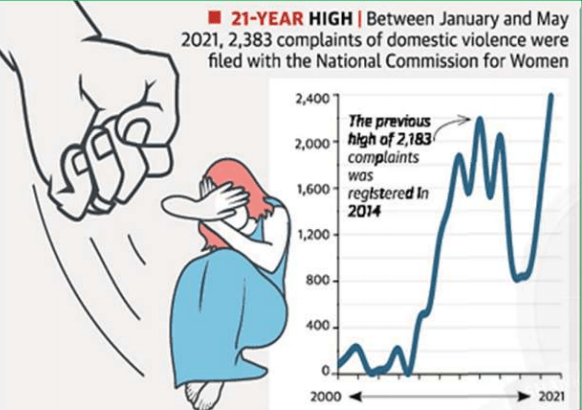
• Domestic violence in India between the period January and May, 2021.
National Commission for Women
• Recommendations – Committee on the Status of Women in India.
• National Commission for Women – statutory body in January 1992.
• National Commission for Women Act of 1990. • Mission – To enable women to achieve equality and equal participation in all spheres of life. Securing due rights and entitlements Suitable policy formulation, legislative measures, effective law enforcement and scheme implementation. • Commission – solves specific problems arising out of discrimination and atrocities against women.
• Composition – Chairperson, member secretary and five other members.
• At least one Member each shall be from among persons belonging to the Scheduled Castes and Scheduled Tribes respectively.
• About 2300 domestic violence complaints were filed with the National Commission for Women.
• Time span of January and May 2021.
• The highest estimation since 2000. • Total complaints recorded against the number of complaints received per one million women. Most complaints – Uttar Pradesh Highest complaint rate – Delhi Kerala stands at the lowest
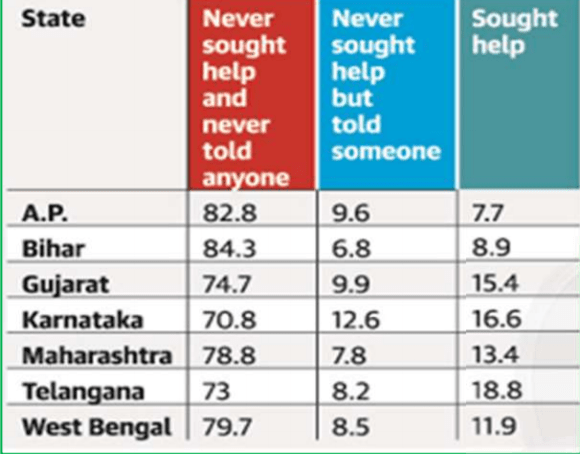
• Response of the victims.
• National Family Health Survey – About 70% of Women who were victims belonging to major states failed to inform anyone about it.
• Only a very few approached the right authorities.
Union Health Ministry categorised the Delta Plus variant of the novel coronavirus as a variant of concern.
DELTA PLUS VARIANT
• A further mutated form of the Delta variant (B.1.617.2).
• Delta variant – Originated in India; predominantly responsible for India’s second wave.
• Delta Plus has an additional mutation – K417N. ∆ Found in the receptor binding domain – through which virus gains entry into the human cell. • Variants of Concern by WHO: ∆ Delta Plus variant ∆ Alpha variant from the UK ∆ Beta variant from Brazil ∆ Gamma variant from South Africa ∆ Delta variant
• Three classes of SARS-CoV-2 variants: ∆ Variant of Interest ∆ Variant of Concern ∆Variant of High Consequence
VARIANT OF INTEREST
• A variant with specific genetic markers – associated with changes to receptor binding and reduced neutralization by antibodies. • May result in reduced efficacy of treatments, potential diagnostic impact, increase in transmissibility etc.
VARIANT OF CONCERN
• A variant with increase in transmissibility and more severe disease. • May result in significant reduction in neutralization by antibodies, reduced effectiveness of treatments/vaccines, or diagnostic detection failures. • More attributes than VoI: Substantially decreased susceptibility, reduced vaccine-induced protection, increased transmissibility etc.
VARIANT OF HIGH CONSEQUENCE
• Prevention measures/medical countermeasures – have significantly reduced effectiveness.
• More attributes than VoC: significant reduction in vaccine effectiveness, significantly reduced susceptibility to approved therapeutics, more severe clinical disease etc.
According to data collected by the United Nations High Commission for Refugees (UNHCR), India has close to 2 lakh refugees living within its territory with the number constantly rising. However, unofficial reports place the figure at above 4.5 lakh.Currently, the only law specifically governing refugees in India is through judicial decisions regulating specific situations. There are also ad hoc administrative advisories by the Ministry of Home Affairs, regulating specific situations concerning refugees, such as the Advisory on preventing and combating human trafficking in India, dated 1 May 2012
In the absence of specific legislation pertaining to refugees, the general law applicable to foreigners, the Foreigners Act, 1946, applies to refugees as well. The status of refugees is determined by UNHCR, but it has limited reach and resources.These ad hoc, case-specific measures lead to a two-fold problem.
First, India’s national security interest are hamere by the absence of a content legal structure to ensure that all non-citizens resident in India are properly documented and have a legitimate reason for their presence in India. Second, the lack of a law providing certain basic rights to refugees violates India’s obligations under customary international law,which it is subject to, notwithstanding its non-ratification of the 1951 Refugee Convention.
SOLUTION
The foremost requirement in the Indian legal framework is a definition of the term ‘refugee’. This is essential for any legislation making any provision for refugees, since the term is not easily defined. Second, the single most important principle relating to refugees in international law needs to be recognised in Indian law – that of non-refoulement, or non-return to country of origin. The Foreigners Act penalises those who enter the country without valid identity documents, or may prohibit entry of such persons into India. This implies that refugee-seekers are liable to be returned to the country they are fleeing from. A legal solution needs to be worked out to prevent this.
As a consequence of accepting refugee-seekers at the border, a structured system must be put in place for refugee status-determination.Moreover, a procedure with such critical security implications should be controlled and carried out entirely by the government. As a result of this procedure, once a person is admitted into the country as a refugee, he needs to be issued a permit, either in form of a long-term visa or a refugee permit. This will serve as an identity document, and assist the government in maintaining records.
IMPLEMENTATION AND IMPACT
The following amendments are required in the Foreigners Act, 1946,to implement the above: 1.The term ‘refugee’ needs to be defined as a person who, owing to well-founded fear of persecution based on race, religion, nationality, membership of a particular social group or political opinion, is outside his country of nationality, or if having no nationality, is outside his country of habitual residence and i unable or, owing to such fear, unwilling to avail himself of that country’s protection. 2. Exceptions must be carved out for refugees, codifying the principle of non-refoulement, wherever the Act prohibits or imposes penalties for being present in India without valid documents. 3. A new section should be inserted in the Act, requiring status determination of refugees at the border, along with providing an identification document; provision for rules outlining criteria for status determination as well as officials responsible for the same.
CONCLUSION
These changes in the Foreigners Act will be the first key steps towards legal recognition of refugees in India.
The Supreme Court of India and the High Courts are the guardians of the Constitution of India. Given their exalted constitutional status, it is imperative that the method of appointing judges to these courts is such that only persons of the highest integrity and aptitude are chdown.
But ,the current system of appointments, by a collegium of senior Justices of the Supreme Court, pursuant to a decision of the Court itself, has proven unequal to this way . Finally, it proceeds on an indefensible interpretation of Article 124(2) and Article 217(1) of constitution which prescribes the method of judicial appointments.
WHAT IS SOLUTION .
The Constitution (120th Amendment)bill,2013 and the judicial Appointment commission bill,2013 were introduced in the Rajya Sabha in August 2013.According to this bill provides for the establishment of a Judicial Appointments Commission to appoint judges, the composition, functions and procedures of which are laid down in the accompanying Bill. In general, the concept of an appointments commission is salutary.
Threekeys amendments to the existing scheme are necessary. 1.too much latitude is allowed to Parliament to change the composition and functions of the Commission. It is necessary that not only the establishment of the Commission but also its composition and functions are laid down by a constitutional amendment.
2. These is no procedure or criteria laid down in the act for shortlisting of candidates or for resolving disagreements in the Commission. The past experience of judicial appointments, both when it was led by the executive as well as the judiciary, suggests the definite need for dispositive rules in this regard thereby bringing an optimal degree of transparency into the process.
3. Despite vesting the Commission with the power to transfer judges and Chief Justices from one High Court to another, the Bills neither specify the grounds nor the procedure for doing so. It is clearly delineated grounds for transfer of judges and the procedure to be followed are laid down in the Act.
Now we comes towards the IMPLEMENTATION AND IMPACT
1. The Constitution (120th Amendment) Bill, 2013 passed by the Rajya Sabha and The Judicial Appointment Commission Bill, 2013 pending in the Rajya Sabha should be withdrawn. 2.A more detailed constitutional amendment should be introduced containing the following- ∆ The composition of the Judicial Appointments Commission; ∆ The functions of the Commission. 3. A new, reworked bill must be introduced alongside the constitutional amendment providing for-
∆ The criteria and procedures for shortlisting and selection of candidates ∆ The grounds and procedures for transfer of judges to be followed by the Commission.
Result
Such reform will ensure that the best candidates for judicial office are selected in an optimally transparcy manner. Further, it will do so in a manner that is perfectly consonant with the independence of the judiciary.





 Eduindex

You must be logged in to post a comment.