NOISE POLLUTION

Noise pollution can cause health problems for people and wildlife, both on land and in the sea. From traffic noise to rock concerts, loud or inescapable sounds can cause hearing loss, stress, and high blood pressure. Noise from ships and human activities in the ocean is harmful to whales and dolphins that depend on echolocation to survive.

Noise pollution  is an invisible danger. It cannot be seen, but it is present nonetheless, both on land and under the sea. Noise pollution is considered to be any unwanted or disturbing sound that affects the health and well-being of humans and other organisms.                        

Sound is measured in decibles. There are many sounds in the environment, from rustling leaves (20 to 30 decibels) to a thunderclap (120 decibels) to the wail of a siren (120 to 140 decibels). Sounds that reach 85 decibels or higher can harm a person’s ears. Sound sources that exceed this threshold include familiar things, such as power lawn mowers (90 decibels), subway trains (90 to 115 decibels), and loud rock concerts (110 to 120 decibels).

Noise pollution impacts millions of people on a daily basis. The most common health problem it causes is Noise Induced Hearing Loss (NIHL). Exposure to loud noise can also cause high blood pressure, heart disease, sleep disturbances, and stress.

These health problems can affect all age groups, especially children. Many children who live near noisy airports or streets have been found to suffer from stress and other problems, such as impairments in memory, attention level, and reading skill.

Noise pollution also impacts the health and well-being of wildlife. Studies have shown that loud noises cause caterpillars’ hearts to beat faster and bluebirds to have fewer chicks. Animals use sound for a variety of reasons, including to navigate, find food, attract mates, and avoid predators. Noise pollution makes it difficult for them to accomplish these tasks, which affects their ability survive.


ENVIRONMENT

All living things that live on this earth comes under the environment. Whether they live on land or water they are part of the environment. The environment also includes air, water, sunlight, plants, animals, etc.

Moreover, the earth is considered the only planet in the universe that supports life. The environment can be understood as a blanket that keeps life on the planet sage and sound.

Importance of Environment

We truly cannot understand the real worth of the environment. But we can estimate some of its importance that can help us understand its importance. It plays a vital role in keeping living things healthy in the environment.

Likewise, it maintains the ecological balance that will keep check of life on earth. It provides food, shelter, air, and fulfills all the human needs whether big or small.

Moreover, the entire life support of humans depends wholly on the environmental factors. In addition, it also helps in maintaining various life cycles on earth.

Most importantly, our environment is the source of natural beauty and is necessary for maintaining physical and mental health.

Benefits of the Environment

The environment gives us countless benefits that we can’t repay our entire life. As they are connected with the forest, trees, animals, water, and air. The forest and trees filter the air and absorb harmful gases. Plants purify water, reduce the chances of flood maintain natural balance and many others.

Moreover, the environment keeps a close check on the environment and its functioning, It regulates the vital systems that are essential for the ecosystem. Besides, it maintains the culture and quality of life on earth.

The environment regulates various natural cycles that happen daily. These cycles help in maintaining the natural balance between living things and the environment. Disturbance of these things can ultimately affect the life cycle of humans and other living beings.

The environment has helped us and other living beings to flourish and grow from thousands of years. The environment provides us fertile land, water, air, livestock and many essential things for survival.

GLOBAL WARMING

Global warming is the long-term warming of the planet’s overall temperature. Though this warming trend has been going on for a long time, its pace has significantly increased in the last hundred years due to the burning of fossil fuels.

As the human population has increased, so has the volume of fossil fuels burned. Fossil fuels include coal, oil, and natural gas, and burning them causes what is known as the “greenhouse effect” in Earth’s atmosphere. 

The greenhouse effect is when the Sun’s rays penetrate the atmosphere, but when that heat is reflected off the surface cannot escape back into space. Gases produced by the burning of fossil fuels prevent the heat from leaving the atmosphere.

These greenhouse gasses are carbon dioxide, chlorofluorocarbons, water vapor, methane, and nitrous oxide. The excess heat in the atmosphere has caused the average global temperature to rise overtime, otherwise known as global warming.

Global warming has presented another issue called climate change. Sometimes these phrases are used interchangeably, however, they are different. Climate change refers to changes in weather patterns and growing seasons around the world.

It also refers to sea level rise caused by the expansion of warmer seas and melting ice sheets and glaciers. Global warming causes climate change, which poses a serious threat to life on earth in the forms of widespread flooding and extreme weather. Scientists continue to study global warming and its impact on Earth.

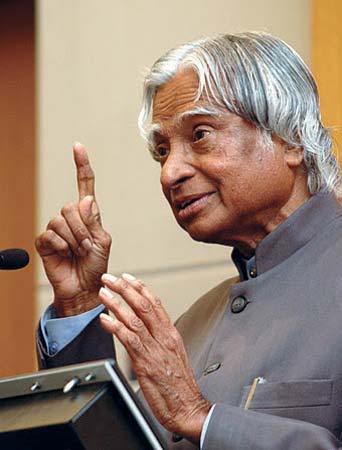
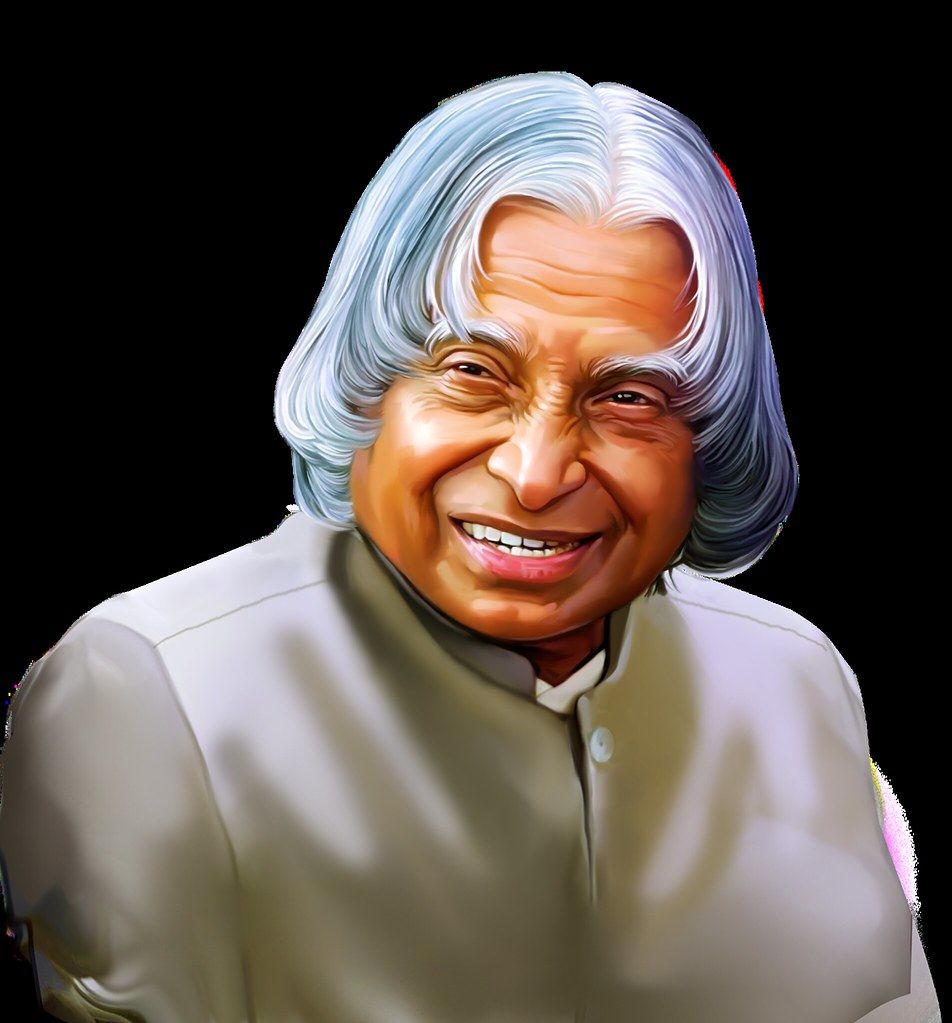
APJ ABDUL KALAM

Dr APJ Abdul Kalam was a scientist who later became the 11th President of India and served the country from 2002 to 2007.

He was the most respected person in the country, as he contributed a lot to the country as a scientist and a president.

His contribution to the Indian Space Research Organization is unforgettable.

There were many projects under his leadership such as Rohini-1, Project Devil and the launch of Project Valent, missiles (under Mission Agni and Prithvi), etc.

For his great contribution in increasing India’s nuclear power, he is popularly known as “Missile Man of India”. He has been awarded the highest civilian awards for his dedicated work.

After completing his service to the Government of India as President, he served the country as a visiting professor at various valuable institutions and universities.

HIS CAREER AND CONTRIBUTION:

He was born on 15 October 1931 to Zainuldeben and Aashiyamma. His family’s financial situation was a bit bad, so he started supporting his family financially at an early age.

He started earning money to support his family but never gave up his education.

He completed his graduation from Madras Institute of Technology in 1954 from St. Joseph’s College, Tiruchirapalli and Aerospace Engineering.

After completing his graduation, he joined the Aeronautical Development Foundation of the Defense Research and Development Organization (DRDO) as a leading scientist.

Soon he moved to the Indian Space Research Organization as the Project Director of India’s first indigenous satellite launch vehicle.

He also served as the Chief Executive of the Integrated Guided Missile Development Program, which is involved in the simultaneous development of missiles.

He had also become the Chief Scientific Adviser of the Prime Minister and Secretary of the Defense Research and Development Organization from the year 1992 to 1999.

He was called the “Missile Man of India” after his successful contribution as the Chief Project Coordinator for Pokhran II nuclear tests.

CHILDREN DAY

All the kids chin up, smile and celebrate the day dedicated specially to you! November 14 is celebrated as Children’s Day (also called Bal Diwas) in our country and the occasion also commemorates the birth anniversary of Jawaharlal Nehru, the first Prime Minister of India. As the schools and colleges gear up to celebrate this day, here is all you need to know about the history, importance and significance of the occasion.

Nehru was known for his affection and love for kids, whom he regarded as the ‘future of the country’ and was fondly called as Chacha Nehru. “The children of today will make the India of tomorrow. The way we bring them up will determine the future of the country,” he exclaimed once. He always emphasised on the education of children and played a major role in establishment of colleges in the country which are still considered one of the best in the country.

After his demise in 1964, his birth date, November 14, was decided to be celebrated as Children’s Day every year.

On this day, schools and colleges organise various programmes like plays, competitions, cultural events etc., and sweets, books, stationary and other gifts are distributed to children. Also, November 20 is celebrated as the Universal Children’s Day, as declared by the United Nations.

The day is a reminder that every child deserves education, nurturing and the best of everything. They are the building blocks of the nation and hence, the future of the nation depends how well they are brought up. To those who are now an adult, keep the kid inside you alive.

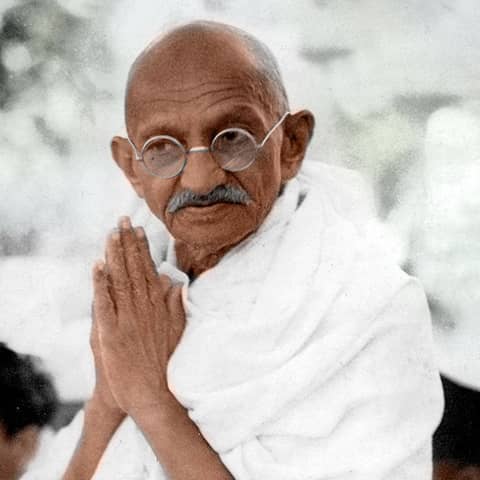
MAHATMA GANDHI

Gandhi was the youngest child of his father’s fourth wife. His father—Karamchand Gandhi, who was the dewan (chief minister) of porbandar, the capital of a small principality in western India (in what is now gujrat state) under British suzerainty—did not have much in the way of a formal education. He was, however, an able administrator who knew how to steer his way between the capricious princes, their long-suffering subjects, and the headstrong British political officers in power.

Early Life

Mohandas Karamchand Gandhi was born on October 2, 1869, at Porbandar, in the present-day Indian state of Gujarat. His father was the dewan (chief minister) of Porbandar; his deeply religious mother was a devoted practitioner of Vaishnavism (worship of the Hindu god Vishnu), influenced by Jainism, an ascetic religion governed by tenets of self-discipline and nonviolence. At the age of 19, Mohandas left home to study law in London at the Inner Temple, one of the city’s four law colleges. Upon returning to India in mid-1891, he set up a law practice in Bombay, but met with little success. He soon accepted a position with an Indian firm that sent him to its office in South Africa. Along with his wife, Kasturbai, and their children, Gandhi remained in South Africa for nearly 20 years.

The Birth of Passive Resistance

In 1906, after the Transvaal government passed an ordinance regarding the registration of its Indian population, Gandhi led a campaign of civil disobedience that would last for the next eight years. During its final phase in 1913, hundreds of Indians living in South Africa, including women, went to jail, and thousands of striking Indian miners were imprisoned, flogged and even shot. Finally, under pressure from the British and Indian governments, the government of South Africa accepted a compromise negotiated by Gandhi and General Jan Christian Smuts, which included important concessions such as the recognition of Indian marriages and the abolition of the existing poll tax for Indians.

Leader of a Movement

As part of his nonviolent non-cooperation campaign for home rule, Gandhi stressed the importance of economic independence for India. He particularly advocated the manufacture of khaddar, or homespun cloth, in order to replace imported textiles from Britain. Gandhi’s eloquence and embrace of an ascetic lifestyle based on prayer, fasting and meditation earned him the reverence of his followers, who called him Mahatma (Sanskrit for “the great-souled one”). Invested with all the authority of the Indian National Congress (INC or Congress Party), Gandhi turned the independence movement into a massive organization, leading boycotts of British manufacturers and institutions representing British influence in India, including legislatures and schools.

Teacher’s Day

Teachers’ Day 2020: In India, Teachers’ Day is celebrated annually on September 5 to mark the birthday of the country’s former President, scholar, philosopher and Bharat Ratna awardee, Dr Sarvepalli Radhakrishnan, who was born on this day in 1888.

The significance of this day is ever-evolving, including taking lessons from life and making your experiences the teachers you needed to shape you into who you become. For school students, the day also means getting roses, chocolates, gifts including handmade cards to profess their affection for their favourite teachers. For senior students, Teacher’s day is one of role reversal and celebration.

Who was Dr Sarvapalli Radhakrishnan

World Teachers’ Day is celebrated on October 5, but every country celebrates the day on different dates. In India, September 5 is marked as Teachers’ Day as it’s the birthday of a highly-respected teacher, philosopher and prolific statesman, Dr Sarvapalli Radhakrishnan. Dr Radhakrishnan said that “teachers should be the best minds in the country.”

The story behind Teachers’ Day goes that when Dr Radhakrishan took the office of the second President of India in 1962, his students approached him to seek permission to celebrate September 5 as a special day. Dr Radhakrishnan instead made a request of them to observe September 5 as Teachers’ Day, to recognise the contribution of teachers to the society.

Teacher’s Day is celebrated across schools, colleges, universities and educational institutions. Students put on performances, dances, and host elaborate shows for their most-loved teachers.

This year, owing to the Covid-19 pandemic, and schools being shut, the celebrations will be given a miss. However, virtual wishes and greetings are a perfect way to tell your teachers you remember them now and always will.

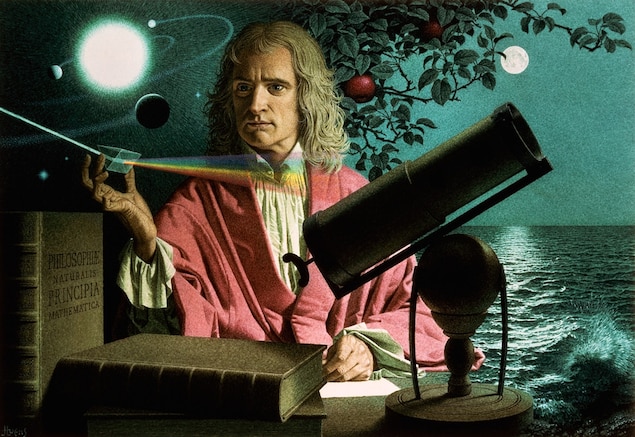
ISSAC NEWTON

Isaac Newton was a tiny man in real life. But he was a giant in the world of science.

Newton created the theory of gravity around 1665 or 1666. He came up with the idea that every physical object, whether it’s a person, an apple or a planet, exerts a force on other physical objects. A force is a push or pull in a certain direction. The bigger the body, the stronger the force. There are different types of forces, but this one is called gravitational.

Some say that Newton came up with his ideas about gravity after watching an apple fall. He wondered why the apple fell straight down. Why didn’t it fall sideways, or even up toward the sky?

Gravity does not just make apples fall from trees. It also holds us on the ground. Newton showed that gravity even makes the moon circle around Earth, and Earth around the sun, Martin Rees says. He was president of Britain’s Royal Society. The Royal Society is the United Kingdom’s national academy of science.

Newton Changes Science Forever

The theory of gravity was just one of Newton’s discoveries. He also loved calculus. This is a mathematical subject that studies rates. A rate is the measurement of how much something changes. Newton’s ideas in calculus are still used today.

Newton also studied optics, the science of light. He found out that white light is not just white. It is actually a mix of all the colors of the rainbow. Newton used his knowledge of light to make better telescopes.

Following his apple idea, Newton wrote three laws of motion. These laws changed all of science, and are still used by scientists today.

First Law of Motion: Inertia

An object that sits still will remain still unless a force is applied to it. An object that is moving will keep moving along a straight line unless an outside force is applied to it.

Second Law of Motion: Acceleration

An object will accelerate if force is applied to it.

Acceleration is the change of an object’s speed. The acceleration will happen in the same direction as the force.

This idea can also be written as force equals mass times acceleration, or F = ma.

Third Law of Motion: Action and Reaction

For every action there is always an equal and opposite reaction.

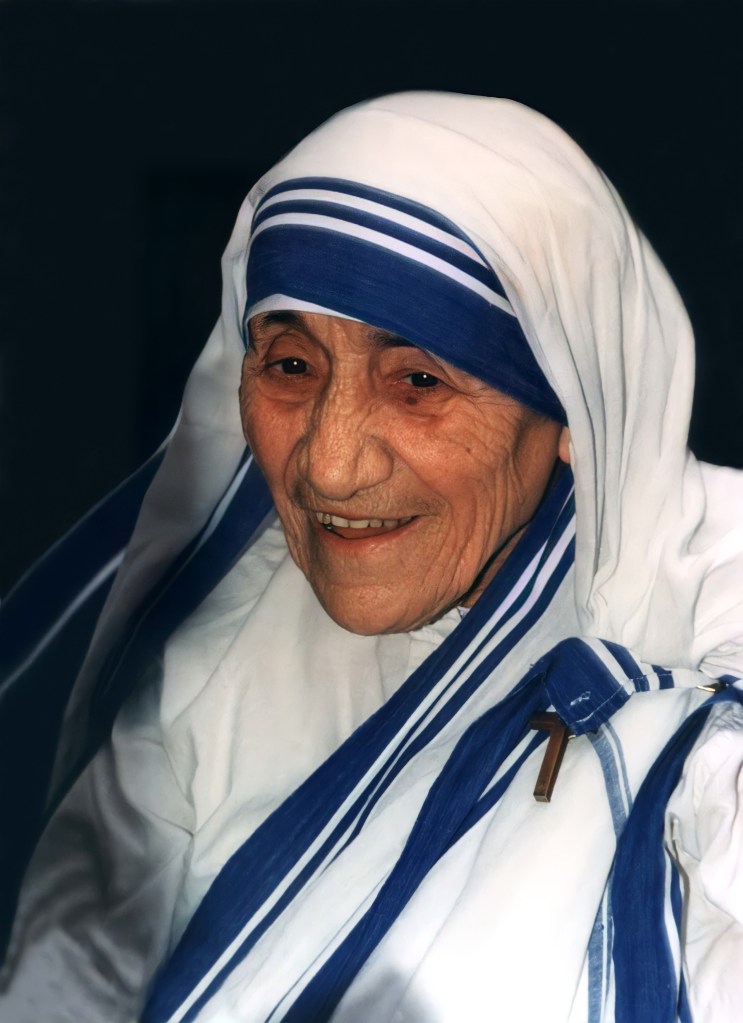
MOTHER TERESA

Who Was Mother Teresa?

Nun and missionary Mother Teresa, known in the Catholic church as Saint Teresa of Calcutta, devoted her life to caring for the sick and poor. Born in Macedonia to parents of Albanian-descent and having taught in India for 17 years, Mother Teresa experienced her “call within a call” in 1946. Her order established a hospice; centers for the blind, aged and disabled; and a leper colony. 

In 1979, Mother Teresa received the Nobel Peace Prize for her humanitarian work. She died in September 1997 and was beatified in October 2003. In December 2015, Pope Francis recognized a second miracle attributed to Mother Teresa, clearing the way for her to be canonized on September 4, 2016.

Mother Teresa’s Family and Young Life

Mother Teresa was born on August 26, 1910, in Skopje, the current capital of the Republic of Macedonia. The following day, she was baptized as Agnes Gonxha Bojaxhiu.

Mother Teresa’s parents, Nikola and Dranafile Bojaxhiu, were of Albanian descent; her father was an entrepreneur who worked as a construction contractor and a trader of medicines and other goods. The Bojaxhius were a devoutly Catholic family, and Nikola was deeply involved in the local church as well as in city politics as a vocal proponent of Albanian independence.

In 1919, when Mother Teresa — then Agnes — was only eight years old, her father suddenly fell ill and died. While the cause of his death remains unknown, many have speculated that political enemies poisoned him.

In the aftermath of her father’s death, Agnes became extraordinarily close to her mother, a pious and compassionate woman who instilled in her daughter a deep commitment to charity. Although by no means wealthy, Drana Bojaxhiu extended an open invitation to the city’s destitute to dine with her family. “My child, never eat a single mouthful unless you are sharing it with others,” she counseled her daughter. When Agnes asked who the people eating with them were, her mother uniformly responded, “Some of them are our relations, but all of them are our people.”

Education and Nunhood

Agnes attended a convent-run primary school and then a state-run secondary school. As a girl, she sang in the local Sacred Heart choir and was often asked to sing solos. The congregation made an annual pilgrimage to the Church of the Black Madonna in Letnice, and it was on one such trip at the age of 12 that she first felt a calling to religious life. Six years later, in 1928, an 18-year-old Agnes Bojaxhiu decided to become a nun and set off for Ireland to join the Sisters of Loreto in Dublin. It was there that she took the name Sister Mary Teresa after Saint Thérèse of Lisieux.

A year later, Sister Mary Teresa traveled on to Darjeeling, India, for the novitiate period; in May 1931, she made her First Profession of Vows. Afterward, she was sent to Calcutta, where she was assigned to teach at Saint Mary’s High School for Girls, a school run by the Loreto Sisters and dedicated to teaching girls from the city’s poorest Bengali families. Sister Teresa learned to speak both Bengali and Hindi fluently as she taught geography and history and dedicated herself to alleviating the girls’ poverty through education.

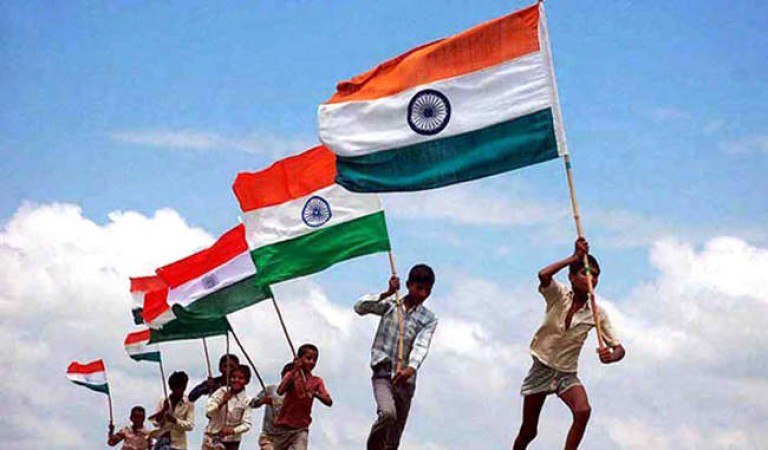
“INDEPENDENCE DAY”

India’s Independence Day reminds the country’s citizens of all the sacrifices the freedom fighters have made to secure the country’s future. Since its independence, India has made stellar progress in every field, including education, military and space programmes.

History of Our Independence Day

For almost two centuries the Britishers ruled over us. And the citizen of the country suffered a lot due to these oppressors. British officials treat us like slaves until we manage to fight back against them.

We struggled for our independence but work tirelessly and selflessly under the guidance of our leaders Jawahar Lal Nehru, Subhash Chandra Bose, Mahatma Gandhi, Chandra Shekhar Azad, and Bhagat Singh. Some of these leaders choose the path of violence while some choose non-violence. But the ultimate aim of these was to drive out the Britishers from the country. And on 15th August 1947, the long-awaited dream come true.

Why We Celebrate Independence Day?

To relive the moment and to enjoy the spirit of freedom and independence we celebrate Independence Day. Another reason is to remember the sacrifices and lives we have lost in this struggle. Besides, we celebrated it to remind us that this freedom that we enjoy is earned the hard way.

Apart from that, the celebration wakes up the patriot inside us. Along with celebration, the young generation is acquainted with the struggles of the people who lived at that time.

Activities on Independence Day

Although it’s a national holiday the people of the country celebrate it with great enthusiasm. Schools, offices, societies, and colleges celebrate this day by organizing various small and big events.

Every year at Red Fort the Prime Minister of India host the national flag. In the honor of the occasion, 21 gunshots are fired. This is the begging of the main event. This event is later on followed by an army parade.

The school and colleges organize cultural events, fancy dress competitions, speech, debate, and quiz competition.

Importance of Independence Day

Every Indian holds a different viewpoint about Indian Independence. For some, it’s a reminder of the long struggle while for youngsters it stands for the glory and honor of the country. Above all, we can see the feeling of patriotism across the country.

The Indian’s celebrate Independence Day with a feeling of nationalism and patriotism across the country. On this day every citizen echoes with festive feeling and pride in the diversity  and unity of the people. It’s not only a celebration of Independence but also of the unity in diversity of the country.

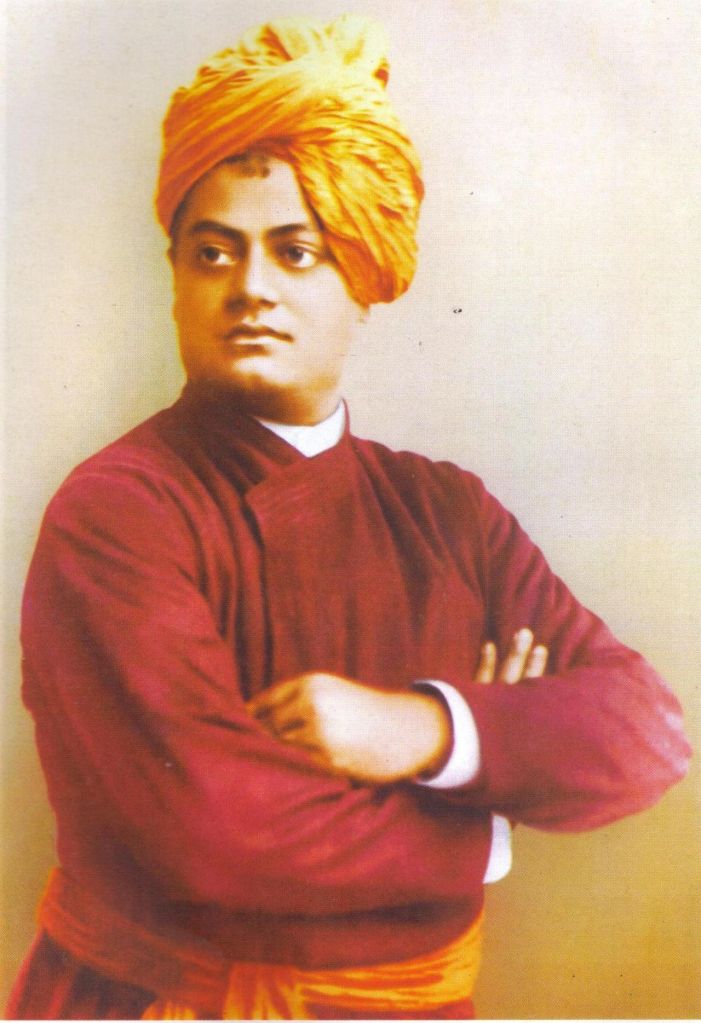
Swami Vivekanand

Early life

Vivekananda was born Narendranath Datta (shortened to Narendra or Naren) in a bengali family at his ancestral home at 3 Gourmohan Mukherjee street in Calcutta, the capital of British india, on 12 January 1863 during the Makar sanskrati festival. He belonged to a traditional family and was one of nine siblings. His father, Vishwanath Datta , was an attorney at the Calcutta high Court. Durgacharan Datta, Narendra’s grandfather was a sanskrti  and Persian  scholar who left his family and became a monk at age twenty-five. His mother, Bhubaneswari Devi, was a devout housewife. The progressive, rational attitude of Narendra’s father and the religious temperament of his mother helped shape his thinking and personality.

Narendranath was interested in spirituality from a young age and used to meditate before the images of deities such as Shiva, rama, sita, and mahavir hanuman. He was fascinated by wandering ascetics and monks. Narendra was naughty and restless as a child, and his parents often had difficulty controlling him. His mother said, “I prayed to Shiva for a son and he has sent me one of his demons”.

Education

1871, at the age of eight, Narendranath enrolled at Ishwar Chandra Vidhyasagar’s Metropolitan institutions, where he went to school until his family moved to Raipur in 1877. In 1879, after his family’s return to Calcutta, he was the only student to receive first-division mark entrance examination.  He was an avid reader in a wide range of subjects, including philosophy, religion, history, social science, art and literature was also interested in Hindu scriptures, including the vedas, the upanishads, the Bhagvad gita, the Ramayana, Mahabharata and the puranas. Narendra was trained in Indian classical music and regularly participated in physical exercise, sports and organised activities.

Narendra studied Western logic, Western philosophy  and European history General assemblyinstitutions (now known as the Scottish Church College). In 1881, he passed the fine arts examination, and completed a Bachelor of Arts degree in 1884. Narendra studied the works He became fascinated with the evolution  of herbert Spencer and corresponded with him, translating Herbert’s Spencer book Education (1861) into Bengali. While studying Western philosophers, he also learned Sanskrit scriptures and Bengali literature.

William hestie (principal of Christian College, Calcutta, from where Narendra graduated) wrote, “Narendra is really a genius. I have travelled far and wide but I have never come across a lad of his talents and possibilities, even in German universities, among philosophical students. He is bound to make his mark in life”.

Narendra was known for his prodigious memory and the ability at speed reading. Several incidents have been given as examples. In a talk, he once quoted verbatim, two or three pages from Pickwick papers. Another incident that is given is his argument with a Swedish national where he gave reference to some details on Swedish history that the Swede originally disagreed with but later conceded.

In another incident with Dr. Paul Deussen’s at kiel in Germany, Vivekananda was going over some poetical work and did not reply when the professor spoke to him. Later, he apologised to Dr. Deussen explaining that he was too absorbed in reading and hence did not hear him. The professor was not satisfied with this explanation, but Vivekananda quoted and interpreted verses from the text, leaving the professor dumbfounded about his feat of memory. Once, he requested some books written by Sir John Lubbock from a library and returned them the very next day, claiming that he had read them. The librarian refused to believe him until cross-examination about the contents convinced him that Vivekananda was being truthful.

BOOK REVIEW : THE ALCHEMIST

~ Paulo Coelho

Philosophy

Characters – Santiago

Setting Egypt

Literary awards – National book award nominee for translation(2015)

Paulo Coelho’s enchanting novel has inspired a devoted following around the world. This story, dazzling in its powerful simplicity a inspiring wisdom, is about an Andalusian shepherded boy named Santiago who travels from his home land in Spain to the Egyptian desert in search of a treasure buriek in the pyramids.

Along the way he meets a gypsy women, a man who calls himself king, and an alchemist, all of whom point Santiago in the direction of his quest. Noone knows what the treasure is, or if Santiago will be able to surmount the obstacles along the way. But what starts out as a journey to find worldly goods turns into a discovery of the treasure found within.

Lush, evocating, and deeply humane, the story of Santiago is an eternal testament to the transforming power of our dreams and the importance of listening to our hearts.

RAJA RAM MOHAN ROY

Raja Ram Mohan Roy, a great reformer, thinker, so much ahead of his times, one of the makers of modern India, a versatile personality and the founder of the Brahma-Samaj was born on 22nd May, 1772 in Radhanagar, a village in West Bengal.

When this so remarkable man was born there was an all-round decline in all walks of life. The law and order was in shambles, moral values, social concerns and religious institutions were at their lowest and the economy in a chaos. It was a time when the whole country was drowned in many superstitions, dead and useless rituals and caste, creed, and religious narrowness reigned supreme. It was a time when women were looked upon as helpless creatures worthy only to be confined to homes and hearths.

Ram Mohan Roy came with his scientific temper, broad outlook, championship of freedom, liberal and fundamental reforms and harbinger of equality and humanism. He thought differently and much ahead of his times. His ideas, ideals and practices helped a lot in the reawakening and renaissance in the country.

His dynamism and personal charismatic charm made people in thousand to rally behind him for fundamental reforms in religion, society, politics, education and personal life. He virtually caused to dawn a new era of enlightenment and reawakening.

Ram Mohan Roy’s father, Rama Kant Roy was a wealthy landlord. He sent his son Ram Mohan to the village school for his elementary education where the young boy learnt Arabic and Persian besides his mother tongue Bengali.

SCIENCE AND TECHNOLOGY

Science, technology and innovation each represent a successively larger category of activities which are highly interdependent but distinct. Science contributes to technology in at least six ways: (1) new knowledge which serves as a direct source of ideas for new technological possibilities; (2) source of tools and techniques for more efficient engineering design and a knowledge base for evaluation of feasibility of designs; (3) research instrumentation, laboratory techniques and analytical methods used in research that eventually find their way into design or industrial practices, often through intermediate disciplines; (4) practice of research as a source for development and assimilation of new human skills and capabilities eventually useful for technology; (5) creation of a knowledge base that becomes increasingly important in the assessment of technology in terms of its wider social and environmental impacts; (6) knowledge base that enables more efficient strategies of applied research, development, and refinement of new technologies.

The converse impact of technology on science is of at least equal importance: (1) through providing a fertile source of novel scientific questions and thereby also helping to justify the allocation of resources needed to address these questions in an efficient and timely manner, extending the agenda of science; (2) as a source of otherwise unavailable instrumentation and techniques needed to address novel and more difficult scientific questions more efficiently.

Specific examples of each of these two-way interactions are discussed. Because of many indirect as well as direct connections between science and technology, the research portfolio of potential social benefit is much broader and more diverse than would be suggested by looking only at the direct connections between science and technology.

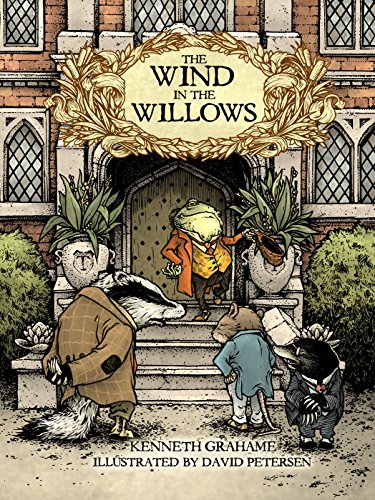
Book Review of kenneth Grahme`s

“The Wind in the willows”

INTRODUCTION

Kenneth Grahame`s ‘ The Wind in the willows’ is a novel aimed at youngsters. The plot, itself is not American humor, but that of great britian. in terms of sarcasm, and british related jokes. The novel illustrates a fair mix of the relationships between the human life animals and wildlife. The narraative acts as an important milestone in post- victorian children literature.

The characters featured in this book are Mole, Rat, Toad, Badges and otter. Toad showing big headed and childlike traits. Mole shows traits of reasoning and sensible behavior patterns. Badger shows traits of kindness and hospitality. Otter possesses traits of intelligence. All these characters participate equally in the narrative of both thrilling and neo-noir.

BODY

One of the problems with the toad is that he enjoys crashing motoe vehicles. As a result, rat tries to talk some sense into him. though, this doesn’t work. Toad is illustrated as a child stuck in an adult’s body. Furthermore, rat always renforces the act of growing up onto toad, and not to be careless for others.

As a result of Toads motorcar crimes, he is sent to a deepest, darkest dungeon to play for his crimes. ” Toad hall….. is an eligible self- contained gentleman’s residence replete with every modern convenince”. Toad, being the character showing the most affluence owns his own manner house. Having regained his big headedness. During his sentence, he started to boast about his mansion and great wealth. While being chained to a black weight.

“Now then, follow me! Mole first, ‘cos I’m very pleased with him; Rat next; Toad last”. Badger starts an invasion, Toad’s behavior illustrates the opposite of Mole. His ordeal is going back to the dungeon, like a child being anxious about going to their bedroom for misbehaving.

” For it has roused a longing in me that is a pain”. While in search of a missing infant otter, rat becomes faced with noise coming from a piper. The quote focuses on the main idea of author’s intension in writing the novel. The focuses being: The reasons which cause life to be worthwhile. The sounds travel through rat likes blades. With this in mind, the focus is intended to be answered between the lines.

CONCLUSION

The characters having a variety of different personalities and views of the world. Their human-like features are included with their animal-like traits. In terms of mole has a good sense of smell. The book is aimed at showing animals living british lifr, in the summer-time. The animals have a justice system, hence toad was sent to play for his motor-car crimes. The mansion was invaded by the other animals while toad was imprisioned and during his escape. Toad’s behaviour is terrible and affects the rest of the animals.

The stroy plays an important part in historical children literature. In modern-day, it is still read by children. The story, features human-like animals who all have their own ordeals. Mole and Rat being the kindest animal featured in the story, as Toad being the most immature and self-observed.