

Early life
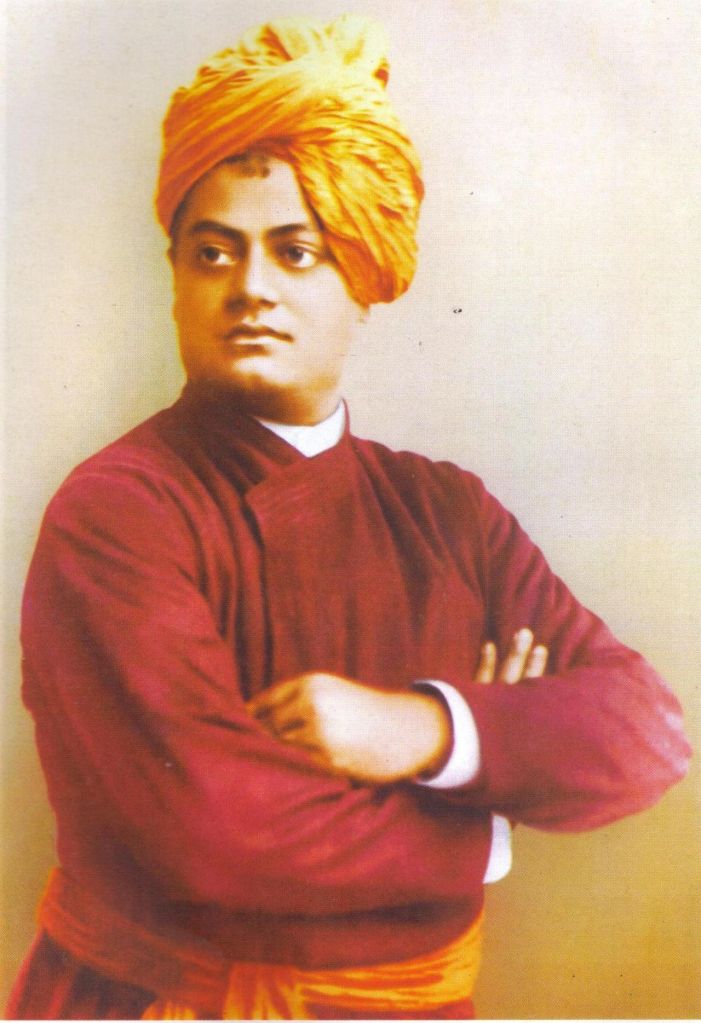
Vivekananda was born Narendranath Datta (shortened to Narendra or Naren) in a bengali family at his ancestral home at 3 Gourmohan Mukherjee street in Calcutta, the capital of British india, on 12 January 1863 during the Makar sanskrati festival. He belonged to a traditional family and was one of nine siblings. His father, Vishwanath Datta , was an attorney at the Calcutta high Court. Durgacharan Datta, Narendra’s grandfather was a sanskrti and Persian scholar who left his family and became a monk at age twenty-five. His mother, Bhubaneswari Devi, was a devout housewife. The progressive, rational attitude of Narendra’s father and the religious temperament of his mother helped shape his thinking and personality.
Narendranath was interested in spirituality from a young age and used to meditate before the images of deities such as Shiva, rama, sita, and mahavir hanuman. He was fascinated by wandering ascetics and monks. Narendra was naughty and restless as a child, and his parents often had difficulty controlling him. His mother said, “I prayed to Shiva for a son and he has sent me one of his demons”.
Education
1871, at the age of eight, Narendranath enrolled at Ishwar Chandra Vidhyasagar’s Metropolitan institutions, where he went to school until his family moved to Raipur in 1877. In 1879, after his family’s return to Calcutta, he was the only student to receive first-division mark entrance examination. He was an avid reader in a wide range of subjects, including philosophy, religion, history, social science, art and literature was also interested in Hindu scriptures, including the vedas, the upanishads, the Bhagvad gita, the Ramayana, Mahabharata and the puranas. Narendra was trained in Indian classical music and regularly participated in physical exercise, sports and organised activities.
Narendra studied Western logic, Western philosophy and European history General assemblyinstitutions (now known as the Scottish Church College). In 1881, he passed the fine arts examination, and completed a Bachelor of Arts degree in 1884. Narendra studied the works He became fascinated with the evolution of herbert Spencer and corresponded with him, translating Herbert’s Spencer book Education (1861) into Bengali. While studying Western philosophers, he also learned Sanskrit scriptures and Bengali literature.
William hestie (principal of Christian College, Calcutta, from where Narendra graduated) wrote, “Narendra is really a genius. I have travelled far and wide but I have never come across a lad of his talents and possibilities, even in German universities, among philosophical students. He is bound to make his mark in life”.
Narendra was known for his prodigious memory and the ability at speed reading. Several incidents have been given as examples. In a talk, he once quoted verbatim, two or three pages from Pickwick papers. Another incident that is given is his argument with a Swedish national where he gave reference to some details on Swedish history that the Swede originally disagreed with but later conceded.
In another incident with Dr. Paul Deussen’s at kiel in Germany, Vivekananda was going over some poetical work and did not reply when the professor spoke to him. Later, he apologised to Dr. Deussen explaining that he was too absorbed in reading and hence did not hear him. The professor was not satisfied with this explanation, but Vivekananda quoted and interpreted verses from the text, leaving the professor dumbfounded about his feat of memory. Once, he requested some books written by Sir John Lubbock from a library and returned them the very next day, claiming that he had read them. The librarian refused to believe him until cross-examination about the contents convinced him that Vivekananda was being truthful.


You must be logged in to post a comment.