Studio Ghibli is a Japanese animation studio that has been creating wonderful animated movies since 1985. Founded by Hayao Miyazaki and co., Ghibli’s movies have always stood apart for their thought-provoking themes and immensely settings. Ghibli animations have the power to transport us to an ethereal land that transcends beyond the mundanities of human life. They are usually set in a mythical of fictional landscapes which are hidden from and within the everyday realities of humans. Through these fictional characters and magical settings, Ghibli movies have a way of moving us to tears with etched emotions. Their plotlines are heart-wrenchingly beautiful and are often presented with a touching message to humanity. Another element that adds to the beauty of each movie is that they are accompanied by an assortment of soulful music. Ghibli movie magic lies in the fact that it can instantly takes us lands that reminds us of the beauty of mossy meadows, gentle rivers, sweet smell of earth after the first rain, dewdrops on a tender leaf and vast grasslands meeting a clear blue sky in its horizon.
Here’s a list of top 3 must-watch Ghibli movies:
1. Spirited Away
Spirited Away was released in 2001 and was directed by Hayao Miyazaki. Spirited Away follows the story of Chiro, a 10-year-old girl who, while moving into a new neighbourhood with her family, accidentally enters the world of Kami or Japanese folk spirits. The family crosses into the threshold before sunset, not knowing that it transforms into the magical land of spirits after sun down. After her parents are turned into pigs, Chiro embarks on a journey to recover their true selves by working for the land’s wealthiest witch Yubaba. Set with beautiful animations of glittering nightscape and elegant river spirits, Spirited Away is easily a true cinematic masterpiece. It won the Academy award for ‘Best Animated Feature Film’ in 2002 and is critically acclaimed worldwide.
2. Princess Mononoke
Princess Mononoke was released in the year 1997 and was directed by Hayao Miyazaki. It is a thought-provoking story that questions and laments the destruction of nature sue to mankind’s greed for more. Set in the late Muromachi perios, it follows the story of a young Prince Ashitaka who encounters wild forest gods and its protectors who are caught fighting against humans who seek to destroy the forest for their purposes. With surreal mythical creatures and an abundance of emotions, Princess Mononoke moves us with its powerful message.
3. My Neighbor Totoro
My Neighbour Totoro was released in the year 1988 and was directed by Hayao Miyazaki. It follows the story of two little girls named Satsuki and Mei who, while moving into their new house, discover a hoard of fantasy creatures in their backyard. The two children, especially the younger one is innocently curious. As she stumbles into a mossy hole, she discovers a couple of friendly wood spirits including the huge Totoro who keep her company until her sister arrives back from school. Set in a post-war Japan, the movie shines with the innocence of the children and explore their humorous interactions with the mysterious and cute creatures. Totoro was widely popular and has been the face of Studio Ghibli since.
There are several other notable Ghibli movies including Howl’s Moving Castle, Castle in the Sky, Grave of the Fireflies and Kiki’s delivery service, etc.
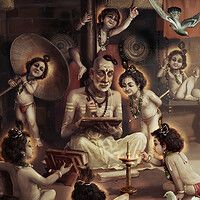
Jnanapana is a devotional Malayalam poem which directly translates to ‘song of wisdom’ or ‘the fountain of divine wisdom’. It is written by Poonthanam, a 16th century bhakti poet who lived in keezhattur in Kerala. He was an ardent devotee of Lord Vishnu, who is considered to be the preserver of life from the Hindu pantheon of gods. Poonthanam was particularly devoted to Vishnu in the form of ‘Guruvayurappa’ (the lord and the presiding deity of the Guruvayur Temple in Thrissur, Kerala.)
According to the legends, Poonthanam and his wife were devoid of any children even after years of trying. The couple was desperate for a child and prayed to the deity in Guruvayur to bless them with an offspring. The couple was elated when they were soon able to bear a boy child. But it so happened that on the day of the celebration of the child’s first birthday, an unfortunate accident occurred. The child had been accidentally buried under a pile of clothes put up by the guests who came to attend the child’s birthday celebrations. Tormented by grief upon the loss of their only child, Poonthanam sought refuge in the Guruvayur Temple to seek penance.
As the legend goes, it is said that Lord Vishnu himself appeared in front of the ardently praying devotee in the form of a young child and blessed the poet-saint with his divine godly graces. Since then, Poonthanam spent his life meditating in the halls of Guruvayur and was devoted to the god like a father to a son. Later, when he wrote Jnanapana, poonthanam says “When Lord Krishna himself dances in my heart, why do I need any other children…” That’s the intensity with which poonthanam adored Krishna and it’s a very powerful and touching statement.
Unlike the other contemporary poet-saints of his time who were well-versed in Sanskrit, Poonthanam wrote most of his poems in very simple verses of Malayalam. This is the reason why ‘Jnanapana’ became popular, as it was easily understandable to the common folks. In fact, when a fellow poet named Melpattur (Who is the author of the reputed devotional song ‘Narayaneeyam’) criticised him for the same, it is said that Krishna himself appeared before him and said “I prefer Poonthanam’s ‘bhakthi’ (devotion) over Melpattur’s ‘vibhakthi’ (scholarly knowledge/input).
Jnanappana is Poonthanam’s magnum opus with over 360 verses of lines. The poet, deeply touched by human beings’ sorry plight in this age of Kali (Kali Yuga), extols the virtues of Jnana (wisdom) and urges them to follow the path of Jnana and to forsake the transient and ephemeral aspects of worldly life through his poem. It is highly philosophical and inquires about the deeper meaning of life and human existence in this world. Yet, the localized language helped the common folks to sing and celebrate this ‘song of wisdom’ for generations to come.
Some of the most philosophical and thought-evoking lines from the poem is as follows:
If God wishes, the people we see now or are with us now, may disappear or be dead in the next moment. Or if HE wishes, in few days a healthy man may be paraded to his funeral pyre.
-Poonthanam
If God wishes, the king living in a palace (malika) today may lose everything and end up carrying a dirty bag on his shoulders and walk around homeless.
Arcadia is a play written by the English playwright Tom Stoppard which was published in 1993. It is among the most popular works written by Stoppard along with Rosencrantz & Guildenstern Are Dead, The Real Inspector Hound, and Hapgood. Most of his works deals with several post-modern themes like science, time, and exploration of reality in pursuit of intellectual and philosophical knowledge. In its truest post-modern sense, the play is a celebration of the intermingling of science and literature using the eternal thread of time.
Stoppard is known for his ingenious ways in which he plays with time to create magic on stage and Arcadia is no exception. Along with several other binaries like order and chaos, or the thirst of intellectual knowledge and the sexual knowledge, Arcadia juxtaposes two binaries of time, namely: the past and the present. The play is set in two different time periods with each scene alternating between both. On one hand, it features the Sidley Park and its occupants in the early 1800s and on the other, it follows the lives of their modern-day counterparts. The narrative of the play intertwines the past and the present, ultimately leading to a concluding scene which features them both simultaneously. As Paul Edwards puts it, “The brilliantly conceived structure of Arcadia enables the audience to witness the effects of time in Sidley Park, since the play is set in two different periods, but in the same garden room of the stately home.”
Regarded as one of the best Science-related works ever written, Arcadia gives equal attention to the scientific advancements of the time as it does to the various nuances of a narrative play. Of the many scientific theories, nonlinear dynamics, theory of deterministic chaos, principles of entropy, bifurcation and fractals are a some of the concepts explored through the play. Deterministic Chaos is a set of principles grounded in nonlinear mathematics that suggest that even carefully calculated equations can lead to uncertain future. This crucial feature of time is highlighted when Hannah discovers that it is the rakish intellectual tutor Septimus Hodge who ended up being the revered hermit of Sidley Park. Nonlinear dynamic systems are processes that may appear chaotic or unpredictable. Although they may seem random, these behaviours are in fact, not random. Arcadia is structured in a similar way to embody this phenomenon. The time periods, although juxtaposed and disorderly, carries a solid order for the sequence of the scenes. This narrative technique is also reflective of entropy, which is the gradual decline of a system from a state of order to disorder. The order of the alternating scenes is disrupted in the final scene of disorder where the time periods and characters overlap with one another. Stoppard himself comments that “The play bifurcates two or three times and then goes into the last section which is all mixed up. So, it’s very chaos structured” (Demastes and Kelly 5).
Fractals are defined as infinitely complex patterns that are self-similar across different scales and are created out of feedback loops. This can be viewed as another feature of time wherein it is predicted that despite the infinite complexities, situations and actions repeat themselves over time. This self-similarity of actions is reflected in several props, dialogues, and characters in Arcadia. For instance, most of the characters in the future seem to have a direct or at least an indirect counterpart in the past. The most obvious one is that of Gus and Agustus, who are both played by the same actor. They alternate between the different scenes until the last scene where Gus appears on stage with regency era clothing, eerily connecting both the time periods. Similarly, Chloe asks Valentine “Do you think I’m the first person to think of this?” (Stoppard 76) not knowing that nearly a century ago, one of her ancestors, Thomasina, had asked the very same question. Where Chloe is obsessed with sexual knowledge, Thomasina’s is merely an innocent curiosity. Thomasina’s thirst for intellectual knowledge is mirrored in the present-day character Hannah. Similarly, one can draw parallels between the intellectuals Septimus and Valentine who have both at one point questioned Thomasina’s intellect.
Stoppard makes great use of props and stage setting to similar extent. Enock Brater observes that the play “relied on its design elements of set, costume and music to track and trace the fluidity of time built into the script.” (164) Few of the props like a tortoise, apple, notebooks, and an old-fashioned theodolite appear in both the time periods becomes a bridge between the two eras. Each of these props carry a symbolic significance throughout the play. For instance, it is the drawing of Septimus along with his tortoise Plautus that helps Hannah confirm that he is the Hermit of the Sidley Park. The Regency era costume also serve as a symbol of time. In the final scene, as the two couples waltz in these costumes, there’s an attempt to blur the lines between the past and the present and it explicitly shows the two eras as parallels. Certain other significant objects in Arcadia are more than just coincidental props. For instance, the signed copy of Chater’s ‘Couch of Eros’, Thomasina’s sketch of Septimus, the game book, and even Sidley Park itself might all just be ‘evidence’ to the modern generation, but they are more than that. These objects are all testaments of time. Characters like Bernard have attempted to manipulate them in order to try and twist the past, but these objects have withstood the troubles of time and they alone carry the truth of the past within them.
One of the major conflicts that is unravelled through time is the conflict between the changing outlooks of the different time periods, namely between Romanticism and Classism. These opposites arise from the inherent tendency of each generation to break away from the past. In the olden age, the characters who followed the Classic ideals long to have a more Romantic outlook while the modern age attempts to go back to Classism. This constant changing of the beliefs and systems can been seen as another feature of time. While the present glorify some aspects of the past, there are some aspects which are seen as outdated. For example, Valentine initially looks down on the theories of Thomasina because he finds it hard to believe that she could have thought of something as innovative during those ages. Valentine later realises that Thomasina had in fact thought of iteration way before the modern technologies which is the very concept that he uses for his research paper.
Almost all the characters in Arcadia are obsessed with knowledge of some kind. In their attempts to uncover these knowledges, they make use of time as a tool. Through her intellect, Thomasina is eager to know more about the future, although she doesn’t have the technology to assist her. Their modern counterparts on the other hand, look back to the past for knowledge. This thirst for historical knowledge can be seen as an obsession with time, especially for Hannah and Bernard. Where Bernard uses time for manipulation, Hannah uses it to disapprove him. Even though the characters desperately seek to travel back and forth in time, they are unable to do so. But due to Stoppard’s ingenious narrative, the audience gets a glimpse of what it is like to travel across time.
Despite all the obsession and conflict that the characters share with time, the fact remains that they are all ultimately subjected to its tyranny. Anything that is created will perish in the course of time. Due to the fire, Thomasina passes away before she has enough time to tap the potential of her intellect. She simply didn’t have enough time to manually do the equation, and Septimus lives out the rest of his life trying to do so. Valentine on the other hand has the luxury of advanced technologies which does the same equation in mere seconds. Knowledge also gets lost in the course of time, a feat that troubles both the time periods alike. Here, time takes on the part of a villainous character that destroys everything in its ruthless flow.
At the same time, the play also resonates the belief that perhaps knowledge and art will piece itself back together in the course of time, an idea that Bernard desperately tries to prove. John Fleming observes “In part, Bernard suggests that great art is timeless, a view that coincides with his desire for a mechanistic universe, i.e., the laws of the Newtonian universe are insensitive to time.” Stoppard manages to bring together two of these conflicting ideologies of science and art into a single masterpiece. The play exhibits one of the cleverest uses of time as a tool to bring together these diverse ideas on stage. If Bernard’s stance on great art is indeed true, Arcadia is bound to stand the test of time.
“Why don’t we have a little game? Let’s pretend that we’re human beings, and that we’re actually alive.”
John Osborne
Look Back in Anger is a realist play written by John Osborne and Published in the year 1956. Set in an economy that has been diminished by the war, it follows the story of a young couple Jimmy and Alison Porter. Being from two different social classes, Jimmy being a working- class man and Alison being an upper-class, the two have trouble navigating through the class conflict present between themselves. The play focuses largely on Jimmy’s anger against the upper-class and particularly the upper-class women.
During the time of the play’s production, The Women’s Movement had already started taking shape in Britain and hence can be read as a reaction against the growing feminist movement of the time. It is evident from the play that Jimmy hates women and has strong misogynistic views. He blames women for his lack of power and impotence even though there is no coherent logic behind that argument. His wife Alison is the main victim of his hatred. Through her, he takes out all his anger against the establishments, the upper-class, Alison’s family and all women in general. His marriage to her was in itself a statement of rebellion against the bourgeoise and he himself states that ‘he took her hostage’. His motive for the marriage was never love and it was simply his need to assert his working-class masculinity over her.
“A refined sort of butcher, a woman is.”
-John Osborne
Where Alison is an aristocrat in terms of her class status, Jimmy is an aristocrat in terms of his gender identity and the only way he can get his anger and frustration against the bourgeoise out is by sexually mastering the upper-class women. He exploits his aristocracy as a male to compensate for his lack of status in terms of class, and he translates his class hatred into a sexual hatred. Here, Femininity is associated with the upper class and masculinity to that of the lower class and this act of attributing characteristics of gender to the classes is seen throughout the play. Despite being immensely flawed himself, Jimmy’s standards for women are highly unrealistic and he needs women only for his own selfish reasons. While Alison suffers to make their relationship work, Jimmy simply complains and puts a strain on them. He contradicts himself when he lashes out against Alison for being too silent but at the same time, he complains that she is like a python that is out to devour him whole with reference to her sexual aggression. The only two women that Jimmy seems to respect are Madeline (His ex-lover) and Mrs. Tanner (A working-class woman who helped him set up his sweet shop). He holds her as an ideal working-class woman as opposed to his own and Alison’s mother who are upper-class.
Although the driving force of the story is Jimmy’s anger, both Helena and Alison have made choices of their own to leave him. Even Alison who acts like a passive pushover has had her own choices and decisions in life. It was her choice to rebel against her parents and to marry Jimmy and leave her upper-class status, it was her choice to leave him and it was also her choice to come back to him in the final scene. Even when Jimmy calls her ‘Lady Pusillanimous’, she chooses to be silent so as to not give him the satisfaction of eliciting a reaction from her. Being silent is actually her way of retaliating against his dominance. On the other hand, Helena is one of the characters who is more expressively strong and feministic. She is unfazed by his threats and slaps him which shatters his façade and brings out his vulnerability. • Even when Alison chose to come back to Jimmy, Helena is unwilling to confirm to his demanding views on what a woman should be and boldly walks out on him because she is determined that she doesn’t want to go through pain and suffering just to be with him.
Look Back in Anger is thus riddled with undaunting and scathing misogyny and sexism. Although Osborne denied any anti-feministic overtones, we see that there’s an erasure of women I the male dominated dynamic in the play.
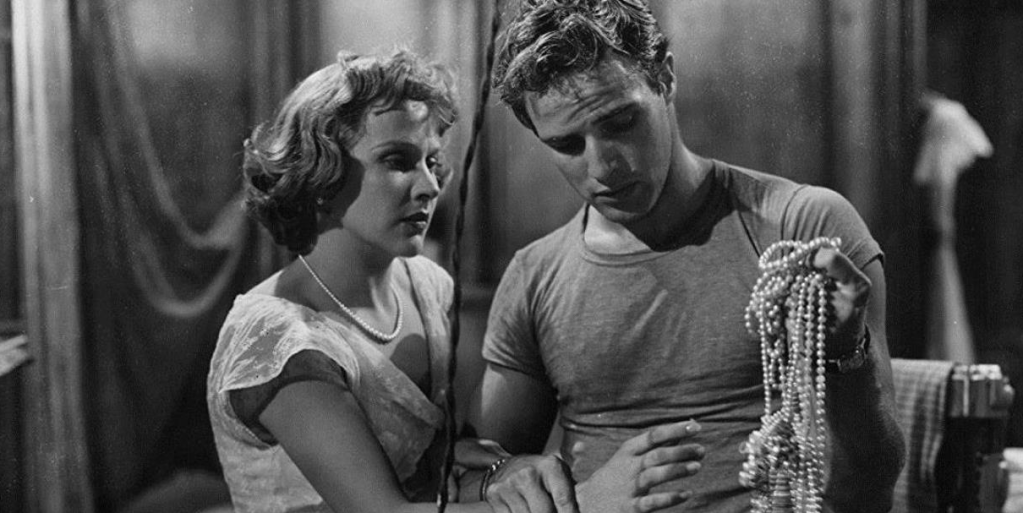
A still from A Streetcar Named Desire (1951) ft. Marlon Brando and Vivien Leigh
A Streetcar Named Desire is a 1947 play by the American playwright Tennessee Williams. It is regarded as one of Williams’ best plays and has received several awards including the Pulitzer Prize. It was also later adapted into a film in the year 1951 starring Marlon Brando and Vivien Leigh, and is still considered to be a classic. Through its eleven scenes, the play delivers a raw reality of the middle class in conflict with the fallen bourgeoise of the American South.
The story is set in motion when Blanche Dubois, a schoolteacher from Mississippi visits her younger sister Stella in New Orleans. Stella has been newly married to Stanley Kowalski, a Polish descent working class man. The Kowalskis live in a tiny apartment located in the shabbier side of New Orleans where jazz music constantly plays right around the corner. Blanche is sophisticated and looks down upon the living condition of Stella. She takes long baths, only wears fancy clothes and jewelleries and still lives a lifestyle that disagrees with her income. She informs her sister that she lost their ancestral plantation called Belle Reve and intends to stay with the Kowalskis for a while. During her stay, she gets close to one of Stanley’s friend Mitch.
Stella, despite having previously led the same luxurious life as Blanche has surprisingly adjusted quite well to her surroundings. She is head-over-heels for her husband and fears the thought of Blanche looking down on him. Stanley is the working-class hero who is unapologetic of his social status. He values his friends and is passionate about Stella. He lives in the practical world which is in stark contrast to the illusionary world of Blanche. He is strong and opinionated and has his way with everything whereas Blanche is soft spoken and is the embodiment of a chaste shy woman.
“I don’t want realism. I want magic! Yes, yes, magic! I try to give that to people. I misrepresent things to them. I don’t tell the truth, I tell what ought to be the truth. And it that’s sinful, then let me be damned for it!”
-Tennessee Williams
As the play unravels, we see the true colours of the characters. Despite trying her best fit the southern ideals of a naïve young woman, Blanche is revealed to be the exact opposite. She is obsessed with her beauty, is promiscuous with young men and has a severe drinking problem. She has no money left but is too proud to accept that and pretends to be an aristocrat who still expects everyone to be at her command. When she meets Mitch, she tries desperately to hide her promiscuous past from him. She refuses to see him in the day or under a light because she’s afraid that he’ll find her old. Her drinking problem starts soon after the suicide of her previous young husband. Stanley sees right through her and is adamant is calling her out. Through her, he takes out all his pent-up anger against the bourgeoise. He despises Blanche for looking down on him and makes up his mind to bring her to reality. He isn’t swayed by her flirting and succeeds in showing her true colours that she desperately wanted to hide. He even goes as far as to assault her. Despite knowing his true nature, Stella chooses to defend him over her sister.
A Streetcar NamedDesire is thus a raw reminder of the fall of the Southern Aristocracy. Williams reminds his audience that inequality of power never prevails and that those who still cling onto the old ideals are bound to perish with it. He also shows that truth eventually finds its way and that its impossible to live in an imaginary world. The play thus brings us to reality and reminds us of its harshness.
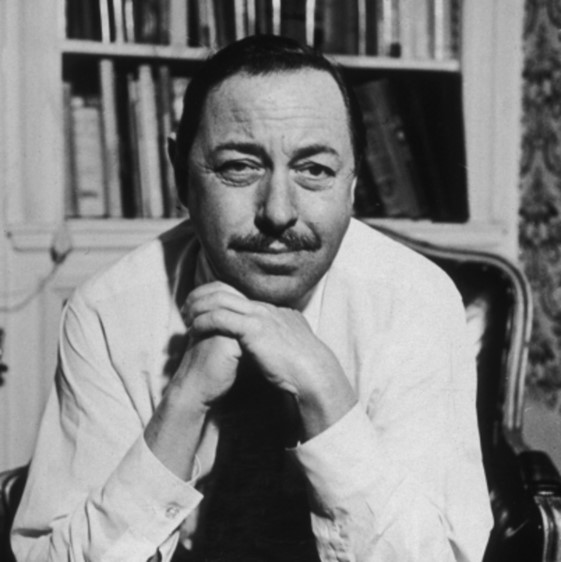
Tennessee Williams is an American playwright hailing from the southern state of Mississippi. For him, writing was an outlet through which he explored the mores of Southern life and the eccentricities and complexities of his own family. His most notable works include The Glass Menagerie (1944) which was considered to be a turning point in his career, A Streetcar Named Desire (1947) and Cat on a Hot Tin Roof (1955) both of which received Pulitzers, Summer and Smoke (1948), Orpheus Descending (1957) etc. Although he wrote throughout his life, his subsequent works never achieved the high acclaim of his earlier works.
Williams as a Southern writer shared a love-hate relationship with the south which provided for dramatic conflicts and excitements. Most of his work reflected traditional topics like agrarianism vs urbanism, New South vs antebellum South, chevalier vs the upstart and so on. For example, his play The Streetcar Named Desire represents the fallen aristocracy with the ethnic denizens a new industrial order, and his play Cat on a Hot Tin Roof represents the different family dynamics of the neo-rich. He drew upon the full resources of language to convey their pictures of culture based on moral absolutes. His characters are portrayed in a way in which they are unable to escape the burdens of their regional histories. Most often, the weight of the southern history the power of racial and social divisions, his rituals and taboos often make self-determination and moral choice unachievable for the characters. In his world, any defiance of this code results in personal destruction.
One of Williams’ most prominent southern trait is the very theatrical display of emotions, dysfunctional characters and unalterable sociological circumstances. He deconstructs the magical appeal of the southern culture and portrays the tension between their dream of an idyllic life and the reality of living it. He also provides constant allusions to plantations like Belle Reve in The Streetcar Named Desire. He also adheres to certain stereotypes of small-town life like gossipy neighbours, fear of scandal, aristocratic families who are deferentially treated by the rest of the community etc.
The usual southern hero is usually almost like an epic figure who embodies the ideals of the society and performs chivalric behaviour which is distinctly different from northern protagonists. A typical southern hero is the leader of men, honest, compassionate, a defender of the faith. They are usually heterosexual, while being protective of the women. But no such southern character exists in Williams’ work. But instead of abandoning the concept of a hero, he has adapted it to the world which has been hopelessly corrupted. He questions the paternalistic order of old South, the enslavement of the black men, the subjugation of the female, the corrupting power of wealth, and the obsession with keeping up appearances. He instead shows guilt caused by the acknowledgement of one sexuality, and the guilt of black subjugation in an antebellum society. Williams attributes perversion and distortions of human behavior to the rigid gender stereotypes that he uncovers in the southern landscape. Certain characters like Brick, who is Blanche’s husband, are unable to cope with the extreme need for masculinity in men. He also questions hypocrisy of a society that denies a woman’s sexuality. Although he does cling to prevailing and romantic point of view past offered luxury and that the present forces the individual to accept barest realities.
“Williams understands human needs and aspirations and is supremely aware of the artist’s role in illuminating urgent personal and social issues; yet his consistent exposure of hypocrisy and his off-beat is reverent sense of humor never hides his deep compassion for those who fear the truth.”
-Kimball King
On one hand, he appreciates the elegance of the past, while on the other, he considers its denial of plurality sufficient cause for its demise. This reflects the love-hate relation that he shares with the South. He does not set out to explain the South and its effects on his characters, but he understands the South and presents characters as real people. He’s a regional writer who does not exploit the peculiarities of his region, and his exploration of the southern value system and conflicts has influenced several later dramatists. To quote Kimball King, “Williams understands human needs and aspirations and is supremely aware of the artist’s role in illuminating urgent personal and social issues; yet his consistent exposure of hypocrisy and his off-beat is reverent sense of humor never hides his deep compassion for those who fear the truth.”
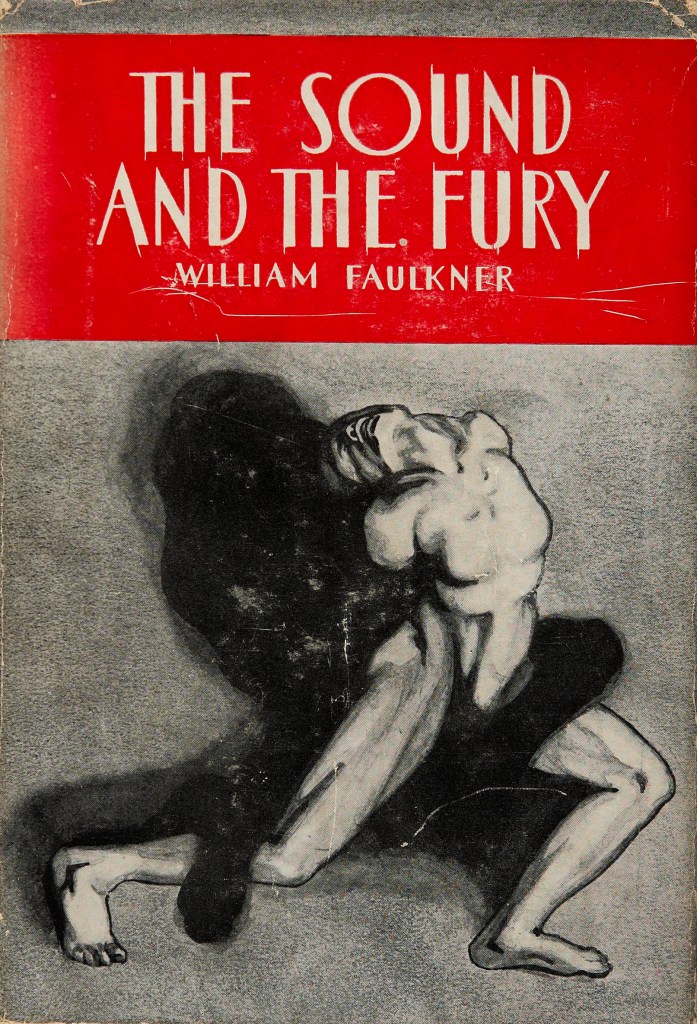
The Sound and the Fury is 1929 novel by the American author William Faulkner. Faulkner is widely renowned for his experimentation of the narrative technique called ‘stream of consciousness’. William James in his Principles of Psychology describes it as ‘the unbroken flow of perceptions, memories, thoughts and feelings in the waking mind’. In this narrative technique, the narrator seemingly rants about thoughts and introspections that flows through their mind. The novel is a true testament to this narrative.
The book follows the story of the Compson family who are slowly losing their way in the an postbellum (post-war) American South. The Composn family used to be wealthy and mighty in their olden days, but unlike their ancestors, the current members of the family cannot seem to command the power they once held. The story is divided into four parts. The first part takes place on April seventh 1928 and is narrated by Benjy Compson, the mentally challenged youngest son of the family. The second part takes place eighteen years prior on June second, 1910. It is narrated by the oldest son Quentin who is a student at Harvard. The third part takes place a day before the first part, on April sixth 1928. It is narrated by the headstrong third son Jason Compson. The final part takes place a day after the first part, on April eighth 1928. It is narrated by a seemingly omniscient narrator who records the observations of Dilsey, the family’s loyal black servant.
“Clocks slay time… time is dead as long as it is being clicked off by little wheels; only when the clock stops does time come to life.”
– William Faulkner
The story is fragmented and is narrated in a non-chronological manner. Most of the story has been uncovered based on audience’s interpretation to try and form a coherent narrative of the same. The story narrates the three Compson brothers’ seeming obsession over their sister Caddy, who surprisingly does not narrate any portion of the novel. Despite not having her own narrative, it is clear that Caddy has influenced her brothers and holds a strong presence throughout the novel. Growing up with an incompetent and absent-minded father, Caddy assumes charge of her brothers. This sense of control continues to grow and she proves that she is capable of making her own way in life. Her family disapproves of her promiscuity and banishes her after she gets pregnant out of wedlock.
The first part, narrated by Benjy is the most convoluted of all. It gives a glimpse of what his thoughts and records his accounts on how people around him treat him. His memories are interconnected and they create a domino effect as they are triggered by senses like smell or touch. For instance, a sensation that he experiences in the present triggers a memory of similar sensation in the past. Caddy is the only one who treated Benjy as a normal being and he misses her. They both share a strong emotional bond and lot of his memories are associated to her. The second narrator Quentin has a similar strong bond with Caddy. Being the older brother, he is overprotective of her and even hints of incestual jealousy over her. Quentin is also deeply disturbed by his sister’s promiscuity which is unlike the ‘Southern morals’. He is intelligent and his narration is crudely interspersed with philosophy and existential questioning. The narrator of the third part Jason is strongly against Caddy. He is petty and resentful and blames everyone else around him for his misfortunes. He blames Caddy for the loss of his job which was promised to him by her ex-husband. He is headstrong and clings desperately to the old power that the Compson family once held. He obtains this feeling by controlling his family including Caddy’s child. The narrator of the fourth part Dilsey is the only objective narrator in the family. Despite being a black woman in a post-slavery abolishment era, she serves the Compson family loyally and seems to be the only one holding the family together. Although the family bosses her around, she’s content and dedicated to the work she does and is the only ‘sane’ one among the rest.
The Sound and the Fury is definitely worth a read to understand the complexities of a non-chronological narrative. It is impossible to be explained through a conventional synopsis as it only scratches the surface of the true depth of the novel. It is riddled with symbolisms and open-ended plotlines that motivates the readers to think for themselves. The realistic aspect of the novel also makes the characters more endearing to the readers. It is easily one of Faulkner’s best.
The month of June is observed as the Pride Month to honor the Stonewall Uprising of 1969 in Manhattan which marked a monumental turning point in the LGBTQ history of America. But today, it has grown much more than that and celebrates the richness and diversity of the LGBTQ community with parades, festivals and several other events. The pride march is a call for unity and togetherness in the community. With the 2021 pride month coming to an end, let’s take a look at what each day of the month celebrates.
Credits: Google Images
1. Gay Pride
June 1st celebrates Gay pride. It refers to people who are emotionally and sexually attracted to others of their own gender. Also commonly used to denote men or man aligned person who are attracted to other man-aligned people.
2. Lesbian Pride
June 2nd celebrates Lesbian Pride. It refers to women or woman-aligned person who are emotionally and sexually attracted to other women or women-aligned people.
3. Bisexual Pride
June 3rd celebrates Bisexual Pride. It refers to people who are emotionally and sexually attracted to two or more genders.
4. Polysexual Pride
June 4th celebrates Polysexual Pride. It refers to someone who is attracted to many or multiple genders but not all.
5. Pansexual Pride
June 5th celebrates Pansexual Pride. It refers to someone who is attracted to different kinds of people regardless of their gender identity. They are attracted to all genders.
6. Omnisexual Pride
June 6th celebrates Omnisexual Pride. It refers to someone who is attracted to all genders. But unlike Pansexuality, they are not gender-blind and recognise the other’s gender. Gender plays a role in one’s attraction.
7. Queer Pride
June 7th celebrates Queer pride. It refers to an identity and is regarded as an umbrella term for sexual and gender minorities, and people who fall outside of the cultural norms around sexuality and gender identity.
8. Demisexual Pride
June 8th celebrates Demisexual Pride. It refers to a sexual orientation which falls under the asexual spectrum. It is defined as someone who does not feel sexual attraction until they form a deep emotional bond with someone.
9. Greysexual Pride
June 9th celebrates Greysexual pride. It refers to a sexual orientation that falls under the asexual spectrum. It refers those who relate to asexuality, yet feel that there are parts of their experience that aren’t fully described by the word asexual.
10. Asexual Pride
June 10th celebrates Asexual Pride. It refers to a sexual orientation which is defined by the lack of sexual attraction. Asexual experiences may also include: not wanting to have sex, not being interested in sex, not experiencing a sex drive/libido, or being repulsed by sex.
11. Polyamory Pride
June 11th celebrates Polyamorous pride. It is the capability or desire to be in a relationship with more than one person at once. Polyamorous can be used both as a description of a relationship with more than two people and as description of people who desire such relationships. Polyamorous relationships can be romantic, sexual, or both.
12. Intersex Pride
June 12th celebrates Intersex pride. Intersex is a term for those born with physical sex characteristics that cannot be traditionally classified as male or female. Variations may appear in a person’s chromosomes, natural hormones, genitalia, gonads, secondary sex characteristics, or some combination of these things.
13. Trans Women Pride
June 13th celebrates Trans Women pride. It refers to a woman who was assigned male at birth. Trans women may experience gender dysphoria and may transition. This process includes hormone replacement therapy and sometimes sex reassignment surgery.
14. Trans Men pride
June 14th celebrates Trans Men pride. It refers to a man who was assigned female at birth. Trans men may experience gender dysphoria and may transition. This process includes hormone replacement therapy and sometimes sex reassignment surgery.
15. Agender Pride
June 15th celebrates Agender pride. It is complete genderlessness, or the lack of gender. It is a non-binary identity in which one is not male, female, or any other gender. They may identify as most strongly as just a person, rather then as any given gender.
16. Genderfluid Pride
June 16th celebrates Genderfluid pride. Genderfluid refers to someone whose gender identity changes over time. A genderfluid person can identify as any gender, or combination of genders at any given time. Their gender can change at random or it may vary in response to different circumstances. One’s gender can change over the course of hours, days, weeks, months, or years.
17. Bigender Pride
June 17th celebrates Bigender pride. Bigender is a non-binary gender identity in which someone has two distinct gender identities. They could feel both genders at the same time or be fluid between them, in which case they may also identify as genderfluid. Bigender people can experience any two genders, including binary and non-binary genders.
18. Trigender Pride
June 18th celebrates Trigender Pride. Trigender is a form of multigender in which someone has three distinct gender identities. These three gender identities can be any genders, either binary or non-binary, so long as it is exactly three. Trigender people may experience these genders simultaneously or fluidly.
19. Pangender Pride
June 19th celebrates Pangender Pride. Pangender is a form of multigender in which someone experiences all genders. It is a non-binary gender which refers to a vast and diverse amount of genders in the same individual that can extend infinitely.
20. Genderqueer Pride
June 20th celebrates Genderqueer Pride. Genderqueer is a term for people who feel that they have a queer or non-normative experience with gender, either through their gender identity, their gender presentation, or other experiences of gender.
21. Demigirl Pride
June 21st celebrates Demigirl pride. It refers to a non-binary gender in which one is partially, but not fully, a girl or woman. They may or may not identify as another gender in addition to being partially a girl. The other part of one’s gender can be any gender or combination of genders, including a lack of gender.
22. Demiboy Pride
June 22nd celebrates Demiboy Pride. It refers to a non-binary gender in which one is partially, but not fully, a boy or man. They may or may not identify as another gender in addition to being partially a boy. The other part of one’s gender can be any gender or combination of genders, including a lack of gender.
23. Androgyne Pride
June 23rd celebrates Androgynous Pride. Androgyne is an identity under the non-binary umbrella. It is described as being simultaneously male and female or in between male and female, or as being simultaneously masculine and feminine or in between masculine and feminine.
24. Intergender Pride
June 24th celebrates Intergender pride. Intergender is a gender for intersex people only, referring to any gender identity that is fundamentally tied to one’s intersex identity. It denotes that being intersex has an important affect on one’s gender identity. It commonly involves a gender that is in between male and female or a gender that is partially male and/or female, but it does not necessarily have to.
25. Nonbinary Pride
June 25th celebrates Nonbinary Pride. It refers to someone whose gender does not fall strictly within the category of the binary genders. Non-binary can be a gender identity on its own, or it can be used as an umbrella term for anyone whose gender is something other than male or female.
26. Questioning Pride
June 26th celebrates Questioning pride. Questioning is the process of exploring, learning, or experimenting with what one’s gender, sexual orientation, romantic orientation, or another part of one’s identity is.
27. Homoromantic Pride
June 27th celebrates Homoromantic Pride. Homoromantic refers to the romantic attraction to the same gender or genders similar to one’s own. A homomantic person may or may not be sexually attracted to the same/similar gender(s).
28. Biromantic Pride
June 28th celebrates Biromantic Pride. It is a romantic orientation in which someone is romantically attracted to two or more genders.
29. Panromantic Pride
June 29th celebrates Panromantic Pride. Panromantic is the romantic attraction to people regardless of gender, and as a result, one is attracted to all genders.
30. Aromantic Pride
June 30th celebrates Aromantic Pride. It refers to a romantic orientation defined by a lack of romantic attraction.
The Famous Five is a children’s adventure series written by the British author Enid Blyton. The first book The Five on a Treasure Island was published in the year (1942) after which 20 more books followed. With the sales totaling over a 100 million, it is considered to be an all-time best-seller in children’s literature. The series revolves around the lives of four children: Julian, Dick, Anne, Georgina (George), and her dog Timothy. Blyton’s portrayal of their carefree summers and adventures have always gained popularity among children. More often, Enid Blyton books are usually responsible for getting children interested in literature. Her use of simple language helps children easily understand the story. Her vibrant descriptions appeal to the readers in such a way that we long for adventures, matching the enthusiasm of the characters portrayed in her stories. Her storylines are intriguing and her peculiar way of dropping hints throughout the book which finally connects up as a shocking climax is always interesting.
“Far from being a set of fixed and stable values and roles assigned/imposed by society, gender is a performance or a role enacted by the individuals. This performance of gender is, of course, social in the sense that it is enacted, validated and accepted by the society.”
-Judith Butler (Gender Trouble)
In most cases, Blyton adheres to the dominant gender norms of her times; which is the Middle-class heteronormative British views which regulated the behaviour of women with respect to their appropriate domestic roles and activities for women like raising children and managing the household instead of careers. Blyton presents rather contradictory representation of gender roles. Mostly, she follows the dominant submissive roles of females but on the other hand, she also shows that there are alternatives where women have agency and freedom of choice. Her writing of ‘sexist’ characters are probably a result of suiting the story to the audiences of her time.
“Anne had a very happy morning. She arranged everything beautifully on the shelf… IT really was a splendid larder and dresser!… Then the little girl set to work to make the beds. She decided to make two nice big ones, one on each side of the cave.”
– Five Run Away Together (1944)
Anne is described as someone who is shy and timid. She’s not as adventurous as her brothers Julian and Dick or like her cousin George. She does all the domestic chores and is often in charge their food and other domestic needs. She is referred to by her brothers as a “Very good little house keeper”. She likes playing ‘house’ and thus, voluntarily does all the chores during their quests and she likes doing it. And she is extremely happy when she’s praised for her work. She takes pride being referred to a good housekeeper. Despite being the youngest of the four, she is often portrayed as the nurturer and care-giver. She selflessly takes care of everyone’s needs and plays a mother-like figure to the rest of the group. George’s mother, Fanny is portrayed in a similar such way and serves as a role-model figure for Anne. It is a given that she’s the youngest and perhaps that’s one of the reasons why she is babied. But there’s a clear hint of patronisation when her brothers address her. Through Anne, Blyton firmly reinforces the typical female gender stereotype that women are supposed to be gentle, caring, nurturing and subservient housekeepers who are not fit for a career-based life.
“Don’t you simply hate being a girl?” asked George.
“No, of course not,” said Anne.“You see – I like pretty frocks – and I love my dolls – and you can’t do that if you’re a boy.”
“Pooh! Fancy bothering about pretty frocks,” said George, in a scornful voice. “And dolls! Well you are a baby, that’s all I can say.”
Anne felt offended.
-Five on a Treasure Island (1942)
Blyton was a career woman, so her portrayal of George can be seen as her personal resistance to the dominant gender stereotype of her time. Georgina prefers to be called George, and is good at everything that is traditionally masculine like climbing trees, swimming, rowing boat, drawing carriages etc. She tries very hard to not be ‘girly’ and dresses up like a ‘boy’. In anyway, she wishes to be a boy as she prefers being called ‘Master’ instead of miss, loves it when people mistake her for a boy etc. It is evident that boys were valued more in the society than girls. And her desperate need to imitate a man can be seen a cry for help in an overtly patriarchal society. She wants to be treated with the same respect and dignity that her male cousins enjoy and so, she feels that the only means to achieve that is by imitating a man. On a separate note, many readers have read into George’s tomboyishness as signs of gender dysphoria. (Gender dysphoria involves a conflict between a person’s physical gender and the gender with which he, she or they identify with.) So, the idea of a tomboy fails to take into account the more contemporary idea of gender as a spectrum rather than a rigid binary. Considering the time that this was written in, it is unlikely that this is what Blyton meant. But nevertheless, it is empowering to interpret that perhaps George is a transman; a boy trapped in a girl’s body.
George despises any characteristic of weakness that is usually associated with women. She seeks power and respect while Anne is contented with whatever the society is willing to give her. There is an instance where George gives into something and the boys praise her for giving in gracefully or decently like a boy. At this, George becomes extremely happy for being identified as a boy and she feels that “She didn’t want to be petty and catty and bear malice as so many girls did.” This can be seen as a perfect example of gender hierarchy where having a “decent” behaviour is normal only for boys and that it’s an exception for girls. George is admired by the rest for being good at physical activities. She excels to the point that she even threatens the authority of the dominant male leader by being better. There are several instances where she’s better at swimming or rowing than the boys. This skilled behaviour empowers Anne and in those instances; she longs and hopes to be as skilled as George. George is a successful, independent girl who can do anything that a boy can do, and do it better. This can be seen as Blyton’s attempt at empowering little girls.
While Anne takes pride in fulfilling her duties as the default nurturing housekeeper, George is expected to help her out and engage in these domestic chores as well. And this internalised social norm creates a feeling of guilt within George while no such guilt exists in the minds of the boys. Now even if the boys do offer help, Anne dismisses it off as “No. That’s my job and George’s.” Anne is easily scared and is seen as a cry-baby. The group takes it for granted that she’s emotional and weak and is in need of protection. George on the other hand, suppresses all of her emotions in fear that it’d show her as a ‘girl’ which was considered inferior. She hates crying as crying is seen as something that only girls do – a sign of weakness if expressed by a boy. Aside from effecting George, this also imposes an unrealistic and unhealthy emotional and mental standard on the boys. For instance, Dick is shamed for crying or expressing any emotions that are not ‘manly’. This also reinforces toxic masculine traits on young boys.
George thus imitates traditional masculinity as an attempt to receive equal treatments. She over-compensates in this aspect to desperately hide any traces of being a girl. To an extent, it does grant her more privileges than the feminine Anne but this comes out as a positive reinforcement on her, and it proves the masculine authority over women of the time. Despite all her attempts, the fact remains that she is still ‘just a girl’ and that she only receives the freedom that her male peers allow her to enjoy. No matter how much she tries to imitate men, she’s still othered by them.
We see a contradictory portrayal of gender roles by Blyton. All the criticisms aside, we can also interpret this as her way of showing that girls can choose to be either Anne or George or a mix of both. Anne might have been typecast as the stereotypical girly girl, but even if it’s because of the inherent social norms, she loves it. She unapologetically takes pride in being herself and doing things that she enjoys, even if the others ridicule her and tease her for being ‘too weak’. On the other hand, even though it reinforces male superiority, George’s unique character proves that girls can do anything that boys can and actually be better at it. For the time that it was written in, it is clear that Blyton intended George’s character as someone who breaks away from tradition. Thus, we see that Blyton offers different perspectives on how girls can choose to be.
Social Class refers to a hierarchy in a society wherein people are grouped on the basis of their wealth status. Jane Austen’s Pride and Prejudice (1813) is acknowledged for its keen commentary on these aspects of the society. The influence of social class and the greed to climb up this social hierarchy is much of novel’s criticism.
Austen’s works usually focus on the preoccupations of the middle class and the upper class, and are rarely focused on the Aristocrats (people with title) or the working class. But even within that, there are several other differentiations as Regency England so working for money something of low standards. They acquired wealth through property, marriage, and inheritance. For instance, although the Bingley family are economically farer than most, on the basis of class, they are considered equal or maybe even lower than that of the Bennets as they are said to have made their money through trade or business.
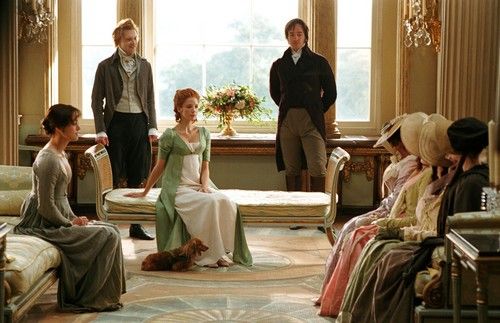
A still from Pride and Prejudice (2005)
The novel also portrays characters who react differently to class. Characters like Bingley sisters and Mr. Collins fawn over the rich and try to please them. Especially Mr. Collins who depends on largely on Lady Catherine De Borough to gain social acceptance. He does all their biddings and constantly attempts to flatter them in order to ensure his good associations with them. Lady Catherine on the other hand, is very proud of her richness and sees everyone as beneath her. The novel satirises these characters who move only in relation to class, and are portrays the conceited idea that social distinction is an important factor in judging someone’s character. Lady Catherine is so used to people doing her biddings and obeying her orders that she is taken off-guard when Elizabeth stands up for herself. She objects to Lizzy marrying Darcy due to her fear that it would indirectly affect her own social class through association. Elizabeth in return, replies that she’d marry whomever she wishes to for her own happiness.
“In marrying your nephew, I should not consider myself as quitting that sphere. He is a gentleman; I am a gentleman’s daughter; so far we are equal.”
Jane Austen (Chapter 56)
Characters such as Mr. Bingley and the Gardeners seem much more as they do not discriminate on the basis of class even if they are financially well-to-do. Darcy can be seen as an example of Austen’s ideal high-class gentleman. Despite seeming selfish and arrogant initially, he later proves that he is capable of change. His innocence also becomes evident when Lizzy talks to the residents of Pemberly. The social status of the Bennet family is threatened to a large extant when Lydia runs away with Mr. Wickham. They are saved from ‘social degradation’ only when Darcy covers up the issue with money.
Pride and Prejudice shows that class might determine a character’s social situation, but it doesn’t signify anything about their behavior. The marriage between Elizabeth and Darcy shows that even though class restrictions are rigid, it does not determine one’s character and that love can overcome all material obstacles like class. It proves that class is ultimately an arbitrary and meaningless distinction between people.
Jane Austen’s Pride and Prejudice (Published in 1813) is considered to be a classic in literature. It has often been glossed over as a romantic novel and though it is concerned with human relationships, especially of romantic ones, Austen focuses a great deal on wealth and class. Her infamous opening quote in itself is a testament to the fact that she consciously criticized the influence of money in a society.
“It is a truth universally acknowledged, that a single man in possession of a good fortune, must be in want of a wife.”
Jane Austen (Chapter 1)
Pride and Prejudice is set in Regency England, which was a time of great political unrest and economy volatility. This was mainly due to the shift of the economy from an agrarian one to that of an industrial one. Until then, people were only mainly concerned about food and other primary needs. But the industrialization paved for more materials in the market like clothes, utensils, etc. So more the commodities, the more people wanted money to spend on such items. Thus, the need for money increased, and in the Regency England, being a gentleman was considered more important than merely being rich. And the concept of a gentleman relied highly on inheritance and people wanted to be rich without working for it.
Austen has taken care to include details of each character’s money and their economy backgrounds. The richer characters include people like Bingley who receives €500 per annum and is clearly rich enough to host balls take care of his sisters’ needs. Georgiana Darcy is said to inherit €30,000 pounds and will remain well-to-do even if she is denied legal inheritance of property. Mr. Darcy on the other hand, is a modern equivalent of a multi-millionaire who gets up to €10,000 per year and would get more from his investments. The middle-class characters include Mr. Bennet who receives approx. €2000 per year and would even be considered an upper-middle class. Mr. Wickham inherits €1000 from Darcy’s father and even more from Darcy for leaving the clergy. Although he spends it all and goes into debt, Darcy pays him again to marry Lydia. The Bennet girls on the other hand, would receive only a maximum of €40 per year until the death of their father, after which, their land would legally go to their cousin. Thus, the Bennet sisters had to marry for survival and not just to uphold class. When Elizabeth rejects both Darcy and Mr. Collins, she’s taking a huge risk by choosing happiness over financial security.
Fitzwilliam Darcy
€10,000 per year + more
Georgiana Darcy
€30,000 inheritance
Charles Bingley
€5000 per year
Rich Characters
Mr. Bennet
€2000 per year
George Wickham
€1000 inheritance
The Bennet Girls
€40 per year
Middle Class Characters
Austen also criticises material obsessions through characters like Mr. Wickham and Mrs. Bennet who obsesses despite not being rich, through Caroline Bingley who is pretentious and through characters like Catherine de Borough who exploit their wealth for status.
One of the criticisms against the novel is also that it unconsciously puts out the idea that you need to be rich and have money to be happy. Elizabeth who marries Darcy is happy, Jane who marries Bingley is happy, Charlotte who marries Mr. Collins is not too happy and Lydia is unhappy as she is doomed to pay off Wickham’s debts for the rest of her life. Nevertheless, the Pride and Prejudice’s detailed treatment of money adds to the novel’s realism.
Personal Boundaries are important because they set the basic guidelines on how you want to be treated. It is essential to have personal boundaries in order to have healthy relationships. A healthy personal boundary is when you’re confident enough to say no to others when it is necessary, but it also means that you’re comfortable enough to open up to someone you’re close with.
Listed below are a few types of important personal boundaries:
1. Material Boundaries
Material boundaries refer to setting limits on lending or borrowing material possessions like money, clothes and other personal belongings. Healthy Material Boundaries involves setting limits to what you will share and with whom.
Material boundaries look like:
Being careful of whom you lend money to
Limiting sharing personal hygiene items like lip balm, clothes, etc.
Not spending time with people who do not respect your time
Material boundaries are violatedwhen:
your things are destroyed or stolen or when they are “borrowed” too frequently.
Another material violation is the use of materials to manipulate and control relationships.
2. Emotional Boundaries
Emotional boundaries deals with people’s feelings and energy. It refers to how much emotional energy you can take in at a moment. A healthy emotional boundary involves knowing when to share and not share personal information and feelings and limiting sharing it with people who respond poorly.
Emotional boundaries look like:
Needing time to cool off after an argument
Not allowing people to shame or belittle you
Being honest to others about your emotional state
Emotional boundaries are violated when:
Your feelings are dismissed and criticized
Not respecting your personal space
asking people to justify their feelings
emotionally dumping on people without their permission
Telling other people how they feel
3. Physical Boundaries
Personal physical boundaries refers to the area immediately surrounding the body. A healthy physical boundaries refers to an understanding of who is allowed to come near our personal space. Physical boundary ranges from public space, social space, personal space to intimate space where nobody should be allowed without your consent.
Physical boundaries look like:
Choosing your comfortable level of physical intimacy (hugging, shaking hands
Setting a boundary of space with the people you live with
Asking people to respect your privacy
Physical boundaries are violated when:
Strangers initiate physical contact
Not knocking your room before they enter
Ridicule you for setting your boundaries
4. Sexual Boundaries
Sexual boundaries are very important in one’s life and are constantly under the threat of being violated. A healthy sexual boundary can be set by understanding the difference between ‘good touch’ and ‘bad touch’. Violation of this boundary can gravely affect someone’s life.
Sexual boundaries look like:
Always ensuring that both parties consent to the act
understanding that it is okay to say ‘no’ at any given time
Knowing whom to share intimate personal information with
Sexual boundaries are violated when:
Someone forces themselves onto you without consent
asking intrusive questions about your sexuality
sharing your intimate information about you without your consent
5. Spiritual Boundaries
We live in a society where many different religions are beliefs are followed. Spiritual boundaries refer to understanding that everyone has right to choose and believe in a religion. A healthy spiritual boundary involves respecting each other’s beliefs and their methods of portraying it.
Spiritual Boundaries look like:
Choosing whom to share your beliefs with
Following your own teachings and traditions
Not allowing people to abuse you for your beliefs
Spiritual Boundaries are violated when:
Going to a place of worship against your consent
Being forced into someone else’s beliefs
Being ridiculed for your beliefs
Setting up personal boundaries should be a priority in our lives as it plays an important role in coexisting harmoniously within the society.
Mansplaining is a portmanteau of the word ‘Man + Explain’. Mansplaining refers to the explanation of something by a man, typically to a woman, in a manner regarded as condescending or patronizing. It stems from an authoritative and privileged belief that men know better, and that women are always ready to be helped and taught. The phenomenon has happened since long but the origin of the word was inspired from an essay by Rebecca Solnit titled MenExplain Thingsto Me. (Published in 2008)
In her essay, Solnit describes an incident which took place while at a party. During a conversation, an older gentleman cuts her off in between and starts explaining on a topic, claiming to know more about it than her. He insists that she read a particular book which supports his evidence. What he did not know was that she was in fact the author of the very book that he was talking about. Ironically, he hadn’t even read the book and had simply read an excerpt from it.
“He was already telling me about the very important book — with that smug look I know so well in a man holding forth, eyes fixed on the fuzzy far horizon of his own authority”
Rebecca Solnit
Although it might seem trivial from the surface, on a deeper level, mansplaining is linked to a larger abuse of patriarchal power. Since knowledge is power, men having held that powerful position for so long assume that they know better and that women are incapable of handling that knowledge of power. It is an offshoot of the societal idea of gender hierarchy where women are expected to be the pleasant audience. Having an opinion for themselves is considered to be an act of ‘questioning the authority’.
A Harvard study conducted in 2004 shows that men are 50% more likely to offer an answer in class and nearly 150% more likely to speak three times or more. This gets carried on and continues from schools to colleges, to workplaces, to politics and basically to any place where expression of ideas is concerned. “….it crushes young women into silence by indicating…that this is not their world. It trains us in self-doubt and self-limitation just as it exercises men’s unsupported overconfidence.”
“Most women fight wars on two fronts, one for whatever the putative topic is and one simply for the right to speak, to have ideas, to be acknowledged to be in possession of facts and truths, to have value, to be a human being.”
Rebecca Solnit
This happens so much so that women are denied of expressing their own lived experiences. More extreme versions of mansplaining can be found in the Middle Eastern countries where women’s testimony has no legal validity. So, if a woman is raped, she cannot testify in court unless there is a male witness to testify for her. As Solnit says, “Credibility is a basic survival tool…Violence is one way to silence people, to deny their voice and their credibility, to assert your right to control over their right to exist.” Thus, on a larger context, it becomes a crime as grave as harassment or an assault.
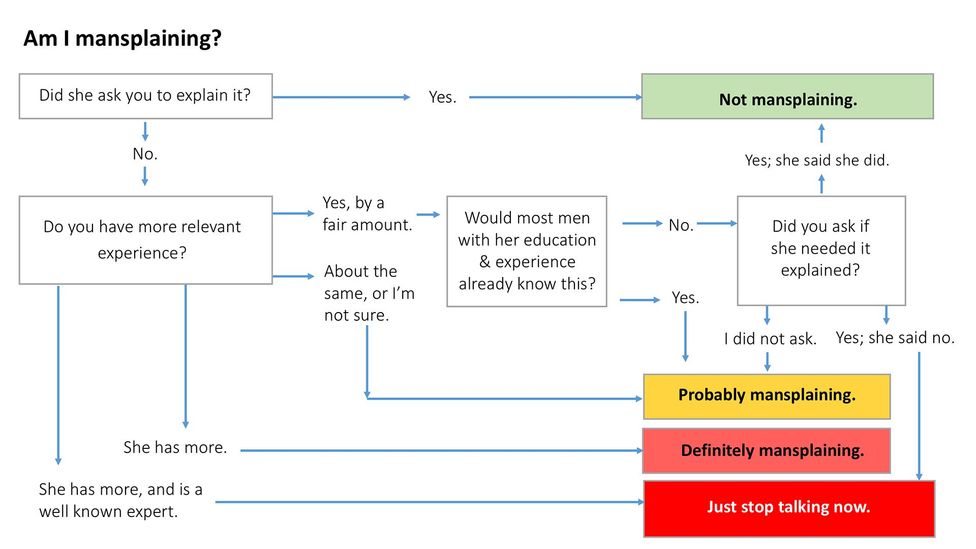
Image Credit: Kim Goodwin
As with every point raised, some would oppose this by pointing out things like “not all men do it” or “Women do this too”, and it’s true. Anyone, regardless of their gender, talking in a patronizing or condescending manner to someone else is wrong. “… a certain amount of self-doubt is a good tool for correcting, understanding, listening, and progressing — though too much is paralyzing and total self-confidence produces arrogant idiots… There’s a happy medium between these poles to which the genders have been pushed, a warm equatorial belt of give and take where we should all meet.”
This need not even be restricted to Gender. It ties into other identities like race, sexuality, class, disability and age; as terms like whitesplaining also exist. Any enlightening discussion involving mutual participation and exchange of information is good as long as it is done with respect for each other in a non-condescending and non-patronizing manner.
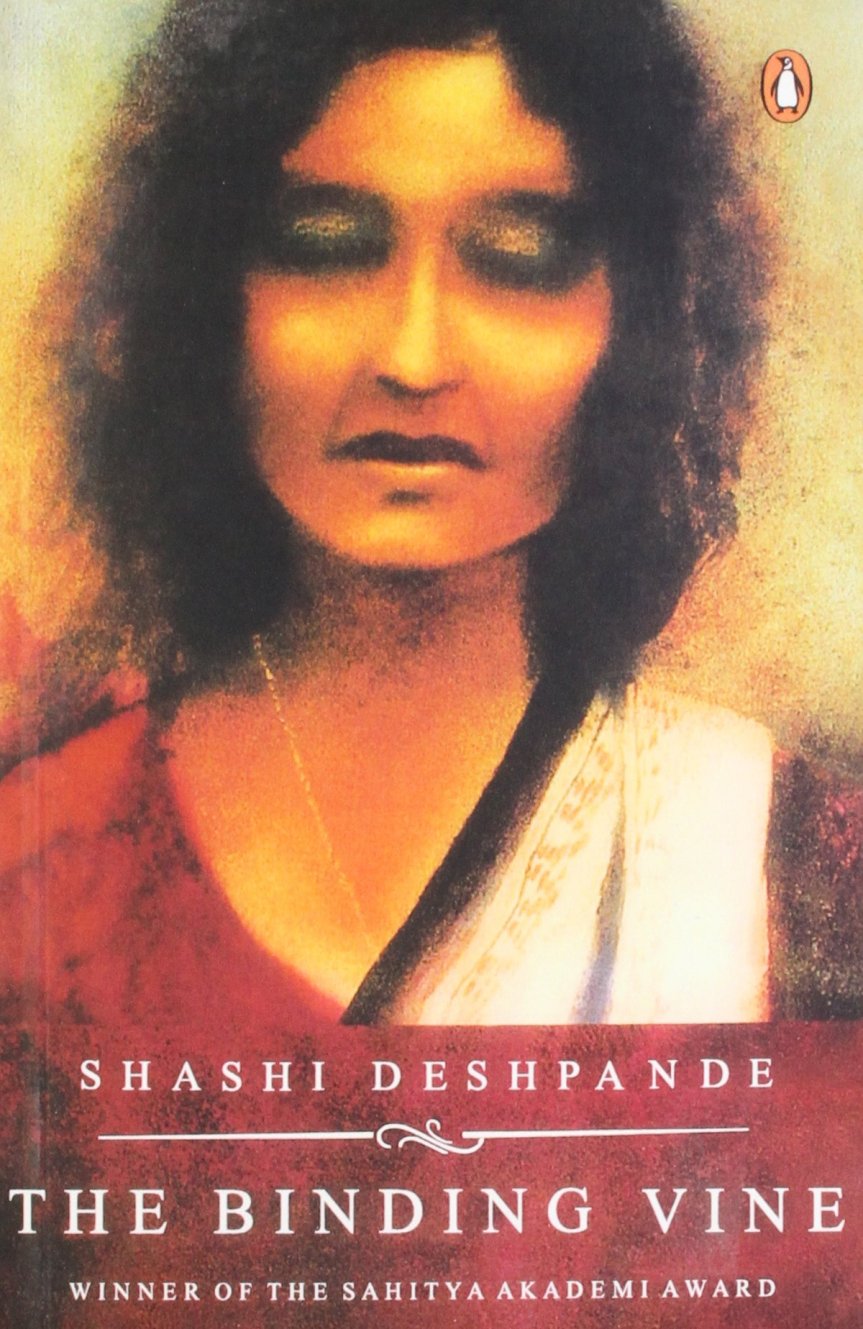
Sashi Deshpande is a Sahitya Academy winning Indian novelist best known for her works The Dark Hold No Terrors and That Long Silence. Her novels generally centre around educated middle-class urban Indian female protagonists who struggle against the oppression of an overtly patriarchal society. She is critically acclaimed for her sensitive and realistic portrayal of women who are fettered to their roles as daughters, wives and mothers. They are conscious of the social inequality and question the deliberate efforts made by men to maintain this. In The Binding Vine, Deshpande introduces women from various backgrounds who collectively question the subordinate status ordained to them by society. This essay seeks to analyse the lead female characters from the novel with reference to feminist theories by Simone De Beauvoir and Virginia Woolf.
“…thus she is called ‘the sex’, by which is meant that she appears essentially to the male as a sexual being.”
Simone De Beauvoir
“What were the use of my creation, if I were entirely contained here?” This quote from Wuthering heights by Emily Bronte in the beginning of the novel runs as a common theme throughout The Binding Vine. The novel uses stream of consciousness method as it follows the life of Urmi, a middle-class college lecturer who encounters several women in her life. With her as the anchor, Deshpande reveals the sufferings of women from different sections of the society. The novel begins by describing Urmi’s personal grief upon losing her infant child. She becomes detached from the world and struggles to get back to her normal life. She is financially independent and is confident in asserting her freedom and agency. She chooses her own husband by marrying Kishore who works in Merchant Navy and is barely ever home. He asserts himself sexually and does not provide the emotional support that she desperately craves. Urmi’s character reinforces Beauvoir’s point that “…thus she is called ‘the sex’, by which is meant that she appears essentially to the male as a sexual being.” Despite being socially and financially independent, Urmi is still scene as a sexual object by her husband.
Urmi later gets acquainted with Shakuntai and her daughter Kalpana. Shakuntai had moved to Bombay in search of her husband who has deserted her for another woman. Coming from the lower strata of the society, she is uneducated, financially unstable and struggles by toiling hard to look after her three children. Her daughter Kalpana is a strong woman who is forced to marry her uncle Prabhakar. Having been molested by Prabhakar since a young age, Kalpana turns down the offer. This enrages him and he brutally rapes her. Though Kalpana is critically injured, Shakuntai hesitates to file a case against Prabhakar and even goes as far to blame her daughter for her current condition. This is due to the internalised patriarchal ideology that the assaulter is entitled to do so as a man while the victim is responsible for ‘encouraging’ the crime. Furthermore, she herself is under constant threat of being held responsible for the downfall of her family as the society always blames women for disrupting its ‘honour’. Just like Beauvoir, Deshpande focuses on the unrealistic standards set by the society on women that expects them to be the perfect loyal caretaker who submissively accepts the will imposed on them by men. Women are always considered as the inessential and the other while the men are the subject and the absolute. Beauvoir further explains this internalisation by saying that “Thus, woman may fail to lay claim to the status of subject because she lacks definite resources, because she feels the necessary bond that ties her to man regardless of reciprocity, and because she is often very well pleased with her role as the Other.” Shakuntai blaming her own daughter for being a rape victim simply emphasises the fact that women themselves unconsciously perpetuate their role as the inessential subordinate.
Another significant character explored in the book is that of Mira, Urmi’s late mother-in-law. Kishore’s step-mother Akka hands Urmi a trunk consisting of Mira’s diaries and poems. Urmi learns how Kishore’s father saw Mira at a wedding and fell in love. “Since then he had “single-minded pursuit of an object; marrying Mira””. She is married off to him against her wishes and falls victim to a life of marital rape. Mira is forced to suppress her aspirations to be a writer, her only channel of outlet being the scribbles of words on her diary. Her writings clearly describe her revulsion and fear for the sexual acts with her husband and it is evident that she’s slowly spiralling into depression. Writing serves as her sole tether to her life on earth. After marriage, she is renamed ‘Nirmala’ by her in-laws which stands testimony to the society’s attempt to estrange women from her individuality after marriage.
"Niramala, they call, I stand statue-still.

Do you build the new without razing the old?

A tablet of rice, a pencil of gold

Can they make me a Nirmla? I am Mira."
Mira’s mental health improves as she joyously awaits the birth of her child, but she dies soon after childbirth. Kishore’s father marries Akka solely for the purpose of looking after the baby. This further reinforces the male perspective pointed out by Beauvoir that “woman has not been socially emancipated through man’s need – sexual desire and the desire for offspring – which makes the male dependent for satisfaction upon the female.”
In spite of being a skilled writer, Mira is shunned away from the literary world. Her husband and her family never encouraged her passion and she was forced to lead a domestic life. Her frustration on being stifled of her skills are evident in her works. This is further reinforced when she narrates her encounter with Venu, a renowned poet. Upon reading a few of her poems, he says “Why do you need to write poetry? It is enough for a young woman like you to give birth to children. That is your poetry; leave the other poetry to us men” . Where Venu is celebrated as a great poet of Indian literature, Mira’s voice is silenced and confined to four walls. She never had the luxury of having a room of her own that Woolf confirms is a necessity for a writer. She was forced to write late at night in secret while the men were asleep. Mira represents the generation of women writers who, despite being talented, were blatantly excluded from the literary world by men. Through Mira, Deshpande resonates the concerns raised by both Virginia Woolf and Adrienne Rich on the struggles of being a female writer in a patriarchal society.
The Binding Vine also features characters such as Urmi’s friend Vanna and Shakuntai’s sister Sulu, who perform their role as the archetypal role of ‘women as angels’. They try hard to maintain the societal pressure of being what Beauvoir explains as “‘truly feminine’ – that is, frivolous, infantile, irresponsible, the submissive woman.”
Despite the numerous struggles of women portrayed in the novel, Sashi Deshpande hints at positivity towards the end of the novel. Urmi convinces Shakuntai to disclose the identity of Kalpana’s assaulter resulting in a gathering of a mass of protestors who fight hard for her Justice. Urmi resolves to translate Mira’s poems to English and to publish them. She also encourages Vanna to stand up for herself and moves on from her personal grief to fight alongside women for a collective cause. Like Beauvoir and Woolf, Deshpande urges women to stand together like ‘binding vines’ against the oppression of patriarchy. The novel celebrates women’s solidarity as friends, companions and sharers of life.
Menakapriya, P. “Portrayal of Women in Shashi Deshpande’s the Binding Vine and Manju Kapur’s Difficult Daughter.” IOSR Journal of Humanities and Social Science (IOSR-JHSS), http://www.iosrjournals.org
‘To Kill a Mockingbird’ is a Southern gothic bestseller written by Harper Lee. The novel is narrated by Scout Finch, a six-year-old white girl who learns about life, people and the injustices prevalent in her society. Through her, Lee cleverly portrays issues such as gender, race and class discrimination in the fictional setting of Maycomb county, Alabama. Readers have speculated that the character of Scout was based on Lee’s own childhood experiences, wherein she combines the nostalgic elements with the political situation that she witnessed around her in America. Scout’s innocence and her defiance against the social hierarchies in Maycomb cuts a deeper meaning into the futility of these societal constructs.
Race is one of the issues that is evidently portrayed in the novel. Scout’s father Atticus Finch is a lawyer who defends the less privileged. He strives hard to stand by his moral compass and wishes to set an example for his children through his actions. One of the major events in the novel takes place when Atticus chooses to defend Tom Robinson, a black man accused of raping a white woman. The racist residents of Maycomb, as well as his family members are horrified and attempt hard to dissuade him. So much so, that even Scout and her brother Jem are subjected to verbal abuse by other children for his actions. During the trial, Atticus provides clear evidence to prove Tom’s innocence. Despite the impressive evidences, the extremely racist jury sentences him to jail where he later attempts to escape, but is shot and killed. We see that even the law is corrupted when it comes to rendering justice to innocent African Americans. Tom Robinson’s trial scene is monumental in proving the racial discrimination in America.
Calpurnia, the Finch family’s black maid plays a significant role in Scout’s life. Unlike most southern black characters, she is well- educated and is highly respected within the Finch family. Having lost her mother at a young age, Scout regards Calpurnia as a mother-like figure. One of the important moments in the novel is when Calpurnia takes Jem and Scout to the Black Church. Here, the children witness a different side of characteristics in Calpurnia as she interacts with the rest of her community. W. E. B. Du Bois refers to this as “double consciousness”; a phenomenon wherein a person exhibits two different personalities with the blacks and the whites. This can be seen as a defence mechanism to gain acceptance in a white supremist society due to their own internalised racism. Furthermore, despite being a novel that is concerned with issues like racism, it only portrays a subjective version of it. The black community are not given a voice of their own against this prejudice, which marginalises them within the text. If they are given a voice, it is usually to show gratitude to the good white people instead of raising their anger and frustration against the racial injustices in Maycomb.
Social class prejudice is an important element highlighted in ‘To Kill a Mockingbird’. This can be understood clearly when Jem imagines ‘folks’ as being divided into four different kinds. “Our kind of folks don’t like the Cunninghams, the Cunninghams don’t like the Ewells, and the Ewells hate and despise the coloured folks.” (Lee, 249) Through Jem, Lee clearly explains the class hierarchical structure of Maycomb. It is a prejudice engrained in Maycomb which even dictates the relationship between children at school. But the novel also explains that the class system can eventually be dismantled. Initially, when Scout treats Walter Cunningham Jr differently, Calpurnia teaches her otherwise and makes her realise that a person’s financial background has nothing to do with their personality. When Cunningham Sr. arrives with a mob to lynch Tom Robinson, Scout’s innocence humbles him, saving Tom’s life briefly. Scout thus is able to achieve a small proportion of justice by disregarding the class system. Her reply “I think there’s just one kind of folks. Folks.” (Lee, 250) is an innocent yet powerful statement against the prevailing class structure in the society.
“You never really understand a person until you consider things from their point of view…”
Harper Lee
Aside from race and class, the novel also deals with other important issues like gender, disability, and sexuality. As Scout belongs to a middle-class white family, the primary concern that she personally deals with is sexism. She is portrayed as a tomboy, who is forced to confirm to the conventional idea of a girl. Over the years, readers have come up with multiple theories from the book pertaining to current social issues which proves that even after sixty years, it is still contemporary. Atticus’s advice that “You never really understand a person until you consider things from his point of view . . .” is a principle that could serve as a solution for all types of prejudices. And as mentioned by John Green, the “combination of nostalgia and criticism makes Mockingbird both endearing and enduring.” To Kill a Mockingbird is revolutionary in the fact that it brilliantly portrays multiple serious themes through the eyes of an innocent child.


















 Eduindex
You must be logged in to post a comment.