

Author: Track2Training
Get training, visit us at https://track2training.com

Can Money Buy Happiness?
Benefits of Cleanliness

LIFE OF AN ENTREPRENEUR
New ‘Drone strategy’ reported; no exceptional status needed before enlistment.

The Center on Thursday declared another robot strategy. Under the Drone Rules 2021, the inclusion of robots expanded from 300 kg to 500 kg, and will incorporate weighty payload-conveying robots and robot taxis.
Furthermore, the new robot rules eliminate trusted status before any enlistment or permit issuance.
In view of the input, the Ministry of Civil Aviation (MoCA) said it chose to annul the UAS Rules, 2021 and supplant something similar with the changed Drone Rules, 2021.
The Aviation service had distributed UAS Rules, 2021 in March.
Here are 30 vital elements of Drone Rules 2021:
1.According to the Civil Aviation Ministry, a few endorsements annulled: remarkable authorisation number, one of a kind model recognizable proof number, declaration of assembling and airworthiness, testament of conformance, authentication of support, import leeway, acknowledgment of existing robots, administrator grant, authorisation of R&D association, understudy distant pilot permit, far off pilot teacher authorisation, drone…
View original post 586 more words
why english is important now days in india ?

English is not an obsession; it is a door to better opportunities”.One cannot overstate the importance of English language in India. As a student, you might have faced embarrassment due to poor English skills at least once in your lifetime. Hence, you understand how important it is today to have knowledge of English.
However, you’re not the only one here to suffer the consequences of poor English skills! A 2016 survey by a Delhi-based employment solutions company found that barely 7% of engineering graduates were fit for core engineering jobs. Poor English skills were one of the prime reasons. Surprising, yet true! (source)
English in India is taught as the second language at every level of education. We have also accepted it as the main medium of learning and instruction in higher education. But why, despite Hindi being the mother tongue, it is so important for Indians to learn…
View original post 1,345 more words
Educational Inequality

“The Rise of India in Olympics” : Tokyo Olympics 2021
Reading Books- A Lost Art

The Power of Advertisements

What is that thin line between ‘feminism’ and ‘Pseudo-feminism’ according to you?
Mughal ruler Shah Jahan’s favorite hunting Lodge is used for storing cow dung
DOCTRINE OF RESTITUION UNDER CPC
RESTITUTION
Section 144 makes provisions for the purpose of the doctrine of Restitution.
Restitution means restoring of anything unjustly taken from another.
It means restoring to a party the benefit which the other party has received under a decree subsequently held to be wrong.
The doctrine of restitution is that, on the reversal of a decree, the law imposes an obligation on the party to the suit who received an unjust benefit of the erroneous decree to make restitution to the other party for what he has lost.
OBJECT
The doctrine of restitution is based upon the well known maxim that the act of the court shall harm no one.
CONDITIONS
Before restitution can be ordered under this section, the following three conditions must be satisfied :
The restitution sought must be in respect of the decree or order which had been reversed or varied;
The party applying for restitution must be entitled to benefit under the reversing decree or order; and
The relief claimed must be properly consequential on the reversal or variation of the decree or order.
WHO MAY APPLY ?
In order to entitle a person to apply under section 144, two conditions must be satisfied :
He must be a party to the decree or order varied or reversed.
He must have become entitled to any benefit by way of restitution or otherwise under the reversing decree or order.
AGAINST WHOM RESTITUTION MAY BE GRANTED ?
Section 144 applies to the parties or their representatives and does not apply to sureties.
WHO MAY GRANT RESTITUTION ?
An application for restitution lies to the court which has passed the decree or made the order.
WANT TO FILE CAVEAT?

CAVEAT
Section 148-A of the Civil Procedure Code,1908 provides for lodging of a Caveat.
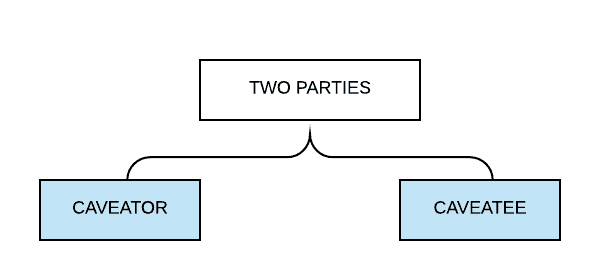
A caveat is a caution or warning given by a party to the court not to take any action or grant any relief to the applicant without notice or intimation being given to the party lodging the caveat and interested in appearing and objecting to such relief.
The person filing the caveat is known as “CAVEATOR“.
OBJECT OF CAVEAT
To safeguard the interest of a person against an order that may be passed on an application filed by a party in a suit or proceeding instituted or about to be instituted.
It seeks to avoid multiplicity of proceedings.
WHO MAY LODGE CAVEAT ?
A Caveat may be filed by any person who is going to be affected by an interim order likely to be passed on an application which is expected to be made in a suit or proceeding instituted or about to be instituted in a court.
A person who is stranger to the proceeding cannot lodge a caveat.
FORM
No form of caveat has been prescribed under the Code. A caveat may, therefore, be filed in the form of a petition.
TIME-LIMIT
A Caveat lodged will remain in force for ninety days from the date of its filing.
After the prescribed period of ninety days is over, caveat may be renewed.

RIGHTS OF THE ARRESTED PERSON

RIGHTS OF THE ARRESTED PERSONS
- Section- 41D of the Criminal Procedure Code:- Allows prisoners to be able to consult with their lawyers even during their interrogation.
- Section 50 (1) of the Criminal Procedure Code:- Right to know the grounds of arrest.
- Section 50 (2) of the Criminal Procedure Code:- Information regarding the right to be released on bail.
- Section 50 A of the Criminal Procedure Code:- makes it compulsory for the person/ police official arresting a person to inform of the arrest to any of his relatives or even friends who may have interest in the same
- Section 56 of the Criminal Procedure Code:- Person arrested to be taken before a Magistrate or officer in charge of the police station
- Section 54 of the Criminal Procedure Code:- Right to be examined by a medical practitioner.
Sheela Barse vs. State of Maharashtra,1983(SC)
The arrested accused person must be informed by the Magistrate about his right to be medically examined.
- Section 75 of the Criminal Procedure Code:- States that the police official executing the warrant must notify the substance of the arrested person and furnish the warrant of the arrest when required
- Section 76 of the Criminal Procedure Code:- Person arrested to be brought before the court without delay.
- Section 303 of the Criminal Procedure Code:- Right of the person against whom proceedings are instituted to be defended.
- Article 22(1) of the Constitution of India:- Provides that every arrested person has the right to choose and elect his lawyer.
- Article- 22(2) of the Indian Constitution:- Stipulates that the police officer making an arrest must produce the arrested person before the Magistrate within 24 hours of the arrest failing to do so would make him liable for wrongful detention.
- Article 57 of the Constitution Of India:- Right of not being detained for more than 24 hours without judicial scrutiny.
- Article 39 A of the Indian Constitution:- Right of an arrested person to free legal aid and to be informed about it
Khatri vs. State of Bihar
It was held in this case, where the Supreme Court has therefore cast a duty on all Magistrates and Courts to inform the indigent accused about his right to get free legal aid.
 Eduindex
You must be logged in to post a comment.