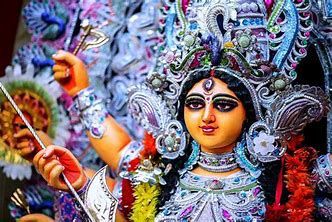
Durga Puja: A Vibrant Celebration of Goddess Durga
Durga Puja, also known as Durgotsav, is a significant Hindu festival celebrated across India, particularly in West Bengal, Assam, and other eastern states. It honors Goddess Durga, the embodiment of feminine power and strength, and her triumph over evil.
Mythological Significance
The festival is rooted in Hindu mythology, specifically the legend of Goddess Durga’s battle against the buffalo-demon Mahishasura. According to the myth, Mahishasura, a powerful demon, threatened the gods and the universe. Goddess Durga, born from the collective energy of the gods, defeated Mahishasura and his army, restoring balance and peace.
Celebrations and Rituals
Durga Puja is a five-day festival, typically celebrated in September or October, corresponding to the Bengali calendar’s Ashvin month.
Day 1: Mahalaya
Marks the beginning of Durga Puja
Radio broadcasts of Mahalaya recitations, narrating Goddess Durga’s story
Devotees visit temples and offer prayers
Day 2-3: Shashthi and Saptami
Idol installation and unveiling
Rituals, prayers, and offerings to Goddess Durga
Cultural programs, music, and dance performances
Day 4: Ashtami
Main puja day, with elaborate rituals and offerings
Devotees visit pandals (temporary shrines) and offer pushpanjali (flower offerings)
Day 5: Navami and Vijaya Dashami
Final rituals and farewell ceremonies
Idol immersion in water bodies, symbolizing Goddess Durga’s return to heaven
Pandals and Idol Making
Temporary shrines (pandals) are erected, showcasing elaborate decorations and themes
Skilled artisans create intricate clay idols of Goddess Durga and her companions
Cultural Significance
Durga Puja is a celebration of:
Feminine power and strength
Victory of good over evil
Community bonding and socializing
Cultural heritage and traditions
Artistic expression and creativity
Traditional Delicacies
Bhog: Offerings to Goddess Durga, including sweets, fruits, and savory dishes
Bengali cuisine: Special dishes like khichuri, labra, and mishti doi
Regional Variations
Durga Puja is celebrated differently across regions:
West Bengal: Known for its grand pandals and cultural events
Assam: Focuses on traditional rituals and folk performances
Odisha: Emphasizes temple worship and traditional dances
Delhi: Celebrated with processions and cultural events
Conclusion
Durga Puja is a vibrant and meaningful festival that celebrates the triumph of good over evil, feminine power, and community bonding. Its rich cultural heritage, traditional rituals, and artistic expressions make it a unique and unforgettable experience.
Important Dates
Mahalaya: Typically in September or October
Durga Puja: Five-day celebration, usually in September or October
Vijaya Dashami: Tenth day, marking the end of Durga Puja
November is a vibrant month filled with various festivals and celebrations across different cultures and regions. Here are some significant festivals in November:
Hindu Festivals
Diwali (Dates vary, typically in November): The festival of lights, symbolizing victory over darkness and evil.
Govardhan Puja (1st November): Celebrating Krishna’s victory over Indra, the god of rain.
Bhai Dooj (2nd November): Honoring the bond between brothers and sisters.
Kartik Purnima (Full Moon Day, typically in November): A sacred day for spiritual growth and rituals.
Tulsi Vivah (typically in November): Celebrating the marriage of Lord Vishnu and Tulsi.
Other Important Days
All Saints’ Day (1st November): A Christian holiday honoring saints and martyrs.
All Souls’ Day (2nd November): A Christian holiday commemorating the deceased.
World Vegan Day (1st November): Promoting veganism and animal rights.
National Author’s Day (1st November): Honoring authors and writers.
International Day for Tolerance (16th November): Promoting tolerance and understanding.
World Children’s Day (20th November): Advocating for children’s rights and welfare.
Thanksgiving Day (4th Thursday of November, USA): Expressing gratitude and appreciation.
Islamic Festivals
Mawlid al-Barzanji (Dates vary, typically in November): Celebrating the birth of Prophet Muhammad.
Sikh Festivals
Guru Nanak Jayanti (full moon day, typically in November): Celebrating the birth of Guru Nanak, the founder of Sikhism.
Buddhist Festivals
Loi Krathong (Dates vary, typically in November): A festival of lights, releasing lanterns onto rivers.
Jain Festivals
Kartik Purnima (Full Moon Day, typically in November): A sacred day for spiritual growth and rituals.
Other Cultural Festivals
Day of the Dead (Día de los Muertos) (1st-2nd November, Mexico): Honoring ancestors and loved ones.
Bonfire Night (5th November, UK): Commemorating the Gunpowder Plot.
These festivals showcase the diversity and richness of cultures worldwide, promoting unity, gratitude, and celebration.
For the construction and design fields, it is significant that projects are visualized correctly and powerfully. 3D animation architectural comes in as a game changer here. It acts as a link between the blueprint and reality, giving stakeholders a lucid picture of what a structure will look like even before it is erected.
Definition of architectural animation
3D animation architecture is about creating animated versions of architectural designs that are dynamic and three-dimensional. Leading software tools create virtual models that are then made alive by computerized perceptions such as movement, texture, lighting, and atmosphere. This technique provides a complete visualization of a project, unlike static renderings or blueprints, offering viewers an experience similar to how the finished building would look.
Significance of architectural animation in the construction industry
In the industry where accuracy and clarity are key, 3D animation in architecture serves as an essential communication tool for decision-making processes. Architects, engineers, developers and clients can collaborate more effectively through the help of architectural animation, allowing them to work on one idea in relation to design concept, spatial relationships, and elements of aesthetics.
How architectural animation brings projects to life
Architectural animation moves beyond still images or blueprints to represent built structures within its environment, thus making it dynamic in nature.
These advanced techniques include camera movements, lighting effects, and realistic textures that take viewers through imaginary walkthroughs inside the projected 3D animation building. This immersive environment allows stakeholders to explore from different perspectives, thus appreciating its scale proportions and spaces within it.
Advantages of using architectural animation in project presentations
It simplifies conveying complex ideas by using visuals.
Enables stakeholder participation by enabling clients to understand how their investments will appear.
It helps to speed up the decision-making process by finding out any design defect or opportunity early.
Simplifies presentation workflow when conveying design intent, thereby obtaining support from interested parties.
Case studies on successful architectural animation projects
Here are a few examples:
Marina Bay Sands, Singapore – Marina Bay Sands utilized its three-towered design with the world’s largest rooftop infinity pool, as shown by the architectural animation, which helped it gain funding and public interest.
The Shard, London – The Shard commands investors’, tenants’ and tourists’ attention through animation which emphasizes its slim elegance and picturesque views.
One World Trade Center, NYC – Architectural animation showed how One World Trade Center symbolized that New York was back in business after 9/11.
Future trends and advancements in architectural animation technology
The future of 3D architectural animations looks promising due to the advancements in technology, such as virtual reality (VR) and augmented reality (AR). These immersive technologies will extend architectural visualizations to new levels where users can interact with them in the real world.
On top of this, the integration of AI technology along with real-time rendering techniques will improve both realistic effects and the performance of architectural animation workflows.
Tips on how to incorporate architectural animation into design presentations
When using 3D architecture animation during design presentations, remember:
Make sure you make your point clear and have a coherent story arc.
It is crucial to establish your message for each clip so that you animate accordingly.
Direct your viewers’ focus by carefully selecting camera angles that present key elements in the project. These cameras should be directed towards certain points.
The project’s vision can be captured by lighting and ambience.
Ensure that the design intent is communicated effectively in the animation by asking for feedback from stakeholders.
Final thoughts
In summary, animation architecture has a great impact on modern architecture and construction; it is a strong visualizing, communicative, and decision-making tool. If you are interested in finding out more about our architectural animation services with which we can help improve your presentation as well as increase sales, contact us today: we are here to help.
A fashion blog can cover many topics, such as specific items of clothing and accessories, beauty tips, trends in various apparel markets (haute couture, prêt-à-porter, etc.), celebrity fashion choices, and street fashion trends. Many fashion blogs could also be categorized as shopping blogs, similar to the content of fashion magazines. Some retailers in the fashion industry have started blogs to promote their products. Some blogs focus more on fashion advice, featuring how-to articles for the lay reader. Articles discuss clothing fit, the matching and complementing of colors, and other information on clothes wearing and care, along with prescriptive advice on adhering to basic standards and recent trends.
History:
Fashion blogs first appeared in the blogosphere before 2002. Both the number of fashion blogs and the number of media mentions of fashion blogs have grown considerably since then. Published accounts of the growing number of fashion blogs are mentioned above, and a Facteva search reveals that media articles mentioning “fashion blogs” grew from one in 2002 to over 100 in 2006. In 2006, the commercial success and growing profile of fashion bloggers were the two main themes in the coverage of fashion blogs. In 2009, CNN wrote about a blogger, Rumi Neely of Fashion Toast, who went from a small website to the runway for a popular label.
Impact on Fashion Industry:
Fashion is a multi-billion dollar industry that has a considerable impact on the way ordinary people dress and present themselves and relies heavily on media and advertising to communicate the producer’s preferences and goals and influence public perception through various types of promotion; at the same time, fashion can be influenced by social change and counter-trends outside the producer, retailer or advertiser’s control. As fashion is driven by trends within and without the fashion industry, fashion blogs and other “new media” outside the control of traditional establishments represent a disruptive innovation to the social dynamics of mass media and fashion consumption in modern consumer society.
From the industry’s standpoint:
The New York Times “Style” section writer, Eric Wilson, did an extensive study on the impact of fashion bloggers on the fashion industry for one of his style columns. Wilson wrote that these bloggers have ascended ‘from the nosebleed seats to the front row’ in the past year and that the divide between the ‘high code’ editors with a professional opinion and the ‘amateur’ fashion bloggers is beginning to disintegrate.
From a reader’s standpoint:
A similar statement was said by Constance White, the style director for eBay and former fashion journalist, saying that the impact of the fashion blogosphere has allowed the whole population to take ownership of the fashion world, including people of all different races, genders, and social standings. Unlike fashion-focused magazines and television shows, fashion blogs can be updated more frequently, keeping up to date with the new and up-and-coming fashion trends.
From an advertising standpoint:
Many of these fashion blogs also serve as a source of advertisement for both designers and fashion retail stores. These advertisements have had a heavy influence on fashion designers of various standings, helping to give a name to small up-and-coming designers as well as bringing high-end designers back to life. Many of the top fashion bloggers are said to have received free samples of the designer pieces that they have mentioned in their blogs and some top fashion bloggers got paid for wearing and publishing a brand name product on their Instagram accounts.
Types of fashion blogs:
• By writer’s expertise:
Fashion blogs may be written by insiders, outsiders, or aspiring insiders. Insiders are people who work (or have previously worked) in the fashion industry or for the traditional fashion media. In addition, some fashion insiders write occasionally as guest bloggers on larger sites. For example, the fashion designer Nanette Lepore has contributed to Glam.com. Aspiring insiders are people who want to work in the fashion industry or media and believe their blog may provide a ‘back door entry into a mainstream fashion writing job.
• By ownership:
Fashion blogs may be owned either by individuals or by companies. The types of individuals running fashion blogs are listed above. The types of companies now running fashion blogs include large mainstream media organizations and fashion retailers. Condé Nast Publications is a mainstream media organization with fashion blogs. Fashion retailers with blogs include Bluefly, Queen of Suburbia, and Splendora.
Fashion blogs are increasingly becoming a part of the mainstream fashion press. Many big media organizations have started fashion blogs and the best fashion bloggers are now also being offered mainstream media positions. Fashion blogging is also now regarded as worthy of mainstream media coverage. The reference list below shows the very high caliber of media publications that have written about fashion blogs. These publications include the Wall Street Journal, The New York Times, Fast Company, and the Sydney Morning Herald. Fashion blogging is rapidly becoming a highly profitable new media business, with a mixture of independent blogs and well-funded fashion blog networks competing to dominate the space.
Cultural pluralism is defined as the societal condition in which minority groups within a society can maintain their distinctive cultural identities, values, and practices if they are consistent with the laws and values of the wider society. Institutions and values that support cultural pluralism include political democracy, tolerance for uncertainty, prioritization of secular rational values, and openness to foreign cultures. societies with a demanding climate and high innovation performance, their citizens tend to support democracy, are more tolerant of uncertainty, prioritize secular-rational values, and take more leisure trips outside of their home country.
Significance of cultural pluralism -:
The late nineteenth and early twentieth centuries, which saw the largest surge of immigrant arrivals in American history, an anti-immigrant backlash took the forms of nativism, xenophobia, and other expressions of prejudice. Criticism of the unfamiliar appearances and behaviours of the newly arrived people prompted discriminatory treatment of the new immigrants in education, employment, government programs, housing, and public accommodations. As a result, the advance of industrious and talented immigrants whose efforts could enhance American progress was held back. The concept of cultural pluralism is an alternative to the “melting pot” view that immigrants should assimilate to American culture by abandoning their own cultures, languages, and other traditions. Cultural pluralists insist that different ethnic groups have enriched the American way of life as immigrants and native-born citizens have learned from one another, thereby broadening their views on art, cuisine, education, history, music, and other aspects of life.
Positive Aspects of Cultural Pluralism -:
1. The cultural plurality system is that it is easily understood by voters, provides a quick decision, and is more convenient and less costly to operate than other methods.
2. The plurality method operates best under a two-party system.
Critique of cultural pluralism –:
1. Cultural pluralism has been attacked for justifying cultural separatism—that is, a transformation to a “nation of nations” like what is found in Switzerland or a segregated America of ethnically pure residential enclaves.
2. The cultural pluralists assume that because ethnic traditions are static, they suppress individuality.
3. Cultural pluralists are attacked for a belief that ethnic identity is primary and thus more powerful than other identities. Some critics even see Kallen’s concept of cultural pluralism as rooted in Jewish ideology.
Cultural pluralism is distinct from multiculturalism, which lacks the requirement of a dominant culture. If the dominant culture is weakened, societies can easily pass from cultural pluralism into multiculturalism without any intentional steps being taken by that society. If communities function separately from each other or compete with one another, they are not considered culturally pluralistic. Pluralism is valuable because it provides individuals with alternative ways to live, promotes critical reflection on the culture within which one currently lives, and thus promotes change and growth within cultures generally.
Canada is a country that is often cited as an example of cultural pluralism. This is due in large part to the fact that Canada is home to a diverse range of cultures and ethnic groups.
Cultural pluralism brings diversity as explained by, Cultural pluralists who insist that different ethnic groups have enriched the American way of life as immigrants and native-born citizens have learned from one another, thereby broadening their views on art, cuisine, education, history, music, and other aspects of life.
Shillong the capital of Meghalaya is undoubtedly one of the most beautiful hill stations in India. Known as the ‘Scotland of the East, if one wants to see the natural charm of the North East then there are numerable places to visit in Shillong, the breathtaking greenery, swaying pine trees, cascading waterfalls, azure lakes, botanical gardens, and museums displaying the enriched culture of the Khasis, all make Shillong a perfect holiday destination. Although you can visit the place all through the year, the best time is considered between October to march.
5 Amazing reasons to consider Shillong you’re next holiday destination
1. Visit the mesmerizing waterfalls & lakes
umiam lake was initially established as a dam or a reservoir. It is quite popular among tourists and is a perfectly picturesque location to enjoy the stunning views. To the adventure activities that one can do here such as boating, kayaking, etc.
Meghalaya is the home to several beautiful cascading waterfalls. The Elephant waterfalls and the Bishop and Beadon waterfalls at Shillong are one of the most beautiful ones. On the outskirts of the city, is a gushing waterfall that looks like an eagle with its wings spread to Eagle Falls. You can even visit the nearby waterfalls such as The Seven Sister Falls, Dainthlein Falls, and Krang Suri.
Ward’s lake, locally known as pollock lake or Nan Polok, is an artificial lake in Shillong, Meghalaya, India.
2. Appetizing cafes and cuisines to warm you’re heart and enjoy the incredible Khasi folk tales and cultures
• Shillong has an array of appetizing cuisines starting from lip-smacking street food to mouth-watering Khasi dishes. Shillong also has some best and most wonderful cafes where you can have your coffee. Khasis was the worshipper of nature and almost anything related to nature has an interesting folk tale behind it. Both vegetarian and non-vegetarian restaurants here offer delicious food.
• Don Bosco Centre for Indigenous cultures provides a very comprehensive overview of the many tribes indigenous to North-East India.
• The police Bazar is the most colorful place in Shillong. It has modern shops as well as an array of traditional shops selling exquisite handicrafts from Meghalaya. You can also dress up in traditional Khasi costumes and click some pictures.
3. The Intriguing Living Root Bridges
• Once you are in the Shillong and are heading to places like Cherrapunjee or Mawlynnong, the scenic beauty of the roads is unmatched. Deep in the tropical forests of Meghalaya shrouded in rain and cloud, lies these root bridges. These are the roots of ancient rubber trees or Ficus Elastica that have been trained by the Khasi tribesmen to grow in a tangled mess, and then they were intertwined to form single and double-decker root bridges. Mawlynnong is considered to be Asia’s cleanest village.
4. Visit the laitlum canyons and The. Shillong peak
• The laitlum canyons are a delight to the eyes, at great heights, it is an edge of the hill surrounded by greenery all around. Our eyes will witness stretches of green all around and laters of rocky hills.
• Shillong peak is the highest point in Shillong at a height of 6449ft. you will get a panoramic view of the city from Shillong peak.
5.The ultimate experience of caving & visit the sacred groves
Meghalaya has the longest system of caves in the Jaintia Hills. The Mawsmai caves near Cherrapunjee consisting of amazing stalactites and stalagmites are quite a famous tourist spot. Arwah caves for a surreal experience.
The Mawphlang Sacred Forest lies around 25km from Shillong. This grove is nature’s museum with rare and amazing plants, orchids, flowering trees, and butterflies.
To reach Shillong the nearest airport and railway station is in Guwahati. Then you can hire a cab as it takes around 2-3 hours to reach there. Enjoy the mesmerizing art work created by mother nature itself.
The environment plays a significant role to support life on earth. But there are some issues that are causing damages to life and the ecosystem of the earth. It is related to the not only environment but with everyone that lives on the planet. Besides, its main source is pollution, global warming, greenhouse gas, and many others. The everyday activities of human are constantly degrading the quality of the environment which ultimately results in the loss of survival condition from the earth.There are hundreds of issue that causing damage to the environment. But in this, we are going to discuss the main causes of environmental issues because they are very dangerous to life and the ecosystem.
Pollution – It is one of the main causes of an environmental issue because it poisons the air, water, soil, and noise. As we know that in the past few decades the numbers of industries have rapidly increased. Moreover, these industries discharge their untreated waste into the water bodies, on soil, and in air. Most of these wastes contain harmful and poisonous materials that spread very easily because of the movement of water bodies and wind. Greenhouse Gases – These are the gases which are responsible for the increase in the temperature of the earth surface. This gases directly relates to air pollution because of the pollution produced by the vehicle and factories which contains a toxic chemical that harms the life and environment of earth. Climate Changes – Due to environmental issue the climate is changing rapidly and things like smog, acid rains are getting common. Also, the number of natural calamities is also increasing and almost every year there is flood, famine, drought, landslides, earthquakes, and many more calamities are increasing.
Development recognises that social, economic and environmental issues are interconnected, and that decisions must incorporate each of these aspects if there are to be good decisions in the longer term.For sustainable development, accurate environment forecasts and warnings with effective information on pollution which are essential for planning and for ensuring safe and environmentally sound socio-economic activities should be made known.
Early times the Indian subcontinent appears to have provided an attractive habitat for human occupation. Toward the south it is effectively sheltered by wide expanses of ocean, which tended to isolate it culturally in ancient times, while to the north it is protected by the massive ranges of the Himalayas, which also sheltered it from the Arctic winds and the air currents of Central Asia. Only in the northwest and northeast is there easier access by land, and it was through those two sectors that most of the early contacts with the outside world took place.
Within the framework of hills and mountains represented by the Indo-Iranian borderlands on the west, the Indo-Myanmar borderlands in the east, and the Himalayas to the north, the subcontinent may in broadest terms be divided into two major divisions: in the north, the basins of the Indus and Ganges (Ganga) rivers (the Indo-Gangetic Plain) and, to the south, the block of Archean rocks that forms the Deccan plateau region. The expansive alluvial plain of the river basins provided the environment and focus for the rise of two great phases of city life: the civilization of the Indus valley, known as the Indus civilization, during the 3rd millennium BCE; and, during the 1st millennium BCE, that of the Ganges. To the south of this zone, and separating it from the peninsula proper, is a belt of hills and forests, running generally from west to east and to this day largely inhabited by tribal people. This belt has played mainly a negative role throughout Indian history in that it remained relatively thinly populated and did not form the focal point of any of the principal regional cultural developments of South Asia. However, it is traversed by various routes linking the more-attractive areas north and south of it. The Narmada (Narbada) River flows through this belt toward the west, mostly along the Vindhya Range, which has long been regarded as the symbolic boundary between northern and southern India.
India’s movement for Independence occurred in stages elicit by the inflexibility of the Britishers and in various instances, their violent responses to non-violent protests. It was understood that the British were controlling the resources of India and the lives of its people, and as far as this control was ended India could not be for Indians.
On 28 December 1885 Indian National Congress (INC) was founded on the premises of Gokuldas Tejpal Sanskrit School at Bombay. It was presided over by W.C Banerjee and attended by 72 delegates. A.O Hume played an instrumental role in the foundation of INC with an aim to provide Safety Valve to the British Government. A.O Hume served as the first General Secretary of INC. The real Aim of Congress is to train the Indian youth in political agitation and to organise or to create public opinion in the country. For this, they use the method of an annual session where they discuss the problem and passed the resolution. The first or early phase of Indian Nationalism is also termed as Moderate Phase (1885-1905). Moderate leaders were W.C Banerjee, Gopal Krishna Gokhale, R.C Dutt, Ferozeshah Mehta, George Yule, etc. Moderates have full faith in British Government and adopted the PPP path i.e. Protest, Prayer, and Petition. Due to disillusionment from Moderates’ methods of work, extremism began to develop within the congress after 1892. The Extremist leaders were Lala Lajpat Rai, Bal Gangadhar Tilak, Bipin Chandra Pal, and Aurobindo Ghosh. Instead of the PPP path, they emphasise on self-reliance, constructive work, and swadeshi. With the announcement of the Partition of Bengal (1905) by Lord Curzon for administrative convenience, Swadeshi and Boycott resolution was passed in 1905.
ONE INDIVIDUAL MAY DIE; BUT THAT IDEA WILL, AFTER HIS DEATH, INCARNATE ITSELF IN A THOUSAND LIVES.
Women’s Organisations emerged in India as a result of the spread of education and the establishment of the notion of the new woman. There was an improved level of communication among women which made them aware of the different problems that they faced and their rights and accountabilities in society. This awareness led to the upsurge of women’s organizations that fought for and signified women’s causes
An exclusive feature of the Indian women’s crusade is the fact that early efforts at women’s liberation were set in motion by men. Social reformers such as Raja Ram Mohan Roy, Maharishi Karve, and Swami Dayanand Saraswati challenged the conventional subservience of women, stimulated widow remarriage, and supported female education and impartiality in matters of religion, among other issues. Mahila mandals organized by Hindu reformist organizations such as the Arya Samaj and Brahmo Samaj encouraged women to go out of the boundaries of their homes and interact with other members of society. Pandita Ramabai, who was considered as one of the innovators of the feminist movement, with the help of Justice Ranade established the Arya Mahila Samaj in 1882. She envisioned creating a support network for newly educated women through weekly lectures and lessons at homes, where women could learn and gain confidence through interactions.
Women’s auxiliaries of general reform associations also served as a ground for women to deliberate social issues, express opinions, and share experiences. The Bharata Mahila Parishad of the National Social Conference was the most protruding among such opportunities. Though the National Social Conference was formed at the third meeting of the Indian National Congress in 1887, the Mahila Parishad was launched only in 1905.
The pre‐Independence period saw women’s issues related to the nationalist agenda at various junctures. In this period, a major enhancement of women was in terms of political participation of women, calling for a redefinition of conventional gender roles. Women began openly demonstrating their opposition to foreign control by supporting civil disobedience actions and other forms of protest against the British. Opportunities to organize and participate in agitations gave women much‐needed confidence and a chance to develop their leadership skills. Cutting across communal and religious barriers, women associated themselves with larger problems of society and opposed sectarian issues such as communal electorates. Political awareness among women grew, owing to a general understanding that women’s issues could not be separated from the political environment of the country. During this period, the initial women’s organizations formed within the historical background of the social reform movement and the nationalist movement were as follows.
•The Women’s India Association (WIA). National Council of Women in India (NCWI). •The All India Women’s Conference (AIWC) in 1917, 1925, and 1927 correspondingly. •Each of these organizations emphasized the importance of education in women’s progress. •The WIA, created by Margaret Cousins in Madras, worked widely for the social and educational emancipation of women. •Associated with the Theosophical Society, it encouraged non‐sectarian religious activity and did creditable work in promoting literacy, setting up shelters for widows, and providing relief for disaster victims. •Women in Mumbai, Chennai, and Kolkata through networks developed during World War I work, allied their associations together, and created the NCWI in 1925. A national branch of the International Council of Women, its most prominent member was Mehribai Tata, who aggressively campaigned against inert charity and advised men to support female education. •The most important of the women’s organizations of the time was the All India Women’s Conference. Though its initial efforts were directed towards improving female education, its scope later extended to include a host of women’s issues such as women’s franchise, inheritance rights.
The Constitution of India enlisted in 1950 which permitted equal rights to men and women. Rights such as the right to vote, right to education, right to enter into public service, and political offices brought in satisfaction among women’s groups. In this period, there was limited activity in the area of women’s rights. Many women’s organizations such as the National Federation of Indian Women (1954) the Samajwadi Mahila Sabha (1559) were formed to work for supporting the cause of Indian women. Since the country was facing a social, political crisis after British rule, many demands of the women activists were not supported by the Government. But during this period from 1945, the Indian women got an opportunity to participate in confrontational politics.
In post-independent India, the women’s crusade was divided, as the common opponent, foreign rule, was no longer there. Some of the women leaders formally joined the Indian National Congress and took a powerful position as Ministers, Governors, and Ambassadors. Free India’s Constitution gave universal adult franchise and by the mid-fifties, India had fairly liberal laws concerning women. Most of the demands of the women’s movement had been met and there seemed few issues left to organize around. Women’s organizations now observed that there was an issue of implementation and consequently there was a pause in the women’s movement.
Some women organizations such as the Banga Mahila Samaj, and the Ladies Theosophical Society functioned at local levels to promote contemporary ideas for women. These organizations deal with issues like women’s education, abolition of social evils like purdah and Child marriage, Hindu law reform, moral and material progress of women, equality of rights and opportunities.
It can be believed that the Indian women’s movement worked for two goals.
•Uplift of women. •Equal rights for both men and women.
Currently, there are many women organizations in India:
•All India Federation of Women Lawyers •All India Women’s Conference •Appan Samachar •Association of Theologically Trained Women of India •Bharatiya Grameen Mahila Sangh •Bharatiya Mahila Bank •Confederation of Women Entrepreneurs Durga Vahini •Friends of Women’s World Banking •Krantikari Adivasi Mahila Sangathan
The major objective of this organization is:
•Strengthening and building new initiatives, networks, forums, etc., for protecting women’s rights •Monitoring the Government of India’s commitments, implementing the Platform for Action with special focus on the eight-point agenda discussed at the Conference of Commitment, CEDAW, the Human Rights, and other United Nations Convention. •Advocacy, lobbying, and campaigning on women-related issues. •Information Dissemination and Documentation. •Solidarity and linkages with other regional and global forums.
Another women organization in India is Swadhina (Self-esteemed Women) which was formed in 1986. It is principally a civil society organization focused on the Empowerment of women and Child Development based on Sustainable Development and Right Lively hood. At Swadhina, it is believed that positive social change has a direct effect on the lives of women and that change is possible only through equal and spontaneous participation of Women. Organization members are active in five states across the country in remote tribal districts of Singbhums in Jharkhand, Purulia, and West Midnapur in West Bengal, Kanya Kumari in Tamil Nadu, Mayurbhanj in Orissa, and East Champaran in Bihar.
Due to the women’s movement, several legislations were passed like the Equal Remuneration Act, Minimum Wage Act, Maternity Benefit Act, etc. to ensure equal status to women in society & more importantly at work. However, illiteracy amongst the major women workforce (87% of women are employed in the unorganized sector), fear of losing employment & lack of awareness of the laws enacted to protect them, make it difficult for women to benefit from them.
When my Nani and I were drinking chai and chatting about random topics a few days ago at her home in Surat, she began talking about her early years spent in Ahmedabad. She told me about her family, the people there, the delectable food, the holidays she celebrated with them, and the spots where she used to hang out with her friends. Her descriptions piqued my enthusiasm for travelling to Ahmedabad and exploring the city.
So, the following morning, I was prepared with my bag and a train ticket in hand and departed for the station after bidding my family farewell. I travelled with one of my cousins because she had visited Ahmedabad previously and was familiar with the area’s landmarks. We left Surat station at eight in the morning and arrived at Ahmedabad station around noon after a four-hour journey. Later on arriving at my cousin’s home, we relaxed there for a while before starting our city tour. I still can remember how I couldn’t contain my excitement to explore the places.
We started our trip at Jama Masjid.
We learned that the mosque was constructed by Ahmad Shah in 1424. The mosque’s architecture was such that it gleamed beautifully in the sunlight.
The tombs of the male and female members of Ahmad Shah’s royal family, Badshah no Hajiro and Rani no Hajiro, respectively, were the next stop on our tour. Since women couldn’t enter Badshah no Hajiro, we snapped some photos of the monument from the outside.
On arriving at the female tomb, we discovered that the street leading there had changed to serve as a neighbourhood women’s market. I was surprised to find an antique jewellery piece at the market that I could afford to buy for my Nani as a souvenir, given that antiques are typically pricey.
After a few hours of exploring these monuments, we went to Manek chowk’s hustling and bustling market. It was late in the evening so it was pretty crowded with people. The aroma of the delicious street food hit us and we decided to dive in. We tried some of the popular food items of the chowk which includes Ghugra sandwich, Gotala Dosa, Fafda Jalebi, Dhokla and Methi Gota. I can still remember how delicious they tasted. We wound up exploring for the day.
On the second day of the tour, we started with having breakfast at a well-known neighbourhood eatery and later travelled to the Sabarmati Ashram. We learnt about its history and spoke with the women who worked there, who gave us information about the Ashram and the city’s rich culture. The ashram was exquisitely constructed.
The Sabarmati Riverfront was our next stop, followed by the lakeside flower garden. From the riverfront, there was a breathtaking vista.
The third and final day of my journey to Ahmedabad, I made the decision to wrap it up by going to the Utkantheshwar Temple in Sarkhej. It made me feel divine and grateful for my decision to travel to Ahmedabad. This city is truly, incredibly extraordinary.
In the modern era, where technology is expanding at an unprecedented pace and people are exploring the possibility of Lunar inhabitation and leveraging Artificial Intelligence to perform tasks using machines that actually require human intelligence, it seems impossible to accept the fact that there is a place where people live in the Paleolithic era? What may seem strange to us, is the truth of the Sentinelese tribe, residing in the Bay of Bengal on the remote island of North Sentinel, is that they have not only avoided any contact with the outer world but stand as a warrior for their island if anyone tries to enter it.
A thick forest-like umbrella that prevents the world from knowing or gathering any information about this island. The funny part is that some don’t even know how many people actually call the island their home.
North Sentinel Island has many interesting facts to know about. No wonders, if you haven’t heard of North Sentinel Island, not many individuals are aware of it. North Sentinel Island is one of the largest islands amongst the cluster of islands within the Bay of Bengal and is part of the Andaman and Nicobar Islands (India).
Geography
The North Sentinel Island is approximately the same size as New York’s Manhattan Island, about 59.6 km2. The 2004 Indian Ocean earthquake tilted the tectonic plate under the island, lifting it by one to two meters. Large tracts of the surrounding coral reefs were exposed and became permanently dry land or shallow lagoons, extending all the island’s boundaries—by as much as one kilometer on the west and south sides. It is surrounded by coral reefs, and lacks natural harbors. The entire island, other than the shore, is forested. There is a narrow, white-sand beach encircling the island, behind which the ground rises 20 meters.
Flora and Fauna
The island is largely covered in tropical and subtropical moist broadleaf forest. Due to the lack of surveys, the exact composition of the terrestrial flora and fauna remain unknown. Maurice Vidal Portman in his 1880s expedition to the island, reported an open, “park-like” jungle with numerous groves of bulletwood and Malabar silk-cotton trees.
Indian boars are apparently found on the island and serves as a major food source for the Sentinelese, with reports by Portman referring to a “huge heap” of pig skulls near a Sentinelese village. North Sentinel Island, is also considered a globally Important Bird Area (IBA) by BirdLife International, as despite the lack of surveys, the pristine habitat likely supports a diversity of birdlife.
A large coral reef is known to circle the island, and mangroves are also known to fringe its banks. Sea turtles also, occur near the island and likely to be a part of diet for the Sentinelese. Sharks and Dolphins were also sighted on a survey near the island.
Sentinelese Tribe
Sentinelese are believed to owning this tiny island for almost 60,000 years. Their language is totally unknown and it doesn’t hold any similarity with other tribes in the Andaman Island. The most interesting fact about these human beings are that they have not yet discovered how to create fire!! Which means, they are still living in Stone age, representing the past of human race. The Sentinelese are among the last of the isolated communities left in the world who live without any communication with globalized civilization. Their exact population is still unknown; it is believed to be between 50 and 500.
Fascinating facts
The Sentinelese are one among the few tribes in the entire world that have been truly isolated.
Visiting the North Sentinel Island is prohibited by the Indian government.
The Sentinelese tribe survived the 2004 Indian Ocean earthquake.
There is no data regarding the actual population of the island.
Anthropologists and researchers consider that the Sentinelese are descendants of Africa, resulting in theories that the island was settled by vacationers from the west coast of Africa.
Sentinelese language is not known by anyone outside of their community.
The lifestyle of the tribes is very unique. They still collect food in the forest for hunting. They also use coastal water as a way of seafood.
They make boats that are too narrow and described as “too narrow to fit two feet”.
Weapons and tools used by the Sentinelese are mostly made of stone and animal bones.
The Indian navy, which repeatedly patrols the Andaman Island chain, has an official coverage known as “eyes on, hands-off.” Military members watch the island to make sure that no outsiders enterprise to its shores whereas they staying away from the Sentinelese people.
Sentinelese are known for killing any guests visiting them. On several previous expeditions and rescue operations, they have killed all the people visiting them.
Sentinelese don’t accept gifts from outsiders; however, they have developed great liking for coconuts, though, they don’t know how to grow them on their own. On several previous occasions they have accepted coconuts as gifts.
It’s loaded with important nutrients, such as protein and vitamin D.
Fish is also a great source of omega-3 fatty acids, which are incredibly important for your body and brain.
1. High in important nutrients
Fish is packed with many nutrients that most people are lacking.
This includes high-quality protein, iodine, and various vitamins and minerals.
Fatty species are sometimes considered the healthiest. That’s because fatty fish, including salmon, trout, sardines, tuna, and mackerel, are higher in fat-based nutrients.
This includes vitamin D, a fat-soluble nutrient that many people are lacking.
Fatty fish also boast omega-3 fatty acids, which are crucial for optimal body and brain function and strongly linked to a reduced risk of many diseases
To meet your omega-3 requirements, eating fatty fish at least once or twice a week is recommended. If you are a vegan, opt for omega-3 supplements made from microalgae
“If I could tell you what it meant, then there would be no point in dancing it” – Isadora Duncan.
IN 1800’s,Contemporary dance was the world of new dancers who sought to discover the area of revolutionary unorthodox movements gathered from all the styles of the world, instead of following rigorous classical ballet and lyrical forms of dance. a Contemporary dance, thus do not use fixed moves but instead try to develop completely new forms and dynamics like fast oppositional moving, changing alignments, raw expressions of emotions, systemic respiration, performed dancing movements in non-standing positions (e.g., lying on the ground) and usually seeking the absolute limits of our human form and physics.
Martha Graham was a dancer who introduced and popularised contemporary dance to the world public (1894 – 1991). Her contemporary dance and choreography has won the renown of her seven decades of experience in comparison with life’s work by great art enthusiasts such as Picasso, Stravinski and Frank Lloyd Wright.
Mercice Cunningham enhanced his own improvement, choreography and avant-garde dance approaches, created by his partner Martha Graham.He has been one of the largest creative forces in American dance during his long career, educating scores of world-famous dancers, and thousands of professionals who have maintained his style until now.
Lester Horton was a great visionary of contemporary dance and was schooled in his dance ways by many well known modern dancers who incorporated the native American dance and modern jazz genres.
You must be logged in to post a comment.