International Astronomy and Astrophysics Competition 2022

What is IAAC?

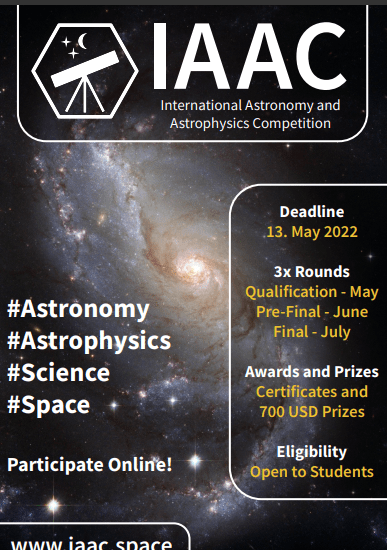
The International Astronomy and Astrophysics Competition is a global competition for science and astronomy enthusiasts.

Online Submission: The competition uses the possibilities of the modern world to allow all students to participate regardless of nation, region, school, or affiliation. Every student may participate independently – there is no affiliation of your school or teacher to IAAC required to participate in this competition.

Research Problems: The pre-final round includes two research problem types. They require participants to get in touch with real scientific research papers and learn about recent scientific results to solve the problems. They encourage students for more advanced science and give them insights into actual research material.

Teacher Support and Online Tools: We supply teachers and schools with additional materials and an online teacher interface that allows teachers to make better use of IAAC problems in class. We also generate performance reports for each individual student.

Information for Teachers and Schools

Teachers and schools are invited to share this opportunity with their students to make talented students in particular benefit from IAAC. There are also special school awards.

Process and Rounds

1. Qualification Round : 5 Problems: Knowledge, Calculation, Research, Free

2. Pre-Final Round : 3x Basic, 3x Advanced, 2x Research Problems, 4 Days, 8 EUR Registration Costs

3. Final Round :  Final Exam with 20 Multiple-Choice Questions, 60 Seconds/Question, Teacher Supervision 

 Note: The Qualification round is free. The 8EUR Registration cost covers both the Pre-final and Final round. DIgital participation certificates are awarded for all rounds.

Who can participate?

You have to be at least 10 years old and you have to be a student (this includes high school, college, and university). There are two age categories:

  Junior: under 18 years on 13. May 2022.

  Youth: over 18 years on 13. May 2022

Students from both categories will receive the same problems in all rounds, however, students that are youths (18 years or older) will have to reach more points to qualify for the next round (e.g. to qualify for the pre-final round, students that are under 18 years have to reach 15 points and students that are over 18 years have to reach 20 points). 

If you are a science enthusiast and love astronomy this competition is the way to go!

Contact me for further details at-yutsawant@amb.iaac.space

Stem Cell Therapy – Working and Future technology

 Our bodies contain many specialized cells that carry out specific functions. These specialized cells are called differentiated cells. Stem cells are cells with the potential to develop into many different types of cells in the body. They act as a repair system for the body. They are unspecialized cells, so they cannot do specific functions in the body. It can create the potential for the cells to be used to grow replacement tissues. American development biologist James Thomson (1958), from the University of Wisconsin School of medicine, won the race to isolate and human embryonic stem cells. On November 6 1998, the ‘journal science’ published the results of Thompson’s research. It described how he used embryos from fro fertility clinics which were donated by couples who no longer needed them, and developed ways to extract stem cells and keep them reproducing indefinitely.

With the ability to develop into any one of the 220 cell types in the body, stem cells hold great promise for treating a host of debilitating illness, including diabetes, leukemia, Parkinson’s disease, heart disease, and spinal cord injury. They also provide scientists with models of human disease and a new ways of testing drugs more effectively in living organisms. But for all the hopes invested, progress has been slow. It has helped that stem cell research has been steeped in controversy, with different groups questing the ethics of harvesting stem cells from human embryos.

In 2007 Thomson and Shinya Yamanaka, from Kyoto university, Japan, both independently found a way to turn ordinary human skin cells into stem cells. Both groups used four genes to reprogram human skin cells. Their work is being heralded as an opportunity to overcome problems including the shortage of human embryonic stem cells and restrictions on U.S. federal funding for research.

How stem cell therapy works?

Researches grow stem cells in lab. These developed stem cells are manipulated to specialize into specific types of cells, such as heart muscle cells, blood cells or nerve cells. These manipulated specialized cells can be implanted into the heart muscle. The healthy implanted heart muscle could then contribute to repairing defective heart muscle. The first stem cell therapy was a bone marrow transplant performed by French oncologist Georges Mathew in 1958 on five workers at the Vinca nuclear institute in Yugoslavia who had been affected by a criticality accident.

Stem cell therapies have become very popular in recent years, as people are seeking the latest alternative treatments for their many conditions. Stem cell therapies are very expensive to pursue. Even simple joint injections can cost $1,000 and more advancement treatments can rise in cost up to $100,000 depending on the condition. Patients must do their research and ask as many questions as they can before financially committing to treatment. Since it is a life changing treatment, it will effectively cost high.

Future stem cell treatments

 The stem cell treatment can helps us curing various diseases in the future. But it is important not to overhype the potential of stem cells and to accurately communicate findings to the public. We must not allow the misleading of some people says that we can cure the untreatable diseases with stem cell treatments. However with more research and investment, I believe that stem cell therapy could transform disease outcomes of many patients.

“The regenerative medicine revolution is upon us. Like iron and steel to the industrial revolution, like the microchip to the tech revolution, stem cells will be the driving force of this next revolution.”   -Cade Hildreth


The Deepest Image ever taken – Hubble Space Telescope

The Hubble space telescope is the most famous telescope in the world. It was named after the famous astronomer Edwin Hubble who changed our understanding of the universe proving the existence of other galaxies. It is an automatic observatory, has discovered millions of new objects in space. It helped us to witness the birth of new stars, found planets outside the solar system and see super massive black holes. Hubble was launched in 199o, and from December 1993 to may 2009, the telescope was repaired and updated four times. Astronauts visited HST five times in order to make repairs and new instruments.

Hubble holds the record for the longest range of observation. The light from the most distant galaxies has taken billions of years to travel across the universe and reach Hubble. By taking this picture, Hubble was literally looking back in time to the very early universe. You can notice on the right side of the image, there is a galaxy very much like the Milky Way that galaxy is about five billion years away, so we are looking back in time by five billion years. In March 4th, 2016, NASA releases a historic image, one that many believed was impossible. It captured the farthest away of all known galaxies; it’s located about 13.4 billion light years away from us. The light from his galaxy has just reached the earth crossing the distance that separates us; hat is now we can observe it as it was 400 million years after the big bang. This galaxy is 25 times smaller than our galaxy, the Milky Way.  It helped to find the age for the universe now known to be 13.8 billion years, roughly three times the age of earth.

With the advanced camera of the NASA’s Hubble space telescope, it discovered a new planet called Fomalhaut b which orbiting is parent star Fomalhaut. Fomalhaut is 2.3 times heavier and 6 times larger than the sun around it is a disc of cosmic dust which creates the resemblance of an ominous eye. Fomalhaut b lies 1.8 billion miles inside the ring’s inner edge and orbits 10.7 billion miles from its star. Astronomers have calculated that Fomalhaut b completes an orbit around its parent star every 872 years. The Fomalhaut system is 25 light years away in the constellation Piscis Australis. But in April 2020, astronomers began doubting its existence; the planet is missing in the new Hubble pictures. Scientists believe that this planet was a cloud of dust and debris formed as a result of a collision of two icy celestial bodies.

In 1994, Hubble captured the most detailed image of the iconic feature called the pillars of creation. The pillars of creation are fascinating but relatively small feature of the entire eagle nebula. The blue color in the image represent oxygen, red is sulfur, and green represents both nitrogen and hydrogen. The nebula was discovered in 1745 by the Swiss astronomer jean Philippe Loys de cheseaux, is located 7,000 light years from earth in the constellation serpens. During its work Hubble has presented millions of images but unfortunately NASA has suspended missions to repair and modernize the telescope. It is assumed that in 2021, Hubble will be replaced with the new James Webb space telescope.

Are Perpetual Machines Really Work?

Most of us might have had this idea, that magnets attract each other in opposite poles, so why can’t we use this to create free energy. Like placing a magnet or a metal in a car and attach the other magnet with a rod or something and place it in front of the car that keeps them attract each other. With this idea, we can move the car without any energy, forever. A perpetual motion machine is a device that is supposed to work indefinitely without any external energy source. Imagine a windmill that produced the breeze it needed to keep rotating or a light bulb whose glow provided its own electricity. These devices have captured many inventers’ imaginations because they could transform our relationship with energy. It sounds cool right? But there is only one problem, it won’t work.

In countless instances in history, people have claimed that they have made a perpetual motion machine. Around 1159 A.D. a mathematician called Bhaskara the learned sketched a design for a wheel containing curved reservoirs of mercury. He reasoned that as the wheels spun, the mercury would flow to the bottom of each reservoir, leaving one side of the wheel perpetually heavier than the other. The imbalance would keep the wheel turning forever. Bhaskara’s drawing was one of the earliest designs for a perpetual motion machine. And more people have claimed that they made a perpetual motion machine, like Zimara’s self blowing windmill in the1500s, the capillary bowl where capillary action forces the water upwards, the oxford electric bell, which takes back and forth due to charge repulsion, and so on. In fact the US patent office stopped granting patents for perpetual motion machines without a working prototype.

Why perpetual motion machines won’t work?

Ideas of perpetual motion machine all violate one or more fundamental laws of thermodynamics. These laws describe the relationship between different forms of energy. The first law of thermodynamics says that “Energy neither be created nor be destroyed”. You can’t get out more energy than you put in. that rules out a useful perpetual motion machine right away because a machine could only ever produce as much as it consumed. There wouldn’t be any leftover energy to power a car or charge a phone. But what if you just wanted the machine to keep itself moving? Let’s take the Bhaskara’s wheel, the moving parts that make one side of the wheel heavier also shift its center of mass downward below the axle. With a low center of mass, the wheel just swings back and forth like a pendulum and will stop. In the 17th century, Robert Boyle came up with an idea for a self watering pot. He theorized that capillary action, the attraction between liquids and surfaces that pulls water through thin tubes, might keep the water cycling around the bowl. But if the capillary action is strong enough to overcome gravity and draw the water up, it would also prevent it from falling back into the bowl.

For each of these machines to keep moving, they had to create some extra energy to nudge the system past its stopping point, breaking the first law of thermodynamics. There are ones that seems to keep moving, but in reality, they invariably turn out to be drawing energy from some external source. Even if engineers could design a machine that didn’t violate the first law of thermodynamics, it still wouldn’t work in the real world because of the second law. The second law of thermodynamics tells us that energy tends to spread out through processes like friction, heating. Any real machine would have moving parts or interactions with air or liquid molecules that would generate tiny amount of friction and heat, even in a vacuum. That heat is energy escaping, and it would keep leeching out, reducing the energy available to move the system itself until the machine inevitably stopped. Like I said about the idea of a car with magnets, the magnets in it won’t able to move the car. Even if the magnet is so powerful to move the car, the friction came into action and will eventually stops the car. So these two laws of thermodynamics will destroy every idea for perpetual motion. With these, we can conclude that perpetual motion machines are impossible.

  YOU  CAN’T  GET  SOMETHING  FOR  NOTHING.

Importance of Self-Confidence

Self-Confidence is one of the important things needed in our life. It has the power to either push us up or pull us down. Most people lack self-confidence at some point in their life due to failures and disappointments. Self -Confidence can be increased due to the motivation of others, but it is not the only way to boost our inner confidence. The confidence that comes from inside is the one that resists for long and helps us achieve more and more in our life. Let us see some of the ways to boost our confidence and try to use them in our daily life.

Photo by Snapwire on Pexels.com

Ways to Boost Self Confidence

  1. Tell good words to yourself : It may feel silly on reading this. But actually it works during the time of crisis. Whenever we feel low, we can tell some good words to “We can do it”,”We are capable of doing it”,”Nothing is impossible”. These words lowers our stress as well as helps in boosting our confidence. We can even ask our friends and family to tell good words to us. Getting these words from those we trust , gives immense amount of confidence in our life.
  2. Take a deep breath : Before starting any task, taking a deep breath will definitely helps us. We should allot some two to three minutes before the beginning of the job and we should take a deep breath without thinking about anything else. During that time, we should not concentrate on the outside environment or thinking about how to do the job. Our only focus must be on taking a breath and relaxing both our mind and the body.
  3. Thinking on past success : When we are doing a difficult or stretchy job, we can think on our past success or achievement for some moments. Beware, it must only be for some moments. Sometimes it will lead to over -confidence and destroys both the time ,the effort and the task.
  4. Thinking on our good time : Everyone will definitely have such moments in our life that brings us instant laughter or instant happiness on our face. During our low time, we can think on these things for some moments to boost up our energy and confidence to do the job. These times can be with the family or friends or colleagues or anyone. Here too, over thinking may lead to procrastination , which is the dangerous one that won’t led us to finish the job.
  5. Hobbies : Hobbies can make an individual feel happy, calm ,satisfied and acts as a complete stress buster. Taking out some time for hobbies can help us to make our brain relaxed and peaceful. These hobbies can be done during breaks or free time.
  6. Talk to yourself : This task doesn’t need anyone to perform. During our low times or when we have no one with us, this is the best way to keep us away from negativity and low confidence. We can talk anything and everything to ourselves. Just imagine yourself as another human and tell everything that is going on our mind.

Believe you can and you’re Halfway there.

Theodore Roosevelt

5 Things to Keep in Mind Before Your First Job Interview

Attending a job interview is by no means a silly feat. Attending a job interview for the first time is not so simple either. When you have put in all the effort and earned that interview call, you are hoping that something good comes out of it. The process and people involved can all be pretty intimidating for a first-time interviewee. Whether you crack the interview or not, you just have to make sure you presented your best foot forward. Here are 5 things to keep in mind before attending your first job interview:

Be Prepared:

Be ready with everything necessary on time to give a good first impression. Double-check that you have all the required documents and your resume with you. Make sure you know how to get to the interview location and reach the place at least 10 minutes in advance. Have your outfit ready the day before. If the interview is online, make sure you have the necessary software. Ensure your computer and microphone work properly and no software updates are pending. Find a good location with good lighting and without much noise or disturbance for your virtual interview.

Keeping a checklist of all the above-mentioned guidelines can be very useful in not missing out on anything.

Have Your Answers (and Questions) Ready:

You obviously cannot know exactly what questions the interviewer will ask. But you can do some research and find the most frequently asked questions and develop your answers for them. You can prepare for industry-specific questions based on the job position you have applied for. Be prepared to introduce yourself, your background, passion and interests. Go through the job offer and review what the company is looking for in a candidate. You can make use of past experiences and situations in college, internships and school to highlight your skills and qualities relevant to the job description.

Also, make sure you have a bunch of smart and relevant questions ready to be asked to the panel of interviewers. You would most likely be expected to ask questions to them at the end of the interview and these questions would have to be relevant and reflect on your interest in the job and the company.

You can ask your friend or teacher to conduct a mock interview or practice saying your answers aloud in front of a mirror so that it sounds confident.

Research the Company:

It is also important to research the company you are interviewing for. Make sure you know what the company’s vision and values are and the leadership and recent news attached to it. This helps the interviewer understand that you are highly dedicated and motivated.

Be Genuine:

Even if you have done your best preparing your answers, it is possible you may not know the right answers to all the questions. It is important that you stay honest and genuine with your answers. It is your first interview after all, and you do not have to act like an expert. You can admit that you do not know something instead of making an answer up and appearing dishonest. Just make sure you convince them with your dedication, passion and willingness to adapt and learn.

Don’t get too Nervous:

Interviews can be pretty nerve-wracking and daunting, even for a seasoned professional. Do not let your nerves get the best of you. Being well prepared and ready with your answers can help a lot with it. Attending a job interview is a crucial experience, but not getting it is not the end of the world either. A lot of other opportunities will come up even if you do not secure a job on the first attempt. There are lots of life lessons and skills to be learned from them too.

So, for your first interview, make sure you do not put too much pressure on yourself and do your best!

What are Quarks? – Definition, Properties and Types

In the early models of the atom were simple, with protons and neutrons forming a nucleus and negatively charged electrons orbiting it, it seemed like a tiny solar system. In the early 1930s, however, analysis of cosmic rays and experiments with particle acceleration showed the existence of new particles by the dozen. In the early of 1960s American physicist Murray Gell-Mann and George Zweig independently conjectured that protons and neutrons were made of even more fundamental particles. They named the subatomic particles as Quark in 1964. The word quark came from James Joyce’s novel “Finnegan’s Wake” in which it is a nonsense word made by Joyce.  He key evidence for their existence came from a series of inelastic electron-nucleon scattering experiments conducted between 1967 and 1973 at the Stanford linear accelerator center. Other theoretical and experimental advances of the 1970s confirmed this discovery, leading to the standard model of elementary particle physics currently in force.

Properties of Quarks

Quarks are most commonly found inside protons and neutrons. They have many properties including mass, electric, charge, and color. There are six types of quarks, up quark, down quark, top quark, bottom quark, strange quark, charm quark. They can have positive (+) or negative (-) electric charge. Up, charm and top quarks have a positive 2/3 charge. Down, strange, bottom quarks have a negative 1/3 charge. So protons are positive because there are two quarks (+2/3) ups and one down quark (-1/3), giving a net positive charge (+2/3+2/3-1/3 =1). These three quarks are known as valence quarks, but the proton could have an additional up quark and anti-up quark pair.

 An anti-quark is the anti-particle of a quark and it could have other types of quarks. It includes pairs of strange quarks and anti-strange quarks, charm quarks, and anti-charm quarks. In fact, the proton has tons of quarks, anti-quarks pairs. The quarks are held together by the strong force which is carried by particles called gluons. So inside the proton, there are zillions of gluons and quarks all moving around close to the speed of light. The quarks that comprise a proton only make of 1% of the mass of that proton. A neutron consist two down quarks and one up quark which gave it an overall charge of 0. The quarks have a property called color change. It includes three color, red, blue, green and each of them is complemented with an anti-color. When we mix these three colors, we get white, that’s why proton is called colorless. The quarks change their colors constantly but, In order to maintain colorless state, the ant-color mix into it.The interaction between quarks and gluons is responsible for almost all the perceived mass of protons and neutrons and is therefore where we get our mass.

Conclusion

The discovery of quarks was a gradual process that took over a decade for the entire sequence of events to unfold. A variety of theoretical insights and experimental results contributed to this discovery, but the MIT-SLAC deep inelastic electron scattering experiments plays a vital role. The existence of quarks is recognized today as a cornerstone of the standard model. I numerous experiments at CERN including those at the Large Hadron Collider (LHC), physicists are measuring the properties of Gell-Mann and Zweig’s particles with ever-greater precision.

                  “Three quarks for muster mark!” – Author James Joyce

Atomic Bomb – History of Nuclear Weapons

During the World War II the united sates used an unprecedented $2 billion to feed an ultra-secret research and development program, the outcome of which would alter the relationships of nations forever. Known as the Manhattan project, it was the search by the United States and her closest allies to create a practical atomic bomb. It is a single device which capable of mass destruction, the threat of which alone could be powerful enough to end the war. The motivation was simple. Scientists escaping the Nazi regime had revealed that research in Germany had confirmed the theoretical viability of atomic bombs. In 1939, in support of their fears that the Nazis might now be developing such a weapon, Albert Einstein and others wrote to President Franklin D. Roosevelt (FDR) warning of the need for atomic research. By 1941 FDR had authorized formal, coordinated scientific research into such a device. Among those efforts would ultimately unleash the power of the atom was Robert Oppenheimer, who was appointed the project’s scientific director in 1942. Under his direction the famous laboratories at Los Alamos would be constructed and the scientific team assembled. On July 16 1945, in a small town called Alamogordo, New Mexico, the course of human history was changed; the first atomic bomb was detonated that day.

By the end of 1945, the bombing had killed an estimated 140,000 people in Hiroshima, and a further 74,000 in Nagasaki.

Principle of an atomic bomb

An atom bomb works in the principle that when you break up a nucleus of an atom, a large amount of energy is released. Because it takes a large amount of energy to keep the nucleus bound together. When you split it apart, the energy is released. Scientists chose the biggest and heaviest nucleus that is found in nature to be the best object for splitting. It is uranium, it is unique in that one of its isotopes is the only naturally occurring element on that is capable of sustaining a nuclear fission reaction. A uranium atom has 92 protons and 146 neurons together to give an atomic mass of 238 or U238. A very small portion of uranium, when it is mine, is in the form of an isotope U235, this isotope  has the same 92 protons but only 143 neutrons, or three fewer than U238. U235 is highly unstable, which makes it highly fissionable. When uranium U235 is slammed by a neutron, it becomes uranium 236. In the process of splitting and creating two more stable atoms, a whole bunch of energy is released, along with three more neutrons. These three more neutrons fly out and slam more U235 atoms. And thus, a chain reaction occurs, causing more and more U235 to be split, and ultimately causes a huge explosion. The uranium contains only 0.7% of this U235 isotope, and a whole bunch of it is needed to make one atomic bomb.

Another engineering challenge is to create a vessel with the correct shape and material to contain the neutrons after fissioning, so that they do not escape, but rather cause more atoms to fission. And it is lined with a special mirror so that it forces neutrons back in to the fissionable material rather than escape the vessel. Then the correct amount of fissionable material has to be placed inside this vessel. This is called ‘super critical mass’. There has to be enough mass to sustain an uncontrollable chain reaction resulting in an explosion.  The super critical mass has to be kept apart until you are ready for an explosion. Otherwise an explosion can occur when you don’t want it. The reason is because these isotopes are unstable, and are throwing off neurons randomly. In an atomic bomb, two subcritical masses are slammed together usually with a conventional bomb contained inside the outer bomb. This conventional explosive charge initiates the chain reaction. This project ultimately created the first, man-made nuclear explosion, which Robert Oppenheimer called “trinity” on July 16, 1945. The concept of an atom bomb is simple but, the process of actually creating a bomb is not so simple.

“Now I am became Death, the destroyer of worlds.” – J. Robert Oppenheimer


Online Vs Offline Education

This is one of the most common topics nowadays on all social media like Facebook, WhatsApp, Twitter, Instagram, and also in newspapers, articles, etc… While some opt for online education and others opt for offline education. There are certain advantages to both. Let’s see some of them.

Photo by Pixabay on Pexels.com

Online Education

Online education is not something that was established just after covid. It has existed before the coronavirus too, but the need for online education is not there. It was a highly considered method during this pandemic due to the inability due to spread the contagious virus. The classes which were conducted with board and chalk are replaced with PowerPoint presentations and mouse cursors. It was a bane to some, while it was a boon to others.

Advantages of Offline education

  1. Environment : May it be a school, college or work place the most important factor is the environment surrounding it. It is the environment that gives us the exposure and the needed opportunities and chances to fall and raise again. Even if we fall, we will definitely will have someone to pull up again and there are will be some who will share their experiences on the current field.
  2. Doubt Solving : In Offline, anyone can ask doubts to teachers and professors at any time. There is no need of waiting for the right place and the right time. Either as a school student or a college student , we can ask doubts at the period at that time itself.
  3. Guidance : We can always ask our doubts to our seniors who had experienced similar situations. There will be no barrier between them and us.
  4. Discipline : Discipline is one of the core principles of life and it will be taught only in offine education. Everyone will be regular to their respective places , maintaining obedience and discipline. The value of discipline is not realised until the 20’s. It will make us reach heights of life even we wouldn’t have dreamed about it.
  5. Consistency : Consistency comes together with people who are disciplined. Consistency is the way to learn any skill and be talented in that. It will not be a problem for disciplined people since they follow it everyday and keeps their day productive as possible.

Advantages of Online education

  1. Recorded Sessions : The main advantage of online education is the videos can be seen any number of times at any place. If some doubt sarises, we can refer the videos. Most of the online classes nowadays are recorded to provide the students this wonderful facility to clear doubts.
  2. Time Saving : Online classes saves a lot of time such as travelling time. Students can use this time to upskill themselves and to be productive.

Disadvantages of Online education

  1. Non-availability of Phone : Even though online education is a convenient,flexible and cost efective method of education, not everyone can afford smart devices like Phone, Laptop, Tablet etc… This disadvantages is mainly for people who face difficulty in even afford daily expenses. This was quite proven in many places during this pandemic.
  2. Network facilities : After Smart devices, internet facility is another important thing to see online classes.
  3. Lack of Discipline
  4. Lazyness
  5. Losing the ability to think
  6. Increased usage of devices

Conclusion

Each has its own advantages and disadvantages. If we think and follow online classes just like offline classes, the productivity will be maximum and there will be no issue .

Nikola Tesla’s Inventions – Working of AC current

“I don’t care that they stole my idea, I care that they don’t have any of their own”, said by one of the greatest inventors to have ever lived, the Serbian inventor Nikola Tesla who developed the framework for modern-day electrical engineering. When Nikola Tesla began work at Edison’s DC (direct current) power plant in the United States, his new employer was not interested in his ideas for a new type of power called AC (alternating current). At the time DC was the only electrical supply, but it could only be transmitted across short distances before it lost power. To Edison, AC sounded like competition and he persuaded Tesla to work on improving his DC system by offering him a huge sum of money. But when Tesla had done what he had been asked, Edison reneged on his promise. Tesla resigned and returned to his AC power concepts. DC power is constant and moves in one direction and the resistance in wires causes it to lose power over distance. AC power does not have this problem as it varies in current so the resistance is less, and yet it varies in current so the resistance is less, and yet it delivers the same amount of power.

How AC current works?

In an atom, the negatively charged electrons are bound to the nucleus due to their electromagnetic attraction to the oppositely charged nucleus. But the electrons in the outer most shell called valence shell can sometimes become free due to external forces. These electrons that escape from the valence shell are called free electrons and they can move from one atom to another. This movement is called charge and the flow of electric charge is called electricity. Materials that allows many electrons to move freely are conductors and don’t allow are called insulators. That why copper is a great conductor. Alternating current would flow back and forth 50-60 times per second, this is called the frequency. Even though Thomas Edison one of the famous and powerful men of the 19th century, he tried his best to compete with Tesla. The mathematic formula of the current is P = I×V, with this formula, the same amount of power can be transmitted either at high current and low voltage or low current and high voltage. But when you transmit current through wires, there will be also loss of heat. To overcome this problem, we have to higher the voltage to reduce the heat loss.

In modern electric power grids, electricity is transmitted at hundreds of thousands of volts. But the voltage cannot be this high when it arrives at your home. So a transformer steps down this high voltage to typically between 100 and 240 volts. The step down process of AC current is way easier than the DC current. Transformers require a time varying voltage to function, and since direct current is constant, and only alternating current is time varying, transformers like these only work with AC electricity. In Edison and Tesla’s time, there was no easy way to transform voltage with direct current. And this is the primary reason Tesla’s AC won out over Edison’s DC in the early era of electrical transmission.

AC current – a scientific breakthrough

This made AC power more cost effective, as fewer power plants were needed. Entrepreneur George Westinghouse saw the potential of Tesla’s AC power and bought his patents for AC motors. Edison began a propaganda war in an attempt to keep DC power on top, but it was inevitable that ac power would win. Almost all electricity is now delivered as Tesla’s AC power. Edison’s place in history as an inventor and electrician is secure. But in many ways Tesla went even further. He envisioned fluorescent lights, technology of the radio, and remote control. Nikola Tesla was one of the most forward thinking, and dynamic visionaries that ever lived.

“If your hate could be turned into electricity, it would light up the whole world”. – Nikola Tesla

Keeping Pace with the Web Designing Industry

Whether it is graphic designing, animation, or web designing, the designing field is one of the most in-demand industries to be working in right now. One of the unavoidable truths about working in the field of web designing is how quickly everything seems to change. Something new always comes up. So, it would be difficult to sustain yourself as a professional in this industry if you are not up-to-date with the relevant technical updates and improvements. Keeping yourself updated would help you perform better at your job and against the competition. Not to forget, it helps make your clients satisfied and happy. Even if your clients may not necessarily know what the new frameworks and their technical names are, they probably want their website to have all the good features and designs as other trending web pages at the time.

Here are some tips on how to be up-to-date with the fast-changing web designing industry:

Be Curious:

As a designing professional, you should always be curious and open to learning something new at any given opportunity. It is probably impossible to learn every new technical update. It is okay not to know absolutely everything in this field. But change is constant and having an open mindset to change is essential.

Get Your Fundamentals Right:

Having a good idea of your fundamentals and maintaining your basic skill sets is one of the most useful practices you can do. Your core programming language skills such as JavaScript, HTML and CSS can make it easier for you to learn a new framework or library. Even if you do not need code in your UI/UX design, it is beneficial to maintain a bit of your programming skills.

Do Not be Too Eager with New Technology:

Just because you should be curious and open-minded does not mean that you have to necessarily jump in with the new techniques and tools immediately when they come out. Instead of getting into it immediately, give it some time for others to figure it out and see if it sticks or goes out of the market as quickly as it came. If it looks like it is going to be stable and relevant, you can then learn that tool or framework. Otherwise, you are probably wasting a lot of your time learning something that is not about to be used by anyone for long.

Have Side Projects:

Having a little side project other than your company’s/client’s works will help you explore your creative potential and hone your skills. You can take up some volunteer work or maybe even do something just for fun if there is nothing on your mind.

Networking and Resources:

Just like any other field, keeping in contact with and meeting new people in the design field is always advantageous. You get more insight into the designing industry and get to find like-minded people this way. Connecting digitally on platforms like Twitter, Facebook and LinkedIn also helps you learn about the latest news and trends from other designers and design companies.

Design professionals can make use of books, websites, newsletters, podcasts and other resources to learn new skills and know what is going on in the designing field. You can also gain inspiration from others’ works shared on amazing platforms like Behance and Dribble.

If you start feeling bored at your designing job, it might just be because you are not finding any new or challenging techniques to learn. In the rapidly changing web designing world, maintaining a lot of interest in the field is key to keeping up-to-date with it.

THE CURSE OF DEPRESSION

For some people, depression may mean showing a sad face all the time, not responding to anyone, sitting in a room all day, and more. Depression is not always a combination of all these symptoms, some people are depressed but still, show happy faces. We must clearly understand what it actually means and must get out of it before it is too late.

Photo by Fredrick Eankels on Pexels.com

Common Symptoms of Depression

  1. Trouble in Concentrating : People with depression may feel difficulty or trouble in concentrating on their jobs. They even feel extremely hard to even take simple decisions due to lack of concentration.
  2. Insomnia : Insomnia is one of the most common symptoms of depression. They either sleep for long number of hours or never sleep at all. It varies with person to person. Even sometimes they wake at early morning without knowing.
  3. Guilty Feeling : Depressed state can also happen due to inability or failure to do an important job. It starts with feeling guilty all the time thinking about the work and stressing themselves too much. It makes them feel helpless and alone all the time even they are always being surrounded by friends , family or relatives.
  4. Lose of Interest : People start to lose interest over things that are once their favourite one. It may be hobbies like drawing, dancing, singing or even visiting places that are their favourite ones initially.
  5. Restlessness : Inability to relax or inability to make your mind calm and peace is called Restlessness. It happens due to over stress, thinking about something all the time and excess usage of devices like Mobile Phones, Laptop and television etc.
  6. Overeating/ Appetite Loss : It happens in two ways , either feeling of hunger at all times or feeling full at all time. It is also a symptom of depression which most people fail to address it at early stages of their life.
  7. Unbalanced feelings : Sometimes they feel too happy, sometimes too sad, sometimes too anxious with no meaning, sometimes too angry without knowing. Their feelings become unpredictable and meaningless during their depressed state of mind.
  8. Digestive problems : Even stomach ache for a long period of time , without reacting to medicines is a symptom of depression.

Most of these symptoms are the common ones, the failure to address them for a long period may lead to suicidal thoughts or suicidal attempts.

Ways to overcome depression

  1. Surround yourself with motivation
  2. Do yoga and meditation
  3. Always ask for help without hesitation.
  4. Go out to new places for refreshment.
  5. Take breaks during job to avoid stress.
  6. Eat healthy food like fresh fruits and vegetables.
  7. Create new hobbies
  8. Do activities that keeps both our mind and body calm.
  9. Focus on people who will be there for you during both good and bad times.
  10. Always get minimum six hours of sleep daily.
  11. It’s okay to say ‘no’ to works which is either stressful or not possible.

“Don’t let life discourage you everyone who got where he is had to begin where he was.”

Richard L. Evans

Social Media Management

In this highly digital era that we live in, every company is trying to make use of social media to increase its presence and gain clients. At this point, social media management is something every management student and prospective job seeker should be knowing about.

Social Media Management is the process of using social media platforms like Twitter, Facebook and Instagram to create, publish and then analyze content for a company. It includes analyzing social media audiences and developing a strategy to create and distribute content for social media profiles, and engage with users. Efficient and well-organized management of social media actually gives many good opportunities for companies to profit more. Brands and companies can use social media to increase brand awareness and store visits. In a company, a Social Media Manager takes on the task of social media management. Social media managers need to be skilled professionals at social media marketing, management and advertising so that the company can reach its goals such as increasing social media revenue and user engagement. They could be working as a consultant or an in-house employee.

  • Social media helps brands engage with users all over the world. This is something traditional marketing and advertising cannot achieve as well as social media networks. Certain platforms like Instagram and Pinterest also help brands connect with niche audiences.
  • With this kind of extensive reach, the brand can now align their marketing initiatives with user behaviour.
  • Not to mention how convenient and cost-effective a social media initiative is. Setting up an account, posting content and engaging with users through chats and comments are all free of cost. Advertising on social media is a very profitable way of building a strong online following.

Major social media platforms used by brands and companies include Facebook, Twitter, Instagram, LinkedIn and Pinterest. There are several paid and unpaid tools that help in managing social media networks by scheduling posts, content, responding to inquiries and comments, etc.  

Photo by Kaboompics .com on Pexels.com

Here are 3 essential steps that will help a brand gain useful information about its social media strategy and direct it through the right path:

Reviewing the company’s social media through an audit:

Conducting a social media audit will help a company understand how effective its marketing strategy is. The audit would include listing all the social media profiles of the company and reviewing social media analytics regarding top-performing posts, engagement, publishing frequency follower growth, traffic sources, average response time, audience interests and demographics. Analyzing this data and reviewing competitor’s social media presence aids the brand in improving its social media management and identifying where it might be wasting its resources.

Researching Target Audience:

Having a good idea about who your audience is, is essential for efficiently managing social media. It helps in creating relevant content and boosting customer relationships. Without knowing your target audience you are basically wasting a lot of time, money and resources.

Determining the Right Social Media Platforms:

While a company should definitely have social media profiles on top networks like Facebook, Twitter and LinkedIn, it should put most effort on networks that is used most by its audience. Not every platform may work well for the brand’s vision and marketing strategy. It should prioritize and put in effort for every platform according to how frequently its audience uses them. Brands that cater to a niche audience can also make use of such platforms that connect with its specific audience demographics.    

Ballistic missiles – History, Application and Working

The history of rocketry dates back to around 900 C.E., but the use of rockets as highly destructive missiles able to carry large payloads of explosives was not feasible until the late 1930s. War has been the catalyst for many inventions, both benevolent and destructive. The ballistic missile is intriguing because it can be both of these things. It has made possible some of the greatest deeds mankind has ever achieved, and also some of the worst. German Walter Dornberger and his team began developing rockets in 1938, but it was not until 1944 that the first ballistic missile, the aggregate-4 or V-2 rocket, was ready for use. V-2 was used extensively by the Nazis at the end of World War II, primarily as an error weapon against civilian targets. They were powerful and imposing: 46 feet (14m) long, able to reach speeds of around 3,500 miles per hour (5600 kph) and deliver a warhead of around 2,200 pounds (1000 kg) at a range of 200 miles (320 km).

Ballistic missiles follow a ballistic flight path, determined by the brief initial powered phase of the missile’s flight. This is unlike guided missiles, such as cruise missiles, which are essentially unmanned airplanes packed with explosives. This meant that the early V-2 flew inaccurately, so they were of most use in attacking large, city sized targets such as London, Paris, and Antwerp. The Nazi ballistic missile program has had both a great and a terrible legacy. Ballistic missiles such as the V-2 were scaled up to produce intercontinental ballistic missiles with a variety of warheads, but also the craft that have carried people into space. Ballistic missiles may have led us to the point of self destruction, but to venture beyond our atmosphere.

 Intercontinental ballistic missiles (ICBM) were first developed by the United States in 1959. It is a guided ballistic missile with a minimum range of 5500 kilometers primarily designed for nuclear weapon. United States, China, France, India, United Kingdom and North Korea are the only countries that have operational ICBMs. The ICBMs has a three stage booster, during the boost phase the rocket get the missile airborne, this phase last around 2 to 5 minutes until the ICBM has reached space. ICBMs have up to three rocket phases with each one ejected or discarded after it burns out. They use either liquid or solid propellant. The Liquid fuel rockets tend to burn longer in the boost phase than the solid propellant. The second phase of the ICBMs is the point where the rocket has reached space, here it continues along is ballistic trajectory. At this point the rocket will be travelling anywhere from 24,140 and 27,360 kilometers an hour. The final phase is the ICBM’s final separation and re- entry into earth’s atmosphere. The nose cone section carrying the warhead separates from the final rocket booster and drops back to earth. If the ICBM has rocket thrusters, those will be used at this point to orient itself towards the target. It is important that ICBMs have adequate heat shields to survive reentry, if not they burn up and fall apart. It’s important to note that although countries have ICBMs, none have ever been fired in anger against another country.

“This third day of October, 1942, is the first of a new era in transportation that of space travel.” –  Walter Dornberger

Does sneezing stops your heart?

Most of us have experienced it while in our class, meeting or at any other important commitments. Yes, sneezing, especially when we were suffering from some allergies, we can’t control it, but why do we sneeze? What’s the reason behind it? Well a sneeze is officially called as Sternutation. Sneezing is an involuntary activity of our body to clear our nose. Whenever a foreign matter such as dust, dirt, germs or anything that shouldn’t be there enters your nostrils, the nose get irritated and it sends a message to your brain. Then to remove the particle your brain sends a message to all of your muscles for a sudden exhalation process called a sneeze, and it would take only milliseconds for your brain to process this. In 2002, a study at Denmark’s department of Otorhinolaryngology at Rigshospitalet showed that 95% of people sneeze four times or less each day. Worldwide, we could be sneezing upwards of 7.8 billion times a day.

Shot of an attractive young woman feeling ill and blowing her nose with a tissue at home

Cultural beliefs about sneezing

          Many people think that sneeze is a sign of good luck, while others think it’s a bad sign. People in ancient Greece, 400BC believed these sneezes are favorable sign from the gods. During the 6th century, the plague killed 200 million people all over the world; sneeze is also one of the symptoms of this disease. So people started to believe that sneeze is a sign of death and by saying “bless you” they thought it may prevent them from being infected and some used to consider as a final blessing. That’s why still some people say “God bless you” when someone sneeze.

Does really sneeze stops our heart?

        Do you know? Your sneeze can create 100,000 droplets and it can travel up to 160 kilometers (100 miles) an hour. Yes it’s more likely a faster way to spread diseases than a cough. So while sneezing, our heart stops for a second and start after that? Well it seems like it takes a break but, it’s not the case. Usually we inhale deeply before sneezing; this increases the pressure in your chest and slows down the blood flow to your heart. The heart compensates this by changing to its regular beat right after we sneeze. So it only reduces the heart rate for a short period of time rather than stopping it. Do you know? The heart can continue to beat for a short time after being removed from the body because; it has its own electrical system that can pump blood as long as it gets oxygen. So a sneeze won’t stop the electrical activity of our heart.

Is holding your sneeze dangerous?

       Most of us hate sneezing in awkward situations, it makes us embarrassed. Did you ever tried to hold your sneeze? If you did, the following incident will show why you should not. A 34 year old man has admitted to a hospital in the UK for serious neck infection. Doctors found that the pressure built from the sneeze cant able to escape as he blocked his nose and mouth. It causes rupture in the cavity that connects our nose and mouth called pharynx. It seems that he is trying to hold his sneeze every time for the last 30 years because, he feels that it would be unhygienic to sneeze into the atmosphere. He was hospitalized for a week and doctors treated him with the necessary antibiotics to cure the infection.

      Sneezing is one of the primary defense systems in our body to get rid of harmful irritants in our nose. The entered irritant somehow should have to go out. So, don’t try to hold it, just let it happen.

“I used to wake up at 4 AM and start sneezing, sometimes for five hours. I tried to find out what sort of allergy I had but finally came to the conclusion that it must be an allergy to consciousness”.     – James Thurber.