A Legal Giant Named Ram Jethmalani Finally Passes Away

“One of the best aspects of Shri Ram Jethmalani Ji was the ability to speak his mind. And, he did so without any fear. During the dark days of the Emergency, his fortitude and fight for public liberties will be remembered. Helping the needy was an integral part of his persona.”
– Prime Minister Narendra Modi
It is most depressing to learn that a legal giant named Ram Jethmalani finally passed away at the age of 95 just short by 6 days ahead of his 96th birthday on 14 September on 8 September after suffering from prolonged illness! But we all were witness to the irrefutable fact that he was physically very fit till the end and did all his works himself! He had announced retirement from legal profession in 2017!

It is my good luck that I had the fortune and privilege of listening exclusively to one of the most eminent, experienced and expert lawyer of Supreme Court named Ram Jethmalani while he came to deliver lecture in our class while I was doing LLB from Symbiosis Law College in Pune way back in 1996-97 and he spoke with not just extreme eloquence and brilliance but also encouraged students like me to not just answer any question which we liked but also answered them to our fullest satisfaction. I still remember that he spoke with a lot of cheerfulness and politeness inspite of being such a great legal giant that it is beyond the capacity of my pen to describe in words! He always advised that never term anyone a criminal unless and until a person is finally convicted and that too not just by lower court or high court but by the top court itself and here too until all his/her remedies are exhausted he/she has the right to be treated just like any other individual! He also advised law students like me that lawyers should never refuse brief from any client even though the cases may be most heinous because those cases may be false and in most of the cases they actually turn out to be false also! Most importantly, he said that it is lawyers job to take up any case whatever he/she gets! 
When I asked Ram Jethmalani about Pakistan’s belligerence towards India, he replied most eloquently that, “China keeps instigating Pakistan against India. China is the most dangerous country in the world. It will eliminate the very existence of Pakistan if it keeps on walking into their trap. China is the root cause of Pakistan’s belligerence against India. China is the real enemy of not just India but also of Pakistan whom it is fooling in the name of friendship just like it fooled us in 1962 and stabbed us most grievously. Pakistan must wake up its ideas before it is too late. Pakistan must develop good relations with India by shunning terror policy because this will benefit Pakistan most than anything else!” I can never forget his priceless words ever which I heard from him then which I remember now more than anytime else as he has finally and forever left for his heavenly abode! He also recounted his hardships which he faced after partition when he migrated to Bombay from Pakistan and lived in an Indian refugee camp. He said that his hard experience made him believe firmly that, “India and Pakistan must forget the tribulations of the tragic Partition and develop a relationship of trust and cooperation.” Pakistan must pay heed to what Ram Jethmalani said and shun its blind hatred for India! Only then can both the countries prosper and progress in the true sense! 
It must be mentioned here that Ram Jethmalani was born in Shikarpur which is now in Pakistan. He was an exceptionally bright student right from the scratch! He completed his matriculation at the age of 13. He became a lawyer at the age of just 17 years at Sindh which is now in Pakistan which itself demonstrates how brilliant he was!
It would be relevant to mention here that he began his career at 17 when he pleaded his own case against the minimum age rule for a lawyer to enroll at the bar which was 21. The rules were amended especially for him! He started his practice in Karachi in Pakistan as till 1947 there was no Pakistan but only India before moving to Mumbai post-partition!
Interestingly enough, Ram Jethamalani did not graduate in law but only obtained a two-year diploma – a condensed course introduced by Bombay University in 1939! Despite having spent six years at the bar in Sindh, he had to qualify the Bombay bar once his family moved there after partition which he did with excellence! Among the highest paid criminal lawyers in the country, Ram Jethamalani got his first shot at fame that is rightly called his first big break in 1969 when he was a part of the team of lawyers that engaged in the famous Naval Commander KM Nanvati case. He appeared for Prem Ahuja, the man killed by Naval Commander KM Nanavati. Ahuja’s sister roped in Jethmalani. Though he did not appear in the trial court after Nanavati was let off by the jury and the Judge referred the case to the Bombay High Court. He assisted the public prosecutor for Maharashtra – YV Chandrachud who later became the longest serving Chief Justice of India as a prosecution lawyer in this case and secured a conviction for Nanavati. 
It cannot be dismissed lightly that during the Emergency imposed by the then PM late Mrs Indira Gandhi, he in his capacity as the Chairman of the Bar Council of India mobilized lawyers against the government. As a consequence, arrest warrant was issued against him! A group of around 300 lawyers led by legendary Constitutional and tax law expert Nani Palkhiwala who refused to become Judge of Supreme Court at the age of just 32 as he was most happy and satisfied being a lawyer along with former Attorney General Soli J Sorabjee appeared before the Bombay High Court and succeeded in securing a stay on the arrest warrant issued against him! He was never afraid of anything and never shied away from speaking even against the most powerful whenever he felt that they were wrong! This was what distinguished Ram Jethmalani from the rest of the crowd! 
It is well known that Ram Jethmalani never shied away from defending even terrorists as he felt that they are innocent until they are finally convicted by the top court and all their legal remedies stood exhausted! It was Ram Jethmalani who defended the men charged with assassinating Indira Gandhi as well as the accused in the killing of Rajiv Gandhi seven years later. It was Ram Jethmalani who said that he was not bothered about BJP expelling him for his decision to represent Mrs Indira Gandhi’s killing which led to the acquittal of one of the accused Balbir Singh who was given the death sentence!
It cannot be ignored that he defended the likes of Harshad Mehta, Ketan Parekh, underworld don Haji Mastan and even political leaders like LK Advani and Amit Shah among others. He headed Manu Sharma’s defence in the Jessica Lal murder’s case and saved him from death penalty by arguing exceptionally well! His daughter – Rani Jethmalani was not happy with this but he said without mincing any words that for him what matters most is his duty which he owes to the legal profession to represent any client who approaches him with a lot of hope!
It was Ram Jethmalani who was never afraid of even Judges! He lost no opportunity to convey his point in simple and straight language! He never forgot to remind Judges that they had not even started their legal careers when he was already a senior lawyer. Very rightly so! Who can deny that Ram Jethmalani dominated for more than seven decades in legal profession single handedly and even his worst critics were gracious enough to always concede this!
It must be recalled here that once while arguing well after normal court hours his petition to bring back black money, Jethmalani noticed that the Judges along with CJI sneaked a peek at the clock. He lost no time in promptly addressing the then Chief Justice of India, saying that, “You tired? Your Lordships are half my age.” Such was the physical fitness and hard working nature of his! How can this not be admired by anyone?
It must also be recalled here that he did not shy away to even write admonishing letter to the Madras High Court Judge – CS Karnan who was facing contempt of court which was the first in history by a sitting High Court Judge for misconduct explaining that he felt that the dignity of an institution could not be overawed by the idiosyncrasies of one man. In his letter, Jethamalani told CS Karnan that he was writing as a “senior member of the Bar and living in the departure lounge of God’s airport.” He rightly advised him to apologize to the Supreme Court but Karnan did not pay heed and had to go to prison as a consequence! Jethmalani signed off with “If you do not know the enormity of your madness, do meet me and I might put some sense in your head.”
It must be also recalled that did not falter to call the National Judicial Appointments Commission which gave primacy to the government in judicial appointments to constitutional courts as an “evil absurdity”. We have seen that how it was finally struck down by the Apex Court! It is the government which is responsible for not paying heed to what he said so plainly!
When he was faced with barbs and uncomfortable questions about his role as a defence lawyer for the powerful, he remained indifferent and said confidently and calmly that, “He was serving the law as an officer of the court. The law allowed the accused to put forward his best defence. It was up to the courts to declare a person guilty.”
Ram Jethmalani had even ventured into politics. It is well known that he contested the Bombay North West seat in the Lok Sabha in 1977 and won by a huge margin! He was twice elected to the Lok Sabha from Bombay. In 1988 he was returned as a Rajya Sabha member with the help of Ramakrishna Hegde and Ramnath Goenke. It was he who pioneered the trend for senior lawyers contributing their best to Parliament by entering through Rajya Sabha! He was also the Union Law Minister when Atal Bihari Vajpayee was Prime Minister! 
No doubt, his passing away has left a void which can never be filled by anyone! The former PM Dr Manmohan Singh rightly said that, “In his death India has lost an eminent jurist, an able administrator and a seasoned parliamentarian.” Solicitor General Tushar Mehta also rightly said that, “With the passing away of Ram Jethmalani, the country has lost a ‘giant of a man’ who was a rare combination of constitutional expertise, razor-sharp understanding of criminal law and a ‘roaring tiger’ when it comes to defending his clients.” Also, British-Indian industrialist Gopichand Hinduja too rightly said that, “India is yet to see a better criminal lawyer than Ram Jethmalani. He was well respected not only by the Judiciary but also by the legal fraternity…Courageous to the core, he undertook many legal struggles against the high and mighty. He was a saviour of democracy in the truest sense.” Sanjay Hegde who is also a senior and an eminent Supreme Court lawyer paid his rich tributes by aptly saying that, “While we mourn Ram Jethmalani’s passing away, we cannot but celebrate his life. He became a lawyer at 17 and continued to contribute till almost his end just short of his 96th birthday. A successful legal career of 78 years is unlikely to be matched anywhere in the world!” His contribution to the legal profession can never be described fully in words! He defended Lalu Prasad Yadav, Karnataka CM BS Yediyurappa, former Tamil Nadu Chief Minister late J Jayalalithaa among many others! He is an inspiration and an example worth emulating for every lawyer and every person who wants to achieve something in life! He was an extraordinary lawyer who pulled no punches and fought hard for all his clients with full vigour always! Words cannot be enough to describe his priceless contribution which he rendered in his various capacities as a lawyer, as a politician and as a Minister among others! 
Undoubtedly, he has died but only after giving his best to society! He has lived his life to the fullest! He is survived by his son Mahesh Jethmalani who too is a renowned senior Supreme Court lawyer who has dabbled in politics also very well! He has a daughter who lives in US. His other daughter – Rani Jethmalani pre-deceased him in 2011 at age of just 52 which had shaken him even though he never showed this to anyone in public! May his departed soul rest in peace! 
Sanjeev Sirohi, Advocate,
s/o Col BPS Sirohi,
A 82, Defence Enclave,
Sardhana Road, Kankerkhera,
Meerut – 250001, Uttar Pradesh.
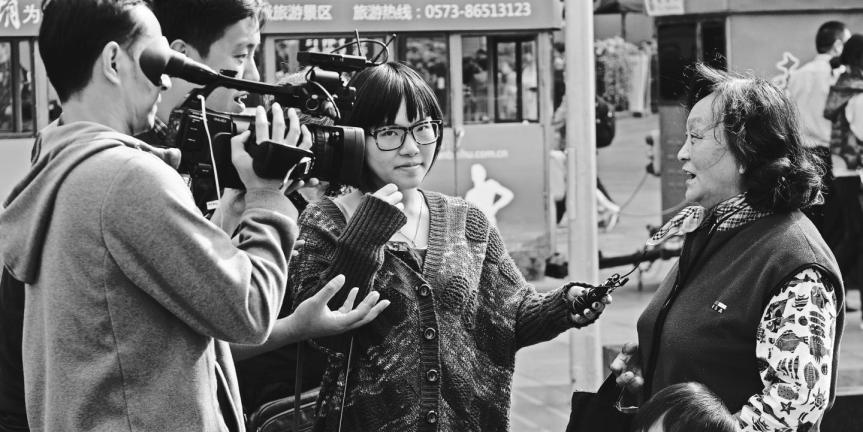
Women and Media

Women who are involved in media are people who take an interest in
media. Media are the aggregate correspondence outlets or devices used to
store and convey data or data. The job of women in media develops
around media opportunity, media pluralism, media freedom, and media
safety. Women in media face indistinguishable challenges and dangers
from men, yet in addition experience sexual orientation disparities,
safety issues. Safety of journalists is the capacity for writers and
media experts to get produce and offer data without confronting physical
or moral dangers. Women journalists, face dangers of physical ambush,
inappropriate behavior, assault and considerably murder. Women
journalists are helpless against assaults not just from those
endeavoring to quietness their inclusion, yet additionally from sources,
associates and others. 
Mass media play a special and vital job in the
molding of a general public where people appreciate equivalent rights.
Raising ladies’ lawful mindfulness is imperative for the production of a
populist society.  The job of media is essential for being effective in
all the referenced circles. The media can advance and accelerate the
changes in advancement, or, unexpectedly, it can hamper their execution.
Notwithstanding common imbalance, common society keeps on being a power
for advancement. Different associations are attempting to push for more
noteworthy portrayal and key standard-setting bodies, for example, the
Gender and Internet Governance trade, started by the Association for
Progressive Communications, which means to change the hole in support by
ladies’ and sexual rights’ activists in web administration approach
forms.

Skills to be a Good Learner

Introduction

 The ability to learn is possessed by humans,
animals, and some machines, and there is also evidence for some kind of
learning in some plants. Some learning is quick and is induced by a single
event but much skill and knowledge accumulate from repeated involvements. The
changes induced by learning often last a lifetime. It is hard to distinguish
learned material that seems to be missing from that which cannot be retrieved.

Obtaining new skills or adapting ideas and
knowledge, preference, behavior, and valuable skills are the learning process.   Learning can be of different types as it encourages
much skill and knowledge to accumulate from repeated experiences. To keep growing
intellectually is what one wishes for.


Leaving school or college doesn’t mean one
should stop learning. Limited learning means limited knowledge of things around
you as no educative process is the end. Learning is the process of inquiring
new or modifying existing knowledge, behaviors, skills, values, or preferences.


Why one need to learn a language

Strong learning skills are an asset that
will promote a lifetime of effective communication. Our language is the most
important part of our being. I think it is important to learn other languages,
other forms of communication besides our own because it helps us to learn about
other peoples and cultures
a)     
Learning helps one
develop a knowledge base and improve for the better.
b)     
Learning is
experimenting with something new which helps gets us access and to find new and
diverse chances and to try new experiences that might be the best ones.
c)     
Hypothetically it
helps rejuvenate one’s life a new and appropriate skill or by developing work
to do.
d)     
 It is essential to learn for staying up to
date in life. This is an ever-changing world where one needs to keep
self-updated and can never stop learning.
e)     
Want to earn
prestige and self-esteem that language is important to you. Learning new things
especially language can stimulate your brain and let it function well. It keeps
brain cell activity and allows people to be in confidence.


What will happen if we stop learning the language?


It’s the
nature of human soul to learn. Learning things especially language makes you go
upward and achieve new heights.  The one
who stops learning can stagnate and actually move backward.  Especially in professional world it is
important to learn. One cannot be linked with the world if learning is
stopped.  Learning across our lives is
essential for staying up to date in an ever-changing world. If we stop learning
things, we can stagnate and actually move backward, especially in our
professional lives. Learning language is beginning of your development and a
result-oriented.  What happens to you as
a result of your reaction and make a man that is base of your development. This
is also a key to your happiness as knowing more is showing what one has
achieved to more.


Road ahead

A language
programmer has a good future and can also earn good. It is becoming a career-oriented
skill as many companies give placement to these candidates. And who doesn’t
love to learn new words and language that makes you smart enough to face the
competitive and challenging world? But making a most of it is where smartness
lies. Language and learning are complementary to each other and are absolutely
central to your development. Without knowledge one cannot make sense and have
understanding of subject.  One needs to
develop language skills and is specifically most effective and central to
development. One needs to develop a specialized language and terminology that
is subjecting relevant and enhance personality. It helps in interpreting and
selecting relevant and appropriate material needed for response.  It is required to work productively with
others and helps to prepare assignments coherently. One who has good knowledge
of subjects can avoid jargon and plagiarism related mistakes in whatever
project they are assigned to.  There are
many institutes that provide a training program that helps to gain a piece of
good knowledge in writing and learning language. This is because language
learning is a skill in development. A language programmer has good future and
can also earn good. It is becoming a career-oriented skill as many companies
give placement to these candidates.


Dr. Sarvepalli Radhakrishnan: Pronam to the Legendry personality on occasion of Teacher’s Day

Since 1962, 5 September is celebrated in India as Teacher’s Day as on this day in 1888 a great scholar, philosopher, erudite person and statesman Sir Sarvepalli Radhakrishnan was born at Thiruttani, Madras Presidency of India. His many activities and assignments are too small to mention here as for this volumes are required. Even then few lines are mentioned on occasion of his birth anniversary. Among his many extensive works in the form of publications, one is Sir highlighted basic tenets and philosophy of Hinduism as well as he had copious knowledge of the Western philosophy and literatures for which many consider him a bridge-builder between India and the West.
At the very young age (33 years) in 1921, he was selected for the prestigious George V Chair in Philosophy at Calcutta University where he had proved his erudite skill. While, he was in Calcutta (now Kolkata) two volumes of Indian Philosophy were published – one in 1923 and the second was four years later. The Philosophy of Rabindranath Tagore written by Sarvepalli Radhakrishnan was also an excellent publication for which he should be applauded. 
Throughout the 1920s, Sir Radhakrishnan’s reputation as a scholar continued to grow both in India and abroad. He was invited to Oxford to give the 1926 Upton Lectures, published in 1927 as The Hindu View of Life, and in 1929 Radhakrishnan delivered the Hibbert Lectures, later published under the title An Idealist View of Life. Also he wrote commentaries on the Prasthanatraya (main primary texts of Vedanta), the Upanisads (1953), Brahma Sutra (1959) and the Bhagavadgita (1948). Dr. Radhakrishnan was awarded several top awards inter alia of which are knighthood in 1931, the Bharat Ratna, the highest civilian award in 1954 etc. He was awarded honorary membership of the British Royal Order of Merit in 1963. He was also one of the founders of Helpage India, a non-profit organisation for elderly underprivileged in India.
Dr Shankar Chatterjee
Former Professor & Head (CPME),NIRD & PR ( Govt. of India), Hyderabad,  India
Former Associate Professor, Eritrea

Former Assistant Prof, Govt. Degree College, Tripura, India
Former Senior Planning Officer, Govt of Assam, India 
PRESENT ADDRESS
Prof. Shankar Chatterjee 
Lidom Villa, No.13
Peranchuru, Bandlaguda(Jagir), Hyderabad-5000091

Vice President Releases Special issue of think India Quarterly on Faiz Ahmed Faiz

The
Vice President of India Shri M. Hamid Ansari  said that it had been observed that the poetry
of Faiz Ahmad Faiz blends skilfully classical sobriety and artistry with modern
incisiveness and ruthlessness of expression in exposing to light the turmoil
and revolutionary urges of the time.essing after releasing Special issue of
Think India” quarterly on Faiz Ahmad Faiz at a function here today, he opined
that Romance and revolution thus
became part of the same impulse and, in Faiz’s own words, “gham-e-jaana aur
gham-e-douran eik hi tajrabe ke do pehlu hain”. 
The resulting mix is overpowering;
it accounts for the popularity of Faiz in the subcontinent and beyond.
Shri Ansari said that the previous week had been a spiritually
uplifting one for him personally. On Friday he was in Dhakka participating in
the joint Bangladesh-India celebration of Rabindranath Tagore’s 150th birth anniversary. Today, he is here
to release this volume. Two great poets, both born Indian, who used the medium
of verse to reflect on issues of wider concern. One thought in evolutionary
terms, the other in revolutionary ones. The menu of options, a teasing one, was
laid bare.
Following
is the text of the Vice President’s address
:
            “I am happy to be here today to
participate in the release of the Faiz Centenary number of Think India.
It brings together writings and impressions of a good number of shaidaa ee yaan-e-Faiz the world over
and would be of particular value to the younger, post-Faiz, generation.
            This
week has been a spiritually uplifting one for me personally. On Friday I was in
Dhakka participating in the joint Bangladesh-India celebration of Rabindranath
Tagore’s 150th birth anniversary. Today, I am here to release this
volume. Two great poets, both born Indian, who used the medium of verse to
reflect on issues of wider concern. One thought in evolutionary terms, the
other in revolutionary ones. The menu of options, a teasing one, was laid bare.
            It
has been observed that the poetry of Faiz Ahmad Faiz blends skilfully classical
sobriety and artistry with modern incisiveness and ruthlessness of expression
in exposing to light the turmoil and revolutionary urges of the time. Romance
and revolution thus became part of the same impulse and, in Faiz’s own words, “gham-e-jaana aur gham-e-douran eik hi
tajrabe ke do pehlu hain”.
The resulting mix is overpowering; it accounts
for the popularity of Faiz in the subcontinent and beyond.
Faiz saheb’s verses challenge authoritarian
edifices and evoke hope for a better tomorrow:
Kahaan hai manzil-e-raahe tamanna hum bhi dekhen gai
Yeh shab hum par bhi guzre gi, yeh farda hum bhi dekhen
gai
Theher ai dil , jamaal-e-roo-e- zaiba hum bhi dekhain gei
Again, in the well
known lines of Tarana:
Darbaar-e-watan main 
ek din sub jaane wale jaaen ge
Kooch apni saza to pohnchen ge, kooch apni jaza le jaaen
ge
Ai khak nasheeno, uth baitho, woh waqt qareeb aa pahuncha
hai
Jab takht  giraae
ja ain ge, jab taaj uchale jaa en ge
And, there are
expressions of despair emanating from the harsh experience of life:
Himmat-e-ilteja nahin baaqi—Zabt ka howsala nahin baaqi
Ho chuka khatm ahd-e-hijr o wisal—Zindagi main maza
nahin baaqi
Or
Jo chal sako to chalo ke raahe wafa bahut mukhtasar
hui hai
Muqaam hai ab koi na manzil, faraaz-e-daar o rasan se
pehle.
            The time Faiz Ahmad Faiz spent in
jail produced some of his most evocative verses. He explained it convincingly: Jail khana, aashqi ki tarah, khud eik
bunyaadi tajraba hai,jis main fikr aur nazar ka eik aadh naya dareecha khud
bakhud khul jaa ta hai.
            The volume before us also brings
forth some delectable episodes in the life of Faiz. One relates to his meeting
with Jazbi in Lucknow
in 1936. Another to how, on being recruited in the public relations department
of the army in World War II, he developed a motivational approach for the
soldiers and for which he received an OBE.
            One of the contributors to this
volume has summed up the sentiments of many who read and cherish Faiz: “He
makes us feel good about ourselves. He makes our lives bearable. He gives us a
glimpse of hope.”
            One last word before I conclude. In
November 1984, I was wandering in Urdu Bazar and acquired a collection of Faiz
entitled Waraq Waraq. It was edited
in 1975 by a distinguished predecessor of mine in this office, the late Shri
Krishan Kant. In an erudite Introduction, he dwelt on various aspects of the
poet’s work. I will share with you his concluding lines:
Bharat main jahan Urdu kasm-pursi ke aalam main hai,
nai nasl Faiz ke kalam ko surma samajh kar aankhon se lagaati hai. Mehnat aur
sarmay ki kash ma kash ka shaoor jun jun awam main barhta jai ga, aane wali
naslain usai ek aham tareeki aur funni dastawaiz ke taur par harz-e-jaan banaen
ge.  

            The poetry of Faiz Ahmad Faiz earned
him immortality in his lifetime. It is incumbent on us, all of us, to pass on
this precious heritage to succeeding generations. D.P. Tripathi ji has earned
our gratitude by bringing forth this collection of writings”.

Courtesy: https://pib.gov.in/newsite/PrintRelease.aspx?relid=72053

Shri Sharad Pawar Released Think India Quarterly

Shri Sharad Pawar, Union Minister of Agriculture and Food Processing Industries released the special issue of Think India Quarterly
on Indian Agriculture. While appreciating the effort, he remarked that
thinking is not an easy task as it requires in-depth study and
understanding of the issue with all ramifications. Shri Pawar raised
some of the important issues and challenges before Indian Agriculture
in his speech. He reminded the contribution of stalwarts such as Dr C
Subramaniam, Shri Jagjivan Ram ji, Dr B P Pal and others who made
significant contributions in accelerating agricultural growth in India
which ultimately led to globally acclaimed green revolution.  Shri Pawar
reiterated the need to make Indian Agriculture more profitable through
processing and marketing initiatives and offering remunerative prices
to farmers.
Shri Sharad Pawar Released Think India Quarterly
Dr M S Swaminathan, noted thinker and Member of Parliament,
highlighted the enormous employment potential of the agricultural
sector despite the slow growth while presiding over the function. Dr
Swaminathan advocated a judicious blending of technology with policy
intervention to make a difference in the Indian Agriculture. He pointed
out the huge untapped potential of agricultural growth in eastern part
of the country which can be developed as an asset in the food security
of the nation.
Dr (Ms) Syeda Hameed, Member (Health Grp, Gender & Equity Grp), Planning Commission, emphasized the important role of Mahila Sashaktikaran Yojana in agriculture and rural development of the country, which needs to be extended to far and wide areas across social groups.
Think India Quarterly is an initiative of Vichar Nyas
Foundation which is a modest attempt to re-emphasize the value of ideas
in both understanding and changing society, culture and politics. The
special issue on Indian Agriculture, edited by D. P. Tripathi, presents
thought provoking articles on various facets of Indian agriculture by a
galaxy of thinkers and innovators.
The release function was attended by policy planners, academia, media and other stakeholders in agriculture.

The future prospect of English as a language

Introduction –

 Human civilization
has expanded due to communication. It is communication that gave birth to
culture, ethos, art and social values in which human prevails. Language is
elementary to communication and a skill that allows a person to improve his
personality.  Apart from being a basic
necessity, good language skills can overcome many personal and professional barriers.  Language being central and basic to learning
and lack of language can create miscommunication. Language and its development
are important for a person who desires to exchange information meaningfully to
the person and places required.

English language and its importance –

One of the most important languages is English which is
essential to build personality and the carrier these days. It has the most
effective use in business world and develops the special charisma relevant for
the carrier. Lack of command in language can lower and darken up future that
can cause frustration to a person.  A
piece of good knowledge in English can provide utter confidence that can boost
up the future and opens many scopes for a perspective future. It doesn’t matter
what profession one chooses, good learning to English is a treasured talent. They
are more sought than any other employees as they are well-groomed to
communicate globally.

Few uses of English as a language

English Opens New Career Breaks: if someone is looking for a
good career break globally than English is a must.  It’s an only global language that is spoken
in almost sixty percent countries of the world. Having a good knowledge of the
language can elevate once career for good.

English Tests to get in prominent college and school

If you wish to study at a famous reputed college in the
world than English is for you.   A global
test termed as Tofel  (Test of English as
a Foreign Language)is an English proficiency test conducted globally that is
required to determine the eligibility to study abroad in a prestigious college
of globe like Cambridge and oxford university.  Without this exam no college gives you
admission to their college as all prestigious college demands the candidate to
pass this TOFEL test.

The first language of the internet –

It is a common and foremost language of the internet with
near about 1 billion users chatting and typing in this language. There are many
apps on internet that are useful but are restricted to be used in English language.  It makes people capable to enjoy many more
resources online without hesitation. Many have also faced difficulties while
using these apps due to lack of proficiency in the language. One can found too many
materials on internet in English than any other language of world.

English Makes Life More enjoyable

English gives many options in both the entertainment and infotainment
industry. Understanding English means you’ll get to relish abundant Hollywood
blockbusters and foreign-language movies that provide sub-title.  Many famous novels are available in this
language. Many videos come with cooperative captions that are also in English. It
enjoys a multinational touch that no other languages have gained. Only a good
knowledge in English can help you get an instant definition and pronunciation
of games language.  Learning this
language can avail many types of entertainment to people.

Conclusion

Undoubtedly, learning English will open up many scopes and
enhances pathways to many experiences, which is helpful to learn new things and
make feel smarter. This language builds personality enhancing social status of
a person.  In a country like India, both
public and private sector function in English language.  Though (Hindi) being first language is
restricted to public sector and the companies but private sector has almost
refrained from use of other languages than English.  Learning English has many benefits and it but
shouldn’t be done in cost of giving once very own language.  It’s good to learn and adopt a global
language but one should respect its native language as well. Researchers have
also proved that being bilingual can make a brain more strongly than others. So
it’s better to learn two or more language and if it is English, it is way
better.    

Most likable language in the world

Introduction
  Knowledge and grasping a language has always
been more diverse and accurate and is also attractive by nature as language learning
polishes your brain. The best we have been able to do is to narrow down the
timeline for origin of language and studying human phycology to know when we developed
mid-brain for language. Magpie is the name given to English language as it has
a mix of many languages that picks up word from all other language. Some
language has understandably widened vocabulary of English than others. Modern
English dictionaries contain more of a geographical melting pot than ever
before.
There are many languages that are spoken in many parts of
the world. The world top languages, a global list that are famous worldwide are
listed down. There are some seventy thousand languages in world that are famous
worldwide also English has borrowed language from these different
languages.  Here goes the list of six
such important languages that are spoken worldwide in large number.
CHINESE: 1197 million native speakers
 Chinese is a
linguistic that is also referred as macro language that comprises many forms to
derive a different form and dialects that together have of 1.2 billion native
speakers. So far it is the widely spoken language in the world. According to
the Oxford English Dictionary, Chinese words have been recorded in English
since the mid-16th century, with the earliest examples including the likes of
tai chi (1736), ginseng (1634), yin and yang (1671), kumquat (1699) and fang
shui (1797). One of the earliest of all is lychee (1588).
2. SPANISH: 399 million
Almost a quarter of Spanish speaker out of the total number
leaves in Mexico.  Other part of the
world where this language is spoken as a major language is Colombia (41
million) Argentina (38.8 million), and Venezuela (26.3 million). They are many
native speakers in the United States of America. In English, Spanish loanwords
like weaponry and military in termed as guerrilla, flotilla, armada,
machetealso the animals name are as follow like chinchilla, alligator,
cockroach, iguana.
3. ENGLISH: 335 million
As per Ethnologies the English language has some 335 million
native speakers, that incudes2 55 million in United States itself, 55 million
in the United Kingdom and 19 million in Canada. Few other main countries have also
15 million in Australia and 5 million in New Zealand. Though English is spoken
in almost every Asian countries of the world and is most wide spread it is
recorded to be spoken in 101 different countries and territories worldwide.
Additionally, the number of people that has opted English as
a second linguistic Franca included, the total no of speaker could rise
globally to one billion.
HINDI: 260 million
Hindi is native language of the world’s 260 million speakers
that are mainly found in India and Nepal. Although some 120 million projected
people in India uses Hindi as a second language.  Also it is spoken in many part of the world such
as in Mauritius, Fiji, Suriname, Guyana, Trinidad & Tobago and Nepal. Hindi
is declared to be official language of the union. The Indian constitution in
1950 declared the Devanagari script and made it an official one. However,
Parliament decided the use of English for an official purpose was announced
fifteen years after the constitution came into effect, i.e. on 26 January 1965.
 PORTUGUESE: 203
million
The population of Portugal is around 12 million but
Portuguese is enjoyed and spoken in large belt and it has 187 million native
speakers. Though it has its similarity with Spanish and is often tricky to
differentiate.
Conclusion
Every language has its importance and linguistic like Urdu
Italian and Arabian are also enjoyed in many region. Though, few are the
languages that have conquered many parts of the world. Many of this language are
expanded due to colonial expansion of territories.  People in many of these countries adopted these
languages mainly forcibly and many took it over their own language.  Adopting these languages made it spread too
many other communities in a country. And that is why language like English and
other are being spoken in many parts of the world and has become global
language.

IBPS ANNOUNCED CLERK RECRUITMENT 2019 EXAM SCHEDULE

The
Institute of Banking and Personnel Selection is recruiting candidates for the
clerk post in public sector banks of India. The official notification is yet to
release. But the tentative dates for the exam have been announced in the IBPS
official calendar.

·       
Preliminary exam- 7th, 8th, 14th
and 15th
of December 2019

·       
Mains exam- 19th January 2020

Your
preparation for the
IBPS clerk
exam should be in very high standards. Because every year the level of
competition and the toughness level of the exam are increasing in a rapid
manner. So only hard work can save you in this scenario.

IBPS Clerk Selection Process:

The
selection process of the IBPS clerk will be in 2 stages in the order of,

·       
Online Preliminary exam

·       
Online Mains exam

The
candidates who clear the preliminary exam will take the online mains exam. From
the mains exam, the shortlisted candidates will get the provisional allotment
order. Further there will be no other interview rounds. The final cut off marks
will be obtained from the mains exam score. The marks obtained in the
preliminary exam will not be considered for the calculation of the final score.

IBPS Clerk Preparation:

For
the preparation of the IBPS clerk exams you have to choose the best study
materials. You can also learn through the online video courses and E-books. The
study material you choose must have a good reputation among the candidates. It
should have questions of various patterns and difficulty level of low to very
high. You can choose any other resources for your preparation but finally mock
test practice is very essential. Without mock test practice your preparation
will go in vain.

So
choose the best study material that will be more comfortable for your effective
preparation. After your preparation take more mock test practice to gain
confidence for the exam.

English Language Preparation Methods:

This section is available for both IBPS clerk prelims and mains exams. In
prelims exam it covers 30 marks. And for the mains exam it covers a total of 40
marks. Most of the students find it difficult to score in the English language
section. If you are weak in the basics of grammar it is very hard to score in
this section. So develop your grammar skills. Also reading daily newspapers
will improve your knowledge in English. You can come across more new terms and
learn their meanings. If you are good at grammar and vocabulary then you can
score more marks in this section easily.

Quantitative Aptitude preparation Methods:

For
preliminary exam this section covers 35 marks. For the mains exam a total of 50
marks is allocated for this section. You have to be strong in the basics of
maths. Then you have to learn and practice more rapid calculation techniques.
It will assist you in saving your time considerably. Also you have to practice
more short cut tricks to complete the problems quickly. For prelims exam target
the easy to moderate level of questions for your practice. Then for the mains
exam practice more high level difficult problems.

Reasoning Ability Preparation Methods:

This
section gives you the marks easily in the prelims exam. But in the mains exam
you need to work hard to score descent marks in this section. So concentrate on
difficult pattern of questions in all the topics. So that you can face the exam
in a bold manner. Also practicing with the difficult questions very often will
sharpen your reasoning skills. Practice more latest version of puzzles and
seating arrangement questions. Because now a days in exams unexpected new
pattern of questions have been asked. So be prepared for such questions to
manage the huge competition.

General Awareness Preparation Methods:

This
section is only for the IBPS clerk mains exam. If you prepare well, this
section will boost your overall score very higher. You have to be in finger
tips with the current affairs (at least last 3 months), static GK and banking
awareness. Take notes regularly and use it for revision purpose. Attend more
online current affairs quizzes to check your standard of preparation. This
section will give you more marks in very less time.

Practice with IBPS Clerk Previous Year Question
Papers:

You
should practice more
IBPS
clerk previous year papers
. From this you
can analyze the level of exam and changes in the pattern of questions. So you
can prepare an exam strategy accordingly. Also you can improve your preparation
level according to the level of questions asked. The memory based previous year
question paper with solutions will guide you the route of success. The
solutions will be helpful for you to understand the concepts for the difficult
questions.

Importance of IBPS Clerk Mock Test:

Practice
more
IBPS
clerk mock test
for prelims and mains
exam. The mock test practice will boost your confidence level to take the real
exam. The mock test will be prepared according to the latest updated pattern.
So it will be an experience before you take the real exam.

·       
You must improve your
speed with clerk mock test practice regularly. Only speed can increase your
number of attempts in the exam which is very important.

·       
Along with speed you have
to maintain a good accuracy rate. If your accuracy is bad, then your overall
score will be low even if you have given more attempts. So maintain your
accuracy rate with the help of IBPS clerk mock test practice.

·       
By practicing more mock
tests you can learn the art of time management. Without time management you
cannot attempt more questions in the exam.

·       
The IBPS clerk mock test
will have more new pattern questions. By solving those questions you can gain
the ability to solve the tough papers with ease. Also your exam fear will be
completely abolished if you take mock tests at regular intervals.

So
candidates follow these preparation methods to shine in the IBPS clerk exam.
Also practice more previous year question papers to get confidence. Finally
take more IBPS clerk mock tests regularly to increase your hopes for the
success.

Career options in India


Early Career Options in India

India has been an agriculture-based economy since early days of civilization. Uniqueness of this can be understood from the fact that, while all other civilization did not mind killing and eating animals, Indians from early days insisted on ahimsa and vegetarianism (with exception of course). The reason such a choice was possible for Indians was an excellent climate and abundance of rivers which built one of the most fertile lands in the world. The harvests were bountiful, there was enough for everyone and people did not look much further.

The extraordinary products of agriculture were what attracted the Britisher and other European explorers. But over the 200 years that Britishers ruled and milked this land mercilessly, they managed to destroy what had attracted them in first place. Their preference for certain type of crops, insistence on ruthless taxation irrespective of crop yield disturbed the crop cycle and entire agriculture sector.  The fallout of this was on allied domestic sectors as well. The Britishers eventually left the country, but not before ruining it the worst they could.

Post-Independence Career options

Post-independence, India was lucky to have visionary leadership who believed it was essential to build other sectors like manufacturing, engineering etc. They built education institutions like IITs, NITs, IIMs research/manufacturing institutions like NTPC, BARC, SAIL, DRDO, ISRO, ONGC. Accordingly, the career options started growing. People went for professional courses. Some joined these organizations, some joined private sectors, and things started growing.

One of the biggest gainers from the early investments of government was Engineering colleges and industries. India was left with virtually zero industry by Britishers, so there was lot to be done. The institutions provided opportunities and young students worked their bones to give best into these. No doubt Indian Engineers were regarded as one of the best in the world.

Modern Times

The early institutions were visionary and did great to pick up low hanging fruits. The success of the premier engineering colleges inspired many students to opt for engineering. But there was only so much talent that they could absorb. This created an unemployment problem in the country. Unfortunately, the government did not do much to create newer sectors or newer opportunities. The worse thing, in the long run, was that the problem got almost resolved without much efforts of Government.

In early 1990s, Government had to open up the Indian economy to allow foreign investors to explore Indian markets. The health services had improved by a lot since Independence and consequently, infant mortality rate was down, and life expectancy was up. This led to a population boom in India. The population had almost doubled in the 40 years of Independence. This made India a very attractive market for investors. The flung in like bees. This also brought many job opportunities.
While the government could take some credit for the first sequence of events. The second revolution was more on the side of technology. The computers evolved massively in 1990s and 2000s. This was followed by boom from mobile phones. These technical developments opened up new ventures and so many new job opportunities. Engineering was the dream again.

What lies ahead?

However, the IT sector, like any other can absorb only so much talent. The rising unemployment numbers are worrying for the government as well as academicians. While the government will take its time and thoughts to do bigger changes, we can here highlight the different options that are still not as overloaded as engineering. They promise jobs with stability, good salary and good growth.

In this series of articles, we will be discussing few such sectors- how are they doing now, how is their future and what it takes to be successful in these sectors. Stay Tuned.

NTA released UGC NET Examination Schedule

The National testing Agency (NTA) has released the UGC NET examination schedule for December 2019 and June 2020. Candidates can check the examination details on the official website of NTA, the link is nta.ac.in. This year the CSIR UGC NET examination will be conducted on 15th December 2019, while UGC NET examination will be held between 2nd to 6th December. The Online application process for December session will starts from 9th September. Aspirant will have one month time for registration as last date of registration is 9th October. Further, the hall ticket/admit cards will be available for download from November 9. 31st December will be the result day for both examination.

                      Source: Pexel

What is NTA
National Testing Agency (NTA) has been established as a premier, specialist, autonomous and self-sustained testing organization to conduct entrance examinations for admission/fellowship in higher educational institutions.The country`s top entrance/ competitive examinations such as Joint Entrance Examination (JEE)  mains, NEET (UG),  UGC NET etc  are conducted by the agency.
On behalf of UGC,  NTA conducts the National Eligibility Test (NET) for determining the eligibility of Indian nationals for the Eligibility for Assistant Professor only or Junior Research Fellowship & Eligibility for Assistant Professor Both in Indian Universities and Colleges. Earlier It was CBSE who conducted the NET in 84 subjects at 91 selected Cities of spread across the country.

Understanding NET and JRF
From Dec 2018, the UGC-NET (for Eligibility for Assistant Professor only or Junior Research Fellowship & Eligibility for Assistant Professor both), was conducted by the NTA. The award of JRF and Eligibility for Assistant Professor both OR Eligibility for Assistant Professor only depends on the performance of the candidate in both the papers of NET in aggregate. However, the candidates qualifying exclusively for Assistant Professor are not to be considered for award of JRF. Candidates who qualify the Test for eligibility for Assistant Professor are governed by the rules and regulations for recruitment of Assistant Professor of the concerned universities/colleges/state governments, as the case may be.


Examination Module
Mode: The Examination shall be conducted as Computer Based Test (CBT) only. 
Pattern: The test will consist of two papers. Both the papers will consist of objective type questions. There will be no break between papers. 

Paper 1
Marks- 100
Number of Questions- 50 
MCQ     — The questions will be generic in nature, intending to assess the teaching/ research aptitude of the candidate. It will primarily be designed to test reasoning ability, comprehension, divergent thinking and general awareness of the candidate.

Paper 2
Marks- 200
Number of Questions- 100
MCQ  —  This will be based on the subject selected by the candidate. 
Total duration–  03 hours without any break
Syllabi for all NET subjects can be downloaded from the UGC website: https://www.ugcnetonline.in/syllabus-new.php

Text of PM’s Address at the Royal University of Bhutan, Thimpu

Anyone visiting Bhutan is struck as much by its natural beauty as by the warmth, compassion and simplicity of its people. Yesterday, I was at Semtokha Dzong, the fore-most example of the richness of Bhutan’s past and the greatness of its spiritual heritage. During this visit, I have had the opportunity to interact closely with the present leadership of Bhutan. I once again received their guidance for the India-Bhutan relationship, which has always benefitted from their close and personal attention.
Now, today, I am here, with the future of Bhutan. I can see the dynamism, and feel the energy. I am confident that these will shape the future of this great nation and its citizens. Whether I look at Bhutan’s past, present or future, the common and constant threads are – deep spirituality, and youthful vigour. These are also the strengths of our bilateral relationship.
Friends,
It is natural that the people of Bhutan and India experience great attachment to each other.  After all, we are close not just due to our geography. Our history, culture and spiritual traditions have created unique and deep bonds between our peoples and nations. India is fortunate to be the land where Prince Siddhartha became Gautam Buddha. And from where the light of his spiritual message, the light of Buddhism, spread all over the world. Generations of monks, spiritual leaders, scholars and seekers have burnt that flame bright in Bhutan. They have also nurtured the special bond between India and Bhutan.
As a result, our shared values have shaped a common world-view. This is visible in Varanasi and Bodh Gaya. And also in Dzong and Chorten. And as people, we are fortunate to be the living vehicle of this great legacy. No other two countries in the world understand each other so well or share so much. And no two countries are such natural partners in bringing prosperity to their peoples.
Friends,
Today, India is witnessing historic transformations in a wide range of sectors.
India is eliminating poverty faster than ever before. The pace of infrastructure construction has doubled in the last five years. We have just pledged about 15 billion dollars for next-generation infrastructure. India is home to the world’s largest health-care programme, Ayushman Bharat that offers health assurance to 500 million Indians.
India has among the cheapest data connectivity in the world, which is directly and indirectly empowering millions. India is also home to among the biggest start-up eco-systems in the world. This is indeed a great time to innovate in India!  These, and many other transformations have the dreams and aspirations of the youth of India at their core.
Friends,
Today, I stand here among the best and brightest youth of Bhutan. His Majesty told me yesterday that he interacts with you regularly and had addressed the last convocation.  It is from you all that Bhutan’s future leaders, innovators, business persons, sports persons, artists and scientists will emerge.
A few days back, my good friend, Prime Minister Doctor Tshering wrote a Facebook post that touched my heart. In that post he mentioned about Exam Warriors, and just now also a student mentioned about that book. Exam Warriors, a book I wrote about how to face exams without stress. Everyone faces exams in schools and colleges and also in the larger class-room of life. Can I tell you something? Much of what I wrote in Exam Warriors is influenced by the teachings of Lord Buddha. Particularly, the importance of positivity, over-coming fear and living in oneness, be it with the present moment or with Mother Nature. You are born in this great land.
Therefore, these traits come naturally to you and shape your personality. When I was young, the search of these traits took me all the way to the Himalayas! As children of this blessed soil, I am confident that you will contribute to finding solutions to the problems of our world.
Yes, we have challenges. But for every challenge, we have young minds to find innovative solutions to over-come them. Let no limitation constrain you.
I want to tell you all- there is no better time to be young than now! The world today offers more opportunities than ever before. You have the power and potential to do extra-ordinary things, which will impact generations to come. Find your real calling and pursue it with full passion.
Friends,
India-Bhutan cooperation in hydro-power and energy is exemplary. But the real source of power and energy of this relationship are our people. So, it is people first, and people will always be at the centre of this relationship. This spirit is clearly seen in the outcomes of this visit. Going beyond the traditional sectors of cooperation, we are seeking to cooperate extensively in new frontiers, from schools to space, digital payments to disaster management. Our cooperation in all these sectors will have a direct impact on young friends like you. Let me give some examples. In this day and age, it is crucial to connect scholars and academics beyond borders, so that creativity and talent of our students bring them at par with the best in the world. Cooperation between India’s National Knowledge Network and Bhutan’s DrukREN, which became a reality yesterday, will serve this purpose.
It will provide secure and fast connectivity between our universities, research institutions, libraries, health-care and agricultural institutions. I urge you all to make full use of this facility.
Friends, Another example is the frontiers of space. At this very moment, India’s second Moon mission, Chandrayaan-2 is on the way to the moon. By 2022 we intend to place an Indian in space, on an Indian space-craft. All these are the results of India’s own achievements. For us, the space programme is not just a matter of national pride. It is a vital instrument of national development and global cooperation.
Friends,
Yesterday, Prime Minister Tshering and I also inaugurated the Thimphu Ground Station of the South Asia Satellite and expanded our space cooperation. Through satellites, benefits of tele-medicine, distance education, resource mapping, weather fore-cast and even warning of natural disasters will reach even remote areas. It is even a matter of great happiness that young Bhutanese scientists will travel to India to work on designing and launching Bhutan’s own small satellite. I hope that someday soon, many of you will be scientists, engineers and innovators.
Friends,
For centuries, education and learning have been central to the ties between India and Bhutan. In ancient times, Buddhist teachers and scholars formed the bridge of learning between our peoples. This is a price-less heritage, which we wish to preserve and promote. Therefore, we welcome more students of Buddhism from Bhutan in institutions such as Nalanda University – a historical global seat of learning and Buddhist traditions, which is revived at the very place where it existed fifteen hundred years ago. The bond of learning between us is as modern as it is ancient. In the 20th century, many Indians came to Bhutan as teachers. Most Bhutanese citizens of older generations would have had at least one Indian teacher during their education. Some of them were honoured by His Majesty last year. And we are grateful for this generous and kind gesture.
Friends,
At any point, over four thousand students from Bhutan are engaged in studies in India. This number can and should grow. As we march forward to develop our countries, we also need to keep pace with ever-changing technological landscape. It is, therefore, Important that we collaborate in all areas of emerging technologies and education.
I am happy that yesterday we have begun new chapters of engagement between India’s premier IITs and this prestigious University. We hope that these will lead to more collaborative learning and research.
Friends,
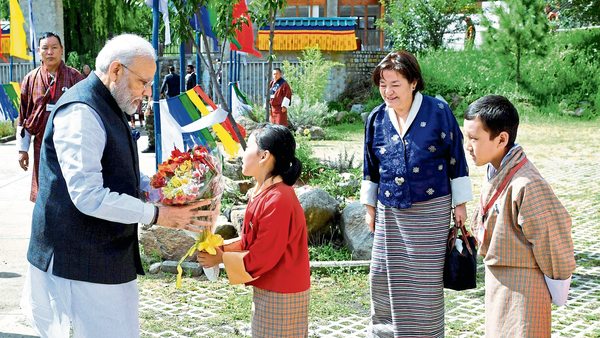
In any part of the world, if we ask the question what do you associate with Bhutan, the answer will be the concept of Gross National Happiness. I am not surprised. Bhutan has understood the essence of happiness. Bhutan has understood the spirit of harmony, togetherness and compassion. This very spirit radiates from the adorable children who lined the streets to welcome me yesterday. I will always remember their smiles.
Friends,
Swami Vivekananda had said, “Every nation has a message to deliver, a mission to fulfill, a destiny to reach”. Bhutan’s message to humanity is happiness. Happiness which springs from harmony. The world can do with a lot more happiness.  Happiness, which shall prevail over mindless hate. If people are happy, there will be harmony, where there is harmony, there will be peace. And it is peace that will help societies achieve progress through sustainable development. In a time where development is often seen in conflict with traditions and the environment, the world has much to learn from Bhutan.  Here, development, environment and culture are not at loggerheads but are in synergy. With the creativity, energy and commitment of our youth, our nations can achieve all that is required for a sustainable future –   whether it is water conservation or sustainable agriculture or making our societies free of single-use plastic.
Friends,
During my last visit to Bhutan, I had the privilege to visit the temple of democracy, the Parliament of Bhutan. Today, I have the honour to visit this temple of learning. Today, we also have in the audience Honourable Members of the Parliament of Bhutan. I especially thank them for their distinguished presence. Democracy and education both aim to set us free. Neither can be complete without the other. And both help us to achieve our fullest potential, and be the best we can. This seat of learning will once again set free our spirit of enquiry and will also keep the student within us alive.
As Bhutan soars high in these endeavours, your 1.3 billion Indian friends will not only just look on and cheer you with pride and happiness. But also they will partner you, share with you and learn from you. With these words, I would like to thank the chancellor of the Royal University of Bhutan His Majesty the King, the Vice Chancellor and the Faculty of the University, and all of you – my young friends.
You all have honoured me with your invitation and given me so much time, attention, and even more affection.  I go back with a lot of happiness and positive energy from you all.

53rd Convocation of Indian Institute of Foreign Trade held in Delhi

The 53rd Convocation of Indian Institute of Foreign Trade (IIFT) was held on August 8at the Institute’s campus in New Delhi. In a ceremony, Hardeep Singh Puri, Minister of State (Independent Charge) of Ministry of Housing & Urban Affairs and Civil Aviation and Minister of State for Commerce & Industry, awarded degrees tothe graduating students of PhDs, Full Time MBA, Weekend MBA programmes, Executive Post Graduate Diploma in International Business and Certificate Programme in Export Import Management courses. Distinguished members from Board of Management of IIFT, faculty members of IIFT and other dignitaries were present during the convocation.
In his address, Hardeep Singh Purispoke about the growth that the Indian economy has witnessed since the last few decades. Considering the contribution of foreign trade to approximatelyfifty percent in this economic growth of India, he emphasized on the importance of specialised institutes like IIFT. Hardeep Singh Puri appreciated the contribution of IIFT’s research based consultancy and corporate trainings and hoped that it will contribute towards attaining thetarget of India becoming a 5 trillion USD economy in the near future.  Congratulating the graduating students, Hardeep Singh Puri exhorted them to be lifelong learners and keep abreast of the latest developments in Foreign Trade.

Commerce Secretary and Chairman, IIFT, AnupWadhawan, complimented IIFT’s placements and role of globally placed alumni in taking the Institute to global heights which has only been possible due to its rigorous teaching pedagogy and unique courses including foreign languages. Commerce Secretary further acknowledged the strong role of IIFT towards the support extended in policy making through its newly established Centre of Trade Facilitation and Logistics (CTFL) as well as Centre for WTO Studies, Centre for Research in Trade (CRT), Centre for Trade and Investment Law (CTIL) and the Centre for North East Studies (Ce-NEST) at IIFT Kolkata. He also assured continued support of the Government to the Institute for its new campus which is being built at Maidan Garhi in New Delhi.

Renaissance of our Education System to make it World class

The Vice President, Shri. M. Venkaiah Naidu, today said that religious harmony and unity in diversity are cherished values of our civilization and asked every citizen of the nation to strive to preserve our values of national integration.
He was addressing the Second Convocation ceremony of Shri Vaishnav Vidyapeeth Vishwavidyalaya in Indore, Madhya Pradesh today.
The Vice President commended the efforts of 135-year-old Shri Vaishnav Committee and the Group of Trusts, Indore in establishing Shri Vaishnav Vidyapeeth Vishwavidyalaya (SVVV) to impart quality education.

Stating that there was a need for rejuvenation and renaissance in our education system to make it world class, Shri. Naidu said that educational institutions must focus on academic excellence, physical fitness, mental alertness, moral uprightness and social conscience.
He urged universities to strive to overcome challenges of quality, equity and access in education through the creation of knowledge networks, research and innovation centres, skill development programs and support for faculty development.
The Vice President said that, with technology making deep inroads in our day-to-day lives, there is a greater need today to align academic curriculum in accordance with changing technological developments and to stay ahead of the curve for the country to reach greater heights.
He spoke of the need for India to upscale research facilities to produce world class publications in reputed international journals. ‘Research is an area where we are lagging behind and serious efforts are needed to bolster the culture of research and innovation in the country’, he said.
Highlighting the importance of preserving our rich culture, especially our languages, the Vice President also opined that mother tongue should be the primary medium of instruction in schools till the high school level.
Shri. Naidu also called for enhanced collaboration between academia and industry and urged the industry to earmark CSR funds for promoting collaboration with the academia and research activities.
Referring to India’s impending demographic dividend, Shri. Naidu said that India had the potential to become the human resource centre of the world. He said that quality education, skills, knowledge and creative thinking are essential to realize the demographic dividend and to make India a 21st century innovation hub.
The Vice President said that we must turn our educational institutions into centres of excellence with global standards. ‘’Our universities and educational institutional institutions must attain great heights and figure in top-ranking global academic institutions’, he added.
Observing that the majority of students who win awards for merit and excellence in universities are women, the Vice President said that women’s education and empowerment must become people’s movements.
Shri. Naidu emphasized that there is a need for inculcating the qualities of sharing and caring among youngsters. ‘They need to have empathy for others, particularly for the vulnerable and marginalized sections of the society’, he said.
He urged the students to continuously update themselves with the latest technologies, innovations and the changes in the world. He advised them to think of the nation first and to work hard with determination to realize their dreams and the aspirations of more than a billion people.
He advised students to firmly adhere to the path of righteousness and remain committed to upholding ethics and morals at all times.
The Governor of Madhya Pradesh, Shri. Lal Ji Tandon, the Minister of Public Health and Family Welfare, Government of Madhya Pradesh, Shri. Tulsiram Silawat, the Minister of Higher Education, Government of Madhya Pradesh, Shri. Jitu Patwari, former Speaker, Lok Sabha, Smt. Sumitra Mahajan and others were present at the occasion.
The following is the full text of the speech:
I am indeed delighted to address all of you on the occasion of Second Convocation of Shri Vaishnav Vidyapeeth Vishwavidyalaya.
At the outset, let me congratulate all the degree and medal recipients. I also convey my greetings to all the parents on this memorable occasion.
The efforts of 135-year-old Shri Vaishnav Committee and the Group of Trusts, Indore in establishing Shri Vaishnav Vidyapeeth Vishwavidyalaya (SVVV) to impart quality education are worthy of appreciation.
Over the years, the role of the private sector in Indian higher education has increased significantly and many outstanding private institutions across the country have contributed towards providing quality education to people.
However, higher education in the country continues to face many fundamental challenges of access, equity, affordability and quality. Although India’s higher education system is the third largest in the world in terms of enrollment, next only to China and the United States, its Gross Enrolment Ratio (GER) at 25.4% significantly lags behind other countries like China, which, currently, has an enrollment ratio of 43.39% and USA, which has 85.8%.
Also, there is a wide disparity in GERs across states, urban and rural areas and gender. We need to address this issue on a war footing. Quality of faculty and infrastructure need to be further enhanced.
I am confident that the private universities and institutions will play an instrumental role in overcoming these challenges through the creation of knowledge networks, research and innovation centres, skill development programs and support for faculty development.
With technology making deep inroads in our day-to-day lives, there is a greater need today than ever before to align academic curriculum in accordance with changing technological developments. As a matter-of-fact, we not only need to keep abreast of the latest technological trends, but strive to stay ahead of the curve for the country to reach greater heights.
To this effect, I would like to impress upon all academic establishments and the UGC, AICTE to completely revamp the curricula and teaching methods, utilize latest IT tools and promote the culture of research in a big way. We need to upscale the research facilities to produce world class publications in reputed international journals. Research is an area where we are lagging behind and serious efforts are needed to bolster the culture of research and innovation in the country.
Another area that needs a huge boost is the collaboration between academia and industry. In fact, the industry must earmark CSR funds for promoting collaboration with the academia and research activities. The students coming out of our institutions should be innovative and creative to meet the requirements of the technology-driven world. In essence, a stronger collaboration between academic institutions and industry must evolve.
India is very soon going to have the largest population of youth in the world. This is India’s demographic dividend. India can become the human resource centre of the world. We cannot any longer continue with status quo. We must turn our educational institutions into centres of excellence with global standards.
As we all are aware, India was once known as ‘Vishwaguru’ and was home to the world’s best universities. Our universities and educational institutional institutions must again attain such heights and figure in top-ranking global academic institutions. For that to happen, all stakeholders in the educational field must make relentless and dedicated efforts.
The potential of demographic dividend can be realized if every segment contributes in its capacity to the fullest. In order to benefit from the capabilities of our youth, educational institutions must also involve them in community development activities. There is a need for inculcating the qualities of sharing and caring among youngsters. They need to have empathy for others, particularly for the vulnerable and marginalized sections of the society.
My dear students, your hard work of years has today culminated into an academic degree. Don’t look at this degree as an end to your education. Rather, it should serve as a catalyst for further pursuits of knowledge. Education is the most powerful weapon to change the world. Change is the only constant.
And to keep up with this change, learning should not be seen as an end but as a means to achieve greater heights in life. You should continuously update yourself with the latest technologies, innovations and the changes in the world. Belief is one of the most powerful tools behind the success of a person—be it personal or professional.
Dear students,
My advice to all of you is to think of the nation first. No doubt, you must all be dreaming of building a great career ahead. Work hard with determination to realize your dreams and strive dedicatedly to build a New India. Let us collectively fulfill the aspirations of more than a billion people.
India today stands at the cusp of a tremendous demographic opportunity. 65% of India’s population is under 35 years of age. For this demographic dividend to be effectively realized, quality education with necessary skills, knowledge and creative thinking is essential to build India into a 21st century innovation hub.
Education is not just the accumulation of knowledge from textbooks. Albert Einstein once said that education is not the learning of facts but the training of the mind to think something that cannot be learned from text books. Sometimes, asking the right questions is more important than having the right answers.
Dear students, you must not deviate from the righteous path and remain committed to upholding ethics and morals at all times. As you step out of the portals of this institution, many of you might look for employment and many others might decide to pursue further studies. Irrespective of what you intend to do, one thing is clear—opportunities are aplenty and make yourself capable of utilizing these opportunities to the fullest possible extent.
At the same time, I must remind you that the society expects a lot from today’s young generation. The scope and opportunities are unlimited. You would find a very different sense of accomplishment and contentment, when you make a difference in someone else’s life, especially if that person is not as fortunate as you. Above all, the interest of the nation must remain uppermost in your minds.
With these words, I once again congratulate the graduates who have received medals and degrees and call upon them to serve the humanity to the best of their capabilities and strive for the growth of our nation and welfare of our countrymen.
Jai Hind!

Is Education Overrated?


Importance of Literacy Rate

When discussing the well-being of any country or state of human development of a country; literacy rate is considered to be one of the key parameters. Disparity between literacy rates across genders, geographies, communities tells government where she needs to focus most. Literacy rate is perfect litmus test of a country’s human development.

But why literacy rate is so important?

One of the key requirements for modern societies to function is our abilities to coordinate and communicate effectively. For example, Government launches a new scheme to provide free polio shots for kids.

Unless the general public understands and appreciates this, the rupees spent on this will not yield anything. The citizens need to be able to read on and understand about the government’s role responsibility and actions. Especially when we talk about democracy, it becomes even more important for the citizens to understand various sides of the argument and choose the best alternative.

Literate vs Educated

Literacy is basically understood as ability to read and write. But is it sufficient? Can a person who can read constitution, understand it?
There is a huge gap between being literate and being educated. The third world countries are often blamed for portraying incorrect picture about literacy rates. As they do not take into account the kind of education the person has received.

Formal Education in India

The formal education in India is divided in 10+2+3 followed by specializations. The first 10 years formal education is common for all, before in +2 students are allowed to choose a stream. +2 does not offer lot of options to diverge, but after 2 years of Intermediate, students are ready to take up specialization course- The Graduation. Graduation normally takes 3 years, but for more technically complex courses like Engineering or medicine, it may take little longer. Post graduation, students are free to choose super-specialization courses- the master’s degree. After Masters, student can go for doctorate (PhD) and so on.

Purpose of Education

For a long time, Indian education system was very formal and people studied on as needed basis. Unless someone had deeper interests in literature or another particular field, the purpose of education was very limited. People learned for their interests, there was no burden.
But then came the British. With Merlo-Minto reforms in early 20th century, the Britishers changed the purpose of education from just education to making people job-ready. While this may sound good, it also made the education just a rat race. People read nowadays just to get a job without exploring their interests or even pursuing their interests.
As a result, such students perform very mediocrely in their jobs, with no passion at all, they just go with the flow without attaining their true potential.

The Indian education system believed in
सा विद्या या विमुक्तये|
This means education is the one that sets us free. In other words, if it is does not set us free, it is not education. And this is where the modern education is failing the humanity. It does not set us free from our doubts, our misbeliefs- it does not make us human.
A concentration camp survivor once said that education does not make the world a better place. The concentration camps and the nuclear bombs were built by some of the brightest minds the world has ever seen. Being a better human being is far too important than anything else.
Role of a “good” education becomes more important in today’s world when it is more fragmented than ever. Democratization of media has created so much noise that differentiating black from white is more difficult and more necessary than ever before. We are using our “education” as a weapon. Such type of education does not set us free; it makes us prisoners of our own devise. If the world has to survive, if the world has to be a happy place we need an education system that frees us, that liberates us. Afterall,
सा विद्या या विमुक्तये|