Evolution of motorcars mechanism

It is difficult, to imagine a world without the motorcar. Back in the 1700s, some of the very first cars were powered by stream engines. When German engineer Karl Benz drove a motorcar tricycle I 1885 and fellow Germans Gottlieb Daimler and Wilhelm Maybach converted a horse down carriage into a four wheeled motorcar in august 1886, none of them could have imagined the effects of their invention. Benz recognized the great potential of petrol as a fuel. His three wheeled car had a top speed of just ten miles (16 km) per hour with its four-stroke, one cylinder engine. After receiving his patent in January 1886, he began selling the Benz Velo, but the public doubted its reliability. Benz’s wife Bertha had a brilliant idea to advertise the new car. In 1886 she took it on a 60 mile (100 km) trip from Mannheim to near Stuttgart. Despite having to push the car up hills, the success of the journey proved to a skeptical public that this was a reliable mode of transport.

Daimler and Maybach did not produce commercially feasible cars until 1889. Initially the German inventions did not meet with much demand, and it was French companies like Panhard at Levassor that redesigned and popularized the automobile. In 1926 Benz’s company merged to form the Daimler Benz company. Benz had left his company in 906 and, remarkably, he and Daimler never met. Due to higher incomes and cheaper, mass produced cars, the United States led in terms of motorization for much of the twentieth century. This kind of movement has, however, come at a cost. Some 25 million people are estimation to have died in car accidents worldwide during the twentieth century. Climate changing exhaust gases and suburban sprawl are but two more of the consequences of a heavy reliance on the automobile.
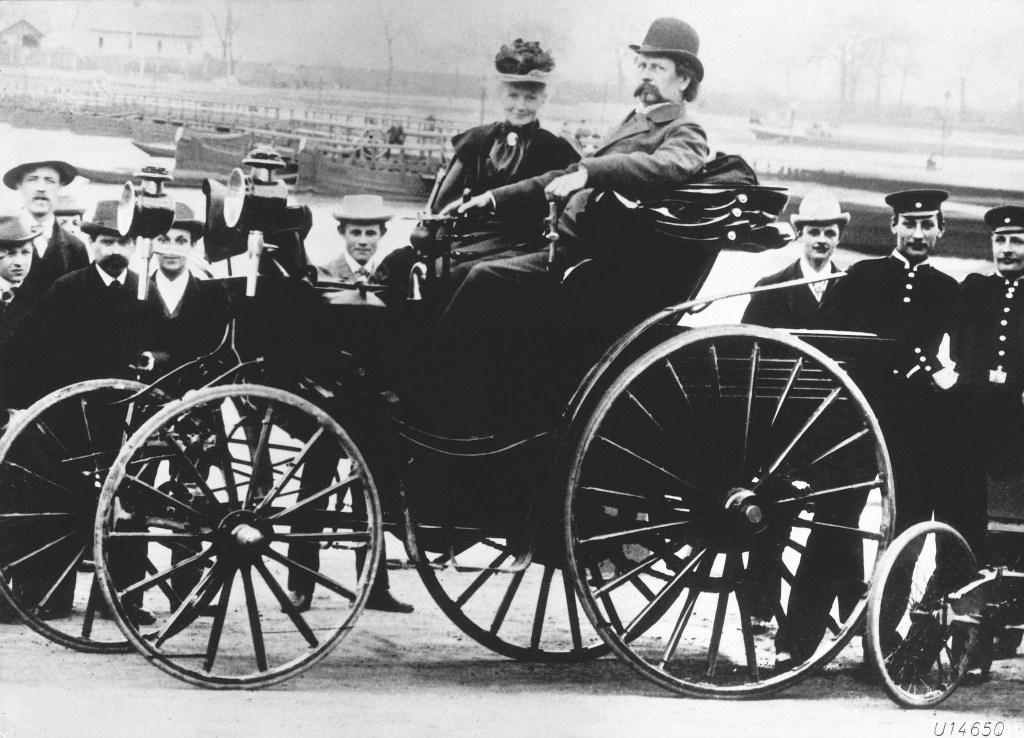
Karl Benz with his wife Bertha, the first motor car (1885)

Invention of the clutch

Almost all historians agree that clutch was developed in Germany in the 1880s. Daimler met Maybach while they were working for Nikolaus Otto, the inventor of the internal combustion engine. In 1882 the two set up their own company, and from 1885 to 1886 they built a four-wheeled vehicle with a petrol engine and multiple gears. The gears were external, however, and engaged by winding belts over pulleys to drive each selected gear. In 1889, they developed a closed four- speed gearbox and a friction clutch to powers the gears, this car was the first to be marketed by the Daimler motor campy in 1890. Without a clutch, if the car engine is running the wheels keep turning. For the car to stop without stalling, the wheels and engine must be separated by a clutch. A friction clutch consists of a flywheel mounted to engine side. The clutch originates from the drive shaft and is a large metal plate covered with a frictional material. When the flywheel and clutch make contract, power is then transmitted to the wheels.
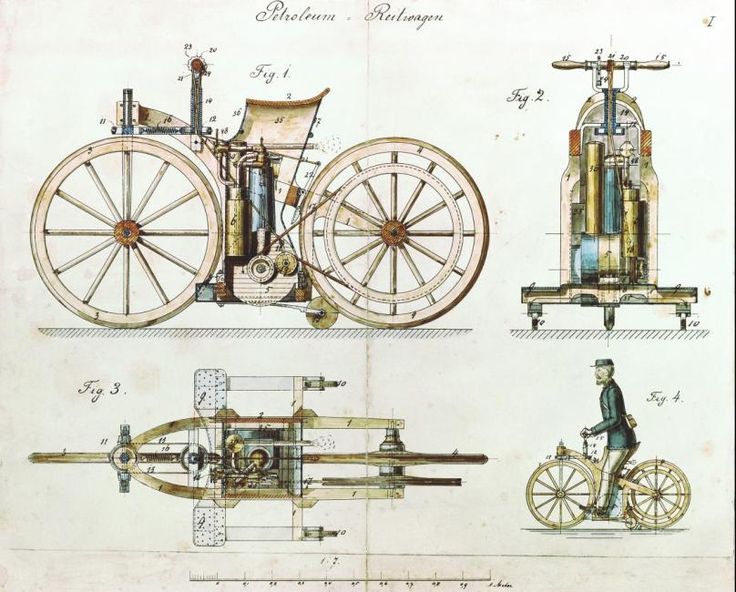
Patent drawings of first motorcar – Karl Benz

Gears in Motorcars

Karl Benz was the first to add a second gear to his machine and also invented the gear shift to transfer between the two. The suggestion for this additional gear came from Benz’s wife, Bertha, who drove the three-wheeled Motorwagen 65 miles from Mannheim to Pforzheim – the first long distance automobile trip. The gears allow the engine to the maintained at its most efficient rpm while altering the relative speed of the drive shaft to the wheels. Gears originally required double clutching, where the clutch had to be depressed to disengage the first gear from the drive shaft, and then released to allow the correct rpm for the new gear to be selected. The clutch was then pressed again to engage the drives shaft with the new gear. Modern cars use synchronized which use friction to match the speeds of the new gear and he shaft before the teeth of the gears engage, meaning that the clutch only needs to be presses once.

“One thing I feel most passionately about: love of invention will never die” – Karl Benz

About that author- Rudyard Kipling

Rudyard Kipling, a journalist, short-story writer, poet, and novelist who is best known among us for his novel the jungle book, was an eminent  20th century writer. Kipling became the youngest person and till this date is the youngest person to receive the award in 1907, at the age of 41.

Life  

Rudyard Kipling was born in 1865, in Mumbai, India, which was a British colony during that time. He was born to John Lockwood Kipling and Alice Kipling. His father was an artist and an architect who used to work at an art school in Mumbai.

He spent his early childhood in India as an Anglo-Indian and at the age of 6 went to Britain and was vaguely perplexed with his identity, a topic he lightly touches on in his later work. In Britain, Kipling did not live with his parents; instead they left both Rudyard and his younger sister with a foster family. During this time, the couple that were looking after the siblings did not treat him very well. In his autobiography Something of Myself for My Friends Known and Unknown, which was published posthumously , Kipling looks back at this period of  his life with dread. Kipling felt abandoned and isolated throughout his childhood. First he was abandoned by his parents and then he was neglected in his foster home too.

In 1877 Kipling’s mother returned to England and pulled her children out of that foster home. The very next year, he was sent to the United Services College in Devon, where students would be prepared for the army. 

Career 

Towards the end of the school, Kipling dropped out as his family did not have enough money to send him to college so instead his father secured a job for him in India and worked as an editor and a journalist for a newspaper. This was the beginning of his journalistic career. It was in India that Kipling started to publish his collection of short stories. He published Plain Tales from the Hills in 1888 and he published 6 volumes of short stories which included soldiers Three, The Phantom Rickshaw; between 1887 and 1889. By the end of this decade, Kipling gained so much popularity that he was being considered one of the best prose writers of his time.

He left India in 1889 and went to San Francisco during this journey he met The Adventures of Tom Sawyer writer Mark Twain.

In 1892, he married Caroline Balestier and the couple lived in America before moving to England. In this decade Kipling he produced work that he is most known for, like  The Light That Failed in 1891, The Jungle Book in 1894, The Seven Seas  in 1896, a collection of poems,  Captains Courageous in 1897.

In 1907, at the age of 41, he became the youngest and the first Englishman to receive the Nobel Prize for literature. Kipling is thought to be an imperialist; his ideology at that time and even during this time is not accepted by people  and has been long criticized for the same. However, he was a very popular writer of his time.

About that author- Charles Bukowski

“We are here to laugh at the odds and live our lives so well that Death will tremble to take us.”

This very famous quote by Charles Bukowski gives us an idea about the kind of individual he was. He was the kind of poet who wrote whatever was in his heart, whenever it was. He always spoke about a part of himself that exists inside us all but we choose to silence it. Bukowski, afraid of that part, still chooses to give it a voice through his poems.

Life 

Charles Bukowski was a German-American poet, writer known for the violent imagery he tries to depict with his writing. Bukowski left his home in Los Angeles to move to New York to pursue writing. In New York he took up a lot of odd jobs so that he could continue to write, but he did not see much success during that period of his life.

Career 

Charles Bukowski published his first story, titled  “Aftermath of a Lengthy Rejection Slip” in 1944, at the age of 24 in a magazine. He published another story titled “20 Tanks from Kasseldown” about 2 years later in 1946, but unfortunately he failed to make a breakthrough and was left disappointed. Bukowski wrote a lot, was published too little and received even less recognition. This led him to quit writing or rather take a break from writing in the year 1946.

Now, one could say that Bukowski did not do anything during his hiatus but I disagree. During these years Bukowski gathered material for his future work. He moved back to Los Angeles and lived the life of a hippie and wandered around the country staying in cheap places. He would travel. drink alcohol and observe. The observations are talked about in his later published books.

Bukowski talked about the harsh and crude reality of existence and is known for his raw and bare writing.

After a hiatus of almost a decade, Bukowski got back to writing. In the mid 1950s he was hospitalized for a fatal bleeding ulcer. After being released from the hospital he started to write poetry, at the age of 35. Charles Bukowski, in 1957 married Barbara Frye, who later died in India. This incident resulted in Bukowski going back to alcohol and writing poetry.

By this time, Bukowski’s poems were published in literary magazines. But still he was unable to see the success he very much deserved. In the 1960s, he published a lot of poems and short stories and only tasted success in his 50s.

Bukowski spent more than half of his life writing and not seeing any considerable amount of success. He did not give up, in fact there was no point in him giving up because he was not one of the writers who wrote to achieve success, he wrote because he was extraordinarily in love with his art. He did not try to be a writer, in fact he didn’t try to be anything but true to himself and his work. He did not force himself to write, evident by his decade long hiatus. He thought that there had been too many writers in the past who forced themselves to try, whereas in his opinion if you truly love an art form you wouldn’t have to try, it would come to the artist. In his opinion if you had to try to be or do something you shouldn’t try at all. Even his grave has the words “don’t try” engraved on it.

He died in 1994, due to leukemia after living an adventurous and fulfiled life. 

Pets A True Friend

Having a pet at home, may be a dog, cat or any other animal makes you feel like a family and a companion. For a pet owners become their whole world. They are always loyal towards their owner, they are actually like parent to them.

There are many scientific proven positive effects on mental and social well being while having a pet at your home. They never let you feel alone, they are always around you. They sense your feelings and try to make you happy always. They can’t speak in our language but, they can understand and we can understand them too, there is actually an internal connection with them.

Having a pet miss you more social as you always have to take them for a walk that also help in having a physical exercise for us too. The help us connect to the people. Once you have a pet you actually have a family member with you which never lets you be lonely.

l just want to say that please care for your pets, don’t ever leave them as where whole world is you can’t live without you. Teacher responsibility of paint only when you can take care of them till the last breath don’t leave them alone in the middle of an ocean.

Be a good pet owner. Be like their parent and care for them as your child, play with them as friend and treat them as your family.

Why Higgs Boson is called as the ‘God Particle’?

By Shashikant Nishant Sharma

In 1964 peter Higgs with five scientists proposed a theory called the Higgs mechanism to explain the existence of mass in the universe. Before 1930s, atoms were considered as the fundamental particles. Then we found electron, protons and neutrons as atomic particles. Later we found that protons and neutrons are made up of even more small fundamental particles called quarks. Quarks are the fundamental building blocks for the whole universe. The key evidence for the existence of these elementary particles came from a series of inelastic electron-nucleon scattering experiments conducted between 1967 and 1973 at the Stanford linear accelerator center. They are commonly found in protons and neutrons. There are six types of quarks, up quark, down quark, top quark, bottom quark, strange quark, charm quark. They can have positive (+) or negative (-) electric charge. Up, charm and top quarks have a positive 2/3 charge. Down, strange, bottom quarks have a negative 1/3 charge. So protons are positive because there are two quarks (+2/3) ups and one down quark (-1/3), giving a net positive charge (+2/3+2/3-1/3 =1). These three quarks are known as valence quarks, but the proton could have an additional up quark and anti-up quark pair.

The Higgs field theory

In the second half of the 20th century, physicists made a developed a theory called a standard model of particle physics. They theorized about twelve fundamental particles that make up all matter, and four particles called bosons are responsible for three fundamental forces of nature. It includes strong force, weak force, and electromagnetism. Gravity is another force, it is not a part of this model but, it can be modeled using general relativity. With these fundamental particles in the standard model and gravity, we can build almost everything in the entire universe. However until 2012, the standard model was an underlying theory. Because all forces carrying particles should be massless. So, although the photons are massless, experiments show that the weak forces bosons have mass. So that was a promising model that could be used to explain our universe. But perhaps, it would need to be thrown out because it had the seemingly fatal flaw in being inconsistent regarding the way the weak force worked in the late 1950s physicists had no idea to resolve these issues all attempts to solve this problem. But indeed it created new theoretical problems. In 1964, Peter Higgs hypothesized that perhaps the force articles were massless but gained mass when they interacted with an energy field that is the reason for the existence of the entire universe.

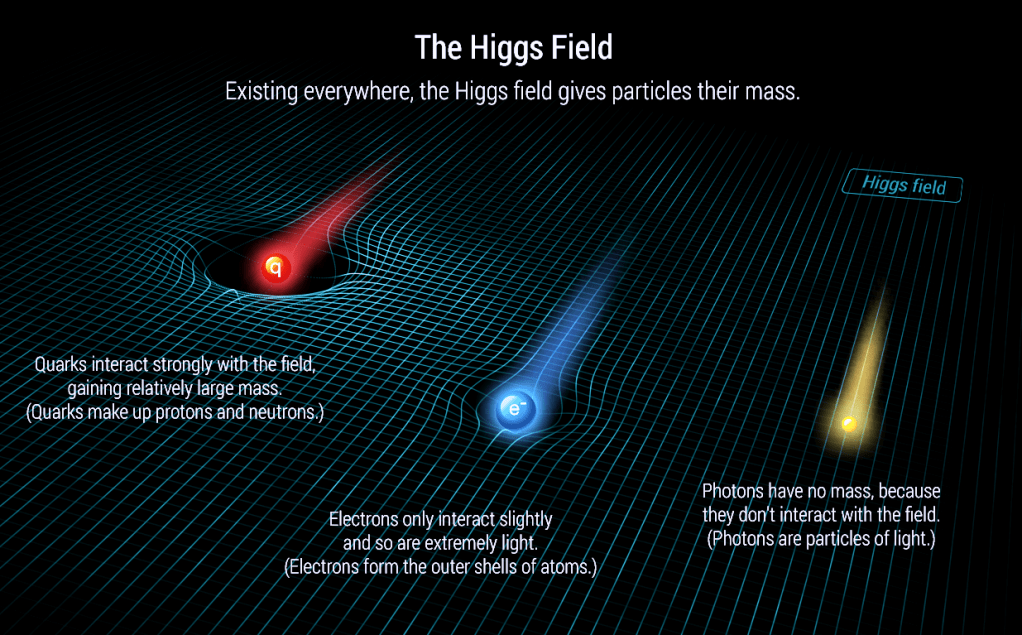
During the very early moments following the big bang, in the universe, the elementary particles were massless and they were pure streams of energy that move at the speed of light. As the expansion of the universe was proceeding, density and temperature decreased below a certain key value. According to the theory, the Higgs field interacts with particles and can give them mass. It is theorized that different particles interact differently with the field, the particles that interact with it more intensely have greater mass and particles that don’t interact with it that much have lower mass. Just imagine Higgs field as water, pointed shape objects interact lesser with water and cube shaped objects interact more with it. Some particles don’t interact with the field like photons are massless. A fundamental part of the theory was the presence of a specific particle; it’s called the Higgs boson. A boson that would allow the Higgs mechanism to unfold correctly to give mass to all other particles.

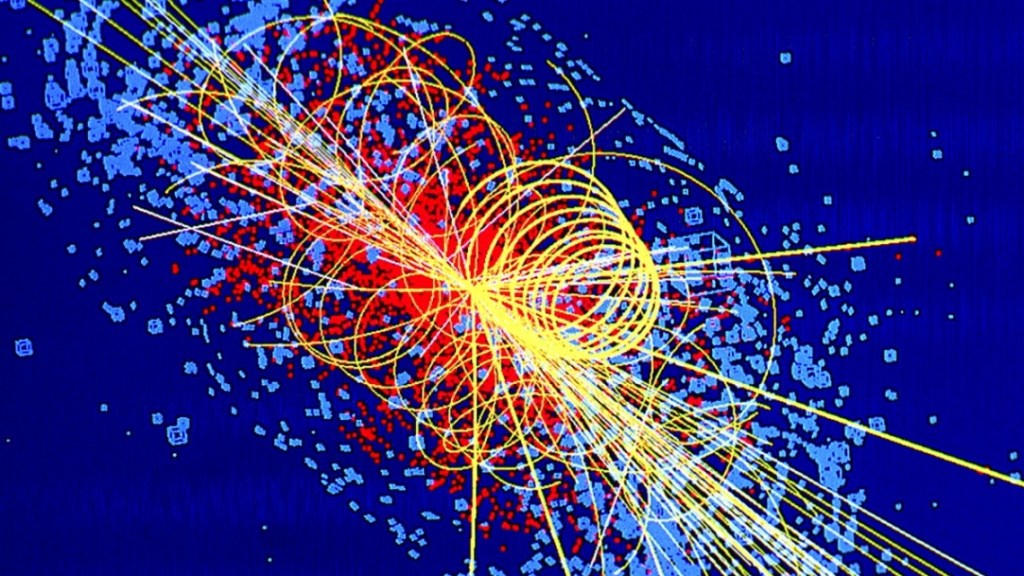
The Higgs Boson – CMS experiment

CERN’s discovery of a new particle

Even though Higgs theorized it, scientists can’t able to prove that until 2012. The particle accelerators had to possess a huge amount of energy to detect them. Finally, the Large Hadron Collider (LHC), the CERN’s particle accelerator has been turned on in 2008 and managed to recreate the required energy and temperature conditions in 2012. The Higgs boson was finally experimentally detected and on 4th July, a conference held in the CERN auditorium announced the discovery of a particle compatible with the Higgs boson. The machine accelerates Hadron bundles at close to the speed of light and collides them each other in opposite directions. At four separate points the two beams cross, causing protons to smash into each other at enormous energies, with their destruction being witnessed by super-sensitive instruments. Even if LHC is the world’s largest particle accelerator, it had to work hard to detect Higgs boson. If the Higgs field doesn’t exist, all particles in the universe will become absolutely weightless and fly around the universe in the speed of light. For This reason Higgs boson is often called as the ‘God particle’.

“I never expected this to happen in my lifetime and shall be asking my family to put champagne in the fridge.”Peter Higgs

About that artist- Artemisia Gentileschi

Artemisia Gentileschi is regarded as one of the most illustrious artists of the 17th century. She made a name for herself during a time when women were not allowed to be a part of art and cultural activities. Her paintings were a symbol of women empowerment of the Baroque period and yet are not well known.

Early life

Artemisia was born in 1593 in Rome Italy, to Orazio Gentileschi, a renowned painter at the time. Her father recognized her talent from an early age and encouraged her to paint. Her father was a huge follower of the remarkable Baroque painter Caravaggio and her own paintings were highly inspired by Caravagio’s dramatic realism.  

Career

Gentileschi’s earliest known work is Sussana and the Elders, who at the time of painting this was only 17. The painting shows a young woman Sussane taking a bath in her garden and two men with ill intentions and a predatory look towering over the young women. Sussane who obviously seems very vulnerable at the moment and can not do much but just confute the two men with her actions which go to waste. This painting is inspired from a tale in the book of daniel. This tale portrays Sussana taking a bath in her garden as two elders start spying and harassing her sexually. 

In 1611, an Italian landscape painter Agostino Tassi who was working under Orazio, went into their house and raped Artemisia. Orazio was under the impression that Tassi would be marrying her daughter to save the Gentileschi name from embarrassment but when Tassi refused to do so Orazio took him to trial. This was really tragic for the 17 year old Gentilesci, according to her father and all the other men in power her virginity was stolen but for her it was a part of her that was stripped away. As if this wasn’t enough torture for her she was tortured with nails and screws at the trial to attest the authenticity of her testimony. Tassi was found guilty but did not serve any sentence owing to his relations with the pope.

A short while after the trial, her father married her off to a Florence based artist and moved to florence. This period of her life brought her tremendous success. She became the first woman to be accepted at the Academy of Design, Florence. This meant that she did not need permission from any man to buy art supplies, she could do it without any men controlling her.

In Florence, Gentileschi had developed her own style. She used tenebrism in her paintings which is a style of painting that uses light and dark contrasts and the dark becomes a dominating feature.

In 1620, she completed Judith Slaying Holofernes, which is inspired from a narrative in The Bible. Throughout the history of art many versions of this tale have been painted by multiple artists, even Caravaggio but Gentileschi’s  version is more real and violent. This work of hers can be compared with her own traumatic experience, where Holofernes can be compared to Tassi and Judith is Gentileschi.

Now it is not that she was the first female painter ever but all the female artists that came before her chose still lives or aesthetically pleasing subject matters. Gentileschi on the other hand, portrayed women that were a subject to male oppression like herself and were raw. Yet she is not very well known in the 21st century. Gentileschi’s work is empowering and a mark of early feminism and needs to be celebrated.

Plastic A Modern Devil

Plastic the most dangerous and harmful enemy of our environment. It is killing mother nature and our health too. We take plastic bags from shop and don’t realise that we are actually taking home a devil who will cause harm to not only nature but to us too.

A normal plastic takes about 1000 years to decompose. Just think about it that a single piece of plastic take such long years to decompose, the level of plastic which we are using today will take how many years to decompose. It is choking our water organisms life. It is also choking are animals who eat food from the garbage like the cow, dogs, cats etc.

The youth are taking responsibility reduce the use of the plastic and organising campaigns and webinars to create awareness among people to not use plastic or use decomposable plastic. The big companies are taking responsibilities to to recycle plastic and many new forms has also set up for this purpose.

Even the government have started realising the need to protect our environment and nature. International organisations like UN has also so so called for an international cooperation in this matter.

There are many innovative way in which the plastic are being reused like in making bricks, floor, dolls, chair, etc. Forest sustainable future we have to look into this matter with utmost seriousness. This earth belongs to everyone and we have no right to miss you or destroy any element on this earth.

How waves differ from tides? why do they occur?

A wave begins as the wind ruffles the surface of the ocean. When the ocean is calm and glass like, even the mildest breeze forms ripples, the smallest type of wave. Ripples provide surfaces for wind to act on, which produces larger waves. Stronger winds push the nascent waves into steeper and higher hills of water. The size a wave reaches depends on the speed and strength of the wind. The length of time it takes for the wave to form, and the distance over which it blows in the open ocean is known as the fetch. A long fetch accompanied by strong and study winds can produce enormous waves. The highest point of a wave is called the crest and the lowest point the trough. The distance from one crest to another is known as the wavelength.

Although water appears to move forward with the waves, for the most part water particles travel in circles within the waves. The visible movement is the wave’s form and energy moving through the water, courtesy of energy provided by the wind. Wave speed also varies; on average waves travel about 20 to 50 Mph. Ocean waves vary greatly in height from crest to trough, averaging 5 to 10 feet. Storm waves may tower 50 to 70 feet or more. The biggest wave that was ever recorded by humans was in Lituya bay on July 9th, 1958. Lituya bay sits on the southeast side of Alaska. A massive earthquake during the time would trigger a mega tsunami and the tallest tsunami in modern times. As a wave enters shallow water and nears the shore, it’s up and down movement is disrupted and it slows down. The crest grows higher and be gins to surge ahead of  the rest of the wave, eventually toppling over and breaking apart. The energy released by a breaking wave can be explosive. Breakers can wear down rocky coast and also build up sandy beaches.

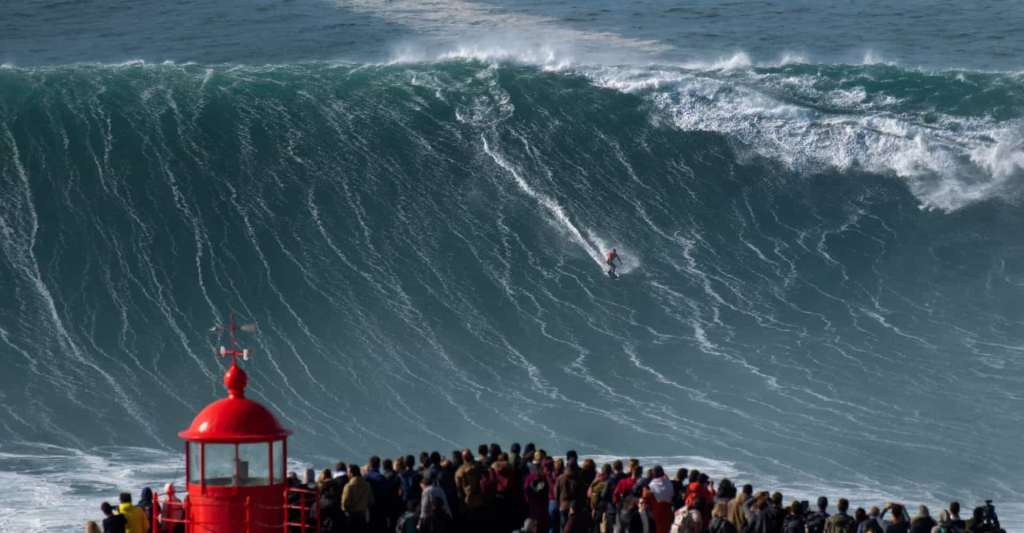
At Nazare ,the Brazilian Rodrigo Koxa holds the record for the biggest wave ever surfed (80ft).

Why does a tide occur?

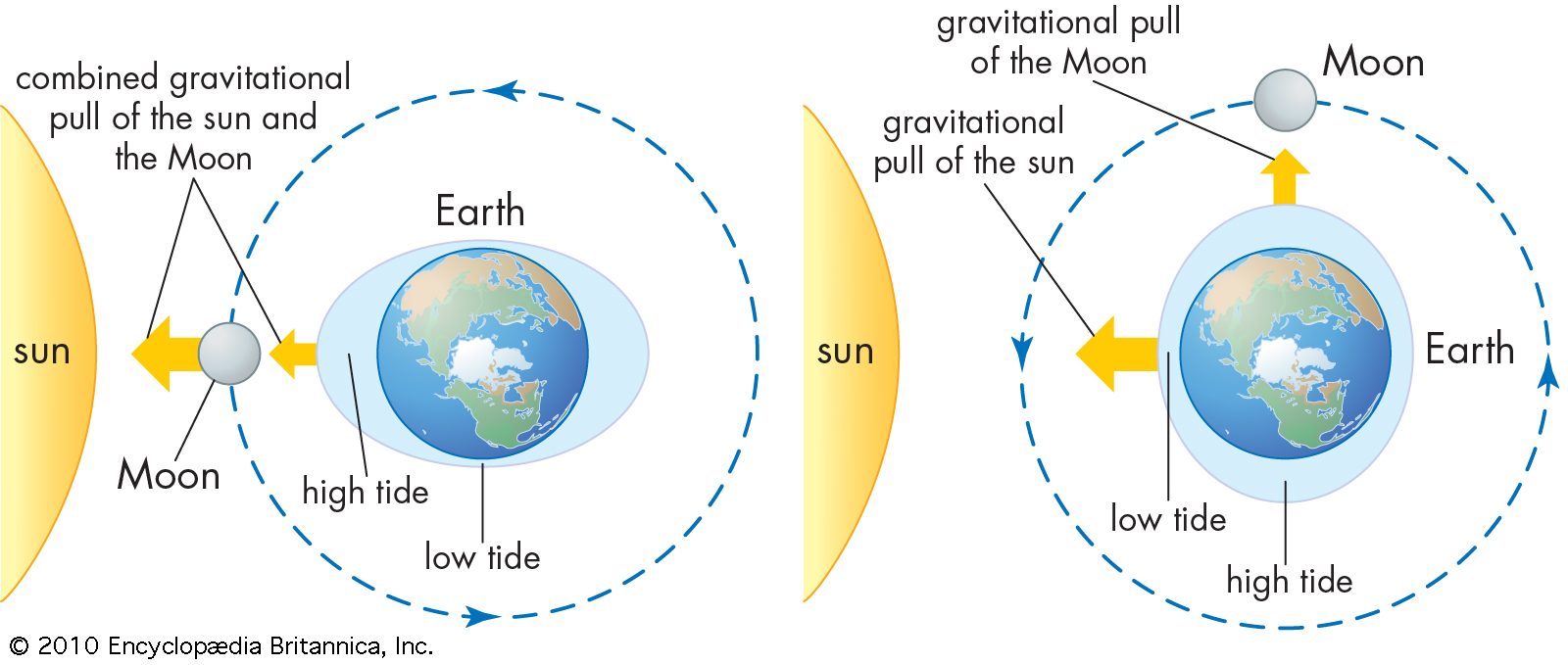
Tides are the regular daily rise and fall of ocean waters. Twice each day in most locations, water rises up over the shore until it reaches its highest level, or high tide. In between, the water recedes from the shore until it reaches its lowest level, or low tide. Tides respond to the gravitational pull of the moon and sun. Gravitational pull has little effect on the solid and inflexible land, but the fluid oceans react strongly. Because the moon is closer, its pull is greater, making it the dominant force in tide formation.

Gravitational pull is greatest on the side of earth facing the moon and weakest on the side opposite to the moon. Nonetheless, the difference in these forces, in combination with earth’s rotation and other factors, allows the oceans to bulge outward on each side, creating high tides. The sides of earth that are not in alignment with the moon experience low tides at this time. Tides follow different patterns, depending on the shape of the seacoast and the ocean floor.  In Nova Scotia, water at high tide can rise more than 50 feet higher than the low tide level. They tend to roll in gently on wide, open beaches in confined spaces, such as a narrow inlet or bay, the water may rise to very high levels at high tide.

There are typically two spring tides and two narrow tides each month. Spring tide of great range than the mean range, the water level rises and falls to the greatest extend from the mean tide level. Spring tides occur about every two weeks, when the moon is full or new. Tides are at their maximum when the moon and the sun are in the same place as the earth. In a semi-diurnal cycle the high and low tides occur around 6 hours and 12.5 minutes apart. The same tidal forces that cause tides in the oceans affect the solid earth causing it to change shape by a few inches.

About that author- George Orwell

George Orwell, best known for his novels “Animal Farm” and his dystopian novel “1984”. He was known for a dystopian world he could create through his imagination. His writings, in a sense were also satirical, criticism towards institutions that held power

Childhood

Born on june 25, 1903 Eric Arthur Blair wrote some of the best dystopian novels under the pen name George Orwell. He was born in Motihari, India. His father worked for the Indian Civil Services. His mother Ida Blair grew up in Burma. A year after Eric was born his mother took him and his sister back to England. Eric had 2 sisters and he was the middle child. He was sent to a boarding school, excelled academically and even secured a scholarship in school.

He did not come from a financially sound household and therefore could not go to a university to study further. So instead he left for Burma (a British colony back then) in 1922 to serve in the Indian Imperial police. 5 years later he resigned from the Imperial Police to go back to England in order to chase his dream of becoming a writer. But Burma left him inspired, inspired enough to write a novel about it entitled “Burmese Days”. His experiences in Burma shaped his perception of writing to a certain extent.

Career 

After leaving Burma, he spent some time with his family and also lived in the slums of London and Paris, working odd jobs, he even washed dishes at hotels in Paris. He collected all of these experiences and wrote them down in his first well recognized  work “Down and Out in Paris and London” published in 1933 under the pen name George Orwell. This work of his provides insights about the life of the impoverished and the working class in that economy. 

Orwell’s second piece of work “Burmese Days” published in 1934 gives it’s readers a tour of Burma under British rule. This novel surrounds the grim facets of colonialism that he himself first handedly lived through.

His stories contain an alienated character, a character who feels a little detached from the environment. This alienation parallels his feelings during childhood and perhaps even his adult life.

Orwell published books in the next few subsequent years including “A Clergyman’s Daughter” in 1935, “Keep the Aspidistra Flying” in 1936, a rather political novel.

Orwell’s writings became political due to political movements involving imperialism and the uprising of the communist ideology.

Orwell left for Spain in 1936 to fight in the Spanish civil war where he suffered some serious injuries. At the time, his wife, Eileen was taking care of the publishing of his next book “The Road to Wigan Pier ” (1937). In mid 1937 Orwell came back to London and was later diagnosed with tuberculosis. His time in Spain was one that he expresses in his novel “Homage to Catalonia”. During WWII, he was working as a journalist at the BBC, a job that he left in 1943. Later working as an editor for a newspaper which led him to be known as a fine journalist.

In 1950, about a year after “1984” was published, he died due to Tuberculosis, granting the world some great work to read.

ALCOHOLISM IN INDIA

One of the most important products of global addiction demand is an alcoholic beverage. In developing countries like India, alcohol consumption tends to be a major problem because of the various socio-cultural practices across the nation, different alcohol policies and practices across the various states, lack of awareness of alcohol-related problems among the community, false mass media propaganda about alcohol use, various alcohol drinking patterns among the alcohol consumers and the emergence of social drinking as a habit because of the widespread urbanisation across the country. 

Social consequences of alcohol use

Alcohol consumption not only affects the individuals but also his family members get affected in one way or the other. The person in an intoxicated state may indulge in domestic violence with his family members; may exhaust the savings of the family, which can negatively affect the education of his children, and the children of alcoholic fathers will have strained relationship with their family members, which can affect their psychological wellbeing.

Road traffic accidents

One of the major problem of alcohol consumption are road traffic accidents which occur due to driving vehicles under the influence of alcoholic beverages. Both developing and developed countries report high rates of road traffic accidents because of alcohol consumption.

Primary care intervention for alcohol-related problems

In developing countries like India, primary care physicians are the first contact of patients with the healthcare system. primary care management of alcohol-related problems include three core steps, namely, counselling the patient on the ill-effects of alcohol and, if necessary, prescribing medications like disulfiram and connecting with the patients by organizing treatment programs and forming support groups. If necessary, they have to refer the patient to higher centres for further care and management.

BUT WHAT ABOUT PEOPLE WHO CAN’T AFFORD THESE TREATMENT AND SUFFERES FROM ITS CONSEQUENCES

In many countries AA Meetings are held for being a support emotionally and spiritually to an alcoholic person with no financial support and most of all countries it being held have not only they have accepted this but hole heartedly supported it some for their family members or some for their friends suffering from alcoholism.

What is AA?

Alcoholics Anonymous is a fellowship of men and women who share their experience, strength and hope with each other that they may solve their common problem and help others to recover from alcoholism.

The only requirement for membership is a desire to stop drinking. There are no dues or fees for AA membership; we are self-supporting through our own contributions. AA is not allied with any sect, denomination, politics, organization or institution; does not wish to engage in any controversy; neither endorses nor opposes any causes. Our primary purpose is to stay sober and help other alcoholics to achieve sobriety.

AA is nonprofessional – it doesn’t have clinics, doctors, counsellors or psychologists. All members are themselves recovering from alcoholism. There is no central authority controlling how AA groups operate. It is up to the members of each group to decide what they do. However, the AA program of recovery has proved to be so successful that almost every group follows it in very similar ways.

WHAT DOES A.A. DO?

  1. A.A. members share their experience with anyone seeking help with a drinking problem; they give person-to-person service or “sponsorship” to the alcoholic coming to A.A. from any source.
  2. The A.A. programme, set forth in our Twelve Steps, offers the alcoholic a way to develop a satisfying life without alcohol.

HISTORY OF AA IN INDIA

Here is an account of how AA came to India and it’s growth in the subsequent years. Though there are no accurate records from the early days, what is definitely clear is that Harold M., a school teacher by profession, was the first person in India, to stop drinking and gain lasting sobriety through the spiritual principles of Alcoholics Anonymous. He stopped drinking on 5th May 1957, and hence that date is nationally acknowledged as the “Founders Day” in India.

On 5th May 2021, AA completed 64 years of its service in India. Looking back, the results are heart-warming. The wide support and awareness generated by the groups in India and its members inspires immense hope for the future.

AWARENESS OF AA

In India, AA meeting is a program which mostly seen by people through foreign movies and shows not through advertisement or medical portals as its necessity seems nonsensical by people especially in India because of their traditional values about alcohol where some drinks it as a medicine and some as men for showing their authority and masculinity over others, stupid norms like that make bad habit like drinking into ADDICTION.

Positive effects of Covid Lockdown

Covid 19 a name which has changed the life of every individual in this world. It has changed the way we live, the way we work the way we think.When we hear covid-19 we get anxious, sad and always look at the negative side of it. Which is right because we have lost so many lives, jobs, increase in the number of of depression cases, which has ultimately made everyone’s life a Topsy-turvy.

But as we know there is always two sides of a coin, so there is always two sides of any situation too. We have already looked at the negative side and we know about it but now let’s look at the positive sides too.

Reduction in air pollution : there was reduced in air pollution which improve the air quality of whole world, as all of the big factories where close up and there was no emission of carbon dioxide, Sulphur and other toxic gases in the atmosphere.

Clearance of water body : the water bodies have cleaned themselves during this time as the industries and factories when not releasing any toxic chemicals and materials in the water bodies which even increased the number of water organism.

Reduction in use of energy : again due to the close down of all the factories and industries the energy consumed earlier was reduced and which lead to saving a lot of energy.

Improve in health facilities : as this covid-19 broke out we actually realised that we need a better health facilities and to provide these facilities many new firms were established to provide this medical and health facilities leading to its improvement. India was one of the largest producer of mass and PPE kits.

Technological advancement : when the spender make broke out everything has switched to online platforms which lead to to its improvement. As we know necessity is the mother of invention and in these time when we were not able to meet each other physically technology help us a lot to overcome this hindrance

Removal of place hindrance : we were able to take online classes, meetings, webinars and other events online which actually remove the hindrance of place as we can attend it being in any part of this world.

Spend more time with family : we were able to give more time to our family members and loved ones which earlier was not possible due to a busy work schedule.

Getting a break from busy life : this actually gave us a break from our busy life and think about ourselves and enjoy quality time with her family which actually make us very happy.

Chances for learning new skills : this also provided as to improve our skills through online courses which was earlier difficult for us to focus upon because of our busy life.

Just look at the positive sides of it. There are many more which I may not be able to cover right now, but you know it. So in order to get inspiration in the difficult time we should look at the positive points of it. Because this is what life is about facing difficulties with a smile on your face and a positive attitude in your mind.

Global Warming a Global Threat

“Global warming, a global threat”. We have heard a lot about global warming in the news debates general discussion and international discussions too. But are we really serious about it, we just hear it and leave it we never try to understand the seriousness of it. It has just turn to be a debate topic for us.

The temperature of the Earth is increasing drastically, even in Antarctica whoes normal temperature remain +10°C in summer experience 18.3 degree Celsius record temperature which is an alarm in one. Even Canada is facing about 50 degree celsius temperature which is the record highest in the history of Canada.

Cause of global warming is the CFC gases which are released by the AC, refrigerators and cars that we use. The clearing of forests that leads to deforestation is another cause of global warming as carbon dioxide is not been able to use by the trees. Global warming leads to melting of glaciers which ultimately leads to increase in sea level which is the main cause of tsunamis and other problems.

We always hear that action speaks Louder Than words and this is the real problem to take action upon. There are many steps taken internationally for this cause but we should contribute from our side too.

We can contribute by planting a tree or any small plant or by reducing the use of ACs, refrigerators and cars. Just think about it it might be a very small step from your side but will cause a great difference to this earth. Just bring the first step forward and other get inspired by you and will ultimately E result in reduction of the Global temperature.

Water A Priceless Resource

Water an absolute necessity of life. How weird, a thing which doesn’t have taste, colour or smell plays the most important part in our life. It is our daily basic necessity, it is so basic that even we have started ignoring it’s presence. The importance of anything is only realise when we are deprived of that.

We have started misusing this resource. We waste a lot of water while brushing, bathing and even pollute water bodies by contaminating it with harmful Chemicals and industrial waste which, leads to death of water organism. We have forgot that what is not our property it belongs to everyone who is present on earth.

The value of water is realised by those who are deprived of it. Almost 90% of the world’s population to not have access to clean drinking water they are forced to drink muddy and dirty water. Those people use every drop of water very cautiously. We should at least think of them if we save even a single drop of water if we can, this will contribute to a great cause.

We should take a youth from today itself that we should not waste a single drop of water. Saving water means saving life, there are many people who died because of drought and many other reason like drinking contaminated water. Do think about them and please save water if you can. Be a responsible citizen and it is our responsibility.

How optics changed the world?

The formal study of light began as an effort to explain vision. Early Greek thinkers associated with a ray emitted from the human eye. A surviving work from Euclid, the Greek geometrician, laid out basic concepts of perspective, using straight lines to show why objects at a distance appear shorter or slower than they actually are. Eleventh-century Islamic scholar Abu Ali al Hasan Ibn Al-Haytham known also by the Latinized name Alhazen revisited the work done by Euclid and Ptolemy and advanced the study of reflection, refraction, and color. He argued that light moves out in all directions from illuminated objects and that vision results when light enters the eye. In the late 16th and 17th centuries, researches including Dutch mathematician Willebrord Snel noticed that light bent as it passed through a lens or fluid. Although he believed the speed of light to be infinite, Danish astronomer Ole Romar in 1676 used telescopic observations of Jupiter moons to estimate the speed of light as 140,000 miles a second. Around the same time, Sir Isaac Newton used prisms to demonstrate that white light could be separated into a spectrum of basics colors. He believed that light was made of particles, where as Dutch mathematician Christiaan Huygens described light as a wave.

The particle versus the wave debate advanced in the 1800s. English physician Thomas young’s experiments with vision suggested wavelike behavior, since sources of light seemed to cancel out or reinforce each other. Scottish physicist James Clerk Maxwell’s research united the forces of electromagnetism fell along a single spectrum. Te arrival of quantum physics in late 19th and early 20th century prompted the next leap in understanding light. By studying the emission of electrons from a grid hit by a beam of light known as the photoelectric effect Albert Einstein concluded that light came from what he called photons, emitted as electrons changed their orbit around an atomic nucleus and then jumped back to their original state. Through Einstein’s finding seemed to favor the particle theory of light, further experiments showed that light and matter itself behave both as waves and as particles.

How do lasers works?

Einstein’s work on the photoelectric effect led to the laser, an acronym for “light amplification by stimulated emission radiation.” As electrons are exited from one quantum state to another, they emit a single photon when jumping back. But Einstein predicted that when an already excited atom was hit with the right type of stimulus, it would give off two identical photons. Subsequent experiments showed that certain source materials, such as ruby, not only did that but also emitted photons that were perfectly coherent-not scattered like the emissions of a flashlight, but all of the same wavelength and amplitude. These powerfully focused beams are now common-place, found in grocery store scanners, handheld pointers, and cutting instruments from the hospital operating room to the shop floors of heavy industry.

Future trends in fiber optics communication

Fiber optics communication is definitely the future of data communication. The evolution of fiber optic communication has been driven by advancement in technology and increased demand for fiber optic communication. It is expected to continue into the future, with the development of new and more advanced communication technology.

Another future trend will be the extension of present semiconductor lasers to a wider variety of lasing wavelengths. Shorter wavelength lasers with very high input powers are of interest in some high density optical applications. Presently, laser sources which are spectral shaped through chirp managing to compensate for chromatic dispersion are available. Chirp managing means that the laser is controlled such that it undergoes a sudden change in its wavelength when firing a pulse, such that the chromatic dispersion experienced by the pulse is reduced. There is need to develop instruments to be used to characterize such lasers. Also, single mode tunable lasers are of great importance for future coherent optical systems. These tunable lasers laser in a single longitudinal mode that can be tuned to a range of different frequencies.

“Music is the arithmetic of sounds as optics is the geometry of light.” – Claude Debussy

Car Market in India during Pandemic Covid-19

The impact of pandemic covid-19 in India has been vastly disruptive in terms of loss of life and economic movement.
Almost every sector has been adversely affected by the pandemic. Production cut due to decline in demand of cars during covid-19 also impacted employment growth negatively.


As the domestic demand and export stopped with some notable exceptions. Pandemic with the lockdown derived in shutting down of production in automobile industries and impacted car marketing in India. In addition, the reduction in the consumer demand for cars is also increased. The car market during covid-19 in India had the hardest hit.

With the statement of automobiles Manufacturers society, the car market registers a negative growth in sales. But that’s not equally true for all. Still, luxury car manufacture said they are seeing a boom in the demand despite the pandemic. While studying the car market trends during covid-19. Profits are been made on the kind of car being sold during pandemic covid-19. Overall car sales were down compared with the previous year. As lockdown is giving ease in some cities hence people are electing to buy cars rather then using public transport. The reason being behind is people are afraid of using public transport while concerning about their safety.
The main Impact that the car market during covid-19 submitted is the slowdown in the demand for new cars and increase in demand for used cars. Because Used cars are budget-friendly and the supply of new cars is slow. Nowadays, The supply and demand all are delivered online. The available option is more.


The picture is improving however, the manufacturers must start the production after relief from the second wave of the covid-19. Confirming the protection of its employees and customers. Following the social distancing and vaccination. In addition, the government has decided to support The car market during covid19 by its policies, such as decreasing the cost of raw material required and cutting down the tax rates on automobiles. All such measures can help the market to recover sooner and tougher.