Pursuing a PhD in England offers a wealth of funding opportunities to support your academic journey. Here are some of the top grants and scholarships available:
1. UK Research and Innovation (UKRI) Scholarships
UKRI, through its seven Research Councils, provides substantial funding for PhD students across various disciplines. These scholarships typically cover tuition fees and offer a stipend for living expenses. For the academic year 2022/23, the minimum stipend is £16,062, with potential adjustments for inflation.
2. Commonwealth Scholarships
Administered by the Commonwealth Scholarship Commission, these scholarships are designed for students from Commonwealth countries. They cover tuition fees, travel costs, and provide a living allowance. Eligibility and application deadlines vary based on the specific scholarship category.
3. University Scholarships and Studentships
Many universities in England offer their own scholarships and studentships to attract talented PhD candidates. These awards can cover tuition fees, provide stipends, or offer grants for research expenses. Prospective students should explore the specific funding opportunities available at their chosen institutions.
4. Charitable Trusts and Foundations
Several charitable organizations, such as the Wellcome Trust and Leverhulme Trust, offer grants and scholarships for PhD students, particularly in specialized research areas. These grants can provide significant financial support, including stipends that may exceed standard rates.
5. Doctoral Loans
The UK government offers doctoral loans to help cover course fees and living costs. Eligible students can borrow up to £25,000, with repayment terms based on income thresholds.
6. International Scholarships
For international students, various scholarships are available to support PhD studies in England. These include awards from the British Council and other organizations dedicated to fostering global academic collaboration.
When considering PhD funding, it’s essential to research each opportunity’s specific eligibility criteria, application deadlines, and funding provisions. Engaging with potential supervisors and university departments can also provide valuable insights into available funding avenues tailored to your research interests.
Atal Academy is an initiative launched by the All India Council for Technical Education (AICTE) to promote quality improvement and professional development among faculty members in higher education institutions, particularly in technical and engineering domains. The academy aims to foster innovation, upskill educators, and ensure the dissemination of the latest developments in technology and pedagogy.
Key Features and Objectives:
1. Faculty Development: Atal Academy organizes specialized Faculty Development Programs (FDPs) in various emerging areas of technology, management, and pedagogy. These programs help teachers enhance their teaching methodologies and technical expertise.
2. Focus on Emerging Technologies: The courses are designed to introduce faculty to cutting-edge technologies such as Artificial Intelligence, Data Science, Machine Learning, Blockchain, Robotics, IoT (Internet of Things), and more, ensuring they stay updated with the latest trends.
3. Capacity Building: The academy aims to build the capacity of educators to meet the challenges of the National Education Policy (NEP) 2020, including multidisciplinary teaching approaches, research capabilities, and innovation in teaching.
4. Nationwide Reach: Atal Academy operates through multiple centers across India to ensure that faculty in remote and less-developed regions have access to high-quality training resources.
5. Industry Collaboration: Many of the FDPs and training sessions are conducted in collaboration with leading industry experts, researchers, and international organizations, ensuring practical exposure and application of concepts.
6. Online and Offline Modules: The academy provides both online and offline training to cater to diverse learning preferences. The online mode has gained popularity for its flexibility, especially post-pandemic.
7. Personalized Learning: Faculty members can choose courses based on their interests and expertise, encouraging personalized and focused learning experiences.
—
Programs and Activities:
1. Workshops and FDPs: Atal Academy regularly conducts short-term workshops and FDPs on topics such as Sustainable Development, Green Technology, Big Data Analytics, and Smart Manufacturing.
2. Train-the-Trainer Initiatives: Programs aimed at training a group of educators who will, in turn, train other faculty members, thus creating a multiplier effect in knowledge dissemination.
3. Research-Oriented Training: Emphasis on improving research skills among faculty, with sessions dedicated to scientific writing, securing patents, and collaborative research opportunities.
4. Interdisciplinary Courses: Courses are often designed to be interdisciplinary, integrating aspects of engineering, management, humanities, and science, reflecting real-world problem-solving approaches.
5. Certification: Participants receive AICTE-recognized certificates upon successful completion of courses, adding value to their professional credentials.
—
Impact of Atal Academy:
Improved Teaching Standards: By equipping educators with updated knowledge and skills, Atal Academy directly enhances the quality of teaching in technical institutions.
Boost to Innovation: Exposure to modern tools and research methods fosters innovation in both teaching and project development.
Bridging the Skill Gap: Faculty trained under Atal Academy programs are better equipped to prepare students for the evolving demands of the job market.
Support for NEP 2020 Goals: The academy plays a crucial role in achieving the goals of the NEP 2020, particularly in promoting research, technology-driven education, and interdisciplinary learning.
—
Future Goals:
1. Expand its reach to more institutions and cover a wider array of subjects, including arts, sciences, and law.
2. Collaborate with global universities to provide world-class resources and training.
3. Foster more entrepreneurship and innovation-focused programs for educators.
4. Leverage AI and analytics to tailor training programs based on faculty needs and institutional requirements.
Atal Academy is a cornerstone in India’s efforts to transform its technical education landscape, ensuring educators are equipped to inspire and guide the next generation of innovators and leaders.
Studying in Australia is an appealing option for international students due to its high-quality education system, vibrant culture, and beautiful landscapes. Many scholarships are available to help offset the costs of studying, including options from the Australian government, universities, and other organizations. Below is a detailed overview of major scholarships available to international students for studying in Australia.
1. Australia Awards Scholarships (AAS)
Eligibility: Students from developing countries, particularly from Asia, the Pacific, Africa, and the Middle East. Level: Undergraduate, Postgraduate (Master’s, Ph.D.) Description: Funded by the Australian government, the Australia Awards Scholarships aim to promote development in partner countries through education. These scholarships are highly competitive and target students who will contribute to the development of their home countries upon their return.
Financial Coverage: Full tuition, return air travel, establishment allowance, health insurance, and a living allowance.
Duration: Full duration of the chosen course.
Fields of Study: Wide range of academic fields that align with Australia’s development goals.
2. Destination Australia Scholarship
Eligibility: Domestic and international students Level: Undergraduate, Postgraduate Description: The Destination Australia Program is an initiative by the Australian Government to encourage students to study in regional Australia. It aims to support both domestic and international students to undertake their studies in regional areas, thus promoting economic growth and community diversity.
Financial Coverage: Up to AUD 15,000 per year.
Duration: Depends on the course length.
Fields of Study: Available for a variety of courses in regional universities.
3. Research Training Program (RTP)
Eligibility: International and domestic students Level: Postgraduate Research (Master’s, Ph.D.) Description: The Australian government’s Research Training Program (RTP) provides block grants to universities to fund students’ tuition and living expenses during their research degrees. RTP scholarships are primarily for students undertaking research-based master’s and doctoral degrees.
Financial Coverage: Tuition fees, a stipend for living costs, and allowances for research expenses.
Duration: 2 years for a master’s by research and 3-4 years for a Ph.D.
Fields of Study: Various research areas are covered, depending on the university.
4. Australia Research Council (ARC) Scholarships
Eligibility: High-achieving postgraduate researchers Level: Ph.D. Description: The ARC offers funding opportunities for research-focused students pursuing doctoral programs in Australia. These scholarships support research in a wide range of disciplines and are typically offered in collaboration with universities and research institutions.
Financial Coverage: Research grants, living stipends, and tuition fee waivers (depending on the program).
Duration: 3 to 4 years.
Fields of Study: Science, engineering, health, and social sciences.
5. Australian Government Endeavour Scholarships
Eligibility: International students from the Asia-Pacific region, the Americas, Europe, and the Middle East. Level: Postgraduate (Master’s, Ph.D.), short-term research programs, professional development. Description: The Endeavour Scholarships, funded by the Australian government, aim to build international relations and promote Australia as a destination for education. The program supports postgraduate study and research in various fields.
Financial Coverage: Tuition, travel allowance (up to AUD 3,000), establishment allowance, and monthly stipend (up to AUD 3,000 per month), plus health and travel insurance.
Duration: 2 to 4 years for long-term programs.
Fields of Study: Open to various academic disciplines.
6. University-Specific Scholarships
Many Australian universities offer scholarships to international students based on academic merit, research potential, or financial need. Some prominent university-based scholarships include:
a. University of Melbourne Scholarships
Eligibility: International students
Level: Undergraduate, Postgraduate, Research
Description: The University of Melbourne offers a range of scholarships, including the Melbourne International Undergraduate Scholarship and the Melbourne Graduate Research Scholarship. These are based on academic merit.
Financial Coverage: Full or partial tuition waivers, living allowances, and health coverage.
b. Australian National University (ANU) Chancellor’s International Scholarship
Eligibility: International students
Level: Undergraduate, Postgraduate
Description: The Chancellor’s International Scholarship recognizes academic excellence and provides financial support to high-performing international students.
Financial Coverage: Tuition fee reductions of up to 50%.
c. University of Sydney International Scholarship
Eligibility: International students
Level: Postgraduate (Master’s, Ph.D.)
Description: This scholarship supports outstanding international postgraduate students undertaking research at the University of Sydney.
Financial Coverage: Tuition fees and a living allowance.
d. Monash University International Scholarships
Eligibility: International students
Level: Undergraduate, Postgraduate
Description: Monash University offers several scholarships, such as the Monash International Merit Scholarship, for high-achieving students.
Financial Coverage: Up to AUD 50,000 over the duration of the course.
e. University of Queensland (UQ) Global Scholarships
Eligibility: International students
Level: Undergraduate, Postgraduate
Description: UQ provides several scholarships, including those for high-achieving students from specific regions, such as India, Hong Kong, and Latin America.
Financial Coverage: Partial or full tuition fee waivers.
7. ACIAR (Australian Centre for International Agricultural Research) Fellowships
Eligibility: Citizens from developing countries Level: Postgraduate (Master’s, Ph.D.) Description: ACIAR provides scholarships to students from partner countries to pursue agricultural research that aligns with Australia’s development cooperation priorities. The scholarship aims to build research capacity in agricultural sciences and related fields.
Financial Coverage: Tuition fees, travel expenses, living allowance, and research costs.
Duration: Up to 4 years.
Fields of Study: Agricultural sciences, environmental management, and related fields.
8. Rotary Peace Fellowship
Eligibility: International students committed to promoting peace and conflict resolution. Level: Master’s Description: This prestigious fellowship is awarded to students studying peace and conflict resolution at one of the Rotary Peace Centers, including the University of Queensland.
Financial Coverage: Tuition fees, travel, living stipend, and field-study expenses.
Duration: 1 to 2 years.
Fields of Study: Peace and conflict studies.
9. Macquarie University Vice-Chancellor’s International Scholarship
Eligibility: International students Level: Undergraduate, Postgraduate Description: Macquarie University offers this partial scholarship to academically outstanding students from around the world. The scholarship is aimed at supporting students financially while also promoting cultural diversity on campus.
Financial Coverage: Up to AUD 10,000 towards tuition fees.
Duration: Varies depending on the course.
Fields of Study: All fields.
How to Apply for Australian Scholarships:
1. Research: Begin by identifying which scholarships you are eligible for based on your country of origin, field of study, and academic level.
2. Check Eligibility: Review each scholarship’s specific requirements, such as academic qualifications, English language proficiency, and professional experience (for some postgraduate scholarships).
3. Prepare Documents: Ensure you have all necessary documents, such as academic transcripts, recommendation letters, a personal statement, and proof of English proficiency (IELTS/TOEFL).
4. Apply Early: Scholarship deadlines often precede admission deadlines, so it’s crucial to apply well in advance.
5. Follow Guidelines: Adhere strictly to the application guidelines provided by the scholarship or university to maximize your chances.
Conclusion:
Australia offers a wide variety of scholarships for international students, many of which provide full or partial financial support for tuition, living expenses, and research. With careful planning and thorough research, you can find scholarship opportunities that will make your dream of studying in Australia a reality.
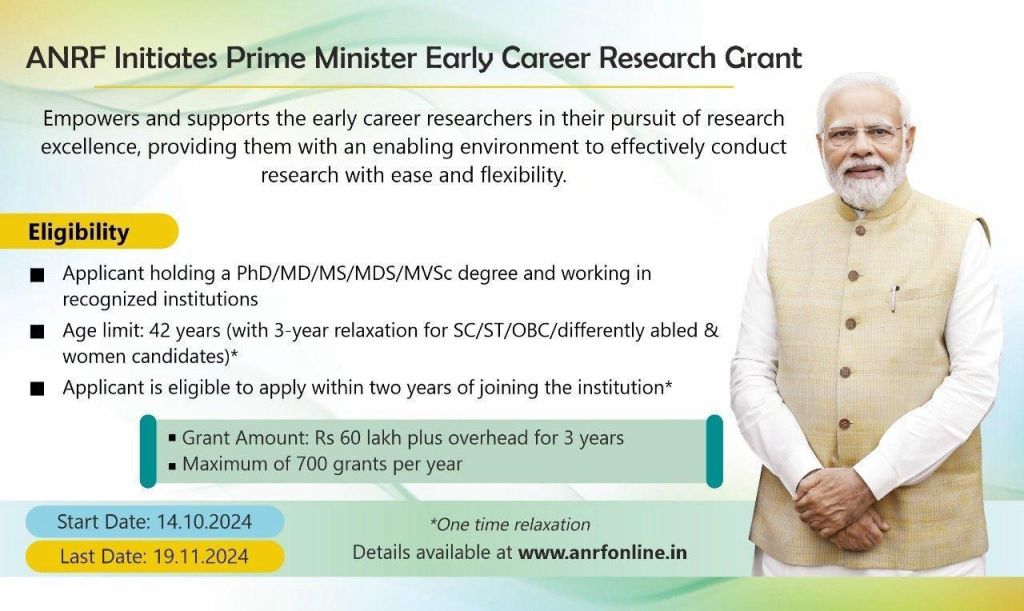
The Prime Minister’s Early Career Research Award (PMECRA) is a prestigious grant designed to support young researchers in India, encouraging them to pursue innovative and groundbreaking research in various fields of science, technology, and other disciplines. The program was introduced as part of the Indian government’s broader effort to promote research and innovation, especially among early-career scientists and academicians.
Objectives of the PMECRA:
1. Promote Young Talent: PMECRA aims to recognize and support young researchers with strong academic credentials and innovative ideas, providing them the necessary financial resources to carry out cutting-edge research.
2. Encourage Independent Research: The program enables early-career scientists to establish themselves as independent researchers, free from the constraints of traditional academic hierarchies, and fosters self-driven innovation.
3. Boost Research Capacity in India: The program is part of a larger national strategy to bolster research output in India, contributing to India’s standing as a global hub of scientific and technological advancement.
4. Support Interdisciplinary Research: PMECRA encourages interdisciplinary research that has the potential for high societal impact, covering a broad range of fields such as biotechnology, environmental sciences, information technology, and more.
Eligibility Criteria:
1. Age Limit: The applicant must generally be below the age of 40 years.
2. Academic Qualifications: Applicants should have a Ph.D. or equivalent degree in their respective fields of research.
3. Employment: The researcher must hold a regular academic or research position in a recognized university, institute, or laboratory in India.
4. Experience: Early career typically refers to researchers with 2–8 years of post-Ph.D. experience.
5. Research Focus: The applicant’s research proposal must align with the scientific priorities of the government, focusing on high-impact research areas with potential applications.
Funding and Benefits:
Research Grant: PMECRA offers substantial funding, typically ranging from ₹25 lakhs to ₹1 crore, depending on the scope of the research project. This grant can be used for various research-related activities such as purchasing equipment, hiring research assistants, covering travel expenses, and publishing research results.
Duration: The funding is usually provided for a period of three to five years, allowing researchers adequate time to develop their ideas and produce meaningful results.
Flexibility: The fund supports both basic and applied research, giving researchers flexibility in their approach while focusing on areas of national importance.
Selection Process:
1. Call for Proposals: The program typically invites research proposals annually. Interested candidates must submit detailed proposals outlining their research objectives, methodologies, expected outcomes, and budget estimates.
2. Evaluation: Proposals are evaluated by a panel of experts from various academic and scientific fields. The evaluation criteria include the novelty of the research, its feasibility, the researcher’s track record, and the potential impact of the project on society or industry.
3. Interview: Shortlisted candidates may be called for an interview, where they will present their research ideas to a panel of experts.
4. Final Selection: Based on the review process, a select number of candidates are awarded the grant, which is disbursed in installments depending on the research progress.
Importance of PMECRA:
Empowering Early Career Researchers: PMECRA provides a vital platform for early-career researchers to establish themselves in the competitive academic world, gain visibility, and build a solid foundation for future research opportunities.
Addressing National Challenges: By supporting research in areas of national importance, PMECRA helps address key challenges faced by India in sectors such as healthcare, agriculture, energy, and environmental sustainability.
Promoting Innovation and Creativity: The grant fosters a culture of innovation by encouraging researchers to explore new ideas, technologies, and methodologies that can lead to significant scientific breakthroughs or technological innovations.
Challenges:
Competition: Due to its prestigious nature, PMECRA is highly competitive, with only a small percentage of applicants receiving funding.
Grant Utilization: Managing large grants and ensuring that funds are used efficiently for research purposes can be a challenge, especially for those with limited administrative experience.
Conclusion:
The Prime Minister’s Early Career Research Award is a pivotal initiative aimed at fostering the next generation of researchers in India. By providing financial resources, mentorship, and independence, the PMECRA program serves as a cornerstone in shaping India’s future scientific and technological landscape. The award not only benefits individual researchers but also contributes to the broader goal of making India a leader in innovation and research on the global stage.




 Eduindex
You must be logged in to post a comment.