Corruption; the ugly truth

Corruption is the mistreatment of authority for personal gain of an individual or group of a country. It is the unjust use of public power for some private advantages by violating rules and regulations made by the government. These days, it has spread its roots deeply in the society which has made it difficult to be rid of it. Corruption is something that is so deep set in the roots of our society that has made it difficult for anyone to not fall into the crutches.

Nowadays, every important work is conducted with corruption. These days, corruption is done with the health of online transfers or in the form of expensive gifts etc. In order to get their work done quickly and rather easily, people take the easier route and bribe the officials.   Some people that are enlisted in the government or non-government offices have been mixed up in the corruption and will do anything to fulfil their wishes.

Corruption, is one form or another, is a worldwide phenomenon. Everyone admits that corruption is something immoral and detestable. Unfortunately, in our country, corruption has become a part of life. It has entered the very roots of Indian society.

Corruption has been defined variously by scholars. But the simple meaning of it is that corruption implies perversion of morality, integrity, character or duty. Corruption is the misuse of authority, public position, natural or public resources, power, etc. by someone to gain his/her personal gratifications.

Corruption is increasing in India day by day because there is a strong connection between the officials, politicians and criminals who are making this country weak. India got Independence in 1947 and it was slowly becoming strong and developing but in the mid-way, the disease of corruption started and stopped India to grow ahead.

Corruption is everywhere and in every department cheater it politics, hospitals, education, job, government offices, nothing is left of corruption. Everything has become a business and the source of earning money in the wrong way.

Evils, it is said, percolate in any society from the top. The topmost people in the country must present model examples of conduct, honesty and behaviour. One must not only be honest but one must also be above doubt. We, the common men also have some responsibilities towards our nation. If we stop giving bribe, the corrupts have no option but to do their job honestly. Then we shall be able to root out the evil of corruption from the entire society.

Corruption is the unjust use of public power for private advantages. We are all familiar with corruption and know that the occurrence is not a new thing in society. Violating rules and taking advantage has become a common practice. In order to get your work done in a shorter amount of time, people resort to giving and taking bribes.

It is a very common toxin in the society since ancient time. It has been found that corruption has been in practice since Mughal times. It is reaching new heights these days and increasing rapidly. It has affected the minds of people to such an extent and become so widespread that wrong people can play with the lives of people of the society. It is a type of materialism that corrupts the human mind and destroys one’s humanity.

Corruption comes in all fields of society such as sports, entertainment, education and politics etc. Corruption weakens a man’s mind and makes him dependent due to his greed and shallow mind. In a country like which is riddled with poverty, corruption is the only means to get by. People take bribes for the smallest things. Third World countries are the one that is the most well known for their corruption activities.

The World Bank has tried reprimanding them for their activities, but so far no strict action has been taken to curb the growing corruption. It is slowly destroying the lives of innocent people.
Fiscal structure in India

Fiscal federalism refers to the division of responsibilities with regards to public expenditure and taxation between the different levels of the government. Having a fiscal federalism mechanism allows the government to optimize their costs on economies of scale, because in this manner, people will get public service which they prefer, and there will be no unnecessary expenditure. From the economic point of view also, having a federalised structure helps as it creates a unified market.
India has a federal form of government, and hence a federal finance system. The essence of federal form of government is that the Centre and the state governments should be independent of each other in their respective, constitutionally demarcated spheres of action. Once the fundamentals of the government are spelt out, it becomes equally important that each of the government should be provided with sources of raising adequate revenues to discharge the functions entrusted to it.
Constitutional Provisions
The fiscal powers and functional responsibilities in India have been divided between the Central and State governments following the principles of federal finance. Article 246 of the Constitution lays down the list of subjects on which different levels of government can make laws. The division of functions is specified in the Seventh Schedule of the Constitution in three lists vis. the Union List, the State List and the Concurrent List.


The Union List contains 97 subjects of national importance, such as defence, railways, national highways, navigation, atomic energy, and posts and telegraphs. 66 items of State and local interest, such as law and order, public health, agriculture, irrigation, power, rural and community development, etc. have been entrusted to the state governments. 47 items such as industrial and commercial monopolies, economic and social planning, labour welfare and justice, etc. have been enumerated in the Concurrent List. The concurrent list is one in which both state and the Centre can make legislations. However, in case of a conflict or tie, federal laws prevail. Similarly, the borrowing powers have also been clearly mentioned in the Constitution. Under Article 292, the Central government is empowered to borrow funds from within and outside the country as per the limits imposed by the Parliament. According to Article 293(3), the States can borrow funds within the Country. Article 293(2) empowers the Centre to provide loans to state subject to conditions laid down by Parliament.


Fiscal Imbalances in India

Fiscal imbalance occurs when there is a mismatch between a government’s future debt obligations and future income streams.


Vertical Fiscal Imbalance occurs when the revenues of different levels of government (i.e. centre, state and local) do not match their expenditures responsibilities. There is a mismatch in the revenue capacity and expenditure responsibilities of the central, state and local govt. The lower level government (state and local) are often dependent on the central govt for finances to meet their expenditure responsibilities and this necessitates inter-governmental transfers from central govt to lower level governments.


Horizontal fiscal imbalance occurs when governments at the same level in different regions of a country have different abilities to provide services due to different abilities of raising funds. For example, not all states or municipalities in India raise equal amount of tax revenue, which will ultimately define the quality of services provided by individual states to their respective people. Then some region have higher cost of services compared to other regions, so this kind of an imbalance or mismatch in the revenue and expenditure accounts of governments at same level is known as horizontal fiscal imbalance.


Typically, federations (including the Indian one) face vertical and horizontal imbalances. A vertical imbalance arises because the tax systems are designed in a manner that yields much greater tax revenues to the Central government when compared to the state or provincial governments; the Constitution mandates relatively greater responsibilities to the state governments. For example, in India, post the advent of Goods and Services Tax (GST), the share of states in the public expenditure is 60% while it is 40% for the Centre to perform their constitutionally mandated duties.
Justifying Centripetal Biases
For the analysis of Indian fiscal federalism, nevertheless, it must be kept in mind that the Indian federation differs from the developed federations in many important respects.


First, India is vast country with wide inter-regional differences in economic endowments as well as levels of income, and is faced with conflicting tendencies of centralisation and decentralisation, the former designed to reduce inter-regional disparities and the latter to meet the diverse patterns of demand. Besides, the Indian economy is faced with severe interjurisdictional competition, underlining the need for utmost cooperation among various jurisdictions.
Second, the low levels of income and wide inter-regional disparities have necessitated governmental intervention not just in the provision of public services; the government has taken the major responsibility for economic development of the country by taking up the role of both catalyst and an entrepreneur. The multilevel planning adopted for the purpose has brought forth additional com plexities in the fiscal arrangements in terms of heavy fiscal dependence of the states on the Centre, high degree of vertical and horizontal tax and expenditure spillovers and multiplicity in intergovernmental transfer schemes with overlapping and ambiguously defined objectives.
Third, as the pattern of investments in pre-independent era was largely determined on the basis of colonial interests of the ruling power, the differences in the levels of development currently in vogue among the states do not necessarily represent their varied resource endowments.
Finally, the existence of wide inter-regional differences in the levels of development itself under lines a significant role for inter- governmental equitable transfer schemes, as the nexus between levels of development and resource endowments seems to be tenuous in most cases. In such a situation, equitable transfers at the expense of richer states may not necessarily result in lower economic growth.


The Case of Horizontal Imbalances
The horizontal imbalances arise because of differing levels of attainment by the states due to differential growth rates and their developmental status in terms of the state of social or infrastructure capital. Traditionally, Finance Commissions have dealt with these imbalances in a stellar manner, and they should continue to be the first pillar of the new fiscal federal structure of India.
However, in India, the phenomenon of horizontal imbalance needs to be understood in a more nuanced fashion. It involves two types of imbalances. Type I is to do with the adequate provision of basic public goods and services, while the second, Type II, is due to growth accelerating infrastructure or the transformational capital deficits. The latter are known to be historically conditioned or path dependent. It is here that we believe that NITI Aayog must create a niche, assume the role of another policy instrument and become the second pillar of the new fiscal federal structure.


What Can be Done?


Reimagining NITI Aayog
In the past, the Planning Commission used to give grants to the states as conditional transfers using the Gadgil-Mukherjee formula. Now with the Planning Commission disbanded, there is a vacuum especially as the NITI Aayog is primarily a think tank with no resources to dispense, which renders it toothless to undertake a “transformational” intervention. On the other hand, it is too much to expect the Union Finance Commission to do the dual job. In other words, there is an urgent need for an optimal arrangement. It is best that the Union Finance Commission be confined to focussing on the removal of the horizontal imbalance across states of the Type I: i.e. the basic public goods imbalance. We need another institution to tackle the horizontal imbalance of the Type II; for this the NITI Aayog is the most appropriate institution. It can be argued that the Finance Ministry is the other alternative to deliver the goods in this regard but it is ill-suited to do this; its primary duty is to concern itself with the country’s macro-economic stability and the proper functioning of the financial system rather than be an instrument of growth at the subnational level.
Towards this task of cooperative federalism, NITI Aayog should receive significant resources (say 1% to 2% of the GDP) to promote accelerated growth in States that are lagging and overcome their historically conditioned infrastructure deficit, thus reducing the developmental imbalance. In short, the NITI Aayog should be engaged with the allocation of “transformational” capital in a formulaic manner, complete with incentive-compatible conditionalities.
NITI Aayog should also be mandated to create an independent evaluation office which will monitor and evaluate the efficacy of the utilisation of such grants. In doing so, it should not commit the mistake of micro-management or conflicts with line departments. It must be also accorded a place at the high table of decision-making as it will need to objectively buy-in the cooperation of the richer states as their resources are transferred to the poorer ones.

EUTHANASIA LAW IN INDIA

WHAT IS EUTHANASIA?

The word Euthanasia originiates from the Greek words: Eu (good) and Thanatos (death) and it means “Good Death”, “Gentle and Easy Death.” It is also known as Mercy killing. It was first used in a medical context by Francis Bacon in the 17th century, to refer to an easy, painless, happy death, during which it was a “physician’s responsibility to alleviate the ‘physical sufferings’ of the body”.

According to the World Medical Association Euthanasia means:

Deliberate and intentional action with a clear intention to end another person’s life under the following conditions: The subject is a competent informed person with incurable illness. Who voluntarily asked for ending his life. The person who is acting knows about the state of this person and about his wish to die and is doing this action with an intention to end life of this person. The action is done with compassion and without any personal profit.

TYPES OF EUTHANASIA

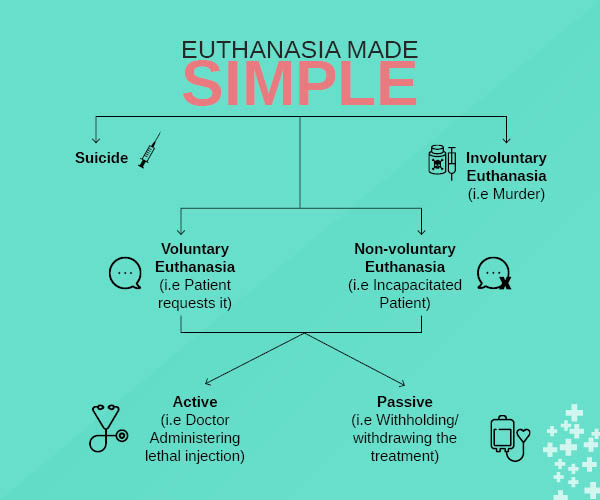
Following are the types of euthanasia:-

  1. Passive or Negative euthanasia means the withdrawal of necessary medical treatment with the deliberate intention to hasten the death of a terminally-ill patient is a must. In order for the death to be voluntary, the medicines which aids in saving lives will be discontinued so that death is brought about voluntarily. A common practice of this is a patient signing a ‘Do Not Resuscitate’ (DNR) document. It implies discontinuing or not using extraordinary life sustaining measures to prolong life. Others include act of omission such as failure to resuscitate a terminally ill or incapacitated patient (e.g. a severely defective new-born infant).

2. Active or Direct euthanasia means when one induces death by giving or providing medication or treatment leading to death.

3. Voluntary Euthanasia, sometimes called “assisted suicide”, is used in cases where the sufferer has made it clear that s/he wishes to die and has requested help to bring this about. When the euthanasia is practiced with the expressed desire and consent of the person concerned

4. Involuntary Euthanasia is one which is conducted without the consent and where an individual makes a decision for another person who is incapable of doing so. E.g. prolonged comma, old age, etc. It occurs when no consent or wish to die is expressed by the sufferer. When the euthanasia is practiced against the will of the person and also involuntary Euthanasia is one where patients can express a wish to die but don’t (this equates to murder).

5. Non- Voluntary Euthanasia is one where patients cannot express a wish to die. Patients who are in comas, infants, profound mentally retarded, severely brain damaged, cases of extreme senile dementia, those who cannot communicate for other reasons.

LEGAL VALIDITY IN INDIA

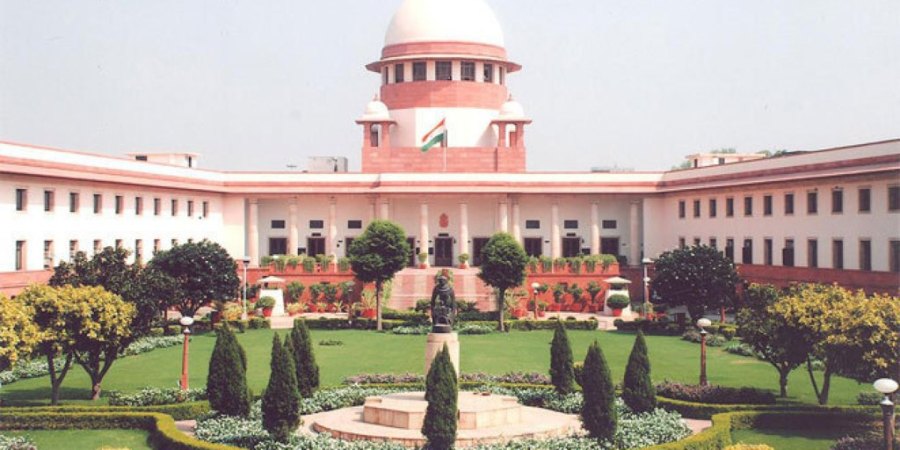
Passive euthanasia is legal in India. As per the 2018 ruling, The Supreme Court has held that the right to die with dignity is a fundamental right.

WHAT IS THE LEGAL POSITION AND TRENDS OF EUTHANASIA IN DIFFERENT COUNTRIES?

The Laws around the world vary greatly with regard to euthanasia, and are constantly subject to change as cultural values shift and better palliative care, or treatments become available. It is legal in some nations, while in others it may be criminalized. In some countries there is a divisive public controversy over the moral, ethical, and legal issues of euthanasia. Those who are against euthanasia may argue for the sanctity of life, while proponents of euthanasia rights emphasize alleviating suffering, and preserving bodily integrity, self-determination, and personal autonomy. Countries which have legitimized euthanasia are The Netherlands,Belgium, Oregon and Washington in the USA. In Switzerland only assisted suicide is legal. In India as mentioned above only passive euthanasia is legal.

LANDMARK CASE IN INDIA

Aruna Ramchandra Shanbaug vs Union Of India

FACTS OF THE CASE

Aruna Shanbaug, a nurse who was assaulted by a ward boy, and went into a vegetative state in 1973. • She remained blind, deaf, paralyzed and in a vegetative state till her death in 2015. A Writ Petition was filed by Pinki Virani claiming that her right to life guaranteed by the constitution had been violated. The petition was rejected by the court after medical examination. However, later in Aruna Ramchandra Shanbaug vs Union Of India, the Supreme Court in March 2011 held that passive euthanasia could be given a nod in case of exceptional circumstances and under strict monitoring of the apex court.

On 7 March 2011 the Supreme Court of India legalized passive euthanasia by means of the withdrawal of life support to patients in a permanent vegetative state. The decision was made as part of the verdict in a case involving Aruna Shanbaug, who had been in a Persistent Vegetative State (PVS) for 42 years until her death in 2015.

The Supreme Court of India specified two irreversible conditions to permit Passive Euthanasia:

  1. The Brain-Dead for whom the ventilator can be switched off.
  2. Those in a Persistent Vegetative State (PVS) for whom the feed can be tapered out and pain-managing palliatives be added, according to laid-down international specifications.

GUIDELINES LAID DOWN BY APEX COURT:

The following guidelines were laid down: A decision has to be taken to discontinue life support either by the parents or the spouse or other close relatives, or in the absence of any of them, such a decision can be taken even by a person or a body of persons acting as a next friend. It can also be taken by the doctors attending the patient. However, the decision should be taken bona fide in the best interest of the patient.

Even if a decision is taken by the near relatives or doctors or next friend to withdraw life support, such a decision requires approval from the High Court concerned. When such an application is filled the Chief Justice of the High Court should forthwith constitute a Bench of at least two Judges who should decide to grant approval or not.

A committee of three reputed doctors to be nominated by the Bench, who will give report regarding the condition of the patient. Before giving the verdict a notice regarding the report should be given to the close relatives and the State. After hearing the parties, the High Court can give its verdict.

WHAT ARE THE ARGUMENTS FOR AND AGAINST EUTHANASIA? 

Benefits of Legalizing Euthanasia (Arguments For)

  1. Provides relief to extreme pain.
  2. Relieves physical, mental and psychological pain for the patient and the family.
  3. Provides more facilities and funds for other patients needing medical treatment and attention.
  4. Euthanasia provides a way of relief when a person’s quality of life is low.
  5. It is another case of freedom of choice – the right to commit suicide.
  6. People should not be forced to stay alive.
  7. Speedy termination of physical and emotional suffering.
  8. Organs can be put to good use.
  9. Relieve mental suffering for the patient and his relatives.

Consequences of legalizing Euthanasia (Arguments Against)

  1. The ‘living will’ could be misused
  2. Religious beliefs could pose as a conflict in few scenarios
  3. The person might not be well informed of the possible treatment options
  4. Guidelines of the content of ‘living will’ has to be standardized
  5. Euthanasia demeans and devalues the sanctity of human life.
  6. Euthanasia can become a means of health care cost containment.
  7. Euthanasia will become non-voluntary.
  8. Euthanasia would not only be for people who are terminally ill.
  9. It amounts to murder and it is only God who can take away human life.
  10. It destroys life, which has potential that could be yet unknown to the patient, doctor or the family members.
  11. It discourages scientists who are looking for a cure for incurable ailments.
  12. An irreversible damage

WEBSITES REFERRED:

  1. https://www.slideshare.net/digitaltejas/euthanasia-types-arguments-for-and-against
  2. https://www.slideshare.net/altacitglobal/euthanasia-law-in-india
  3. http://racolblegal.com/euthanasia-an-act-of-mercy-killing/
  4. https://www.latestlaws.com/articles/euthanasia-the-contemporary-art-of-dying-by-aman-kumar-and-richa-hudilwala/
  5. https://byjus.com/free-ias-prep/euthanasia-or-mercy-killing/
  6. https://www.123rf.com/photo_109776197_stock-vector-red-flat-line-banner-trends.html
  7. https://www.slideserve.com/nami/euthanasia-mercy-killing
  8. http://racolblegal.com/the-dharma-jurispudence-of-the-supreme-court/

Rafale Fighter Jets after 18 Years, Finally it’s here in IAF.

Image Source: News18

Indian Airforce (IAF) finally received its first squadron of five rafale fighter jets out of a deal of 36 Rafales fighter jets signed with France in September 2016. Generally defence deals consume significantly larger time than this but India received its first squadron in just 4 years.

Anyways the path had its own hurdles, for example the main controversy that attached was attached to this deal was cost of each aircraft. Agenda was long run by chief political parties in India and in fact the honourable supreme court of India too was dragged into this matter.

Congress leaders Ghulam Nabi Azad and former minister of state for defence Jitendra Singh, citing Dassault’s annual report, alleged that Egypt and Qatar had paid ₹1,319 crore per aircraft in comparison to ₹1,670 crore paid by India, which represented an increase of ₹351 crore per aircraft. They alleged that acquiring 36 aircraft instead of 126 adversely affected national security. Dassault’s CEO, Eric Trappier responded by saying that the numbers were not comparable as India’s total included costs for Mirage 2000 support and the deliverables for each country was different. He said that India’s deal included after-sales support which was absent from other countries’ deals. On 12 March 2018, Subhash Bhamre informed the Rajya Sabha that the cost of each Rafale was approximately ₹670 crore, although this cost did not include the costs of “associated equipment, weapons, India specific enhancements, maintenance support and services”.

On 23 March 2018, Congress joined Telugu Desam Party and YSR Congress Party in filing a motion of no confidence against the government. In April 2018, Rahul Gandhi alleged that ₹45,000 crore was stolen and given to “an industrialist friend”, referring to Anil Ambani. In May 2018, Rahul Gandhi alleged that UPA had finalised a deal to buy Rafales at ₹700 crore, but Modi cancelled the transfer of technology contract wth HAL and gave it to “his friend’s company”, referring to Reliance Defence Limited. In June 2018, it was reported that Comptroller and Auditor General of India was close to finishing its report on the Rafale acquisition.

How Rafale is Different than Any Other Fighter Aircraft?

Cockpit of Dassault’s Rafale Multirole Combat Fighter

The cockpit has hands-on throttle and stick control (HOTAS). The cockpit is equipped with a heads-up, wide-angle holographic display from Thales Avionique, which provides aircraft control data, mission data and firing cues.

A collimated, multi-image head-level display presents tactical situation and sensor data, while two touchscreen lateral displays show the aircraft system parameters and mission data.

The pilot also has a helmet-mounted sight and display. A CCD camera and on-board recorder records the image of the head-up display throughout the mission.

Rafale fighter weapons

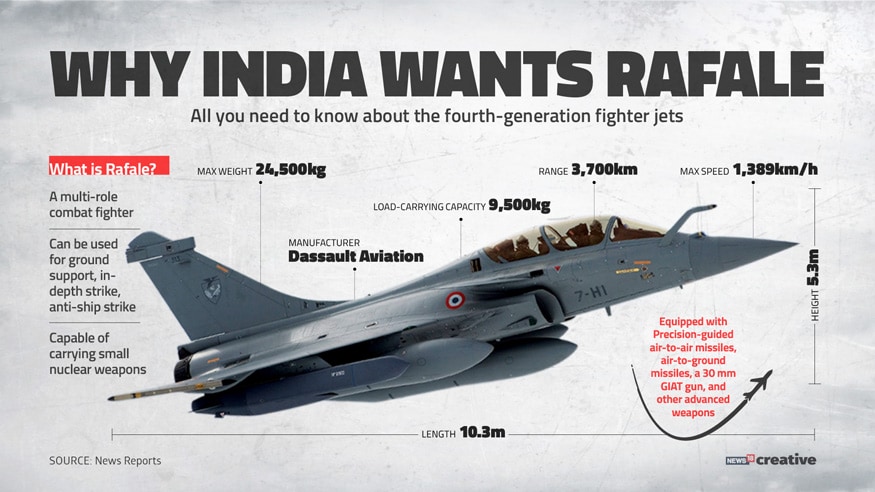
Rafale can carry payloads of more than 9 tonnes on 14 hardpoints for the airforce version, with 13 for the naval version. The range of weapons includes: Mica, Magic, Sidewinder, ASRAAM and AMRAAM air to-air missiles; Apache, AS30L, ALARM, HARM, Maverick and PGM100 air-to-ground missiles and Exocet / AM39, Penguin 3 and Harpoon anti-ship missiles.

For a strategic mission the Rafale can deliver the MBDA (formerly Aerospatiale) ASMP stand-off nuclear missile. In December 2004, the MBDA Storm Shadow / Scalp EG stand-off cruise missile was qualified on the Rafale.

In September 2005, the first flight of the MBDA Meteor BVRAAM beyond visual range air-to-air missile was conducted on a Rafale fighter. In December 2005, successful flight trials were carried out from the Charles de Gaulle of the range of Rafale’s weapon systems, Exocet, Scalp-EG, Mica, ASMP-A (to replace the ASMP) and Meteor missiles.

In April 2007, the Rafale carried out the first firing of the Sagem AASM precision-guided bomb, which has both GPS / inertial guidance and, optionally, imaging infrared terminal guidance. Rafale have been equipped with the AASM from 2008. Rafale can carry six AASM missiles, with each aiming to hit the target with 10m accuracy.

The Rafale has a twin gun pod and a Nexter (formerly Giat) 30mm DEFA 791B cannon, which can fire 2,500 rounds a minute. The Rafale is equipped with laser designation pods for laser guidance of air-to-ground missiles.

How much India Needed an Upgrade in IAF?

The induction of Rafale fighter aircrafts into Indian Airforce (IAF) is viewed as a pivotal turning point that will augment the capabilities of Indian defence forces. Certainly its game changers by all means, Rafale in the Indian Airforce will mean winning a prime place among the countries that boast of superior fighting aircrafts. When compared with the air power of Pakistan and many other south Asian countries, Rafale will lift up India’s competence significantly.

Consumer Protection Bill 2019, (E-Commerce) Rules, 2020

An Act to provide for protection of the interests of consumers and for the said purpose, to establish authorities for timely and effective administration and settlement of consumers’ disputes and for matters connected therewith or incidental thereto.

The Indian Parliament, on 6 August 2019, passed the landmark Consumer Protection Bill, 2019 which aims to provide the timely and effective administration and settlement of consumer disputes. The Consumer Protection Act, 2019 (New Act) received the assent of the President of India and was published in the official gazette on 9 August 2019. The New Act will come into force on such date as the Central Government may so notify. The New Act seeks to replace the more than 3 (three) decades old Consumer Protection Act, 1986 (Act).

While e-commerce has opened new avenues and has made transactions faster and more convenient, they have also been prone to unfair trade practices. Although e-commerce platforms tried to resolve the grievance of the customers, there was a need to streamline the functioning of the same. With this perspective, the Central government notified the Consumer Protection (E-commerce) Rules, 2020.

From Amazon to Walmart and now Facebook and Google, through Reliance Jio are all betting on India being their next big online consumer market.

Walmart has invested $1.2 billion in Flipkart in an equity round, two years after it bought a 77% stake in the Indian retail giant for $16 billion. Walmart’s investment came just days after Amazon invested ₹2300 crore or $305 million into its Indian arm, following Jeff Bezos’ $1 billion investment promise to India. Earlier this year, Amazon had also signed a long-term business agreement with Kishore Biyani’s Future Group.

Meanwhile, Facebook’s $5.7 billion investment and Google’s $4.5 billion bet on Reliance Jio come at a time when Reliance chairperson Mukesh Ambani is betting on retail as the next big venture. One of the most significant factors of the Facebook-Jio deal was that Reliance Retail and WhatsApp are now in a commercial partnership to accelerate JioMart’s growth. Through JioMart and WhatsApp, the entities will now help support consumer businesses.

E-commerce Rule, 2020

The intention of the Legislature to specifically deal with e-commerce and online transactions was evident from the very enlargement of the definition of consumer under Section 2(7) of the Act by including both online and offline transactions within the scope of ‘buying goods’ and ‘hiring services’. Further, the Act categorically defines relevant e-commerce, electronic service provider and misleading advertisement while specifically addressing the most commonly faced issues such as refusing to take back defective goods or refusing to refund the amount.

The Rules are pretty exhaustive in their sweep and, at the outset, declares its application to:

(i) All goods and services bought or sold over digital or electronic network including digital products;

(ii) All models of e-commerce, including marketplace and inventory models of e-commerce;

(iii) All e-commerce retail, including multi-channel single brand retailers and single brand retailers in single or multiple formats; and

(iv) All forms of unfair trade practices across all models of e-commerce.

A bare perusal of the same demonstrates that the intention of the Legislature is, clearly, to encompass every aspect of e-commerce and keep consumer interests on the highest pedestal while streamlining the functioning of e-commerce platforms. This is also demonstrated from the fact that the Rules clearly define the relevant players of the e-commerce space, such as e-commerce entity, inventory e-commerce entity, marketplace e-commerce entity and seller.

Loss Of Ice Cover In The Arctic Sea

The National Centre of Polar and Ocean Research (NCPOR) recently found the largest decline in the Arctic Sea ice as seen in last 41 years due to global warming in July 2019.

Between 1979 and 2018, NCPOR noted that the sea ice has seen a declination at a rate of -4.7 per cent per decade while its rate in July 2019 was found to be -13 per cent.

Sea ice is basically frozen seawater that floats on the ocean surface. It forms in each hemisphere’s winter of both the Arctic and the Antarctic. The ice retreats in the summer. However, it does not completely disappear.

The Research has clarified that if this trend continues, there would be no ice left by 2050 in the Arctic sea since the volume of ice loss during summers might surpass the volume of the same formed during winters. This rapid decline in Arctic sea ice cover has been linked with growing carbon emissions and subsequent global warming.

The Impacts of Declining Arctic Sea ice cover can be huge. It would have an influence on regional weather as the decline of sea ice may impact the evaporation rates, cloud cover, air humility and rainfall of neighbouring regions.

The National Centre for Polar and Ocean Research (NCPOR) was established in 1998 as an autonomous Research and Development Institution under the Ministry of Earth Sciences. The objective was to primarily carry out research activities in the polar and Southern Ocean realms.

It is also responsible for maintenance of the Indian stations in Arctic (Himadri) and Antarctica (Maitri & Bharati).

In recent times, the high temperatures that have been recorded in the Siberian region have caused a prolonged heatwave that has been ascribed to the absence of sea ice among other factors.

Loss of habitat for seals and polar bears have also increased resulting encounters between polar bears and humans. As the sea ice retreats from coastlines, wind-driven waves combined with melting permafrost may also lead to more rapid coastal erosion.

In the Arctic region, the ocean circulation is driven by the sinking of dense and salty water. Fresh meltwater coming largely from the Greenland Ice Sheet could furthermore interfere with ocean circulation at high latitudes, ultimately slowing it down. Any changes in ocean circulations can have unpredictable global impacts even in lower latitudes such as extreme weather events, droughts etc.

It is a result from the positive feedback cycle known as the ice-albedo feedback states that sea ice has higher albedo than ocean water. Once sea ice begins to melt, a self-reinforcing cycle often begins whereby as more ice melts and exposes more dark water. Then the water absorbs more sunlight and the sun-warm water then melts more ice.

On concluding, Arctic sea ice is part of a complex global system, and as a result it affects communities at all latitudes. The loss of Arctic sea ice has to be slowed down existentially by reducing carbon dioxide and other greenhouse gas emissions and also by conserving other natural resources that have global impacts. The world needs to come together as one.

Introduction to Fundamental Rights

The fundamental rights are defined as the basis humar rights of all citizens. These rights, defined in part 3rd of the constitution. Applied irrespective of caste, creed, place of birth, religion etc. They are enforceable by the court, subject to specific restrictions.

What is the purpose of fundamental rights ?

1. Preserve individual liberty,

2. Equality of all members of society,

3. Dr Ambedkar said that the responsibility of the legislature is just not to provide fundamental rights but also and rather,  to safeguard them.

List of fundamental rights 

There are six fundamental rights of Indian constitution along with to constitutional article.

Right to equality (article 14-18)

Right to equality guarantees equal rights for everyone irrespective of their caste, creed, birth of place, religion or race. This right also includes the abolition of titles as well as untouchability.

Right to freedom (article 19-22)

Freedom is one fo the most important ideals enhanced and cherished by the democratic country. Without freedom the democracy is meaningless. The freedom right includes many rights such as freedom of speech, freedom of expression, freedom of association And freedom to practice any profession and religion.

Right against exploitation (article 23-24)

This right implies the prohibition of traffic in human beings, beggar and other forms of force labour. It also implies the prohibition of child labour. The constitution prohibits the employment of children under 14 years in hazardous conditions.

Right to freedom of religion (article 25-28)

There is equal importance given to all religions. There is freedom of conscience, profession, practice and propagation of religion. The state has no official religion. Every person has the right to choose his/her religion.

Cultural and educational rights (article 29-30)

Special protection provided in the constitution to preserve and develop the language, Culture and religion of minorities. Every culture has the right to conserve it’s language, culture and religious practices.

Right to constitutional remedies (article 32)

Article 32 provide a guaranteed remedy, in the form of a fundamental right itself, for enforcement of all the other fundamental rights, and the supreme court is designated as the protector of these rights by the constitution.the supreme court has the jurisdiction to enforce the fundamental rights even against the private bodies. And in case of violation, award compensation as well as to the affected individual.

Right to privacy

Right to privacy is the latest right of our country being recently approved by the supreme court of india. According to this right we are liable to keep our material private and without our permission no one can interfere in our private matter.

Right to property was removed from the Indian constitution in 1978. It is no longer counted as a fundamental right.  

Standard of Living

A standard of living is the level of wealth, comfort, material goods, and necessities available to a certain socioeconomic class or a certain geographic area. The standard of living includes basic material factors such as income, gross domestic product (GDP), life expectancy, and economic opportunity. The standard of living is closely related to quality of life, which can also include factors such as economic and political stability, political and religious freedom, environmental quality, climate, and safety.

The standard of living is often used to compare geographic areas, such as the standard of living in the United States versus Canada, or the standard of living in St. Louis versus New York. The standard of living can also be used to compare distinct points in time.

For example, compared with a century ago, the standard of living in the United States has improved greatly. The same amount of work buys an increased quantity of goods, and items that were once luxuries, such as refrigerators and automobiles, are now widely available. Also, life expectancy has increased, and annual hours worked have decreased.

Standard of Living vs. Quality of Life

The terms standard of living and quality of life are often believed to mean the same. While they may overlap, there is a difference between the two. A standard of living generally refers to wealth, comfort, material goods and necessities of certain classes in certain areas—or more objective characteristics, whereas a quality of life is more subjective and intangible, such as personal liberty or environmental quality. Characteristics that make up a good quality of life for one person may not necessarily be the same for someone else.

A distinction is sometimes made between standard of living and standard of life. Standard of living refers to our usual scale of expenditure, the goods we consume and the services we enjoy, our attitudes and values. Standard of life is a much wider term. It refers to one’s ideals in life. It includes a person’s expenditure on his non-material requirements. “Simple living and high thinking” is a common axiom. “Simple living” hints at a low standard of living, but “high thinking” refers to a high standard of life. Mahatma Gandhi had a low standard of living but a high standard of life.

The following are the main factors on which the standard of living in a country depends:

Level of National Income or Output:

The fundamental reason for the differences in the levels of living between different countries is the difference in their levels of national income. The level of national income depends upon the total volume of production in the country. Those countries having higher national income or output enjoy a higher standard of living, while the countries having lower national income or output have a lower standard of living. The main reason why the standard of living is much higher in the U.S.A. than in India is that the level of national output in the U.S.A. is much higher than that in India.

Now the question arises:

Why do some countries produce more than others? This brings us to the question of levels of productivity.

Level of Productivity:

The total amount of goods and services which a country can produce, and hence the standard of living it can provide to its people, depends upon the levels of productivity in different branches of economic activity such as agriculture, industry, transport, etc. The higher the productivity per person engaged in agriculture, industry, etc., the higher will be the national output and the standard 01 living of the people. The difference in productivity is the major cause of differences in standards of living between different countries.

Terms of Trade:

Another factor which accounts for the differences in the levels of living between different countries is the rate of exchange between goods exported and goods imported. The rate of exchange between exports and imports is called the terms of trade. The terms of trade show how much of the goods a country imports can be obtained by a unit of the goods it exports. The terms of trade can be measured by taking the ratio of price-level of its exports to the price-level of its imports.

Size of Population:

Still another important factor which determines the standard of living of the people of a country is the size of its population. Given the total national income or output of a country, the greater the size of its population, the lower will be its average standard of living. It is the per capita income which determines the average standard of living in a country.

The per capita income of a country is determined by the total national income and the size of its population. Thus, the difference in the size of the population also accounts for the difference in the standards of living between people of different countries.

Distribution of National Income:

Another determinant of the standard of living of the people of a country is the distribution of national income among the population. If there is large inequality in the distribution of income, then the standard of living of a few rich people will be very high, while the standard of living of the masses of the people will be extremely low.

General Price Level:

Another factor determining the standard of living of a people is the general price level in the century. Given the national income, the standard of living of the people will be lower when the price at high and higher when the prices are low. Different price levels prevail in different counties. This also accounts for the differences in standards of living of the people between different countries. Other things being equal, if the price level in country A is higher than in B, the standard of living will be lower in A than in B.

Level of Education:

Another factor responsible for the differences in stan­dards of living is the difference in the level of education. Educated people tend to have a higher standard of living than the uneducated. You cannot expect a higher living standard from the illiterate and ignorant people. Even if the illiterate and uneducated people happen to have large incomes, they would either hoard them or squander them in useless social ceremonies or by indulging in evil habits such as drinking, gambling, etc.

It is often hard to determine the standard of living years after divorce when the modification issue arises. It is also costly to then have to reconstruct the records and perform the analysis. The issues can be raised in a proceeding to modify support–but the better practice is to ensure that the issue is appropriately addressed before the case is settled or goes to trial – especially for the spouse who is ordered to make the payments and wants to keep the door open to reduce or terminate them.

Finance Commission

What is the Finance Commission?

The Finance Commission is a constitutional body formed every five years to give suggestions on centre-state financial relations. Each Finance Commission is required to make recommendations on: (i) sharing of central taxes with states, (ii) distribution of central grants to states, (iii) measures to improve the finances of states to supplement the resources of panchayats and municipalities, and (iv) any other matter referred to it.


Composition of transfers:

The central taxes devolved to states are untied funds, and states can spend them according to their discretion. Over the years, tax devolved to states has constituted over 80% of the total central transfers to states. The centre also provides grants to states and local bodies which must be used for specified purposes. These grants have ranged between 12% to 19% of the total transfers.

Over the years the core mandate of the Commission has remained unchanged, though it has been given the additional responsibility of examining various issues. For instance, the 12th Finance Commission evaluated the fiscal position of states and offered relief to those that enacted their Fiscal Responsibility and Budget Management laws. The 13th and the 14th Finance Commission assessed the impact of GST on the economy. The 13th Finance Commission also incentivised states to increase forest cover by providing additional grants.
15th Finance Commission: The 15th Finance Commission constituted in November 2017 will recommend central transfers to states. It has also been mandated to: (i) review the impact of the 14th Finance Commission recommendations on the fiscal position of the centre; (ii) review the debt level of the centre and states, and recommend a roadmap; (iii) study the impact of GST on the economy; and (iv) recommend performance-based incentives for states based on their efforts to control population, promote ease of doing business, and control expenditure on populist measures, among others.


Why is there a need for a Finance Commission?
The Indian federal system allows for the division of power and responsibilities between the centre and states. Correspondingly, the taxation powers are also broadly divided between the centre and states. State legislatures may devolve some of their taxation powers to local bodies.

The centre collects majority of the tax revenue as it enjoys scale economies in the collection of certain taxes. States have the responsibility of delivering public goods in their areas due to their proximity to local issues and needs.
Sometimes, this leads to states incurring expenditures higher than the revenue generated by them. Further, due to vast regional disparities some states are unable to raise adequate resources as compared to others. To address these imbalances, the Finance Commission recommends the extent of central funds to be shared with states. Prior to 2000, only revenue income tax and union excise duty on certain goods was shared by the centre with states. A Constitution amendment in 2000 allowed for all central taxes to be shared with states.
Several other federal countries, such as Pakistan, Malaysia, and Australia have similar bodies which recommend the manner in which central funds will be shared with states.

Commission considerably increased the devolution of taxes from the centre to states from 32% to 42%. The Commission had recommended that tax devolution should be the primary source of transfer of funds to states. This would increase the flow of unconditional transfers and give states more flexibility in their spending.


The share in central taxes is distributed among states based on a formula. Previous Finance Commissions have considered various factors to determine the criteria such as the population and income needs of states, their area and infrastructure, etc. Further, the weightage assigned to each criterion has varied with each Finance Commission.
with the weight assigned to them.


• Population is an indicator of the expenditure needs of a state. Over the years, Finance Commissions have used population data of the 1971 Census. The 14th Finance Commission used the 2011 population data, in addition to the 1971 data. The 15th Finance Commission has been mandated to use data from the 2011 Census.
• Area is used as a criterion as a state with larger area has to incur additional administrative costs to deliver services.
• Income distance is the difference between the per capita income of a state with the average per capita income of all states. States with lower per capita income may be given a higher share to maintain equity among states.
• Forest cover indicates that states with large forest covers bear the cost of not having area available for other economic activities. Therefore, the rationale is that these states may be given a higher share.

Grants-in-Aid
Besides the taxes devolved to states, another source of transfers from the centre to states is grants-in-aid. As per the recommendations of the 14th Finance Commission, grants-in-aid constitute 12% of the central transfers to states. The 14th Finance Commission had recommended grants to states for three purposes: (i) disaster relief, (ii) local bodies, and (iii) revenue deficit.

How Easy or Difficult it is to Start a Business in India?

India has improved drastically in the World Bank’s ‘Ease of Doing Business’ 2020 international ranking by moving up to 63 out of 190 countries in the list. India was at rank 130 in a list of 189 countries in 2016. A sudden jump in rank from 130 to 63 is definitely remarkable and shows true business potentials of new India. Although this sounds good there is a lot more to be done for India to continue rising up. Hrishikesh Datar, Founder and CEO of Vakilsearch, a technology driven company empowering Indians with access to trustworthy legal solutions for entrepreneurs, gives his insights into what more can be done to push India further up the ranking.

The World Bank has said “In the year of 2015, India eliminated the paid-in minimum capital requirement and streamlined the process for starting a business. More reforms are ongoing—in starting a business and other areas measured by Doing Business—though the full effects are yet to be felt”.

Doing business in India – a country which the economic pundits say will be the world’s second-largest economy by 2030 (with China top and the USA pushed into third place). Going back a decade or so this assertion might have seemed nothing more than a fantasy, but everybody now seems to agree that India is finally going places. With a rapidly growing population of 1.3 million which boasts a vibrant middle class and a demographic which is heavily weighted towards youth, the potential of India seems almost limitless.

In the past, many developed economies saw India as a destination for the low-cost outsourcing of back-office or R&D-type functions and, whilst this area of the economy continues to thrive, India needs to be viewed in a very different light these days. India is, quite simply, the world’s largest potential market for goods and services. Where China has already developed much of its infrastructure and service economy, India still has enormous work to do. Look around on the streets of Delhi, Bangalore or Chennai and the need for development is obvious – move into the second or third tier cities and this need becomes even more acute.

What does all of this point to? Opportunities. India is a land of endless possibility where the people are aspirational, energetic, open and eager for progress.

Research

The biggest mistake organisations make when looking at India as a market is that they fail to do adequate research. To say that India is enormous would be a massive understatement. A country with 1.3 billion people, multiple languages, ethnicities, climates and geographies cannot be approached as a homogenous unit. You can’t really have an ‘India strategy’ – you probably need multiple India strategies.

The first question has got to be is: ‘Is India the right market for your products or services at this stage of your development, taking into consideration the current needs of India?’ This is not an easy question to answer. So many factors come into play when addressing this – what is your price point, and how does that sit against the competitive landscape in India? Who are your major competitors and how are they faring? Can you afford to invest in India knowing that the returns might not accrue for a number of years? Which city or region would be a good starting point?

All of these questions need answers, but good quality information is not always easy to come by in India. You will need to engage people on the ground in India who can really get under the skin of the local market and get back to you with honest, trustworthy answers to key strategic questions. Don’t convince yourselves you can do all your research via a laptop back in your office or home– you quite simply can’t.

Finding Manpower

India is full of really great potential employees. On the whole, Indians are well-educated, ambitious, enthusiastic and motivated. Lack of local talent definitely isn’t the issue; finding and retaining good people though can be very difficult.

The Indian employment market is very fast-moving. Indians are always on the lookout for ways of improving their career prospects, job titles and income. How are you going to convince good people that you offer them a bright future? Why should they join your company when there is a myriad of opportunities for the type of people you are looking for?

Culture in India

The underlying factors which drive Indian business culture are deeply rooted in the country’s religious, societal and ethnic past. People are often fooled into thinking that because Indian’s often speak good English and because the country has a western-influenced history, that the cultural challenges they might face will be minimal. Nothing could be further from the truth.

You simply cannot hope to succeed in India unless you gain a very good understanding of the local cultural landscape.

Though with huge efforts of Indian government like launching a start-up India portal, Mudra Loan scheme for MSME (medium small & micro enterprises), there’s a lot to be done in collaborate efforts of Indian citizens and Indian government to get into top economic powers of the world.

Problem of Food Wastage in India

Food is the most fundamental among the essential necessities of life . Food squander is the serious issue in our nation which brings down country head with disgrace because numerous individuals passes on every day because of craving.

FOOD WASTAGE

Food wastage primary rotates around any type of food , crude or cooked utilized or unused disposed of or proposed .At wide level it is additionally enhanced into different classes and suggestions, for example, the sort of food squander, the structure it is delivered/created by and materials and wellspring of waste.

ABOUT THE MAGNITUDE OF FOOD WASTAGE IN INDIA

As per reports by the UN’s Food and Agriculture Organization (FAO), about 40 percent of India’s new products of the soil – worth a yearly $8.3bn or thereabouts – perishes before arriving at buyers. Every year, some 21m metric huge amounts of wheat, particularly grain – a sum practically equivalent to Australia’s all out yearly creation – spoils in India in light of ill-advised capacity in the guardianship of the legislature controlled Food Corporation of India.As indicated by an ongoing report by the Indian Institute of Management in Kolkata, cold storerooms are accessible for only 10 percent of India’s transitory produce – and are for the most part utilized for potatoes – to meet India’s hearty interest for chips. The investigation gauges that India needs stockpiling offices for another 370m metric huge amounts of short-lived produce.

CAUSES

1.Weddings blamed for colossal food squander

The monetary development of India won’t tally if the nation individuals bite the dust for hunger.

For imagining families are simply squandering the nation food by surpassing the food things to show there freshly discovered affluence. 1/5 of food served at weddings and get-together s is disposed of, “It’s a criminal waste,” The huge amounts of food squandered at get-together s the nation over every day stands out pointedly from the food deficiencies, frequently verging on constant starvation, looked by a huge number of poor Indians.

2.Inadequate capacity framework

In spite of a great many Indians heading to sleep on an eager stomach, the nation is letting food worth an incredible Rs 44,000 crore go squander every year because of absence of sufficient stockpiling infrastructure.The Saumitra Chaudhuri Committee, comprised by the Planning Commission in 2012, has assessed the nation’s cool stockpiling prerequisite as 61.3 million ton as against the current limit of around 29 million ton.

  1. Awareness

What to state illetrate individual , educated are doing same thing.People are uninformed of the issue the nation is confronting bcz they have cash and they usuallu would prefer not to mind at all until and except if they face a similar circumstance. Indeed, even adminstration resembles a visually impaired framework simply disregarding the fundamental development of the country.

4.Food Waste-to-Energy Conversion

The problem of waste administration stumbles into geologies and its gravest causal specialist, i.e., urban ism, is a worldwide wonder. In any case, its implications are moderately progressively articulated in creating countries by virtue of improved ways of life and changing utilization designs. The developing populace and expanding customer request are prompting unnecessary utilization of accessible assets and age of gigantic measure of various sort of squanders, which is rising as a chronic issue in urban social orders.

5.Lack of transport offices

We in India need appropriate transportation offices to connect with the market just as chilly stockpiling’s for new produce and food crates.The new produce carried on these long excursions is once in a while cooled or concealed, but instead oppressed – particularly in summers – to the rankling sun, making high paces of waste.

Remedies

  • As an individual,” Food that we BUY, EAT and WASTE is legitimately identified with the Global emergency we are confronting. It may be know to all of you that once in a while we eat everything that we purchase. So how about we make it a highlight BUY WHAT WE NEED and EAT WHAT WE BUY”.
  • At the shopper level, we can diminish our commitment to food and vitality
  • squander by taking basic, fundamental strides at home, in the supermarket and at cafe’s.
  • first of all, plan a food menu before each outing to the supermarket so it’s simpler to monitor when vegetables, products of the soil perishables should be eaten consistently.
  • Careful consideration ought to likewise be given to how food is put away and enclosed by the fridge so it doesn’t ruin as fast, and shoppers ought to make sure to purchase just what they will eat.
  • We ought not squander food in our plate , any place we are bcz the food which is going to squander or squandered is the guardian angel of others life.
  • Modernization in the food flexibly chain and increment foriegn speculation , better gathering machines , advancements , food bundling and so forth steps should received by the organization. Japanhas different laws relating to the various reasons for food wastage, for example, Container and Packaging Recycling Law’, ‘Food Wastes Recycling.

“ARRANGE YOUR BAD HABITS AS WASTE NOT FOOD”

Its an opportunity to wake up and this isn’t the obligation of just organization however every single individual .So before squandering a solitary bit of food consistently recall that we are just answerable for Food emergency.

Invites for the Frontline COVID Warriors: A special feature of the I-Day 2020 celebrations in India this year

Ministry of Home Affairs | MyGov.in

INTRODUCTION

The Ministry of Home Affairs (MHA) has issued the guidelines for the Independence Day celebrations that will take place amid the cloud of novel coronavirus pandemic. Due to this unfortunate and extraordinary situation the Independence Day celebrations on the 15th August will be subdued and low key.

THE LETTER

Joint Secretary Anuj Sharma has written a letter to all States and Union Territories sharing with them how the celebrations should be carried out in these testing times. In the letter preventive measures like social distancing, wearing of masks that are absolutely imperative have been mentioned in order to make sure that the celebrations are carried out without any collateral damage.

“In view of the spread of Covid-19 pandemic, while organizing various programmes or activities for the Independence Day celebrations, it is imperative to follow certain preventive measures such as maintaining social distancing, wearing of masks, proper sanitization, avoiding large congregations, protecting vulnerable persons, etc.; and follow all guidelines related to Covid-19 issued by the Ministry of Home Affairs and Ministry of Health a Family Welfare,” the letter read. Hence one can assume and infer that all the functions organised countrywide will be deprived of large gatherings.

Happy 74th Independence Day Wishes India | 15th August 2020

CELEBRATIONS AT THE LAL QILA

The Ceremony at Red Fort consisting of the presentation of a Guard of Honour by the Armed Forces and the Delhi Police to the Prime Minister (Pradhan Mantri), unfurling of the National Flag accompanied by playing of the National Anthem and firing of 21-gun salute, speech by the Prime Minister, singing of the National Anthem immediately after PM’s speech, and release of tricoloured balloons at the end. This will be followed by “At Home” reception at Rashtrapati Bhawan. As regards holding of “At Home” reception at Raj Bhawan /Raj Niwas by the Governor/Lt. Governor on the Independence Day, the matter is left to the discretion of Governors/Lt. Governors.

CELEBRATIONS AT THE STATE LEVEL

A ceremony in the morning (after 9.00 AM) in the State/Union Territory Capitals consisting of unfurling of the National Flag by the Chief Minister; playing of the National Anthem; presentation of Guard of Honour by the Police including Para-Military Forces, Home Guards, NCC, Scouts, etc; speech by the Chief Minister; and singing of the National Anthem.

In view of Covid-19 pandemic, large congregation in the ceremony be avoided. It is imperative that social distancing norms, wearing masks, etc., are followed. It would also be appropriate that Covid-19 warriors like doctors, health workers, sanitation workers, etc., are invited in the ceremony as a recognition of their noble service in fight against Covid-19 Pandemic. Some persons cured from Covid-19 infection may also be invited.

CELEBRATIONS AT THE DISTRICTS, SUB DIVISIONAL BLOCS AND PANCHAYAT HEADQUARTERS

The Districts, Sub Divisional blocs, Panchayat headquarters will have to follow similar protocols as the states. In view of the COVID-19 pandemic, preventive measures such as maintaining social distancing, wearing of masks, proper sanitization, avoiding large congregations, protecting vulnerable groups, etc., and other measures as prescribed and recommended by the Ministry of Health a Family Welfare, are to be followed. It would be appropriate that frontline warriors and workers like the doctors, health workers, sanitation workers, etc., are invited in the ceremony as recognition for their noble service in fight against the COVID-19 Pandemic. Some persons who have been cured from the infection may also be invited.

Performance of Police/Military bands may be recorded at places of historic importance associated with the Independence movement; and recorded versions thereof may be displayed through large screens/digital media, during public functions and on social media.

Other functions of the day may include activities like planting of trees; inter-school/inter-college debates on digital platforms; online quiz contests/patriotic essay writing and poetry competitions; launching of any important scheme, singing patriotic songs/delivering patriotic talks by selected boys/girls on the social media; illumination of Government Buildings/State Bhawans, etc; thematic webinars; online campaign by NSS and NYKS centered around patriotic themes; or any other activity deemed appropriate by the State Government/Union Territory Administration befitting the occasion. Other innovative ways of celebrating Independence Day may be considered like propagating patriotic or national integration messages/songs through digital and social media platforms, sound shows/lighting of important public buildings, waving of National Flags by people at rooftops/balconies, etc.

“It would be appropriate that the theme of “Aatmanirbhar Bharat” is suitably spread and publicized amongst the masses through various activities/messages in the functions and on social media during Independence Day celebrations,” the letter signed off with.

WEBSITES REFERRED

  1. https://www.mha.gov.in/sites/default/files/IndependenceDay_24072020.pdf

2. https://www.indiatvnews.com/news/india/independence-day-celebrations-guidelines-covid-19-coronavirus-new-guidelines-mha-636649

3. https://www.ndtv.com/india-news/74th-independence-day-covid-warriors-to-be-invited-on-independence-day-government-to-states-2268156#:~:text=Prime%20Minister%20Narendra%20Modi%20will,Independence%20Day%20on%20August%2015

4. https://secure.mygov.in/group/ministry-home-affairs/

5. https://www.jaborejob.com/happy-74th-independence-day-wishes-india-15th-august-2020/

Chaloung Sukapha in the light of a recent controversy

Chaolung Sukapha, the founder of Ahom kingdom, was recently referred to as a “Chinese invader”. The name-calling broke media as it showed the illiteracy of knowing his/her own history and culture. To know of Chaolung Sukapha is the least we can do to pay a tribute.

This 13th-century ruler founded the Ahom kingdom that went on to reign over Assam for six centuries.

The contemporary scholars have traced his roots which evidentially belong to Myanmar. He is also widely referred to as the architect of Assam that is recalled as “Bor Asom” or “Greater Assam”. This shows the gratitude given by the indigenous people towards his successful efforts to assimilate so many different communities and tribes that make today a dignified society.

As the state today is fighting with floods, it is the best time to commemorate Sukapha and his rule, which Assam celebrates as “Asom Divas” on the 2nd of December every year.

The Ahom Kingdom ruled from 1228 to 1824. In the 13th century, the Ahoms migrated from the regions of present-day Myanmar to the Brahmaputra valley.

In 1253, this tributary ruler established his capital at Charaidau, Assam. They recognized new states by suppressing the older political systems of the landlords locally called as Bhuiyas. The same was done in 1523 by conquering one of the powerful kingdoms of those times, the Chhutiyas and in 1581 the Koch-Hajo. By the 16th century, Sukapha had subjugated different tribes into their community.

These unpopular kingdoms faced many invasions from the south-western areas of the Indian subcontinent on a repetitive basis and remained under as shackles as they were finally defeated by the Mughals in 1662.

The Burmese invasion of Assam ended the dynasty of this kingdom and later the subsequent annexation was done by the British East India Company which followed the Treaty of Yandaboo in 1826.

The Administration of Ahom society was then divided into clans or khels.  A khel in turn was often in control of several villages. A census was done and the people were transferred from the more populated to the less populated areas.

By the beginning of the 17th century, the administration transformed into almost a centralised version.

The administration involved labourers called ‘paiks’, system of forced labour prevalent in the Ahom kingdoms, who in the name of economic structure were sent and received from each village by rotation.

The Men of the kingdoms were mostly involved in agriculture, construction of dams and other similar public works. During the times of wars, the men also served in the armies. There were also employed in different home manufacturers and cottage industries.

Inclusive of this, the State impressively saw flourishment as the agriculture thrived. It saw many new methods of rice cultivation which were developed by the Ahoms.

The Culture of the Ahoms was originally the worshipping of their tribal gods. But gradually with other developments, Hinduism became a predominant religion during the mid-eighteenth century due to the rule of Hindu kings. However, the entire community of the Ahoms did not adopt Hinduism completely.

Various arts and literature also had a separate culture in the Ahom kingdoms. The Poets and Scholars were specifically given land grants on their valuable performances. Theatre was encouraged thoroughly as well.

The translation works carried out from Sanskrit into the local languages with time. It involved the historical works, known as Buranjis, to be written and converted into first the Ahom language and then in Assamese language.

The technology in the Ahom Kingdoms as the usages of firearms suggest even in the 1530s reflect advancement. The kingdom began to make gunpowder and cannons by 1660s.

The kingdom may not be highlighted by bright colors but their reflection is very well noticed in the developments of the State and importantly, the country as a whole. To be giving them terms without proper knowledge only reflects signs of disrespect towards our own country.

Podcasts I Love

“Journalists have linked this online podcasting boom to the ubiquity of smartphones, time spent in transit, and online music services. Others attribute it to the brain-stimulating and addictive effects of audio learning, or the multitasking potential of listening. The beauty is in the overlap.”

Jeff Desjardins, Editor-in-Chief of Visual Capitalist

The Seen and Unseen:

Amit Verma.

Writer, Journalist, and Podcaster.

“The Seen and the Unseen is a weekly podcast hosted by Amit Varma. It takes its title from Frédéric Bastiat’s famous essay, ‘That which is seen and that which is unseen’. In his essay, Bastiat uses the example of what later came to be known as the “Broken Window Fallacy”, and pointed out that to evaluate the consequences of any action, we need to look at both its seen effects, which are often the rationale behind the action, and its unseen effects, which include unintended consequences and ripple effects.

The Seen and the Seen started off looking at the unintended consequences of public policies, and then evolved into a deep-dive interview podcast. It has tackled subjects such as the life and thought of Mahatma Gandhi, the Emergency, Hindutva, cricket, Demonetization, the Bangladesh War, Plato, Venezuela, the Harappans and the Me-Too Movement. Its guests have included Ram Guha, Srinath Raghavan, Steven Pinker, Matt Ridley, Tyler Cowen, Shashi Tharoor, Tony Joseph, Aakar Patel and Harsha Bhogle.

The Seen and the Unseen is supported by the Takshashila Institution, an independent centre for research and education in public policy.

The Seen and the Unseen is owned and produced by Amit Varma. It releases every Monday.”

I Weigh:

Jameela Jamil.

Actress, Model, Writer, and Activist.

“What started with a social media post has become a movement, and now a podcast. On I Weigh, Jameela Jamil challenges society’s definition of worth through weight by asking different thought-leaders, performers, activists, influencers, and friends about how they are working through their past shames to find where their value truly lies. With hilarious and vulnerable conversations, I Weigh will amplify and empower diverse voices in an accessible way to celebrate progress, not perfection.”

Ted Talks Daily:

“TEDx is a grassroots initiative, created in the spirit of TED’s overall mission to research and discover “ideas worth spreading.” TEDx brings the spirit of TED to local communities around the globe through TEDx events. These events are organized by passionate individuals who seek to uncover new ideas and to share the latest research in their local areas that spark conversations in their communities. TEDx events include live speakers and recorded TED Talks, and are organized independently under a free license granted by TED. These events are not controlled by TED, but event organizers agree to abide by our format, and are offered guidelines for curation, speaker coaching, event organizing and more. They learn from us and from each other. More than 3000 events are now held annually.”

Work in Progress:

Sophia Bush.

Actress, Director, Producer, and Activist.

“Work in Progress with Sophia Bush features frank, funny, personal, professional, and sometimes even political conversations with people who inspire Sophia about how they’ve gotten to where they are, and where they think they’re still going. These discussions stem from her “aha” moment of realizing you are allowed to be both a masterpiece and a work in progress, simultaneously.”

BBC Global News Podcast:

“We’re impartial and independent, and every day we create distinctive, world-class programmes and content which inform, educate and entertain millions of people in the UK and around the world.

The day’s top stories from BBC News. Delivered twice a day on weekdays, daily at weekends”

Daily Dose:

News Laundary.

News Channel.

“News Laundry is a news, current affairs and media analysis organisation. We value independence and transparency and believe the two are integral to democracy and a healthy society. This applies to news media too, often referred to as the fourth pillar of democracy. You can read about our mission here and see our ownership structure here.

We will question established ways and models that get too comfortable and cozy. No one should be above scrutiny: Not politics, industry, civil society, and certainly not the media. Not them, not you, not us – no one.”

Cronyism

“It’s the most familial-based societies where the sense of obligation is strongest, that breed the worst nepotism and cronyism.”

Franklin Foer

Nepotism
“The practice among those with power and/or influence of favouring relatives or friends, especially by giving them jobs or opportunities.”

Favouritism
“The practice of giving unfair preferential treatment to one person or a group at the expense of another.”

Cronyism
“The practice of appointing friends and associates to positions of authority, without proper regard to their qualifications.

All of them exist in every field, work, or education. We are compelled to be more forgiving to our loved ones’ mistakes and shortcomings. We forgive ‘our’ people more easily and hold grudges against strangers.

Similarly, it is common to prefer our people over others. It’s deeply instilled in us and we are also under fire with others if we don’t prefer our own. It comes to us naturally.

But!

Not everything that comes naturally is correct. Natural Disasters exist right?

Each time we make biased choices, we are not only taking away another’s opportunities but we are also cutting their growth. Merit and Skill are the only reasons a person should be chosen. No matter the field or the influence.

Having said that, it is undeniable that a few people have a slight advantage over the others most times.

Taking, for instance, Bollywood. Every ‘star kid’ has a slight advantage, no one can deny that. Some have it more than others. Denying them an opportunity is also wrong.

In the business world, the offspring takes over the family business. Would you call them out on their nepotism? No. You’d say, that the parent worked hard in building the business and the offspring deserves it. How are Bollywood actors and actress’s kids getting a head start any different?

While I understand the majority’s point, it’s completely different. We are confusing Cronyism with Nepotism.

Cronyism. That’s our culprit.

It’s wrong to blindly accuse someone of something without knowing the whole story. It is important to first educate ourselves before pointing a finger at another.

The reason for this post is the blind hatred towards celebrities and the abuse they are receiving. Social Media is now a vital part of our everyday life. Likes and Comments or the lack thereof affect us. With the death of one of our beloved actor, it is more important now, than ever to be kind, and compassionate towards everyone. The kind of abuse is encouraging more hatred and malice.

Amid a pandemic, with millions affected and thousands lost, we should be a bit more compassionate. The world is already being affected so harshly by a virus, do we need hatred? Do we deserve to see more people break?

We have seen so many cases where bullying ending in horrible ways. We cannot afford any more of this. We cannot deal with more premature deaths caused by violence.

Let’s stop spreading hatred and spread compassion. If you can’t say something nice, don’t say anything bad. If you see someone saying something wrong, correct them nicely. Help people in need to the best of your abilities. Educate yourself and then, others.