SPITTING IN INDIA: A PUBLIC NUISANCE

 INTRODUCTION

As you are aware that Smoking/spitting tobacco is also a major public health hazard which contributes to the spreading of communicable diseases like Tuberculosis, Swine Flu, Avian Flu and Pireumonia disease. As India combats the novel coronavirus and ensures the safety of every citizen, the government is making stringent laws to help control the spread of COVID-19 pandemic.

On that note and in view of this there are new laws that can come into force as a bane to many Pan Masala lovers. The national directive on lockdown conditions issued by the Home Ministry on Wednesday, April 15 states that the violators will be punished. It states that “Spitting in public spaces shall be punishable with a fine. There should be a strict ban on the sale of liquor, gutka, tobacco etc.” 

RELEVANT PROVISIONS APPLICABLE

Following are the sections under the Indian Penal Code, 1860:-

  1. Section 268 : Public nuisance:- a person is guilty of a public nuisance who does any act or is guilty of an illegal omission which causes any common injury, danger or annoyance to the public or to the people in general who dwell or occupy property in the vicinity, or which must necessarily cause injury, obstruction, danger, or annoyance to persons who may have occasion to use any public right.
  1. Section 269:- Negligent act likely to spread infection of disease danger­ous to life:—Whoever unlawfully or negligently does any act which is, and which he knows or has reason to believe to be, likely to spread the infection of any disease dangerous to life, shall be punished with imprisonment of either description for a term which may extend to six months, or with fine, or with both.
  1. Section 278 :- Making atmosphere noxious to health:—Whoever voluntarily vitiates the atmosphere in any place so as to make it noxious to the health of persons in general dwelling or carrying on business in the neighbourhood or passing along a public way, shall be punished with fine which may extend to five hundred rupees.

WHAT’S IN IT?

The Union Ministry has made public spitting an offence under the Disaster Management Act. With a daily rise of novel coronavirus, the patients around the country and the State Governments are ensuring strict laws. On that note, Himachal Pradesh police have issued a law for people who spit in public will now be charged with attempt to murder.

The reason for this measure that not only Himachal Pradesh but various states around the country are banning spitting because of its scientific reasons. Medical professionals state that droplets expelled in the air by infected patients via coughing or sneezing are the common means of transmission of the virus. As such, spitting is more dangerous as it can carry the pathogen to a longer distance than even coughing or sneezing could. 

CONCLUSION

Other states in India have their own take when it comes to public spitting. In states like Uttar Pradesh, pan masala products are banned to discourage spitting. Other states including Bihar, Telangana, Haryana, and Assam, have banned smokeless tobacco products and public spitting. Furthermore, the Brihanmumbai Municipal Corporation imposed ₹1000 fine on anyone caught spitting in public. So everyone, do be careful and refrain from spitting in public.  

BOOKS REFERRED

  1.  Pillai’s, P S A Criminal Law Lexis Nexis 13th edition 2017 p. 537

WEBSITES REFERRED

  1. https://curlytales.com/you-can-now-be-charged-with-attempt-to-murder-if-you-spit-in-public-places/#:~:text=The%20national%20directive%20on%20lockdown,%2C%20gutka%2C%20tobacco%20etc.%E2%80%9D
  2. http://pbhealth.gov.in/6e.pdf
  3. https://www.ijlmh.com/wp-content/uploads/2019/04/Law-Relating-to-Public-Nuisance-in-India.pdf
  4. https://indiankanoon.org/doc/734195/#:~:text=%E2%80%94Whoever%20unlawfully%20or%20negligently%20does,with%20fine%2C%20or%20with%20both
  5. https://indiankanoon.org/doc/209076/
  6. https://indiankanoon.org/doc/1368265/#:~:text=278.,extend%20to%20five%20hundred%20rupees.
  7. https://www.dreamstime.com/no-spitting-sign-white-background-illustration-no-spitting-sign-illustration-isolated-white-warning-sign-red-circle-image137114866

N.E.O.N

N is ‘N’OBLE

E is ‘E’NERGY

O is ‘O’BEDIENT

N is ‘N’IFTY

  • “N” OBLE, Law is a ‘Noble’ Profession as its purpose is to conserve and preserve the moral sanctity that binds the society and it protects and upholds the law, this is depicted in Article 14 as per the Constitution of India, the State shall not deny to any person equality before law or the equal protection of the laws within the territory of India.
  • “E” NERGY, we are full of ‘Energy’ and ‘zeal’ due to Lawyers providing legal aid to all as “Justice delayed is Justice denied”.
  • “O” BEDIENT, as Lawyers  we appear in Hon’ble Court in person at certain place, time and aid the person who seeks justice when the  summons, notice, order, or proclamation proceeding issued from any public servant who is  legally competent to the same as stated  under Section 174 of Indian Penal Code.
  • “N” IFTY meaning Skilful. An Advocate is effective and good in proffering legal assistance, apart from being an avid Listener and an effective communicator.

Books Referred:-

  1. Universal Law Publications :- The Constitution of India by P.M. Bakshi,  15th edition
  2. “Professional Bare Act”:- Indian Penal Code

Websites Referred:-

  1. https://www.lexico.com/en/definition/nifty
  2. https://www.legistify.com/indianpenalcode/details/ipc-section-174-non-attendance-in-obedience-to-an-order-from-public-servant/
  3. https://pib.gov.in/newsite/mbErel.aspx?relid=118011
  4. https://www.hiclipart.com/free-transparent-background-png-clipart-pvuct

TRUTH AND HONESTY: TWO SIDES OF THE SAME COIN

As the saying goes by “Honesty is the best policy”. The power of truth can be known from the fact that nobody, not even the greatest liar in the world, has the courage to say that he is telling a lie or that truth is not good. A man who tells a lie is like a criminal who has committed murder and is pleading not guilty even though all the facts, circumstances and evidences point towards the criminal. And the thing which a criminal pleads guilty for a crime which the hardened criminal is pleading not guilty yet it is that criminal who has committed the murder, one must always be truthful and honest no matter how henious the crime is and also avoid lying and being dishonest.

And when the truth is known, that person is terribly upset and highly afraid. An ordinary criminal may be afraid of fine, imprisonment or other punishment. But if the liar i.e the criminal happens to be a well-known popular figure, that person may be afraid of losing his popularity or reputation. In this respect, truth also becomes an acid test for our inner strength or bravery.

Many people may not be afraid of losing their life with a bullet but there must be few who have the courage to face the bullet of truth. A truly brave person sticks to the truth in all the circumstances. But many succumb to pressure or fear of torture or death like a criminal might. Joan of Arc, a young girl of eighteen, who refused to bow before the church and the government and embraced death by being burnt but she stuck to what she believed to be the truth.

WEBSITES REFERRED

  1. https://www.shareyouressays.com/english-essays/342-words-short-essay-on-the-value-of-truth/3031
  2. https://www.123rf.com/clipart-vector/honesty.html?sti=lj06uh9mvspsnqs4rk|
  3. https://www.dreamstime.com/stock-images-truth-not-lies-board-shows-honesty-image25845894

Electricity (Amendment) Bill 2020: A Gist and Overview

INTRODUCTION

Recently, the Central government has introduced the Electricity (Amendment) Bill 2020 to amend various provisions in the Electricity Act 2003.

The Electricity Act, 2003 (the “Electricity Act”) was enacted to consolidate the electricity laws in India. While the Electricity Act facilitated significant private investments, market development, and adoption of transparent tariff mechanism etc., the power sector has been facing various developmental hurdles for some time.

Consequently, to address various issues which have been highlighted by the industry and to further reform the power sector, the Ministry of Power (“MoP”), Government of India, released the draft Electricity (Amendment) Bill, 2020 (the “Amendment Bill”) on April 17, 2020, to amend the Electricity Act. 

The MoP has requested the stakeholders to provide their comments and suggestions on the Amendment Bill within 21 (twenty-one) days from the date of release of the Amendment Bill (i.e. by or before 8 May 2020).

The electricity amendment seeks to end the malaise in the production, distribution and transmission. Further, it seeks to revive investments and promote growth in line with the vision of a $5 trillion economy in the near future

KEY OBJECTIVES:

Following are the key objectives of the Electricity (Amendment) Bill 2020:

  1. Ensure consumer centricity
  2. Promote Ease of Doing Business
  3. Enhance the sustainability of the power sector
  4. Promote green power

THE DIMENSIONS 

There are two dimensions, these are as follows:

  1. Static Dimension: The Electricity Act, 2003 and Privatisation of Discoms and;
  2. Current Dimension: UDAY Scheme, T&D Losses, Need for a new amendment and Important features.

WHY IS THE NEW AMENDMENT REQUIRED

  1. Some of the provisions of the Act have become dated and archaic and needs an update. 
  2. Policy modifications are needed to address some recurring issues and to promote further commercial incentive for private players to enter the market in the generation, distribution and transmission of electricity.
  3. Measures need to be augmented to ease the financial crunch of the Discoms.
  4. It is necessary to promote a legal and administrative ecosystem which harbours special attention to renewable energy.

ISSUES INVOLVED

  1. Cost reflective tariff has been a concern for states like Telangana which provide free electricity to the farming sector.
  2. Formation of ECEA has also been criticized as a move towards centralization of power.
  3. Recognition of franchisees and sublicensees might open the sector to private players.

IMPORTANT FEATURES OF THE DRAFT

  1. The bill enables state as well as central power regulators to specify transmission charges under open access (earlier both functions were with the central commission).
  2. The draft law provides for the introduction of power distribution sub-licensee or franchisee, which would not require a separate licence from the state commission.
  3. The Electricity Act would be applicable to the entire country, including the Union Territories of Jammu and Kashmir and Ladakh.

KEY AMENDMENTS  

  1. National Selection Committee:  Instead of the separate Selection Committee (for appointment of Chairperson and Members of State Electricity Regulatory Commissions-SERCs), there is a proposal to set up a National Selection Committee.
  2. Introduction of Direct Benefit Transfer: Direct Benefit Transfer will be beneficial for both the State Governments and as well as Distribution Companies. It will be beneficial for the State Government because it will ensure that the subsidy reaches the people who are actually entitled and the State Government gets clear accounts of the amount given as subsidy.
  3. National Renewable Energy Policy: India is a signatory to the Paris Climate Agreement. It is therefore proposed to have a separate policy for the development and promotion of generation of electricity from renewable sources of energy. The policy prescribes a minimum percentage of the purchase of electricity from renewable sources of production. It seeks to give special attention to hydropower.
  4. Sustainability: To address this problem, the Amendment has prescribed a period of 60 days to adopt the determined tariffs. Failing such a timeline of 60 days, the tariff would be deemed to be accepted.
  5. Cost Reflective Tariff: To address this problem, the Amendment has prescribed a period of 60 days to adopt the determined tariffs. Failing such a timeline of 60 days, the tariff would be deemed to be accepted.
  6. Payment Security:  It is proposed to empower Load Dispatch Centres to oversee the establishment of adequate payment security mechanisms before dispatch of electricity, as per contracts.
  7. Ease of Doing Business:
  1. Establishment of Electricity Contract Enforcement Authority (ECEA): The Authority will enforce performance of contracts related to purchase or sale or transmission of power between a generating company, distribution licensee or transmission licensee.
  2. Central Electricity Regulatory Commission (CERC) and State Electricity Regulatory Commissions (SERCs) do not have powers to execute their orders as a decree of a civil court.
  3. Cross Subsidy: The Bill provides for the SERCs to reduce cross-subsidies as per the provisions of the Tariff Policy.

8. Open Access: Under the Electricity Act, open access can be granted to a consumer on the payment of surcharge and wheeling charges as determined by the relevant State Commission. However, such charges do not include charges for intra-state transmission and interstate transmission of power. In view of this, the Amendment Bill proposes to add such transmission charges, wherever applicable, to the existing charges (i.e. surcharge and wheeling charges). 

Further, it is proposed under the Amendment Bill that open access surcharge and cross-subsidies will be “progressively reduced” by the State Commission in the manner provided in the tariff policy – Section 42 of the Electricity Act envisaged reduction in cross-subsidy as per discretion of the relevant State Commission, however, the Amendment Bill seek to take away the discretion of the State Commission for determination of cross-subsidy and post amendment the State Commission will be bound to follow the mandate of the Central Government.

Miscellanous:

  1. Strengthening of the Appellate Tribunal (APTEL): It is proposed to increase the strength of APTEL to at least seven to facilitate quick disposal of cases.
  2. Penalties: In order to ensure compliance of the provisions of the Electricity Act and orders of the Commission, section 142 and section 146 of the Electricity Act are proposed to be amended to provide for higher penalties.
  3. Cross Border Trade in Electricity: Provisions have been added to facilitate and develop trade in electricity with other countries. and Lastly 
  4. The Distribution sub-licensees: To improve quality of supply, an option is proposed to be provided to Discoms to authorize another person as a sub-license to supply electricity in any particular part of its area, with the permission of the State Electricity Regulatory Commission.

WEBSITES REFERRED:

  1. https://powermin.nic.in/sites/default/files/webform/notices/Draft_Electricity_Amendment_Bill_2020_for_comments.pdf
  2. https://www.drishtiias.com/daily-updates/daily-news-analysis/electricity-amendment-bill-2020
  3. https://induslaw.com/app/webroot/publications/pdf/alerts-2020/InfoAlert-Highlights-of-the-Electricity-Amendment-Bill-2020-April-2020.pdf
  4. https://www.manifestias.com/2020/05/15/electricity-amendment-bill-2020/#:~:text=The%20Union%20power%20ministry%20has,power%20generation%20companies%20(gencos)
  5. https://www.indiathinkers.com/2020/04/electricity-act-amendment-bill-2020.html

EUTHANASIA LAW IN INDIA

WHAT IS EUTHANASIA?

The word Euthanasia originiates from the Greek words: Eu (good) and Thanatos (death) and it means “Good Death”, “Gentle and Easy Death.” It is also known as Mercy killing. It was first used in a medical context by Francis Bacon in the 17th century, to refer to an easy, painless, happy death, during which it was a “physician’s responsibility to alleviate the ‘physical sufferings’ of the body”.

According to the World Medical Association Euthanasia means:

Deliberate and intentional action with a clear intention to end another person’s life under the following conditions: The subject is a competent informed person with incurable illness. Who voluntarily asked for ending his life. The person who is acting knows about the state of this person and about his wish to die and is doing this action with an intention to end life of this person. The action is done with compassion and without any personal profit.

TYPES OF EUTHANASIA

Following are the types of euthanasia:-

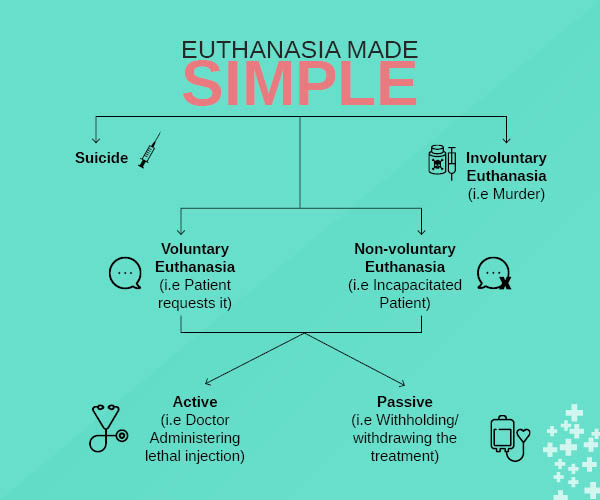
  1. Passive or Negative euthanasia means the withdrawal of necessary medical treatment with the deliberate intention to hasten the death of a terminally-ill patient is a must. In order for the death to be voluntary, the medicines which aids in saving lives will be discontinued so that death is brought about voluntarily. A common practice of this is a patient signing a ‘Do Not Resuscitate’ (DNR) document. It implies discontinuing or not using extraordinary life sustaining measures to prolong life. Others include act of omission such as failure to resuscitate a terminally ill or incapacitated patient (e.g. a severely defective new-born infant).

2. Active or Direct euthanasia means when one induces death by giving or providing medication or treatment leading to death.

3. Voluntary Euthanasia, sometimes called “assisted suicide”, is used in cases where the sufferer has made it clear that s/he wishes to die and has requested help to bring this about. When the euthanasia is practiced with the expressed desire and consent of the person concerned

4. Involuntary Euthanasia is one which is conducted without the consent and where an individual makes a decision for another person who is incapable of doing so. E.g. prolonged comma, old age, etc. It occurs when no consent or wish to die is expressed by the sufferer. When the euthanasia is practiced against the will of the person and also involuntary Euthanasia is one where patients can express a wish to die but don’t (this equates to murder).

5. Non- Voluntary Euthanasia is one where patients cannot express a wish to die. Patients who are in comas, infants, profound mentally retarded, severely brain damaged, cases of extreme senile dementia, those who cannot communicate for other reasons.

LEGAL VALIDITY IN INDIA

Passive euthanasia is legal in India. As per the 2018 ruling, The Supreme Court has held that the right to die with dignity is a fundamental right.

WHAT IS THE LEGAL POSITION AND TRENDS OF EUTHANASIA IN DIFFERENT COUNTRIES?

The Laws around the world vary greatly with regard to euthanasia, and are constantly subject to change as cultural values shift and better palliative care, or treatments become available. It is legal in some nations, while in others it may be criminalized. In some countries there is a divisive public controversy over the moral, ethical, and legal issues of euthanasia. Those who are against euthanasia may argue for the sanctity of life, while proponents of euthanasia rights emphasize alleviating suffering, and preserving bodily integrity, self-determination, and personal autonomy. Countries which have legitimized euthanasia are The Netherlands,Belgium, Oregon and Washington in the USA. In Switzerland only assisted suicide is legal. In India as mentioned above only passive euthanasia is legal.

LANDMARK CASE IN INDIA

Aruna Ramchandra Shanbaug vs Union Of India

FACTS OF THE CASE

Aruna Shanbaug, a nurse who was assaulted by a ward boy, and went into a vegetative state in 1973. • She remained blind, deaf, paralyzed and in a vegetative state till her death in 2015. A Writ Petition was filed by Pinki Virani claiming that her right to life guaranteed by the constitution had been violated. The petition was rejected by the court after medical examination. However, later in Aruna Ramchandra Shanbaug vs Union Of India, the Supreme Court in March 2011 held that passive euthanasia could be given a nod in case of exceptional circumstances and under strict monitoring of the apex court.

On 7 March 2011 the Supreme Court of India legalized passive euthanasia by means of the withdrawal of life support to patients in a permanent vegetative state. The decision was made as part of the verdict in a case involving Aruna Shanbaug, who had been in a Persistent Vegetative State (PVS) for 42 years until her death in 2015.

The Supreme Court of India specified two irreversible conditions to permit Passive Euthanasia:

  1. The Brain-Dead for whom the ventilator can be switched off.
  2. Those in a Persistent Vegetative State (PVS) for whom the feed can be tapered out and pain-managing palliatives be added, according to laid-down international specifications.

GUIDELINES LAID DOWN BY APEX COURT:

The following guidelines were laid down: A decision has to be taken to discontinue life support either by the parents or the spouse or other close relatives, or in the absence of any of them, such a decision can be taken even by a person or a body of persons acting as a next friend. It can also be taken by the doctors attending the patient. However, the decision should be taken bona fide in the best interest of the patient.

Even if a decision is taken by the near relatives or doctors or next friend to withdraw life support, such a decision requires approval from the High Court concerned. When such an application is filled the Chief Justice of the High Court should forthwith constitute a Bench of at least two Judges who should decide to grant approval or not.

A committee of three reputed doctors to be nominated by the Bench, who will give report regarding the condition of the patient. Before giving the verdict a notice regarding the report should be given to the close relatives and the State. After hearing the parties, the High Court can give its verdict.

WHAT ARE THE ARGUMENTS FOR AND AGAINST EUTHANASIA? 

Benefits of Legalizing Euthanasia (Arguments For)

  1. Provides relief to extreme pain.
  2. Relieves physical, mental and psychological pain for the patient and the family.
  3. Provides more facilities and funds for other patients needing medical treatment and attention.
  4. Euthanasia provides a way of relief when a person’s quality of life is low.
  5. It is another case of freedom of choice – the right to commit suicide.
  6. People should not be forced to stay alive.
  7. Speedy termination of physical and emotional suffering.
  8. Organs can be put to good use.
  9. Relieve mental suffering for the patient and his relatives.

Consequences of legalizing Euthanasia (Arguments Against)

  1. The ‘living will’ could be misused
  2. Religious beliefs could pose as a conflict in few scenarios
  3. The person might not be well informed of the possible treatment options
  4. Guidelines of the content of ‘living will’ has to be standardized
  5. Euthanasia demeans and devalues the sanctity of human life.
  6. Euthanasia can become a means of health care cost containment.
  7. Euthanasia will become non-voluntary.
  8. Euthanasia would not only be for people who are terminally ill.
  9. It amounts to murder and it is only God who can take away human life.
  10. It destroys life, which has potential that could be yet unknown to the patient, doctor or the family members.
  11. It discourages scientists who are looking for a cure for incurable ailments.
  12. An irreversible damage

WEBSITES REFERRED:

  1. https://www.slideshare.net/digitaltejas/euthanasia-types-arguments-for-and-against
  2. https://www.slideshare.net/altacitglobal/euthanasia-law-in-india
  3. http://racolblegal.com/euthanasia-an-act-of-mercy-killing/
  4. https://www.latestlaws.com/articles/euthanasia-the-contemporary-art-of-dying-by-aman-kumar-and-richa-hudilwala/
  5. https://byjus.com/free-ias-prep/euthanasia-or-mercy-killing/
  6. https://www.123rf.com/photo_109776197_stock-vector-red-flat-line-banner-trends.html
  7. https://www.slideserve.com/nami/euthanasia-mercy-killing
  8. http://racolblegal.com/the-dharma-jurispudence-of-the-supreme-court/

LEASES OF IMMOVABLE PROPERTY

LEASE (SECTION 105)

A lease of an immoveable property is a transfer or handing over of a right to enjoy such property, made for a certain time, express or implied, or in perpetuity, in consideration of a value paid or promised, or of money, a share of crops, service or any other thing of value, to be rendered intermittently or on specified or stated occasions to the transferor by the transferee, by whom transfer on such terms is accepted.

The person who transfers the property (transferor) is known as the lessor. The person to whom the transfer is made(transferee) is known as the lessee. The price here is acknowledged as the premium and the money, share, service, or any other thing so rendered in acknowledged as the rent.

A lease is the enjoyment of immovable property for a certain period of time or in perpetuity. But, in lease transfer of immovable property is not absolute like there it is in sale. The right of possession is separated from the right of ownership. In a sale, all the rights of ownership, which the transferor has, passes on to the transferee. In a lease, there is a partial transfer, that is a transfer of a right of enjoyment for a certain time.

A lease is transfer of an interest in an immovable property which is the subject matter of the lease and interest is the right to occupy and utilize the property for which the lease is given for period on terms and conditions as settled between the parties to lease agreement.

ESSENTIALS OF A LEASE AGREEMENT

2 Parties:

There should be two parties to a lease. The lessor and the lessee. Parties must be competent. The parties in a lease agreement should be competent to enter into a contract. Lesser should be authorised to a property and have absolute rights over that property.

Right of possession:

Ownership rights are not transferred in a lease, only the possession of the property is transferred or the right to use and enjoy the property.

Rent:

Consideration for a lease agreement can be reserved in the form of a rent or a premium.

Acceptance:

Lessee, who get the interest in the property after lease, has to agree to the lease agreement along with the time period and terms & conditions levied on the transfer.

Time Period:

Lease can continue for a certain time period which has to be specified in the lease agreement.

DURATION OF CERTAIN LEASES IN ABSENCE OF WRITTEN CONTRACT OR LOCAL USAGES (SECTION 106)

Section 106 provides for the duration of the lease in the absence of the lease agreement. It lays down that in the non-existence of a contract, lease can be terminated by both parties to the lease agreement by issuance of a notice to quit. The specified time period always initiates from the date notice to quit is received.

According to section 106 of TPA, 1882, if there is an absence of a written contract or a local usage to the contrary then in the case, a lease of immovable property for manufacturing and agriculture purpose will be from year to year and will be valid till the time until it was terminated by either of the party, by six months’ notice and if there is a lease any other purpose except agriculture or manufacturing will run from month to month then it will be terminated by 15 days’ notice.

LEASE HOW MADE (SECTION 107)

Section 107 states about lease how made. This section covers three aspects:

A lease of Immovable property for the term of 1 year or exceeding a year– This can only be prepared by a registered deed.

Another leases of Immovable property for the period less than one year can be either prepared by a registered deed or a verbal agreement or settlement, accompanied by delivery of possession of that property.

When the lease is of multiple properties that require multiple deeds, it will be made by both the parties of the lease.

DETERMINATION OF LEASE (SECTION 111)

Section 111 states concerning the determination of the lease, which sets down the methods to terminate lease:

Lapse of time – When the prescribed time of the lease expires, the lease is terminated.

Specified event – When there is a condition on termination of time of lease i.e. lease will terminate on happening of an event.

Interest – Lessor’s interest to lease the property may cease, hence the lease is terminated.

Same owner – When the interest and rights of both lessor and lessee are relocated or vested in the same person.

Express Submission– Happens when the lessee ceases to own an interest in the property and gets into a mutual agreement with the lessor.

Implied Submission – When the lessee goes into a contract with some other lessor for the lease of property, it is an implied surrender of the current lease.

Forfeiture – There are three ways in which a termination of lease can be done:

When there is a breach of an express condition by the lessee. The lessor may get the possession of his property back.

When lessee renounces his character or gives the title of the property to a third person.

When the lessee is called as insolvent by the banks, and the conditions provided for it, the lease will be held terminated.

Expiry of Notice to Quit – When the notice to quit by the lessor to the lessee expires, the lease will also expire.

RIGHTS OF LESSOR

Right to accretions- If during the tenancy period any further accession, accumulation or addition is made in the property whether naturally or artificially by the expense of the lessee. On the termination of the lease period, the lessee must surrender the accession to the lessor.

Right to collect rent- The lessor has the right to collect rent or any form of consideration as mentioned in the terms and conditions of the contract from the tenant without any form of interruptions.

LIABILITIES OF A LESSOR

Duty of disclose material defects- The lessor is bound to disclose to the buyer any material defect in the property. There are two kinds of defects:

So basically, a lessor is bound to disclose those apparent defects to the lessee, which are material with reference to the intended use of property or interfere with the enjoyment of the property by the lessee.

To give possession- The lessor must deliver possession of the leased property to the lessee on being requested by lessee. The lessor is not entitled rent unless he has fulfilled his obligations to put lessee in possession of the leased premises.

Covenant for quiet enjoyment- the lessor is deemed to contract with the lessee that if the lessee pays the rent and performs his own obligation, he may hold property during the time limited by the lease without any interruption. The Madhya Pradesh HC stated that actions such as physical interference or direct interference in the premises lead to a breach of enjoyment and interruptions.

RIGHTS OF A LESSEE

To deduct the cost for repair- If the lessor commits a breach of the covenants which the lessor is bound to do in that case the lessee can make such repairs by his personal expenses. The lessee after giving reasonable notice to the lessor, may do such repairs by his personal expenses, and recover the amount expended by him by him together with interest by deducting it from the rent.

Right to remove fixtures- Lessee has right to remove the fixtures or trees planted by him in the property during the time continuance of lease. However, after the termination of the lease deed the lessee is allowed to remove his possession in the property. It is considered optimal that property is left in the condition in which it was received by lessee.

Right to assign his interest- The lessee may transfer absolutely or by way of sub-lease or mortgage the whole or any part of his interest in the property.  However, if the lease deed restricts a lessee to dispense his interest then the lessee is barred to do so and even after the transfer of his rights, the lessee is still subordinate to all the liabilities related to the lease deed.

Right to have benefits of crops- a lessee who holds the lease of uncertain duration then, in that case, the lessee or his/her legal representative has been given the right to take benefits from all the crops cultivated by them.

LIABILITIES OF A LESSEE

Duty to disclose material facts- The lessee is bound to disclose facts concerning the lessors title which increase the value of lease and of which the lessor is ignorant.  In case if the lessee does not disclose material fact and the lessor undergoes any loss then the lessee is bound to compensate the lessor.

Duty to pay rent- The lessee’s liability for rent is regulated by term of the lease. He is bound to pay the rent or the premium to the lessor or his agent in the appropriate time and suitable place. In case the lessee fails to pay his/her rent then, in that case, the lessor can expel the lessee on the ground of non-payment of rent or file a suit for arrears of rent.

Duty to maintain the property- The lessee is bound to maintain and restore the property in the condition he was given the possession of the property. Only the changes caused by uncontrollable forces can act as an exception for this liability.

Duty to give notice of encroachment- duty of lessee to inform lessor when he becomes aware that any person has tried or is trying to damage the rights of the lessor or the title of the lessor is endangered then, in that case, the lessee must give notice to the lessor.

Duty to use the property in a reasonable manner- The lessee is under an obligation to use the property as a person of ordinary prudence would.

Duty not to erect any permanent structure- prohibits lessee from erecting any permanent structures except the agricultural cultivation without the consent of the lessor.

Duty to restore possession- On determination of the lease, the lessee is bound to the possession of the property to the lessor. If the lessee does not vacate the premises even after the expiry of the notice, then lessee remains liable for the rent.

CONCLUSION

The fundamental conception of a lease is that it is the separation of possession from ownership. For a lease of immovable property, there must be lessor and lessee. An agreement of lease must be executed lawfully by the parties to lease agreement.


Introduction to Fundamental Rights

The fundamental rights are defined as the basis humar rights of all citizens. These rights, defined in part 3rd of the constitution. Applied irrespective of caste, creed, place of birth, religion etc. They are enforceable by the court, subject to specific restrictions.

What is the purpose of fundamental rights ?

1. Preserve individual liberty,

2. Equality of all members of society,

3. Dr Ambedkar said that the responsibility of the legislature is just not to provide fundamental rights but also and rather,  to safeguard them.

List of fundamental rights 

There are six fundamental rights of Indian constitution along with to constitutional article.

Right to equality (article 14-18)

Right to equality guarantees equal rights for everyone irrespective of their caste, creed, birth of place, religion or race. This right also includes the abolition of titles as well as untouchability.

Right to freedom (article 19-22)

Freedom is one fo the most important ideals enhanced and cherished by the democratic country. Without freedom the democracy is meaningless. The freedom right includes many rights such as freedom of speech, freedom of expression, freedom of association And freedom to practice any profession and religion.

Right against exploitation (article 23-24)

This right implies the prohibition of traffic in human beings, beggar and other forms of force labour. It also implies the prohibition of child labour. The constitution prohibits the employment of children under 14 years in hazardous conditions.

Right to freedom of religion (article 25-28)

There is equal importance given to all religions. There is freedom of conscience, profession, practice and propagation of religion. The state has no official religion. Every person has the right to choose his/her religion.

Cultural and educational rights (article 29-30)

Special protection provided in the constitution to preserve and develop the language, Culture and religion of minorities. Every culture has the right to conserve it’s language, culture and religious practices.

Right to constitutional remedies (article 32)

Article 32 provide a guaranteed remedy, in the form of a fundamental right itself, for enforcement of all the other fundamental rights, and the supreme court is designated as the protector of these rights by the constitution.the supreme court has the jurisdiction to enforce the fundamental rights even against the private bodies. And in case of violation, award compensation as well as to the affected individual.

Right to privacy

Right to privacy is the latest right of our country being recently approved by the supreme court of india. According to this right we are liable to keep our material private and without our permission no one can interfere in our private matter.

Right to property was removed from the Indian constitution in 1978. It is no longer counted as a fundamental right.  

Invites for the Frontline COVID Warriors: A special feature of the I-Day 2020 celebrations in India this year

Ministry of Home Affairs | MyGov.in

INTRODUCTION

The Ministry of Home Affairs (MHA) has issued the guidelines for the Independence Day celebrations that will take place amid the cloud of novel coronavirus pandemic. Due to this unfortunate and extraordinary situation the Independence Day celebrations on the 15th August will be subdued and low key.

THE LETTER

Joint Secretary Anuj Sharma has written a letter to all States and Union Territories sharing with them how the celebrations should be carried out in these testing times. In the letter preventive measures like social distancing, wearing of masks that are absolutely imperative have been mentioned in order to make sure that the celebrations are carried out without any collateral damage.

“In view of the spread of Covid-19 pandemic, while organizing various programmes or activities for the Independence Day celebrations, it is imperative to follow certain preventive measures such as maintaining social distancing, wearing of masks, proper sanitization, avoiding large congregations, protecting vulnerable persons, etc.; and follow all guidelines related to Covid-19 issued by the Ministry of Home Affairs and Ministry of Health a Family Welfare,” the letter read. Hence one can assume and infer that all the functions organised countrywide will be deprived of large gatherings.

Happy 74th Independence Day Wishes India | 15th August 2020

CELEBRATIONS AT THE LAL QILA

The Ceremony at Red Fort consisting of the presentation of a Guard of Honour by the Armed Forces and the Delhi Police to the Prime Minister (Pradhan Mantri), unfurling of the National Flag accompanied by playing of the National Anthem and firing of 21-gun salute, speech by the Prime Minister, singing of the National Anthem immediately after PM’s speech, and release of tricoloured balloons at the end. This will be followed by “At Home” reception at Rashtrapati Bhawan. As regards holding of “At Home” reception at Raj Bhawan /Raj Niwas by the Governor/Lt. Governor on the Independence Day, the matter is left to the discretion of Governors/Lt. Governors.

CELEBRATIONS AT THE STATE LEVEL

A ceremony in the morning (after 9.00 AM) in the State/Union Territory Capitals consisting of unfurling of the National Flag by the Chief Minister; playing of the National Anthem; presentation of Guard of Honour by the Police including Para-Military Forces, Home Guards, NCC, Scouts, etc; speech by the Chief Minister; and singing of the National Anthem.

In view of Covid-19 pandemic, large congregation in the ceremony be avoided. It is imperative that social distancing norms, wearing masks, etc., are followed. It would also be appropriate that Covid-19 warriors like doctors, health workers, sanitation workers, etc., are invited in the ceremony as a recognition of their noble service in fight against Covid-19 Pandemic. Some persons cured from Covid-19 infection may also be invited.

CELEBRATIONS AT THE DISTRICTS, SUB DIVISIONAL BLOCS AND PANCHAYAT HEADQUARTERS

The Districts, Sub Divisional blocs, Panchayat headquarters will have to follow similar protocols as the states. In view of the COVID-19 pandemic, preventive measures such as maintaining social distancing, wearing of masks, proper sanitization, avoiding large congregations, protecting vulnerable groups, etc., and other measures as prescribed and recommended by the Ministry of Health a Family Welfare, are to be followed. It would be appropriate that frontline warriors and workers like the doctors, health workers, sanitation workers, etc., are invited in the ceremony as recognition for their noble service in fight against the COVID-19 Pandemic. Some persons who have been cured from the infection may also be invited.

Performance of Police/Military bands may be recorded at places of historic importance associated with the Independence movement; and recorded versions thereof may be displayed through large screens/digital media, during public functions and on social media.

Other functions of the day may include activities like planting of trees; inter-school/inter-college debates on digital platforms; online quiz contests/patriotic essay writing and poetry competitions; launching of any important scheme, singing patriotic songs/delivering patriotic talks by selected boys/girls on the social media; illumination of Government Buildings/State Bhawans, etc; thematic webinars; online campaign by NSS and NYKS centered around patriotic themes; or any other activity deemed appropriate by the State Government/Union Territory Administration befitting the occasion. Other innovative ways of celebrating Independence Day may be considered like propagating patriotic or national integration messages/songs through digital and social media platforms, sound shows/lighting of important public buildings, waving of National Flags by people at rooftops/balconies, etc.

“It would be appropriate that the theme of “Aatmanirbhar Bharat” is suitably spread and publicized amongst the masses through various activities/messages in the functions and on social media during Independence Day celebrations,” the letter signed off with.

WEBSITES REFERRED

  1. https://www.mha.gov.in/sites/default/files/IndependenceDay_24072020.pdf

2. https://www.indiatvnews.com/news/india/independence-day-celebrations-guidelines-covid-19-coronavirus-new-guidelines-mha-636649

3. https://www.ndtv.com/india-news/74th-independence-day-covid-warriors-to-be-invited-on-independence-day-government-to-states-2268156#:~:text=Prime%20Minister%20Narendra%20Modi%20will,Independence%20Day%20on%20August%2015

4. https://secure.mygov.in/group/ministry-home-affairs/

5. https://www.jaborejob.com/happy-74th-independence-day-wishes-india-15th-august-2020/

SECTION 10 AND 11, COMPETENCY TO CONTRACT

WHAT IS A CONTRACT?

The contract is an agreement between various parties which is validated and framed by Indian Contract Act, 1872. It defines the term “Contract” under its section 2 (h) as “An agreement enforceable by law”. An agreement is a deliberate, mutual, legally binding between two or more competent parties. The Agreement creates reciprocal legal obligations between two private parties. Generally, contracts are written, but they may be implied or spoken. A contract is therefore a legal agreement that provides special rights (as specified by the contract itself) to the parties as well as responsibilities that all parties to the contract have created, established, and agreed upon.

SECTIONS 11 AND 12 AS GIVEN IN ICA,1872

SECTION 11: Every person is competent to contract who is of the age of majority according to the law to which he is subject,1 and who is of sound mind and is not disqualified from contracting by any law to which he is subject.

SECTION 12: A person is said to be of sound mind for the purpose of making a contract, if, at the time when he makes it, he is capable of understanding it and of forming a rational judgment as to its effect upon his interests.”

A person who is usually of unsound mind, but occasionally of sound mind, may make a contract when he is of sound mind.

A person who is usually of sound mind, but occasionally of unsound mind, may not make a contract when he is of unsound mind. 

PROVISIONS UNDER SECTION 11

  • Attaining the age of majority
  • Sound minded
  • Not a disqualified person by law from contracting

ATTAINING THE AGE OF MAJORITY

The age of majority in India is specified as 18 years, according to the Indian Majority Act of 1875. Any person who has not reached 18 years of age and is a resident of India is considered a minor.

Contract with minor is void

Because a person under the age of 18 does not have the potential to enters a contract, any agreement entered into with a minor is void or void ab-initio.  However, if a minor entered a contract, he cannot ratify it even though the majority has been reached because the contract is invalid.

Conditions when contract with minor is not void

A minor could be a beneficiary of a contract:

While a minor may not be able to enter into a contract, he may be the beneficiary of one.

A minor is always given the advantage of being a minor:

Even if a minor falsely represents himself as a major and takes a credit or enter into an agreement, he may plead a minority.  The estoppel rule will not be extended against him/her.

Contract by a guardian:

In certain conditions, the guardian of a minor may enter into a valid contract on behalf of the minor. Such a contract entered into by the guardian for the benefit of the minor.

Insolvency:

A minor cannot be declared insolvent because he cannot afford debts.

A Minor and an Adult shared contract:

In the case of a joint contract between an adult and a minor, performed on behalf of the minor by the guardian, the adult shall be held liable for the contract.

SOUND MINDED PERSON

According to Section 12 of the Indian Contract Act , 1872 describes the principle of soundness of brain as follows:

A person is said to have a sound mind if he or she is capable of comprehending the contract and its effect on his or her interests. Besides, who is typically of a sound mind, but occasionally of an unsound mind, cannot enter a contract during the period of his/her unsound mind. Similarly, a person who is normally of an unsound mind, but occasionally of a sound mind, can make a contract when he is of a sound mind.

Analogy between English law and Indian law:

In England, mere unsoundness of mind is no defense; a lunatic’s contract is binding on him, unless he can prove that he was entirely incapable of comprehending what he/she was doing at the time of entering the contract and that the other party was known to his/her lunaticism. In India, the contract of a person with an unsound mind is void.

PERSONS DISQUALIFIED BY LAW

A person who is blacklisted person by law. Grounds for disqualification by law include political affiliation, legal status, etc. Some of such people are foreign sovereigns and ambassadors, alien enemies, convicts, insolvents, etc.

Alien enemy: A person who is not an Indian citizen is called an alien or non-citizen of the Republic of India. An alien enemy is a person whose country is at war with India.

Convicts: A convict is a person, who is sentenced by a competent court to the death sentence or imprisonment.

Insolvent: There is no prohibition against a contract by an insolvent after the insolvency proceedings have commenced but before adjudication.

Foreign sovereigns and diplomats: Foreign sovereigns have some special privileges. Generally, they cannot be sued unless they, themselves surrender under the jurisdiction of the Indian court of law.

Corporations: A corporation’s ability to establish a contract varies according to the corporation’s character. A corporation is an artificial entity created by law and is capable of contracting but its contractual power is subject to the limitation.

CONCLUSION

Some of the most important conditions for making an arrangement legal and enforceable in a court of law is the integrity of the parties to contract.

A contract made by a person who does not have the intellectual capacity to understand the meaning of the contract and its effects is void ab initio. In the other hand, arrangements with lunatics can / may not be void for persons under the influence of the drug depending on the circumstances surrounding the case.

A person regains the legal capacity to contract if any of the disqualifications are removed.

PAKALA NARAYAN SWAMI V. EMPEROR AIR 1939

INTRODUCTION

Examination of accused defined under section161 Cr.PC is prevalently known as interrogation. The object of examination of witness u/s.161 CrPC is to generate the evidence before the court at the time of trial as per section 162. Further, these statements are beneficial for the court for framing the charge. Before trial commences copies of these statements recorded by the police should be delivered to accused without costing any charge. Confession is deliberate admission of fault by the accused person.

The term statement is not defined in the Code of Criminal Procedure but its dictionary meaning is the act of stating or reciting. Section 161 and 162, deals with the oral examination of witnesses by police, the record to be made of the statements and their use subsequently.  These sections authorize the police to examine witnesses during the course of an investigation. Any person who is supposed to be acquainted with the facts and circumstances of the case maybe examined orally and such statement can be used in court as an evidence after fulfilling required conditions. The words “any person” used in Section 161 (1) also include a person who maybe accused of the crime and suspects. This is held by the Privy Council in the case:  Pakala Narayana Swami v. Emperor.[1]

ABOUT THE CASE LAW

COURT OF JUSTICE: Bombay High Court

NAME: Pakala Narayana Swami vs Emperor

DECIDED ON: 19 January, 1939

CITATION: (1939) 41 BOMLR 428

BENCH OF JUDGES:  Justice Atkin, Justice G Rankin, Justice Porter, Justice Thankerton, Justice Wright

FACTS:

An appeal by special leave from a judgment of the High Court of Patna who affirmed the decision of the Sessions Judge at Berhampur who had convicted the appellant of the murder of one Kuree Nukaraju and sentenced him to death. The accused, his wife, his wife’s brother, and his clerk living at his house were charged with the murder before the Sub-divisional Magistrate, Chatrapur, in May and June, 1937. After hearing the evidence the examining Magistrate discharged all the accused holding that there was no sufficient evidence to support the charge. Thereupon the Sessions Judge, Berhampur, exercising his powers under the Code of Criminal Procedure, called upon the accused to show cause why they should not be committed for trial, and in July, 1937, ordered the present accused and his wife to be committed to the Court of Session to stand their trial for offences under sections of the Indian Penal Code 120B (conspiring to murder) 302 (murder) and 201 (causing evidence of an offence to disappear). At the trial the Sessions Judge acquitted the appellant’s wife of all the charges but convicted the appellant of murder and sentenced him to death. The appeal is based upon the admission of certain evidence said to be made inadmissible by provisions of the Code of Criminal Procedure and the Indian Evidence Act; and is further maintained upon the contention that whether the disputed evidence be admitted or not, and certainly if it ought to have been rejected, there is no evidence sufficient to support this conviction.[2]

It will be observed that “the circumstances” are of the transaction which resulted in the death of the declarant. In the present case the cause of the deceased’s death comes into question. The transaction is one in which the deceased was murdered on March 21, or March 22, and his body was found in a trunk proved to be bought on behalf of the accused. The statement made by the deceased on March 20 or 21 that he was setting out to the place where the accused lived, and to meet a person, the wife of the accused, who lived in the accused’s house, appears clearly to be a statement as to some of the circumstances of the transaction which resulted in his death. The statement was rightly admitted.

ISSUE:

It is now necessary to discuss the question whether the alleged statement of the accused to the police before arrest was protected by Section 162 of the Code of Criminal Procedure which provides [Sub-section (1)] :

No statement made by any person to a police-officer in the course of an investigation under this Chapter shall, if reduced into writing, be signed by the person making it; nor shall any such statement or any record thereof, whether in a police-diary or otherwise, or any part of such statement or record, be used for any purpose (save as hereinafter provided) at any inquiry or trial in respect of any offence under investigation at the time when such statement was made.

RELEVANT INFORMATION:

After giving powers to certain police officers to investigate certain crimes, the Code proceeds in:

Section 160, which gives power to any police officer making an investigation by an order in writing is required to take the attendance before him of persons who appear to be acquainted with the circumstances of the case.

Section 161, allows examination of witness by police.

SCOPE OF SEC.161 ( Cr.PC) STATEMENTS:

Recording of Statements of Witnesses: The Police Officer making an investigation should himself customarily inspect any person and record his statement during that investigation. However, in the cases where it is unfeasible, the Head Constable or the writer connected with the Police Station may record the statements of witnesses. In that case both the recording officer and the investigating officer should sign the statement recorded under section 161 (3) Cr.P.C. Under this section, administering oath or affirmation is not obligatory in an examination.

Here expression ‘any person’ includes accused also. Therefore, persons to be examined include whosoever may subsequently be accused of the offence in respect of which the investigation is made by the police officer. The person examined in the course of a police investigation is obliged to answer all questions put to him “other than questions the answers to which would have a tendency to expose him to a criminal charge or to a penalty or forfeiture.” Accused has got right to remain silent as he got ‘right against self incrimination’ as per S.161 (2) CrPC and Article 20 (3) of Indian Constitution. The person questioned is legally bound to state the truth. However, if a witness examined by the police does not give answers to the questions, he can be punishable u/s.179 IPC or if he gives false information, he can be punished u/s.193 IPC.

The statements of all witnesses (which are familiar with the facts and circumstances of the case and they may have to be cited as witnesses in the court) are desirable to be reduced into writing. The statement of each witness should be recorded separately. Statements recorded by Police Officers should not be in the indirect form of speech, as per Sec.161 (3) Cr.P.C. The language of Sec.162 Cr.P.C and S.145 of Evidence Act clearly point outs that the writing should be describable as a statement of the witness himself also it should be as nearly as possible, a complete record of what he has said. Sec.161 (3) Cr.P.C read together with Sec.173 (3) Cr.P.C clearly indicates that separate statements of all persons whom the prosecution proposes to examine as its witnesses should be recorded and copies thereof must be given to the accused before the instigation of the inquiry.

Evidentiary Value of statements recorded The statements recorded by the police u/s.161 CrPC are not evidence for prosecution. They can be used by the defense for oppose the prosecution witnesses. However, when the prosecution witness turns hostile with the permission of court, the Public Prosecutor can cross-examine that witness by using his Sec.161 statements to determine contradiction. But when Sec.161 statements falls u/s.27 or u/s.32 (1) of Indian Evidence Act, then those statements can be used by prosecution as an evidence. Sec.161 statements are not substantive evidence. Statement of injured witness was recorded as dying declaration but he survived, then such statement has to be considered as Sec.161 statements. But Sec. 161 statements can be treated as dying declaration if that person dies. Sec.161 statements cannot be used against the accused in criminal cases. They shall not be used for any purpose except to contradict a witness in the manner prescribed in the proviso to Sec. 162 (1). Under Sec.161 & Sec.162 Cr.P.C the Witness is not confronted with the statement. The Court cannot subsequently use the statement even for drawing any adverse impression against the witness. If thumb impression or signature is not obtained, such statements are fallacious. Signing of statement merely puts the Court on prudence and may necessitate in depth inspection of the evidence, but the evidence on this account cannot be rejected outright. Hindrance in examination of witnesses by police u/s.161 CrPC, if properly explained, is not lethal to the prosecution case


[1] AIR 1939 PC 47

[2] https://indiankanoon.org/doc/516808/

The 19 Important Laws and Rights which every Indian Citizen must be aware of

A Citizen of India has a vast and wide array of rights from right to protection of life, assets to the right to education etc. These rights aid a Citizen of India so that one can lead their life in a dignified manner. A Citizen of India has been provided these rights and laws in various different provisions of the Indian Constitution. I have explained some basic rights and laws which every Indian National must be aware of and have knowledge of it.

1. Motor Vehicle Act 1988, section -185, 202:- At the time of driving if your 100ml blood contains more than 30mg of alcohol then the police can arrest you without a warrant.

2. Criminal Procedure Code, Section 46:- No woman cannot be arrested before 6 A.M. and after 6 P.M.

Lady Police Arrested A Woman Royalty Free Cliparts, Vectors, And ...

3.  Indian Penal Code, 166 A:- A Police officer can’t refuse to lodge an FIR if he/she does so they could be jailed for up to 6 months to 1 year.

Section 166A in The Code Of Criminal Procedure | Police can not ...

4. Indian Sarais Act, 1887:- Even any 5-star hotel can’t prohibit you from drinking potable water and using its washrooms.

Is there any rule in India that we can enter into any hotel for ...

5.  Motor Vehicle Act, 1988:- As per Section 129 of the Indian Motor Vehicle Act, wearing the helmet is a must for two-wheeler riders. Section 128 of this Motor Vehicle Act limits the maximum two riders on the bikes. The law states and provides for that, if the traffic police officer snatches the key from the car or motorcycle, it is illegal and you shall have the full right to launch a Legal proceeding against the officer.

6.  Domestic Violence Act, 2005:- If a young boy and a girl want to live together in a “live-in relationship”, they can do so because it is not illegal. Even the newborn from this relationship is also a legal son or daughter and this newborn have the full right in the assets of his/her father.

7. Police Act, 1861:- A police officer is always on duty whether he/she wearing a uniform or not. If a person makes a complaint to the officer, he/she could not say that he can’t help the victim because he/ she is not on duty.

8. Maternity Benefit Act, 1961:- No company can fire a pregnant woman. It may be punishable by a maximum of 3 years of imprisonment. If the company (Government or private) has more than 10 employees then the pregnant women employee is eligible to get 84 days paid maternity leave.

9. Income Tax Act, 1961:-  In the case of tax violations, the tax collection officer has the power to arrest you but before arresting you, he/she will have to send a notice to you. Only Tax Commissioner decides how long you will stay in the custody.

10.  Hindu Marriage Act, Section -13: As per the Hindu Marriage Act, 1955 (any husband or wife) may apply for divorce in the court on the basis of Adultery (physical relationship outside of marriage), physical and mental abuse, impotency, to leave home without information, to change Hindu religion and adopt other religion, insanity, incurable disease and no information about husband or wife for seven-year.

11. Code of Criminal Procedure, 1973:- Only women police constable can arrest women.  Male constable doesn’t have the right to arrest women. Women have the right to deny going to police stations after the 6 P.M. and before the 6 A.M. In the case of a serious crime only after receipt of the written order from the magistrate, a male policeman can arrest a woman.

12. As per the Citizen Charter (Indian Oil Corporation website):- There are very few people who know that if their gas cylinder blasts during the cooking of food then the gas agency is liable to pay Rs. 50 lakh to the victim as compensation. To claim this compensation consumers need to lodge an FIR to the nearest police station and submit it to the concerned gas agency.

13. Foreign Contribution Regulation Act (FCRA), 2010:- It would surprise you to know that if you take a gift from any company on the occasion of a festival, it falls into the category of bribery. You can also be sentenced to jail for this crime.

14.  Automotive (Amendment) Bill, 2016,:- If you are fined for a crime (like riding without a helmet or any other reason) then you will not be fined for the same reason in the same day.

15. Maximum Retail Price Act, 2014:- Any Shop keeper can’t charge more than the printed price of any commodity but a consumer has the right to bargain for less than the printed price of a commodity.

16. Limitation Act, 1963:-  If your office does not pay you then you have the power to file an FIR against it within 3 years. But if you report after 3 years, you will not get anything for the due.

17.  Section 294 of the Indian Penal Code:- If you are found involved in “obscene activity” at a public place, you can be imprisoned for 3 months. But in the absence of an exact definition of obscene activity police have always misused this act.

18.  Hindu Adoption and Maintenance Act, 1956:- If somebody belongs to the Hindu religion and has a son or grandson then he can’t adopt a second child. There must be a gap of at least 21 years between you (the adopter) and your adopted son.

19.  Delhi Rent Control Act, 1958, Section 14:- If you are living in Delhi then your landlord does not have the right to forcefully vacate your house without giving prior notice to you.

WEBSITES REFERRED

  1. https://www.facebook.com/notes/meripadhai/19-laws-and-rights-must-be-known-to-every-indian/480097059230223/

2.https://www.jagranjosh.com/general-knowledge/19-laws-and-rights-must-be-known-to-every-indian-1486368049-1

3.https://legodesk.com/legopedia/drunk-driving/

4.https://www.123rf.com/photo_64116772_stock-vector-lady-police-arrested-a-woman.html

5.https://www.google.com/searchq=Indian+Penal+Code+166+A&rlz=1C1CHBD_enIN782IN782&sxsrf=ALeKk00PWxtPznaaUVIMZA9GwifqhJZgqA:1595844030365&source=lnms&tbm=isch&sa=X&ved=2ahUKEwje3a-klu3qAhVJxzgGHWACDKgQ_AUoBHoECA4QBg&biw=1366&bih=576#imgrc=_bLrmlGmEdtXVM

6.https://www.quora.com/Is-there-any-rule-in-India-that-we-can-enter-into-any-hotel-for-water

7.https://in.pinterest.com/pin/614037730417601943/

8)https://www.google.com/amp/s/www.indiatimes.com/amp/news/india/women-in-live-in-relationships-are-like-concubines-says-rajasthan-human-right-s-body-asking-for-ban-375078.html

9)https://www.vecteezy.com/vector-art/242672-police-officer-helping

10)https://www.slideshare.net/mobile/meghaiyer1988/the-maternity-benefits-act-1961

11)https://topcornerjob.com/how-to-respond-to-income-tax-notice-online/

12)https://www.legalsalah.com/blog/mutual-divorce-us-13b-hindu-marriage-act1955/

13)https://in.pinterest.com/pin/734509020455350757/

14)https://kashmirobserver.net/2019/11/30/4-killed-3-injured-in-gas-cylinder-explosion-in-ramban/

15)https://www.kindpng.com/imgv/bxTooo_memo-clip-art-hd-png-download/

Is internet the new crime scene?

Cyber Crime is an unlawful act where the computer is used as a tool or target or both. These days Cyber Crime is a fast-growing area of crime. As the technology is advancing man is becoming dependent on the internet for all his needs as it gives easy access to do shopping, gaming, online studying, social networking, online jobs etc. everything at one place. Apart from other countries, India is also not far where the rate of incidence of cybercrime is increasing day by day.

The bane of the internet, cybercrime refers to any illegal activities carried out using technology. Cybercriminals — who range from rogue individuals to organized crime groups to state-sponsored factions — use techniques like phishing, social engineering, and all kinds of malware to pursue their nefarious plans. Cybercriminals buy and sell malware online (generally on the dark web) while also trading in services that test how robust a virus is, business intelligence dashboards to track malware deployment, and tech support (that’s right — crooks can contact a criminal helpline to troubleshoot their illegal hacking server or other malfeasance!).

The professionalization and proliferation of cybercrime adds up to countless costs in damages every year, impacting individuals, businesses, and even governments. Experts estimate that cybercrime damages will reach $6 trillion annually by 2021, making it one of the most lucrative criminal enterprises.

Criminals are mostly exploiting the speed, convenience and anonymity of the internet, commit various criminal activities and pose the real threat to victims all over the world. These crimes can be phishing, Fraud due to credit card, debit card, bank robbery, illegal downloading, child pornography, distribution of viruses etc.

New technologies create new criminal opportunities but few new types of crime. What distinguishes cybercrime from traditional criminal activity? Obviously, one difference is the use of the digital computer, but technology alone is insufficient for any distinction that might exist between different realms of criminal activity. Criminals do not need a computer to commit fraud, traffic in child pornography and intellectual property, steal an identity, or violate someone’s privacy. All those activities existed before the “cyber” prefix became ubiquitous. Cybercrime, especially involving the Internet, represents an extension of existing criminal behaviour alongside some novel illegal activities.

Most cybercrime is an attack on information about individuals, corporations, or governments. Although the attacks do not take place on a physical body, they do take place on the personal or corporate virtual body, which is the set of informational attributes that define people and institutions on the Internet. In other words, in the digital age our virtual identities are essential elements of everyday life: we are a bundle of numbers and identifiers in multiple computer databases owned by governments and corporations. Cybercrime highlights the centrality of networked computers in our lives, as well as the fragility of such seemingly solid facts as individual identity.

Cyber Laws in India

Cyber Crimes, in India are registered under three main heads, The IT Act, The IPC (Indian Penal Code) and State Level Legislations (SLL).

Cases of Cyber Laws under IT Act:

Tampering with computer source documents – Sec. 65

Hacking with Computer systems, Data alteration – Sec. 66

Publishing obscene information – Sec. 67

Un-authorised access to protected systems – Sec. 70

Breach of Confidentiality and Privacy – Sec. 72

Publishing false digital signature certificates – Sec. 73

Cases of Cyber Laws under IPC and Special Laws:

Sending threatening messages by email – Sec 505 IPC

Sending defamatory messages by email – Sec 499 IPC

Forgery of Electronic records – Sec 463 IPC

Bogus websites, Cyber Frauds – Sec 420 IPC

Email Spoofing – Sec. 463 IPC

Web- Jacking –Sec. 383 IPC

Email abuse – Sec 500 IPC

Cyber Crime under special cells:

Online sale of Arms Act

Online sale of Drugs under Narcotic Drugs and Psychotropic Substances Act

Child Rights equally important

Children and childhood across the world, have broadly been construed in terms of a ‘golden age’ that is synonymous with innocence, freedom, joy, play and the like. It is the time when, spared the rigours of adult life, one hardly shoulders any kind of responsibility or obligations. But, then, it is also true that children are vulnerable, especially when very young. The fact that children are vulnerable, they need to be cared for and protected from ‘the harshness of the world outside’ and around.

This being so, the adult-child relation, parents, in particular, is said to provide ‘care and protection’ – serving thereby the ‘best interests of the child’ and meeting their day-to-day ‘needs of survival and development’. The adult is presumed to be the guardian and in that respect expected to take the responsibility of a child’s welfare and development. Whether or not, the premise underlying this is correct or not, the childhood ‘reality’ on the whole is questionable, demanding critical evaluation. Accordingly, idealistic notions and representations associated with children and childhood have been challenged, especially concerning poverty, disease, exploitation and abuse rife across the globe. Many also believe that childhood is that period during which children are subject to a set of rules and regulations unique to them, and one that does not apply to members of other social categories. It is indeed a period in a person’s life during which she/he is neither expected nor allowed to fully participate in various domains of social life. It is thus not a world of freedom and opportunity but one of confinement and limitation in which children are ‘wholly subservient and dependent’. This being so, childhood is nothing short of a world of isolation, sadness, exploitation, oppression, cruelty and abuse.

The UNCRC outlines the fundamental human rights that should be afforded to children in four broad classifications that suitably cover all civil, political, social, economic and cultural rights of every child:

Right to Survival:

• Right to be born

• Right to minimum standards of food, shelter and clothing

• Right to live with dignity

• Right to health care, to safe drinking water, nutritious food, a clean and safe environment, and information to help them stay healthy

Right to Protection:

• Right to be protected from all sorts of violence

• Right to be protected from neglect

• Right to be protected from physical and sexual abuse

• Right to be protected from dangerous drugs

Right to Participation:

• Right to freedom of opinion

• Right to freedom of expression

• Right to freedom of association

• Right to information

• Right to participate in any decision making that involves him/her directly or indirectly

Right to Development:

• Right to education

• Right to learn

• Right to relax and play

• Right to all forms of development – emotional, mental and physical

CRC and India

Adopted by the United Nations in 1989, the CRC is an international agreement legally binding on the parties signatory to it. It has incorporated in its various articles rights of children without any discrimination whatsoever. It was ratified by India on 11 December 1992. It has a preamble setting out different principles the CRC is built upon.

It is based on four basic principles:

1.  Non-discrimination (Article 2)

2.  Best Interest of the Child (Article 3)

3.  Right to Life Survival and Development (Article 6)

4.  Right to be Heard (Article 12)

Steps that can be taken to improve the lives of children.

·         Strengthen the reporting mechanism on violence against children by making it more accessible to children.

·         Develop a framework for the protection of children from online abuse and ensuring privacy, safety and confidentiality of data shared on digital platforms.

·         Enhance financial investment on child protection components

·         Sensitise parents, service providers and community for early identification and management of children facing abuse and violence; and sensitisation of children, parents and caregivers on gender issues.

·         Create awareness amongst children on safe usage of online platforms and protection from cyber abuse.

·         Strengthen the juvenile justice system in India and provide care, support and rehabilitation to survivors, particularly of sexual violence.

·         Ensure safe schools by integrating safe school principles in curricula, conduct awareness-raising workshops and develop capacities of teachers and other staffs

·         Emphasise on vocational training for children especially those involved in labour after they complete the age of 15 years.

Judiciary: Functions, Importance and an Essential Quality of Judiciary

The Judiciary is the third organ of the government. It has the responsibility to apply the laws to specific cases and settle all disputes. The real ‘meaning of law’ is what the judges decide during the course of giving their judgements in various cases. From the citizen’s point of view, Judiciary is the most important organ of the government because it acts as their protector against the possible excesses of legislative and executive organs. Role of Judiciary as the guardian-protector of the constitution and the fundamental rights of the people makes it more respectable than other two organs.
Functions of Judiciary and Its Importance:

  1. To Give Justice to the people:
    The first and foremost function of the judiciary is to give justice to the people, whenever they may approach it. It awards punishment to those who after trial are found guilty of violating the laws of the state or the rights of the people.

    The aggrieved citizens can go to the courts for seeking redress and compensation. They can do so either when they fear any harm to their rights or after they have suffered any loss. The judiciary fixes the quantity and quality of punishment to be given to the criminals. It decides all cases involving grant of compensations to the citizens.
  2. Interpretation and Application of Laws: One of the major functions of the judiciary is to interpret and apply laws to specific cases. In the course of deciding the disputes that come before it, the judges interpret and apply laws. Every law needs a proper interpretation for getting applied to every specific case. This function is performed by the judges. The law means what the judges interpret it to mean.
  3. Role in Law-making:

    The judiciary also plays a role in law-making. The decisions given by the courts really determine the meaning, nature and scope of the laws passed by the legislature. The interpretation of laws by the judiciary amounts to law-making as it is these interpretations which really define the laws.
    Moreover, ‘the judgements delivered by the higher courts, which are the Courts of Records, are binding upon lower courts. The latter can decide the cases before them on the basis of the decisions made by the higher courts. Judicial decisions constitute a source of law.
  4. Equity Legislation:
    Where a law is silent or ambiguous, or appears to be inconsistent with some other law of the land, the judges depend upon their sense of justice, fairness, impartiality, honesty and wisdom for deciding the cases. Such decisions always involve law-making. It is usually termed as equity legislation.
  5. Protection of Rights:
    The judiciary has the supreme responsibility to safeguard the rights of the people. A citizen has the right to seek the protection of the judiciary in case his rights are violated or threatened to be violated by the government or by private organisations or fellow citizens. In all such cases, it becomes the responsibility of the judiciary to protect his rights of the people.
  6. Guardian of the Constitution:
    The judiciary acts as the guardian of the Constitution. The Constitution is the supreme law of the land and it is the responsibility of the judiciary to interpret and protect it. For this purpose the judiciary can conduct judicial review over any law for determining as to whether or not it is in accordance with the letter and spirit of the constitution. In case any law is found ultra vires (unconstitutional), it is rejected by the judiciary and it becomes invalid for future. This power of the court is called the power of judicial review.
  7. Power to get its Decisions and Judgements enforced:
    The judiciary has the power not only to deliver judgements and decide disputes, but also to get these enforced. It can direct the executive to carry out its decisions. It can summon any person and directly know the truth from him.
    In case any person is held:
    (i) Guilty of not following any decision of the court, or
    (ii) Of acting against the direction of the court, or
    (iii) Misleading the court, or
    (iv) Of not appearing before the court in a case being heard by it, the Court has the power to punish the person for the contempt of court.
  8. Special Role in a Federation:
    In a federal system, the judiciary has to perform an additionally important role as the guardian of the constitution and the arbiter of disputes between the centre and states. It acts as an independent and impartial umpire between the central government and state governments as well as among the states. All legal centre-state disputes are settled by the judiciary.
  9. Running of the Judicial Administration :
    The judiciary is not a department of the government. It is independent of both the legislature and the executive. It is a separate and independent organ with its own organisation and officials. It has the power to decide the nature of judicial organisation in the state. It frames and enforces its own rules.
    These govern the recruitment and working of the magistrates and other persons working in the courts. It makes and enforces rules for the orderly and efficient conduct of judicial administration.
  10. Advisory Functions:
    Very often the courts are given the responsibility to give advisory opinions to the rulers on any legal matter. For example, the President of India the power to refer to the Supreme Court any question of law or fact which is of public importance.
  11. To Conduct Judicial Inquiries:
    Judges are very often called upon to head Enquiry Commissions constituted to enquire into some serious incidents resulting from the alleged errors or omissions on the part of government or some public servants. Commissions of enquiry headed by a single judge are also sometimes constituted for investigating important and complicated issues and problems.
  12. Miscellaneous Functions:
    Besides the above major functions, the judiciary also performs several other functions. Some such functions are the appointment of certain local officials of the court, choosing of clerical and other employees. Cases relating to grant of licenses, patents, and copy rights, the appointment of guardians and trustees, the admission of wills, to appoint trustees to look after the property of the minors, to settle the issues of successions of property and rights, issue of administrating the estates of deceased persons, the appointment of receivers, naturalization of aliens, marriage and divorce cases, election petitions and the like.
    Through all these functions, the Judiciary plays an important role in each state. It also plays a role in the evolution of Constitution through the exercise of its right to interpret and safeguard it against all legislative and executive excesses.

Importance of Independent Judiciary:
In the life of the citizens of a state, Judiciary is a source of confidence and fearlessness. The common man depends upon judiciary for getting justice. Without a security of rights and freedom guaranteed by the judiciary, they cannot really hope to carry out their jobs and enjoy their living. They are more dependent upon judiciary than the legislature and the executive. Without judicial protection, their lives can become miserable. From citizens point of view Judiciary is the most important organ of the government.
Garner highlights this view when he observes, “A society without legislature is conceivable, and indeed, legislative organs did not make their appearance in the state until modern times, but a civilised state without a judicial organ and machinery is hardly conceivable.”
Judiciary enjoys a big importance in the eyes of the people because it acts as:

(1) The dispenser of Justice.
(2) Protector of the rights of the people.
(3) Guardian protector of the Constitution of the State.
(4) Arbiter of center-state disputes.
(5) Safeguard against Legislative and executive excesses.
(6) Check against arbitrary exercise of powers by the power-holders.
(7) Guardian of Rule of Law and Justice.
An independent judiciary is always considered to be the most essential part of every democratic government worth its name. A government without judiciary is almost inconceivable. A government without independent judiciary is always held to be an authoritarian government.
Independence of Judiciary: An Essential Quality:
The chief quality which helps the judiciary to faithfully administer justice and to perform its functions efficiently is judicial independence. It is only when the judiciary works independently without any interference of the other two organs of the government that it can carry out its high responsibilities.
“The independence of judiciary,” writes Dr. P. Sharan, “is a corner stone of every democratic government and upon it is built the structure of civil liberty.” Judiciary can perform its functions only when it is free to administer justice according to law. Without being well-organised and independent it can never serve its purpose. Therefore, Judiciary must be organised in such a way as can enable the judges to give their judgements without any fear or favour.
Organisation of Judiciary must be based on the following features:
(1) Appointment of only highly qualified and experienced judges.
(2) The Judiciary must have prevented the executive and legislature from committing excesses.
(3) The ability of the judiciary to maintain and independently run the judicial administration.
(4) The Judiciary must be made the guardian protector of the Constitution,
(5) The Judiciary must ensure full, fair and less- expensive opportunities to the people for defending their rights and getting justice.
(6) The method of appointment of judges must be fair, systematic, effective and transparent.
(7) Method of removal of judges should be difficult and no single should have the power to remove the judges.
(8) Judges must be paid high salaries, necessary allowances, good service conditions, and appropriate retirement benefits.

By incorporating all these features in the judicial system, a well organised and independent judiciary can be secured.

Is death sentence a solution?

All punishments are based on the same proposition i.e. there must be a penalty for wrongdoing. There are two main reasons for inflicting the punishment. One is the belief that it is both right and just that a person who has done wrong should suffer for it; the other is the belief that inflicting punishment on wrongdoers discourages others from doing wrong. The capital punishment also rests on the same proposition as other punishments. The capital punishment debate is the most generally relevant, keeping in mind the situation that has been brought about by today. Capital punishment is an integral part of the Indian criminal justice system. The increasing strength of the human rights movement in India, the existence of capital punishment is questioned as immoral. However this is an odd argument as keeping one person alive at the cost of the lives of numerous members or potential victims in the society is unbelievable and in fact, that is morally wrong.

MEANING OF CAPITAL PUNISHMENT Capital punishment, also called the death penalty, execution of an offender sentenced to death after conviction by a court of law for a criminal offence. Capital punishment should be distinguished from extrajudicial executions carried out without due process of law. The term death penalty is sometimes used interchangeably with capital punishment, though the imposition of the penalty is not always followed by execution (even when it is upheld on appeal), because of the possibility of commutation to life imprisonment. The term “Capital Punishment” stands for the most severe form of punishment. It is the punishment which is to be awarded for the most heinous, grievous and detestable crimes against humanity. While the definition and extent of such crimes vary from country to country, state to state, age to age, the implication of capital punishment has always been the death sentence. By common usage in jurisprudence, criminology and penology, the capital sentence means a sentence of death.

POLITICAL COMMITMENTS REGARDING CAPITAL PUNISHMENT GLOBALLY

Ø  Several resolutions of the UN General Assembly (UNGA) have called for a moratorium on the use of the death penalty. In 2007, the UNGA called on states to “progressively restrict the use of the death penalty, reduce the number of offences for which it may be imposed” and “establish a moratorium on executions to abolish the death penalty.” In 2008, the GA reaffirmed this resolution, which was reinforced in subsequent resolutions in 2010, 2012, and 2014. Many of these resolutions noted that “a moratorium on the use of the death penalty contributes to respect for human dignity and to the enhancement and progressive development of human rights.” In 2014, 117 States had voted in favour of the most recent resolution. India has not voted in favour of these resolutions.

Ø  In a 2013 resolution, the UN Human Rights Council acknowledged “the negative impact of a parent’s death sentence and his or her execution on his or her children,” and urged “States to provide those children with the protection and assistance they may require,” Human Rights Council resolution, 2014 noted that “States with different legal systems, traditions, cultures and religious backgrounds have abolished the death penalty or are applying a moratorium on its use” and deplored the fact that “the use of the death penalty leads to violations of the human rights of those facing the death penalty and of other affected persons.” The Human Rights Council urged states to ratify the Second Optional Protocol to the International Covenant on Civil and Political Rights.

Ø  The law of extradition has been another tool for countries pushing for the abolition of the death penalty. Several abolitionist countries either require assurances that retentions-extraditing countries not impose the death penalty, or have included such a clause in bilateral extradition treaties.

CAPITAL PUNISHMENT: THE CURRENT STATUS Supreme Court on Validity of Capital Punishment in India Article 21 of the Indian Constitution ensures the Fundamental Right to life and liberty for all persons. It adds no person shall be deprived of his life or personal liberty except according to procedure established by law. This has been legally construed to mean if there is a procedure, which is fair and valid, then the state by framing a law can deprive a person of his life. While the central government has consistently maintained it would keep the death penalty in the statute books to act as a deterrent, and for those who are a threat to society, the Supreme Court to has upheld the constitutional validity of capital punishment in “rarest of rare” cases. In Jagmohan Singh vs State of Uttar Pradesh (1973), then in Rajendra Prasad vs State of Uttar Pradesh (1979), and finally in Bachan Singh vs State of Punjab (1980), the Supreme Court affirmed the constitutional validity of the death penalty. It said that if capital punishment is provided in the law and the procedure is a fair, just and reasonable one, the death sentence can be awarded to a convict. This will, however, only be in the “rarest of rare” cases, and the courts should render “special reasons” while sending a person to the gallows.

JUDICIAL REVIEW OF EXERCISE OF MERCY POWERS

The Supreme Court in Shatrughan Chauhan case has recorded that the Home Ministry considers the following factors while deciding mercy petitions:

a)      Personality of the accused (such as age, sex or mental deficiency) or circumstances of the case (such as provocation or similar justification);

b)      Cases in which the appellate court expressed doubt as to the reliability of evidence but has nevertheless decided on conviction;

c)       Cases where it is alleged that fresh evidence is obtainable mainly to see whether a fresh enquiry is justified;

d)      Where the High Court on appeal reversed acquittal or an appeal enhanced the sentence;

e)      Is there any difference of opinion in the Bench of High Court Judges necessitating reference to a larger Bench;

f)       Consideration of evidence in fixation of responsibility in gang murder case;

g)      Long delays in investigation and trial etc.

I cannot comment on if the death sentence is right or not. But I do believe that India gives enough chances for an accused to prove his innocence. Our judicial system does not take decisions on convicting or acquitting an accused hurriedly. So I feel awarding death sentence in rarest of rare cases isn’t too unfair.