Youth Source Of Endless Energy.

Nathan Thomas, who was president of the Raleigh Midtown Rotary Club at age 23 and will become district governor in 2022-2023, witnessed the joy firsthand. Thomas, now 27, founded All We Are, a non-profit organization that oversees the Solarize Uganda Now (SUN) project. Working together, they secured a $2,000 grant from the clubs committee on international affairs to install LED lighting at a school and shelter for underprivileged young women in Uganda.

He invented the “International Youth Party” because it symbolized the movement and was a good pun. Abby Hoffman and the Yippies first proposed a “Festival of Life” in the park prior to the 1968 Democratic National Convention in Chicago.

First, it was intended to strengthen the reputation of the coal industry. Second, it was designed to secure coal as the main source of energy in today’s post-war society. It is one of nine paintings in a series commissioned in 1945 by the Coal Institute and the Benton and Bowles advertising agency. In this context, we might wonder what place this 1945 work occupies, which supposedly glorifies the power of industry over the common people, the workers.

It’s all about attitude, they say, as if attitude itself isn’t determined by energy. It often turns out that it is energy, strength and motivation that are not enough to achieve goals. Only the right profession can become an endless source of energy and strive for continuous improvement. The dedication, hard work and desire for knowledge of young people will not only help them lead a fulfilling life, but will also become their contribution to society.

It is important to recognize the role of young people in the success story and to educate and motivate them to build a better society. Hence, it is well said that youth is the powerhouse and storehouse of infinite energy and the pride of society. Our budding youth are seen as the future power as the leader of the nation. Needless to say, promising young people are seen as the future power as the leader of the nation.

They make the best decisions in life and are full of spark, courage, and work to bring about positive change in society. Youth activism is participation in a community organization for social change. If anyone can view young people as a national savings account, he should know that today it is like an investment, he will benefit from it in the next few years.

An immense amount of energy, feelings and enthusiasm in the blood, passion in the body, will know that these are the qualities of a young man. But a young person turns these hardships, stresses and problems into responsibility, passion and will, and this is the power of energy that young people have. The burden can be stress at work, money problems, not being able to get the job you want, not being able to do exactly what you want, being rejected, choosing the wrong path, etc.

In the battle of life, problems and difficulties will arise at every moment of life. Only young people can easily deal with these difficulties and win the battle of life. My hope is for you, “Imagine the power of boundless energy that a young man has, a great man putting his hopes in his youth. You can be young, smart, and hopeful, but if you feel it 100% of the time Frustrated and lethargic, then all your youth and potential is meaningless. Without the energy and ability to act and fulfill, all your best intentions don’t count as licking.

Energy is fuel. It inspires all the good things in life, whether it’s creativity, productive work, innovative solutions to life’s problems, personal development, rich relationships with others, or simply having a strong body, a clear mind and intense happiness from emotional well-being. The great thing about energy is that it nourishes and encourages oneself in a certain way. Energy, whether mental or physical, is like your personal life context.

You can think of energy as the most primitive and fundamental type of wealth. After all, we are all living beings; we are all organisms that need energy to work, move, communicate, and live. It doesn’t matter how many other good things happen in your life; if you don’t have the energy to interact with them properly, appreciate them, bring them to life, it’s like there are none of those good things at all.

The idea that you can train, train, or even heal in a constant state of enthusiasm, charisma, and contentment lends an air of devotion to the energy appreciation dance. Individuals endowed with it may attribute this to their virtue, perseverance, or self-discipline, and sometimes use the descriptor “low energy” as mild, as if Eeyore are contagious. Or it could be kindness, consideration, optimism, humor, the ability to make other people feel good.

The energies of B. and M. are of different types that you project or perceive in others, but are related. It is clear that despite our best efforts, energy is not distributed evenly due to heredity or fate, nature or upbringing. Victini (Pokemon) can generate unlimited energy that he can share with others to ensure absolute victory.

By removing his Inhibitor Rings and becoming a Shadow of Chaos, Shadow the Hedgehog (Sonic the Hedgehog) can absorb an infinite supply of Chaos Energy, becoming a raw and uncontrollable dynamo of power. Using food immersion, Toriko can absorb and store more nutrients from food in his body than normal, allowing him to store an almost unlimited amount of energy and survive for abnormal periods of time without food or water. Jugosa’s (Naruto’s) body constantly absorbs natural energy, providing him with an infinite supply of life energy to use at will, although it also corrupts his sanity from time to time.

The energy of this water cycle, which is powered by the sun, can be used to generate electricity or for mechanical activities such as grinding grain. Since the water cycle is an endless and constantly recharged system, hydroelectricity is considered a renewable energy.

There are various types of hydroelectric power plants; they all feed on the kinetic energy of the water flowing downstream. Turbines and generators convert energy into electricity, which is then fed into the power grid for use in homes, businesses, and industries. Aerobic metabolism uses oxygen from the blood as a way to produce energy.

Specifically, the researchers looked at how energy production and recovery rates after exercise differ between children (young male participants aged 8 to 12), endurance athletes, and adults who were not trained athletes.

In the lab, he hooked up subjects to an oscilloscope (one of them was the young Willy Brandt, future chancellor of West Germany) and, using a microscope, discovered pulsating particles he called “bions”, which he said were the source of a mysterious life force called orgone. . Rockwell Kents’ Infinite Energy for Infinite Life presents the vital role of man in turning coal into energy.

The Deadly Fashion Trends that Actually Killed People

Beauty is the subject of a magnificent exhibition of around 150 objects assembled in the British Museum—Defining Beauty: the Body in Ancient Greek Art. One quoted epigram from Socrates sums up the central idea of this show—”It is a disgrace to grow old through sheer carelessness before seeing what manner of man you may become by developing your bodily strength and beauty to their highest limit.” But as Ian Jenkins, a Senior Curator at the museum, argued in a talk at the preview, this exhibition is really about “the quarrel between art and philosophy”.

The definition of beauty has changed a lot with time. The feminine beauty ideal, which also includes female body shape, varies from culture to culture. The feminine beauty ideal traits include but are not limited to: female body shape, eyelid shape, skin tones, height, clothing style, modified facial features, hairstyle and body weight. From a very young age, women are raised to live up to unrealistic beauty standards put upon them by society. They are expected to be hairless all over their body, have to be slim with no tummy but big butt, smell like daisies and roses all the time, not have regular bodily fluids and gases, and be an all-around perfect Barbie. It is hard to live up to something so unobtainable especially starting at an age as low as three. Having a normalized yet extraordinary societal implication drilled into you as soon as you are out of the womb is and can be mentally and physically draining. Social media, magazines, newspapers, and even televisions tend to push high and barely achievable standards. You must look a certain way for society to at least acknowledge your “beauty” even when you have tried to mold yourself to please them. Even then there is always criticism behind it all. Women have to be slim but not too slim, thick but not too thick to where you have a tummy. Women can wear makeup but not too much because it would look like we are trying too hard. We can show skin but not too much because we would get shamed. It is considered weird or impolite for a woman to even have bodily gases. What can we do but try to love ourselves as is?

All these beauty standards are not modern things. These are going on from the past and today I am going to show you how women used to make their body beautiful by using the following “so called” beauty stuffs or hacks which were actually killing their body.

1) ORGAN CRUSHING CORSETS

The ideal of what a woman’s body should look like has changed dramatically over time and varies by culture. One of the most well-known historical attempts at changing a woman’s body shape, corseting of the waist to make an hourglass figure left lasting effects on the skeleton, deforming the ribs and misaligning the spine. Corset-wearing was common in the 18th and 19th centuries across Europe and across different socioeconomic classes. Women wore corsets to shape their bodies away from nature and toward a more ‘civilized’ ideal form. A woman would wear her corset for almost her entire life. Very young children were placed in corsets, as advertisements from Paris at the time mention sizing “pour enfants & fillettes.” Even in pregnancy, special corsets were made to fit a woman’s growing belly and, later, her need to nurse her baby. Side gussets or special snaps over the breasts, were used to accommodate their changing form while still allowing them to follow the fashion of the time. While scholars still debate the extent to which patriarchal control over women’s bodies and women’s own clothing choices affected corseting practices, it is clear that long-term use of these garments caused changes in women’s skeletons. By looking at the variation in corsets and their physical effects on the spine, and correlating those observations with age-at-death.

Corsets
The corsets crushing the organs inside

2) EATING TAPEWORMS TO LOSE WEIGHT

Individuals seeking to lose weight are constantly confronted with a variety of diets, supplements, and weight-loss regimens to choose from. Whether in magazines, on television or on the Internet, the consumer can be bombarded with any number of advertisements that claim to offer them the opportunity to lose weight with their products. However, individuals need to be cautious and well-informed when considering what products to use, as certain weight-loss marketing claims are not only misleading but also potentially detrimental to your health. The use of tapeworms for weight-loss purposes illustrates this risk. Sometimes the affected individual may notice a segment of the tapeworm in their feces. More serious complications can also occur in some individuals. Tapeworms rarely can cause obstruction of the intestines, requiring surgery in order to resolve the blockage. Infection with the pork tapeworm (Taenia solium) can sometimes result in a disease called cysticercosis, which occurs when the eggs of the pork tapeworm are ingested by humans. The larvae can then penetrate the intestinal wall and disseminate into the bloodstream to other parts of the body, leading to the formation of cysts throughout the body. These cysts can sometimes spread to the brain (neurocysticercosis), leading to headaches, confusion, seizures, and rarely, death.

Advertise on Tapeworm Tablets for Weight loss

3) HOBBLE SKIRTS

A hobble skirt was a skirt with a narrow enough hem to significantly impede the wearer’s stride. It was called a “hobble skirt” because it seemed to hobble any woman as she walked. Hobble skirts were a short-lived fashion trend that peaked between 1908 and 1914. Hobble skirts were directly responsible for several deaths. In 1910, a hobble-skirt-wearing woman was killed by a loose horse at a racetrack outside Paris. A year later, eighteen-year-old Ida Goyette stumbled on an Erie Canal bridge while wearing a hobble skirt, fell over the railing, and drowned.

The Hobble Skirt

4) THE STIFF HIGH COLLAR

Not only women but men were also the prey for this so-called fashion trends. The detachable collar sound innocuous enough, but in reality it was a deadly hidden killer. Known as the “Vatermorder” (father killer), this collar was designed to keep the necks of men straight and, er, erect (you can guess what parallels they were attempting to draw there). This meant that they were essentially corsets for the throat. The stiff, high collar could easily cut off blood circulation and air supply, leading to death by asphyxiation at the slightest pressure or swelling, and there were even reports of the torture collars literally cutting through the neck of the wearer.

Father Killer Collar

5) FOOT BINDING

There’s nothing worse that a woman galumphing around the place with her normal-sized feet, is there? Well, something just had to be done. Foot binding was practiced by the Chinese for more than a thousand years, and is thought to have claimed the lives of more than a million women during that time. First, a girl of around four years old was treated to a nice foot spa of vinegar and botanicals. He toenails were then removed, her feet broken and bent in on themselves and wrapped in tight bandages. The broken and bound feet were highly susceptible to infection, and bits often dropped off due to lack of blood supply. If a girl’s feet were still considered too big, shards of broken tile were sometime inserted into the bindings to encourage the toes to fall off through infection. Death by septic shock was common, as was gangrene and broken bones from “falling off” bound feet.

Foot binding tradition from China

Aristotle as a Critic

Crucial to Aristotle’s defense of art is his 

  • Rejection of Plato’s Dualism

Man is not an “embodied” intellect, longing for the spiritual release of death, but rather an animal with, among all the other faculties, the ability to use reason and to create

  • Rejection of Plato’s Rationalism
    We must study humans as we would study other animals to discover what their “nature” is. Look among the species; see who are the thriving and successful and in what activities do they engage? For Aristotle, this is how to determine what is and is not appropriate for a human and human societies
  • Rejection that Mimesis= Mirroring Nature

Aristotle: Art is not useless

  • It is Natural:
  1. It is natural for human beings to imitate
  2. Any human society which is healthy will be a society where there is imitative art
  3. Nothing is more natural that for children to pretend
  • Art production and training is a necessary part of any education since it uses and encourages the imaginative manipulation of ideas
  1. Nothing is more natural than for human beings to create using their imagination
  2. Since art is imitation, it is an imaginative use of concepts; at its heart art is “conceptual,” “intellectual”

Aristotle: good art is not dangerous

A) Art is not deceptive:

  • Artists must accurately portray psychological reality in order for characters to be believable and their actions understandable
  • It teaches effectively and it teaches the truth
  • Convincing and powerful drama is convincing and powerful because it reveals some truth of human nature
  • Introduces the concept of “Organic Unity” – the idea that in any good work of art each of the parts must contribute to the overall success of the whole
  • Just as in biological organisms each part contributes to the overall health and wellbeing of the creature, so too in good works of art reflects or imitates reality
  • Unified action, “with its several incidents so closely connected that the transposal or withdrawal of any one of them will disjoin and dislocate the whole”

B) Sensuous art is not a bad thing:

  • Aristotle did not believe that the mind was one thing and body was something else and therefore Aristotle did not have the bias against physical pleasure that Plato had
  • The only way of acquiring knowledge at all, according to Aristotle, was through the senses and so developing, exercising and sharpening those senses through art was a healthy thing to do
  • Art was not solely concerned with the sensual pleasures, but rather was/should be an intellectual, conceptual affair.

C) (Good) Art is tied to Morality and Truth

  • (Successful Tragic) Drama always teaches morality. When trying to understand how tragedies achieve their peculiar effect (Pathos), he notes the psychology and morality on which they must be based
  • NB: Aristotle believe that drama imitated not only “evens” but actions. As such they imitated intended behaviours, psychological forces and the unseen “inner life” of persons
  • He unwittingly set up two functions for a work of art to fulfil; to imitate nature’s perceptual detail and to imitate nature’s “organic unity.”

Aristotle agreed that art did stir up negative emotions but, he claims it then purged these in harmless, healthy way. This led to the principle of Catharsis

  • Art is neither psychologically destabilizing nor politically destructive
  • Art is a therapeutic part of the healthy life of not only the individual, but of the nation

Aristotle: Mimesis is not equal to imitation

Mimesis is more like

  • Rendering
  • Depicting
  • Construing
  • Idealizing
  • Representing

Aristotle’s Critical Responses

  • Poetry is more Philosophical than History
  • “Poetry is sometimes more philosophic and of graver importance than history (He means a mere chronicle of events here), since its statements are of the nature rather of universals, whereas those of history are singulars”
  • Poetry describes “not the thing that has happened” as Aristotle imagines history does “but a kind of thing that might happen, (i.e, what is possible) as being probable or necessary”
  • Thus history mere “mirrors,” but not art. Art is necessarily conceptual /cognitive.

Aristotle on Tragedy

In the Poetics, Aristotle compares tragedy to such other metrical forms as comedy and epic. He determines that tragedy, like all poetry, is a kind of imitation (mimesis), but adds that it has a serious purpose and uses direct action rather than narrative to achieve its ends. He says that poetic mimesis is imitation of things as they could be, not as they are — for example, of universals and ideals — thus poetry is a more philosophical and exalted medium than history, which merely records what has actually happened.

The aim of tragedy, Aristotle writes, is to bring about a “catharsis” of the spectators — to arouse in them sensations of pity and fear, and to purge them of these emotions so that they leave the theater feeling cleansed and uplifted, with a heightened understanding of the ways of gods and men. This catharsis is brought about by witnessing some disastrous and moving change in the fortunes of the drama’s protagonist (Aristotle recognized that the change might not be disastrous, but felt this was the kind shown in the best tragedies — Oedipus at Colonus, for example, was considered a tragedy by the Greeks but does not have an unhappy ending).

According to Aristotle, tragedy has six main elements: plot, character, diction, thought, spectacle (scenic effect), and song (music), of which the first two are primary. Most of the Poetics is devoted to analysis of the scope and proper use of these elements, with illustrative examples selected from many tragic dramas, especially those of Sophocles, although Aeschylus, Euripides, and some playwrights whose works no longer survive are also cited.

Several of Aristotle’s main points are of great value for an understanding of Greek tragic drama. Particularly significant is his statement that the plot is the most important element of tragedy:

Tragedy is an imitation, not of men, but of action and life, of happiness and misery. And life consists of action, and its end is a mode of activity, not a quality. Now character determines men’s qualities, but it is their action that makes them happy or wretched. The purpose of action in the tragedy, therefore, is not the representation of character: character comes in as contributing to the action. Hence the incidents and the plot are the end of the tragedy; and the end is the chief thing of all. Without action there cannot be a tragedy; there may be one without character. . . . The plot, then, is the first principle, and, as it were, the soul of a tragedy: character holds the second place.

Aristotle goes on to discuss the structure of the ideal tragic plot and spends several chapters on its requirements. He says that the plot must be a complete whole — with a definite beginning, middle, and end — and its length should be such that the spectators can comprehend without difficulty both its separate parts and its overall unity. Moreover, the plot requires a single central theme in which all the elements are logically related to demonstrate the change in the protagonist’s fortunes, with emphasis on the dramatic causation and probability of the events.

New Criticism

New Criticism is a movement in 20th-century literary criticism that arose in reaction to those traditional “extrinsic” approaches that saw a text as making a moral or philosophical statement or as an outcome of social, economic, political, historical, or biographical phenomena.

New Criticism holds that a text must be evaluated apart from its context; failure to do so causes the Affective Fallacy, which confuses a text with the emotional or psychological response of its readers, or the Intentional Fallacy, which conflates textual impact and the objectives of the author.

New Criticism assumes that a text is an isolated entity that can be understood through the tools and techniques of close reading, maintains that each text has unique texture, and asserts that what a text says and how it says it are inseparable. The task of the New Critic is to show the way a reader can take the myriad and apparently discordant elements of a text and reconcile or resolve them into a harmonious, thematic whole. In sum, the objective is to unify the text or rather to recognize the inherent but obscured unity therein. The reader’s awareness of and attention to elements of the form of the work mean that a text eventually will yield to the analytical scrutiny and interpretive pressure that close reading provides. Simply put, close reading is the hallmark of New Criticism.

The genesis of New Criticism can be found in the early years of the 20th century in the work of the British philosopher I. A. Richards and his student William Empson. Another important fi gure in the beginnings of New Criticism was the American writer and critic T. S. Eliot. Later practitioners and proponents include John Crowe Ransom, Cleanth Brooks, Allen Tate, Robert Penn Warren, Reni Wellek, and William Wimsatt. In many ways New Criticism runs in temporal parallel to the American modern period.

From the 1930s to the 1960s in the United States, New Criticism was the accepted approach to literary study and criticism in scholarly journals and in college and university English departments. Among the lasting legacies of New Criticism is the conviction that surface reading of literature is insufficient; a critic, to arrive at and make sense of the latent potency of a text, must explore very carefully its inner sanctum by noting the presence and the patterns of literary devices within the text. Only this, New Criticism asserts, enables one to decode completely.

New Criticism gave discipline and depth to literary scholarship through emphasis on the text and a close reading thereof. However, the analytic and interpretive moves made in the practice of New Criticism tend to be most effective in lyric and complex intellectual poetry. The inability to deal adequately with other kinds of texts proved to be a significant liability in this approach. Furthermore, the exclusion of writer, reader, and context from scholarly inquiry has made New Criticism vulnerable to serious objections.

What is an Essay?

An essay is generally a short piece of writing outlining the writer’s perspective or story. It is often considered synonymous with a story or a paper or an article. Today the word essay is applied to several kinds of literary compositions in prose. An essay may contain reflections, quotations, or a few pages of concentrated wisdom. It may contain thin or diluted thought, profound or light observations, or even didactic musings or personal gossip. An essay can be as short as 500 words, it can also be 5000 words or more. However, most essays fall somewhere around 1000 to 3000 words; this word range provides the writer enough space to thoroughly develop an argument and work to convince the reader of the author’s perspective regarding a particular issue.

Orgin of The Essay

The word ‘Essay’ means an attempt or assay – an attempt to dwell on some subject or part of a subject. This is an apt name for this writing form because the essay’s ultimate purpose is to attempt to convince the audience of something. Since an essay does not necessarily deal with every aspect of a subject, it is usually short. Thus, the essay may be defined as a ‘composition of moderate length on any particular subject or branch of a subject’. It is limited in range though sometimes elaborate in style. The essay comes in many shapes and sizes; it can focus on a personal experience or a purely academic exploration of a topic. Essays are classified as a subjective writing form because while they include expository elements, they can rely on personal narratives to support the writer’s viewpoint. The essay genre includes a diverse array of academic writings ranging from literary criticism to meditations on the natural world.

History of Essay

Michel de Montaigne first coined the term essayer to describe Plutarch’s Oeuvres Morales, which is now widely considered to be a collection of essays. Under the new term, Montaigne wrote the first official collection of essays, Essais, in 1580. Montaigne’s goal was to pen his ideas in prose. In 1597, a collection of Francis Bacon’s work appeared as the first essay collection written in English. The term essayist was first used by English playwright Ben Jonson in 1609.

Definitions of The Essay

There are several definitions of the essay available. Dr.Johnson defined it as a loose sally of the mind, an irregular, undigested piece, not a regular and orderly composition’. The essay is characterized by comparative brevity and comparative want of exhaustiveness.

According to W.H. Hudson, an essay is essentially personal. It belongs to the literature of self-expression. This is most true of modern essays. In the essays of E.V. Lucas, G.K. Chesterton, A.G. Gardiner, etc. we find the personal elements dominant. We read them not to acquire facts or information but to acquire contact with the personality of the writer. Hugh Walker remarks that no subject may not be dealt with in an essay. The essay is easily distinguished by its manner and style rather than by its matter. The important elements in the essay of Charles Lamb, Hilaire Belloc, or A.G. Gardiner are the style and manner and the theme is secondary.

Sainte beuve, himself a delightful essayist, thought that a good essay should be characterized by conciseness and thoroughness. the essay is brief not because the writer knows little about the subject but because he is a master of the subject that he can present his ideas concisely and adequately. Thus brevity in an essay does not mean superficiality.
considering the various aspects of the essay, it can be defined as a composition of moderate length, usually in prose, which deals in an easy cursory manner with the chosen subject and with the relation of that subject to the writer.

Principles of Essay

One of the elementary principles of essay writing is selections and distribution of emphasis. In spite of its fragmentariness, as an essay should impress as complete within itself. Another trait of the essay is its freedom and informality. The essay provides the freedom of conversation. Bacon called his essays ‘brief notes set down rather significantly than anxiously’. The essay is relatively unmethodical though modern essays have undergone some transformation in this respect.

The essay is subjective and personal. The central fact of the essay is the play of the writer’s mind and character upon the subject matter. In the study of the essay, one has to consider the writer’s personality and standpoint, and outlook on life. we have to follow the evolution of thought, presentation, exposition, and illustration. Finally, we have to assess the value of what he says and the beauty of how he says it.

Marxist Literary criticism

Marxism was introduced by Karl Marx. Most Marxist critics who were writing in what could chronologically be specified as the early period of Marxist literary criticism, subscribed to what has come to be called “vulgar Marxism.”

In this thinking of the structure of societies, literary texts are one register of the superstructure, which is determined by the economic base of any given society. Therefore, literary texts are a reflection of the economic base rather than “the social institutions from which they originate” for all social institutions, or more precisely human–social relationships, are in the final analysis determined by the economic base.

According to Marxists, even literature itself is a social institution and has a specific ideological function, based on the background and ideology of the author. The English literary critic and cultural theorist Terry Eagleton defines Marxist criticism this way: “Marxist criticism is not merely a ‘sociology of literature’, concerned with how novels get published and whether they mention the working class. Its aim is to explain the literary work more fully; and this means a sensitive attention to its forms, styles and, meanings. But it also means grasping those forms, styles and meanings as the product of a particular history.”

Karl Marx‘s studies have provided a basis for much in socialist theory and research. Marxism aims to revolutionize the concept of work through creating a classless society built on control and ownership of the means of production. In such a society, the means of production (the base in the architectural metaphor Marx uses to analyze and describe the structure of any given society in written human history) are possessed in common by all people rather than being owned by an elite ruling class. Marx believed that economic determinismdialectical materialism and class struggle were the three principles that explained his theories. (Though Marx does attribute a teleological function to the economic, he is no determinist. As he and Friedrich Engels write in The Communist Manifesto, the class struggle in its capitalist phase could well end “in the common ruin of the contending classes,” and as Terry Eagleton argues in Why Marx Was Right, “Capitalism can be used to build socialism, but there is no sense in which the whole historical process is secretly laboring towards this goal.”) The bourgeoisie (dominant class who control and own the means of production) and proletariat (subordinate class: the ones who do not own and control the means of production) were the only two classes who engaged in hostile interaction to achieve class consciousness. (In Marx’s thought, it is only the proletariat, the working class, that must achieve class consciousness. The bourgeoisie is already quite well aware of its position and power in the capitalist paradigm. As individuals, workers know that they are being exploited in order to produce surplus value, the value produced by the worker that is appropriated by the capitalists; however, the working class must realize that they are being exploited not only as individuals but as a class. It is upon this realization that the working class reaches class consciousness). Marx believed that all past history is a struggle between hostile and competing economic classes in the state of change. Marx and Engels collaborated to produce a range of publications based on capitalism, class struggles, and socialist movements.

These theories and ideologies can be found within three published works:

The first publication Communist Manifesto (1848) argues that ‘the history of all hitherto existing societies is the history of class struggle’.[4] As class struggle is the engine room of history, to understand the course of history, one must analyse the class relations that typify different historical epochs, the antagonisms, and forms of class struggle embodied in such class relations. This involves the development of class consciousness and follows the revolutionary movements that challenge the dominant classes. It extends to rating the success of these revolutions in developing new modes of production and forms of social organization.

In contrast to the ManifestoPreface to the Contribution to the Critique of Political Economy (1859) and Capital (1867) focus on the unfolding logic of a system, rather than class struggle. These provide an alternative account of historical development and emphasize the self-destructive contradictions and law of motion of specific modes of production.Preface argues that society’s economic organization consists of a distinctive pattern of forces and relations of productions. From this foundation arises a complex political and ideological superstructure, where economic development impacts societal progress.

Capital was more concerned with the genesis and dynamic of capitalism. As Mclellan (1971) states, “it refers to class struggle mainly in the context of the struggle between capital and labor, within capitalism, rather than over its suppression.” Capital was less concerned with forecasting how capitalism would be overthrown, than considering how it had developed and how it functioned. The key to understanding this logic was the ‘commodity form of social relations – a form that was most fully developed only in capitalism.

Psychoanalytic Literary Criticism

Psychoanalytic literary criticism is literary criticism or literary theory which, in method, concept, or form, is influenced by the tradition of psychoanalysis begun by Sigmund Freud.

Psychoanalytic reading has been practiced since the early development of psychoanalysis itself, and has developed into a heterogeneous interpretive tradition. As Celine Surprenant writes, ‘Psychoanalytic literary criticism does not constitute a unified field. However, all variants endorse, at least to a certain degree, the idea that literature … is fundamentally entwined with the psyche’.

Psychoanalytic criticism views the artists, including authors, as neurotic. However, an artist escape many of the outward manifestations and end results of neurosis by finding in the act of creating his or her art a pathway back to saneness and wholeness.

The object of psychoanalytic literary criticism, at its very simplest, can be the psychoanalysis of the author or of a particularly interesting character in a given work. The criticism is similar to psychoanalysis itself, closely following the analytic interpretive process discussed in Freud’s The Interpretation of Dreams and other works. Critics may view the fictional characters as psychological case studies, attempting to identify such Freudian concepts as the Oedipus complexFreudian slipsId, ego and superego, and so on, and demonstrate how they influence the thoughts and behaviors of fictional characters.

However, more complex variations of psychoanalytic criticism are possible. The concepts of psychoanalysis can be deployed with reference to the narrative or poetic structure itself, without requiring access to the authorial psyche (an interpretation motivated by French psychoanalyst Jacques Lacan‘s remark that “the unconscious is structured like a language”[citation needed]). Or the founding texts of psychoanalysis may themselves be treated as literature, and re-read for the light cast by their formal qualities on their theoretical content (Freud’s texts frequently resemble detective stories, or the archaeological narratives of which he was so fond).

Like all forms of literary criticism, psychoanalytic criticism can yield useful clues to the sometime baffling symbols, actions, and settings in a literary work; however, like all forms of literary criticism, it has its limits. For one thing, some critics rely on psychocriticism as a “one size fits all” approach, when other literary scholars argue that no one approach can adequately illuminate or interpret a complex work of art.

As Guerin, et al. put it in A Handbook of Critical Approaches to Literature, The danger is that the serious student may become theory-ridden, forgetting that Freud’s is not the only approach to literary criticism. To see a great work of fiction or a great poem primarily as a psychological case study is often to miss its wider significance and perhaps even the essential aesthetic experience it should provide.

Freud wrote several important essays on literature, which he used to explore the psyche of authors and characters, to explain narrative mysteries, and to develop new concepts in psychoanalysis (for instance, Delusion and Dream in Jensen’s Gradiva and his influential readings of the Oedipus myth and Shakespeare‘s Hamlet in The Interpretation of Dreams). The criticism has been made, however, that in his and his early followers’ studies ‘what calls for elucidation are not the artistic and literary works themselves, but rather the psychopathology and biography of the artist, writer, or fictional characters’.[3] Thus ‘many psychoanalysts among Freud’s earliest adherents did not resist the temptation to psychoanalyze poets and painters (sometimes to Freud’s chagrin’). Later analysts would conclude that ‘clearly one cannot psychoanalyse a writer from his text; one can only appropriate him’.

Early psychoanalytic literary criticism would often treat the text as if it were a kind of dream. This means that the text represses its real (or latent) content behind obvious (manifest) content. The process of changing from latent to manifest content is known as the dream work and involves operations of concentration and displacement. The critic analyzes the language and symbolism of a text to reverse the process of the dream work and arrive at the underlying latent thoughts. The danger is that ‘such criticism tends to be reductive, explaining away the ambiguities of works of literature by reference to established psychoanalytic doctrine; and very little of this work retains much influence today’.

Formalism

Formalism, also called Russian Formalism, Russian Russky Formalism, innovative 20th-century Russian school of literary criticism. It began in two groups: OPOYAZ, an acronym for Russian words meaning Society for the Study of Poetic Language, founded in 1916 at St. Petersburg (later Leningrad) and led by Viktor Shklovsky; and the Moscow Linguistic Circle, founded in 1915. Other members of the groups included Osip Brik, Boris Eikhenbaum, Yury Tynianov, and Boris Tomashevsky.

Although the Formalists based their assumptions partly on the linguistic theory of Ferdinand de Saussure and partly on Symbolist notions concerning the autonomy of the text and the discontinuity between literary and other uses of language, the Formalists sought to make their critical discourse more objective and scientific than that of Symbolist criticism. Allied at one point to the Russian Futurists and opposed to sociological criticism, the Formalists placed an “emphasis on the medium” by analyzing the way in which literature, especially poetry, was able to alter artistically or “make strange” common language so that the everyday world could be “defamliarized.” They stressed the importance of form and technique over content and looked for the specificity of literature as an autonomous verbal art.

They studied the various functions of “literariness” as ways to separate poetry and fictional narrative from other forms of discourse. Although always anathema to the Marxist critics, Formalism was important in the Soviet Union until 1929, when it was condemned for its lack of political perspective. Later, largely through the work of the structuralist linguist Roman Jakobson, it became influential in the West, notably in Anglo-American New Criticism, which is sometimes called Formalism.

Victor Erlich’s Russian Formalism (1955) is a history; Théorie de la littérature (1965) is a translation by Tzvetan Todorov of important Russian texts. Anthologies in English include L.T. Lemon and M.J. Reis, eds., Russian Formalist Criticism (1965), L. Matejka and K. Pomorska, eds., Readings in Russian Poetics (1971), and Stephen Bann and John Bowlt, eds., Russian Formalism (1973).

The focus in formalism is only on the text and the contents within the text such as grammar, syntax, signs, literary tropes, etc. Formalism also brings attention to structural tendencies within a text or across texts such as genre and categories. Formalism is based on an analysis of a text rather than a discussion on issues more distant to the text.

So Formalism is based on the technical purity of a text. Formalism is divided into two branches Russian Formalism and New Criticism. Formalism also argued that a text is an autonomous entity liberated from the intention of the author.

A text according to Formalism is a thing on its own without the need of external agents. As the name suggests, Formalism is a scientific, technical mode of understanding texts which expects a greater degree of mental intelligence instead of emotional intelligence from the readers.  

Russian Formalism was a school of literary criticism in Russia from 1910 to 1930. Some prominent scholars of Russian Formalism were Viktor Shklovsky, Yuri Tynianov, Vladimir Propp, Boris Eichenbaum, Roman Jakobson, Boris Tomashevsky and Grigory Gukovsky. Russian Formalism brought the idea of scientific analysis of poetry. Russian Formalism alludes to the work of the Society for the Study of Poetic Language (OPOYAZ), 1916 in St. Petersburg by Boris Eichenbaum, Viktor Shklovsky and Yury Tynyanov.

Feminist Literary Critisim

Feminist literary criticism is literary criticism informed by feminist theory, or more broadly, by the politics of feminism. It uses the principles and ideology of feminism to critique the language of literature.

This school of thought seeks to analyze and describe the ways in which literature portrays the narrative of male domination by exploring the economic, social, political, and psychological forces embedded within literature.This way of thinking and criticizing works can be said to have changed the way literary texts are viewed and studied, as well as changing and expanding the canon of what is commonly taught. It is used a lot in Greek myths.

Traditionally, feminist literary criticism has sought to examine old texts within literary canon through a new lens. Specific goals of feminist criticism include both the development and discovery of female tradition of writing, and rediscovering of old texts, while also interpreting symbolism of women’s writing so that it will not be lost or ignored by the male point of view and resisting sexism inherent in the majority of mainstream literature. These goals, along with the intent to analyze women writers and their writings from a female perspective, and increase awareness of the sexual politics of language and style were developed by Lisa Tuttle in the 1980s, and have since been adopted by a majority of feminist critics.

The history of feminist literary criticism is extensive, from classic works of nineteenth-century female authors such as George Eliot and Margaret Fuller to cutting-edge theoretical work in women’s studies and gender studies by “third-wave” authors. Before the 1970s—in the first and second waves of feminism—feminist literary criticism was concerned with women’s authorship and the representation of women’s condition within the literature; in particular the depiction of fictional female characters. In addition, feminist literary criticism is concerned with the exclusion of women from the literary canon, with theorists such as Lois Tyson suggesting that this is because the views of women authors are often not considered to be universal.

Additionally, feminist criticism has been closely associated with the birth and growth of queer studies. Modern feminist literary theory seeks to understand both the literary portrayals and representation of both women and people in the queer community, expanding the role of a variety of identities and analysis within feminist literary criticism.

Feminist scholarship has developed a variety of ways to unpack literature in order to understand its essence through a feminist lens. Scholars under the camp known as Feminine Critique sought to divorce literary analysis away from abstract diction-based arguments and instead tailored their criticism to more “grounded” pieces of literature (plot, characters, etc.) and recognize the perceived implicit misogyny of the structure of the story itself. Others schools of thought such as gynocriticism—which is considered a ‘female’ perspective on women’s writings—uses a historicist approach to literature by exposing exemplary female scholarship in literature and the ways in which their relation to gender structure relayed in their portrayal of both fiction and reality in their texts. Gynocriticism was introduced during the time of second wave feminism. Elaine Showalter suggests that feminist critique is an “ideological, righteous, angry, and admonitory search for the sins and errors of the past,” and says gynocriticism enlists “the grace of imagination in a disinterested search for the essential difference of women’s writing.”

More contemporary scholars attempt to understand the intersecting points of femininity and complicate our common assumptions about gender politics by accessing different categories of identity (race, class, sexual orientation, etc.) The ultimate goal of any of these tools is to uncover and expose patriarchal underlying tensions within novels and interrogate the ways in which our basic literary assumptions about such novels are contingent on female subordination. In this way, the accessibility of literature broadens to a far more inclusive and holistic population. Moreover, works that historically received little or no attention, given the historical constraints around female authorship in some cultures, are able to be heard in their original form and unabridged. This makes a broader collection of literature for all readers insofar as all great works of literature are given exposure without bias towards a gender influenced system.

Women have also begun to employ anti-patriarchal themes to protest the historical censorship of literature written by women. The rise of decadent feminist literature in the 1990s was meant to directly challenge the sexual politics of the patriarchy. By employing a wide range of female sexual exploration and lesbian and queer identities by those like Rita Felski and Judith Bennet, women were able attract more attention about feminist topics in literature.

Since the development of more complex conceptions of gender and subjectivity and third-wave feminism, feminist literary criticism has taken a variety of new routes, namely in the tradition of the Frankfurt School‘s critical theory, which analyzes how the dominant ideology of a subject influences societal understanding. It has also considered gender in the terms of Freudian and Lacanian psychoanalysis, as part of the deconstruction of existing relations of power, and as a concrete political investment. The more traditionally central feminist concern with the representation and politics of women’s lives has continued to play an active role in criticism. More specifically, modern feminist criticism deals with those issues related to the perceived intentional and unintentional patriarchal programming within key aspects of society including education, politics and the work force.

When looking at literature, modern feminist literary critics also seek ask how feminist, literary, and critical the critique practices are, with scholars such as Susan Lanser looking to improve both literature analysis and the analyzer’s own practices to be more diverse.

Structuralism

The advent of critical theory in the post-war period, which comprised various complex disciplines like linguistics, literary criticism, Psychoanalytic Criticism, Structuralism, Postcolonialism etc., proved hostile to the liberal consensus which reigned the realm of criticism between the 1930s and `50s. Among these overarching discourses, the most controversial were the two intellectual movements, Structuralism and Poststructuralism originated in France in the 1950s and the impact of which created a crisis in English studies in the late 1970s and early 1980s. Language and philosophy are the major concerns of these two approaches, rather than history or author.

Structuralism which emerged as a trend in the 1950s challenged New Criticism and rejected Sartre‘s existentialism and its notion of radical human freedom; it focused instead how human behaviour is determined by cultural, social and psychological structures. It tended to offer a single unified approach to human life that would embrace all disciplines. Roland Barthes and Jacques Derrida explored the possibilities of applying structuralist principles to literature. Jacques Lacan studied psychology in the light of structuralism, blending Freud and Saussure. Michel Foucault‘s The Order of Things examined the history of science to study the structures of epistemology (though he later denied affiliation with the structuralist movement). Louis Althusser combined Marxism and Structuralism to create his own brand of social analysis.

Structuralism, in a broader sense, is a way of perceiving the world in terms of structures. First seen in the work of the anthropologist Claude Levi-Strauss and the literary critic Roland Barthes, the essence of Structuralism is the belief that “things cannot be understood in isolation, they have to be seen in the context of larger structures they are part of”, The contexts of larger structures do not exist by themselves, but are formed by our way of perceiving the world. In structuralist criticism, consequently, there is a constant movement away from the interpretation of the individual literary work towards understanding the larger structures which contain them. For example, the structuralist analysis of Donne‘s poem Good Morrow demands more focus on the relevant genre (alba or dawn song), the concept of courtly love, etc., rather than on the close reading of the formal elements of the text.

With its penchant for scientific categorization, Structuralism suggests the interrelationship between “units” (surface phenomena) and “rules” (the ways in which units can be put together). In language, units are words and rules are the forms of grammar which order words.

Structuralists believe that the underlying structures which organize rules and units into meaningful systems are generated by the human mind itself and not by sense perception. Structuralism tries to reduce the complexity of human experiences to certain underlying structures which are universal, an idea which has its roots in the classicists like Aristotle who identified simple structures as forming the basis of life. A structure can be defined as any conceptual system that has three properties: “wholeness” (the system should function as a whole), “transformation” (system should not be static), and “self-regulation (the basic structure should not be changed).

Structuralism in its inchoate form can be found in the theories of the early twentieth century Swiss linguist, Ferdinand de Saussure (Course in General Linguistics, 1916), who moved away from the then prevalent historical and philological study of language (diachronic) to the study of the structures, patterns and functions of language at a particular time (synchronic). Saussure’s idea of the linguistic sign is a seminal concept in all structuralist and poststructuralist discourses. According to him, language is not a naming process by which things get associated with a word or name. The linguistic sign is made of the union of “signifier” (sound image, or “psychological imprint of sound”) and “signified” (concept). In this triadic view, words are “unmotivated signs,” as there is no inherent connection between a name (signifier) and what it designates .

The painting This is Not a Pipe by the Belgian Surrealist artist Rene Magritte explicates the treachery of signs and can be considered a founding stone of Structuralism. Foucault‘s book with the same title comments on the painting and stresses the incompatibility of visual representation and reality.

Saussure’s theory of language emphasizes that meanings are arbitrary and relational (illustrated by the reference to 8.25 Geneva to Paris Express in Course in General Linguistics; the paradigmatic chain hovel-shed-hut-house-mansion-palace, where the meaning of each is dependent upon its position in the chain; and the dyads male-female, day-night etc. where each unit can be defined only in terms of its opposite). Saussurean theory establishes that human being or reality is not central; it is language that constitutes the world. Saussure employed a number of binary oppositions in his lectures, an important one being speech/writing. Saussure gives primacy to speech, as it guarantees subjectivity and presence, whereas writing, he asserted, denotes absence, of the speaker as well as the signified. Derrida critiqued this as phonocentrism that unduly privileges presence over absence, which led him to question the validity of all centres.

Saussure’s use of the terms Langue (language as a system) and Parole an individual. utterance in that language, which is inferior to Langue) gave structuralists a way of thinking about the larger structures which were relevant to literature. Structuralist narratology, a form of Structuralism espoused by Vladimir Propp, Tzvetan Todorov, Roland Barthes and Gerard Genette illustrates how a story’s meaning develops from its overall structure, (langue) rather than from each individual story’s isolated theme (parole). To ascertain a text’s meaning, narratologists emphasize grammatical elements such as verb tenses and the relationships and configurations of figures of speech within the story. This demonstrates the structuralist shift from authorial intention to broader impersonal Iinguistic structures in which the author’s text (a term preferred over “work”) participates.

Structuralist critics analyse literature on the explicit model of structuralist linguistics. In their analysis they use the linguistic theory of Saussure as well as the semiotic theory developed by Saussure and the American philosopher Charles Sanders Peirce. According to the semiotic theory, language must be studied in itself, and Saussure suggests that the study of language must be situated within the larger province of Semiology, the science of signs.

Semiology understands that a word’s meaning derives entirely from its difference from other words in the sign system of language (eg: rain not brain or sprain or rail or roam or reign). All signs are cultural constructs that have taken on their meaning through repeated, learned, collective use. The process of communication is an unending chain of sign production which Peirce dubbed “unlimited semiosis”. The distinctions of symbolic, iconic and indexical signs, introduced by the literary theorist Charles Sande  Peirce is also a significant idea in Semiology. The other major concepts associated with semiotics are “denotation” (first order signification) and “connotation” (second order signification).

Structuralism was anticipated by the Myth Criticism of Northrop Frye, Richard Chase, Leslie Fiedler, Daniel Hoffman, Philip Wheelwright and others which drew upon anthropological and physiological bases of myths, rituals and folk tales to restore spiritual content to the alienated fragmented world ruled by scientism, empiricism and technology. Myth criticism sees literature as a system based or recurrent patterns.

The French social anthropologist Claude Levi-Strauss applied the structuralist outlook to cultural phenomena like mythology, kinship relations and food preparation. He applied the principles of langue and parole in his search for the fundamental mental structures of the human mind. Myths seem fantastic and arbitrary yet myths from different cultures are similar. Hence he concluded there must be universal laws that govern myths (and all human thought). Myths consist of 1) elements that oppose or contradict each other and 2) other elements that “mediate” or resolve those oppositions (such as trickster / Raven/ Coyote, uniting herbivores and carnivores). He breaks myths into smallest meaningful units called mythemes. According to Levi-Strauss, every culture can be understood, in terms of the binary oppositions like high/low, inside/outside, life/death etc., an idea which he drew from the philosophy of Hegel who explains that in every situation there are two opposing things and their resolution, which he called “thesis, antithesis and synthesis”. Levi-Strauss showed how opposing ideas would fight and also be resolved in the rules of marriage, in mythology, and in ritual.

In interpreting the Oedipus myth he placed the individual story of Oedipus within the context of the whole cycle of tales connected with the city of Thebes. He then identifies repeated motifs and contrasts, which he used as the basis of his interpretation. In this method, the story and the cycle part are reconstituted in terms of binary oppositions like animal/ human, relation/stranger, husband/son and so on.

Concrete details from the story are seen in the context of a larger structure and the larger structure is then seen as an overall network of basic dyadic pairs which have obvious symbolic, thematic and archetypal resonance. This is the typical structuralist process of moving from the particular to the general placing the individual work within a wider structural content.

A very complex binary opposition introduced by Levi-Strauss is that of bricoleur (savage mind) and an engineer (true craft man with a scientific mind). According to him, mythology functions more like a bricoleur, whereas modern western science works more like an engineer (the status of modem science is ambivalent in his writings). In Levi-Strauss’s concept of bricolage, what is important is that the signs already in existence are used for purposes that they were not originally meant for. When a faucet breaks, the bricoleur stops the leak using a cloth, which is not actually meant for it. On the other hand the engineer foresees the eventuality and he would have either a spare faucet or all the spanners and bolts necessary to repair the tap.

Derrida, the poststructuralist, opposes Levi-Strauss‘s concept of bricolage in his Structure, Sign and Play, saying that the opposition of bricolage to engineering is far more troublesome that Levi-Strauss admits and also the control of theory and method, which Levi-Strauss attributes to the engineer would seem a very strange attribution for a structuralist to make.

In Mythologies he examines modern France from the standpoint of a cultural theorist. It is an ideological critique of products of mass bourgeois culture, like soaps, advertisements, images of Rome etc., which are explained using the concept of ‘myth’. According to Barthes, myth is a language, a mode of signification. He reiterates Saussure’s view that semiology comprises three terms: signifier, signified and sign, in which sign is a relation between the signifier and signified. The structure of myth repeats this tri-dimensional pattern. Myth is a second order signifying system illustrated by the image of the young Negro in a French uniform saluting the french flag, published as the cover page of the Parisian magazine, Paris Match, which reveals the myth of French imperialism at the connotative level.

The complexity and heterogeneity of structuralism, which is reflected even in the architecture of this period (eg., structuralist artefacts like Berlin Holocaust Memorial, Bank of China Tower, etc) paved the way to poststructuralism which attacked the essentialist premises of structuralism. Poststructuralism argues that in the very examination of underlying structures, a series of biases are involved. Structuralism has often been criticized for being ahistorical and for favouring deterministic structural forces over the ability of people to act. As the political turbulence of the 1960s and 1970s (especially the student uprising of May 1968) began affecting the academy, issues of power and political struggle moved to the centre of people’s attention. In the 1980s deconstruction and its emphasis on the fundamental ambiguity of language—rather than its crystalline logical structure—became popular, which proved fatal to structuralism.

WHAT IS A SONNET?

The sonnet is a popular classical form that has compelled poets for centuries. Traditionally, the Sonnet is a lyric in fourteen lines in iambic pentameter governed by certain prescribed rules in general and in the arrangement of the rhymes. It aims at concentrated expression, but fairly complex development of a single theme also is possible. It derives its name from the Italian ‘sonnetto’ which means ‘a little song’ or sound sung to the strain of music. It has only one leading thought or emotion as in Milton’s ‘On His Blindness’ or Keats’s ‘On first looking into Chapman’s homer.

Primary Types of Sonnets:

In English literature, there are two basic sonnet patterns:

Petrarchan Sonnet:

The first and most common sonnet is the Petrarchan, or Italian. Named after one of its greatest practitioners, the Italian poet Petrarch, the Petrarchan sonnet is divided into two stanzas, the octave has two rhymes ‘a’ and ‘b’ arranged in ab ab, ab ab scheme. The sestet has three rhymes arranged in various forms as abba, abba, cdecde or cdcdcd is suited for the rhyme-rich Italian language, though there are many fine examples in English. The octave may be divided into two stanzas of four lines each called tercets. Since the Petrarchan presents an argument, observation, question, or some other answerable charge in the octave, a turn, or volta, occurs between the eighth and ninth lines. This turn marks a shift in the direction of the foregoing argument or narrative, turning the sestet into the vehicle for the counterargument, clarification, or whatever answer the octave demands.

Sir Thomas Wyatt introduced the Petrarchan sonnet to England in the early sixteenth century. His famed translations of Petrarch’s sonnets, as well as his own sonnets, drew fast attention to the form. Henry Howard, Earl of Surrey, a contemporary of Wyatt’s, whose own translations of Petrarch are considered more faithful to the original though less fine to the ear, modified the Petrarchan, thus establishing the structure that became known as the Shakespearean sonnet. This structure has been noted to lend itself much better to the comparatively rhyme-poor English language.

Shakespearean Sonnet:

The second major type of sonnet, the Shakespearean, or English sonnet, follows a different set of rules. Here, three quatrains and a couplet follow this rhyme scheme: abab, cdcd, efef, gg. The couplet plays a pivotal role, usually arriving in the form of a conclusion, amplification, or even refutation of the previous three stanzas, often creating an epiphanic quality to the end. In sonnet 130 of William Shakespeare’s epic sonnet cycle, the first twelve lines compare the speaker’s mistress unfavorably with nature’s beauties, but the concluding couplet swerves in a surprising direction.
 

Shakespeare Sonnet 130: My Mistress’ eyes

Variations on the Sonnet Form

John Milton’s Italian-patterned sonnets (later known as “Miltonic” sonnets) added several important refinements to the form. Milton freed the sonnet from its typical incarnation in a sequence of sonnets, writing the occasional sonnet that often expressed interior, self-directed concerns. He also took liberties with the turn, allowing the octave to run into the sestet as needed. Both of these qualities can be seen in “When I Consider How My Ligth is Spent”.

The Spenserian sonnet, invented by sixteenth-century English poet Edmund Spenser, cribs its structure from the Shakespearean—three quatrains and a couplet—but employs a series of “couplet links” between quatrains, as revealed in the rhyme scheme: abab, bcbc, cdcd, ee. The Spenserian sonnet, through the interweaving of the quatrains, implicitly reorganized the Shakespearean sonnet into couplets, reminiscent of the Petrarchan. One reason was to reduce the often excessive final couplet of the Shakespearean sonnet, putting less pressure on it to resolve the foregoing argument, observation, or question.

THe Theme:

The common theme of a sonnet is love as in the sonnets of Shakespeare, Philip Sidney, and Elizabeth Barrett Browning. However several poets have used other themes also in their sonnets. Milton’s sonnet ‘On His Blindness ‘,Wordsworth’s sonnet addressed to Milton, Keat’s sonnet ‘On First Looking into Chapman’s Homer and Arnold’s sonnet on Shakespeare are examples.

Examples of Famous Fisrt Lines in Shakespeare’s Sonnet:

William Shakespeare is credited with writing 154 sonnets, collected and published a few years after his death. Shakespeare featured many themes and subjects in his sonnets, and his works in this poetic form are arguably the most famous in English literature. Most of Shakespeare’s sonnets are known by their first-line rather than their number. Here are some examples of famous first lines in Shakespeare’s sonnets:

  • Mine eye and heart are at a mortal war
  • Those lines that I before have writ do lie
  • To me, fair friend, you never can be old
  • My love is as a fever longing still
  • Shall I compare thee to a summer’s day?
  • So are you to my thoughts as food to life
  • My mistress’ eyes are nothing like the sun
  • No longer mourn for me when I am dead
  • Love is too young to know what conscience is
  • Then let not winter’s ragged hand deface

Sonnet Sequences:

There are several types of sonnet groupings, including the sonnet sequence, which is a series of linked sonnets dealing with a unified subject. Examples include Elizabeth Barrett Brownings’s Sonnet from the Portuguese and Lady Mary Wroth’s The Countess of Montgomery’s Urania, published in 1621, the first sonnet sequence by an English woman.

Within the sonnet sequence, several formal constraints have been employed by various poets, including the corona (crown) and sonnet redoublé. In the corona, the last line of the initial sonnet acts as the first line of the next, and the ultimate sonnet’s final line repeats the first line of the initial sonnet. La Corona by John Donne  is comprised of seven sonnets structured this way. The sonnet redoublé is formed of 15 sonnets, the first 14 forming a perfect corona, followed by the final sonnet, which is comprised of the 14 linking lines in order.

The Fear of the Unknown

You woke up and you decided to choose fear. A fear that overcame you every time you decided on doing something exceptional or exiting or different from the usual. That fear even scared your shadow in doing something uncanny and that fear was so strong that you didn’t even get the time to regret what you just did. That fear made you take stupid decisions like, rejecting the people who love you or not being able to perform even the simplest of tasks or just loosing contact with everything that was beautiful in the world including the human beings you wanted to be yours. And finally when you got hold of your surroundings, of your real self again it was too late.

It was too late to say sorry, to say that you were out of your senses because you were not, you were under the spell of your own fear and that made you go for a wrong life decision. You fought well for yourself, with yourself, but you never recognised that the need was to fight the devil called unknown fear. You lost in your game, in your own life and you thought that fear of uncertainty will leave you once you could make things better or normal again but you were wrong all along. For you were not to make things okay but you were to get rid of the fear but you failed. This failure in leaving the fear behind, got you to the failure in life and even when you tried you just lost the sparkle you once owned.

It must have been disheartening for you losing it to the fear of the unknown but did that fear actually broke your heart? Or did it just get you an ache that you could not forget? You tried getting busy in the worldly pleasures only to come home to an empty room or rather a room full of despair, disappointment and rejection. That room you wished for to be filled with fragrance of flowers of your honesty, fruits of your true nature but rather there was just fear that smelled delicious to you then. You attempted and looked outside of the window seeking any light, some light of hope or optimism to teach you how to live without fear but in that moment you rather accepted defeat for you didn’t see any beam of positivity.

When your world came to a standstill for the ills you had performed or all the actions you had been proud of you believed it to be the new normal. You accepted that you had lost at life and just then, you saw what you had been waiting to see. You saw the end of the tunnel, it was not close, not near enough to even have a clear view but you knew it was there. You felt it. You finally felt the pressure being dropped off your chest, you felt lighter, much lighter than you had ever been in your life, you felt free. You assumed it to be the new beginning, a fresh start without the baggage of the past, of the fear but you were proven wrong, again, by the witch of words. The words you had hoped would clear your sky for you, didn’t tidy up even the slightest of your discomfort but rather brought you back to the starting of the tunnel, for this time the fear was even stronger than before and you were losing it all again.

You believed you stood an opportunity to make things right, but it was a thorny path to follow. The path where you knew everything, where there was no uncertainty but rather you were well versed with every inch of it. There you saw your beam again and you thought you were just in time to grab it, that finally you would be free and liberated from all the struggles you faced, from the sense of regret that hit you once in a while, but just when you were about to catch it, its tail slipped your hand and you saw it going away from you, this time forever, for you were again in the same pothole, where even if you try hard you fell again and again for you knew it was the hole of the fear of the unknown and no matter how hard you tried you were not able to leave it all behind, leave it all in the past and that’s the reason why you still live without what you asked for but with the fear of the unknown.

Light Academia book recommendations .

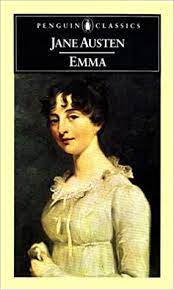
Emma by Jane Austen.

Emma Woodhouse is a fascinating and vivid character in Jane Austen’s novels. Emma organises the lives of the residents of her sleepy little village and plays matchmaker with terrible effect. She is beautiful, pampered, vain, and irrepressibly clever.

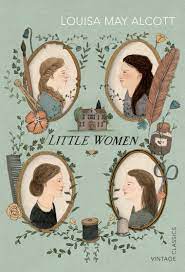
Little Women by Louisa May Alcott.

The March sisters, Jo, a bright tomboy and aspiring author, Beth, who is terribly frail, Meg, who is lovely, and romantic, spoilt Amy, are bonded in their love for one another and their battles to survive in New England during the Civil War.
It’s no secret that Little Women was inspired by Alcott’s own childhood. While her father, the freethinking reformer and abolitionist Bronson Alcott, mingled with the likes of Emerson, Thoreau, and Hawthorne, Louisa supported herself and her sisters with her own writing “Sewing, doing laundry, and serving as a household servant are examples of “women’s work.” She soon learned, however, that she could earn more money by writing. Little Women brought her fame and fortune for the rest of her life, and it wasn’t just because she was a woman “It explores such timeless themes as love and death, war and peace, the conflict between personal ambition and family responsibilities, and the clash of cultures between Europe and America, as requested by her publisher.

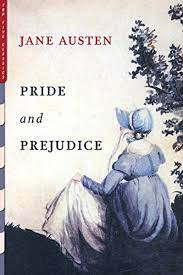
Pride and Prejudice by Jane Austen.

Pride and Prejudice has been one of the most popular novels in the English language since its early success in 1813. This great masterpiece was dubbed “her own beloved child” by Jane Austen, and its vivacious protagonist, Elizabeth Bennet, was described as “as charming a creature as ever appeared in literature.” The romantic conflict between Elizabeth and her pompous beau, Mr. Darcy, is a brilliant display of civilised sparring. Jane Austen’s dazzling wit gleams as her characters dance a delicate quadrille of flirting and intrigue, making this the finest comedy of manners in Regency England.

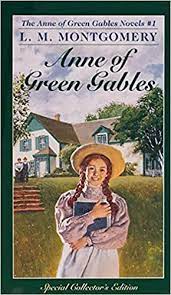
Anne of Green Gables by L. M. Montgomery.

Green Gables, an old-fashioned farm outside of Avonlea, has enticed generations of readers into the wonderful world of Green Gables. Anne Shirley, an eleven-year-old orphan, arrives in this lush corner of Prince Edward Island only to learn that the Cuthberts—elderly Matthew and his severe sister, Marilla—wish to adopt a boy rather than a fiery redhead girl. But, before they can send her back, Anne, who needs more room for her ideas and a genuine home, fully converts them. Anne of Green Gables is a beloved classic that examines all of a child’s fragility, expectations, and hopes as they grow up. It’s also a magnificent portrayal of a time, a location, and a family… and, above all, love

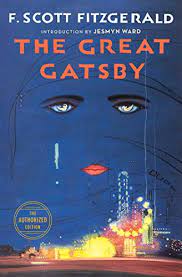
The Great Gatsby by F. Scott Fitzgerald.

F. Scott Fitzgerald’s third book, The Great Gatsby, is often regarded as his greatest achievement. This classic Jazz Age novel has been praised by generations of readers. It’s a wonderfully constructed narrative of America in the 1920s about the fantastically affluent Jay Gatsby and his new love for the beautiful Daisy Buchanan, of opulent parties on Long Island at a time when “gin was the national drink and sex was the national obsession,” according to The New York Times.

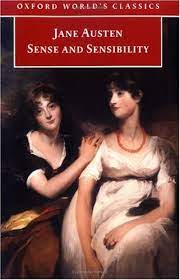
Sense and Sensibility by Jane Austen.

Marianne Dashwood wears her heart on her sleeve, and she rejects her sister Elinor’s warning that her rash behaviour exposes her to gossip and innuendo when she falls in love with the handsome but unsuitable John Willoughby. Meanwhile, Elinor, who is usually conscious of social convention, is fighting to hide her amorous disappointment even from her closest friends. The sisters learn that sense must combine with sensibility if they are to discover genuine pleasure in a culture where rank and money dominate the rules of love through their simultaneous experiences of love—and its potential loss.

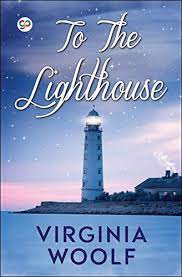
To the Lighthouse by Virginia Woolf.

On the Isle of Skye, the tranquil and maternal Mrs. Ramsay, the tragic yet absurd Mr. Ramsay, their children, and many guests are on vacation. Woolf creates a magnificent, emotional analysis of the complicated tensions and allegiances of family life, as well as the battle between men and women, from the seemingly little postponement of a visit to a local lighthouse.

As time passes, the Ramsays face the greatest of human obstacles as well as its greatest triumph—the human ability for change—alone and simultaneously.

Dark Academia book recommendations.

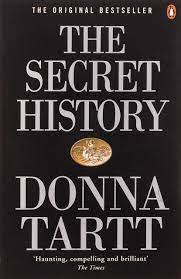
The Secret History by Donna Tartt.

A group of bright, eccentric misfits at a prestigious New England college discover a way of thinking and living that is a world away from their classmates thanks to the influence of their charismatic classics professor. When they cross the line into normal morality, however, they progress from infatuation to corruption and betrayal, and finally—inexorably—to evil.

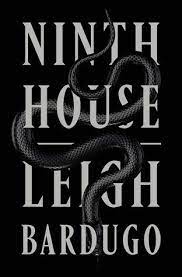
Ninth House by Leigh Bardugo.

Galaxy “Alex” Stern is the most unusual freshman in Yale’s class. Alex was raised by a hippie mother in the Los Angeles suburbs and dropped out of school early, plunging into a world of sketchy drug dealer boyfriends, dead-end jobs, and much, much worse. She is the solitary survivor of a brutal, unsolved multiple homicide by the age of twenty. Some could claim she’s squandered her life. But, from her hospital bed, Alex is given a second chance: a full scholarship to one of the world’s most prestigious colleges. What’s the catch, and why is she involved? Alex arrives in New Haven charged by her mysterious donors with monitoring the activities of Yale’s hidden clubs, still searching for answers. The future rich and powerful, from high-ranking politicians to Wall Street and Hollywood’s top players, are known to frequent these eight windowless “tombs.” Their esoteric operations, however, are revealed to be far more evil and fantastic than any paranoid imagination could imagine.

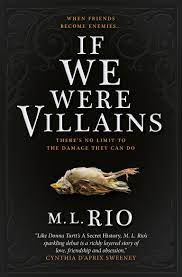
If We Were Villains by M. L. Rio.

Oliver Marks was just released from prison after a ten-year sentence for a murder he may or may not have committed. He is greeted by the man who put him in prison on the day he is released. Detective Colborne is planning to retire, but first he wants to get the truth about what happened a decade ago.

Oliver and his buddies play the same roles onstage and off as heroes, villains, tyrants, temptresses, ingenues, and extras as part of a group of seven teenage actors studying Shakespeare at an elite arts institution. However, when the cast changes and the supporting characters take over, the plays become dangerously alive, and one of them is discovered dead. The rest of the cast faces their most difficult acting task yet: persuading the cops, as well as themselves, that they are blameless.

The Picture of Dorian Gray by Oscar Wilde.

Oscar Wilde’s storey of a fashionable young man who sells his soul for eternal youth and beauty is the author’s most popular work, written in his distinctly sparkling style. When the storey of Dorian Gray’s moral decay first came out in 1890, it caused a stir, but when Wilde was chastised for the novel’s corrupting influence, he remarked that “there is a horrible moral in Dorian Gray.” Only a few years later, the book and the aesthetic/moral conflict it posed were used as evidence in the trials resulting from Wilde’s gay liaisons, which led to his imprisonment. “Basil Hallward is what I think I am: Lord Henry is what the world considers me: Dorian is what I would like to be—in other ages, maybe,” Wilde wrote in a letter about Dorian Gray’s relationship to autobiography.

Catherine House by Elisabeth Thomas.

Catherine House is a unique institution of higher learning. With its experimental curriculum, highly selective admissions criteria, and substantial endowment, this furnace of reformer liberal arts study has produced some of the world’s brightest minds: prize-winning authors, painters, inventors, Supreme Court judges, and presidents. Tuition, lodging, and board are all provided for those chosen. Acceptance, however, comes at a cost. Students must spend three years in the House, including the summers, completely cut off from the outside world. They must leave behind their family, friends, television, music, and even their attire. In exchange, the school promises its pupils a future of supreme power and distinction, as well as the ability to transform into anyone or anything they wish. Ines, a member of this year’s new class, expects to trade the blurry nights of parties, narcotics, harsh friends, and dangerous men for rigorous intellectual discipline—only to find a culture of sanctioned revelry instead. Viktória, the enigmatic director of the school, urges the kids to explore, to broaden their minds, to discover themselves and their position within Catherine’s intimidating black iron gates.Catherine is the closest thing Ines has ever had to a home, and her serious, shy roommate, Baby, quickly becomes an unusual friend. Despite its aged velvet and weathered leather, the House’s peculiar rituals make this haven feel more and more like a gilded jail. And when Baby’s obsession with acceptance ends in tragedy, Ines begins to suspect that the school—in all its shabby splendour, hallowed history, advanced theories, and controlled decadence—may be concealing a dangerous agenda linked to a secretive, tightly knit group of students chosen to study its most promising and mysterious curriculum.

YA Retellings.

Beauty and the beast:

Into the heartless wood by Joanna Ruth Meyer.

The woodland is a deadly place where men and women are lured to their deaths by siren song. A witch has been harvesting souls to feed the callous tree for ages, harnessing its power to expand her realm.

Seren, one of the witch’s tree-siren daughters, saves Owen Merrick’s life rather than ending it after he is led into the witch’s wood. Every night, he climbs over the garden wall to see her, and her desire to be human becomes stronger. Seren’s desire to become human will take them into an old struggle waging between the witch and the king who is trying to stop her, as a shift in the constellations foreshadows a dreadful curse.

Romeo and Juliet

Roman and Jewel by Dana L. Davis

Who would play the leads in a Hamilton remake of Romeo and Juliet? This is the storey of a young woman who believes she has what it takes…and the rest of the world agrees.

Jerzie Jhames will go to any length to get the main role in Roman and Jewel, Broadway’s hottest new show, a Romeo and Juliet inspired hip-hopera with a diverse cast and current twists on the play. Her aspirations are dashed, however, when she discovers that Cinny, the mega-star, has won the lead…and Jerzie is her understudy.

It’s a bad idea for Jerzie to fall for male lead Zeppelin Reid, especially after she knows Cinny wants him for herself. Star-crossed love is doomed to fail. When a video of Jerzie and Zepp practising goes online and the entire world votes on who should play Jewel, Jerzie realises that while fame is expensive, friendship, family, and love are invaluable.

The phantom of the Opera:

Sing Me Forgotten by Jessica S. Olson.

There is no such thing as Isda. At least not beyond the opera house’s ornate walls.

Cyril, the opera house’s owner, protected her from being cast into a well at birth for being one of the magical few who can modify memories when people sing. He has protected her from the violent world outside since that day. He only requests that she use her influence to keep ticket sales high—and that she stay hidden. Isda and Cyril would pay the price if it was discovered she had survived.

But when Isda meets Emeric Rodin, a handsome boy who upsets her tranquil, isolated life, she defies Cyril’s cardinal rule. His voice is unlike any she’s ever heard, but the true shock comes when she discovers glimpses of a way out of her gilded prison in his recollections.Isda spends more and more time with Emeric, haunted by the potential, searching for answers in his music and his past. But the cost of liberty is far greater than Isda could ever imagine. Even as she battles with her growing affections for Emeric, she realises that the only way she can control her own future is to become the monster the world sought to drown in the first place.

Pride and Prejudice:

Pride and Premeditation by Tirzah Price

Despite the meddling of Mr. Fitzwilliam Darcy, the stern young heir to the prominent company Pemberley Associates, seventeen-year-old aspiring lawyer Lizzie Bennet seizes the opportunity to establish herself when a shocking murder shakes London high society.

Lizzie vows to solve the murder on her own, convinced that the authorities have imprisoned the wrong person. However, as the case—and her feelings for Darcy—become more convoluted, Lizzie realises that her ideal career may make her happy, but it may also lead to her death.

Rapunzel:

What Once Was Mine by Liz Braswell

The virtuous people of Corona search for the all-healing Sundrop flower to cure their queen and her unborn child in a desperate attempt to preserve their queen’s life—but instead obtain the sparkling Moondrop flower. Regardless, it heals the queen, and she gives birth to a healthy baby girl with moon-like silver and grey hair. It brings with it perilous magical abilities: the ability to harm rather than cure. Rapunzel is imprisoned in a tower and placed in the care of Mother Gothel, a powerful goodwife, for her own and the kingdom’s safety.

Rapunzel has been kept away for eighteen years, knowing she must protect people from her miraculous hair. However, when she leaves the only home she’s ever known in order to witness the floating lights that emerge on her birthday, she becomes entangled in an adventure with two robbers that takes her throughout the kingdom. Rapunzel discovers that there may be more to her storey, and her miraculous tresses, than she ever imagined before she reaches her happy ending.