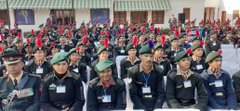
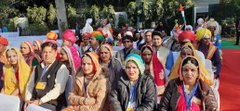
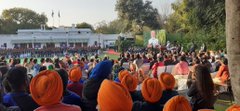
Prime Minister Interacts with Tribal Guests, NCC cadets, NSS Volunteers and Tableaux Artists who would be showcasing India at 71st Republic Day Parade

The Prime Minister Shri Narendra Modi today interacted in an At Home event with over 1730 Tribal Guests,, NCC Cadets, NSS Volunteers and Tableaux Artists who would be a part of the 71st Republic Day parade in the National Capital.


Referring to the large enthusiastic gathering, the Prime Minister said they would be showcasing a Mini India at the Republic Day Parade. Saying that the world would see the essence of India during their performance in the Parade, the Prime Minister said India is not a mere geographic or demographic entity.

PMO India

@PMOIndia

यहां आप जितने भी साथी एकत्र हुए हैं, आप एक प्रकार से Mini India- New India को showcase करने वाले लोग हैं। भारत असल में क्या है, ये हमारा देश और पूरी दुनिया आपके माध्यम से समझती है: PM @narendramodi

View image on TwitterView image on TwitterView image on TwitterView image on Twitter
423 people are talking about this

India is a Way of Life On Ek Bharat, Shrestha Bharat, Prime Minister said that it should be remembered that India is not only home to 130 crore people but also a nation with a vibrant tradition.

PMO India

@PMOIndia

जब हम एक भारत, श्रेष्ठ भारत की बात करते हैं, तो हमें ये भी याद रखना है कि भारत असल में है क्या। भारत क्या सिर्फ सरहदों के भीतर 130 करोड़ लोगों का घर भर ही है? नहीं, भारत एक राष्ट्र के साथ-साथ एक जीवंत परंपरा है, एक विचार है, एक संस्कार है, एक विस्तार है: PM @narendramodi

View image on TwitterView image on TwitterView image on TwitterView image on Twitter
787 people are talking about this

He said India is a way of life, an idea, a confluence of several philosophies and a metaphor for a rich global & universal perspective. He said, “India means one Global Family, India means Equanimity for all Religions, India means Triumph of Truth, India means an idea that permits understanding of the One Truth in different ways, India means the one that loves and protects Flora and Fauna, India Means Self Reliance, India believes that only those who sacrifice can remain blissful, India means the one which believes in welfare of everyone, India means one which worships women, India means one which believes that motherland is more virtuous than Gold” Belief in Unity and not Uniformity The Prime Minister said India’s strength is its diversity in geological and social fabric. He compared India to a floral garland where different flowers stitched together through a common thread of Indianness. He said, “India believes in Unity and not Uniformity. “ Shri Modi said, “Strengthening that thread of unity and preserving it is our continuous effort and toil” He said as a New India progresses, the effort is to see that no one is left behind and no region is left behind. Striving for Fundamental Duties The Prime Minister said that it is time now to give importance to our fundamental duties. “If we deliver our duties sincerely, then there would be no necessity for fighting for our rights” he said.

PMO India

@PMOIndia

यहां जितने भी युवा साथी आए हैं, मेरा आपसे आग्रह रहेगा कि राष्ट्र के प्रति अपने कर्तव्यों की ज्यादा से ज्यादा चर्चा करें। चर्चा ही नहीं, बल्कि खुद अमल करके, उदाहरण पेश करें। हमारे ऐसे ही प्रयास न्यू इंडिया का निर्माण करेंगे: PM @narendramodi

View image on TwitterView image on TwitterView image on TwitterView image on Twitter
524 people are talking about this

Prime Minister Shri Modi also witnessed a cultural programme showcased by the Tribal Guests, NCC Cadets, NSS Volunteers and Tableaux Artists

***

Text of PM’s interaction with winners of Pradhan Mantri Rashtriya Bal Puraskar 2020

राष्‍ट्रीय बाल पुरस्‍कार के आप सभी विजेताओं को मेरी तरफ से बहुत-बहुत बधाई। अब आप बधाई लेते-लेते थक गए लगते हो। बधाई ज्‍यादा हो गई ना? कम है कि ज्‍यादा हो गई; ऐसा तो नहीं हुआ ना? अच्‍छा, यहां आते समय मास्‍टरजी ने कहा होगा वहां बिल्‍कुल discipline में रहना है, हाथ-पैर नहीं हिलाने, ऐसा बोला होगा। हां….ये गड़बड़ है। यहां आ करके कैसा लग रहा है आप लोगों को? मतलब क्‍या – मौसम अच्‍छा लग रहा है? राष्‍ट्रपति भवन देखा…पूरा..और आज क्‍या देख रहे हैं? पेड़-पौधे ?

आप में से कितने लोग हैं जो पहली बार दिल्‍ली आए हैं? अच्‍छा…बाकी सब बार-बार आ चुके हैं.. सब परिचित हैं। ये जो पीछे लोग हैं उनके लिए सवाल नहीं हैं मेरे…ये सब बच्‍चों के लिए हैं। वरना prompting पीछे से हो रहा है।

वैसे दिल्‍ली आने का अपना ही एक उत्‍साह होता है, फिर भी मुझे पता है कि आपको जरा जल्‍दी जाने का मूड करता होगा, घर जाने का। देखिए, आपको पक्‍का मन करता होगा जल्‍दी घर जाएं, क्‍या-क्‍या हुआ दोस्‍तों को बताएं, फोटो दिखाएं, अपना अवॉर्ड दिखाएं, दिल्‍ली के अनुभव सुनाएं, दिल्‍ली की ठंड कैसी है, वो बताएं, ऐसा मन करता है ना? किसी का भी करता है जी, अपने सा‍थियों को अपनी अच्‍छी-अच्‍छी बातें बताने का मन हर किसी को करता है। आपको नहीं करता है?

देखिए, पूरी यात्रा की ढेर सारी कहानियां होंगी, जो आप सुनाना चाहते होंगे। आप भले ही न कहते हों, लेकिन आपका मन करता होगा, पहले जा करके दादीजी को तो ये कहना ही कहना है, ऐसा मन करता होगा। और कुछ लोग होंगे जो घर जा करके कहेंगे, देखो आप मुझे मना कर रहे थे, अब पता चला ना मैं अच्‍छा-अच्‍छा काम कर रहा हूं। तो अब आप लोग घर में जा करके मम्‍मी-पापा को डांटोगे? बताओगे- हां-हां देखो हमारे पास फोटो है राष्‍ट्रपति जी के साथ, हम अवॉर्ड लेकर आए हैं, ऐसा करोगे ना? नहीं करोगे? ऐसा हो सकता है क्‍या? अच्‍छा छुपा करके करना, चोरी-छिपे से करना। करेंगे, नहीं करेंगे?

ये क्‍या बचपन खो दिया है आपने? अरे बचपन तो बचा रहना चाहिए। आपका बचपन खो गया है। जिसको ये मन न करे कि मम्‍मी–पापा को भी जा करके बताऊंगा,  ये कहूंगा, उनको ये सुनाऊंगा, तो फिर तो आपने बचपन खो दिया है आपका। तो आपको अलग खुला नहीं छोड़ते हैं मम्‍मी-पापा, पीछे लगे रहते हैं? उनको भरोसा नहीं है, छोटे बच्‍चे हैं क्‍या करेंगे, ऐसा लग रहा है ना? अगली बार बताइए उनको कि मुझे अकेले कहीं जाने दो।

देखिए, थोड़ी देर पहले आप सभी का जब परिचय हो रहा था, तो मैं सचमुच में बहुत हैरान था। इतनी कम आयु में जिस प्रकार से आप सभी ने अलग-अलग क्षेत्रों में कुछ न कुछ करके दिखाया है, कोई प्रयास किए, कोई काम किया है, आपको तो समाधान होगा ही होगा लेकिन आज के बाद आपको कुछ और करने का मन कर जाएगा। और अधिक अच्‍छा करने का इरादा हो जाएगा।

और मैं समझता हूं कि ये सारे जो awards वगैरह होते हैं ना, वो आखिरी मुकाम नहीं होता है। एक प्रकार से ये beginning होता है। जब कोई recognize करता है तो मन को अच्‍छा लगता है। एक प्रकार से ये जिंदगी की शुरूआत है। और आपने मुश्किल परिस्थितियों से लड़ने का साहस दिखाया। आप में से कुछ वीर बालक हैं, कुछ ऐसे भी हैं जिन्‍होंने गंभीर बीमारियों से लोगों को बाहर निकालने के लिए, ease of living के लिए कई नए-नए innovation किए हैं। किसी ने आर्ट एंड कल्‍चर में, किसी ने स्‍पोर्ट्स में, तो किसी ने शिक्षा साहित्‍य में, तो किसी ने समाज सेवा में; विविधताओं से भरा हुआ आपका योगदान रहा है।

आप अपने समाज के प्रति, राष्ट्र के प्रति अपनी ड्यूटी… आपने देखा होगा मैंने लालकिले से एक बात कही थी, याद है किसी को…लाल किले से कुछ कहा था?  याद है ? बहुत कुछ कहा था, कुछ भी कहोगे तो सच निकलेगा। एक बात मैंने कही थी- ‘कर्त्तव्‍य पर बल’। ज्‍यादातर हम अधिकार पर बल देते हैं। अब देश की आजादी को 75 साल होने वाले हैं, तो कब तक अधिकार पर बल देते रहेंगे? अब कर्त्तव्‍य पर बल देना चाहिए कि नहीं देना चाहिए? Duty को प्राथमिकता कि rights को प्राथमिकता? पक्‍का, सब सहमत हैं, चलिए हमने आज एक कानून पास कर दिया।

देखिए, आप अपने समाज के प्रति, राष्‍ट्र के प्रति अपनी ड्यूटी से और उसके लिए जिस प्रकार से जागरूक हैं, ये सिर्फ आपके माता-पिता को नहीं, आपके परिवारजनों के लिए, जो भी आपके बारे में जानेगा उन सबको गर्व होगा,  उनको पक्‍का गर्व होगा।

देखिए, मैं एक काम करूंगा, आप सबकी फोटो के साथ मैं आज आपकी जो स्‍टोरी है, उसको मैं सोशल मीडिया में दुनिया से शेयर करूंगा। हर individual, कैसे आपने किया है, कहां से आए हैं, कैसा रहा है; मैं लिखूंगा उसमें। लेकिन कुछ गलती हो जाए तो फिर आप नाराज मत हो जाना, क्‍योंकि कभी-कभी जानकारियों में गलती हो जाती है।

देखिए दोस्‍तो, आप सब कहने को तो बहुत छोटी आयु के हैं, कम आयु के हैं, लेकिन आपको पता है आपने जो काम किया है, उसको करने की बात छोड़ दीजिए, सोचने में भी बड़े-बड़े लोगों को पसीने छूट जाते हैं। आप में से जिन्‍होंने innovation किया होगा, जब अपने टीचर को बताओगे तो टीचर भी कहेगा, तुम मुझे परेशान मत करो, तुम जाओ। उनको दिमाग खपाते होंगे, टीचर भी नाराज हो जाते होंगे। उनको लगता होगा ये बच्‍चा इतना bright है, ये मेरे पल्‍ले कैसे पड़ गया, ये मुझे पढ़ाता है। ऐसा होता है ना? देखिए, मैं एक बात बताऊं आपको, आप अपने सभी friends और teachers को जरूर बताइएगा। मैं आप सभी युवा साथियों के ऐसे साहसिक काम के बारे में जब भी सुनता हूं, आपसे बातचीत करता हूं, तो मुझे भी प्रेरणा मिलती है, आपसे मैं भी कुछ सीखता हूं। अभी एक बच्‍चे ने मुझे पूछा कि आप इतना काम करते हैं तो मां की याद नहीं आती है; याद करता हूं तो सब थकान उतर जाती है।

सा‍थियो, आप जैसे बच्‍चों के भीतर छुपी इस प्रतिभा को प्रोत्‍साहित करने के लिए ही ये राष्‍ट्रीय पुरस्‍कारों का दायरा बढ़ाया गया है। और ये सिर्फ आपको पुरस्‍कार मिल रहा है, ऐसा नहीं है, इस अवसर के कारण देशभर के बच्‍चों का इन चीजों पर ध्‍यान जाता है। एक प्रकार से आप उनके लिए हीरो बन जाते हैं, आप उनके लिए inspiration बन जाते हैं। जम्‍मू-कश्‍मीर में बैठा हुआ कोई बच्‍चा होगा, लद्दाख में बैठा हुआ बच्‍चा होगा, नागालैंड में बैठा हुआ बच्‍चा होगा; वो केरल के किसी बच्‍चे की कथा सुनेगा तो उसको लगेगा अच्‍छा! हमारे देश के बालक ऐसा कर रहे हैं? ये अपने आप में- कई गुना इसका प्रभाव पैदा होता है, इसकी तरंगें चलती रहती हैं। Waves लगातार नीचे प्रभावित करते रहते हैं और इसलिए इन चीजों की तरफ, इन घटनाओं को कभी कम नहीं आंकना चाहिए, उसका अपना एक महत्‍व है। लेकिन कभी-कभी क्‍या होता है, जब नाम हो जाए, अखबार में तस्‍वीर छप जाए तो फिर हम भी जमीन से दो-तीन फीट ऊपर चलते हैं ना, फिर पैर जमीन पर नहीं पड़ते हैं,  ऐसा हो जाता है ना? फिर घर में भी- देखिए, मुझे कोई काम मत बताइए, मैं National award लेकर आया हूं, ऐसा होता है ना? तो क्‍या ऐसा करोगे आप लोग? पैर जमीन पर रखोगे?

अधिकतम लोगों के जीवन में दो पड़ाव आते हैं- एक सहज भाव से अच्छा करता चला जाता है और जब कहीं recognized हो जाता है, फिर जाने-अनजाने में हवा भर जाती है और फिर वो उसी धुन में रहता है आगे कुछ नया नहीं कर पाता है। उसको लगता है बस हो गया, फोटो छप गई, दिल्‍ली हो आया, राष्‍ट्रपति भवन हो आया, अब क्‍या है। ज़िन्दगी में सब हो गया है। ज़िन्दगी इतनी छोटी नहीं है।

दूसरे वो लोग होते हैं- अगर कुछ किया, कहीं recognized हुआ तो उसी को वो अपनी प्रेरणा बना लेते हैं, उसी को अपनी प्रतिज्ञा बना लेते हैं, उसी में से पुरुषार्थ करने के रास्‍ते खोजते रहते हैं और वे नई-नई चीजों को हासिल करने के लिए रुकते नहीं हैं, थकते नहीं हैं।

मैं चाहूंगा कि आप कभी भी अपने जीवन में उन दूसरे प्रकार की आदतों को घुसने ही मत देना। अभी जो हुआ है वो कुछ नहीं, ऐसा ही मानकर जाइए। ठीक है, अभी तो मुझे बहुत कुछ करना है, देश को बहुत कुछ देना है, खुद को हर प्रकार से तैयार करना है। ये अगर जज्‍बा ले करके जाते हैं तो आप देखिए, आपको इस अवसर का बहुत बड़ा आनंद मिलेगा, उसमें से कुछ नया सीखने को मिलेगा। तो आप बताइए पहले रास्‍ते पर जाएंगे कि दूसरे? अपने हाथ ऊपर कीजिए, कितने लोग हैं जो पहले रास्‍ते पर जाएंगे? अच्‍छा ये बताइए, जो दूसरे रास्‍ते पर जाएंगे, वो कौन हैं? इसका मतलब आप मेरी बात समझे नहीं? मैं ये कह रहा था कि एक रास्‍ता वो होता है जो पहला रास्‍ता, कि जिसमें इसको आप अंतिम नहीं मानते हैं, इसको आप शुरूआत मानते हैं। आपके पैर जमीन से उखड़ नहीं जाते हैं, आप हवा में उड़ने नहीं लगते और कुछ और अधिक करने का संकल्‍प करते हैं, ये पहला रास्‍ता है। दूसरा- यार बहुत हो चुका, अब फोटो छप गई, टीवी में आ गए, अब क्‍या करना है, सो जाओ। तो बताइए कि पहला रास्‍ता है कि दूसरा? पक्‍का, देखिए, पहले गलती की थी ना?

अच्छा, मैं आपसे कुछ सवाल पूछता हूं। आप में से कौन इतने लोग हैं जिनको दिन में चार बार पसीना आता है, भरपूर पसीना आता है, पूरा पसीना-पसीना शरीर हो जाता है, जैसे कोई भी सीजन हो, ठंडी हो, गरमी हो। जिसको चार बार दिन में पूरा पसीना निकलता है, कैसे निकलता है, धूप में खड़े रहते हैं? Morning exercise में? और कोई ? देखिए एक भी बालक ऐसा नहीं होना चाहिए, अपने दोस्‍तों को भी बताइए कि जिसको दिन में चार बार पसीना नहीं आए, ऐसा एक भी बालक नहीं होना चाहिए। मुझे एक बार किसी ने बहुत साल पहले किसी ने पूछा था कि आपके चेहरे पर इतना तेज क्‍यों है तो मैंने बड़ा आसान जवाब दिया था- मैंने कहा मेरे शरीर में इतना पसीना निकलता है, मेहनत करता हूं और मैं उसी पसीने से मालिश करता हूं, इसलिए चमक जाता है। अच्‍छा आप में से कितने लोग हैं जो पानी पीते हैं तो खड़े-खड़े पीते हैं, बैठ करके नहीं पीते? ऐसे कितने लोग हैं? देखिए, पानी जब पीते हैं तो बैठ करके पीजिए। छोटी चीज है लेकिन आपको जा करके उसका शास्‍त्र कोई समझाएगा, मैं उस चक्‍कर में नहीं पड़ता हूं। करेंगे ये?

अच्‍छा आपमें से कितने हैं जो पानी दवाई की तरह पीते हैं? कुछ लोग होंगे जो पानी जूस की तरह पीते होंगे, पानी का भी आनंद लेते होंगे। कुछ लोग होते होंगे दवाई की तरह…आप कितने हैं जो पानी को पानी का मजा लेते हैं, पानी का टेस्‍ट करते हैं? Enjoy करते हैं। आप कोशिश कीजिए पानी का टेस्‍ट होता है, वो शरीर को बहुत फायदा करता है, आप उसको enjoy कीजिए। दवाई की तरह ऐसे पानी लगा दिया, ऐसे मत कीजिए। करेंगे? आप कहेंगे- ऐसे क्‍या फायदा, मां तो कहती है पढ़ाई करो, मैं पांच मिनट तक पानी पी रहा हूं, तो झगड़ा हो जाएगा ना। कभी-कभी मां दूध ले करके आती है, मां को काम है, टीवी सीरियल चल रहा है तो मां कहती है, चल जल्‍दी दूध पी ले और आप वो दूध भी दवाई की तरह पी जाते हो, क्‍योंकि मां को सीरियल देखना है। ऐसा होता है ना? कौन सा- सास भी कभी बहू थी?

छोटी-छोटी चीजें होती हैं, हमने बचपन में शरीर को जो आदतें डाली होती हैं वो जीवनभर काम आती हैं और मन में वो एकदम से फिट बैठ जाती हैं। आपको मालूम है देश में एक अभियान चल रहा है, ‘फिट इंडिया’, पता है? कितनों को मालूम है? तो फिट इंडिया के लिए किस दर्जी के पास जाते हो, किस tailor के पास जाते हो? कौन, फिट इंडिया के लिए tailor के पास कौन जाता है, तो क्‍या करते हैं फिट इंडिया के लिए कोई बताएगा? नहीं, क्‍या करते हैं? exercise कहने से थोड़ा ही होता है, कोई कहेगा मैं सूर्य नमस्‍कार करता हूं, कोई कहता है मैं साइकलिंग करता हूं, कोई कहता है मैं स्‍वीमिंग करता हूं…क्‍या करते हैं? अच्‍छा आप में से कितने लोग हैं फटाफट पेड़ पर चढ़ जाते हैं, फिर उतर जाते हैं? घरवालों को चिल्‍लाना पड़ता है, अरे नीचे उतरो, नीचे उतरो- ऐसे कितने लोग हैं?

देखिए साहस- ये हमारे स्‍वभाव में होना चाहिए। यहां पैर रखूंगा तो गिर जाऊंगा, तो ये करूंगा तो- ऐसे जिंदगी नहीं जीते। साहस के बिना जीवन संभव नहीं है। आप छोटी-छोटी चीजों का साहस करने की आदत बनाओगे तो आगे चलकर वो भी बहुत काम आएगा। और आप जैसे लोग जब करेंगा ना,  तो बाकी 50 लोग देखेंगे- अरे देखो,  ये भी करता है। इतना अवॉर्ड लेकर आया, फिर भी इतनी मेहनत करता है। इतना मान-सम्‍मान ले करके आया, लेकिन देखिए ये काम कर रहा है। तो क्‍या होगा- बहुतों को प्रेरणा मिलेगी। करोगे? पक्‍का करोगे? तो परसों 26 जनवरी की तैयारी? तो सिखाया गया होगा, ऐसे-ऐसे करो? दाहिने हाथ से करना है कि बाएं हाथ से? ये नहीं बताया। जिस तरफ लोग होंगे, उस तरफ करना है। अरे हम होंगे तो पांच मीटर, दस मीटर तक ही होंगे, बाकी तो बहुत भीड़ होती है।

चलिए, मुझे बहुत अच्‍छा लगा आप लोग enjoy कीजिए और दिल्‍ली में बहुत कुछ देखिए। अलग-अलग जगह पर जाइए। लालकिले में आपको मालूम होगा, नेताजी सुभाष बाबू को ले करके, क्रांतिकारियों को ले करके बहुत अच्‍छा म्‍यूजियम बना है। देखेंगे आप लोग? देखकर आए, ले जाने वाले हैं? अच्‍छा वॉर मेमोरियल देखा? हैं, नहीं देखा। देखिए, वॉर मेमोरियल भी देखने जाना चाहिए। और अपने राज्‍य का कोई एकाध भी जो वीर शहीद हुआ होगा, उसका नाम पढ़ करके, लिख करके ले जाना, अपने घर पर। अगर मोबाईल फोन है तो उसकी फोटो निकाल करके ले जाना। देखिए, कर्नाटक के ये वीर शहीद का नाम है, उसका फोटो लेकर जाना चाहिए। किसी को दिखाना चाहिए- देखिए, हमारे कर्नाटक के वीर शहीद का नाम वहां वॉर मेमोरियल में है। हरेक को अपने-अपने राज्‍य का ढूंढना चाहिए। ऐसे ही देखकर नहीं आना चाहिए वो जो नाम लिखे हैं ना उन पर तुम्‍हें गर्व होना चाहिए। यहां एक पुलिस मेमोरियल भी बना है, देखने जाओगे? आपको मालूम है ये देश में 33 हजार से ज्‍यादा पुलिस, कभी-कभी लोग पुलिस से नफरत करते हैं ना? पुलिसवाले कहते हैं, चलो इधर चलो,  साइकिल यहां मत रखो,  बहुत गुस्‍सा होता है ना? 33 हजार पुलिस देश के नागरिकों की रक्षा के लिए शहीद हुए हैं आजादी के बाद। आंकड़ा बहुत बड़ा है, 33 हजार। उस पुलिस के प्रति आदर का, गौरव का भाव बनना चाहिए, देखिए समाज जीवन में एक बदलाव शुरू हो जाएगा। पुलिस मेमोरियल देखोगे ना तो आपको लगेगा कि ये इतना काम होता रहा, ये ऐसे करते रहे। करोगे? पक्‍का करोगे?

चलिए, बहुत-बहुत धन्‍यवाद आपको। बहुत-बहुत शुभकामनाएं।


***


A movement of ethics must be initiated at all levels in governance of the country: VP;

The Vice President of India, Shri M Venkaiah Naidu today called for a total war on corruption and described corruption as a major canker which skews growth and development, deepens poverty and increases inequality.

Delivering the ‘IC Centre for Governance Sardar Patel Lecture on Governance’ at Upa Rashtrapati Niwas, Shri Naidu said that various transformative policies and programmes like Beti Bachao, Beti Padao, Ayushman Bharat, Goods and Services Tax and ‘Swachh Bharat’ are aimed at accelerating the progress and empowering people. “We can accomplish the desired goals only if we have a robust governance system and there is an unflinching commitment to excellence at every level”, he added.

He asked the bureaucracy to be more proactive and ensure that there was no gap in the intent, execution and delivery of various services to the people.

Observing that it was critical for the state institutions to be agile, adaptable and resilient in the rapidly changing 21st century, he called for strengthening program implementation, improving competence and credibility of institutional structures and adopting a work ethic that keeps national interest at the top and public welfare at its core.

Wondering whether degeneration in moral and social values in the society has led to a general decline in the functioning of public services at every level, Shri Naidu called for an introspection and said that it was imperative to initiate a movement of ethics at all levels in governance of the country.

The Vice President said that there was a need to foster public trust in institutions and the integrity of public officials, while injecting greater accountability into decision-making. “I feel that it is imperative that a movement of ethics is initiated at all levels in governance of the country”, he added.

Asserting that people must be at the center of an effective and just governance system, Shri Naidu called for efforts to ensure that the poorest of the poor and most deserving gets the benefits of government schemes. “Perhaps, we need Process Reengineering in governance. We don’t have to change the system, as is being suggested in some quarters, but we have to make the system work better”, he added.

Paying glowing tributes to Sardar Patel, he described him as the unifier and Iron Man of modern India.

Observing that India owed a huge debt of gratitude to Sardar Patel for unifying the nation into a single territorial entity, the Vice President said that nothing mattered more to Sardar Patel than the interests of the nation.

The Vice President said that Sardar Patel wanted the All India Services, which he conceived as a ‘steel-frame’ of the nation, to provide people-centric governance. “With a clear vision for an efficient administrative system, Sardar Patel wanted the civil servants to maintain the highest standards of probity and efficiency and strive to uplift the conditions of the poor without any fear or favour”, he added.

In this context he recalled that the accession of Jammu and Kashmir to Indian Union was total, final and irrevocable. He also pointed out that Article 370 was only a temporary provision and said that it had outlived its purpose long back.

The Vice President said that unity and consensus on larger issues facing the country was the need of the hour. He advised people to develop a positive outlook and not become cynical. He urged the youngsters in particular to adopt a constructive approach towards nation building.

The Vice President said that all Indians must work together, a collective endeavour, for ushering in Gandhi Ji’s Ram Rajya, where there is all-round inclusive growth without poverty, discrimination, inequality, illiteracy and hunger. ‘Every citizen must strive to protect the unity, safety, security and sovereignty of the country’, he added.

Shri Prabhat Kumar, Former Cabinet Secretary & Former Governor of Jharkhand and President, IC Centre for Governance, Shri Harivansh, Hon’ble Deputy Chairman, Rajya Sabha and others were present on the occasion.

The following is the full text of the speech:

I am delighted that the ‘IC Center for Governance Sardar Patel Lecture on Governance’ is being held here at the Sardar Vallabhbhai Patel Conference Hall at Uparashtrapati Bhavan today.

I welcome you all to the official residence of the Vice President of India. It gives me immense pleasure to deliver this lecture at this conference hall named after the great son of the soil, the unifier and the Iron Man of modern India – Shri Sardar Vallabhbhai Patel.

Firstly, let me remind every Indian that each one of us owes a huge debt of gratitude to Shri Sardar Patel for unifying India into a single territorial entity by spectacularly bringing about the merger of more than 560 princely States with the Union of India at its most critical point in the country’s history.

Had he not displayed vision, firmness, pragmatism and tact in nipping in the bud even the remotest thought of a few princely States to remain independent or join Pakistan, India’s geographical contours would have been totally different.

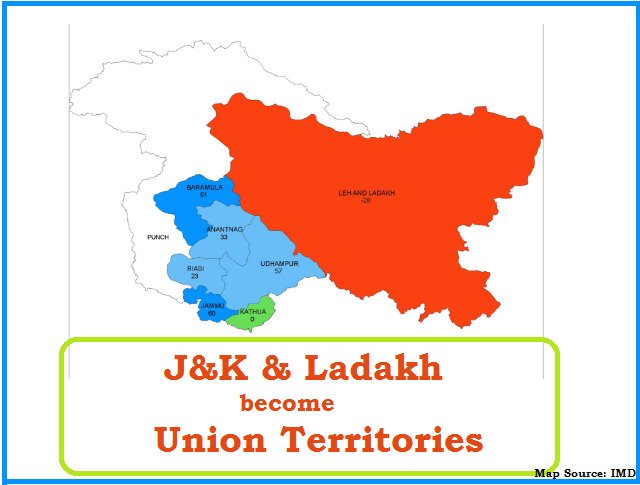
In this context, it is pertinent to recall that the accession of Jammu and Kashmir to the Indian Union by Raja Hari Singh was without conditions. As such it is irrevocable and final. Another aspect is that Article 370 was only a temporary provision and had outlived its purpose long back. With the abrogation of the Article 370, the Union Territories of Jammu, Kashmir and Ladakh will witness all-round and faster development.

It was our good fortune that Shri Patel was entrusted with the most challenging assignment during India’s turbulent time and the country found the man of the moment in him. It undoubtedly was one of the greatest accomplishments of the 20th century.

Patel knew that India was under foreign rule because of a lack of unity. Pointing out that our mutual conflicts and internecine quarrels and jealousies in the past had been the cause of our downfall and falling victims to foreign domination several times, he had cautioned “We cannot afford to fall into those errors or traps again.”

Nothing mattered more than the interests of the nation for Shri Sardar Patel.

Apart from ensuring the territorial integrity of the country, he had conceived and created the administrative steel-frame, All India Services, to provide people-centric governance.

Dear sisters and brothers,

Shri Patel wanted post-independent India to stay united without any narrow considerations and divisions based on caste, creed, religion or language. With a clear vision for an efficient administrative system, he wanted the civil servants to maintain the highest standards of probity and efficiency and strive to uplift the conditions of the poor without any fear or favour.

Addressing the Probationers of the first batch of Indian Administrative Service, Sardar Patel said, “The service will now have to adopt its true role of national service, without being trammeled by traditions and habits of the past”.

He was equally keen to ensure that the governance system empowers the rural India and protects farmers’ interests.

As you all are aware, governance has been an enduring subject of discussion among practitioners and laymen alike for many years now.

As I see it, governance is an overarching concept with many dimensions and institutional and political manifestations. Conventionally understood, governance is the way the state and its various institutions negotiate and mediate with people, markets and civil society, through laws, policies, regulation and finance.

The concept of governance has grown beyond the conventional definition. The process of governance is increasingly influenced by market forces as well as civil-society processes and citizen initiatives.

The discourse on governance has grown as a parallel discourse to that of civil society, human rights and globalization. It also provides institutional and legal interfaces through which citizens mediate and interact with the state and seek accountability.

A just, people-centred and inclusive growth approach seeks to transform political and governance processes. Its purpose is social transformation through the realization of rights to all people, and political transformation to challenge unjust power relationships within and among institutions at the national and local level.

Has the degeneration in moral and social values in the society led to a general decline in the functioning of our public services at every level? There needs to be an honest introspection at every level to arrest the declining standards.

It should be always remembered that people have to be at the centre of an effective and just governance system. It must necessarily aim at empowerment of all people in an inclusive manner by providing a transparent and efficient institutional framework and the rule of law.

The right to information is likewise an essential prerequisite for a robust, informed public debate through which decision-makers become answerable to their people, and rights-holders are enabled to assess public and private sector conduct.

Just governance is about ensuring that those vested with authority are not allowed to become corrupted by their power.

Just governance holds decision-makers accountable for actions or omissions. It, therefore, can help foster public trust in institutions and the integrity of public officials, while injecting greater accountability into decision-making.

I feel that it is imperative that a movement of ethics is initiated at all levels in governance of the country.

Corruption is a major canker and has to be relentlessly fought at every level. It is said that corruption skews growth and development, affects the economy, deepens poverty and increases inequalities. It sustains informal power structures.

In this era of Information Technology, corruption can be best compared to a computer virus. The hardware looks the same; the software generally works, but some part of it gets “corrupted” and you find yourself in danger of losing the whole system. Like the virus, corruption may be invisible, small, contained to a few people, but like the virus, its mere existence in an organization puts everything at risk.

We have to declare a total war on corruption which has to become a people’s movement.

I think the system of governance adopted by our constitution makers and national leaders after independence has substantially stood the test of time. It is reflected in the national and political stability and has also, to an extent, aided in the development and economic progress. One can reasonably conclude that the system is capable of managing change from time to time, as observed in managing the economic reforms in the last two decades, and in making progress in many key development sectors.

That is not to say that the system is perfect or that its functioning has been without any defects. I am only saying that the system, if followed honestly and efficiently, is capable of taking care of the problems of the people. Also, in my view, there is no other system of governance more suited to the plurality of our country.

The same, however, cannot be said at the level of institutions and the processes in government. Perhaps, we need Process Reengineering in governance. We don’t have to change the system, as is being suggested in some quarters, but we have to make the system work better.

In the last few years, several administrative and legal reforms were initiated to bring in transparency and accountability. They include measures to curb corruption, unearth black money, and promote ease of doing business and speedy delivery of services to the beneficiary in a hassle-free manner.

In view of increasing globalization, there is a need to take  action against economic fugitives who should not find any safe havens anywhere in the world.  There should be greater cooperation at the international level. Various countries must not only exchange information but also enter into extradition treaties. The United Nations must take the lead in this regard.

The implementation of Insolvency and Bankruptcy Code was another important reform undertaken by the government.

Promoting the use of IT for the delivery of services is equally important to control corruption and ensure transparency. Everything should be online so that people need not stand in line. Direct Benefit Transfer through JAM (Janadhan-Aadhar-Mobile) is a fine example of the use of technology to eliminate bogus beneficiaries and check corruption.

The Prime Minister, Shri Narendra Modi’s three-word mantra of ‘Reform, Perform and Transform’ seeks to bring in total transformation in all walks of life. A responsible citizenry, honest political class, ethical bureaucracy and a vibrant judiciary will help India to become a role model for others.

Public institutions are at the heart of governance. Good governance thrives on good institutions.

To deliver public services, we have a number of public institutions. The overall performance of the government can be judged by an aggregation of performances of these public institutions.

It should be remembered that in a rapidly changing world, public institutions cannot remain rigid. They need to suitably change their ways of functioning to meet the mounting aspirations of the people. We have to do away with lot of outdated and time-consuming procedures and increasingly use IT to promote transparency and provide efficient delivery of services.

What we need today is effective implementation of laws and policies. The bureaucracy must take the lead in the transformation of institutions. These institutions must be instruments of effective and efficient delivery of public services and socio-economic development.

They should have credibility and competence.

The integrity of the governance institutions is very essential. They should be transparent and accountable in respect of everything they do.

In the rapidly changing 21st century, it is critical that state institutions are agile, adaptable and resilient. The bureaucracy must become more pro-active and ensure that there is no gap in the intent, execution and delivery of various services to the people.

Various transformative policies and programmes like Beti Bachao, Beti Padao, Ayushman Bharat, Goods and Services Tax,  ‘Swachh Bharat’, ‘Make-in-India’, ‘Digital India’, ‘Start-up India’, and ‘Skill India’  are aimed at accelerating the progress and empowering people. We can accomplish the desired goals only if we have a robust governance system and there is an unflinching commitment to excellence at every level.

Taking a leaf out of Sardar Patel’s life and the extraordinary mission accomplished by him, I would suggest that we focus on strengthening programme implementation; on building up the competence and credibility of institutional structures and adopting a work ethic that keeps the national interest at the top and public welfare at its core.

People need to develop a positive outlook and not become cynical. Everybody, particularly the youngsters, should adopt a constructive approach towards nation building. Through a collective endeavour, all Indians must work together for ushering in Gandhi Ji’s Ram Rajya , where there is all-round inclusive growth without poverty, fear, corruption, discrimination, inequality, illiteracy and hunger.

Every citizen must strive to protect the unity, safety, security and sovereignty of the country.

I am sure that all those involved in delivering public services will rise to the occasion and strive to make India one of the best countries in the world in providing citizen-centric governance.

JAI HIND

********

President of India to Address the Nation Tomorrow on the Eve of 71st Republic Day

The President of India, Shri Ram Nath Kovind, will address the nation tomorrow (January 25, 2020) on the eve of the 71st Republic Day.

The address will be broadcast from 1900 hrs. on the entire national network of All India Radio (AIR) and telecast over all channels of Doordarshan in Hindi followed by the English version. Broadcast of the address in Hindi and English on Doordarshan will be followed by broadcast in regional languages by regional channels of Doordarshan. AIR will broadcast regional language versions from 2130 hrs. onwards on its respective regional networks.


*****

NITI Aayog Releases Its Vision for the National Data and Analytics Platform

NITI Aayog released its vision for the National Data and Analytics Platform (NDAP) today. The platform aims to democratize access to publicly available government data. It will host the latest datasets from various government websites, present them coherently, and provide tools for analytics and visualization. NDAP will follow a user-centric approach and will enable data access in a simple and intuitive portal tailored to the needs of a variety of stakeholders.

NDAP will spearhead the standardization of formats in which data is presented across sectors and will cater to a wide audience of policymakers, researchers, innovators, data scientists, journalists and citizens.

The vision document was released by Dr Rajiv Kumar, Vice Chairman, NITI Aayog, in the presence of Mr Amitabh Kant, CEO, NITI Aayog, senior officials from various ministries and state governments, academics and researchers.

In his opening remarks, Dr Rajiv Kumar said, ‘India has made tremendous progress in generating and using data for policymaking and programme implementation. It is now time to build on these efforts to further strengthen the data ecosystem. I am certain that NDAP, with its mission to be a one-stop and user-friendly data platform, will go a long way in transforming India’s data ecosystem.’

Mr Amitabh Kant explained the context for the development of NDAP, ‘NITI Aayog has always promoted and championed the use of data in all spheres of governance. It is therefore natural that NITI Aayog takes the lead in providing the nation with a simple and compelling platform where various datasets can be accessed together. This has been a longstanding gap in the data ecosystem, which NITI Aayog is now seeking to try and address.’

Senior Adviser Anna Roy, who is leading this initiative within NITI Aayog, expounded the need for NDAP: ‘We are seeking to address three main gaps. One, all datasets are not published in a user-centric manner that is analyzable and visually presented. Two, there are a multitude of datasets out there that is not easily accessible. The NDAP proposes a simple, interactive, visual, and robust platform that will host various Central and state government datasets.’

An inter-ministerial committee will oversee the progress of the development of platform and a group of leading experts have been inducted into an advisory group to provide technical guidance for the development of the platform. The success of the endeavour is dependent on the cooperation and support of various stakeholders.

The development of NDAP will take place over a period of one year. The first version of the platform is expected to be launched in 2021. The process will follow a user-centric approach, and will incorporate feedback received from various users and stakeholders throughout the course of its development.

*****

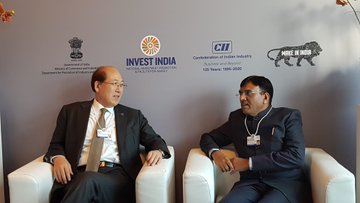
Shri Mansukh Mandaviya meets Secretary General of International Maritime Organisation (IMO) Mr. Kitack Lim at the 50th Annual Meeting of World Economic Forum at Davos, Switzerland

Union Minister of State for Shipping (Independent Charge) and Chemicals &Fertilizers Shri Mansukh Mandaviya today met  the  Secretary General of IMO Mr. Kitack Lim at the 50th Annual Meeting of World Economic Forum at Davos, Switzerland.

Shri Mansukh Mandaviya Shipping (I/C) and Chemical & Fertilizers with theSecretary General, IMO Mr. Kitack Lim in meeting at the 50th Annual Meeting of World Economic Forum at Davos, Switzerland

In this meeting, mutual discussions were held regarding various Global Maritime issues concerning India like Ban on Single Use Plastic by India for reducing Marine Pollution, Availability of low Sulphur fuel complying to IMO 2020 Convention and installation of Mahatma Gandhi Bust at IMO Headquarter, London.

As India is celebrating 150th birth anniversary of Mahatma Gandhi, Shri Mandaviya impressed upon setting up of the ‘Mahtama Gandhi Bust’ at the IMO Headquarters, as a mark of respect to the great global leader. Secretary General, Mr. Kitack Lim consented for setting up the bust at IMO headquarters, London. “This will be one of the prominent busts of Mahatma Gandhi at UN headquarters in the world. It is indeed a matter of great honor and proud moment for India”, Shri Mansukh Mandaviya stated there during media briefing.

Mansukh Mandaviya

@mansukhmandviya

Met Secretary General of IMO, Mr. Kitack Lim at @wef. India’s accession to Hong Kong Convention & enactment of the Recycling Act 2019 were appreciated. Issues regarding banning of single use plastic & bust at @IMOHQ were also discussed.

View image on Twitter
126 people are talking about this

Further, India’s engagement with IMO and role with the International community in the global maritime scenario was applauded by the Secretary General, IMO. India’s recent initiatives for accession to Hong Kong Convention and enactment of the Recycling Act 2019 were also greatly acknowledged and appreciated. Mr. Kitack Lim has assured to extend his full co-operation for the Indian Seafarers injail / custody in different countries.

Shri Mansukh Mandaviya is presently on his four-day official visit to Davos to attend the Annual World Economic Forum Meeting 2020 and having one-on-one meetings with all important World leaders and CEOs of the global companies.

****

NB/MS

New MV Registration Mark “DD” Assigned to New Union Territory ‘Dadra & Nagar Haveli and Daman and Diu’,

The Ministry of Road Transport & Highways has assigned a new motor vehicle Registration Mark “DD” to ‘Dadra & Nagar Haveli and Daman and Diu’ for registration of vehicles. A new Union Territory has been formed after merger of Dadra & Nagar Haveli and Daman & Diu.   The Ministry has issued a  Notification No. S.O. 295(E) dated 22nd January, 2020 to this effect, under the Motor Vehicle Act 1988.

This will be  implemented from 26th  January, 2020.

*****

Gadkari stresses upon strict adherence to project schedules; reviews 500 road projects worth Rs 3 Lakh Crore

Union Minister for Road Transport & Highways and MSMEs Shri Nitin Gadkari has stressed upon strict adherence to project schedules. Chairing the first day of the two-day long review meeting of NHAI-Ministry projects with Minister of State Gen (Retd) Dr V.K. Singh, officials from the Ministry, NHAI, NHIDCL and State Authorities in Haryana’s Manesar today, the Minister called for adopting best practices in project management and construction. He said, while he is committed to quality, he has zero tolerance towards corruption. He added that any inter-ministerial issues holding up a project may be brought to the notice of the Ministry for his intervention to expedite resolution.

Projects from the Southern and Central zones that include Tamil Nadu, Kerala, Karnataka, Andhra Pradesh, Puducherry, Telangana, Gujarat, Chhattisgarh, Rajasthan and Madhya Pradesh are among those reviewed today.

The Minister also launched online Web Portal ‘GATI’ on the occasion. The portal has been created by NHAI taking inspiration from the PRAGATI Portal used by PMO. It can be accessed from NHAI Website and contractors/concessionaires can raise any project related issues on the Portal. The issue will immediately come to the notice of every official of NHAI including top management, and immediate action will be taken by the concerned officer, duly updating on the Portal. The issues raised in the GATI will be daily monitored by a team of officers in NHAI and will be constantly reviewed by the senior officers of NHAI and the Ministry of Road Transport & Highways. This will bring transparency and speed up the decision making giving real GATI to highway construction.

A total of 500 projects valued at Rs 3 lakh crore will be reviewed in the following two days. The projects from North-Eastern states, Maharashtra, Uttarkhand, Punjab, Jammu & Kashmir, Laddakh, Haryana, Bihar, Odisha, Jharkhand, West Bengal and Uttar Pradesh will be reviewed tomorrow.

***

We are laying a Network of Gas Pipelines from Kutch to Kohima and from Kashmir to Kochi, Says Shri Dharmendra Pradhan at the National Conclave

Minister of Petroleum and Natural Gas Shri Dhamendra Pradhan has called upon all the stakeholders to contribute positively in transforming India into a gas based economy.  Presiding over the national conclave on emerging opportunities in the natural gas sector here today, he said that the present share of gas in the energy basket of the country is 6.2% and the target is to take it to15% by 2030.  He said that the world average is 24% while within the country, the Gujarat has 26% share of gas based energy.


Describing the natural gas as the next generation fossil fuel which is comparatively cheaper and less polluting, Shri Pradhan said that the Government has taken a number of initiatives to give thrust to gas based economy.  He said that the domestic gas production is likely to increase in the current financial year to 34.55 billion cubic metre.   Pricing and LNG marketing freedoms have been given to gas producers, LNG terminal capacity is being augmented and national gas grid is being developed.  Shri Pradhan said that this is the first time that Government of India is providing Rs.10,500 crore worth of viability gap funding for laying pipeline in Eastern and North-Eastern India.  He said gas pipeline network will be ready from Kutch to Kohima and Kashmir to Kochi.  Shri Pradhan said that 4 lakh crore rupee worth of investment is likely to be made in such projects which is a challenge as well as an opportunity.He said that the sources of import have been diversified and the Government is holding discussions with gas-exporting countries for getting more gas on favourable terms. He said that CBG is a great initiative which has the potential to generate wealth from waste, provide employment, protect the environment, and give boost to the economy.

Calling upon the States to fully cooperate and support the gas infrastructure activities and projects, he said Ministry of Petroleum and Natural Gas has prepared a draft Policy of City Gas Distribution (CGD), which may be adopted by States to facilitate such activities.


Shri Pradhan said that PNGRB is likely to soon start bid round 11 for CGD and States make like to give suggestions in identification of geographical areas.  He also called upon the States to adopt qualification packs developed by Hydrocarbon Sector Council in their Vocational Training Institutes.   He called upon the States to actively promote CNG usage in State transportation and mining sector.

Shri Pradhan called upon all the entities who have bagged CGD rounds to not delay their work and immediately start action.  He also called upon PNGRB to strictly monitor the progress.

Shri Pradhan announced that Federation of Indian Petroleum Industry (FIPI) will have a Help Desk for holding any future interaction with all stakeholders. He assured full support to all the stakeholders who are part of the gas based supply chain.

In today’s meeting State Ministers from Gujarat, Assam, Odisha, Himachal Pradesh, Uttarakhand, Bihar, Manipur, Chhattisgarh, Punjab and Goa participated.  They also gave suggestions for improving the gas network in the country.  Besides various stakeholders from private and public sector involved in various aspects of supply chain of gas distribution took part in the conference.

An exhibition was also inaugurated by the Minister, highlighting various developments and initiatives in the gas sector.


*****

YB/SK

Lok Sabha passes the Special Protection Group (Amendment) Bill, 2019

The Lok Sabha passed the Special Protection Group (Amendment) Bill, 2019, after negating all the proposed amendments today.

Initiating the debate on the Special Protection Group (Amendment) Bill, 2019 today in the Lok Sabha, Union Home Minister Shri Amit Shah said that SPG shall provide proximate security to the Prime Minister and his immediate family members residing with him at his official residence. The Bill says that family members of a former Prime Minister who reside with him at his allotted accommodation will get security cover of the SPG only for five years, from the date he/she ceases to hold the office of Prime Minister.

Special Protection Group (Amendment) Bill, 2019

Replying to the debate, the Home Minister noted that there is a perception in the country that the amendment in SPG Act is only for the purpose to remove the SPG security cover for the Gandhi family. Contrary to this, the change of the security cover has been done only on the basis of yearly security threat perception review by the government. Such a security review has been a part of the original act, he added.

Shri Shah emphasized that the security cover of the Gandhi family has not been reduced or taken away, rather it has just been changed from SPG cover to Z Plus security cover by the CRPF, along with ASL and ambulance, across the country. The level of the security cover has been maintained and not even one security personnel has been reduced. He also said that the SPG security cover is being formed by the same security personnel who comprise of the Z plus security cover.

Shri Shah informed that based on the recommendations of the Birbal Nath committee report, SPG came into existence in 1985. From 1985 to 1988, SPG was governed by an Executive Order and only in 1988 the SPG Act came into existence to provide security to the Prime Minister and his/her family.

Shri Shah said that the SPG Act was enacted in 1988 to provide for the constitution and regulation of the SPG as an armed force to provide proximate security to the Prime Minister and his/her immediate family members. Amendments to the Act were effected in 1991, 1994, 1999 and 2003 and today a further amendment is being brought to revert back to the original spirit of the Act.

Shri Shah stated that the previous amendments to the 1988 Act have been carried out each time to provide security cover only to one family. According to the original Act, SPG is a specialised force to provide comprehensive security cover to the Prime Minister of the country and not a particular family. SPG doesn’t only provide physical security, but it takes care about protection of Prime Minister’s office, his/her communication systems, foreign tours and issues pertaining to his/her health and well being.

Dismissing the charge of vindictiveness for removal of SPG cover of Gandhi family, Shri Shah stated that such security cover reviews have happened in the past with respect to ex prime ministers, including Shri P.V. Narasimha Rao, Shri I.K. Gujaral, Shri Chandra Shekhar, Shri H.D. Deve Gowda and Dr. Manmohan Singh, but there was no such opposition ever when SPG cover was withdrawn. The Home Minister said that the Government is committed to secure each citizen of the country.

Shri Shah further stated that the Modi government never takes decision of providing security cover on the basis of vendetta politics but on scientific threat analysis for a particular individual. He also said that security cover has been provided to members of all political parties based on individual case based threat analysis. Security cover must not be treated as a status symbol by individuals. The security cover meant specifically for the Prime Minister, must not be enjoyed by any other individual. Moreover, the three protectees of the Gandhi family who have been specially mentioned here, have been on many trips without informing SPG, the Home Minister pointed out.

Talking about the rationale behind bringing the amendment, Shri Shah informed the House that in the Act, there is no cut off period for providing the SPG protection to former Prime Ministers or members of their immediate families. Thus, the number of individuals to be provided SPG cover can potentially become quite large. In such a scenario, there can be severe constraint on the resources, training and related infrastructure of SPG. This can also impact the effectiveness of SPG in providing adequate cover to the principle protectee, the Prime Minister in office.

Shri Shah said that the main aim of bringing this amendment is to make SPG more efficient. This would ensure that no omission happens in carrying out its core mandate, as the security of the Prime Minister, as Head of the Government, is of paramount importance for Government, governance and national security. The Bill says that when the proximate security is withdrawn from a former Prime Minister, such proximate security shall also stand withdrawn from members of his or her immediate family.


*****

Courts Can Interfere With Administrative Actions Only If It Suffers From Vice Of Illegality, Irrationality Or Procedural Impropriety: SC

It must be mentioned right at the outset that in a latest, landmark and extremely laudable judgment titled Municipal Council Neemuch vs Mahadeo Real Estate And Ors in Civil Appeal No. 7319-7320 of 2019 (Arising out of S.L.P.(C) Nos. 172-173 of 2019) which was delivered on September 17, 2019 by a three Judge Bench of Supreme Court comprising of Justice BR Gavai who authored the judgment for himself, Justice Arun Mishra and Justice MR Shah has sought to send a very loud, clear and categorical message to all the High Courts that an interference by the High Court would be warranted only when the decision impugned is vitiated by an apparent error of law. It was reiterated that while exercising its powers of judicial review of administrative action, Courts could not interfere with the administrative decision unless it suffers from the vice of illegality, irrationality or procedural impropriety. This observation was made by the three Judge Bench of Apex Court while setting aside a Madhya Pradesh High Court judgment that had interfered with an order passed by Revenue Commissioner of Ujjain in a matter of issuing tenders for allotment of land on lease, for a period of 30 years. 

To start with, the ball is set rolling in para 2 after leave is granted under para 1 wherein it is observed that, “The present appeals challenge the Judgment and Order passed by the Division Bench of the Madhya Pradesh High Court Bench at Indore dated 31.08.2017 thereby allowing the writ petition filed by respondent No. 1 herein and the subsequent Order dated 05.07.2018 thereby rejecting the Review Petition filed by the appellant.”

For the sake of brevity, para 3 then states that, “The factual background, in brief, giving rise to the present appeals is as under. The appellant, which is a Municipal Council, duly constituted under the Madhya Pradesh Municipality Act, 1961 (hereinafter referred to as the “said Act”) had invited tenders for allotment of land on lease, for a period of 30 years. The land was ad-measuring 163176 sq. ft. situated in Scheme No. 1A (Commercial-cum Residential Use), Neemuch. The Notice Inviting Tenders (“NIT” for short) was published in the daily newspapers, viz., Nai Duniya, Dainik Bhaskar, Free Press and Dashpur Express. Respondent No. 1, which is a registered partnership firm along with other bidders had submitted the tender thereby giving an offer of Rs. 5,81,00,106/-. It had also deposited the earnest money amounting to Rs. 47,00,000/-. The bids of the participants were opened in presence of the representatives of all the bidders. The bid of respondent No. 1 herein was found to be highest.”

To be sure, it is then mentioned in para 4 that, “The appellant issued a letter dated 27.09.2008 thereby informing respondent No. 1 that its bid was accepted. Respondent No. 1 was directed to deposit an amount of Rs. 1,45,25,050/-, i.e., 25% of the bid amount within a period of seven days. Respondent no. 1 in accordance therewith deposited the aforesaid amount on 01.10.2008.”

Truth be told, it is then unfolded in para 5 that, “It appears that an objection was raised by two members of the Municipal Council under the provisions of Section 323 of the said Act before the Collector with regard to the said tender process. It further appears, that the Collector vide Order dated 18.07.2008 had stayed further proceedings of the tender process. Vide Order dated 23.12.2008, the Collector disposed of the proceeding observing therein, that the proposal be sent for approval of the State Government in the Urban Administrative and Development Department, respondent No. 2 herein, under the provisions of Section 109 of the said Act.”

While continuing in the same vein, it is then pointed out in para 6 that, “Thereafter, it appears that, there was certain correspondence between the Urban Administrative and Development Department, on one hand, and the Divisional Revenue Commissioner of Ujjain, respondent No. 3 herein, on the other hand. Finally, respondent No. 3 passed an order dated 03.07.2010 observing therein that, the tenders invited in connection with transfer of the said land were not competitive. He further observed in the said Order, that the NIT was published only in Indore edition of two Hindi Newspapers at Indore and as such there was no wide circulation. As such, he rejected the proposal of the Municipal Council and returned the same with the direction to invite the tenders again by publishing the NIT in at least one National level English newspaper and one State level reputed Hindi newspaper. Being aggrieved thereby, respondent No. 1 herein approached the Madhya Pradesh High Court in Writ Petition No. 12204 of 2010. The Division Bench vide Order dated 31.08.2017 allowed the writ petition thereby quashing and setting aside the Order dated 03.07.2010 passed by respondent No. 3 and further directing him to grant approval on behalf of the State Government for allotment of the land on lease in favour of respondent no. 1. The appellant, thereafter, preferred Review Petition No. 1072 of 2017. The same was rejected. Hence the present appeals challenging both the Orders dated 31.08.2017 and 05.07.2018.”

In the context of Rule 3 of the Municipal Corporation (Transfer of Immovable Property) Rules 1994 (referred to as the “said Rules”), it would be apposite to note that para 11 envisages that, “A perusal of the aforesaid Rule 3 of the said Rules would reveal that no immovable property which yields or is capable of yielding an income shall be transferred by sale, or otherwise conveyed, except to the highest bidder at a public auction or by inviting offers in a sealed cover. The proviso thereof provides that if the Corporation is of the opinion that it is not desirable to hold a public auction or to invite offers in sealed covers, the Corporation may, with the previous sanction of the State Government, effect such transfers without public auction or inviting offers in sealed covers. The second proviso also provides that the Corporation may, with the previous sanction of the State Government and for the reasons to be recorded in writing, transfer any immovable property to a bidder other than the highest bidder.”

What is truly a no brainer is then elaborated upon in para 12 which states clearly that, “It is thus amply clear that, no land, exceeding fifty thousand rupees in the value shall be sold or otherwise conveyed without the previous sanction of the State Government. The perusal of the aforesaid Rule further makes it clear that the immovable property which yields or is capable of yielding an income shall not be transferred by sale or otherwise conveyed, except to the highest bidder at the public auction or by inviting offers in a sealed cover. No doubt, with the previous sanction of the State Government such a transfer could be effected without public auction or inviting offers in a sealed cover. The second proviso further provides that, the Corporation may, with the previous sanction of the State Government and for the reasons to be recorded in writing, transfer any immovable property to a bidder other than the highest bidder.”

What is also a no brainer is further elucidated in para 13 that, “It is thus amply clear that, whenever any land which is having a value exceeding fifty thousand rupees is to be sold the same cannot be done without the previous sanction of the State Government.”

More importantly, while discussing about the scope of judicial review, it is then rightly underscored in para 15 that, “It could thus be seen that the scope of judicial review of an administrative action is very limited. Unless the Court comes to a conclusion, that the decision maker has not understood the law correctly that regulates his decision-making power or when it is found that the decision of the decision maker is vitiated by irrationality and that too on the principle of “Wednesbury Unreasonableness” or unless it is found that there has been a procedural impropriety in the decision-making process, it would not be permissible for the High Court to interfere in the decision making process. It is also equally well settled, that it is not permissible for the Court to examine the validity of the decision but this Court can examine only the correctness of the decision making process.”

What’s more, para 17 then illustrates that, “It could thus be seen that an interference by the High Court would be warranted only when the decision impugned is vitiated by an apparent error of law, i.e. when the error is apparent on the face of the record and is self evident. The High Court would be empowered to exercise the powers when it finds that the decision impugned is so arbitrary and capricious that no reasonable person would have ever arrived at. It has been reiterated that the test is not what the court considers reasonable or unreasonable but a decision which the court thinks that no reasonable person could have taken. Not only this but such a decision must have led to manifest injustice.”

To put things in perspective, para 22 then lays bare stating that, “The situation that emerges is this. Initially the Municipal Council, Neemuch, invited tenders for allotment of the said land on lease for 30 years. This was done without taking prior approval of the State Government as is required under Section 109 of the said Act. Two municipal counselors raised objections before the Collector under the provisions of Section 323 of the said Act. The Collector, who initially granted stay on 18.07.2008, vide order dated 23.12.2008 directed the Municipal Council to seek approval of the State Government to the said proposal. Vide communication dated 21.12.2009, the State Government directed respondent No. 3-Revenue Commissioner to hand over the possession of the land to respondent No. 1. While doing so, the State Government directed the Commissioner to inspect as to whether the land was being put for use as per the development plan. On receipt of the communication the Divisional Commissioner addressed a communication to the State Government on 03.03.2010 thereby, specifically pointing out that no proper publicity was given to the NIT and that the rates were not competitive as per the market value. It was specifically observed that there was a cartel among the tenderers and therefore, sought clear orders of the State Government in view of Section 109 of the said Act. He also proposed to reject the proposal with further direction to invite fresh tenders by giving adequate publicity. In response to the said communication, the State Government re-examined the issue and by communication dated 18.05.2010 authorised the Commissioner for transferring the land in question. It is further clear from the said communication that, the State Government authorised the Commissioner to take necessary decision with regard to grant of sanction under the provisions of Section 109 of the said Act and Rule 7 of the said Rules. It specifically observed that if the Commissioner does not agree with the proposal of the Municipal Council he may while invalidating the proposal of the Municipal Council give orders for initiation of proceedings afresh. It is in view of this authorisation that the Divisional Commissioner has passed the orders which were impugned before the Madhya Pradesh High Court.”

While pooh-poohing the manner in which the Division Bench of Madhya Pradesh High Court based its decisions, the Bench then observes in para 23 that, “We are at pains to say, that the Division Bench of the High Court by only referring to the communication dated 21.12.2009 came to the conclusion that the sanction contemplated under Section 109 of the said Act was granted by the State Government. However, the Division Bench has totally ignored the subsequent correspondence between the State Government and the Commissioner. Perusal of the subsequent communication reveals that the Commissioner had pointed out the infirmities in the proposal of the Municipal Council and advised the State Government to reject the said proposal with a direction to the Municipal Council to invite fresh tenders. On the objection of the Commissioner, the State Government reexamined and reconsidered the issue and authorized the Commissioner to exercise powers under Section 109 of the said Act to take appropriate decision including rejecting the proposal and directing the process of re-tendering.”

It cannot be lost on us that it is then held in para 24 that, “It could thus be clearly seen that, the Commissioner, instead of blindly accepting the directions contained in the communication dated 21.12.2009 has acted in larger public interest so that the Municipal Council earns a higher revenue. Not only this, but the State Government, after the Commissioner pointing out anomalies to its notice, has reexamined and reconsidered the issue and authorised the Commissioner to pass appropriate orders including invalidating the tender process and directing initiation of fresh tender process. In the background of this factual situation, the finding of the Division Bench of the High Court that the action of the Commissioner is arbitrary and illegal, in our view, is neither legally or factually correct. As discussed hereinabove, the High Court, while exercising its powers of judicial review of administrative action, could not have interfered with the decision unless the decision suffers from the vice of illegality, irrationality or procedural impropriety.”

Most importantly, it is then observed in para 25 that, “In the present case, we find that the Commissioner had acted rightly as a custodian of the public property by pointing out the anomalies in the proposal of the Municipal Council to the State Government and the State Government has also responded in the right perspective by authorizing the Commissioner to take an appropriate decision. We are of the considered view that, both, the Commissioner as well as the State Government, have acted in the larger public interest. We are unable to appreciate as to how the High Court, in the present matter, could have come to a conclusion that it was empowered to exercise the power of judicial review to prevent arbitrariness or favouritism on the part of the State authorities, as has been observed by it in paragraph 13. We are also unable to appreciate the finding of the High Court in para 17 wherein it has observed that the impugned decision of the authorities are found not to be in the public interest. We ask the question to us as to whether directing re-tendering by inviting fresh tenders after giving wide publicity at the National level so as to obtain the best price for the public property, would be in the public interest or as to whether awarding contract to a bidder in the tender process where it is found that there was no adequate publicity and also a possibility of there being a cartel of bidders, would be in the public interest. We are of the considered view that the decision of the Commissioner which is set aside by the High Court is undoubtedly in larger public interest, which would ensure that the Municipal Council earns a higher revenue by enlarging the scope of the competition. By no stretch of imagination, the decision of the State Government or the Commissioner could be termed as illegal, improper, unreasonable or irrational which parameters only could have permitted the High Court to interfere. Interference by the High Court when none of such parameters exist, in our view, was totally improper. On the contrary, we find that it is the High Court, which has failed to take into consideration relevant material.”

Broadly speaking, as a corollary of what has been mentioned above, we then finally see that it is held in para 26 that, “In the result, the impugned Orders are not sustainable in law. The appeals are, accordingly, allowed and the impugned orders dated 31.08.2017 and 05.07.2018 are quashed and set aside. The petition of respondent No. 1 stands dismissed.” However, it is also then added in para 27 that, “However, the Municipal Council is directed to refund the amount deposited by respondent No. 1 herein along with interest at the rate of 6% per annum forthwith.” Lastly, it is then held in the last para 28 that, “In the facts and circumstances of the case, there shall be no order as to costs.”

In a nutshell, this decisive and laudable judgment minces just no words whatsoever to send a loud and unmistakable message that, “Courts can interfere with administrative actions only if it suffers from the vice of illegality, irrationality or procedural impropriety”. The Apex Court in this noteworthy judgment also generously cites the relevant cases like Tata Cellular Vs Union of India (1994) 6 SCC 651 and West Bengal Central School Services Commission vs Abdul Halim 2019 SCC Online SC 902 wherein it is pointed out in detail when the Court can intervene. It is pointed out that the scope of judicial review of an administrative action is very limited. Also, it is enunciated that unless the Court comes to a conclusion that the decision maker has not understood the law correctly that regulates his decision-making power or when it is found that the decision of the decision maker is vitiated by irrationality and that too on the principle of “Wednesbury Unreasonableness” or unless it is found that there has been a procedural impropriety in the decision-making process, it would not be permissible for the High Court to interfere in the decision making process. It is also equally well settled that it is not permissible for the Court to examine the validity of the decision but this Court can examine only the correctness of the decision-making process.

By the way, it is also explicitly stated that an interference by the High Court would be warranted only when the decision impugned is vitiated by an apparent error of law, i.e. when the error is apparent on the face of the record and is self evident. The High Court would be empowered to exercise the powers when it finds that the decision impugned is so arbitrary and capricious that no reasonable person would have ever arrived at.

It has also been very rightly reiterated that the test is not what the court considers reasonable or unreasonable but a decision which the court thinks that no reasonable person could have taken. Not only this but such a decision must have led to manifest injustice. Very rightly so!

It needs no Albert Einstein to conclude that all the High Courts in our country must always unflinchingly abide by what the 3 Judge Bench of the Apex Court has held so clearly, categorically and convincingly in this latest, landmark and extremely laudable judgment in similar such cases. If they do so, it will very rightly save them from getting a rap on the knuckles as we see in this notable case the High Court Bench of Madhya Pradesh got much to their own relief! This is exactly what makes this judgment so significant and crucial that no High Court Judge can ever afford to miss it out some how! .

Sanjeev Sirohi, Advocate,

s/o Col BPS Sirohi,

A 82, Defence Enclave,

Sardhana Road, Kankerkhera,

Meerut – 250001, Uttar Pradesh.

Hindi as a National Language

Annual Hindi Diwas

14th September has been designated
as “Hindi Diwas”- meaning “Hindi Day”. Authors, speakers and various
contributors of different capacity towards promotion of Hindi, are recognized
and awarded on this day. Like many other festivals and days of the country,
this day has also lost its meaning and purpose. But even while this day has
failed to achieve anything significant, it always manages to achieve one thing-
that is attracting the supporters and criticisers of “Hindi as a National
Language”.
This year, the feud got kicked off by Home
Minister Amit Shah, while he was speaking at a ceremony on Hindi. He said, “While
diversity in languages is the strength of our nation, a national language
needed so that foreign languages and cultures do not overpower our own”.
He recognized Hindi as the most capable national language candidate.  Of course, this got twisted by all degrees by
various leaders for their interests. But Honorable Home Minister is not the
first person to say this. Many greater leaders have said similar things and
more passionately. Mahatma Gandhi- who was perhaps the first true National
Leader, said exactly similar things. Even his first language was not Hindi.
Interestingly, Hindi is not first language of Home Minister either. So, it is
interesting to understand why Hindi brings out such divisions? Why some
non-native speakers of Hindi vouch for Hindi, while others fight it fiercely.

History of Indian
Languages

Art XVII of the Constitution of India designates
Hindi as the official language of the Union and a clause “or in
English” is added for carrying out daily official work. Though English was
to be phased out in 15 years post the implementation of the constitution, but
such proposals have faced severe protests from non-Hindi speaking states.
In addition to official language, constitution
also recognizes 22 scheduled languages- English is not part of this list. Below
is the count of language wise speakers as per the Census 2011.
Language
Speakers (in lakhs, 2011)
Hindi
5280
Bengali
972
Marathi
830
Telugu
811
Tamil
690
Gujarati
555
Urdu
507
Kannada
437
Odia
375
Malayalam
348
Punjabi
331
Assamese
153
Maithili
136
Santali
73
Kashmiri
68
Nepali
29
Sindhi
27
Dogri
26
Konkani
22.5
Manipuri
18
Bodo
14.8
Sanskrit
0.2

What should be our way
forward?

As you can see, Hindi is the largest language
spoken by almost 40% Indians. If you add Hindi-family languages together, the
count would be even higher. So naturally Hindi has the highest potential of
becoming the language that can thread the pearls of India.
So why are there protests? Welcome to democratic
freedom!
Every voice matters. So does every choice. Why
would anyone give up their choice unless they see any gain from it? And this
cannot be done by force or law. That is where policymakers have been making
mistake. Hindi does not offer any more advantage than the other Indian
languages as far as work is concerned. In fact, the widely availability of
texts, research and other materials in English- makes English more efficient
language than most other languages of the world. There is no harm or shame in
acknowledging this.
So, in such scenario, what role Hindi can play?
Well, English can be language of minds, but matters of heart belong to Hindi.
There is no better option than this. But encouraging matters of heart is
totally different from encouraging matters of mind.
The pure Hindi is hardly spoken by a handful of
people in informal environment. There are tens of thousands of dialects of
Hindi and they all come to together in this beautiful language. We have
incorporated words from Awadhi, Brij, Magahi, Maithili, Bhojpuri, Punjabi,
Marathi, Bengali, Urdu, Farsi and even English. We will have to go further- we
can incorporate more languages. This can only happen when interaction between
two different cultures happen more often. School meets, sports meet, Melas and
other such informal gatherings can be the perfect way to do this.
Hindi deserves to be the language of hearts,
and this cannot be done formally. We have to be informal, experimental and
open-minded about this. Otherwise petty politicians will keep using this topic
as to create divide in the society.

Career options in India: Law as a career Option (Part 1)

The key reason that humans excelled compared to other species, or even managed to survive the harsh initial days on earth was their abilities to co-ordinate and stay in groups. For functioning of such groups, a set of rules must exist. Therefore, law is a field which is almost as ancient as the civilization. 
The first written instance of law came during the reigns of Hammurabi (18th century BC, Babylon). His laws were simple four lines, but it is a remarkable point in the history of civilization. For a long time the Kings usually kept the justice system under their thumb or let a council of his trusted ministers handle the affair.
Independent Judiciary
Needless to say, such a justice system was easily swayed by the ruling authorities or other influential few persons. Such a justice system can never be truly just. The concept of independent judiciary can be traced back to 18th Century England. One of the founding fathers of the United States Alexander Hamilton wrote in 1788 “The complete independence of the courts of justice is particularly essential in a limited constitution.” 
Such a judiciary can safeguard the people’s interests and rights and prevent any encroachment by the rulers of the country. Within this statement is the purpose and need of the judiciary system and this gives birth to various career options available in field of Law.
Career Options
The two main actors in a courtroom are the lawyers- who present various sides of the arguments in favor of their respective clients, previous precedence, constitution citations etc. and the judges who with or without assistance of a jury dwell into the arguments to decide upon a verdict so that the justice is provided.
Career as a Lawyer
Law as a profession is in great demand these days. With economic system and corporate world getting more and more complex, lawyers are required to a daily basis to interpret the law and it is no longer limited to traditional streams like civil or criminal. Now, lawyers can specialize in streams such as Criminal Justice, Civil Rights, Corporate Affairs, Taxation, Patent Law etc.
How to pursue a career in law?
Most popular way to pursue a career, one has to start with a good college. The tests can be taken post clearing 12th. The cut-off and other details can be obtained from the respective websites of the tests. The most popular Law entrance exams in India are-
i. CLAT- Common Law Admission Test. 21 national universities take admission through this test. (https://www.clat.ac.in/)
ii. AILET – All India Law Entrance Test is an exam conducted exclusively for National Law University (NLU) Delhi. (http://www.nludelhi.ac.in/)
iii. SLAT- For admission in Symbiosis Law School, Pune/Noida/Hyderabad (http://www.set-test.org/)
iv. LSAT – Law School Admission Test is conducted four times every year specially designed for LLB and LLM admissions.
 LSAT scores are accepted by more than 70 top institutes like Rajiv Gandhi School of Intellectual Property Law, IIT Kharagpur Law School, Galgotia University Law School, The Jindal Global Law School, UPES Dehradun, SRM University, Amity Law School and many more (http://www.pearsonvueindia.com/lsatindia/)
The top colleges as per the MHRD NIRF ranking (https://www.nirfindia.org/2019/LAWRanking.html) 2019 are-
1. National Law School of India University, Bangalore
2. National Law University, Delhi
3. Nalsar University of Law, Hyderabad
4. Indian Institute of Technology Kharagpur
5. The West Bengal National University of Juridical Sciences, Kolkata
6. National Law University, Jodhpur
7. Symbiosis Law School, Pune
8. Jamia Millia Islamia, Delhi
9. Gujarat National Law University, Gandhinagar
10. The Rajiv Gandhi National University of Law, Patiala
Job Opportunities
As discussed earlier, there are plenty of job opportunities in the area of Law and many more are being created as the world gets complicated. You may choose to practice on your own, join a law firm or join a corporate to advise them on daily matters. You may also choose to specialize for social issues like environment, labor laws, PLIs etc. If you give your heart and mind to a career in law, there is no way you will regret it.

Abolition of Triple Talaq will ensure dignity and equality to crores of Muslim women

Union Minister of Home Affairs Shri Amit Shah addressed an audience on “Abolition of Triple Talaq – correction of a historic wrong” at the Constitution Club of India earlier today.
Tracing the journey of the Act, Shri Shah said that he had spoken on the issue of Triple Talaq when it was in the ordinance format and when it was a bill. He said that it was a proud moment for him to speak of the issue of Triple Talaq when it had finally been enacted by the Parliament.

Blaming the policy of appeasement for the opposition to the removal of Triple Talaq, he said that while removal of social evils is generally welcomed by society, it was appeasement that led to some opposition to the move.
Shri Shah asserted that social unity and holistic development are hampered because of appeasement. He said that development of an entire society takes hard work and rigorous planning, and requires dedication, commitment and empathy. Calling appeasement a “shortcut”, he said that appeasement never leads to development.
Shri Shah said that those who are left behind in the journey of development must be empowered, and that holistic, all-encompassing, last-mile development is the philosophy of the government under the leadership of Prime Minister Shri Narendra Modi.
Giving the examples of nations that had abolished Triple Talaq, Shri Shah said that several Islamic nations had already taken the step decades ago, and this proves that such a barbaric practice is not part of Islamic culture.
Praising the tenacity and decisiveness of the government, Shri Shah said that the road to ending Triple Talaq was not easy, as the Bill was not able to pass through Rajya Sabha multiple times. However, the government persisted with the passage of the Bill and was ultimately successful.
Commenting on the Constitutional Status of the issue, Shri Shah said that a five judge Constitution Bench had pronounced with a majority of 3-2 that the practice of Triple Talaq violates Article 14 of the Constitution – Equality before the law and equal protection of the law. Thus, Supreme Court itself has declared the practice of Triple Talaq to be illegal, unconstitutional, arbitrary and void.
Shri Shah said that a soicety must progress with time, otherwise it becomes stale. He also said that the abolition of Triple Talaq would ensure dignity and equality for crores of Muslim women.
Commenting on the aspect of imprisonment for the violation of the Act, Shri Shah remarked that the correction of many social evils required the application of criminal laws – from Sati Pratha and child marriages to polygamy and dowry.
Regarding the maintenance of the aggrieved wife and children, Shri Shah said that the husband will be required to provide for the wife he divorces through Triple Talaq, as well as their children.
Shri Shah said that the law stipulates 3 years of imprisonment for violators, and bail is possible only after the aggrieved woman has had a chance to present her side to the court. Thus, this law empowers Muslim women in the truest sense of the word. Commenting on the results of a survey, Shri Shah said that 92.1% Muslim women wanted Triple Talaq gone.
He said that he was proud of having voted against ending the social evil of Triple Talaq.
Shri Shah observed that nepotism, casteism and appeasement have collectively damaged the nation’s polity, and emphasized that under the leadership of Prime Minister Shri Narendra Modi, the government had taken steps to remove all three from India’s polity.
Shri Shah stated that with the passage of the Act, the Prime Minister’s promise to the nation stands fulfilled. He also said that the world looks up to India with respect because of this move.
He remarked that great social reformers like Raja Rammohan Roy, Jyotiba Phule, Kavi Narmad Mahatma Gandhi, Veer savarkar and Dr Ambedkar have all contributed to uplifting our society and removing social evils. He said that Prime Minister Shri Narendra Modi’s name would find a place in the list of great social reformers because of his leadership in the quest for abolishing the practice of Triple Talaq.
Hailing the Prime Minister for the decision, Shri Shah said that the journey of the nation towards development must not stop here. He emphasized that the nation must function not on nepotism, casteism or appeasement, but on merit.

Daring Resolve Taken By Centre On Jammu And Kashmir

It is not Sanjeev Sirohi or my best friend Sageer Khan or any of my other friends or any layman who has termed Centre’s latest decisions on Jammu and Kashmir as a daring resolve. It is senior Congress leader and former Union Law Minister who is also one of the eminent, senior lawyer of the Supreme Court – Ashwani Kumar who has called the move on Jammu and Kashmir by Centre as “a daring resolve in line with the mood of the nation”. How can anyone ignore when such an eminent senior lawyer of Supreme Court and former Union Law Minister who hails not from ruling party BJP or its ally party but from the main opposition party which is the Congress says so openly with full confidence? It is reliably learnt from many news channels that even another eminent and most experienced senior lawyer of Supreme Court who has also served earlier as Additional Solicitor General and is also a senior Congress leader Abhishek Manu Singhvi has also expressed his support to this bold decision taken by Centre!

To be sure, Ashwani Kumar further reiterated that, “The J&K gamble by the Central government has received popular national support and seems to be consistent with the national mood although history and future alone can attest to its wisdom.” He also clarified that he can’t work by diktat! Very rightly so!

There are a galaxy of other senior and eminent Congress leaders who too have hailed this daring resolve of Centre in taking steps to ensure the full integration of Jammu and Kashmir with India by virtually eliminating all the key provisions of Article 370 of the Constitution and abolishing most controversial Article 35A! I support the move on Jammu and Kashmir & Ladakh and its full integration into Union of India. There is no valid reason to oppose what Centre has done which according to me was the crying need of the hour!

No doubt, even though Congress is fulminating against revocation of Article 370 and Article 35A yet it is most heartening to note that many prominent faces of Congress party including Janardhan Dwivedi, Jyotiraditya Scindia, Deepender Hooda, Jiten Prasad, Salman Khurshid, Milind Deora among many others have expressed their solidarity with this latest move by Centre! Senior and eminent Congress leader Janardhan Dwivedi minced no words in saying that a historic blunder has been remedied today after the scrapping of Articles 35A and 370! Jyotiraditya Scindia said that he supported the Narendra Modi government’s proposed move to bifurcate the state into two Union Territories – Jammu and Kashmir and Ladakh. He tweeted minutes before the Lok Sabha voted on the resolution that, “I support the move on Jammu and Kashmir & Ladakh and its full integration into union of India. Would have been better if constitutional process had been followed. No questions could have been raised then. Nevertheless, this is in our country’s interest and I support this.”

As things stand, Congress senior leader Janardhan Dwivedi said happily that, “It is a very old issue. After Independence, many freedom fighters did not want Article 370 to remain. I had my political training under Dr Ram Manohar Lohia, who was against this Article. Personally, this is an issue of a matter of satisfaction for the nation. This historical mistake that happened at the time of independence has been rectified today, even though late, and is welcomed.” Mumbai Congress Chief – Milind Deora said that it was “very unfortunate” that Article 370 was being converted into a “liberal vs conservative debate”. He said in a tweet that, “Parties should put aside ideological fixations & debate what’s best for India’s sovereignty and federalism, peace in J&K, jobs for Kashmiri youth and justice for Kashmiri Pandits.”

Not stopping here, another Congress leader Deepender Hooda who is a three-time MP from Haryana’s Rohtak constituency said that, “I’ve always maintained that Article 370 should be scrapped. It is irrelevant and has no place in the 21st century. Abrogation of this article is in the interest of national integrity and the people of J&K which is an integral part of India. Senior Congress leader Anil Shastri also openly came out in support of Centre’s move and said that the the people are totally with the government on this issue! There can be no denying it! Kuldeep Bishnoi who is a special invitee to the Congress Working Committee also welcomed the removal of Article 370 calling it a “good decision”. He said that, “When this Article was implemented, then Nehru called it temporary. My personal view is that it is a welcome step. This amendment will be successful only when we are able to convince Kashmiris that they are a part of Akhand Bharat.” Former Union Minister RPN Singh too has backed Centre’s daring move!

Above all, even the Congress’s chief whip in the Rajya Sabha – Bhubaneshwar Kalita strongly protested against his party’s stand and said emotionally while quitting his membership in Rajya Sabha after the party asked him to issue a whip to all members for opposing the bill that, “I was asked by the party to issue a whip but this is against the mood of the nation. The party as it is on its way towards destruction and I can’t be a contributor to it.” Even Congress MLA from Rae Bareli Aditi Singh said on Twitter that, “United we stand! Jai Hind. #Article 370”. She termed it a historic decision and urged people not to politicize it. When someone reminded that she was a Congress leader, she boldly retorted that, “Main ek Hindustani hoon (I am an Indian).” Absolutely right!

Interestingly enough, even veteran Congress leader Karan Singh who is son of J&K’s last ruler, Maharaja Hari Singh who signed the Instrument of Accession in 1947 and who was a Union Minister in the Indira Gandhi Cabinet in 1967, has been a member of CWC and worked with four generations of the Nehru-Gandhi family took a divergent stand from that of his party and said that he did not agree with a “blanket condemnation” of the government’s decision and said that it has “several positive points”. He welcomed the government’s decision to make Ladakh a Union Territory and reminded that, “In fact, I had suggested this as far back as 1965, when I was still Sadr-i-Riyasat of J&K, when I had publicly proposed reorganisation of the state.” He said that he hoped the hill councils of Leh and Kargil would “continue to function, so that in the absence of the Legislature, the grassroots opinion of the people of Ladakh are duly represented.” He minced no words to reiterate his support to scrap Article 35A and the government’s plan to initiate an exercise to redraw the contours of the Assembly constituencies. He said that, “The gender discrimination in Article 35A needed to be addressed as also the long-awaited and enfranchisement of lakhs of West Pakistan’s refugees and reservations for Scheduled Tribes which will be welcomed. There will also be a fresh delimitation which, for the first time, will ensure a division of political power between the Jammu and Kashmir regions.”

Be it noted, Union Home Minister Amit Shah who tabled the Jammu and Kashmir Reorganisation Bill, 2019 and the statutory resolutions in Rajya Sabha around 11 am after the Union cabinet met at Prime Minister Narendra Modi’s residence at 9.30 am to grant the go-ahead said that, “Article 370 was a temporary provision…how long can a temporary provision be allowed to continue…After abrogation of Article 370, Jammu and Kashmir will truly become an integral part of India.” Saying Article 370 was at the root of terrorism, Amit Shah told the House that full state status will be restored to Jammu and Kashmir at an appropriate time when normalcy returns. He rightly said that the decision to do away with the special status of J&K and to bifurcate the state into two UTs was in the supreme national interest! No denying it!

Honestly speaking, PM Narendra Modi very rightly summed up by saying that, “Nobody could pinpoint what benefit these Articles had brought to the people. These Articles only gave terrorism, dynasty politics and widespread corruption to J&K.” He also rightly said that, “Who voted in Parliament or who did not, who supported the Bill or who did not; we must move beyond all this and work together for the people of Jammu and Kashmir-Ladakh.” He also clarified that the new UT arrangement for J&K would be required for some time “but not indefinitely”. He indicated that the arrangement could change if development works happen at a quicker pace than he has envisioned.

What’s more, even Ahmad Al Banna who is the UAE’s ambassador to India was outspoken in observing that, “The reorganization of states is not a unique incident in history of independent India and it was mainly aimed at reducing regional disparity…It is an internal matter as stipulated by the Indian Constitution.” China and US have also advised Pakistan to come to terms with what has happened and not to overreact or do anything that spark more tension in the entire region! Very rightly so! Even Russia has backed India and termed it as internal matter with India having right to amend its Constitution!

Why is it that so many opposition parties like AAP, BJD, BSP, TDP, AIADMK, YSR-Congress and many others extended their unstinted support to Centre? It is because this most historic decision reflected the true sentiments of every Indian! This alone explains that why so many top leaders of Congress party also which opposed this landmark decision came out in open support of it! Why even JD(U) which initially walked out in protest has now endorsed Centre’s move to scrap Article 370? It is because many senior party leaders came out in full support of Centre’s bold move! There were rumblings of discontent even within TMC led by Mamata Banerjee and many leaders openly voiced their unstinted support for Centre’s bold move!

More importantly, another eminent and very senior Supreme Court lawyer who is also the former Attorney General of India Soli J Sorabjee too has clarified that, “The opposition has condemned the legislation as murder of democracy and betrayal of the people of J&K. In my opinion the charge is exaggerated and not tenable. The J&K Reorganization Bill and the resolutions moved by Amit Shah have been passed by both the Houses. The result is that Jammu and Kashmir now has no special status and all laws applicable to people of India including fundamental rights guaranteed by Part III of the Constitution shall be available to people of J&K. In short, J&K is now constitutionally recognized as an integral part of India.” He also sought to make it clear that, “The other favourable points are that people from other states can buy land in Kashmir which they could not do before. RTI which was not applicable before cannot now be denied. There will be no separate flag for J&K, but only one flag, the Indian tricolor.” If this is not a daring move, then what else can it be? Can anyone please tell me?

Truth be told, the first statutory resolution stated: “That this House recommends the following public notification to be issued by the President of India under Article 370(3): ‘In exercise of the powers conferred by Clause (3) of Article 370 read with clause (1) of Article 370 of the Constitution of India, the President, on the recommendation of the Parliament, is pleased to declare that, as from 5th of August, 2019, all clauses of the said Article 370 shall cease to be operative except clause (1).”

To put things in perspective, Article 370 will survive on paper but will now read “All provisions of this Constitution, as amended from time to time, without any modifications or exceptions, shall apply to the State of Jammu and Kashmir notwithstanding anything contrary contained in Article 152 or Article 308 or any other article of this Constitution or any other provision of the Constitution of Jammu and Kashmir or any law, document, judgement, ordinance, order, bye-law, rule, regulation, notification, custom or usage having force of law in the territory of India, or any other instrument, treaty or agreement as envisaged under Article 363 or otherwise.”

Going forward, the second resolution pertaining to the Bill said that the President has referred the Jammu and Kashmir Reorganisation Bill, 2019 to the House “under the proviso to Article 3 of the Constituion of India for its views as this House is vested with the powers of the State Legislature of Jammu and Kashmir, as per proclamation of the President of India dated 19th December, 2018.” Amit Shah who is Union Home Minister tabled the Bill and the statutory resolutions after Ram Nath Kovind signed the official notification, The Constitution (Application to Jammu and Kashmir) Order 2019, superseding the Constitution (Application to Jammu and Kashmir) Order 1954 under which the Constitution was applied only selectively to the State. The notification said that, “All the provisions of the Constitution, as amended from time to time, shall apply in relation to the state of Jammu and Kashmir…”

It would be pertinent to mention here that the government has added in Article 367 of the Constitution a clause 4 which makes four changes. The order said references to Sadar-i-Riyasat of Jammu and Kashmir shall be construed as references to the Governor of J&K. Similarly, references to the Government of J&K shall be construed as reference to the Governor of J&K acting on the advice of the Council of Ministers. With Opposition members expressing their dismay that the Bill to bifurcate was not even circulated, Shah introduced the Bill and statutory resolutions again promptly. Shah also introduced the Jammu and Kashmir Reservation (Second Amendment) Bill, 2019 providing for 10 percent reservation for SC, ST and OBCs in J&K which now after being passed and having received President’s assent have become a law.

In essence, this daring resolve which many term as biggest surgical strike since independence will ensure that Jammu and Kashmir will have no separate flag or Constitution. The tenure of Assembly will be for 5 years and not for 6 years. Article 356 under which President’s rule can be imposed in any state will become applicable to J&K as well. Now people from other states would be free to buy land and properties and settle down wherever they want! Those who don’t hail from J&K can now be employed in any state government job. There can now be quota for minorities like in other states. Those lakhs of people who had come from Pakistan and settled down in Jammu and who earlier could not vote in elections can now vote and also apply for any government job which they like unlike earlier when they were wrongly forbidden! RTI Act will also be applicable to Jammu and Kashmir thus empowering people in the real sense!

Now coming to its legality, many eminent lawyers have concurred with Harish Salve according to whom “Article 370 confers powers on the President to issue orders with the concurrence of the state government where the subject matter is not covered by the Instrument of Accession. Here the President has obtained the concurrence of the government of J&K. So, the order is valid.” Supreme Court Judge NV Ramana rightly refused to entertain a plea of urgent hearing by senior Supreme Court lawyer ML Sharma who said that Pakistan would move the United Nations against the Presidential order and said that, “If they go to the United Nations, can the UN stay the constitutional amendment of the Union of India?” Who is UN to meddle in the internal affairs of India? Just no one! Has UN done anything to compel Pakistan to vacate LoC and China to also vacate the territory of PoK illegally ceded by Pakistan to China? It has just been a mute spectator all these years! So how can it interfere in India’s internal matters?

In summary, it may well be said that this daring move will help the Kashmiri Pandits and other Hindus and Sikhs to return to the Kashmir Valley and settle down there and once again lead a normal life! Many benefits accruing from it have already been pointed exhaustively! Now Jammu and Kashmir women are free to marry a men of their choice residing in any part of India without losing their rights in any manner!

It may well be said that Kanwal Sibal who is India’s former Foreign Secretary rightly sums up by saying that, “India has succeeded in outflanking Pakistan. There is now no scope to discuss the issue of Kashmir with Islamabad in any “comprehensive dialogue”. All in all the Modi government has taken a risky but much needed step in the long term interest of the country and deserves applause for this.” Can any sane person question this? Certainly not!

It is now that India can confidently say that, “Jammu and Kashmir which is now a Union Territory along with Ladakh who also has been made a separate Union Territory are an integral part of India in the real sense.” What Sardar Patel was not allowed to do in Jammu and Kashmir and Ladakh what he did to other 562 princely states has now been done by the incumbent government in Centre led by Narendra Modi as Prime Minister and Amit Shah as Home Minister! Those who criticize the government’s move must remember that the governments in the past had affected 44-45 amendments to this article beginning with replacing Maharaja with Sadr-e-Riyasat in 1952. On all such occasions we find that the same Presidential Order route was adopted and this time also the same has been done!

Yes, what is extraordinary this time is that Pakistan which was gaining because of the wrong effects of Article 35A and Article 370 will now stop gaining and this alone explains that why it is so frustrated that it approached the UN Security Council which refused to meddle in between and same is the case with US and China who too advised Pakistan to behave cautiously with India! Yet Pakistan has resorted to heavy firing along border which India is responding effectively and has decided to recall its ambassador and also send India’s ambassador back to India because it is Pakistan which was directly gaining by the operation of Article 35A and Article 370 which is indisputable as is evident from Pakistan’s belligerent approach also! But now Pakistan must reconcile with the ground reality and accept that Jammu and Kashmir will henceforth be always treated as an integral part of India in the real sense! Thanks to the daring resolve by Centre to proceed ahead for integrating Jammu and Kashmir along with Ladakh with India even though many questioned its utility and some criticized it most bitterly! We must also accept that whenever something great happens, it is initially criticized as done by JD(U) initially by staging a walkout and then accepting it after seeing the groundswell of public support it received from the people cutting across party lines, religion lines, caste lines and community lines! No denying it!

Sanjeev Sirohi, Advocate,

s/o Col BPS Sirohi,

A 82, Defence Enclave,

Sardhana Road, Kankerkhera,

Meerut – 250001, Uttar Pradesh.