What are the causes and effects of DEFORESTATION ?

Deforestation is the huge destruction of trees in the forest. Trees are usually cleared to make place for farmland, roads and urban growth. Deforestation refers to the decrease in forest areas across the world that are lost for other uses such as agricultural croplands,urbanization,or mining activties.The construction of human infrastructures has also been driving to deforestation.The populational shift that is leading from rural to urban areas is also contributing to deforestation. Deforestation also has serious environmental impacts. Although forests still make up 30% of the Earth, deforestation activities are losing an estimated 18 million acres of land each year. It has caused the degradation of land and soil while displacing animals and plants that depend on forests

WHY ARE FORESTS IMPORTANT ?

  1. Forests battle climate change by removing greenhouse gases and act as a carbon storehouse.
  2. They are the source of fresh oxygen,Medicine,clean water etc.
  3. In forest areas, the large mass of trees combats soil erosion by providing the soil with mechanical support.
  4. Forests are home to more than 50% of all species on the planet.
  5. Forests play an important role in the water cycle. They work to add water through the transpiration process to the atmosphere.
  6. They are also a source of raw materials for many commercially important products such as paper, wood and fabric.
  7. They account for more than 80% of land-based biodiversity. Forests provide home to various flora and fauna worldwide.

CAUSES FOR DEFORESTATION:

Deforestation is caused by either human actions or natural. Natural disasters like natural forest fires or parasite related diseases can lead to deforestation. However, human activities are important causes of deforestation. According to the Food and Agriculture Organization (FAO), almost 80%of deforestation has been caused by agricultural expansion. Some of the main causes are as follows:

AGRICULTURE:

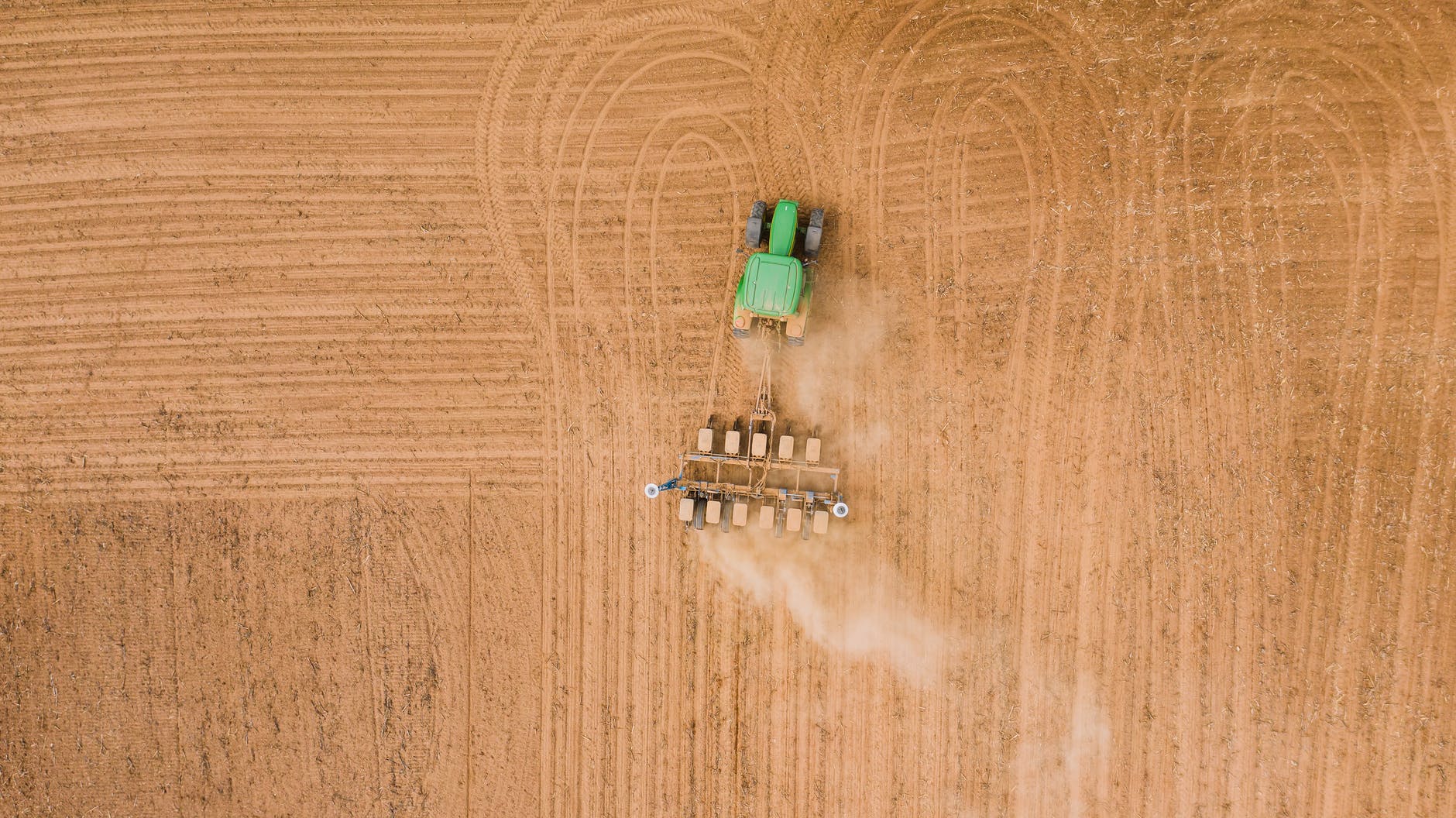
Agriculture is the main cause of deforestation and responsible for almost 80% of deforestation. In developed countries,33% of the deforestation caused by agriculture results from subsistence agriculture, such as local peasant agriculture.About 40% of forest destruction is caused by commercial or industrial agriculture searching space for fruit, fiber or biofuel production like beef, maize, cotton, soybeans, palm oil, and sugar cane. It is also interesting to note that about 14% of global deforestation is assumed to be caused by livestock. The key reasons they have to do with broad areas include raising livestock and growing their food.
FOREST FIRES :

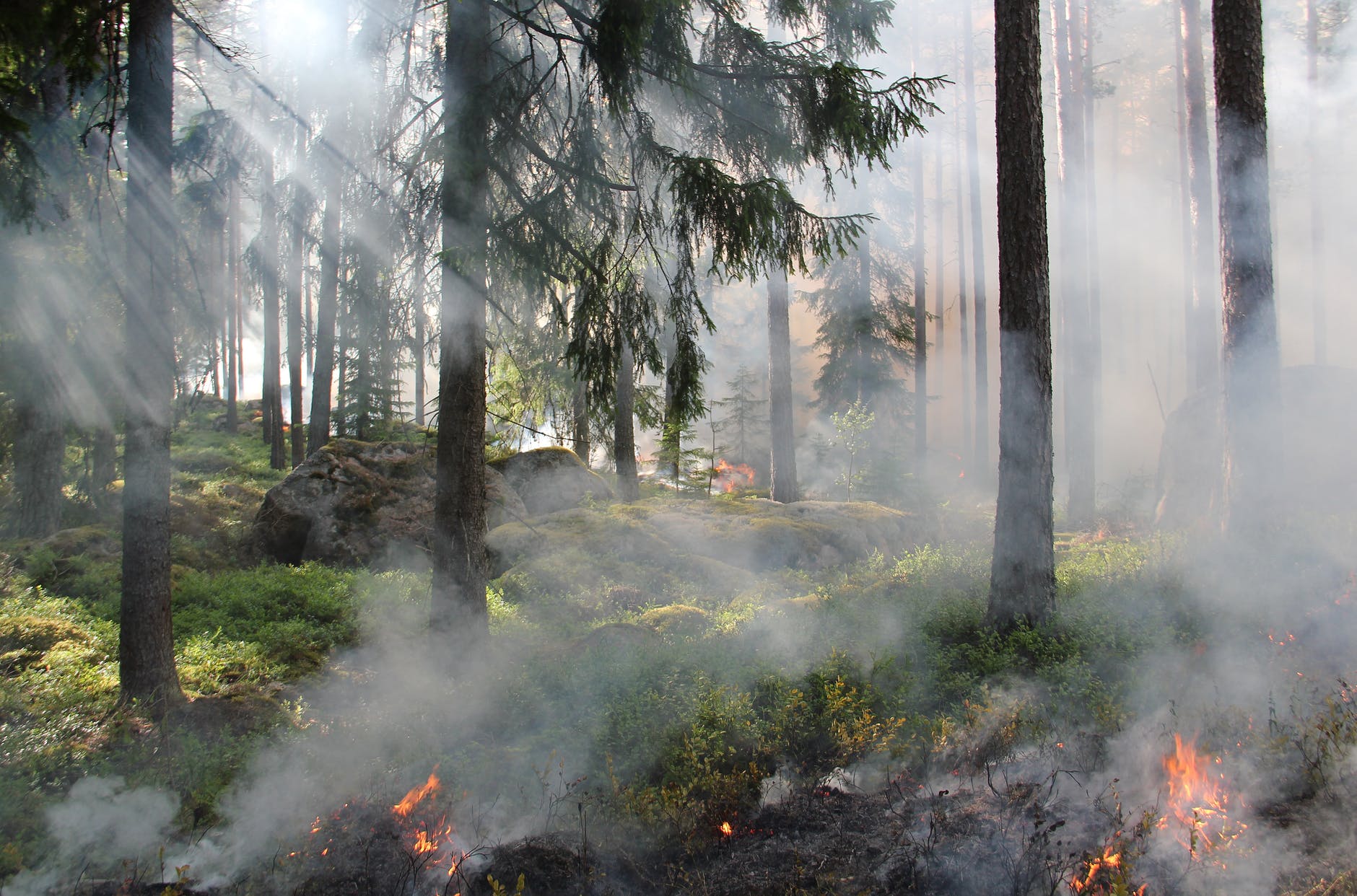
Fires burn million of hectares of forest worldwide each year. Fires are a part of nature, but forests that are degraded are mostly vulnerable. These involve heavily logged rainforests, peat forests, or forest fires that have been suppressed for years, causing unnatural vegetation that makes the fire burn more intensely.
MINING :

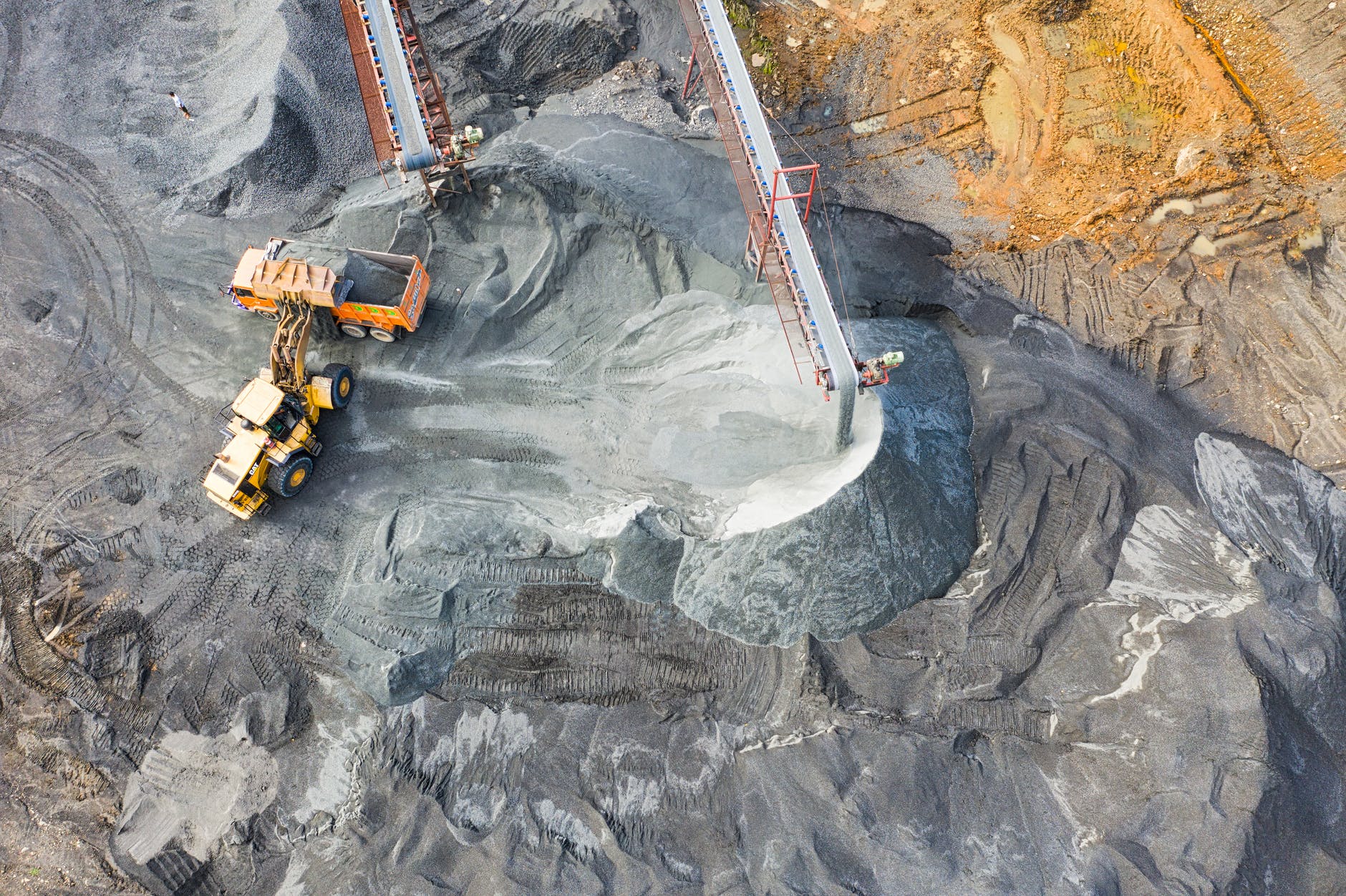
Due to rising demand and high mineral prices, the effect of mining on tropical forests is increasing. Significant building, such as bridges, railway lines and power stations, also follows mining projects, placing more strain on forests and freshwater habitats.
CLIMATE CHANGES:

The destruction of forests is both a cause and a consequence of climate change. For example, by drying out tropical rain forests and growing fire damage in boreal forests, climate change will damage forests. Climate change is already affecting biodiversity in the forest, a danger which is likely to rise.

EFFECTS OF DEFORESTATION :

It has many effects on natural resources and ecosystems and creates serious problems for the adaptability of the planet. Some of the main effects of deforestation are as follows:

SOIL EROSIN :

Trees are also important to our local water cycles, as they keep returning water vapor to the atmosphere. The soil stays moist as the rainwater flows through the soil. The fertile soil of several layers of trees is kept in place by complex root systems. The land is directly exposed to the sun with the clearing of tree cover, making it dry. Without trees, erosion also happens, sweeps the land into surrounding rivers and streams. Forests function as natural water purification plants. Soil erosion causes soil to be exposed to pollutants that spill into the water system, which damages our drinking water quality.

ACID RAINS :

The oceans become more acidic by increasing carbon dioxide levels in the atmosphere due to deforestation and the burning of fossil fuels. Beaches are now 30% more acidic after the Industrial Revolution, that have ocean organisms and their habitats at extreme risk.Acid rains damage forests,especially those at higher elevations.The acid properties rub the soil of essential minerals such as calcium and cause aluminium to be released in the soil,which makes it hard for trees to take up water.

INCREASE IN GLOBAL WARMING :

Trees perform an important role in controlling global warming. The trees use greenhouse gases to maintain the balance of the environment. With the continuous deforestation, the ratio of greenhouse gases has increased in the atmosphere that increases global warming problems.Global Warming the gradual heating of earth’s surface,ocean and atmosphere,is caused by human activity.As the earth’s surface temperature becomes hotter the sealevel becomes higher.It is also partly because warm temperatures makes glaciers and ice caps to melt.

PREVENTIVE MEASURES FOR DEFORESTATION :

REFORESTATION :

For certain purposes, reforestation is a process of planting trees in a forest region where the trees have been cut. To save the world, we all need to realize the value of reforestation and enforce it. Tree planting will reduce the various causes and impacts of deforestation, global warming, pollution, greenhouse effects, etc.Afforestation is a proces where new forests are planted across land without trees.As a forest grows,naturally removes co2 from atmosphere and stores it in its trees.

USE OF RENEWABLE FOREST RESOURCES :

We can grow plants as a source of wood from secondary forest growth. The use of renewable local wood and charcoal resources for cooking or heating is an excellent alternative to fossil fuels.Renewable resources include biomass energy,hydro power,geothermal energy,wind energy and solar energy.Biomass refers to organic material from plants and animals.These resources are capable of Regeneration.These are renewed along with exploitation and hence,availble for use.The regeneration of these sources involves some ecological process on a time scale.

EDUCATIONAL CAMPAIGNS:

Deforestation can be fought via awareness. Educational campaigns can only be a clear example of deforestation awareeness.By educating people on the importance of our environment and sustainable logging practices,deforestation may begin to slow down.Hence,Educational programmes and campaigns are so important-they increase public awareeness,teachers critical thinking and enchances an individual’s problem-solving skills.

THANK YOU !


All you need to know about Eclipses

Ever heard of eclipses? I am sure you must have. Ever seen one? If you have then you are very lucky, and if you have observed a total or annular solar eclipse you are even luckier and I am jealous. The word eclipse is derived from the ancient Greek noun ἔκλειψις (ékleipsis), which means “the abandonment”, “the downfall”, or “the darkening of a heavenly body. 

What is an Eclipse?

For any two objects in space, a line can be extended from the first through the second. The latter object will block some amount of light being emitted by the former, creating a region of shadow around the axis of the line. Typically these objects are moving with respect to each other and their surroundings, so the resulting shadow will sweep through a region of space, only passing through any particular location in the region for a fixed interval of time. As viewed from such a location, this shadowing event is known as an eclipse.

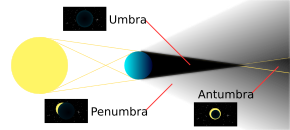
Typically the cross-section of the objects involved in an astronomical eclipse are roughly disk shaped. The region of an object’s shadow during an eclipse is divided into three parts:

  • The umbra, within which the object completely covers the light source. For the Sun, this light source is the photosphere.
  • The antumbra, extending beyond the tip of the umbra, within which the object is completely in front of the light source but too small to completely cover it.
  • The penumbra, within which the object is only partially in front of the light source.

Eclipses on Earth

On earth lunar eclipses and solar eclipses are the major form of eclipses which occur here on Earth.

Lunar eclipse:

Image result for Total Lunar Eclipse Diagram

The Moon moves in an orbit around Earth. At the same time, Earth orbits the Sun. Sometimes Earth moves between the Sun and the Moon. When this happens, Earth blocks the sunlight that normally is reflected by the Moon. Instead of light hitting the Moon’s surface, Earth’s shadow falls on the Moon. This is an eclipse of the Moon, or a lunar eclipse. A lunar eclipse can occur only when the Moon is full. A lunar eclipse usually lasts for a few hours. At least two partial lunar eclipses happen every year, but total lunar eclipses are rare. It is safe to look at a lunar eclipse. A lunar eclipse can be seen from Earth at night. 

There are two types of lunar eclipses:

  1. Total lunar eclipse- A total lunar eclipse occurs when the Moon and the Sun are on exact opposite sides of Earth. Although the Moon is in Earth’s shadow, some sunlight reaches the Moon. The sunlight passes through Earth’s atmosphere, which filters out most of the blue light. This makes the Moon appear red to people on Earth.
  2. Partial lunar eclipse-A partial lunar eclipse happens when part of the Moon enters Earth’s shadow. In a partial eclipse, Earth’s shadow appears very dark on the side of the Moon facing Earth. What people see from Earth during a partial lunar eclipse depends on how the Sun, Earth and Moon align.

Solar Eclipse:

Image result for Total solar Eclipse Diagram

Sometimes when the Moon orbits Earth, the Moon moves between the Sun and Earth. When this happens, the Moon blocks the light of the Sun from reaching Earth. This causes an eclipse of the Sun, or a solar eclipse. During a solar eclipse, the Moon casts a shadow onto Earth. Solar eclipses happen every 18 months somewhere on Earth. Unlike lunar eclipses, solar eclipses last only a few minutes.

There are three main types of solar eclipses:

  1. Total solar eclipse: A total solar eclipse is visible from a small area on Earth. The people who see the total eclipse are in the center of the Moon’s shadow when it hits Earth. The sky becomes very dark, as if it were night. For a total eclipse to occur, the Sun, Moon and Earth must be in a direct line.
  2. Partial solar eclipse: This happens when the Sun, Moon and Earth are not exactly aligned. The Sun appears to have a dark shadow on a small part of its surface.
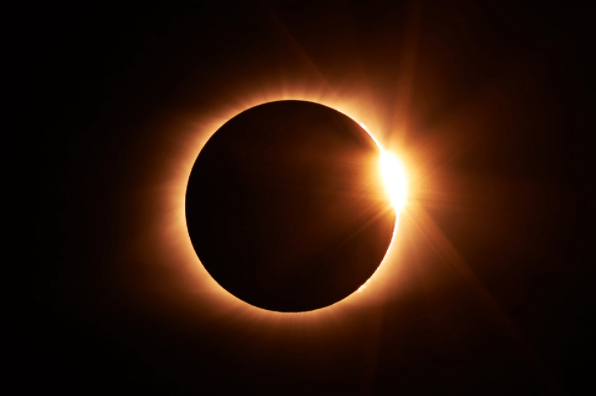
  3. Annular solar eclipse: An annular eclipse happens when the Moon is farthest from Earth. Because the Moon is farther away, it seems smaller. It does not block the entire view of the Sun. The Moon in front of the Sun looks like a dark disk on top of a larger Sun-colored disk. This creates what looks like a ring around the Moon.

Eclipses on other planets

The gas giant planets have many moons and thus frequently display eclipses. The most striking involve Jupiter, which has four large moons and a low axial tilt, making eclipses more frequent as these bodies pass through the shadow of the larger planet. Transits occur with equal frequency. It is common to see the larger moons casting circular shadows upon Jupiter’s cloud tops.

On the other three gas giants (Saturn, Uranus and Neptune) eclipses only occur at certain periods during the planet’s orbit, due to their higher inclination between the orbits of the moon and the orbital plane of the planet. The moon Titan, for example, has an orbital plane tilted about 1.6° to Saturn’s equatorial plane. But Saturn has an axial tilt of nearly 27°. The orbital plane of Titan only crosses the line of sight to the Sun at two points along Saturn’s orbit. As the orbital period of Saturn is 29.7 years, an eclipse is only possible about every 15 years.

On Mars, only partial solar eclipses (transits) are possible, because neither of its moons is large enough, at their respective orbital radii, to cover the Sun’s disc as seen from the surface of the planet. Eclipses of the moons by Mars are not only possible, but commonplace, with hundreds occurring each Earth year. There are also rare occasions when Deimos is eclipsed by Phobos. Martian eclipses have been photographed from both the surface of Mars and from orbit.

Pluto, with its proportionately largest moon Charon, is also the site of many eclipses. A series of such mutual eclipses occurred between 1985 and 1990. These daily events led to the first accurate measurements of the physical parameters of both objects.

Eclipses in 2021

  • May 26, 2021 — Total Lunar Eclipse
  • Jun 10, 2021 – Annular Solar Eclipse
  • Nov 18–19, 2021 — Partial Lunar Eclipse
  • Dec 4, 2021 – Total Solar Eclipse

Scientists use solar eclipses as an opportunity to study the Sun’s corona. The corona is the Sun’s top layer. During an annular eclipse, NASA uses ground and space instruments to view the corona when the Moon blocks the Sun’s glare.

https://www.nasa.gov/audience/forstudents/5-8/features/nasa-knows/what-is-an-eclipse-58/ http://en.wikipedia.org/wiki/Eclipse

Innovation and its types

Innovation is the discovery of new knowledge. It is neither automatic nor accidental rather it is a product of deep thinking, careful observation, and systematic activity. Scientific inquiry is an unending process and the object of this inquiry is innovation.

Types of innovation:

Product- Innovation in this category refers to the innovation in the quality of the product and both improvements to existing product lines or completely new offerings. The key is to add significant value.

Service- It involves the improvement of the consumer’s experience. It includes innovation in the offerings of the product, making it easier to use, fixing common problems. Here the objective is to make the product stand out.

Process- It is an inward-looking innovation, improving core competencies. It includes significant changes in technology, equipment, or software. For example, Henry Ford’s invention of the assembly line shortened the time necessary to produce a single-vehicle.

Management- It is the process of managing innovative ideas. The planning and process behind coming up with ideas, turning them into action plans, and developing them for the business until they become a reality. Implementation of new management practices, processes, etc that shows a departure from older norms.

Open- It refers to the innovation process to collaborate globally, bring out newer ideas, working beyond boundaries and expand the markets for external use of innovation.

Value-creation- It means to give something valuable for receiving something valuable in return. Value creation involves a process to make the product stand out,to deal with competitions, create demand in the market.

Radical innovation- It involves the birth of new industries and the application of revolutionary technologies. They allow society to take a leap forward. It brings about revolutionary changes in society like the industrial revolution.

Incremental innovation- Majority of innovation are of this type. It includes making improvements in existing products. the aim is to make the product stand out in the market and reduce competition around it. For example, the newer updates in smartphones and various apps add new features and improve their efficiency.

Disrupting Innovation- It involves the creation of newer markets and value networks which eventually disrupts the existing market and value network. It describes a process that initially a product is at the bottom of the market, it is less expensive and more accessible and gradually comes to rule the market. For example, Netflix disrupted the video rental business.

Architectural Innovation- It refers to innovation in the architecture of any product that changes or modifies the way various components of the system relate to each other.

Neptune-The Coldest Planet

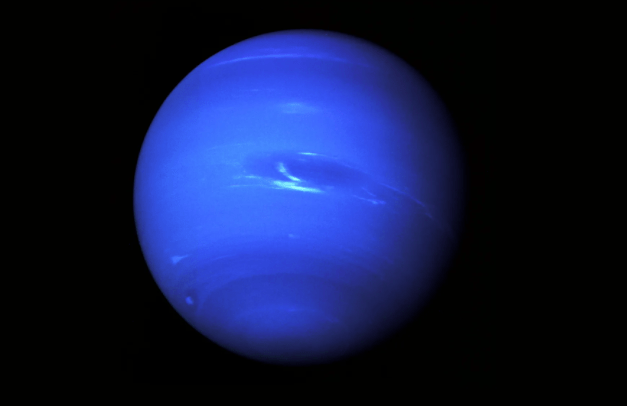
Neptune is the eighth and farthest-known Solar planet from the Sun. In the Solar System, it is the fourth-largest planet by diameter, the third-most-massive planet, and the densest giant planet. It is 17 times the mass of Earth, slightly more massive than its near-twin Uranus. Neptune is denser and physically smaller than Uranus because its greater mass causes more gravitational compression of its atmosphere. It is named after the Roman god of the sea and has the astronomical symbol ♆, a stylised version of the god Neptune’s trident.

Some facts about Neptune

Diameter-  49,500km

Orbital period-  164.8yrs

Length of a Day-   16.1hrs

Axis tilt- 28 degrees

Distance from  the Sun- 30.1AU(4.5 billion km)

Moons- 14

Special features

Neptune is not visible to the unaided eye and is the only planet in the Solar System found by mathematical prediction rather than by empirical observation. Unexpected changes in the orbit of Uranus led Alexis Bouvard to deduce that its orbit was subject to gravitational perturbation by an unknown planet. After Bouvard’s death, the position of Neptune was predicted from his observations, independently, by John Couch Adams and Urbain Le Verrier.

Neptune is our solar system’s windiest world. Despite its great distance and low energy input from the Sun, Neptune’s winds can be three times stronger than Jupiter’s and nine times stronger than Earth’s. These winds whip clouds of frozen methane across the planet at speeds of more than 1,200 miles per hour (2,000 kilometers per hour). Even Earth’s most powerful winds hit only about 250 miles per hour (400 kilometers per hour).

In 1989 a large, oval-shaped storm in Neptune’s southern hemisphere dubbed the “Great Dark Spot” was large enough to contain the entire Earth. That storm has since disappeared, but new ones have appeared on different parts of the planet.

Natural satellites and Rings

Neptune has 14 known moons. Neptune’s largest moon Triton was discovered on October 10, 1846, by William Lassell, just 17 days after Johann Gottfried Galle discovered the planet. Since Neptune was named for the Roman god of the sea, its moons are named for various lesser sea gods and nymphs in Greek mythology.

Triton is the only large moon in the solar system that circles its planet in a direction opposite to the planet’s rotation (a retrograde orbit), which suggests that it may once have been an independent object that Neptune captured. Triton is extremely cold, with surface temperatures around minus 391 degrees Fahrenheit (minus 235 degrees Celsius). And yet, despite this deep freeze at Triton, Voyager 2 discovered geysers spewing icy material upward more than 5 miles (8 kilometers). Triton’s thin atmosphere, also discovered by Voyager, has been detected from Earth several times since, and is growing warmer, but scientists do not yet know why.

  Neptune has at least five main rings and four prominent ring arcs that we know of so far. Starting near the planet and moving outward, the main rings are named Galle, Leverrier, Lassell, Arago and Adams. The rings are thought to be relatively young and short-lived. Neptune’s ring system also has peculiar clumps of dust called arcs. Four prominent arcs named Liberté (Liberty), Egalité (Equality), Fraternité (Fraternity) and Courage are in the outermost ring, Adams. The arcs are strange because the laws of motion would predict that they would spread out evenly rather than stay clumped together. Scientists now think the gravitational effects of Galatea, a moon just inward from the ring, stabilizes these arcs.

See the source image

Structure and Atmosphere

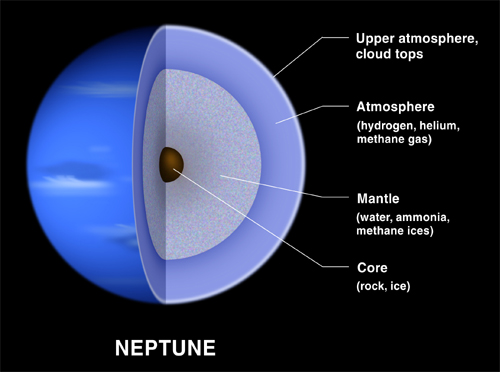
Neptune is one of two ice giants in the outer solar system (the other is Uranus). Most (80 percent or more) of the planet’s mass is made up of a hot dense fluid of “icy” materials—water, methane and ammonia—above a small, rocky core. Scientists think there might be an ocean of super hot water under Neptune’s cold clouds. It does not boil away because incredibly high pressure keeps it locked inside.

Neptune’s atmosphere is made up mostly of hydrogen and helium with just a little bit of methane. Neptune’s neighbor Uranus is a blue-green color due to such atmospheric methane, but Neptune is a more vivid, brighter blue, so there must be an unknown component that causes the more intense color.

Exploration

Voyager 2 is the only spacecraft that has visited Neptune. The spacecraft’s closest approach to the planet occurred on 25 August 1989. Because this was the last major planet the spacecraft could visit, it was decided to make a close flyby of the moon Triton, regardless of the consequences to the trajectory, similarly to what was done for Voyager 1’s encounter with Saturn and its moon Titan. The images relayed back to Earth from Voyager 2 became the basis of a 1989 PBS all-night program, Neptune All Night.

https://en.wikipedia.org/wiki/Neptune
https://solarsystem.nasa.gov/planets/neptune/overview/

Pluto-The King of Kuiper Belt

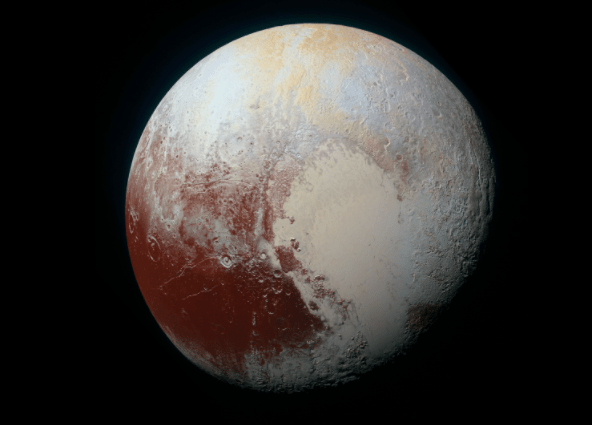
Pluto is the ninth-largest and tenth-most-massive known object directly orbiting the Sun. It is the largest known trans-Neptunian object by volume but is less massive than Eris. Pluto is a dwarf planet in the Kuiper belt, a ring of bodies beyond the orbit of Neptune. It was the first and the largest Kuiper belt object to be discovered. After Pluto was discovered in 1930, it was declared to be the ninth planet from the Sun. Beginning in the 1990s, its status as a planet was questioned following the discovery of several objects of similar size in the Kuiper belt and the scattered disc, including the dwarf planet Eris. This led the International Astronomical Union (IAU) in 2006 to formally define the term “planet”—excluding Pluto and reclassifying it as a dwarf planet.

Some facts about Pluto

Diameter-   2300km

Orbital period-  247.8 yrs

Length of a Day-    6.39 days

Axis tilt- 123 degrees

Distance from  the Sun- 39.5AU (5.9billion km)

Moons- 5

Special features

Like other Kuiper belt objects, Pluto is primarily made of ice and rock and is relatively small—one-sixth the mass of the Moon and one-third its volume. It has a moderately eccentric and inclined orbit during which it ranges from 30 to 49 astronomical units or AU (4.4–7.4 billion km) from the Sun. This means that Pluto periodically comes closer to the Sun than Neptune, but a stable orbital resonance with Neptune prevents them from colliding. Light from the Sun takes 5.5 hours to reach Pluto at its average distance (39.5 AU).

Natural satellites

Pluto has five known moons: Charon, Nix, Hydra, Kerberos and Styx. This moon system might have formed by a collision between Pluto and other similar-sized bodies early in the history of the solar system.

Charon, the biggest of Pluto’s moons, is about half the size of Pluto itself, making it the largest satellite relative to the planet it orbits in our solar system. It orbits Pluto at a distance of just 12,200 miles (19,640 kilometers). For comparison, our moon is 20 times farther away from Earth. Pluto and Charon are often referred to as a double planet. Charon’s orbit around Pluto takes 153 hours—the same time it takes Pluto to complete one rotation. This means Charon neither rises nor sets, but hovers over the same spot on Pluto’s surface. The same side of Charon always faces Pluto, a state called tidal locking.

Pluto’s other four moons are much smaller, less than 100 miles (160 kilometers) wide. They’re also irregularly shaped, not spherical like Charon. Unlike many other moons in the solar system, these moons are not tidally locked to Pluto. They all spin and don’t keep the same face towards Pluto.

See the source image

Structure and Atmosphere

Pluto is about two-thirds the diameter of Earth’s moon and probably has a rocky core surrounded by a mantle of water ice. Interesting ices like methane and nitrogen frost coat its surface. Due to its lower density, Pluto’s mass is about one-sixth that of Earth’s moon. Pluto’s surface is characterized by mountains, valleys, plains, and craters. The temperature on Pluto can be as cold as -375 to -400 degrees Fahrenheit (-226 to -240 degrees Celsius).

Pluto has a thin, tenuous atmosphere that expands when it comes closer to the sun and collapses as it moves farther away—similar to a comet. The main constituent is molecular nitrogen, though molecules of methane and carbon monoxide have also been detected. 

When Pluto is close to the sun, its surface ices sublimate (changing directly from solid to gas) and rise to temporarily form a thin atmosphere. Pluto’s low gravity (about six percent of Earth’s) causes the atmosphere to be much more extended in altitude than our planet’s atmosphere. Pluto becomes much colder during the part of each year when it is traveling far away from the sun. During this time, the bulk of the planet’s atmosphere may freeze and fall as snow to the surface.

Exploration

The New Horizons spacecraft, which flew by Pluto in July 2015, is the first and so far only attempt to explore Pluto directly. Launched in 2006, it captured its first (distant) images of Pluto in late September 2006 during a test of the Long Range Reconnaissance Imager. The images, taken from a distance of approximately 4.2 billion kilometers, confirmed the spacecraft’s ability to track distant targets, critical for maneuvering toward Pluto and other Kuiper belt objects.

https://www.nasa.gov/audience/forstudents/k-4/stories/nasa-knows/what-is-pluto-k4.html
https://en.wikipedia.org/wiki/Pluto

SCIENCE AND TECHNOLOGY

The Google  every knows about  Google, it  gives us access to almost all information by typing what you want to know into the search bar. There are some interesting secrets you can have enjoy.

Then why are u waitimg just go with my steps ,

Go with,you have  type the phrase “Do a barrel roll”  into the search bar of Google and press enter, the entire page spin around once.

Second is a fun trick if you like Chuck Norris jokes. If you type in ‘Find Chuck Norris’ and click ‘I’m feeling lucky’, you will get a little message from Google about being careful what you search for.

Next, and this is one of my favourites, try typing ‘Google Gravity’ into the search bar on Google and pressing search. It will cause the entire page to fall into pieces. Although sometimes this doesn’t work, if you search it and click the first result on the page, it will take you back to the homepage which will then fall. The best part is that you can still search for things even after it has taken effect. It will, however, cause all of the results to fall from the sky and crash down on top of the already fallen homepage.

Finally, my favourite. Type ‘Zerg Rush’ into the search bar and hit enter. This will cause many ‘o’s to appear from all directions! But beware, they are not your friends. You must hover over each of the ‘o’s with your cursor and click like crazy. Soon they will vanish. Attempt this at your own peril, you have been warned.

So there you have it, a few cool things to do with Google when you’re bored. Of course, there are far more tricks to do with Google, but you can always find them by, you know, googling it. A little extra for reading this far: if you leave the search bar blank and click ‘I’m Feeling Lucky’, you’ll be shown all of the Google doodles that have ever been used on special dates.

Here are way more tricks you can do on google.

Do a Barrel Roll. Search for “do a barrel roll” without the quotes, and hold onto your desk for dear life. …

“As I rained blows upon him, I realized there had to be another way!” It’s a Festivus MIIIRACLE! …

Zerg Rush. …

Blink HTML. …

Party Like It’s 1998. …

Recently Discovered Letter Written by Albert Einstein Discusses Link Between Physics and Biology – Seven Decades Before Evidence Emerges

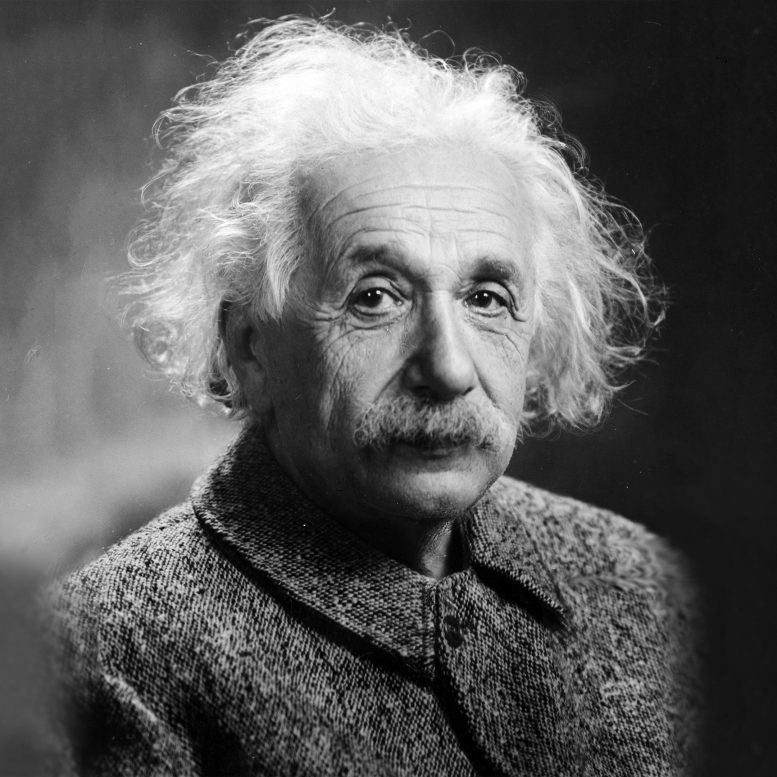
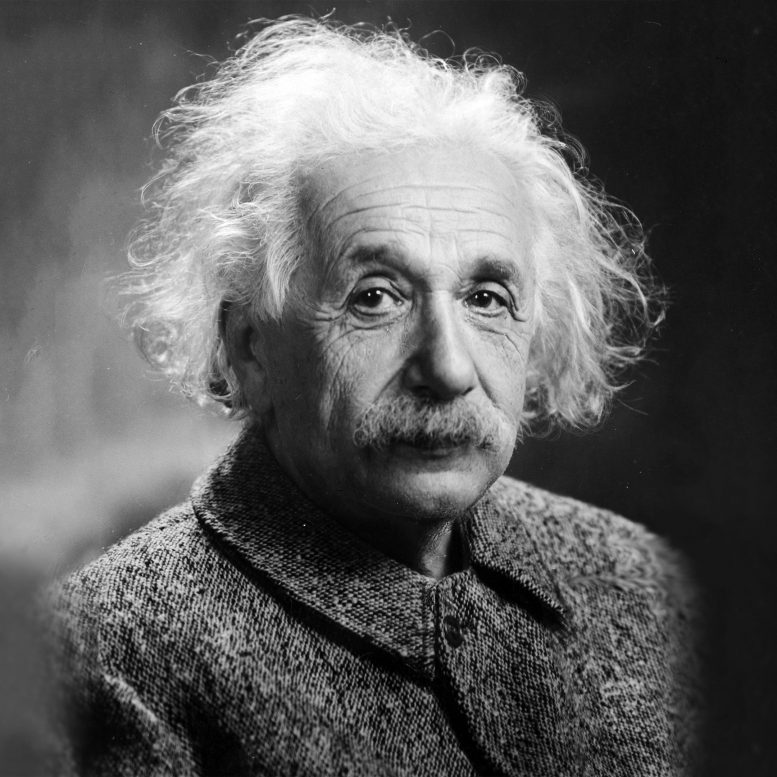
Albert Einstein Portrait

Previously Unknown Letter Reveals Einstein’s Thinking on Bees, Birds and Physics

The 1949 letter by the physicist and Nobel laureate discusses bees, birds, and whether new physics principles could come from studying animal senses.

It’s a position still being realized within physics to this day, with a growing body of research and understanding of how animals such as birds and bees find their way around.

Now a study led by RMIT University in Melbourne, Australia, discusses how recent discoveries in migratory birds back up Einstein’s thinking 72 years ago.

The previously unpublished letter was shared with researchers by Judith Davys — Einstein had addressed it to her late husband, radar researcher Glyn Davys.

RMIT’s Associate Professor Adrian Dyer has published significant studies into bees and is the lead author of the new paper on Einstein’s letter, published in the Journal of Comparative Physiology A.

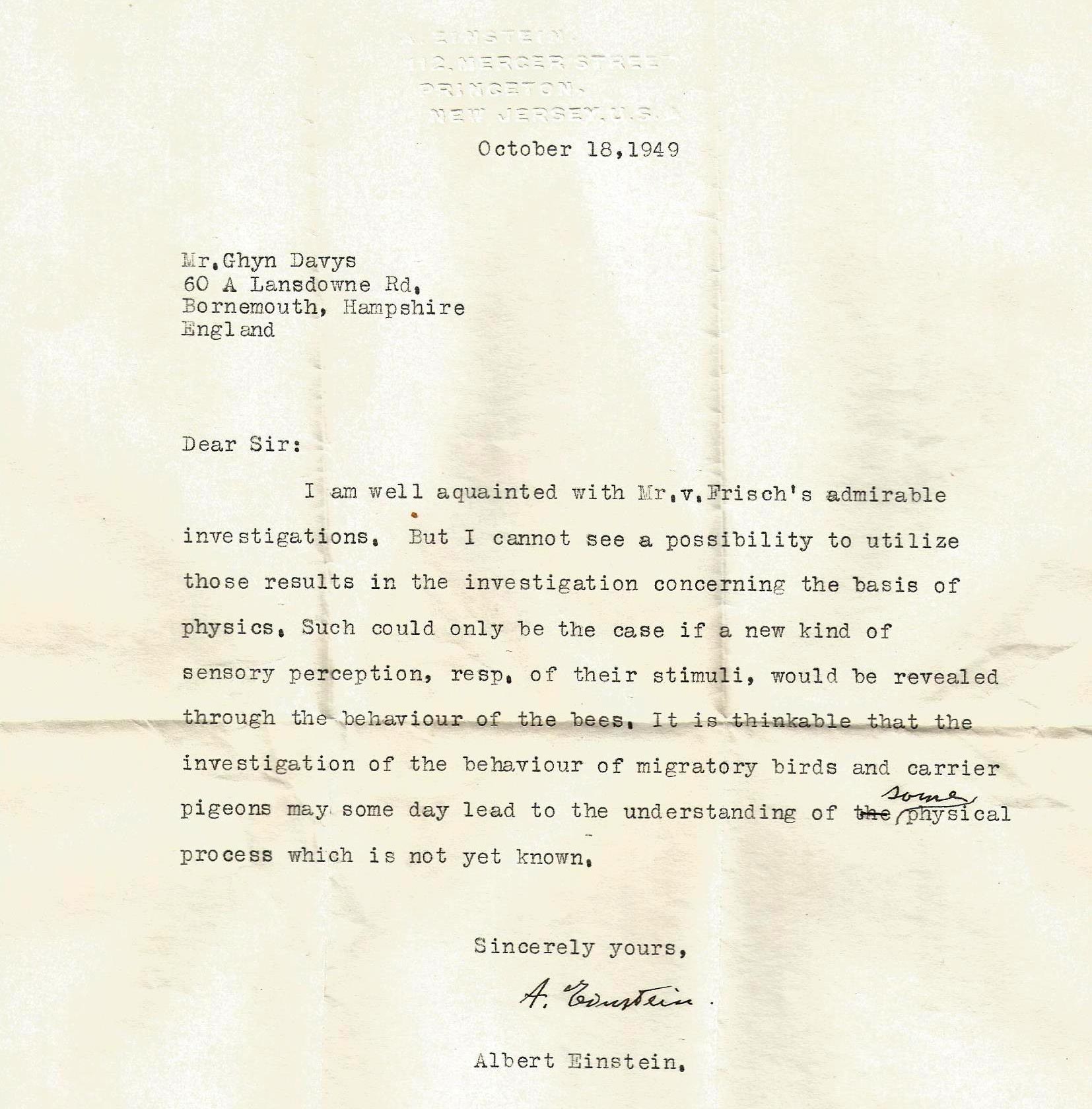
Letter by Albert Einstein, validated by The Hebrew University of Jerusalem, where Einstein bequeathed his notes, letters and records. Credit: Dyer et al. 2021, J Comp Physiol A / The Hebrew University of Jerusalem

Dyer said the letter shows how Einstein envisaged new discoveries could come from studying animals.

“Seven decades after Einstein proposed new physics might come from animal sensory perception, we’re seeing discoveries that push our understanding about navigation and the fundamental principles of physics,” he said.

The letter also proves Einstein met with Nobel laureate Karl von Frisch, who was a leading bee and animal sensory researcher.

In April 1949, von Frisch presented his research on how honeybees navigate more effectively using the polarization patterns of light scattered from the sky.

The day after Einstein attended von Frisch’s lecture, the two researchers shared a private meeting.

Although this meeting wasn’t formally documented, the recently discovered letter from Einstein provides insight into what they might have talked about.

“It is thinkable that the investigation of the behavior of migratory birds and carrier pigeons may someday lead to the understanding of some physical process which is not yet known,” Einstein wrote.

Professor Andrew Greentree, a theoretical physicist at RMIT, said Einstein also suggested that for bees to extend our knowledge of physics, new types of behavior would need to be observed.

“Remarkably, it is clear through his writing that Einstein envisaged new discoveries could come from studying animals’ behaviors,” Greentree said.

More than 70 years since Einstein sent his letter, research is revealing the secrets of how migratory birds navigate while flying thousands of kilometers to arrive at a precise destination.

In 2008, research on thrushes fitted with radio transmitters showed, for the first time, that these birds use a form of magnetic compass as their primary orientation guide during flight.

One theory for the origin of magnetic sense in birds is the use of quantum randomness and entanglement. Both of these physics concepts were first proposed by Einstein.

Reference: “Einstein, von Frisch and the honeybee: a historical letter comes to light” by Adrian G. Dyer, Andrew D. Greentree, Jair E. Garcia, Elinya L. Dyer, Scarlett R. Howard and Friedrich G. Barth, 10 May 2021, Journal of Comparative Physiology A.
DOI: 10.1007/s00359-021-01490-6

The letter to Glyn Davys shows the openness of Einstein’s mind to novel possibilities observed in nature and the evidence that he took an interest in von Frish and his bee research.

Electric Mushrooms- Torches for the locals’

When was the last time you came across wild mushrooms? Oh wait! Scratch that. Have you ever heard of glowing mushrooms? Yes, you read absolutely right. Don’t worry, in this article you’ll get to know everything about this miraculous mushroom.

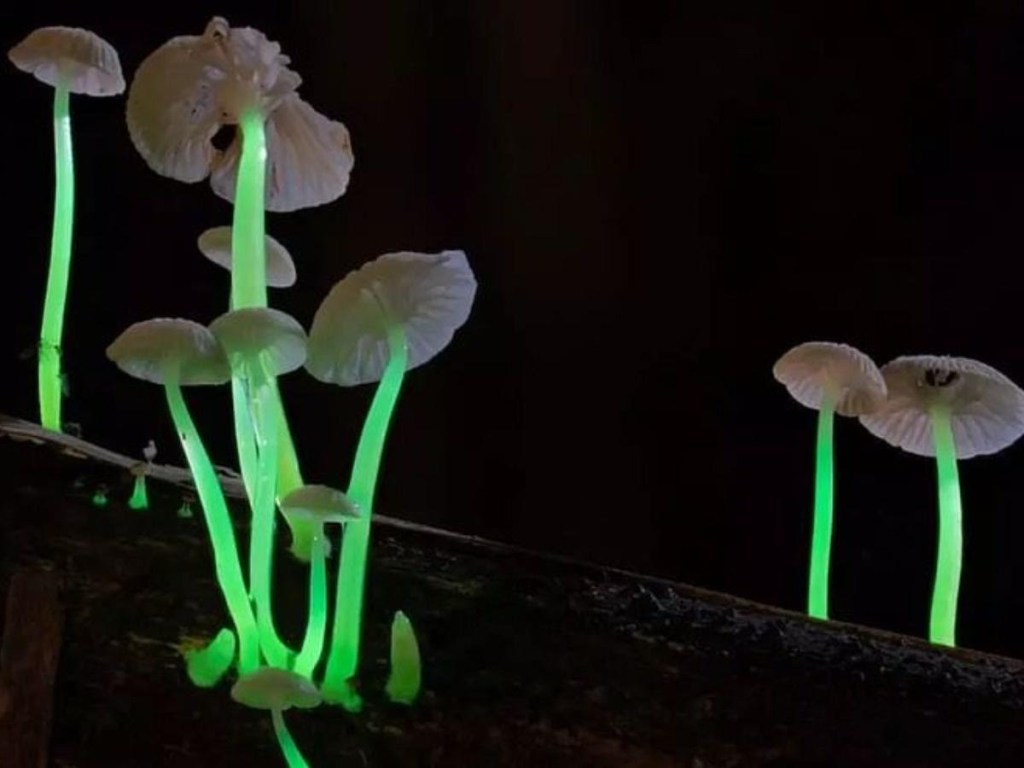
It sounds like a psychedelic riddle, but believe me when I say that bioluminescent mushrooms are a reality.

There are about 120,000 known species of fungi, and amongst them only around 100 are known to be bioluminescent or in simple words, capable of emitting light. Before we dive in deeper let us first take a look at the story behind these fascinating and mind-blowing exotic species.

The story behind the discovery

Scientists were amazed on the discovery of the glowing mushrooms, used by locals as natural torches. During the monsoon season, a team of scientists from India and China embarked on a fungal foray in Assam. After hearing reports from the locals about the ‘electric mushrooms’, out of curiosity they headed to West Jaintia Hills District in Meghalaya. 

It was drizzling that night and the team was guided by a local to the bamboo forest. Then the local asked them to switch off their torches.

The team was bedazzled by what they saw: amidst the darkness an eerie green glow emerged from a dead bamboo sticks that were covered with mushrooms.

The new species

The new species- named Roridomyces phyllostachydis- was first sighted near a stream in Meghalaya’s Mawlynnong in East Khasi Hills District. This mushroom was found only on the dead bamboo plants.

What does bioluminescent fungi means?

Bioluminescence is a property exhibited by living creatures to produce and emit light. The colour of the light emitted by the organism depends on their chemical properties.

In fungi, the luminescence comes from the enzyme, luciferase. The green light is emitted from the fungi when luciferans is catalysed by the enzyme luciferase, in the presence of oxygen. Luciferans give fireflies and the bioluminescent underwater creatures their characteristic glow as well. The mushrooms glow 24 hours and are not reactive.

Other bioluminescent mushrooms in India

Numerous glowing fungi have been reported in other parts of India as well. Two have been reported from the Western Ghats, one from the Eastern Ghats, and one in the state of Kerala, among others. Some have been spotted in Maharashtra and Goa as well, but they were not scientifically reported.

Read more about glowing mushrooms at:https://www.india.com/viral/mysterious-new-mushrooms-species-that-glow-bright-green-found-in-meghalaya-forests-heres-why-4218923/

“Animals, plants, fungi and bacteria show bioluminescence. Bioluminescent organisms are usually found in the ocean environments, but they are also found on terrestrial environments. The colour of the light emitted by the organism depends on their chemical properties,” Samantha Karunarathna, mycologist from the Kunming Institute of Botany, Chinese Academy of Sciences, who was part of the team that discovered the mushroom, told East Mojo.

Bioluminescence- https://www.nationalgeographic.org/encyclopedia/bioluminescence/#:~:text=Encyclopedic%20Entry%20Vocabulary-,Bioluminescence%20is%20light%20produced%20by%20a%20chemical%20reaction%20within%20a,reaction%20where%20light%20is%20produced.

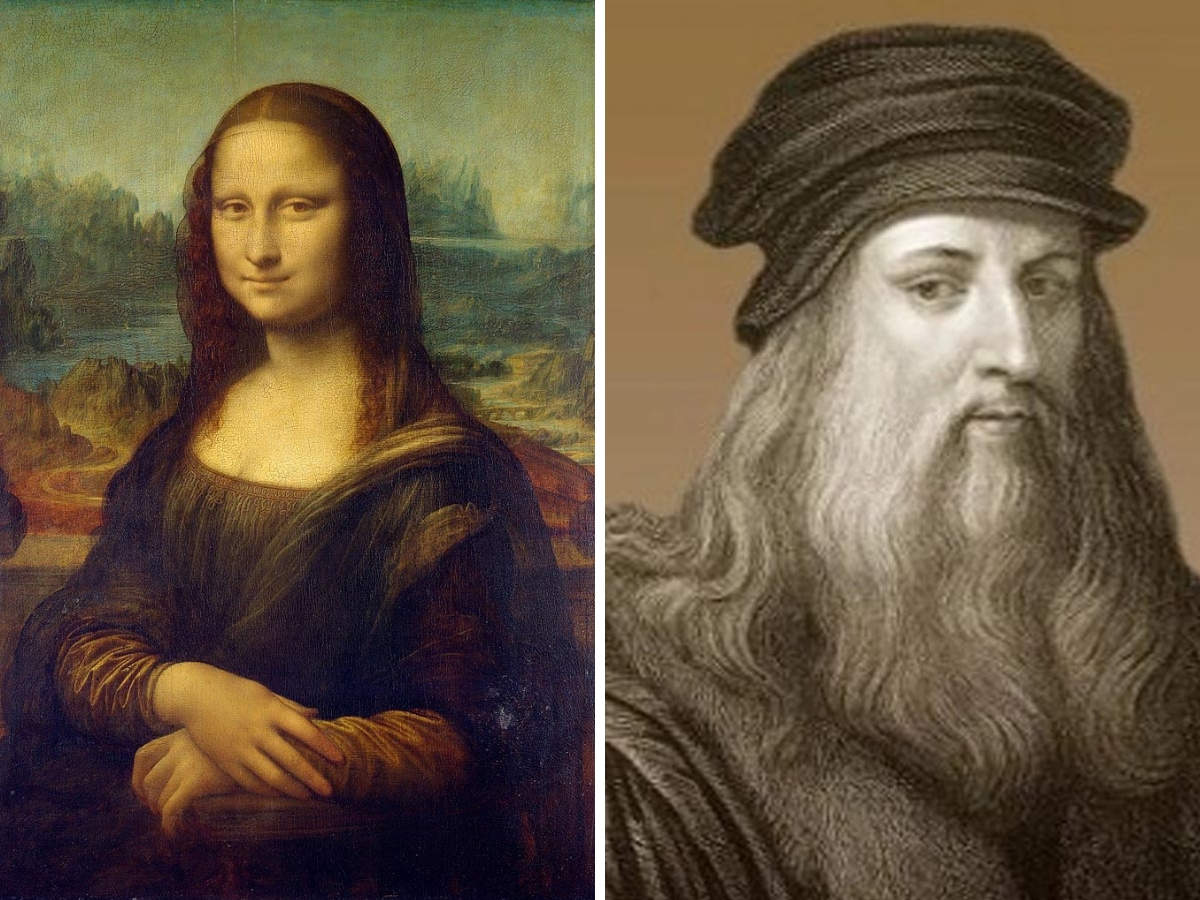
Leonardo da Vinci -The Man Behind Mona Lisa

Leonardo da Vinci: Leonardo Da Vinci may have had a condition that  prevented him from finishing Mona Lisa - The Economic Times

Leonardo da Vinci (1452-1519) was a painter, architect, inventor, and student of all things scientific. His natural genius crossed so many disciplines that he epitomized the term “Renaissance man.” Today he remains best known for his art, including two paintings that remain among the world’s most famous and admired, Mona Lisa and The Last Supper. Art, da Vinci believed, was indisputably connected with science and nature. Largely self-educated, he filled dozens of secret notebooks with inventions, observations and theories about pursuits from aeronautics to anatomy. But the rest of the world was just beginning to share knowledge in books made with moveable type, and the concepts expressed in his notebooks were often difficult to interpret. As a result, though he was lauded in his time as a great artist, his contemporaries often did not fully appreciate his genius—the combination of intellect and imagination that allowed him to create, at least on paper, such inventions as the bicycle, the helicopter and an airplane based on the physiology and flying capability of a bat.

Leonardo da Vinci: Early Life and Training

Leonardo da Vinci (1452-1519) was born in Anchiano, Tuscany (now Italy), close to the town of Vinci that provided the surname we associate with him today. In his own time he was known just as Leonardo or as “Il Florentine,” since he lived near Florence—and was famed as an artist, inventor and thinker.

Did you know? Leonardo da Vinci’s father, an attorney and notary, and his peasant mother were never married to one another, and Leonardo was the only child they had together. With other partners, they had a total of 17 other children, da Vinci’s half-siblings.

Da Vinci’s parents weren’t married, and his mother, Caterina, a peasant, wed another man while da Vinci was very young and began a new family. Beginning around age 5, he lived on the estate in Vinci that belonged to the family of his father, Ser Peiro, an attorney and notary. Da Vinci’s uncle, who had a particular appreciation for nature that da Vinci grew to share, also helped raise him.

Leonardo da Vinci: Early Career

Da Vinci received no formal education beyond basic reading, writing and math, but his father appreciated his artistic talent and apprenticed him at around age 15 to the noted sculptor and painter Andrea del Verrocchio, of Florence. For about a decade, da Vinci refined his painting and sculpting techniques and trained in mechanical arts. When he was 20, in 1472, the painters’ guild of Florence offered da Vinci membership, but he remained with Verrocchio until he became an independent master in 1478. Around 1482, he began to paint his first commissioned work, The Adoration of the Magi, for Florence’s San Donato, a Scopeto monastery.

However, da Vinci never completed that piece, because shortly thereafter he relocated to Milan to work for the ruling Sforza clan, serving as an engineer, painter, architect, designer of court festivals and, most notably, a sculptor. The family asked da Vinci to create a magnificent 16-foot-tall equestrian statue, in bronze, to honor dynasty founder Francesco Sforza. Da Vinci worked on the project on and off for 12 years, and in 1493 a clay model was ready to display. Imminent war, however, meant repurposing the bronze earmarked for the sculpture into cannons, and the clay model was destroyed in the conflict after the ruling Sforza duke fell from power in 1499.

Leonardo da Vinci: ‘The Last Supper’ and ‘Mona Lisa’

Although relatively few of da Vinci’s paintings and sculptures survive—in part because his total output was quite small—two of his extant works are among the world’s most well-known and admired paintings.

The first is da Vinci’s “The Last Supper,” painted during his time in Milan, from about 1495 to 1498. A tempera and oil mural on plaster, “The Last Supper” was created for the refectory of the city’s Monastery of Santa Maria delle Grazie. Also known as “The Cenacle,” this work measures about 15 by 29 feet and is the artist’s only surviving fresco. It depicts the Passover dinner during which Jesus Christ addresses the Apostles and says, “One of you shall betray me.” One of the painting’s stellar features is each Apostle’s distinct emotive expression and body language. Its composition, in which Jesus is centered among yet isolated from the Apostles, has influenced generations of painters.

When Milan was invaded by the French in 1499 and the Sforza family fled, da Vinci escaped as well, possibly first to Venice and then to Florence. There, he painted a series of portraits that included “La Gioconda,” a 21-by-31-inch work that’s best known today as “Mona Lisa.” Painted between approximately 1503 and 1506, the woman depicted—especially because of her mysterious slight smile—has been the subject of speculation for centuries. In the past she was often thought to be Mona Lisa Gherardini, a courtesan, but current scholarship indicates that she was Lisa del Giocondo, wife of Florentine merchant Francisco del Giocondo. Today, the portrait—the only da Vinci portrait from this period that survives—is housed at the Louvre Museum in Paris, France, where it attracts millions of visitors each year.

Around 1506, da Vinci returned to Milan, along with a group of his students and disciples, including young aristocrat Francesco Melzi, who would be Leonardo’s closest companion until the artist’s death. Ironically, the victor over the Duke Ludovico Sforza, Gian Giacomo Trivulzio, commissioned da Vinci to sculpt his grand equestrian-statue tomb. It, too, was never completed (this time because Trivulzio scaled back his plan). Da Vinci spent seven years in Milan, followed by three more in Rome after Milan once again became inhospitable because of political strife.

Leonardo da Vinci: Philosophy of Interconnectedness

Da Vinci’s interests ranged far beyond fine art. He studied nature, mechanics, anatomy, physics, architecture, weaponry and more, often creating accurate, workable designs for machines like the bicycle, helicopter, submarine and military tank that would not come to fruition for centuries. He was, wrote Sigmund Freud, “like a man who awoke too early in the darkness, while the others were all still asleep.”

Several themes could be said to unite da Vinci’s eclectic interests. Most notably, he believed that sight was mankind’s most important sense and that “saper vedere”(“knowing how to see”) was crucial to living all aspects of life fully. He saw science and art as complementary rather than distinct disciplines, and thought that ideas formulated in one realm could—and should—inform the other.

Probably because of his abundance of diverse interests, da Vinci failed to complete a significant number of his paintings and projects. He spent a great deal of time immersing himself in nature, testing scientific laws, dissecting bodies (human and animal) and thinking and writing about his observations. At some point in the early 1490s, da Vinci began filling notebooks related to four broad themes—painting, architecture, mechanics and human anatomy—creating thousands of pages of neatly drawn illustrations and densely penned commentary, some of which (thanks to left-handed “mirror script”) was indecipherable to others.

The notebooks—often referred to as da Vinci’s manuscripts and “codices”—are housed today in museum collections after having been scattered after his death. The Codex Atlanticus, for instance, includes a plan for a 65-foot mechanical bat, essentially a flying machine based on the physiology of the bat and on the principles of aeronautics and physics. Other notebooks contained da Vinci’s anatomical studies of the human skeleton, muscles, brain, and digestive and reproductive systems, which brought new understanding of the human body to a wider audience. However, because they weren’t published in the 1500s, da Vinci’s notebooks had little influence on scientific advancement in the Renaissance period.

Leonardo da Vinci: Later Years

Da Vinci left Italy for good in 1516, when French ruler Francis I generously offered him the title of “Premier Painter and Engineer and Architect to the King,” which afforded him the opportunity to paint and draw at his leisure while living in a country manor house, the Château of Cloux, near Amboise in France. Although accompanied by Melzi, to whom he would leave his estate, the bitter tone in drafts of some of his correspondence from this period indicate that da Vinci’s final years may not have been very happy ones. (Melzi would go on to marry and have a son, whose heirs, upon his death, sold da Vinci’s estate.)

Da Vinci died at Cloux (now Clos-Lucé) in 1519 at age 67. He was buried nearby in the palace church of Saint-Florentin. The French Revolution nearly obliterated the church, and its remains were completely demolished in the early 1800s, making it impossible to identify da Vinci’s exact gravesite.

Can we ever be able to travel with speed of light?

From more than a century humankind is asking about could we ever be able to travel with speed of light, Is travel with speed of light is possible?. As space enthusiasts, could space ships shown in movies star trek and star wars be possible, can we make warp drives?

Let us first discuss about speed of light. It is a cosmic speed limit. Speed of light is fastest speed of which any two poles in space can communicate with each other. It is a speed at which light travels. In one second a beam of light can make 8 rotations. The standard speed of light if we convert to km/hr than speed of light is 1,079,252,848.8 km/hr(1.07 billion km/hr). Or we can say 299,792,458 meter/sec. So again question arises can this speed be achievable. If we can make to travel with speed of light then to reach to our nearest star Proxima Centauri it will take 4.2 earth years. So if we travel 5 times speed of light then to reach proxima centauri it will take nearly 1 year.

In 1994 a Mexican physicist Miguel Alcubierre published a theory, in which he showed how a warp drive is possible with Albert Einstein’s Theory of General Relativity. He said that in order to make a warp drive it will require a huge amount of negative energy. Negative energy equivalent t mass of Jupiter.

Alcubierre said that if the lift hand side of Einstein’s equation is for curvature of space-time, right hand side is newton’s gravitational constant with T is stress energy factor, then there requires a negative energy in right side to bend fabric of space-time. Alcubierre determined that the ship needed to stay inside a flat space-time bubble, which is such that it can move with any arbitrary speed.

But, Alcubierre’s theory is as real as fiction. As we know that negative energy is not possible and does not exists. Anti matter exists and is different from negative energy. Anti matter is a regular matter with opposite charge but with it has positive mass.

In 2021 paper by physicist Erik Lentz of Gottingen University showed that space time warp bubble solution is possible by positive energies and theoretically move at any arbitrary speed.

Again we have question that is warp drives be possible? The answer is Yes.

In recent papers published by Advanced propulsion laboratory at Applied Physics authors Alexey Bobrick and Gianni Martire showed that how warp drives are possible without negative energy. They showed that we can travel with some fraction of speed of light, but to travel faster than speed of light you would need a superluminal matter. In other words, you would need a matter that travels faster than speed of light. Accelerating anything with mass to speed of light requires an infinite amount of energy. This would be true for any warp engine design, but is impossible.

Gianni and Bobrick showed that there are four types of warp drives, of which Alcubierre showed class 3 type. They showed that Class 1 type of warp drive is physically possible with positive energy and real matter and they don’t travel with speed of light. These classification is based on speed inside the bubble(Vin) and speed outside the bubble(Vout).

These can be achieved by time dilation. Gianni and Bobrick proposed two ways of time dilation, either you go really fast with 90% of speed of light or you put yourself into a strong gravitational field. The stronger the gravitational speed the slower the time passes for passengers. If we make a ship of super dense material, perhaps close to mass of a neutron star then gravitational field will be strong enough for time dilation. They designed a shape, if the ship has diameter of 620 meter with mass of 10% as of sun then time for the passengers inside the ship will be 1/10. The passengers will travel to Proxima Centauri in 9 Earth years but for passengers inside ship will feel as of 10 months.

But to move such a massive ship we need a powerful engine. If we convert its 13% mass to energy than we can get enough energy. The one way is fusion as it converts 1% of mass to energy. The one Bobrick and Gianni proposed that if we take advantage of Gravitational Accretion Energy. This is disklike flow of dust, gas and plasma orbiting around a massive astronomical object. The friction and loss of angular momentum creates huge amount of energy that potentially be harnessed. Accretion disk can convert 10% of any given mass into energy which is highly sufficient.

Now the question is no longer “If” humanity will achieve warp travel, now the question is “When”.

Credit: Arvin Ash: https://youtu.be/PA66ah9b0U4 Reference Papers: Bobrick and Martire: https://arxiv.org/pdf/2102.06824.pdf Website: https://appliedphysics.org/ Lentz: https://arxiv.org/pdf/2006.07125.pdf

Bandwagon Effect

What Is the Bandwagon Effect?

The bandwagon effect is a psychological phenomenon in which people do something primarily because other people are doing it, regardless of their own beliefs, which they may ignore or override. This tendency of people to align their beliefs and behaviors with those of a group is also called a herd mentality. The term “bandwagon effect” originates from politics but has wide implications commonly seen in consumer behavior and investment activities. This phenomenon can be seen during bull markets and the growth of asset bubbles.

Understanding the Bandwagon Effect

The bandwagon effect arises from psychological, sociological, and, to some extent, economic factors. People like to be on the winning team and they like to signal their social identity. Economically, some amount of bandwagon effect can make sense, in that it allows people to economize on the costs of gathering information by relying on the knowledge and opinions of others. The bandwagon effect permeates many aspects of life, from stock markets to clothing trends to sports fandom.

Politics

In politics, the bandwagon effect might cause citizens to vote for the person who appears to have more popular support because they want to belong to the majority. The term “bandwagon” refers to a wagon that carries a band through a parade. During the 19th century, an entertainer named Dan Rice traveled the country campaigning for President Zachary Taylor. Rice’s bandwagon was the centerpiece of his campaign events, and he encouraged those in the crowd to “jump on the bandwagon” and support Taylor. By the early 20th century, bandwagons were commonplace in political campaigns, and “jump on the bandwagon” had become a derogatory term used to describe the social phenomenon of wanting to be part of the majority, even when it means going against one’s principles or beliefs.

Consumer Behavior

Consumers often economize on the cost of gathering information and evaluating the quality of consumer goods by relying on the opinions and purchasing behavior of other consumers. To some extent, this is a beneficial and useful tendency; if other people’s preferences are similar, their consumption decisions are rational, and they have accurate information about the relative quality of available consumer goods, then it makes perfect sense to follow their lead and effectively outsource the cost of gathering information to someone else.

However, this kind of bandwagon effect can create a problem in that it gives every consumer an incentive to free ride on the information and preferences of other consumers. To the extent that it leads to a situation where information regarding consumer products might be underproduced, or produced solely or mostly by marketers, it can be criticized. For example, people might buy a new electronic item because of its popularity, regardless of whether they need it, can afford it, or even really want it.

Bandwagon effects in consumption can also be related to conspicuous consumption, where consumers buy expensive products as a signal of economic status. 

Investment and Finance

Investing and financial markets can be especially vulnerable to bandwagon effects because not only will the same kind of social, psychological, and information-economizing factors occur, but additionally the prices of assets tend to rise as more people jump on the bandwagon. This can create a positive feedback loop of rising prices and increased demand for an asset, related to George Soros’ concept of reflexivity.

For example, during the dotcom bubble of the late 1990s, dozens of tech startups emerged that had no viable business plans, no products or services ready to bring to market, and in many cases, nothing more than a name (usually something tech-sounding with “.com” or “.net” as a suffix). Despite lacking in vision and scope, these companies attracted millions of investment dollars in large part due to the bandwagon effect.

Viruses and Malicious software

A computer virus is a piece of software that can “infect” other programs by modifying them; The modification includes injecting the original program with a routine to make copies of the virus program, which can then go on to infect other programs. A virus can do anything that other programs do. The difference is that a virus attaches itself to another program and executes secretly when the host program is run.

The terminology in this area presents problems because of a lack of universal agreement on all of the terms and because some of the categories overlap. Malicious software can be divided into two categories: those that need a host program, and those that are independent.

  • Need a host program : The former, referred to as parasitic, are essentially fragments of programs that cannot exist independently of some actual application program, utility, or system program.  Examples: Viruses, logic bombs, and backdoors
  • Independent malware is a self-contained program that can be scheduled and run by the operating system.  Examples : Worms and bot programs

Backdoor or Trapdoor

A backdoor, also known as a trapdoor, is a secret entry point into a program that allows someone who is aware of the
backdoor to gain access without going through the usual security access procedures. Programmers have used backdoors legitimately for many years to debug and test programs; such a backdoor is called a maintenance hook. It Has been commonly used by developers. A threat when left in production programs allowing exploited by attackers. It is very hard to block in O/S. It requires good s/w development & update.

Logic Bomb

It is one of oldest types of malicious software. The code is embedded in legitimate program. It is activated when specified conditions met
 Eg presence/absence of some file
 Particular date/time
 Particular user
When it is triggered it typically damages system, Modify/delete files/disks, halt machine, etc.

Trojan Horse

A Trojan horse is a useful, or apparently useful, program or command procedure containing hidden code that, when invoked, performs some unwanted or harmful function. Trojan horse programs can be used to accomplish functions
indirectly that an unauthorized user could not accomplish directly, Which is usually superficially attractive. Eg game, s/w upgrade etc. When it runs performs some additional tasks. Allows attacker to indirectly gain access they do not have directly. Often used to propagate a virus/worm or install a backdoor. Another common motivation for the Trojan horse is data destruction. The program appears to be performing a useful function (e.g., a calculator program), but it may also be quietly deleting the user’s files.

Zombie

Program which secretly takes over another networked computer is called zombie. Then uses it to indirectly launch attacks. Often used to launch distributed denial of service (DDoS) attacks. Exploits known flaws in network systems.

Types of Attacks

The following are the four general types of attacks:

  1. Interruption
  2. Interception
  3. Modification
  4. Fabrication

Interruption

A system asset is destroyed, made unavailable, or made useless. To put it another way, a network service is degraded or made unavailable for lawful purposes.

They are attacks against the availability of the network.

Examples of Interruption Attacks:

  • Overburdening a server host to the point that it is unable to reply.
  • Severing a chain of communication
  • Overloading an intermediary network or network device to prevent access to a service.
  • Requests are being redirected to invalid locations.
  • There is a risk of software or hardware theft or destruction.
  • File management systems are disabled.

Mitigate the attack:

  • Firewalls can be used to allow or reject protocols, ports, or IP addresses. Modern stateful firewalls, such as the Check Point FW1 NGX and Cisco PIX, have the capacity to distinguish between legitimate traffic and DoS attack traffic.
  • Maintaining appropriate backups of system configuration data.
  • Replication.

Interception

An asset is accessed by an unauthorized person. A human, software, or a computer might be an unauthorized party. To put it another way, an unauthorized person obtains access to confidential or private data.

They are the attacks against the confidentiality objective of the CIA Triad.

Examples of Interception Attacks:

  • Eavesdropping in on conversations.
  • Telecommunications networks are being wiretapped.
  • Copying files or programs without permission.
  • Obtaining copies of messages in order to replay them later.
  • To capture data from a computer system or network, packet-sniffing and keylogging are used.

Mitigate the attack:

  • Encrypting the flow of information from source to destination – SSL, VPN, 3DES, and BPI+ are used to encrypt the flow of information from source to destination so that if someone is able to eavesdrop on the traffic, all they will see is ciphered text.
  • Traffic Padding is a function that generates ciphertext output endlessly, even when plain text is not available. A random data stream is created endlessly. The plaintext is encrypted and sent when it is available. When there is no plaintext in the input, the random data is encrypted and delivered. As a result, an attacker will be unable to discriminate between tree data flow and noise, and hence will be unable to estimate the quantity of traffic.

Modification

An unauthorized person not only obtains access to an asset but also tampers with it.

This is an attack against the integrity of the information.

Basically, there are three types of modifications:

  • Change: Make a change to the information that already exists. The information was previously available, but it was wrong. Change attacks can be used to target either sensitive or public information.
  • Insertion: When an insertion attack is carried out, data that did not exist earlier is inserted. This attack might be used against historical data or data that hasn’t been acted on yet.
  • Deletion: Deletion is the process of removing data from a system.

Examples of Modification Attacks:

  • Modifying the contents of network communications.
  • Changing data files and their contents.
  • Changing programs to make them function better.
  • System hardware or network topologies are being reconfigured.

Mitigate the attack:

  • Intrusion detection systems (IDS) were introduced, which could check for various signatures that indicate an attack.
  • Encryption methods are used.
  • Padding for traffic
  • Backing up your data
  • Use checksums, sequence numbers, digests, and authentication codes as communications methods.

Fabrication

Counterfeit items are inserted into the system by an unauthorized entity. Simply said, a person introduces false information, resources, or services into a network.

This is an attack against authenticity.

Examples of Fabrication Attack:

  • Using the identity of another person to send communications across the network.
  • Replaying communications that were previously intercepted.
  • The act of impersonating a website or other network service.
  • Taking another host’s or service’s address and effectively-becoming that host or service.

Mitigate the attack:

  • Authentication and authorization methods are used.
  • Putting Firewalls to Work
  • Use Digital Signatures – A digital signature method is a mathematical scheme for proving a digital message or document’s authenticity.

History Of C Language

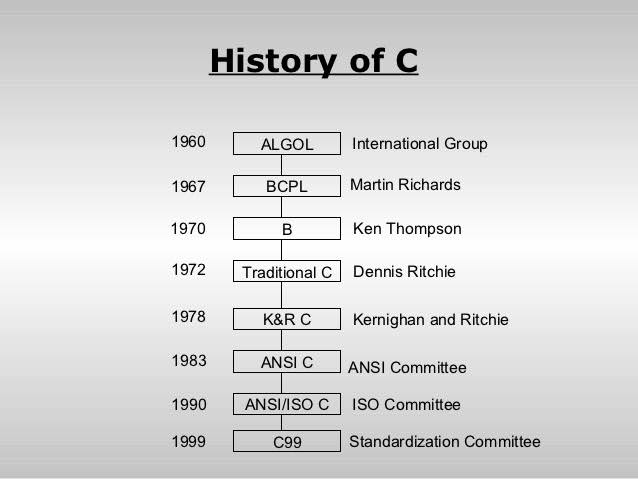
There are many programming languages in use today, one of which is C. There are many offshoots of the C programming language, including Objective-C, C++, and C#. None of these are the same language.
THE BEGINNING:
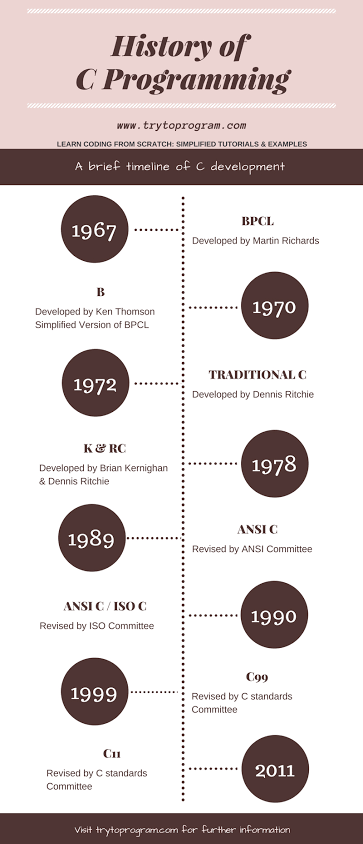
The C programming language came out of Bell Labs in the early 1970s. According to the Bell Labs paper The Development of the C Language by Dennis Ritchie, “The C programming language was devised in the early 1970s as a system implementation language for the nascent Unix operating system. Derived from the typeless language BCPL, it evolved a type structure; created on a tiny machine as a tool to improve a meager programming environment.” Originally, Ken Thompson, a Bell Labs employee, desired to make a programming language for the new Unix platform. Thompson modified the BCPL system language and created B. However, not many utilities were ever written in B due to its slow nature and inability to take advantage of PDP-11 features in the operating system. This led to Ritchie improving on B, and thus creating C.

The development of C was to become the basis for Unix. According to the Bell Labs paper, “By early 1973, the essentials of modern C were complete. The language and compiler were strong enough to permit us to rewrite the Unix kernel for the PDP-11 in C during the summer of the year.” This now meant that C was becoming a strong language that could, and would be, implemented across many systems. By the middle of the 1970s, the C-based Unix was used in many projects within the Bell System as well as “a small group of research-oriented industrial, academic, and government organizations outside [Bell Labs]”. In 1978, Brian Kernighan and Dennis Ritchie published The C Programming Language, which would serve as the language reference until a formal standard was adopted. Five years later, the American National Standard Institute (ANSI) formed the committee, X3J11, to establish the formal standard of C. The C standard was ratified as ANSI X3.159-1989 “Programming Language C”. This was the first formal standard of C. Currently, we are on the fourth standard of C, known as C18 as it was published in June of 2018

Over time, C began to be used in personal computers for developing software applications and other purposes.
The first change (even if only a little) came when the American National Standards Institute (ANSI) formed a committee in 1983 to standardize C. After a review of the language, they modified it a little so that it was also compatible with other programs that preceded C. So the new ANSI standard came into being in 1989, and is known as ANSI C or C89. The International Organization for Standardization (ISO) has also contributed to the standardization of C.
Over time, C has evolved as it has added some significant features like memory management, functions, classes and libraries to its rich feature set. C is being used in some of the biggest and most prominent projects and products in the world.
C has also influenced the development of numerous languages such as AMPL, AWK, csh, C++, C–, C#, Objective-C, Bit C, D, Go, Java, JavaScript, Julia, Limbo, LPC, Perl, PHP, Pike, Processing, Python, Rust, Seed7, Vala and Verilog.
USES TODAY :
According to Toptal, UNIX operating systems are written in C and most of Linux is also in C. Also databases such as Oracle Database, MySQL, MS SQL Server, and PostgresSQL are at least partially written in C. C is the basis of many system kernels. Other programming languages, like Python and Perl, use compilers or interpreters that are written in C.
C has changed over the years and is still a common language to use in lower level programs, like kernels. But it is also used for many applications ranging from device drivers to other programming languages’ compilers or interpreters. The language also made way for C++, Objective-C, C#, and many more C-based languages that each have their own speciality.

OUR SOLAR SYSTEM

The “Solar system”

There are many planetary systems like ours in the universe, with planets orbiting a host star. Our planetary system is named the “solar” system because our Sun is named Sol, after the Latin word for Sun, “solis,” and anything related to the Sun we call “solar.”

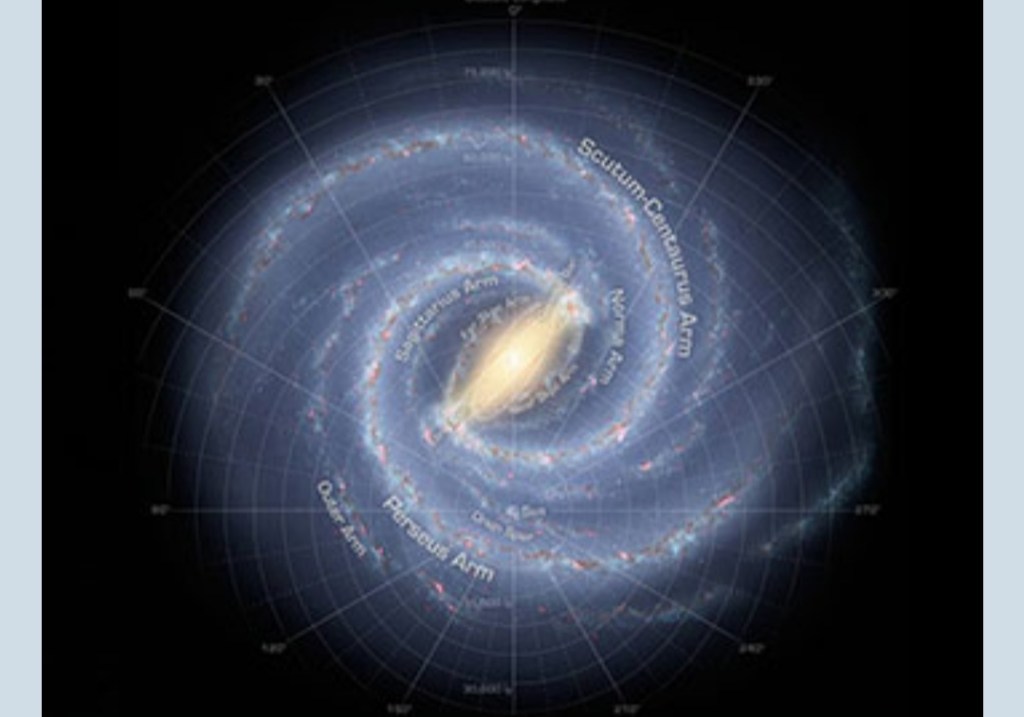
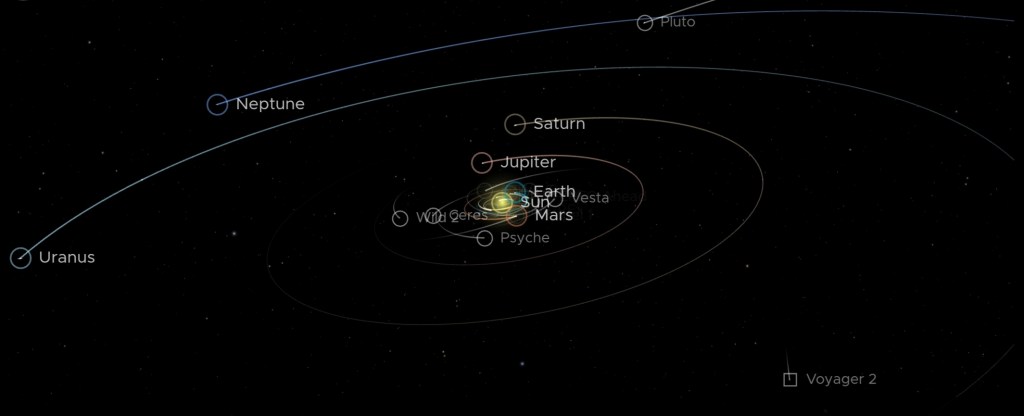
Our planetary system is located in an outer spiral arm of the Milky Way galaxy.Our solar system consists of our star, the Sun, and everything bound to it by gravity — the planets Mercury, Venus, Earth, Mars, Jupiter, Saturn, Uranus and Neptune, dwarf planets such as Pluto, dozens of moons and millions of asteroids, comets and meteoroids. Beyond our own solar system, we have discovered thousands of planetary systems orbiting other stars in the Milky Way.

10 Need-to-Know Things About the Solar System

1>ONE OF BILLIONS

Our solar system is made up of a star, eight planets and countless smaller bodies such as dwarf planets, asteroids and comets.

2>MEET ME IN THE ORION ARM

Our solar system orbits the center of the Milky Way Galaxy at about 515,000 mph (828,000 kph). We’re in one of the galaxy’s four spiral arms.

3>A LONG WAY ROUND

It takes our solar system about 230 million years to complete one orbit around the galactic center.

4>SPIRALING THROUGH SPACE

There are three general kinds of galaxies: elliptical, spiral and irregular. The Milky Way is a spiral galaxy.

5>GOOD ATMOSPHERE(S)

Our solar system is a region of space. It has no atmosphere. But it contains many worlds—including Earth—with many kinds of atmospheres.

6>MANY MOONS

The planets of our solar system—and even some asteroids—hold more than 150 moons in their orbits.

7>RING WORLDS

The four giant planets—and at least one asteroid—have rings. None are as spectacular as Saturn’s gorgeous rings.

8>LEAVING THE CRADLE

More than 300 robotic spacecraft have explored destinations beyond Earth orbit, including 24 astronauts who orbited the moon.

9>LIFE AS WE KNOW IT

Our solar system is the only one known to support life. So far, we only know of life on Earth, but we’re looking for more everywhere we can.

10>FAR-RANGING ROBOTS

NASA’s Voyager 1 is the only spacecraft so far to leave our solar system. Four other spacecraft will eventually hit interstellar space.

Spacecraft are Headed into Interstellar Space:-

Five spacecraft have achieved enough velocity to eventually travel beyond the boundaries of our solar system. Two of them reached the unexplored space between the stars after several decades in space.

  • Voyager 1 went interstellar in 2012 and voyager 2 joined it in 2018. Both spacecraft are still in communication with Earth. Both spacecraft launched in 1977.
  • NASA’s new horizons spacecraft—currently exploring the an icy region beyond Neptune called the Kuiper Belt—eventually will leave our solar system.
  • Pioneer 10 and pioner 11 also will ultimately travel silently among the stars. The spacecraft used up their power supplies decades ago.