Nasal Vaccine to Combat COVID-19

Covaxin,Covishield,Sputnik V (left to right)

The unprecedented onset of COVID-19 brought an unexpected storm in the lives of people all around the globe. The pandemic not only affected the jobs and social life of the people but also took a great toll on the lives of people, resulting in the death of lakhs of people in India.

Medical researchers around the world extensively worked for developing vaccines for the deadly coronavirus. India at present produces two locally developed vaccines for coronavirus: Covaxin and Covishield.

Covaxin is a product of Bharat Biotech, while Covishield is a product of Serum Institute of India. Both vaccines require two doses.

The government of India further approved for the use of Sputnik V vaccine, supplied by Russia. Unlike Covaxin and Covishield, the Sputnik V vaccine is a single dose vaccine. This vaccine is also locally being produced for fastening the vaccination drive.

Now, a new vaccine is in the process of developing- the nasal vaccine.

Prime Minister Narendra Modi on 07th June 2021, Monday said that researchers are working on the nasal vaccine, and hopefully it would turn out to be successful, which would further increase the pace of vaccination drive in the country.

What is a Nasal Vaccine?

As the name suggests, the nasal vaccine is a vaccine given through a person’s nose. It does not require to be injected in the body by a needle unlike the existing vaccines. It is a spray that is pumped via nostrils which would travel through the nasal passage and directly work upon the microbes that might have travelled through air.

As it is found out that the coronavirus commonly enters the body through the nose affecting the respiratory tract and lungs, damaging the respiratory system. The nasal vaccine would intercept the virus, helping combat the virus and prevent it from multiplication. It would also build a much widespread immune system against the coronavirus.

Currently, vaccination drive is going on for the people above the age of 18 years. The children below the age of 18 years are still left to be vaccinated. Which again is a matter of great concern as the old aged and the children are more vulnerable to coronavirus. The existing vaccines are not suitable for the children and hence the kids are left to be vaccinated.

Experts say, if the nasal vaccine turns out to successful, it would be safe to use nasal vaccine on children. It would also much easy to be administered in kids as it would not require insertion of needle on the skin, which children often resists because of the pain caused.

The nasal vaccine would be a single dose requirement unlike the existing vaccines. It is also expected to have no after affects like pain, fever or cold, as with the existing vaccines. The nasal vaccine could be self-administered with any medical help as it has a simple process of spraying the vaccine into the nostrils.

The self-assistance aspect of nasal vaccine would also reduce the crowd which is often seen for getting the present vaccines because of the que people have to stand in.

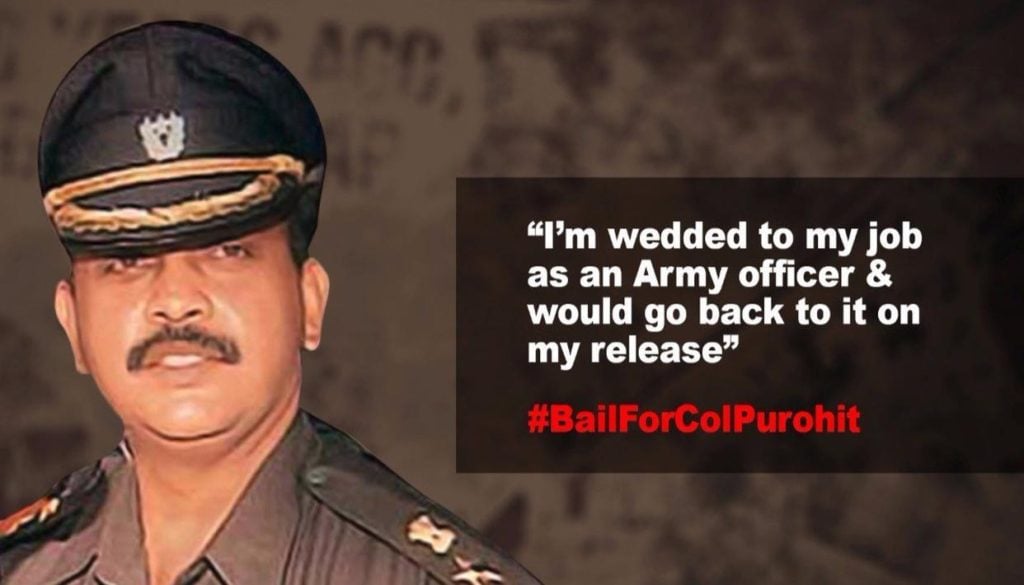
President Must Speak Up For Lt. Col Purohit

  I am sorry to say but his (Lt Col Srikant Purohit) plight is worse than even Kulbhushan Jadhav who too was wrongly implicated as a terrorist but this happened in Pakistan and not in India which is his own country!  Not one or two or seven but seventy six Army officers who had served with him earlier testified to his being an upright and committed officer but India trusted Mumbai ATS who are notorious for wrongly implicating innocents and here they didn’t spare even an honest and committed Army officer like Lt Colonel Srikant Purohit! What has happened with Lt Colonel Purohit should not happen even with a terrorist! Even Nasik Police Chief whose jurisdiction extended to Malegaon had commended Lt Col Purohit for actively working to expose terrorists funded directly from Pakistan! Can all this be dismissed lightly? NIA too it must be said with dismay has not crowned itself with glory by keeping quiet for 9 years which is a very long time!

                                          Needless to say, Lt Colonel Purohit was regularly informing his superiors in Army informed about what all he was doing yet NIA didn’t care to listen his version properly! Is it a coincidence that Mumbai terror attack of 26/11 happened just months after his arrest? Why such a senior Army officer was treated so shabbily? Why when he was working to expose those who supported terrorism locally was he himself arrested, tortured and branded a terrorist and for 9 years not a single evidence was produced before any court? All this must be investigated impartially and truth must come out! The bold Army officer who was the only one to help Mumbai ATS in falsely implicating Lt Colonel Purohit and get him arrested breaking all norms and who has not produced a single shred of evidence in any court even after 9 years must be taken to task and not allowed to go scot free!
                                                  Let me be direct in asking: Who will compensate him for the 9 years that he, his wife and his children have suffered endlessly? There can be no compensation that can compensate for the terrible sufferings he and his family had to undergo! I am sorry to say but even Army has not held his hand when he needed it most and this is the worst tragedy! However, I am extremely happy to note that one of the most reputed lawyer of our country – Harish Salve has taken up his case and has ensured that Lt Col Purohit got bail after being in jail for about 9 years!  I am sure that now at least he will get justice from the highest court!  
                                               Be it noted, Supreme Court had reserved its verdict on a plea of Lieutenant Colonel Shrikant Prasad Purohit seeking interim bail in the 2008 Malegaon blast case after Bombay High Court had earlier dismissed his bail plea. A Bench of Justices RK Agarwal and AM Sapre said it will pass an order on the plea. During the hearing, senior advocate and former Solicitor General Harish Salve who just some months back had successfully defended Kulbhushan Jadhav in ICJ said that he has been in jail for the past nine years but charges have still not been framed against him! He said the MCOCA charge has already been dropped against him and therefore he is entitled to get interim bail! Our whole judicial system should be ashamed that a serving Army Officer is designated a terrorist by Mumbai ATS but for last nine years no charges have been framed against him! This itself is the strongest testimony to prove that how strong case Mumbai ATS has against Lt Col Purohit!
                                        To put things in perspective, while seeking bail in the 2008 Malegaon blasts case, Lt Col Shrikant Purohit made it clear to the Supreme Court that he was caught in a “political crossfire” and was falsely implicated. But the NIA while opposing his plea accused him of running Abhinav Bharat which NIA alleged is an outfit promoting fundamentalism and unlawful acvtivities. One is tempted to ask here: Why Hurriyat leaders who openly rant against India, chant anti-India slogans, indulge in unlawful activities and get funded hugely from Pakistan due to which they have amassed huge money empire and purchased properties all across the country have not been sent to jail for 9 years as we see in case of Lt Col Shrikant Purohit? Why those Hurriyat leaders who had a hand in murder of Kashmiri Hindus when they fled Kashmir in lakhs way back in 1989 were all released from jail and till now they are roaming scot free?
                                        Anyway, coming back to Lt Colonel Purohit’s case, his senior counsel Harish Salve contended that the officer attended meetings of Abhinav Bharat as an “Army mole” and was not involved in terrorist activities. He rightly said that there were “big holes” in the probe which is why another accused Pragya Singh Thakur was granted bail. Harish Salve made a strong case for bail to be granted to Lt Col Purohit by pointing out that, “My client has been in jail for nine years but charges have not been framed. Since 2001, he has got numerous recommendations (as intelligence officer). I am not asking for discharge but give interim bail after nine years of incarceration till framing of charges in the case.”  He also pointed out that Purohit had informed seniors about meetings of Abhinav Bharat and there were infirmities in the probe conducted by the Maharashtra ATS and NIA. Why then Army has not firmly stood behind him is most baffling!
                                         Not stopping here, Harish Salve said on behalf of his client that, “The allegation against me is that I supplied explosive material on the conspiracy hatched by Sadhvi Pragya Thakur. Now if she is enlarged on bail and given a clean chit by the NIA, then the link between me and her is snapped.” Salve also rightly pointed out that, “My client has got himself caught in political crossfire. He has been in jail for nine years but still he is serving in the Indian Army. Since 2001, he has got numerous recommendations for infiltration. From an unsung hero, he has been now called an incarcerated hero.” If he was a terrorist would he still be serving in the Indian Army? Would he not have been dismissed? Did he not pass all information about activities of Abhinav Bharat group who allegedly masterminded Malegaon bomb blast on September 29, 2008 in which seven people were killed to his seniors? Have his seniors not testified about it? Still why he is being made the scapegoat? Why was he arrested at the first place? Why he was kept in illegal detention?
                                     Simply put, while denying his involvement in the incident, Purohit told the court that even assuming that the charges that he had supplied the bomb were true, even then he would have to be out of jail as the offence attracted a maximum of seven years imprisonment. Why is he still in jail after nine years when no charges have been proved against him and even a chargesheet has not been filed against him? Why his arrest was not carried out as per procedure? Why he was deceived and then arrested by another Army Officer who it is alleged had even tortured him and till now has not produced even a single shred of evidence against him? Why Lt Col Purohit has been made to suffer so much that he is in jail for nine years even though the maximum term for the offence for which he was charged was just seven years? Who are the powerful forces who are not allowing truth to come out? Why should their questionable conduct not be probed?
                                          There are many unanswered troubling questions that must be answered: Why NIA had to file a separate chargesheet stating that ATS had planted the RDX found from Purohit’s house? Why ATS planted RDX  found from Purohit’s house? What does all this prove? Why ATS was hell bent in implicating Purohit as a terrorist? Was it at the instance of some political party? This itself shows that there is a political angle to it also which merits no a thorough probe!  Why MCOCA charges were also dropped? Why it has taken 9 years for the case to move at snail’s pace and still till date no charges have been framed against him as Harish Salve has pointed out? Truth must come out finally!
                                                 It is a national shame that some news channels even before the case is finally pronounced by the Courts not just labelled him a “Hindu Terrorist” but also leveled many other serious charges against him and they have not been able to substantiate it in any court! These very news channels had no compunctions in inviting Pakistani invader Gen Pervez Musharraf and honouring him knowing fully well that he had masterminded the Kargil war in which we lost more than 600 soldiers! The negative hype created by various news channels against him was just not done! It certainly served to tarnish his image because very few know the real truth! Additional Solicitor General Maninder Singh while appearing for the National Investigation Agency (NIA), said there was some evidence against him which would help in framing of charge! Even an illiterate person will have the common sense to ask: Why no charge framed against him for 9 years if there was evidence against him?
                                              For nearly nine years a serving army officer of the armed forces and that too of the intelligence wing was made to suffer all sorts of humiliation along with jail and yet not even chargesheet has been filed against him leave alone trial being started! Is this the way a nation treats its officers? What message is being sent to future aspirants who want to join the Indian Army?
                                 It must be asked: If there was an open and shut case against him as those who arrested him projected then why after nine years they have not been able to even file a  chargesheet and why they have not produced any evidence before the court? How can any person leave alone army officer be made to wear the tag of a terrorist without giving him any opportunity to defend himself in last nine years? Why the Mumbai ATS did not frame charges for 9 years if they had evidence to prove that Lt Colonel Purohit is a terrorist? Why RDX was planted in his house as NIA alleged?
                                          It must also be asked: How long will police keep the nation waiting? Who will be responsible if it is found that there is no evidence against Purohit and others? Why a UN report which mentioned that a Pakistan based terror group was responsible for the terror attack yet Purohit who as intelligence officer was providing information on terrorist was himself implicated instead? Why no evidence has been produced against him?
                                            Why even a bench of Supreme Court comprising of Justices FMI Kalifulla and Abhay Manohar Sapre said that, “There was no concrete evidence to show their involvement in any other criminal case and the trial court should decide their bail plea on merit, preferably within one month”? Was it just for fun that two Judges and that too serving judges of our highest court – Supreme Court are saying that there was no concrete evidence to show their involvement in any other criminal case? Why Supreme Court said there was considerable doubt about the involvement of those charged under the MCOCA?
                                                      Why trial court didn’t decide their bail plea nearly nine years back and why Lt Col Purohit was made to suffer along with Sadhvi Pragya Thakur in jail where their health deteriorated thus grossly violating their legal rights? What was the compelling circumstance that police decided to keep a serving army officer of the rank of Lt Colonel in jail for nearly nine years without producing any evidence against him in any court? This itself proves that there is more to it than meets the eye and his arrest along with others was done as part of a grand political conspiracy to keep the ruling elite happy and to be on their right side!             
 
                                        Why for nearly nine years Lt Colonel Purohit was not shown even the army documents which he had a right to see? Why it is that only  after the ex Defence Minister Manohar Parrikar  himself personally intervened to make it clear that the main accused in the Malegaon and Samjhauta blasts, Lt Col Prasad Purohit, would be given access to documents he had sought to enable him to prove his innocence? Why was he denied even his basic legal right for such a long time? Who were those army officers who didn’t want that he should be shown any documents and why? They must explain!
                                          Let me also be direct in asking: Why such a senior army officer of the rank of Major General and having an impeccable reputation whom we keep listening in most of the news channels speaking always about defence and our national interests – GD Bakshi keeps crying foul on the ghoulish manner in which Lt Colonel Purohit was falsely implicated and he was made a fall guy while the real culprits were allowed to run away? Why so many other Army officers 76 who had earlier served with him have all hailed him as “a man of courage, conviction with firm uprighteousness”? Are they all speaking lies and only Mumbai ATS and one odd Army officer who falsely implicated him and who has kept quiet for 9 years by not producing any evidence in any court speaking truth?  Why RSN Singh a retired officer of RAW whom again we keep listening in various news channels talking always about our national interests writes in his cover story titled “Col Purohit : A Victim Of Hindu Terror Industry” published in Uday India magazine dated March 22, 2014 that, “It is a travesty to paint Purohit as the Indian Osama Bin Laden. Going by the selective and flip-flop leaks by the Anti Terrorist Squad (ATS) of Maharashtra, and the manner in which the media is lapping it up, it appears that there is a concerted bid to make an ‘Osama bin Laden’ out of Lt Col Purohit, and prove that Sadhvi Pragya and her accomplices are the new ‘Hindu jihadis’. The credulity of the general public is being stretched on various scores. Firstly, the speed at which fresh revelations are being disseminated by the ATS, is in complete disregard to professional propriety. Secondly, the unprecedented number of narco tests the accused are being subjected to. Thirdly, there is a total blankout with regard to the version of the accused. Fourthly, with every passing day, the network is being enlarged; as if to suggest that the entire country is being consumed by ‘Hindu terrorism’, and has pan-Indian dimension. Fifthly, if intercepts of some of the accused were available prior to the blasts, why were no pre-emptive measures taken? Sixthly, no army representative has been included in the interrogation team. Seventhly, the most intriguing aspect is the timing of the investigations—on the eve of elections.”
                                              Truth be told, Lt Col Purohit claimed that he had been framed in the Samjhauta blasts while he had successfully infiltrated various terror groups such as the Indian Mujahideen and the SIMI. He said with tears in his eyes that, “I have been robbed of honour, dignity and rank and punished for serving the nation”. What a tragedy that Indian politicians go out of the way to invite Pakistani invaders like Gen Pervez Musharraf who masterminded Kargil war in which we lost officially more than 600 soldiers and treat him like a royal emperor but care two hoots for Indian officers like Lt Col Purohit who at the risk of their own lives penetrate inside enemy camp only to be themselves labeled a terrorist! Captain Saurav Kalia was brutally tortured by Pakistani soldiers and terrorists but Lt Col Purohit is even more unlucky as he was tortured most brutally not for just 22 days but for nearly 9 years to force him to give a confession not by any Pakistani army or terrorist or ISI but by Indian police, Indian intelligence and all donning uniform of India which is his own nation and not Pakistan! Kashmiri separatists leaders openly rant against India, wave flags of ISIS and Pakistan, are known for their proximity to terror leaders but yet they are not arrested but an army officer with a distinguished track record like Lt Col Purohit is arrested and kept in jail without even filing a chargesheet for nearly 9 years! Disgusting!
                                         Anyway coming back to the main subject, incidentally, NIA Director General Sharad Kumar had clarified that Lt Col Purohit was never an accused in the Samjhauta blasts case. However, he had been charge-sheeted by the Mumbai Anti-Terrorism Squad in the Malegaon blast case, and the NIA was investigating the matter. Does it take nine years to file chargesheet?
                                             I am hundred percent convinced that he is not a terrorist rather is “a victim of most dangerous political conspiracy hatched up in cahoots with some senior police officers and some in the army”. If there was even an iota of proof against him that proof would not have been taken to any temple for some havan or puja for nearly nine years but produced before the court! Just because a person sets up an organization or even has hardline views is no ground to send him to jail and keep him languishing there for nearly 9 years without even showing him the chargesheet and without producing him even before the lowest court!
                                         You can dismiss what I say lightly but certainly not what Supreme Court says or a senior army officer of the stature of Gen GD Bakshi or a former RAW officer Col RSN Singh or 76 Army officers says and whom we always love to hear in various news channels because they always speak keeping in mind our national interests first and not any regional or religion interest first! Even the seniors of Lt Col Purohit confirm him as “over zealous officer” and profusely praised him but in his bad days he was left in the lurch to suffer all alone by himself with no one standing near him to defend! If this is the way in which an intelligence officer is treated for doing his duty who will like to take risk only to be himself labelled a terrorist? This is terrible!
                                                  Justice must not only be done in Purohit’s case but also seen to be done! By not filing even a chargesheet in last nearly 9 years several questions have been thrown up and all those who are responsible for this needs to be taken to task! NHRC must itself also investigate the matter and all those who tortured Lt Col Purohit must themselves be sent behind bars and taken to task for their misdeeds and misdemeanours! What Lt Col Purohit’s family is bearing and what he himself is bearing that only they themselves can understand best! Punish them with the strictest punishment if they are terrorists but facts on ground indicate otherwise! I have not seen one Army Officer speaking against Lt Col Purohit till now openly in any news channel not even that Army Officer who it is alleged was hands-in-glove with Mumbai ATS in falsely implicating him because of the personal grudge that he held against him! Why deafening silence? It is because there is no strong case against him!
                                  I am sure Supreme Court will consider all facts on the ground and deliver justice to Lt Colonel Purohit by granting him bail! Nine years in jail for a serving Army officer without dismissing him or producing any evidence against him and not even filing chargesheet against him for 9 years speaks volumes of how strong the case is against Lt Col Purohit! The jury is still out! Let’s wait and watch what happens! Truth must prevail! This case is not just of Lt Col Purohit alone! This is attached directly with Army’s impeccable reputation which has unnecessarily been sought to be damaged by those having vested interests without producing any hard evidence for 9 years and worst of all, by not even filing any charges against him till now!  President must himself directly intervene and make sure that justice is done with this senior serving Army Officer who is still in service but was framed in most questionable manner and tortured most ruthlessly as he himself candidly acknowledged also while speaking to journalists after getting bail! He is still proud to have joined the Army as an officer to serve this nation. President is the supreme commander of Armed forces and he must speak up just like former Defence Minister Manohar Parrikar had spoken up! Let’s hope for the same so that this serving senior army officer gets his honour and pride back at the earliest!
Sanjeev Sirohi

What Happened With Lt Col Purohit And Pragya Is Most Unfortunate!

Coming straight to the crux of the matter, let me initiate my humble piece by first and foremost pointing out that in a huge relief for Lt Col Prasad Shrikant Purohit, Sadhvi Pragya Singh Thakur and others in the 2008 Malegaon blast case, the Supreme Court on April 13, 2016 said categorically that there was no evidence to charge them under Maharashtra Control of Organised Crimes Act (MCOCA) at this stage and their bail could hence be examined on merit by a trial court. We all saw how after rotting for nearly nine years on jail could Lt Col Purohit get bail after legal giant who is none other than Harish Salve. himself most meticulously, brilliantly and most convincingly argued for his bail in the top court! It is most unfortunate that the order to consider their bail expeditiously came close to eight years after the military intelligence officer and others were arrested and jailed in connection with the blast case. This cannot be justified under any circumstances!           For nearly eight years a serving army officer of the armed forces and that too of the intelligence wing was made to suffer all sorts of humiliation along with jail and yet not even chargesheet has been filed against him leave alone trial being started! Same is the case with Sadhvi Pragya Singh Thakur. Is this the way a nation treats its officers?                                                    If there was an open and shut case against him as those who arrested him projected then why after eight years they have not been able to even file a  chargesheet and why they have not produced any evidence before the court? How can any person leave alone army officer be made to wear the tag of a terrorist without giving him any opportunity to defend himself in last eight years? Why was the police worshipping in temple the evidence it has to prove that Lt Colonel Purohit is a terrorist? Why only media hype against Lt Col Purohit for. 8 to 9 years that he was planning to make India a Hindu state without any evidence whatsoever?                                     How long will police keep the nation waiting? Who will be responsible if it is found that there is no evidence against Purohit and others? Why a UN report which mentioned that a Pakistan based terror group was responsible for the terror attack yet Purohit who as intelligence officer was providing information on terrorist was himself implicated instead? Why no evidence has been produced against him?                                               Why a bench of Supreme Court comprising of Justices FMI Kalifulla and Abhay Manohar Sapre said that, “There was no concrete evidence to show their involvement in any other criminal case and the trial court should decide their bail plea on merit, preferably within one month”? Was it just for fun that two Judges and that too serving judges of our highest court – Supreme Court are saying that there was no concrete evidence to show their involvement in any other criminal case? Why Supreme Court said there was considerable doubt about the involvement of those charged under the MCOCA? Again was it just for fun? What nonsense!                                                      Why trial court didn’t decide their bail plea nearly eight years back and why Lt Col Purohit was made to suffer along with Sadhvi Pragya Thakur in jail where their health deteriorated thus grossly violating their legal rights? Why Lt Col Purohit’s wife had to say with moist eyes that, “Nothing has changed. I am tired?” What was the compelling circumstance that police decided to keep a serving army officer of the rank of Lt Colonel in jail for nearly eight years without producing any evidence against him in nay court? This itself proves that there is more to it than meets the eye and his arrest along with others was done as part of a grand political conspiracy to keep the ruling elite happy and to be on their right side!     We have just seen the murky racket of police officers extorting crores of rupees from rich to pay hundreds of crores to politicians in this very State named Maharashtra  due to which senior police officials were either dismissed from service as we saw in case of Assistant Police Inspectors Sachin Waze, Riyazuddin Kazi and Sunil Mane! The NIA claimed that  Sunil Mane was part of the conspiracy to kill Thane-based business man Hiran   who purportedly owned the explosive-laden vehicle which was found parked near Ambani’s house ‘Antilia’ in South Mumbai on February 25. By the way, Hiren’s body was found in a creek in Thane on March 5, 2021. Very serious allegations were levelled against Maharashtra State Home Minister Anil Deshmukh by former Mumbai Police Commissioner Param Vir Singh!                                      Why for nearly eight years Lt Colonel Purohit was not shown even the army documents which he had a right to see? Why it is that only now after the Defence Minister Manohar Parrikar has himself personally intervened to make it clear that the main accused in the Malegaon and Samjhauta blasts, Lt Col Prasad Purohit, would be given access to documents he had sought to enable him to prove his innocence? Why was he denied even his basic legal right for such a long time? Who were those army officers who didn’t want that he should be shown any documents and why? They must explain!                                                    Why such a senior army officer of the rank of Major General and having an impeccable reputation whom we keep listening in most of the news channels speaking always about defence and our national interests – GD Bakshi keeps crying foul on the manner in which Lt Colonel Purohit was falsely implicated and he was made a fall guy while the real culprits were allowed to run away? Why RSN Singh a retired officer of RAW whom again we keep listening in various news channels talking always about our national interests writes in his cover story titled “Col Purohit : A Victim Of Hindu Terror Industry” published in Uday India magazine dated March 22, 2014 that, “Look at the distance the anti-national discourse of Indian politics has travelled. A film actor serving sentence for aiding and abetting terrorism is the beneficiary of parole with vulgar regularity and brazenness and Col Purohit, a patriotic soldier continues to languish in prison. His cardinal sin being his infiltration into the network of Indian Mujahideen and its patron LeT. More than two dozen concerned officers have vouched in Court-of-Inquiry that in pursuit of his duty, by no standards ordinary, he had kept the organization in loop. Purohit, in keeping with the imperatives of country’s security, shared intelligence with sister agencies including the Maharashtra ATS, which invited him on several occasions to deliver lectures. By now it is clearly established by some prime plotters and participants of 26/11 like Ajmal Kasab, David Headley and Abu Jundal, that a painstaking diligence was invested by the planners to portray the attack as handiwork of ‘Hindu terror’ organisations. If Ajmal Kasab had not been caught alive the plot had nearly succeeded. It was a sort of divine intervention that Kasab developed cold-feet and failed to destroy himself as per the instruction of his handlers and jihadi indoctrination. The network of plotters included some politicians and journalists in India. Readers may find out who wrote a book, (to apologise later) about 26/11 being a handiwork of Hindu groups and which politician was the chief guest during the release of the book!Fabrication of ‘Hindu Terror’Few days before 26/11, I was solicited by the Tehelka magazine to write a column on my views on the arrest of Col Purohit. My initial response, knowing the unabashed pro-establishment proclivities of the magazine, was that my views would be repugnant. Only when, I was assured of my intellectual freedom, I relented. I must say, my views were not only respected, it was carried as the very first item on Nov 22, 2008 issue. Without the benefit of hindsight I then wrote:“It is a travesty to paint Purohit as the Indian Osama Bin Laden. Going by the selective and flip-flop leaks by the Anti Terrorist Squad (ATS) of Maharashtra, and the manner in which the media is lapping it up, it appears that there is a concerted bid to make an ‘Osama bin Laden’ out of Lt Col Purohit, and prove that Sadhvi Pragya and her accomplices are the new ‘Hindu jihadis’. The credulity of the general public is being stretched on various scores. Firstly, the speed at which fresh revelations are being disseminated by the ATS, is in complete disregard to professional propriety. Secondly, the unprecedented number of narco tests the accused are being subjected to. Thirdly, there is a total blankout with regard to the version of the accused. Fourthly, with every passing day, the network is being enlarged; as if to suggest that the entire country is being consumed by ‘Hindu terrorism’, and has pan-Indian dimension. Fifthly, if intercepts of some of the accused were available prior to the blasts, why were no pre-emptive measures taken? Sixthly, no army representative has been included in the interrogation team. Seventhly, the most intriguing aspect is the timing of the investigations—on the eve of elections.“The ATS revelations are extremely complex in nature due to the alleged involvement of an army officer belonging to military intelligence. The media, therefore, needs to be cautious about the manner in which it reports the briefs by the ATS. The Colonel is a legitimate intelligence operative. Interaction with the police authorities, other intelligence agencies, desirable and undesirable elements, was very much a part of his duty. No intelligence agency issues written orders in pursuance of intelligence operations. The entire system is based on trust and faith. It is yet to be established how much disconnect there is between the legitimate and illegitimate activities of the officer during the course of his duty. The level and extent of interaction and cooperation that the officer had with other intelligence agencies is not known. There can be no greater travesty than the suggestion by certain quarters that the involvement of Lt Col Purohit is symptomatic of a deeper malaise in the Indian army.“An officer of military intelligence is not in direct command of troops. He has only a small complement of personnel working under him. A military intelligence officer is hardly competent in providing training on improvised explosive devices. Importantly, the nation must trust in the legal procedures of the army which is far more stringent. The army will brook no ideology which impacts on its established secular character and credentials. As and when Lt Col Purohit is handed back to army custody, it is inevitable that he will be meted out the appropriate punishment, if found guilty. The media must be patient, and, spare the army.”In flagrant violation of all imperatives, norms and practice Col Purohit was not handed back to the army nor the Indian army was meaningfully incorporated in the interrogation and investigation. The country could trust the Indian army with 92,000 Pak prisoners in the wake of 71 War, but could not be depended for fairness and justice with one of its own intelligence officer. It is now beyond doubt that the decision of his civil custody was deliberate and conspiratorial. It nails the persisting doubts regarding involvement of facilitators within the Indian dispensation in staging 26/11.Anticipating that Col Purohit will eventually be handed over to the Army I wrote in the Indian Defence Review in 2008:“The level and extent of intelligence interaction and cooperation with other intelligence agencies that this officer had, is also not known. That is why, it was very important to have a representative of the military intelligence, when the interrogation of the officer began. To that extent, a state police organisation is not only under-equipped but also out of sync with central intelligence agencies in dealing with an official of military intelligence.”The stories being fed to the media by the government was not only incredulous but outrageous to any professional intelligence personnel. Those feeding the information particularly to a particular newspaper were police discards who had gravitated to this altered ATS, solely for the purpose of politicising terror at the behest of their political masters. Subsequently, post 26/11 another investigative organisation was created to perpetuate politicisation of terror at national scale. The low intensity blasts in Malegaon in September 2008 was the trigger for creation of the desperate theme of Hindu terror, following which the respective ATSs of states ruled by one particular party went on an overdrive. The newspaper as mentioned, in its blind fidelity, reproduced stories of Hindu terror dished out by the govt, having hilarious contradictions in frequency of two consecutive days. The plot was slowly unraveling and so was the desperation of the spin-doctors. I therefore expressed my suspicion thus in Indian Defence Review in 2008:“The investigation following the ‘Malegaon blasts’, is extremely complex in nature due to the alleged involvement of an army officer belonging to the military intelligence. The media, therefore, needs to be extremely cautious and circumspect about the manner in which it reports the briefs by the ATS. I have deep apprehension that the complete truth, as and when it unfolds in the future, could have several unsavoury and damaging twist.”Unsavoury and Damaging DeductionsIt has indeed proven to be unsavoury and damaging. Now, with the benefit of hindsight analysis and driven by growing crops of facts and evidence, some of the ineluctable deductions are:■             26/11 was orchestrated by Pakistan and other external powers in concert with vested interests in India. The objectives of external interests was geopolitical and of internal players— the need to balance the spate of jihadi terror by fabricating so-called ‘Hindu terror’. Towards this, there were plans in place in all three phases of 26/11, i.e. preparatory phase, conduct phase, and post-conduct phase. In the preparatory phase, the jihadis were taught about Hindu ways and were also taught Hindi language. Their instructor was none other than Abu Jundal, who has confessed as much to the Indian authorities. The jihadis were made to wear sacred threads on their wrists to establish their identities as ‘Hindus’ after their ‘shahadat’ (martyrdom). In the conduct phase, it appears that the chief of the ATS Mr Hemant Karkare was eliminated as he knew ‘too much’ and in the post-conduct phase or consolidation phase, the plans to publish books labeling 26/11 as an act of ‘Hindu terror’ was pursued, despite the unexpected apprehension of Ajmal Kasab, which had put paid the conspiracy.■             The low intensity blast in Malegaon were probably orchestrated in September 2008 (Malegaon-II), just two months before 26/11 to create the bogey of ‘Hindu terror’ so that the attack could be sold as an act of ‘Hindu terror’ with some degree of credulity.■             Later, Malegaon-II was used as the trigger and kernel to weave the story of so-called ‘Hindu terror’. High publicity suspects were carefully chosen, created and implicated. It included an army officer (Col Purohit) and a saffron clad woman Hindu activist (Sadhvi Pragya). Great combination for publicity and to neutralise Pak-sponsored jihadi terror!■             Once Malegaon-II to facilitate 26/11 was effected, to dispel obvious doubts the spin-doctors began to work backwards in order to prove that all terrorist attacks in which Muslims were victims, were the handiwork of the so-called ‘Hindu terror’ groups. In this bid, they got badly stuck on two counts, i.e. Malegaon-I (2006) and Samjhauta Express blast (2007). In Malegaon-I, the casualties were very high, some 37 people were killed and usage of RDX was in evidence. In establishing the attack as ‘Hindu terror’, the spin-doctors are in quandary about pin-pointing the source of RDX. Initially, through the medium of its captive newspaper, it was disseminated that it was sourced from the army. However the very next day, it was clarified that the Indian army does not use RDX. As far as Samjhauta Express blasts are concerned, the Moroccan wife of David Headley, Faiza Outalha, had told the US Embassy in Pakistan that her husband was the mastermind. The US State Treasury Department till today maintains that the main financer of the blasts was a Karachi-based businessman, and LeT operative, Muhammad Arif Qasmani.■             It also appears that Col Purohit was castigated and then taken into custody to facilitate 26/11, as he had infiltrated deep into LeT network. His arrest was also used a measure to scare conscientious operatives of other intelligence agencies.■             Similarly, the self-inflicted vicissitudes of the Aseemanand case are ludicrous. Sometimes he undergoes a ‘change of heart’ and is on a song, only to retract later, sometimes a ghost journalist interviews him in the dark room of the jail, which he subsequently denies.■             The scripting of the untruths has been so unprofessional and so politically motivated that the establishment is finding it nearly impossible to prepare credible and sustainable charge-sheets against these so-called ‘Hindu terrorists’.”ConclusionIndia’s most respected and incisive intelligence and geopolitical analyst, Mr B Raman, a former senior official of R&AW, was at pains to underscore that there is no phenomenon such as ‘Hindu terrorism’. He was castigated by his detractors. He was called names. His detractors insinuated that he was looking for sinecures by the future dispensation. A hurt and distraught Mr Raman had to finally reveal that he, suffering from terminal stages of cancer, and was only looking for sinecures away from this earth. Mr Raman left for the heavenly abode on June 16, 2013.                                                 After series of jihadi attacks across the nation in the preceding five years, the decision to script the so-called ‘Hindu terror’ by the ‘Hindu terror industry’ was in keeping with the imperatives of vote-bank politics in run up to the elections in 2009. Untruths are now recoiling on the establishment. In the past five years, nothing has been established against the so-called ‘Hindu terrorists’, like Col Purohit and Sadhvi Pragya. They deserve to be restored and rehabilitated with dignity with which a saint and soldier deserves. If a nervous establishment decides to see last of them before it relinquishes power, then it is another matter. What  a senior former intelligence officer of RAW – Col RSN Singh has written cannot be brushed aside very lightly!                                                  Lt Col Purohit claimed that he had been framed in the Samjhauta blasts while he had successfully infiltrated various terror groups such as the Indian Mujahideen and the SIMI. He said with tears in his eyes that, “I have been robbed of honour, dignity and rank and punished for serving the nation”. What a tragedy that Indian politicians go out of the way to invite Pakistani invaders like Gen Pervez Musharraf who masterminded Kargil war in which we lost officially more than 600 soldiers and treat him like a royal emperor but care two hoots for Indian officers like Lt Col Purohit who at the risk of their own lives penetrate inside enemy camp only to be themselves labelled a terrorist, Captain Saurav Kalia and 5 soldiers of 4 Jat Regiment who were the first to inform about Pakistan troops infiltration and who on being captured alive were brutally tortured for not 5 or 10 days but nearly a month before maiming them, not sparing even their private parts but our politicians forgot everything within two-three months and started dining in Gen Musharraf – mastermind of Kargil and who labels terror leaders of dreaded terror organizations like Hizbul Mujahideen and Lashkar-e-Taiba like Syed Salaluddin and Hafiz Saeed as “Yeh to hamare hero hai ji hero. Bharat ke liye to aatankwadi hain paar hamare liye to yeh aasli hero hain ji aasli hero”. Captain Saurav Kalia was brutally tortured by Pakistani soldiers and terrorists but Lt Col Purohit is even more unlucky as he was tortured most brutally not for just one month but for nearly 8 years to force him to give a confession not by any Pakistani army or terrorist or ISI but by Indian police, Indian intelligence and all donning uniform of India which is his own nation and not Pakistan! Disgusting!                                         Anyway coming back to the main subject, incidentally, NIA Director General Sharad Kumar clarified that Lt Col Purohit was never an accused in the Samjhauta blasts case. However, he had been charge-sheeted by the Mumbai Anti-Terrorism Squad in the Malegaon blast case, and the NIA was investigating the matter.                                             I have always been deadly against terrorists ever since my best friend Sageer Khan told me way back in 1994 that terrorists are a threat to our entire nation unlike other ordinary criminals who are a threat to just one or few individuals and can never ever in my life be on their side but after going through Lt Col Purohit’s case, I am hundred percent convinced that he is not a terrorist rather is “a victim of most dangerous political conspiracy hatched up in cahoots with some senior police officers and some in the army”. If there was even an iota of proof against him that proof would not have been taken to any temple for nearly eight years but produced before the court! Just because a person sets up an organization or even has hardline views is no ground to send him to jail and keep him languishing there for nearly 8 years without even showing him the chargesheet and without producing him even before the lowest court!                                         You can dismiss what I say lightly but certainly not what Supreme Court says or a senior army officer of the stature of Gen GD Bakshi or a former RAW officer Col RSN Singh says and whom we always love to hear in various news channels because they always speak keeping in mind our national interests first and not any regional or religion interest first! Even the seniors of Lt Col Purohit confirm him as “over zealous officer” and profusely praised him but in his bad days he was left in the lurch to suffer all alone by himself with no one standing near him to defend! If this is the way in which an intelligence officer is treated for doing his duty who will like to take risk only to be himself labelled a terrorist?                                                  Justice must not only be done in Purohit’s case but also seen to be done! By not filing even a chargesheet in last nearly 8 years several questions have been thrown up and all those who are responsible for this needs to be taken to task! NHRC must itself also investigate the matter and all those who tortured Lt Col Purohit or Sadhvi Pragya must themselves be sent behind bars and taken to task for their misdeeds and misdemeanours! The hush hush manner in which Lt Col Purohit was arrested and the total opaque manner in which he was treated for days after his arrest raises most serious question marks on those who arrested him!  What Lt Col Purohit’s family is bearing and what he himself or Sadhvi Pragya is bearing that only they themselves can understand best yet he always present a brave face which is truly commendable! Punish them with the strictest punishment if they are terrorists but facts on ground indicate otherwise! Kashmiri separatists leaders openly rant against India, chant anti-India slogans, are known for their proximity to terror leaders yet are not arrested but a serving army officer of intelligence like Lt Col Purohit is arrested and kept in jail without even filing a chargesheet for nearly 8 years! Disgusting! Most disgusting! Our courts as well as our governments must feel terribly ashamed for this unpalatable fiasco! Keeping a serving Army Officer in jail for nearly nine years without even chargesheet being filed against him is the biggest insult of our Indian Army and President being the supreme commander of Armed Forces should have spoken out vocally in his support and even now he can speak out for it is better to be late than never!  Sanjeev Sirohi,

Importance of Training and Internship

In today’s world where the competition is significantly high, almost every second person is a master in his/her field. and to survive in this competition there is a need of Experience of the work and training as to master the field. Training has always been a significant element of any successful person, in order to master an art the artist has to train hard, with every step we conquer a significant competition and thus we move ahead of others.In present time all the institution while hiring take help the resume and thus it is really important to have the elements in your resume as in order to make any institution perceive you.


IMPORTANCE OF TRAINING

Training is an important aspect as to hone our skills and develop in the weak points and reach a level where we can satisfy what particular job needs. Training is important in all the fields whether it is coding, content writing or any other respective fields. As a gold is heated and when it come’s out it looks more lustrous and beautiful same as the more we train , the more we give time to a particular field will eventually lead us to master the field. Not only training improves our skills but also give us experience which is the thing which every resume needs as to prevent it from going to trash . Training has an vital role in improving and conditioning the tasks which are given to us and also time management is also improved. Experience is much needed at present time any institution is not willing to hire anyone with less or no experience and to get experience the beginners have the easiest way which is working in a internship. hey not only provide a platform but also give us work experience which is important in good C.V. Internship provides an exposure to a beginner and with time confidence is boosted. Basically, Internships helps in a positive way and not only they give above benefits but also they help us to make connections with companies as to find an permanent job rather than a part time.

OPPORTUNITIES IN INTERNSHIPS

All the internships provide opportunities to the interns which helps them in the career and in the work point of view. The interns are given specific tasks and than a targeted goal is given that has to be achieved in a specific point of time. Internships are the greatest means to gain experience in our own fields and the exposure that a intern get cannot be achieved in any other means. This not only improves the work of the intern but also improve the resume of the applicant in an institution. A resume is a brief summary of personal and professional experiences, skills, and education history. The internship provides Professional experience of the work we are doing in any field.Opportunities other than these are also given and sometimes an intern is paid for the work he does.

Training

TRAINING AND INTERNSHIP

Internships and training can be found in many fields and the student or person has to decide which skill he wants to master. After the selection of the skill, working on it and applying for internship would give him the exposure and the experience he wants. The skills could be used after wards to work as an freelancer or to have an permanent job. Training and Internship both have a very crucial role in developing an incredible intern and a good resume which would be irresistible to overlook it. Small steps lead to great achievement and hard work always pay off. The grind should be done with passion and soon the results would come with the help of training and internships.

What Is Guest Posting And How Is It Used For SEO?

 What Is Guest Posting And How Is It Used For SEO?

If you’re a blogger and you’re not completely happy with the level of traffic being driven to your site, you need to ask yourself a simple question – is it worth investing more time in guest posting?

If you’ve got your head screwed on right and you know your stuff, the answer should be a resounding yes.

Despite some speculation about the longevity of this particular inbound marketing strategy (we’ll get to this later), guest posting is still one of the best ways to grow your audience and drive traffic to your site.

So, what is guest posting in SEO, how do you do it, and what should you know about it?

The Basics Of Guest Blogging

The basic definition of guest blogging is pretty straightforward – it means posting on another person’s blog as a guest.

You contribute content to someone’s blog and in return you get an external backlink to your own blog and wider exposure.

It’s a simple concept with a clean sounding, win-win logic, but why exactly is guest posting a good idea?

What Does Guest Posting Accomplish?

For a start, what does guest blogging accomplish from the perspective of the guest?

Firstly, guest blogging is about building relationships. You’re networking with other bloggers and making new connections which might prove useful later on down the line.

Bloggers can be influential people and their chatter makes up a large proportion of conversation on the internet.

Through guest posting and getting to know people, you might indirectly end up increasing your influence in the social media world.

Secondly, guest blogging introduces you to a new audience. By essentially tapping into the host blog’s audience you are making a pitch to an already established community ready to hear what you have to say.

If you’re adding value to their reading experience, then they’re likely to head over to your blog to check out your other content. A big focus of guest blogging is on the next, third point, but the effect of actual click throughs to your blog shouldn’t be neglected.

Thirdly, guest posting is big in the world of SEO (search engine optimisation). This is the context in which it is most often discussed, and guest blogging is indeed an undeniably important way to drive traffic to your blog.

When you post on another person’s site, the one thing you should be adamant about is their inclusion of a link to your own blog.

This might be embedded in the text, or might be included in the author bio. However it’s incorporated, generating these links is one of the main goals of guest blogging.

Being referenced on reputable, quality sites is a big factor in how big search engines decide to rank your blog.

Over time, generating these backlinks will help boost you in the search engine rankings. That’s why people refer to guest blogging as being ‘good for SEO’.

But What Does Guest Posting Do For The Host Site?

Mostly it’s about generating interesting, new content. That’s why you’re guest posts will have to be good, especially if you’re small fry looking to publish on a more reputable platform.

From the perspective of the host, guest blogs are essentially free content, and who doesn’t love free content? Of course, the more prominent the blog, the pickier they can afford to be.

There’s also something of the community vibe to guest blogging lower down in the food chain. Amongst small to medium bloggers, hosting other peoples’ blogs is about helping each other out.

If you’re posting on other blogs, it makes sense for you to offer the same courtesy to others. It’s a win-win strategy, and both of you will benefit from the cooperation.

How To Go About Guest Posting

So, guest posting is good for SEO, it introduces you to a new audience, and it helps you make friends. How do you get started?

First step, you need to find a blog that will host you. There are a few ways you might want to do this. There are some sites out there that actively list blogs which are up for guest posting. However, the links can be unreliable. Moreover, you might not be getting the quality hosting that you’re truly aiming for.

Submit Guest post for publication to editor@pen2print.org 

Know more at https://www.pen2print.org/p/guest-post-offer.html

Uniform Bail Act Must Be Initiated At The Earliest

 Let me at the very outset begin by voicing my utmost indignation at the discriminatory manner in which bails are given with poor being at the receiving end almost in all the cases barring a few notable exceptions. This has to change now. The earlier this is done, the better it shall be in the long term interest of millions and millions of poor people who for many years languish in jail just because they don’t have the push and pull to obtain the necessary money and other things required to obtain bail.

                                      It is only the rich and influential who face no difficulty or just a few hassles in obtaining bail as they can arrange for money, surety etc at the drop of a hat. Why this raw discrimination between the rich and the poor? Under no circumstances can this be justified. I will not like to be even the last person on earth to ever justify this raw discrimination just because this malady has been an integral part of our legal system not just since independence but since British Raj days as we have also inherited the legal system mostly in the form Britishers handed over to us.
                                    While craving for my esteemed readers exclusive indulgence, let me invite their undiminished attention to what our former. Union Law Minister Sadanand Gowda had said in this regard while as Law Minister for which I fully and unstintedly extend my fullest support to him. He had rightly urged the newly appointed chairman of Law Commission – Justice (retd) Dr BS Chauhan who is a former Supreme Court Judge and former Chairman of Cauvery Water Dispute Tribunal to explore the possibility of a ‘Bail Act’ that would ensure “uniformity and predictability” in matters relating to grant of bail in the country. Gowda has minced no words in urging Dr Chauhan to explore a “major revamp” in the bail system so that there is parity between the poor and the rich in their right to bail. I am sure that Dr Chauhan will pay heed to what our Law Minister Sadanand Gowda has very rightly urged him to do so.
                                          For my esteemed readers exclusive benefit, let me also reveal here that Sadanand Gowda met Justice BS Chauhan on March 29, 2016 where he very rightly urged the latter to examine bail laws prevailing in countries such as the UK and US. Under Section 5(3) of the Bail Act, 1976 of the UK, a court in England that withholds bail is required to give reasons for doing so. Likewise, in the US an accused has the right to bail unless there is sufficient reason not to grant it. Why should India also not emulate the law as prevalent now in UK and US rather than blindly sticking to what the British Raj left when they treated Indians as slaves and we were ruled also by them?
                                                Needless to say, the matter was first mooted by the law ministry after Bollywood star Salman Khan was granted bail the same day when he was convicted in a hit-and-run case. The ministry in September had written to the then Chairman of Law Commission – Justice (retd) AP Shah, seeking a report suggesting a revamp of the bail system. We all had seen how Salman Khan quickly got bail just because he had hired top lawyers like Harish Salve whereas we see how on the contrary a poor man who has no money to hire good lawyer languish in jail for an interminably long period just because of his poor financial condition.   
                                      I have always opposed tooth and nail Sadanand Gowda for not supporting the creation of a high court bench for not just 26 districts of West UP but for any of the 80 districts of UP except the one at Lucknow which is so close to Allahabad. When 3 high court benches can exist for just 6 crore population of Karnataka with less than 2 lakh pending cases and whose districts are half nearly as compared to that of UP then why can’t 3 and rather 5 or 6 high court benches be created for UP which has maximum pending cases among all states – more than 10 lakh as per official figures maintained by the ministry of Law itself, maximum population more than 20 lakh with West UP alone accounting for more than 9 crore population which is much more than Karnataka and most of the other states except Bihar, Maharashtra and UP itself of which it is a part yet has not even a single bench! If 2 benches of high court can be created for home state of Gowda for just 4 and 8 districts at Gulbarga and Dharwad then why can’t a single bench be created for 26 districts of West UP or for 80 districts of UP? Similarly why a lawless state like Bihar has no bench? The 230th report of Law Commission favoured more benches not just for Karnataka but for all  the big states like UP, Bihar, Rajasthan etc! But on his courageous decision on enacting a uniform bail act, I fully support him.
                                  It may be recalled that  Gowda had spearheaded the most commendable initiative with an internal note. He wrote that, “There is a growing dissatisfaction among public about the system of grant of bail. Though it is a uniform and reasonable provision in theory but in practice it does not prove to be so. Rather, it has a crude effect on the undertrials and hence the system of grant of bail has come under severe criticism from a cross-section of society. Therefore the bail system as it is practiced in India may have to be studied in detail and major revamp may have to be brought in.” I fully support Gowda’s historic initiative. How I wish he also could have unbiasedly implements 230th report of Law Commission in all major states! 
                                           A senior official of the Law ministry while requesting anonymity told reporters of The Economic Times as reported in 13 April, 2016 that , “Bail(s) should not be a matter of discretion (of the judges). A poor person should be treated at par with a rich or an influential person when it comes to grant of bail. And that is possible only when there are specific guidelines laid down for grant of bail.” He also said that, “Another benefit of this will be that the judges would be required to give reasons for denying bail which would benefit an accused or an undertrial in challenging the order before an appellate court. Since at present bail is a matter of discretion (of the judges) the accused virtually has no cogent reason to immediately move in appeal against the denial of bail”. This is the crying need of the hour also!
                                  Frankly speaking,  I wholeheartedly support the landmark initiative of our the then Law Minister Sadanand Gowda in this regard. I am also happy to note that the Law ministry has told the Law Commission to submit a report after detailed examination of the subject. I am sure that Law Commission too which is headed by a former very learned Judge of the Supreme Court Justice (retd) BS Chauhan too will seize upon this landmark initiative of Gowda and act in the interest of millions of poor people who rot in jail for many years just because they don’t have enough money to hire lawyer leave alone good or very good lawyers as opposed to rich people leave alone celebrities like Salman Khan who get bail very easily! This should now end permanently! Uniform Bail Act must be initiated at the earliest cutting across different states so that no person of any particular state faces any kind of discrimination in this regard! No delay of any kind is advisable on this score! I don’t see anything happening on this since last five years when the idea was first mooted historically but let’s hope that better wisdom prevails on our lawmakers on this count also!
        
Sanjeev Sirohi

India in crisis today

 Everyone, literally everyone thought that 2020 was the worst year anyone could have. This was partially true but time showed us that nature has worse to show. Wherever one could see at the end of December 2020, social media was full of messages of hope and a better beginning. Little did anyone know, what time had in hold for us.

The start was great, every firm started unlocking fully and some schools and colleges also decided to call back their students to the old classrooms which now, everyone became fond of. Families and friends started going together on trips and parties and politicians flourished their campaigns in full swing. 

Everything was great , that people stopped taking note of the news channels and the daily tracks of increasing cases. And then suddenly, things got serious. Hospitals became busier and beds started getting filled. Oxygen cylinders which usually were in surplus in each hospital, starting facing shortage. Those relatives and friends who were happily mingling a month or 2 back suddenly got very sick. Unrest and panic spread everywhere. 90% of the population lost someone who was dear to them in the past 2 months. And then different side-effects came in. Black fungus was the new monster dreading patients. No one could trust the figures which the government posted because everyone knew there were a much more people who died silently in their homes from symptoms of covid. 

And now, when things have finally come to a temporary rest, there is a deep-rooted fear of the 3rd wave coming in ingulfing the youth and children. Can the government do something about it? Can the general public do something about it? 

No one knows. All we know is to try keeping safe and sane.


Fast Tracking The Entire Criminal Justice System Is Imperative Now

 To begin with , in no uncertain terms had the Supreme Court responded with alacrity to PM Narendra Modi’s suggestion to fast track trials in criminal cases against MPs by emphasizing that the Centre should look at fast-tracking the entire criminal justice system instead . A bench of 3 Judges comprising of the then CJI RM Lodha and Justices Kurian Joseph and RF Nariman made it very clear that , “It cannot happen piecemeal . If fast-tracking of trials against MPs is needed , it is equally true for cases involving women and senior citizens .” No sane person will ever dispute what the bench of 3 Judges led by CJI said !

                                                     What a tragedy that UP tops the list among all the States in crimes against not only women but also all other types of crimes and yet has the least number of benches in India ! What a tragedy that UP has been given only one bench and that too just about 200 km away from Allahabad at Lucknow and not anywhere else! This is so shocking and so ironical that more than 9 crore people of 26 districts of West UP have to travel whole night on an average more than 700 km all the way to Allahabad as there is no High Court Bench in West UP ! 
                       What a tragedy that time and again riots keep breaking out in West UP at either Moradabad or Meerut or Muzaffarnagar or Saharanpur as happened some years back in which 4 were killed and many injured and more than 250 shops were gutted and yet West UP comprising of 26 districts has no bench and people have to travel about 700 km on an average to get justice from faraway Allahabad ! The bench of Apex Court led by the then CJI RM Lodha had rightly asked the government to explain how it intends to speed up the system so that the Constitution’s resolve of “justice to all” is fulfilled ! 
 
                                                     It is terrible that lawyers of West UP comprising of 26 districts have been going on strike every Saturday since last more than four decades and as if this was not enough even went on strike for more than 6 months at a row on several occasions but Centre decided instead not to bother for West UP with a population of more than 9 crore and took no time to create 2 more benches for Karnataka at Dharwad and Gulbarga for just 4 and 8 districts even though they never went on strike for such a long period or even for a short period or even for a single day as lawyers of West UP did and still doing !          
                                           What a tragedy that ex UN Secretary General Ban Ki Moon in his official capacity condemned the law and order situation in UP after 2 minor girls were gangraped and then hanged in Badaun publicly but Centre decides not to allow a single more bench to be created in UP while approving 2 more benches for Karnataka for just 4 and 8 districts at Dharwad and Gulbarga respectively ! What a tragedy that UP has more pending cases than Karnataka , has more Judges than Karnataka – UP has 160 and Karnataka has only 50 yet UP has one bench and Karnataka has 3 benches ! On this score pertaining to lack of courts and benches , CJI RM Lodha said that , “Fast-tracking of cases  without creation of additional courts and infrastructure creates more burden of the category of cases left out of the fast-track system . I have my own limitation as the Chief Justice of India as I cannot constitute more courts .”  Even former CJI Ranjan Gogoi while hearing a PIL on setting up of  High Court Bench in West UP filed by a woman lawyer KL Chitra in his official capacity as CJI in 2018 had acknowledged the dire need for a High Court Bench in West UP but clarified that it is for the Centre to take the final call on it! But Centre since 1947 has been very firm that under no circumstances can a single bench be allowed to come into existence not just in West UP but in any hook and corner of UP under any circumstances ! This alone explains why the people of Uttaranchal had to travel about 1500 km all the way to Allahabad to get justice for 50 years until 2000 when it was created as a separate State after massive protests were held for months together !
                                             What a tragedy that Ajay Shukla who was the Chairman of UP Bar Council   openly expressed his support for the creation of a high court bench in West UP in his personal capacity but Centre is not prepared ! The present UP Bar Council Chairman Rohitashwa Kumar Aggarwal who has been the President of Meerut Bar five times and has always led from the front the sacred demand to create a High Court Bench in West UP too fully supports this age old demand!  He has even suffered head injuries while protesting the denial of a High Court Bench in West UP when police tried to stop lawyers! What a tragedy that two senior ministers of UP ex CM Akhilesh Yadav openly advocated the creation of 6 more high court benches in UP while addressing lawyers of Meerut Bar and claimed that Centre can create them whenever it wants but they are not prepared ! 
             .        What a tragedy that Justice Jaswant Commission appointed by late Mrs Indira Gandhi government in 1980s advocated the creation of 3  benches in West UP and one in Aurangabad in Maharashtra but Centre did not allow creation of a single bench in West UP while conceding a bench at Aurangabad ! What a tragedy that 230th report of Law Commission advocated creation of more high court benches in big States like UP , Rajasthan , Bihar etc but Centre gave green signal only for Karnataka !
                                              Ex-CJI RM Lodha also stated when he was CJI that , “I have written to the Chief Justices of the High Courts too for fast-tracking cases involving senior citizens and women but they also have their own limitations… you don’t need a huge investment for providing better infrastructure .” The bench also added that , “Fast-tracking is a must . You ( government ) have to come out with a comprehensive scheme . Take all the states into confidence and convene a meeting of all law secretaries and chief secretaries if required . We are worried about the pace of the system . This is the most important thing we have to do . You have to work really hard to improve the system .”  
                                        Let me also bring out here that the bench made it clear that , “There is a demand by you ( government ) that criminal trials involving MPs should be fast-tracked . Fast-tracking one type of cases cannot be at the cost of other kinds of cases . For how long will we keep on taking out one category of cases and creating special courts ? We are not fast-tracking the system with such approach .” The CJI RM Lodha further added that , “Setting up of additional courts cannot be just a symbolic gesture . There has to be a substantial and methodical approach . You ( government ) cannot have old mindset and an old burdened justice delivery system yet expect faster results .” What wrong has he said?
              Coming straight to the heart of the matter , let me say that it is heartwarming to learn that the law ministry , in consultation with the home ministry , is preparing a blueprint to reform the entire criminal justice system , with particular emphasis on fast-tracking trials of elected representatives which , as per a ruling of the Apex Court , should be completed within a year after registration of the case . Instances like J Jayalalithaa’s conviction in a disproportionate assets case after 18 years and former Bihar CM Lalu Prasad’s conviction after 17 years may soon be a thing of the past . All thanks to the law ministry preparing a blueprint to reform our entire criminal justice system by which cases against elected representatives will be decided at a faster pace within a year and not in decades as most unfortunately we see right now !
                                                    The guidelines to be soon communicated to Chief Justices of High Courts and Chief Ministers , provide for setting up of a special cell in each of the 24 High Courts where records of all cases filed against elected representatives will be maintained and updated on a quarterly basis . I must also mention here that earlier already former  home minister Rajnath Singh and law minister Ravi Shankar Prasad have written to Chief Ministers and Chief Justices of High Courts to create a databank on all cases against elected representatives and ensure their trials are completed within a year , adhering to the Apex Court order . This is certainly a laudable step and deserves unadulterated and unqualified appreciation !
                                                       While craving for the exclusive indulgence of my esteemed readers , it would be pertinent to discuss briefly the main guidelines proposed to expedite cases and they are as follows : –
(a) Role of Police : –
1.    It has been proposed that the investigation to be completed within three months and chargesheet to be filed within six months in case of influential public personalities .
2.    An investigating officer or the SSP to be made responsible for monitoring the completion of a probe and filing of chargesheet against a lawmaker charge-sheeted for heinous crimes within three months or face action .
3.    The SSP has been made the supervisory authority responsible for all investigation to be completed in the specified period . Any failure can invite disciplinary proceedings against the SSP .
4.    All confessions should be recorded by Magistrate under Section 164 of CrPC .
5.    Where there are no formal complaints , police to register FIR based on credible information .
6.    It would be mandatory for police to send FIR through email and update courts on all confessional statements electronically and details to be posted on website of the court concerned .
(b) Role of Courts : –
1.    Special cell is proposed in each High Court to take stock of old pending sessions case against MPs/MLAs .
2.    In case the police is not cooperating , the district judge shall send a special report to the High Court .
3.    High Court can invoke Article 235 of the Constitution to play their due role in ensuring the speedy disposal of criminal cases against influential persons .
4.    Quarterly report to be generated by district judges on all cases against MPs/MLAs and record the stage of trial in each case and send to the High Court special cell .
5.    When it comes to trials of MPs or MLAs , the district judges to be made responsible to monitor cases against politicians in sessions courts and ensure trials are completed within a year .
6.     In case of delay in investigation , district judge may order arrest of accused and initiate action against the Senior Superintendent of Police ( SSP ) or Investigating Officer ( IO ) of the case .
7.    Also , in case of delay , this has to be conveyed to the Chief Justice of the High court giving reasons for it .
                                                     For my readers benefit , let me tell them that the guidelines proposing reform of the criminal justice system is being drawn based on various Supreme Courts judgments and incorporating recommendations of past reports of the Law Commission . The district judge may be vested with powers to arrest accused politicians in case he is found to be influencing the probe or take action against the superintendent of police in whose jurisdiction the case has been registered if the SP fails to complete the probe within three months of the FIR . I have no doubt in my mind that the blueprint which the law ministry is preparing to reform our criminal justice system is much needed . At present , there is a lot of resentment and brewing anger in the mind of a common man that to acquire any job , you need a police verification and even if somebody maliciously and deliberately frame your name in a criminal case , you are barred from all government jobs but to become an MP or MLA , you can murder scores of innocents like Phoolan Devi and still enter Parliament , like former underworld don Arun Gawli and other mafias can contest elections even from jail itself ! This all the more necessitates fast tracking the entire criminal justice system!          
                                         In addition, Centre must ensure that time limit is set for disposing of cases! This time limit must be strictly implemented also! Centre must ensure that all vacant posts of Judges are promptly filled up in totality both in lower courts and the High Courts! ! Cases should be conducted online by virtual hearing as we see now in times of corona! All this will go a long way in fast tracking our entire criminal justice system which is most essential for the very survival of people’s faith in judiciary and democracy to stay intact! No step should be spared which will ensure this to become a reality!
Sanjeev Sirohi 

Track2Training has launched Training and Skill Development

Track2Training has objective to enable a large number of Indian youth to take up industry-relevant skill training that will help them in securing a better livelihood. Individuals with prior learning experience or skills were also assessed and certified under Recognition of Prior Learning (RPL) category.

Track2Training is training partners to many NGOs. The employment data available reflects only a fraction of the actual employment provided under the scheme. Out of the total trained candidates, around 9 thousands candidates have been reported as placed. It was a reward based scheme, which provided entire cost of training as reward to successful candidates.

Track2Training is providing free of cost skill development training and skill certification in over 252 job roles to increase the employability of the youth. The scheme is launched with the following objectives:

  1. Provide fresh skill development training to school dropouts, college dropouts and unemployed youth through short term courses
  2. Recognise the skill available of the current work force through skill certification
  3. Engage States in the implementation of the scheme leading to capacity development of the states
  4. Improved quality of training infrastructure along with alignment of training with the needs of the industry
  5. Encourage standardization in the certification process and initiate a process of creating a registry of skills
For getting training and Skill Development opportunities, visit their official site at https://track2training.com

The Report Of Malimath Committee On Reforms Of Criminal Justice System

 o start with , it was for the first time that the Government of India , Ministry of Home Affairs constituted a Committee to suggest reforms in our criminal justice system which has been facing repeated criticism for its various drawbacks . This Committee was constituted under the chairmanship of Justice VS Malimath who is the former Chief Justice Justice of Karnataka and Kerala High Court , chairman of Central Administrative Tribunal and member of National Human Rights Commission . Apart from Justice Malimath , the members of the Committee included S Vardachary ( retd IPS ) formerly DGP Rajasthan , Prof ( Dr ) NR Madhava Menon , Vice-Chancellor West Bengal National University of Jurisdical Sciences Kolkata and DV Subba Rao , Advocate , Chairman Bar Council of India with Member Secretary Durgadas Gupta Joint Secretary , Ministry of Home Affairs , Government of India . The Committee after examining various aspects submitted its report ( Vol I ) in March 2003 .

                                                           Let me for my readers benefit disclose here that the Committee has suggested major reforms in the administration of criminal justice system to put it on the right track . Amongst other things , it considered the tardy investigation , the absence of witnesses , the inordinate delays in the Court’s hearings , the cumbersome procedures laid down in the Code of Criminal Procedure , 1973 , the lengthy judgments , the paucity of criminal courts and the non-filling of a large number of vacancies of judges . It made a comprehensive and exhaustive review of all wings of criminal justice system . Let me also point out here that the Committee after completing its painstaking efforts submitted its two volume report containing 158 recommendations to the Deputy Prime Minister .
                                                          Recommendations
1.      Need for reforms –  It is the duty of the State to protect fundamental rights of the citizens as well as the right to property . The State has constituted the criminal justice system to protect the rights of the innocent and punish the guilty . The system devised more than a century back , has become ineffective ; a large number of guilty go unpunished in a large number of cases ; the system has taken years to bring the guilty to justice and has ceased to deter criminals . Crime is increasing rapidly everyday and various types of crimes are proliferating . The citizens live in constant fear . It is therefore that the Government of India , Ministry of Home Affairs constituted the Committee on Reforms of Criminal Justice System to make a comprehensive examination of all the functionaries of the criminal justice system , the fundamental principles and the relevant laws . The Committee , having given its utmost consideration to the grave problems facing the country , has made its recommendations in its final report , the salient features of which are given below .
2.      Adversarial System – The Committee has given its anxious consideration to the question as to whether this system is satisfactory or whether we should consider recommending any other system . The Committee examined in particular the inquisitorial system followed in France , Germany and other continental countries . The Inquisitorial System is certainly efficient in the sense that the investigation is supervised by the judicial magistrate which results in a high rate of conviction . The Committee on balance felt that a fair trial and in particular , fairness to the accused, are better protected in the Adversarial System . However , the Committee felt that some of the good features of the Inquisitorial System can be adopted to strengthen the Adversarial System and to make it more effective . This includes the duty of the Court to search for truth , to assign a pro-active role to the Judges , to give directions to the Investigating Officers and Prosecution agencies in the matter of investigation and leading evidence with the object of seeking the truth and focusing on justice to victims . Accordingly the Committee has made the following recommendations : –
( 1 ) A preamble shall be added to the Code on the following lines
            “Whereas it is expedient to constitute a Criminal Justice System . For punishing the guilty and protecting the innocent” .
            “Whereas quest for truth shall be the foundation of the Criminal Justice System” .   
            “Whereas it shall be the duty of every functionary of the Criminal Justice System and everyone associated with it in the administration of justice , to actively pursue the quest for truth” .
( 2 )  A provision on the following lines be made and placed immediately above Section            311 of the Code . “Quest for truth shall be the fundamental duty of every Court .”
( 3 )  Section 311 of the Code shall be substituted on the following lines :
“Any Court shall at any stage of any inquiry , trial or other proceeding under the Code , summon any person as witness or examine any person in attendance though not summoned as a witness or recall and re-examine any person already examined as it appears necessary for discovering truth in the case .
( 4 ) Provision similar to Section 225 to the Code relating to summons trial procedure be made in respect of trial by warrant and sessions procedures , empowering such Court to take into consideration , the evidence received under Section 311 ( new ) of the Code in addition to the evidence produced by the prosecution .
( 5 ) Section 482 of the Code be substituted by a provision on the following lines :
“Every Court shall have inherent power to make such orders as may be necessary to discover truth or to give effect to any order under this Code or to prevent abuse of the process of Court or otherwise to secure the ends of justice .”
( 6 ) A provision on the following lines be added immediately below Section 311 of the Code . Power to issue directions regarding investigation :
“Any Court shall , at any stage of inquiry or trial under this Code , have such power to issue directions to the Investigating Officer to make further investigation or to direct the Supervisory Officer to take appropriate action for proper or adequate investigation so as to assist the Court in search for truth .
( 7 ) Section 54 of the Evidence Act be substituted by a provision on the following lines :
“In criminal proceeding the fact that the accused has a bad character is relevant .”
Explanation – A previous conviction is relevant as evidence of bad character .
3.      Right to Silence – The right to silence is a fundamental right guaranteed to the citizen under Article 20 ( 3 ) of the Constitution which says that , “No person accused of any offence shall be compelled to be a witness against himself .” As the accused is in most cases the best source of information , the Committee felt that while respecting the right of the accused a way must be found to tap his critical source of information . The Committee feels that without subjecting the accused to any duress ,  the Court should have the freedom to question the accused to elicit the relevant information and if he refuses to answer , to draw adverse inference against the accused .
At present the participation of the accused in the trial is minimal . He is not even required to disclose his stand and the benefit to special exception to any which he claims . This results in great prejudice to the Prosecution and impedes the search for truth . The Committee has therefore felt that the accused should be required to file a statement to the Prosecution disclosing his stand .
( 8 ) Section 313 of the Code may be substituted by the following : –
( i ) 313-A – In every trial , the Court shall , immediately after the witnesses for the prosecution have been examined , question the accused generally , to explain personally any circumstances appearing in evidence against him .   
( ii ) 313-B (1 ) – Without previously warning the accused , the Court may at any stage of trial and shall , after the examination under Section 313-A and before he is called on his defence , put such questions to him as the Court considers necessary with the object of discovering the truth in the case . If the accused remains silent or refuses to answer , the Court may draw such appropriate inference including adverse inference as it considers proper in the circumstances .
(iii ) 313-C ( 1 ) – No oath shall be administered when the accused is examined under Section 313-A or Section 313-B and the accused shall not be liable to punishment for refusing to answer any question or by giving false answer to them . The answers given by the accused may be taken into consideration in such inquiry or trial , and put in evidence for or against him in any other inquiry into , or trials for , or any other offence , which such answers may tend to show he has committed .
( 9 ) Suitable provisions shall be incorporated in the Code on the following lines : –
( i ) Requiring the Prosecution to prepare a “Statement of Prosecution” containing all relevant particulars including , date , time , place of the offence , part played by the accused , motive for the offence , the nature of the evidence , oral and documentary , name of witnesses , names and similar particulars or other involved in the commission of the crime , the offence alleged to have been committed and such other particulars as are necessary to fully disclose the prosecution case .
( ii ) ‘Prosecuting statement’ shall be served on the accused .
(iii ) On the charge being framed the accused shall submit the ‘Defence Statement’ within two weeks . The Court may on sufficient cause being shown extend the time not beyond 4 weeks .
( iv ) In the defence statement the accused shall give specific reply to every material allegation made in the prosecution statement .
( v ) If the accused pleads guilty he need not file the defence statement .
( vi ) If any reply is general , vague or devoid of material particulars , the Court may call upon the accused to rectify the same within 2 weeks , failing which it shall be deemed that the allegation is not denied .
( vii ) If the accused is claiming the benefit of any general or special exceptions or the benefit of any exception or proviso , or claims alibi , he shall specifically plead the same , failing which he shall be precluded from claiming benefit of the same .
( viii ) Form and particulars to be furnished in the prosecution statement and deference statement shall be prescribed .
( ix ) If in the light of the plea taken by the accused , it becomes necessary for the prosecution to investigate the case further , such investigation may be made with the leave of the court .
( 10 ) ( i ) On considering the prosecution statement and the defence statement the Court shall formulate the points of determination that arise for consideration .
( ii ) The points for determination shall indicate on whom the burden of proof lies .
( iii ) Allegations , which are admitted or are not denied need not be proved and the Court shall make a record of the same .
4. Rights of Accused – The accused has several rights guaranteed to him under the Constitution and relevant laws . They have been liberally extended by the decisions of the Supreme court . The accused has the right to know all the rights he has , how to enforce them and whom to approach when there is a denial of those rights . The Committee therefore felt that all the rights of the accused flowing from the laws and judicial decisions should be collected and put a schedule to the rights of the accused .
( 11 ) The rights of the accused recognized by the Supreme Court may be subject to the clarification in Chapter 4 and the manner of their protection be made statutory , incorporating the same in a schedule to the Criminal Procedure Code .
( 12 ) Specific provisions in the Code be made prescribing reasonable conditions to regulate handcuffing including provision for taking action for misuse of the power by the police officers .
5. Presumption of Innocence and Burden of Proof – There is no provision in the Indian Evidence Act prescribing a particular or a different standard of proof for criminal cases . However , the standard of proof laid down by our Courts following the English precedents is proof beyond reasonable doubt in criminal cases . In several countries following the Inquisitorial System , the standard is proof on “preponderance of probabilities .” There is a third standard of proof which is higher than “proof on preponderance of probabilities” and lower than “proof beyond reasonable doubt” described in different ways , one of them being “clear and convincing” standard . The Committee , after careful assessment of the standard of proof came to the conclusion that the standard of proof beyond reasonable doubt presently followed in criminal cases should be done away with and recommended in its place a standard to proof lower than that of “proof beyond reasonable doubt” and higher than the standard of “proof on preponderance of probabilities .”  The Committee therefore favours a mid level standard of proof of “Courts conviction that it is true .” Accordingly , the Committee has made the following recommendations :
( 13 ) ( i ) The Committee recommends that the standard of “proof beyond reasonable doubt” presently followed in criminal cases shall be done away with .
         ( ii ) The Committee recommends that the standard of proof in criminal cases should be higher than “preponderance of probabilities” and lower than “proof beyond reasonable doubt .”
         ( iii ) Accordingly the Committee recommends that a clause be added in Section 3 on the following lines :
“In criminal cases , unless otherwise provided , a fact is said to be proved when , after considering the matters before it , the Court is convinced that it is true .” ( The clause may be worded in any other way to incorporate the concept in para 2 above .
        ( iv ) The amendments shall have effect notwithstanding anything contained to the contrary in any judgment , order or decision of any Court .
6. Justice to Victims – An important object of the Criminal Justice System is to ensure justice to the victims , yet he has not been given any substantial right , not even to participate in the criminal proceedings . Therefore , the Committee feels that the system must focus on justice to victims and has , thus , made the following recommendations which include the rights of the victim to participate in cases involving serious crimes and to adequate compensation .
( 14 ) ( i ) The victim , and if he is dead, his legal representative shall have the right to be impleaded as a party in every criminal proceeding where the offence is punishable with 7 years imprisonment or more .
         ( ii ) In select cases notified by the appropriate government , with the permission of the Court an approved voluntary organization shall also have the right to implead in Court proceedings .
        ( iii ) The victim has a right to be represented by an advocate of his choice ; provided that an advocate shall be provided at the cost of the State if the victim is not in a position to afford a lawyer .
        ( iv ) The victim’s right to participate in criminal trial shall , inter alia , include :
                 ( a ) To produce evidence , oral or documentary , with leave of the Court and / or to seek directions for production of such evidence .
                 ( b ) To ask questions to the witnesses or to suggest to the Court questions which may be put to witnesses .
                 ( c ) To know the status of investigation and to move the Court to issue directions for further investigation on certain matter or to a supervisory officer to ensure effective and proper investigation to assist in the search for truth .
                 ( d ) To be heard in respect of the grant or cancellation of bail .
                 ( e ) To be heard whenever prosecution seeks to withdraw and to offer to continue the prosecution .
                 ( f ) To advance arguments after the prosecution has submitted arguments .
                 ( g ) To participate in negotiations leading to settlement of compoundable offences .
( v ) The victim shall have a right to prefer an appeal against any adverse order passed by the Court acquitting the accused , convicting for a lesser offence , imposing inadequate sentence , or granting , inadequate compensation . Such appeal shall lie to the Court to which an appeal ordinarily lies against the order of conviction of such Court .
( vi ) Legal services to victims in select crimes may be extended to include psychiatric and medical help , interim compensation and protection against secondary victimization .
( vii ) Victim compensation is a State obligation in all serious crimes , whether the offender is apprehended or not , convicted or acquitted . This is to be organized in a separate legislation by Parliament . The draft bill on the subject submitted to Government in 1995 by the Indian Society of Victimology provides a tentative framework for consideration .
( viii ) The Victim Compensation Law will provide for the creation of a Victim Compensation Fund to be administered possibly by the Legal Services Authority . The law should provide for the scale of compensation in different offences for the guidance of the Court . It may specify offences in which compensation may not be granted and conditions under which it may be awarded or withdrawn .
It is the considered view of the Committee that criminal justice administration will assume a new direction towards better and quicker justice once the rights of victims are recognized by law and restitution for loss of life , limb and property are provided for in the system . The cost for providing it is not exorbitant as sometimes made out to be with increase in quantum of fine recovered . Diversion of funds generated by the justice system and soliciting public contribution , the proposed victim compensation fund can be mobilized at least to meet the cost of compensating victims of violent crimes . Even if part of the assets confiscated and forfeited in organised crimes and financial frauds is made part in the fund and if it is managed efficiently , there will be no paucity of resources for this well conceived reform . In any case , dispensing justice to victims cannot any longer be ignored on grounds of scarcity of resources .
7. Investigation – The machinery of criminal justice system is put into gear when an offence is registered and then investigated . There can be no gainsaying that a prompt and quality investigation is therefore the foundation of the effective criminal justice system . Police are employed to perform multifarious duties and quite often the important work of expeditious investigation gets relegated in priority . A separate wing of investigation with clear mandate that it is accountable only to rule of law is the need of the day .
        Most of the laws , both substantive as well as procedural , were enacted more than 100 years back . It is to be noted that criminality has undergone a tremendous change qualitatively as well as quantitatively . Therefore , the apparatus designed for investigation has to be equipped with laws and procedures to make it functional in the present context . If the existing challenges of crime are to be met effectively , not only does the mindset of investigators need a change , they also have to be trained in advanced technology , knowledge of changing economy , new dynamics of social engineering , efficacy and use of modern forensics etc . Investigation agency is understaffed , ill equipped and therefore the gross inadequacies in basic facilities and infrastructure also need attention on priority . There is need for the law and the society to trust the police and the police leadership to ensue improvement in their credibility . In the above back drop following recommendations are made :
( 15 ) The Investigation Wing should be separated from the Law and Order Wing .
( 16 ) National Security Commission and the State Security Commissions at the State level should be constituted , as recommended by the National Police Commission .
( 17 ) To improve quality of investigation the following measures shall be taken :
( i ) The post of an Additional SP may be created exclusively for supervision of crime .
( ii ) Another Additional SP in each district should be made responsible for collection , collation and dissemination of criminal intelligence , maintenance , an analysis of crime data and investigation of important cases .
( iii ) Each State should have an officer of the IGP rank in the State Crime Branch exclusively to supervise the functioning of the Crime Police . The Crime Branch should have specialized squads for organized crime and other major crimes .
( iv ) Grave and sensational crimes having inter-state and transnational ramifications should be investigated by a team of officers and not by a single I.O.
( v ) The Sessions cases must be investigated by the senior most police officer posted at the police station .
( vi ) Fair and transparent mechanisms shall be set up in place where they do not exist and strengthened where they exist , at the District Police Range and State level for redressal of public grievances .   
( vii ) Police Establishment Boards should be set up at the police headquarters for posting , transfer and promotion etc. , of the District level officers .
( viii ) The existing system of Police Commissioner’s officer which is found to be more efficient in the matter of crime control and management shall be introduced in the urban cities and towns .
( ix ) The burden of investigation placed by certain statutes on the Deputy SP level officers be reduced so that they can devote sufficient time to effectively supervise the investigation by subordinate officers .
( x ) Criminal cases should be registered promptly with utmost promptitude by the SHOs .
( xi ) Stringent punishment should be provided for false registration of cases and false complaints . Section 182 / 211 of IPC be suitably amended .
( xii ) Specialised Units / Squads should be set up at the State and District level for investigating specified category crimes .
( xiii ) A panel of experts be drawn from various disciplines such as auditing , computer science , banking , engineering and revenue matters etc. , at the State level from whom assistance can be sought by the Investigating Officers .
( xiv ) With emphasis on compulsory registration of crime and removal of difference between non-cognizable and cognizable offences , the work load of investigation agencies would increase considerately . Additionally , some investigation would be required to be done by a team of investigators . For ending the existing pendency and for prompt and quality investigation increase in the number of Investigation Officers is of utmost importance . It is recommended that such number be increased at least two fold during the next three years .
( xv ) Similarly for ensuring effective and better quality of supervision of investigation , the number of supervisory officers ( additional SPs / Deputy SP ) should be doubled in next three years .
( xvi ) Infrastructure facilities available to the Investigating Officers specially in regard to accommodation , mobility , connectivity , use to technology , training facilities etc. , are grossly inadequate and they need to be improved on top priority . It is recommended a five year rolling plan be prepared and adequate funds are made available to meet the basic requirements of personnel and infrastructure of the police .
( 18 ) The training infrastructure , both at the level of Central Government and State Governments , should be strengthened for imparting state-of-the-art training to the fresh recruits as also to the in-service personnel . Hard-picked officers must be posted in the training institutions and they should be given adequate monetary incentive .
( 19 ) Law should be amended to the effect that the literate witness signs the statement and illiterate one puts his thumb impression thereon . A copy of the statement should mandatorily be given to the witness .
( 20 ) Audio / video recording of statements of witnesses , dying declarations and confessions should be authorized by law .  
( 21 ) Interrogation Centres should be set up at the District Headquarters in each District , where they do not exists , and strengthened where they exist , facilities like tape recording and / or videography and photography etc .
( 22 ) ( i ) Forensic Science and modern technology must be used in investigations right from the commencement of investigations . A cadre of Scene of Crime Officers should be created for preservation of scene of crime and collection of physical evidence therefrom .
( ii ) The network of CFSLs and ESLs in the country needs to be strengthened for providing optimal forensic cover to the investigating officers . Mini FSLs and Mobile Forensic Units should be set up at the District / Range level . The Finger Print Bureaux and the FSLs should be equipped with well trained manpower in adequate numbers and adequate financial resources .
( 23 ) Forensic Medico-Legal Services should be strengthened at the District and the State Central level , with adequate training facilities at the State / Central level for the experts doing medico-legal work . The State Government must prescribe time frame for submission of medico-legal reports .
( 24 ) A mechanism for coordination amongst investigators , forensic experts and prosecutors at the State and District level for effective investigations and prosecutions should be devised .
( 25 ) Preparation of Police Briefs in all grave crimes must be made mandatory . A certain number of experienced Public Prosecutors must be set a part in each District to act as Legal Advisors to the District Police for this purpose .
( 26 ) An apex Criminal Intelligence Bureau should be set up at the national level for collection , collation and dissemination of criminal intelligence . A similar mechanism may be devised at the State , District and police station level .
( 27 ) As the Indian Police Act , 1861 , has become outdated a new Police Act must be enacted on the pattern of the draft prepared by the National Police Commission .
( 28 ) Section 167 ( 2 ) of the Code be amended to increase the maximum period of police custody to 30 days in respect of offences punishable with sentence of more than seven years .       
( 29 ) Section 167 of the Code which fixes 90 days for filling charge sheet failing which the accused is entitled to be released on bail be amended empowering the Court to extend the same by a further period up to 90 days if the Court is satisfied that there was sufficient cause , in cases where the offence is punishable with imprisonment above seven years .
( 30 ) A suitable provision be made to enable the police take the accused in police custody remand even after the expiry of the first 15 days from the date of the arrest subject to the condition that the total period of police custody of the accused does not exceed 15 days .
( 31 ) A suitable provision be made to exclude the period during which the accused is not available for investigation on grounds of health etc. , for computing the permissible period of police custody .
( 32 ) Section 438 to the Code regarding anticipatory bail be amended to the effect that such power be exercised only by the Court of competent jurisdiction only after giving the Public Prosecutor an opportunity of being heard .
( 33 ) Section 161 of the Code be amended to provide that the statements by any person to a Police Officer should be recorded in the narrative or question and answer form .
( 34 ) In cases of offences where sentence is more than seven years it may also be tape / video recorded .
( 35 ) Section 162 be amended to require that it should then be read over and got signed by the maker of the statement and a copy furnished to him .
( 36 ) Section 162 of the Code should also be amended to provide that such statements can be used for contradicting and corroborating the maker of the statements .
( 37 ) Section 25 of the Evidence Act may be suitably amended on the lines of Section 32 of POTA-2002 that a confession recorded by the Superintendent of Police or officer above him and simultaneously audio / video recording is admissible in evidence subject to the condition the accused was informed of his right to consult a lawyer .
( 38 ) Identification of Prisoners Act , 1920 be suitably amended to empower the Magistrate to authorize taking from the accused finger prints , foot prints , photographs , blood sample for DNA , Finger printing , hair , saliva or semen etc. , on the lines of Section 27 of POTA-2002 .
( 39 ) A suitable provision be made on the lines of Sections 36 to 48 of POTA-2002 for interception of wire , electric or oral communication for prevention or detection of crime .
( 40 ) Suitable amendments be made to remove the distinction between cognizable and non-cognizable offences in relation to the power of the police to investigate offences and to make it obligatory on the Police Officer to entertain complaints regarding commission of all offences and to investigate them .
( 41 ) Refusal to entertain complaints regarding commission of any offences shall be made punishable .
( 42 ) Similar amendments shall be made in respect of offences under special laws .
( 43 ) A provision in the Code be made to provide that no arrest shall be made in respect of offences punishable with fine as an alternative to sentence of imprisonment .
( 44 ) In the schedule to the Code for the expression “cognizable” , the expression “arrestable without warrant” and for the expression “arrestable with warrant or order” shall be substituted .
( 45 ) The Committee recommended for the review and re-enactment of the IPC , Cr PC and Evidence Act may take a holistic view in respect to punishment , arrestability and bailability .
( 46 ) Consequential amendments shall be made to the First Schedule in the column relating to bailability in respect of offences for which the Committee has recommended that no arrest shall be made .
( 47 ) Even in respect of offences which are not arrestable , the police should have power to arrest the person when he fails to give his name and address and other particulars to enable the police to ascertain the same . Section 42 of the Code be amended by substituting the word “any” for the words “of non-cognizable” .
( 48 ) As the Committee has recommended removal of distinction between cognizable and non-cognizable offences , consequential amendments shall be made .
( 49 ) The First Schedule to the Code be amended to provide only the following particulars –
( i ) Section
( ii ) Offence
( iii ) Punishment
( iv ) No arrest / arrestable with warrant or order / arrestable without warrant or order .
( v ) Bailable or non-bailable
( vi ) Compoundable or non-compoundable
( vii ) Triable by what Court
          Consequential amendments shall be made to part II of the First Schedule in respect of offences against other laws .
( 50 ) Rights and duties of the complainant / informant , the victim , the accused , the witnesses and the authorities to whom they can approach with their grievances should be incorporated in separate Schedules to the Code . They should be translated in the respective regional language and made available free of cost to the citizens in the form of easily understandable pamphlets .
( 51 ) Presence of witnesses of the locality or other locality or neighbourhood is required under different provisions of the existing laws . The Committee recommends that such provisions be deleted and substituted by the words “the police should secure the presence of two independent witnesses .”
8. Prosecution – Prosecutors are the officers of the Court whose duty is to assist the Court in the search of truth which is the objective of the criminal justice system . Any amount of good investigation would not result in success unless the institution of prosecution has committed persons of merit with foundation of a well structured professional training . This important institution of the criminal justice system has been weak and some what neglected . Its recruitment , training and professionalism need special attention so as to make it synergetic with other institutions and effective in delivering good results . The following recommendations are made in this regard –
( 52 ) ( i ) In every State , the post of the Director of Prosecution should be created , if not already created , and should be filled up from among suitable police officers of the rank of DGP in consultation with the Advocate General of the State .
         ( ii ) In State where the term of the existing incumbents comes to an end , such appointments shall be made , after the expiry of the term .
( 53 ) The Assistant Public Prosecutors and Prosecutors ( other than the State Public Prosecutor in the High Court ) shall be subject to the administrative and disciplinary control of the Director of Prosecutions .
( 54 ) The duties of the Director , inter alia , are to facilitate effective coordination between the investigation and prosecuting officers and to review their work and meeting with the Public Prosecutors , Additional Public Prosecutors and Assistant Public Prosecutors from time to time for that purpose .
( 55 ) The Director must function under the guidance of the Advocate General . 
( 56 ) ( i ) All appointments to APPs shall be through competitive examination held by the Public Service Commission having jurisdiction .
          ( ii ) 50 % of the vacancies in the posts of Public Prosecutors or Additional Public Prosecutors at District level in each State shall be filled up by selection and promotion on seniority- cum- merit from the APPs .
          (iii ) Remaining 50 % of the posts of Public Prosecutors or Additional Public Prosecutor shall be filled by selection from a panel prepared in consultation with District Magistrates and District Judges .       
          ( iv ) No person appointed as APP or promoted as Public Prosecutor shall be posted in the home district to which he belongs or where he was practicing .
          ( v ) Public Prosecutors appointed directly from the Bar shall hold office for a period of three years . However , the state may appoint as Special Public Prosecutor any member of the Bar for any class or cases for a specified period .
          ( vi ) In appointing to various offices of Public Prosecutors and Assistant Public Prosecutors sufficient representation shall be given to women .
( 57 ) Assistant Public Prosecutors should be given intensive training , both theoretical and practical . Persons in service should be given periodical in-service training .
( 58 ) To provide promotional avenues and to use their expertise , posts be created in institutions for training for Prosecutors and Police Officers .
( 59 ) To ensure accountability , the Director must call for reports in all cases that end in acquittal , from the Prosecutor who conducted the case and the Superintendent of Police of the District .
( 60 ) All prosecutors should work in close cooperation with the Police Department and assist in the speedy and efficient prosecution of criminal cases and render advice and assistance from time to time for efficient performance of their duties .
( 61 ) The Commissioner of Police / District Superintendent of Police may be empowered to hold monthly review meeting of PPs / Additional PPs and APPs for ensuring proper coordination and satisfactory functioning .
( 62 ) Provision may be made for posting Public Prosecutor / Senior Assistant Public Prosecutors at the Commissionerate / District Superintendent officer for rendering legal advice .
9. Courts and Judges – There is gross inadequacy of Judges to cope up with the enormous pendency and new inflow of cases . The existing judge-population ratio in India is 10.5 : 13 per million population as against 50 judges per million population in the many parts of the world . The Supreme court has given direction to all the States to increase the Judge strength by five times in a phase manner within the next five years . The vacancies in the High Courts have remained unfilled for years . This must be remedied quickly .
             The Committee is deeply concerned about the deterioration in the quality of Judge appointed to the Courts at all levels . The constitution of a National Judicial Commission being considered at the national level to deal with appointment of the Judges to the High Courts and the Supreme Court and to deal with complaints of misconduct against them . The mere entrustment of the power of appointment to the National Judicial Commission will not ensure appointment of competent and upright Judges . We need a process to ensure objectively and transparency in this behalf . This requires Judges . We need a precise qualification experience , qualities and attributes that are needed to in a good judge and also the prescription of objective criteria to apply to the overall background of the candidate . The analysis discussions preceding their recommendations should be recorded so as to ensure objectivity and transparency in the matter of selecting the candidates .
                There are also complaints of serious aberrations in the conduct of the judges . Under Article 235 of the Constitution , the High Court can exercise supervision and control over the Subordinate Courts . There is no such power conferred either on the Chief Justice of the High Court or the Chief Justice of India , or the Supreme Court of India . The provisions regarding impeachment are quite difficult to implement . It is felt that the Chief Justice should be conferred certain powers to enforce discipline and to take some corrective or advisory measures against his colleagues whenever aberrations in their conduct come to notice .
                The Committee also feels that criminal work is highly specialized and to improve the quality of justice only those who have expertise in criminal work should be appointed and posted to benches to deal exclusively with criminal work . As the available expertise at all levels found to be woefully inadequate the committee feels that suitably tailored intensive training , including practical programme should be devised and all the judges given training not only at the induction time but also in service at frequent intervals . To achieve these objectives , the following recommendations are made :
( 63 ) ( i ) Qualifications prescribed for appointment of Judges at different levels should be reviewed to ensure that highly competent Judges are inducted at different level .
          ( ii ) Special attention should be paid to enquire into the background and antecedent of the persons appointed to Judicial Officers to ensure that persons of proven integrity and character are appointed .
( 64 ) Intensive training should be imparted in theoretical , practical and in Court management to all the judges .
( 65 ) ( i ) In the Supreme Court and High Courts , the respective Chief Justice should constitute a separate criminal division consisting of such number of criminal benches as may be required consisting of Judges who have specialized in criminal law .
          ( ii ) Such judges should normally be continued to deal with criminal cases until they demit office .
         ( iii ) Vacancies in the criminal divisions should be filled up by appointing those who have specialized knowledge to criminal law .
( 66 ) In the subordinate Courts where there are more judges of the same cadre at the same place , as far as possible assigning of civil and criminal cases to the same Judge every day should be avoided .
( 67 ) In urban areas where there are several trial Courts some Courts should have lady judges who should be assigned as far as possible criminal cases relating to woman .
( 68 ) A high power should be constituted to lay down the qualifications , qualities and attributes regarding character and integrity that the candidate for the High Court Judgeship should possess and specify the evidence or material necessary to satisfy these requirement . Reasons should be recorded with reference to these criteria by the selecting authority .  
( 69 ) The Chief Justice of the High Court may be empowered on the lines of US Judicial Councils Reforms and Judicial Conduct and Disabilities Act , 1980 to do the following :
          ( i ) Advice the judge suitably .
          ( ii ) Disable the judge hearing a particular class or cases .
         ( iii ) Withdrawing judicial work for a specified period .
          ( iv ) Censure the judge .
          ( v ) Advise the judge to seek voluntary retirement .
          ( vi ) Move the Chief Justice of India to advise the Judge or initiate action for impeachment .
( 70 ) The Chief Justice of the High Court may issue circulars :
A.    That immediately below the cause title of the judgment order the following particulars shall be entered :
( i ) Date of conclusion of arguments .
( ii ) Date of reserving the judgment .
( iii ) Date of pronouncement of the judgment .
( iv ) At the bottom of the judgment the following particulars shall be entered –
         ( a ) Date when the dictation was completed .
         ( b ) Date when typing was completed and placed before the judge .
         ( c ) The date when the judge signed .
B.     The Court Officer shall enter in a separate register :
 ( i )  The time when the judge assembled .
(ii )   The time when the judge rose .
( iii ) Copy of this record shall be sent to the chief Justice on the same day and put up on the notice board .
( 71 ) The Committee recommends that the law commission’s consultation paper on case management be accepted and the proposals carried out without any delay .
10. Trial Procedure – The Committee is concerned with enormous delay in decision making particularly in Courts . At present , a large number of cases in which punishment is two years and less are tried as summons cases . The summary procedure prescribed by Section 262 to 264 of the Code if exercised properly , would quicken the pace of justice considerably . However , the number of cases which are presently tried summarily is quite small and maximum punishment that can be given after a summary trial is three months . In order to speed up the process , the Committee feels that all cases in which punishment is three years and below should be increased to three years . At present only specially empowered Magistrate can exercise summary powers which Committee feels should be given to all the Judicial Magistrates First Class .
                 Section 206 of the Code prescribed the procedure for dealing with ‘petty offences’ . This provision empowers the Magistrates to specify in the summons the fine which the accused should pay if he pleads guilty and to send the fine amount along with his reply to the Court . This procedure is simple and convenient to the accused , as he need not engage a lawyer nor appear before the Court if he is not interested in contesting the case . However , the definition of the expression ‘petty offences’ restricts to those offences punishable only with fine not exceeding Rs. 1,000 . In order to give benefit of this provision to large number of accused the Committee has favoured suitable modification of the expression ‘petty offences’ . Hence the following recommendations are made :
( 72 ) ( i ) Section 260 of the Code be amended by substituting the word “shall” for the words “may if he think fit” .
         ( ii ) Section 260 ( 1 ) ( c ) of the code be amended empowering any Magistrate First Class to exercise the power to try the cases summarily without any special empowerment in this behalf by the High Court .
        ( iii ) The limit of Rs. 200 fixed for the value of property under Section 260 ( 1 ) ( c ) ( ii , iii , iv ) be enhanced to Rs. 5,000 .
( 73 ) ( i ) Section 262 ( 2 ) be amended to enhance the power of sentence of imprisonment from three months to three years .
        ( ii ) Section 2 ( x ) be amended by substituting the word “three” for the word “two” .
( 74 ) That all Magistrates shall be given intensive practical training to try cases following the summary procedure .
( 75 ) Section 206 be amended to make it mandatory to deal with all petty cases in the manner prescribed in sub-section ( 1 0 .
( 76 ) ( i ) In the proviso to sub-section ( 1 ) the fine amount to be specified in the summons shall be raised to Rs. 2,000 .
         ( ii ) Notice to the accused under Section 206 shall be form No. 30-A and the reply of the accused shall be in form No. 30-B as per annexures .
( 77 ) In sub-section ( 2 ) of Section 206 the limit relating to fine be raised to Rs. 5,000 .
( 78 ) ( i ) Sub-section ( 3 ) shall be suitably amended to empower every Magistrate to deal with cases under sub-section ( 1 ) . Offences which are compoundable under Section 320 or any offence punishable with imprisonment for a term not exceeding one year or with fine or with both .
( ii ) ( a ) Section 62 of the Code be amended by deleting reference to the need for rules by State Government for alternate modes of service .
        ( b ) In Section 69 before the “witness” the words “accused or” be added wherever the word “witness” occurs .
11. Witnesses and Perjury – The Prosecution mainly relies on the oral evidence of the witnesses for proving the case against the accused . Unfortunately there is no dearth of witnesses who come to the Courts and give false evidence with impunity . This is a major cause of the failure of the system . The procedure prescribed for taking action against perjury is as cumbersome as it is unsatisfactory . Many witnesses give false evidence either because of inducement or because of the threats to him or his family members . There is no law to give protection to the witnesses subject to such threats , similar to witness protection laws available in other countries .
                     Unfortunately the witnesses are treated very shabbily by the system . There are no facilities for the witnesses when they come to the Court . They have to wait for long period often their cross-examination is unreasonable and occasionally rude . They are not given their TA / DA promptly . The witness are not treated with due courtesy and consideration , nor are they protected . Witnesses are required to come to the Court unnecessarily and repeatedly as a large number of cases posted and adjourned on frivolous grounds . To overcome the problems , the Committee has made the following recommendations :
( 79 ) ( i ) Witness who comes to assist the Court should be treated with dignity and shown due courtesy . an official should be assigned to provide assistance to him .
         ( ii ) Separate place should be provided with proper facilities such as seating , resting , toilet , drinking water etc. , for the convenience of the witnesses in the Court premises .
( 80 ) Rates of travelling and other allowance to the witness should be reviewed so as to compensate him for the expenses that he incurs . Proper arrangements should be made for payment of the allowances due to the witness on the same day when the case is adjourned without examining the witness he should be paid TA and DA the same day .
( 81 ) A day should be enacted for giving protection to the witnesses and their family member on the lines of the laws in USA and other countries .
( 82 ) Courts should list the cases in such a manner as to avoid the witnesses being required to come again and again for giving evidence . The trial should proceed on day-to-day basis and granting of adjournments should be avoided . The Judge should be held accountable for any lapse in this behalf . High Court should ensure due compliance through training and supervision .
( 83 ) Evidence of experts falling under Sections 291 , 292 and 293 of the Court may as far as possible received under affidavit .
( 84 ) DNA experts should be included in sub-section 4 of Section 293 of the Code .
( 85 ) The witness should be provided a seat for him to sit down and give evidence in Court .
( 86 ) The Judge should be vigilant and regulate cross-examination to prevent the witness being subjected to harassment , annoyance or indignity . This should be ensured through training and proper supervision by the High Courts .
 ( 87 ) (i ) Section 344 to the Code may be suitably amended to require the Court to try the case summarily once it forms the opinion that the witness has knowingly or willfully given false evidence or fabricated false evidence with the intention that such evidence should be used in such proceeding .The expedient in the interest of justice that the witnesses should be tried summarily for giving or fabricating as the case may be , false evidence shall be deleted .
        ( ii ) The Committee recommends that the punishment of three months or fine up to Rs 500 or both should be enhanced to imprisonment of two years or fine up to Rs. 1,000 or both .
       ( iii ) Sub-section 3 may be suitably amended to the effect that if the Court of Session or Magistrate of First Class disposing the judicial proceeding is , however , satisfied that it is necessary and expedient in the interest of justice that the witness should be tried and punished following the procedure prescribed under Section 340 of the Code , it shall record a finding to that effect and proceed to take further action under the said provision . Section 341 providing for appeal is unnecessary and shall be deleted .
( 88 ) As the oath or affirmation administered to the witnesses has become an empty formality and does not act as a deterrent against making false statements by the witnesses , it is recommended that a provision should be incorporated requiring the Judge administering the oath or affirmation to caution the witness that he is duty bound under section 8 of the Oaths Act to speak the truth and that if he makes a false statement in violation of the oath or affirmation that has been administered to him , the Court has power to punish him for the offence of perjury and also to inform him of the punishment prescribed for the said offence .
( 89 ) It is further recommended that the High Court may impress upon the subordinate Courts of their duty to resort to those provisions to curb the menace of perjury , through training and calling for periodic reports .
12. Vacation for Court – In view of the large pendency and mounting arrears of criminal cases , the long vacations for the High Courts and Supreme Court in the larger public interest , the Committee feel that there should be a reduction of the vacations . Hence , the following recommendations made :       
( 90 ) ( i ) The working days of the Supreme Court be raised to 206 days .
         ( ii ) The working days of the High Courts be raised to 231 days .
         ( iii ) Consequently the Supreme Court and the High courts shall reduce vacations by 21 days on the increase in their working days .     
13. Arrears Eradication Scheme – The recommendations made by the Committee in this report would help in reducing arrears and speeding up the trials ; but to tackle the huge arrears a complementary strategy is recommended . Government of India , Ministry of Law and Justice has created a “Fast Track Courts” scheme for dealing with sessions cases . Though the scheme is good it is beset with many practical problems besides being limited to dealing with sessions cases . The Committee is in favour of working out an “Arrears Eradication Scheme” for the purpose of tackling the cases that are pending for more than 2 years on the appointed day .
                       To carry out the scheme , the Committee feels that a retired Judge of a High Court who is known for effective and expeditious disposal of criminal cases , should be put in charge of the Arrears Eradication Scheme as the sitting Judges may not find the time for it . Hence the following recommendations are made :
( 91 ) Arrears Eradications scheme should be framed on lines suggested in the section “Arrears Eradication Scheme” .
( 92 ) There should be a cell in the High Court whose duty shall be to collect and collate information and particulars from all the subordinate Courts in regard to cases pending in the respective Courts for more than two years , so identify the cases among them which can be disposed of summarily under Section 262 of the Code or as per petty cases under Section 206 of the Code and cases which can be compounded with or the leave of the Court .
( 93 ) On the coming into the force of the scheme , arrangements shall be made for sending all the compoundable cases to the Legal Service Authority for settling those cases through Lok Adalats on priority basis .
( 94 ) The Courts constituted under the Arrears Eradication Scheme shall dispose off cases on priority basis . The arrears of cases triable under Section 262 and under section 206 shall be disposed off expeditiously .
( 95 ) The Courts constituted under the Arrears Eradication Scheme shall dispose of the cases expeditiously .      
( 96 ) A case taken up for hearing should be heard on a day-to-day basis until conclusion . Only such number of cases as can be conveniently disposed of shall be posted for hearing every day as far as possible in consultation with the concerned lawyers .
( 97 ) Once the case is posted for hearing it shall not be adjourned . If under special circumstances a case is required to be adjourned , it should be done for reasons to be recorded in writing subject to payment of costs and also the amount of expenses of the witnesses . The Court in its discretion shall award costs to the other party or direct that the same shall be credited to the victim compensation fund if one is constituted .
( 98 ) The ( retired ) Judge in charge of the Arrears Eradication Scheme shall make an estimate of the number of additional Courts required to be constituted for eradication of the arrears at each place including the requirement of staff , number of Public Prosecutors and other infrastructure required and move the concerned authorities to appoint them .
( 99 ) The High Court shall take effective measures to ensure that the current cases are disposed of expeditiously and that no current cases would be pending for more than two years . Additional Courts , if needed for this purpose , should be sanctioned expeditiously .
14. Offences , Sentences , Sentencing and Compounding – Since the IPC was enacted in the year 1860 , many developments have taken place , new forms of crimes have come into existence , punishments for some crimes are proving grossly inadequate and the need for imposing only fine as a sentence for smaller offences is felt . Variety of the punishments prescribed is limited . Thus , there is need to have new forms of punishments such as community service , disqualification from holding public offices , confiscation orders , imprisonment for life without commutation or remission etc . Hence the Committee is in favour of reviewing the IPC .
              The IPC prescribes only the maximum punishments for the offences and in some cases minimum punishment is also prescribed . The Judge exercise wide discretion within the statutory limits . There are no statutory guidelines to regulate his discretion . Therefore in practice there is much variance in the matter of sentencing . There is no clear indication as to what are all factors that should be taken into account in the matter of assessing the sentences to be imposed . In many countries there are laws prescribing sentencing guidelines . The Committee is therefore in favour of a permanent Statutory Committee being constituted for the purpose of prescribing sentencing guidelines . As the fines were prescribed more than a century ago and value of the rupee has since gone up considerably , the Committee feels that it should be suitably enhanced .
                            The Committee feels the practice of jailing women pregnant or having child is cruel and most unreasonable . To virtually to put the innocent child in prison for no fault of the child will also affect his future life . Therefore pregnant women or women with child ( below 7 years ) should , instead of being sent to prison , be ordered to be under house arrest . This , the Committee feels is not a charity but the legitimate right of the unborn and young children .
                         The Committee feels that the law should lean in favour of settlement of cases without trial , where the interest of the society is not involved . The law commission has already made its recommendations on this . The implementation of the law commission recommendations with the inclusion of more offences in the category of cases can be compounded is recommended .
( 100 ) The Committee recommends that wherever fine is prescribed as one of the punishments , suitable amendments shall be made to increase the fine amount by fifty times .
( 101 ) In respect of offences for which death is a punishment , the sentences for “imprisonment for life without commutation or remission” be prescribed as an alternative sentences . Suitable amendments shall be made to make it clear that when such punishment is imposed , the Government is precluded from commuting or remitting the sentences .
( 102 ) When a pregnant woman or one having a child below 7 years of age is sentenced to any term of imprisonment , a provision shall be made to give effect to the sentence by directing that she shall remain under house arrest during that period . Similar provisions shall be made in respect of such women who are remanded to judicial custody .
( 103 ) IPC empowers the Court to prescribe the sentence of imprisonment when the accused commits default in payment of fine . The Committee recommends that a suitable provision should be made empowering the Court to prescribe , as an alternative to default sentence , community service for a specified time .
( 104 ) The Committee recommends that a statutory Committee be constituted to lay down sentencing guidelines to regulate the discretion of the Court in imposing sentences for various offences under the IPC and Special Local Laws under the Chairmanship of a former Judge of the Supreme Court or a retired Chief Justice of a High Court .
( 105 ) The Committee recommends review of the Indian Penal Code to consider enhancement , reduction or prescribing alternative modes of punishments , creating new offences in respect of new and emerging crimes and prescribing new forms of punishments wherever appropriate and including more offences in the category or compoundable offences and without leave of the Court .
( 106 ) The Committee recommends implementation of 142nd and 154th reports of the Law Commission of India in regard to settlement of cases without trial .
15. Reclassification of Offences – It is recommended that non-cognizable offences should be registered and investigated and arrestability shall not depend on cognizability . The present classification has further lost its relevance . However , the Committee feels that when reviewing the Indian Penal Code it may be examined whether it would be helpful to make a new classification into ( i ) The Social Welfare Code , ( ii ) The Correctional Code , ( iii ) The Criminal code and ( iv ) Economic and other offences Code . Hence , it made the following recommendations :   
( 107 ) To remove the distinction between cognizable and non-cognizable offences and making it obligatory on the police officer to investigate all offences in respect of which a complaint is made . This is discussed in the chapter on “Investigation” .
( 108 ) Increasing the number of cases falling within the category of cases triable by following the summary procedure prescribed by Sections 262 to 264 of the Code in respect of which recommendations have been made in the section dealing with “Trial Procedure” .
( 109 ) Increasing the number of cases falling within the category of cases triable by following the summary procedure prescribed by Section 206 of the Code which has been discussed in the section dealing with “Trial Procedure” .
                Report  of the Committee on Reforms of Criminal Justice System
( 110 ) Increasing the number of offences for which no arrest shall be made , which has been discussed in the section dealing with “Investigation” .
( 111 ) Increasing the number of offences where arrest can be made only with the order of the Court and reducing the number of cases where arrest can be made without an order or warrant from the Magistrate , which has been discussed in the section dealing with “Investigation” .
( 112 ) Increasing the number of offences which are bailable and reducing the number of offences which are not bailable as discussed in the section dealing with “Investigation” .
( 113 ) Increasing the number of offences that can be brought within the category of compoundable / settlement category discussed in section dealing with “Sentences and Sentencing” .
( 114 ) The Committee recommends a comprehensive review of the Indian Penal Code , the Evidence Act and the Criminal Procedure Code by a broad based Committee representing the functionaries of the criminal justice system , eminent men and women representing different schools of thoughts , social scientists and vulnerable sections of the society and to make recommendations to the Parliament for stronger and progressive laws for the country .
16. Offences Against Women – There are several shortcomings or aberrations in dealing with the offences against women , which need to be addressed . The Committee feels that a man who marries for a second time during the subsistence of the first wife should not escape his liability to maintain his second wife under Section 125 of the Cr PC on the grounds that the second marriage is neither lawful nor valid .
                  The Supreme court has held that , for proving bigamy , it is to be established that the second marriage was performed in accordance with the customary rites of either parties under the personal laws , which is not easy to prove . Therefore , the Committee feels that evidence regarding a man and woman living together for a reasonably long period should be sufficient to draw the presumption that the marriage was performed according to the customary rites of the parties .
                  As a man can be punished under Section 497 of IPC for adultery , for having sexual intercourse with a wife of another man it stands to reason that a woman should likewise be punished if she has sexual intercourse with another married man .
                  There is a general complaint that Section 498A of the IPC regarding cruelty by the husband or his relatives is subjected to gross misuse and many times operates against the interest of the wife herself . This offence is non-bailable and non-compoundable . Hence husband and other members of the family are arrested and can be behind the bars , which may result in husband losing his job . Even if the wife is willing to condone and forgive the lapse of the husband and live in matrimony , this provision comes in the way of spouse returning to the matrimonial home . This hardship can be avoided by making the offence bailable and compoundable .
                     As instances of non-penile penetration are on the increase and they do not fall in the definition under the offence of rape under Section 375 of the IPC , the Committee feels that such non-penile penetration should be made an offence prescribing a heavier punishment . The Committee is not in favour of imposing death penalty for the offence of rape , for in its opinion the rapists may kill the victim . Instead the Committee recommends sentence of imprisonment for life without commutation or remission . The Committee , however , feels that investigation and trial of rape cases should be done with most expedition and with a high degree of sensitivity . The Committee therefore , makes the following recommendations :      
( 115 ) Definition of the word ‘wife’ in Section 125 of the Code be amended to include a woman who was living with the man like his wife for reasonably long period .
( 116 ) Section 494 of the IPC be suitably amended to the effect that if the man and woman were living together as husband and wife for a reasonably long period the man shall be deemed to have married the woman according to the customary rites of either party .
( 117 ) Section 497 of the Indian Penal Code regarding offence of adultery be amended to include wife who has sexual intercourse with a married man , by substituting the words “whosoever has sexual intercourse with the spouse of any other person is guilty of adultery .”
( 118 ) The Code may be suitably amended to make the offence under Section 498A of the IPC , bailable and compoundable .
( 119 ) Forcible penetration , penile / oral , penile / anal , object or finger / vaginal and object or finger / anal / should be made a separate offence under the IPC prescribing appropriate punishment on the lines of Section 376 of IPC .
( 120 ) The Committee is not in favour of prescribing death penalty for the offence of rape .
( 121 ) A suitable provision should be made requiring the officer investigating to complete investigation of cases of rape and other sexual offences on priority basis and requiring the Court to dispose of such cases expeditiously within a period of four months .
( 122 ) Specialised training should be imparted to the Magistrate in regard to trial of cases of rape and other sexual offences to instill in them sensitivity to the feelings , image , dignity and reputation etc. , of the victim .  
( 123 ) Provision should be made in the Code permitting filing of FIRs in respect of offences under Sections 376 , 376A , 376B , 376C , 376D and 377 of IPC within a reasonable time .
17 , 18 & 19. Organised Crime , Federal Crime and Terrorism – Organised crime and terrorism have been growing globally and India has not escaped their pernicious effect . The nexus between organised crime and terrorism has also been a cause of serious concern to the country . The Committee has given deep consideration to inter-twined and inter-dependent professional crimes in Indian as well as the international background . The task of dealing with the organised crime and the terrorism becomes more complicated as structured group in organised crime is enmeshed with its counter-part ( of structured group ) in terrorism . The former is actuated by financial / commercial propositions whereas the latter is prompted by a wide range of motives and depending on the point in time and the prevailing political ideology . The Committee has given deep consideration to the growth of organised crime , terrorism and their invisible correlationship with the avowed objective to destroy secular and democratic fabric of the country . The Committee feels that time has come to sink political differences for better governance of the country and address the task of dealing with these menaces . In the backdrop of the States reluctance to share political power through legislatures , for enactment of federal laws to deal with certain crimes , the Committee has made recommendations to deal with ( a ) organised crime ( b ) enactment of central law to tackle federal crimes and ( c ) terrorism .
Organised Crime :
( 124 ) The Government release a paper delineating the genesis of organised crime in India , its international ramifications and its hold over the society , politics and the economy of the country .
( 125 ) Enabling legislative proposals to be undertaken speedily in order to amend domestic laws to conform to the provisions of the UN Convention on Transnational Organised Crime .
( 126 ) An inter-Ministerial Standing Committee be constituted to oversee the implementation of the Convention .
( 127 ) The Nodal Group recommended by the Vohra Committee may be given the status of a National Authority with a legal framework with appropriate composition :
( i ) This authority may be mandated to change the orientation and perception of law enforcement agencies , sensitise the country to the dimensions of the problem and ensure that investigation of cases falling within the ambit of the authority are completed within a specified time-frame ;
( ii ) The authority should be empowered to obtain full information on any case from any agency of the Central or the State Governments ;
( iii ) It should also have the power to freeze bank accounts and any other financial accounts of suspects / accused involved in cases under its scrutiny ;
( iv ) The power to attach the property of any accused .    
( 128 ) Suitable amendments to provisions of the Code of Criminal Procedure , the Indian Penal Code , the Indian Evidence Act and such other relevant laws as required may be made to deal with the dangerous nexus between politicians , bureaucrats and criminals .
( 129 ) A special mechanism be put in place to deal with the cases involving a Central Minister or a State Minister , Members of Parliament and State Assemblies to proceed against them for their involvement .
( 130 ) That the Code of Criminal Procedure provide for attachment , seizure and confiscation of immovable properties on the same lines as available in Special Laws .   
( 131 ) A Central , special legislation to be enacted to fight organised crime for a uniform and unified legal statue for the entire country .
                                           FEDERAL LAW
( 132 ) That in view of legal complexity of such cases , underworld criminals / crimes should be tried by federal Courts ( to be established ) , as distinguished from the Courts set up by the State Governments .
( 133 ) That Government must ensure that End User Certificate for international sales of arms is not misused ( as happened in the Purulia Arms Drop ) .
( 134 ) The banking laws should be so liberalised as to make transparency the cornerstone of transactions which would help in preventing money laundering since India has become a signatory to the UN Convention against Transnational Organised Crime .
( 135 ) That a Federal Law to deal with crimes of interstate and / or international / transnational ramification be included in List I ( Union list ) of the Seventh Schedule to the Constitution of India .
                                              TERRORISM
( 136 ) A Department of Criminal Justice be established to not only carry out the recommendations of the Committee but also set up a Committee , preferably under an Act of Parliament , to appraise procedural and criminal laws with a view to amend them as and when necessary .
( 137 ) Crime Units comprising dedicated investigators and Prosecutors and special Courts by way of Federal Courts be set up to expeditiously deal with the challenges of ‘terrorist and organised’ crimes .
( 138 ) A comprehensive and inclusive definition of terrorist acts , disruptive activities and organised crimes be provided in the Indian Penal Code , 1860 so that there is no legal vacuum in dealing with terrorists , under-world criminals and their activities after special laws are permitted to lapse as in the case of TADA , 1987 .
( 139 ) The sunset provision of POTA , 2002 must be examined in the light of experiences gained since its enactment and necessary amendments carried out to maintain human rights and civil liberties .
( 140 ) Possession of prohibited automatic or semi-automatic weapons ( like AK-47 , AK-56 Rifles , Machine Guns etc. ) and lethal explosives and devices such as RDX , Landmines detonators , time devices and such other components should be made punishable with a term of up to 10 years .
( 141 ) Power of search and seizure be vested in the intelligence agencies in the areas declared as Disturbed Areas under the relevant laws .   
20. Economic Crimes – Inspite of well over 70 laws , apart from earlier laws in the Penal Code , the magnitude and variety of Economic Crimes is growing at a fast rate . The number of agencies for regulation and investigation have also increased . Yet , the need for rigorous laws and strong regulatory enforcement and investigation agencies cannot be more obvious . The attempts made in the last few decades to legislate in the matter have not been quite successful . Our judicial processes have not been helpful either . It is essential that these crimes are tackled urgently through legislative and other measures  and it is for this purpose that the following recommendations are made :
( 142 ) Sunset provisions should be continued in statutes and these provisions be examined keeping in view the continuing changes in economy and technology . Such statues should not be allowed to become out-of-date which can be ensured by comprehensive drafting of those statues to cover future crimes .
( 143 ) ( i ) The procedural laws regarding presumption of burden of proof in the case of economic crimes should not be limited to explanation of an accused who must rebut charges conclusively .
            ( ii ) Adverse inference should be drawn if violation of accounting procedures are prima facie established and public documents , including bank documents , should be deemed to be correct ( AIR 1967 SC 211 : 1967 CrLJ 328 ) .
( 144 ) Sentences in economic offences should not run concurrently , but consecutively . Fines in these cases should be partly based on seriousness of offence , partly on the ability of the individual / corporation to pay , but ensuring that its deterrence is not lost .
( 145 ) Legislation on proceeds of crime be enacted on the lines of similar legislation in the UK and Ireland . An Asset Recovery Agency at the Federal level and similar agency at the State levels may be created .
( 146 ) In the past , non-compliance with procedures , healthy norms , institutional rules has led to financial frauds of enormous proportion . The abdication of responsibility by Regulatory Bodies has also contributed to the perpetuity of frauds . Keeping this in view , it is recommended that Regulatory Agencies should at all times be vigilant and launch timely investigation and punish offenders expeditiously .
( 147 ) While bona fide or inadvertent irregularities should normally be ignored with appropriate advice for remedial action , the failure of the Regulatory Bodies in serious lapses should be viewed adversely by the Central Government .
( 148 ) Most economic crimes are amenable to investigation and prosecution by the existing law and institutions . However , there are still some economic offenders of such magnitude and complexity that could call for investigation by a group of different kind of specialists . Therefore , it is recommended that a mechanism by name ‘Serious Fraud Office’ be established by an Act of Parliament with strong provisions to enable them to investigate and launch prosecution promptly .
( i ) To inspire the confidence of the people and ensure autonomy , the Chairman and Members of Serious Fraud Office be appointed for a term of not more than five years following a procedure that itself should inspire confidence , integrity , objectivity and independence .
( ii ) In a similar manner , State Government must set up Serious Fraud Office , but appointment be made in consultation with the Chairman of the Central Fraud Office to eliminate political influence .
( 149 ) The Committee recommends that the existing Economic Intelligence Units under Ministry of Finance be strengthened suitably by induction of specialists , state of the art technology and specialized training . Moreover , to achieve a common preventive strategy for tackling serious economic crimes , it is necessary that a closer coordination be maintained between the National Authority , the SFO , the Intelligence Units and the regulatory authorities as also private agencies . They should develop and share intelligence tools and database , which would help investigation and prosecution of cases .
( 150 ) For tackling serious economic offences , it is necessary that our domestic laws are made compatible with laws of other countries . Mutual legal assistance under appropriate Conventions / Treaties / Protocols of the United Nations should be developed for exchange of information of a continuous basis .
( 151 ) It is recommended that to reduce the work of judges , the responsibility of recovery of assets be given to a newly created Assets Recovery Agency which will deal with not only forfeiture of confiscation on behalf of Courts and Government departments but also support in certain other type of work .
( 152 ) The practice of appointing serving representatives of regulators on the Board of Directors of financial institutions be discontinued immediately to avoid conflict of interests . To ensure compliance with guidelines of regulators , the Government may consider appointing independent professionals to represent regulators .
( 153 ) An effective coordination mechanism must be introduced between the Government and Regulators to detect suspicious activities in time and take prompt action .
( 154 ) Violations of environmental laws having serious economic and public health consequences must be dealt with effectively and expeditiously .
( 155 ) The Committee recommends the enactment of a law to protect informers , covering major crimes .
22. Training – A Strategy for Reform :
( 156 ) “Government and Judiciary will be well advised to invest in training according to the eight point agenda ( set out in the section on “Training – A Strategy for Reform” ) for reaping the benefits of Criminal Justice Reforms in reasonable time .”
23. Vision for the Future :
            Society changes , so do its values , crimes are increasing especially with changes in technology . Ad-hoc policy-making and piecemeal legislation is not the answer . The Committee therefore recommends the following :
( 157 ) That the Government may come out with a policy statement on criminal justice .
( 158 ) That a provision be incorporated in the Constitution to provide for a Presidential Commission for periodical review of the functioning of the criminal justice system .  
                                     Police Investigation
According to the Malimath Committee , “the primary responsibility of police is to protect life , liberty and property of the citizens . It is for the protection of these rights that the Criminal Justice System has been constituted assigning important responsibility to the police . They have various type of duties to perform , the most important among them being maintenance of Law and Order and investigation of offences . The police are charged with the responsibility of protecting precious Human Rights of the citizens . Whenever there is invasion or threat of invasion of one’s Human Rights it is to the police that the citizen rushes for help . Unfortunately the contribution of the police in this behalf is not realized and only the aberrations of the police are noticed , highlighted and criticized . The aberrations must be corrected and the police respected for the difficult role they play even at the cost of their lives in the process of protecting the rights of the citizens . The manner in which police investigations are conducted is of critical importance to the functioning of Criminal Justice System . Not only serious miscarriage of justice will result if the collection of evidence is vitiated by errors or mal-practice , but successful prosecution of the guilty depends on thorough and careful search for truth and collection of evidence which is both admissible and probative . In undertaking this search , it is the duty of the police to investigate fairly and thoroughly and collect all evidence whether for or against the suspect . Protection of the society being the paramount consideration , the laws , procedures and police practices must be such as to ensure that the guilty are apprehended and punished with utmost dispatch and in the process the innocent are not harassed . The aim of investigation and , in fact , the entire criminal justice system is to search for truth . To achieve this objective , the Investigating Officer must be properly trained and supervised and necessary scientific and logistical support should be made available to him or them . The police perceive themselves psychologically and morally bound to do everything possible to curb crime and investigate the case successfully to meet the people’s expectations . In this process the police often resort to shortcut methods and exhibit negative traits of police sub-culture , namely rudeness , use of third degree methods , defensiveness in face of criticism , lack of innovativeness etc. Even though investigation is the foundation of the criminal justice system it is unfortunate that it is not trusted by the laws and the courts . Sections 161 and 162 of the Code of Criminal Procedure and Sections 25 and 26 of the Evidence Act was the result of historical legacy of colonial rulers . It is common knowledge that the police often use third degree methods during investigations . There are also allegations that in some cases they try to suppress truth and put forward falsehood before Court for reasons such as corruption or extraneous influences , political or otherwise . Unless the basic problem of strengthening the foundation is solved , the guilty will go on escaping conviction and sometimes even innocent persons may get implicated and punished .” 
               Difficulties of the Police
  The police officers stated before the Committee that they are facing difficulties such as excessive work load due to inadequacy of man power and long working hours even on holidays and the absence of the shift system , non-cooperative attitude of public at large , inadequacy of logistical and forensic lack of support , inadequacy of trained investigating personnel , state of the art training facilities in investigation , particularly in service-training , lack of coordination with other sub-system in crime prevention , control and search for truth , distrust of laws and Courts , lack of laws to deal effectively the emerging areas of crime such as organized crimes , money launderings etc. , misuse of bail and anticipatory provisions , directing police for other tasks which are not part of police functions , interrupting investigation work by being withdrawn for law and order and other duties in the midst of investigation , political and executive interference and existing preventive laws being totally ineffective in curbing criminal tendencies of hardened criminals and recidivists .
      The Committee referred to the objectives of police investigation which is basically an art of unearthing the truth for the purpose of successful detection and prosecution . In this context the decision of the Apex Court was cited in H.N. Rishbud v. State of Delhi AIR 1955 SC 196 : 1955 Cr LJ 283 . The Committee felt that the standard of police investigation in India remains poor and there is a considerable room for improvement . Bihar Police Commission ( 1961 ) and Punjab Police Commission ( 1961-62 ) bemoaned poor quality of investigation . During the examination process of the Commission it was told that besides inefficiency there was rudeness , intimidation , suppression of evidence , concoction and padding was the overall conduct of the investigating officers . The West Bengal Commission ( 1961-62 ) and second West Bengal Commission ( 1988 ) reaffirmed the downward trend .    
              The Committee found some basic lacunae in the process of investigation work i.e. , –
( 1 ) Inadequacy of staff ;
( 2 ) Non-separation of investigation wing from law and order wing . As per the Committee the duties prescribed in section 23 of the Indian Police Act 1861 have become totally outdated . Terrorism particularly state sponsored terrorism from across the border has drastically changed the ambit and role of police functions and duties in certain parts of the country . Besides organized crime having interstate and trans-national dimensions has emerged as a serious challenge to State authority . This has compelled the police to divert a large chunk of their resources to these areas , leaving as much less for the routine crime work .  
                                            Let me point out here that the Committee was of the view that : –
1.      The National Security Commission at the National level and State Security Commission at the State level should be constituted as recommended by National Security commission . It will give an element of insularity to the police forces in the country and invoke faith and trust of the people in its functioning .
2.      Police Establishment Boards consisting of DGP and 3 to 4 other senior officers should be set up at the police headquarters in each State . Posting , transfer and promotions etc. , of district level officers should be made on the recommendations of such Boards , with the proviso that the government may differ with the recommendation for reasons to be recorded in writing .
3.      No case should ordinarily be transferred from one I.O. to another or to other agencies unless there are very compelling and cogent reasons which should be recorded in writing by the concerned authority .
4.      The “superintendence” of the police in each State vests in the State Government . As there are allegations , not always unfounded , of misuse of this power for extraneous considerations , it would be desirable to delimit the ambit and scope thereof  by adding an explanation as recommended by scope thereof  by adding an explanation as recommended by National Police Commission to the following effect – “Explanation – the power of superintendence shall be limited to the purpose of ensuring that the police performance is in strict accordance with law .”      
                         Strict Supervision
The committee desired that there should be positive supervision of all level of officers as per Section 36 Cr PC . The Committee pointed out that in view of our fractured polity and social dissonances , it has now become a regular feature to embellish the FIR’s and statements , giving incorrect facts and circumstances , with the objective of roping in innocent persons for political reasons or to settle personal scores . This happens even in grave offences like murder and rape etc . Witnesses and victims even make statements before the Magistrate under Section 164 Cr PC . It is , therefore , the duty of the supervisory officers to properly guide the investigations right from the beginning so as to ensure that innocent persons are exculpated and the real guilty ones brought to justice . It is easier said than done . It needs hard work , professional expertise , and to top it all , moral courage to call a spade a spade , unmindful of the parties and pressure groups involved . The I.O. alone , which unfortunately , alone , lowly in rank , cannot do it . The moral support is missing either due to professional inaptitude or political compulsions . Supervision ensures proper direction , coordination and control and helps efficiency . Effective supervision by S.P. and Dy. S.P. also reduces the utilization of opportunities misuse of coercive powers vested in the police officers and men posted at the police stations . If the supervision is lax it is bound to breed inefficiency and corruption in the force . There must be clear percept and example in the process of supervision . Close supervision of each investigation is also essential to check the canker of corruption .
                                                 The modes of supervision –
1.      Crimes are freely registered .
2.      Crimes are registered under the appropriate section without minimizing the occurrence for the sake of statistics .
3.      There is no minimization or lessening of the value of property in order to reduce supposed police responsibility .
4.      Complaint , if made orally , is recorded at once carefully and accurately in plain and simple language by the senior most officer present in the police station or by someone to his dictation without omitting any of the important and relevant details .
5.      There is no interpolation while writing complaints and if any fact is omitted , it is written afresh at the bottom , and if anything is scored out , it is done neatly with initials and date and in such a manner that it could be read .
6.      If investigation is refused under Section 157 ( 1 ) ( b ) Cr PC , it is done on proper grounds .
7.      The investigation in all cases is prompt , thorough and sustained .
8.      Final reports are submitted without delay and charge-sheet are accompanied by complete evidence that is to be led at the trial .
9.      Cases are not routinely closed as false unless there are reasons to do so and in case it is decided to close the case , steps are taken to prosecute the accused under Section 182 / 211 IPC .
10.  After , the case has gone to the Court , its progress is watched and it is ensured that the witnesses including the investigating police officers , attend the Court on the due dates and depose properly and that the Public Prosecutor performs their duties competently .
11.  They should coordinate with the neighbouring police or neighbouring districts and even States in investigation of Inter-District or Inter-State Crimes .
12.  Investigation is kept on the right track and no extraneous influences and political and otherwise are allowed to influence it .
13.  Investigations are conducted in an honest and transparent manner .
14.  Scientific aids to investigation are optimally utilised in investigations and the FSL experts are taken to the spot in specified crimes for preservation and collection of evidence .
15.  Articles / exhibits seized in investigation are sent to FSL for expert opinion and that such opinion is promptly obtained and cited as evidence along with the charge-sheet .
16.  The Medical-Legal Reports are obtained from the experts quickly so as to reach a fair and just conclusion in a case .
17.  Case diaries are properly maintained as per law and entries in the General Diary .
18.  The power of arrest is not abused or misused .
19.  The human rights of the accused are protected .
Medico-Legal Services
Recommendations made in this regard are : –
1.      Since the Medico-Legal services are placed under the Health Department , the Medical Authorities are not concerned with the police or with the criminal justice system . The doctors doing Medico-Legal work i.e. , conducting post mortem and preparing injury reports etc. , are also dispirited lot and in poor state of morale . They feel forsaken by their parent departments and not owned up by the police for which they seemingly work . In these state of affairs Medical Legal Advisory Committee should be set up on the pattern of State of Tamil Nadu under the seniormost Medico-Legal Functionary / Professor of Forensic Medicine / Police Surgeon , with at least two Board members , including one from the State FSL . One of the main job of Committee would be to resolve the differences of opinion between the Medico-Legal professionals and the Forensic Experts .
2.      The pitiable conditions of mortuaries be improved with adequate infrastructure and the same may be made available to each of the medical college .
3.      The State Government must prepare a panel of qualified doctors adequately trained in Medico-Legal work , and post them in the districts and other mufassil hospitals for attending to such work .
4.      The State Government should prescribe the time frame for the submission of the reports i.e. , 6 hours for the injury reports and 24 hours for the post mortems reports .
5.      It was pointed out that there have been a tendency on the part of some Medico-Legal experts to reserve their opinion , as to the cause of death etc. , pending receipt of FSL on toto cological examination even in cases where it is possible for them to give a definite opinion about the cause of death . This tendency should be eschewed .
                                                              As per the Malimath Committee , the distinction between cognizable and non-cognizable offences is not conducive to the satisfactory dispensation of criminal justice and should be removed . It is to be noted that whenever any offence is committed it results in the invasion of the rights of citizens . The non-cognizable offences are regulated by Section 155 Cr PC . The offences that are cognizable include public servants disobeying law to cause injury to any person ; bribery during election , giving or fabricating false evidence ; escape from confinement , offences relating to weights and measures , some offences affecting public health , safety , convenience and morals ; causing miscarriage , causing hurt , buying or disposing of any person as a slave , rape of wife under 12 years , dishonest misappropriation ; cheating , mischief , forgery , or using documents resembling currency notes or bank notes , offences relating to marriage , criminal intimidation , causing annoyance in a state of intoxication in a public place etc . These are some offences which affect the citizens . Offence under Section 194 IPC carries imprisonment for life . There is no good reason why such offences should not be investigated without the order of the Magistrate . The Committee reports that by categorizing a large number of offences as non-cognizable , unreasonable burden is imposed which must be done away with .
                                            The Committee also recommended :
1.      The witnesses coming to the police station are not made to wait for long hours and they are disposed of as promptly as possible .
2.      Third degree methods are avoided in the investigation .
3.      The inbuilt system of timely submission of case diaries etc. , to supervisory officers is re-inforced and investigations completed expeditiously .
4.      In cases of grave crimes supervisory officers have to coordinate with other districts and other States Police Forces and may when necessary undertake tours to places outside their jurisdictions . Given the present crime scenario , the supervisory officers must lend a helping to because of their superior caliber , better mobility and superior contacts . The Circle Officer and the I.O. need to be made accountable for ensuring correctness of investigation .
                  Need To Develop And Sharpen Investigative Skill
There are only three Central Detective Training Schools at Kolkata , Chandigarh and Hyderabad that are simply unable to cater to the total requirements . The Malimath Committee was of the view –
1.      Adequate number of training institutions should be set up by the State Governments as also by the Central Government for initial training of various ranks of the police personnel as also for in service training .
2.      Protection of scene of crime .
3.      Collection of physical evidence therefrom with the help of experts , including forensic experts .
4.      Inculcating the art of interrogation of suspects and witnesses .
5.      Developing the art of collection , collation and dissemination of criminal intelligence .
6.      Developing and handling informers etc .
7.      The trainers should be hand picked by a committee constituted by the DGP and officers having professional skills and aptitude alone should be inducted in the training institutions . They need to be given adequate monetary incentive and a fixed tenure , say of three years . The old system of 30 % of the basic pay to the trainers may be revived .    
8.      Facilities should be developed for imparting training in modern disciplines such as Forensic Accounting , Information Technology , Cyber Crimes , Economic and Organised Crimes etc.
The Committee laid emphasis on –
1.      Comprehensive use of forensic science from the inception .
2.      Police Manuals and Standing Orders need to be amended to make use of forensic science .
3.      The supervisory should be mandated to carefully monitor and scrutinize if the I.O. has made use of forensic science .
4.      The post of experts be enhanced .
5.      Instead of old methods of storing and analyzing the finger prints , modern gazettes must be used in collection , storage , analysis and retrieval of finger print related data .
6.      In every university a department of forensic science should be established by UGC .  
                            The citizens be required to investigate the case , collect evidence and produce them before the Magistrate . The citizen would also be obliged to engage a lawyer . Sometimes the witnesses will not be willing to cooperate with the complainant . This task is not easy for a citizen . Some times the police twists the fact so that the offence may fall within the ambit of non-cognizable offence due to political , or other pressures or corruption . The citizens are thus discriminated and made deprived . Law should provide free and equal access to all victims of crimes . Thus the distinction needs to be removed . False registration of cases be made punishable for a term of 2 years has been highlighted by the Committee .
           Recording of Statements of Witnesses – Section 161 and 162 of Cr PC
The combined study of Sections 161-162 Cr PC and Section 145 of the Indian Evidence Act show the distrust of the legislature with the investigation of police . The suitable amendment is needed to dispel such distrust . The statements recorded under Section 161 Cr PC may be brought on the pedestal of Section 164 Cr PC so as to bring it within the legal parameters of Section 145 Evidence Act ( previous statement relevant for corroboration ) . Section 163 ( 3 ) Cr PC provides discretion to the investigating officer to record the statement in writing . The National Police Commission in its 14th Report and 37th Report , was of the view that it should be mandatory otherwise the whole purpose of the Section 173 ( 2 ) Cr PC would be defeated . The Committee was of the view that an amendment be made under Section 163 ( 3 ) to provide that the investigating officer shall put questions and answers written in a narrative form . It was further pointed out that the witness shall be bound to affix his signature over his statement . This procedure may go a long way in curbing the practice of hostility . The Committee further was of the view that the copy of the statement of the witness should be supplied to him forthwith . The further suggestion was with regard to record the statement on audio / video . The Committee also opined for providing facilities for interrogation .
             The Committee considered the provisions of Section 41 , 42 , 43 , 44 , 47 , 50 , 53 , 54 and 56 read with Article 22 of the Constitution of India and suggested that a fine balance has to be struck between the interest of society and the rights of the accused . The National Police Commission in its 3rd Report  referring to the quality of arrest by the police in India had mentioned that power of arrest was one of the chief sources of corruption in the police . The Report suggested that by and large nearly 60 % of the arrest were either unnecessary or unjustified and that such unjustified police action accounted for 43.2 % of the expenditure of the prison department . The Committee found that the power of arrest is often misused and expressed the view that no arrest should be made if the punishment is fine only and fine is an alternative to imprisonment . The Committee also made recommendation for making an amendment in the schedule .  
                                      Police Remand
     The Committee felt that it is not always possible to complete the investigation in grave offences particularly having inter-State or trans-national ramifications and accused involved in such crimes being enlarged on bail . In view of such apprehensions it would be desirable if the law under Section 167 Cr PC is amended to provide another 90 days if on the report of the investigating officer , the Court is satisfied that there are sufficient reasons for not filing the charge-sheet within the initial period of 90 days . The Committee further suggested that Section 167 ( 2 ) Cr PC may be amended to lift the legal bar that the police custody remand cannot be given after the expiry of first remand of 15 days . It found that in many cases the accused are admitted in the hospital during police custody on health ground and stay there for several days and thus the interrogation cannot be made . In order to overcome this difficulty a suitable provision be made in Section 167 ( 2 ) Cr PC to exclude the period of hospitalization of such other cause for computing the period available for police custody . The Committee further recommended that specific provision should be made for custody warrants ( B Warrants ) .
                    The Committee suggested for inclusion in the Code the provisions for holding Test Identification Parades . It was also suggested that the requirement of “independent witnesses of the locality” occurring under Sections 93 , 94 , 95 and 100 , should be done away with . The witnesses of the neighbourhood remain reluctant to be a witness and there remains the chance of becoming hostile .
                The Committee suggested that the bar created under Section 25 of Evidence Act 1872 should be lifted so far as the police officers are concerned . It was seen that such powers exist under Section 12 of the Railway Protection Force Act 1957 , Sections 8 and 9 of RPUP Act 1966 and Section 18 of Maharashtra Control of Organised Crime Act 1999 and Section 32 of the repealed POTA , 2002 . It may be apt to recall here that the Law Commission in its 48th Report had recommended that the confession recorded by S.P. and above should be made admissible in evidence subject to the condition that the accused is informed of his right to consult a legal practitioner .
                          Sections 4 and 5 of the Identification Of Prisoners Act , 1920 empower a Magistrate to permit taking of finger prints , foot prints and photograph of a convict or of an accused arrested for an offence punishable with imprisonment of one year or more . There is at present no law which binds the accused to give his specimen writing or blood samples for DNA finger printing . Similarly under the existing law an accused cannot be compelled to give the samples of his hair , saliva or semen etc . Sections 45 and 73 of the Evidence Act are not comprehensive enough to admit of such samples being taken on Court orders . The Committee therefore , recommended that a specific provision be made in the Cr PC and the evidence Act for the above purpose and its scientific examination . The Committee further recommended for electronic surveillance and referred to the decision of the Supreme Court in Govind  v. State of MP , AIR 1975 SC 1378 and Section 14 of Maharashtra Act 1999 and Sections 36 to 48 of the POTA 2002 ( repealed in September 2004 ) .
                                 In sum,  I must be very forthright in saying that no doubt the recommendations made by the Malimath Committee are not only exhaustive and also highly commendable but it is a matter of grave concern that  what we see generally with such Committees is that the recommendations made by such high powered Committee rarely sees the light of the day and only serve academic purpose . This is what has happened most unfortunately with this Committee also . It was way back in 2003 that the report was submitted but eighteen years on and we are yet to see any tangible action on the ground . Why ? This is just not done . When so much of money is poured on such Committees and very eminent legal luminaries including Judges of higher Courts rack in their brains to produce the best , then the least that needs to be done is that their notable recommendations must be implemented at the earliest and not put indefinitely in cold storage as most unfortunately we see happening right now . I hope our lawmakers and Government are listening and act now itself to restore the faith of people in such Committees which is fast vanishing as this can never be good for the health of our democratic system .
 Sanjeev Sirohi

Strictest Punishment Must Be Awarded For Marital Rape

 Without mincing any words and coming straight to the heart of the matter, let me say this from the bottom of my heart that I fully support the burgeoning demand for making marital rape an offence. A rape is a rape. It cannot be justified under any circumstances! A husband who is supposed to protect his wife and take care of her in all possible respects if himself starts raping his wife must be awarded the strictest punishment and our laws must be suitably amended to make the laws more stricter and most importantly must make marital rape an offence immediately so that it can be checked! The figure of marital rape exceeds all our wildest imagination but never come in the limelight because very few cases are reported and out of them also less than a handful are registered and here too wife is finally cajoled or compelled by her own family members to relent and move ahead to save the so called institution of marriage from being destroyed which our politicians keep citing as a pretext to not making marital rape an offence! This is utterly reprehensible!

                                                Just because a man has married a woman that by itself does not confer the legitimate right or unbridled license to man to have sex with woman against her wish by forcing her in anyway. By marriage woman becomes equal partner with men and not an object or property of man whom a man can ravish as and when he likes and in the manner he likes caring a damn for woman’s wishes and safety! Highlighting the sheer hypocrisy of the political establishment in this, Supreme Court advocate Karuna Nundy reacted on Twitter that if a 17-year-old’s husband rapes her, it is legal, but if a 17-year-old  makes loves to her boyfriend, it is rape and then he goes to adult jail!
                                             If a husband can be prosecuted for murdering his wife, why can’t he be charged with raping her? A crime after all is a crime and under no circumstances should it ever be condoned! By not punishing marital rape, are we not reminded of a “stone age” mentality? In some states ruled by BJP, you can go to jail for eating beef but you face no punishment at all for raping your wife as you have the legal license! No marriage can confer unfettered right on husband to rape her wife without her consent!
                                                I am ashamed to note that in our Indian society it is considered the right of a husband to rape her wife as many times as he likes and that too against her wishes as people feel that marriage confers the right on husband to do so! I had myself heard a senior lawyer saying on the 9 o’ clock news on television that, “When you sign up for marriage, you sign up for sex”. Nothing on earth can be more atrocious!
                                           When a woman signs for marriage, she signs up for equal partnership and not surrenders her body rights to her husband as is very absurdly assumed even by some of learned lawyers and eminent academicians in India and in many other countries of the world! Infact, I very strongly feel that a husband who breaks the sacred sanctity of marriage and dares to forcibly rape her wife must be awarded the strictest punishment and such abominable and heinous offence deserve no mercy of any kind!
                                                  It is most unfortunate that in India a woman is regarded as personal property of man who has been vested with the marital right to rape her whenever he likes and as many times as he want. Nothing on earth can be more unfortunate than this! Worse still, a woman has no remedy and if she dares to go to police station, she is laughed at by policemen who say that, “Why did you marry him if you don’t want to have sex with him?” Even government feels that the introduction of a law against marital rape will destroy marriage! This is most ridiculous and absurd, to say the least!
                                             This male dominated patriarchal medieval mindset must change if our nation is to progress! Our laws must be suitably amended and marital rape must be made a criminal offence which must contain more punishment than even rape because here a husband betrays the sacred trust created by the marriage and so must be punished most harshly! There can be no exception and zero tolerance has to be demonstrated towards not only rape but also marital rape!
                                              According to the United Nations Population Fund, one-third of men out of a sample size of 9,205 admitted to have forced a sexual act on their wife. The study was conducted in eight states in India. The report also came out with the fact that 75% of married women were subjected to marital rape. What is most despicable is that inspite of all this, the government refuses to act in favour of making marital rape an offence and our Parliamentarians brazenly declare that the concept of marital rape in India does not apply to India leaving woman rights of protection against marital rape in the lurch!             
 
                                                      It is in this context that we have to see and appreciate what a trial court in Delhi while emphasizing the need for a law to recognize marital rape as a crime said that lakhs of women are made to suffer by their husbands. Additional Sessions Judge (ASJ) Kamini Lau observed that absence of a provision to deal with marital rape as an offence exposes “double standards and hypocrisy in law” which has failed to recognize such incidents actionable offences. Lau was at great pains to note that, “It is unfortunate that we are yet to recognize woman’s right to control marital intercourse as a core component of equality. The shortfall in law was gross violation of the acknowledgement of a women’s right of self-determination i.e. control on all matters relating to her body and criminalization of marital rape.”
                                            The court made the observations while rejecting the bail application of a Delhi resident, Praveen Arora who was accused of sodomising his wife. The wife alleged that her husband used to rape and commit unnatural sex with her. She further said that the man showed her adult videos and bit her. Denying bail to the man, the court said, “There appears to be something seriously wrong with the accused and our society …with sexual perversity pervading the system where lakhs of women suffer this kind of sexual violence and perversity in silence.”
                                                     The court also cited United Nations Report – ‘All Forms of Violence against Women’ – which said 52 states have explicitly outlawed marital rape. The ASJ Kamini Lau made a scathing attack on this marital rape not being punishable in India  by saying that, “Non-recognition of marital rape in our nation set upon the bedrock of equality is gross double standard and hypocrisy in law which is central to the subordination and subjugation of women…it is rape when a man forces himself sexually upon a woman whether he has a license by marriage law to do it or not. It is the need of hour to seriously recognize and address this problem.” There can be no denying what ASJ Lau has said rather I would say that it is high time and now marital rape must be made an offence, to say the least.   
                                                Throwing out Praveen Arora’s bail application, court said it could not allow him to get away with such “perverse actions”, which had caused “physical and psychological damage to the young girl who was married for only eight months on account of his abusive relationship. Activists and lawyers agree with Lau. Senior advocate Meenakshi Arora, who is best known as the lawyer who propelled forward the ground breaking Vishaka guidelines in the Supreme Court minced no words in stating that, “A lot of violence exists in marriages, mostly in the form of spousal rape. We need to criminalise this so that the victims have a name for what they go through, so they have somewhere to turn to when they’ve been wronged.”
                                           In March 2014, Parliament rejected the Verma Committee’s proposal to criminalise marital rape . A panel of lawmakers said the proposed marital rape law “has the potential of destroying the institution of marriage”. Women’s rights activist Kalpana Vishwanath believes the decision could be attributed to “patriarchal anxiety that stops people from taking it up as a serious issue.”
                                                  If a woman is destroyed by raping her, what purpose does the institution of marriage serve? What institution are we talking about? That institution which confers unbridled license to a husband to rape her wife? Utter nonsense and load of rubbish this is! It only encourages husband to take her wife for granted and care a damn for her feelings and crave only for his own enjoyment and pleasure thus reducing her wife to a mere object to be exploited at her husband’s own sweet will!
                                            While craving for my esteemed readers exclusive indulgence, let me tell them that the Verma Committee Report headed by former CJI late Justice JS Verma recommended strongly that the exception for marital law be removed. It also recommended that –
1.  The law ought to specify that –
(a)        A marital or other relationship between the perpetrator or victim is not a valid defence against the crimes of rape or sexual violation;
(b)        The relationship between the accused and the complainant is not relevant to the inquiry into whether the complainant consented to the sexual activity;
(c)        The fact that the accused and victim are married or in another intimate relationship may not be regarded as a mitigating factor justifying lower sentences for rape.
Eminent jurist Leila Seth, who was herself part of the three member panel constituting the Justice JS Verma Committee found the Minister of State for Home Affairs Haribhai Parathibhai Chaudhary comments in Parliament that, “It was not possible to amend the Indian Penal Code to remove marital rape from the definition of rape because of the cultural and religious values in India and society’s belief that marriage is sacred” absolutely strange. She rightly pointed out that, “Today, you will deny woman the right to consent for sex after marriage ; tomorrow you could even deny her the right to life under the pretext of defending culture.” She further said that, “Unfortunately, as a Committee, they could only make recommendations and implementing it was in the hands of the State. Parliament can and must change the law as per the Committee’s recommendations.”
                                      Most recently, marital rape the Pam Rajput Committee that recently submitted its report to the women and child development ministry, has recommended that as a pro-woman measure, marital rape should be considered an offence irrespective of the age of the wife and the relationship between the perpetrator and survivor. The recommendations will be discussed in an inter-ministerial consultation scheduled later. There is no reason why this landmark recommendation should be not accepted immediately and in its totality.
                                      Women and Child Development minister Maneka Gandhi too had voiced her support of the view that marital rape was a form of violence against women and was “unacceptable”. She had stated categorically that, “My opinion is that violence against women shouldn’t be limited to violence by strangers. Very often a marital rape is not always about a man’s need for sex ; it is only about his need for power and subjugation. In such case, it should be treated with seriousness”.  
 
 
                                    According to the United Nations Population Fund, marital rape is the most common form of violence against women in India. Two-thirds of married Indian women surveyed by the UN, aged 15 to 49, allege to have been beaten and said their husbands had forced them to have sex on numerous occasions . In 2011, the International Men and Gender Equality Survey has revealed that one in five has forced their wives or partner to have sex. This must end now ! To make this happen, those husbands who unabashedly rape their wife must be made to face the strictest punishment and should not be allowed to go away lightly or scot free without facing any punishment as most unfortunately we are seeing right now!
                                              There are 104 countries that have outlawed marital rape. Why are we among the few nations like Yemen, Iran, Libya and Sudan where marital rape is no offence and woman has no option but to submit to rape? The present legal system in India does not recognize rape as crime except when a man rapes his wife who is below 15 years of age! This is most outrageous and deserves to be discarded right now !
                                                Marital rape became a crime in every state in USA by 1993. Most states of USA penalize marital rape like any other crime with fines that could exceed $ 50,000 and prison terms varying between several years and life in prison without parole. Marital rape was made a crime in Britain in 1991. The 2003 Sexual Offences Act clarified the law, giving consent a legal definition in England and Wales. Under the law, the accused would face punishment of five years in prison.
                                                    Many other countries like Canada, New Zealand, South Africa, France, Israel, Poland, Turkey, Malaysia and, this year, Bolivia too have all criminalized marital rape. In Bhutan, marital rape is considered an offence but not a serious one. It is punishable with a minimum prison term of one year and a maximum term of three years!
 
                                                Why are we splitting hairs on making marital rape a punishable offence? Why can’t we go headlong with the proposal to make marital rape an offence? Domestic violence in any form is most reprehensible and completely unacceptable! I earnestly call upon Centre and our lawmakers to immediately implement the proposals of Justice Verma Committee report and make marital rape punishable in same manner as rape with no ifs and buts whatsoever! What an irony that when a man has sex with a married woman with her consent, he is punishable for adultery under Section 497 of the IPC for imprisonment that may extend to  five years but if a husband commits marital rape and breaks the blind trust that his wife poses on him, he is not at all punishable! This is utterly disgusting and can never under any circumstances be ever justified!    
                                                  Every man has the birth right to do what he wants to do with his own body except obviously the right to commit suicide and here too Centre has now decided to decriminalize it so that committing suicide also becomes the birth right of not only man but also every person including woman! But no man including husband has the right to rape a woman against her will and even marriage confers no such right. It is only with her consent that he has the right to have physical relationship with her and not without her consent ! Those who fear that disgruntled wives would misuse this provision like they say has been the case with Section 498A must remember that just because a law can be misused is no ground for not making a law! I do, however, agree that some safety clauses must also be inserted like if the complaint is found to be false or malafide, woman can be fined or jailed or both! This would go a long way in checking false complaints and in saving the time of courts and unnecessary harassment of innocent husbands!  Under no circumstances can marital rape be condoned and if it is not made even now the most heinous offence then we have to blame our ownself for condoning it! Shame on us! Shame on our law makers!   
               
Sanjeev Sirohi, Advocate,
s/o Col BPS Sirohi,
A 82, Defence Enclave,
Sardhana Road, Kankerkhera,
Meerut -250001, UP. 

Importance of Internships for Your Professional Career

How important is it really to do an internship before applying for a job? Do you need to get the hands-on experience that is talked about when discussing the importance of internships or is it a matter of just landing the right job?

Getting Your Feet Wet 

Internships are a proven way to gain relevant knowledge, skills, and experience while establishing important connections in the field. Internships are also a way to get your feet wet and find out if a specific field is something you could see yourself doing full-time.

 Internships may be completed during fall or spring semester or full time over the course of the summer. Unpaid internships may be easier to get but may also pose problems if making money is necessary, especially during the summer. There are many who cannot afford to work for no pay, so they are forced into doing menial jobs such as wait staff or bartending to work their way through college. It may preclude some from doing an internship which may be a detriment when hoping to get a full-time job

Financial Considerations 

Financial considerations when looking for an internship can make a big difference in the decision-making process. Sometimes, students will take a part-time or full-time job to supplement the time that they are spending at their internship. Whether an internship is paid or unpaid, there are many things that need to be taken into consideration to decide if an internship is worthwhile. It’s important to decide if an internship will ultimately be in the best interest of the student to help meet the requirements needed when applying for a full-time job.

How to Get Funding for an Internship 

Some colleges also offer funded internships for students. Check with your college to see if they offer a funded internship program that may help to meet the requirements of your college curriculum while offering experiences that employers seek when hiring new college graduates for entry-level jobs. Many foundations and organizations offer financing to college students so they may try writing to a number of them to see if they provide funding for college students seeking to do internships in their field.

Having an Internship and a Job

Students may elect to do a summer internship a couple of days per week while working a part-time job for the remainder of the time. For those who need to maximize the amount of money they make over the course of the summer, they may look into doing an internship during the academic year when they are less likely to expect to make money to help defray their college expenses.

In addition to internships, volunteer opportunities can also be an excellent way to gain experience and exposure to the workforce. Employers love to see volunteer experiences on a student’s ​resume. Volunteering shows commitment to causes and certain values that are intrinsic to the individuals who have participated in these types of experiences. Employers look for employees who are publicly engaged and who take an interest in community service and in doing good work.

What Employers Want 

Internships and volunteer experiences make candidates more competitive in the job market. In addition to gaining exposure and experience in the field, they also provide an opportunity to see if the particular career field is the right one based on getting personal experience in the field. No matter what opportunities you engage in, it’s important to maintain professionalism and take on the individual responsibility that is required.


The Benefits of Completing an Internship 

By doing a great job and completing more than what is required of you in your internship, you will be creating a great impression that can provide a great reference letter at the least, and may even potentially lead to a potential job offer. When you leave the organization at the end of the internship, you should ask for a recommendation letter that you can keep on file for future reference.

Internships Are a Learning Experience 

Internships are a great way to learn the ropes so even if you find yourself filing or making coffee, as long as you‘re learning about the field take advantage of the opportunity and don’t take the experience lightly. Asking questions is one key to learning in an internship and keeping yourself flexible throughout the internship can open many doors.

Importance of an Internship: Top 5 Reasons

 Just having a good degree is no longer enough to secure that all-important graduate job offer in today’s world. Pertinent work experience is now just as valuable as your degree and exam results when it comes to building a successful career. As a result, internships have become an essential way to help candidates make themselves stand out. The importance of an internship has been shown in several recent surveys. According to NACE’s Class of 2019 Student Survey, “More than half of all graduating seniors who applied for a full-time job (53.2%) received at least one job offer. Within this group, 57.5% of students who had an internship and 43.7% of graduating seniors who did not have an internship received a job offer.” Not bad right? Let’s keep it going. 

We will discuss everything you need to know about internships and determine why interning at a company is vital to career growth.

So, let’s get started!

The concept of an internship 

You need the experience to get hands-on knowledge in your career field. In today’s labour market, employers rely heavily on CVs that demonstrate relevant work history, whether it is from actual job experience, volunteer work, or interning at a company. 

An internship is an official program offered by organisations to help train and provide work experience to students and recent graduates. The concept of working as an intern began a long time ago but has drastically evolved over the years. Internships first started as a labourer who would take on young individuals and teach them their art or trade. In exchange for being taught a skill, the trainee would agree to work for the labourer for a specific time. Even then, the purpose of an internship or rather an apprenticeship was to gain new skills to be able to obtain future work.

In modern interning, an intern or trainee can work for an organisation for a specific amount of time. Interns can work for 1-12 months or longer, depending on the company and the industry. Internships are popular amongst graduate and undergraduate students who need to gain research or valuable work experience. Almost every sector and type of company, from a large multinational corporation to a small startup, now offers internships. Additionally, there has been a rise in remote internships – which is the ability to intern virtually for global companies. The vast number of internship opportunities available indicates the importance of an internship in today’s world.

How valuable is job experience? 

Getting work experience is an essential aspect of starting your career as a young graduate. The earlier you start gaining experience for your CV, the better. Job experience is not just restricted to an office job with a large organisation. You can get an internship at a small company or get experience by freelancing. Any experience where you use skills that you can transfer to your future career is an excellent addition to your CV. It can help you demonstrate your commitment and capabilities to an employer while highlighting the skills that are both appropriate and transferable to the post you are applying for. An internship is one of the best ways to gain that all-important job experience.

Here are the top 5 reasons we think show the importance of an internship.

Internships provide exposure to the real world

Unfortunately, in today’s job market, passing exams with high scores and getting a degree doesn’t offer the much-needed work experience, you will need to succeed in a workspace. 

By partaking in an internship, you will be able to gain real-life exposure, grow your knowledge and determine if you are in the right career field. Internships not only provide you with the first-hand experience in the real working world but also enable you to understand the career trajectory for your desired job title. You can learn how to apply the knowledge you have acquired during an internship to your future workplaces.

In addition to this, it is an excellent learning curve for young graduates and students while meeting new people and making connections in the professional world.

Internships give you a platform to establish critical networking connections

Networking is the exchange of information between individuals to form acquaintances and relationships to further their professional career. An internship is an experiential learning opportunity that offers an invaluable chance for students to network and build crucial professional connections before they even graduate. 

For some students, it is a stepping-stone to bonus opportunities within the same organisation, including a full-time job. The more people you meet in the professional world with the same interest, the higher your chances to grow as a professional. You will get to know how these people work, what strategies they use to tackle a difficult situation, and how they get the job done. Different people have different skills. Meeting them and watching them work will help you understand how to work with different people and in various work environments. You can use their strategies and reinvent them for your circumstances. 

Internships allow you to learn more about yourself 

You may start as an intern in a specific field. But the more you explore it, the more you will discover about it. Every industry has its pros and cons. Working in a real-world environment will help you understand the depths of your field and will help you determine whether it is a career you wish to pursue in the future.

An internship will help you learn about your capabilities and ultimately encourage you to have a greater understanding of your strengths and weaknesses. It can be a challenging experience at times. Still, the benefits you gain from being pushed out of your comfort zone will help you tremendously in the future when you are presented with a difficult task or situation.

Internships equip you with more than just technical skills 

When you are working as a professional for an organisation, business and technical knowledge are not the only things that the industry demands. You need people skills as well – because no matter how good you are, you won’t stand a chance of succeeding in any profession unless you develop a collaborative work ethic and learn to be a team player. 

On top of that, you need to know how to work under pressure, and why deadlines matter. An internship gives you exposure to the challenges of a work environment and having experience of these situations will be useful to talk about in future interviews and show employers that you will be a good fit for their company.

Internships allow you to gain a competitive edge 

Everyone knows that the job market is competitive, especially in the current climate. There may be hundreds of other candidates applying for the same role as you. As a result, you need a way to help give you a competitive edge and make yourself stand out. Internships can provide you with experience and the skills to help make employers notice you and as well as showing them that you would be a good fit for their company. It also shows that you are someone who has the drive and passion and has been motivated to acquire experience outside of just University. 

What do the stats say? 

There is plenty of research supporting the decisive role that interning at an organisation plays in a student’s life. According to the State of Millennial Hiring Report, US graduates who complete more than three internships are more likely to secure a full-time job.
More and more institutions are emphasising that students graduate with experience and also understanding the importance of an internship. According to the same report, 81.1% of graduates say that working as an intern has helped them significantly improve their career prospects. 

In the UK, Sutton Trust’s 2018 report showed “Completing an internship was associated with higher salaries, for both middle and working-class students”. These studies all show the importance of an internship in today’s environment.

Going forward, there will be a lot more remote career opportunities opening up, and it could be a viable alternative to working from an office. It is worth considering in your career plan.

If a remote internship is not for you, don’t worry, there are still other ways you can make the most out of this time. You can perhaps learn new skills like programming or volunteer with a local charity; the worst thing you can do now is to do nothing and expect something to happen.

Final Thoughts

To sum up, internships play a crucial role in shaping one’s career. It not only helps undergraduates and graduates gain real exposure to working environments but also helps them develop the necessary skills required to stand out in a saturated job market. Now that you know the importance of an internship, it is time to find a course in your chosen industry.

Why An Internship is Important to All Students

 Our economy is changing daily, and with it, the talents, skills, and experience needed to be a part of that growth cycle are too. The job market is a competitive one, and often that is a tough learning curve for recent graduates. This is a big reason behind the growth of applied learning and internship opportunities becoming a key part of the college experience for all students.

According to dictionary.com, an internship is defined as “any official or formal program to provide practical experience for beginners in an occupation or profession.” The most important element of internships is that they integrate classroom knowledge and theory with practical application and skills developed in professional or community settings. They also bring a wealth of benefits to students, both while completing a degree and when seeking a career path post-graduation.

Why should you intern?

  1. Application of education and career exploration. Internships are a great way to apply the knowledge from the classroom to real-world experience. Learning is one thing, but taking those skills into the workforce and applying them is a great way to explore different career paths and specializations that suit individual interests.
  2. Gain experience and increase marketability. Having an internship gives you experience in the career field you want to pursue. Not only does this give individuals an edge over other candidates when applying for jobs, it also prepares them for what to expect in their field and increases confidence in their work.
  3. Networking. Having an internship benefits you in the working environment, and it also builds your professional network. There is a 1 in 16 chance of securing a job by connecting with people, so networking is critical. Internships provide a great environment to meet professionals in the career field you want to pursue, as well as other interns who have similar interests.
  4. National Data. According to a 2016 National Association of Colleges and Employers (NACE) survey, more than 56 percent of graduating seniors reported taking part in at least one internship. Of those respondents, 56 percent were paid, while 44 percent were unpaid. Seventy-two percent of those unpaid internships were credit-bearing.
  5. Professionalism. Internships can provide students with the soft skills needed in the workplace and in leadership positions. In a LinkedIn Skills Report (2018), 57% of people rated soft skills as being more important than technical skills. Skills, such as communication, leadership, problem-solving, and teamwork can all be learned through an internship and utilized beyond that experience.
  6. Learn how a professional workplace operates. Depending on your major, you may read about how organizations thrive and function in textbooks, hear from guest speakers who talk about organizational structures, or dive into case studies about workplace culture, but nothing compares to living the actual experience. Internships help students learn all about workplace culture, employee relations, and leadership structure, which should help them onboard in their first professional job with more ease than if they haven’t had professional experience.
  7. Build your resume. Most organizations and jobs that you apply to following graduation want employees to have some sort of professional experience, even for entry-level jobs. In the event that you are a finalist for a position and haven’t had an internship experience but the other finalist has, you may lose out on a job opportunity, so make sure you at least have one internship on your resume before leaving college to give you a leg up on the competition.
  8. Gain professional feedback. Not only will you be helping out the organization you intern with, but they’ll help you out too. While professors and teachers will prepare you for the theoretical side of your field and hands-on projects, internships provide opportunities for receiving feedback from someone who works in your desired field on a daily basis.
  9. Learn from others. It might seem common sense – you’re interning to learn skills, after all – but don’t forget to purposefully observe others in their job role to learn the ins and outs of different positions. Consider asking your supervisor if you can shadow them for a day, along with other people in your department. Ask to sit in on departmentwide meetings as well. Act like a sponge and soak up all the information you can during your internship – it will benefit you in the long run.
  10. Figure out what you like and don’t like. While everyone probably wants to walk away from an internship feeling excited and passionate about the experience, there’s a silver-lining to be found if you didn’t enjoy the job: you’ll know what you don’t like. According to an article from monster.com, “figuring out what type of job you don’t want while you’re interning can help prevent you from accepting an ill-fitting job when you graduate.”

Why An Internship Is Important For Your Future Career

 Employers in today’s labor market rely heavily on resumes that illustrate a relevant work history, whether that’s from internships, volunteer work, or actual job experience.

practical work background carries a major significance when attempting to enter the job market. It’s all about competition.

Not only are businesses competing against each other for a competitive advantage, but people are also competing to land that coveted position in a company.

Even your buddy who graduated with you in college has become your competition.

Take a moment and think about it. If you’re looking to gain experience, working as an intern is arguably the most advantageous plan of action.

That one internship you did over summer could be the difference between winning a job opportunity or losing it.

If that information alone isn’t compelling enough, we have compiled a list of reasons why partaking in internships are important for your future career.

1. An Internship Provides Real Life Experience and Exposure

Internship experience

If you’re lucky enough to snag a beneficial internship, it can be remarkably valuable towards your career.

An internship enables you to gain first-hand exposure of working in the real world.

It also allows students to harness the skill, knowledge, and theoretical practice they learnt in university.

You can acquire endless amounts of education in your life, however, that knowledge doesn’t always translate to the working life.

The great thing about internships is that it teaches young professionals about the specific industries and companies they are interested in.

Even the experience of trying something new is extremely beneficial.

A lot of people get stuck in routines, staying in the same town, attending the same schools or surrounding themselves with the same people.

Doing an internship exposes you to new people in a more controlled and stable environment.

An intern isn’t thrown into the wolves but rather given proper training, assignments, and duties without the added pressure.

Internships provide a nice learning curve for students with little experience of the professional world.

2. The Opportunity To Learn More About Yourself

“Knowing yourself is the beginning of all wisdom.” – Aristotle

Business networking

The experiences we go through are what shapes us. Your internship will not only encourage personal development, but also a greater understanding of self.

To know yourself is to know your goals and how to best achieve them.

Finding this level of clarity is difficult, but sometimes all it takes is trying someone new, out of your comfort zone.

For example, take a Business Marketing student who decides to do an internship related to his field of study.

That internship will give them a chance to explore what a career in business marketing would be like. Sometimes, reality does not meet expectations.

At this point, the student is given a chance to decide whether they wish to continue with their current career path or try something else.

3. Get Connected and Develop Your Professional Network

Student development

Networking is an exchange of information between people, with the ultimate goal of establishing acquaintances and relationships to advance your professional career.

Sure, you can attend a networking event without doing an internship, but you would be limiting yourself.

Partaking in an internship allows you to establish deeper relationships than you normally would talking to a stranger one-on-one.

Being an intern gives you more opportunities to build connections with company professionals that can be very beneficial for your future career.

According to Timothy Butler, a professor at Harvard Business School, “The biggest mistake that people make networking is that people don’t do it.”

Even if you think you don’t need it, it’s always good to have a backup plan. Life is unpredictable and a time may arise when a network may come in handy.

Make sure to carry some business cards at all times because networking can occur anywhere or anytime, even at a local coffee shop you frequent!

4. Prevent CV From Going To The Trash

Internship

While you may get second chances when talking to someone face-to-face, your resume will not.

Think of your resume as an extension of yourself and how you would want someone to perceive you.

Instead of thinking long term about landing that job, switch up your mindset to short term. Your short term goal should be to secure a job interview.

Once you get an interview, then you’re able to elaborate on why you’re deserving of working with this company.

So now you may be asking, “How do I get a job interview?” Well, there is one specific section on your resume that employers will be more interested in than any other section.

Experience! Internships are the perfect way to enhance your resume through relevant experiences.

When an employer sees that you’ve completed an internship over the summer, for a hefty 6 month span, or even abroad, it will go a long way to convincing them that you are an asset to their company.

It’s not enough to simply show you’ve spent some time as an intern. List the tasks you’ve done and projects you’ve participated in to demonstrate your value.

During your internship you can acquire new skills and abilities which can improve yourself as a young professional, and furthermore enhance your resume.

The more experience you acquire, the better you position yourself for success in landing a job.

5. Transition Into A Full-Time Position

Sometimes graduating from college and immediately jumping into a new job position has its disadvantages.

When you start out, you are the most vulnerable employee when it comes to layoffs.

If you have never worked full-time before, the change may be difficult or overwhelming. In a working environment, not every boss is tolerant of mistakes.

In an economy where you likely cannot afford to lose your job, not being able to quickly adapt can be devastating.

Future career

Internships offer opportunities to transition into full-time positions.

Although it is not guaranteed, most employers are always seeking to add value to their organization.

With an internship, you’re given the opportunity to showcase your talents, commitment, and value to a prospective employer.

Furthermore, employers are more inclined to hire you once they have invested time and money to train you.

Given these points, an internship is more than crucial for your future career. An internship is the building blocks necessary for creating the path to a successful career.

So next time you’re on a gap year or summer break, you might want to consider indulging in a meaningful internship and build towards your future.