An Interesting Book on Contemporary Situation: “Event Management: A Zero Investment Start-up Business”

This book written by Abhijeeth Bhattacharjee (published in the year 2020 by Penman Books, Delhi) under the title of  “Event Management: A Zero Investment Start-up Business”, is a pioneering effort from a maven in the field of Event Management with little more than  4000 plus events to his credit. There are altogether 15 chapters including two case studies in this volume. The author was motivated in this area when present Hon’ble Prime Minister addressed the youths ‘Job Creators’ and ‘Not Job Seekers’. The author spent 25 years in developing the business, with zero capital, undoubtedly a praiseworthy concept. Because the author by quitting Government job has initiated the venture and subsequently has proved that “where there is a will there is a way”. During the course of developing his business, he has coined a new word ‘Eventpreneur ‘by combining two words – Event and Entrepreneur.
  The book presents a practical way of thinking about strategy and competition and addressing the issues on aspiring ‘Eventpreneurs’ and also presented with facts and figures dos and don’ts of  the existing Event Managers.  The author feels that every entrepreneur has the opportunity to shape their own destiny.
Keeping in mind of this, the volume covers the various facets of Event Management and elucidates how one can start their business journey in Event Management with Zero Capital. The book emphasises that money as a resource, is not much of a constraint but the entrepreneurial zeal to take risks and have a passion for the business, in that case an entrepreneur will be successful ‘Eventpreneur’.
 The volume deals with all the practical aspects of the business starting from conceptualisation and design of the event to actual execution. It is a road map to success through some important tips, tools, techniques, and pragmatic approach towards making a successful career in Event Management. The author has reiterated that one should not take the easy path and rather than to take the difficult and arduous path, and face challenges all the time.  According to the author, Event Management is an amazing business which gives absolute delight of achieving success, not only money-wise but also satisfaction. As an example, the author has cited the case of a propriety firm which can be started with zero investment and gradually it can be scaled up to a Private limited company later on may be  in the next 3-4 years.

 Also in social life, according to the author, ‘Events’ are the celebrations that provide an opportunity to meet and share happy moments with family members, relatives, colleagues, and friends. A family event is envisaged as an opportunity to meet old friends and relatives and develop new relationships through matrimonial alliances.

 Before winding up in nutshell, I wish to mention few lines. At the outset, I congratulate the author Abhijeeth Bhattacharjee for lucidly presenting important tips, tools, techniques, and pragmatic approach towards making a successful career in Event Management. In this book, he has narrated how one can start his/her journey in Event Management with Zero Investment which is really praiseworthy information. The book has added special flavour as two cases, one on – Event Designing of Factory Inauguration and Unveiling of the Foundation Stone and other one on Event Designing of a Social Event (Wedding Event), are stimulating.

Dr. Shankar Chatterjee

 Former Professor& Head (CPME)

NIRD &PR (Govt. of India),

Hyderabad-500 030

Telangana, India

Email <shankarjagu@gmail.com>

Central Govt Not Enacted Law To Prohibit Candidates

It is most refreshing, most reassuring and most remarkable that the Madras High Court has just recently on 13 August 2020 in a well-reasoned, well-articulated, well-worded, well-analyzed and well-balanced judgment titled Jamuna Vs 1. The Secretary to Government, Government of India, 2. The Lieutenant Governor, Puducherry, 3. The District Magistrate-cum-Authorised Officer, Puducherry in H.C.P. No. 90 of 2020 has very rightly demanded from the Centre as to why it does not enact a law to prohibit candidates with criminal background from contesting elections to the Parliament as well as State legislatures as suggested by the Constitution Bench of the Supreme Court on September 25, 2018 in Public Interest Foundation v. Union of India? The Madras High Court also noted alarmingly that persons with criminal background are becoming policy makers in many parts of the country. Time and again eminent persons have raised their extreme concern on this but Centre from 1947 till now in 2020 has shamelessly turned a deaf ear to it just like it has done in the case of setting up of more benches in big states like UP which has just one high court bench set up in 1948 in Lucknow that is just 200 km away from Allahabad where high court is located leaving the rest of UP especially West UP high and dry. People are compelled to travel whole night to Allahabad shamelessly by our shameless lawmakers who have decided just not to listen to even the recommendations of Justice Jaswant Singh Commission which recommended 3 benches for undivided UP in late 1970s at Agra, Dehradun and Nainital by not approving even a single even while approving benches for other smaller states like Aurangabad in Mahrashtra, Madurai in Tamil Nadu and Jalpaiguri in West Bengal nor to the 230th report of Law Commission of India which recommended setting up of more high court benches! Should we be all as good citizens of our country feel really very proud of this?  

                         Bluntly put: Why for getting a government job even as small as a police constable, we see that there is a proper police verification and even if one false case is registered, the candidate is promptly barred from getting any government job? Why if that very same candidate commits thousands of crimes like rape, murder, gangrape, dacoity, robbery etc in different cases, still he/she would be eligible to fight in elections for becoming an MP or an MLA even from jails on the pretext that the case is “politically motivated” or it is still pending in one court or the other which is yet to be decided? Not just this there is no need to have any educational qualification to become and MP or an MLA! Can there be a bigger mockery of our democratic system and of Article 14 which talks about equality in our Constitution? Even God cannot help the country where criminals themselves become law makers!

                               To start with, this latest, landmark and laudable judgment authored by Justice N Kirubakaran for himself and Justice Ms. VM Velumani of Madras High Court sets the ball rolling by first and foremost pointing out in para 2 after noting in para 1 that  the matter was heard through “Video Conference” that, “This Petition has been filed by the Wife of the Detenu against the detention order passed against her husband on 05.11.2019 in No.7/DM/RO/D2/PPASAA/2019 as he has got about 19 cases pending registered against him for various offences. Out of the 19 cases, one case was registered for the Offence under Section 302 of Indian Penal Code, one case was registered for the Offence under Section 307 of Indian Penal Code, three cases for the offence of dacoity and one case registered under NDPS Act and so on. Taking note of the above facts, this Court questioned the respondent as to why investigation has not been properly done and charge sheets are not filed even for the case pending from the year 2009 and directed, by Order dated 29.07.2020, to file a report regarding the stages of investigation in the cases registered against the detenu as well as the details of pending trial cases.”

                           Going ahead, it is then disclosed in para 3 that, “Counter affidavit and a report has been filed on behalf of respondents 2 & 3 giving the details of the stages of the cases pending against the detenu. Out of the 19 cases, in one case alone in S.C. No. 43 of 2016, the detenu has been acquitted and the other cases are pending.”

                     Alarmingly, it is then disclosed in para 4 that, “It is evident from media reports that criminal elements in Puducherry have close connection and support of political parties. Political parties are having criminals as their members and also office bearers. It is brought to the notice of this Court that many cases are relating to inter-gang rivalries and country made bombs are used to murder the opposite gang members. Totally in 5 cases, country made bombs were hurled by the detenu and his associates. Only in two cases, charge sheets have been filed in Crime No. 95/2015 dated 15.06.2015 on the file of Odiansulai Police Station and in Crime No. 98/2019 on the file of Thirubuvanai Police Station in which offences under the Explosives Substances Act, 1908 have been invoked. So far, no charge sheet has been filed in Crime No. 98/2019 wherein double barrel country made gun was used. The detenu and his associates are said to have used country made bombs for murdering one Velazhagan S/o Iyyavu on 19.04.2017 and a case has been registered in Crime No. 40 of 2017 under Section 302 of Indian Penal Code and 3 of Explosive Substances Act, 1908 and thereafter, the case was transferred to CBCID, Puducherry. Though the case has been registered in the year 2017, the sanction for prosecution under Explosives Substances Act has not been granted by the Government. Only after this Court questioned the attitude of the Respondents by virtue of the order dated 29.07.2020, sanction has been granted last week and chargesheet has also been filed in the said case, Mr. Bharatha Chakravarthy, learned Public Prosecutor would submit. This Court is justified to observe that three years delay in granting sanction for the case registered in the year 2017 is only due to political support enjoyed by the accused. In 2015 case, not even investigation is over for the past 5 years. This would speak about his clout with political parties, especially ruling parties and Police. But for political interference, Police would have filed charge sheets.”

                             More alarmingly, it is then also conceded in para 5 that, “This would only go to show the lethargic attitude of the police even in the cases involving heinous criminals that too murders by using country made bombs. Many murders are committed cruelly by throwing country made bombs. In three cases registered against the detenu, the detenu and other accused had used country made bombs for committing murders. In 2018, Former Speaker of Puducherry, Sivakumar was murdered by a gang in the same fashion, by hurling country bombs. It is reported in media that even some of the Ministers and Legislators are being given security by rowdy gangs.”  

                       Furthermore, it is then brought out in para 6 that, “It is submitted by Mr. Bharathy Chakravarthy that in most of the cases, accused would be more than ten persons and they will not co-operate with trial and cases are pending because of the Non-Bailable Warrant issued against the accused. Since the cases are pending for a long time, the Courts are compelled to split up the matters and thereafter, conduct trials. This has to be taken into consideration by the lower Courts while granting bail, as the accused violate the bail conditions.” 

                  Honestly speaking, it is then candidly conceded in para 7 that, “It is appearing in the Media that rowdy gangs are operated by many politicians, communal and religious leaders throughout the Country. There seems to be a syndicate between the police force, political leaders and rowdy gangs and hence, the safety and security of the people are jeopardised.”   

                                         How can all this be allowed to go on with impunity? But Centre has allowed this to happen right under its nose and even Supreme Court has been a silent spectator to it! This is exactly what is damaging most our image of being a truly democratic country!

                                  While giving a piece of sensible advice to our political parties, the Bench then observes in para 8 that, “Further, it is reported that persons with criminal background are becoming policy makers in many parts of the country and the same has to be prevented and the system has to be cleansed. This is possible, only if the top leaders of our political parties are firm in not admitting the criminals in their political parties. The leaders should have a vision for decriminalization of politics. If criminals are accommodated in political parties and given tickets to contest elections and elected as M.L.A.s, M.P.s, and made as Ministers, wrong message would be sent to the people.”        

                          With due respect to Madras High Court, it must be pointed out here that it is an unpalatable truth that criminals facing serious criminal charges like rape, murder, dacoity are becoming MLAs, MPs and Ministers because our judiciary has given them the long rope even while simultaneously ensuring that for small jobs there is so much strict checking that even one case filed wrongly by someone in enmity can end the chances of getting a small government job! Wrong message is being sent to the people since 1947 yet no law made till 2020 to bar criminals from contesting elections! Here lies the real rub! 

                    Needless to say, the Bench then very correctly and commendably points out in para 9 that, “Persons with criminal background should not become policy makers. Association for Democratic Reforms (ADR) released a report “Lok Sabha Elections 2019 – Analysis of Background, Financial, Education, Gender and other details of the winners” and it revealed that 43% (233 out of 539) elected MPs have serious criminal cases pending against them. Therefore, the Central Government has to come out with a comprehensive legislation to prohibit persons with criminal background from contesting elections to Parliament, State Legislatures and local bodies as observed by the Constitution Bench of Hon’ble Supreme Court in Public Interest Foundation and others vs. Union of India and another on 25th September 2018. Para 119 of the above Judgment is extracted as follows:-

“119. We are sure, the law making wing of the democracy of this country will take it upon itself to cure the malignancy. We say so as such a malignancy is not incurable. It only depends upon the time and stage when one starts treating it; the sooner the better, before it becomes fatal to democracy. Thus, we part.”

Indian Democracy should not be tainted by criminals. Further, it is seen that some of the criminal elements are floating political parties on their own with the support of their religion or communities and the same is required to be prohibited.”

                Finally and far most significantly, it is then held in para 10 that, “In view of the above, this Court, Suo Motu, impleads, “The Director General of Police, Puducherry”, as party respondents to the proceedings and Mr. Bharatha Chakravarthy, learned Public Prosecutor (Puducherry) takes notice on behalf of the newly impleaded 4th respondent, Mr. G. Kathikeyan, learned Assistant Solicitor General, assisted by Mr. S.S. Pajaniradja, Central Government Standing Counsel appearing on behalf of the first respondent shall answer the following queries:

(i)                         How many rowdy gangs are active in Puducherry as well as in other States?

(ii)                      How many persons with criminal background are accommodated by various political parties as top office bearers and District Secretaries and the details of the criminal cases registered against those persons and their position in the respective political party?

(iii)                    How many History sheets have been opened for the past ten years in Puducherry?

(iv)                   How many murders have been committed by Rowdy Gangs in Puducherry as well as in other states?

(v)                      How many cases have been registered so far against the rowdies and what are all the stages of the said cases in Puducherry?

(vi)                   Whether witnesses in the said cases are threatened to turn hostile so as to get acquittal in Puducherry?

(vii)                How many years it takes for a criminal case, especially a murder case to get disposed of in Puducherry?

(viii)             How many persons have been so far detained under the Goondas Act for the past ten years in Puducherry? (Each year detail to be given)

(ix)                   Whether Rowdy gangs are using illegal arms like Pistols etc., apart from using Explosive Substances? 

(x)                      If so, in how many cases, the illegal weapons have been used?

(xi)                   Why not the Central Government enact a law to prohibit candidates with criminal background contesting the elections to the Parliament as well as State legislatures as suggested by the Constitution Bench of the Hon’ble Supreme Court on 25.09.2018 in Public Interest Foundation and others vs. Union of India and another reported in 2019 (3) SCC 224?

(xii)                Why not the Puducherry Government enact a law like Maharashtra Control of Organized Crime Act, 1999 to control the criminal activities in Puducherry?

                                 In essence, it would be perfectly in order for Centre to pause, ponder and plan on the volley of queries that have been posed in this noteworthy case by the Madras High Court and answer them to the fullest satisfaction of the court which has posted the matter to be listed after two weeks! Just strong political will is needed to do this to ban criminals from entering politics and if Centre is able to do this, it will only enhance its own credibility in the eyes of not only the courts but also the common man! The earlier this is done, the better it shall be for our national interests!

                         No doubt, if criminals are barred permanently from anyhow entering politics then our democratic system will slowly start coming back to shape which is the crying need of the hour also! Why can’t this present dispensation led by PM Narendra Damodardas Modi do within its own territory when it can carry out surgical strikes deep inside the territory of a hostile country like Pakistan and also suitably amend Article 370 of the Constitution and repeal Article 35A much to the chagrin of China and Pakistan?       

Sanjeev Sirohi, Advocate,

s/o Col BPS Sirohi,  

A 82, Defence Enclave,

Sardhana Road, Kankerkhera,

Meerut – 250001, Uttar Pradesh.

COST

Cost refers to the expenditure incurred by a producer on factor as well as non-factor inputs for given output of a commodity. It can be categorized into explicit ( Opportunity cost of hiring inputs from the market, measured in cash payments that firm make to others.) and implicit costs. ( Opportunity cost of using self-owned inputs, measured in terms of imputed costs of self owned resources.). It is also termed as selling ( expenditure caused due to promote sale of good.) and production costs ( expenditure on inputs to produce an output.)

Fixed costs are costs related to use of fixed factor of production in short period like, machines, license fee, land expenditure, etc. They do not change with change in output. Variable costs on other hand refer to expenditure by producer on use of variable factors of production like, costs of raw material, wages of workers, wear and tear expense, etc. They increase with increase in output and vice-versa. Graphical representation is given by-

Cost Behavior

Total cost is defined as sum of variable and fixed costs. Since total variable cost tends to increase at diminishing rate initially, meaning that less and less of additional cost is incurred in every additional output. This happens due to increasing return to a factor and eventually TVC increases at an increasing rate.

Relationship between TVC and MC:

i) Marginal cost is estimated as the difference between total costs of two successive units of output. Thus,

MCn = TCn – TCn-1

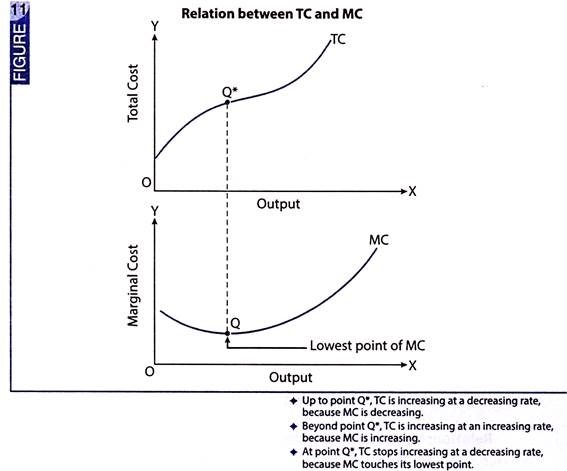
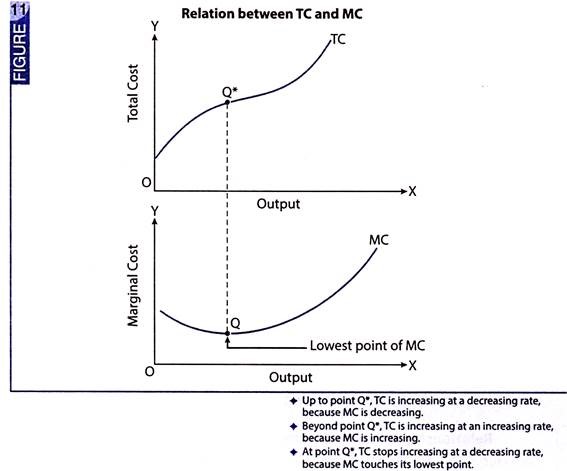
(ii) When MC is diminishing, TC increases at a diminishing rate.

(iii) When MC is rising, TC increases at an increasing rate.

(iv) When MC reaches its lowest point (point Q in Fig. 11), TC stops increasing at a decreasing rate (point Q* in Fig. 11).

Briefly, MC is the rate of TC.

A break from social media

How often do you use social media? Are you spending too much time on Facebook and losing out time for doing something worthwhile? If yes, then you are not alone in this case. According to reports, an average user spends 2 hours and 24 minutes per day on social media in 2020.
  Social media has become an inseparable part of our everyday life. It is always there with us right from the moment we wake up until the moment we fall asleep. Social media has both it’s share of advantages and disadvantages. Facebook at one hand helps bring the community closer and let’s one find new friends and connect instantly while on the other side social media at times affect one’s mental health easily when people start comparing their lives with others and land up being depressed.
  A break from social media at times, therefore, becomes a necessity to get back your sanity and most importantly to break free from its spell. Some of the ways to snooze social media can be the following.
1) Put down your phone- when you are with your friends you should make it a point to not check your phone every now and then and enjoy being with them at the present. Living in the present and enjoying the moments should be more important for you than being there just for the sake of posting stories on social media. While being with your friends keep your phone upside down so that you won’t check it often.
2) Schedule “social media free days” –
Take a day off or two from social media. Decide on a day or maybe choose the weekends to not waste your time scrolling Facebook or Instagram but instead try to invest your time on learning new skills or doing something productive. Get back to your long lost hobbies. Enjoy your weekend by spending quality time with your family or meet new people offline.
3) Turn off notification – you can turn off notifications of the apps where you know you waste excessive time than required without even knowing. Set alarms or download any app that would restrict your screen time and limit your access to social media, ultimately helping you get rid of its addiction.
4) Respond offline- try staying in touch with your friends offline. If you get any birthday notifications on Facebook, or if you see your friends getting married than instead of writing congratulations on their posts, better make a phone call and congratulate them. This would have a greater impact on your friendship.
5) Deactivate social media altogether- well, this could look like an impossible task for many, but you can at least give it a try for a week. Challenge yourself to take a break from social media for a week and see the amount of time you have saved from getting wasted on scrolling the screen looking at memes, viewing people’s stories and feeling miserable about not having such an adventurous or romantic life like most people try to show on their social media platforms of living a perfectly happy life.
So readers, try doing the above-mentioned steps, if you truly value your time and if you think you can utilise it on doing certain other productive activities. We all have to live in the real world in the end, so socialising with people in reality than socialising more online would help you grow better in life. Go ahead and try taking a break from social media, today. You won’t regret it, for sure!

NEW NORMAL IS NOT SO NORMAL !!

OUR PRIME MINISTER SHRI NARENDER MODI HAS TAGGED OUR COUNTRY A ‘ NEW INDIA ‘ , SURVIVING ALL THE CONSEQUENCES OF THE WIDE SPREAD CORONA VIRUS NOT ONLY IN OUR COUNTRY BUT ALL OVER THE WORLD. UNPREDICTABLE CHANGES HAVE OCCURRED WHICH HAS INCLINED US TO A PRETTY DIFFRENT TURN IN OUR LIFE AND OUR COUNTRY AS WELL . THEESE CHANGES HAVE INJECTED NEW TECHNOLOGIES INN , WHICH IS COMPLETE DIGITALISATION , IT HAS BECOME A NECESSITY NOW . EVERYTHING IS PROJECTED TO ONLINE MODE ALONG WITH PRODUCTIVE SCHEMES , WHICH HAS CREATED A ROAD FOR A ‘ NEW INDIA ‘ .NOW , OUR NORMAL LIFE IS ALL ONLINE , TAGGING IT AS “NEW NORMAL” . BUT , THE QUESTION ARISES ‘ ARE YOU LIKING THIS NEW NORMAL ? ‘ .

I KNOW CHANGES ARE USUALLY UNUSUAL AND ADAPTATION IS OUR NEED TO SURVIVE . UNFORTUNATELY , EVERYTHING ONLINE IS REALLY FRUSTRATING FOR ME . I AM MISSING THOSE DAYS WHEN I USED TO WORK HARD PHYSICALLY FOR ATTENDING THE CLASSES , I AM MISSING THAT HUSTLE , THAT IS MY NORMAL ! . WHEN I USED TO WRITE WITH A PEN ON A SHEET OF PAPER WHICH ALWAYS LEFT MY HANDS IN PAIN , I AM MISSING THAT OF SATISFACTION OF HARD WORK . NOW , I CN ONLY TYPE , STILL MY HAND PAINS BUT GIVING ME ZERO SATISFACTION.

I AM SITTING 24*7 EITHER IN FRONT OF MY MOBILE OR LAPTOP OR BOTH AT THE SAME TIME , THERE IS NO PEACE IN IT. MOREOVER , IT IS JUST ADDING TIREDNESS .

YES ! SOCIAL MEDIA , DIGITALISATION ARE IMPORTANT AND MOST OF THE WORK , AT PRESENT , ARE HAPPENING DUE TO ITS AVAILABILITY . BUT , IT CAN NEVER REPLACE THE PLACE OF OUR OFFLINE HUSTLE . I AM WISHING FOR MY NORMAL TO COME BACK AGAIN , FOR THAT PEACEFULL LIFE TO COME AGAIN . I HOPE THE SITUATION IMPROVES AND EVERYTHING BACK ON TRACK.

ONLINE TRANSFORMATON IS GOOD IN ALL THE SECTORS EXCEPT EDUCATION SECTOR , IT IS BEST IN OFFLINE .MOST OF YOU WILL DEFINITELY AGREE ON THIS !

OLD IS GOLD !

AND LIFE’s HUSTLE “A WHITE GOLD ” !

CCI approves proposed acquisition of compulsorily convertible preference shares and equity of Nxtra Data Limited by Comfort Investments II.

The Competition Commission of India (CCI) approves proposed acquisition of compulsorily convertible preference shares and equity of Nxtra Data Limited by Comfort Investments II.

The proposed combination pertains to the acquisition of compulsorily convertible preference shares and a few equity shares of Nxtra Data Limited by Comfort Investments II. Further, it is stated that the CCPS shall be converted to equity shares upon completion of the valuation.

Comfort Investments II is a specialpurpose vehicle incorporated in Mauritius, created for the purposes of the proposed transaction and is owned and controlled by the investment funds advised by affiliates of the Carlyle Group Inc. The Carlyle Group Inc. is a global alternative asset manager, which manages funds that invest globally.

Nxtra Data, and unlisted entity incorporated in India, is a fully owned subsidiary of Bharti Airtel Limited which provides an integrated portfolio of colocation, cloud and managed services across Indiathrough its 10 data centers located in India(including 2 partner datacentres in Mumbai) across 7 locations.

Bureau of Police Research and Development (BPR&D) to celebrate its Golden Jubilee Anniversary on 28th August, 2020

The Bureau of Police Research and Development is celebrating its Golden Jubilee Anniversary tomorrow, i.e., 28th August, 2020. Sh. G Kishan Reddy, MoS Home, has consented to be the Chief Guest and Sh. Ajay Kumar Bhalla, Home Secretary, MHA, will be the Guest of Honour.  Due to the Corona pandemic, the function will be conducted on virtual mode. The function will be viewed by the BPR&D Hqrs., its outlying units, States’ Police and CAPFs through the video link provided for this purpose. 

The Bureau of Police Research and Development was raised on 28th August, 1970, through a resolution of Ministry of Home Affairs, Government of India, with a mandate to promote excellence in policing, promote speedy and systematic study of police problems, apply science and technology in the method and techniques by the Police. The Bureau was initially started with two Divisions, i.e., Research, Publication & Statistics Division and Development Division. In 1973, the Training Division was added, on the recommendation of the Gore Committee on Police training. In 1995, Correctional Division was started to study the issues of Prisons and Prison Reforms. In 2008, the National Police Mission was added and Development Division was restructured as Modernization Division.

Over the years, the BPR&D has transformed through several additions of responsibilities into the present role. Now, with the raising of a new unit, Central Academy for Police Training at Bhopal, specialized as Centre of Excellence for Police & Correctional Administration, BPR&D has 6 outlying units.

The contribution of the BPR&D to Indian Police has been aptly summed up by Union Home Minister Shri Amit Shah on its 49th Foundation Day, while ushering the Bureau into its 50th year of existence:

Union Minister of Agriculture & Farmers’ Welfare Shri Narendra Singh Tomar holds discussion with Chief Ministers and State Agriculture Ministers on recent agriculture reforms and implementation of Agri Infrastructure Fund

Union Minister of Agriculture & Farmers’ Welfare, Rural Development & Panchayati Raj, Shri Narendra Singh Tomar, today held a detailed discussion with Chief Ministers and State Agriculture Ministers on recent agriculture market reforms and the new Central Sector Scheme of financing facility under the Agriculture Infrastructure Fund of Rs. 1 Lakh Crore. The event was conducted through Video Conference and Chief Minister of Uttar Pradesh Shri Yogi Adityanath, Chief Minister of Maharashtra Shri Uddhav Thackeray, and Agriculture Ministers of Rajasthan, Kerala, Chhattisgarh and Telangana, and Union Ministers of State for Agriculture Shri Purshottam Rupala and Shri Kailash Choudhary participated in the discussion.

During the discussion, Shri Tomar emphasized that the focus of the fund is to improve post-harvest management infrastructure and availability of community farming assets, and it is to be ensured that small and medium farmers receive the full benefit. The Chief Ministers and State Agriculture Ministers gave full assurance that no stone will be left unturned in ensuring utilization of the Rs 1 lakh crore fund, and new infrastructure will be created in all the villages.

States urged to proactively limit COVID transmission and keep the mortality below 1%

Cabinet Secretary holds a video conference (VC) with the Chief Secretariesand Health Secretaries of nine States and one UT at 1030 hrs today. The States/UT attending  the VC were Maharashtra, Tamil Nadu, Karnataka, Telangana, Gujarat, West Bengal, Uttar Pradesh, Punjab, Andhra Pradesh and Jammu & Kashmir, alongwith the Union Health Secretary, DG ICMR and Member  (Health), NITI Aayog. The VC was convened to review and discuss the COVID management and response strategy in these States/UT.

Union Health Secretary made a detailed presentation on the current status of COVID-19 in these States/UT, with a focus on districts reporting high case fatality and the need to refine as well as strengthen approach and strategiesrelating to testing, contact tracing, surveillance, containment, home isolation, availability of Ambulances, hospital beds, oxygen, treatment protocols, etc. It was observed that out of the total deaths in the country in the last two weeks, 89% of deaths are in these 10 States/UT and hence, these States/UT need to have continued and rigorous vigil so as to contain the spread of infection as well as take steps to reduce fatalities.

The States/UT were advised to proactively take stepstowards reducing case fatality to less than 1% across all districts focusing on :

  1. Effective containment, contact tracing & surveillance
  2. Ensuring that at least in 80 % of new positive cases, all close contacts should be traced and tested with 72 hours
  3. Ensuring a minimum of140 tests per million per day in all districts while targeting a positivity/confirmation rate of <5%
  4. Leveraging Antigen tests in containment zones / healthcare settings & retesting of all symptomatic negatives with RT-PCR
  5. Regular monitoring of home isolation patients (tele-calling and home visits) and ensuring timely admission to healthcare facility if SPO2 level falls below the designated level
  6. Putting in public domain the availability of beds and ambulances across COVID facilities while significantly reducing ambulance response time
  7. Saving lives by effective clinical management of all cases
  8. Monitoringweek-wise fatality rates for each health facility with particular focus on vulnerable patients (Comorbid, patients > 60 years’ age)
  9. Upgrading COVID dedicated facilities based on case load
  10. Monitoring availability and usage ofnecessary drugs, masks and PPE kits in all facilities
  11. Focus on Behavioral Change Communication promoting COVID appropriate behavior consisting of social distancing, wearing of masks, hand hygiene, cough etiquettes etc.

The Chief Secretaries explained about the current situation in the States/UT and their preparedness to tackle the spread of COVID-19, health infrastructure available to meet the challenge and steps taken to strengthen it further. States/UT also highlighted steps taken towards reducing case fatality as well as involving community in terms of COVID safe behaviour.

Grand finale to Textile Grand Challenge 2019 organized by Ministry of Textiles to bring forward innovative ideas aimed at phasing out plastic bags

Union Minister of Textiles and Women & Child Development Smt Smriti Zubin Irani today

said that the innovative spirit of India needs to be institutionalized for developing eco-friendly and cost-friendly alternative ideas that can also be utilized to create job opportunities. Speaking at the award giving ceremony for winners of the Textile Grand Challenge 2019 organized by Ministry of Textiles in keeping with Prime Minister Shri Narendra Modi’s clarion call to take decisive action for plastic waste management during his Independence Day speech on 15th August 2019, the Union Minister said that the contribution of innovative ideas by the participants is an indication that the legacy of Indiais steeped in equal opportunities for all.

Minister Smt Smriti Zubin Irani stressed on the need to upgrade textiles machine technology especially in the jute sector and proposed to organize a Grand Machinery Challenge for the Textile Sector to throw up new technologies.

Providing Ease of Tax Compliance and Opportunity to taxpayers before finalizing of Assessment Order are the core features of Faceless Assessment Scheme, a right step towards Minimum Government, Maximum Governance: Principal Chief Commissioner – Income Tax, Mumbai

Faceless E-Assessment scheme is a right step towards Minimum Government, Maximum Governance and the foundation stone for a transparent tax system. This is how Principal Chief Commissioner of Income Tax in Mumbai, Shri Patanjali Jha summarizes the new platform of Income Tax Department. He added that providing Ease of Tax Compliance and Opportunity to taxpayers before finalizing of Assessment Order are the core features of this scheme, while speaking at a webinar on ‘Faceless Assessment, Appeals & Taxpayer’s Charter’ jointly organized by the IMC Chamber of Commerce & Industry and Bombay Chamber of Commerce & Industry today.

Making a comparison between the faceless assessment system and the current system it replaces, the Principal Chief Commissioner explained how the new system is one designed for the 21st century. “There is no discretion in selection of assessment cases, while earlier, case selection used to happen manually. In place of single territorial jurisdiction, we now have automated random allocation of cases. While notices used to be issued both manually and on the system, issue of notices will now be done through a central mechanism (by NeAC) in electronic mode. There will be no physical meeting with any officer, no officer will call you to office and no more waiting outside office”, explained Shri Jha. He also noted, wide discretion and subjective assessment are being replaced by team-based assessment and a system wherein draft order is issued in one city, review is done in another city and finalization is done in yet another city, said the Principal Chief Commissioner. This apart, the scheme gives opportunity to taxpayers, in case of any order prejudicial before finalizing the Assessment order.

The Principal Chief Commissioner urged all taxpayers to visit the e-filing portal to understand how easy it is to use the platform from where all issues with the Department can be resolved easily. “On our part we expect you to understand and try to adapt; We will also provide suitable infrastructure facilities and ensure tax compliance is easy for tax payers”, stated Shri Jha

A National e-Assessment Centre (NeAC) and a network of Regional e-Assessment Centres will be set up to implement the Faceless Assessment Scheme of the Income Tax Department, launched nation-wide by Prime Minister Shri Narendra Modi on 13th August, 2020. The regional assessment network would comprise assessment units, verification units, technical units and review units. The system allows for dynamic jurisdiction, team-based working, and functional specialization and does away with human interface altogether.

The Chief Commissioner of Income-Tax (ReAC) Mumbai, Smt. Lekha Kumar and Principal Commissioner of Income-Tax, Mumbai, Shri. Kaushal Shrivastava also addressed the participants and responded to their queries.

Text of PM’s address at seminar on Atmanirbhar Bharat in Defence manufacturing

मंत्रिमंडल मे मेरे सहयोगी श्रीमान राजनाथ जी, Chief of Defence Staff जनरल बिपिन रावत जी, सेना के तीनों अंगों के प्रमुख, भारत सरकार के सभी उपस्थित उच्‍चाधिकारी, उद्योग जगत के सभी साथी, नमस्‍कार।

मुझे खुशी है कि भारत में रक्षा उत्‍पादन से जुड़े हुए सभी अहम stakeholders आज यहां मौजूद हैं। इस सेमिनार के आयोजन के लिए रक्षामंत्री राजनाथ जी और उनकी पूरी टीम को मैं बहुत-बहुत बधाई देता हूं। आज यहां हो रहे इस मंथन से जो परिणाम मिलेंगे, उनसे रक्षा उत्‍पादन के क्षेत्र में आत्‍मनिर्भरता के हमारे प्रयासों को अवश्‍य बल मिलेगा, गति मिलेगी और आप सबने जो सुझाव दिए हैं, आज आपने एक सामूहिक मंथन किया है, वो अपने-आप में आने वाले दिनों के लिए बहुत उपकारक होगा।

मुझे इस बात की भी खुशी है कि रक्षामंत्री श्री राजनाथ जी इस काम के लिए mission mode में पूरी तरह से जुटे हुए हैं। मुझे विश्‍वास है कि उनके इन अथक प्रयासों के कारण बहुत ही अच्‍छे परिणाम मिलना निश्चित है।

साथियो, ये किसी से छिपा नहीं है कि भारत कई सालों से दुनिया के सबसे बड़े Defence Importers में एक प्रमुख देश रहा है। जब भारत आजाद हुआ था तो उस समय रक्षा उत्‍पादन के लिए भारत में बहुत सामर्थ्‍य था। उस समय भारत में 100 साल से अधिक समय से स्‍थापित रक्षा उत्‍पादन का Ecosystem था। और भारत जैसा सामर्थ्‍य और potential बहुत कम देशों के पास था। लेकिन भारत का दुर्भाग्‍य रहा कि दशकों तक इस विषय पर उतना ध्‍यान नहीं दिया गया जितना देना चाहिए था। एक प्रकार से ये routine exercise बन गया, कोई गंभीर प्रयास नहीं किए गए थे। और हमारे बाद में शुरूआत करने वाले अनेक देश भी पिछले 50 साल में हमसे बहुत आगे निकल गए। लेकिन अब स्थिति बदल रही है।

पिछले कुछ वर्षों में आपने अनुभव किया होगा कि हमारा प्रयास इस सेक्‍टर से जुड़ी सभी बेड़ियां तोड़ने का एक निरंतर प्रयास है। हमारा उद्देश्‍य है कि भारत में manufacturing बढ़े, नई technologies का भारत में ही विकास हो और प्राइवेट सेक्‍टर का इस विशेष क्षेत्र में अधिकतम विस्‍तार हो। और इसके लिए लाइसेंसिंग प्रक्रिया में सुधार, level playing field की तैयारी, export की प्रक्रिया का सरलीकरण, offset के प्रावधानों में सुधार; ऐसे अनेक कदम उठाए गए हैं।

साथियो, मेरा मानना है कि इन कदमों से भी अधिक महत्‍वपूर्ण है रक्षा क्षेत्र में देश में एक नई मानसिकता हम सब अनुभव कर रहे हैं, एक नई मानसिकता का जन्‍म हुआ है। आधुनिक और आत्‍मनिर्भर भारत के निर्माण के लिए रक्षा क्षेत्र में आत्‍मविश्‍वास की भावना अनिवार्य है। बहुत लंबे समय से देश में Chief of Defence Staff की नियुक्ति पर विचार किया जा रहा था, लेकिन निर्णय नहीं हो पा रहा था। ये निर्णय नए भारत के आत्‍मविश्‍वास का प्रतीक है।

बहुत लंबे समय तक रक्षा उत्‍पादन में विदेशी निवेश की अनुमति नहीं थी। श्रद्धेय अटल जी की सरकार के समय ये नई पहल की शुरूआत हुई थी। हमारी सरकार आने के बाद इसमें और सुधार किए गए और अब पहली बार इस सेक्‍टर में 74 पर्सेंट तक एफडीआई ऑटोमेटिक रूप से आने का रास्‍ता खोला जा रहा है। ये नए भारत के आत्‍मविश्‍वास का परिणाम है।

दशकों से Ordnance कारखानों को सरकारी विभागों की तरह ही चलाया जा रहा था। एक सीमित vision के कारण देश का नुकसान तो हुआ ही, वहां जो काम करने वाले लोग थे,‍ जिनके पास talent थे, commitment था, मेहनती थे, ये हमार बहुत ही अनुभव से संपन्‍न हमारा जो मेहनत करने वाला श्रमिक वर्ग वहां जो है, उनका तो बहुत नुकसान हुआ।

जिस सेक्‍टर में करोड़ों लोगों के रोजगार के अवसर बन सकते थे, उसका ecosystem बहुत ही सीमित रहा। अब Ordnance कारखानों का corporatization करने की दिशा में हम आगे बढ़ रहे हैं। इस प्रक्रिया के पूरा होने पर श्रमिकों और सेना, दोनों को बल मिलेगा। यह नए भारत के आत्‍मविश्‍वास का प्रमाण है।

साथियो, रक्षा उत्‍पादन में आत्‍मनिर्भरता को लेकर हमारा commitment सिर्फ बातचीत में या‍ फिर कागजों तक ही सीमित नहीं है। इसके कार्यान्‍वयन के लिए एक के बाद एक ठोस कदम उठाए गए हैं। CDS के गठन के बाद सेना के तीनों अंगों में procurements पर समन्‍वय बहुत बेहतर हुआ है, इससे defence equipments की खरीद को scale up करने में मदद मिल रही है। आने वाले दिनों में domestic industry के लिए orders का साइज भी बढ़ने वाला है। ये सुनिश्चित करने के लिए रक्षा मंत्रालय के कैपिटल बजट का एक हिस्‍सा अब भारत में बने उपकरणों के लिए अलग से रख दिया गया है।

हाल में आपने देखा होगा कि 101 defence items को पूरी तरह से घरेलू खरीद के लिए सुरक्षित कर दिया गया है। आने वाले दिनों में इस लिस्‍ट को और व्‍यापक बनाया जाएगा इसमें और items जुड़ते रहेंगे। इस लिस्‍ट का उद्देश्‍य आयात को रोकना मात्र नहीं है, बल्कि भारत में उद्योगों को प्रोत्‍साहित करने के लिए ये कदम उठाया गया है। इससे आप सभी सा‍थियों को, चाहे वो प्राइवेट सेक्‍टर हो, पब्लिक सेक्‍टर हो, MSME हों, स्‍टार्टअप हो, सभी के लिए ये सरकार की भावना और भविष्‍य की संभावना अब आपके सामने black and white में क्लियर है।

इसके साथ हम procurement प्रकिया को speed up करने के लिए, testing की व्‍यवस्‍था को streamline करने के लिए और क्‍वालिटी की requirements को rationalize करने के लिए भी लगातार काम कर रहे हैं। और मुझे खुशी है कि इन सभी प्रयासों को सेना के तीनों अंगों का बहुत ही coordinated रूप में, बहुत ही सहयोग है, एक प्रकार से pro-active भूमिका है।

साथियो, आधुनिक उपकरणों में आत्‍मनिर्भरता के लिए technology up-gradation जरूरी है। जो उपकरण आज बन रहे हैं उनका next generation तैयार करने पर काम करना भी आवश्‍यक है। और इसके लिए DRDO के अलावा प्राइवेट सेक्‍टर में और academic institutions में भी research और innovation को प्रोत्‍साहित किया जा रहा है। Technology transfer की सुविधा से हटकर Foreign partners के साथ Joint ventures के माध्‍यम से Co-production के मॉडल पर बल दिया जा रहा है। भारत के मार्केट साइज को देखते हुए हमारे Foreign partners के लिए अब भारत में ही production करना सबसे उत्‍तम विकल्‍प है।

साथियो, हमारी सरकार ने शुरू से ही Reform, Perform & Transform, इस मंत्र को ले करके हमने काम किया है। Red tapism कम करना और Red Carpet बिछाना, यही हमारा प्रयास रहा है। Ease of doing business को लेकर 2014 से अब तक जो सुधार किए गए हैं, उनका परिणाम पूरे विश्‍व ने देखा है। Intellectual property, taxation, insolvency and Bankruptcy, यहां तक कि Space और Atomic energy जैसे बहुत कठिन और जटिल, ऐसे जो विषय माने जाते हैं, उन विषयों पर भी हमने reforms करके दिखाए हैं। और आप तो अअब भलीभांति जानते हैं पिछले दिनों labour laws में reforms का सिलसिला भी लगातार जो शुरू हुआ है, चल रहा है।

कुछ साल पहले तक इस प्रकार के विषयों पर सोचा भी नहीं जाता था। और आज ये reforms जमीन पर उतर चुके हैं। Reforms का ये सिलसिला थमने वाला नहीं है, हम आगे बढ़ते ही जाने वाले हैं। इसलिए न थमना भी है और न थकना भी है; न मुझे थकना है न आपको थकना है। हमें आगे भी आगे बढ़ते रहना है और हमारी तरफ से मैं आपको बताता हूं ये हमारा commitment है।

साथियो, जहां तक infrastructure की बात है, जो defence corridors पर तेजी से काम चल रहा है, उत्‍तर प्रदेश और तमिलनाडु की सरकारों के साथ मिलकर state of the art infrastructure तैयार किया जा रहा है। इसके लिए आने वाले पांच सालों में 20 हजार करोड़ रुपये के निवेश का लक्ष्‍य रखा गया है। MSME और Start-ups से जुड़े Entrepreneurs को प्रोत्‍साहित करने के लिए IDEX की जो पहल की गई थी, उसके भी अच्‍छे परिणाम मिल रहे हैं। इस प्‍लेटफॉर्म के माध्‍यम से 50 से अधिक startups ने सैन्‍य उपयोग के लिए technology और products को विकसित किया है।

साथियो, मैं एक और बात आपके सामने खुले मन से रखना चाहता हूं। आत्‍मनिर्भर भारत का हमारा संकल्‍प inward looking नहीं है। Global economy को ज्‍यादा resilient, ज्‍यादा stable बनाने के लिए, विश्‍व में शांति के लिए एक सक्षम भारत का निर्माण ही इसका लक्ष्‍य है। यही भावना Defence manufacturing में आत्‍मनिर्भरता के लिए भी है। भारत में अपने कई मित्र देशों के लिए रक्षा उपकरण का एक भरोसेमंद सप्‍लायर बनने की क्षमता है। इससे भारत की strategic partnership को और बल मिलेगा और हिंद महासागर क्षेत्र में भारत की net security provider की भूमिका और सुदृढ़ होगी।

साथियो, सरकार के प्रयास और प्रतिबद्धता आप सभी के सामने हैं। अब आत्‍मनिर्भर भारत के संकल्‍प को हमें मिल करके इसे सिद्ध करना है। चाहे प्राइवेट सेक्‍टर हो या पब्लिक सेक्‍टर हो, या फिर हमारे foreign partners, आत्‍मनिर्भर भारत सभी के लिए Win-Win संकल्‍प है। इसके लिए आपको एक बेहतर ecosystem देने के लिए हमारी सरकार प्रतिबद्ध है।

यहां आपकी तरफ से जो भी सुझाव आए हैं वे बहुत ही उपयोगी सिद्ध होने वाले हैं। और मुझे बताया गया है कि Defence production and export promotion policy का draft सभी stakeholders के साथ साझा कि‍या गया है। आपके feedback से इस पॉलिसी को जल्‍द से जल्‍द लागू करने में मदद मिलेगी। यह भी जरूरी है कि आज का ये सेमिनार एक one time event न रहे बल्कि आगे भी ऐसे आयोजन होते रहें। इंडस्‍ट्री और सरकार के बीच लगातार विचार-विमर्श और feedback की स्‍वाभाविक culture बननी चाहिए।

मुझे विश्‍वास है कि ऐसे सामूहिक प्रयासों से हमारे संकल्‍प सिद्ध होंगे। मैं फिर एक बार, आप सबने समय निकाला, आत्‍मनिर्भर भारत बनाने के लिए आत्‍मविश्‍वास के साथ आप जुटे, मुझे विश्‍वास है कि आज जो संकल्‍प हम ले रहे हैं, इसको पूर्ण करने में हम सब ने अपनी जिम्‍मेदारी बहुत खूब अच्‍छे ढंग से निभाएंगे।  

मैं फिर एक बार आप सभी को बहुत-बहुत शुभकामनाएं देता हूं।

Raksha Mantri Shri Rajnath Singh highlights Atmanirbhar Bharat initiatives of MoD at Defence Industry Outreach Webinar

Raksha Mantri Shri Rajnath Singh listed out the salient features of the recently announced first Defence Production and Export Promotion policy at the Atmanirbhar Bharat Defence Industry Outreach Webinar which was jointly organised by Society of Indian Defence Manufacturers (SIDM), Federation of Indian Chambers of Commerce and Industry (FICCI) and Department of Defence Production (DDP), Ministry of Defence (MoD) here today.

It may be recalled that Prime Minister Shri Narendra Modi had highlighted the need for achieving self-sufficiency in defence production in his clarion call on ‘Atmanirbhar Bharat Abhiyan’ during his announcement of COVID-19 related economic package of Rs20 lakh crore on May 12, 2020. He further outlined his vision for the same on Jun 02, 2020; wherein five pillars of Atmanirbhar Bharat were identified as economy, infrastructure, systems, vibrant demography and demand.

Defence sector has already been identified as one of the core areas to boost ‘Make in India’ where immediate transformation is required. Prime Minister Shri Narendra Modi also spelt out his vision of achieving five billion USD (Rs35,000 crore) defence related exports target to become net exporter of defence equipment in the next five years.

Towards this end, a draft Production and Export Promotion policy has been formulated and it was placed in the public domain seeking suggestins from various stakeholders.

The draft of Production and Export Promotion policy aims at providing greater visibility of Armed Forces requirements to the defence manufacturing industry. The policy proposes establishment of an aero-engines complex with focus on Maintenance Repair Overhaul (MRO) as well as critical technologies. Under this policy export target has been set as 25 percent of the revenue. By 2025, this policy aims at achieving Rs 1.75 lakh crore in annual turnover.

To promote Atmanirbhar Bharat in the defence manufacturing, a separate budget of Rs 52,000 crore has been set aside for procurement from domestic vendors.

Speaking on MoD recently issuing a negative list of 101 defence items on the valuable suggestion of Prime Minister Shri Narendra Modi, Shri Rajnath Singh said, “After a certain period of time these items will not be procured from outside. This list is the beginning of a process that has the potential to transform the defence industry. This list of 101 items includes not only minor parts but also warfare systems, integrated platforms, combat vehicles. This list is just a beginning, so that in the coming time, defence equipment worth Rs 1.40 lakh crore will be purchased domestically.”

Raksha Mantri said that the government has made several bold policy reforms to promote self-reliance, in the defence sector. These include increasing the limit to 74 percent for Foreign Direct Investment through automatic route in the Defence sector and setting up of Defence corridors in UP and Tamil Nadu in addition to Strategic Partnership (SP) Model to promote investments, liberalisation of Industrial License regime, and ‘Defence Investor Cell’ to address the problems of investors.

Shri Rajnath Singh said, “Self-reliance is actually another form of our confidence and strength. According to the formula presented by our Prime Minister five ‘I’, i.e., Intent, Inclusion, Investment, Infrastructure and Innovation, we have taken steps towards increasing our own strength. Its results have also started coming in front of us.”

Speaking about the urge of Nations to become self-reliant, the Raksha Mantri said, “The spirit of ‘self-reliance’ has always been present in our society, our education and values. It has existed as part of us, from our tradition to modern times. It has existed from ‘the Vedas’ to ‘Vivekananda Ji’, from ‘the Geeta’ to ‘Gandhi Ji’, and from ‘Upanishads’ to ‘Upadhyay’ (Deendayal) ji. Everyone, whether they have been our great men or our governments, in their own way accepted the importance of self-reliance. But in the recent past, the emphasis placed on the call of our Prime Minister Shri Narendra Modi on atmanirbharta is unprecedented.”

While answering questions from the participants, Raksha Mantri said that corporatisation of Ordnance Factory Board (OFB) would be completed within a year. In response to another question, Shri Rajnath Singh replied that the two Defence Industrial Corridors in Uttar Pradesh and Tamil Nadu were targeted to attract thousands of crores of investments in the next five years.

Industry representatives also sought clarifications on various reforms introduced in defence acquisition procedure including offset provisions, reservation of items for procurement from MSMEs, definition of Indian vendor etc.

After the question and answer session, Prime Minister Shri Narendra Modi addressed the webinar.

Today’s webinar was another step of Outreach to Industry which aimed to evolve a mutually beneficial and pragmatic road map in consonance with industry expectations and capabilities.

The FICCI webinar which had representation from all three Services, MoD, DRDO and industry covered energising strategies to develop niche tech and promote culture of innovations. It was decided to develop large eco system with well-defined role for all stake holders/ MSMEs as tier-II / tier-III suppliers, start-ups and academia as innovators, industry houses as aggregators, testing & quality assurance services providers. To achieve the envisioned goal, Webinar encouraged innovation to make in India as an integral part of Global Supply Chain and top class destination for manufacture of defence equipment. It stressed to develop world class testing and evaluation infrastructure by utilising existing infrastructure with DRDO and private industry. The participants also discussed ways to develop manufacturing and sustenance eco system to help in life cycle support of indigenous equipment.

Chief of Defence Staff & Secretary Department of Military Affairs General Bipin Rawat, Chief of Army Staff General M M Naravane, Chief of Naval Staff Admiral Karambir Singh, Chief of Air Staff Air Chief Marshal R K S Bhadauria, Principal Scientific Advisor to the Government of India Prof VijayaRaghavan, Defence Secretary Dr Ajay Kumar, Secretary (Defence Production) Shri Raj Kumar, Secretary Department of Defence R&D and Chairman DRDO Dr G Satheesh Reddy, President of SIDM Shri Jayant D Patil, FICCI President Smt Sangeeta Reddy, former president of SIDM Shri Baba N Kalyani, Chairman FICCI Defence committee S P Shukla, senior civil & military officials of MoD, Ordnance Factory Board, DPSUs and private industry participated in the webinar which was watched by nearly 2,000 participants from industry and academia.

Union Minister of Jal Shakti and Goa Chief Minister held joint review meeting through VC for implementation of Jal Jeevan Mission

Minister of Jal Shakti Shri Gajendra Singh Shekhawat held a meeting with Chief Minister of Goa Shri Pramod Sawant through video conferencing today to discuss the implementation of Jal Jeevan Mission in the State. Jal Jeevan Mission (JJM) is under implementation in partnership with States to provide drinking water to every rural household of the country. The objective of the Mission is universal coverage i.e. every family in the village gets tap water connection in their households.

Jal Jeevan Mission’s vision is to ensure that every rural household has drinking water supply in adequate quantity of prescribed quality on regular and long -term basis at affordable service delivery charges leading to improvement in living standards of rural communities. To assist, empower and facilitate States in implementation of the participatory rural water supply strategy, water security & building water infrastructure, Ministry of Jal Shakti is reviewing the progress regularly.

Goa is planning 100% tap connections to all households by 2020-21. Out of 2.6 lakh households in the State, 2.29 lakh households have household tap connections. In 2019-20, the State could provide only 1025 household tap connections. In 2020-21, 4,500 households provided with tap connections so far.

The Union Minister of Jal Shakti had a detailed discussion on the progress of the mission in the State with the Chief Minister. The Chief Minister assured to provide household tap connections to remaining households in rural areas of the State.

The Union Minister mentioned that Union Government led by Prime Minister is committed to provide all assistance to the State Government to achieve the goal of the mission. The Minister stated that providing potable water is a national priority for the Government. He stated that expeditious implementation of JJM will ensure that people living in rural areas will get potable water in adequate quantity, of prescribed quality on regular basis in their households on long-term basis; thus, ensuring our mothers, sisters and daughters a well-deserved ‘ease of living’ and dignified life. The Minister requested Goa Chief Minister to work in a ‘campaign mode’ and enable the households of marginalised sections of society with tap connections. Shri Shekhawat urged that priority should be given on saturating villages in water scarce areas and aspirational districts, SC/ ST dominated villages/ habitations & Sansad Adarsh Gram Yojana villages.

The minister of Jal Shakti emphasized on strengthening of existing drinking water sources to ensure long-term sustainability of drinking water supply systems through convergence of various programmes like MGNREGS, JJM, SBM (G), 15th FC Grants to PRIs, District Mineral Development Fund, CAMPA, CSR Fund, Local Area Development Fund, etc.

It was also emphasised the need for source strengthening and grey water management in each village. Sensor-based IoT solutions can be started in the State on pilot basis to measure and monitor water supply in villages. The minister also raised his concerns over high operation & maintenance cost of water supply in the State. It was further requested to open the water testing laboratories for public, so that people can test the water at reasonable rate.

It was highlighted that Goa can become a model state in public utility for water service delivery by assuring regular water supply and also ensuring responsive grievance redressal system.

National Jal Jeevan Mission to work with Sector Partners

Announced by Hon’ble Prime Minister in his address to the nation, Jal Jeevan Mission (JJM) is under implementation in partnership with States/ UTs. The mission aims to provide Household Tap Connection to every rural household of the country by 2024. JJM is a time-bound, mission-mode programme that focuses on service delivery at household level, i.e.  water supply on regular and long-term basis in adequate quantity and of prescribed quality. The mission plans to holistically address the challenges, viz. depleting water sources, increasing water quality-issues, lack of in-village infrastructure, poor Operation & Maintenance, lack of resource efficiency, competing water demands from various sectors, etc.

The goal of the Jal Jeevan Mission is to improve lives of people by ensuring potable water in their households. The mission is not just about creating physical infrastructure but also forging partnerships with various organizations for smooth implementation of JJM. Therefore, Department of Drinking Water and Sanitation (DDWS), Ministry of Jal Shakti has sought interest from foundations, trusts, NGOs, Community Based Organizations (CBOs), VOs, etc. to work closely with the mission as ‘Sector Partner’.  Organizations proactively working in the sectors such as water, sanitation and hygiene, natural resources management, community engagement, capacity building & awareness generation, education, health, tribal development, gender & equity, etc. with wide outreach and impact are expected to be associated with the mission. The interested agencies would have to submit their applications online by 16.09.2020 for consideration of the Mission. Details are available on https://jalshakti-ddws.gov.in/.

The Sector Partner will provide support to Mission/ States by working in the broad areas of the mission including selection of Implementation Support Agencies, forging partnership with State Water and Sanitation Mission, to bring together academic institutions, NGOs, civil society, and assisting assist the States to adopt appropriate O&M mechanisms to ensure long term sustainability of sources with special focus on water quality. Further, the scope of work for Sector Partner shall also include providing capacity building support to different stakeholders; identification of successful models in community mobilization for replication, field visits to understand social inclusion, social audit/ monitoring under JJM, etc.

There are many organizations, individuals already working in the field of water have shown genuine interests to be partner in the Jal Jeevan Mission. Thus, by engaging Sector Partners, JJM aims to harness the huge potential of the local community through Voluntary Organizations (VOs), Non-Governmental Organizations (NGOs), social service & charity organizations, and professionals working in drinking water sector, who are willing to work towards mobilizing and enhancing the capacities of the communities to achieve the goal of the mission.

The mission aims at capacity building of Gram Panchayat and/ or its sub-committee, i.e., Village Water & Sanitation Committee (VWSC)/ Paani Samiti on managerial, technical and financial aspects so that they can plan, manage, implement, operate and maintain the in-village water supply infrastructure. Communities are also to be enabled to take up surveillance of quality of water supplied by training five persons, preferably women, in every village for quality testing through Field Test Kits (FTKs). To take forward these activities, role of organizations working in rural areas will be very vital especially in mobilizing the community as well as handholding them.

For the success of this life changing mission, it’s necessary that Government and private/ corporate sector including voluntary & charity organizations join hands together to develop synergy for efficient outputs. To make water everyone’s business, the mission strives to build partnerships and work together with different stakeholders to achieve drinking water security for all.