𝑹𝑨𝑰𝑵𝒀 𝑺𝑬𝑨𝑺𝑶𝑵𝑺

Rain is not only drops of water. It’s the love of the sky for the 𝗘𝗔𝗥𝗧𝗛 They never meet each other but sends love this way.” 

A rainy day refrigerates the weather with showers and a warm breeze. It freshens everyone by making the climate fresh and pleasant and brings in a sigh of relief from the scorching heat.

It is a blessing for trees, birds, animals, plants and people during the summer. Trees look so fresh, colourful and refreshing after a shower. Rainy day is essential for farmers as it helps in the growth of crops.

Rainy days are different from any other day. They hold great importance for everyone differently. People have different reasons to wait for the 𝙍𝘼𝙄𝙉𝙔 𝙎𝙀𝘼𝙎𝙊𝙉 eagerly. After all, it brings a sigh relief for everyone. No matter what the weather may be, a rainy day relaxes and soothes our soul. There is no age limit to enjoy rainy days people of almost every age enjoy it equally. Thus, rainy days are very important for a number of reasons.

There are so much rainwater and fresh air in this season. That’s why the environment becomes very clear and enjoyable. People love this season a lot. Personally, I love a rainy time a lot and get wet in the rain.

The whole natural environment including trees, flowers, and other plants become so much green and full of life. They look so alive and beautiful. Most of the trees get new leaves and look very attractive. There are lots of festivals that people celebrate in this season.

My mother  cooks so many types of delicious food this season. I love eating them. A rainy day is really enjoyable for me, I love to listen song at this time. LIstening songs is one of my fav hobbies, Overall, the rainy season is really amazing.

I always think that the rainy season is the best season, because of its natural beauty. Most people refer to this season as their favorite one. Yeah, it’s my favorite season. After a long hot summer, people become restless for some cold air and clear rains. At that time, the 𝗥𝗮𝗶𝗻𝘆 𝘀𝗲𝗮𝘀𝗼𝗻  comes with so much pleasure and blessings.

It makes the whole environment cool and looks beautiful. Sometimes it becomes really boring for a long time rain, but most of the time I enjoy the rainy day. 

We don’t go to school if there are heavy rains outside. Most of the time we go to the roof to enjoy the rain. A few of my friends dance and sing, it is really great fun together on the roof. We mostly do this at the beginning of the season.

But gradually after a few weeks, we don’t care so much about rain. Overall, this season is really amazing and enjoyable. I love this season a lot because everything gets life with a touch of rainwater. That is an amazing scene for everyone…..

ARYABHATTA

Aryabhatta was the first Indian mathematician and astronomer. He had immense knowledge in the field of mathematics. Moreover, he did he may discoveries during his era. For instance, some of them were the discovery of algebraic identities, trigonometrical functions, the value of pi, Place value system, etc.

Furthermore, he wrote many books which still help us in performing various calculations. Aryabhatta was a great influence to many youngsters. For he excelled in academics from a very early age. Moreover, he contributed much to the society his works and theories are still remembered and honored till date.


EARLY LIFE

Aryabhatta was born in 475 A.D. Furthermore his birthplace eas not sure, but in his book the ‘Aryabhatiya’, he mentions that he was a native of Kusumapura the modern-day Patna. Moreover, from his historical records, the archaeologists believed that he continued his further studies in Kusumapura. Because in Kusumapura his major astronomical observatory was located.

Therefore, we can ascertain that Aryabhatta spent most of the time there. Further, some historians believe that he was also the head of Nalanda University in Kusumpura. Though these theories are all on a probable basis because no proper evidence was there except the books Arybhatta wrote in his lifetime. Yet some of his records were lost and are not found till date.


WORK OF ARYABHATTA

Aryabhatta contributed greatly to the field of mathematics. For instance, he was responsible for discovering various trigonometrical functions which are useful for us in the modern era too.

Furthermore, his discovery for the value of ‘pi’ eased the complications in mathematics. Above all, he founded the place value system and zero which are one of his major contributions in the history of mathematics. Most Noteworthy is that every theory is in his book ‘Aryabhatiya’ which states astronomical theories. Furthermore, his book divides into different sections of mathematics and astronomy.

Apart from his discoveries in the field of mathematics, Aryabhatta contributed immensely towards astronomy. He proposed the heliocentric theory which states the planets revolve around the Sun. with the help of this theory, he calculated the speed of the different planets with respect to the Sun.

Furthermore, he also calculated the sidereal rotation which is the rotation of the earth in reference to the stars. Moreover, he founded the sidereal year to be 365 days, 6 hours, 12 minutes and 30 seconds which varies with only 3 minutes and 20 seconds over the modern-day value.


CONTRIBUTIONS

Most noteworthy is that Aryabhatta correctly founded that the earth rotates on its axis. Furthermore, he also proposed the geocentric model of the solar system which described the earth to be the center of the universe. And the sun, the moon, and the planets revolve around it.

Aryabhata also explained the solar and lunar eclipses in his book. Consequently, he also proposed that the moon due to the reflection of the sunlight. He explained in his book that the lunar eclipse and the solar eclipse takes by the shadow-casting of the earth and the moon.

In conclusion Aryabhatta approximations in the field of astronomy were quite accurate. It provided the core to the computational paradigm which provides a base to the modern theories.

ARYABHATTA

Aryabhatta was the first Indian mathematician and astronomer. He had immense knowledge in the field of mathematics. Moreover, he did he may discoveries during his era. For instance, some of them were the discovery of algebraic identities, trigonometrical functions, the value of pi, Place value system, etc.

Furthermore, he wrote many books which still help us in performing various calculations. Aryabhatta was a great influence to many youngsters. For he excelled in academics from a very early age. Moreover, he contributed much to the society his works and theories are still remembered and honored till date.


EARLY LIFE

Aryabhatta was born in 475 A.D. Furthermore his birthplace eas not sure, but in his book the ‘Aryabhatiya’, he mentions that he was a native of Kusumapura the modern-day Patna. Moreover, from his historical records, the archaeologists believed that he continued his further studies in Kusumapura. Because in Kusumapura his major astronomical observatory was located.

Therefore, we can ascertain that Aryabhatta spent most of the time there. Further, some historians believe that he was also the head of Nalanda University in Kusumpura. Though these theories are all on a probable basis because no proper evidence was there except the books Arybhatta wrote in his lifetime. Yet some of his records were lost and are not found till date.


WORK OF ARYABHATTA

Aryabhatta contributed greatly to the field of mathematics. For instance, he was responsible for discovering various trigonometrical functions which are useful for us in the modern era too.

Furthermore, his discovery for the value of ‘pi’ eased the complications in mathematics. Above all, he founded the place value system and zero which are one of his major contributions in the history of mathematics. Most Noteworthy is that every theory is in his book ‘Aryabhatiya’ which states astronomical theories. Furthermore, his book divides into different sections of mathematics and astronomy.

Apart from his discoveries in the field of mathematics, Aryabhatta contributed immensely towards astronomy. He proposed the heliocentric theory which states the planets revolve around the Sun. with the help of this theory, he calculated the speed of the different planets with respect to the Sun.

Furthermore, he also calculated the sidereal rotation which is the rotation of the earth in reference to the stars. Moreover, he founded the sidereal year to be 365 days, 6 hours, 12 minutes and 30 seconds which varies with only 3 minutes and 20 seconds over the modern-day value.


CONTRIBUTIONS

Most noteworthy is that Aryabhatta correctly founded that the earth rotates on its axis. Furthermore, he also proposed the geocentric model of the solar system which described the earth to be the center of the universe. And the sun, the moon, and the planets revolve around it.

Aryabhata also explained the solar and lunar eclipses in his book. Consequently, he also proposed that the moon due to the reflection of the sunlight. He explained in his book that the lunar eclipse and the solar eclipse takes by the shadow-casting of the earth and the moon.

In conclusion Aryabhatta approximations in the field of astronomy were quite accurate. It provided the core to the computational paradigm which provides a base to the modern theories.

History of Tea in India

Though the Camellia synesis is also native to India, and grew in the wild long before its actual value was understood, it is thought that tea was carried to India by silk caravans travelling from China to Europe centuries ago.

Native Americans ate the leaves occasionally, but they were largely employed for their medicinal powers.

Photo by Lisa on Pexels.com

It took a long time for it to evolve into what is currently known as chai, a flavorful black tea sweetened with sugar and milk, along with spices like cardamom and ginger, and used in cooking, vegetable dishes, and soup.

Tea was initially introduced to Indians by the British and is now an integral component of daily life. Tea originated in India thanks to the British, who sought to break China’s tea monopoly after discovering that Indian soil was ideal for growing these plants.

The presence of native flora indicated that the soil was suitable for transplanting Chinese seedlings, and the Assam valley and Darjeeling’s towering mountains were chosen as early tea planting sites.

Tea manufacturing in India began to blossom after 14 years of fruitless attempts, allowing the manufacture of a tea that was equivalent to, if not better than, its Chinese counterpart.

The native tea species

When Scotsman Robert Bruce identified a native type of Camellia sinensis plant in Assam in 1823, commercial tea plantations were first created under British rule.

According to legend, a local merchant named Maniram Dewan brought Bruce to the Singpho people, who drank a tea-like beverage. The Singphos gathered fragile leaves from a wild plant and dried them in the sun.

It’s worth noting that, at the time these changes were taking shape, the East India Company was attempting to break the Chinese monopoly on the global tea trade due to a growing conflict of interests.

In response to this scenario, one of the Company’s initiatives was to begin producing tea in British possessions, particularly India.

Around the year 1840, India’s tea industry began to take shape. Chinary tea plants, which were first tested in Assam, were later tested in the high-elevation districts of Darjeeling and Kangra, where they thrived.

Tea planting in Darjeeling began in 1841, when Archibald Campbell, the first superintendent of Darjeeling, experimented by planting a few chinar trees.

Tea consumption has evolved in a variety of ways, with each region of this large country producing its own chai variations. On one end of the scale are the gourmet stores that sell and serve good Indian tea, while on the other are the simple roadside chaiwallas who offer hundreds of steaming cups to people from all walks of life.

Photo by Tatiana Syrikova on Pexels.com

While India is today known for its high-quality tea and the countless cups of chai consumed by Indians, the custom of drinking tea as a regular beverage did not begin in India.

Tea had been used as a medicinal drink in India since ancient times (nearly identical to China), but it had never been used as a beverage.

After years of selling tea to Portugal, Japan opted to seal its doors to the rest of the world and isolate itself, leaving the global tea trade in the hands of the Chinese. While China was willing to trade, it was adamant about keeping the secrets of tea cultivation.

Darjeeling tea estates began in the 1850s, and the world soon sampled the “Champagne of teas,” Darjeeling tea.

The Chinese tea monopoly was fully broken with the creation of Darjeeling tea and widespread marketing by the British, and Indian teas quickly seized both the market and the imagination of worldwide tea consumers; and the rest, as we all know, is history.

References

http://www.teatrunk.in

http://www.wikipedia.com

http://www.cafesrichard.com

http://www.teabox.com

History of Tea in India

Though the Camellia synesis is also native to India, and grew in the wild long before its actual value was understood, it is thought that tea was carried to India by silk caravans travelling from China to Europe centuries ago.

Native Americans ate the leaves occasionally, but they were largely employed for their medicinal powers.

Photo by Lisa on Pexels.com

It took a long time for it to evolve into what is currently known as chai, a flavorful black tea sweetened with sugar and milk, along with spices like cardamom and ginger, and used in cooking, vegetable dishes, and soup.

Tea was initially introduced to Indians by the British and is now an integral component of daily life. Tea originated in India thanks to the British, who sought to break China’s tea monopoly after discovering that Indian soil was ideal for growing these plants.

The presence of native flora indicated that the soil was suitable for transplanting Chinese seedlings, and the Assam valley and Darjeeling’s towering mountains were chosen as early tea planting sites.

Tea manufacturing in India began to blossom after 14 years of fruitless attempts, allowing the manufacture of a tea that was equivalent to, if not better than, its Chinese counterpart.

The native tea species

When Scotsman Robert Bruce identified a native type of Camellia sinensis plant in Assam in 1823, commercial tea plantations were first created under British rule.

According to legend, a local merchant named Maniram Dewan brought Bruce to the Singpho people, who drank a tea-like beverage. The Singphos gathered fragile leaves from a wild plant and dried them in the sun.

It’s worth noting that, at the time these changes were taking shape, the East India Company was attempting to break the Chinese monopoly on the global tea trade due to a growing conflict of interests.

In response to this scenario, one of the Company’s initiatives was to begin producing tea in British possessions, particularly India.

Around the year 1840, India’s tea industry began to take shape. Chinary tea plants, which were first tested in Assam, were later tested in the high-elevation districts of Darjeeling and Kangra, where they thrived.

Tea planting in Darjeeling began in 1841, when Archibald Campbell, the first superintendent of Darjeeling, experimented by planting a few chinar trees.

Tea consumption has evolved in a variety of ways, with each region of this large country producing its own chai variations. On one end of the scale are the gourmet stores that sell and serve good Indian tea, while on the other are the simple roadside chaiwallas who offer hundreds of steaming cups to people from all walks of life.

Photo by Tatiana Syrikova on Pexels.com

While India is today known for its high-quality tea and the countless cups of chai consumed by Indians, the custom of drinking tea as a regular beverage did not begin in India.

Tea had been used as a medicinal drink in India since ancient times (nearly identical to China), but it had never been used as a beverage.

After years of selling tea to Portugal, Japan opted to seal its doors to the rest of the world and isolate itself, leaving the global tea trade in the hands of the Chinese. While China was willing to trade, it was adamant about keeping the secrets of tea cultivation.

Darjeeling tea estates began in the 1850s, and the world soon sampled the “Champagne of teas,” Darjeeling tea.

The Chinese tea monopoly was fully broken with the creation of Darjeeling tea and widespread marketing by the British, and Indian teas quickly seized both the market and the imagination of worldwide tea consumers; and the rest, as we all know, is history.

References

http://www.teatrunk.in

http://www.wikipedia.com

http://www.cafesrichard.com

http://www.teabox.com

Unification of Italy

(1815-1871)

Introduction

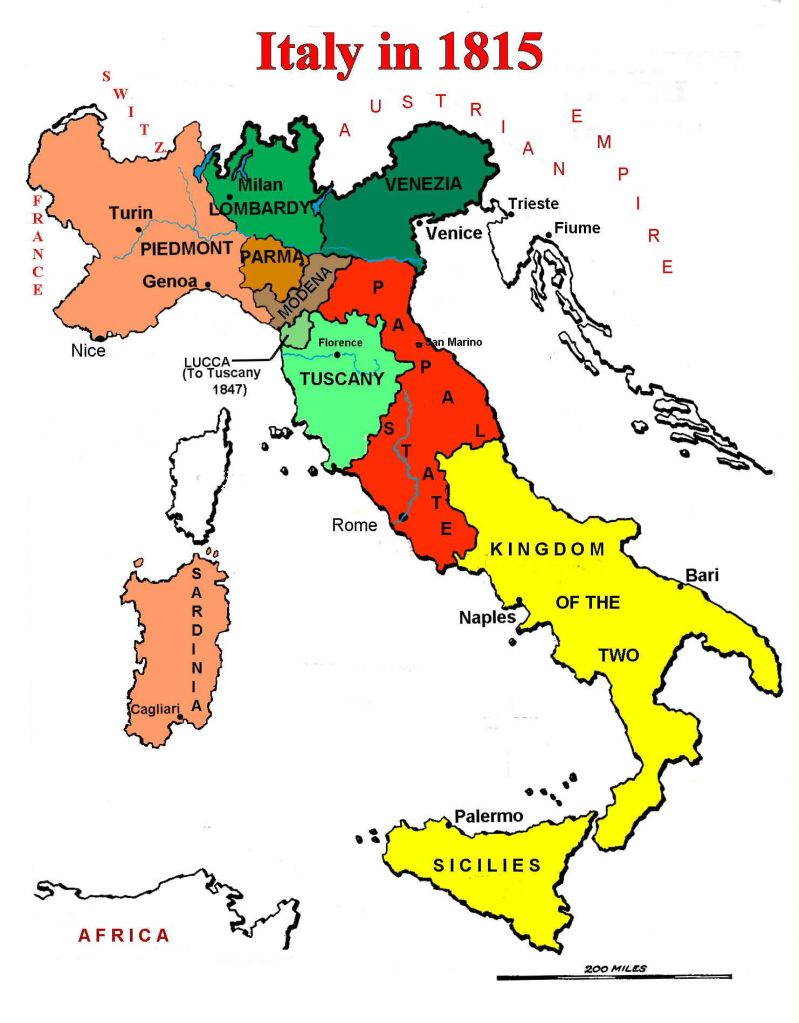
Nationalism arose mainly after the Napoleon attack in 1796. He consolidated the four major areas and people of Italy wanted revival of rich culture as during that of Renaissance period.

Congress of Vienna (1815)

As Italy was a large area, it could emerge as another powerful state. Therefore it was not declared as an independent state but distributed among kingdoms of France, Spain and Austria.

Like German unification, Italian unification was also done in three parts.

  • 1858-59 : War against Austria and integration of Lombardy
  • 1860 : Integration of Parma, Modena, Tuscany, Naples and Sicily
  • 1866 : Integration of Venice and in 1871, Rome.

(Nationalism arose in 1815 but actually started in 1858.)

Causes of Unification

  • Nationalism Wave of nationalism swept across Europe in nineteenth century, Language, Religion and Territory.
    • Italian thinkers, writers, artists started bringing up cultural traditions
    • Secret societies were formed for political change to overthrow Austrian government.
    • Carboneria was a secret organisation (1800-31) aimed simply ato remove foreign rule and tyranny.
    • Guiseppe Mazzini was the first person who gave idea of unification. In 1831 formed YOUNG ITALY a nationalist group. He gave the Republican ideology and was exciled to France but smuggled patriotic pamphlets to Italy. However, all his insurrections sadly failed.
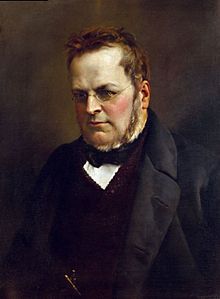
  • Cound Cavour who was the Prime Minister of Piedmont Sardinia (1852) under King Victor Emanuel II was the architect of Italian Unification.
    • He founded nationalistic newspaper Il Risorgiments. Gave civil rights freedom of press and economi development.

Cavour’s policies

  • Built up Sardinian economy
  • Believed unified Italy should be reborn as monarchy
  • Spread telling of unification to neighbouring states
  • Helped France and British soldiers in crimean War. At the conference, he highlighted Austria’s suppression over Italy. Thereby gained sympathy.

Phase I (1858-59)

  • Lombardy and Venice were instigated by cavour against Austria
  • Austria declared war on Sardinia
  • Italy with French helped emerged as victor and liberated Lombardy
  • But could not lierate Venice
  • Lombardy was therefore integrated

Phase II (1860)

  • Parma, Modena, tuscany was ruled by client state of Habsburg.
  • Plebiscite was conducted here and people voted to join Piedmont- Sardinia.
  • Some popal states were also unified.
  • Challenge: cavour had a deal with France only for Austria. the Southern Italy was under Bourbon dynasty who were relatives of Napoleon III. This could dismantle Cavour and Napoleon III’s relation.
  • Guiseppe Garibaldi came to rescue. Cavour asked him to lead Sardinian army against Sicily. these armies were called Red Shirts. With this, Naples and Sicily were also liberated.
  • On this Cavour said to Napoleon III- Bourban dynasty =had been overthrown by a revolutionary garibaldi. I will not attack Pope. Kindly ask pope yo let my army pass through so that I can go attack Sicily.
  • In 1861, Victor Emannuel II provclaimed the kingdom. Sadly Cavour died at the age of 50, due to over work.

Phase III 1866, 71

  • The King signed treaty with Prussia with following terms
    • both against Austria
    • Italy will help in Austria-Prussia war.
    • Venice will be given to Italy after any such war.
    • There was a Battle of Sodowa (1866) where Prussia won and Venice was given to Italy.
  • Papal State was still under France.
    • But in Franco Prussian war france lost. Napoleon III was captured.
    • Rome was captured and made capital of Italy.
    • But since they respected Pope, Vatican city is still under the control of Pope.

Unification of Italy

(1815-1871)

Introduction

Nationalism arose mainly after the Napoleon attack in 1796. He consolidated the four major areas and people of Italy wanted revival of rich culture as during that of Renaissance period.

Congress of Vienna (1815)

As Italy was a large area, it could emerge as another powerful state. Therefore it was not declared as an independent state but distributed among kingdoms of France, Spain and Austria.

Like German unification, Italian unification was also done in three parts.

  • 1858-59 : War against Austria and integration of Lombardy
  • 1860 : Integration of Parma, Modena, Tuscany, Naples and Sicily
  • 1866 : Integration of Venice and in 1871, Rome.

(Nationalism arose in 1815 but actually started in 1858.)

Causes of Unification

  • Nationalism Wave of nationalism swept across Europe in nineteenth century, Language, Religion and Territory.
    • Italian thinkers, writers, artists started bringing up cultural traditions
    • Secret societies were formed for political change to overthrow Austrian government.
    • Carboneria was a secret organisation (1800-31) aimed simply ato remove foreign rule and tyranny.
    • Guiseppe Mazzini was the first person who gave idea of unification. In 1831 formed YOUNG ITALY a nationalist group. He gave the Republican ideology and was exciled to France but smuggled patriotic pamphlets to Italy. However, all his insurrections sadly failed.
  • Cound Cavour who was the Prime Minister of Piedmont Sardinia (1852) under King Victor Emanuel II was the architect of Italian Unification.
    • He founded nationalistic newspaper Il Risorgiments. Gave civil rights freedom of press and economi development.

Cavour’s policies

  • Built up Sardinian economy
  • Believed unified Italy should be reborn as monarchy
  • Spread telling of unification to neighbouring states
  • Helped France and British soldiers in crimean War. At the conference, he highlighted Austria’s suppression over Italy. Thereby gained sympathy.

Phase I (1858-59)

  • Lombardy and Venice were instigated by cavour against Austria
  • Austria declared war on Sardinia
  • Italy with French helped emerged as victor and liberated Lombardy
  • But could not lierate Venice
  • Lombardy was therefore integrated

Phase II (1860)

  • Parma, Modena, tuscany was ruled by client state of Habsburg.
  • Plebiscite was conducted here and people voted to join Piedmont- Sardinia.
  • Some popal states were also unified.
  • Challenge: cavour had a deal with France only for Austria. the Southern Italy was under Bourbon dynasty who were relatives of Napoleon III. This could dismantle Cavour and Napoleon III’s relation.
  • Guiseppe Garibaldi came to rescue. Cavour asked him to lead Sardinian army against Sicily. these armies were called Red Shirts. With this, Naples and Sicily were also liberated.
  • On this Cavour said to Napoleon III- Bourban dynasty =had been overthrown by a revolutionary garibaldi. I will not attack Pope. Kindly ask pope yo let my army pass through so that I can go attack Sicily.
  • In 1861, Victor Emannuel II provclaimed the kingdom. Sadly Cavour died at the age of 50, due to over work.

Phase III 1866, 71

  • The King signed treaty with Prussia with following terms
    • both against Austria
    • Italy will help in Austria-Prussia war.
    • Venice will be given to Italy after any such war.
    • There was a Battle of Sodowa (1866) where Prussia won and Venice was given to Italy.
  • Papal State was still under France.
    • But in Franco Prussian war france lost. Napoleon III was captured.
    • Rome was captured and made capital of Italy.
    • But since they respected Pope, Vatican city is still under the control of Pope.

Gandhigiri With Munna Bhai: Valuable Lessons From The Film

Released in 2006, Lage Raho Munna Bhai is a movie directed by Rajkumar Hirani, screenplay by Vidhu Vinod Chopra, and starring talented actors like Sanjay Dutt, Arshad Warsi, Vidya Balan, Boman Irani, etc that proved to be a massive hit on the box office. The story begins with Munna Bhai being in love with the radio jockey Jhanvi. To win a chance to meet her, he cheats his way through the Mahatma Gandhi quiz and passes. When he finally meets Jhanvi, Jhanvi requests him to give a lecture on Mahatma Gandhi to the old people in her house. Munna who pretended to be a History professor and a Mahatma Gandhi fan has no choice left but to study all about Mahatma Gandhi for the remaining 3-4 days that he has left until the fixed date. This causes an extensive load on his brain due to which Munna Bhai starts hallucinating about Mahatma Gandhi’s persona.

The whole story moves forward with a battle against the corrupt Lucky Singh who deceives Munna and takes over the 2nd Innings House (of the old men) versus Munna Bhai who fights back using Gandhigiri. All along the movie Munna’s hallucinations of Gandhi continue to help him win and showcases Gandhi’s ethics that were long forgotten. Lage Raho Munna Bhai leaves its viewers with a deep sense of morality and Gandhigiri along with bouts of humor and comedy that keeps the audience engaged throughout the end, making it such a massive hit.!

The movie succeeds in reminding the long-forgotten ethics laid by Mahatma Gandhi for the country that he visioned. Below are the major matters that the movie tackles by implementing the concept of Gandhigiri. A neologism that refers to implementing and following the methods and guidelines laid and preached by Mahatma Gandhi. Throughout the movie, Munna acts as a spokesperson for Gandhiji’s values.

Here are some of the valuable lessons from the movie:

1. Truth – Truth is one of the fundamental teachings of Mahatma Gandhi. In this movie too, the value to always speak the truth no matter what is depicted firmly. There are 3 major instances when the characters are encouraged to speak the truth. The first instance is when Munna hides his real identity from Jhanvi and is later persuaded by Gandhi to tell Jhanvi the truth.

The second instance is when Munna and Jhanvi start their ‘Gandhigiri’ program to help people and a caller explains his desire to die as he doesn’t have the courage or way to return the hard-earned money of his father. To this Munna convinces the caller to tell his father the truth honestly and work hard to return the money. No matter how small the amount he earns or how long it takes to return the money Munna requests the caller to speak the truth.

The last instance is when Lucky’s daughter runs away from her wedding because she is upset about the lie that her father told her in-laws about her not being ‘Manglik’. Munna advocates her to face whatever it is and to tell the truth to her in-laws. Further, he comforts her by saying that if the boy loves her then he will not care about such stuff and will still marry her regardless of all this.

2. Non-Violence – This is the 2nd fundamental teaching of Mahatma Gandhi. Non-violence is also preached through the movie in a very subtle and effective way. The first example of non-violence in the movie is when Gandhi advocates Munna to turn to non-violence rather than hurting his enemy.

The second example is when another caller asks Munna for help to stop his fellow neighbour from spitting on his entrance wall. Munna suggests him to adopt the Non-Violent way and instead of beating or spewing bad words, he should clean up the spit every day with a smile on his face. This will reduce the hatred in the enemy’s heart and make him realize his mistake. And so, it happens!

3. Importance of values and respect for elders – At the start of the film, we see how children abandon their parents in their old age. This is a very heart-wrenching scene. Later Munna is seen remarking and rebuking the son of one of the old men. He scolds him saying that the parent who raised him with everything he got, is being abandoned today by his son when he needs him the most. This is a strong criticism towards people who, in their selfishness forgets the values and morals that one needs to follow in life.

4. Satyagraha and peaceful methods of protests – The very core theme of Lage Raho Munna Bhai movie explores the aspects of corruption and bribery. Gandhi Ji advocated the concept of Sarvodaya for everyone’s progress however, we know that the present world does not focus on equity but greed.

Corruption in the system is growing at a stark rate. By adopting the Gandhigiri way to fight against this, the peaceful methods of protests preached by Mahatma Gandhi are ignited again in this movie. First, Munna adopts the peaceful method of Satyagraha to fight against Lucky Singh’s corruption. In another instance, again through one of the callers, we are reminded about how to fight bribery and corruption in the system i.e. by making the other person feel ashamed in the most non-violent way.

5. Superstitious beliefs in India Lage Raho Munna Bhai smoothly tackles the superstitious problems that are still common in India. We see the plot of the movie revolve around Lucky Singh’s daughter being ‘Manglik’ and how Lucky Singh lies about it, which in the end is revealed to the in-laws by Lucky Singh’s daughter. It shows how most of the superstitions that Indians have is nothing but a way for the so-called ‘pandits’ and ‘Jyotish’ to extract money from people. Mahatma Gandhi never showed support for superstitious beliefs and always asked people to walk with reason, empathy, truth, and non-violence. Thus, this also remains an important point in Gandhian Philosophy.

The film succeeds in lining up with the expectations of people. Lage Raho Munna Bhai proves to be a great movie to convey the message of Gandhigiri to the audience in a serious yet humoristic way without being didactic. It not only shows Gandhi’s principles of thought but also shows a way to employ them in the present situations in India. The film is a great medium for anyone who wants to explore Gandhi Ji’s ideals without needing to have any prior knowledge about it.

Gandhigiri With Munna Bhai: Valuable Lessons From The Film

Released in 2006, Lage Raho Munna Bhai is a movie directed by Rajkumar Hirani, screenplay by Vidhu Vinod Chopra, and starring talented actors like Sanjay Dutt, Arshad Warsi, Vidya Balan, Boman Irani, etc that proved to be a massive hit on the box office. The story begins with Munna Bhai being in love with the radio jockey Jhanvi. To win a chance to meet her, he cheats his way through the Mahatma Gandhi quiz and passes. When he finally meets Jhanvi, Jhanvi requests him to give a lecture on Mahatma Gandhi to the old people in her house. Munna who pretended to be a History professor and a Mahatma Gandhi fan has no choice left but to study all about Mahatma Gandhi for the remaining 3-4 days that he has left until the fixed date. This causes an extensive load on his brain due to which Munna Bhai starts hallucinating about Mahatma Gandhi’s persona.

The whole story moves forward with a battle against the corrupt Lucky Singh who deceives Munna and takes over the 2nd Innings House (of the old men) versus Munna Bhai who fights back using Gandhigiri. All along the movie Munna’s hallucinations of Gandhi continue to help him win and showcases Gandhi’s ethics that were long forgotten. Lage Raho Munna Bhai leaves its viewers with a deep sense of morality and Gandhigiri along with bouts of humor and comedy that keeps the audience engaged throughout the end, making it such a massive hit.!

The movie succeeds in reminding the long-forgotten ethics laid by Mahatma Gandhi for the country that he visioned. Below are the major matters that the movie tackles by implementing the concept of Gandhigiri. A neologism that refers to implementing and following the methods and guidelines laid and preached by Mahatma Gandhi. Throughout the movie, Munna acts as a spokesperson for Gandhiji’s values.

Here are some of the valuable lessons from the movie:

1. Truth – Truth is one of the fundamental teachings of Mahatma Gandhi. In this movie too, the value to always speak the truth no matter what is depicted firmly. There are 3 major instances when the characters are encouraged to speak the truth. The first instance is when Munna hides his real identity from Jhanvi and is later persuaded by Gandhi to tell Jhanvi the truth.

The second instance is when Munna and Jhanvi start their ‘Gandhigiri’ program to help people and a caller explains his desire to die as he doesn’t have the courage or way to return the hard-earned money of his father. To this Munna convinces the caller to tell his father the truth honestly and work hard to return the money. No matter how small the amount he earns or how long it takes to return the money Munna requests the caller to speak the truth.

The last instance is when Lucky’s daughter runs away from her wedding because she is upset about the lie that her father told her in-laws about her not being ‘Manglik’. Munna advocates her to face whatever it is and to tell the truth to her in-laws. Further, he comforts her by saying that if the boy loves her then he will not care about such stuff and will still marry her regardless of all this.

2. Non-Violence – This is the 2nd fundamental teaching of Mahatma Gandhi. Non-violence is also preached through the movie in a very subtle and effective way. The first example of non-violence in the movie is when Gandhi advocates Munna to turn to non-violence rather than hurting his enemy.

The second example is when another caller asks Munna for help to stop his fellow neighbour from spitting on his entrance wall. Munna suggests him to adopt the Non-Violent way and instead of beating or spewing bad words, he should clean up the spit every day with a smile on his face. This will reduce the hatred in the enemy’s heart and make him realize his mistake. And so, it happens!

3. Importance of values and respect for elders – At the start of the film, we see how children abandon their parents in their old age. This is a very heart-wrenching scene. Later Munna is seen remarking and rebuking the son of one of the old men. He scolds him saying that the parent who raised him with everything he got, is being abandoned today by his son when he needs him the most. This is a strong criticism towards people who, in their selfishness forgets the values and morals that one needs to follow in life.

4. Satyagraha and peaceful methods of protests – The very core theme of Lage Raho Munna Bhai movie explores the aspects of corruption and bribery. Gandhi Ji advocated the concept of Sarvodaya for everyone’s progress however, we know that the present world does not focus on equity but greed.

Corruption in the system is growing at a stark rate. By adopting the Gandhigiri way to fight against this, the peaceful methods of protests preached by Mahatma Gandhi are ignited again in this movie. First, Munna adopts the peaceful method of Satyagraha to fight against Lucky Singh’s corruption. In another instance, again through one of the callers, we are reminded about how to fight bribery and corruption in the system i.e. by making the other person feel ashamed in the most non-violent way.

5. Superstitious beliefs in India Lage Raho Munna Bhai smoothly tackles the superstitious problems that are still common in India. We see the plot of the movie revolve around Lucky Singh’s daughter being ‘Manglik’ and how Lucky Singh lies about it, which in the end is revealed to the in-laws by Lucky Singh’s daughter. It shows how most of the superstitions that Indians have is nothing but a way for the so-called ‘pandits’ and ‘Jyotish’ to extract money from people. Mahatma Gandhi never showed support for superstitious beliefs and always asked people to walk with reason, empathy, truth, and non-violence. Thus, this also remains an important point in Gandhian Philosophy.

The film succeeds in lining up with the expectations of people. Lage Raho Munna Bhai proves to be a great movie to convey the message of Gandhigiri to the audience in a serious yet humoristic way without being didactic. It not only shows Gandhi’s principles of thought but also shows a way to employ them in the present situations in India. The film is a great medium for anyone who wants to explore Gandhi Ji’s ideals without needing to have any prior knowledge about it.

Stopping by Woods on a Snowy Evening

BY ROBERT FROST

Whose woods these are I think I know.   

His house is in the village though;   

He will not see me stopping here   

To watch his woods fill up with snow.   

My little horse must think it queer   

To stop without a farmhouse near   

Between the woods and frozen lake   

The darkest evening of the year.   

He gives his harness bells a shake   

To ask if there is some mistake.   

The only other sound’s the sweep   

Of easy wind and downy flake.   

The woods are lovely, dark and deep,   

But I have promises to keep,   

And miles to go before I sleep,   

And miles to go before I sleep.

        Summary

The speaker thinks about who owns the woods that he is passing through, and is fairly sure of knowing the landowner. However, the owner’s home is far away in the village, and thus he is physically incapable of seeing the speaker pause to watch the snowfall in the forest.
The speaker thinks his horse must find it strange to stop so far from any signs of civilization. Indeed, they are surrounded only by the forest and a frozen lake, on the longest night of the year.
The horse shakes the bells on its harness, as if asking if the speaker has made a mistake by stopping. The only other sound besides, is that of the wind and falling snowflakes.
The speaker finds the woods very alluring, drawn both to their darkness and how vast and all-encompassing they seem. However, the speaker has obligations to fulfill elsewhere. Thus, though he or she would like to stay and rest, he knows there are many more miles to go before that is possible.

       Themes

  • Nature vs. Society
    The speaker reflects on the natural world and its implicit contrast with society.The natural world it depicts is “lovely” and overwhelming. The fact that it seemingly lures the speaker to linger in the dark and cold suggests that nature is both a tempting and a threatening force, a realm that resists people’s efforts to tame it while also offering respite from the demands of civilized life. The complete lack of signs of civilization, meanwhile, further emphasizes the distance between society and nature. Far from the sights and sounds of the village, the speaker stands alone “Between the woods and frozen lake” on the “darkest evening of the year.” Together all these details present nature as a cold and foreboding space distinct from society. At the same time, however, the woods are “lovely” enough that they tempt the speaker to stay awhile, complicating the idea of nature as an entirely unwelcoming place for human beings. However raw and cold, nature also allows for the kind of quiet reflection people may struggle to find amidst the stimulation of society. 
  • Social Obligation vs. Personal Desire(Hesitation vs. Choice)

Though the speaker is drawn to the woods and would like to stay there longer to simply watch the falling snow, various responsibilities prevent any lingering. The speaker is torn between duty to others and his wish to stay in the dark and lovely woods. The poem can thus be read as reflecting a broader conflict between social obligations and individualism. He seems worn by travel and social obligation, and the woods seem to represent his or her wish to rest. But this wish cannot be realized because of the oppressive “miles to go,” which must be traveled as a result of duty to others. He is  torn between the tiresome duties of society, and the desire for individual freedom, that is manifested in the woods. This poem points to the reality of making decisions in complex situations in order to fulfill our responsibilities.

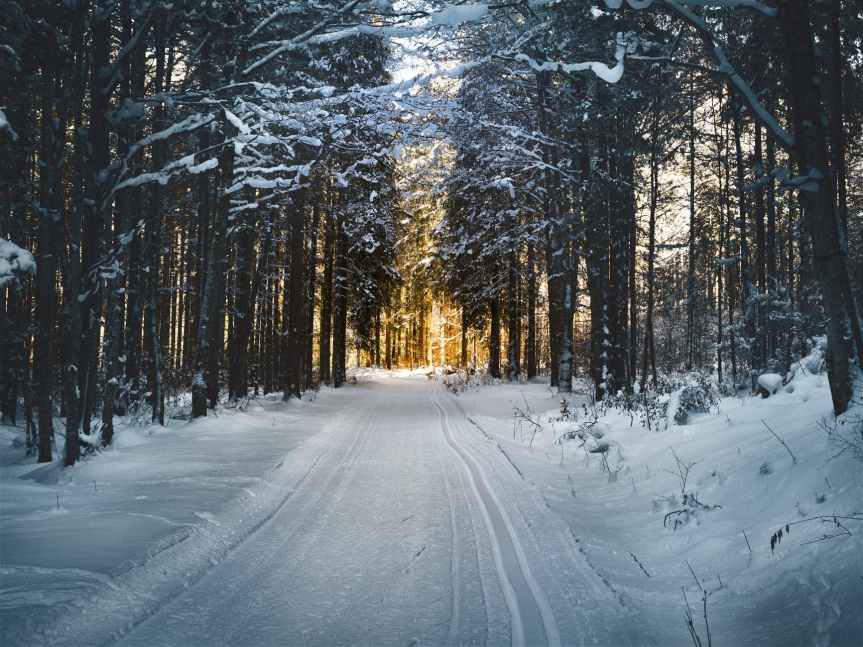
SettingAs the title makes clear, the poem is set in the “woods on a snowy evening.” It’s the “darkest evening of the year,” which suggests that this might be the winter solstice.The setting is also mostly silent, with the exception of the sound of wind and snowfall. The woods are expansive, as evidenced in the description “dark and deep.”


Tone

The poem conjures a tone of quiet reflection and wintry reminiscence. The last lines are not of pain or sadness, but more of a meditative appreciation and realization that there’s still much to be done that day.While most readers agree that the general tone is calm and serene, quiet and contemplative, others argue that this is dark and depressing.

Poetic Devices

Metaphor: The last line of the third stanza, “sweep of easy wind and downy flake” and the second metaphor is used in the last line with repetition, “and miles to go before I sleep.” Here, miles represent life’s journey, while sleep represents death.

Personification: Frost has personified the thinking of the horse mildly in the second stanza when it stops, and in the third stanza he gives a sign to the rider. “He gives his harness bells a shake/ to ask if there is some mistake.” It shows as if the horse is a human being who understands his owner’s needs or inquires if they have to stop.

Imagery: The poet has used the images for the sense of sights such as woods, houses, lakes, and they help readers see the woods as a source of solace and comfort to a lonely traveler.

Alliteration: “watch his woods”, “sound’s the sweep”, “His house”.

Euphony: It refers to the sound that is pleasing to the ears. While the journey through the forest is of loneliness, according to Robert Frost woods are not haunting or even scary but provide comfort and calmness. The woods also represent an uncorrupted world that the traveler wishes to stay in. 

         Structure

The whole poem follows the AABA rhyme scheme. Frost has used end rhyme in every first, second and fourth line of the poem. The third line of each stanza rhymes with the next stanza. Such as, “know”, “though” and “snow” rhymes with each other in the first stanza and” here” rhymes with “near” in the second stanza.

Repetition (Refrain): There is a repetition of the verse “and miles to go before I sleep” “and miles to go before I sleep “which has created a musical quality in the poem

Stopping by Woods on a Snowy Evening

BY ROBERT FROST

Whose woods these are I think I know.   

His house is in the village though;   

He will not see me stopping here   

To watch his woods fill up with snow.   

My little horse must think it queer   

To stop without a farmhouse near   

Between the woods and frozen lake   

The darkest evening of the year.   

He gives his harness bells a shake   

To ask if there is some mistake.   

The only other sound’s the sweep   

Of easy wind and downy flake.   

The woods are lovely, dark and deep,   

But I have promises to keep,   

And miles to go before I sleep,   

And miles to go before I sleep.

        Summary

The speaker thinks about who owns the woods that he is passing through, and is fairly sure of knowing the landowner. However, the owner’s home is far away in the village, and thus he is physically incapable of seeing the speaker pause to watch the snowfall in the forest.
The speaker thinks his horse must find it strange to stop so far from any signs of civilization. Indeed, they are surrounded only by the forest and a frozen lake, on the longest night of the year.
The horse shakes the bells on its harness, as if asking if the speaker has made a mistake by stopping. The only other sound besides, is that of the wind and falling snowflakes.
The speaker finds the woods very alluring, drawn both to their darkness and how vast and all-encompassing they seem. However, the speaker has obligations to fulfill elsewhere. Thus, though he or she would like to stay and rest, he knows there are many more miles to go before that is possible.

       Themes

  • Nature vs. Society
    The speaker reflects on the natural world and its implicit contrast with society.The natural world it depicts is “lovely” and overwhelming. The fact that it seemingly lures the speaker to linger in the dark and cold suggests that nature is both a tempting and a threatening force, a realm that resists people’s efforts to tame it while also offering respite from the demands of civilized life. The complete lack of signs of civilization, meanwhile, further emphasizes the distance between society and nature. Far from the sights and sounds of the village, the speaker stands alone “Between the woods and frozen lake” on the “darkest evening of the year.” Together all these details present nature as a cold and foreboding space distinct from society. At the same time, however, the woods are “lovely” enough that they tempt the speaker to stay awhile, complicating the idea of nature as an entirely unwelcoming place for human beings. However raw and cold, nature also allows for the kind of quiet reflection people may struggle to find amidst the stimulation of society. 
  • Social Obligation vs. Personal Desire(Hesitation vs. Choice)

Though the speaker is drawn to the woods and would like to stay there longer to simply watch the falling snow, various responsibilities prevent any lingering. The speaker is torn between duty to others and his wish to stay in the dark and lovely woods. The poem can thus be read as reflecting a broader conflict between social obligations and individualism. He seems worn by travel and social obligation, and the woods seem to represent his or her wish to rest. But this wish cannot be realized because of the oppressive “miles to go,” which must be traveled as a result of duty to others. He is  torn between the tiresome duties of society, and the desire for individual freedom, that is manifested in the woods. This poem points to the reality of making decisions in complex situations in order to fulfill our responsibilities.

SettingAs the title makes clear, the poem is set in the “woods on a snowy evening.” It’s the “darkest evening of the year,” which suggests that this might be the winter solstice.The setting is also mostly silent, with the exception of the sound of wind and snowfall. The woods are expansive, as evidenced in the description “dark and deep.”


Tone

The poem conjures a tone of quiet reflection and wintry reminiscence. The last lines are not of pain or sadness, but more of a meditative appreciation and realization that there’s still much to be done that day.While most readers agree that the general tone is calm and serene, quiet and contemplative, others argue that this is dark and depressing.

Poetic Devices

Metaphor: The last line of the third stanza, “sweep of easy wind and downy flake” and the second metaphor is used in the last line with repetition, “and miles to go before I sleep.” Here, miles represent life’s journey, while sleep represents death.

Personification: Frost has personified the thinking of the horse mildly in the second stanza when it stops, and in the third stanza he gives a sign to the rider. “He gives his harness bells a shake/ to ask if there is some mistake.” It shows as if the horse is a human being who understands his owner’s needs or inquires if they have to stop.

Imagery: The poet has used the images for the sense of sights such as woods, houses, lakes, and they help readers see the woods as a source of solace and comfort to a lonely traveler.

Alliteration: “watch his woods”, “sound’s the sweep”, “His house”.

Euphony: It refers to the sound that is pleasing to the ears. While the journey through the forest is of loneliness, according to Robert Frost woods are not haunting or even scary but provide comfort and calmness. The woods also represent an uncorrupted world that the traveler wishes to stay in. 

         Structure

The whole poem follows the AABA rhyme scheme. Frost has used end rhyme in every first, second and fourth line of the poem. The third line of each stanza rhymes with the next stanza. Such as, “know”, “though” and “snow” rhymes with each other in the first stanza and” here” rhymes with “near” in the second stanza.

Repetition (Refrain): There is a repetition of the verse “and miles to go before I sleep” “and miles to go before I sleep “which has created a musical quality in the poem

Dulce et Decorum Est

BY WILFRED OWEN

Bent double, like old beggars under sacks,

Knock-kneed, coughing like hags, we cursed through sludge,

Till on the haunting flares we turned our backs,

And towards our distant rest began to trudge.

Men marched asleep. Many had lost their boots,

But limped on, blood-shod. All went lame; all blind;

Drunk with fatigue; deaf even to the hoots

Of gas-shells dropping softly behind.

Gas! GAS! Quick, boys!—An ecstasy of fumbling

Fitting the clumsy helmets just in time,

But someone still was yelling out and stumbling

And flound’ring like a man in fire or lime.—

Dim through the misty panes and thick green light,

As under a green sea, I saw him drowning.

In all my dreams before my helpless sight,

He plunges at me, guttering, choking, drowning.

If in some smothering dreams, you too could pace

Behind the wagon that we flung him in,

And watch the white eyes writhing in his face,

His hanging face, like a devil’s sick of sin;

If you could hear, at every jolt, the blood

Come gargling from the froth-corrupted lungs,

Obscene as cancer, bitter as the cud

Of vile, incurable sores on innocent tongues,—

My friend, you would not tell with such high zest

To children ardent for some desperate glory,

The old Lie: Dulce et decorum est

Pro patria mori.

    Summary:

    The speaker begins with a description of soldiers, bent under the weight of their packs like beggars, their knees unsteady, coughing like poor and sick old women, and struggling miserably through a muddy landscape. They turn away from the light flares and begin to march towards their distant camp, as lethargic as the walking dead. Many have lost their combat boots, yet continue on despite their bare and bleeding feet. They are tired to the point of hindered eyesight, and don’t even notice the sound of the dangerous poison gas-shells dropping just behind them.
Somebody cries out an urgent warning about the poison gas, and the soldiers fumble with their gas masks, getting them on just in time. One man, however, is left yelling and struggling, unable to get his mask on. The speaker describes this man as looking like someone caught in fire or lime (an ancient chemical weapon used to effectively blind opponents). The speaker then compares the scene—through the panes of his gas-mask and with poison gas filling the air — to being underwater, and imagines the soldier is drowning.
The speaker jumps from the past moment of the gas attack to a present moment sometime afterward, and describes a recurring dream that he can’t escape, in which the dying soldier races towards him in agony.

  Theme:The Horror and Trauma of War
The banal daily life of a soldier is excruciating, the brutal reality of death is unimaginable agony, and even surviving a war after watching others die invites a future of endless trauma. 

The speaker thrusts the reader into the mundane drudgery and suffering of the wartime experience, as the speaker’s regiment walks from the front lines back to an undescribed place of “distant rest.” They are miserable: “coughing like hags,” cursing as they “trudge” through “sludge” with bloody feet. They march “asleep,” suggesting that these soldiers are like a kind of living dead. The terror and brutality of war have deadened them.
The poem reveals another aspect of the horror of war: even surviving war offers ceaseless future torment. The speaker’s sleep is permanently haunted by the trauma of the death he has witnessed.

The Enduring Myth that War is Glorious
This poem presents a vision of war—that is entirely brutal, bitter, and pessimistic. Owen wrote the poem with the belief that by highlighting the juxtaposition between a sanitized image of honorable death versus the messy, horrifying truth of actual war, perhaps the poem’s audience will change its attitude towards war and cease cheerfully sending young men to die in agony. The speaker suggests that if readers could experience their own such suffocating dreams,marching behind a wagon in which the other men have placed the dying soldier, seeing the writhing of the dying soldier’s eyes in an otherwise slack and wrecked face, and hearing him cough up blood from his ruined lungs at every bump in the path—a sight the speaker compares to the horror of cancer and other diseases that ravage even the innocent, they would not so eagerly tell children, hungry for a sense of heroism, the old lie that “it is sweet and fitting to die for one’s country.”

The poem demands that the readers face the truth and no longer be complicit with that old Lie, but even as it does so, it seems to bitterly perceive that nothing will change, because nothing ever has.


 Structure: 

The poem is a combination of two sonnets. In the first sonnet, the poet describes his experiences of the war, in the second sonnet he becomes analytic and attempts to correct the outlook of others about the war.

Sonnet: A sonnet is a fourteen-line poem in which a single idea floats throughout the poem.

Rhyme Scheme: The whole poem follows the ABAB, CDCD rhyme scheme.


Poetic Devices:

  1. Alliteration: “But someone still was yelling out and stumbling” and /w/ sound in “And watch the white eyes writhing in his face.
  2. Simile: Owen has used many self-explanatory similes in this poem such as,” Bent double, like old beggars under sacks”, “Knock-kneed, coughing like hags”, “like a man in fire or lime” and “like a devil’s sick of sin.”
  3. Metaphor: “Drunk with fatigue; deaf even to the hoots.” It presents the physical state of the men.
  4. Consonance: Consonance is the repetition of consonant sounds in the same line such as the /r/ sound in “Come gargling from the froth-corrupted lungs.”
  5. Synecdoche: It is a figure of speech in which a part is made to represent the whole. For example, the word “sight” in the second stanza represents the speaker.
  6. Imagery: Imagery is used to make the readers perceive things with their five senses. “old beggars under sacks”, “had lost their boots”, “His hanging face, like a devil’s sick of sin” and “white eyes.”

          Setting:

Wilfred Owen wrote “Dulce et Decorum Est” while he was fighting as a soldier during World War I. The use of “flares” and “gas-shells” are specific to World War I, since they had not been used in combat before this time.The majority of British troops in WWI were deployed to France. Chlorine gas, with its distinctive green color, was first deployed by the German army in Belgium in 1915.The “clumsy helmets,” or gas masks, were developed in response to the introduction of gas.  

Language:The way Owen uses language to put readers inside the experiences of a soldier helps them begin to understand the horrific experience of all of these awful aspects of war.If the audience could experience the trauma the speaker describes (“the white eyes writhing,” the “gargling from froth-corrupted lungs”), then they wouldn’t pass their patriotic militarism down to their children. But they don’t experience it, except through the language of the poem 

Tone

The tone of this poem is angry and critical. Owen’s own voice in this poem is bitter – perhaps partly fuelled by self-recrimination for the suffering he could do nothing to alleviate. Owen dwells on explicit details of horror and misery in order to maximise the impact he wishes to have on those who tell the ‘old Lie’. The way in which he addresses as ‘My friend’ those with whom he so strongly disagrees is ironic.


Dulce et Decorum Est

BY WILFRED OWEN

Bent double, like old beggars under sacks,

Knock-kneed, coughing like hags, we cursed through sludge,

Till on the haunting flares we turned our backs,

And towards our distant rest began to trudge.

Men marched asleep. Many had lost their boots,

But limped on, blood-shod. All went lame; all blind;

Drunk with fatigue; deaf even to the hoots

Of gas-shells dropping softly behind.

Gas! GAS! Quick, boys!—An ecstasy of fumbling

Fitting the clumsy helmets just in time,

But someone still was yelling out and stumbling

And flound’ring like a man in fire or lime.—

Dim through the misty panes and thick green light,

As under a green sea, I saw him drowning.

In all my dreams before my helpless sight,

He plunges at me, guttering, choking, drowning.

If in some smothering dreams, you too could pace

Behind the wagon that we flung him in,

And watch the white eyes writhing in his face,

His hanging face, like a devil’s sick of sin;

If you could hear, at every jolt, the blood

Come gargling from the froth-corrupted lungs,

Obscene as cancer, bitter as the cud

Of vile, incurable sores on innocent tongues,—

My friend, you would not tell with such high zest

To children ardent for some desperate glory,

The old Lie: Dulce et decorum est

Pro patria mori.

    Summary:

    The speaker begins with a description of soldiers, bent under the weight of their packs like beggars, their knees unsteady, coughing like poor and sick old women, and struggling miserably through a muddy landscape. They turn away from the light flares and begin to march towards their distant camp, as lethargic as the walking dead. Many have lost their combat boots, yet continue on despite their bare and bleeding feet. They are tired to the point of hindered eyesight, and don’t even notice the sound of the dangerous poison gas-shells dropping just behind them.
Somebody cries out an urgent warning about the poison gas, and the soldiers fumble with their gas masks, getting them on just in time. One man, however, is left yelling and struggling, unable to get his mask on. The speaker describes this man as looking like someone caught in fire or lime (an ancient chemical weapon used to effectively blind opponents). The speaker then compares the scene—through the panes of his gas-mask and with poison gas filling the air — to being underwater, and imagines the soldier is drowning.
The speaker jumps from the past moment of the gas attack to a present moment sometime afterward, and describes a recurring dream that he can’t escape, in which the dying soldier races towards him in agony.

  Theme:The Horror and Trauma of War
The banal daily life of a soldier is excruciating, the brutal reality of death is unimaginable agony, and even surviving a war after watching others die invites a future of endless trauma. 

The speaker thrusts the reader into the mundane drudgery and suffering of the wartime experience, as the speaker’s regiment walks from the front lines back to an undescribed place of “distant rest.” They are miserable: “coughing like hags,” cursing as they “trudge” through “sludge” with bloody feet. They march “asleep,” suggesting that these soldiers are like a kind of living dead. The terror and brutality of war have deadened them.
The poem reveals another aspect of the horror of war: even surviving war offers ceaseless future torment. The speaker’s sleep is permanently haunted by the trauma of the death he has witnessed.

The Enduring Myth that War is Glorious
This poem presents a vision of war—that is entirely brutal, bitter, and pessimistic. Owen wrote the poem with the belief that by highlighting the juxtaposition between a sanitized image of honorable death versus the messy, horrifying truth of actual war, perhaps the poem’s audience will change its attitude towards war and cease cheerfully sending young men to die in agony. The speaker suggests that if readers could experience their own such suffocating dreams,marching behind a wagon in which the other men have placed the dying soldier, seeing the writhing of the dying soldier’s eyes in an otherwise slack and wrecked face, and hearing him cough up blood from his ruined lungs at every bump in the path—a sight the speaker compares to the horror of cancer and other diseases that ravage even the innocent, they would not so eagerly tell children, hungry for a sense of heroism, the old lie that “it is sweet and fitting to die for one’s country.”

The poem demands that the readers face the truth and no longer be complicit with that old Lie, but even as it does so, it seems to bitterly perceive that nothing will change, because nothing ever has.


 Structure: 

The poem is a combination of two sonnets. In the first sonnet, the poet describes his experiences of the war, in the second sonnet he becomes analytic and attempts to correct the outlook of others about the war.

Sonnet: A sonnet is a fourteen-line poem in which a single idea floats throughout the poem.

Rhyme Scheme: The whole poem follows the ABAB, CDCD rhyme scheme.


Poetic Devices:

  1. Alliteration: “But someone still was yelling out and stumbling” and /w/ sound in “And watch the white eyes writhing in his face.
  2. Simile: Owen has used many self-explanatory similes in this poem such as,” Bent double, like old beggars under sacks”, “Knock-kneed, coughing like hags”, “like a man in fire or lime” and “like a devil’s sick of sin.”
  3. Metaphor: “Drunk with fatigue; deaf even to the hoots.” It presents the physical state of the men.
  4. Consonance: Consonance is the repetition of consonant sounds in the same line such as the /r/ sound in “Come gargling from the froth-corrupted lungs.”
  5. Synecdoche: It is a figure of speech in which a part is made to represent the whole. For example, the word “sight” in the second stanza represents the speaker.
  6. Imagery: Imagery is used to make the readers perceive things with their five senses. “old beggars under sacks”, “had lost their boots”, “His hanging face, like a devil’s sick of sin” and “white eyes.”

          Setting:

Wilfred Owen wrote “Dulce et Decorum Est” while he was fighting as a soldier during World War I. The use of “flares” and “gas-shells” are specific to World War I, since they had not been used in combat before this time.The majority of British troops in WWI were deployed to France. Chlorine gas, with its distinctive green color, was first deployed by the German army in Belgium in 1915.The “clumsy helmets,” or gas masks, were developed in response to the introduction of gas.  

Language:The way Owen uses language to put readers inside the experiences of a soldier helps them begin to understand the horrific experience of all of these awful aspects of war.If the audience could experience the trauma the speaker describes (“the white eyes writhing,” the “gargling from froth-corrupted lungs”), then they wouldn’t pass their patriotic militarism down to their children. But they don’t experience it, except through the language of the poem 

Tone

The tone of this poem is angry and critical. Owen’s own voice in this poem is bitter – perhaps partly fuelled by self-recrimination for the suffering he could do nothing to alleviate. Owen dwells on explicit details of horror and misery in order to maximise the impact he wishes to have on those who tell the ‘old Lie’. The way in which he addresses as ‘My friend’ those with whom he so strongly disagrees is ironic.

Medicinal plants

India is rich in its flora fauna, one of the advantages that this brings is ample variety of medicinal plants in different Indian terrains. The use of medicinal herbs can be traced back before prehistoric time. The presence and use of Ayurveda in treatment is mentioned in the literature and this knowledge is used to develop medicine and treatment techniques that are effective.
When COVID was at its peak people in India preferred Kardha and as prevention added herbs that have medicinal property in the food and beverages consumed on daily bases. Here is a list of some very common yet very useful medicinal plants-

• Tulsi (Holy Basil)
Holy Basil or Tulsi is a flowering plant that can be found in almost every India household, it is worshipped in Hinduism and is among the top medicinal herbs. The plant has few varieties and is widely available, it has aromatic leaves and beautiful green colour. It is used since ancient times in medicine making and treatments. Its medical property can help prevent common cough and cold etc.

• Sandal wood
Sandal wood also known as Chandan in Hindi is another aromatic variety that is used mainly in making medicine, sandalwood perfumes are quite famous but, additionally it also help in treatment of fever, urinary track infection, liver, cardiovascular diseases etc.
Sandalwood has multiple uses It is used in Hindu rituals and sometimes as a flavouring agent in food and beverages. Many products are made using sandal wood like- sandalwood oil, sandalwood powder etc thus, it is available in different forms.

• Turmeric
You must have heard of the colour Turmeric yellow; its yellow colour is its identity. The colour is extracted, and turmeric has many health benefits, as it is good for heart and prevent against serious diseases like cancer and Alzheimer’s. it is used in making medicine and easily available, apart from this it is good for skin when used in home -made face pack, keeps the blood sugar stable, and prevents inflammation.

• Neem
Neem trees are often known to provide clean and fresh environment wherever they are planted. The green leaves and bitter taste of neem are its identity. The most popular variety in medicinal plant used in treatment and even products like shampoo and soap, it has anti- bacterial quality it can treat skin ulcers, gum problems, improves body metabolism, cuts body fat etc. it is used in Ayurveda since a long time and the leaves, the bark of neem tree both are very useful. It is available in the form of powder, paste or can be used directly.

Cinnamon
Cinnamon is known as daalchini in Hindi, it looks like rolled pieces of wood, and has its own aroma, it has multiple uses and is also available in the form of powder, often used in cooking and baking. Cinnamon can give relief from digestion related problems and can prevent the body from bacteria and fungal infections, good for patients with type 2 diabetes it is anti-inflammatory and contains antioxidants as well.

The list is very long if we start counting and each medicinal plant or herb has its own unique quality. It is no less than a blessing of mother earth that we have access to such wide variety of resources.

Medicinal plants

India is rich in its flora fauna, one of the advantages that this brings is ample variety of medicinal plants in different Indian terrains. The use of medicinal herbs can be traced back before prehistoric time. The presence and use of Ayurveda in treatment is mentioned in the literature and this knowledge is used to develop medicine and treatment techniques that are effective.
When COVID was at its peak people in India preferred Kardha and as prevention added herbs that have medicinal property in the food and beverages consumed on daily bases. Here is a list of some very common yet very useful medicinal plants-

• Tulsi (Holy Basil)
Holy Basil or Tulsi is a flowering plant that can be found in almost every India household, it is worshipped in Hinduism and is among the top medicinal herbs. The plant has few varieties and is widely available, it has aromatic leaves and beautiful green colour. It is used since ancient times in medicine making and treatments. Its medical property can help prevent common cough and cold etc.

• Sandal wood
Sandal wood also known as Chandan in Hindi is another aromatic variety that is used mainly in making medicine, sandalwood perfumes are quite famous but, additionally it also help in treatment of fever, urinary track infection, liver, cardiovascular diseases etc.
Sandalwood has multiple uses It is used in Hindu rituals and sometimes as a flavouring agent in food and beverages. Many products are made using sandal wood like- sandalwood oil, sandalwood powder etc thus, it is available in different forms.

• Turmeric
You must have heard of the colour Turmeric yellow; its yellow colour is its identity. The colour is extracted, and turmeric has many health benefits, as it is good for heart and prevent against serious diseases like cancer and Alzheimer’s. it is used in making medicine and easily available, apart from this it is good for skin when used in home -made face pack, keeps the blood sugar stable, and prevents inflammation.

• Neem
Neem trees are often known to provide clean and fresh environment wherever they are planted. The green leaves and bitter taste of neem are its identity. The most popular variety in medicinal plant used in treatment and even products like shampoo and soap, it has anti- bacterial quality it can treat skin ulcers, gum problems, improves body metabolism, cuts body fat etc. it is used in Ayurveda since a long time and the leaves, the bark of neem tree both are very useful. It is available in the form of powder, paste or can be used directly.

Cinnamon
Cinnamon is known as daalchini in Hindi, it looks like rolled pieces of wood, and has its own aroma, it has multiple uses and is also available in the form of powder, often used in cooking and baking. Cinnamon can give relief from digestion related problems and can prevent the body from bacteria and fungal infections, good for patients with type 2 diabetes it is anti-inflammatory and contains antioxidants as well.

The list is very long if we start counting and each medicinal plant or herb has its own unique quality. It is no less than a blessing of mother earth that we have access to such wide variety of resources.