
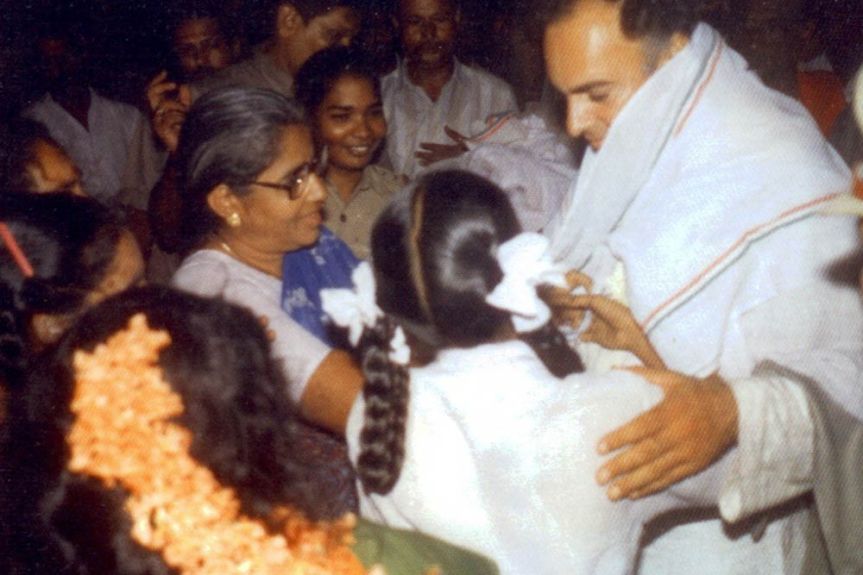
Assassination Of Former Prime Minister Rajiv Gandhi .

The assassination of former Prime Minister of India Rajiv Gandhi, , occurred on 21 May 1991 as a result of a suicide bombing in Sriperumbudur in Tamil Nadu, India . At least 14 others,we’re killed alongside Rajiv Gandhi in the suicide bombing.
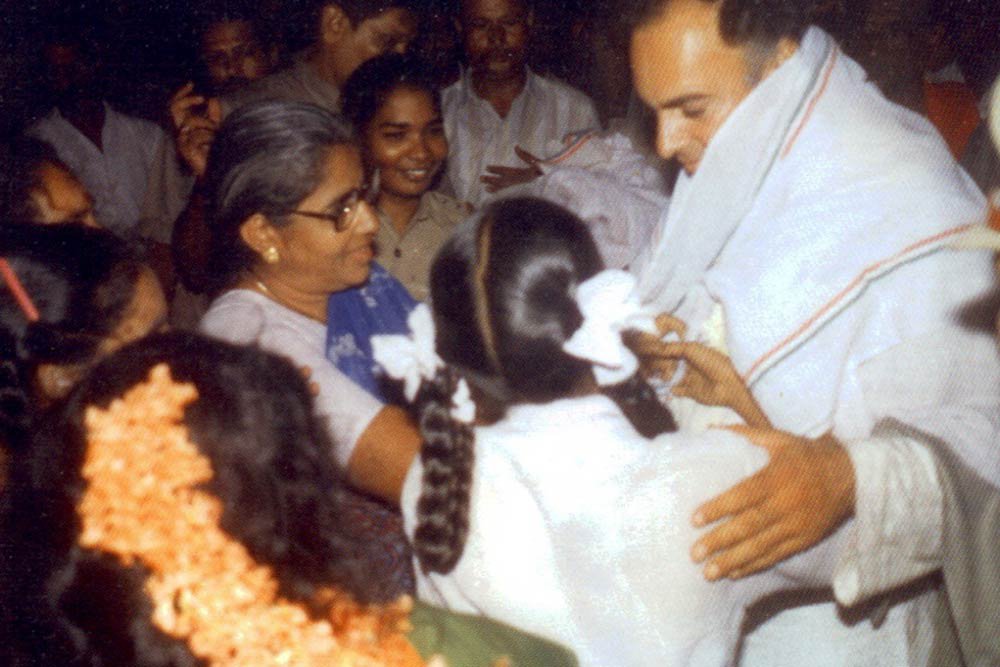
The assassination was carried out by Thenmozhi Rajaratnam, a member of the Tamil Liberation Tigers (LTTE), a Tamil separatist organization in Sri Lanka, and Dr. Jagjit Singh Chohan of the National Council of Khalistan (NCK) and Gurjant Singh Budhsinghwala of the Khalistan Liberation Force. At that time, India had just finished its involvement in the civil war in Sri Lanka through the Indian Peace Keeping Force. Rajiv Gandhi along with G.K. Moupanal started election campaign in southern state of India. After campaigning in Visakhapatnam, Andhra Pradesh on May 21, his next destination was Sriperumbudur, Tamil Nadu. Approximately two hours after arriving in Madras ,Rajiv Gandhi rode a white ambassador car to Slipelumbudur in a convoy, stopping at several other campaign sites along the way. Arriving at the campaign rally at Sriperumbudur, Rajiv left the car and went up to the podium, where he gave a speech. After the soeech the assassin Danu (Thenmozhi Rajaratnam) approached and greeted him. Then she bent over and touched his leg, and at 10:10 pm, detonated a belt loaded with RDX explosives place under her dress. Gandhi, his assassin and 14 others were killed in a subsequent explosion, and 43 were seriously injured. The assassination was filmed by local photographer Haribab. Haribab’s camera and film were found intact on the scene, but he also died in the blast.

Apart from Rajiv Gandhi, former Prime Minister of India and the suicide bomber Thenmozhi Rajaratnam , several people were killed in the blast on 21 May 1991:
Including Pradeep K Gupta (personal security officer of Rajiv Gandhi ), K.S Mohammed Iqbal (police superintendent), Edward Joseph ( police inspector) ,Dharman,Chandra, Ethiraju Muruganand and Rajguru (police constables), Santhani Begum (Mahila Congressn Leader) ,Latha Kannan ( Mahila Congress worker,who was with her daughter Kokilavani ),Kokilavani (ten-year-old daughter of Latha Kannan, who sang a poem to Gandhi immediately before the blast), Munuswamy (former member of the Tamil Nadu Legislative Council) ,Saroja Devi (seventeen-year-old college student), Ravichandran (Black Cat commando).
Around forty-three spectator present in the campaign including police sub-inspector Anushiya Daisy were also injured in the explosion.
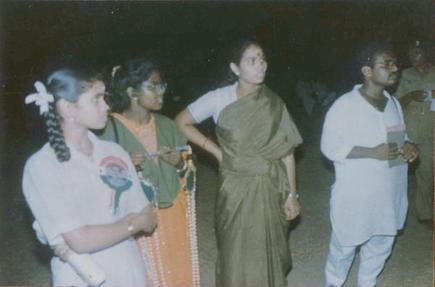
Immediately after the assassination, the Chandrasekhar government handed over the investigation to the CBI on May 22, 1991. Authorities, formed a special research team led by Karthikeyan to determine who is responsible for the assassination. A SIT investigation confirmed the role of the LTTE in assassination and was endorsed by the Supreme Court of India. Judge Millap Chand Jain’s interim report investigated the secret aspects of the assassination and accused DMK of working with the LTTE. The report concluded that the DMK provided the LTTE with shelter and made it easier for rebels to assassinate Rajiv Gandhi. The report also claimed that Jaffna’s LTTE leaders possessed confidential, encrypted messages exchanged between the federal and DMK state governments.Authorities also stated in reports “There is evidence that during this period some of the most important radio messages were exchanged between the LTTE agents stationed in Tamil Nadu and Jaffna. These later deciphered messages are directly related to the assassination of Rajiv Gandhi “. The Congress demanded withdrawal of DMK from the Union Front government, after claiming to have played an important role in Rajiv Gandhi’s death. According to reports Dr. Jagjit Singh Chohan supported the LITTE with logistic and tactical support. His involvement was first revealed in 2016, about 10 years later. Speculation. This was evidence of the Jain Commission’s report and was suspected that the LTTE had contacted Gurjant Singh Budhsinghwala with Jagjit Singh Chohan to plan the plot.

After the investigation on the assassination of former prime minister Rajiv Gandhi ,the court convicted and sentenced the seven persons who were involved in the assassination to life imprisonment. They are currently undergoing life imprisonment in prisons in India.
They are:
Murugan – A LTTE operative from Sri Lanka, Nalini – Wife of Murugan. Nalini is a citizen of India ,Jayakumar – The brother in law of Robert Pious ,Ravichandran – A Sri Lankan national ,T. Suthenthiraraja – A Sri Lankan national ,Robert Pious – A Sri Lankan national and A. G. Perarivalan – An Indian citizen who was arrested for supplying a 9-volt battery for the explosive device.

The 1991 Indian Economic Crisis

The 1991 Indian economic crisis was an economic crisis in India that resulted from poor economic policies and the resulting trade deficits. India’s economic problems started worsening in 1985 as the imports swelled, leaving the country in a twin deficit: the Indian trade balance was in deficit at a time when the government was running on a large fiscal deficit. By the end of 1990, in the run-up to the Gulf War, the dire situation meant that the Indian foreign exchange reserves could have barely financed three weeks’ worth of imports. Meanwhile, the government came close to defaulting on its own financial obligations. By July that year, the low reserves had led to a sharp depreciation of the rupee, which in turn exacerbated the twin deficit problem. The Chandrasekhar sir’s government could not pass the budget in February 1991 after Moody downgraded India’s bond ratings. The ratings further deteriorated due to the unsuccessful passage of the fiscal budget. This made it impossible for the country to seek short term loans and exacerbated the existing economic crisis. The World Bank and IMF also stopped their assistance, leaving the government with no option except to mortgage the country’s gold to avoid defaulting on payments.

In an attempt to seek an economic bailout from the IMF, the Indian government airlifted its national gold reserves.

The crisis, in turn, paved the way for the liberalisation of the Indian economy, since one of the conditions stipulated in the World Bank loan (structural reform), required India to open itself up to participation from foreign entities in its industries, including its state owned enterprises.

Causes of the Crisis :

The crisis was caused by currency overvaluation; the current account deficit, and investor confidence played significant role in the sharp exchange rate depreciation.

The economic crisis was primarily due to the large and growing fiscal imbalances over the 1980s. During the mid-eighties, India started having the balance of payments problems. Precipitated by the Gulf War, India’s oil import bill swelled, exports slumped, credit dried up, and investors took their money out. Large fiscal deficits, over time, had a spillover effect on the trade deficit culminating in an external payments crisis. By the end of the 1980s, India was in serious economic trouble.

The gross fiscal deficit of the government rose from 9.0 percent of Gross Domestic Product (GDP) in 1980-81 to 10.4 percent in 1985-86 and to 12.7 percent in 1990-91. For the centre alone, the gross fiscal deficit rose from 6.1 percent of GDP in 1980-81 to 8.3 percent in 1985-86 and to 8.4 percent in 1990-91. Since these deficits had to be met by borrowings, the internal debt of the government accumulated rapidly, rising from 35 percent of GDP at the end of 1980-81 to 53 percent of GDP at the end of 1990-91. The foreign exchange reserves had dried up to the point that India could barely finance three weeks worth of imports.

In mid-1991, India’s exchange rate was subjected to a severe adjustment. This event began with a slide in the value of the Indian rupee leading up to mid-1991. The authorities at the Reserve Bank of India took partial action, defending the currency by expanding international reserves and slowing the decline in value. However, in mid-1991, with foreign reserves nearly depleted, the Indian government permitted a sharp devaluation that took place in two steps within three days (1 July and 3 July 1991) against major currencies.

Recovery :

With India’s foreign exchange reserves at $1.2 billion in January 1991 and depleted by half by June, barely enough to last for roughly 3 weeks of essential imports, India was only weeks away from defaulting on its external balance of payment obligations.

Government of India’s immediate response was to secure an emergency loan of $2.2 billion from the International Monetary Fund by pledging 67 tons of India’s gold reserves as collateral security. The Reserve Bank of India had to airlift 47 tons of gold to the Bank of England and 20 tons of gold to the Union Bank of Switzerland to raise $600 million.  The van transporting the gold to the airport broke down en route due to tyre burst and panic followed . The airlift was done with secrecy as it was done in the midst of the 1991 Indian General elections. National sentiments were outraged and there was public outcry when it was learned that the government had pledged the country’s entire gold reserves against the loan. A chartered plane ferried the precious cargo to London between 21 May and 31 May 1991, jolting the country out of an economic slumber.The Chandra Shekhar government had collapsed a few months after having authorised the airlift. The move helped tide over the balance of payment crisis and kick-started P.V. Narasimha Rao’s economic reform process.

Under Narsimha Rao Sir’s Government :

P. V. Narasimha Rao took over as Prime Minister in June, and roped in Manmohan Singh as Finance Minister. The Narasimha Rao government ushered in several reforms that are collectively termed as liberalisation in the Indian media.

The reforms formally began on 1 July 1991 when RBI devaluated Indian Rupee by 9% and by a further 11% on 3 July. It was done in two doses to test the reaction of the market first by making a smaller depreciation of 9%. There was significant opposition to such reforms, suggesting they were an “interference with India’s autonomy”. Then Prime Minister Rao’s speech a week after he took office highlighted the necessity for reforms, as New York Times reported, “Mr. Rao, who was sworn in as Prime Minister last week, has already sent a signal to the nation—as well as the I.M.F.—that India faced no “soft options” and must open the door to foreign investment, reduce red tape that often cripples initiative, and streamline industrial policy. Mr. Rao made his comments in a speech to the nation Saturday night.” The foreign reserves started picking up with the onset of the liberalisation policies and reached an all-time high US$426.1 billion as on 13 April 2018