Review of a research article

Article name:A Study of University Students’ Motivation and Its Relationship
with Their Academic Performance.

Student motivation is the element that leads students’ attitude towards learning process.God-gifted talents, best teachers and best schooling facilitate the academic performance and students’ motivation
is prerequisite for students’ accomplishment. This study attempts to identify the influence of students’
motivation on their academic performance.So come on research enthusiasts let’s look into the why,how and what of student motivation through this review!

Purpose and sample

This outstanding Research article by Ali and colleagues has been published in the International Journal of Business and Management.This study attempts to identify the influence of students’ motivation on their academic performance.The sample consisted of 342 university students of different programs in various universities of Islamabad and Lahore, Pakistan.The students were asked about how motivated they are about their university experience and what really motivated them to study.

METHODOLOGY

The questionnaire was distributed among both male and female students. There were 82% male and 18% female students in the survey with an average age of 20 years.“The University Student Motivation and Satisfaction Questionnaire version 2″ (TUSMSQ2) instrument was developed by Neill (2004) to measure student’s motivation. TUSMSQ2 instrument contains 30-items.

WHAT WAS TESTED?

The questions measure both Intrinsic and Extrinsic motivation of students. There were two intrinsic motivators; Self-exploration and Altruism and four extrinsic motivators;rejection of Alternative options, career and qualifications, Social enjoyment, and Social pressure in the questionnaire. The questions were based on five point Likert scale. For each item, students rated themselves on a scale of 1 to 5; 1 being “Very False”, towards, 5 being “Very True”

BASIS/THEORY OF THE STUDY

Motivation is state of mind that stimulates activities and human body actions.Student motivation is often separated into two types: Intrinsic motivation and extrinsic motivation.


Intrinsic motivation: A student is intrinsically motivated when he or she is motivated from within. Intrinsically motivated students keenly engage themselves in learning out of oddity, interest, or enjoyment, or in order to achieve their own scholarly and personal goals.Thus students with intrinsic motivation are more enthusiastic, self driven, challenging and feel pleasure in their studies.Intrinsically motivated students tend to prefer challenging tasks.

Extrinsic motivation: It is commonly viewed that extrinsically motivated student engages in learning
purely for attaining a reward or for avoiding some punishment.Extrinsic motivation means
to obtain some reward or avoid some punishment external to the activity itself such as grades, stickers or teacher approval.Students with extrinsic motivation try to drag themselves with academic assignments, feel compelled to learn, and always put minimal efforts to achieve maximum appreciations.

Results

The results indicate that academic performance amplifies between the ranges of 23 percent and 34 percent due to extrinsic motivation and intrinsic motivation.Also the comparisons of variables on
individual bases indicates that those students who adapt self-exploratory variable and altruism variable, rejection of alternative options variable tend to perform better, whereas student who adapt career and qualifications variable, social enjoyment variable and social pressure variable tend to perform less then expected.Also the study found positive and mutually causal relationship between student’s motivation and student’s academic performance. This relationship is reciprocal, meaning students who are more motivated perform better and student who perform better become more motivated.

implications

Any research article would be a waste without implications.This study helps in identifying the factors that will help educational thinkers to know students’ attitudes towards learning, what facilitates learning and what hinders in learning.Thus it will lead to better teaching methods and facilities to suit the student’s need thereby increasing their job competence.

So,this was a comprehensive review of a wonderful research article.Click the below button to read the article:

Hope you all liked the review,if yes please give this blog a like.

Thankyou!

Stay Knowledgeable!

ONLINE EDUCATION PROS V/S CONS


The Majestic year 2020 is marked by two major events.One is the Onset of the worst pandemic that the entire world is reeling under and the other as the title suggests is Online learning!

The Use of Online Learning or E Learning has skyrocketed in the recent times as the only mode of education in a social distancing setup.Indeed it is a necessity as education cannot be put to rest halting the progress of millions of students.As a coin has two sides,similarly online form of education has it’s own perks and drawbacks.So lets find out more!READ MORE

This image has an empty alt attribute; its file name is online-learning.png

Online schooling is a popular alternative to attending a brick-and-mortar college or university. Though online students don’t get the face-to-face experiences of a typical on-campus student, there are many benefits and advantages to online learning, also known as distance learning or e-learning.

While not every program or school imaginable has an online option, a large number of them do, and many programs are nationally or regionally accredited. Students can learn through online lectures, projects and discussions. Online degree programs are available at every level, from certificates to doctorates.

Owing to the Covid situation,organisations that used to vouch for traditional methods of education are now radically shifting towards online education because there is no other alternative.Earlier online education used to be an alternative, now it is the only choice for those who want to desperately continue their education.

When Online Education is the new reality,it is very essential to keep in mind it’s advantages and disadvantages to take maximum benefits out of it and also minimize stress levels.

ADVANTAGES

-Convenient Learning:It can be undertaken anywhere ranging from a tiny corner in the living room to a study table in the bedroom and without a particular dress code(still modest dressing is expected).

-No Infrastructure:No physical infrastructure such as building,classrooms and benches are required for online education.

-Less Travelling: In Online classes there is no need to undertake strenuous travelling routines as students can attend the classes from the comfort of their homes.

-Recordings:Unlike the Traditional Systems,Online Education system provides an option of class recording and hence students can re watch the class recordings to make concepts clear.

-Virtual Reality(VR):Teachers in the online mode can make use of Virtual Reality Techniques to make students understand complex topics in an interesting way.

DISADVANTAGES

-Motivation:The laid back nature of the online classes do not provide much motivation to the students.Students do not take online classes to be as serious as classroom and thus do not pay attention.

-Lack of Concrete Assessments:Online mode of education has so far not been promising for people with theoretical subjects as it is difficult to conduct heavy exams here.

-No practicals:People Who study medicine,chemistry and physics an understand how bad this can be!There are certain subjects which cannot be simply taught,practicals and experiments have to be performed to further the understanding.Online education does not support this.

-Stress on health:The negative impacts of online mode of education on the health of the students is indisputable!Several students have complained of migraines,back aches,eye pain and so forth.Students psychologically too have not been able to cope up with the sudden shift and are suffering.

Thus,Online mode of education is a tricky one and should be suitable for certain conditions,Since it is the only alternative now, educationists and policy makers should study the pros and cons to make amends in the present online education structure to suit the demands of students.We have to always remember that Education is fruitful only when it reaches learners effectively!

If you liked the article,do give it a like.

Thankyou!

Stay Knowledgeable!

Union HRD Minister Shri Ramesh Pokhriyal ‘Nishank’ addresses education

Union HRD Minister Shri Ramesh Pokhriyal ‘Nishank’ addressed education ministers/representatives of of nearly 190 countries at the 40th UNESCO General Conference today in Paris. Speaking on the occasion he said that age-old immortal Indian culture has considered the whole world as family. Spreading the great idea of ​​VasudhaivaKutumbakam all over the world,  India has prayed for the welfare of the entire humanity by accepting the hypothesis of “SarveBhavantuSukhinah, Survey SantuNiramaya”, he added.By contemplating the idea of Integral Human Debate, we have pledged to reach out to the last person in the society.
The HRD Minister said that the motto of India is “Collective efforts, for growth of all, with everyone’s trust” as it was mentioned by thePrime Minister of India, Mr Narendra Modi, at the 74thConference of the United Nations General Assembly.
The Minister said that this session of UNESCO has another significance as it is being held at a time when the whole world is celebrating the 150th birth anniversary of Mahatma Gandhi. His message on truth and non-violence is even more important and relevant today.Through education, we are trying to pursue and spread the spirit of universal brotherhood, social harmony, cordiality, human values and love to each and every citizen of India, he added.
Shri Nishank said that being the third largest education system in the world, it is important for India to be committed in building a bright future of more than 33 crore students.There are more than 1000 universities andmore than 45000 degree colleges in India and is the country with the largest number of young population. India has been playing a positive and constructive role to carry forward the UNESCO’s mission and realize our common objectives.
He assured continuous support of India to UNESCO in its effort to pursue its core mandate of building peace through international cooperation in  Education,Science,Environment and Culture. He said that our philosophy, our thinking and our feeling everything remains focused for the welfare of humanity,”Asato Ma SadgamyaTamaso Ma Jyotirgamya”meansleadall creatures from  falsehood to truth and from  darkness to  light.
He appreciated the efforts of UNESCO to ensure that every child and citizen receives quality education. He said that according to our mandate, we were able to reach every child across India by implementing the Right to Education Act 2009. He said that India has one of the oldest centres of learning in the world, the Nalanda University. Nalanda, Vikramashila, Vallabhi University have been the centre of attraction for students and scholars from different parts of the world.
He informed the gathering that in a span of 33 years, some radical changes have been made  in the education sector of the country. Through our new education policy, we are committed to achieve the target fixed in the areas of quality, employability, creativity, inclusiveness, human values, science & innovation, skill, Social interest, practical research, and environmental education.
The HRD Minister further said that India is highly determined to make higher education qualitative and affordable.Through SWAYAM-portal, we are trying to provide free online education not only Indian students but also to foreign students. In India, already  12.3 million students are taking online education under the SWAYAM portal. We are also providing free online education through E-VidyaBharati and Arogyabharati, through SWAYAM PRABHA, DTH Channel. He also informed that we have already entered in to an agreement with African Countries for providing the same at free of cost.
He also informed the gathering that India has provided 1000 scholarships to all of the ASEAN countries for research, in our excellent IITs. He said that IMPRINT, SPARC, STRIDE, NIRF Ranking, IMPRESS and GIAN are some of our schemes by which students from other countries are getting education in India. He said that more than 100 excellent educational institutes of India are available as attractive destination for students all over the world under Study in India program.
While speaking about teachers’ training he said that we understand the importance of training programs for the teachers therefore we have started the world’s largest teacher training programme “Nishtha” under which more than 4.2 million teachers will be trained. In the same manner, more than 1 million higher education teachers will be trained under ARPIT programme, he added.
The HRD Minister conveyed his thanks to UNESCO for including the city of Jaipur in the World Heritage List. He also thanked UNESCO for including KumbhMela, the world’s largest human gathering, in the list of intangible heritage. Likewise he also welcomed the selection of Mumbai and Hyderabad in list of network of creative cities.The Minister said that we are in favour of strengthening the 1970’s conference which discussed the illegal import, export and transfer of ownership of cultural property.
He said that this year UNESCO has declared “International Year of Indigenous Languages”. Hesaid that there are more than 2000 indigenous languages in India and India is committed to preserving and strengthening Hindi, Sanskrit and all other Indian languages ​​and their script.
He said that India is committed to achieve UNESCO’s sustainable development goals with the help of science and technology. In this context, the Prime Minister of India, Shri Narendra Modi has unveiled ‘India Technology Vision 2035’ at the 103rd Indian Science Congress, which focuses on 12 subjects.
The Minister said that new schemes like clean energy, research, solar energy and water technology have been introduced to protect our environment. India Has led the “International Solar Alliance” to reduce the growing climate imbalance in the field of environment in India, he added.
The challenge before the world of climate change is to face it together.Climate change is a major challenge before all of us.India wants to take this kind of initiative with other countries in the fields of education, culture, science, technology, water and sanitation. He requested the entire world that together we can meet the Sustainable Development Goals of the UNESCO Environment Sector.
The Minister reiterated that India is in favor of integrating UNESCO into the broader framework of UN reform in the organization. We believe that the amendment to the UNESCO Constitution will have far-reaching effects and will encourage mutual cooperation and committee, he added.
He also reiteratedthat India needs to integrate into the broader framework of UN reform in UNESCO’s organization. We believe that amending the UNESCO Constitution will have far-reaching effects, he added.
*****

Right To Access Internet Is Part Of Right To Privacy And Right To Education: Kerala HC

Right To Access Internet Is Part Of Right To Privacy And Right To Education: Kerala HC
It is highly remarkable that the Kerala High Court has just recently on September 19, 2019 in a latest, landmark and extremely laudable judgment titled Faheema Shirin RK Vs State of Kerala and others in WP (C) No. 19716 of 2019 (L) has taken a giant step forward by declaring clearly, categorically and convincingly that right to access internet is a fundamental right forming part of right to privacy under Article 21 of the Constitution of India. This commendable judgment was delivered by a single Bench of Justice PV Asha while allowing a petition filed by a student named Faheema Shirin challenging the unwarranted restrictions on the usage of mobile phones in a girls hostel. The Kerala High Court also added that it also forms part of the right to education. Very rightly so!

To start with, the ball is set rolling in para 1 of this commendable judgment which briefly states the background of the case by saying that, “A 3rd semester B.A. student of Sree Narayanaguru College, Chelannur, Kozhikode, has filed this Writ Petition aggrieved by her expulsion from the hostel. It is stated that she has been staying in hostel run by the college which is an aided college affiliated to University of Calicut. It is stated that the inmates of the hostel were not allowed to use their mobile phone from 10 p.m. to 6 a.m. within the hostel and that undergraduate students were not allowed to use laptop also in the hostel. While so from 24.06.2019 onwards the duration of the restriction in using the mobile phones was changed as 6 p.m. to 10 p.m. The petitioner claims that though she, along with other inmates of the hostel, met the Deputy Warden – the 5th respondent, requested to convene a meeting of the inmates, explaining the inconveniences caused to them on account of the restrictions, the Deputy Warden or the matron did not respond. It is also stated that though a meeting was convened within a week thereafter, no discussion was made regarding the restriction of the electronic devices. It is stated that the 5th respondent sent a Whatsapp message informing that those who do not abide by the rules would have to vacate the hostel. The petitioner claims that she thereupon approached the Principal on 03.07.2019 and submitted Ext.P2 letter requesting to relax the restrictions. Thereupon, Ext.P3 letter was obtained from her in writing to the effect that she was not willing to abide by the new rule restricting usage of phone between 6 p.m. to 10 p.m. Thereupon her parents were asked to meet the Principal on 05.07.2019; the 4th respondent informed them that the petitioner has to vacate the hostel as she refused to abide by the rules; Ext.P4 memo dated 05.07.2019 was issued to her directing her to vacate the hostel immediately; respondents 4 to 6 convened a meeting of the hostel inmates on 08.07.2019 when the students were informed about the action taken against the petitioner based on her request to relax the rules and that the inmates were asked to give in writing their willingness to abide by the restrictions when all the hostel inmates except the petitioner submitted such willingness; on 11.07.2019, Ext.P5 notice was issued to the petitioner directing her to vacate the hostel within 12 hours; on 15.07.2019, the petitioner submitted Ext.P6 leave letter for the period from 12.7.2019 on 15.7.2019, as it was not possible for her to attend the classes since she had to travel nearly 150 km every day; when the petitioner reached the hostel on 15.7.2019 to vacate her room, it was seen locked and the hostel authorities did not allow her to take her belongings.”

Before proceeding ahead, it would be useful to mention the names of all the 7 respondents. They are as follows: –

1. State of Kerala represented by the Secretary;

2. University of Calicut represented by its Registrar;

3. University Grants Commission represented by its Secretary;

4. Principal Sree Narayanaguru College, Chelannoor, Balussery, P.O. Kozhikkode;

5. Deputy Warden, Women’s Hostel, Sree Narayanaguru College;

6. Matron, Women’s Hostel, Sree Narayanaguru College; and

7. SFLC.IN represented by its Executive Director, New Delhi.

No doubt, it is rightly pointed out in para 8 that, “The question to be considered is whether the restrictions imposed by the hostel authorities on use of mobile phones while enforcing discipline has infringed the fundamental rights of the petitioner, even assuming that such modification was brought about at the request from the parents.”

Going forward, it would be useful to have a quick look at the relevant part of para 9 which states that, “However in this case the question to be examined is whether such enforcement of discipline by restricting the use of mobile phones would result in curtailing the right of the students to acquire knowledge by different means. Using of mobile phones by itself would not cause any harm to anyone. If a restriction is unreasonable and arbitrary and infringes the fundamental right of an inmate, it cannot be said that the student has to abide by such restriction, especially when the inmate is an adult.”

Furthermore, while examining the impact of using mobile phone in hostel, it is then enunciated in para 10 that, “It is therefore necessary to examine whether usage of mobile phone during 6 pm to 10 pm would amount to indiscipline and whether the refusal to abide by the instruction in using it should result in expulsion from the hostel. It is stated that the object behind introducing such a restriction is to see that the students are utilizing their study time for study purposes alone. The respondents have not stated whether usage of mobile phone by the petitioner or by any inmate caused any disturbance to other inmates. Therefore, indiscipline comes only to the extent of disobedience of an instruction. Then the question is whether an instruction or restriction can stand in the way of acquiring knowledge by the inmates. It is also necessary to examine whether they can utilise the study time for study purposes using the mobile phones also, in this advanced world of technology. The college authorities as well as parents should be conscious of the fact that the students in a college hostel are adults who are capable of taking decisions as to how and when they have to study. It is a fact that there is large scale misuse of mobile phones; but that misuse can happen with the laptops also; it can be even before 6 pm and 10 pm, before and after the study time.”

While underscoring the growing indispensable importance and necessity of mobile phones in routine life, it is then rightly pointed out in para 11 that, “The mobile phones which were unheard of once and later a luxury has now become part and parcel of the day to day life and even to a stage that it is unavoidable to survive with dignity and freedom. Though initially it was a mere replacement of land phone enabling one to connect another and talk, on the advent of internet the connectivity became so wide. On availability of more and more facilities, since the year 1998, the number of users gradually increased and as at present India stands 2nd in the world in the usage of internet. The facilities to access internet, which was initially possible only through desktop computers, later in laptop, is now available in mobile phones which are handy and portable; with more and more applications, connectivity became feasible for everyone everywhere even among the common man. Apart from the facilities to read E-newspapers, e-books, etc. one can undergo online courses also sitting at home or hostel and it is pointed out that there are courses under SWAYAM recognized by the UGC, which students can undergo even when they are undergoing regular studies in colleges. Though the respondent college has stated that there is no restriction for the inmates to use laptops, all the students would not be ordinarily able to afford to have a laptop in addition to mobile phone. Assuming that the purpose is to prevent misuse of mobile phones during study time, such misuse is quite possible with laptops also. Thus the purpose of such restriction would not be achieved. It would not be proper for the college authorities to impose such restrictions on students of the college going age even if it is at the request of parents, in their anxiety to see that their children are studying and not being misdirected through mobile phones. It is a well known fact that these phones as well as the modern technologies are prone to misuse. At the same time, the college authorities as well as the parents cannot be permitted to shut their eyes on the innumerable advantages out of internet on various aspects of learning with world wide connectivity, on its proper usage. Apart from facilities for interaction, exchange of ideas or group discussions, there are several methods by which the devices can be usefully utilised by its proper use by downloading of data or e-books or undergoing other courses, simultaneously utilising the facilities under the Swayam program of UGC, etc; knowledge can be gathered by adopting the method which one chooses. When one student may be interested in garnering knowledge by reference of books in libraries, one may be interested in referring to e-books or downloading data.”

While batting for more freedom for students above 18 years, it is then rightly articulated in para 12 that, “By compelling one that she should utilise the books in the library during the study time or that she should not access the technological means during a particular time or study time may not always yield positive results. A student above the age of 18 years shall be given the freedom to choose the mode for her studies provided it does not cause any disturbance to others. The schools in Kerala promotes digitalisation with smart class rooms and the modern technology has taken its place in all the fields even from primary section. Thus the usage of mobile phones in order to enable the students to have access to internet will only enhance the opportunities of students to acquire knowledge from all available sources based on which they can achieve excellence and enhance quality and standard of education.”

While quoting liberally from the landmark cases, it is then pointed out in para 15 that, “As found by the Apex Court in Charu Khurana v. Union of India (2015) 1 SCC 192, women still face all kinds of discrimination and prejudice and the days when women were treated as fragile, feeble, dependent and subordinate to men, should be a matter of history.” Similarly, it is then held in para 16 that, “In the judgment in Puttaswamy’s case (supra) the Apex Court held that right to privacy is held to be an intrinsic part of the right to life, personal liberty and dignity and hence a fundamental right under part III of the Constitution.”

Be it noted, para 18 then envisages that, “Though it is true that the Principal of the college is the supreme authority to enforce discipline as held by this Court in Manu Wilson’s case, Sojan Francis’ case, Indulekha Joseph’s case (supra) and that there cannot be any dispute that rules and regulations lawfully framed are to be obeyed by the students and that teachers are like foster parents who are required to look after, cultivate and guide the students in their pursuit of education for maintaining excellence of education, the rules should be modified in tune with the modernisation of the technology so as to enable the students to acquire knowledge from all available sources. It would be open to the authorities in the hostel to supervise whether any distraction or disturbance is caused to other students on account of usage of mobile phone or take action when any such complaint is received. The total restriction on its use and the direction to surrender it during the study hours is absolutely unwarranted. When the Human Rights Council of the United Nations have found that right to access to Internet is a fundamental freedom and a tool to ensure right to education, a rule or instruction which impairs the said right of the students cannot be permitted to stand in the eye of law.”

What’s more, it is then eruditely pointed out in para 19 that, “It is pertinent to note that the learned counsel for the college vehemently argued that in the absence of any challenge to the rules and regulations, the petitioner cannot be heard to challenge the action taken in accordance with the rules. The learned counsel for the college also argued that in the light of the judgment of the Full Bench of this Court in Pavitran VKM V. State of Kerala & others 2009(4) KLT 20: 2009(4) KHC 4, the rules and regulations of the hostel will stand as long as it is not set aside. But in this case the rule was that the mobile phones shall not be used in the hostel. Therefore, what remains is only the decision/instruction restricting/banning the use of mobile phone from 6 pm to 10 pm and the direction to surrender the mobile phone to the warden. When it is already found that such an action infringes the fundamental freedom as well as privacy and will adversely affect the future and career of students who want to acquire knowledge and compete with their peers, such instruction or restriction cannot be permitted to be enforced.”

To put it succinctly, para 20 then states unambiguously that, “While enforcing discipline it is necessary to see the positive aspects of the mobile phone also. As held by this Court in the judgment in Anjitha K. Jose’ case (supra), the restriction should have connection with the discipline and when there is nothing to show that there was any act of indiscipline on account of the usage of mobile phone by the petitioner, that cannot stand. The fact that no other student objected to the restriction or that all others obeyed the instructions will not make a restriction legal if it is otherwise illegal. No student shall be compelled either to use mobile phone or not to use mobile phone. It is for each of the students to decide with self confidence and self determination that she would not misuse it and that she would use it only for improving her quality of education.”

While adding a word of advice for parents, hostel authorities and students, para 21 then states that, “The parents as well as the authorities of the hostel have to consider the fact that almost all the undergraduate students staying in the hostel have attained majority. They have joined the course after passing one or two public examinations. The students in that age group are expected to be conscious of their duty to study properly in exercise of their right to education. The manner in which as well as the time during which each person can study well, vary from person to person.”

More importantly, Justice PV Asha who delivered this landmark judgment then categorically observes in para 22 that, “I am of the view that what is required is a counseling for the students, as well as parents in the colleges. The students in the hostels should be given counseling in order to inculcate in them self restraint in the usage of mobile phones, to make them capable of choosing the right path, to make them aware of the consequences of misuse as well as advantage of its proper use. It should be left to the students to choose the time for using mobile phone. The only restriction that can be imposed is that they should not cause any disturbance to other students. While acting in exercise of right to privacy, persons like the petitioner shall also see that such exercise does not invade the right to privacy of another student residing in the hostel especially in her room.”

While spelling out the boundaries for enforcement of rules and discipline, it is then observed in para 24 that, “Regarding the contention of the respondent that any inmate is bound to abide by the rules and regulations or else she is free to leave the hostel, it is pertinent to note that rules and regulations require reforms to cope up with the advancement of technology and the importance of modern technology in day to day life. As per the University Regulations as well as the UGC Regulations, the college is bound to run a hostel to enable the students to reside near the college in order to enable them to have sufficient time to concentrate in their studies. Therefore, the hostel authorities are expected to enforce only those rules and regulations for enforcing discipline. Enforcement of discipline shall not be by blocking the ways and means of the students to acquire knowledge.”

Finally, it is then held in the last para 25 that, “In view of the aforesaid reasons, I am of the view that imposing of such restrictions is unreasonable and therefore the respondent shall re-admit the petitioner in the hostel without any further delay. It is made clear that the petitioner or her parent shall not do any act in a manner humiliating any of the respondents or any other teacher or warden or Matron in the hostel/college. The petitioner or any other inmate shall also see that no disturbance is caused to others by usage of mobile phone in the hostel. The Writ Petition is allowed to the above extent.”

In the ultimate analysis, what can be easily inferred from the above foregoing discussion is that the Kerala High Court has laid down in no uncertain terms that right to access internet is part of the right to privacy under Article 21 of the Constitution of India and also the right to education. We all know fully well how crucial internet is to acquire invaluable information about anything which cannot be acquired from other sources so easily which makes it all the more important!

It also cannot be denied that even the UN General Assembly had declared right to internet to be a human right in 2014. Even the Kerala Finance Minister Dr Thomas Issac in 2017 in his budget speech had recognized right to internet as a human right and had disclosed that efforts were being made to make internet accessible to all. The only restriction that can be imposed is that the students using mobile phones should not cause disturbance to other students! This was made clear by the Kerala High Court also in this commendable judgments and all students must adhere to it!

Sanjeev Sirohi, Advocate,

s/o Col BPS Sirohi,

A 82, Defence Enclave,

Sardhana Road, Kankerkhera,

Meerut – 250001, Uttar Pradesh.

Renaissance of our Education System to make it World class

The Vice President, Shri. M. Venkaiah Naidu, today said that religious harmony and unity in diversity are cherished values of our civilization and asked every citizen of the nation to strive to preserve our values of national integration.
He was addressing the Second Convocation ceremony of Shri Vaishnav Vidyapeeth Vishwavidyalaya in Indore, Madhya Pradesh today.
The Vice President commended the efforts of 135-year-old Shri Vaishnav Committee and the Group of Trusts, Indore in establishing Shri Vaishnav Vidyapeeth Vishwavidyalaya (SVVV) to impart quality education.

Stating that there was a need for rejuvenation and renaissance in our education system to make it world class, Shri. Naidu said that educational institutions must focus on academic excellence, physical fitness, mental alertness, moral uprightness and social conscience.
He urged universities to strive to overcome challenges of quality, equity and access in education through the creation of knowledge networks, research and innovation centres, skill development programs and support for faculty development.
The Vice President said that, with technology making deep inroads in our day-to-day lives, there is a greater need today to align academic curriculum in accordance with changing technological developments and to stay ahead of the curve for the country to reach greater heights.
He spoke of the need for India to upscale research facilities to produce world class publications in reputed international journals. ‘Research is an area where we are lagging behind and serious efforts are needed to bolster the culture of research and innovation in the country’, he said.
Highlighting the importance of preserving our rich culture, especially our languages, the Vice President also opined that mother tongue should be the primary medium of instruction in schools till the high school level.
Shri. Naidu also called for enhanced collaboration between academia and industry and urged the industry to earmark CSR funds for promoting collaboration with the academia and research activities.
Referring to India’s impending demographic dividend, Shri. Naidu said that India had the potential to become the human resource centre of the world. He said that quality education, skills, knowledge and creative thinking are essential to realize the demographic dividend and to make India a 21st century innovation hub.
The Vice President said that we must turn our educational institutions into centres of excellence with global standards. ‘’Our universities and educational institutional institutions must attain great heights and figure in top-ranking global academic institutions’, he added.
Observing that the majority of students who win awards for merit and excellence in universities are women, the Vice President said that women’s education and empowerment must become people’s movements.
Shri. Naidu emphasized that there is a need for inculcating the qualities of sharing and caring among youngsters. ‘They need to have empathy for others, particularly for the vulnerable and marginalized sections of the society’, he said.
He urged the students to continuously update themselves with the latest technologies, innovations and the changes in the world. He advised them to think of the nation first and to work hard with determination to realize their dreams and the aspirations of more than a billion people.
He advised students to firmly adhere to the path of righteousness and remain committed to upholding ethics and morals at all times.
The Governor of Madhya Pradesh, Shri. Lal Ji Tandon, the Minister of Public Health and Family Welfare, Government of Madhya Pradesh, Shri. Tulsiram Silawat, the Minister of Higher Education, Government of Madhya Pradesh, Shri. Jitu Patwari, former Speaker, Lok Sabha, Smt. Sumitra Mahajan and others were present at the occasion.
The following is the full text of the speech:
I am indeed delighted to address all of you on the occasion of Second Convocation of Shri Vaishnav Vidyapeeth Vishwavidyalaya.
At the outset, let me congratulate all the degree and medal recipients. I also convey my greetings to all the parents on this memorable occasion.
The efforts of 135-year-old Shri Vaishnav Committee and the Group of Trusts, Indore in establishing Shri Vaishnav Vidyapeeth Vishwavidyalaya (SVVV) to impart quality education are worthy of appreciation.
Over the years, the role of the private sector in Indian higher education has increased significantly and many outstanding private institutions across the country have contributed towards providing quality education to people.
However, higher education in the country continues to face many fundamental challenges of access, equity, affordability and quality. Although India’s higher education system is the third largest in the world in terms of enrollment, next only to China and the United States, its Gross Enrolment Ratio (GER) at 25.4% significantly lags behind other countries like China, which, currently, has an enrollment ratio of 43.39% and USA, which has 85.8%.
Also, there is a wide disparity in GERs across states, urban and rural areas and gender. We need to address this issue on a war footing. Quality of faculty and infrastructure need to be further enhanced.
I am confident that the private universities and institutions will play an instrumental role in overcoming these challenges through the creation of knowledge networks, research and innovation centres, skill development programs and support for faculty development.
With technology making deep inroads in our day-to-day lives, there is a greater need today than ever before to align academic curriculum in accordance with changing technological developments. As a matter-of-fact, we not only need to keep abreast of the latest technological trends, but strive to stay ahead of the curve for the country to reach greater heights.
To this effect, I would like to impress upon all academic establishments and the UGC, AICTE to completely revamp the curricula and teaching methods, utilize latest IT tools and promote the culture of research in a big way. We need to upscale the research facilities to produce world class publications in reputed international journals. Research is an area where we are lagging behind and serious efforts are needed to bolster the culture of research and innovation in the country.
Another area that needs a huge boost is the collaboration between academia and industry. In fact, the industry must earmark CSR funds for promoting collaboration with the academia and research activities. The students coming out of our institutions should be innovative and creative to meet the requirements of the technology-driven world. In essence, a stronger collaboration between academic institutions and industry must evolve.
India is very soon going to have the largest population of youth in the world. This is India’s demographic dividend. India can become the human resource centre of the world. We cannot any longer continue with status quo. We must turn our educational institutions into centres of excellence with global standards.
As we all are aware, India was once known as ‘Vishwaguru’ and was home to the world’s best universities. Our universities and educational institutional institutions must again attain such heights and figure in top-ranking global academic institutions. For that to happen, all stakeholders in the educational field must make relentless and dedicated efforts.
The potential of demographic dividend can be realized if every segment contributes in its capacity to the fullest. In order to benefit from the capabilities of our youth, educational institutions must also involve them in community development activities. There is a need for inculcating the qualities of sharing and caring among youngsters. They need to have empathy for others, particularly for the vulnerable and marginalized sections of the society.
My dear students, your hard work of years has today culminated into an academic degree. Don’t look at this degree as an end to your education. Rather, it should serve as a catalyst for further pursuits of knowledge. Education is the most powerful weapon to change the world. Change is the only constant.
And to keep up with this change, learning should not be seen as an end but as a means to achieve greater heights in life. You should continuously update yourself with the latest technologies, innovations and the changes in the world. Belief is one of the most powerful tools behind the success of a person—be it personal or professional.
Dear students,
My advice to all of you is to think of the nation first. No doubt, you must all be dreaming of building a great career ahead. Work hard with determination to realize your dreams and strive dedicatedly to build a New India. Let us collectively fulfill the aspirations of more than a billion people.
India today stands at the cusp of a tremendous demographic opportunity. 65% of India’s population is under 35 years of age. For this demographic dividend to be effectively realized, quality education with necessary skills, knowledge and creative thinking is essential to build India into a 21st century innovation hub.
Education is not just the accumulation of knowledge from textbooks. Albert Einstein once said that education is not the learning of facts but the training of the mind to think something that cannot be learned from text books. Sometimes, asking the right questions is more important than having the right answers.
Dear students, you must not deviate from the righteous path and remain committed to upholding ethics and morals at all times. As you step out of the portals of this institution, many of you might look for employment and many others might decide to pursue further studies. Irrespective of what you intend to do, one thing is clear—opportunities are aplenty and make yourself capable of utilizing these opportunities to the fullest possible extent.
At the same time, I must remind you that the society expects a lot from today’s young generation. The scope and opportunities are unlimited. You would find a very different sense of accomplishment and contentment, when you make a difference in someone else’s life, especially if that person is not as fortunate as you. Above all, the interest of the nation must remain uppermost in your minds.
With these words, I once again congratulate the graduates who have received medals and degrees and call upon them to serve the humanity to the best of their capabilities and strive for the growth of our nation and welfare of our countrymen.
Jai Hind!


Is Education Overrated?


Importance of Literacy Rate

When discussing the well-being of any country or state of human development of a country; literacy rate is considered to be one of the key parameters. Disparity between literacy rates across genders, geographies, communities tells government where she needs to focus most. Literacy rate is perfect litmus test of a country’s human development.

But why literacy rate is so important?

One of the key requirements for modern societies to function is our abilities to coordinate and communicate effectively. For example, Government launches a new scheme to provide free polio shots for kids.

Unless the general public understands and appreciates this, the rupees spent on this will not yield anything. The citizens need to be able to read on and understand about the government’s role responsibility and actions. Especially when we talk about democracy, it becomes even more important for the citizens to understand various sides of the argument and choose the best alternative.

Literate vs Educated

Literacy is basically understood as ability to read and write. But is it sufficient? Can a person who can read constitution, understand it?
There is a huge gap between being literate and being educated. The third world countries are often blamed for portraying incorrect picture about literacy rates. As they do not take into account the kind of education the person has received.

Formal Education in India

The formal education in India is divided in 10+2+3 followed by specializations. The first 10 years formal education is common for all, before in +2 students are allowed to choose a stream. +2 does not offer lot of options to diverge, but after 2 years of Intermediate, students are ready to take up specialization course- The Graduation. Graduation normally takes 3 years, but for more technically complex courses like Engineering or medicine, it may take little longer. Post graduation, students are free to choose super-specialization courses- the master’s degree. After Masters, student can go for doctorate (PhD) and so on.

Purpose of Education

For a long time, Indian education system was very formal and people studied on as needed basis. Unless someone had deeper interests in literature or another particular field, the purpose of education was very limited. People learned for their interests, there was no burden.
But then came the British. With Merlo-Minto reforms in early 20th century, the Britishers changed the purpose of education from just education to making people job-ready. While this may sound good, it also made the education just a rat race. People read nowadays just to get a job without exploring their interests or even pursuing their interests.
As a result, such students perform very mediocrely in their jobs, with no passion at all, they just go with the flow without attaining their true potential.

The Indian education system believed in
सा विद्या या विमुक्तये|
This means education is the one that sets us free. In other words, if it is does not set us free, it is not education. And this is where the modern education is failing the humanity. It does not set us free from our doubts, our misbeliefs- it does not make us human.
A concentration camp survivor once said that education does not make the world a better place. The concentration camps and the nuclear bombs were built by some of the brightest minds the world has ever seen. Being a better human being is far too important than anything else.
Role of a “good” education becomes more important in today’s world when it is more fragmented than ever. Democratization of media has created so much noise that differentiating black from white is more difficult and more necessary than ever before. We are using our “education” as a weapon. Such type of education does not set us free; it makes us prisoners of our own devise. If the world has to survive, if the world has to be a happy place we need an education system that frees us, that liberates us. Afterall,
सा विद्या या विमुक्तये|

New Education Policy, the way to Nalanda, Takshasila glory

Expressing
concern over India’s slide from the heights of Nalanda and Takshasila
to not being among the world’s top 100 educational institutions now, the
Vice President of India and Chairman of Rajya Sabha, Shri M. Venkaiah
Naidu has said that the New Educational Policy will make India a global
educational hub. He urged the public to give their views and suggestions
on the draft NEP by the stipulated time of 15th of this month.
Shri
Naidu further called for a holistic and value-based education that will
lay strong foundations for the vibrant economy that India is emerging
as. He spoke on the challenges to Indian education after releasing a
book ‘The Dynamics of Indian Education’ authored by Prof. J.S. Rajput at
the Vice President’s residence, here today.
The
Vice President said; “These are the critical times for the country and
there is a need for having a fresh look at the education system. I have
been consistently advocating the need for revamping the education system
to not only make our universities world-class, but to make India the
knowledge hub. I am glad that the draft of the New Education Policy
makes several out of the box suggestions that have the potential to turn
India into a global education hub.”
Shri
Naidu stressed that primary education shall be in the mother tongue
which enables learning other languages effectively at later stages.
Highlighting the knowledge traditions of India, he referred to several
German Universities promoting Sanskrit to decipher ancient palm leaves
and scriptures for clues for scientific innovation.
Former
Union Minister Shri Arif Mohammad Khan who spoke on the occasion said
that the land of India for ages is marked by the tradition of knowledge
and wisdom. He referred to Prophet Mohammad as having said; “Sitting in
Mecca, I am feeling the cool breeze of Knowledge from India. I am an
Arab without Arabness; I am not an Indian but feel the Indianness.”
Prof.
Rajput, former Secretary-General of Lok Sabha, Shri Subhash Kashyap and
Chairman of Prasar Bharti, Shri A. Surya Prakash spoke on various
aspects of Indian Education.
Following is the text of Vice President’s address:
I am immensely pleased to release the book “The Dynamics of Indian Education” written by well-known educationist, Prof Rajput. 
The
book covers a whole gamut of issues relating to Indian education system
and I must compliment the author for this timely work on a topic that
is very close to my heart.
As
we all are aware, India has a rich history, tradition and culture of
education system from Vedic times. The Gurukul system of imparting
knowledge and skills used to focus on holistic development of
individuals. Education of women was also accorded huge importance during
ancient times and there were well-known women scholars during the Vedic
period.
In
fact, India was once known as Vishwaguru because of its world class
centres of learning like Takshashila, Pushpagiri, Nalanda and others. It
was stated that around 10,000 students, including many from foreign
shores used to study diverse subjects at Takshashila.
India
contributed not only in philosophy and spirituality, but in sciences,
mathematics, astronomy and other areas. The objective was “welfare of
one and all – Sarva Bhut Hite Ratah”
Subsequently,
following foreign invasions and the colonial rule, India lost its
pre-eminent position. Today, one finds that not a single Indian
university figures in the top-ranking global educational institutions.
These
are the critical times for the country and there is a need for having a
fresh look at the education system. I have been consistently advocating
the need for revamping the education system to not only make our
universities world class, but to make India the knowledge and innovation
hub.
We
need to recapture the past glory. Our education system must remain
deeply rooted to culture, while simultaneously steadfastly pursuing new
frontiers of knowledge.
Undoubtedly,
our post-Independence achievements in education are praiseworthy. We
have near total enrolment in schools in spite of over-threefold increase
in population!
The
recent launch of Chandrayaan -2 and other remarkable achievements in
space sciences have unveiled before the world the Indian tradition for
the quest of knowledge. It inspires and motivates young Indians and our
scientists deserve all the praise for making us proud. Elsewhere,
Indians working at NASA and Silicon Valley have made the country proud
with their contributions.
I
feel that the need of the hour is to provide quality education at all
levels to all people. I am glad that the draft of the New Education
Policy makes several out-of-box suggestions that have the potential to
turn India into a Global education Hub. With the draft report placed for
another round of receiving inputs, I hope that many more suggestions
would come forth to make Indian universities achieve their rightful
place in the global rankings.
I
must however, mention that in our march towards a knowledge society, we
need to strengthen our school education on priority basis. In
particular, special attention has to be bestowed to improve government
schools.
We
must reform the education system to do away with rote learning. We need
to promote concept learning, critical thinking, creativity, problem
solving skills as also multilingualism and digital literacy to enable
the students to confidently face challenges and successfully pursue
their careers.
I
need not once again enumerate the importance of teaching in mother
tongue from a young age. In fact, I have consistently been advocating
the need to make it mandatory for mother tongue to be the medium of
instruction up to primary level.
I
am told that some of the top universities in Germany teach Sanskrit to
enable the scholars of the subject decipher ancient palm leafs and
scriptures and find clues for scientific innovation. We should not
neglect Sanskrit. I feel that no language should be imposed, nor any
language opposed.
Teachers
are the pivot of national educational endeavors. We need best of the
minds in teaching profession. Once in the profession they need to
internalize “yavadjeevait adhiyate viprah” – the wise continue to gain knowledge throughout life.
Teachers
should be torchbearers of the society. I am told that there are around 1
crore teachers and 30 crore students from KG to PG level in the
country. Filling up all the vacant positions of teachers is equally
important to make our education effective.
Teachers
play the most crucial role in shaping the character of a child after
his or her parents. Therefore, teachers should have societal concerns.
We must develop a model of education that reflects Indian culture and
ethos. We need to inculcate cultural, moral, ethical and spiritual
values among children.
I
hope the new educational policy will address various concerns on
reforming the system and fulfill the need for India-centric education
architecture. The draft policy should be studied with an open mind.
People should give constructive suggestions rather than criticize it for
the sake of criticism.
We
need education for progress and development. Probably more than that,
we need Education for Character Development. Value based education that
prepares the young for an India that abounds in ‘social cohesion and
religious amity’ is our goal.
The
book practically covers all the aspects mentioned by me. Prof. Rajput
strongly pleads for value education, character formation and celebration
of unity in diversity. I wish him well in his efforts.

Central Board of Secondary Education (CBSE) declares results of Central Teachers Eligibility Test (CTET) – July 2019

The
Central Board of Secondary Education (CBSE) declares results of Central
Teachers Eligibility Test (CTET) – July 2019 here today. The
12th edition of Central Teachers Eligibility Test (CTET) was conducted
on 7th July 2019 in 104 cities at 2942 centres all over country. Total
no of 114 City Coordinators, 2942 centre superintendents, 4335 observers
and 827 CBSE officials were deputed for smooth and fair conduct of
examination.

A
total no of 29.22 Lacs candidates were registered for this examination
out of which 23.77 Lacs candidates appeared in the examination.
The
result of this examination is declared in a record time of 23 days in
which 3.52 Lacs candidates declared qualified. Out of 3.52 Lacs, 2.15
Lacs from Paper -1(Primary school) & 1.37 Lacs from Paper-2 (Junior
high school) have qualified. The result is available at CTET website
i.e. www.ctet.nic.in and CBSE website i.e. www.cbse.nic.in.
The
mark sheet of candidates, who appeared in CTET examination July, 2019
will be available in the DigiLocker.  The qualifying certificate will be
uploaded in the DigiLocker & the qualified candidate will be
provided their login details on their registered mobile number.
The details of CTET July, 2019 Examination is as under:
Registered Candidates
Appeared Candidates
Qualified Candidates
Paper-I
1656091
1359478
214658
Paper-II
1266136
1017553
137172
TOTAL
29,22,227
23,77,031
3,51,830
The candidates are advised to check their result by login on website of CTET and CBSE.

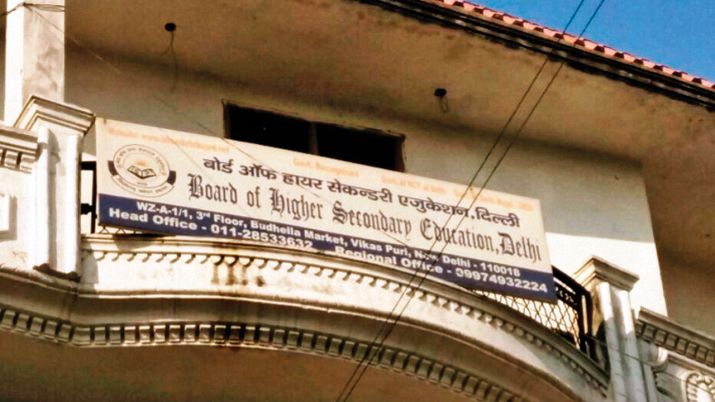
Board of Higher Secondary Education, Delhi

The
Ministry of Human Resource and Development wishes to inform the general
public that it has come to the notice of Ministry of HRD that one
entity operating in the name of “Board of Higher Secondary Education,
Delhi” is claiming to be a recognised Board of Education by this
Ministry vide letter No. 1812/2009/SKT-1 dated 29/06/2009 and D.O.
letter No. 3-5/2013/Sch.3 dated the 26th April, 2013. On scrutiny of the
relevant records of this Ministry, it has been found that no such
letters have ever been issued by this Ministry in favour of so called
Board of Higher Secondary Education, Delhi. Both these letters are,
therefore, completely forged and fabricated. Further, it is abundantly
clarified that No letters, whatsoever, have ever been issued by this
Ministry recognising the said entity i.e. Board of Higher Secondary
Education, Delhi.
The
said entity i.e. Board of Higher Secondary Education, Delhi stands
dissolved w.e.f. 01.07.1962 vide Directorate of Education Delhi
Administration Resolution’s No. F.32(10)/62-Edn. dated 30.06.1962.
Therefore, if any other document(s) is/are produced by the Board of
Higher Secondary Education, Delhi in relation to its recognition, then
the same may be deemed to be fake and the veracity of the documents may
first be got confirmed from the concerned organisation/Ministry.
The
General Public, all students, their parents and all other stakeholders
are, therefore, advised to take note of the above facts and act
accordingly.

UGC launch PARAMARSH to promote quality education

PARAMARSH
University Grants Commission (UGC) launched a new
scheme as an attempt to promote good learning amongst students of higher
education. Paramarsh, a University Grants Commission scheme for mentoring
NAAC accreditation aspirant institutions to promote quality assurance in higher education is launched by Union HRD Minister Ramesh Pokhriyal ‘Nishank.

Under the Paramarsh scheme, imminent institutions
will be mentoring colleges to achieve them high quality standards. It
would also be providing financial support to supervisory institutions with an option
to appoint an expert.  The scheme main
aim is to subjugate a national challenge of improving the quality of Higher
Education in India. Services like sharing of knowledge, information and
opportunities for research collaboration and faculty development are the major concern areas of Paramarsh scheme for Mentee Institutions.

Hub
& Spoke” model
The scheme will run under a Hub & Spoke” model called
where mentoring institute would act as a Hub will have the responsibility of
guiding the Mentee institution and the mentee institution through the secondary
branches the “Spoke” through the facilities delivered to the mentee for self-development.
It will have a centralized control over functioning, efficiency, resource
utilization to accomplish complete progress of the mentee institution. Each mentor
institute will guide five NAAC (National Assessment Accreditation Council) aspirant
colleges. The mentor institution will only be the top Indian colleges and
universities that have achieved a NAAC Score of 3.26 or an “A”
accreditation. They will share their resources and expertise with  learning institutes, which have failed to meet quality standards of NAAC score. They will also be providing proper guidance to these colleges to improve their grade or
rank. Initially 71 universities and 391 colleges have NAAC accreditation that
will mentor undermine colleges, as per guidelines issued by government in PIB (Press
information Bureau).

Importance
of NAAC Accreditation
NAAC (National Assessment Accreditation Council) was
established in 27 January 2018. It has a mission to evaluate the higher
education institute and organization to assure the quality in
terms of education, infrastructure, research, teaching & learning etc. Accreditation
of NAAC is mandatory for all the institute and organization that aims to
provide higher education to students, particularly state universities. Organizations
with top NAAC grades such as ‘A++’, ‘A+’ and ‘A’ are most sought-after
institutes for higher studies. It help student to choose the best college they
want to get admission to shape their career. Also, UGC don’t grant RUSA and financial assistance if the college or institute fails to have accredited from NAAC.
Benefits
of NAAC Accreditation for Institutions
·        
NAAC
accreditation helps learning Institution to have a SWOT analysis and provides an opportunity to improve through an informed review process.
·        
It also provides financial assistance to the institute for better development of infrastructure
building.
·        
NAAC
assessment aids educational organizations to initiate pioneering
methods of teaching.

·       Being
one of the major accreditation agencies of the country, NAAC recommendation is
mandatory  for all the higher learning institutes.

Breaking News! New UGC scheme for Higher Education launched

In a bid to promote quality assurance in Higher Education, Union HRD
Minister Ramesh Pokhriyal ‘Nishank’ today launched  University Grants
Commission (UGC) Scheme of ‘Paramarsh.’

The scheme is aimed at mentoring National Accreditation and Assessment
Council (NAAC) Accreditation Aspirant Institutions to promote Quality
Assurance in Higher Education.

Initially 71 universities and 391 colleges with NAAC score of 3.26 and above will mentor five colleges each.
Under
the Paramarsh scheme, the leading institutions will provide regular
mentoring to help colleges achieve high quality standards. The scheme
also proposes to provide financial assistance to the mentoring
institutions and the option of appointing an expert, who can be paid a
fellowship amount of Rs 31,000 per month.
“The scheme will be a
paradigm shift in the concept of mentoring of institution by another
well performing institution to upgrade their academic performance and
enable them to get accredited by focusing in the area of curricular
aspects, teaching-learning & evaluation, research, innovation,
institutional values & practices etc,” Speaking on the occasion,”
the Minister said.
The
scheme is expected to have a major impact in addressing a national
challenge of improving the quality of Higher Education in India.
Sharing
information about the scheme, the Minister said the Scheme will be
operationalized through a “Hub & Spoke” model wherein the Mentor
Institution, called the “Hub” is centralized and will have the
responsibility of guiding the Mentee institution through the secondary
branches the “Spoke” through the services provided to the mentee for
self improvement. This allows a centralized control over operational
efficiency, resource utilization to attain overall development of the
mentee institution.
The scheme aims at enhancement of overall
quality of the Mentee Institutions and its profile as a result of
improved quality of research, teaching and learning methodologies.
Mentee Institution will also have increased exposure and speedier
adaptation to best practices. “Paramarsh” scheme will also facilitate
sharing of knowledge, information and opportunities for research
collaboration and faculty development in Mentee Institutions.
The
eligibility guidelines laid down by UGC say the mentor and the mentee
can be government, aided, private or self-financing institution. “The
mentor institution should be NAAC accredited with an A grade, having an
overall score of 3.26 and above. Any such institution recognised under
2(f) & 12B of the UGC Act 1956 will be eligible to receive UGC
grants for the purpose.
Since these grants will be used for
mentoring the institution and not for creation of any infrastructure,
the private institution can also receive funding as they do for student
teacher centric schemes,” the guidelines stated.
The “Paramarsh”
scheme will target 1000 Higher Education Institutions for mentoring with
a specific focus on quality as enumerated in the UGC “Quality Mandate”.
Mentor-Mentee relationship will not only benefit both the institutions
but also provide quality education to the 3.6 crore students who are
enrolling to Indian Higher Education system at present.