Modern Trends in Indian Art

Modern art refers to the artistic work produced during the period of 1860s to the 1970s and represents the styles and philosophies of the art produced during that era. The term is usually pertains to the art in which the traditions of the past have been thrown aside in a spirit of experimentation. In India, the modern art movement began in the early 1900s. During 1900-1925, Bengal School dominated the Indian art.
Bengal school of painting represented the first art movement in the country. Artists like Abindranath Tagore, Nandal Bose, Raja Ravi Verma, Jamini Roy were some of the pioneers of Bengal school. It was the rebirth of Indian art. Bengal school witnessed the departure of traditional painting methods like tempera. Chinese cloth painting and Japanese wash technique were used. The Japanese water colour technique called wash became the hallmark of Bengal school. This technique diluted the impact of the colours used giving the paintings a mystic sense of space and atmosphere. The these of the paintings included religious, social and historical events. Paintings of landscapes, birds and animals were also done.
After 1925, artists refused to imitate the mannerisms of the art of the past. They argued that such imitation bounds the imagination and creativity of the artists. The contemporary artists stressed on liberating the imagination from the shackles of past. The art after 1925, was therefore very different from the previous Indian arts. There was variety in the techniques used and artworks were different from each other having more or less similarity.
Technique like cubism was used by the artist Gaganendranath. Cubism is a European style of art which aims to show all of the possible viewpoints of a person or an object all at once. Cubistic artworks look like they are made out of cubes and other geometrical shapes. Chiaroscuro, which is a characteristic of the European Renaissance was used in his famous painting ‘Magician’. Chiaroscuro is the use of strong contrasts between light and dark, usually bold contrasts affecting a whole composition.
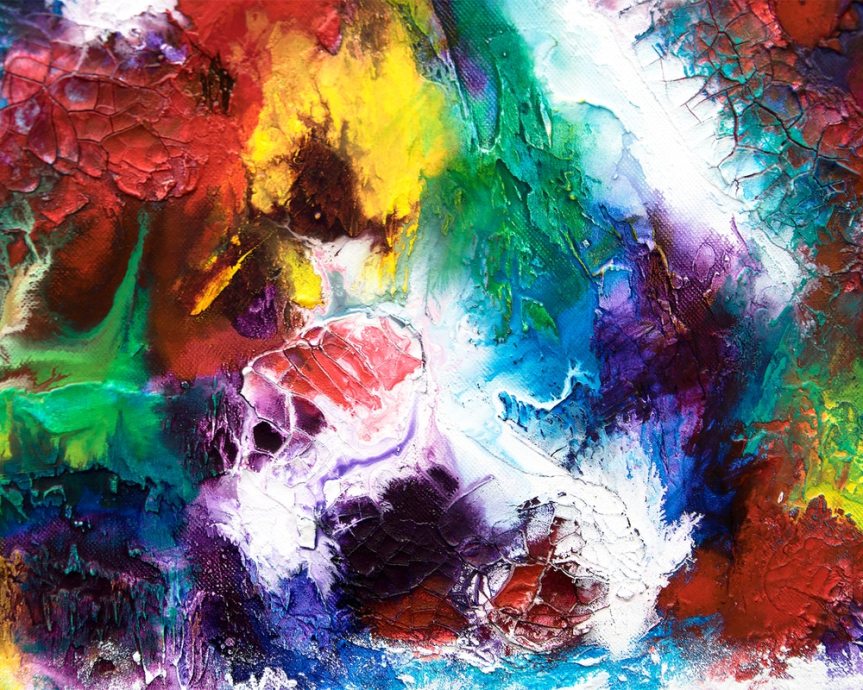
The soft wash technique was discarded and oil painting started getting more recognition. These paintings had bold and contrasting colour scheme in comparison to the light wash technique of the Bengal school. The credit for popularising oil painting in India goes to Amrita Sher Gil.
Graphic Prints stated getting popular as well. Artist Krishna Reddy used techniques like intaglio and kaleidoscopic effects in his graphic prints. Intaglio is a printmaking technique in which the image is incised into a surface and the incised line or sunken area holds the ink. It is a process of print on engraved design. In his painting ‘Whirlpool’ which is a intaglio on paper, Krishna Reddy has also used the method of viscosity printing. Viscosity printing is a multi-colour printmaking technique which is uses the viscosity of the paint or ink.
Etching and aquatint was also used in contemporary print making. Etching is an intaglio printmaking process in which lines or areas are incised using acid into a metal plate in order to hold the ink. Aquatint is also an intaglio printmaking technique, a variant of etching that produces areas of tone rather than lines. Both of these techniques were used together to create contemporary prints. ‘The Children’ by Somnath Hore, ‘TheDevi’ by Jyoti Bhatt and ‘ Man, Women and Tree’ by K. Laxman Goud are some of the famous prints which have been made using these techniques.

https://www.jagranjosh.com/general-knowledge/bengal-school-of-art-1345270637-1
https://www.flexiprep.com/NIOS-Notes/Secondary/Painting/NIOS-Class-10-Painting-Chapter-9-Contemporary-Indian-Art-Part-1.html

Indian Miniature Paintings

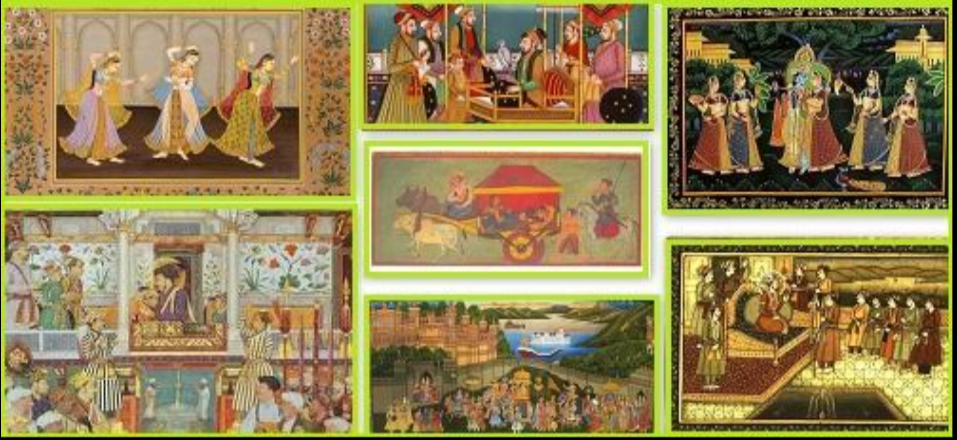
Miniature Art refers to paintings, sculptures, engravings etc. That have small dimensions. Though they are small, they are well detailed. The origin of miniature paintings dates back to the prehistoric times and is profoundly influenced by Indian literature. A miniature painting is generally less than 25 square inches or 100 square centimetres. The subjects in the painting are one -sixth of their actual sizes. Miniature paintings were generally done on materials like cloth, paper, leaves etc. which are quite perishable. These paintings are handmade and very delicate.
Miniature paintings are considered as an ancient art in India and there were many schools for the same, including those of the Rajput’s, Deccan’s and the Mughals. These paintings give an insight into the life of the royals and the common man, the beauty of their womenfolk and the inspirations and devotions of the artists themselves. These paintings are often associated with the Ragas i.e. the melodies of Indian classical music.
Rajasthani School of Miniature Paintings:
This school developed around the areas of Rajasthan, Bundelkhand and Punjab regions. The Rajasthani paintings were greatly influenced by Tulsidas and Kabir. The main theme observed in the illustrations of this school is love in all of its form. Main emphasis is given on the love between human soul and god. This might have been influenced by the Bhakti cult which originated in those days. Paintings are left to the imagination and emotion of the viewers for interpretation.
Features:
Compositions are clear and simple. All figures are in same dimensions. The figure of a woman are duplicated for other women. This is painted as a symbol of femininity. Colours are used harmoniously and are bright with each colour having it’s own specific meaning. The medium mostly used was water colour in tempera hand made paper. The colour scheme is flat and paintings are two dimentional.
Some of the famous Rajasthani miniature paintings:
‘Radha Bani Thani’by Nihal Chand
‘Maru Ragini’ by Sahibdin
‘Chaugan Players’ by Dana

Mughal School of Miniature Painting:
With the advent of Mughal, the Indian miniature paintings shifted to the portraits and richness of colour effects with the unique Persian flavour. During this period, the art specialises in Court and Palace scenes. Themes from Indian epics such as Ramayana, Mahabharata, Bhagvata Purana etc. Are also included. The Indian Miniature painting was at it’s prime time during the period of Mughal Emperor Shah Jahan because he was a great patron of miniature painting. But after his regime, paintings lost their charm and started to decline in the 18th century.
Features:
Mughal paintings denoted the habits of the ruling class. Portraiture was done. Figures were drawn in profile or quarter profile. A decorative border called hasiah was also used. Calligraphy was also done in the paintings. The paintings were male dominated. Portraits of women were drawn from imagination. The medium generally used was water colour in tempera handmade paper.
Some of the famous Mughal Miniature Paintings:
‘Kabir and Raidas’ by Ustad Faquirullah Khan
‘Falcon on a Bird Rest’ by Ustad Mansoor
‘Babur Crossing River Sone’ by Jagannath

https://m.jagranjosh.com/general-knowledge/do-you-know-that-how-indian-art-of-miniature-painting-evolves-1532003322-1

https://artsandculture.google.com/exhibit/indian-miniature-paintings-the-rajasthan-school-academy-of-fine-arts-and-literature/PgLSknKVv0F_JQ?hl=en

Does Art Really Matter in Our Daily Lives?

Art is known to surround life, every individual in different locations, without us being aware of it fully.  Since time has been immemorial, art has existed as long as man has and has exited ever since. It is an integral part of our culture, which contributes in shaping our ideas, and vice versa, and it provides us with a deeper understanding of our emotions, increases our self-awareness, and more. To conclude that art is only confined to the artist or the painter, the dancer, the sculptor, the musician or the singer or other craftsman is to look at a needlessly rigid and a restricted view of life. Life itself is known to be art and though poets and artists may seem visionaries, they have a specific and distinct role to play in our being. Almost every individual has some form of art in their house—a hanging painting, framed photographs on walls, a decorative table center piece and even the main layout and design of a house is and can be considered as a form of art.  Art is not restricted purely for looking at it and admiring, a lot of it is functional too which we often don’t realize, especially when it comes to our living spaces and our daily lives.

Image of World Collaboration Limited edition Art Print (6 artists  collaboration) | Art, Drawings, Art drawings

Everything from a delightfully patterned cushion cover on the pillow or even a decorative plate and intricate designed teacups can be considered as a form of art.  Our brain is mostly conditioned to think that these type of items or things are not a form of art when it’s only for decoration. Another important element of form of art that adds value in our daily lives is Music, it is similar as art, and is considered to be a universal language and it holds importance in our daily lives which is indisputable. Subconsciously, when we hear music through various forms like on shows, commercials, radio and through other forms of media. Sounds, songs, instruments and music can make life extremely joyful and it can contribute heavily in lifting our spirits up and also till some extent improve our mental health and wellbeing. People think that technology and science are considered to be superior to art or any form of art.

Brain research shows the arts promote mental health

But art makes life worthwhile. It may not be as vital to fulfil our basic wants or necessities, but it does add value into our lives and brings colours in it as well. As we proceed our journey of a fast-paced life with quick decisions, moments, time and with many fragmented thoughts, art allows us to learn from every moment and to enjoy each moment and to make it memorable. Understanding our true emotions can help us heal from pain, grow and improve ourselves to become better humans. It helps in increasing our self-awareness and through that it can lead to more success professionally and personally. Through any form of art, we gain a better understanding of history, culture and tradition. It helps people in the present to build a better life for themselves.