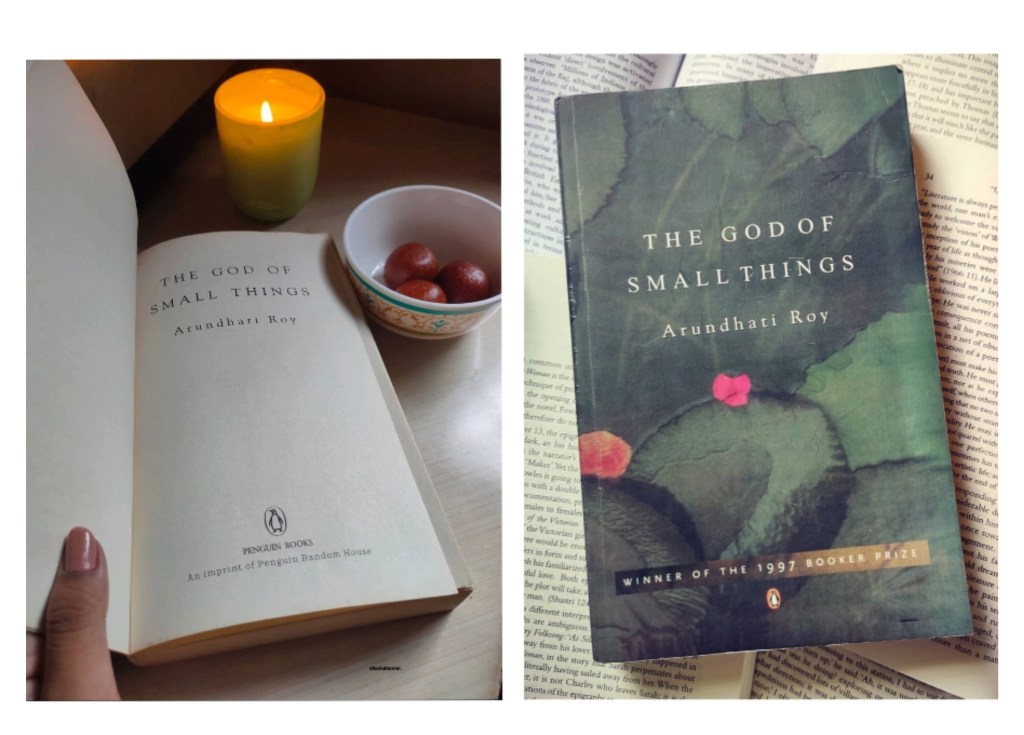
The god of small things: A Book Review

Buy God of Small Things: Booker Prize Winner 1997- English Book Online at  Low Prices in India | God of Small Things: Booker Prize Winner 1997-  English Reviews & Ratings - Amazon.in

A broken marriage can mean a lot of things to a family. Marriages can be broken by a lot of things including laws defined by societies about whom to love, whom to marry and whom not to.

The god of small things is a caricature of human pain and life built on the layers of political leanings, the realities of Indian conservative societies, casteism and of course on how other people exploit it just to feel away and free from their own realities.

A multi-generational family lives in a small village in the state of Kerala – a communist stronghold. A woman from the family falls in love with an Irish priest, despite the opposition of her father, but failing to get any near him, is left bitter and becomes the antagonist of the narrative. Two twins witness a rape and murder wherein this lady, their aunt, the one who once loved an Irish priest is almost implicated for lying about the criminal and she tricks the poor children into blaming their servant. All this happens in the backdrop of a violent and turbid communist politics of which the servant who dies due to police beating turns out to be a member of. The aunt hates the communists because they once forced her to weave the red flag while forcible stopping her car on the road. To save herself of any implications, the lady gets rid of the children – blaming them of the death of the raped girl and the servant, breaks down their family – the mother dying at 31 and the father never really bothered. The twins grow broken, traumatized and never really heard or cared for. And the climax of the story just leaves one crying when the two twins finally meet at 31 – the age their mother died. The girl twin no longer speaks and the boy is just a lost one. They, for the first time realize the meaning of love and warmth and that it is them alone who share it with each other.

This review will and any review will, as a matter of fact, fail to capture the perfection Roy has achieved in this book. The 1997 Booker’s Prize winner is a masterpiece of storytelling and narrative. And it is a wonderful critique on politics, religion and casteism.

Happy reading!

arundhati roy
Arundhati Roy, who might be in news due to her remarks in the present day has penned a beauty.

The God of Small Things by Arundhati Roy

Genre: Fiction, Drama

Rating: 4/5

“They all crossed into forbidden territory. They all tampered with the laws that lay down who should be loved and how. And how much.” Arundhati Roy – God of small things. 

This book was published and won the man booker prize in the year 1997.

A story about three generations of one broken family made up of flawed and broken individuals. It deals with themes of class and caste, love and sexuality, family and politics, and other little things. The God of Small Things is more than a novel. It’s an immersion of senses into a world, a language, a society, a culture that leaves you shattered. Arundhati Roy has crafted a world within the sleepy little town of Ayemenem. The way she has written is almost as if she invented her own language. The prose is so distinct and poetic that I’ve never read anything like it. At its heart, this is a story of family struggle (and everything that entails), but the trauma and division are beautifully balanced with lush descriptions of Kerala life.

‘May in Ayemenem is a hot, brooding month. The days are long and humid. The river shrinks and black crows gorge on bright mangoes in still, dustgreen trees. Red bananas ripen. Jackfruits burst. Dissolute bluebottles hum vacuously in the fruity air. Then they stun themselves against clear windowpanes and die, fatly baffled in the sun.’

Estha and Rahel, two-egg twins have met after years of staying apart. Set in the backwaters of Kerala during the height of Marxist influence, the book moves back-and-forth in time to establish the twins’ lives, and also that of their family – their parents, uncle, grandmother, and grandaunt. One tragic evening unravels any semblance of balance in their lives and leaves the family broken.

Arundhati Roy


“Perhaps it’s true that things can change in a day. That a few dozen hours can affect the outcome of whole lifetimes. And that when they do, those few dozen hours, like the salvaged remains of a burned house—the charred clock, the singed photograph, the scorched furniture—must be resurrected from the ruins and examined. Preserved. Accounted for. Little events, ordinary things, smashed and reconstituted. Imbued with new meaning. Suddenly they become the bleached bones of a story.”

Through the eyes of the twins, Estha and Rahel, she’s pointed out the hypocrisy, dejection, and sadness that is in the world. Specifically related to Love. About who should be loved and how much. Neither the questions asked, nor the answers given are easy. I can only imagine what her process might have been while writing this masterpiece. It is one of the finest pieces of literature I’ve ever read. The beautiful prose makes rain soaked, pickled flavour, cast ridden, left leaning Kerala come alive.


But what really bothered me is the constant repetition and lack of setting and description.
The story goes back and forth in time and and is filled with rich metaphors so it demands more attention.
If I have to describe it in a sentence I would say – It’s a lesson in sociology baked in prose poetry.

Pick this book up when your brain isn’t too scrambled.