

The Ministry of Ayush has marked a significant milestone in the year 2023 by reaffirming the implementation of its vision and objectives on National and International levels. This year has witnessed the global dissemination and acceptance of Indian traditional medicine culture. Ayush has advanced to a new degree of international recognition and left several permanent footprints of success.
The visionary support and direction of the Prime Minister Shri Narendra Modi translated well into Ayush’s efforts in the fields of healthcare infrastructure development, research collaborations, export promotion mechanisms, educational reforms, global expansion of the Indian traditional medicine system and more.
Chintan Shivir: The inaugural “Chintan Shivir” in February provided a roadmap for Ayush’s future, focusing on digital health, strategy, challenges, and collaboration, reinforcing its commitment to growth.
Inclusion of Traditional Medicine in G-20 New Delhi Leaders Declaration: India’s G20 presidency provided a golden chance to showcase this efficacy more intimately to world leaders and healthcare experts in a focused manner. The Ministry of Ayush actively participated in all relevant deliberations to communicate to the global community how traditional healthcare sciences of India have been performing to negotiate the ever-growing challenges of humanity and the environment while remaining focused to SDG 3 of “Good Health and Wellbeing.” The Ayush Ministry proactively participated in all the Health Working Group events during India’s presidency. This resulted in Para 28 (vii) of G-20 New Delhi leader declaration where it has been mentioned of “Recognize the potential role of evidence-based Traditional and Complementary Medicine in health, and take note of international efforts in this direction, including WHO’s global and collaborating centres, and clinical trial registries.”
First SCO Conference: The first Shanghai Cooperation Organisation Conference generated trade interest of ₹590 crores, highlighting Ayush’s growing significance in international markets. Under the aegis of the Ministry of Ayush, Invest India conducted B2B meetings at the event with the support of Ayushexcil (Ayush Export Promotion Council). More than 56 exhibitors and buyers from 19 countries discussed and expressed their interest in trade in traditional medicine. More than 50 one-to-one meetings between buyers and sellers were conducted during the conference. Over 75 meetings took place during the event, where participants from India, Tajikistan, Armenia, Uzbekistan, Mongolia, Kazakhstan, Bahrain & Sri Lanka engaged. The trade interest of ₹590 crores was received in the B2B meetings from companies like Damaira Pharma, AIMIL Global, Herbal Strategi Homecare, Almaty, Dindayal Industries, Fidalgo Healthcare and many more. Multiple meetings between buyers &and sellers as delegates from 19 countries interacted with exhibitors at the Expo with interest in multiple product categories Participating countries like India, Tajikistan, Armenia, Uzbekistan, Mongolia, Kazakhstan, Bahrain, and Sri Lanka expressed their interest in traditional medicine trade.
Dedicated vertical for Ayush at BIS: Bureau of Indian Standards has also created a dedicated vertical for Ayush at BIS. In a short span of time, BIS has published 7 Ayush related Indian standards, and further 53 are in process of development and publication. BIS is also making stronger presence in ISO for Ayush and a dedicated Working Group (WG 10 – Traditional Medicine) has been created in ISO under ISO/TC 215 – Health Informatics to formulate International Standards on Ayush Informatics. This will help in more acceptance and will open the door of huge exports of Ayurveda products and services in more than 165 countries.
The International Organization for Standardization (ISO) released the first ISO standard technical report titled “ISO/TR 4421:2023 Health informatics- Introduction to Ayurveda informatics”. This technical report aims to provide a foundational understanding of the Ayurvedic medicine system. It introduces numerous aspects and processes that are inherent and necessary in Ayurvedic diagnosis and treatment. An ISO TC 215 dedicated working group (WG 10) on Traditional Medicines was formed in response to a proposal presented by the Bureau of Indian Standards (BIS) for standardization in the field of Ayurveda Informatics. Ministry of Ayush and BIS has been working since 2019 to formulate Indian Standards and ISO deliverables for Ayush systems. Three more Indian applications are currently being considered for the WG 10 Traditional Medicine within the ISO TC 215 Health Informatics to produce international deliverables.
WHO-Global Summit on Traditional Medicine & Gujarat Declaration: First ever Global Summit on Traditional Medicine (17-18 August 2023) was organised by the World Health Organisation, and co-hosted by the Ministry of Ayush, in Gandhinagar, Gujarat. The main outcomes of the global summit were released by the World Health Organisation in the form of Gujarat declaration. In the summit, WHO also has shared the initial findings of the global survey on Traditional Medicine that indicates that the reach of Traditional Medicine is on the rise across the globe. “Gujarat Declaration” emphasised that the importance of Traditional Medicine is recognised for the attainment of universal health coverage and WHO’s commitment to work toward it through evidence generation and policy support to member states.
This event also saw “Health Ministers conclave of G20 Nations on Traditional Medicine”, on the side line of G20 Health Ministers meet, whereby the G20 nations talked about role and prospects of Traditional Medicine in their respective countries.
Advanced R&D through Ayush based fundamentals: Under Centre of Excellence of Ministry of Ayush at Institute of Genomics and Integrative Biology (IGIB) CSIR, relation of Ayurveda Prakriti is made with the Genome sequence, making it a landmark study toward personalized preventive and predictive medicine, they are also getting promising outcomes on Gut Microbiota and working on advance biology of metabolomics, Proteomics etc. to shape the future of healthcare sector.
International Day of Yoga: The 9th edition witnessed unprecedented outreach, setting two world records, including a Guinness record for participation at the UN Headquarters. The event witnessed an overwhelming response from thousands of Yoga enthusiasts from over 135 nationalities, setting a Guinness World Record for participation by maximum number of nationalities in a Yoga session. IDY 2023 also witnessed another feather in the cap of IDY whereas Surat (Gujarat, India) made a Guinness world record for the largest gathering of people for a yoga session in one place. More than one lakh people took part in the event.
The highlight of 9th International Day of Yoga was the unique concept of the creation of the Ocean Ring of Yoga, ‘Yoga for Arctic to Antarctic’, ‘Yoga at North and South poles’, ‘Yoga Bharatmala’ and ‘Yoga Sagarmala with a massive participation of around 23.14 Crore individuals.
Nearly 3500 naval personnel on board 19 Indian Naval ships travelled over 35,000 Km as ambassadors of Yoga in both national and international waters. This includes over 2400 personnel on 11 IN ships at foreign ports/international waters. Notably, IDY was celebrated on board ships of several foreign Navies in concert with our overseas Missions, involving over 1200 foreign Navy personnel.
For engaging with rural communities Ministry of Ayush had elaborately planned to spread message of “Har Aangan Yoga”. Yoga demonstrations were organized at Panchayats, Anganwadi, Health and Wellness Centres, and schools, around 2 lakh Common Service Centres, Ayush Gram Unit and location on Amrit Sarovar.
Ayush Visa boosting Medical Value Travel: As announced by Hon’ble Prime Minister Shri Narendra Modi ji in GAIIS 2022, the Ministry of Home Affairs notified Ayush Visa (category AY) for foreign nationals for treatment under Ayush System/Indian System of Medicines. The introduction of Ayush Visa introduces a special visa scheme for foreigners visiting India seeking treatment under Indian system of Medicines like therapeutic care, wellness, yoga etc. Ayush Visa will boost medical value travel and is intended to promote India as a medical value travel destination. Ministry of Ayush and Ministry of Health and Family Welfare are working together to develop a one-stop ‘Heal in India’ portal to promote India as a Medical Tourism destination of the world.
Ministry of Ayush and India Tourism Development Corporation has signed an MoU in January 2023 to work together for the promotion of Medical Value Travel in Ayush sector in India.
Research Impact: The Prime Minister’s mention of ‘Ayush’ in “Mann Ki Baat” significantly contributed to the sector’s growth and it was compiled and published in a special issue of JRAS Journal of CCRAS. Ministry initiated many collaborative and integrative researches with Basic Science Ministries/departments and reputed scientific organizations at national and international levels.
Integrative Health: A Memorandum of Understanding (MOU) was signed between the Ministry of Ayush and the Indian Council of Medical Research (ICMR) on 11th May 2023 to promote and collaborate on Integrative Health Research. Shri Sarbananda Sonowal, Hon’ble Minister of Ayush and Ports, Shipping and Waterways, Dr. Mansukh Mandaviya, Hon’ble Minister of Health and Family Welfare, Dr. Bharati Pravin Pawar, Hon’ble Minister of State for MOHFW, Dr. V. K. Paul, Hon’ble Member, NITI Aayog, Secretary, Ayush, Secretary (Health), Secretary and DG (ICMR) and other senior officers of both ministries were present during the MOU signing. Further, this cooperation will explore the possibility to work on public health research, take initiatives for addressing diseases of national importance and look at possibilities of conducting high-quality clinical trials jointly on identified areas/disease conditions of national importance with promising therapies of Ayush system to generate evidence for wider acceptance. The MoU will facilitate looking at the possibility of inclusion of research on Integrative Medicine in the “National ethical guidelines for biomedical and health research involving human participants” by ICMR-DHR. This MoU will also strengthen research capacity through training of Ayush researchers.
Shri Sarbananda Sonowal, Hon’ble Union Minister of Ayush and Ports Shipping and Waterways and Dr. Mansukh Mandaviya, Hon’ble Union Minister of Health & Family Welfare jointly inaugurated the Department of Integrative Medicine at Safdarjung hospital, New Delhi on 7h February 2023. The Department of Integrative Medicine will offer services in specialty OPD, Panchakarma Therapy, and diet consultation for the patients.
The Central Council for Research in Ayurvedic Sciences and Lady Hardinge Medical College and Hospital signed a MoU on the 25th October 2023 for establishing and integrated medicine centre. The integrated centre will help for collecting research data for the impact of integrated treatment approach of allopathy as well as Ayurveda in disease management.
Ministry of Ayush and the Department of Ex-servicemen Contributory Health Scheme (ECHS) has signed an MoU in March 2023 to integrate Ayurveda in 10 ECHS polyclinics across India. This MoU will further expand Ayush health services in defence sector. In addition, there are already operating Ayurveda Centres in 12 Military Hospitals of AFMC and 37 Cantonment Board Hospitals.
Effective Documentation of Research in Ayush: Huge repository of extensive research works by various stakeholders in Ayush is created online at a dedicated website: Ayush research portal, cataloguing 41743 research publications (as on 28.12.2023). The portal is actively managed by CCRAS, Ministry of Ayush and is made in a searchable format and includes publications in indexed journals. This provide a showcase of evidence based Ayush systems and a ready solution of researchers and academicians.
SMART Program: The National Commission for Indian System of Medicine (NCISM) and the Central Council for Research in Ayurvedic Sciences (CCRAS), for regulating medical education and conducting scientific research respectively, have launched ‘SMART’ (Scope for Mainstreaming Ayurveda Research in Teaching Professionals) program aimed to boost scientific research in priority healthcare research areas through Ayurveda colleges and hospitals.
National Ayush Mission: One of the initiatives is implementing a flagship scheme i.e., Centrally Sponsored Scheme of National Ayush Mission (NAM), to support the UT / State Governments in developing infrastructure and improving access to the Ayush healthcare.
Ministry of Ayush organized a 2-day National Ayush Mission (NAM) Conclave- State/UT Ayush/Health Ministers’ Conference on 18th and 19th May 2023 at Vigyan Bhawan, New Delhi. Shri Sarbananda Sonowal, Hon’ble Minister of Ayush and Ports, Shipping and Waterways inaugurated the Conclave. Dr. Mansukh Mandaviya, Union Minister of Health & Family Welfare was the chief guest on this occasion. Dr. Mahendrabhai Munjpara, Hon’ble Minister of State for Ayush and Women & Child Development and 13 Health & Ayush Ministers from participating States/UTS attended this Conclave. A roundtable discussion with Ayush & Health Ministers of various states was held on the sidelines of the NAM Conclave. During the inaugural session of this Conclave, E-Learning Management System (eLMS) and comprehensive AHMIS, an upgraded EHR system, were launched.
Further, through National Ayush Mission, Ministry of Ayush completed the process for approval for upgradation of 12,500 Health facilities into Ayush Health and Wellness Centre under the Ayushman Bharat. As per the data received from States/UTs, 8.42 Crores beneficiaries benefitted through these facilities during 2022-23 and 6.91 crores from January 2023 to October 2023.
Ayurtech IIT Jodhpur: Ministry of Ayush under Centre of Excellence (CoE) scheme has sponsored the AyurTech center at the IIT Jodhpur in May 2023. The CoE AyurTech is part of the Centre of Excellence in Artificial Intelligence (AI) based Precision Healthcare at the school of Artificial Intelligence and Data Science (AIDE) at IIT Jodhpur. The aim of this centre is to establish an AI-driven integrative framework for population and individual risk stratification and early actionable precision health interventions. The Centre for AyurTech is being proposed as the first-of-its-kind initiative in the precision health and medicine space that would combine Electronics, Digital health and AI and multi-omics technologies for realising ‘Evidence-based Ayurveda’ solutions in a transdisciplinary framework.to establish AI-driven integrative framework for population and individual risk stratification and early health interventions
Focus on North-East development:
Ministry of Ayush contributed significantly to accelerate the pace of socio-economic development of North-east region through its various schemes, infrastructure development, & various summits and conferences, Ayush Parv and Expo etc. To foster Ayush Infrastructure in the region in the year 2023 following measures were taken:
- 819 Ayush Health & Wellness Centres have been constructed or sanctioned
- Construction of more than 100 Ayush pharmacies has been approved
- More than 50 Ayush hospitals have been sanctioned
- Financial assistance was provided for the development of educational institutions
First B2B conference under the Shanghai Corporation Organization (SCO) on traditional medicine was organised in Guwahati, Assam. International Expo was organized on the sidelines of the main event, paving the way for International Collaborations and fostering trade ties.
Ayush in International Classification of Disease: Ministry of Ayush supported for inclusion of Ayush Morbidly and standardized codes for inclusion in 2nd Module of Traditional Medicine Chapter of ICD-11.
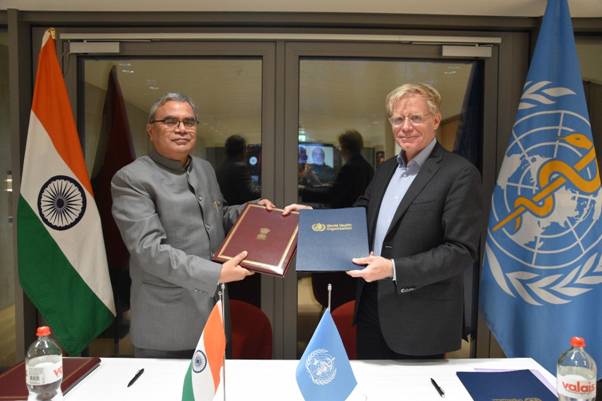
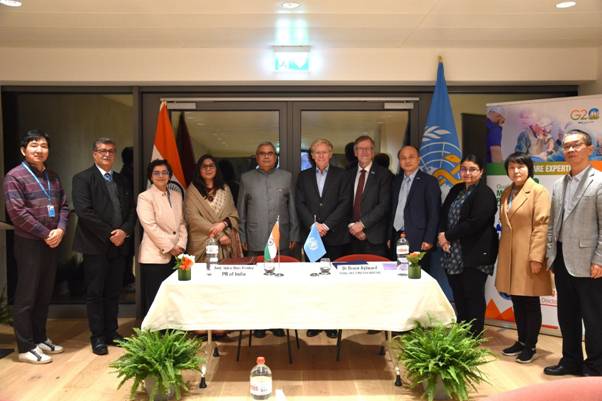
WHO Collaboration: The Ministry signed a Project Collaboration Agreement with WHO, aiming to propel the formulation of a global strategy, focusing on elevating the standards, quality, safety, and effectiveness of traditional and complementary medicines over the next 5 years.
Leadership to India in AI Talking Group for Traditional Medicine at W.H.O/ITU–Focus Group on AI in Health: Talking Group (TG) for AI for traditional medicine has been formed under Focus Group on Artificial Intelligence for Health (FG-AI4H) at W.H.O/ITU-Focus Group on AI in Health. Ministry of Ayush would lead this work together with other traditional medicine partners.
In summary, 2023 marked a transformative year for the Ministry of Ayush, showcasing its global influence, commitment to traditional medicine, and efforts to enhance healthcare on a national and international scale.
***
 Eduindex