
Network Topology and its Types

Network topology refers to the arrangement of nodes, devices, and communication channels in a computer network. There are several types of network topologies, including bus, star, ring, mesh, and tree. Each topology has its own advantages and disadvantages, depending on the network’s size, scalability, and fault tolerance requirements.

Network topology has basically 5 types:

BUS TOPOLOGY – A bus topology connects all devices to a single communication channel called a bus. Data is transmitted along the bus to all connected devices, and each device listens for its specific address. This topology is simple and cost-effective for small networks, but it can suffer from congestion and is not scalable to larger networks.

Source – https://www.javatpoint.com/

STAR TOPOLOGY – A star topology connects all devices to a central hub or switch. Data is transmitted from the sender device to the hub, which then broadcasts the data to all other devices. This topology is widely used in LANs and is scalable, fault-tolerant, and easy to manage. However, it requires a larger number of cables and devices, and a single point of failure in the hub can disrupt the entire network.


Source –
https://www.javatpoint.com/

RING TOPOLOGY – A ring topology connects all devices in a circular loop, where each device is connected to its neighboring devices. Data is transmitted in one direction along the loop, and each device repeats the data to the next device until it reaches its destination. This topology is simple and efficient for small networks, but it can suffer from congestion and a single faulty device can disrupt the entire network.


Source –
https://www.javatpoint.com/

MESH TOPOLOGY – A mesh topology connects all devices in a fully interconnected network, where each device is connected to every other device. Data can be transmitted through multiple paths, making this topology highly fault-tolerant and scalable. However, it is complex and expensive to implement, and requires a large number of cables and devices.

Source – https://www.javatpoint.com/

TREE TOPOLOGY – A tree topology connects devices in a hierarchical structure, where branches of devices connect to a single root node or hub. Data is transmitted from the sender device to the hub, which then broadcasts the data to all other devices in the branch. This topology is scalable and fault-tolerant, and it allows for easy management and troubleshooting. However, a single point of failure in the root node can disrupt the entire network, and the network’s size and complexity can affect its performance.

Source – https://www.javatpoint.com/

In summary, network topology is an important aspect of computer networks that can affect the network’s performance, scalability, and fault tolerance. Choosing the right topology depends on the network’s requirements, size, and cost constraints. It is also important to consider network security and management issues when designing and implementing a network topology.
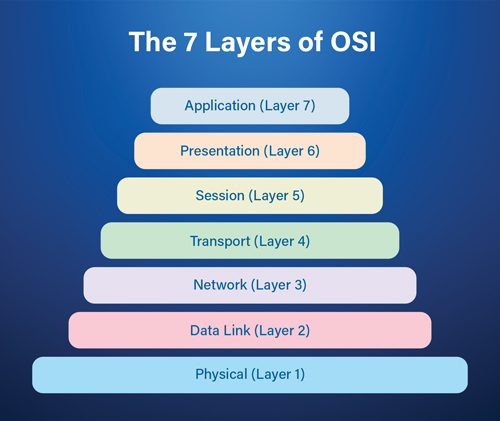
What is Open System Interconnection(OSI) Model ?

The Open Systems Interconnection (OSI) model is a conceptual framework for network communication that was developed by the International Organization for Standardization (ISO) in the 1980s. The OSI model provides a way to understand how data is transmitted over a network by breaking down the process into seven layers. Each layer has a specific function, and the layers work together to ensure reliable communication.

The OSI model provides a standardized way of describing network communication, which allows different network technologies and devices to communicate with each other. For example, a device that uses Ethernet can communicate with a device that uses Wi-Fi because they both follow the same OSI model. The OSI model also allows for easier troubleshooting of network issues because each layer has a specific function that can be tested independently.

However, the OSI model is a theoretical framework and does not correspond directly to the actual implementation of network protocols. In practice, network protocols are often a combination of multiple OSI layers, and some layers may be merged or omitted entirely. Nonetheless, the OSI model remains a useful tool for understanding the complex process of network communication.


Source –
https://www.real-sec.com/

The seven layers of the OSI model are:

  1. Physical Layer: The physical layer is responsible for transmitting raw data bits over a physical medium such as copper wires, optical fibers, or radio waves. It deals with the electrical, mechanical, and physical characteristics of the physical medium. It also defines the procedures and functions that physical devices and interfaces have to perform for transmission to occur.

  2. Data Link Layer: The data link layer is responsible for the reliable transfer of data frames over a physical medium. It establishes and terminates connections between network devices, performs error detection and correction, and manages flow control.

  3. Network Layer: The network layer is responsible for routing data packets from the source to the destination network. It determines the best path for data to travel and manages congestion control.

  4. Transport Layer: The transport layer is responsible for ensuring reliable end-to-end communication between applications. It segments and reassembles data into packets and provides error recovery and flow control.

  5. Session Layer: The session layer is responsible for managing communication sessions between applications. It establishes, maintains, and terminates sessions and provides synchronization and recovery in case of failures.

  6. Presentation Layer: The presentation layer is responsible for ensuring that data is presented in a format that can be understood by the application layer. It provides data encryption, compression, and decryption.

  7. Application Layer: The application layer is responsible for providing network services to user applications. It provides a user interface and manages application-level protocols such as HTTP, FTP, and SMTP.