Indo-Norway collaboration on Blue-Economy

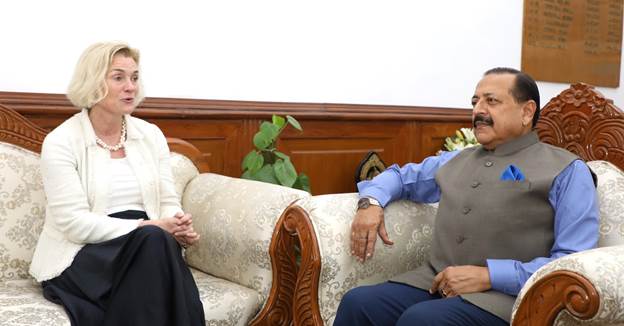
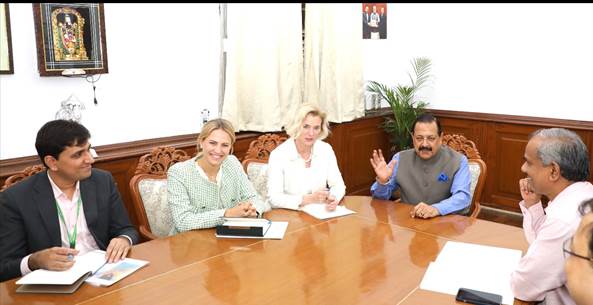
 Union Minister Dr. Jitendra Singh holds a meeting to review the Indo-Norway collaboration on Blue-Economy with Norwegian Ambassador to India Ms. May-Elin Stener in the North Block today.

Union Minister of State (Independent Charge) for Science and Technology, Minister of State (Independent Charge) for Earth Sciences, MoS PMO, Department of Atomic Energy and Department of Space, Personnel, Public Grievances and Pensions Dr. Jitendra Singh said, “The Joint Task Force (JTF) on Blue Economy (BE) to be strengthened by reinforcing our cooperation.” The task force is co-chaired by the Secretary, Ministry of Earth Sciences, Government of India.
The Minister also recalled the ‘India-Norway Integrated Ocean Management and Research Initiative’ and stated that we need to further deepen our collaboration. He also shared with the ambassador that India is carrying out a deep-sea mission by sending three Indians to deep sea which will open a horizon of opportunities in mineral exploration and seabed mining.
“Prime Minister Narendra Modi’s leadership enabled India’s Journey to Marine and Ocean exploration” is the reason for the gathering pace in this sector as described by the Earth sciences Minister. He also Said “Blue economy will foster India’s growth story in the coming years.” He highlighted the deployment of IndARC in the Arctic- India’s first sub-surface moored observatory in the polar waters, roughly halfway between Norway and the North Pole as India’s major scientific accomplishments.

Norwegian Ambassador to India Ms. May-Elin Stener said “Norway has Technology and India has Scalability”. She appreciated the efforts of the Minister for his increased co-operation, and able guidance to the projects under the Earth Sciences Ministry.

May-Elin Stener proposed to enhance the ties in fields of Science and technology along with ongoing Marine and Polar studies. The Ambassador recalled their Prime Minister’s Remarks on India and Norway being neighbors in Antarctica as far as the scientific research and establishing research facilities are concerned.
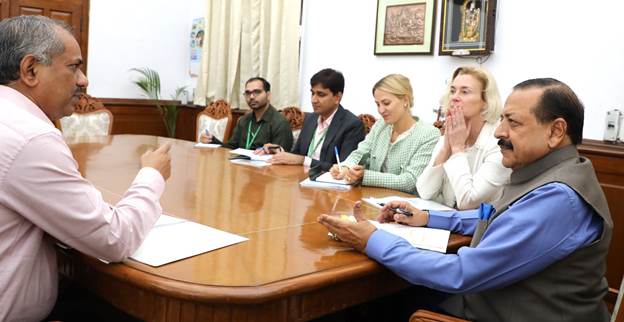
Dr. Jitendra Singh highlighted that his Earth Sciences Ministry has supported the Indo-Norwegian Fellowship Program which enabled three students to work on Arctic and Antarctic Glaciology funded by the Government.

The Earth Sciences Minister mentioned that an MoU was signed between the National Centre for Polar and Ocean Research (NCPOR) and Norwegian Polar Institute (NPI) for close collaboration in various fields of polar sciences at the 46th Antarctic Treaty Consultative Meeting held in Kochi.

Dr. Jitendra Singh recalled the draft framework jointly developed by India and Norway for Marine Spatial Planning (MSP). Going further he categorically stated both India and Norway look forward to the upcoming UN Conference on Oceans (UNOC-3) in Nice, France 2025.

****
Blue Economy and Space Economy

 Blue Economy and Space Economy are among some of the new concepts introduced in last 9 years by Prime Minister Narendra Modi.

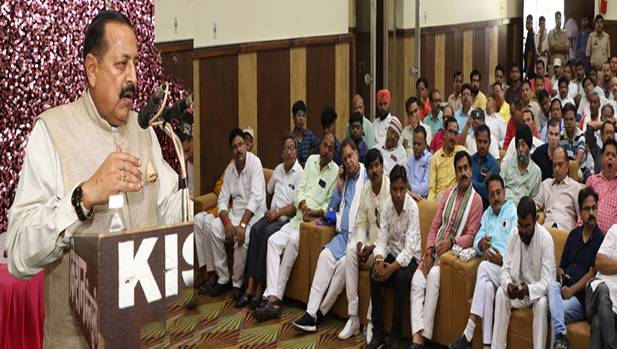
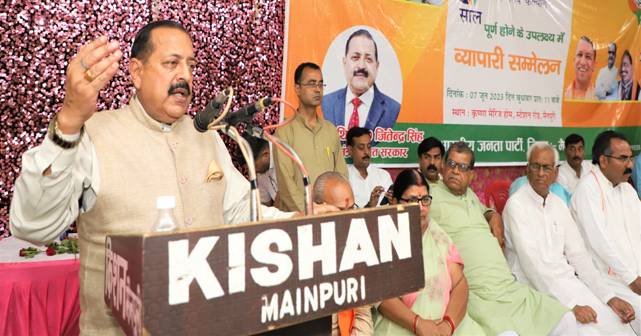
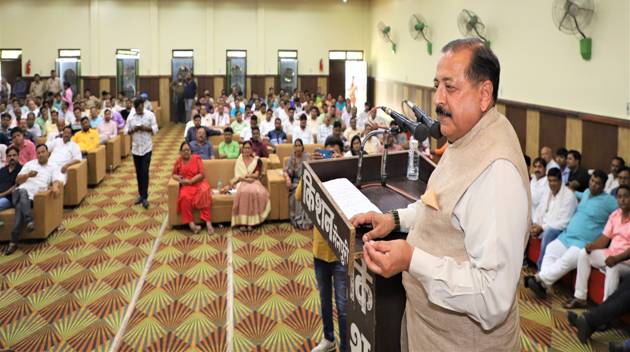
This was stated here today by Union Minister of State (Independent Charge) Ministry of Science & Technology, PMO, Ministry of Personnel, Public Grievances & Pensions, Atomic Energy and Space, Dr. Jitendra Singh while addressing “Vyapar Sammelan” (Industry and traders’ Meet) as a part of the month-long campaign to commemorate the 9 years of Modi government.

Dr. Jitendra Singh said, one of the hallmarks of Prime Minister Modi’s approach towards the economy has been that he not only reinforced and strengthened the existing pillars of economy by imposing a check on pilferage or malpractice and by reducing the load of avoidable restrictions and regulations for ease of business, but he also introduced new dimensions to Indian economy which hardly received any attention by previous governments even though these were important. If India has to compete globally, it will have to stand up to global parameters and the value addition to the future economy of the country will come from hitherto lesser explored areas like ocean resources and Space.

It is also a matter of pride, said the Minister, that even though our space journey started several years after countries like USA and Soviet Union, but today, these countries are using our technology provided by ISRO (Indian Space Research Organisation) for launching their satellites. 353 out of the total 385 foreign satellites launched so far have been launched during the last 9 years and 174million US Dollars have been earned while the launching of the European Satellites has yielded 86 million Euros.

Dr Jitednra Singh said, while India has as the fastest growing economy, overtaken the United Kingdom, it has also generated revenue by launching their satellites.

As far as the Blue Economy is concerned, Prime Minister Modi spoke about the Deep Sea Mission in his Independence Day address because he wants to make people aware of the Blue wealth that lies hidden under the seabed.

Dr Jitendra Singh called upon the business community to adapt to the new culture of business and make maximum use of technology.

The Minister said, there is no such technology which is not available in India but sometimes we were not able to utilise it because we are not fully aware of it. The government today is not only providing ease of business but also offering assistance in developing new entrepreneur products and marketing the same, he said.

The Minister particularly called upon the business community to identify potential StartUps. He said it goes to the credit of Prime Minister Narendra Modi that India stands at Number-3 in the world in StartUp Ecosystem. But in order to sustain this, we have to continuously work hard.

Dr Jitendra Singh also hailed Prime Minister Narendra Modi for revival of Khadi business which has yielded more than 10 Lakh Crore of turnover.

Blue Economy is the sixth dimension of Government of India’s Vision

 Union Minister of State (Independent Charge) Science & Technology; Minister of State (Independent Charge) Earth Sciences; MoS PMO, Personnel, Public Grievances, Pensions, Atomic Energy and Space, Dr Jitendra Singh today said that the Government of India’s Vision of New India by 2030 enunciated in February 2019 highlighted the Blue Economy as the sixth dimension of its vision. He said, Rs. 150 Cr has been provisioned during 2021-22 under Deep Ocean Mission.

In a written reply to a question in the Rajya Sabha today, Dr Jitendra Singh said, a Draft Policy document on Blue Economy has been prepared by MoES taking into consideration the reports of the expert working groups which emphasizes holistic development and growth of India’s Blue Economy. The following seven thematic areas or pillars are identified:

  • National accounting framework for the blue economy and ocean governance.
  • Coastal Marine Spatial Planning and Tourism.
  • Marine fisheries, aquaculture, and fish processing.
  • Manufacturing, Emerging industries, trade, technology, services, and skill development.
  • Logistics, infrastructure and shipping, including trans-shipments.
  • Coastal and deep-sea mining and offshore energy.
  • Security, strategic dimensions, and international engagement


Deep Ocean Mission- to explore and harness deep-oceanic resources and support Blue Economy Initiatives

 The year 2021 brought some unprecedented challenges for mankind amidst the Covid-19 pandemic. Indian scientists and researchers came out with a number of remarkable achievements in the field of Earth Sciences and related sectors in year 2021. A few of many success stories of the hard work and relentless efforts of Indian scientists and researchers are listed below.

Major Success Stories of M/o Earth Sciences During 2021

  • The Deep Ocean Mission, India’s ambitious plan to explore and harness deep-oceanic resources and support the Blue Economy Initiatives of the Government of India with a budget of Rs 4077 crores was approved by the Cabinet Committee on Economic Affairs on June 16, 2021. Ministry of Earth Sciences (MoES) will be the nodal Ministry implementing this multi-institutional ambitious mission. Dr. Jitendra Singh, Hon’ble Minister of State (Independent Charge) of the Ministry of Earth Sciences and Ministry of Science & Technology launched the SAMUDRYAAN, Indian Manned Ocean Mission under Deep Ocean Mission on 05th November 2021.
  • The underwater mining system was deployed from ORV Sagar Nidhi and Seabed locomotion trials of the experimental undercarriage system of underwater mining system (Varaha-I and II) was successfully undertaken over a distance of 120m on water-saturated soft soil at 5270 m depth in the Central Indian Ocean (CIO) during March – April 2021.
  • Two gliders were deployed in the Bay of Bengal to monitor the deep ocean physical and biogeochemical parameters with special emphasis to understand the temporal and spatial variability of the Oxygen Minimum Zone (OMZ). Both the gliders after covering 5000 km distance are recovered and collected data was retrieved. 
  • An Earth System Science Data Portal (ESSDP) of MoES (https://incois.gov.in/essdp) was launched on 27 July 2021.  The ESSDP hosts about 1050 metadata records of data collected and maintained under different programs implemented by MoES over the years and link them to the respective data centres. It facilitates ease of search and discovery of various data-sets by different search criteria. ESSDP serve the increasing data-discovery needs of a wide range of users including research institutions, operational agencies, strategic users, academic community, industry, policy makers and the public. 
  • Accurate and timely prediction of tropical cyclones Tautkae, Yaas, Gulab and Shaheen combined with fieldwork by disaster management agencies, that helped save thousands of precious lives of countrymen.
  • There have been significant improvements in forecasting accuracy with respect to severe weather events including tropical cyclones, heavy rainfall, fog, heat wave, cold wave, thunder storm. In general, there has been 20 to 40 percent improvement in forecast accuracy of severe weather events in recent five years (2016-2020) as compared to previous five years (2011-15).The annual average track forecast errors in 2021 have been 60 km, 93 km and 164 km respectively for 24, 48 and 72 hrs against the past five-year average error of 77, 117 and 159 km based on data of 2016-2020. 
  • To mitigate the casualties due to thunderstorm and associated severe weather phenomena, IMD issues three hourly nowcasts for severe weather including thunderstorm and associated weather phenomena for about 1084 stations and all districts in India on regular basis utilizing Radar and satellite data as well as ground based observations. These nowcasts are provided in real time to the users through the Website of India Meteorological Department. Additionally, in case of possibility of severe thunderstorms and associated severe weather phenomena, warnings are issued through SMS and e-mail to the Disaster Management authorities and mass media like All India Radio, TV and social media.
  • Three Doppler Weather Radars were commissioned at Mukteshwar, Uttarakhand and Kufri, Shimla, Himachal Pradesh and Jammu.Eleven new District Agro-Meteorological Units (DAMUs) were established during the year taking the total of DAMUs to 199.
  • Atmospheric Research Testbed is an open field observatory spread over 100 acres of land (50 km northwest of Bhopal in Sehore District of Madhya Pradesh) for better understanding on the processes governing monsoon convection and land-atmosphere interactions over the core monsoon region using the state-of-the-art observational systems such as Radars, Wind Profilers, UAVs etc. This Atmospheric Research Testbed will be a unique facility in the Tropical region. A Dual-polarimetric C-band Doppler Weather Radar was commissioned in the above facility recently for detailed precipitation process studies in the core monsoon zone.
  • Under Lightning Location Network, Indian Institute of Tropical Meteorology (IITM) has established total 83 sensors across the country. With these installations, sensors have been placed in all the States and Union territories except Lakshadweep Islands
  • IITM has successfully developed indigenous Decision Support System (https://ews.tropmet.res.in/dss/) for advanced air quality management for Delhi NCR region. It was inauguratedby the Hon’ble Minister of Earth Sciences, Dr. Jitendra Singh, on 18 October 2021.
  • The Data Assimilation (DA) system at National Centre for Medium Range Weather Forecasting (NCMRWF), has been updated to assimilate more new satellite observations. A High-Resolution Rapid Refresh (HRRR) system was also implemented to support nowcasting activities of IMD.
  • The High Resolution Rapid Refresh (HRRR) model has been developed to generate forecasts for next 12 hours. The RADAR data is assimilated in HRRR model every 10-15 min over a 1-h period. The HRRR is hourly updated, cloud-resolving, convection-allowing atmospheric model, with horizontal resolution of 2km and provides reflectivity and rainfall forecast for next 12 hours. The HRRR model coversthe entire mainland of India viz. North-West Domain, East & North-East Domain and South Peninsular India domain and forecast products are updated after every two hours.
  • A Virtual Centre on Artificial Intelligence (AI) / Machine Learning (ML)/ Deep Learning (DL) is established at IITM Pune in order to expand the domain through multidisciplinary programs in the field of Earth System Sciences.
  • During the year, several advisories (88 nos.) on possible coral bleaching were provided s comprising of the locations of Hot Spots (HS) and Degree of Heating Weeks (DHWs) estimated using SST anomalies derived from satellite data on a bi-weekly basis.
  • A water quality buoy deployed by National Centre for Coastal Research (NCCR) in the coastal water off Puducherry at 10m depth (~1.5 km from the coast) was dedicated to the nation on 28.07.2021 by the Chief Minister of Puducherry. This is an automated water quality buoy fitted with sensors to monitor the variations in the water quality and productivity of the coastal waters. The real time water quality data will be disseminated through web-based forecasting system and a mobile app “clean coast” at every 20 minutes interval.
  • Under the Resource Exploration and Inventorization System (REIS) programme taxonomic studies of samples collected on-board FORV Sagar Sampada within the Indian Exclusive Economic Zone (EEZ) yielded six new species of decapod crustaceansone new species of polycheate and two species of deeps eels.
  • The Joint OMNI-RAMA Indian Ocean Data Portal developed by INCOIS jointly with NIOT and PMEL-NOAA was launched on 9 August 2021. It will showcase the large inventory of meteorological and oceanographic data sets with direct access for data display and delivery.
  • The Existing National Seismological Network has now been strengthened to 150 stations with the addition of 35 new seismic observatories to improve the operational capability to detect any earthquake of M:3.0 or above in most parts of the country
  • The seismic microzonation work of four cities, Bhubaneswar, Chennai, Coimbatore and Mangalore, is at advanced stage of completion and work related to eight more cities (Patna, Meerut, Amritsar, Agra, Varanasi, Lucknow, Kanpur and Dhanbad) has been started and various Geophysical & Geotechnical surveys are in progress.
  • Under the Scientific Deep Drilling project in the Koyna Intraplate Seismic Zone, Maharashtra,the evidence of deep-water percolation in the Koyna Seismogenic Zone has been established withseveral damage zones being delineated between 2 and 3 km in the Koyna pilot borehole based on the physical and mechanical properties of the rock formations.  
  • Under the national network project, Submarine Ground Water Discharge (SGD), National Centre for Earth Science Studies (NCESS) has estimated SGD flux from three coastal catchments of southwest coastal zone of India through aquifer modelling technique. There are nine critical zones with a total shore length of 106.5 km, out of 640km surveyed, in the SW coastal zone having SGD signatures
  • The 40th Indian Scientific Expedition to Antarctica (40-ISEA) was launched from Murmugao, Goa in January 2021 with 43 Indian members on board expedition vessel MV Vasiliy Golovnin. The 41st Indian Scientific Expedition to Antarctica launched from National Centre for Polar and Ocean Research (NCPOR), Goa on November 15, 2021.
  • The 41st expedition has two major programs. The first program encompasses geological exploration of the Amery ice shelf at Bharati station. This will help explore the link between India and Antarctica in the past. The second program involves reconnaissance surveys and preparatory work for drilling of 500 meters of ice core near Maitri in collaboration with the British Antarctic Survey and the Norwegian Polar Institute. It will help in improving the understanding of Antarctic climate, westerly winds, sea-ice and greenhouse gases from a single climate archive for past 10,000 years. 
  • The International Training Centre for Operational Oceanography (ITCOocean) established at INCOIS, Hyderabad a UNESCO Category 2 Centre, had trainees from 95 countriestill date. The online training mode due to the pandemic has enabled increased participation from Indian Ocean Rim countries in the training programmes. During January 2021 – November 2021, 9 training course and 3 webinars were conducted. A total of 1526 persons (Male: 904, Female: 622) were trained of which 906 are from India and 620 (Male: 386, Female: 234) from 58 other countries.
  • The Implementation Agreement on “Technical Cooperation in Development of the Research moored Array for African-Asian-Australian Monsoon Analysis and prediction (RAMA) and the Ocean Moored buoy Network in the northern Indian ocean (OMNI) for Improving Weather and Monsoon Forecasts” was signed on 09 August 2021 in a virtual event. 
  • India and Vietnam signed a Memorandum of Understanding (MoU) towards promoting scientific and technical cooperation in marine science and ecology on 17th December 2021.
  • The innovative technologies developed by National Institute of Ocean Technology (NIOT) on “Recombinant Ectoine Deep Sea Bacteria for Skin Care And Cosmetic Application” And Biosurfactant From Marine Bacteria For Environmental Cleanup And Waste Management To M/S. Cosmos Biotech LLP (CBLLP), Bengaluru, Karnataka and M/s ECO BUILDCORP PRIVATE LIMITED (EBPL), Bengaluru, Karnataka respectively through NRDC.
  • Azadi Ka Amrit Mahotsav is an initiative of the Government of India to celebrate and commemorate 75 years of progressive India and the glorious history of its people, culture, and achievements.  This event is an embodiment of all that is progressive about India’s socio-cultural, political, and economic identity. The MoES iconic week celebrations began on October 18, 2021 and ended on October 24, 2021.To commemorate the monumental occasion, MoES and all its institutes hosted a set of activities for a resurgent, AtmaNirbhar Bharat.
  • The seventh edition of the India International Science Festival (IISF 2021) organized by the Ministry of Earth Sciences, Ministry of Science and Technology and Vijnana Bharati along with Government of Goa was held in Goa during 10-13, December 2021. The National Centre for Polar and Ocean Research (NCPOR), MoES was the nodal agency for organizing the IISF 2021. The theme of IISF 2021 was ‘Celebrating Creativity in Science’. The festival had 12 programmes including the mega science and technology expo. About 25% of the delegates participated in physical mode and 75% delegates and experts participated through virtual platforms. Three Guinness World Records were set by students in IISF 2021. These records were for (i) most number of students assembling a model rocket kits simultaneously and launching it (ii) most number of students assembling rainwater harvesting kits online and at a single venue and (iii) most number of students attending a space exploration session and building a replica of the giant radio telescope dish antenna.

*****