



By Shashikant Nishant Sharma
India’s role in the multipolar global political economy is significant due to its economic and geopolitical importance. India is the world’s sixth-largest economy and has been experiencing steady economic growth in recent years. The country’s strategic location between East and West, coupled with its large population, make it an important player in the international arena.
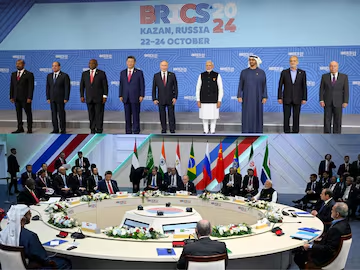
India’s economic policies and reforms have contributed to its rise as a major economic power. The country has implemented policies to attract foreign investment and has opened up various sectors for private participation. The government has also focused on improving infrastructure, developing a skilled workforce, and promoting entrepreneurship. In addition to its economic importance, India also plays a significant role in global politics. The country is a member of various international organizations, including the United Nations, World Trade Organization, and BRICS. India’s leadership has been instrumental in shaping the agenda of these organizations and in promoting the interests of developing countries. India’s strategic location also makes it an important player in regional geopolitics. The country has been involved in various peacekeeping missions, and its military capabilities have been growing in recent years. India has also been strengthening its relationships with other major powers, including the United States, Russia, and China. Overall, India’s role in the multipolar global political economy is likely to continue to grow in the coming years. The country’s economic and geopolitical importance, coupled with its strategic location, make it a key player in the international arena. Global trade is an essential aspect of the modern economy, and it relies heavily on trust and confidence between parties involved. A breach of confidence can have severe consequences for international trade and the global economy as a whole.
A breach of confidence in global trade can take many forms, including the failure to fulfill contractual obligations, misrepresentation of goods or services, or the theft of intellectual property. These breaches can result in legal disputes, loss of revenue, and damage to reputation, which can be costly for businesses and countries involved. When a breach of confidence occurs, it can lead to a breakdown in trust between parties involved, making it more challenging to engage in future trade deals. This can lead to increased transaction costs, reduced investment, and lower economic growth, ultimately impacting consumers. The World Trade Organization (WTO) and other international bodies play a crucial role in promoting fair trade practices and resolving disputes between countries. However, their effectiveness is limited when it comes to enforcing trade agreements and preventing breaches of confidence.
Dollar hegemony refers to the dominant position of the US dollar in the global economy as the primary reserve currency and medium of exchange. The term is used to describe the extensive use of the US dollar in international trade, finance, and investment, giving the United States significant economic and political power.
The dollar’s dominance dates back to the Bretton Woods agreement of 1944, where the US dollar was established as the international reserve currency, and other countries pegged their currencies to the dollar. This allowed the US to enjoy significant economic and political power and played a crucial role in the post-World War II economic order. Today, the dollar remains the dominant currency in international trade and finance, with over 60% of global foreign exchange reserves held in US dollars. Many countries continue to use the dollar as a medium of exchange, and international commodity prices are usually quoted in dollars. The dollar’s dominance has several implications for the global economy. First, it provides the United States with a unique advantage in international trade, as other countries are dependent on the US dollar to conduct transactions. Second, it allows the US to borrow at lower interest rates, as investors have a high level of confidence in the US dollar and the US economy. However, the dollar’s hegemony also comes with some challenges. The US’s monetary policy decisions can have significant impacts on the global economy, as changes in interest rates and other monetary policies can affect other countries’ economies. Additionally, the US’s high level of debt has raised concerns about the dollar’s stability as a reserve currency. In recent years, there have been calls for the diversification of international reserve currencies and the establishment of alternative payment systems. Some countries, including China and Russia, have been promoting the use of their currencies in international trade and finance to reduce their dependence on the US dollar.
Overall, dollar hegemony continues to shape the global economy, and it is an essential factor in international trade and finance. The ongoing debates around its stability and the need for diversification demonstrate the complex and ever-changing nature of the global economic order.
India plays a significant role in the multipolar global political economy due to its economic and geopolitical importance. The country’s economic policies and reforms have contributed to its rise as a major economic power, and its strategic location makes it a key player in regional geopolitics. India’s leadership has been instrumental in shaping the agenda of international organizations and promoting the interests of developing countries.
However, India also faces several challenges, including poverty, inequality, and infrastructure gaps. The country has been working towards addressing these challenges through various initiatives such as the Make in India campaign, Digital India, and Swachh Bharat Abhiyan. India’s role in the global economy and its rise as a major economic power can provide opportunities for businesses and investors to tap into its large market and skilled workforce. The country’s focus on innovation and entrepreneurship can also create opportunities for collaboration and partnership in various sectors.
In conclusion, India’s position in the multipolar global political economy is significant, and its continued growth and development will have far-reaching implications for the global economy. However, the country faces several challenges that need to be addressed, and there is a need for continued investment and collaboration to unlock its full potential.
References
Bastos, M. (2014). The Indian Ocean and the rise of a multi-polar world order: The role of China and India. Policy Perspectives: The Journal of the Institute of Policy Studies, 11(2), 17-28.
Chakraborty, S. (2018). Significance of BRICS: Regional powers, global governance, and the roadmap for multipolar world. Emerging Economy Studies, 4(2), 182-191.
Cooper, A. F., & Flemes, D. (2013). Foreign policy strategies of emerging powers in a multipolar world: An introductory review. Third World Quarterly, 34(6), 943-962.
Kukreja, V. (2020). India in the emergent multipolar world order: Dynamics and strategic challenges. India Quarterly, 76(1), 8-23.
Peters, M. A. (2023). The emerging multipolar world order: A preliminary analysis. Educational Philosophy and Theory, 55(14), 1653-1663.
Sharma, S. N. (2017). Geopolitics and Terrorism in Asia-Pacific Region vis-a-vis India.
 Eduindex
You must be logged in to post a comment.