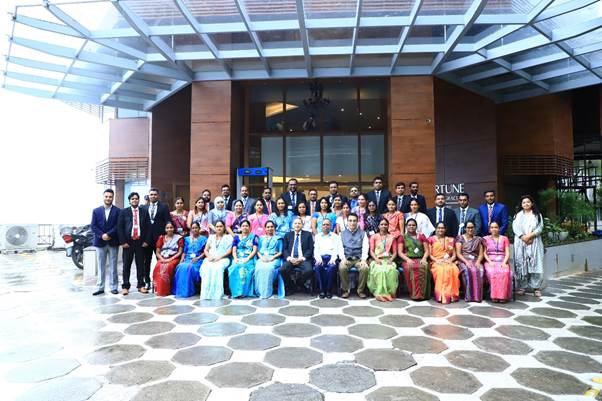
4th Capacity Building Program for the Civil Servants of the Socialist Republic of Sri Lanka commences today at National Centre for Good Governance (NCGG), Mussoorie

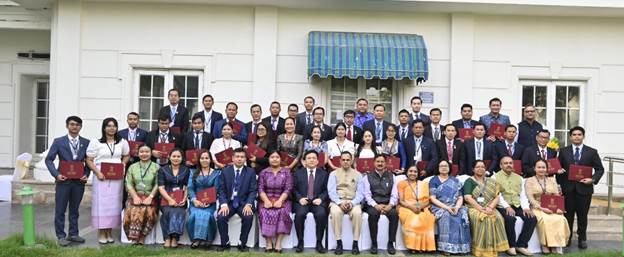
 The National Centre for Good Governance (NCGG) has launched the 4th Capacity Building Program for senior civil servants from the Socialist Republic of Sri Lanka today at NCGG, Mussoorie. The program will be organized from 22nd July to 2nd August 2024, with 40 distinguished participants.

Shri V. Srinivas, Director General of NCGG and Secretary of the Department of Administrative Reforms and Public Grievances (DARPG) addressed the inaugural session. In his address, Shri V.Srinivas emphasized on India’s vision of ‘Viksit Bharat 2047’. He highlighted the critical role of modern infrastructure and cutting-edge technology and the policy maxim of “Maximum Governance, Minimum Government.”  Highlighting India’s commitment to good governance through policies focused on social justice, transparency and accountability, aiming to provide equal opportunities for all citizens.

During the programme, Dr. AP Singh, Associate Professor, provided an overview of NCGG’s workings and the program’s focus. The program includes lectures on topics such as the Changing Paradigm of Governance, Overview of Indian Services, Climate Change and its Impact on Biodiversity: Policies and Global Practices, Right to Service: Ease of Living, E-Office, Planning and Building Eco-Friendly Smart Cities, Public-Private Partnerships, Digital India, Land Records Management (Swamitva Scheme & DILRMP), India’s Growth Story, Disaster Management, and Approaches to Achieving SDGs by 2030, among others. Participants will also visit key institutions and sites, including the Indira Gandhi Forest National Academy, Forest Research Institute, District Attachment to Panchkula, Cyber Crime Centre in Chandigarh, National Institute of Solar Energy, International Solar Alliance, Pradhanmantri Sanghralaya, and the Taj Mahal.

This program aims to educate participants on India’s good governance and advanced technology models, facilitating the implementation of better governance practices in Sri Lanka. The National Centre for Good Governance (NCGG), in partnership with MEA, has imparted training to civil servants of 17 countries, viz. Bangladesh, Kenya, Tanzania, Tunisia, Seychelles, Gambia, Maldives, Sri Lanka, Afghanistan, Laos, Vietnam, Nepal, Bhutan, Myanmar, Ethiopia, Eritrea, and Cambodia.

A group of people posing for a photoDescription automatically generated

****

5th Capacity Building program on Public Policy and Governance for Civil Servants of the Kingdom of Cambodia

  The National Centre for Good Governance (NCGG) successfully completed the 5th Capacity Building Program on Public Policy and Governance for Civil Servants of Cambodia today in New Delhi. The 2-week program was organized from June 24th to July 5th, 2024 in collaboration with the Ministry of External Affairs (MEA). The program was attended by 40 civil servants from Kingdom of Cambodia, such as Joint Secretary, Director, Deputy Secretary and Under Secretary from the Ministry of Civil Services and Senate of Cambodia. The program offered a platform for policy dialogue and sharing best practices, helping participants gain valuable insights into institutional transformation and citizen engagement.
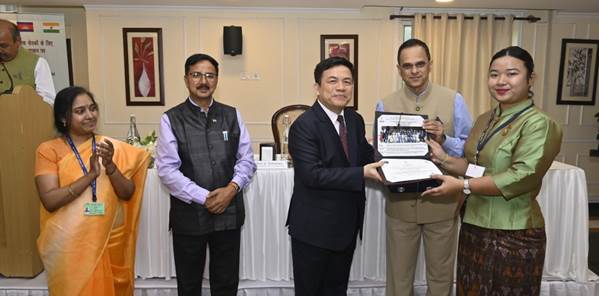
The valedictory session was chaired by Shri V. Srinivas, Director General (DG) National Centre for Good Governance (NCGG) & Secretary Department of Administrative Reform and Public Grievances (DARPG), Government of India who highlighted the importance of long friendly and historical relations between the two nations. He discussed that it is the role of civil servants to simplify the interface between citizen and government. Citing examples from the grievance redressal model he elaborated how technology has played a key role in bringing citizens closer to government, while optimizing transparency and accountability. He complemented the participating officers for making excellent and substantive presentations.

Speaking on the occasion guest of honour H.E. Mr.Koy Kuong, High Commissioner of Kingdom of Cambodia to India spoke about the ancient connections between the two civilizations and thanked the government of India for support in capacity building of its officers. He elaborated how the two nations have been exchanging knowledge, wisdom and people have been travelling between the countries for pilgrimage as well as medical requirements. He spoke that it was encouraging to see the participants showcasing the learning from the programme in the form of insightful and excellent presentations made during the valedictory session. He highlighted that bilateral relations are at the core of collaborations between the two countries, which are aimed at building the human resource capital of the countries which in turn are necessary to meet the aspirations of the common people, thus helping in achieving good governance.

H.E Ms. Say Pagnvathey, Deputy Director General, Senate of Cambodia and head of delegation from Cambodia expressed gratitude to the Indian Government for this opportunity. She also thanked  Shri V. Srinivas, Director General, NCGG along with the training team for conducting such a training programme for the Cambodian civil service officers. She elaborated how they learnt about a lot of best practices in the area of public policy and governance and how technology is being leveraged in India. She was of the opinion that they are looking forward to such exposure and this will lead the officers to give better services to the people of their country and ultimately help in achieving good governance.
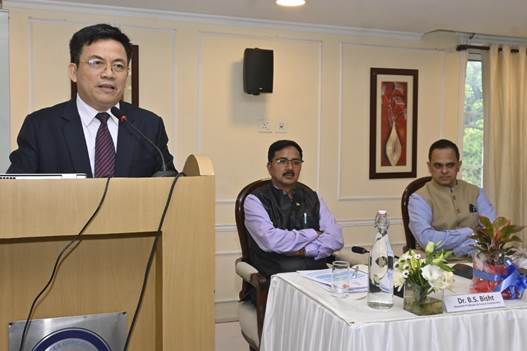
The participating officers as part of the learning outcomes gave four elaborate and insightful presentation on “ Role of Civil Services in Policy Design and Implementation in Cambodia”, “Social Protection in Cambodia”, “Cambodia towards Hybrid Digital 2050” and “Role of Cambodia Parliament in Policy Design and Implementation”.
Dr. B. S. Bisht, Associate Professor, NCGG and Course Coordinator of the programme gave detailed information about the programme. He discussed that in the first week, the training focused on a variety of topics, including Public Policy and Management, GeM: Bringing Transparency in Government Procurement, Parliament in the Indian Constitutional Scheme, India-Cambodia Relations, Public-Private Partnerships in Infrastructure, Aadhaar as a Tool for Good Governance, Health Governance, the impact of Parliamentary Devices on governance, Best Practices from various development schemes, approaches to achieving SDG by 2023, Viksit Bharat: Policies and Developments in Industry and Infrastructure, Financial Inclusion, the Changing Paradigm of Governance, Leadership and Communication, Urban Governance and Sustainable Cities, Civil Services in India, Doorstep Delivery of Services, E-Governance and Digital Public Service Delivery, Gender Development, and Ethics in Administration, PM Award on exemplary execution of Pradhan Mantri Fasal Bima Yojana among others. The second phase of the program included field visits to Smart City project and Information Technology Developmetn Agency in Dehradun, District Administration in Gautam Buddha Nagar, Uttar Pradesh, the Union Public Service Commission and Indian Parliament. The programme also gives exposure to history and culture of the country during visits to the PM Sangrahalaya, Buddha Temple and the Taj Mahal.

It is noteworthy that NCGG has imparted training to civil servants of 17 countries viz. Bangladesh, Kenya, Tanzania, Tunisia, Seychelles, Gambia, Maldives, Sri Lanka, Afghanistan, Laos, Vietnam, Nepal, Bhutan, Myanmar, Ethiopia, Eretria and Cambodia.

The Valedictory Ceremony was graced by Ms. Prisca Mathews, Chief Administrative Officer, NCGG, Dr. Himanshi Rastogi, Associate Professor, NCGG, Dr. Gazala Hasan, Assistant Professor, NCGG among others. The programme was supervised and coordinated by Dr. B. S. Bisht, course coordinator, along with Dr. Sanjeev Sharma, co-course coordinator, Shri. Brijesh Bisht, Training Assistant and Ms. Monisha Bahuguna, Young Professional alongwith the capacity building team of the NCGG.

*****

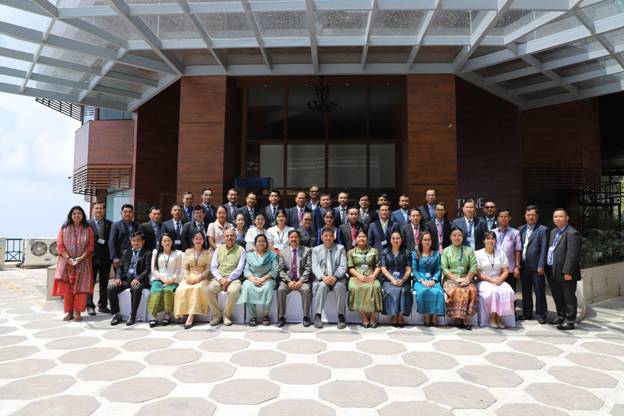
5th Capacity Building program on Public Policy and Governance for Civil Servants of the Kingdom of Cambodia commences at National Centre for Good Governance, Mussoorie

 The National Centre for Good Governance (NCGG) in Mussoorie commenced 5th Capacity Building Program on Public Policy and Governance for Cambodian Civil Servants today. The 2-week program is being organized from June 24 to July 5, 2024 in collaboration with the Ministry of External Affairs (MEA). The program is being attended by 40 civil servants from Kingdom of Cambodia, such as Joint Secretary, Director, Deputy Secretary and Under Secretary from the Ministry of Civil Services and Ministry of Senate. The program offers a platform for policy dialogue and sharing best practices, helping participants gain valuable insights into institutional transformation and citizen engagement.


The inaugural session was chaired by Shri V. Srinivas, Director General (DG) National Centre for Good Governance (NCGG) & Secretary Department of Administrative Reform and Public Grievances (DARPG), Government of India who highlighted the role of technology in bringing citizens closer to government, while optimizing transparency and accountability. India’s policy maxim of “Minimum Government and Maximum Governance” seeks to bring citizens and government closer using technology, and creating digitally empowered citizens and digitally transformed institutions. The example of CPGRAMS, the AI-driven public grievance redressal portal of India, was presented.

Mr. Mam Phoeuk, Deputy Director General, Ministry of Civil Services and head of delegation from Cambodia expressed gratitude to the Indian Government for this opportunity. He emphasized that the training programme would not only enhance capacity building but also foster bilateral dialogue and lead to  strengthening of ties between India and Cambodia.

Dr. BS Bisht, Associate Professor, NCGG and Course Coordinator of the programme gave detailed information about National Centre for Good Governance and the milestones achieved by the NCGG over the years. In the elaborate presentation he discussed about objectives, activities, achievements, and future plans of NCGG and how it has evolved as a Centre for excellence. In the first week, the training will focus on a variety of topics, including Public Policy and Management, GeM: Bringing Transparency in Government Procurement, the Indian Constitutional Scheme, India-Cambodia Relations, Public-Private Partnerships in Infrastructure, Aadhaar as a Tool for Good Governance, Health Governance, the impact of Parliamentary Devices on governance, Best Practices from various development schemes, approaches to achieving SDG by 2023, Viksit Bharat: Policies and Developments in Industry and Infrastructure, Financial Inclusion, the Changing Paradigm of Governance, Leadership and Communication, Urban Governance and Sustainable Cities, Civil Services in India, Doorstep Delivery of Services, E-Governance and Digital Public Service Delivery, Gender Development, and Ethics in Administration, among others. The second phase of the program will include field visits to Smart City project and ITDA in Dehradun, District Administration in Gautam Buddha Nagar, Uttar Pradesh, the Union Public Service Commission and Indian Parliament. The programme also gives exposure to history and culture of the country during visits to the PM Sangrahalaya, Buddha Temple and the Taj Mahal.

It is noteworthy that NCGG has imparted training to civil servants of 17 countries viz. Bangladesh, Kenya, Tanzania, Tunisia, Seychelles, Gambia, Maldives, Sri Lanka, Afghanistan, Laos, Vietnam, Nepal, Bhutan, Myanmar, Ethiopia, Eretria and Cambodia.

Dr. Himanshi Rastogi, Associate Professor at NCGG, delivered the vote of thanks. The programme will be supervised and coordinated by Dr. B. S. Bisht, course coordinator, along with Dr. Sanjeev Sharma, co-course coordinator, Shri. Brijesh Bisht, Training Assistant, Ms. Monisha Bahuguna, Young Professional and the capacity building team of the NCGG.

****