Hello everyone, The word ‘Capitalism’ comes from the word Capital which means Money. Or any type of wealth. Whether you have houses, cars on land, they are your capital. In the last video, I gave you the basic definition of Communism. It is a society where every person works according to his ability and receives according to his needs. If we have to define Capitalism similarly, Capitalism is a society where “from each according to his ability, To each according to his capital.”
A society where every person works according to his ability but they get returns according to their capital. The person with the most capital will get the most profit. After knowing the definition you’d ask me: “What kind of a society is this?” “Where a person who has more money will get more money.” You heard it right, friends. I’ll talk about the exact workings later in the video. Basically, Capitalism is an ideology that promotes privatisation where the means of production like land, fields, factories, and industries, are owned by private individuals.
In Communism they were owned by the public, everyone owned these. Similar to Communism, Capitalism is a very broad term and ideology. Where there are many subsections of ideologies with differences among them. But if you look at it broadly, there are a few things that are common in all the types. First is the Privatisation. Second, minimal interference by the Government. Most Capitalists believe that the Government has no business to be in business. This dialogue has been used by our Government recently. The third is the Free Market and Competition. and Fourth is something that is easily seen in a capitalist society, “Money Begets Money.”
Money is earned through Money. I’ll explain this later. First, let’s talk about the history of Capitalism. The oldest example of Capitalism is Feudalism. This can be called the primitive form of capitalism. This was around the 10th century when landlords occupied land, and the farmers and labourers who worked on the land, worked tirelessly to grow crops. But all the profits from the land, was used to be taken by the landlords, and the farmers hardly earned enough to get by. You may wonder how this is an example of capitalism. The land was owned by an individual, the landlord. And to whom did most of the profit from the land go? The Landlord. Capitalism works similarly today.
Whatever you do at whichever company, suppose you’re an employee at Apple, you work the whole day and get a monthly salary in return. But the company earns profits. Where does the profit go? It doesn’t go to you It goes to the owner of the company. Obviously, there are differences. Today you get workers’ rights and minimum wages and are not exploited, in most of the cases Who is the owner of this Apple company? That person who holds the most number of shares of the company. Even you can become the owner of the company through the share market.
If you buy some shares Apple, any profits earned by it, you will get a part of. Because you are also an owner of a portion. We live in such a capitalist society today. An employee works in a company for a monthly salary and the profit earned by the company will be distributed among such people who don’t even know the day to day working of the company. You can earn the profit of the company by doing nothing if you invest in the company. And who can invest? Someone who already has the money. As I said, money makes money.
One with the most money in a capitalist world can make more money easily by investing in such companies and taking their profits. Modern Capitalism started in the 16th-17th century in Britain and Netherlands. The first stock exchange of the world was the Amsterdam Stock Exchange, and the first company to be listed was the Dutch East India Company in 1602. Like there’s Karl Marx for Communism, similarly there’s Adam Smith for Capitalism. Known as the Father of Capitalism. In 1776 he wrote the book The Wealth of Nations. In the book, he talked about a policy Laissez-Faire. It is a French word that literally means ‘leave alone.’ That government should leave the economy alone and should not interfere. From here Free Market Capitalism started. Suppose you want to open a pizzeria and so does your neighbour.
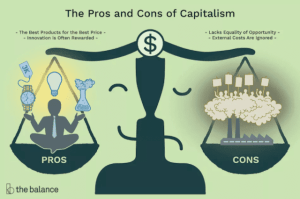
If a third person does not interfere between the two, there will be a very interesting and fair competition between you. About who can make the better pizza and sell it at a lower rate. Both of you will try to compete with each other and start experimenting. Trying to improve the quality of the pizza. Because of this competition, both of you will innovate and think of new ways. About how the pizza can be improved and sold at a lower price. In the opinion of Adam Smith, this competition was the invisible hand of the free market. Where no one is forcing you to make a better pizza, but the market situation is forcing you to innovate to make a better pizza. You are working only for your self-interest. You want your restaurant to grow and earn more profit and to perform better than your neighbour.
But your working in your self-interest is also benefiting others. It is also in the interest of society that you work for your self-interest. This is the philosophy of Adam Smith. To increase the efficiency of your pizzeria you’d eventually realise that doing everything yourself was not smart. If you start taking orders yourself and making the pizza, it’ll take a lot of time. It would be better to hire a few people. One to take the orders at the front desk. One who’ll make the pizza and buy ingredients for it. One who will put the toppings on the pizza and put it in the oven. And one whose work would be to deliver the pizza.
This is the Division of Labour. Every person is specialising in his work and because of the specialisation, productivity and efficiency increase rapidly. Adam Smith talked about this as well. This is one of the major reasons for the success of Capitalism across the world. Everyone realised that if they want to work in a better manner at a better speed, division of labour and specialization is necessary. Take Apple company, if a person wants to build an iPhone, it will take him years. but if there is an assembly line of workers to manufacture these iPhones, where the first person would fit the screen the second will fit the screws, then the assembly line will be able to manufacture numerous iPhones in a day.
By implementing these ideas Industrial Revolution began. Where large factories were established; but what happened then? I talked but that in the Communism video. The workers were forced to work for hours in terrible conditions. They were getting exploited and eventually communist ideologies started. After hearing this you’d think that Karl Marx and Adam Smith would be sworn Enemies. But this wasn’t so, in reality, Karl Marx has written a book Das Kapital, where he agreed on many viewpoints of Adam Smith. There were definite disagreements between them but it can be said that they were looking at the same situation from different perspectives.
On one hand, Adam Smith focuses on productivity and efficiency, On the other hand, Karl Marx agrees that productivity and efficiency would indeed increase but his focus is on an individual. He says that a worker would start feeling alienated if he works on repetitive tasks. To do the same for hours and years on end. The worker would not be proud of his work. He would question the purpose of his life. Seeing himself as only a small gear in a piece of large machinery. Karl Marx believed that specialisation would make workers more easily replaceable, and the capitalist would get more power to exploit the workers. The ideas of Karl Marx and Adam Smith are two perspectives of the same situation. Remember that both of them were born in different eras. Adam Smith died in 1790 and Karl Marx was born in 1818. 1790 was a time when the Industrial Revolution had just begun. And Karl Marx grew up seeing the workers being exploited in the factories.
Maybe if they lived in the same era, their opinions would have agreed. Moving ahead in history, we know that Communism was first implemented in the Soviet Union. When it comes to the implementation of capitalism, in 1902 a significant incident happened. Three large steel companies in the USA, Carnegie Steel, Federal Steel and National Steel, merged together to become The US Steel. This was the first billion-dollar corporation in the world. Elbert H Gary was the chairperson of the company. And in the first year, it manufactured 2/3rd of the total steel manufactured in the US. But there remained some competition in the steel industry.
So Garry invited all his competitors for a dinner and asked them why they were fighting amongst themselves while someone else was benefitting from their competition. He suggested that they work together and stop competitive pricing. This was how the first billion-dollar company in the world became a monopoly. According to the theory of Adam Smith, the Invisible hand of the free market was supposed to work and set things right. but in reality, this did not happen. Whenever there’s a monopoly for anything or a company, it is terrible for the consumers. Imagine you are stranded in a village late at night, waiting for a taxi. And the nearest city is 100-200 km away.
But there is only one taxi. You ask the taxi driver to take you to the city, While he charges ₹500 for the distance normally, but he tells you that he would charge you ₹50,000 for taking you. You will not have any option. The taxi driver will have a monopoly here. You are stuck in a situation where the only way out is to, either give in or remain stuck there. You are forced to pay that sum. This extra amount is known as profit in Capitalism. In Das Kapital, Karl Marx talks about this theory, the Theory of Surplus Value. If I run a company that manufactures a product, and you are an employee working in the company that actually makes the product, Suppose I earn a profit of ₹80,000 by selling that product, but I pay ₹8,000 to you as salary.
The ₹72,000 that we put call profit, Karl Marx called Surplus Value. All the surplus value and profits are taken away by me and you get only a salary. This is often seen in Capitalism. There can be many examples for this. A trader that buys products very cheap from the farmer and sells it at a much higher price The profit or surplus value is taken by the trader. A scientist discovers the formula for a vaccine, but in reality, the pharma companies selling that vaccine get the most profits. A singer that actually sings the song, but it is the music label that takes most of the profit.
According to Karl Marx, this is a system where everyone is trying to climb a ladder to stop being exploited, but as soon as they reach the top they would start exploiting others. A system where work is not rewarded but money is. If you have the money to establish a company and employ people, you can take away the maximum profits. But obviously, not every company is like this, not every company owner is like this that’d keep on exploiting the employees. In contrast to the companies owned by private individuals are Joint Cooperative Companies such as Amul. More than 36 lakh of farmers are joint owners of Amul Co-operative. This is not a company listed on the stock market. You and I cannot invest our capital in Amul company. The profit earned by Amul and its benefits is distributed among these farmers that have created this company together.
But obviously, to make such cooperative, one person has to take the lead. In the case of Amul, it was Tribhuvandas Patel who set up the Cooperative in 1946. Under the guidance of Sardar Vallabhbhai Patel. Regarding this there was a film as well called Manthan. It was the first crowd-funded film in India. More than 5 lakh farmers working in Amul contributed ₹2 each to make this film. Anyways, I got too diverted in the story. Coming back to the history of Capitalism, in 1929, capitalism received a huge shock when the stock market crashed terribly and a Great Depression started. The recession has been a very regular feature in Capitalism.
There were large scale unemployment and poverty in the USA because of this. At this point entered the revolutionary economist Keynes, who altered the history of Capitalism. He believed that the Invisible Hand of the free market does not actually exist. In reality, if the free market is left free, it will lead to depression, recession, monopolies. The theory of Keynes was that governments should interfere and regulate the companies. Small companies should be subsidized, and big companies should be prevented from getting monopolies, there should be strict rules and regulations in place.
In the decades that followed Keynes, countries all over the world took inspiration from him and implemented a model of Capitalism where rules and regulations existed. The next big shock to Capitalism was in the 1980s when Ronald Reagan in the USA and Margaret Thatcher in the UK reintroduced the free market of Adam Smith to the world. The capitalism implemented in these two countries is known as Neoliberalism.
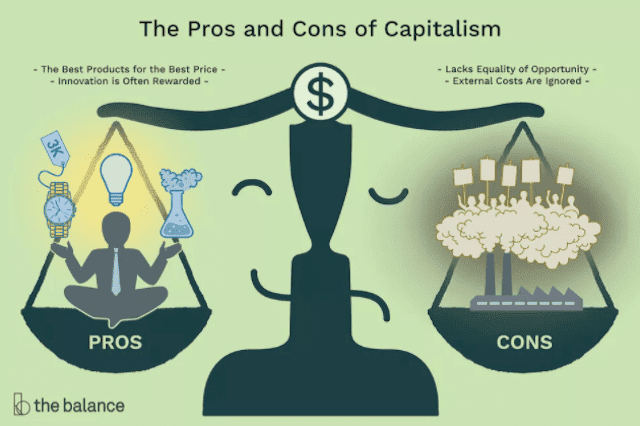
The basic foundational idea is of Adam Smith that government should not interfere in the market and market share run itself, and there exists an invisible free hand of the market, The current status is that in the last 40 years, in many countries of the world, especially the USA, we have seen Neoliberalism being implemented. Because of this inequalities have been rising significantly in the US. The rich are getting richer and the poor are not able to improve their situation. The big companies are starting to become monopolies.



 Eduindex
You must be logged in to post a comment.