Colorism In British India .

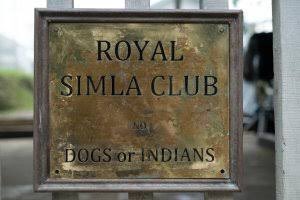
British colonialism further exacerbated colourism. The British Raj, or the official British rule over India, began in 1858 and lasted until the independence of India and the partition of Pakistan in 1947. During this time, a pseudo-scientific concept called “social Darwinism” became popular. The term, a reference to Charles Darwin’s work on evolution, describes the common belief that factors such as skin colour, bone structure, and facial features were determinants of levels of intelligence, and it became part of the justification for Britain’s treatments of its colonised natives. In India, Britain’s general strategy seemed to involve keeping fair-skinned Indians as allies by privileging them over darker-skinned Indians. A system of institutionalised segregation was established and, while some institutions segregated against all “[coloured] people”, many segregated only against “black Indians”, with signs clearly stating: “Indians and dogs not allowed”. Conversely, lighter-skinned Indians were given preference over their darker counterparts and were hired more frequently.

Although there was some pushback against this mistreatment by the British, the Indian people were, in general, less motivated to protest because the caste system had already cemented clear divisions along racial lines. Centuries of rule by foreigners had already cemented the idea that power belonged to light-skinned individuals, and it meant that when an external, more malicious force came in to uphold those divisions, people were less inclined to object.

However, colourism has always been an intersectional issue. The oppression people face due to colourism is often paired with, and/or magnified by their gender, caste, social status, financial status, and education. Despite the longevity of the issue, civil society is only now beginning to dismantle institutional colourism. “Dark is Beautiful” is an organisation fighting colourism by organising workshops to educate the youth on the dangers of colourism and by creating petitions and lobbying against the leading fairness cream brands. In the future, it seeks to “involve… many people and [organisations], including politicians, sportspersons, and influential people.” “India’s Got Colour” is another campaign that aims to end systemic bias against skin colour. One of its ambassadors, Nandita Das, an actress and producer, travels around the country to educate children in schools on the pervasiveness of colourism and to share her story and recount the different treatment she received from the media due to her skin colour. In Bollywood, instances of brownface, the act of intentionally darkening one’s skin, have started receiving more public backlash than ever before.

Colourism refers to prejudice against individuals with a dark skin tone. In India, it is reflected in many parts of society, from advertisements on billboards to lyrics in songs to household anecdotes. It can manifest itself in very apparent ways, such as in advertisements for skin lightening products showcasing women achieving their dreams only after lightening their complexion, but it can also take on more subtle forms. Regardless, its influence is pervasive. In 2015, the Indian National Museum conducted a study where they surveyed one hundred college students from across the country, inquiring about the skin colour they considered to be a beauty ideal. When asked to describe “pretty”, 71% of the respondents cited words alluding to lighter skin tones, including “fair” and “light”. While this study featured a relatively small sample size, the trends it highlights are common in Indian society and perpetuated through the media. In fact, 90% of all Indian advertisements show lighter-skinned models, and most Bollywood movies feature a cast of exclusively light-skinned actors.

Beyond a lack of representation of dark-skinned individuals in the media, having darker skin is seen as a disadvantage for many other prospects as well, from “hireability” to chances of marriage. The latter is especially true in rural villages wherein women with a darker skin tone are seen as less desirable and face greater challenges in finding a spouse. Another damaging result of colourism is the rise of the ever-growing skin lightening market and the health risks this market presents. The Tata Institute of Social Science (TISS) conducted a study in which they surveyed 1,238 women and 746 men on their use of fairness creams. Of those, 59.6% of women and 46.1% of men reported using fairness products at some point in their lives. When asked why, 31.2% said they wanted to look “beautiful” and 36.2% believed looking fairer would help them “feel culturally accepted”. These skin lightening products have serious, and often long-lasting, side effects. In 2006, the Food and Drug Administration (FDA) released a notice stating that it no longer recognises over-the-counter skin bleaching products as safe or effective. Despite this, India’s skin lightening market is projected to continue growing with an April 2018 study estimating that by 2023, it would be worth “Rs. 5,000 crore”, or about $700 million USD.

COLORISM IN INDIA

See the source image

Colorism

Colorism is the practice of favoring lighter skin over darker skin. The preference for lighter skin can be seen within any racial or ethnic background. Race can be defined as the attributes, traits and features which differentiates one group from the other existing social groups. In simple words, races are the physical qualities that one inherits biologically and serves as a way of self-identification from the other groups. Racism is a theory that one race is superior that the other based on the physical attributes, caste, creed, ethnicity or origin. A person is being racist when he displays the emotions of hatred, prejudice, biasness and intolerance against another person solely due to his skin color, structure of his lips, language, place of origin or any other attribute which he might have gained biologically.

Colorism in India

India is known as one of the most mega diverse nations in the world. It is indeed a diverse country and a home for people belonging to different caste, religion, color, creed, culture and traditions. Indians are known for their varied degrees of skin complexion termed as fair skinned and dark skinned. The skin color has always remained an important factor in determining a person’s value and worth. Fair skin people are considered to be of a superior status than to the people with a dark sin. Racism has been prevailing in India since the Rig Veda Period, followed by the Mughal era and the British ruleWe live in a society where the people are highly obsessed with one’s skin tone. Indians have varied degrees of skin complexion and they are categorized as fair, dusky, dark etc. Indians believe that fair-skinned people are of a much more worth and value than those who are dark skinned. The fair is considered the intellectual and gets the respect, dignity and the social status while the dark are left behind struggling for their rights and status. We face color hatred and prejudice and somehow still choose to remain silent about it.

The people need to understand that a person’s worth or status is not determined by his or her color. There are numerous cosmetic brands promoting skin lightening creams and lotions. There are advertisements promoting the desperate need of looking fair. The question is why? No one has the right to question or judge one’s complexion. Racial discrimination brings down the morale and the enthusiasm of the dark, they do not get a chance to stand up and speak up or fight for themselves. The mindset of the Indian society should realize the fact that no matter what the skin tone is, what caste or origin a person belongs to, irrespective of all the other physical traits, a person is entitled to equality before the law and has every right to deserve the same respect and honor a fair person gets. Racism is a refuge for the ignorant. It seeks to divide and to destroy. It is the enemy of freedom, and deserves to be met head-on and stamped out.

RACISM IN THE FORM OF COLORISM

Our country has a history of being ruled by the whites, i.e. the Portuguese, the Dutch and French traders, the Mughals, the British. They were relatively fairer than the rest of the Indian population. This succession by the white people left behind the desperate desire of looking fair. Indians felt that only the light skin people can attain power, dignity and respect as they were the master race. The racial prejudice in our country has taken the form of colorism. The basic definition of colorism means that differentiating or classification of a person from another on the basis of the skin tone or complexion. Discrimination against the members of the same race due to their dark skin complexion is called colorism. The black people are generally considered of a lower status and they are included in the lowest strata of the society while the fair is considered the noble and intellectual. In our Indian society, the complexion of a person is given a lot of importance, fair people are believed to have positive impacts and the dark has negative impacts. This is how the stereotypical mindsets of the Indians work. The black is now hated upon, it is highly condemned by the people worldwide. 

Racism and colorism are very closely related to each other. People with a lighter skin tone were considered as a rich of an upper-caste while people with a dusky skin tone is considered as a poor of a lower caste. Due to the color discrimination, the black people face problems all over the world. It brings down their morale, enthusiasm, self-efficiency to a great extent. They fear the world outside, the voices of the black people go unheard. They do not receive the right amount of appreciation, instead they face constant hatred and are subjected to brutality. The black people face harassment be it in either a physical or virtual form on any online platform. They are bullied not only on the basis of their color, but also on the basis of the structure of their lips or any facial attribute. The black color is the least preferred color in the entire human race. They are denied access to educational institutions, workplace or employment services, social services etc. There is no system which would act as a protection shield against the brutal and the inhumane bullying. The crime rate against the black has evidently increased, but people choose to be silent about it. If the same crime had been done to a white, then the public and the law would have done their best to win justice.

The social media and the advertising agency contribute to a great extent in favoring the notion of colorism. It is well known that the people would prefer a lighter skin tone than a deeper one and they would try their level best to reduce the tone of their skin color using any artificial means. People tend to follow the social media, their role models and hence in a despair to look fair. There are numerous cosmetic brands and skin lightening industries which came up as a solution to their consumer’s needs. In 1975, the “Fair and Lovely” cream was launched by Hindustan Unilever. This brand added a lot to the theory of colorism. It had become an indispensable requirement in the life of the young girls. It denoted that the deep complexion was not acceptable by the society anymore and how the dark people prove to be a disappointment. Only the fair people could achieve success and lead a happy life. Such fairness cream commercials promote the concept that how fairness is the only means of achieving success, dignity, honor and respect. Such products created an obstacle in the society by differentiating people on their skin tone. There was no actual appreciation of the natural beauty and color anymore. It led to the formation of biasness on the preference on the skin tone and color. Colorism really brings down the level of self-esteem and confidence in life of the people which in turn creates a confined status. 

Indian Colourism: Origins and its residual effects


While some people might not be familiar with the concept or term colourism, rest assured for everyone has indulged in it. The oxford dictionary defines colourism as “prejudice or discrimination against individuals with a dark skin tone, typically among people of the same ethnic or racial group.” Perpetuated by both the oppressed and the oppressor alike, it is deeply entrenched in the average person’s psyche. Discussions of such topics are often littered with defensive stances and refusal to believe in one’s own fallacy. People tend to gloss over the microaggressions they partake in every day unbeknownst to themselves.


If we try to look at the roots of the issue and where its origins lie, if there are any, one will find being ruled by fairer-skinned Aryans, Mughals, and Europeans a recurring theme. However, was there no discrimination on the basis of skin in ancient India? The ancient texts portrayed dark-complexioned princes and princesses, gods and heroes in the same light as their fairer counterparts. They were allowed to be heroic and dark and beautiful not in spite of their skin tone but because of it. Lord Krishna’s—whose name means black itself—statues could be dark while Radha’s were made from marble. Times seem to have changed with idols carved in lighter stones selling exponentially more. India’s fanatic obsession hasn’t exempted even gods.


The Britishers moulded the pliable atmosphere after the end of the Mughal rule to their benefit. They were modernized and scientific here to save the uncivilized natives from our erroneous ways. They were symbols of power, class, and status. Who wouldn’t want to be like them? If dogs and Indians were not allowed inside exclusive clubs, who wouldn’t want to shed a part of them for a better life? Thus, colourism unfurled its tendrils. If you weren’t white, be the next best thing. Being white adjacent would land you better opportunities. With the English came the Eurocentric beauty standards. Other places have loosened these to let in talents from diversified backgrounds, but India is still stuck with the remnants of British rule.  


  Manufacturers seized the perfect opportunity by preying on the insecurities of the general public who desperately longed for upward mobility to escape from their circumstances. In 2019, the Indian skin lightening industry was reportedly worth nearly Rs 3000 crore. Bollywood jumped on the bandwagon and ingrained in all our minds that only fair can be attributed to lovely. With whitewashing actors in commercials and casting only fair actresses as love interests, the message was clear: there is no space for dark-skinned actors to be leads in a country of dark-skinned people.


We have internalized the messaging and bigoted ideals. So much to find fair attached to qualities in every matrimonial. To use skin bleaching and lightening products even after knowing their harmful effects. We have attached our self-worth and ability to be seen as desirable and worthy of respect and love to the shade of our skin. We have broken the hearts of millions of innocent kids who would grow to doubt themselves because what they see in the mirror will always resemble the dirt beneath their feet more than it ever does their favourite actor. Change is long overdue.