
CITI Informed Consent SBE FAQ

 This page will answer the most popular questions of the CITI Informed Consent SBE.

There is general consensus on the importance of informed consent in research for treating individuals with respect, autonomy, and the right to decide.

Photo by Matthias Zomer on Pexels.com

However, obtaining and documenting consent can be a complex process, with certain challenges like potential subjects not being literate in the language of the study or the need to deceive to obtain valid data.

The federal regulations provide flexibility for cases with minimal risk of harm, allowing waivers or alterations to the requirements for consent and documentation processes.

The Process

Informed consent is a process that begins with recruitment and screening and continues throughout the subject’s involvement in the research. It involves providing specific information about the study in an understandable way, answering questions to ensure understanding, giving subjects time to consider their decision, and obtaining voluntary agreement to enter the study (subjects may withdraw or decline to answer at any time).

Popular Questions

Question 1: A therapist at a free university clinic treats elementary school children with behavior problems who are referred by a social service agency. She is also a doctoral candidate who proposes using data she has and will collect about the children for a case-based research project. Which of the following statements about parental permission is correct?

Answer: The parents of the children might feel pressure to give permission to the therapist to use their children’s data so that she will continue to provide services to their children. [Quizzma]

In this case, the researcher must make sure to provide additional information about the research to balance out any potential benefit of participation against any risks or harms. The parent should also be informed that there is an option for their child not to participate in the study, and all reasonable efforts should be made to ensure that the parent’s permission is voluntary.

Question 2: A criterion for waiving informed consent is that, when appropriate, subjects are provided additional pertinent information after the study. In which of the following studies would it not be appropriate to provide subjects with information about missing elements of consent?

Answer: A study in which subjects were assigned to study activities based on an undesirable or unflattering physical characteristic as assessed by members of the research team.

In this case, providing additional information after the study would potentially cause greater harm than good and is likely inappropriate. The research team should ensure that subjects are fully informed of all elements of the consent process prior to the study.

Question 3: A researcher leaves a research file in her car while she attends a concert, and her car is stolen. The file contains charts of aggregated numerical data from a research study with human subjects but no other documents. The consent form said that no identifying information would be retained, and the researcher adhered to that component. Which of the following statements best characterizes what occurred?

Answer: There was neither a violation of privacy nor a breach of confidentiality.

In this case, since no identifying information was retained and all data was stored in an aggregated form, there is likely no violation of privacy or breach of confidentiality. However, the researcher should still take appropriate steps to investigate the theft and file a police report if necessary.

Question 4: When a focus group deals with a potentially sensitive topic, which of the following statements about providing confidentiality to focus group participants is correct?

Answer: The researcher cannot control what participants repeat about others outside the group.

In this case, the researcher should make clear to participants that confidentiality is expected and enforced within the focus group.

The researcher should also do their best to ensure that all information shared remains confidential by setting ground rules for discussion and by limiting access to the recordings or transcripts of the group discussion. However, it is ultimately up to each participant to keep any shared information confidential outside of the focus group setting.

Overall, informed consent is an important process in research involving human subjects and must be adhered to carefully. It involves providing relevant information about the study clearly and accurately, answering questions as needed, giving sufficient time for consideration of participation, and obtaining voluntary agreement from participants.

In order to ensure that informed consent is obtained appropriately, researchers must be familiar with the principles of informed consent and their legal obligations.

Question 5: A general requirement for informed consent is that no informed consent may include any exculpatory language. Exculpatory language is that which waives or appears to waive any of the subject’s legal rights or releases or appears to release those conducting the research from liability for negligence. Which of the following statements in a consent form is an example of exculpatory language?

Answer: Participation in the research is voluntary, but if you choose to participate, you waive the right to legal redress for any research-related injuries.

This statement is an example of exculpatory language as it releases those conducting the research from any liability for negligence. Informed consent forms should not contain any exculpatory language and must be reviewed and approved by an Institutional Review Board. In addition, informed consent forms should clearly state that participation in research activities is voluntary, without coercion or undue influence. It is important to ensure that all potential risks and safeguards associated with the study are outlined clearly in the informed consent form before a participant agrees to participate in a research study.

The CITI Informed Consent SBE provides useful guidance on informed consent processes in research. Questions like these can help researchers understand their obligations regarding informed consent and ensure that they carry out their research ethically and humanely. Ultimately, informed consent helps protect the rights of participants while allowing for meaningful science that responds to real-world challenges.

In conclusion, CITI offers a comprehensive FAQ section on informed consent which can help researchers understand their legal obligations when obtaining informed consent from participants in a research study. The FAQs provide detailed answers to common questions about informed consent that researchers should consider when designing their research.

Familiarity with the principles of informed consent and understanding one’s legal obligations is critical to ensuring that research is conducted ethically and responsibly. By following best practices, researchers can ensure a responsible research process while protecting the rights of participants.
What is Considered Rape?

“Silence does not mean yes. No can be thought and felt but never said. It can be screamed silently on the inside. It can be in the wordless stone of a clenched fist, fingernails digging into palm. Her lips sealed. Her eyes closed. His body just taking, never asking, never taught to question silence”

Amy Reed

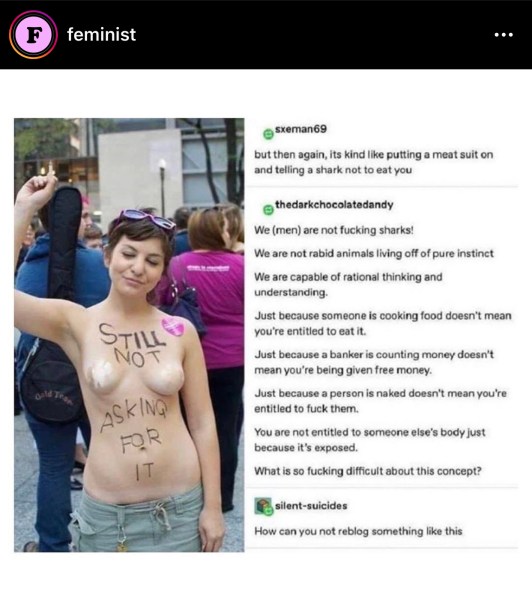
I came across a post on Feminist’s Instagram.

This post struck a nerve that no other post ever did. Mainly because whoever this person (thedarkchocolatedandy) is, didn’t insult anyone, nor did they try to persuade anyone to believe them. All they did was point out how humans are different than animals and also that women aren’t a piece of meat.

I decided to make a post on what crosses the line from being intimate to being considered rape. I am not sure how comfortable I am with men and most women not knowing or understanding what rape is and who the assailant is, and also that no reason is justifiable for rape, however, I wanted to make it clear and give no one who reads this an opportunity to claim they were unaware.

Take this post as a guide to know what is rape.

What is Consent?

The general definition of consent is to allow or permit for something to happen.

Consent in terms of sex or intimacy refers to agreeing to have sexual intercourse with someone and letting them know about it. It also includes finding out where the other person stands.

Consent is restricted and comes with thick boundaries. A person may consent to sexting, but not actually having sex, or vice versa.

Consent could also be restricted to just being physical and not actually having sex.

Take for instance the Netflix Original, “GUILTY”. A beautiful movie loudly stating that consent doesn’t give permission for anything and everything. Tanu (Akansha Ranjan), accuses VJ (Gurfateh Singh Pirzada) of raping her. Throughout the movie everyone had numerous reasons to tag her a fibster, they refused to believe her, they ridiculed her, said she was asking for it. The biggest reason was that she was very into VJ and that she threw herself on him quite a lot. In the end it was revealed that she wanted to have sex with VJ. She was consenting to the sex. What she wasn’t consenting to is being watched by VJ’s friends and being recorded. She didn’t consent to being sexually assaulted while the two bystanders ridiculed her and lead VJ on.

This movie is an eye-opener and covers many reasons rape culture still persists in our society.

When do you NOT have Consent?

  • When a person is sleeping or unconscious
  • When a person is drugged or intoxicated
  • When you are threatening them
  • You use a position of authority or trust
  • Consent is withdrawn
  • When you ignore their NO, cries and physically being pushed away
  • When you have consent for only one form of sexual act and not the other
  • When they are pressured

Verbal Consents:

  • Yes
  • I am sure
  • I want to
  • Don’t stop
  • Go on
  • I still want to
  • I want you to
  • I’m ready
  • Yes please
  • I am comfortable
  • I want to continue

Verbal Disagreements:

  • No
  • Stop
  • I don’t want to
  • I am not sure
  • I don’t think so
  • Please don’t
  • Please stop
  • This makes me uncomfortable
  • I want to stop
  • I don’t want to continue
  • This feels wrong
  • Maybe we should wait
  • Diverting the topic
  • I want to, BUT
  • Saying Yes fearfully

Non-Verbal Disagreement:

  • Pushing Away
  • Pulling Away
  • Crying
  • Avoiding Eye Contact
  • Silence
  • Shaking their head no
  • Standing/Lying motionlessly
  • Looking Scared
  • Not removing their own clothes

What is Rape?

Sexual Assault refers to any form of sexual contact or behaviours without explicit consent by the victim. Attempted Rape, Unwanted touching, forcing a victim to perform sexual favours, oral or penetrating penis or any other object.

The Medical definition of Rape is, “Forced sexual intercourse, and/or forced sexual assault between two or more people is considered rape. Rape may be heterosexual or homosexual. Rape involves insertion of penis or any inanimate object into a person’s vagina, anus, mouth. Rape also includes any other sexual acts.” Force here doesn’t just refer to physical force; blackmail, psychological manipulation to coerce someone into being sexually active is also considered rape.

Sexual intercourse between an adult and a minor is legally considered statutory rape. The adult is found guilty even if the minor was consenting.

Intimacy with a minor wife is considered rape in India.

Marriage is not a licence for either partner to force an unwilling partner to have sex. Marital/Spousal Rape is now recognized and is a criminal offence.

Date Rape, sexual assault followed by the victim being drugged or psychologically manipulated.

Intoxicated Rape is when the victim is drunk and unconscious, not in the state to make a sober choice.

Consent taken by threatening the victim or victims loved ones is also considered rape.

Gang Rape occurs when a group of people rape a person.

Rapes in prisons and jails by other inmates or prison officials is also an offence, often overlooked and unreported.

Serial Rape is the rape committed continuously over a relatively long time period.

Payback/Punishment Rape is when a person rapes another out of spite.

War Rapes are rapes committed by soldiers during war as a way to force prostitution and slavery to insult an entire country.

Deceptive Rape is the rape that occurs when the rapist rapes a victim by gaining consent by misleading them.

Corrective Rape is a hate crime where homosexuals, trans and queer individuals are raped hoping to “correct” them. To force them to “turn” heterosexual.

Custodial Rape is the rape occurred in custody of police, hospitals, old age homes, orphanages or any other employee of the state.

Prostitution Rapes are rapes where rapists force prostitutes to have sex without paying them for their services, to inflicting pain and torture (cigarette burns, slapping, choking).

Exchange Rape is the rape where sexual favours are exchanged for money, rent, food, drugs or any other resource.

Punitive Rape is when rape is used to punish or discipline someone. Usually by an abusive teacher, parent, Religious leader, or a peer.

Incest Rape is when a victim is raped by family member.

Consenting Rape is when a consenting partner withdraws consent, but the rapist doesn’t stop and continues to get sexually intimate. Consenting rape is also when the victim consents, but isn’t completely “into it.”

Rape Culture

Rape Culture refers to the sociological concept of normalizing rape, and blaming victims for dressing or acting provocatively. A few illustrations of Rape Culture include:

  • Blaming the victim
    • She dressed provocatively
    • She shouldn’t have been out so late
    • She is already sexually active, who says she didn’t want it?
  • Boys will be boys
  • Tolerating sexual harassment
  • Assuming only immoral women get raped
  • Making degrading jokes about women
  • Associating “manhood” as dominant and sexually aggressive
  • Associating “womanhood” as submissive and sexually passive
  • Offensive memes
  • Not believing people who speak out
  • “You haven’t been raped yet, so chill”
  • Slut-shaming and congratulating men on “scoring”
  • Calling young women gold diggers when they marry old and older woman, cougars
  • Objectifying Women
  • Associating Rape to Victims character and not the rapists

Rape Culture is the direct consequence of toxic masculinity. The heavily patriarchal world teaches and forces boys and men to be strong and exert “masculinity” in the form of dominance, arrogance and sexual and physical aggression.

The only solution is to fight patriarchy.

Support for Those in Distress

The National Commission for Women, provides a set of helpline numbers, legal aid, and counselling contacts.

Marital Rape:Culture or Consent?

Patriarchy, often perceived as a “culture” by the Indian society, strives to be protected at all costs, even if that means to strip off the “vulnerable”, of their basic human rights. All concepts that threaten this so-called culture, are categorised as “western concepts”, and are further refused to be acknowledged. Living in denial and refusing to acknowledge the problems, does not mean that they don’t prevail in the Indian Society. In fact, this means that a significant chunk of the society is not ready for the particular problem, but, that does not in any way, give them the right to disregard other people’s safety and security, just because their’s is intact.
One such controversial concept is ‘Marital rape’, often perceived as an oxymoron. Although, ‘rape’ has been clearly defined by most of the criminal codes of almost every country recognised by the United Nations, yet the understanding is rather subjective varying on the culture and relationship of the accused and the victim.  As Estelle B. Freedman points out in Redefining Rape,”At its core, rape a legal term that encompasses a malleable and culturally determined perception of the act…The meaning of rape is thus fluid”. One such factor is ‘marriage’, which supposedly rules out the possibility of forceful sexual conduct upon a wife, since a wedlock provides  immunity to the husband, sociologically as well as on legal grounds in 10 nations of the world.
Well, one of the most difficult challenge faced by people opposing marital rape, is the lack of acknowledgment of this sin. The surprising fact is that this is probably the only crime , where the victim does not recognise her violation of the rights, because control of a woman’s body is foundational to patriarchy. As British jurist, Lord Mathew Hale, states that,”The husband cannot be guilty of rape committed by himself upon his lawful wife, for by their mutual consent and contract the wife hath given up herself in this kind unto her husband, which she cannot retract.” This orthodox thinking is deep rooted in our society and is a shame to our so-called judicial progress, because if we see the section 375 of the Indian Penal Code,1872, although it defines rape, yet there is an exception in the statute which states, that, ’Sexual intercourse by a man with his own wife, the wife not being under fifteen years of age, is not rape.’

Arguments generally used to justify the non existence of this crime in the IPC, are that there are other sections like domestic violence and cruelty that protect the wives from the oppression and dominance.“there are other provisions that safeguards the rights of a wife, like domestic violence which covers cruelty, so why do we need another law? So greedy, these ‘feminists’ have become!”. This shows us the biggest problem in not recognising marital rape as a form of rape ,that is, the society is ready to accept the husband as an offender of  domestic violence, since the ‘anger issues’ are just unstoppable and ‘he is a man’, but are not ready to accuse the husband of rape of his own wife.Such beliefs are imbedded in notions such as the idea that a woman’s sexuality is a commodity that can be owned by her father or husband, the belief that what happens between husband and wife in the bedroom is a private matter, that a man is entitled to sexual relations with his wife, and that a wife should consensually engage in sex with her husband, thus making rape “unnecessary.” 

The ways in which marital rape is condoned varies cross-culturally. In India, Supreme court ruled in February 2015, that marital rape is not a crime.A government minister then told the parliament, that it could not be criminalised in India, since “marriages are sacrosanct”.(BBC News,2015). Like, in United States of America, although it is a criminal offence, yet a significant amount of attitudinal surveys show that Americans regard the rape of a wife far less than a similar assault by an acquaintance or a stranger. “Marital rape is a western concept, it is not possible in the Indian Society”, as stated by Maneka Gandhi, minister of women and child development, Ironical? It’s a crying shame, that people still have to be convinced, that there is ‘no difference’ between rape and marital rape. A wedlock, does not take away the bodily rights of a woman, she is still an individual and her rights must be protected. This mindset cannot be changed solely by judicial activism, but by educating men and women, and making them sensitive towards each others sentiments.

One of the ignored reason of the exclusion of this crime, is the anthropological aspect of research. As Gabriella Torres points out in her book, ’Marital Rape: Consent, Marriage, and Social Change in Global Context’, that first and foremost, this issue is not been given the level of public importance that it deserves. The  arguments for keeping the exemption have included, first,  keeping the marital relationship private,  second,  protecting husbands from vindictive wives, third, because it is nearly impossible to prove, and fourthly because a charge of rape would discourage reconciliation between husband and wife.

The reason for the less public attention given by the people to this inhuman and heinous act is that, the society is so blinded with culture and customs, that now the customs are not according to the behaviour of the people, but the behaviour is according to the culture and customs. This is where anthropologists come into power, since the society has nicely, adapted the crime to the custom, it’s important to understand what the culture or customary practice originally stated.There can be two possible scenarios, that is, one, culture does not state to violate any right, then society’s mindset can be changed with the right information regarding their culture  and second possible scenario is, if the culture succumbs to the violent and dominant ideology and even after reading the accounts of the victim, the dominance of the culture has a possibility, then it is high time we make a choice between ‘Culture or Consent’.
