

Yoga Policies and Programmes in Global Scanerio

Source: yoga alliance

Ongoing Pandemic has left with many physical and mental health issues; where we face constant on and off lockdowns. People suffering through financial hardship lead to an impact on their lifestyle and their work routine. Large population confronting Mental health issues, loneliness, constant fear of losing job, psychological suffering, anxiety depression, sleeping pattern and isolation.

It is natural for anyone to develop anxiety or any health issue but this time needs to focus on our mental health therefore, yoga is considered as a preventive measure. Yoga is helpful to decrease the intensity of mental health issues and lead us towards a healthy lifestyle. Government of India, private yoga institutes abroad, campus awareness exclusively works on yoga significant aspects of human life. But, not even government or yoga institutes have introduced yoga programs for GBV survivors. India is a country who extensively works on yoga Policies and programmes by state government ,yoga Universities. India has its own Ministry for yoga that promotes yoga events on a larger scale. 

USA (New Jersey, Newton Massachusetts)

The USA federal government had not supported any yoga Policy or even program. To make it easier here, we need to understand the difference between Policy and programme.

Programme – short term intervention that creates temporary improvement in wake of challenges not necessarily supported by the government. On the other hand, policies are those which are passed by legislature and implemented by executives. 

Therefore, there is no government funded yoga policy or programme. But many initiatives taken up by several universities or yoga school based programmes. More  Christian dominating states are not ready for school based yoga programs for their children according to The Atlantic report. States like Georgia, Alabama find yoga as Hindu and Buddhist roots. 

Many private yoga studios are opening in the USA or programs. For example

  • Outdoor fitness Program by New York City Dept of Parks  & Recreation (private & paid).
  • 80 hours online yoga training 
  • Online self paced Restoration yoga training 
  • Online yoga teacher training 50 hours
  • Paid programmes in Arizona, Miami, California and Oregon.
  • Vinyasa flow, Iyengar, Ashtanga, heated flow, Relax & Renew and Restoration Yoga 

France/UK/Istanbul

France

France also has the same situation when it comes to government Policy or programmes. Few paid programmes are there like :-

  • Yoga holiday in Ariege
  • Day yogic healing Retreat in Biarritz
  • Day meditation and yoga retreat in Chateaubriant

Istanbul

Istanbul yoga centers have joined the yoga alliance to promote the practices of yoga.

  • Yoga posture and breathing classes for all ages
  • Yoga instructor certificate program of VYASA
  • Yoga therapy for common ailments.

United kingdom

  • Isha foundation
  • Yoga for health & wellness

Yoga practices in the UK Study: cross sectional online anonymous survey. The study investigated the characteristics of people who practice yoga, reasons for initiating & maintaining practices and perceived impact of yoga on health & well being.

India 
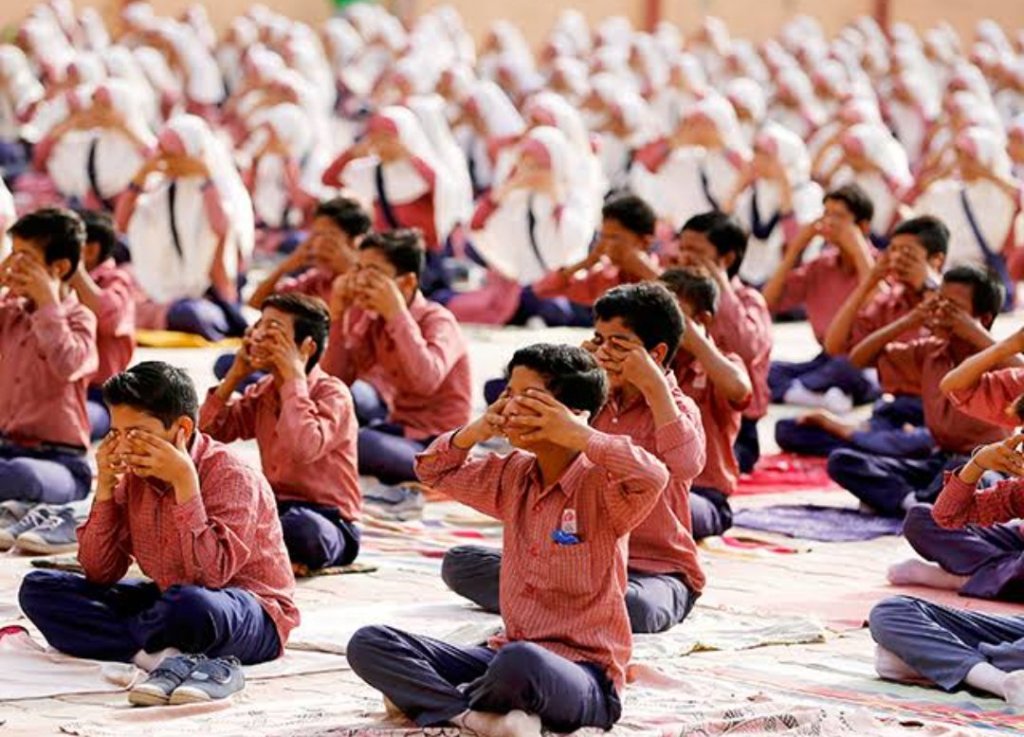
Source: International yoga day
  • Delhi Government launched online yoga classes for Covid 19 patients in home isolation. One hour each from 6am to 11am and 4pm to 7pm named the ” Dilli ki Yogshala”  programme.
  • Yoga on call promoting and facilitating yoga practices.
  • Yoga institutes give their services to transgenders, school children and senior citizens in Mumbai and Delhi.
  • Niti Aayog suggested yoga as a regular activity in schools to encourage healthy choices and behaviors.
  • Government schemes for those who are practicing yoga.
  • By HRD minister yoga training “study in India” program was introduced to enable foreign students to obtain authentic yoga training.
  • Haryana CM maintained a statement “yoga has been included in school curriculum for classes 1 to 10 from 2021” taking yoga to the grassroot level.
  • Many private/paid clubs are already in india.
  • Isha foundation
  • Art & living 
  • Total yoga

International organization

NGOs work overseas to promote yoga and well-being in people.

  • International yoga federation aims to create a world’s yoga community and environment of wellness through yoga.
  • Yoga alliance 
  • World yoga organization
  • International yoga training and healing center (Mauritius)
  • Sampoorna yoga
  • Total yoga program has group yoga classes, corporate wellness workshops, yoga retreats, seminars & events in Singapore, California and Philadelphia.
  • Yoga without Borders in Barcelona working in Palestine, Morocco and Tanzania
  • Art & Living (New Jersey) program teaches free breath meditation and breathing techniques that are helpful in reducing stress and make meditation effortless.
  • Isha foundation & Meditation class – Inner engineering Meetup group free meditation classes, different yoga programs and public events.
  • WHO also considers Yoga as one of the significant processes to protect themselves from coronavirus.
  • UN on International yoga day “yoga is also playing a significant role in psycho Social care and rehabilitation of Covid 19 patients during quarantine and isolation.

Private Research and Development

  • Dept of Ayush of Ministry of Ayush their laboratories come under Government of India R & D programs.
  • Kaivalyadhama established the scientific research Dept leading initiative in yoga recognised in the Institute of scientific research by the scientific & industrial research organization (SIRO) Ministry of science & technology Govt of india. More research on yoga’s impact on various biochemical, physiological and psychological parameters. Yoga effects on cancer, chronic diseases, immune diseases, psychogenic disorders, obesity, diabetes and stress.
  • Post graduate institute of medical education, Tshwane University of Technology and Uttarakhand Ayurved University put a recent development in yoga: A scientific perspective.

State Legislature

There is no uniformity in the creation of State Legislature. Most of the states have unicameral system, only seven states Andhra Pradesh, Bihar, Jammu and Kashmir, Karnataka, Maharashtra, Utar Pradesh, and Telangana are having bicameral system.

Legislative Assembly [Article 170]:- The Legislative Assembly (Vidhan Sabha) consist of not more than 500 members and not less than 60 members. However the Legislative Assembly of Sikkim, Goa, Mizoram, Arunachal Pradesh, Nagaland and Puducherry have less than 60 members.

Legislative Council [Article 171]:- As per Article 169, if the Legislative Assembly passes a resolution for abolition or creating of the Legislative Council by a majority of the total membership of the assembly and by a majority of not less than 2/3rd if the members present and voting, the Parliament may approve the resolution by a simple majority to create or abolish the Legislative Council.

Composition of Legislative Council:- Of the total member of members of a Legislative Council shall consist:

• 1/3rd elected from local bodies

• 1/2th elected by graduates in the states.

• 1/2th elected by teachers of 3 year standing in the state, not lower in standard than secondary school.

• 1/3rd elected by the members of the Legislative Assembly of the state amongst a person who is not a member of the assembly.

• 1/6th are nominated by the Governor from persons of special knowledge, science, art, cooperative movement, and social service.

• 5/6th of the total number of members of the Legislative Council are indirectly elected.

Qualification of members:- Under Article 17, they must fulfill the conditions:

• he must be a citizen of india.

• he must make and subscribe before the person authorized by the Election Commission an oath or affirmation according to the form prescribed in the 3rd Schedule.

• he must be not less than 30 years of age in the case of the Legislative Council and not less than the age of 25 years in the case of the Legislative Assembly.

• he must possess other qualifications prescribed by Parliament, under the Representation of People Act 1951.

Duration of the two House:- Legislative Assembly same as Lok Sabha. And Legislative Council same as of Rajya Sabha.

Presiding Officer of the State Legislature:-

• Speaker/ Deputy Speaker in Legislative Assembly [Article 178].

• Chairman/Deputy Chairman in Legislative Council [Article 182].

Speaker of Legislative Assembly:- Speaker of Assembly is elected by the assembly itself from amongst its members. He can vacate his office earlier in any of the following cases:

• if he ceases to be a member of the assembly;

• if he resigns by writing to be Deputy Speaker; and

• if he is removed by a resolution passed by a majority of all the members of the assembly. Such a resolution can be moved only after providing 14 days of advance notice

Chairman of Legislative Council:- The Chairman is elected by the council itself from amongst its members. The Chairman vacates his office in any of the following cases:

• if he ceases to be a member if the counil.

• if he resigns by writing in his hand to the Deputy Chairman; and

• if he is removed by a resolution passed by a majority of all the members of the coucil.

Powers of the State Legislature:-

• it participates in the election of the President.

• it can remove the Council of Ministers by passing a no- confidence Motion.

• it controls the executive by the various financial committees. It ratified certain Constitutional Amendments, in which participation of half of the State Legislatures is required.

The Comptroller and Auditor- General of India

Another essential office in the Government of India is that of the Comptroller and Auditor- General who controls and checks the financial operation of the entire country [Article 148], at the Union as well as State levels. As observed by Dr. Ambedkar, the Comptroller, and Auditor General of India shall be the most prominent officer under the Constitution of India. For he, is to be the guardian of the public purse and he must look after expenditures out of the Consolidated Fund of India or if a state without the authority of the appropriate Legislature. To discharge his duty properly, his office must be independent of any control of the Executive. The office of the Comptroller and Auditor General, in the Constitution, is substantially modeled upon that of the Auditor General under the Government of India Act, 1935.

Conditions of Service:- The independence of the Comptroller and Auditor General has been protected by the following provisions of the Constitution—

Though appointed by the President, the Comptroller and Auditor General may discard only on the ground of ‘proved misbehavior’ or ‘incapacity’, on an address from both the Houses of the Parliament. He thus excepted from the general rule that all civil servants of the Union hold their office at the pleasure of the President [Article 310(1)].

His salary and conditions of service shall be statuary and shall not be liable to variation to his disadvantages during his term of office. Under this power, Parliament has enacted the Comptroller and Auditor General’s Act 1971, as amended, provides as follows:

(i) The term of office of the Comptroller and Auditor General shall he six years from the date on which he presumes office, but—

• he shall vacate office on attaining the age of 65 years if either than the expiry of the six-year term;

• he may, at any time, resign his office, by writing under his hand, addressed to the President of India;

• he may be removed by impeachment [Article 148, 124(4)].

(ii) His salary shall be equal to that of the Judge of the Supreme Court.

(iii) On retirement, he shall be eligible for an annual pension as per the High Court and Supreme Court Judges.

(iv) In order matters his conditions of service shall be determined by the rules applicable to a member of the IAS, holding the rank of a Secretary of the Government of India.

(v) he shall disqualify for any further Government office after retirement.

(vi) the salaries, etc of the Comptroller and Auditor-General, his staff, and administrative expenses of his office shall be charged upon the Consolidated Fund of India and shall be non-votable [Article 148].

Duties and Powers:- The Comptroller and Auditor General shall perform such duties and exercise such powers about the accounts of the Union and the States as may be prescribed by Parliament. In exercise of this power, Parliament has enacted the Comptroller and Auditor General’s duties, powers, and conditions of services Act, 1971 which relieves him of his pre- Constitution duty to compile the accounts of the Union; and the States may enact similar legislation with the prior approval of the President — to separate accounts from audit at the State level, and to relieve the Comptroller and Auditor General of his responsibility in the matter of preparation of accounts, either of the States of the Union.

Constitutional provisions in education system

Constitutional provision in education

Introduction

India got independence on 15 august 1947 at midnight. There was an urgent need for a constitution to lead the nation. Dr. Rajendra parsad was elected as the president of the constitutional committee. Dr. B. R . Ambedkar was the head of the drafting committee. Our constitution was enacted on 26 november 1949 and enforced on 26 January 1950. It took 2 years 11 month and 18 day to make our constitution. Our constitution has 6 fundamental rights and 20 directive principles in itself.  There were 365 articles and 6 seven fundamental rights initially. 

Our constitution has a preamble. It contains the summary of our whole constitution. 

Constitutional provision: The constitution provision is important for the recognition of access to information as a fundamental right. 

There are many constitutional provisions in the constitution which promote education in India. These constitutional provisions act as security for the people about the access of the rights related to education. There are mainly 11 constitutional provisions.  These articles are 45, 21A, 15(1) (3), 46, 25, 28 (1) (2) (3), 29, 30, 350-A, 351, 239 and  51(A). 

The constitution of India provides free and compulsory education till the age of 14. The 86th amendment of the constitution created the right to education. There would be no discrimintation on the basis of gender (article 15 (1). The constitution also promotes the education for women of weaker sections (46).  Article  21, 28 , 29 and 30 promotes religious education too. Article 51 states that minorities have the right to education. Noone will be discriminated against on the basis of religion, caste , gender or birth place. Article 350-A states that instruction would be in the mother tongue at primary stage. Article 351 promoted Hindi for its development and propagation. 

The government of India provided many provisions to frame a strong structure for the school environment. The aim of these provisions are holistic development of the people of India. The government of India wants to provide inclusive education to all. Many administrations were made for the development and watch out on the education system.  Education is also included in the concurrent list. 

There is a separate ministry for education at centre as well as state level.. The ministry works over the education structure, setting goals and achieving the aims by planning organisation and direction. The ministry of education at centre level directs, controls, and plans for the ministry at state level. The state level ministry works with the guidelines provided by the central government.

The central government also controls the action of private institutions.  The central government shares their funds on education with the state government. There are many pilot projects such as rural education, regional institutions for education and sarva shiksha abhiyan. 

There are three lists in the constitution which are divided as the concurrent, union and states list. The list consists of subjects. Every list has some entity about education. 

The whole constitution promotes education at every level. The preambles, articles and lists promote education at states and union territories level.