Consumer Grievances, National Consumer Helpline appoints five professionals through agency

 It came to the notice of the Central Consumer Protection Authority (CCPA) through National Consumer Helpline (1915-toll free number) that many grievances were lodged relating to non-refund of cancelled air tickets on account of COVID-19 lock down wherein the consumers had alleged that the travel agencies informed them that refunds have not been received from the airlines etc.

The Apex Court in its decision in Pravasi Legal Cell vs Union of India (W.P.(C)D.No.10966 of 2020) dated 01.10.2020 had directed that:

If the tickets have been booked during the lockdown period through a travel agent for a travel within the lockdown period, in all such cases full refund shall be given by the airlines immediately. On such refund, the amount shall be passed on immediately by the agent to the passengers”.

In light of the above, the CCPA initiated suo-moto action against Yatra regarding non refund of airline tickets cancelled due to Covid-19 lockdown.

Show Cause Notice vide dated 09.03.2021 was sent to this travel company regarding pendency of refunds of bookings which got affected in Covid-19. In pursuant to that CCPA conducted several hearings of the Company and closely monitor the progress of refunds made to the consumers.

From July 8, 2021, to June 25, 2024, the CCPA conducted several hearings to address these issues. As a result of these efforts, Yatra Online Limited has made significant progress in reducing the total number of pending refund bookings. In 2021, there were 36,276 pending bookings amounting to ₹26,25,82,484. As of June 21, 2024, this number has been significantly reduced to 4,837 bookings, amounting to ₹2,52,87,098. Yatra has refunded approx 87% amount to consumers and further endeavor to refund approx 13% amount to consumers in order to ensure that all pending refunds are processed promptly and efficiently by airlines.

In 2021, there were total 5,771 bookings pertaining to airlines pending for refunds amounting to ₹9,60,14,463. By 2024, Yatra has reduced the pendency of airlines to 98 bookings with an outstanding amount of ₹31,79,069. CCPA vide order dated 27.06.2024 directed 22 remaining airlines of Yatra to expeditiously refund ₹31,79,069 to consumers.

During the proceedings held before CCPA, several other travel platforms like MakeMyTrip, EaseMyTrip, ClearTrip, Ixigo and Thomas Cook have refunded the entire amount to Consumers whose tickets got affected due to Covid-19 lockdown.

To further facilitate timely processing of refunds to consumers, CCPA issued an order on 27.06.2024 wherein it directed Yatra to set up dedicated arrangements at the National Consumer Helpline (NCH). Specifically, Yatra is required to allocate five exclusive seats at NCH for making calls to the remaining 4,837 passengers informing them that their pending refunds due to COVID-19 lockdown-related flight cancellations will be processed. The costs incurred for engaging these five dedicated personnel will be fully covered by Yatra with payments made directly to the agency managed by NCH.

The CCPA’s order reinforces the importance of timely refunds and Yatra is directed to adhering to this directive to ensure complete resolution for all pending bookings.

****

What is Consumer Protection and Why it is Important?

Consumer Protection

All buyers of goods are consumers. The general public are all consumers of each other. Protecting the interests of consumers is paramount. We will see about consumer protection in this article.

Consumer Welfare

Human life is about living interdependently. Just as a tree does not become a forest, so it is natural for everyone to seek the help of others. The main need to survive is the food we eat. As for the food, its excellent quality, reasonable price and quantity are essential.

It is important to protect the interests of consumers, from ordinary small items to the most expensive luxury items. There is no place for discrimination between low-priced goods, high-priced goods, small goods, large goods, ordinary people and the rich people. Equal price, quality and quantity are one and the same because everyone buys and sells. There is no chance for discrimination. Just as the state has a duty to protect the interests of the consumer, so do traders have a moral duty to uphold it. 

Consumer Awareness

An thought has developed among the rural people, especially the illiterate. The habit of wanting to buy goods is spreading in a sales system where one item is bought and another item is free. This is not the right way. Because no trader does business without profit. That being said it is not acceptable to say it is free.

Is the quality of a product good? Is it good for our health? Is it reasonably priced? Is proper weight followed? Such doubts should come to the mind of a consumer. The welfare of the consumer is properly maintained only when there is awareness among the consumers.

To Prevent Cheating

While taking various creative steps on behalf of the state, it should be fully followed. Must give full cooperation.

When consumers are affected in any way, they need the courage to immediately oppose it. Consumers need to create an organization within themselves and assert their rights. Raising consumer awareness about adulteration and the affordable prices of substandard products can help prevent cheating.  

The protests of the people are increasing day by day. Demand is growing accordingly. At the same time as meeting the needs, it is important to consider that the interests of the consumer are protected.

Advertisement & Consumer Buying Behavior

Image Source: google.com

Advertisement has today become one of the most important aspects of all business and to imagine life without it is almost impossible. Advertising is all over all places, on TV and radio, in newspapers and magazines, on billboards and even plastered across the side of the buses. If an advertisement can really persuade us to buy a product, surely it can be just as effective in persuading us to think in a certain way. Advertising has a great influence on our daily lives whether we are aware or oblivious of it.

Consumer is someone who buys and makes use of a product. Therefore, consumer maintain the production cycle moving in addition to play a crucial position in the economic position of any country, as a result, any country will face crisis if consumers don’t have the effective call for items produced. Consumers call for special commodities is primarily based totally on their taste and choice for them. Consciousness of good affects consumer purchase of that good. Other elements that have an effect on one’s taste and choice for a good are psychological and environmental. Taste and choice for a product change overtime. Thus, advertisements play a role in influencing taste and choice of consumers choice.

Consumer behavior includes what they buy, why they buy it, when they buy it, where they buy it, how often they buy it, how often they use it and how they dispose of it. In other words, consumer behavior is a behavior of individuals in regard to acquiring, using, and disposing of products, services, ideas or experiences.

Advertising has big stimulating impact on shopping behavior of the consumers. Mostly, marketing and marketing is greater powerful on merchandise which have intrinsic features. Qualities aren’t acknowledged on the time of buy and it takes one to find out the features upon the use of the product. And, whilst there may be a full-size danger of differentiating a product, it pleasant fits to put it on the market on that product.

Types Of Consumer Buying Behavior

There are four types of consumers buying behaviour namely, dissonance reducing, habitual, variety seeking and complex buying behaviour.

Dissonance reducing behaviour occurs when the customer finds it difficult to differentiate among the brands. So, consumers may respond primarily to a relatively better price. After the purchase, consumer might experience post purchase dissonance. This is the consumer behaviour displayed mostly by uninformed consumers.

Habitual buying behaviour is a consumer purchase decision whereby the consumers level of involvement is low. So, consumers don’t search much information among the available brands, and they don’t find important differences among the brands and buy the product without a high level of involvement. If the consumer keeps buying the same brand repeatedly, it becomes their habit.

In case of variety seeking buying behaviour the level of consumer involvement is low, but consumer perceive significant differences among the brands. In variety seeking buying behaviour, consumers very often switch from one brand to another. This type of decision is common among consumers who want to stay ahead of the latest fashion trends.

Complex buying behavior can be defined when consumers are highly involved in making a purchase decision. It calls for a high level of involvement on the part of the consumer. In the case of high involvement, consumers distinguish salient differences among the competing brands. Consumers are involved in case of expensive and highly self-expressive products.

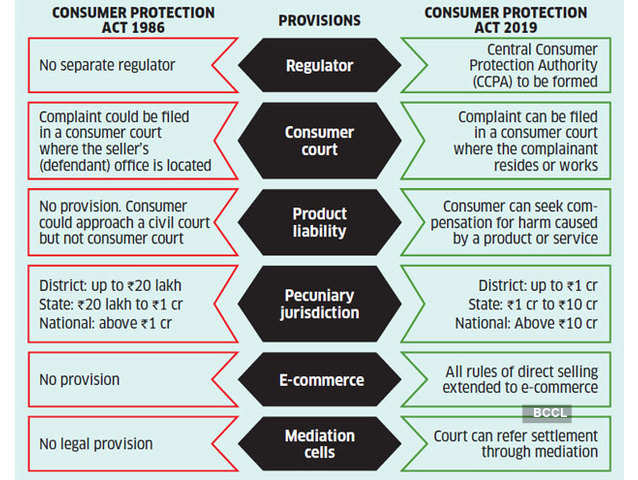
The New Consumer Protection Act,2019 in India is an upper hand and an added advantage for the consumers in manifold ways

The Consumers can now cheer as the Consumer Protection Act, 2019 has recently replaced the three decade old Consumer Protection Act, 1986. The Consumer Protection Act, 2019 which came into effect on Monday (July 20) has replaced the earlier Consumer Protection Act, 1986.

The new Act as per the Experts say that “it gives more power to the consumers”. It seeks to revamp the process of administration and settlement of consumer disputes, with strict penalties, including jail term for adulteration and misleading ads by firms.

On July 20, 2020 certain provisions of the Consumer Protection Act, 2019 came into force as notified by the Central Government. Following the the key features of the relevant provisions:-

Key features of the Consumer Protection Act, 2019 which came into effect on July 20, 2020:-

1) Consumers can now institute a complaint from where they reside or work for gain.

2) The original pecuniary jurisdiction of the District Commissions has increased upto ₹1 crore from ₹20 lakh earlier.

3) The Pecuniary jurisdiction of State Commissions has been increased from ₹1 crore to Rs. 10 crore.

4) The National Commission can hear cases above ₹10 crore when compared to above ₹1 crore earlier.

5) While the provisions relating to e-commerce are not yet notified, a section relating to electronic service provider (covering software services, electronic payments) is notified.

6) The opposite party needs to deposit 50% of the amount ordered by the District Commission before filing an appeal before the State Commission. Earlier, the ceiling was a maximum of ₹25,000, which has been removed.

7) The limitation period for filing of appeals to the State Commission has been increased from 30 days to 45 days.

8) The Parties can be allowed to settle the disputes through mediation.

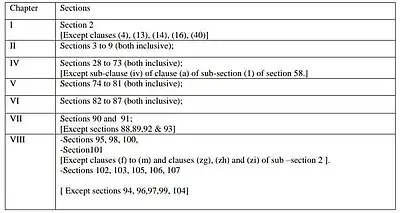
Following are the Sections which came into force:

Consumer Protection Act 2019- Sections to come into force from July 20,2020

Above mentioned provisions pertain to the Consumer Protection Councils, Consumer Disputes Redressal Forum, Mediation, Product Liability, punishment for manufacturing, selling, distributing etc spurious good or products which contain adulterant.

As per the rules, the e-commerce players will have to display the total ‘price’ of goods and services offered for sale along with break-up of other charges. Only a few certain miscellaneous provisions with regards and respect to the powers of the Central and State Government to make the rules and regulations have also been enforced.

On misleading advertisements there is provision for jail term and fine for manufacturers. There is no provision for jail for celebrities but they could be banned for endorsing products if it is found to be misleading.

For the first time there will be an exclusive law dealing with Product Liability. A manufacturer or product service provider or product seller will now be responsible to compensate for an injury or damage caused by the defective product or deficiency in services.

The Act has also defined an “e-commerce” as the buying or selling of goods or services including the digital products over digital or electronic networks. The existing definition of e-commerce has been adopted from India’s FDI Guidelines on e-commerce.

The definition of ‘e-commerce Entity’ as provided under the FDI Guidelines includes inventory and market place models.

There is also a provision for class action law suit for ensuring that rights of consumers are not infringed upon. The authority will have power to impose a penalty on a manufacturer or an endorser of up to 10 lakh rupees and imprisonment for up to two years for a false or misleading advertisement.

WEBSITES REFERRED

1)https://consumeraffairs.nic.in/acts-and-rules/consumer-protection

2)https://www.barandbench.com/news/law-policy/provisions-under-consumer-protection-act-2019-to-come-into-force-on-july-20-2020-centre-notifies

3)https://www.google.com/amp/s/www.thehindu.com/news/national/tamil-nadu/new-consumer-protection-act-gives-more-power-to-consumers-experts-say/article32135908.ece/amp/

4)https://www.google.com/amp/s/www.livemint.com/news/india/consumer-protection-act-rules-for-e-retailers-to-be-effective-by-this-weekend/amp-11595291549084.html

5)https://www.google.com/amp/s/zeenews.india.com/economy/new-consumer-protection-act-2019-comes-into-force-today-know-how-it-will-benefit-you-2297012.html/amp

6)https://www.google.com/amp/s/m.economictimes.com/wealth/spend/heres-how-consumers-will-benefit-under-the-new-consumer-protection-act/amp_articleshow/70711304.cms

7)https://www.google.com/search?q=consumer+protection+act%2C2019&tbm=isch&ved=2ahUKEwjOhv7-sN7qAhVIH3IKHTOCBfMQ2-cCegQIABAC&oq=Consumer&gs_lcp=ChJtb2JpbGUtZ3dzLXdpei1pbWcQARgAMgQIIxAnMgUIABCxAzIFCAAQsQMyBQgAELEDMgUIABCxAzoHCCMQ6gIQJzoCCAA6BwgAELEDEEM6BAgAEENQ0xRYzipg1jBoAnAAeACAAZABiAGHCJIBAzAuOJgBAKABAbABBcABAQ&sclient=mobile-gws-wiz-img&ei=e-QWX47dJsi-yAOzhJaYDw&bih=682&biw=393&prmd=ivn#imgrc=eILduqMFjleJaM

8)https://www.vecteezy.com/free-vector/consumer

9)https://www.google.com/amp/s/www.livelaw.in/amp/news-updates/most-provisions-of-consumer-protection-act-to-come-into-force-160003